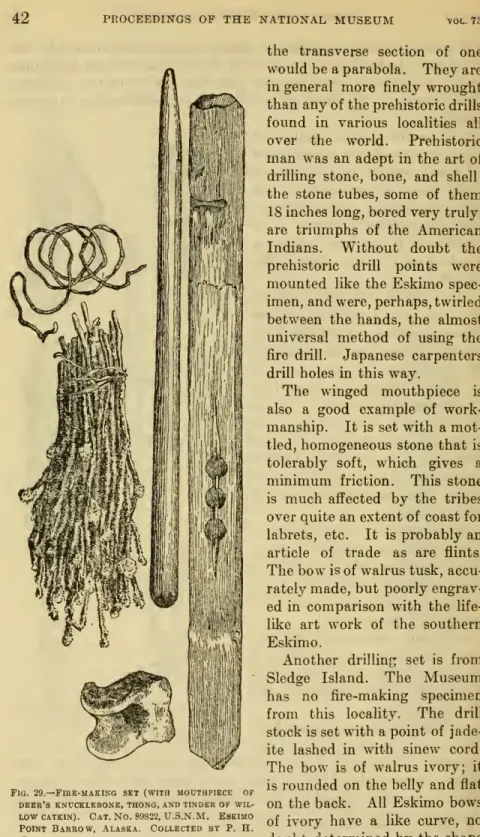
Even when rotating the drill, the hands gradually move to the lower part of the shaft. Twist the string around the drill once, leaving the bow on the right side, place the drill in the hearth socket and install the nut.
12 PROCEEDIN-QS OF THE NATIONAL MUSEUM VOL. 73
ART. 14 FIRE-MAKING APPARATUS HOUGH 13
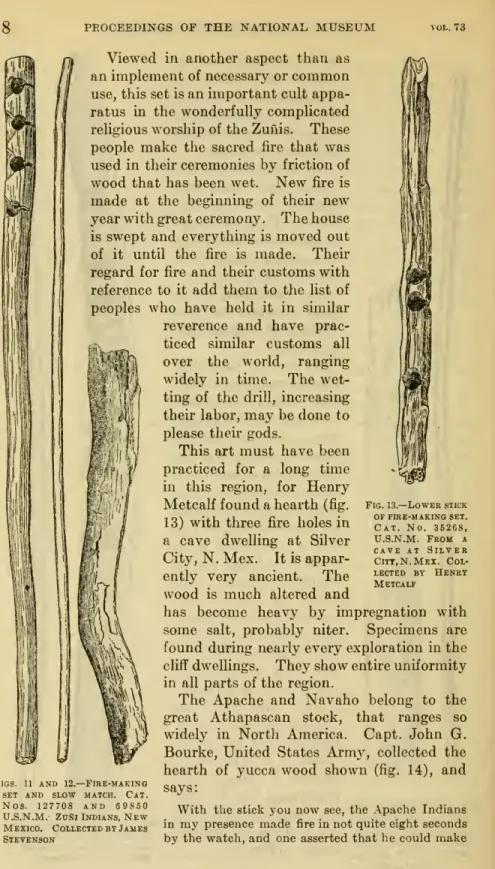
14 PEOCEEDINGS OF THE NATIONAL MUSEUM VOL. 73
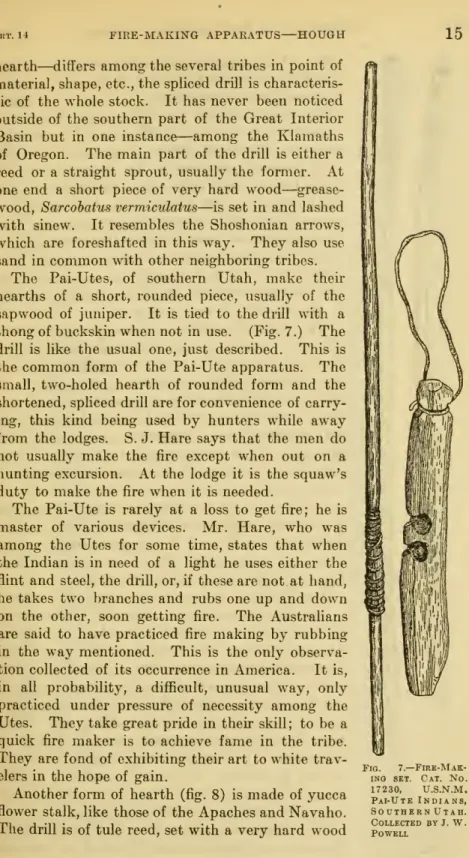
The main part of the drill is either a tube or a straight sprout, usually the former. The Pai-Utes, of southern Utah, make their hearths from a short, rounded piece, usually of juniper sapwood.
16 PROCEEDINGS OF THE NATIONAL MUSEUM VOL. 73
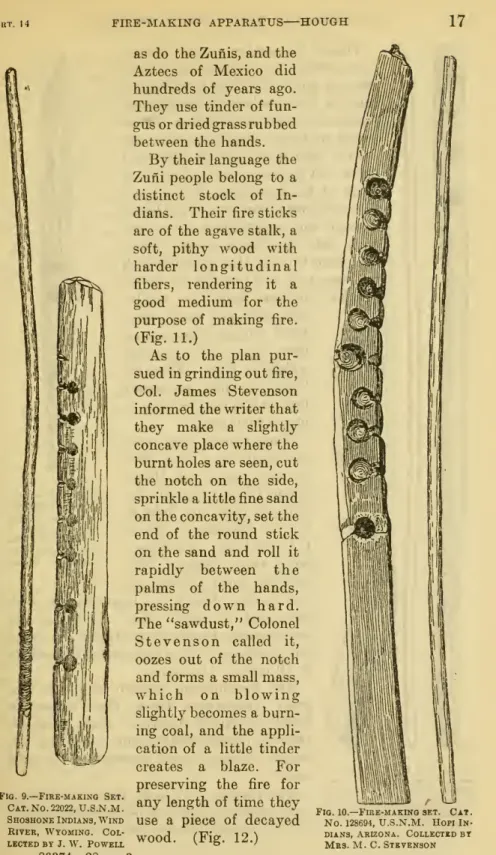
ART. 14 FIKE-MAKING APPARATUS HOUGH 17
18 PKOCEEDINGS OF THE NATIONAL MUSEUM VOL. 73
ART. 14 FIEE-MAKING APPARATUS HOUGH 19
20 PROCEEDINGS OF THE NATIONAL MUSEUM VOL. 73
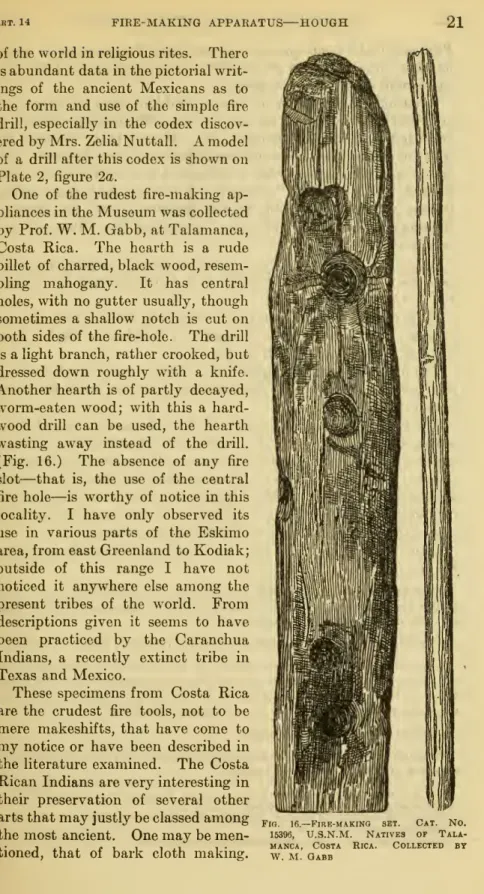
This was oriented, and at the joining of the sticks new fire was made by friction.^^. A bit of the black bark is left at the top end of the drill as decoration.
VHT. 14 FIRE-MAKING APPARATUS HOUGH ' 29
The top of the drill is smoothed by wear against the nut, which was a piece of coconut shell. The apparatus from Pulo Sunalur is larger than the set described above, and the drill is turned with rattan. From the above it will be seen that the edge of islands on the south coast of Sumatra can be characterized as an area in which the cord drill is used.
Harris, United States Army, assembled a focus of fire from the river district to the Rio Grande de Mindanao, P. It is like the Malay exercises of Simahir, Pagi, and Nias, and greatly extends the range of drive exercises in these regions. Felkin,-^ in a study of the Maidu or Moru negroes of Central Africa, 5° N., 30°20' E., describes.
AKT. 14 FIEE-MAKING APPARATUS HOUGH 31
The arrangement of the hearth with a central hole (see Fig. 19) and the hearth with slits and steps (see Fig. 32) is quite striking. The same reason caused Eskimo to drill holes in the middle of the block. The operation of the drill is well described in the oft-quoted description of Sir E. Belcher.
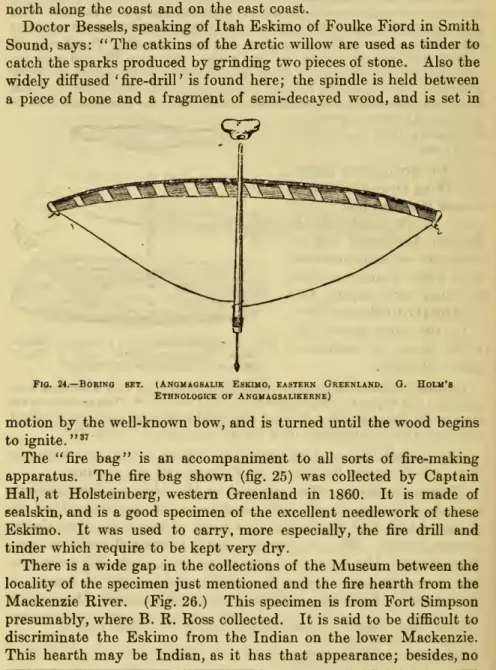
An ethnographic study of Eskimo fire drills begins with Labrador, including Greenland, and follows distribution. Cupped hollows were often seen in the handles of knives and other bone and ivory tools, where they were used for fire drill heads. It was probably this cause, together with the poor supply of food, which made the Eskimos most miserable.
ABT. 14 FIRE-MAKING APPARATUS HOUGH 31 Our knowledge of eastern Greenland has been very much increased
38 PROCEEDINGS OF THE NATIONAL MUSEUM VOL. 73
ACT.14 FIRE-MAKING APPARATUS HOUGH 39 Eskimo hearth yet observed has side holes and slits like this with- Eskimo hearth still observed has side holes and slits like this without steps. The close resemblance of this stick to that of the Washoans of Nevada has been commented upon. It is the custom of those who live in snowy regions to wrap the drill and hearth together very carefully to keep them dry, as these are the essential parts of the apparatus.
In this example, there is a groove cut along the bottom of the hearth to make it easier to securely tie the drill and hearth together.
40 PROCEEDINGS OF THE NATIONAL MUSEUM VOL. 73
The Eskimo further east sometimes use a fish vertebra for the same purpose; one from the Anderson River has this. The small wooden and bone mouthpieces of the Eskimo east of Point Barrow to the Cumberland Gulf appear to be copies of the deer knuckle bone. He mentions that the "women seem to be more accustomed than men to the use of this implement."
He also makes a very interesting observation about the use of the weighted drill among the Chukchi.
42 PROCEEDINGS OF THE NATIONAL MUSEUM VOL. 73
Dr.E.W.Nelson collected at Unalakleet, in Norton Sound, a fire drill and the native names of the parts. This object has apparently been valued by the owner; There are two rows of burn holes in it (fig. 31), one row of which is drilled on the step before the first holes made. Chalitmute, in the Kuskokwim region. on the north side of the bay of that name, opposite the island of Nunivak, is the next eligible place south. parts of this set are exceptionally well finished.
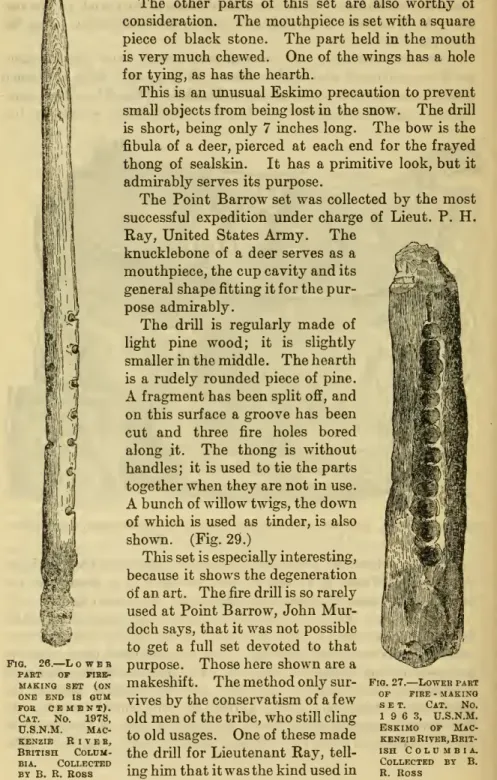
The drill is unusually thick. and there is no evidence that it was ever mouthed. The holes for the drill string are narrow; they must be pierced with a sharp, narrow instrument. Applegate, from the United States Signal Corps, Kassianamute, which village it comes from, is located in the Bristol Bay region, but this set looks different from the previous outfits. is a block of wood that has been worked out at one end.

ART. 14 FIRE-MAKING APPARATUS HOUGH 45
46 PROCEEDINGS OF THE NATIONAL MUSEUM TOL. 73
ART. 14 FIRE-MAKING APPARATUS HOUGH 47
48 PROCEEDINGS OF THE NATIONAL MUSEUM VOL. 73
ABT. 14 PIBE-MAKING APPARATUS HOUGH 49 the true mouthpiece nor any bow has been procured by the Museum
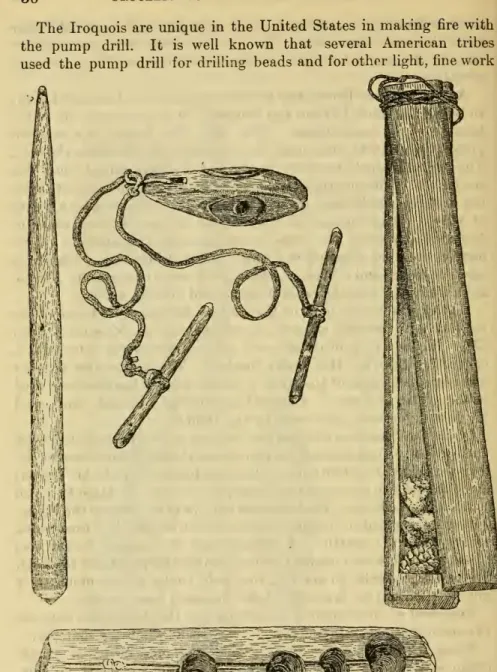
50 PROCEEDINGS OF THE NATIONAL MUSEUM vot.73 The Iroquois are unique in the United States in making fire with the pump drill. It is well known that some American tribes used the pump drill for drilling beads and for light and fine work.
AKT. 14 FIRE-MAKING APPARATUS HOUGH 51 producer and hardly a practical tool for
52 PEOCEEDINGS OF THE NATIONAL MUSEUM VOL. 73 alleged to suggest the way and to repeat the process that would
ART. 14 FIEE-MAKING APPARATUS HOUGH 53
This is allowed to glow, and if it is to be transferred to dry leaves or wood shavings, it is done by means of a tinder made of frayed or worn cock-cloth. The groove (Fig. 39a) is the most characteristic feature of this apparatus, as there appears to be no definite type of tool for this purpose. It is not necessary to cut a slot or even a groove; the hard-wood gum will mold, so that no more apparatus is needed than among the Navahos, where two pieces of yucca stalk are gathered near the fire implements.
No wonder starting a fire this way is difficult for the inexperienced. This is generally the case as thong material is difficult to source in other parts of the world. On his expedition to central New Guinea in collaboration with the Dutch government, Stirling found that fire belts were in use.
ART. 14 FIRE-MAKING APPARATUS HOUGH 55
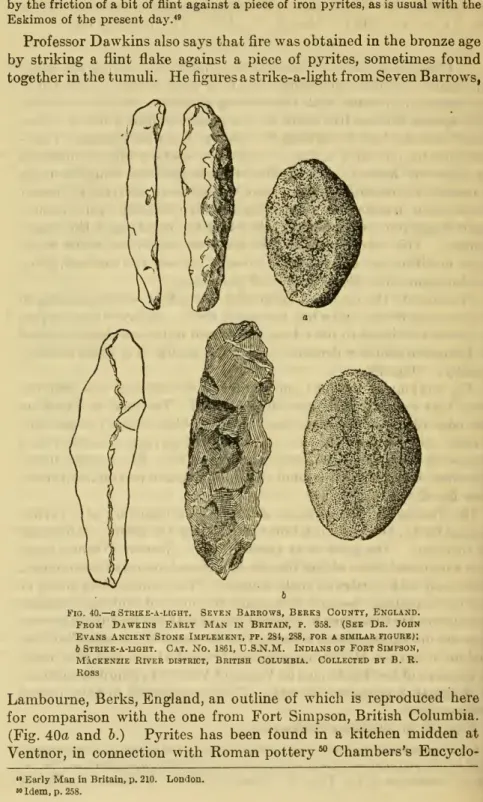
56 PROCEEDINGS OF THE NATIONAL MUSEUM VOL.73 Prehistoriqueen Belgique, secondedition, p. 153), may have acquired a light Prehistoriqueen Belgique, second edition, p. 153), perhaps he got the light. by rubbing the creature against a piece of iron pyrites, as is usual among the Eskimos of to-day.*.
ART. 14 FIRE-MAKING APPARATUS HOUGH 57
58 PROCEEDINGS OP THE NATIONAL MUSEUM VOL. 73
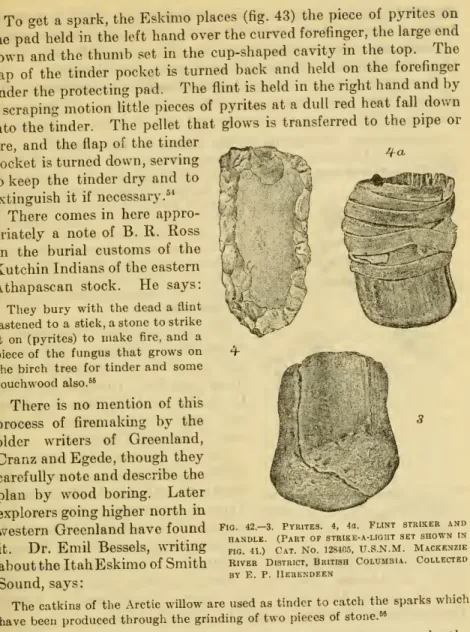
To get a spark, the Eskimo (Fig. 43) places the piece of pyrite on the pad, which is held in the left hand, over the curved forefinger, the large end downwards, and the thumb inserted in the cup-shaped cavity at the top.
60 PROCEEDINGS OF THE NATIONAL MUSEUM VOL. 73
14 FIEE-MAKING APPAEATUS HOUGH 61together by Bancroft,^''was accurate as to the stones used. together by Bancroft,^''was accurate as to the stones used. It is well known that pieces of quartz even when rubbed with sulphur. will not strike a spark of sufficient heat to cause ignition. pieces used must have been pyritic quartz as noted by L. To summarize, the following facts arise from the preceding considerations of the flint and pyrite method:. As far as known, its extent is limited to this area, only one other case that comes to our knowledge, that of the Fuegians.
The museum's archaeological department has a specimen of an iron battle from the early Iron Age in Scandinavia. Many people remember the tinderbox that was taken out. warm corner next to the fireplace when light was needed; the sulphur-dusted matches used to ignite a sea of fire from the glowing tinder are also known to the older generation. There is a suspicion that the existing tinder flint fell directly.
62 PROCEEDINGS OF THE NATIONAL MUSEUM VOL. 73 is a suspicion that the present tinder flint has come down directly
62 PROCEEDINGS OF THE NATIONAL MUSEUM VOL.73 is a presumption that the present tinder flint came directly down. a rope from its shaft with a sharp pull as when it spins on top. flint was pressed against the fast-turning wheel, and a shower of sparks fell into the tin. The tinder gun, as its name suggests. its use, was another device.^^. Other devices were intended to be carried in the pocket and were probably brought about by the introduction of tobacco and the need of smokers for a convenient light. The roll of tinder, or "match," is made from the felt lining of an ant's nest {Polyrachus hispinosus).
The flint is a chipped piece of gray chert, probably an old tool brought from the surface. Here arises one of the confusions of modern intercourse; perhaps both these steels originated from the same commercial center.
64 PROCEEDINGS OF THE NATIONAL MUSEUM VOL. 73
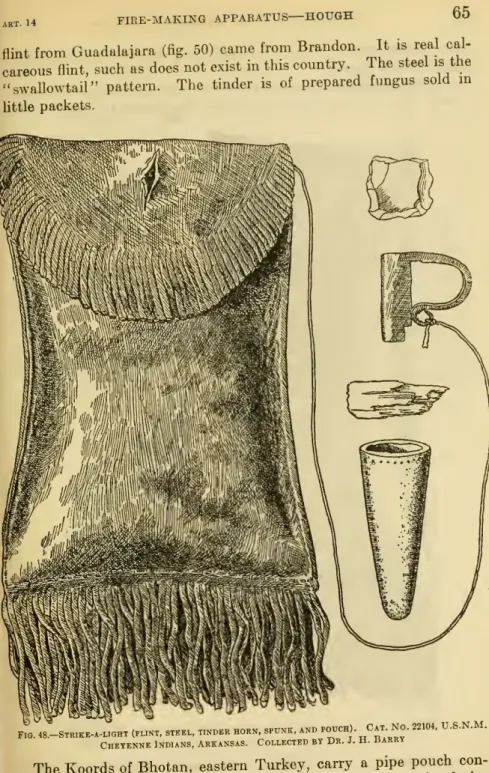
The Koords of Bhotan, in eastern Turkey, carry a pipe-case, in which, in addition to brandy, steel, and steel, there is also a pipe-pick and a pair of tongs to transfer the lighted spot to the pipe. is prepared from a fungus, probably of the polyporus species. 66 PROCEEDINGS OF THE NATIONAL MUSEUM year 73 steel, shaped like an old-fashioned bell pull, is a very good shape to hold in the hand. This is a very imaginative way to combine steel with a. scrotum for storing quartz and needles.
14 HOUGH FIRE APPARATUS 67 The Ainos of Japan use flint and steel to strike a light, this The Ainos of Japan use flint and steel to strike a light, this.
AKT. 14 FIRE-MAKING APPARATUS HOUGH 69
70 PROCEEDINGS OP THE NATIONAL MUSRUM VOL 7:?
ART. 14 FIRE-MAKING APPARATUS HOUGH 71 The specimens are as follows
This is a method used by many tribes of men in Malaysia and appears to be a native invention. It is undoubtedly true that man was forced to become acquainted with thorn-like substances by the behavior of the campfire in the various uses of such material. The collection of rail in the museum is almost exclusively of vegetable matter, but these have in many cases been improved by the addition of charcoal, gunpowder, and nitre.
Animal matter is necessarily rare, and, so far as has been ascertained, consists of bird-down and nest lining spun by the ant {PolyracMs hispinosus), the latter from South America. The vegetable matter used as a trunk is classified as follows: (a) bark, especially the outer spent layers of trees with fibrous bark of the first stage of decomposition; (b) combustible wood shavings; (c) debris from the leaves and around the flowering areas of some plants; (d) downy catkins or downy seed heads that have not flowered; (e) dry leaves, finely ground, or grass treated in the same way; (/) rotten wood, also used for fire-keeping; (g) Mushrooms, whether natural, such as leafy mushrooms, or processed to a usable condition, such as cooking in a solution of potassium nitrate or salt; (h) Incompletely charred cotton or linen fabric or thick, soft cords impregnated with a chemical. The Japanese, as far as is known, are unique in using a mixed rail composed of several of the above-mentioned substances.