Extensive diversification of pebblesnails (Lithoglyphidae:
Fluminicola) in the upper Sacramento River basin, northwestern USA
ROBERT HERSHLERi*, HSIU-PING LIU^ TERRENCE J. FREST^ and EDWARD J. JOHANNES'
^Department of Invertebrate Zoology, Smithsonian Institution, PO Box 37012, NHB W-305, MRC 163, Washington, DC 20013-7012, USA
^Department of Biological Sciences, University of Denver, Denver, CO 80208, USA
""DEIXIS Consultants, 2517 NE 65th Street, Seattle, WA 98115-7125, USA
Received May 2005; accepted for publication February 2006
Mitochondrial DNA sequences from the cytochrome c oxidase subunit I (COI) and cytochrome b (cytb) genes were obtained from the nine extant, previously described species of the northwestern North American freshwater gas- tropod genus Fluminicola (commonly known as pebblesnails) and from a large number of taxonomically undescribed populations of these animals from the upper Sacramento River basin, California and Oregon, which is composed of the Sacramento River headwaters, and the McCloud and Pit Rivers. Phylogenetic analyses of separate and combined molecular datasets yielded well-supported and largely congruent trees delineating 13 genetically divergent and mor- phologically distinctive upper Sacramento basin lineages, which we describe as new species. These include two groups of closely related and geographically proximal species that are further united by unique radular or shell fea- tures. Most of these novelties have narrow geographical distributions and are restricted to headspring areas, whereas several are more wide ranging and typically occupy larger, well-integrated habitats. The highly endemic fauna of upper Sacramento River pebblesnails is not a single species flock, but instead a polyphyletic assemblage spread among four separate clades. Our phylogeny, together with the application of a COI molecular clock for Flu- minicola, suggests that upper Sacramento River clades originated as a result of late Neogene separation of this basin from neighbouring regions (northwestern Great Basin, Klamath River basin), which is consistent with previous bio- geographical hypotheses based on the distributions of fishes. The upper Sacramento River pebblesnails evolved in association with the complex late Cenozoic history of regional landscape and drainage and diversification was also facilitated by the invasion of and adaptation to insular spring habitats. Our findings are consistent with the gen- erally limited dispersal ability and geologically ancient (mid-Tertiary) age of this genus and imply that other portions of northwestern North America may also harbour a large number of undescribed pebblesnail species. Journal compilation © 2007 The Linnean Society of London, Zoological Journal of the Linnean Society, 2007, 149, 371—422.
No claim to original US government works.
ADDITIONAL KEYWORDS: biogeography taxonomy.
freshwater — Gastropoda — mitochondrial DNA — phylogenetics
INTRODUCTION
Aquatic gastropods of the genus Fluminicola (family Lithoglyphidae), commonly known as pebblesnails, are distributed from central California to British Columbia (Hershler & Frest, 1996; Hershler, 1999), ranging from sea level to elevations in excess of 2000 m. Although pebblesnails are locally abundant and easily collected
*Corresponding author. E-mail: [email protected]
in springs, streams, and rivers throughout much of their broad range, they have been little studied and the scope and content of the genus has not been well estab- lished. Hershler & Frest (1996) reviewed Fluminicola and considered nine nominal species, all described prior to 1950, to be distinct. (Two of these have not been collected since their original descriptions and may be extinct; Hershler & Frest, 1996.) They also provided a morphology-based phylogenetic hypothesis in which Fluminicola was depicted as paraphyletic relative to
the eastern North American hthoglyphid genus Somat- ogyrus. Two additional species of Fluminicola were subsequently described by Hershler (1999).
The nine currently recognized extant species oi Flu- minicola are considered to be a small fraction of actual taxonomic diversity in this genus (Hershler & Frest, 1996), which is consistent with what is known of the natural history of the genus. Pebblesnails are gill breathing and have an entirely benthic life cycle. They are restricted to clean, flowing, well-oxygenated waters and are usually confined to hard substrates, suggesting that colonies separated by dry land or reaches of unsuitable aquatic habitat (e.g. soft sediment) may be genetically isolated. Given the wide geographical range and mid-Tertiary age of Fluminicola (Hershler & Frest, 1996) it is reasonable to hypothesize that the genus has undergone extensive diversification leading to the development of a large modern fauna.
A rigorous evaluation of this hypothesis leading to an accurate description of Fluminicola diversity is especially desirable at this time because these snails are currently being incorporated into conservation ini- tiatives in various parts of the Pacific North-west (e.g.
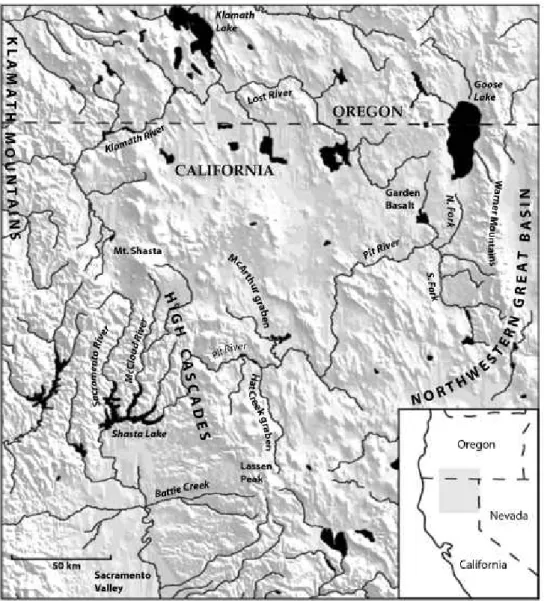
USDA, USDI, 1994). Towards this end, we examined the evolutionary differentiation of pebblesnails in the upper Sacramento River basin, a large (c. 19 830 km^) watershed in north-eastern California and south-east- ern Oregon that traverses two major physiographical regions (Modoc Plateau, High Cascades) (Fig. 1). The upper Sacramento River heads in the vicinity of Mount Shasta and flows south within a narrow gap between the Klamath Mountains and southern High Cascades. Its main tributary, the Pit River, flows west- ward across the Modoc Plateau (volcanic and com- posed of Miocene and younger lava flows; Pease, 1965) and through the Cascades between Mount Shasta and
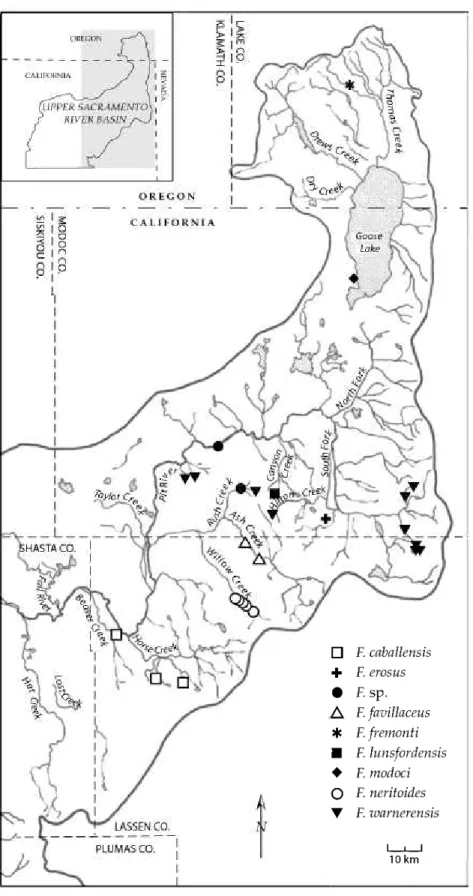
Figure 1. Map showing the upper Sacramento River drainage and other geographical features discussed in the text.
Lassen Peak, where it joins the south-flowing McCloud River just above its connection with the Sac- ramento River (this area of confluence is now impounded behind Shasta Dam). The Pit River head- waters consist of two forks that join in the vicinity of Alturas, California. Goose Lake, which is located in a deep, topographically closed basin in south-east Ore- gon, occasionally overflowed its sill to the North Fork Pit River during the late Quaternary and as recently as 1881 (Phillips & Denburgh, 1971) and thus is con- sidered the uppermost segment of this drainage. The upper Sacramento River basin had a complex late Cenozoic geological history (Pease, 1965; Macdonald, 1966; Page, 1995), which presumably set the stage for extensive local diversification of aquatic biota.
Although only two described pebblesnails live in this basin — F. seminalis (Hinds, 1842), which was histori- cally distributed from the Pit River drainage to near the mouth of the Sacramento River, but is now extinct over much of its range (Taylor, 1981; Hershler & Frest, 1996) and F. modoci Hannibal, 1912, which was described from springs along the margin of Goose Lake (Hershler & Frest, 1996) - the two junior authors discovered many taxonomically unstudied populations during the course of a recent field survey, including representatives of a potentially large num- ber of new species (Frest & Johannes, 1993, 1994, 1995a, 1997).
Previous taxonomic studies of Fluminicola have been based on gross morphology that, aside from one divergent species, F. virens (Lea, 1838), is conservative within the genus (Hershler & Frest, 1996). Molecular evidence may thus be critical to delineating species limits within Fluminicola, especially in studies such as ours that have a relatively narrow geographical focus. Here we generate phylogenetic hypotheses for the upper Sacramento River fauna and all currently recognized extant species oiFluminicola based on par- tial DNA sequences from two mitochondrial genes, cytochrome c oxidase subunit I (COI) and cytochrome b (cytb). Separate and combined analyses of these two mitochondrial datasets congruently depict a large number of distinct pebblesnail lineages within the upper Sacramento River basin, consistent with the previously hypothesized occurrence of substantial undescribed evolutionary diversity. Thirteen of these lineages were found to be diagnosable by differences in morphology and consequently are described as new species. We also use our molecular-based phylogenies to examine the biogeographical history of the upper Sacramento River pebblesnails, and discuss geological and biological factors that may have contributed to the extensive diversification of this fauna. This paper is the second in a series on the systematics of aquatic snails of the upper Sacramento River basin (Hershler et al., 2003).
MATERIAL AND METHODS
SPECIMENS
Samples from the upper Sacramento River basin were relaxed with menthol crystals, fixed in dilute (4%) for- malin, and preserved in 70% ethanol for morphologi- cal study. Brief locality descriptions are provided in the taxonomic section, and are followed by UTM coor- dinates (all from Zone 10) and elevation (in parenthe- ses), the date of collection, and the name(s) of the collector(s). Collector abbreviations are as follows: JC, Julian Colescott; TF, Terrence J. Frest; AH, Amy Hansen; EJ, Edward J. Johannes; JJ, James E.
Johannes; JL, Jacquie S. Lee; SR, Stewart Reid; DS, Donald W. Sada. For additional locality details, see Frest & Johannes (1995a, 1997). The specimens used in this study are deposited at the National Museum of Natural History, Smithsonian Institution (USNM).
Portions of these lots were also catalogued into the col- lections of Deixis Consultants, Seattle, Washington; a list of this material may be obtained from the third author (TJF).
Small subsamples from 82 of the 120 sites in which pebblesnails were found were directly preserved in 90—95% ethanol and utilized for DNA analysis. In order to evaluate the phylogenetic relationships of the upper Sacramento River basin pebblesnails, the nine currently recognized, extant species of Fluminicola — F. coloradensis Morrison, 1940, F dalli (Call, 1884), F. fuscus (Haldeman, 1841), F. insolitus Hershler, 1999, F. modoci, F. seminalis, F. turbiniformis (Tryon, 1865), F. virens, F virginius Hershler, 1999 — were also included in the DNA study.
DNA Laboratory methods
Genomic DNA was extracted from individual snails using a CTAB protocol (Bucklin, 1992). Amplifications were conducted in a 25 |al total volume, containing 5 (0,1 of Invitrogen optimizer buffer F (10 mM MgCl2, pH 9.0) for COI and buffer D (17.5 mM MgCls, pH 8.5) for cytb, 2.5 (il of dNTPs (2.5 mM each), 1.25 |al of each primer (10 |aM), 1 unit Taq polymerase, 1 \A of tem- plate (c. 100 ng double-stranded DNA), and 13.8 ^1 of sterile water. For the COI gene, COIL1490 and COIH2198 (Folmer et al., 1994) were used to amplify a c. 710 bp fragment. For the cytb gene, Cytb424F (5'TGA GGY GCY ACK GTT ATT ACT AA3') and MUcytbR (5'AAN AGA AAR TAY CAY TON GGY TG3') were used to amplify a c. 430 bp fragment. Cytb424F and MUcytbR were designed based on a set of univer- sal cytb primers, UCTYB151F and UCYTB270R (Merritt etal., 1998), and cytb sequences from two gastropods: Littorina saxatilis (GenBank 4165511) and Cepaea nemoralis (GenBank 5835415). Thermal
cycling was performed with an initial denaturation for 2 min at 94 °C, followed by 35 cycles of 1 min at 94 °C, 1 min at the gene-specific annealing temperature, 2 min at 72 °C, with a final extension of 10 min at 72 °C. Annealing temperatures were 45-50 °C for COI, 50 °C for cytb. The amplified polymerase chain reaction product was cleaned using the exonuclease I/shrimp alkaline phosphatase method. Double- stranded DNA templates were incubated at 37 °C for 30 min and then at 85 °C for another 15 min with 5 U exonuclease I and 0.5 U shrimp alkaline phosphatase.
Between 1 and 5 ^1 (c. 10—20 ng) of the cleaned poly- merase chain reaction product was used as a template for cycle sequencing reactions in a 10 |il total volume with the CEQ DTCS Quick Start Kit (Beckman Coulter). The following cycling conditions were used:
96 °C for 2 min, then 35 cycles of 96 °C for 20 s, 45- 50 °C for 20 s, and 60 °C for 4 min. The cycle- sequenced products were purified using an ethanol precipitation method following the Beckman Coulter protocol and separated by electrophoresis using a Beckman Coulter CEQ8000 sequencer. Sequences were determined for both strands and were edited and aligned using SEQUENCHER• 3.1.1 (Gene Codes Corp.).
A survey of sequence variation within several upper Sacramento River samples revealed limited diver- gence ranging from 0 to 0.6% (0-4 bp) for COI and from 0 to 1.7% (0-6 bp) for cytb, e.g. Elk Springs (ten specimens, 0 bp for COI, 0 bp for cytb), site 30 (ten, 0 bp, 0-5 bp), site 65 (ten, 0-3 bp, 0-5 bp), site 68 (five, 0-2 bp, 0-6 bp), site 69 (five, 0-4 bp, 1-6 bp), and site 330 (four, 0—1 bp, 0 bp). On the basis of this limited amount of within-sample haplotype variation, we typ- ically sequenced only two specimens per population and used one sequence from each in the final set of phylogenetic analyses. Sample localities, museum voucher numbers, and GenBank accession numbers for sequenced material are given in Table 1.
PHYLOGENETIC ANALYSIS
Several preliminary sequence analyses were con- ducted prior to the phylogenetic analysis. Base com- positional differences were evaluated with the y^ test.
The partition homogeneity/incongruence length differ- ence test (Farris et al., 1994) implemented in PAUP*4.0blO (Swofford, 2002) was used to determine whether the two datasets were consistent and could be combined for the phylogenetic analysis. The test was conducted using parsimony-informative sites only and 500 replicates. The incongruence length difference test indicated no significant incongruence between COI and cytb (P = 0.1). Because no major incongruence was found, we performed both separate and combined analyses of the two datasets.
MODELTEST (Posada & Crandall, 1998) was used to obtain an appropriate substitution model and parameter values for distance, maximum likelihood (ML), and Bayesian analyses. The TIM + I + G model was selected as the best fit for the COI dataset using the Akaike information criterion (MODELTEST 3.7;
Posada & Crandall, 1998), and the GTR + I + G model was selected for the cytb and combined datasets.
Phylogenetic trees based on distance, parsimony, and ML methods were generated using PAUP*
4.0bl0. A Bayesian analysis using MrBayes 3.04 (Huelsenbeck & Ronquist, 2001) was also performed as another means of estimating phylogeny. GTR dis- tances were used to generate neighbour-joining (NJ) trees based on the clustering method of Saitou & Nei (1987). Node support was assessed by completion of 10 000 bootstrap replications (Felsenstein, 1985) in PAUP using the fast-search option. Maximum parsi- mony (MP) analyses were conducted with equal weighting using the heuristic search option with tree bisection reconnection branch swapping, 100 replica- tions of random stepwise additions, and MAXTREES set to 10 000. Bootstrapping with 10 000 replications (as implemented in PAUP) was used to evaluate node support. ML analyses were based on the GTR + I + G model with empirical base frequencies using the heu- ristic search algorithm. A NJ tree (GTR distances) was used as the initial topology for branch swapping.
Node support was evaluated by 100 bootstrap pseudo-replicates.
Bayesian analyses of the COI, cytb, and combined datasets were also based on the GTR +1 + G model.
Several short runs were first conducted using the default random tree option to determine when the log likelihood sum reached a stable value (by plotting the log likelihood scores of sample points against genera- tion time). For all three datasets, the log likelihood values converged upon a stable state after approxi- mately 50 000 generations. Metropolis-coupled Markov chain Monte Carlo simulations were then run with four chains using the default random tree option for 1 000 000 generations, and Markov chains were sampled at intervals of ten generations to obtain 100 000 sample points. The last 95 000 sampled trees with branch lengths (the first 5000 trees, equal to 50 000 generations, having been removed as 'burn-in') were used to generate a 50% majority rule consensus tree. The percentage of samples that recovered a spe- cific clade on this topology represented the clade's pos- terior probability; these were P-values and P > 95%
was considered evidence of significant support (Huelsenbeck & Ronquist, 2001).
Preliminary COI analyses with European Litho- glyphus naticoides (Pfeiffer, 1828) used as the root consistently depicted F. virens, which is the most morphologically divergent member of the genus
Table 1. Localities, codes, museum voucher numbers (all USNM), and GenBank accession numbers for samples of Flu- minicola used in this study
Species (lineage) Code Locality Voucher COI Cytb
F. fremonti (1) F. fremonti (1) F. warnerensis (2) F. warnerensis (2) F. warnerensis (2) F. warnerensis (2) F. warnerensis (2) F. warnerensis (2) F. warnerensis (2) F. lunsfordensis (3) F. lunsfordensis (3) F. erosus (4) F. erosus (4) F. erosus (4) F. erosus (4) F. erosus (4) F. favillaceus (5) F. favillaceus (5) F. favillaceus (5) F. favillaceus (5) F. caballensis (6) F. caballensis (6) F. caballensis (6) i^ caballensis (6) i^ caballensis (6) i^ neritoides (7) i^ neritoides (7) i^ neritoides (7) i^ ahjuraawi (8) i^ ahjuraawi (8) i^ ahjuraawi (8) i^ ahjuraawi (8) i^ ahjuraawi (8) i^ ahjuraawi (8) i^ ahjuraawi (8) i^ ahjuraawi (8) i^ ahjuraawi (8) i^ ahjuraawi (8)
D45aA Hunters Spring, Lake Co., OR 1020662 AY962931 AY963038 D45aB Hunters Spring, Lake Co., OR 1020662 AY962932 AY963039 F13 210B Spring creek east of Blue Lake, Modoc Co., CA 1020655 AY962995 AY963101 F13 217A Parsnip Spring, Modoc Co., CA 1020653 AY962996 AY963102 F13 351B Soup Spring, Modoc Co., CA 1020654 AY962997 AY963103 SP360A Springs south-east ofHilton, Modoc Co., CA 1020657 AY962999 AY963105 FSP387F Springs east of Miller Gulch, Modoc Co., CA 1020790 AY962998 AY963104 SP388A Miller Spring run, Modoc Co., CA 1020659 AY963000 AY963106 F10 482A Rush Creek (source), Modoc Co., CA 1020658 AY962994 AY963100 F359A Lunsford Spring, Modoc Co., CA 1020689 AY962935 AY963041 F359B Lunsford Spring, Modoc Co., CA 1020689 AY962936 AY963042 F11200B Smokey Charlie Spring, Modoc Co., CA 1020667 AY962918 AY963025 F12 200E Smokey Charlie Spring, Modoc Co., CA 1020667 AY962920 AY963027 F10 202E Spring south-east of Smokey Charley Spring, 1020664 AY962917 AY963024
Modoc Co., CA
F11202A Spring south-east of Smokey Charley Spring, 1020664 AY962919 AY963026 Modoc Co., CA
F12 202A Spring south-east of Smokey Charley Spring, 1020664 AY962921 AY963028 Modoc Co., CA
SP364B Ash Creek at north culvert, Lassen Co., CA 1020672 AY962927 AY963034 SP487A Ash Creek above FS39N50 bridge, Lassen Co., 1020673 AY962928 AY963035
CA
SP509A Chisolm Spring, Lassen Co., CA 1020674 AY962929 AY963036 SP510A Ash Creek, south culvert at Ash Valley Road 1020669 AY962930 AY963037
crossing, Lassen Co., CA
SP400A Bob Creek, Lassen Co., CA 1020678 AY962910 AY963017 FSP401A Davis Creek, Lassen Co., CA 1020677 AY962911 AY963018 SP402A Russell Dairy Spring, Lassen Co., CA 1020679 AY962912 AY963019 SP403B Spring run west ofRussell Dairy Spring, Lassen 1020680 AY962913 AY963020
Co., CA
SP404A Second spring west of Russell Dairy Spring, 1020681 AY962914 AY963021 Lassen Co., CA
F9 369B Willow Creek at mouth of Hayden Canyon, 1020685 AY962953 AY963059 Lassen Co., CA
F9 371A Willow Creek at lower end of Lower McBride 1020686 AY962954 AY963060 Springs, Lassen Co., CA
F9 372A Willow Creek west ofHayden Hill, Lassen Co., 1020687 AY962955 AY963061 CA
sem93C Lost Creek (middle site), Shasta Co., CA 1020704 AY962894 AY963001 F10116B Hat Creek at Bridge Picnic Area, Shasta Co., CA 1020693 AY962895 AY963002 F10164A Three springs on point opposite large island in 1020695 AY962896 AY963003
Pit River, Shasta Co., CA
F10 195C Spring run near Pit River Hatchery, Shasta Co., 1020697 AY962897 AY963004 CA
sem340A Honn Creek, Shasta Co., CA 1020698 AY962898 AY963005 F10 344B Spring run north of Sam Wolfin Spring, Shasta 1020699 AY962899 AY963006
Co., CA
FSP345E Upper Sucker Springs Creek, Shasta Co., CA 1020791 AY962900 AY963007 sem347B Spring west of Thousand Spring run, Shasta 1020692 AY962901 AY963008
Co., CA
sem349A West spring source of Mallard Creek, Shasta 1020700 AY962902 AY963009 Co., CA
F10 405A Beaver Creek, Lassen Co., CA 1020701 AY962903 AY963010
Table 1. Continued
Species (lineage) Code Locality Voucher COI Cytb
^. ahjumawi (8) sem408C
<; ahjumawi (8) SP476B
^. ahjumawi (8) Fsem535A
<! ahjum,awi (8) Fsem536A
<! um,bilicatus (9) F8 92A
<! um,bilicatus (9) F8 93B
<! um,bilicatus (9) F7 99A
<! um,bilicatus (9) F7 338A
<; umbilicatus (9) F8 536A
<; anserinus (10) F6 40B
<; anserinus (10) F15 270B i^ anserinus (10) F6 321A
<; anserinus (10) SP395A i". potemicus (11) F2 36A K potemicus (11) F2 36B
<! scopulinus (12) F14 251B
<! scopulinus (12) F14 303B
<! multifarius (13) SP8B
^ multifarius (13) F2 lOB
^ multifarius (13) Fl 12B
^ multifarius (13) F6 27B i: multifarius (13) F4 30A
^ multifarius (13) F5 30A
<! multifarius (13) F3 65A
<! multifarius (13) F4 65A
<! multifarius (13) F5 65A
^ multifarius (13) FSP65F
^ multifarius (13) F4 68A
^ multifarius (13) F3 69A
^ multifarius (13) FIO 99B
<! multifarius (13) Fl 140A
<! multifarius (13) F2 143A
<! multifarius (13) F2 144A
^ multifarius (13) SP237A
^ multifarius (13) SP238B
^ multifarius (13) FIO 239B
<! multifarius (13) SP241A
Burney Creek, upstream of Burney Falls, Shasta Co., CA
Jimmerson Spring, Modoc Co., CA
Lost Creek near source spring, Shasta Co., CA Lost Creek (uppermost site), Shasta Co., CA Lost Creek (lowermost site), Shasta Co., CA Lost Creek (middle site), Shasta Co., CA Big Spring, tributary of Hat Creek, Shasta Co.,
CA
Hat Creek at Hat Creek Resort, Shasta Co., CA Lost Creek (uppermost site), Shasta Co., CA Spring near Chalk Mountain, Shasta Co., CA Spring, Goose Valley, Shasta Co., CA
Blackberry Creek, Shasta Co., CA Rim of the Lake Spring, Shasta Co., CA Spring near Potem Creek, Shasta Co., CA Spring near Potem Creek, Shasta Co., CA Northern-most spring south-west of Popcorn
Spring, Shasta Co., CA
Northern-most spring west of Popcorn Spring, Shasta Co., CA
Spring near Conant, Siskiyou Co., CA Ney Springs, Siskiyou Co., CA
Sacramento River near Stink Creek, Siskiyou Co., CA
Crystal Spring, Siskiyou Co, CA Rock Spring, Siskiyou Co., CA Rock Spring, Siskiyou Co., CA
Southern-most of Shasta Springs, Shasta Co., CA
Southern-most of Shasta Springs, Shasta Co., CA
Southern-most of Shasta Springs, Shasta Co., CA
Southern-most of Shasta Springs, Shasta Co., CA
Spring north of Mossbrae Falls, Shasta Co., CA Spring runs north of Mossbrae Falls, Shasta Co.,
CA
Big Springs (source), north-west of city of Mount Shasta, Shasta Co., CA
Sacramento River at Cave Springs, Siskiyou Co., CA
Spring along Sacramento River (third to the) east of Cantara Bend, Siskiyou Co., CA Spring along Sacramento River (first to the)
east of Cantara Bend, Siskiyou Co., CA Big Springs, three middle runs, Siskiyou Co.,
CA
Big Springs, western-most run, Siskiyou Co., CA
Big Springs, eastern-most run, Siskiyou Co., CA Big Springs at west side of park, Siskiyou Co.,
CA
1020702 AY962904 AY963011 1020703
1020797 1020798 1020710 1020711 1020707 1020716 1020799 1020735 1020729 1020733 1020730 1020720 1020720 1020723
1020772 1020757 1020760 1020774 1020777 1020778 1020781 1020780 1020782 1020792 1020783 1020785 1020755 1020786 1020762 1020764 1020765 1020767 1020768 1020769
AY962905 AY962906 AY962907 AY962987 AY962988 AY962989 AY962990 AY962991 AY962984 AY962908 AY962985 AY962909 AY962956 AY962957 AY962958
AY962939 AY962975 AY962976 AY962940 AY962941 AY962942 AY962943 AY962944 AY962945 AY962946 AY962947 AY962948 AY962977 AY962949 AY962978 AY962979 AY962980 AY962981 AY962982 AY962983
AY963012 AY963013 AY963014 AY963093 AY963094 AY963095 AY963096 AY963097 AY963090 AY963015 AY963091 AY963016 AY963062 AY963063 AY963064 1020726 AY962959 AY963065 AY963045 AY963081 AY963082 AY963046 AY963047 AY963048 AY963049 AY963050 AY963051 AY963052 AY963053 AY963054 AY963083 AY963055 AY963084 AY963085 AY963086 AY963087 AY963088 AY963089
Table 1. Continued
Species (lineage) Code Locality Voucher COI Cytb F. multifarius (13)
F. multifarius (13) F. multifarius (13) Fluminicola sp. (A) Fluminicola sp. (B) Fluminicola sp. (A) Fluminicola sp. (A) Fluminicola sp. (B) F. coloradensis F. dalli
FIO 322B F3 330A ELKSPB SP113A SP373A SP373B F2SP373A F2SP373E
F. fuscus -
F. insolitus -
F. modoci -
F. cf. modoci - F seminalis sem98B F seminalis seml04B F seminalis semlOSA F seminalis sem329A F seminalis D38A F. seminalis sem364A F. seminalis SP366B F. seminalis sem411A F. seminalis sem416A F seminalis sem425A F seminalis sem426A F seminalis sem487A F. seminalis Fsem532A F. seminalis Fsem546A F. seminalis Fsem552A F. turbiniformis -
F virens -
F Virginias —
Bundoora Spring, Siskiyou Co., CA
Spring run north of Crystal Spring, Siskiyou Co., CA
Elk Spring (lowermost), Siskiyou Co., CA Springs west of Canby, Modoc Co., CA Spring at west end of Upper Rush Creek
Campground, Modoc Co., CA
Spring at west end of Upper Rush Creek Campground, Modoc Co., CA
Spring at west end of Upper Rush Creek Campground, Modoc Co., CA
Spring at west end of Upper Rush Creek Campground, Modoc Co., CA
Green River above Warren Bridge, Sublette Co., WY
Spring west of Thunderbolt Bay, Washoe Co., NV
Grande Ronde River, Asotin Co., WA Page Springs, Harney Co., OR
Spring at Three Springs Ranch, Modoc Co., CA Link River at Klamath Falls bridge, Klamath
Co., OR
Big Lake outlet near Rat Farm, Shasta Co., CA Baum Lake (deep-water site), Shasta Co., CA Fall River at Caltrout Public Fishing Access
Area, Shasta Co., CA
Baum Lake (shallow-water site), Shasta Co., CA Battle Creek east of Coleman Fish Hatchery,
Shasta Co., CA
Ash Creek at north culvert, Lassen Co., CA Ash Creek north-west of Ash Creek
Campground, Lassen Co., CA Crystal Springs, Shasta Co., CA Big Lake Springs, Shasta Co., CA
Pit River near confluence of Hat Creek, Shasta Co., CA
Spring Creek on south side of Spring Creek Road, Shasta Co., CA
Ash Creek above FS39N50 bridge, Lassen Co., CA
Lava Creek at boathouse on Hanna Estate, Shasta Co., CA
Spring on west side of Spring Creek, Shasta Co., CA
Lava Creek source spring pool, Shasta Co., CA Roaring Springs, Harney Co., OR
Willamette River at Canby Ferry, Clackamas Co., OR
Hardscrabble Creek, Washoe Co., NV
1020771 AY962950 AY963056 1020788 AY962951 AY963057 1020801 AY962952 AY963058 1020796 AY962922 AY963029 1020793 AY962923 AY963030 1020793 AY962924 AY963031 1020793 AY962925 AY963032 1020793 AY962926 AY963033 905307 AY962915 AY963022 1009519 AY962916 AY963023 1082059 DQ372901 DQ3 72902 863507 AY962934 AY963040 1009518 AY962938 AY963044 1020714 AY962937 AY963043 1020736 AY962960 AY963066 1020737 AY962961 AY963067 1020783 AY962962 AY963068 1020739 AY962963 AY963069 1020740 AY962964 AY963070 1020741 AY962965 AY963071 1020742 AY962966 AY963072 1020743 AY962967 AY963073 1020744 AY962968 AY963074 1020746 AY962969 AY963075 1020747 AY962970 AY963076 1020748 AY962971 AY963077 1020749 AY962972 AY963078 1020751 AY962973 AY963079 1020752 AY962974 AY963080 883506 AY962986 AY963092 1020713 AY962992 AY963098 1004474 AY962993 AY963099 COI, cytochrome c oxidase subunit I; cytb, cytochrome b.
(Hershler & Frest, 1996), as basally positioned rela- tive to other congeners. Because we do not have cytb sequences for L. naticoides or representatives of other hthoglyphid genera, we used divergent F. virens as the root in our final analyses.
Pairwise sequence divergence and mean genetic dis- tances were calculated using MEGA version 3.0 (Kumar, Tamura & Nei, 2004). In order to estimate divergence times of lineages, we calibrated a molecu- lar clock for Fluminicola based on the divergence of F. virginius, which is endemic to a spring in the Vir- ginia Mountains c. 800 m above Pyramid Lake (Her- shler, 1999). Recent geological studies suggest that in this portion of Nevada, faulting that began approxi- mately 3.0 Ma resulted in the production of the present-day basin and range landscape (Trexler et al., 2000; Henry & Perkins, 2001; Henry, Faulds & dePolo, 2006). Using this estimate of the inception of range uplift and the 5.78 ± 0.83% COI divergence of F. virginius relative to its sister species, F. dalli (see below), a clock rate of 1.93 ± 0.28% per million years is implied. This rate, which should be considered a max- imum estimate as divergence of these two species could have taken place prior to range uplift, closely approximates the 1.83 ± 0.21% per million years COI divergence that was previously derived for European hydrobiid snails (Wilke, 2003).
MORPHOLOGY AND TAXONOMY
The methods used for the morphological study were generally those of Hershler (1998). Counts and mea- surements (in mm) of the following parameters were obtained for the holotype and up to 31 paratypes of each new species and are summarized in Tables 3—15:
total shell whorls (WH), shell height (SH), shell width (SW), height of body whorl (HBW), width of body whorl (WBW), aperture height (AH), aperture width (AW). For paratypes, the parameters listed are the mean (above) and the range of values (below). Shell data were analysed using SYSTAT 10.2.01. ^tests were utilized in some instances to facilitate shell com- parisons between closely related species and were based on paratype data (unless otherwise indicated) provided in the systematics section. The study of shells, opercula, and radulae using a scanning elec- tron microscope was generally restricted to specimens from the type series of each new species. Radular tooth cusp counts were obtained from five specimens from each sample studied. For each specimen, cusp counts for each tooth type (on both sides of the tooth row) were obtained from single tooth rows near the ante- rior, middle, and posterior portion of the radular rib- bon, thereby providing a consistent and relatively detailed survey of variation in cusp number. Snail anatomy was studied in dissection for five to ten spec-
imens of each sex of each new species, again generally from the type series only. Although the focus was on reproductive characters that were previously shown to constitute the main source of anatomical variation within the genus (Hershler & Frest, 1996), other fea- tures were also examined. Morphological terminology follows that of Hershler & Frest (1996) and Hershler
& Ponder (1998).
In order to resolve the taxonomy of these morpho- logically conservative snails, we used sequence data to identify populations or groups of populations that are phylogenetically independent and substantially diver- gent. Our methodology closely followed that utilized by Garcia-Paris & Wake (2000). In those cases in which such lineages were also found to be diagnosable based on morphology, we describe them as new spe- cies. In other cases in which lineages appear to be mor- phologically cryptic, we chose not to describe these as new species as we believe that additional research is needed to confidently assess their evolutionary and taxonomic status. Nonetheless, we acknowledge that several of the pebblesnails described herein may ulti- mately merit subdivision into multiple taxonomic units that can be diagnosed on the basis of molecular data {fide Bond & Sierwald, 2003). Common names are proposed for each new species. Most of the species treated herein have a lengthy record of mention (infor- mally as 'n. sp.' or 'new species') in agency and con- sulting reports. A detailed compilation of these citations may be obtained from the third author (TJF).
For the sake of brevity, herein we only cite (in the 'Remarks' sections) the upper Sacramento River field survey reports in which these snails were first noted.
RESULTS
The alignment of COI sequences yielded 658 bp, of which 224 sites were variable (34.0%) and 188 were parsimony informative (28.57%). Average base fre- quencies for COI were 27.5% A, 34.1% T, 19.7% C, and 18.7% G. Base frequencies were homogeneous across all sites (x^ = 36.54, d.f = 318, P = 1.0). For cytb, 361 bp were sequenced, of which 161 were variable (44.6%) and 132 were parsimony informative (35.6%).
Average base frequencies for cytb were 30.0% A, 36.3%
T, 20.4% C, and 14.3% G. Base frequencies were homo- geneous across all sites {y^ = 56.46, d.f = 318, P = 1.0).
Pairwise sequence divergence (uncorrected p dis- tance) among the currently recognized species of peb- blesnails ranged from 4.1 to 18.8% (COI) and 4.4 to 25.7% (cytb). F. virens, which was previously shown to be morphologically divergent relative to other conge- ners (Hershler & Frest, 1996), had the highest levels of sequence divergence, ranging from 17.3 to 18.8%
(COI) and 19.1 to 25.6% (cytb). The two previously described species that live in the upper Sacramento
River basin, F. modoci and F. seminalis, were among the least divergent pairs of congeners (5.0—6.1% COI;
6.4-8.0% cytb).
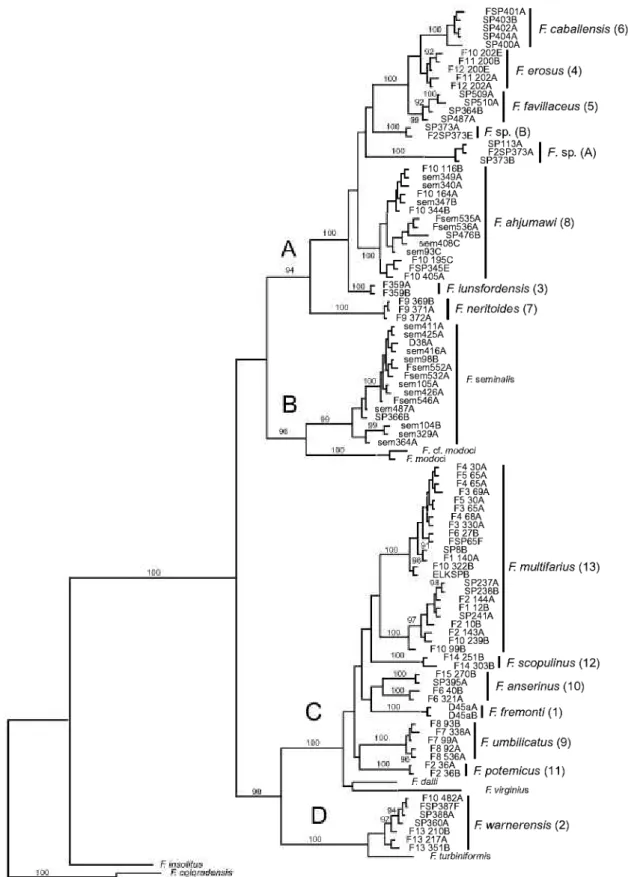
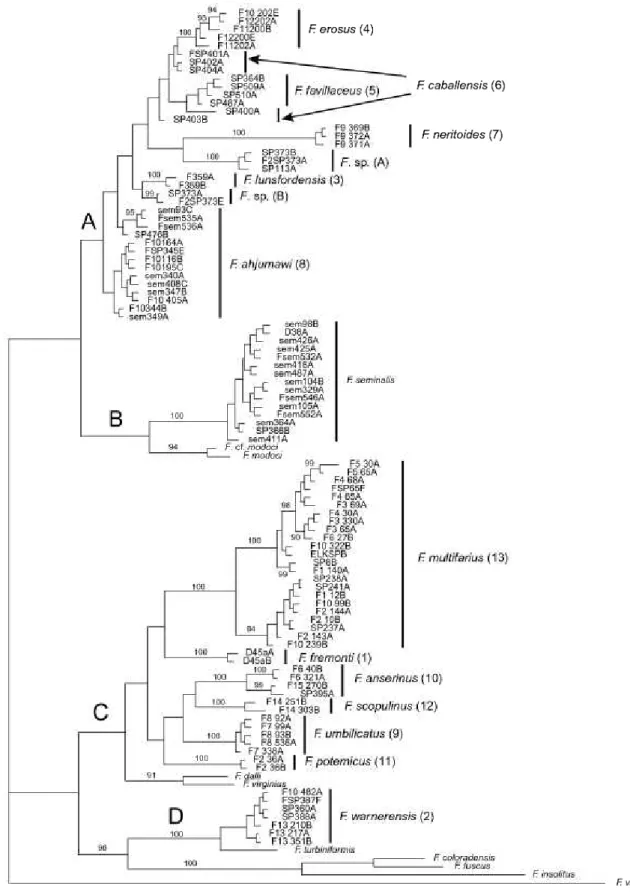
Separate and combined NJ, MP, ML, and Bayesian analyses were highly concordant and thus only repre- sentative (Bayesian) trees for COI, cytb, and the com- bined dataset are illustrated (Figs 2^, respectively).
The resulting trees were well structured and delin- eated 13 genetically differentiated (sequence diver-
gence > 2% for both genes in most cases) and morphologically distinctive upper Sacramento River lineages (Figs 2—4:1—13) that do not correspond to pre- viously described species. The mean pairwise sequence divergence within and among these lineages and boot- strap support values (for ML, MP, and NJ analyses) are summarized in Table 2. Lineages 10 and 13 had weak bootstrap support values of < 50% (Table 2) and a Bayesian posterior probability of < 73% in the COI Table 2. Ranges of pairwise mean sequence divergence values among species (lineage number in parentheses), with mean values within species + standard deviation given below in parentheses. Bootstrap support values are from the maximum likelihood, neighbour-joining, and maximum parsimony analyses, respectively
Species (lineage) N COI divergence Support cytb Divergence Support Combined Support F. fremonti (1) 2 3.7-17.0%
(0.0 + 0.0%)
100/100/100 5.7-21.2%
(0.3 + 0.3%)
99/100/100 100/100/100 F. warnerensis (2) 7 2.52-18.45%
(0.3 + 0.2%)
55/91/88 3.7-21.1%
(0.1+0.1%)
*/99/96 81/100/99 F lunsfordensis (3) 2 2.2-17.0%
(0.0 + 0.0%)
100/100/98 2.6-19.4%
(0.3 + 0.3%)
93/97/95 100/100/100 F erosus (4) 5 1.6-17.6%
(0.3 + 0.1%)
57/92/65 1.8-21.1%
(0.7 + 0.3%)
94/91/91 99/100/98 F favillaceus (5) 4 1.4-17.1%
(0.4 + 0.2%)
89/76/86 1.6-19.5%
(0.3 + 0.2%)
57/61/* 94/98/95 F. caballensis (6) 5 1.6-17.7%
(0.3+0.1%)
97/90/98 1.6-20.1%
(1.0 + 0.3%)
#/#/# 92/84/87 F. neritoides (7) 3 4.9-17.6%
(0.0 + 0.0%)
99/100/100 7.9-20.8%
(0.0 + 0.0%)
100/100/100 100/100/100 F. ahjumawi (8) 14 2.2-16.9%
(0.5 + 0.2%)
86/96/87 2.3-20.1%
(0.5 + 0.2%)
#/*/# 93/98/90 F umbilicatus (9) 5 3.6-16.7%
(0.2 + 0.1%)
97/100/100 5.3-21.3%
(0.0 + 0.0%)
96/100/100 98/100/100 F anserinus (10) 4 3.4-17.6%
(1.8 + 0.5%)
*/*/* 5.7-21.1%
(1.8 + 0.4%)
96/100/99 98/100/99 F potemicus (11) 2 3.6-17.8%
(0.0 + 0.0%)
99/100/100 5.5-21.6%
(0.0 + 0.0%)
100/100/100 100/100/100 F. scopulinus (12) 2 4.0-17.6%
(0.5 + 0.3%)
99/100/100 5.3-21.2%
(1.1 + 0.5%)
90/100/98 93/100/100 F. multifarius (13) 23 3.4-17.4%
(1.4 + 0.3%)
*/*/51 7.6-23.0%
(2.4 + 0.5%)
95/88/92 93/94/97
F. coloradensis 1 4.1-17.8% - 5.9-25.7% - -
F dalli 1 3.8-17.5% - 4.4-20.6% - -
F fuscus 1 4.1-18.1% - 5.9-25.5% - -
F insolitus 1 9.1-17.5% - 13.3-23.3% - -
F modoci 2' 5.6-17.6%
(0.9 + 0.4%)
98/100/100 6.7-19.4%
(1.1+0.5%)
84/100/99 99/100/100 F seminalis 15 5.6-18.7%
(0.6 + 0.2%)
70/100/100 6.8-21.1%
(0.3+0.1%)
79/100/100 88/100/100
F. turbiniform,is 1 2.5-17.5% - 3.7-21.9% - -
F. virginius 1 5.5-18.2% - 4.4-18.8% - -
F. virens 1 16.7-18.7% - 18.8-25.7% - -
COI, cytochrome c oxidase subunit I; cytb, cytochrome b.
N = number of sequenced specimens used in the phylogenetic analyses.
*< 50% support; #nonmonophyletic.
^Includes F. cf. m.odoci specimen.
FSP401A SP403B SP402A SP404A SP400A F10 202E
"11 200B 200E 11 202A 2 202A SP509A I
SP510A SP364B SP487A I SP373A I p__ ,a,\
F2SP373E I ^ Sp. (b) _r SP113A
1?
F. caballensis (6)
F. erosus (4) F favillaceus (5)
F lunsfordensis (3) I F neritoides (7)
F. seminalis j- F10 116B
Jl- sem349A p— sem340A Ir F10 164A rP- sem347B L F10 344B
Fsem535A Fsem536A SP476B m408C sem93C I- F10 195C JT- FSP345E T- F10 405A
F359A F359B
F9 369B F9 371A F9 372A j- sem411A n- sem425A U D38A T- sem416A
r sem98B n- Fsem552A 1- Fsem532A
semlOSA sem426A Fsem546A sem487A SP366B
sem104B sem329A sem364A
J F. cf. modoci 1- F. modoci
1- F4 30A jL F5 65A t\r F4 65A H- F3 69A
\l F5 30A T- F3 65A F4 68A F3 330A F6 27B FSP65F SP8B F1 140A F10 322B ELKSPB
SP237A SP238B F2 144A F1 12B SP241A F2 10B F2 143 A F10 239B F10 99B
F14251B
F2SP373A
SP373B I F. sp. (A)
F ahjumawi (8)
F multifarius (13)
L '"'FI4 303BI F scopulinus (M) F15 270B I
SP395A F6 40B F6 321A
D45aA I
F anserinus (10) t D451B\ F. fremonti{^)
F8 93B F7 338A F7 99A
F8 92A F8 536A
''F2^36BI Fpotemicus(^^)
F dam
F umbilicatus (9)
F10 482A FSP387F SP388A SP360A F13210B F13 217A F13351B
F turbiniformis F Virginias
F warnerensis (2)
F virens
Figure 2. Bayesian phylogram for c}d;ochrome c oxidase subunit I sequences. Upper Sacramento River basin haplotypes are distributed among clades A—D. Posterior probability values > 90% are shown. Upper Sacramento River basin lineages newly discovered in this study are highlighted by the larger font. Specimen codes are from Table 1.
F. erosus (4)
F. caballensis (6)
F neritoides (7)
Figure 3. Bayesian phylogram for cytochrome b sequences. Upper Sacramento River basin haplotypes are distributed among clades A—D. Posterior probability values > 90% are shown. Upper Sacramento River basin lineages newly discovered in this study are highlighted by the larger font. Specimen codes are from Table 1.
A
SP402A SP404A FSP401A SP403B - SP400A
F10 202E F11 200B F12 202A F11 202A F12 200E
SP509A SP510A H"- SP364B 100L J
F. caballensis (6)
F erosus (4) F favillaceus (5)
100 Ijl-
B
I F. sp. (B) IF lunsfordensis (3)
F ahjumawi (8)
I F. sp. (A)
F neritoides (7)
F seminalis
iqa-
4l
• 1_
/
100 If
100 r t
D
SP487A SP373A
F2SP373E F359A F359B
sem340A sem349A sem347B F10 116B F10 164A F10 344B F10 195C FSP345E F10 405A sem408C Fsem535A Fsem536A sem93C SP476B
j- SP113A -t- F2SP373A
>• SP373B r F9 369B J- F9 371A
~ F9 372A sem105A sem425A sem426A Fsem552A j sem98B f- D38A
•• sem411A r Fsem532A
^ Fsem546A sem416A SP366B sem487A
sem104B sem329A sem364A
F. cf. modoci F modoci
F3 65A F3 330A F4 30A F6 27B FSP65F F5 30A F5 65A F4 68A F4 65A
F3 69A SP8B F1 140A
• F10 322B ELKSPB , SP237A ' SP238B F1 12B F2 144A SP241A r F2 143 A L F10 239B 1- F2 10B
• F10 99B D45aA D45aB F8 93B F7 99A F7 338A F8 92A F8 536A
F2 36A F2 36B F15 270B SP395A F6 40B F6 321A F14 251B
• F14 303B F dalli
F virginius F10 482A SP360A FSP387F SP388A F13 210B F13 217A F13 351B
F turbiniformis
_I F coloradensis F fuscus
F multifarius (13)
I F fremonti{^) F umbilicatus (9) I F potemicus (11) I F anserinus (10)
I F scopulinus (12)
F warnerensis (2)
F insolitus
F wrens
Figure 4. Bayesian phylogram for the combined dataset (cytochrome c oxidase subunit I and cytochrome b). Upper Sacramento River basin haplotypes are distributed among clades A—D. Posterior probability values > 90% are shown. Upper Sacramento River basin lineages newly discovered in this study are highlighted by the larger font. Specimen codes are from Table 1.
analyses. Lineage 6 was not depicted as monophyletic in any of the cytb analyses (e.g. Fig. 3). Lineage 8 had weak support in the cytb NJ analysis, and did not form a monophyletic group in the other cytb analyses (e.g.
Fig. 3). However, all 13 lineages were depicted as monophyletic groups with strong bootstrap support and posterior probability values in each of the com- bined analyses (Table 2, Figs 2-^).
Upper Sacramento River lineages were consistently depicted as a polyphyletic assemblage of four well-sup- ported clades (A—D, Figs 2—4). Clade A contains six lin- eages (3—8) that are distributed in the Pit River basin.
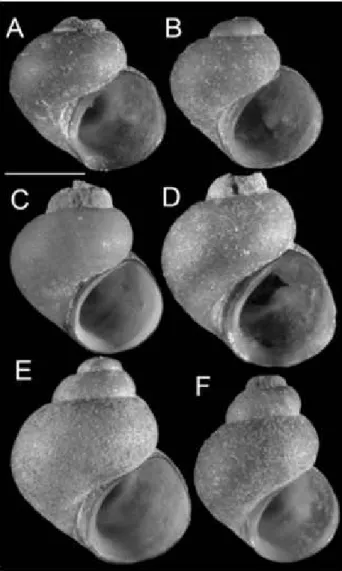
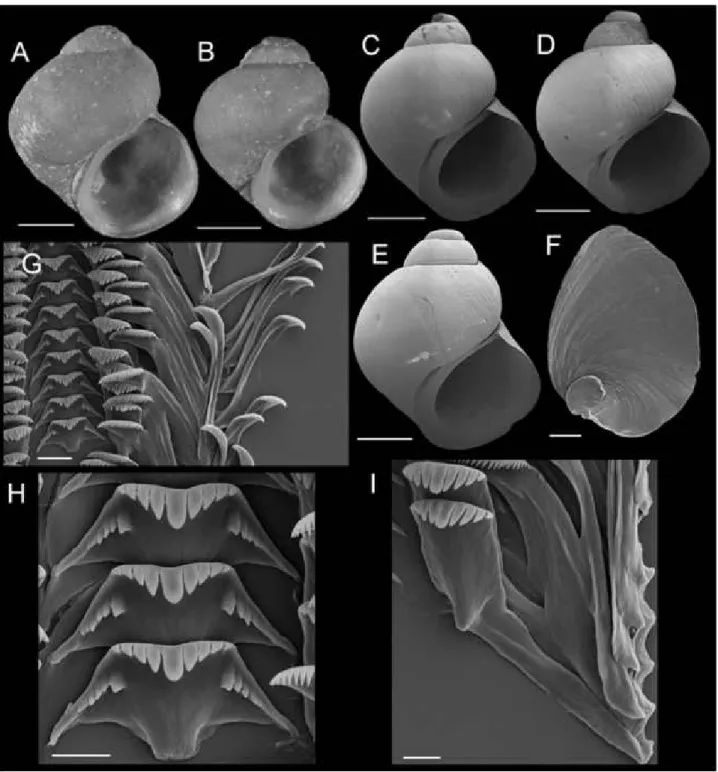
Five of these lineages (3—7) share a uniquely elongate basal tongue of the central radular tooth. Clade A also contains an enigmatic, conchologically variable (Fig. 5) population living in the Rush Creek drainage (site 373), Pit River basin, which was studied in some detail. Among the 25 snails sequenced from this pop-
Figure 5. Shell variation within the Rush Creek popula- tion {Fluminicola sp., site 373). A, E, F, USNM 1020795. B, C, USNM 1020793. D, USNM 1020794. Scale = 1.0 mm.
ulation, 33 variable sites were observed for COI, resulting in five haplotypes; 19 variable sites were observed for cytb, resulting in five haplotypes. These were distributed among two clades, one of which also contained haplotypes from a morphologically distinct population living along the Pit River (site 113). The two clades, Fluminicola sp. (A) and Fluminicola sp.
(B) (Figs 2—4), were nonsister in all analyses and were substantially differentiated from one another by 4.7—
5.0% (31-33 bp) for COI and 4.4-5.0% (16-18 bp) for cytb. Within each clade, haplotypes only differed by 0—
0.3% (0-2 bp) for COI and 0-0.6% (0-2 bp) for cytb.
(The two sequenced specimens from site 113 shared a COI haplotype with site 373 specimens, whereas their cytb sequence differed from one of the site 373 haplo- types by a single bp.) Although our data suggest that two evolutionarily distinct lineages are present at the Rush Creek site, we were unable to confidently sort these on the basis of their shells, nor have we been able to find other diagnostic morphological features.
This confusing pattern may reflect incipient specia- tion, incomplete lineage sorting, or secondary contact and merits additional study.
Clade B contains populations of/^ seminalis, which formed a well-supported (70—100%) monophyletic unit that was sister to a similarly well-supported (84—
100%) subclade composed of F. modoci and an unde- scribed (and possibly conspecific) population from the Klamath Lake basin (F cf. modoci). Clade C is com- posed of six lineages that were usually depicted as sis- ter to a subclade composed of two Great Basin species {F. dalli, F virginius). Two of these lineages (9, 12) share a large shell umbilicus that is unique within the genus. Lineages 10 and 13 are both composed of allo- patric, genetically divergent (> 2% for both genes) sub- clades that are not morphologically distinguishable.
Clade D is composed of lineage 2, which is distributed in the upper portion of the Pit River basin, and its sis- ter, F. turhiniformis, a Great Basin species. In some analyses, clade D was depicted as sister to clade C, with the three remaining congeners {F. coloradensis, F fuscus, F. insolitus) occupying a more basal position (Figs 2, 4), whereas in others clade D was sister to a clade composed of the latter three species (Fig. 3).
DISCUSSION
TAXONOMIC IMPLICATIONS
Analysis of the mitochondrial DNA sequence data revealed 13 divergent and phylogenetically indepen- dent upper Sacramento River lineages that are mor- phologically diagnosable and do not correspond to previously described species. Although most of the lin- eages are distributed allopatrically, lineage 8 is sym- patric with F. seminalis or with lineage 9 at one or
more sites, and lineage 5 is sympatric with F. seminalis at another site. The sequence divergence for most of the 13 hneages was > 2% for both genes (Table 2). COI sequence divergence among these 13 lineages is within the range observed among conge- ners of other North American freshwater rissooidean gastropods (e.g. Tryonia, 1.3-14.8%, Hershler, Liu &
Mulvey, 19m; Pyrgulopsis, 1.1-13.1%, Liu & Hershler, 2005), but is generally less than that of previously described pebblesnail species (Table 2). However, the latter are widely scattered within a much larger region than our study area (Hershler & Frest, 1996:
figs 11, 14) and presumably have been long isolated from each other. Consequently, it may be expected that the sequence divergence between these species will be greater than among congeners inhabiting a single watershed, such as the upper Sacramento River drain- age. Application of the COI clock for Fluminicola (1.93% per million years; see Methods section) sug- gests that the upper Sacramento River basin lineages have been minimally isolated for 0.72—2.90 million years. Based on our morphological and genetic evi- dence, we conclude that each of these 13 lineages mer- its recognition as a distinct species new to science using the evolutionary species concept that we advo- cate (see Methods section) as well as other currently utilized operative definitions of this taxonomic cate- gory (summarized in Mayden, 1997; Wheeler & Meier, 2000). Although it is possible that several of these lin- eages may be composed of multiple cryptic species (notably lineage 13), we chose not to describe addi- tional new taxa at this time solely based on genetic evidence.
Our finding of a large number of new species within a single drainage basin suggests that other northwestern North American watersheds may also contain substantial undescribed diversity of this geo- logically ancient group of snails. Inasmuch as a rea- sonably complete taxonomic study of Fluminicola will not be available for many years, it may be appropri- ate in the meanwhile for land managers to provision- ally treat populations or groups of populations that are isolated by dry land or by reaches of unsuitable aquatic habitat as distinct conservation units, espe- cially when these snails are also shown to be morpho- logically distinctive.
EVOLUTIONAEY CONSIDERATIONS
Our findings provide some insight into the evolution- ary development of the upper Sacramento River peb- blesnails, although this topic should be revisited following similar studies of the largely undescribed faunas of adjacent regions (e.g. Frest & Johannes, 1995b). The highly endemic upper Sacramento River pebblesnail fauna does not form a monophyletic unit
consistent with recognition as a single species flock (Fig. 4). In two major clades (C, D), upper Sacramento River species form monophyletic subunits that are sister to western Great Basin pebblesnails, which parallels previously hypothesized close relationships between the fish faunas of these areas (see Minckley, Hendrickson & Bond, 1986). Clade D is composed of two species whose closely proximal ranges (F. warnerensis, Fig. 9; F. turbiniformis, Hershler, 1989, Fig. 7) are separated by the Warner Mountains, which form the eastern flank of the South Fork Pit River Valley (Fig. 1). Our data indicate that these two species diverged approximately 1.27 Ma (COI sequence divergence, 2.45%), and we suggest that this vicariance may have resulted from the large amount of uplift and tilting of the Warner Mountains that occurred in the past 3 million years (Fosdick et al., 2005; Markman et al., 2005; Carmichael et al., 2006).
Clade C contains subclades composed of two species from the Pyramid Lake basin in western Nevada {F. dalli, F. virginius) and six Sacramento River basin species that, with one exception {F. fremonti. Goose Lake basin), are distributed in the lower portion of this drainage (Fig. 20). The estimated 2.60 Ma diver- gence (COI sequence divergence, 5.0%) of these broadly disjunct subclades may have also resulted from tectonic development of the topographic bound- ary between the Modoc Plateau and northwestern Great Basin, which in some areas began as early as the late Miocene (Colgan, Dumitru & Mifler, 2005).
A third clade (B, Fig. 4) shows a different pattern of extra-limital relationships in which a species from the Goose Lake basin {F. rnodoci), which had an occa- sional stream connection with the upper Pit River basin during the late Quaternary, is sister to an undescribed (and possibly conspecific) population from the Klamath River basin {F. cf rnodoci), with an estimated 0.47 Ma (COI sequence divergence, 0.91%) age of divergence. Pease (1965) suggested on the basis of geological evidence that the upper portion of the Pit River basin (Alturas and Goose Lake basins) drained to the north-west (towards the Klamath River basin) during the late Pliocene and Pleistocene.
He further speculated that this connection was blocked by the eruption of the Garden Basalt, which formed a broad plateau extending north of Alturas and west of the Goose Lake basin (Fig. 1), with the upper Pit River subsequently developing its modern westward course to the Sacramento River. Hubbs &
Miller (1948; also see Robins & Miller, 1957) proposed a Pleistocene stream connection between the Goose and Klamath Lake basins based on ichthyological evi- dence that was contested by Minckley et al. (1986), who suggested that the former fauna was instead derived from that of the Pit River. The Garden Basalt is now known to be late Miocene to early Pliocene in
age (e.g. McKee, Duffield & Stern, 1983), which seem- ingly precludes the possibility of westward drainage across this area from the Goose Lake basin during the Quaternary. Nonetheless, our finding, which is paralleled by recent molecular studies demonstrating 0.2 Ma divergence of the lamprey fish faunas of the Goose and Klamath lake basins (M. F. Docker, pers.
comm.), provides compelling evidence of some form of geologically recent drainage integration or transfer between these areas.
The evolutionary origin of the pebblesnails of the Goose Lake basin is of additional interest because this area is considered to have had only a recent (late Qua- ternary), intermittent connection with the rest of the upper Sacramento River basin (Phillips & Van Den- burgh, 1971). The substantial COI differentiation of both the F. modoci—F. cf. modoci clade and a second Goose Lake basin pebblesnail (F. fremonti) with respect to their upper Sacramento River basin sister taxa (F. seminalis, 5.39-5.88%, 2.79-3.05 Ma;
F. multifarius, 4.23%, 2.19 Ma, respectively) nonethe- less suggests a divergence event that preceded the recent integration of these areas.
Diversification of pebblesnails within the upper Sac- ramento River basin may be attributed to several aspects of regional geological history. The volcanic eruptions that formed the main axis of the southern High Cascades during the Pliocene and Quaternary (Christiansen, 1985) may have played a role in isolat- ing ancestral fauna in the western part of the study area (McCloud and Sacramento Rivers). The two spe- cies that are endemic to this region minimally diverged in the late Pliocene or earliest Pleistocene (Table 2, F. multifarius, 3.4% COI divergence, 1.76 Ma;
F. scopulinus, 4.0% COI divergence, 2.07 Ma), con- sistent with the age of this prominent topographical feature. Another defining barrier may have been intro- duced by the tectonic development of the Hat Creek and McArthur grabens, which are bounded by major normal faults that are down dropped to the west and have steep scarps that displace Pliocene to Pleistocene basalt (Wills, 1991). This fault zone has been inter- preted as the northern portion of a 400 km long trough that extends from Lake Tahoe to the Oregon state line (Page et al., 1993; Page & Renne, 1994; Page, 1995).
The distributions of clades A and C (Figs 9, 17) corre- spond in large part to the two regions separated by this fault zone, and their estimated 3.80—3.98 Ma age of divergence is consistent with its Pliocene inception.
Additional opportunities for pebblesnail differentia- tion were surely created by the repeated interruption, ponding, and shifting of Modoc Plateau drainage that resulted from basaltic volcanism and extensional faulting in the late Cenozoic (Pease, 1965).
The evolutionary diversification of this fauna has also been strongly influenced by pebblesnail ecology.
Most of the upper Sacramento River basin species are restricted to spring influenced habitats and all but one (F. warnerensis) of these are narrowly distributed. This pattern of high diversity and local endemism in spring environments is shared by rissooidean gastropod fau- nas elsewhere in North America (e.g. Thompson, 1968;
Hershler, 1998) and in other parts of the world (e.g.
Ponder, Hershler & Jenkins, 1989; Haase & Bouchet, 1998). The frequent restriction of snail species to a sin- gle spring or spring complex can be attributed in part to the low physical connectivity of these habitats, whose outflows frequently disappear into the ground without connecting to other water bodies. This feature is especially pronounced in arid regions and is further enhanced in the Modoc Plateau owing to its highly per- meable, volcanic landscape (Rose, Davisson & Criss, 1996). Even in situations where springs are connected either with each other or with other water bodies by stream outflows, genetic isolation of snail populations may still occur as a result of physiological specializa- tion to unique, stable headspring environments and an associated inability to disperse and/or survive more than a short distance downflow (e.g. O'Brien & Blinn, 1999; Ponder & Colgan, 2002). In contrast with the typ- ically narrow distributions of spring-dwelling pebble- snails of the upper Sacramento River basin, all three species that were collected from regional rivers or large streams {F. ahjumawi, F. multifarius, F. seminalis) have broad ranges that span multiple hydrographic units (Figs 17,20). The relatively shallow divergence of populations within these species (e.g. F. seminalis, COI sequence divergence 0.6%, 0.31 Ma) suggests that their wide distributions may have resulted from geologically recent dispersal or contemporary gene flow within inte- grated streams and rivers.
SYSTEMATICS
FAMILY LITHOGLYPHIDAE TROSCHEL, 1857
GENUS FLUMINICOLA CARPENTER, 1864 Flurninicola Carpenter, 1864: 676. Type species Palu- dina nuttalliana Lea, 1838, by original designation.
Flurninicola shares with other members of the family Lithoglyphidae {fide Wilke et al., 2001) a distinctive combination of a flattened, blade-like penis lacking glands and a female capsule gland with an enclosed ventral channel (Radoman, 1983; Thompson, 1984;
Hershler & Thompson, 1990). Hershler & Frest (1996) provided a morphology-based phylogenetic analysis that resolved a 'Flurninicola clade' that was more closely related to eastern North American Somatogy- rus than to divergent F virens. However, because the phylogenetic placement of the type species of Flumini- cola (Paludina nuttalliana Lea, 1838) is unknown (this snail has never been anatomically studied and is
probably extinct), the genus continues to be broadly envisaged as a paraphyletic unit consisting of i^ virens and all other regional lithoglyphids (Hershler & Frest, 1996). A detailed description of Fluminicola was pro- vided by Hershler & Frest (1996) and does not need to be repeated or emended here.
The fauna of the upper Sacramento River basin described below may be referred to as the 'Fluminicola clade' (see above) as they share the two synapomor- phies of this unit — an elongate pedal commissure and a sickle-shaped or elongate penis that lacks an ever- sible, terminal papilla (Hershler & Frest, 1996). Vari- ation in reproductive morphology, which has often been useful in taxonomic studies of freshwater ris- sooidean snails, proved to be relatively minor among the members of this fauna (Figs 6, 7) and most of the new species described below are instead diagnosed by shell or radular features. Species are treated in the text below in approximately the order of their distri- bution within the upper Sacramento River basin.
FLUMINICOLA FREMONTI SP. NOV. (FREMONT PEBBLESNAIL)
Type material: Holotype (Fig. 8A), USNM 1020660, Hunters Spring on the north side of FS28, Fremont National Forest, Lake County, Oregon (704840 E, 4684990 N, 1604 m), 26 August 2000 TF, EJ.
Paratypes, USNM 1020661, from same lot as holotype.
Referred material: USNM 1020662, topotypes, 30 October 2002, TF, EJ.
Diagnosis: Differs from closely similar F. turbinifor- mis in its smaller basal cusps on the central radular teeth, the typically pointed distal end of the penis, the presence of internal pigment in the penis, a more tri- angular-shaped bursa copulatrix, a longer bursa cop- ulatrix duct, a larger seminal receptacle, and the absence of a seminal receptacle duct. Readily distin- guished from geographically proximal F. modoci by its typically broader shell, narrower columellar lip, and lighter coloured periostracum^.
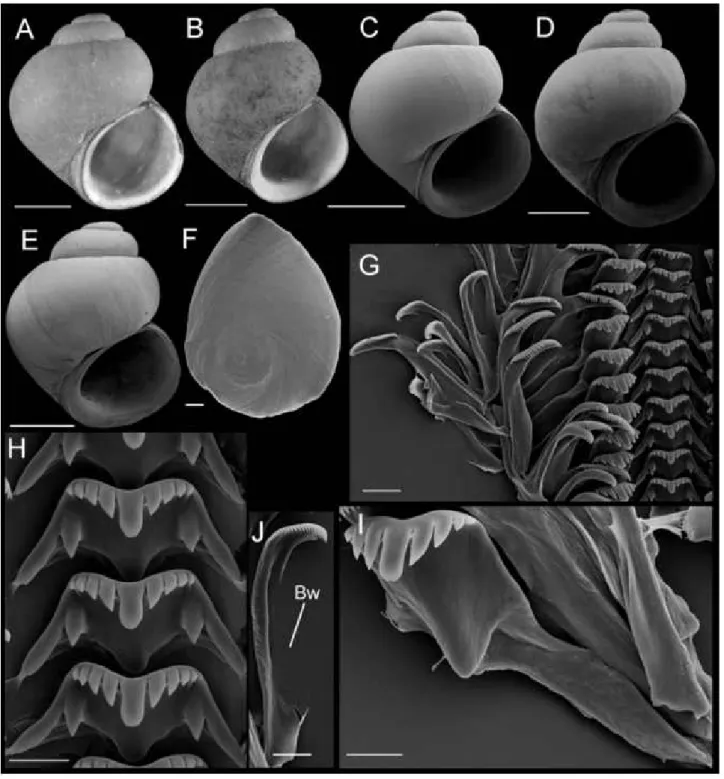
Description: Shell (Fig. 8A-E; Table 3) usually subglo- bose, rarely ovate-conic, rarely having eroded spire;
height, 2.32-3.98 mm; whorls, 3.25-4.0. Protoconch 1.3—1.4 whorls, diameter approximately 0.70 mm.
Teleoconch whorls medium convex, narrowly shoul-
dered. Aperture broad, angled above. Parietal lip com- plete, usually adnate, thin and curved across body whorl; occasionally slightly disjunct, thickened. Col- umellar lip narrow to medium width, often overlapping part of umbilical region. Outer lip usually thin, proso- cline. Shell anomphalous or having narrow umbilicus, umbilical region narrowly excavated. Periostracum tan or light brown. Outer surface of operculum smooth (Fig. 8F). Central radular tooth approximately 37 ^m wide, cutting edge convex, lateral cusps four to five;
central cusp near parallel-sided, distal end rounded;
basal cusps one; basal tongue broadly V- or U-shaped, equal to lateral margin (Fig. 8H). Lateral tooth face broadly rectangular; central cusp rounded; lateral cusps three (inner), four to five (outer); outer wing flexed, medium length (Fig. 81). Inner marginal teeth (Fig. 8G) having 27-33 cusps. Outer marginal teeth having 28—36 cusps; basal wing rectangular (Fig. 8G, J). Head-foot dark brown, almost black. Ctenidium connected to pericardium by short, efferent branchial vessel (fide Hershler & Ponder, 1998: fig. 18c); ctenidial filaments approximately 16, weakly pleated. Osphra- dium elongate, positioned opposite middle of ctenid- ium. Female reproductive anatomy shown in Figure 6A. Bursa copulatrix longitudinal, triangular, duct medium length. Seminal receptacle medium- sized, partly overlapped by albumen gland. Albumen gland having moderate rectal furrow. Capsule gland a little longer than albumen gland. Genital aperture a simple pore. Penis medium-sized, coiled, distal end usually pointed, rarely tapering or having papilla (Fig. 7A). Penis surface pale; internal black granules scattered along length of penial duct. Penial duct near centrally positioned, weakly undulating medially.
Distribution: Known only from the type locality, which is located in the Thomas Creek drainage. Goose Lake basin (Fig. 9).
Etymology: Named after John C. Fremont, intrepid early explorer of the American West. The single local- ity for this species is located in the Fremont National Forest.
Remarks: On the basis of sequence divergence data, F. fremonti is most similar to species living in the lower Pit River basin: F anserinus (described below) (COI 3.5—3.8%) and F. scopulinus (described below) (cytb 5.5-5.8%).
Table 3. Shell parameters for Fluminicola fremonti
WH SH SW HBW WBW AH AW
Holotype 3.75 Paratypes (AT = 31) 3.50
*iV = 26 3.25- -3.75*
3.57 3.03 2.70- -3.98
3.05 2.66 2.37- -3.23
3.10 2.58 2.31-3.27
2.68 2.23 1.99-2.77
1.86 1.66 1.46- -2.03
1.83 1.57 1.39-2.00
A Ag
Figure 6. Female glandular oviduct and associated structures (viewed from the left side) for six species of Fluminicola. A, F. fremonti (USNM 1020661). B, F. warnerensis (USNM 1020653). C, F. erosus (USNM 1020664). D, F. favillaceus (USNM 1020670). E, F. neritoides (USNM 1020682). F, F- anserinus (USNM 1020728). Scales = 0.5 mm. Ag, albumen gland; Bu, bursa copulatrix; Cg, capsule gland; Dbu, bursal duct; Ga, genital aperture; Pc, posterior wall of pallial cavity; Rf, rectal fur- row; Sr, seminal receptacle; Vc, ventral channel of capsule gland.
Figure 7. Penes (upper side) of the 13 Fluminicola species newly described herein. A, F. fremonti (USNM 1020661). B, F. warnerensis (USNM 1020653). C, F. lunsfordensis (USNM 1020689). D, F. erosus (USNM 1020664). E, F. favillaceus (USNM 1020670). F, F. cahallensis (USNM 1020676). G, F. neritoides (USNM 883563). H, F. ahjumawi (USNM 1020699). I, F umbilicatus (USNM 1020706). J, F anserinus (USNM 1020728). K, F potemicus (USNM 1020719). L, F scopulinus (USNM 1020722). M, F. multifarius (USNM 883782). Scale = 0.25 mm. Pd, penial duct.
FLUMINICOLA WARNERENSIS SP. NOV. (WARNER PEBBLESNAIL)
Type material: Holotype (Fig. lOA), USNM 1020652, Parsnip Springs, south of South Warner Road (FS64, also designated as 39N01) in wet, open meadow, Modoc National Forest, Lassen County, California
(729680 E, 4559760 N, 1957 m), 18 September 2001, TF, EJ. Paratypes (from same lot), USNM 1020653.
Referred material: CALIFORNIA. Lassen County:
USNM 1020655, spring brook in sedge meadow on east side of Blue Lake just east of Blue Lake Campground
Figure 8. Shells, opercula, and radula of Fluminicola fremonti. A, holotype (USNM 1020660). B-E, USNM 1020661.
Scales = 1 mm. F, outer side of operculum (USNM 1020661). Scale = 100 ^m. G, portion of radular ribbon (USNM 1020661).
Scale = 20 ^m. H, central radular teeth (USNM 1020661). Scale = 10 ^m. I, lateral radular tooth (USNM 1020661).
Scale = 10 |xm. J, outer marginal tooth, with basal, rectangular wing (Bw) on outer edge. Scale = 10 |xm.
access road, c. 0.16 km east of lake, Modoc National Forest (728375 E, 4558240 N, 1853 m), 17 September 2001 TF, EJ.—USNM 1020656, spring creek to Blue Lake on west side of FS64, c. 0.81 km south-east of Blue Lake Campground, Modoc National Forest (729020 E, 4557760 N, 1894 m), 18 June 1994 TF, EJ. - USNM
883557, USNM 883561, spring tributary to Blue Lake (729770 E, 4557577 N, 1830 m), 2 June 1993 DS. - USNM 883559, spring tributary to large meadow, Harvey Creek drainage, Jess Valley (725112 E, 4563474 N), 2 June 1993 DS. - USNM 883564, stream tributary to south end of Blue Lake (728489 E,
u
f. caballensis+
F. erosus•
f.sp.
A
f. favillaceus* F. fremonti
•
F. lunsfordensis•
F. niodociO
F. neritoides T F. warnerensis1 . 1 10 km
Figure 9. Map showing the distribution of eight species (plus Fluminicola sp.) in the Goose Lake and Pit River basins.
Some symbols represent multiple, closely proximal localities.
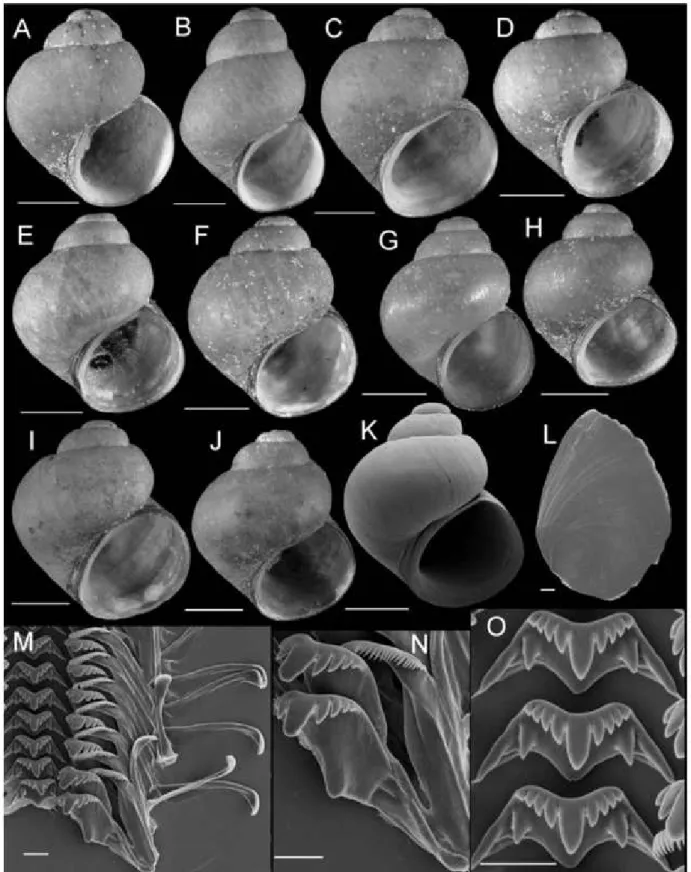
Figure 10. Shells, opercula, and radula oiFluminicola warnerensis. A, holotype (USNM 1020652). B, USNM 1020654. C, USNM 1020655. D, USNM 1020656. E, 1020657. F, USNM 1020658. G, USNM 883559. H, USNM 883561. I, USNM 883564. J, USNM 1020655. K, USNM 1020653. Scales = 1.0 mm. L, outer side of operculum (USNM 1020653).
Scale = 100 \im. M, portion of radular ribbon (USNM 1020653). Scale = 20 |xm. N, lateral and inner marginal radular teeth (USNM 1020653). Scale = 20 ^m. O, central radular teeth (USNM 1020653). Scale = 20 urn.