Fuzzy Sets
This chapter begins with a brief review of classical sets in order to facilitate the introduction of fuzzy sets. Next the concept of membership function is explained. It defines the degree to which an element under consideration belongs to a fuzzy set. Fuzzy numbers are described as a particular case of fuzzy sets. Fuzzy sets and fuzzy numbers will be used in fuzzy logic to model words such as profit, investment, cost, income, age, etc. Fuzzy relations together with some operations on fuzzy relations are introduced as a generalization of fuzzy sets and ordinary relations. They have application in database models. Fuzzy sets and fuzzy relations play an important role in fuzzy logic.
1.1 Classical Sets: Relations and Functions
Classical sets
This section reviews briefly the terminology, notations, and basic prop- erties of classical sets, usually calledsets.
The concept of asetorcollectionof objects is common in our every- day experience. For instance, all persons listed in a certain telephone directory, all employees in a company, etc. There is a defining prop- erty that allows us to consider the objects as a whole. The objects in a set are called elements or members of the set. We will denote ele- ments by small letters a, b, c, . . . , x, y, z and the sets by capital letters
1
A, B, C, . . . , X, Y, Z.Sets are also called ordinary or crisp in order to be distinguished from fuzzy sets.
The fundamental notion in set theory is that ofbelonging ormem- bership. If an objectx belongs to the set A we writex∈A; if x is not a member of A, we writex6∈A. In other words for each objectx there are only two possibilities: either x belongs toA or it does not.1
A set containing finite number of members is called finite set; oth- erwise it is called infinite set. We present two methods of describing sets.
Listing method
The set is described bylistingits elements placed in braces; for example A ={1,3,6,7,8}, B ={business, finance, management}. The order in which elements are listed is of no importance. An element should be listed only once.
Membership rule
The set is described by one or more properties to be satisfied only by objects in the set:
A={x | x satisfies some property or properties}.
This reads: “A is the set of all x such that x satisfies some property or properties.” For example R={x | x is real number} reads: “R is the set of all x such that x is a real number”; R+ ={x|x ≥ 0, x∈R} reads “R+ is the set of allx which are nonnegative real numbers.”
Universal set
The set of all objects under consideration in a particular situation is called universal set or universe; it will be denoted by U.
Empty set
A set without elements is called empty; it is denoted by φ.
Interval
The set of all real numbersxsuch thata1 ≤x≤a2, wherea1anda2are real numbers, form a closed interval [a1, a2] ={x | a1≤x≤a2, x∈R} with boundaries a1 and a2. It is also called interval number.
Equal sets
Sets A and B are equal , denoted by A = B, if they have the same elements.
Subset
The set A is a subset of the set B (A is included in B), denoted by A ⊆ B, if every element of A is also an element of B. Every set is subset of itself, A ⊆A. The empty set φ is a subset of any set. It is assumed that each set we are dealing with is a subset of a universal set U.
Proper subset
A is a proper subset of B, denoted A ⊂ B, if A ⊆ B and there is at least one element in B which does not belong to A. For instance {a, b} ⊂ {a, b, c}. IfA⊆B and B⊆C, thenA⊆C.
Intersection
The intersection of the sets A and B, denoted byA∩B, is defined by A∩B ={x | x∈A and x∈B}; (1.1) A∩B is a set whose elements are common to Aand B.
Union
The union of A andB , denoted byA∪B, is defined by
A∪B ={x | x∈A or x∈B}; (1.2) A∪B is a set whose elements are inAorB, including any element that belongs to both Aand B.
Disjoint sets
If the setsAandB have no elements in common, they are calleddisjoint.
Complement
The complementof A⊂U, denoted byA, is the set
A={x∈U | x6∈A}. (1.3)
The complement of a set consists of all elements in the universal set that are not in the given set.
Example 1.1 Given the sets
A={1,2,3,4}, B ={1,3,5,6}, U ={1,2,3,4,5,6,7}, then using (1.1)–(1.3) we find
A∩B ={1,3}, A∪B ={1,2,3,4,5,6}, A={5,6,7}, B={2,4,7}. Convex sets 2
Consider the universe U to be the set of real numbersR.
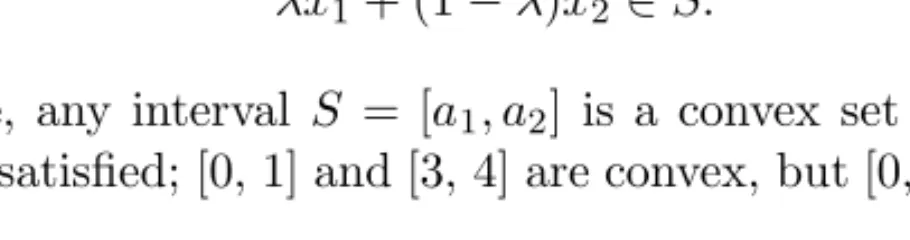
A subsetS ofR is said to beconvexif and only if, for allx1, x2 ∈S and for every real number λsatisfying 0≤λ≤1, we have
λx1+ (1−λ)x2 ∈S.
For example, any interval S = [a1, a2] is a convex set since the above condition is satisfied; [0, 1] and [3, 4] are convex, but [0,1]∪[3,4] is not.
Venn diagrams
Sets are geometrically represented by circles inside a rectangle (the uni- versal set U). In Fig. 1.1 are shown the setsA∩B and A∪B.
A B
A B
A B
B
∩ A∪
Fig. 1.1. Venn diagrams for A∩B(intersection), A∪B(union).
Ordered pairs
It was noted that the order of the elements of a set is not important.
However there are cases when the order is important. To indicate that
a set or pair of two elements aand bis ordered, we write (a, b), i.e. use parentheses instead of braces;ais called first elementof the pair andb is called second element.
Cartesian product
Cartesian product(orcross product) of the setsAandB denotedA×B is the set of ordered pairs
A×B ={(a, b)|a∈A, b∈B}. (1.4) Example 1.2
(a) Given
A={1,2,3}, B ={1,2}, then according to (1.4) we find
A×B ={(1,1),(1,2),(2,1),(2,2),(3,1),(3,2)}; geometrically it is presented on Fig. 1.2 (a).
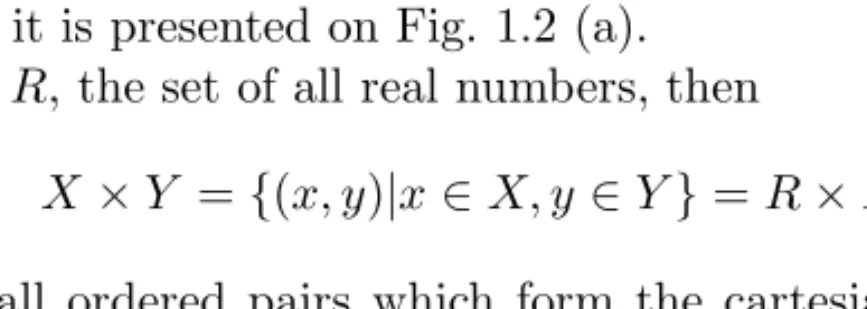
(b) If X, Y =R, the set of all real numbers, then X ×Y ={(x, y)|x∈X, y∈Y}=R×R
is the set of all ordered pairs which form the cartesian plane xy (see Fig. 1.2(b)).
- 6
u u u
u u u
- 6
1 2 3
x 1
2
y y
x
(a) (b)
Fig. 1.2. (a) Cartesian product {1,2,3} × {1,2}; (b) Cartesian plane.
2
Relations
The concept of relation is very general. It is based on the concepts of ordered pair (a, b), a ∈A, b∈ B, and cartesian product of the sets A and B.
A relation from A to B (or between A and B) is any subset < of the cartesian product A×B. We say thata∈A andb∈B are related by <; the elements aand b form the domain and range of the relation, correspondingly. Since a relation is a set, it may be described by either the listing method or the membership rule. The relation < is called binary relation since two sets,A andB, are related.
Example 1.3
LetA={x1, x2, x3} and B={1,2,3,4}.
We list some binary relations generated byA andB:
<1 ={(x1,1),(x2,1),(x3,4)},
<2 ={(x1,2),(x1,3)}, <3 ={(x2,2),(x3,1)},
<4 ={(x1,1),(x1,2),(x1,3),(x1,4),(x2,1),(x4,1)} are relations from Ato B;
<5={(1, x2),(2, x3),(3, x1)}, <6 ={(1, x1),(2, x1)},
<7={(1, x1),(1, x2),(1, x4)}, <8 ={(2, x1),(3, x3)}
are relations from B to A; the empty set φ is a relation; the cross product A×B is a relation fromA to B and the cross productB×A is a relation from B to A.
2 Functions
Afunctionf is a relation<such that for every elementxin the domain offthere corresponds a unique elementyin the range off. For instance the relations in Example 1.2 are not functions.
We often say that f maps x onto y; y is the image of x under f. Then we can write f : x → y. However, it is customary to use the notation y=f(x).
Generalization
The notions of ordered pair, Cartesian product, relation, and function can be generalized for higher dimensions than two. For instance when n= 3 we have:
Ordered triple(a, b, c);
Cartesian product
A×B×C={(a, b, c)|a∈A, b∈B, c∈C}; Relationfrom A×B to C is any subset< ofA×B×C.
Function z =f(x, y) is a relation such that for every pair (x, y) in the domain of f there corresponds a unique element z in its range.
Characteristic Function
The membership rule that characterizes the elements (members) of a set A⊂U can be established by the concept ofcharacteristic function (or membership function)µA(x) taking only two values, 1 and 0, indicating whether or not x∈U is a member ofA:
µA(x) =
( 1 for x∈A,
0 for x6∈A. (1.5)
Hence µA(x)∈ {0,1}. Inversely, if a functionµA(x) is defined by (1.5), then it is the characteristic function for a set A⊂U in the sense that Aconsists of the values ofx∈U for whichµA(x) is equal to 1. In other words every set is uniquely determined by its characteristic function.
The universal set U has for membership function µU(x) which is identically equal to 1, i.e. µU(x) = 1. The empty set φ has for mem- bership function µφ(x) = 0.
Example 1.4
Consider the universe U ={x1, x2, x3, x4, x5, x6} and its subsetA, A={x2, x3, x5}.
Only three of the six elements in U belongA. Using the notation (1.5) gives
µA(x1) = 0, µA(x2) = 1, µA(x3) = 1, µA(x4) = 0, µA(x5) = 1, µA(x6) = 0.
Hence the characteristic function of the setA is µA(x) =
( 1 for x=x2, x3, x5, 0 for x=x1, x4, x6; The set Acan be represented as
A={(x1,0),(x2,1),(x3,1),(x4,0),(x5,1),(x6,0)}.
2 Example 1.5
Let us try to use crisp sets to describetall men. Consider for instance a man as tall if his height is 180 cm or greater; otherwise the man is not tall. The characteristic function of the set A={tall men} then is
µA(x) =
( 1 for 180≤x, 0 for 160≤x <180.
It is shown in Fig. 1.3, where the universe is U ={x|160≤x≤200}.
- 6
1
0 160 180pppp 200
pppppppp pppppppp ppppp
pppppppp pppppppp pppppppp
pppppppppppppppppppppppppppppppppppppppppppppppppppppppppppp p
Fig. 1.3. Membership function of the settall men.
Clearly this description of the set of tall men is not satisfactory since it does not allow gradation. The word tall is vague. For instance, a person whose height is 179 cm is not tall as well as a person whose height is 160 cm. Yet a person whose height is 180 is tall and so is a person with height 200 cm. Also the above definition introduces a drastic difference between heights of 179 cm and 180 cm, thus fails to describe realistically borderline cases.2
2 The concept of characteristic function introduced here will facili- tate the understanding of the concept fuzzy set, the subject of the next section.
1.2 Definition of Fuzzy Sets
We have seen that belonging or membership of an object to a set is a precise concept; the object is either a member to a set or it is not, hence the membership function can take only two values, 1 or 0. The set tall men in Example 1.5 illustrates the need to increase the describing capabilities of classical sets while dealing with words.
To describe gradual transitions Zadeh (1965), the founder of fuzzy sets, introduced grades between 0 and 1 and the concept of graded membership.
Let us refer to Example 1.4. Each of the six elements of the universal set U = {x1, x2, x3, x4, x5, x6} either belongs to or does not belong to the set A={x2, x3, x5}. According to this, the characteristic function µA(x) takes only the values 1 or 0. Assume now that a characteristic function may take values in the interval [0, 1]. In this way the concept of membership is not any morecrisp (either 1 or 0), but becomesfuzzy in the sense of representing partial belonging or degree of membership.
Consider a classical setAof the universeU. Afuzzy setAis defined by a set or ordered pairs, a binary relation,
A={(x, µA(x)) | x∈A, µA(x)∈[0,1]}, (1.6) where µA(x) is a function called membership function; µA(x) specifies thegradeordegreeto which any elementxinAbelongs to the fuzzy set A. Definition (1.6) associates with each element x inA a real number µA(x) in the interval [0, 1] which is assigned to x. Larger values of µA(x) indicate higher degrees of membership.3
Let us express the meaning of (1.6) in a slightly modified way. The first elements x in the pair (x, µA(x)) are given numbers or objects of the classical set A; they satisfy some property (P) under consideration partly (to various degrees). The second elements µA(x) belong to the interval (classical set) [0,1]; they indicate to what extent (degree) the elements x satisfy the property P.
It is assumed here that the membership function µA(x) is either piecewise continuous or discrete.
The fuzzy set A according to definition (1.6) is formally equal to its membership function µA(x). We will identify any fuzzy set with
its membership function and use these two concepts asinterchangeable.
Also we may look at a fuzzy set over a domainAas a function mapping A into [0, 1].
Fuzzy sets are denoted by italic letters A,B,C, . . . and the corre- sponding membership functions by µA(x), µB(x), µC(x), . . ..
Elements with zero degree of membership in a fuzzy set are usually not listed.
Classical sets can be considered as a special case of fuzzy sets with all membership grades equal to 1.
A fuzzy set is called normalized when at least one x ∈ A attains the maximum membership grade 1; otherwise the set is called nonnor- malized. Assume the set A is nonnormalized; then maxµA(x) <1. To normalize the setAmeans to normalize its membership functionµA(x), i.e. to divide it by maxµA(x), which gives maxµAµ(x)
A(x).
Ais called empty set labeled φifµA(x) = 0 for each x∈A.
The fuzzy set A = {(x1, µA(x1))}, where x1 is the only value in A⊂U and µA(x1)∈[0,1], is called fuzzy singleton.
While the setAis a subset of the universal setU which is crisp, the fuzzy setA is not.
Instead of (1.6), some authors use the notation A={µA(x)/x, x∈A, µA(x)∈[0,1]},
where the symbol / is not a division sign but indicates that the top number µA(x) is the membership value of the elementxin the bottom.
Example 1.6
Consider the fuzzy set
A={(x1,0.1),(x2,0.5),(x3,0.3),(x4,0.8),(x5,1),(x6,0.2)} which also can be represented as
A= 0.1/x1+ 0.5/x2+ 0.3/x3+ 0.8/x4+ 1/x5+ 0.2/x6;
it is a discrete fuzzy set consisting of six ordered pairs. The elements xi, i= 1, . . . ,6, are not necessary numbers; they belong to the classical set A = {x1, x2, x3, x4, x5, x6} which is a subset of a certain universal
set U. The membership functionµA(x) ofA takes the following values on [0, 1]:
µA(x1) = 0.1, µA(x2) = 0.5, µA(x3) = 0.3, µA(x4) = 0.8, µA(x5) = 1, µA(x6) = 0.2.
The following interpretation could be given to µA(xi), i= 1,· · ·,6.
The element x5 is a fullmember of the fuzzy set A, while the element x1 is a member of A a little (µA(x1) = 0.1 is near 0); x6 and x3 are a little more members of A; the element x4 is almosta full member ofA, while x2 ismore or less a member of A.
The fuzzy setA can be given also by the table A=4 x1 x2 x3 x4 x5 x6
0.1 0.5 0.3 0.8 1 0.2 where the symbol = means “is defined by.”4
Now we specify in two different ways the elements xi inA:
(a) Assume that xi, i = 1,· · ·,6, are integers, namely, x1 = 1, x2 = 2, x3 = 3, x4 = 4, x5 = 5, x6 = 6; they belong to the set A = {1,2,3,4,5,6}, a subset of the universe U = N, the set of all integers. The fuzzy set Abecomes
A={(1,0.1),(2,0.5),(3,0.3),(4,0.8),(5,1),(6,0.2)};
its membership function µA(x) shown in Fig. 1.4 by dots is a discrete one.
(b) Assume now that xi, i = 1, . . . ,6, are friends of George whose names are as follows: x1 is Ron,x2 is Ted, x3 is John, x4 is Joe, x5 is Tom, andx6 is Sam. They form a set of friends of George,
A={Ron, Ted, John, Joe, Tom, Sam},
a subset of the universe U (all friends of George). The fuzzy setAhere expresses closeness of friendsof George on A⊆U:
A={(Ron,0.1),(Ted,0.5),(John,0.3),(Joe,0.8),(Tom,1),(Sam,0.2)}.
0 1 µ
1 2 3 4 5 6 x
0.5
Fig. 1.4. Fuzzy setA={(1,0.1),(2,0.5),(3,0.3),(4,0.8),(5,1),(6,0.2)}. 2 Example 1.7
Let us describe numbersclose to 10.
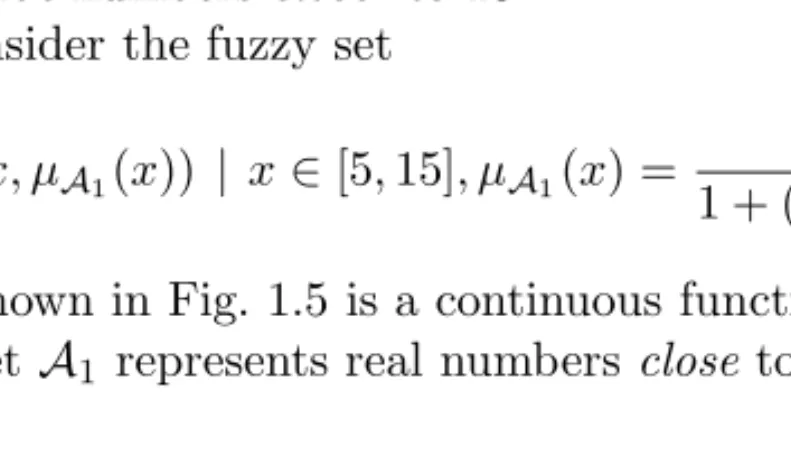
(a) First consider the fuzzy set
A1 ={(x, µA1(x)) | x∈[5,15], µA1(x) = 1
1 + (x−10)2}, where µA1(x) shown in Fig. 1.5 is a continuous function.
The fuzzy setA1 represents real numbers close to 10.
0 1 µ
10 x
µA1(x)
5 15
Fig. 1.5. Real numbersclose to 10.
(b) Integers close to 10 can be expressed by the finite fuzzy set consisting of seven ordered pairs
A2 ={(7,0.1),(8,0.3),(9,0.8),(10,1),(11,0.8),(12,0.3),(13,0.1)}. The membership function of A2 is shown on Fig 1.6 by dots; it is a discrete function.
0 1 µ
7 8 9 10 11 12 13 x
0.3 0.8
0.1
Fig. 1.6. Integers closeto 10.
2 Example 1.8
We have seen in Example 1.5 that the description of tall men by classical sets is not adequate. Now we employ for the same purpose the fuzzy set T ={(x, µT(x))}, wherexmeasured incm belongs to the interval [160, 200] and µT(x) is defined by (see Fig 1.7)
µT(x) = ( 1
2(30)2(x−140)2 for 160≤x≤170,
−2(30)1 2(x−200)2+ 1 for 170≤x≤200.
The membership functionµT(x) is a continuous piecewise-quadratic function. The numbers on the horizontal axis x give height in cm and the vertical axis µshows the degree to which a man can be labeled tall.
According to the graph in Fig. 1.7, if a person’s height is 160 cm, the person is a little tall (degree 0.22), 180 cm stands for almost tall (degree
0.78), 200 cm for tall (degree 1). The segment [0.22,1] of the vertical axisµexpresses thequantificationof the degree of vagueness of the word tall.4
0 1 µ
0.5
160 170 180 190
x 200 µT (x)
Τ Τ
0.5
0.22
Τ0.78
0.78
0.22
Fig. 1.7. Description oftall men by fuzzy set.
2 Further we define α-level interval or α-cut, denoted by Aα, as the crisp set of elements x which belong to A at least to the degree α:
Aα={x | x∈R, µA(x)≥α}, α∈[0,1]. (1.7) It gives athresholdwhich provides alevel of confidenceαin a decision or concept modeled by a fuzzy set. We may use the threshold to discard from consideration those element x in A with grades of membership µA(x)< α.
Example 1.9
Consider Example 1.8, the setT,tall men. It has an infinite number of α-level intervals (α-cuts) denoted byTα whereα varies between 0.22 and 1. Some α-cuts shown in Fig. 1.7 are given below:
T0.22={x|x∈R,160≤x≤200}, µT(x)≥0.22, T0.5 ={x|x∈R,170≤x≤200}, µT(x)≥0.5, T0.78={x|x∈R,180≤x≤200}, µT(x)≥0.78
For instance we may choose as a threshold the α-cut T0.5 thus dis- carding from consideration men whose height is below 170 cm.
2 A fuzzy set A, where the universe U = R, is convex if and only if the α-level intervals Aα (see (1.7)) are convex for all α in the interval (0, 1]. In such a case all α-levelintervalsAαconsist of one segment (see Fig. 1.8(a)). Otherwise the set is nonconvex (see Fig. 1.8(b)).
0 x
(a) (b)
x
µ µ
1 1
Aα
normalized
nonnormalized nonnormalized
normalized
Fig. 1.8. (a) Convex fuzzy sets; (b) Nonconvex fuzzy sets.
1.3 Basic Operations on Fuzzy Sets
Consider the fuzzy sets A and Bin the universe U, A = {(x, µA(x))}, µA(x)∈[0,1],
B = {(x, µB(x))}, µB(x)∈[0,1].
The operations withAandBare introduced via operations on their membership functions µA(x) and µB(x).
Equality
The fuzzy sets A and B are equal denoted by A= B if and only if for every x∈U,
µA(x) =µB(x).
Inclusion
The fuzzy set Ais included in the fuzzy set Bdenoted byA ⊆ B if for every x∈U,
µA(x)≤µB(x).
Then Ais called asubsetof B. Proper subset
The fuzzy set A is called a proper subset of the fuzzy set B denoted A ⊂ B when Ais a subset of Band A 6=B, that is
µA(x)≤µB(x) for every x∈U , µA(x)< µB(x) for at least onex∈U .
)
For instance the nonnormalized sets in Fig. 1.8 (a) and (b) are proper.
Complementation
The fuzzy sets Aand Aare complementary if
µA(x) = 1−µA(x) or µA(x) +µA(x) = 1. (1.8) The membership function µA(x) is symmetrical to µA(x) with re- spect to the line µ= 0.5.
Intersection
The operation intersectionof A andB denoted as A ∩ B is defined by µA∩B(x) = min(µA(x), µB(x)), x∈U. (1.9) If a1 < a2, min(a1, a2) =a1. For instance min(0.5,0.7) = 0.5.
Union
The operation union of Aand B denoted asA ∪ B is defined by µA∪B(x) = max(µA(x), µB(x)), x∈U. (1.10) If a1 < a2, max(a1, a2) =a2. For instance max(0.5,0.7) = 0.7.
Example 1.10
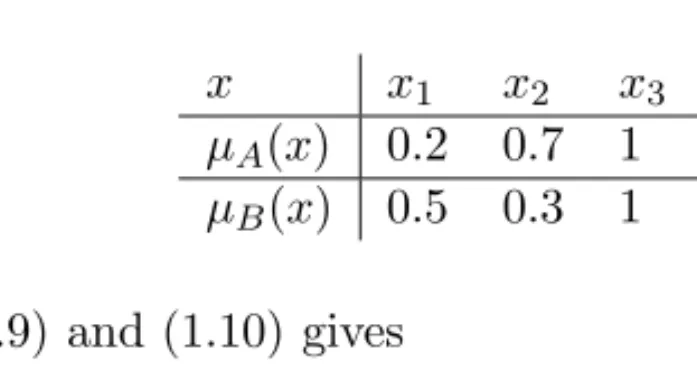
Consider the universeU ={x1, x2, x3, x4}and the fuzzy sets Aand B defined by the table
x x1 x2 x3 x4 µA(x) 0.2 0.7 1 0 µB(x) 0.5 0.3 1 0.1 Using (1.9) and (1.10) gives
x x1 x2 x3 x4
µA∩B(x) 0.2 0.3 1 0 µA∪B(x) 0.5 0.7 1 0.1
2 Schematic representation of operations on fuzzy sets
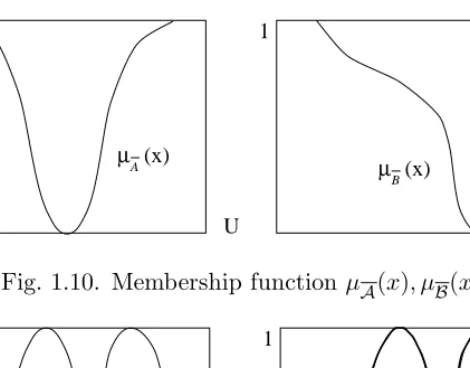
Fuzzy sets are schematically represented by their membership functions (assumed continuous) inside of rectangles. In Fig. 1.9 are shownµA(x) and µB(x), in Fig. 1.10 the complements µA(x) and µB(x), and in Fig. 1.11 the union µA∩B(x) and the intersection µA∩B(x).
1 1
U U
µ A(x) µB(x)
Fig. 1.9. Membership functionµA(x), µB(x).
Figure 1.11 shows thatA ∩ B ∈ A ∪ B. Law of excluded middle and fuzzy sets
The classical sets possess an important property, the law of excluded middle,2 expressed by A ∩ A =φ and A ∪ A = U. It is illustrated in Fig. 1.12 by the means of Venn diagrams.
The law of excluded middle is not valid for the fuzzy sets since A ∩ A 6=φ andA ∪ A 6=U. This is illustrated in Fig. 1.13.
1 1
U U
µ A(x) µB(x)
Fig. 1.10. Membership functionµA(x), µB(x).
1 1
U U
µ (x) µA∪B(x)
A∩B
Fig. 1.11. Membership function of intersection and union.
A A A
U U
A
A∩A=φ A∪A=U
Fig. 1.12. The law of excluded middle for classical sets.
It is natural that the law of the excluded middle is not valid for fuzzy sets. In classical sets every object does or does not have a certain property, expressed by 1 or 0. Fuzzy sets were introduced to reflect the
existence of objects in reality that have a property to a degree between 0 and 1. There are many shades of graycolor between black andwhite.
1 1
A ∩ A 6=φ A ∪ A 6=U
Fig. 1.13. The law of excluded middle is not valid for fuzzy sets.
The lack of the law of excluded middle in fuzzy set theory makes it less specific than that of classical set theory. However, at the same time, this lack makes fuzzy sets more general and flexible than classical sets and very suitable for describing vagueness and processes with incomplete and imprecise3 information.
1.4 Fuzzy Numbers
Afuzzy number5is defined on the universeRas aconvexandnormalized fuzzy set. In Figs. 1.14(a),(b) are shown two fuzzy numbers, with a maximum and with a flat.
For instance, the normalized fuzzy set in Fig. 1.8(a) is a fuzzy num- ber while the sets in Fig. 1.8(b) are not. The fuzzy set in Fig. 1.7 is also a fuzzy number.
The fuzzy set in Fig. 1.6 is a fuzzy number in the set of integers while the fuzzy set in Fig. 1.4 is not. Also we may consider a fuzzy number with a flat in the set of integers.
The interval [a1, a2] is called supporting interval for the fuzzy num- ber. For x = aM the fuzzy number in Fig. 1.14 (a) has a maximum.
The flat segment (Fig. 1.14(b)) has maximum height 1; actually it is the α-cut at the highest confidence level 1.
Fuzzy numbers will be denoted by bold capital lettersA,B,C, . . . , and their membership functions by µA(x), µB(x), µC(x), . . . .
1
aM a2
x µ
1 µ
x a1
0 a1 b1 b2 a2
(a) (b)
Fig. 1.14. Fuzzy numbers: (a) with a maximum; (b) with a flat.
Piecewise-quadratic fuzzy number
The membership functionµA(x) of a piecewise-quadratic fuzzy number shown in Fig. 1.15 is bell-shaped, symmetric about the linex=p, has a supporting intervalA= [a1, a2], and is characterized by two parameters, p= 12(a1+a2) andβ ∈(0, a2−p). Thepeak-point(the maximum point) is (p,1); 2β called bandwidth is defined as the segment (α-cut) at level α = 12 between the points (p−β,12) and (p+β,12), called crossover points.
1 α
0
1 2 __
a p a x
2β (p,1)
__1
2) )
2 __1
β, (p+
β
p+ 2
1 p−β
(p−β,
Fig. 1.15. Piecewise-quadratic fuzzy number.
The curve on Fig. 1.15 is described by the equations
µA(x) =
1
2(p−β−a1)2(x−a1)2 fora1 ≤x≤p−β,
−2β12(x−p)2+ 1 forp−β ≤x≤p+β,
1
2(p+β−a2)2(x−a2)2 forp+β ≤x≤a2,
0 otherwise.
(1.11)
The interpretation for the fuzzy number (1.11) is real numbersclose to the number p. Since the wordcloseis vagueand in that sensefuzzy, it cannot be defined uniquely. That depends on the selection of the supporting interval and the bandwidth which are supposed to reflect a particular situation. For instance the fuzzy set tall men(Example 1.8) is a particular case of (1.11) (left branch) on the interval [160, 200] with a1 = 140, p= 200, and β = 30.
Example 1.11
The manufacturing price of a product is close to 28. It can be described by the fuzzy number A in Fig. 1.16 where a1 = 23, a2 = 33, p= 28, β = 3.
The membership function µA(x) can be obtained from (1.11) by substituting the specific values of a1, a2, p andβ given above.
1
x 0
µ
0.5 (25, 0.5) (31, 0.5)
23 25 28 31 33
A
Fig. 1.16. Product priceclose to 28.
2
1.5 Triangular Fuzzy Numbers
A triangular fuzzy number A or simply triangular number with mem- bership function µA(x) is defined onR by
A=4 µA(x) =
x−a1
aM−a1 fora1 ≤x≤aM,
x−a2
aM−a2 foraM ≤x≤a2,
0 otherwise,
(1.12) where [a1, a2] is the supporting interval and the point (aM,1) is the peak (see Fig. 1.17). The third line in (1.12) can be dropped.
0 a x
M a
2
(aM,1) 1
α
a1
A Ar
l
Fig. 1.17. Triangular fuzzy number.
Often in applications the pointaM ∈(a1, a2) is located at the middle of the supporting interval, i.e. aM = a1+a2 2. Then substituting this value into (1.12) gives
A=4µA(x) =
2ax−a1
2−a1 fora1 ≤x≤ a1+a2 2, 2ax−a1−a22 for a1+a2 2 ≤x≤a2,
0 otherwise.
(1.13)
We say that (1.13) represents a central triangular fuzzy number (see Fig. 1.18(a)). Similarly to the piecewise-quadratic fuzzy number, it is very suitable to describe the word close (close toaM).
Triangular numbers are very often used in the applications (fuzzy controllers, managerial decision making, business and finance, social
sciences, etc.). They have a membership function consisting of two linear segments Al (left) andAr (right) joined at the peak (aM,1) (see Fig. 1.17) which makes graphical representations and operations with triangular numbers very simple. Also it is important that they can be constructed easily on the basis of little information.
a1+ a
2
0 1 µ
a µ
1
0 x
x
(a) (b)
_________
2
a a
1 2 −a
Fig. 1.18. (a) Central triangular number; (b) Central triangular number symmetrical about µ.
Assume while dealing with an uncertain value we are able to specify the smallest and largest possible values, i.e. the supporting interval A = [a1, a2]. If further we can indicate a value aM in [a1, a2] as most plausible to represent the uncertain value, then the peak will be the point (aM,1). Hence with the three values a1, a2 and aM, one can construct a triangular number and write down its membership function (1.12). That is why the triangular number is also denoted by
A= (a1, aM, a2). (1.14) A central triangular number issymmetricalwith respect to the axisµ if in (1.13) a1=−a, a2=a, henceaM = 0 (see Fig. 1.18(b)). According to (1.14) it is denoted by
A= (−a,0, a).
It is very suitable to express the wordsmall. The right branch (segment) of A= (−a,0, a), i.e. when 0≤x≤a, can be used to describepositive small(PS), for instanceyoung age, small profit, small risk, etc. We can denote it by Ar = (0,0, a).
More generally, the left and right branches of the triangular number (1.14) can be denoted correspondingly by Al= (a1, aM, aM) and Ar= (aM, aM, a2). They will be considered as triangular numbers and called correspondingly left and right triangular numbers. The left triangular numberAl(see Fig. 1.17) is suitable to representpositive large(PL) or words with similar meaning, for instance old age, big profit, high risk, etc. provided that aM is large number.
1.6 Trapezoidal Fuzzy Numbers
A trapezoidal fuzzy number A or shortly trapezoidal number (see Fig. 1.19) is defined on R by
A=4 µA(x) =
x−a1
b1−a1 fora1≤x≤b1, 1 forb1 ≤x≤b2,
x−a2
b2−a2 forb2 ≤x≤a2, 0 otherwise.
(1.15)
It is a particular case of a fuzzy number with a flat.
The supporting interval is A = [a1, a2] and the flat segment on level α = 1 has projection [b1, b2] on the x-axis. With the four values a1, a2, b1, and b2, we can construct the trapezoidal number (1.15). It can be denoted by
A= (a1, b1, b2, a2). (1.16) If b1 = b2 = aM, the trapezoidal number reduces to a triangular fuzzy number and is denoted by (a1, aM, aM, a2). Hence a triangular number (a1, aM, a2) can be written in the form of a trapezoidal number, i.e. (a1, aM, a2) = (a1, aM, aM, a2).
If [a1, b1] = [b2, a2], the trapezoidal number issymmetrical with re- spect to the linex= 12(b1+b2) (see Fig. 1.20). It is incentral form and represents the interval [b1, b2] and real number close to this interval.
x 1
0 a
1 b1 b2 a2
µ
Fig. 1.19. Trapezoidal fuzzy number.
1
1 2
______________
2
x 0
a1 1 2 a
b b + b b 2
µ
Fig. 1.20. Trapezoidal number in central form.
Similarly to right and left triangular numbers (Section 1.5) we can introduce right and left trapezoidal numbers as parts of a trapezoidal number.
The right trapezoidal number denotedAr= (b1, b1, b2, a2) has sup- porting interval [b1, a2] and the left denoted Al = (a1, b1, b2, b2) has supporting interval [a1, b2]. Especially they are suitable to represent small 4=Ar = (0,0, b2, a2) (Fig. 1.21(a)) andlarge=4 Al= (a1, b1, b2, b2) where b1 is a large number (Fig. 1.21(b)).
1
x µ
1 µ
x
0 b a2 a1 b1 b2
A A
2
r l
(b) (a)
Fig. 1.21 (a) Right trapezoidal numberAr representingsmall; (b) Left trapezoidal number Al representing large.
1.7 Fuzzy Relations
Definition of Fuzzy Relation Consider the Cartesian product
A×B ={(x, y) | x∈A, y ∈B},
whereAandBare subsets of the universal setsU1andU2, respectively.
A fuzzy relationon A×B denoted byR orR(x, y) is define as the set
R={((x, y), µR(x, y))|(x, y) ∈A×B, µR(x, y)∈[0,1]}, (1.17) where µR(x, y) is a function in two variables called membership func- tion. It gives the degree of membership of the ordered pair (x, y) inR associating with each pair (x, y) inA×B a real number in the interval [0, 1]. The degree of membership indicates the degree to which x is in relation with y. We assume that µR(x, y) is piecewise continuous or discrete in the domainA×B; it describes a surface. Formally, the fuzzy relation R is a classical trinary relation; it is a set of ordered triples.
The definition (1.17) is a generalization of definition (1.6) for fuzzy set from two-dimensional space (x, µA(x)) to three-dimensional space (x, y, µA(x, y)).6 Here we also identify a relation with its membership function.
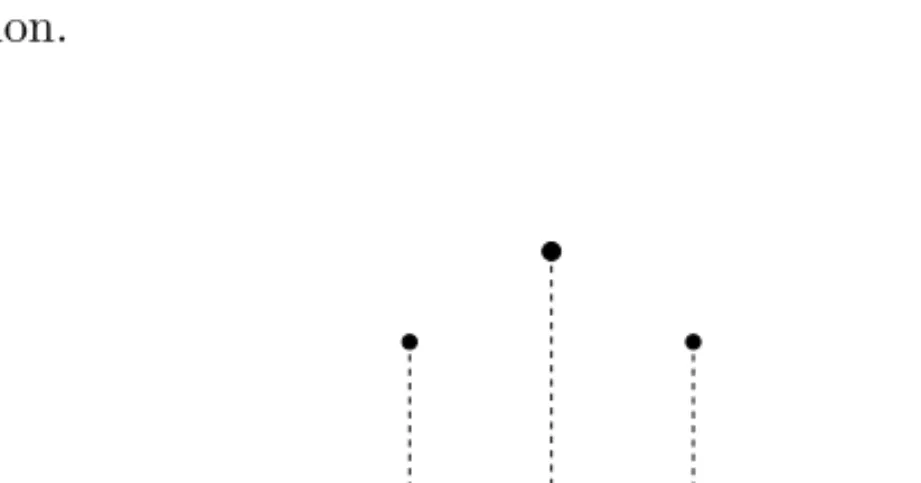
The fuzzy relation in comparison to the classical relation possesses stronger expressive power while relating xandydue to the membership function µR(x, y) which assigns specific values (grades) to each pair (x, y).
Common linguistic relations that can be described by appropriate fuzzy relations are: xismuch greater thany,xis close toy, xisrelevant to y, x and y arealmost equal, xand y are very far, etc.
Example 1.12
Consider the fuzzy relation which consists of finite number of ordered pairs,
R = {((x1, y1),0),((x1, y2),0.1),((x1, y3,0.2), ((x2, y1,0.7),((x2, y2,0.2,((x2, y3,0.3), ((x3, y1),1),(x3, y2),0.6),((x3, y3),0.2))}; it can be described also by the table (or matrix)
R=4
y y1 y2 y3 x
x1 0 0.1 0.2
x2 0.7 0.2 0.3
x3 1 0.6 0.2
where the numbers in the cells located at the intersection of rows and columns are the values of the membership function:
µR(x1, y1) = 0, µR(x1, y2) = 0.1, µR(x1, y3) = 0.2, µR(x2, y1) = 0.7, µR(x2, y2) = 0.2, µR(x2, y3) = 0.3, µR(x3, y1) = 1, µR(x3, y2) = 0.6, µR(x3, y3) = 0.2.
Assuming that x1 = 1, x2 = 2, x3 = 3, y1 = 1, y2 = 2, y3 = 3, we can present schematically R by points in the three-dimensional space (x, y, µ) (see Fig. 1.22).
0 1
y
x
1 2 3
2 3
1 µ
Fig. 1.22. Fuzzy relation Rdescribing xis greater thany.
Since the values of the membership function 0.7, 1, 0.6 in the direc- tion of xbelow the major diagonal (0, 0.2, 0.2) in the table are greater than those above in the direction of y, 0.1, 0.2, 0.3, we say that the relation R describesx is greater than y.
The fuzzy relation R can be expressed also as a fuzzy graph (Fig. 1.23). The numbers at the segments are the degrees of mem- bership.
x
0.3
0.2
0.2 0.6 1
0.2
0.1 0.7
3 2 1
3 2 1
y y y
x x
Fig. 1.23. Fuzzy relation R presented as a fuzzy graph.
2
Example 1.13
Consider the following two sets whose elements are business companies: A = {companya1,companya2,companya3}, B = {companyb1,companyb2}. Let Rbe a fuzzy relation between the two sets that represents the linguistic relation very far concerning distance between companies:
R = {((companya1,companyb1),0.9), ((companya1,companyb2),0.6), ((companya2,companyb1),1), ((companya2,companyb2),0.4), ((companya3,companyb1),0.5), ((companya3,companyb2),0.1)}. The relation can also be presented by the table
R=4
company b1 company b2
companya1 0.9 0.6
companya2 1 0.4
companya3 0.5 0.1
The membership values indicate to what degree the corresponding companies are very farfrom each other. For instance, companya2 and company b1 are very far (degree of membership 1) while companies a3 and b2 are not very far (degree of membership 0.1).
2
1.8 Basic Operations on Fuzzy Relations
Let R1 and R2 be two fuzzy relations on A×B,
R1={((x, y), µR1(x, y))}, (x, y)∈A×B, R2={((x, y), µR2(x, y))}, (x, y)∈A×B.
We use the membership functions µR1(x, y) andµR2(x, y) in order to introduce operations with R1 and R2 similarly to operations with fuzzy sets in Section 1.3.
Equality
R1 =R2 if and only if for every pair (x, y)∈A×B, µR1(x, y) =µR2(x, y).
Inclusion
If for every pair (x, y)∈A×B,
µR1(x, y)≤µR2(x, y),
the relation R1 isincluded in R2 or R2 is larger than R1, denoted by R1 ⊆ R2.
IfR1 ⊆ R2 and in addition if for at least one pair (x, y), µR1(x, y)< µR2(x, y),
then we have the proper inclusion R1 ⊂ R2. Complementation
The complementof a relation R, denoted by R, is defined by
µR(x, y) = 1−µR(x, y), (1.18) which must be valid for any pair (x, y)∈A×B.
Intersection
The intersectionof R1 andR2 denoted R1T
R2 is defined by
µR1∩R2(x, y) = min{µR1(x, y), µR2(x, y)}, (x, y)∈A×B. (1.19) Union
The union of R1 and R2 denoted R1S
R2 is defined by
µR1∪R2(x, y) = max{µR1(x, y), µR2(x, y)}, (x, y)∈A×B. (1.20) The operations intersection and union are illustrated in the following example.
Example 1.14
Consider the relations R1 and R2 given by the tables
R1
=4
y1 y2 y3 x1 0 0.1 0.2 x2 0 0.7 0.3 x3 0.2 0.8 1
R2
=4
y1 y2 y3 x1 0.3 0.3 0.2
x2 0.5 0 1
x3 0.7 0.3 0.1 Using definitions (1.19) and (1.20) for each ordered pair (xi, yj), i, j= 1,2,3, gives
R1∩R2
=4
y1 y2 y3 x1 0 0.1 0.2
x2 0 0 0.3
x3 0.2 0.3 0.1
; R1∪R2
=4
y1 y2 y3 x1 0.3 0.3 0.2 x2 0.5 0.7 1 x3 0.7 0.8 1 A comparison between the corresponding membership values inR1∩ R2 and R1∪ R2 shows that R1∩ R2⊂ R1∪ R2 (proper inclusion).
2
Direct Product
Consider the fuzzy sets A and B
A={(x, µA(x)), µA(x)∈[0,1]}, B={(y, µB(y)), µB(y)∈[0,1]}. defined on x∈A⊂U1 andy ∈B ⊂U2, correspondingly.
We introduce two types ofdirect products which will be used in the next chapter.
Direct min product of the fuzzy sets A and B denoted A ×. B with membership functions µA×.B is a fuzzy relation defined by
A×. B={(x, y),min(µA(x), µB(y)),(x, y)∈A×B}, (1.21) which means that we have to perform the Cartesian productA×B and at each pair (x, y) to attach as membership value the smaller between µA(x) andµB(y).
Direct max product of the fuzzy sets A and B denoted A×B˙ with membership function µ(A×B˙ )(x, y) is a fuzzy relation defined by
A×B˙ ={(x, y),max(µA(x), µB(y)),(x, y)∈A×B}. (1.22) Here each pair (x, y) has for membership value the larger betweenµA(x) and µB(y).
Example 1.15
Given the fuzzy sets
A={(x1,0),(x2,0.1),(x3,1)}, B={(y1,0.3),(y2,1),(y3,0.2),(y4,0.1)},
the direct min product and the direct max product according to (1.21) and (1.22) are the fuzzy relations
A×· B=4
y y1 y2 y3 y4
x
x1 0 0 0 0
x2 0.1 0.1 0.1 0.1
x3 0.3 1 0.2 0.1
A×B˙ =4
y y1 y2 y3 y4 x
x1 0.3 1 0.2 0.1 x2 0.3 1 0.2 0.1
x3 1 1 1 1
.
2
1.9 Notes
1. The formal development of set theory began in the late 19th cen- tury with the work of George Cantor (1845–1918), one of the most original mathematicians in history. Set theory has been used to establish the foundations of mathematics and modern methods of
mathematical proof. Cantor’s sets are crisp. Each element under consideration either belongs to a set or it does not; hence there is a line drawn between the elements of the set and those which are not. The boundary of a set is rigid and well defined (see Exam- ple 1.5). However in reality things are rather fuzzy than crisp.
2. A paradox coming from ancient Greece has caused serious prob- lems to logicians and mathematicians. Consider a heap of grains of sand. Take a grain and the heap is still there. Take another grain, and another grain, and continue the process. Eventually ten grains are left, then nine, and so on. When one grain is left, what happens with the heap. Is it still a heap? When the last grain is removed and there is nothing, does the heap cease to be a heap?
There are many paradoxes of similar nature called “sorites.” This word comes from “soros” which is the Greek word for heap. For instance let us apply the above procedure to the cash (say, one million) of a rich person. He/she spends one dollar and is still rich; then another dollar and so on. When one hundred dollars are left, what happens to his/her richness? When does that per- son cease to be rich? In the crisp set theory such dilemmas are solved by sort of appropriate assumptions (as in Example 1.5) or by decree. In the case of the heap a certain natural numbern is to be selected; if the number of sand grains is≥n, then the grains constitute a heap;n−1 sand grains does not form a heap anymore.
This defies common sense. Also how to select the number n? Is it 100, 1000, or 1,000,000, or larger? Common sense hints that the concept heap is avagueone. Hence a tool that can deal with vagueness is necessary. The concept of fuzzy set, a generalization of Cantor’s sets, is such a tool (see Example 1.7).
The following thoughts by Bertrand Russell (1923) are quoted very often: “All traditional logic habitually assumes that precise symbols are being employed. It is therefore not applicable to this terrestrial life, but only to an imagined celestial one. The law of excluded middle is true when precise symbols are employed but it is not true when symbols are vague, as, in fact, all symbols are.” “All language is vague.” “Vagueness, clearly, is a matter of
degree.”
An important step towards dealing with vagueness was made by the philosopher Max Black (1937) who introduced the concept of vague set.
3. The concept of fuzziness was introduced first in the form of fuzzy sets by Zadeh (1965).
According to dictionaries (see for instance Merriam-Webster’s Collegiate Dictionary and The Heritage Illustrated Dictionary of the English Language) and also use in everyday language the words fuzzy, vague, ambiguous, uncertain, imprecise, and their adverbs, are more or less closely related in terms of meaning. This state- ment is supported by the following brief explanations.
Fuzzy: not sharply focused, clearly reasoned or expressed; con- fused; lacking of clarity; blurred.
Vague: not clearly expressed, defined, or understood; not sharply outlined (hazy); lack of definite form.
Ambiguous: capable of being understood in two or more possible ways; doubtful or uncertain (synonym: vague).
Uncertain: not certain to occur; not clearly identified or defined;
lack of sureness about something; lack of knowledge about an outcome or result.
Imprecise: not precise, inexact, vague.
There are various opinions on the meaning of these words and their use and misuse in common language, philosophy, and in fuzzy logic. We leave it to philosophers and linguistists to debate and deliberate on the subject if they choose to do it. Poper (1979) for instance sounds quite discouraging: “One should never quarrel about words, and never get involved in questions of terminology.
One should always keep away from discussing concepts. What we are really interested in, our real problems, are factual problems, or in other words, problems of theories and their truth.” There is some truth in Poper although he goes to an extreme. We think it
will be useful for the better understanding of this book to provide a clarification.
Fuzzy, adv. fuzziness, in fuzzy logic is associated with the concept of graded membership which can be interpreted as degree of truth (see Section 2.6). The objects under study in fuzzy logic admit of degrees expressed by the membership functions of fuzzy sets (see Section 1.2). Problems and events in reality involving components labeled as vague, ambiguous, uncertain, imprecise are considered in this book as fuzzy problems and events if graded membership is the tool for their description. In other words, when gradation is involved, vagueness, ambiguity, uncertainty, imprecision are in- cluded into the concept of fuzziness.
Beside the fundamental volume Fuzzy Sets and Applications: Se- lected Papers by L.A. Zadeh (1987), here we list several impor- tant books dealing with fuzzy sets and fuzzy logic used in this text: Kaufmann (1975), Dubois and Prade (1980), Zimmermann (1984), Kandel (1986), Klir and Folger (1988), Nov´ak (1989), Ter- ano, Asai, Sugeno (1992).
Fascinating popular books on fuzzy logic are written by McNeill and Freiberger (1993) and Kosko (1993).
4. The notion of fuzzy set is sometimes incorrectly considered as a type of probability. Although there are similarities and links between fuzzy sets and probability, there are also substantial dif- ferences. For instance, grade or degree of membership is not a probablistic concept. In Example 1.8 (tall men), a man who is 180 cm tall has a degree of membership 0.78 (or 78%) in the set tall men. We can say this person is 78% tall (almost tall), but we can not say that there is a probability of 78% that he is tall.
5. The concept of fuzzy number was introduced after that of fuzzy set. Valuable contributions to fuzzy numbers were made by Nah- mias (1977), Dubois and Prade (1978), and Kaufmann and Gupta (1985) (see also G. Bojadziev and M. Bojadziev (1995)).
In many applications both fuzzy numbers and fuzzy sets can be used equally well although presentations with fuzzy numbers are
somewhat simpler. For general studies and also for facilitating fuzzy logic, fuzzy set theory is a very suitable tool.
6. Fuzzy relations were introduced by Zadeh (1971) as a generaliza- tion of both classical relations and fuzzy sets.