Genera of New World Eragrostideae (Poaceae : Chloridoideae)
Paul M. Peterson, Robert D. Webster, and Jesus Valdes-Reyna
SMITHSONIAN INSTITUTION PRESS Washington, D.C.
1997
Peterson, Paul M., Robert D. Webster, and Jesus Valdes-Reyna. Genera of New World Eragrostideae (Poaceae: Chloridoideae). Smithsonian Contributions to Botany, number 87, 50 pages, 1 table. 1997.-A comprehensive study of generic concepts, evaluation of taxonomic characters, and a revised classification is presented for the Eragrostideae of the New World. An original set of data, consisting of 88 characters recorded for 38 genera, was collected and analyzed to produce a dichotomous key, a synoptic key, and comparative descriptions. A detailed discussion is presented on the characters and the distribution of the character states.
Remarks on the morphology, taxonomic history, and relationships among the species within each genus and among the genera of Eragrostideae are given. A new combination is proposed for Neeragrostis contrerasii.
OFFICIAL PUBLICATION DATE is handstamped in a limited number of initial copies and is recorded in the Institution’s annual report, Annals ofthe Smithsonian Institution. SERIES COVER DESIGN: Leaf clearing from the katsura tree Cercidiphyllum japonicum Siebold and Zuccarini.
Library of Congress Cataloging-in-Publication Data Peterson, Paul M.
Valdes-Re p a .
Genera of New World Eragrostideae (Poaceae : Chloridoideae) / Paul M. Peterson, Robert D. Webster, and Jesus p. cm. - (Smithsonian contributions to botany ; no. 87)
Includes bibliographical references (p. 47).
1. Grasses-America- Classification. I. Webster, Robert D. (Robert Dale), 1950- . 11. Valdes-Rep, Jesus. 111. Title. IV. Series.
QKl.S2747 no. 87 [QK495.G74] 580 s d c 2 1 [584‘.9] 97-29204
@ The paper used in this publication meets the minimum requirements of the American National Standard for Permanence of Paper for Printed Library Materials 239.48-1984.
Page
Introduction
. . .
1Materials and Methods
. . .
2Acknowledgments
. . .
3Key to the Eragrostideae of the New World
. . .
Clave para Eragrostideae del Nuevo Mundo. . .
12Synoptic Key to the New World Genera of the Eragrostideae
. . .
17Taxonomy
. . .
22ERAGROSTIDEAE
. . .
221
.
Allolepis. . .
222
.
Bealia. . .
233
.
Blepharidachne. . .
234
.
Blepharoneuron. . .
245
.
Calamovilfa. . .
256
.
Chaboissaea. . .
257
.
Crypsis. . .
268
.
Dactyloctenium. . .
269
.
Dasyochloa. . .
2710
.
Distichlis. . .
2711
.
Eleusine. . .
2812
.
Eragrostis. . .
2813
.
Erioneuron. . .
2914
.
Gouinia. . .
3015
.
Jouvea. . .
3116
.
Leptochloa. . .
3117
.
Lycurus. . .
3218
.
Monanthochloe. . .
3219
.
Muhlenbergia. . .
3320
.
Munroa. . .
3421
.
Neeragrostis. . .
3522
.
Neesiochloa. . .
3523
.
Neyraudia. . .
3624
.
Pereilerna. . .
3625
.
Redfieldia. . .
3726
.
Reederochloa. . .
3827
.
Scleropogon. . .
3828
.
Sohnsia. . .
3929
.
Sporobolus. . .
3930
.
Steirachne. . .
4031
.
Swallenia. . .
4032
.
Tetrachne. . .
4133
.
Trichoneura. . .
4134
.
Tridens. . .
4235
.
Triplasis. . .
4336
.
Tripogon. . .
43The Characters and Their Variation
. . .
3 8iii
37
.
Uniola. . .
.1438
.
Vaseyochloa. . .
44Classification
. . .
45Literature Cited
. . .
47Genera of New World Eragrostideae (Poaceae: Chloridoideae)
Paul M. Peterson, Robert D. Webster, and Jesus Valdes-Reyna
Introduction from glumes. Glumes and valves [lemmas] rather similar in The Eragrostideae includes approximately 80 genera and
1000 species, or about one-tenth of all grasses. These taxa are primarily distributed in the subtropical to tropical regions in arid climates, with centers of distribution in the savannahs of southern Africa and north central Mexico. In the New World, or Western Hemisphere, this study recognizes 38 genera and about 427 species, with the highest concentration in north central Mexico and the southwestern United States.
Within the Eragrostideae there is considerable variation in morphology, anatomy, and cytology (Peterson, 1988, 1989;
Peterson et al., 1989, 1993, 1995; Peterson and Annable, 1990, 1991, 1992; Valdes-Reyna and Hatch, 1991; Peterson and Herrera A., 1996). It is difficult, if not impossible, to select diagnostic characteristics that exclusively delimit the Eragros- tideae from other tribes in the Chloridoideae; however, the tribe commonly has paniculate inflorescences (occasionally ra- cemose), laterally compressed or terete (rarely dorsiventral) spikelets, lemmas 3-nerved (occasionally 1 -nerved or more than 3-nerved), and disarticulation typically above the glumes (Peterson et al., 1995).
In the Flora Capensis, Stapf (1898) first used the tribal name Eragrostideae ( Eragrosteae), where he placed four genera:
Desmostachya (Ho0k.f. ) Stapf, Diplachne Beauv. (= Lepto- chloa P. Beauv.), Eragrostis Wolf, and Pogonarthria Stapf.
Stapf (1898:3 16) used the following characteristics to distin- guish this tribe: “Spikelets variously panicled sometimes spicate or subspicate. Florets usually numerous and far exerted
Paul M. Peterson, Department of Botany, National Museum ofNatural History, Smithsonian Institution, Washington, D. C. 20560. Robert D.
Webster, Systematic Botany and Mycology Laboratory, Agn‘culture Research Service, Bldg. 003, Room 235, BARC- West, Beltsville, Maryland 20705. Jesus Valdes-Reyna, Departamento de Botanica.
Universidad Autonoma Agraria Antonio Narro, Buenavista, Saltillo, Coahuila, 253I5, Mexico.
appearance. Valves [lemmas] membranous to chartaceous, very often olive green or olive grey, entire or 3-cleft, 3-nerved;
nerves evanescent above or excurrent into bristles [awns];
side-nerves submarginal, glabrous or pubescent or finely ciliate below. Paleas often persistent or subpersistent.” Hubbard (1934) expanded the number of genera in the Eragrostideae to 38 and added the following characteristics, among others, to the circumscription: spikelets usually with two or more fertile florets, disarticulation above the glumes, and spikelets laterally compressed. Pilger (1956) increased the number of taxa in the Eragrostideae to include 53 genera in six subtribes. Five of the six Eragrostideae subtribes (Eragrostinae, Lycurinae, Muhlenbergiinae, Scleropogoninae, and Sporobolinae) used by Pilger contain indigenous New World genera. The following characteristics were used by Pilger to differentiate the Eragrostideae from five other tribes in his subfamily Eragros- toideae (=Chloridoideae, in part): spikelets in loose or contracted panicles, these often compounded in racemes or spikes, branches spirally inserted; empty glumes usually shorter than the lemma; upper floret in many-flowered spikelets often sterile; lemma usually l-3-nerved, membranous to leathery; apex of the lemma entire, crenate, toothed, or lobed, if artistate, the awn arising from the midnerve; lemma nerves often hairy; stamens 2-3; fruits usually loosely surrounded by the palea, often becoming free; pericarp thin, often loosening and leaving the seeds naked; hilum small, basal; base chromosome number 10 or 8. A comparison of our classifica- tion of the Eragrostideae with that of Hitchcock and Chase (1951), Pilger (1954, 1956), Gould and Shaw (1983), Clayton and Renvoize (1986), and Watson and Dallwitz (1992) is given in Peterson et al., 1995.
It seems appropriate initially to make a general statement concerning the relative number of species in the New World genera of the Eragrostideae on a world-wide basis. Of the species currently recognized in the tribe, about 67% are contained in the three largest genera (Eragrostis (350), 1
MuhEenbergia Schreb. (160), and Sporobolus R. Br. (160)).
Eleven (about 29%) of the New World genera are monotypic.
These include Allolepis Soderstr. & H.F. Decker, Bealia Scribn., Dasyochloa Willd. ex Rydb., Neesiochloa Pilg., Redfieldia Vasey, Reederochloa Soderstr. & H.F. Decker, Scleropogon Phil., Sohnsia Airy Shaw, Swallenia Soderstr. &
H.F. Decker, Tetrachne Nees, and Vaseyochloa Hitchc.
Fourteen (37%) of the New World genera contain two to four species. These include Blepharidachne Hack. (4), Ble- pharoneuron Nash (2), CalumoviIfa (A. Gray) Hack. (4), Chaboissaea E. Fourn. (4), Erioneuron Nash (3), Jouvea E.
Fourn. (2), Lycurus Kunth (3), Monanthochloe Engelm. (2), Neerugrostis Bush (2), Neyraudia Hook. (2), Pereilema C.
Presl (4), Steirachne Ekman (2), Triplasis P. Beauv. (2), and Uniola L. (4). Therefore, 66% of the New World genera encompass about 6% of the species world wide. Five New World genera have five to 10 species. These include Crypsis W.T. Aiton (S), Distichlis Raf. (6), Eleusine Gaertn. (9), Munrou Torr.
(9,
and Trichoneura Andersson (7). The remaining five New World genera (Dacfyloctenium Willd.(13), Gouinia E. Fourn. (12), Leptochloa (40), Tridens Roem.
& Schult. (17), and Tripogon Roem. & Schult. (30)) have 11 to 40 species.
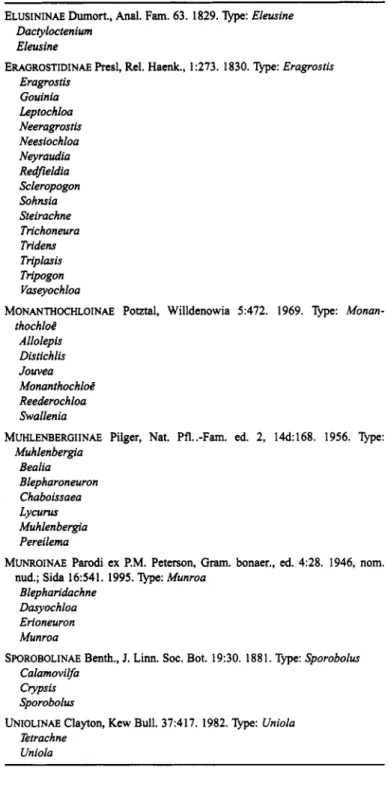
The objectives of this paper are to provide a synopsis of the 38 native and introduced New World genera of the Eragros- tideae and to provide keys in English and Spanish for ease in determination. In addition to the refined generic concepts provided, remarks on nomenclature, number of species in each genus, and habitat preference have been included. A provi- sional classification recognizing seven subtribes is given to elucidate probable phylogenetic relationships among the New World genera.
MATERIALS AND METHODS
The DELTA system (Dallwitz, 1974, 1980) was used in the collection and analysis of the taxonomic data presented in this paper. Initially, an ordered sequence of 89 characters and relevant character states was produced to account for all significant variation at the generic level for the New World Eragrostideae. Data for each of the characters were gathered in DELTA format on the 38 recognized genera from observations of all available specimens or from representative (20-50) specimens from each genus. All species of the smaller genera (1-15 species) or representative specimens of larger genera (more than 15 species) were examined. Recorded data were checked against specimens to insure correctness and uniformity in recording characters. These data were analyzed by the DELTA programs and were used for the production of the identification key, synoptic key, description of the tribe, generic descriptions, and some of the information contained in the remarks section for each genus. For additional information concerning these methods see Webster (1 988), Webster and Valdes-Reyna (1988), Webster et al. (1989), and Webster (1992a, 1992b).
A reliability weight was given to each character and was used for the production of the identification key and for the selection of characters for the diagnosis within the descriptions.
Assessment of reliability was based on the degree of consistency within a genus and on how well the character could be applied. For example, if a character was easy to determine and was consistent within a genus then it was given a higher reliability than a character that was difficult to determine and was variable between the species of the genus. This weight, the settings of other DELTA parameters (i.e., REIASE, ABASE, VARYWT, etc.), and how well the characters separated taxa into equal groups were important parameters influencing the design of the key and the selection of diagnostic characters. These weights, from five (relatively low) to nine (high), are given in the synoptic key following the feature description. For example, character 17 (ligule type) was given the relative weight of 8 and would be considered more taxonomically significant than a 7-weighted character and of less importance than a 9-weighted character.
The DELTA program KEY was used as an experimental tool to automatically generate numerous key designs. After experi- mentation and analysis a final key design was selected that satisfied the authors’ concepts of character significance and placement of the genera, together with the program KEY requirements of mechanical efficiency and correctness. This character list was translated into Spanish for the production of the Spanish key. Finally, the keys were extensively edited to enhance the practical application of the couplets.
The data were converted into INTKEY format for database interrogation and information retrieval. One of the numerous forms of information retrieval is exemplified by the synoptic key for the characters and genera. Initially, an alphabetic list in numeric order is given for the genera and is followed by an ordered sequence of 88 taxonomic characters. This character sequence is identical to that used in the descriptions. Each character consists of the feature description (e.g., plants, spikelets, etc.) followed by the character states used in this study. Each character state is followed by the numbers of genera exhibiting that state. The numbers correspond to those in the list of genera, For example, in character one (plant sexuality), monoecious genera include Blepharidachne (spe- cies 3) and Scleropogon (species 27). The synoptic key is especially useful for understanding the distribution of taxa for the character states.
The description of the tribe was automatically generated by combining the data for all the recognized New World genera into a single description via INTKEY. In this description each character state is followed by a comment consisting of a whole number or a proportion that indicates the number of genera recorded for that state. For example, “plants hermaphroditic (30), dioecious (8)” indicates that 30 of the 38 genera are hermaphroditic, and eight of the 38 genera are dioecious. The statement “main axis glandular (4/37) or not glandular (34137)”
indicates that four of 37 genera have a glandular main axis, 34
of 37 genera have a nonglandular main axis. Evidently, for one genus this character does not apply. From the synoptic key we find that the inflorescence of Monanthochloe consists of a single spikelet and is neither a raceme nor a panicle; that is, the main axis does not exist and the character is inapplicable.
Generic descriptions were generated by CONFOR and then edited to enhance their aesthetic and scientific value. In these descriptions, characters are separated by semicolons, and commas are used where more than two character states apply.
Additional information beyond that conveyed by the character list is treated as comments and is enclosed within parentheses.
A period terminates a sequence of characters describing a primary feature. The descriptions are complete and are fully comparative. Any missing characters within a description are either data not applicable to the taxon or are information designated as implied. For example, if a genus lacks sterile florets then characters describing sterile florets will be inapplicable and will not occur in that description. Further- more, character states designated as “implied” will not occur in the descriptions unless they are associated with additional information in the form of comments or other character states.
Character states designated as implied are indicated within the synoptic key by an asterisk (*). An INTKEY analysis was performed to extract the diagnostic characters for each genus.
The characters of this subset are underlined within each description. They are diagnostic in that the combination of these states is unique for the genus. For example, Allolepis is the only genus with the following subset of data: plants dioecious; ligule a ciliate membrane; florets 8-20 per spikelet;
lemma 3-nerved. Selection of these characters by INTKEY was based on the identical parameters used in key production.
Each description is followed by a paragraph containing four distribution characters, including the distribution by continent, distribution for the political regions of North American and Mesoamerica, distribution for the geopolitical regions of the continental United States, and distribution for the countries of South America. Finally, a character is given as to whether the genus is native or introduced to the New World. Information on each genus is terminated by a “Remarks” section, which presents comments on relationships among the genera and on character similarities.
ACKNOWLEDGMENTS
Financial support to visit the United States National Herbarium, Washington, D.C., was provided to JVR in the form of a Short-Term Visitor Grant from the Smithsonian Institution. We thank Dan Nicolson for correcting the Latin diagnosis and Vittoria Hess for technical support required for the special procedures. We also thank Stephan L. Hatch, Kelly W. Allred, Cheryl S. Roesel, and Surrey Jacobs for suggesting modifications that improved the manuscript.
The Characters and Their Variation
The purpose of this section is to present a discussion of the characters and character states applied in this study. Of the 88 characters initially selected, 21 describe the habit, 17 describe the inflorescence, and, other than distribution and chromosome number, the remaining characters describe various structures of the spikelets (i.e,, general spikelet characters, glumes, rachilla, lemmas, paleas, and caryopses).
Plant sexuality (character 1) was recorded as hermaphroditic for plants with all perfect spikelets, dioecious for separate male and female plants, monoecious for separate male and female spikelets on the same plant, gynomonoecious for plants with pistillate and perfect spikelets, or andromonoecious for plants with staminate and perfect spikelets. The most common state for this character is hermaphroditic. The taxonomic signifi- cance of this character is the presence of the dioecious state, which is diagnostic for Allolepis, Jouvea, Neeragrostis, Scleropogon, and Sohnsia. Scleropogon is the only genus recorded to be either dioecious or monoecious. There are no genera exclusively monoecious, gynomonoecious, or andro- monoecious. An assessment of whether the genera are annual or perennial (character 2) was based on gross morphological features. This character has limited taxonomic significance due to the wide range of overlap among the genera. Bealia, Crypsis, Munroa, Neeragrostis, Neesiochloa, and Pereilema, however, are exclusively annual, and 21 taxa are exclusively perennial.
This character does not appear in the diagnostic characters.
Stoloniferous (character 3) was based on the presence or absence of sterile, above ground, and horizontal culms. This character also has limited taxonomic value at the generic level and does appear in the diagnostic characters. Presence or absence of rhizomes (character 4), or horizontal underground culms, is not a taxonomically significant character because it is not used in any of the diagnostic descriptions. Twenty-two genera may possess a rhizome and 22 may lack rhizomes.
Sixteen genera are exclusively rhizomatous and 16 are not. Six genera (Allolepis, Eragrostis, Gouinia, Muhlenbergia, Spo- robolus, and Tridens) are variable for this character.
Flowering culm habit (character 5 ) was recorded in terms of erect, decumbent, or mat forming. A majority of the genera, 33, may be erect. None are exclusively decumbent, and only Monanthochloe is exclusively mat forming. This character does not appear in the diagnostic characters. Most of the genera may be caespitose (character 6 ) ; however, Blepharidachne, Crypsis, Monanthochloe, Munroa, Neeragrostis, and Pereilema are exclusively not caespitose. This character does not appear in the diagnostic characters. Flowering culms were recorded as either glabrous or hairy (character 7). A majority of the genera may be glabrous. Blepharidachne, Lycurus, Munroa, Sohnsia, and Swallenia are exclusively hairy. This character does not appear in the diagnostic characters. Type of hairs (character 8) associated with the flowering culms was recorded as pubescent for short scattered hairs, as pilose, or as villous. Of the 10
genera that may be hairy, only Swallenia is not pubescent. This character is not taxonomically significant. Whether the inter- nodes are viscid or glaucous was the ninth character applied in this study. Viscid internodes are found in Eragrostis, and glaucous internodes are found in Muhlenbergia; however, character overlap occurs for both genera. Therefore, this character has limited diagnostic value at the generic level.
Whether the leaves are cauline or mostly basal (character 10) was also found to be highly variable. Thirty-one genera may have cauline leaves and 12 may possess mostly basal leaves.
Genera recorded as exclusively with basal leaves include Dasyochloa, Erioneuron, Munroa, Reederochloa, Sclero- pogon, Sohnsia, and Tripogon. This character does not appear in the diagnostic characters. There is no overlap among the genera as to the presence of distinctly distichous leaves (character 11). This character appears in the diagnostic characters for Distichlis, Jouvea, and Monanthochloe, which are exclusively distichous. Character states for presence of leaf auricles (character 12) include the presence of sheath auricles, the presence of blade auricles, or the absence of auricles. The most common state is the absence of auricles, which occurs in 36 of the 38 genera. Blade auricles are only found in Pereilema, whereas sheath auricles may be found in Bealia, Leptochloa, and Muhlenbergia but are exclusive only in Bealia. This character does not appear in the diagnostic characters; however, it is useful for distinguishing Bealia from Blepharoneuron.
Relative length of the sheaths and culm internodes (character 13) showed a high amount of overlap among the genera. This character has limited taxonomic value and does not appear in the diagnostic characters. Whether the sheaths are glandular or not (character 14) is particularly important for distinguishing Neeragrostis from all other genera except Eragrostis, for which this character is variable. Presence of a glandular sheath is one of the two diagnostic characters for Neeragrostis. Whether the sheath margins are smooth or scabrous (character 15) refers to the presence or absence of scabrosities on the margins.
Character-state overlap exists among the genera for this character. Thus, it does not appear in the diagnostic characters and is relatively taxonomically insignificant for these genera.
Presence or absence of a ciliate sheath (character 16) refers to the presence of the hairs on the sheath margins, especially toward the apex. Twenty-four genera are exclusively not ciliate, whereas eight are exclusively ciliate. Six genera are variable for this character, which was not selected for use in the diagnostic characters.
One of the most important vegetative characters is the type of ligule (character 17), which is described in terms of a membrane, a ciliate membrane, a line of hairs, or absent. This character occurs in 12 of the diagnostic subsets of characters.
The ligule in eight genera is exclusively a membrane, and in eight genera it is a ciliate membrane. The taxonomic significance between these two states is minimal. The ligule in 16 genera is exclusively a line of hairs. No genera are recorded for both a membrane and a line of hairs; however, Eragrostis
and Tridens are variable for ligule a ciliate membrane and ligule a line of hairs. Only Blepharidachne may lack a membrane. Shape of the leaf blades (character 18) was recorded in terms of filiform, linear, and triangular. The common recorded state was linear, which was present in 35 genera.
Filiform leaves are found in seven genera but are exclusive only in Redfieldia. Triangular leaves are found in three genera but are exclusive only in Neeragrostis. This character is used in two subsets of diagnostic characters. Character states for shape of the leaf blades in cross section (character 19) include flat, conduplicate, involute, terete, and plicate. Plicate is only found in some species of Blepharidachne, whereas terete is only found in Sporobolus. Involute blades are found in 21 genera and are exclusively found in Calamoviljia, Dasyochloa, Jouvea, Redfleldia, Reederochloa, and Tripogon. Leaf blades condupli- cate is exclusive in Erioneuron and Monanthochloe. The most common state is flat, which is found in 30 genera. This character was not used in the diagnostic characters, which is probably a result of the relatively low weight initially given the character. Leaf blades pungent or not (character 20) was determined by whether or not the tip or apex of the leaf blade was relatively hard and sharp pointed. The most common state was not pungent; however, pungent leaves were found in 12 genera and were exclusive in nine of these. This character does not appear in the diagnostic characters. A determination was made as to whether the leaf margins were thickened or not thickened (character 21). The most common state is lacking thickened margins. Thickened margins are found in seven genera and are exclusive in six (Bealia, Dasyochloa, Erioneu- ron, Lycurus, Munroa, and Neesiochloa). Only Muhlen bergia is recorded as variable for this character, which does not appear in the diagnostic characters.
Number of spikelets comprising the inflorescence (character 22) was grouped into three character states. The most common state is an inflorescence of more than three spikelets, which occurs in 36 genera. An inflorescence of two or three (four) spikelets is characteristic of Jouvea and Reederochloa but is exclusive only in Reederochloa. An inflorescence consisting of a single spikelet occurs in Jouvea and Monanthochloe and is exclusive in Monanthochloe. This character appears in the diagnostic subset of characters and is important in defining the generic limits of Distichlis, Monanthochloe, and Reederochloa.
Type of inflorescence (character 23) was either a raceme or a panicle. A true spike does not occur in this group. The most common state is a panicle, which is characteristic of 35 genera.
A raceme occurs in Dasyochloa, Neesiochloa, Reederochloa, Scleropogon, and Tripogon but is exclusive only in Reedero- chloa and Tripogon. This character is used in the diagnostic subset for Chaboissaea, Eragrostis, Erioneuron, Leptochloa, and Tripogon. Whether the inflorescence was exserted, partially included, or fully included in the upper leaf sheath (character 24) was recorded. The most common state, filly exserted, is found in 35 genera. There is a high amount of overlap between exserted and partially included; however,
Dasyochloa and Monanthochloe are exclusively partially included in the upper sheath. Distichlis and Jouvea are exserted or fully included. Only Munroa is exclusively fully included.
This character does not appear in the diagnostic characters. The main axis of the inflorescence was recorded as glands present or absent (character 25). The implied state is not glandular, which is found in 34 genera. A glandular main axis is found in four genera but is exclusive in Bealia, Neeragrostis, and Neesiochloa. This character does not occur in the diagnostic characters. Whether the main axis was smooth, scabrous, or hairy (character 26) also does not occur in the diagnostic subset of characters. Most of the genera are either smooth or scabrous.
A hairy main axis may be found in six genera but is exclusive in Blepharidachne, Pereilema, and Sohnsia.
Arrangement of primary branches on the main axis (charac- ter 27) was recorded as digitate or not digitate. The most common state is not digitate, which occurs in 35 genera.
Digitate primary branches occur in Dactyloctenium and Eleusine. There is no overlap between these states. The degree of spreading of the primary branches (character 28) was recorded as appressed (an angle less than lo"), spreading (angle 1O0-8Oo), divaricate (angle 8Oo-9Oo), or reflexed (angle greater than 90'). The typical states are appressed and spreading. Seven genera (Dactyloctenium, Eragrostis, Gouinia, Muhlenbergia, Redfieldia, Sporobolus, and Tridens) may be divaricate;
however, only Redfieldia is exclusively divaricate. There are no genera with exclusively reflexed branches. This character does not occur in the diagnostic subset of characters. Whether the primary branches terminate in a spikelet or a bare point (character 29) is significant in defining Dactyloctenium, which is unique for exclusively possessing a naked point at the termination of the primary branches. One of the more important inflorescence characters is the degree of reduction in the primary branches (character 30). The character states include primary branches with appressed secondary branches or with spreading secondary branches and primary branches reduced to a fascicle of spikelets. Twenty-one genera may possess appressed secondary branches and 11 may have spreading secondary branches. Of these, seven (Bealia, Calamovilfa, Eragrostis, Muhlenbergia, Sporobolus, Uniola, and Va- seyochloa) are variable between these states. Three genera have the primary branches reduced to a fascicle of spikelets. Of these, Dasyochloa and Pereilema are exclusively reduced to a fascicle. This character appears in the diagnostic characters for Erioneuron, Leptochloa, and Tridens.
Pedicels were recorded as glandular or not (character 3 1).
The character state pedicels glandular is included in the diagnosis for Blepharoneuron. Not glandular is the implied state and may occur in 32 genera. Four genera may be glandular, but this state is exclusive for Bealia, Blepharoneu- ron, and Neesiochloa. The absence of this character in the diagnostic subset of characters for Bealia and Neesiochloa indicates that higher weighted characters were chosen over this character, which was initially given a relatively low weight of
six. Presence of hair on the pedicels (character 32) also was given a relatively low reliability. Twenty-nine of the genera may be glabrous; of these, only three are variable. Of the six genera with hairy pedicels only Blepharidachne, Sohnsia, and Swallenia are exclusive for that state. Character states for hair type (character 33) include pubescent, pilose, and villous.
Blepharidachne and Sohnsia are exclusively pubescent, Swal- lenia is exclusively pilose, and no genus is exclusively villous.
Hair type has limited taxonomic significance at the generic level. Surface ornamentation of the pedicels (character 34) was recorded as smooth or scabrous. The genera are about equally divided between these states, and only four (Eragrostis, Muhlenbergia, Pereilema, and Tridens) are variable. This character has limited diagnostic value but is used in one couplet of the identification key as a secondary character to separate Erioneuron and Neesiochloa from Leptochloa and Tricho- neura.
Presence or absence of cleistogamous spikelets (character 35) is used in the identification key but does not occur in the subset of diagnostic characters. Of the six genera recorded as possessing cleistogamous spikelets, only two (Steirachne and Triplasis) are exclusive for this state. One of the highest weighted characters is the point of disarticulation (character 36). The two states are disarticulation above or below the glumes; the precise point is not defined. All of the genera except Uniola may have disarticulation above the glumes.
Disarticulation below the glumes occurs in four genera but is variable in three (Cvpsis, Muhlenbergia, and Sporobolus).
This character is used in two of the diagnostic descriptions.
Whether disarticulation is at the base of the florets or within the florets (character 37) determines whether the lemma and palea disarticulate as a unit or disarticulate separately. Typically, the lemma and palea separate as a unit; however, in four genera (Crypsis, Eragrostis, Neeragrostis, and Neyraudia) the lemma and palea disarticulate separately. The latter two of these four are not variable. This character occurs in the diagnostic characters and is especially useful for separating Neyraudia from similar genera.
The term callus is used to define a modification at the point of disarticulation. A hairy callus (character 38) may be found in 15 genera and is exclusive in 12 of these. A glabrous callus is the typical state and may be found in 26 genera. Chaboissaea, Muhlenbergia, and Scleropogon are the only genera variable for this character, which occurs in five of the diagnostic subsets of characters. This character is especially useful for making the final separation between Neesiochloa and Tripogon, Triplasis from Leptochloa and Munroa, and Eragrostis and Redfieldia from similar m a . The only numeric character used in this study was spikelet length (character 39), which was divided into two artificial states (less than or equal to 4.9 mm long and greater than 4.9 mm long), resulting in minimal overlap among the genera. This character is used in the diagnostic characters of Calamovilfa, Jouvea, Leptochloa, and Scleropogon. Arrange- ment of spikelets (character 40) on the primary branch was
described in terms of solitary, paired, or clustered. Lycurus is the only genus with paired spikelets. Spikelets may be in clusters in five genera but are exclusively clustered in four (Jouvea, Munroa, Neeragrostis, and Pereilema). Eragrostis is the only variable taxon for this character. The remaining 32 genera are exclusively solitary. This character is especially useful for separating Jouvea and Scleropogon and for distin- guishing Munroa from similar genera. Presence of sterile, bristle-like spikelets (character 41) is a unique characteristic of Pereilema; the remaining genera lack these structures. Spikelet compression (character 42) was recorded as laterally com- pressed, terete (for no compression), or dorsiventrally com- pressed. Thirty-two genera may be laterally compressed;
however, five of these overlap with other states.
Six
genera are exclusively terete. Muhlenbergia is the only genus that overlaps all three character states. The terete state is especially useful for distinguishing Sporobolus from other genera with a I-nerved lemma (Calamovilfa and Cvpsis). Development of the pedicels (character 43) was recorded as sessile, subsessile (for pedicels less than 0.5 mm long), or pedicellate. Of the eight genera that lack pedicels, four (Dactyloctenium, Eleusine, Jouvea, and Monanthochloe) are exclusive for this state.Thirty-four genera are either subsessile or pedicellate, and a high degree of overlap exists between these states. This character was not in the diagnostic characters.
Presence or absence of glumes (character 44) is only useful for separating Monanthochloe, which always lack glumes.
Presence of glumes is the implied state and occurs in 37 genera.
Jouvea and Munroa are variable for this character. The relative length of the glumes and spikelets (character 45) was separated into three states. Glumes shorter than the spikelets occurs in 30 genera, and glumes about equal to the spikelets occurs in 13 genera. Six genera overlap between these states. Only in Bealia and Muhlenbergia can the glumes exceed the spikelets. This character is especially useful for distinguishing between Leptochloa and Trichoneura. Relative length of the glumes (character 46) was defined by two states, unequal and more or less equal. The genera are about equally split between the states. Variable genera include Blepharoneuron, Eragrostis, Erioneuron, Muhlenbergia, Munroa, Pereilema, and Tridens.
This character is especially useful for distinguishing Cvpsis from Calamovilfa and Sporobolus and distinguishing Chabois- saea from Leptochloa. Surface ornamentation of the glumes (character 47) was recorded as smooth or scabrous. This character has little or no diagnostic value at the generic level and does not appear in the diagnostic characters. The glumes of most of the genera are smooth, 11 may be scabrous, and eight are exclusively scabrous. Presence of hairs on the glumes (character 48) also does not appear in the diagnostic characters.
Thirty-five may be glabrous and four may be hairy. Only Bealia and Lycurus are exclusively hairy. Number of nerves on the first glume (character 49) ranges from 0- to 8-nerved. Only Jouvea always lacks nerves on the first glume. A I-nerved first glume is the most common state and may occur in 30 genera.
No genera are exclusively 2-, 3-, 4-, or 5-nerved. Reederochloa is the most variable genus, with 2-8-nerved first glumes.
Swallenia is exclusively %nerved. This character is especially useful for separating Lycurus from Chaboissaea and Muhlen- bergia. Relative length of the second glume to the lower lemma (character 50) was divided into three states. Four genera are recorded as having a second glume longer than the lemma, but only Dasyochloa is exclusive for this state. The typical morphology is for the second glume to be shorter than the lemma; however, they may be more or less equal in 15 genera This character was not used in the diagnostic characters.
Whether the second glume was awned or unawned (character 51) was not used in the diagnostic characters; however, this character was used as a secondary character in the identification key. The typical state is unawned, but nine genera may possess an awn, and six (Dactyloctenium, Dasyochloa, Lycurus, Neesiochloa, Pereilema, and Trichoneura) of these are exclu- sively awned. This character is useful for separating Neesio- chloa from Tripogon and Erioneuron, Trichoneura from Leptochloa, and Dasyochloa from similar genera. Number of nerves on the second glume (character 52) ranges from one to 1 1. Twenty-eight genera may be 1 -nerved, and five of these are variable. A 3-nerved second glume occurs in 10 genera and is exclusive in Allolepis. No genera are exclusively 5-, 7-, or
%nerved. Swallenia and Vaseyochloa are characterized by a high number of nerves. This character has diagnostic value in separating Gouinia and Chaboissaea.
Rachilla pronounced or not pronounced between the florets (character 53) was weighted as a taxonomically important character but was not selected in the analysis for diagnostic characters nor was it used in the identification key. The absence of a pronounced rachilla is implied and occurs in nine genera.
Only two of these, Allolepis and Chaboissaea, overlap for the states. Rachilla hairy or glabrous (character 54) does appear in the diagnostic descriptions and key. No genera are variable for these states. A glabrous rachilla is the most common state. This character is useful for separating Neesiochloa and Steirachne from similar genera. The number of florets per spikelet (character 55) is one of the more taxonomically important characters. Of the nine genera characterized by a solitary floret, only Chaboissaea (with 1-3 florets) is variable. This character does not give a clear separation among the remaining 30 genera. Five genera (Allolepis, Eragrostis, Jouvea, Neeragros- tis, and Uniola) may have more than 20 florets. The highest number of florets is found in Eragrostis and Neeragrostis. This character is used in 22 of the diagnostic descriptions and is therefore the most significant character for defining New World generic concepts in this tribe. The presence or absence of sterile florets (character 56) was not used in the diagnostic descrip- tions. Sterile florets may be absent in eight genera and are always absent in six (Bealia, Blepharoneuron, Calamovilfa, Ctypsis, Muhlenbergia, and Sporobolus). Chaboissaea and Eragrostis are variable. This character is of secondary importance for distinguishing between Lycurus and Muhlen-
bergia. Location of the sterile florets (character 57) does not occur in the diagnostic description but is used in the identification key. Three genera (Blepharidachne, Neyraudia, and Tetrachne) only possess sterile florets below the fertile ones. Uniola is the only variable genus for this character.
Whether the sterile florets are morphologically similar or dissimilar (character 58) was not selected as a diagnostic character; however, it is used in the key to separate Munroa from Sohnsia and Triplasis. Only Munroa and Pereilema are exclusively heteromorphic.
Shape of the lemma apex (character 59) was defined with four states. Twenty-six genera may be entire, which is the most common state. Of these, only Leptochloa and Muhlenbergia overlap. Eleven genera may be emarginate or lobed. The most taxonomically important state is cleft, which is exclusive for Blepharidachne, Neyraudia, and Sohnsia and which can be used to separate these from morphologically similar genera.
This character occurs in numerous diagnostic descriptions.
Presence of an apical appendage (character 60) was defined in terms of awned, mucronate, and unawned. Fourteen genera are exclusively awned, and 17 genera are either mucronate or unawned. This character is particularly valuable for separating Bealia from Blepharoneuron. Presence of hairs on the lemma (character 61) was not used in the diagnosis, and the genera are evenly divided between the states. Type of hairs on the lemma (character 62) include pubescent, pilose, and villous. This character has limited diagnostic value; however, Erioneuron and Sohnsia are exclusively pilose, and Bealia, Blephari- dachne, Blepharoneuron, Dasyochloa, Neyraudia, Swallenia, and Triplasis are exclusively villous. Surface ornamentation of the lemma (character 63) was described as smooth or scabrous.
This character has little diagnostic value at the generic level and does not appear in the diagnostic subset of characters. Most of the taxa are smooth, but 1 1 are exclusively scabrous. Number of nerves on the lemma (character 64) varies from 1- to 13-nerved. Three genera (Calamovilfa, Crypsis, and Sporobo- lus) are 1-nerved and do not vary. Genera with many-nerved lemmas include Distichlis, Monanthochloe, Reederochloa, Uniola, and Vaseyochloa. The remaining genera are 3-5- nerved. This character is used extensively in the diagnostic descriptions. Texture of the lemma (character 65) varies from hyaline to indurate. Neeragrostis is the only genus exclusively with a hyaline lemma. This state is shared with four genera that overlap with state lemma membranous. Exclusively dense- textured lemmas are characteristic of Allolepis, Distichlis, Monanthochloe, Reederochloa, and Scleropogon. This charac- ter is useful for the final separation of Chaboissaea from Bealia and Blepharoneuron. Whether the lemma nerves are glabrous or hairy (character 66) has little diagnostic value. Genera that are variable for the states of this character include Calamovi&ia, Leptochloa, Muhlenbergia, and Sohnsia. Whether the palea is hairy or glabrous (character 67) is valuable for making the final separation of Dasyochloa from Munroa and Neyraudia. The typical state for the presence or absence of an awned palea
(character 68) is unawned. Only three genera (Chaboissaea, Gouinia, and Muhlenbergia) may possess an awned palea. This character is specifically valuable for making the final separa- tion of Gouinia from Eleusine, Leptochloa, and Tridens.
Texture of the palea (character 69) varies from hyaline to indurate. Cvpsis and Neeragrostis are exclusively hyaline. The most common states are membranous and chartaceous, which are found in 34 taxa. Genera with relatively dense-textured paleas are Allolepis and Monanthochloe. Recording data for whether or not the palea margins enfold the h i t (character 70) tended to be subjective, and the distinction between the states was obscure. As a result, the character was initially given a low weight and thus was not used in the key and diagnostic descriptions. At present, 1 1 genera are coded as palea enfolding the h i t and the others are coded as the alternative, with no overlap between the states. Additional studies are needed to precisely define the differences between the states of this character. Whether the palea keels are ciliate or not (character 71) does not appear in the diagnostic characters but is used as a secondary character in the key. A ciliate palea occurs in 11 genera but is exclusive for nine genera. Eragrostis and Gouinia are the only variable taxa. Surface Ornamentation of the palea (character 72) was recorded as smooth or scabrous. The character has limited taxonomic significance at the generic level and was not used in the key or the diagnostic characters.
Those genera recorded as always scabrous are Chaboissaea, Eleusine, Gouinia, Lycurus, Pereilema, and Steirachne.
Presence or absence of lodicules (character 73) was given a relatively low weight due to the difficulty in correctly making the interpretation. The common or typical condition is for the lodicules to be present, which occurs in 35 genera. It appears to be always absent in Blepharidachne, Crypsis, and Monan- thochloe. Variable genera are Munroa, Scleropogon, and Sporobolus. Whether or not the lodicules are adnate to the palea (character 74) also was given a relatively low weight. Only two genera (Erioneuron and Tridens) are recorded as adnate, and there are no variable genera for this character. Shape of the lodicule apex (character 75) also was low weighted and was not used as a diagnostic character. The most common state is truncate, which occurs in 25 genera. At present, data for this character are suspect.
Number of stamens (character 76) varies between one and three. No genus exclusively has only one stamen. One or three stamens are found in Erioneuron, and one to three stamens are found in Tripogon. Only Steirachne is recorded as exclusively possessing two stamens. Three stamens occur in 37 genera.
Anther color (character 77) was grouped into three states (yellow, reddish purple, and olivaceous plumbeous). Twenty- four genera are coded as yellow, and of these, 16 are exclusively yellow. Twenty were considered to be reddish purple. Six genera (Eragrostis, Jouvea, Leptochloa, Lycurus, Redfieldia, and Tetrachne) are variable between these states.
Neesiochloa and Reederochloa are exclusively olivaceous
plumbeous. Because the distinction between these states can be somewhat subjective, the character was given a relatively low weight and was not used in the identification key or diagnostic characters. Number of stigmas (character 78) is consistently two for all genera except Munroa, which varies between two or three stigmas. Whether the pericarp is free or adnate (character 79) to the fruit was weighted relatively high.
Thirty-one taxa possess the implied state of an adnate pericarp.
A free pericarp is found in seven genera and no taxa vary between these states. This character is useful for separating Eleusine from other genera with a ciliate membrane ligule and for separating Terrachne from genera with a similar ligule and overlapping number of florets per spikelet. Compression of the caryopsis (character 80) was not considered to be a highly reliable character. The typical condition is terete, which is characteristic of 27 genera. Exclusively dorsiventrally com- pressed caryopses are found in Munroa, Neesiochloa, Tricho- neura, Tridens, and Triplasis, whereas the caryopsis in
Blepharidachne, Pereilema, and Reederochloa is exclusively laterally compressed. Presence of persistent style bases (character 8 1) was high weighted. The typical condition is for persistent style bases to be absent. The presence of these persistent bases is diagnostic of Swallenia and Vaseyochloa, which may be then separated on shape of the base (character 82). A short and blunt base is characteristic of Swallenia, and a sharp-pointed base is characteristic of Vaseyochloa. Base chromosome number (character 83) for this tribe is typically eight, nine, or 10. A base number of seven is found in Blepharidachne and Munroa, but the latter may have a base number of eight.
Distribution was described under four characters (distribu- tion by continent (character 84), in North America and Mesoamerica (character SS), in regions of the United States (character 86), and in South America (character 87)). Specific data on these characters are discussed following each generic description.
Key to the Eragrostideae of the New World
Florets 1 per spikelet
. . .
2Florets 2 or more per spikelet
. . .
12Lemma 1-nerved; ligule a line of hairs or absent; fruit with free pericarp
. . .
3Lemma 3-nerved or more; ligule a membrane or a ciliate membrane; fruit with adnate pericarp
. . .
5Spikelets 2 5-10 mm long; lemma chartaceous; callus hairy; palea hairy
. . . .
Spikelets up to 4.9 mm long; lemma hyaline to membranous; callus glabrous; Glumes very unequal; spikelets usually terete; glumes smooth. . . . . .
29. Sporobolus Glumes more or less equal; spikelets strongly laterally compressed; glumes scabrous.. . .
. 7 . Crypsis Spikelets subtended by sterile bristles and in small clusters; blade auricles prominent and usually ciliate. . .
24. Pereilema Spikelets not subtended by sterile bristles and occurring solitarily or in pairs; blade auricles absent. . .
6Lemma apex emarginate to lobed
. . .
11. . .
5 . Calamovilfa palea glabrous. . .
. 4Lemma apex entire.
. . .
7First glume 1-nerved and occasionally I-awned
. . .
8First glume 2- or 3-nerved and 2(-3)-awned
. . .
10Lemma with densely appressed to spreading silky, whitish hairs on midnerve and margins, hairs often appearing as ridges on surface at x20; pedicels minutely glandular, capillary, wiry, and flexuous, usually nodding and reflexed; paleas densely silky villous between nerves
. . .
. . .
, 4 . Blepharoneuron Lemma glabrous or with appressed to spreading hairs on midnerve and margins but without silky, whitish hairs appearing as ridges on surface at x20; pedicels not minutely glandular, appressed or spreading, occasionally capillary to nodding and reflexed; paleas glabrous or with appressed to spreading hairs between nerves.. . .
9lO(7).
1 l(6).
12( 1).
13(12).
14(12).
15(14).
16(15).
17(16).
18( 15).
Spikelets with 1,2, or occasionally 3 florets, lowermost perfect, upper pedicelled florets usually staminate, reduced, and/or sterile; lemma chartaceous and Spikelets with 1 floret, or when occasionally 2-3-flowered, upper floret fertile;
lemma hyaline or membranous, rarely chartaceous, plumbeous or mottled
. .
Spikelets paired; sterile florets present, lower spikelet with floret short pedicellate, usually staminate, occasionally sterile or perfect, upper spikelet with floret usually long pedicellate and perfect; inflorescence a spiciform Spikelets solitary or paired; sterile florets absent; inflorescence a contracted Lemma apex deeply bilobed, lobes 1-1.4 mm long, rounded to obtuse; awn crisped-curled to flexuous, borne between lobes; pedicels minutely glandular;
Lemma apex not deeply bilobed (except in perennials Muhlenbergia argentea and M. lucidu), sometimes emarginate to shallowly lobed, teeth C 1 mm long, usually acuminate to aristate; awn straight to flexuous; pedicels not glandular;
wide ranging in North and South America to Southeast Asia
. . .
Caryopsis with persistent styles bases
. . .
13 Ligule a membrane or a ciliate membrane; caryopsis with pronounced sharp-pointed style bases, deeply concave on ventral side; leaf blades not Ligule a line of hairs; caryopsis with relatively short and blunt style bases, not deeply concave on ventral side; leaf blades pungent; glumes more or less equal. . .
. 3 1 . Swallenia Inflorescence a raceme with stalked or pedicelled spikelets placed along central axis. . .
15 Inflorescence a panicle with at least primary branches, these rebranched, or primary branches often racemosely inserted along elongated central axis or digitately arranged from central point.. . .
19 Second glume 1 -nerved; plants hermaphroditic; lemma emarginate, lobed, or Second glume 3-8-nervedY nerves often indistinct; plants dioecious or monoecious; lemma entire; lemma coriaceous. . .
18 Ligule a line of hairs; palea extending into awns; leaf blades pungent; plants Ligule a ciliate membrane; palea not extending into awns; leaf blades not Lemmas oblate (much wider than long) to fan-shaped, apex truncate; spikelets3-5.5 mm wide; glumes more or less equal; second glume awned; rachilla Lemmas elliptic to ovate-lanceolate, apex acute; spikelets < 1.5 mm wide;
glumes very unequal; second glume unawned; rachilla glabrous
. . .
Lemmas of pistillate spikelets unawned; ligule a membrane; staminate culms 3- 1 1 cm tall; sheaths ciliate; leaf blades tightly involute; glumes very unequal
. . .
.26. Reederochloa Lemmas of pistillate spikelets with 3 terminal awns 3-15 cm long; ligule a line of hairs; culms mostly 10-25 cm tall; sheaths not ciliate; leaf blades flat or conduplicate; glumes more or less equal. . .
27. Scleropogon plumbeous to grayish yellow, mottled. . .
6. Chabohsaea. . .
19. Muhlenbergiapanicle, branches < 0.6 cm long
. . .
17. Lycurus panicle, branches 1-3.7 cm long. . .
19. Muhlenbergiasingle annual species in Chihuahua and Durango, Mexico
. . .
2. Bealia. . .
19. Muhlenbergia Caryopsis lacking persistent style bases. . .
14pungent; glumes very unequal
. . .
.38. Vaseyochloacleft; lemma membranous
. . .
16stoloniferous
. . .
9. Dasyochloa pungent; plants lacking stolons. . .
17hairy
. . .
22. Neesiochloa. . .
36. Tripogon19( 14). Disarticulation below glumes, spikelets falling entire; lemmas strongly keeled, coriaceous, 3-9-nerved; lower 2-6 florets of each spikelet sterile
. . . . . .
37. Uniola Disarticulation above glumes, spikelets not falling entire; lemmas not strongly keeled, or if keeled then hyaline, membranous, or chartaceous, usually3-nerved; lower florets of each spikelet usually fertile
. . .
2020(19). Lemma and palea usually disarticulating separately; keels of palea usually ciliolate; palea longitudinally bowed out
. . .
12. Eragrostis Plants lacking above combination of character states. . .
2121(20). Ligule a membrane or a ciliate membrane
. . .
22Ligule a line of hairs or absent
. . .
3922(21). Lemma entire.
. . .
23Lemma emarginate, lobed, or cleft
. . .
3323(22). Fruit with free pericarp; inflorescence with primary branches digitate or of I-sided racemes loosely spaced along central axis
. . .
24Fruit with adnate pericarp; inflorescence with primary branches not digitate or of l-sided racemes along central axis
. . .
. 2 6 24(23). Inflorescence with 6-16 racemosely arranged primary branches; sterile florets present below fertile ones. . .
32. Teachne Inflorescence with 1-1 7 digitately or subdigitately arranged primary branches; sterile florets present above fertile ones. . .
2525(24). Second glume l-nerved and awned; primary branches terminating in a bare point; plants often stoloniferous
. . .
8. Dactyloctenium Second glume 3-5-nerved and unawned; primary branches terminating in a spikelet; plants lacking stolons. . .
11. Eleusine Leaves not distinctly distichous; leaf blades not pungent. . .
2827(26). Inflorescence consisting of a solitary spikelet borne in mils of fascicled leaves; leaf blades 0.5- 1.5 cm long, conduplicate and subulate; glumes absent; plants stoloniferous; spikelets sessile
. . .
18. Monanthochloe Inflorescence normally consisting > 3 spikelets borne on exserted to partially included axis without fascicled leaves; leaf blades 2-8 cm long, flat or involute, linear; glumes present; plants usually lacking stolons; spikelets pedicellate. . .
10. Distichlis 28(26). Plants hermaphroditic. . .
29Plants dioecious or andromonoecious
. . .
3229(28). Spikelets < 5 mm long
. . .
30Spikelets 2 5 mm long
. . .
3130(29). Glumes very unequal; inflorescence with racemose primary branches along elongated central triquetrous main axis; lemma membranous, greenish to 26(23). Leaves distinctly distichous; leaf blades pungent
. . .
27stramineous, not mottled; palea membranous and smooth
. . .
. . .
16. Leptochloa Glumes more or less equal; inflorescence with distant, alternate, rebranched primary branches, secondary branches usually strongly appressed; lemma chartaceous and plumbeous to grayish yellow, mottled; palea chartaceous and scabrous. . .
6. Chaboissaea 31(29). Lemmas awned, awns 5-20 mm long; callus hairy; sheaths with scabrous margins; glumes and palea scabrous. . .
14. Gouinia Lemmas unawned or with awns < 3.5 mm long; callus glabrous; sheaths with smooth margins; glumes and palea smooth. . .
16. Leptochloa32(28). Spikelets 1.8-4.7 mm long; second glume l-nerved; plants lacking stolons;
spikelets laterally compressed, usually with 2, or occasionally 3, florets, lowermost perfect, upper pedicellate florets usually staminate, reduced, and/or
. . .
6. Chaboissaea Spikelets 9-25 mm long; second glume 2-nerved or more; plants stoloniferous;spikelets terete or dorsiventrally compressed, with 6-20 florets, upper ones often sterile; lemma coriaceous and stramineous or lustrous, not mottled
. . . . . .
1. Allolepis 33(22). Sterile florets reduced, sterile florets below fertile floret; spikelets always 4-flowered, 2 sterile, 1 fertile, 1 reduced; fertile lemma 3-awned; pedicels hairy; lodicules absent , ,. .
,. .
, ,.
, ,.
, , ,.
, 3. Blepharidachne Sterile florets only above fertile florets; spikelets usually > (2-)4-20-flowered;fertile lemma usually l-awned; pedicels glabrous; lodicules present
. . . .
3434(33). Lemma awned.
. . .
. 3 5 Lemma unawned or mucronate. . .
. 3 835(34). Callus hairy; palea ciliate; leaf blades with thickened margins; pedicels smooth
. . .
36Callus glabrous; palea not ciliate; leaf blades without thickened margins;
pedicels scabrous
. . .
37 36(35). Lemmas ovate to lanceolate, apex acute to obtuse; second glume unawned;rachilla glabrous; primary branches with appressed secondary branches;
pedicels < 4 mm long
. . .
13. Erioneuron Lemmas oblate (much wider than long) to fan-shaped, apex truncate; second glume awned; rachilla hairy; primary branches with spreading secondary 37(35). Glumes shorter than spikelet, very unequal, smooth; second glume unawned;rachilla completely glabrous; lateral nerves of lemma not ciliate, often pubescent, hairs < 0.6 mm long
. . .
16. Leptochloa Glumes about equaling spikelet, more or less equal, scabrous; second glume awned; rachilla with a tuft of hairs at summit; lateral nerves of lemma long-ciliate, hairs 1-3 mm long. . .
33. Trichoneura 38(34). Inflorescence with racemose primary branches along elongated central triquetrous rachis, spikelets mostly appressed; lemmas mostly glabrous to puberulent along nerves below. . .
16. Leptochloa Inflorescence with paniculate primary branches with mostly spreading. . .
34. Tridens 39(21). Lemma entire.. . .
40 40(39). Plants hermaphroditic. . .
41 Plants dioecious or monoecious. . .
. 4 34 l(40). Sterile florets below fertile florets; inflorescence with racemose primary branches separated by about their own length along central axis; plants introduced to New World
. . .
32. Teirachne Sterile florets above fertile florets; inflorescence with paniculate primarybranches; plants native to New World
. . .
42 42(41). Callus glabrous; glumes more or less equal in length; cleistogamous spikelets near base or upper leaf a i l s ; spikelets 6- 13-flowered; lemma membranous;keels of palea bowed out, finely ciliate-scabrid
. . .
30. Steirachne sterile; lemma chartaceous and plumbeous to grayish yellow, mottled. . . .
branches; pedicels 5-20 mm long
. . .
22. Neesiochloasecondary branches; lemmas mostly short hairy along nerves below
. . .
Lemma emarginate, lobed, or cleft