GLOBAL MARKET REACTION TO THE INDONESIAN ISLAMIC CAPITAL MARKET DURING COVID
OUTBREAK
Ahmad Habibi1*
Khavid Normasyhuri2 Aula Nurul Ma’rifah3
1,2,3Universitas Islam Negeri Raden Intan Lampung
*Corresponding Email: [email protected]
ABSTRACT - The COVID-19 pandemic has impacted the global Islamic capital market, including Indonesia. As a result, it is critical to investigate the global stock market reaction to this issue. This study seeks to comprehend the global Islamic stock market's reaction to the Indonesian Islamic stock market, as represented by the Jakarta Islamic Index (JII), during the COVID-19 outbreak. To test the hypothesis, this study employs the Error Correction Model (ECM) techniques. The findings revealed that the global Islamic stock market had a significant influence on the Indonesian Islamic stock market during that time, both in the short and long term. This is due to the Islamic stock market's interconnected nature, which attracts investors as it allows foreigners to own Islamic stocks in Indonesia, and also offers valuable long- and short-term prospects. In addition, the globalization of the world economy, social and political relations are interrelated between countries, especially in the era of COVID-19. Because the outbreak was unavoidable, it caused global economic chaos and extreme crises, including investments in the Islamic stock market. In light of crisis, the findings of this study can be used as practical guidance for investors considering investing in the Islamic stock market.
Keywords: Covid-19, Indonesian Islamic stock market, Market reaction
ABSTRAK - Reaksi Pasar Global Terhadap Pasar Modal Syariah Indonesia Dalam Masa Covid-19.
Pandemi COVID-19 berdampak pada pasar modal syariah global, termasuk Indonesia. Oleh karena itu, kajian yang berkaitan dengan hal tersebut sangat penting dilakukan. Penelitian ini bertujuan untuk mengkaji reaksi pasar modal syariah global terhadap pasar modal syariah Indonesia yang diwakili oleh Jakarta Islamic Index (JII) dalam masa COVID-19. Untuk menguji hipotesis, penelitian ini menggunakan teknik Error Correction Model (ECM). Hasil temuan menunjukkan bahwa pasar modal syariah global memiliki pengaruh signifikan terhadap pasar modal syariah Indonesia, baik dalam jangka pendek maupun jangka panjang. Hal ini disebabkan oleh sifat interkoneksi pasar modal syariah, yang menarik investor karena memungkinkan orang asing untuk memiliki saham syariah di Indonesia, dan juga menawarkan prospek jangka panjang dan jangka pendek yang menguntungkan. Selain itu, akibat globalisasi ekonomi, hubungan sosial dan politik antar negara saling berkaitan, terutama di era COVID-19. Karena pandemi tersebut tidak terhindarkan, kondisi ekonomi global dan krisis terjadi dalam berbagai sektor, termasuk pasar modal syariah. Temuan penelitian ini berimplikasi sebagai pedoman praktis bagi investor dalam berinvestasi di pasar modal syariah di Indonesia.
Kata Kunci: Covid-19, Saham Syariah, Pasar Modal Syariah Indonesia
INTRODUCTION
The Covid-19 pandemic that struck the world at the end of December 2019 precipitated crises in every aspect of life. The 2019 Corona Virus, also known as the Covid-19 Virus, was discovered and identified for the first time in the Wuhan region of China (United Nations 2020). The global outbreak of COVID- 19 has had far-reaching consequences in a variety of industries. Not only did the face of health cause the death of millions of people, but it also caused a very powerful contraction in the economic field.
Indonesia was not immune to the Covid-19 outbreak. The first Covid-19 case in Indonesia was discovered in March 2020 and quickly spread. As a result, the Covid-19 pandemic is a major concern for the Indonesian government. As the situation worsened, the Indonesian government moved quickly and declared a national lockdown at the end of March 2020 to ensure that the Corona Disease 2019 virus did not spread and kill millions of people.
The Covid-19 pandemic has resulted in an economic crisis that has had repercussions on the global economic order and on society as a whole. As it indirectly affects political, economic, and social systems, including the Islamic capital market, this pandemic has unquestionably created one of the greatest challenges ever faced by global humanitarian and development organizations (Hasan et al., 2021; Rani et al., 2020). The Covid-19 pandemic has had a profound impact on global Islamic stock markets, creating a sense of uncertainty and exposing the fragility of the global financial system, as noted by Salisu and Shaik (2022). Given its importance in today's global economy, the capital market plays a crucial role in the financial sector, as highlighted by Hasan et al. (2021). The Islamic capital market, which operates in accordance with sharia principles, encompasses a range of activities related to issuers, securities, and trading mechanisms, as Adekoya, Oliyide, and Tiwari (2022) have observed. Despite the challenges posed by the pandemic, the Islamic capital market continues to play an important role in supporting economic growth and development.
Global Islamic capital markets are spread across various regions in Asia, including Vietnam, Malaysia, Philippines, Singapore, Thailand, Bahrain, Kuwait, Oman, Qatar, United Arab Emirates, China, Japan, India, Hong Kong, Taiwan, Australia, South Korea, and Switzerland. Meanwhile, in the European region, countries like England, Netherlands, France, Sweden, Denmark,
Germany, Russia, Italy, Finland, Spain, and the United States also have their Islamic capital markets. The stock index is the key parameter used to measure the trend or movement of stock prices, as it serves as a marker of market direction and a benchmark for portfolio performance in the Islamic capital market. The Dow Jones Islamic Market Index (DJIM) is the most commonly used index for measuring Islamic stocks globally, as it is specifically designed for investors who want to invest according to Islamic sharia law (Yarovaya, Elsayed, & Hammoudeh, 2021).
The Covid-19 pandemic had a significant impact on the global Islamic stock market, as most Islamic stock market indices experienced a sharp decline in prices. Islamic stock markets in countries affected by Covid-19 faced negative abnormal returns due to investors' pessimism about market conditions, resulting in an overreaction phenomenon (Halim, 2021). The pandemic also caused instability and weakened investments in the global Islamic stock market, as highlighted by the shock from the COVID-19 virus disaster. The Islamic capital market faced significant shocks during the pandemic, which led to a decline in investment portfolios. The pandemic had a significant negative impact on the Islamic capital market, resulting in a significant decrease in investment levels in the Islamic stock market (Slide & Ashraf, 2022).
The long-term negative impact of the virus on the global economy has also affected sharia investment in Indonesia. To measure the movement of sharia investment in Indonesian sharia stocks, the Jakarta Islamic Index (JII) can be used. The JII is one of the stock indexes in Indonesia used to calculate the average stock price index of types of stock that meet sharia criteria (Faruk, 2022). The pandemic caused a significant decline in the Indonesian sharia stock returns, reflecting the strong reaction of the JII to the fall in the Islamic stock market in Indonesia. The Covid-19 pandemic also affected the dynamics of the sharia stock market, leading to increased inefficiencies and a slump in the stock market in Indonesia. The negative impact of the increase in Covid-19 cases on Islamic stock market returns was mainly due to investor sentiment being pessimistic about future yields and concerns over uncertainty.
In addition, the spread of the COVID-19 virus has triggered a critical liquidity situation and resulted in an unpredictable setup in the Indonesian Islamic stock market. If the COVID-19 pandemic persists, stability may not increase, and the movement of Islamic stocks on the Jakarta Islamic Index (JII) may decline further. The rapid spread of the COVID-19 outbreak in Indonesia has raised
market concerns about its economic impact, leading to a weakening of stock prices in the Islamic capital market. Research conducted by Mishra and Mishra (2020) has found that the virus has caused a spiral of uncertainty in the stock market in Asia.
Previous studies have shown that the COVID-19 pandemic has caused uncertainty in the stock market and has had a significant negative impact on the global capital market, including the conventional and Islamic stock markets.
Hassan et al. (2021), for instance, found that the pandemic has pushed the global capital market to the brink of a terrible decline. The pandemic has also had a long-term negative impact on the global economy, particularly in the investment sector. Meanwhile, Adekoya, Oliyide, and Tiwari (2021) have noted that the Islamic capital market experienced shocks during the pandemic, causing a decline in investment portfolios. Portfolio managers must closely monitor health outbreak trends due to the COVID-19 pandemic. Furthermore, Rahmayani and Oktavilia (2020) found that the higher cumulative number of COVID-19 cases was a source of weakness in the Indonesian stock market in the long term. Recent studies showed that the incidence of Covid-19 and the implementation of Large-Scale Social Restrictions (PSBB) had a significant impact on the stability of the Islamic stock market. A study by Rizaldy and Rahayu (2021) employed a global Islamic stock market map during the Covid- 19 period to analyze the performance of Islamic stock indices in Indonesia and compared it to other countries. The objective of examining global Islamic stock investments during the pandemic was to assess both returns and risks, given the pandemic's severe impact on the global economy and the Islamic capital market.
Despite previous research findings, there remains a research gap regarding the reaction of the Islamic capital market to the global COVID-19 pandemic and its domestic impact on the Indonesian Islamic stock market. Therefore, this study aims to provide empirical evidence regarding the strong influence of the global Islamic stock market on the Indonesian Islamic stock market in both the short and long term during the COVID-19 era. This is due to the global Islamic stock market becoming a reference map for investors in assessing the movement of Indonesian Islamic stocks and considering the returns and risks associated with investing in the Indonesian Islamic stock market.
LITERATURE REVIEW Contagious Effects Theory
The contagious effects theory, as posited by Barry, Rose, and Wyplosz, suggests that contagion occurs successively among interconnected countries.
This phenomenon is observed when economic crises spread to other countries that share similar economic conditions. The contagion effect is brought about by the information asymmetry and collective behavior of investors, who may respond to the same information by altering their expectations in the capital market (Aslam et al. 2020). In this context, the investment and stock market in one country cannot be considered independent of those in other countries, but rather interdependent and with potential long-term impacts, a phenomenon commonly referred to as the domino or contagion effect. The situation in Indonesia, specifically in the Islamic capital market, is not immune to the global crises affecting other countries. As global investment flows greatly impact the Indonesian economy, crises that occur elsewhere may have significant repercussions in Indonesia's capital market. As a result, it is crucial to examine the reaction of the Islamic capital market in Indonesia to global crises, as it is an integral part of the global financial system.
PortfolioTheory
Portfolio theory was initially formulated by Harry Markowitz, who proposed the Markowitz model, which aims to obtain the desired level of returns with minimal risk. The reduction of risk is achieved through diversification, which involves investing in multiple assets with a certain proportion of funds, rather than investing in a single asset (Rusydiana & Prakoso 2021). This process involves the allocation of assets in the capital market, such as stocks, and the determination of the percentage of shares in each investment product. To select and allocate investments, it is crucial to analyze macro conditions (Pratiwi et al., 2020). Portfolio risk is calculated based on the contribution of asset risk to the portfolio risk. Hence, diversification is necessary to minimize risk.
Systematic risk, which is the risk caused by macro factors that affect all companies and industries, such as changes in interest rates, exchange rate fluctuations, and economic recession, is a crucial factor to consider in portfolio management (Nugraha, 2021).
Sharia Capital Market
The Islamic capital market, which adheres to the principles of Islamic finance, prohibits transactions that involve interest, gambling, speculation, and other prohibited practices. This market serves as a complement to other financial institutions in the financial system, including commercial banks and insurance companies, by providing intermediary services (Bahloul and Khemakhem 2021). The growth of the global Islamic capital market was driven by the urgent need for liquidity management by Islamic financial institutions. During the 1980s and 1990s, Islamic financial institutions were able to mobilize funds through deposits, which were invested in a limited number of financial instruments (Ashraf, Rizwan, and Ahmad 2022). The Islamic capital market has since expanded, offering a wider range of investment options, including Islamic bonds (sukuk), equities, and investment funds that are compliant with Islamic principles. This has helped to meet the growing demand for Shariah- compliant financial products and services.
Sharia Stock
In the context of the capital market, stocks or shares are commonly understood as evidence of ownership or a manifestation of capital ownership in a limited liability company. Shareholders, as the owners of the company, have decision- making power in proportion to their shareholding percentage. The profits earned by the company are distributed to the shareholders in the form of dividends, which are determined at the General Meeting of Shareholders upon the conclusion of the financial statements (Bugan, Cevik and Dibooglu 2022).
However, in the Islamic financial system, the concept of equity participation is implemented in a manner that is consistent with sharia principles. Accordingly, sharia shares refer to certificates that indicate proof of company ownership issued by entities whose business activities and management practices are not in violation of sharia principles. In contrast to conventional shares, equity participation in sharia-compliant companies avoids activities that are deemed haram (forbidden), such as gambling, usury, and the production of prohibited goods (Aloui et al., 2022). The issuance of sharia shares reflects the notion of equity participation in companies that adhere to sharia principles and practice profit-sharing arrangements that are in line with these principles (Bossman, Owusu Junior, and Tiwari 2022).
Dow Jones Islamic Market (DJIM)
The Dow Jones Islamic Market (DJIM) is a stock market index established by Charles Dow, the editor of The Wall Street Journal and founder of Dow Jones
& Company. The index was designed to gauge the performance of industrial components on the US stock market and was officially launched on May 26, 1986 (Choi, 2022). As one of the oldest continuously running US stock market indices, the DJIM is a globally recognized benchmark that is comprised of investable equities that have been screened for Shariah compliance. To ensure Shariah compliance, companies involved in the production of alcohol, pork- related products, tobacco, and weapons and defense, as well as those in the entertainment and conventional financial services industries, are excluded from the index through a rigorous filtering process (Ali, Jiang, and Sensoy 2021).
Jakarta Islamic Index (JII)
The Jakarta Islamic Index (JII) is a stock index in Indonesia that is specifically designed to reflect the performance of sharia-compliant stocks. The introduction of this index was a significant milestone in the development of the Islamic Capital Market in Indonesia, and it was launched in Jakarta on March 14, 2003. The mechanism of the Islamic Capital Market follows the model of similar markets in other countries, such as Malaysia, and operates alongside conventional stock exchanges such as the Jakarta Stock Exchange and Surabaya Exchange. The JII comprises 30 stocks that meet sharia criteria, and the index is calculated based on the average stock price index of these stocks, using January 1, 1995, as the base day with a value of 100 (Nugroho et al., 2021). The establishment of JII aimed to enhance investor confidence in sharia- compliant stocks and provide them with investment opportunities that adhere to Islamic principles. The index is expected to promote transparency and accountability in the trading of sharia-compliant shares in Indonesia. JII serves as a guide for investors who seek to invest their funds according to sharia principles, without the fear of being associated with usurious activities.
Moreover, JII serves as a performance benchmark for investors in selecting a halal stock portfolio. Overall, the creation of the JII has contributed significantly to the growth and development of the Islamic Capital Market in Indonesia (Karerina et al., 2021).
Hypothesis Development
The emergence of a novel virus, namely the severe acute respiratory syndrome coronavirus 2 (SARS-CoV-2), which causes coronavirus disease 2019 (COVID-19), has triggered global shockwaves. It is widely acknowledged that the virus was first identified in Wuhan, China, towards the end of December 2019. The coronavirus family is known to cause respiratory illnesses, ranging from mild common colds to severe conditions such as Middle East Respiratory Syndrome (MERS-CoV) and Severe Acute Respiratory Syndrome (SARS- CoV). Being a positive single-strand RNA virus, the coronavirus primarily infects the respiratory tract and can be transmitted from animals to humans (Liu et al., 2020). The swift transmission of the virus, which has spread rapidly across countries, has had a significant impact on global economies, including the Islamic capital market. Furthermore, the unprecedented situation has led to the enactment of the Indonesian Government Regulation number 21 of 2020, which stipulates large-scale social restrictions to manage the outbreak of COVID-19 (Yuliana, 2020). Consequently, the era of COVID-19 has given rise to an atmosphere of uncertainty that has severely affected sharia stock investment in the capital market sharia (Saleem et al., 2021).
Previous research conducted by Situngkir (2019) found that the Dow Jones Index, Strait Times Index, and Hang Seng Index have significant impacts on the Jakarta Composite Index (IHSG) in both the short and long term.
Kurniawan (2019) also revealed that the Dow Jones Islamic World Malaysia Index (DJMY25D) and the Dow Jones Islamic Market Japan Index (DJIJP) have positive and significant effects on the Indonesian Islamic Stock Index (ISSI). Herlianto and Hafizh (2020) provided scientific evidence of the combined significant effects of the Dow Johns Index, Nikkei 225, Shanghai Composite Stock Price Index, and Singapore Straits Times Index on the Jakarta Composite Index (IHSG) on the Indonesia Stock Exchange (IDX). In another study, Soeharjoto and Inviah (2021) demonstrated the positive and significant effects of the Dow Jones Islamic Market India Index, the Dow Jones Islamic Market Asia or Pacific ex-Japan Index, and the Dow Jones Arabia Titans 50 Index on the Indonesian Sharia Stock Index in the long run. Finally, Safitri (2021) revealed that the Korea Composite Stock Price Index, Hang Seng Index, Straits Times Index, and Dow Jones Industrial Average jointly have a significant impact on the Jakarta Composite Index.
Drawing on the aforementioned research findings, the research hypothesis can be formulated as follows: “The Global Sharia Stock Market has a significant influence on the Indonesian Sharia Stock market in the short and long term during the Covid-19 era”.
METHODOLOGY
This research adopts a quantitative approach with an associative design. The independent variable in this investigation is the global Islamic stock market, encompassing the United States Dow Jones Islamic Market (DJIMUS), Dow Jones Islamic Market Turkey Index (DJIMTR), Dow Jones India Islamic Market (DJIMIN), Dow Jones Islamic Canada (DJICA), and Dow Jones Islamic Market Europe 25 (DJEU25). The dependent variable, on the other hand, is the Indonesian Islamic stock market, which includes the Jakarta Islamic Index (JII).
To ensure generalizability to the Covid-19 period in Indonesia, which commenced in March 2020, this study employs time-series data covering the period from March 2020 to December 2021 (Sihombing, 2022). The global Islamic capital market data is sourced from the Dow Jones Islamic Market World Index-S&P Global, while the Indonesian Islamic capital market data is obtained from the Indonesian Stock Exchange (IDX). The statistical software used for analysis is Eviews Version 10, while the Error Correction Model (ECM) technique is applied for data analysis. The analysis process involves several stages of testing, including the Degree of Integration Test, Cointegration Test, Classical Assumption Test, and Hypothesis Test (Ghozali, 2018).
Integration Degree Test
The purpose of conducting a degree of integration test is to examine the stationarity of the residual. Stationary data is a crucial prerequisite for analyzing time series data, as non-stationary data may result in spurious regression. To determine whether the data is stationary, it is necessary to perform a stationary test, which measures the data's tendency to approach its mean value and fluctuate around it. The basis for decision-making in this regard is the Augmented Dickey-Fuller (ADF) value, whereby a value greater than the critical value and a probability value below 0.05 (<0.05) indicate that the data is stationary (Hamid et al., 2020).
Cointegration Test
The cointegration test is a statistical technique utilized to infer the presence of a long-term relationship between economic variables. Its objective is to assess the degree of equilibrium in the relationship between economic variables over the long term. The decision-making process for the cointegration test is based on the aforementioned criterion, whereby if the Trace Statistic value exceeds the critical value, the existence of a cointegration or long-term relationship between variables can be established.
Classical Assumption Test
The classical assumption test is an important step in statistical analysis that aims to assess whether the data meets the assumptions required by the selected statistical method. The classical assumption test includes four tests, namely the normality test, the heteroscedasticity test, the multicollinearity test, and the autocorrelation test (Wahyudi, 2020).
The normality test is used to determine whether the distribution of the data is normal. A normal distribution is a prerequisite for many statistical analyses.
The normality test can be conducted using several statistical tests, including the Shapiro-Wilk test, the Kolmogorov-Smirnov test, and the Anderson-Darling test. The heteroscedasticity test is used to determine whether the variance of the error term is constant across all levels of the independent variable.
Heteroscedasticity violates the assumption of homoscedasticity, which assumes that the variance of the error term is constant across all levels of the independent variable. Heteroscedasticity can lead to biased and inefficient estimates of the regression coefficients.
The multicollinearity test is used to determine whether there is a high correlation between the independent variables. Multicollinearity can cause problems in statistical analysis, such as making it difficult to determine the unique contribution of each independent variable to the dependent variable. The autocorrelation test is used to determine whether there is a correlation between the error terms in a time series analysis. Autocorrelation violates the assumption of independence of observations, which assumes that the error terms are not correlated with each other. Autocorrelation can lead to biased and inefficient estimates of the regression coefficients (Ibrahim, 2023).
Hypothesis Testing
The process of hypothesis testing involves selecting an appropriate test statistic, calculating a p-value (the probability of obtaining a test statistic as extreme as or more extreme than the observed value under the null hypothesis), and comparing the p-value to the significance level. If the p-value is less than the significance level, the null hypothesis is rejected and the alternative hypothesis is accepted. The following tests were undertaken:
1. The Error Correction Model (ECM) is a technique used to correct short- term imbalances towards long-term balance and to explain the relationship between the variables.
2. The Partial Test (Test Statistic T) aims to determine whether the independent variables have a significant effect on the dependent variable partially.
3. The Simultaneous Test (F Statistical Test) is used to see the effect of the independent variables on the dependent variable simultaneously.
4. The Coefficient of Determination Test (R2) aims to detect the best accuracy in the regression analysis by comparing the value of the coefficient of determination, which measures how much of the variation in the dependent variable (Jakarta Islamic Index – JII) can be explained by the independent variables, which includes Dow Jones Islamic Market United States (DJIMUS), Dow Jones Islamic Market Turkey Index (DJIMTR), Dow Jones Islamic Canada (DJIMCA), Dow Jones Islamic Market India (DJIMIN), and Dow Jones Islamic Market Europe 25 (DJEU25).
RESULTS AND DISCUSSION Results
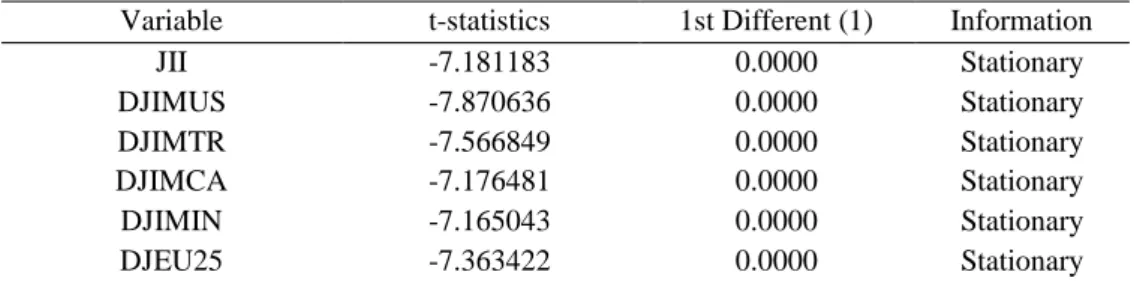
The findings presented in Table 1 indicate that the degree of integration test has been conducted on the variables JII, DJIMUS, DJIMTR, DJIMCA, DJIMIN, and DJIMEU25. At the first difference (1) level, the results demonstrate that all variables exhibit a probability value of 0.0000 or less than 0.05, which indicates that the data are stationary and do not suffer from the unit root problem. These results suggest that the variables are suitable for use in the error correction model (ECM) and other regression analyses that assume stationarity of the data.
Table 1. Results of the Degree of Integration Test
Variable t-statistics 1st Different (1) Information
JII -7.181183 0.0000 Stationary
DJIMUS -7.870636 0.0000 Stationary
DJIMTR -7.566849 0.0000 Stationary
DJIMCA -7.176481 0.0000 Stationary
DJIMIN -7.165043 0.0000 Stationary
DJEU25 -7.363422 0.0000 Stationary
Source: Processed data (2022)
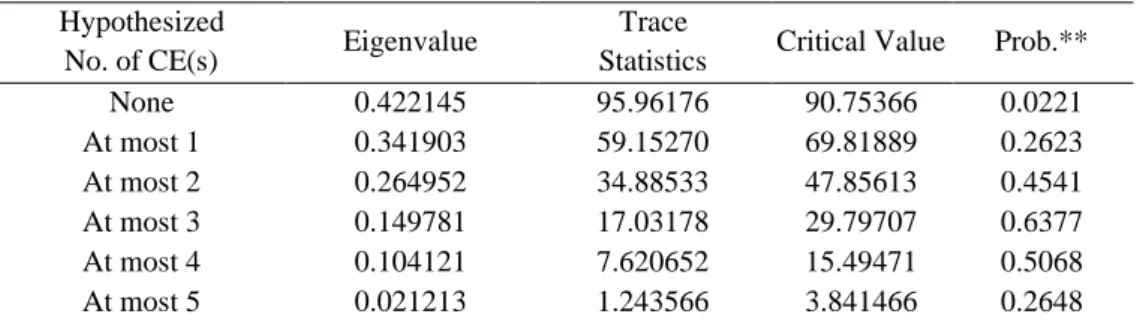
Table 2 displays the results of the cointegration test conducted to examine the existence of a long-term relationship between the global Islamic stock market variables (DJIMUS, DJIMTR, DJIMCA, DJIMIN, and DJIMEU25) and the Indonesian Islamic stock market variable, namely the Jakarta Islamic Index (JII). The test results reveal that the Eigenvalue of the variables is 0.422145, while the Trace Statistics value and the Critical Value are 95.96176 and 90.75366, respectively.
Further analysis of the results indicates that the Trace Statistics value is greater than the Critical Value value. As such, the data is declared to have cointegration, suggesting the presence of a long-term relationship between the variables. These findings provide evidence that the global Islamic stock market variables are significantly related to the Indonesian Islamic stock market variable, thereby contributing to a better understanding of the dynamics of the stock market and providing valuable insights for investors and policymakers.
Table 2. Cointegration Test Results
Hypothesized
No. of CE(s) Eigenvalue Trace
Statistics Critical Value Prob.**
None 0.422145 95.96176 90.75366 0.0221
At most 1 0.341903 59.15270 69.81889 0.2623
At most 2 0.264952 34.88533 47.85613 0.4541
At most 3 0.149781 17.03178 29.79707 0.6377
At most 4 0.104121 7.620652 15.49471 0.5068
At most 5 0.021213 1.243566 3.841466 0.2648
Source: Processed data (2022)
The results of the normality test, as presented in Table 3, indicate that the Jarque-Bera (JB) statistic is equal to 1.064121 with a corresponding p-value of 0.587393. Given that the JB value is less than 2 and the probability value exceeds 0.05, it can be concluded that the global Islamic stock market data,
comprising of Dow Jones Islamic Market United States (DJIMUS), Dow Jones Islamic Market Turkey Index (DJIMTR), Dow Jones Islamic Canada (DJIMCA), Dow Jones Islamic Market India (DJIMIN), and Dow Jones Islamic Market Europe 25 (DJEU25), as well as the data pertaining to the Indonesian Islamic stock market, specifically the Jakarta Islamic Index (JII), during the Covid-19 outbreak in Indonesia from March 2020 to December 2021, can be considered as representative of the population and sample under study.
Table 3. Normality Test Results
Std. Dev Jarque- Bera Probability
34,68363 1.064121 0.587393
Source: Processed data (2022)
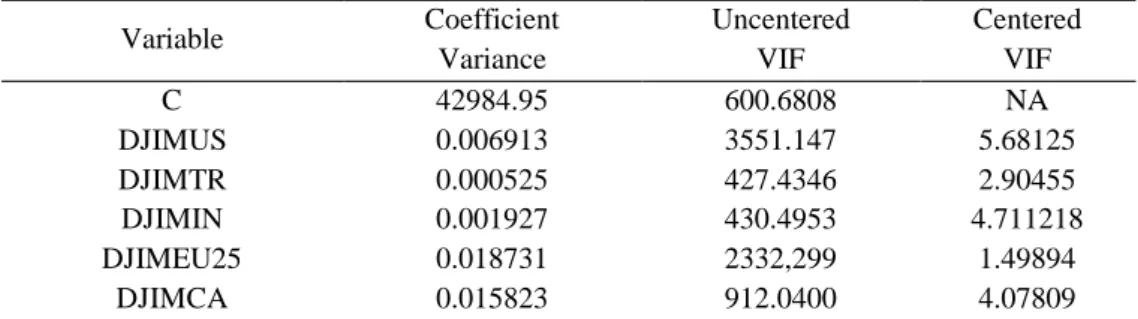
Table 4 presents the results of the multicollinearity test, which indicates that the VIF (Variance Inflation Factors) value for the variables Dow Jones Islamic Market United States (DJIMUS), Dow Jones Islamic Market Turkey Index (DJIMTR), Dow Jones Islamic Canada (DJIMCA), Dow Jones Islamic Market India (DJIMIN), and Dow Jones Islamic Market Europe 25 (DJEU25) is below the threshold of 10. This finding suggests that there is no evidence of multicollinearity or intercorrelation among the independent variables in the regression model under consideration.
Table 4. Multicollinearity Test Results
Variable Coefficient
Variance
Uncentered VIF
Centered VIF
C 42984.95 600.6808 NA
DJIMUS 0.006913 3551.147 5.68125
DJIMTR 0.000525 427.4346 2.90455
DJIMIN 0.001927 430.4953 4.711218
DJIMEU25 0.018731 2332,299 1.49894
DJIMCA 0.015823 912.0400 4.07809
Source: Processed data (2022)
The results of the heteroscedasticity test, as reported in Table 5, reveal that the value of Obs*R-squared is equal to 0.099578 with a corresponding probability of 0.9998. As the probability value exceeds the significance level of 0.05, it can be concluded that there is no evidence of heteroscedasticity in the present study.
Table 5. Heteroscedasticity Test Results
F-statistics Obs*R-squared Prob. F Prob. Chi-Square
0.014550 0.099578 0.9999 0.9998
Source: Processed data (2022)
Table 6 presents the results of the autocorrelation test, which indicate that the value of Obs*R-squared is 10.01339 with a corresponding probability of 0.6167. Given that the probability value exceeds the conventional significance level of 0.05, it can be concluded that there is no evidence of autocorrelation in the present research.
Table 6. Autocorrelation Test Results
F-statistics Obs*R-squared Prob. F Prob. Chi-Square
5.847670 10.01339 0.0143 0.6167
Source: Processed data (2022)
The results of the Error Correction Model (ECM) test, as presented in Table 7, indicate that the prob. (F-Statistics) value is equal to 0.0000. This finding suggests that, as a group, the global Islamic stock market variables, namely Dow Jones Islamic Market United States (DJIMUS), Dow Jones Islamic Market Turkey Index (DJIMTR), Dow Jones Islamic Canada (DJIMCA), Dow Jones Islamic Market India (DJIMIN), and Dow Jones Islamic Market Europe 25 (DJEU25), exert a statistically significant impact on the Indonesian Islamic stock market, specifically the Jakarta Islamic Index (JII), during the Covid-19 era in the short run.
Table 7. Error Correction Model (ECM) Test Results
Variable Coefficient Std. Error t-Statistic Prob. Prob
(F-statistics) R-squared D(DJIMUS) -0.003316 0.025367 -0.130719 0.8965 0.000000 0.531312 D(DJIMTR) 0.007760 0.010826 0.716824 0.4767
D(DJIMIN) 0.088343 0.025501 3.464256 0.0011 D(DJIMCA) 0.011077 0.054898 0.11777 0.8409 D(DJIEU25) 0.064876 0.050676 1.280206 0.2062 C -5.283508 3.269444 -1.616026 0.1121
Source: Processed data (2022)
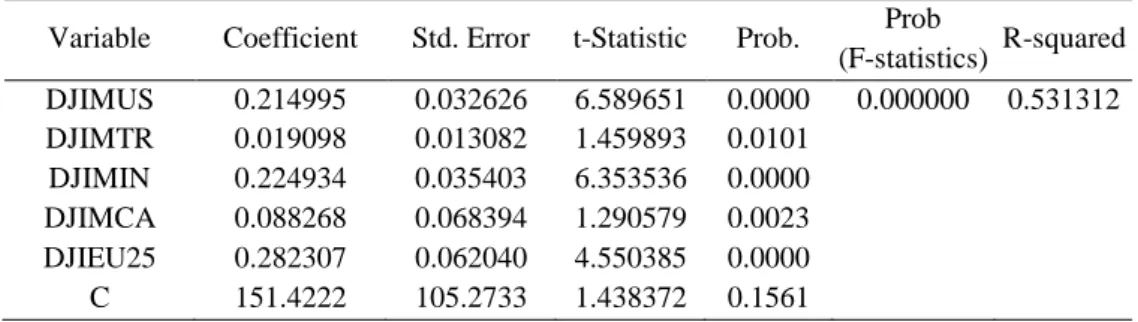
Table 8 presents the results of the Partial Test, which involved testing the statistical significance of individual coefficients in the Ordinary Least Square
(OLS) regression model. The regression coefficients for the variables Dow Jones Islamic Market United States (DJIMUS), Dow Jones Islamic Market Turkey Index (DJIMTR), Dow Jones Islamic Market India (DJIMIN), Dow Jones Islamic Canada (DJIMCA), and Dow Jones Islamic Market Europe 25 (DJEU25) were found to have significant long-term effects on the Jakarta Islamic Index (JII) during the Covid-19 era. Specifically, the coefficient for DJIMUS was estimated at 0.214995 with a probability value of 0.0000, indicating a significant long-term effect. Similarly, the coefficient for DJIMTR was estimated at 0.019098 with a probability value of 0.0101, while the coefficient for DJIMIN was estimated at 0.224934 with a probability value of 0.0000, both of which also indicated significant long-term effects. The coefficients for DJIMCA and DJEU25 were estimated at 0.088268 and 0.282307, respectively, with probability values of 0.0023 and 0.0000, indicating significant long-term effects on JII in the Covid-19 era.
Table 8. Test Results Ordinary Least Square
Variable Coefficient Std. Error t-Statistic Prob. Prob
(F-statistics) R-squared DJIMUS 0.214995 0.032626 6.589651 0.0000 0.000000 0.531312 DJIMTR 0.019098 0.013082 1.459893 0.0101
DJIMIN 0.224934 0.035403 6.353536 0.0000 DJIMCA 0.088268 0.068394 1.290579 0.0023 DJIEU25 0.282307 0.062040 4.550385 0.0000 C 151.4222 105.2733 1.438372 0.1561
Source: Processed data (2022)
The Simultaneous Test (Statistical Test F) presented in Table 8 indicates that the probability value of the F-statistic is 0.0000. This outcome suggests that, in the long run, the global Islamic stock market, comprising Dow Jones Islamic Market United States (DJIMUS), Dow Jones Islamic Market Turkey Index (DJIMTR), Dow Jones Islamic Canada (DJIMCA), Dow Jones Islamic Market India (DJIMIN), and Dow Jones Islamic Market Europe 25 (DJEU25), exerts a significant influence on the Indonesian Islamic stock market, namely the Jakarta Islamic Index (JII) during the covid-19 era. Thus, it can be inferred that the aforementioned variables collectively possess a significant impact on JII in the long term.
Moreover, the Coefficient of Determination Test (R2) provided in Table 8 indicates an adjusted R-squared value of 0.640714. This finding signifies that the global Islamic stock market, including DJIMUS, DJIMTR, DJIMCA,
DJIMIN, and DJEU25, have an impact of 64.07% on the Jakarta Islamic Index (JII) in the covid-19 era in the long run. However, the remaining 35.93% of JII variation is influenced by other variables not accounted for in the current study.
Thus, these findings suggest that while the global Islamic stock market has a significant impact on JII, other factors may also contribute to the overall variation in JII.
Discussions
Despite originating as a health crisis, the Covid-19 pandemic has had severe economic repercussions, triggering widespread financial distress and exacerbating the plight of the populace. This has caused a state of economic and financial instability, leading to a steep decline in share prices, including Islamic shares, fueled by growing anxieties surrounding the pandemic's potential escalation (Al-Awadhi et al., 2020). Consequently, this has resulted in pessimistic shareholder sentiments, leading to a sharp reduction in investments in the stock market, further driving the decline of share prices, despite the attractive risk-return characteristics of Islamic stock markets (Suleman et al., 2021).
Investors typically rely on stock indexes as indicators of market trends when evaluating the Islamic stock market, to determine whether the market is active or sluggish. The movement of stock indices that tend to decrease reflects a decline in most stock prices, while a rising stock index indicates that most stock prices are on the rise (Mzoughi et al., 2022; Mariana & Ibrahim, 2022).
The evaluation of the impact of Covid-19 on the Islamic stock market is a critical consideration in assessing the returns and risks of investing in the Islamic stock market. The policies implemented by various countries, such as restrictions on gatherings and lockdowns, have further amplified the negative impact of the pandemic on the economy. Consequently, Islamic capital markets worldwide, including those in Indonesia, have experienced an unprecedented and severe downturn in Islamic stocks and Islamic stock indices (Rudiawarni et al., 2022; Muarif, Ibrahim, & Amri, 2021).
The present study reveals that the global Islamic stock market exerts a significant influence on the Indonesian Islamic stock market during the Covid- 19 era, both in the short and long term. This can be attributed to the interconnected nature of the Islamic stock market, wherein foreign investors are permitted to control Islamic stocks in Indonesia, thereby enabling investors
from across the globe to invest wherever they are situated. Consequently, various international exchanges are linked globally.
The stock price index is regarded as a reliable indicator of the health of the capital market, reflecting the performance of the stock market, inclusive of Islamic stocks. A rise in the index signifies an upswing in the capital market and implies favorable economic conditions. Investors frequently employ the stock price index as a benchmark for determining the continuation, postponement, or termination of their investments. Given this context, investors display a preference for investing in the Islamic stock market that holds promising prospects in both the short and long term, for the purpose of constructing their investment portfolio. In this context, the interplay and dynamics of the Islamic stock index between Islamic capital markets have a reciprocal influence on one another.
Additionally, the globalization of the world economy has led to economic, social, and political relations between countries to become increasingly interdependent. This phenomenon has resulted in the impact of the global Islamic capital market on the Indonesian Islamic stock market. The Covid-19 pandemic has exacerbated this situation, causing widespread chaos and extreme crises in the economic field, including investment, and thus significantly affecting the Islamic stock market in various countries (Mafaza, 2021).
The present study provides empirical support for the Portfolio Theory, which suggests that the investment approach of investors is closely linked to their perception of the risk and expected returns associated with a particular investment, and this perception is statistically measured to construct investment portfolios. The findings of this study suggest that investors tend to prefer investing in the Islamic stock market, which has favorable prospects in both the short and long term. The dynamics of Islamic stock indexes between different Islamic capital markets have been found to influence and impact each other, especially during the Covid-19 pandemic, which has resulted in economic shocks in the investment sector and affected the performance of different stock markets.
Moreover, this study is also supported by the Contagion Effect theory, which proposes that a crisis in one country can spread to other countries with similar economic conditions. The contagion effect occurs due to information asymmetry and collective behavior of investors, who tend to share the same
information and respond in a similar way to market changes. As a result, the Islamic capital market can also be affected by changes in other stock markets, and investors in the Islamic stock market may respond to changes in the global economy.
The results of this study are also consistent with previous research on the relationship between the global Islamic stock market and the Islamic stock market in Indonesia. For instance, Herlianto and Hafizh (2020) found that the Dow Jones Index, Nikkei 225, the Shanghai Composite Stock Price Index, and the Singapore Straits Times Index significantly affect the Jakarta Composite Index (IHSG) on the Indonesia Stock Exchange (IDX). Similarly, Rizaldy and Rahayu (2021) conducted a study on the performance of Islamic stock indices during the Covid-19 pandemic and found that the Indonesian Sharia Stock Index was influenced by other Islamic capital markets. Additionally, Soeharjoto and Inviah (2021) investigated the long-term effects of various stock indices, including the Dow Jones Islamic Market India Index, the Dow Jones Islamic Market Asia or Pacific ex-Japan Index, and the Dow Jones Arabia Titans 50 Index, on the Indonesian Sharia Stock Index and found a positive and significant impact.
Thus, the present study adds to the growing body of literature on the relationship between the Islamic stock market and other global stock markets, and highlights the importance of understanding the factors that influence investors' investment decisions. The findings suggest that investors' perception of the risk and expected returns associated with a particular investment is a crucial factor in constructing their investment portfolios. Moreover, the contagion effect can also have a significant impact on the performance of the Islamic capital market, and investors need to be aware of global economic conditions and respond accordingly. These outcomes have important implications for policymakers, investors, and financial institutions who seek to enhance their understanding of the Islamic capital market and its potential for growth and development.
The findings also suggest that current global economic landscape is increasingly interconnected, and the COVID-19 outbreak has demonstrated the potential for shocks in one part of the world to have far-reaching consequences on other regions, including the Islamic capital market in Indonesia. Foreign investors are active in Islamic stock exchanges around the world, resulting in global linkages that transmit changes in one exchange to others. This result is
consistent with the notion that the information available to investors is an essential determinant of market behavior. The market tends to respond positively to good information, as reflected in the abnormal returns around the announcement, and negatively to bad news, as demonstrated by negative abnormal returns around the announcement.
The direction of global Islamic stock market movements is an indicator of market sentiment. Negative sentiment from the global Islamic stock market can weaken the Indonesian Islamic stock market, while positive sentiment can strengthen the price movements of Indonesian Islamic stocks. Investor sentiment is tied to the level of confidence that investors have in issuers' future prospects, whether based on sufficient information or predictions. Investor behavior is largely influenced by their risk preference, whether they tend to be risk averse, moderate risk-takers, or risk takers. Investors who are proactive in seizing opportunities, even during a pandemic, can have the opportunity to earn profits.
These findings align with the existing literature on the impact of market sentiment on stock prices. For example, it has been shown that market sentiment can have a significant effect on the behavior of stock prices, particularly in cases where investors have incomplete information. Research has also demonstrated the importance of investor sentiment in driving the behavior of the market. Indeed, market sentiment has been found to have a significant impact on stock prices, particularly in markets that are more prone to investor irrationality and emotional biases.
These results suggest that the Indonesian Islamic capital market is closely tied to global trends, and that investor sentiment can have a significant impact on the behavior of the market. This underscores the importance of monitoring global trends and sentiment, as well as conducting in-depth analyses of market behavior in order to understand the factors that influence stock price movements. Furthermore, these findings underscore the need for investors to be proactive and to seize opportunities, even in the face of uncertainty and market volatility. By doing so, investors can increase their chances of earning profits and achieving their investment objectives in the long term.
CONCLUSION
The present study has contributed to the understanding of the interdependent nature of the global Islamic stock market and the Indonesian Islamic stock market during the Covid-19 era. The study found that the global Islamic stock market has a significant impact on the Indonesian Islamic stock market in both the short and long term. This is due to the global linkages between the stock exchanges, which are influenced by investors' estimates of risk and expected returns. Foreign investors have the option to invest in sharia-compliant stocks in Indonesia, thus making the market interrelated with other Islamic capital markets. The events and dynamics of Islamic stock indices between these markets influence and affect each other.
The findings of this study can be useful for investors in making investment decisions and minimizing investment risks. It is important for investors to recognize the influence of the global Islamic capital market on domestic conditions in Indonesia, especially during times of crisis such as the Covid-19 pandemic. The study emphasizes the fluctuation of the Islamic capital market in Indonesia during a health crisis and recommends that investors use this factor as an assessment criterion in maintaining the value of their investment.
Furthermore, the impact of the global Islamic capital market on the Indonesian Islamic stock market highlights the economic, social, and political relations between countries that are intertwined due to globalization. The Covid-19 pandemic has exacerbated this interdependence, leading to chaos and extreme crises in the economic field, including investment. The practical implications of this study are expected to be beneficial to policymakers, market regulators, and investors in developing strategies that can mitigate the impact of the global Islamic stock market on the Indonesian Islamic stock market.
The scope of this study is limited to the analysis of the global Islamic market index, which may not capture the nuances and idiosyncrasies of individual Islamic stock markets in different regions of the world. Additionally, the study only examines the impact of Covid-19 on the Indonesian Islamic stock market within a specific time frame, and does not account for other potential factors that may have influenced market dynamics outside of the pandemic. Future research could benefit from expanding the scope of analysis to include a wider range of Islamic stock indexes from various regions, and to examine the long- term effects of different factors on the performance of Islamic stock markets.
REFERENCES
Abdul Rani, U., Muhammad, A., Fachrur, R., Teuku, Z., Julianto, Hamdani, M.
S., . . . Abdul Jalil, S. (2020). Corona in culture: tradition of warding off the plague in acehnese society. PalArch's Journal of Archaeology of Egypt / Egyptology, 17(4), 314-327. Retrieved from http://www.palarch.nl/index.php/jae/article/view/297
Adekoya, O. B., Oliyide, J. A., & Tiwari, A. K. (2021). Risk transmissions between sectoral Islamic and conventional stock markets during COVID- 19 pandemic: What matters more between actual COVID-19 occurrence and speculative and sentiment factors? Borsa Istanbul Review.
https://doi.org/10.1016/j.bir.2021.06.002
Adekoya, O. B., Oliyide, J. A., & Tiwari, A. K. (2022). Risk transmissions between sectoral Islamic and conventional stock markets during COVID- 19 pandemic: What matters more between actual COVID-19 occurrence and speculative and sentiment factors? Borsa Istanbul Review, 22(2), 363–376. https://doi.org/10.1016/j.bir.2021.06.002
Agustin, I. N. (2021). How does the impact of the COVID-19 pandemic on Indonesia’s Islamic stock returns? JEMA: Jurnal Ilmiah Bidang
Akuntansi Dan Manajemen, 18(1), 21.
https://doi.org/10.31106/jema.v18i1.9235
Al-Awadhi, A. M., Alsaifi, K., Al-Awadhi, A., & Alhammadi, S. (2020). Death and contagious infectious diseases: Impact of the COVID-19 virus on stock market returns. Journal of Behavioral and Experimental Finance, 27, 100326. https://doi.org/10.1016/j.jbef.2020.100326
Ali, F., Jiang, Y., & Sensoy, A. (2021). Downside risk in Dow Jones Islamic equity indices: Precious metals and portfolio diversification before and after the COVID-19 bear market. Research in International Business and Finance, 58(July), 101502. https://doi.org/10.1016/j.ribaf.2021.101502 Aloui, C., Asadov, A., Al-kayed, L., Hkiri, B., & Danila, N. (2022). Impact of
the COVID-19 outbreak and its related announcements on the Chinese conventional and Islamic stocks’ connectedness. North American Journal of Economics and Finance, 59(66833), 101585.
https://doi.org/10.1016/j.najef.2021.101585
Ashraf, D., Rizwan, M. S., & Ahmad, G. (2022). Islamic equity investments and the COVID-19 pandemic. Pacific-Basin Finance Journal, 73(June 2021), 101765. https://doi.org/10.1016/j.pacfin.2022.101765
Aslam, F., Mohmand, Y. T., Ferreira, P., Memon, B. A., Khan, M., & Khan, M.
(2020). Network analysis of global stock markets at the beginning of the coronavirus disease (Covid-19) outbreak. Borsa Istanbul Review, 20, S49–S61. https://doi.org/10.1016/j.bir.2020.09.003
Bahloul, S., & Khemakhem, I. (2021). Dynamic return and volatility connectedness between commodities and Islamic stock market indices.
Resources Policy, 71(June 2020), 101993.
https://doi.org/10.1016/j.resourpol.2021.101993
Bossman, A., Owusu Junior, P., & Tiwari, A. K. (2022). Dynamic connectedness and spillovers between Islamic and conventional stock markets: time- and frequency-domain approach in COVID-19 era.
Heliyon, 8(4), e09215. https://doi.org/10.1016/j.heliyon.2022.e09215 Bugan, M. F., Cevik, E. I., & Dibooglu, S. (2022). Emerging market portfolios
and Islamic financial markets: Diversification benefits and safe havens.
Borsa Istanbul Review, 22(1), 77–91.
https://doi.org/10.1016/j.bir.2021.01.007
Choi, S. Y. (2022). Dynamic volatility spillovers between industries in the US stock market: Evidence from the COVID-19 pandemic and Black Monday. North American Journal of Economics and Finance,
59(December 2021), 101614.
https://doi.org/10.1016/j.najef.2021.101614
Faruk, A. R. Al. (2022). Comparative Analysis of Sharia Stock Performance Before and During Covid-19 Pandemic in Indonesia. Perbanas Journal of
Islamic Economics & Business, 65–74.
https://joieb.perbanas.id/index.php/Joieb/article/view/44%0Ahttps://joie b.perbanas.id/index.php/Joieb/article/download/44/8
Gandasari, D., & Dwidienawati, D. (2020). Content analysis of social and economic issues in Indonesia during the COVID-19 pandemic. Heliyon, 6(11), e05599. https://doi.org/10.1016/j.heliyon.2020.e05599
Ghozali, I. (2018). ANALISIS MULTIVARIAT DAN EKONOMETRIKA Teori, Konsep dan Aplikasi Dengan EViews 10. Semarang : Badan Penerbit Universitas Diponegoro (UNDIP).
Halim, S. (2021). The Effect of Dow Jones Islamic Market World Index , Foreign Exchange , Foreign Investment and Domestic Investment with the Intervening Composite Stock Price Index on the Indonesian Sharia Stock Index. Al-Iqtishad: Jurnal Ilmu Ekonomi Syariah (Journal of
Islamic Economics), 13(2), 369–410.
https://doi.org/10.15408/aiq.v13i2.22585
Hamid, S. H., Bachri, S., Salju, & Ikbal, M. (2020). Panduan Praktis Ekonometrika: Konsep Dasar dan Penerapan Menggunakan Eviews 10.
Serang: CV AA Rizky.
Hasan, M. B., Mahi, M., Hassan, M. K., & Bhuiyan, A. B. (2021). Impact of COVID-19 pandemic on stock markets: Conventional vs. Islamic indices using wavelet-based multi-timescales analysis. North American Journal of Economics and Finance, 58(June), 101504.
https://doi.org/10.1016/j.najef.2021.101504
Hassan, M. K., Chowdhury, M. I. H., Balli, F., & Hasan, R. (2021). A note on COVID-19 instigated maximum drawdown in Islamic markets versus conventional counterparts. Finance Research Letters, August, 102426.
https://doi.org/10.1016/j.frl.2021.102426
Herlianto, D., & Hafizh, L. (2020). Pengaruh Indeks Dow Jones, Nikkei 225, Shanghai Stock Exchange, Dan Straits Times Index Singapore Terhadap Indeks Harga Saham Gabungan (IHSG) Di Bursa Efek Indonesia (BEI).
INOBIS: Jurnal Inovasi Bisnis Dan Manajemen Indonesia, 3(2), 211–
229. https://doi.org/10.31842/jurnalinobis.v3i2.133
Ibrahim, A. (2023). Metodologi Penelitian Ekonomi dan Bisnis Islam - Edisi Revisi (Q. Aini Ed.). Jakarta: Bumi Aksara
Karerina, E., Wiguna, B. A., & Suhaemy, A. I. (2021). Reaksi Pasar Modal Terhadap Pengumuman Resesi Ekonomi Indonesia 2020. Journal of Islamic Economics And Finance, 1(1), 12–24. http://e- journal.iainpekalongan.ac.id/index.php/jief/article/view/3452
Kurniawan, A. (2019). Pengaruh Dow Jones Islamic World Malaysia Index Dan Dow Jones Islamic Market Japan Index Terhadap Indeks Sahamsyariah Indonesia. FINANSIA: Jurnal Akuntansi Dan Perbankan Syariah, 2(01), 102. https://doi.org/10.32332/finansia.v2i01.1543
Liu, Y. C., Kuo, R. L., & Shih, S. R. (2020). COVID-19: The first documented coronavirus pandemic in history. Biomedical Journal, 43(4), 328–333.
https://doi.org/10.1016/j.bj.2020.04.007
Mafaza, S. A. A. R. M. E. R. P. A. R. Z. (2021). Determinant of Sharia Stock Price Evidence Sharia Stock Price in Indonesia and Malaysia.
Islamiconomic: Jurnal Ekonomi Islam, 12(2), 221–237.
Mariana, & Ibrahim, A. (2022). Determinan Cash Holding pada Perusahaan
Manufaktur yang Terdaftar di Bursa Efek Indonesia. HEI EMA: Jurnal Riset Hukum, Ekonomi Islam, Ekonomi, Manajemen dan Akuntansi, 1(1).
Mishra, P. K., & Mishra, S. K. (2020). Corona Pandemic and Stock Market Behaviour : Empirical Insights from Selected Asian Countries.
https://doi.org/10.1177/0976399620952354
Muarif, H., Ibrahim, A., & Amri, A. (2021). Likuiditas, Kecukupan Modal, Pembiayaan Bermasalah Dan Pengaruhnya Terhadap Profitabilitas Bank Umum Syariah Di Indonesia Periode 2016-2018. JIHBIZ: Global Journal of Islamic Banking and Finance., 3(1), 36-55.
Mzoughi, H., Ben, A., Belaid, F., & Guesmi, K. (2022). The Impact of COVID- 19 pandemic on Islamic and conventional financial markets : International empirical evidence. Quarterly Review of Economics and Finance, xxxx, 1–23. https://doi.org/10.1016/j.qref.2022.04.007
Nugraha, D. P. (2021). Comparative Analysis of Risk and Return on Indonesian Islamic Stock Index in Different Economic Conditions. Jurnal Ekonomi
Dan Manajemen, 51–64.
https://journals.umkt.ac.id/index.php/JEM/article/view/2171
Nugroho, A., Wasiaturrahma, W., & Anggia, P. (2021). Jakarta Islamic Index:
Covid-19 Pandemic and Potential Financial Distress. Jurnal Ekonomi Dan Bisnis Islam (Journal of Islamic Economics and Business), 7(2), 210.
https://doi.org/10.20473/jebis.v7i2.26147
Pratiwi, A., Darmawati, & Amaliyah, R. (2020). Sharia Stocks Selection In Indonesia Stock Exchange (IDX): Fuzzy-ANP Approach. Jouranl of Islamic Economic and BUsiness, 3(2), 257–281.
Rahmayani, D., & Oktavilia, S. (2020). Does the Covid-19 pandemic affect the stock market in Indonesia? Jurnal Ilmu Sosial Dan Ilmu Politik, 24(1), 33–47. https://doi.org/10.22146/JSP.56432
Rizaldy, M. R., & Rahayu, S. (2021). Mapping the global Islamic equity market vis-à-vis the COVID-19 turbulence. Jurnal Ekonomi Dan Keuangan Islam, 7(2), 105–122. https://www.researchgate.net/profile/Budi- Trianto/publication/353730816_Determinant_factor_of_Islamic_financi al_inclusiveness_at_MSMEs_Evidence_from_Pekanbaru_Indonesia/lin ks/610cb0721ca20f6f86044f85/Determinant-factor-of-Islamic-financial- inclusiveness-a
Rosadi, D. (2021). Ekonometrika Dan Analisis Runtun Waktu Terapan Dengan EViews, Aplikasi Untuk Bidang Ekonomi, Bisnis, Dan Keuangan.
Gramedia Pustaka Utama.
Rudiawarni, F. A., Sulistiawan, D., & Sergi, B. S. (2022). Is Conservatism Good News? the Case of Stocks of Jakarta Islamic Index. Heliyon, 8(April), e09292. https://doi.org/10.1016/j.heliyon.2022.e09292
Rusydiana, A. S., & Prakoso, D. (2021). Impact of COVID-19 and Macroeconomic Factors on Sharia Stock Market Performance : A Case Study of Indonesia. Syariah Economic Applied Research and Training (SMART), 3(1).
Safitri, H. (2021). Pengaruh Korea Composite Stock price Index, Hang Seng Index, Staits Times Index dan Dow Jones Industrial Average Terhadap Indeks Harga Saham Gabungan di Bursa Efek Indonesia. Jurnal Produktivitas (JPO) Jurnal Fakultas Ekonomi Universitas
Muhammadiyah Pontianak, 8(2), 350–359.
https://doi.org/10.29406/jpr.v8i2.3520
Saleem, A., Bárczi, J., & Sági, J. (2021). COVID-19 and Islamic Stock Index:
Evidence of Market Behavior and Volatility Persistence. Journal of Risk
and Financial Management, 14(8), 389.
https://doi.org/10.3390/jrfm14080389
Salisu, A. A., & Shaik, M. (2022). Islamic Stock indices and COVID-19 pandemic. International Review of Economics and Finance, 80(January), 282–293. https://doi.org/10.1016/j.iref.2022.02.073
shear, F., & Ashraf, B. N. (2022). The performance of Islamic versus conventional stocks during the COVID-19 shock: Evidence from firm- level data. Research in International Business and Finance, 60(November 2021), 101622. https://doi.org/10.1016/j.ribaf.2022.101622
Sihombing, P. R. (2022). Aplikasi EVIEWS Untuk Statistisi Pemula. Bekasi : PT Dewangga Energi Internasional.
Situngkir, T. L. (2019). Pengaruh Dow Jones Indeks, Strait Time , dan Hang Sheng Terhadap Indeks Harga Saham Gabungan dengan Pendekatan Eror Correction Model. Jurnal Mandiri : Ilmu Pengetahuan, Seni, Dan Teknologi, 3(2), 307–313. https://doi.org/10.33753/mandiri.v3i2.92 Soeharjoto, & Inviah. (2021). Integrasi Dow Jones Islamic Market-5 Dengan
Indeks Saham Syariah Indonesia. Jurnal Ilmiah Ekonomi Islam, 7(03), 1270–1277. http://jurnal.stie-aas.ac.id/index.php/jei/article/view/3469 Suleman, M. T., McIver, R., & Kang, S. H. (2021). Asymmetric volatility
connectedness between Islamic stock and commodity markets. Global
Finance Journal, 49(June), 100653.
https://doi.org/10.1016/j.gfj.2021.100653
United Nations. (2020). The Impact of COVID-19 on South-East Asia. Policy Briefs, 1–29.
Wahyudi, S. T. (2020). Konsep dan Penerapan Ekonometrika Menggunakan E- views. Depok : PT RajaGrafindo persada.
Yarovaya, L., Elsayed, A. H., & Hammoudeh, S. (2021). Determinants of Spillovers between Islamic and Conventional Financial Markets:
Exploring the Safe Haven Assets during the COVID-19 Pandemic.
Finance Research Letters, 43(January), 101979.
https://doi.org/10.1016/j.frl.2021.101979
Yuliana, Y. (2020). Corona virus diseases (Covid-19): Sebuah tinjauan literatur.
Wellness And Healthy Magazine, 2(1), 187–192.
https://doi.org/10.30604/well.95212020