The Role of Government in The Penta Helix Synergy Model on Halal Tourism Development and Economic Growth in Pahawang Island: Islamic Economic
Perspective
Melinia1*, Rubhan Masykur2, Dania Hellin Amrina3
1Departemen Ekonomi Syariah, Fakultas Ekonomi dan Bisnis Islam, Universitas Islam Negeri Raden Intan Lampung, Indonesia, [email protected]
2Departemen Ekonomi Syariah, Fakultas Ekonomi dan Bisnis Islam, Universitas Islam Negeri Raden Intan Lampung, Indonesia, [email protected]
3Departemen Ilmu Ekonomi, Fakultas Ekonomi dan Bisnis, Universitas Pembangunan Nasional
“Veteran” Yogyakarta, Indonesia, [email protected]
*Email Korespondensi : [email protected]
ABSTRACT
PERDA Lampung Province No. 6 of 2012 Pahawang Island has become a leading tourist destination for districts / cities, this cannot be separated from the charm of beauty that is on Pahawang Island. The high number of tourist visits, especially Pahawang Island, is one of the potentials in developing sharia tourism. Of course, in the development of the concept of sharia tourism, there needs to be cooperation between all interested parties in the tourism sector. In the penta helix synergy model, there are 5 elements or 5 stakeholders in the development of sharia tourism, namely the government, business people, communities, academics, and the media. Of the five elements contained in the penta helix synergy model, this research focuses on 1 element, namely the government, a discussion of the role of the government in developing sharia tourism and as a driver, regulator, and embracing other elements in working together to realize the concept of sharia tourism, especially on Pahawang Island.
Keywords: Penta Helix Synergy, Halal Tourism, Economic Growth
ABSTRAK
PERDA Provinsi Lampung No. 6 tahun 2012 Pulau Pahawang menjadi destinasi wisata unggulan kabupaten/kota hal ini tidak terlepas dari pesona keindahan yang berada di Pulau Pahawang.
Jumlah kunjungan wisatawan yang tinggi terutama Pulau Pahawang ini menjadi salah satu potensi dalam upaya pengembangan pariwisata syariah. Tentunya dalam pengembangan konsep pariwisata syariah perlu adanya kerjasama antar semua pihak berkepentingan di sektor pariwisata.
Pada model penta helix synergy terdapat 5 elemen atau 5 pemegang kepentingan dalam upaya pengembangan pariwisata syariah yaitu pemerintah, pembisnis, komunitas, akademisi, dan media.
Dari kelima elemen yang terdapat pada model penta helix synergy penelitian ini terfokus pada 1 elemen yaitu pemerintah, pemebahasan mengenai peran pemerintah dalam upaya pengembangan pariwisata syariah dan sebagai penggerak, pengatur, dan perangkul elemen lainnya dalam bekerja sama mewujudkan konsep pariwisata syariah terutama di Pulau Pahawang Kabupaten Pesawaran.
Kata Kunci: Penta Helix Synergy, Halal Tourism, Pertumbuhan Ekonomi
INTRODUCTION
The contribution of tourism to the national economy continues to increase(Gilang Widagdyo, 2015). Tourism is one of the government's priority sectors because it is considered capable of moving the economy, not only as a source of national and regional income, tourism also offers considerable opportunities for job creation and its position is expected to grow(B. P. S. Lampung, 2019). Indonesia with the largest Muslim population in the world is still trying to improve the halal tourism industry, in 2013 Indonesia through the Ministry of Tourism has set 13 provinces to become leading halal tourism destinations, namely West Nusa Tenggara (NTB), Nangroe Aceh Darussalam, West Sumatra, Riau , Lampung, Banten, DKI Jakarta, West Java, Central Java, Yogyakarta, East Java, South Sulawesi, and Bali (Indonesia Travel,2013(Hasan, 2017). Sharia tourism or halal tourism in Indonesia has great potential supported by the largest number of Muslims in the world owned by Indonesia, this is what makes various regions in the archipelago increasingly develop the concept of tourism(Hadi & Al-Asy Ari, 2017).
Lampung is one of the provinces that is used as a leading halal tourist destination, of course, it cannot be separated from the many potential attractions in Lampung Province(B. P. S. Lampung, 2019). The Lampung Provincial Government continues to strive to develop the tourism sector through Lampung Regional Regulation No. 6 of 2012 concerning the Regional Tourism Development Master Plan (RIPPDA) of Lampung Province, which stipulates 2 leading tourist areas, namely provincial superior tourist areas and Regency / City Superior Tourism Areas. The leading tourist area of Lampung Province consists of 7 tourist areas, namely(P. P. Lampung, 2013):
a. The leading tourist area of Bandar Lampung City;
b. Krui and Tanjung Setia tourism areas;
c. The leading tourist area of Way Kambas National Park;
d. The leading tourist area of Kiluan Bay
e. The leading tourist areas of Mount Krakatau and Sebesi Island f. Bakauheni Featured Tourist Area and Siger Tower
g. The prime tourist area of Bukit Barisan National Park.
On the other hand, the leading tourist areas in the Regency/City in Lampung Province consist of:
a. Bandar Lampung city with a leading tourist area Kedaton Earth Park.
b. Metro City with the leading tourist area of Taman Merdeka.
c. West Lampung Regency with the leading tourist areas of Krui and Tanjung Setia as well as the Bukit Barisan Selatan National Park.
d. South Lampung Regency with the leading tourist areas of Krakatau and Sebesi and the Siger Tower.
e. Central Lampung Regency with the leading tourist area of Curup Tujuh Waterfall.
f. East Lampung Regency with the leading tourist areas of Way Kambas and Pugung Raharjo National Parks.
g. North Lampung Regency with the leading tourist area of Way Rarem Dam.
h. Mesuji Regency with the leading tourist area of Wiralaga marine tourism.
i. Pesawaran Regency with a leading tourist area for marine tourism, Mutun Beach, and Pahawang Island.
j. Pringsewu Regency with the leading tourist area of Goa Maria and Eating Kyai Galib.
k. Tanggamus Regency with the leading tourist area of Kiluan Bay and the Proof of South Barisan II National Park.
l. Way Kanan Regency with Featured Tourist Areas Curup Gangsa Waterfall.
m. Bone Bawamg Regency, West with a leading tourist area, Pagar Dewa Traditional Village n. Tulang Bawang Regency with the leading tourist areas of Cakat and Rawa Pacing tourism
areas.
Sourced on the Lampung Regional Regulation No. 6 of 2012 Pesawaran Regency is one of the regencies that has a leading tourist area, as for tourist destinations and the number of tourist visits in Pesawaran Regency, among others:
Table 1. Number of Tourist Attractions Visitors in Pesawaran Regency, 2020
No. Tourist attraction 2019 2020
1. Pantai Mutun Town Beach 194.325 111448
2. Pantai Mutun Haruna Jaya - -
3. Pantai Sekar Wana - -
4. Pantai Quin Artha 9015 -
5. Pantai Ringgung Haruna 178.527 36.448
6. Pantai Tangkil - -
7. Pantai Klara 58.282 40.381
8. Pantai Mutun Asri - -
9. Pantai Putra Mutun 93.617 68.334
10. Teluk Saung - -
11. Pantai Ketapang 91.713 66.944
12. Pulau Tegal 41.544 37.361
13. Pulau Pahawang 448.008 165.342
14. Pulau Tanjung Putus - -
15. Pulau Balak - -
16. Tahura Wan Abdurrahman 20.550 15.000
17. Museum Nasional Ketransmigrasian
- -
Amount 1.135.581 541.258
Source : Dinas Pariwisata Kabupaten Pesawaran, 2020
Based on the table above, the most visited tourist attractions in Pesawaran Regency are Pahawang Island with the number of visits in 2020 as many as 165,342, and in 2021 Pahawang Island became the most visited tourist spot with a total of 218,588 tourist visits(B. K. Pesawaran, 2022).
total of 218,588 tourist visits(B. K. Pesawaran, 2022).
Tourist visits that continue to increase on Pahawang Island have become a great potential and opportunity for the development of the concept of halal tourism on Pahawang Island. one of the indicators of the creation of halal tourism is that this can maximize the economy of Pahawang Island, move from this to optimizing the existing potential, as well as ensuring the quality of activities, facilities, services, generating experience and value for tourism benefits in order to provide benefits and benefits to the community and the environment. Around this, an innovation model and a driving force for the tourism system(Vani et al., 2020) is needed through optimizing the role of the penta helix, meaning that there is synergy or cooperation between elements (government, academics, media, communities, and business people)(Yunas, 2019).
The concept of sharia tourism has the potential to continue to grow with the Muslim population, sharia tourism itself is a product and process of tourism or travel or visits that follow the values or principles of Islamic teachings(Ghafur Wibowo & Yusuf Khoiruddin, 2020). The concept of sharia tourism or halal tourism can develop and contribute to economic growth on Pahawang Island, Pesawaran Regency, so the role of the penta helix synergy or collaboration model between these 5 stakeholders really needs to be done.
LITERATURE REVIEW A. Penta Helix Synergy
The penta helix model originates from or is rooted in the theory of Etzkowitz and Leyesdorff's 1995 with the triple helix model in the development of innovation to create competitiveness and economic growth of a country(Praswati, 2017) in the triple helix model the sector responsible for creating innovation is industry, the sector responsible for creating knowledge is university/academic, and interacting with the government(Etzkowitz & Leydesdorff, 1995) later in the development of the triple helix model, not only in the industrial, academic and government sectors, but also in the media and community sectors (Praswati, 2017).
In Indonesia, the penta helix model was introduced in the context of tourism management by the Ministry of Tourism by enacting the Ministerial Regulation (Permen) of Tourism No. 14 of 2016 concerning Guidelines for Sustainable Tourism which is a collaborative management model of an activity involving five stakeholders (Ghafur Wibowo & Yusuf Khoiruddin, 2020). Penta helix is a reference in developing synergy between agencies that have the goal of innovation and contributing to regional socio-economic progress, as well as creating orchestrations and ensuring the quality of activities, facilities, services, creating experiences and value for tourism benefits, this is to provide benefits and benefits to the community and the community. the surrounding environment, therefore it is necessary to encourage the tourism system through optimizing the role of pentahelix synergy in this case the government (government), business (business), community (community), academics (academic), media publications (media)(Vani et al., 2020).
The government's role in the penta helix synegy model is as a regulator, the government acts as a regulator as well as a facilitator who has regulations and responsibilities in developing halal tourism, involving all types of activities such as planning, implementation, monitoring, control,
promotion, financial allocation. , licensing, programs, legislation, development and knowledge(Umiyati & Tamrin, 2021).
Tourism policy is generally part of economic policy, which is related to the structure and economic growth which is usually manifested in tourism planning, besides that tourism policy formulation is an important responsibility that must be carried out by the government to develop or maintain tourism as an integral part of the economy. There are several main areas of public sector (government) involvement in tourism, including(Pariwisata, 2018):
1) Coordination
2) Tourism consists of various sectors and this often creates conflicts of interest, therefore coordination in the use of resources is very important and the government is responsible for balancing various roles in the tourism development process. The government (government) has a role in coordination, the Ministry of Tourism and Creative Economy (Kemenparekraf) seeks to build trust in tourism industry players through the CHS (Cleanliness, Health, and Safety) protocol by preparing facilities, as well as supporting the sector, including accommodation, restaurants, transportation, and places that become tourist destinations, Kemenparekraf has 3 communication strategies, namely minimizing the worries of tourists to return to travel, the negative stigma of this activity must be removed, providing inspiration and comfort in traveling(Khusniyah, 2020). Planning
Tourism planning takes place in the form of infrastructure development, promotion and marketing, structure, and scale (international, national, local, and sectoral).
3) Regulations and legislation
The government has the authority or legal power and legislation directly or indirectly related to the tourism industry, such as passport and visa policies, land use, labor, wages and so on.
4) Stimulation
Stimulation that can be done by the government is to provide financial incentives. Finance tourism research, stimulate tourism through promotional marketing, and service to visitors.
B. Halal Tourism
Based on law number 9 of 1990, it is stated that "the state of nature, flora and fauna as a gift from
God Almighty, historical heritage, as well as arts and culture owned by the Indonesian people are resources and capital for tourism development to increase the prosperity and welfare of the people as contained in Pancasila and the Preamble to the 1945 Constitution of the Republic of Indonesia”(Panorama, 2018). The definition of sharia tourism was also conveyed by the Ministry of Tourism of the Republic of Indonesia, namely as an activity that is supported by various facilities and services provided by the community, entrepreneurs, government (regional/central) that meet sharia provisions. The concept of sharia tourism is interpreted as services, facilities, and all things related to it, does not conflict with sharia values and ethics (Alim et al., 2020).
The concept of Sharia tourism is the actualization of the Islamic concept where the values of halal and haram are the main benchmarks, this means that all aspects of tourism activities cannot be separated from halal certification which must be a reference for every tourism actor. The concept of Sharia tourism can also be interpreted as a tourism activity based on worship and da'wah when Muslim tourists can travel and glorify the results of Allah's creation (taking nature) by continuing to carry out the obligatory prayers five times a day and all of this is well facilitated and stays away from all kinds of activities. forbidden by him (Gilang Widagdyo, 2015).
Indonesia in the implementation of sharia tourism is guided by the Fatwa of the National Sharia Council-Indonesian Ulema Council No: 108/DSN-MUI/X/2016 concerning Guidelines for the Implementation of Tourism Based on Sharia Principles, the Fatwa is based on:
a. Firman Allah SWT. : 1) Q.S. Al-Mulk : 15
ﻮَھُ
ا يْ ﻟﱠﺬِ
ﻌَﺟَ
ﻞَ
ﻟَ
ﻢُ ﻜُ
ا
َرْﻻْ
ضَ
ُﻮْذَﻟ ﻻً
ﻓَ
ﻣْﺎ ﻮْﺸُ
ﻓِا ﻲْ
ﻣَ
ﻛِﻨَﺎ ﺒِ
ﮭَﺎ وَ
ﻛُ
ﻮْﻠُ
ﻣِا رِّﻦْ
ﻗِزْ
وَاِﮫۗ
ﮫِﻟَﯿْ
ا ﻟﻨﱡ ﻮْﺸُ
ر
Meaning: "It is He who made the earth easy for you, so walk in all directions and eat some of His sustenance. And to Him only you (return after) resurrected."
2) Q.S. Nuh : 19-20
وَ
•ﱣ
ُ ﺟَ
ﻌَ
ﻞَ
ﻟَ
ﻢُ ﻜُ
ا ﻻَْرْ
ضَ ﺑِ
ﺴَ
ﺎ طًﺎۙﻟِّ
ﺘَ
ﺴْ
ﻠُ
ﻮْﻜُ
ﻣِا ﮭَﺎﻨْ
ﺳُ
ﺒُ
ﻓِﻼً
ﺠَ
ﺟًﺎ ﺎ
Meaning: "And Allah made the earth for you as a stretch, so that you may travel in the wide earth."
3) Q.S. Al-Ankabut : 20
ﻗُ
ﺳِﻞْ
ﺮُﯿْ
وْ
ﻓِا ﻰ ا ﻻَْرْ
ضِ ﻓَ
ﺎﻧْ
ﻈُﺮُ
وْ
ا ﻛَ
ﯿْ
ﻒَ ﺑَﺪَ
اَ
اﻟْ
ﺨَ
ﻠْ
ﻖَ
ﻢﱠ ﺛُ
•ﱣ
ُ ﯾُﻨْ
ﺊُﺸِ
ا ﻟﻨﱠ ﺸْ
ﺎَةَ
ا ﺧِﻻْٰ
ﺮَ
ةَ ۗ اِ
•ﱣنﱠ
َ ﻋَ
ﻠٰ
ﻰ ﻞِّﻛُ
ﻲْﺷَ
ءٍ
ﻗَ
ﺪِ
ﺮٌﯾْ
ۚ
Meaning: "Walking on (face of) the earth, then pay attention to how Allah created (humans) from the beginning, then Allah created again. Verily, Allah has power over all things."
b. Hadist Nabi Muhammad SAW.
1) Hadith of the Prophet Ahmad's history:
Meaning: "From Abi Hurairah, that the Prophet SAW. He said: Travel, you will be healthy, and fight, you will have enough."
2) Hadith narrated by al-Bukhari and Muslim:
Meaning: "Do not enter the place of a people who are punished unless you are crying (in that place). If you cannot cry, then do not enter them, so that the calamity that befalls them (the Thamud) will not afflict you."
c. Opinions of Ulama
1) Al-Qasimi in Mahasin al-Ta'wil, when explaining the word on Q.S. Al-Naml (27):
69 says:
Meaning: "those (who are ordered to travel) are people who travel to various places to see historical relics in order to take lessons and other benefits.
2) Ibn 'Abidim in radd al-Muhtar
Meaning: "(The original law) traveling is permissible unless it is caused by other conditions such as hajj or jihad, then it becomes worship (obedience), or for the purpose of robbing then traveling is a sin."
Rasulullah SAW. He said, "Seeking something lawful is an obligation for every Muslim" (HR.
Al-Tabarani from Ibn Mas'ud). From another hadith narrated by Bukhari, it is narrated that from Abu Hurairah ra. Said that the Prophet SAW. He said, “Indeed, Allah is pure and accepts nothing but the pure. And Allah commands the believers as commanded the apostles in the word "O Messengers, eat good and do righteousness". And Allah said, "O you who believe, eat of the good things We have provided." Then the Messenger of Allah (SAW) said. Mention a person who goes on a long journey until his hair is matted and dusty, while raising his hands to the sky shouting,
"O Lord, O Lord" while his food is unlawful, drinking is unlawful, his clothes are unlawful, and being fed with unlawful how can his prayer be answered?”
From this hadith, it can be concluded that the halal-haram of sustenance obtained and consumed will affect our relationship with Allah SWT. So that when making a tourist visit, it is not only oriented to mere pleasure, but also in terms of service facilities, food provided, accommodation, transactions, and so on must be in accordance with the Shari'a with halal and haram provisions.
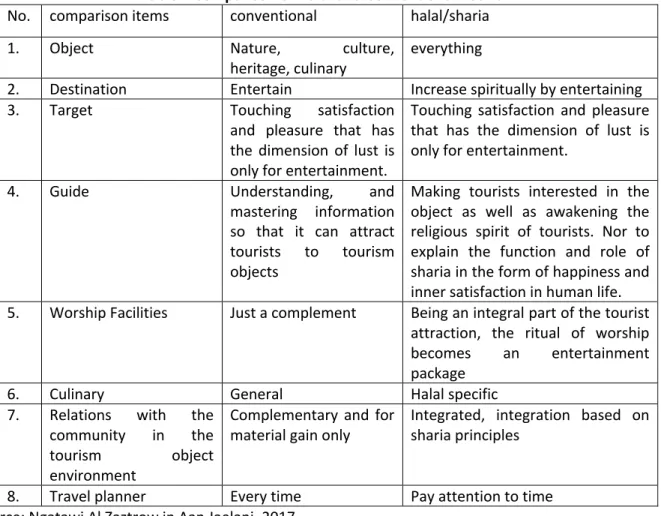
The implementation of sharia tourism has been regulated by the tourism minister in Law Article 6 paragraph 1 number 1 of 2016 "all implementation related to sharia tourism businesses must have a halal certificate issued by the DSN-MUI(Oliver, 2013). There are some significant differences between halal and conventional tourism which are explained in the table below(Hasan, 2017).
Table 2 Comparison of Halal and Conventional Tourism No. comparison items conventional halal/sharia
1. Object Nature, culture,
heritage, culinary everything
2. Destination Entertain Increase spiritually by entertaining
3. Target Touching satisfaction
and pleasure that has the dimension of lust is only for entertainment.
Touching satisfaction and pleasure that has the dimension of lust is only for entertainment.
4. Guide Understanding, and
mastering information so that it can attract tourists to tourism objects
Making tourists interested in the object as well as awakening the religious spirit of tourists. Nor to explain the function and role of sharia in the form of happiness and inner satisfaction in human life.
5. Worship Facilities Just a complement Being an integral part of the tourist attraction, the ritual of worship becomes an entertainment package
6. Culinary General Halal specific
7. Relations with the community in the
tourism object
environment
Complementary and for
material gain only Integrated, integration based on sharia principles
8. Travel planner Every time Pay attention to time Source: Ngatawi Al Zaztrow in Aan Jaelani, 2017
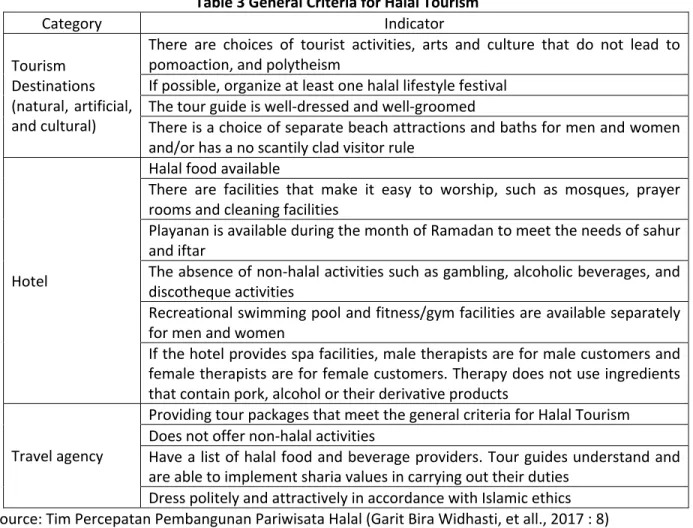
Indonesia in developing halal tourism adopts the criteria from the Global Muslim Travel Index as a reference for developing halal tourism. There are 3 general criteria for developing halal tourism
made by the Development Acceleration Team Halal Tourism under the auspices of the Ministry of Tourism of the Republic of Indonesia as shown in table 2 (Subarkah, 2018).
Table 3 General Criteria for Halal Tourism
Category Indicator
Tourism Destinations (natural, artificial, and cultural)
There are choices of tourist activities, arts and culture that do not lead to pomoaction, and polytheism
If possible, organize at least one halal lifestyle festival The tour guide is well-dressed and well-groomed
There is a choice of separate beach attractions and baths for men and women and/or has a no scantily clad visitor rule
Hotel
Halal food available
There are facilities that make it easy to worship, such as mosques, prayer rooms and cleaning facilities
Playanan is available during the month of Ramadan to meet the needs of sahur and iftar
The absence of non-halal activities such as gambling, alcoholic beverages, and discotheque activities
Recreational swimming pool and fitness/gym facilities are available separately for men and women
If the hotel provides spa facilities, male therapists are for male customers and female therapists are for female customers. Therapy does not use ingredients that contain pork, alcohol or their derivative products
Travel agency
Providing tour packages that meet the general criteria for Halal Tourism Does not offer non-halal activities
Have a list of halal food and beverage providers. Tour guides understand and are able to implement sharia values in carrying out their duties
Dress politely and attractively in accordance with Islamic ethics Source: Tim Percepatan Pembangunan Pariwisata Halal (Garit Bira Widhasti, et all., 2017 : 8)
C. Economic Growth
Economic growth is an effort to increase production capacity to achieve additional output as measured by gross domestic product (GDP) and gross regional domestic product (GRDP) in a region. The most important factor in the success of a region's development is measured based on the level of economic growth achieved, conventional economic measurement is usually by calculating the increase in the percentage of GDP for national and GRDP for provinces or districts or cities(Noviarita et al., 2021).
Islam defines economic growth as a continuous development of factors of production correctly
and able to contribute to the welfare of society, in other words, factors of production are not considered as economic growth if the production includes something that has a bad effect and is harmful to humans. Islam must have its own characteristics so that economic growth can be achieved, according to Al-Tariqi, these characteristics include (Akhmad, 2022).
1. Comprehensive (al-Syumul)
Islam sees growth as being oriented towards goals and values. Material, moral, economic, social, spiritual and fiscal aspects cannot be separated. Happiness and prosperity to be achieved is not only the happiness of this world but also the hereafter.
2. Balanced (Tawazun)
Growth is not only oriented to creating increased production, but is based on the principle of distributional justice, therefore Islam does not accept growth steps by concentrating on accelerating the development of certain programs but ignoring public facilities and other basic infrastructure.
3. Realistic (Waqi'iyyah)
Realistic is a view of the problem in accordance with reality. Islam, which is a religion that comes from God, cannot set idealistic rules that are far from human life and the possibility of its application, the reality of Islam is ideal, the ideal of Islam is reality.
4. Justice (Adalah)
Economic growth must be accompanied by distributive justice. From the existing reality, it can be seen how big the gap between the rich and the poor is, for that the importance of growth accompanied by fair distribution.
5. Responsible (Mas'uliyyah)
Islam gives space for freedom to individuals in any field, this reflects respect for humans to enjoy the pleasures of the world but is not given absolutely without limits. This freedom is limited by various rules that indicate a guarantee of happiness for the community. These characteristics are related to other aspects of growth, namely growth must be sustainable.
Growth must pay attention to ecological factors but not exploit all existing resources without
paying attention to their sustainability.
6. Sufficient (Kifayah)
Responsibilities must be absolute and include the realization of adequacy for humans, so fiqh experts have determined in the field of property allocation with a size that can meet needs, namely in the form of food, clothing, boards with proper limits.
7. Focus on humans (Ghayatuha al-insan)
Islam expands the range of objects of development from the physical environment to humans.
Islam is very concerned about the problem of economic development, but still places it on a larger development problem, namely the development of mankind. All aspects related to economic development must be integrated with the development of humanity as a whole.
RESEARCH METHOD
This research uses a qualitative approach, qualitative research is a multi-focused method, which links an interactive approach and must be for each topic, qualitative research works in a natural area that aims to understand phenomena, interpret in meaning, and qualitative research relates the use and collection of various empirical materials. , such as problem research, individual experiences, introspection, biographies, interviews, observations, interactions, and visual history readings, which describe problems and their meaning in people's and collective lives (Denzim, N.K & Lincoln, 1994).
RESULTS AND DISCUSSION
Pulau Pahawang Village is located in the District of Marga Punduh, Pesawaran Regency which has an area of 10.00 km2 / sq.km and has 6 hamlets namely Pahawang, Suakbuah, Penggetahan, Jeralang, Kalangan, and Cukuhnya. Administratively, Pulau Pahawang Village has regional boundaries, namely to the north, east and south, bordering Lampung Bay, while in the west it is bordered by Kampung Bebangkak (Badan Pusat Statistik Kabupaten Pesawaran, 2021). 1. The potential that exists on Pahawang Island is agriculture, fisheries, and also tourism, Pahawang Island is the main attraction for tourists to visit because of the natural beauty that is on the island, the main attraction of Pahawang Island is the beauty of the beach and underwater scenery which
is still beautiful and beautiful (D. P. K. Pesawaran, 2021).
Through Lampung Regional Regulation Number 6 of 2012 concerning the Master Plan for Regional Tourism Development (RIPPDA) of Lampung Province, Pahawang Island, Pesawaran Regency has become one of the leading tourist areas in the Regency / City, according to the 2018 Pesawaran BPS Regency, Pulau Pahawang Village is one of the small islands that has According to the Disparekraf of Pesawaran Regency (2017), Pahawang Island is one of the tourist destinations that is crowded with visitors from various regions and abroad because it has many attractions such as clean white sand beaches, sea water that has gradations. 3 colors, views with beautiful tree hills, and preserved coral reefs. Based on this, it can be seen from the number of visitors which continues to increase from year to year and is a marine tourism object with the highest number of arrivals in Pesawaran Regency. Based on this, it is very likely that in the future tourism on Pahawang Island will continue to grow. According to the Central Statistics Agency of Pesawaran Regency (2018), the source of income for most people on Pahawang Island comes from the tourism sector which consists of providing equipment rental services, tour guides, lodging rentals, and inter-island crossing transportation services. This is because currently there are many requests for tourism from visitors who are not only from Lampung Province, but from outside the province to foreign countries. Thus the development of Pahawang Island is very important in increasing visitor visits as the development of other areas aims to improve the welfare of the community.
In the penta helix model the government has a role as a regulator, the government acts as a regulator as well as a facilitator who has regulations and responsibilities in tourism development by involving all types of activities such as planning, implementation, monitoring, control, promotion, financial allocation, licensing, programs, legislation, development, and knowledge.
So, based on the Regulation of the Regent of Pesawaran Number 35 of 2017 concerning Management of Marine Tourism Areas in Pesawaran Regency, that the objectives of managing tourist areas in Pesawaran Regency are (P. K. Pesawaran, 2017):
a. Maintain, protect and preserve cultural traditions and local wisdom to strengthen national culture.
b. Maintain environmental sustainability in tourist areas.
c. Provide a source of information regarding the implementation of tourism businesses.
d. Organize and manage potential and create opportunities for the community.
e. Provide encouragement, motivation and create opportunities for the community.
f. As the main actor in tourism development.
g. Realizing the utilization of the results of tourism development in the context of increasing the welfare and prosperity of the community.
h. Raising the image of Pesawaran Regency, especially the village.
The management of the Pesawaran Regency tourism area is carried out based on the following principles:
a. Benefit and sustainability.
b. Creative and participatory.
c. Efficient and effective.
d. Social justice and environmental insight.
In addition to the above, in the Regulation of the Regent of Pesawaran Number 35 of 2017 concerning Management of Marine Tourism Areas in Pesawaran Regency in chapter V article 7 the management of tourist areas includes:
1) Tour package management a. Cross transportation b. Insurance
c. Travel equipment 2) Parking management 3) Waste management 4) Souvenir management 5) Culinary management 6) Security management 7) Travel agency management
8) Management of snorkeling and diving spots and mangroves 9) Management of lodging (home stays, cottages and hotels).
The procedures for tourism management as stated in chapter VI article 8 of the Regulation of the Regent of Pesawaran Number 35 of 2017 include:
1) The management of tour packages as referred to in Article 7 point 1 is carried out by means of an integrated service system at one counter that is integrated with each other.
2) Parking management as referred to in Article 7 point 3 is carried out by taking into account:
a. Regulate the placement of vehicles in the designated parking area.
b. Fully bear the cost of managing a designated parking space.
c. Maintain the cleanliness of the parking area.
d. Bear all the consequences arising from the management of the parking area.
3) Waste management as referred to in Article 7 point 3, includes waste services consisting of:
a. Collection b. Freight c. Processing d. Final processing.
4) Management of souvenirs as referred to from 7 point 4, is carried out by involving MSMEs and the community around the area and the availability of beautiful, inexpensive and unique souvenirs to the region.
5) Culinary management as referred to in Article 7 point 5, is carried out by taking into account the level of cleanliness and proper hygiene.
6) Security management as referred to in Article 7 point 6, involves the community and institutions/organizations around the area and the availability of an integrated security post whose personnel consist of:
a. Pesawaran district civil service police unit.
b. Regional Disaster Management Agency of Pesawaran Regency.
c. Pesawaran District Transportation Office.
d. Non-governmental organizations/local community organizations.
7) The management of travel agents as referred to in Article 7 point 7, must cooperate with the management of the area and must have a permit from the Pesawaran Regency Transportation Service.
8) The management of snorkeling and diving spots as referred to in Article 7 point 8 must be managed properly and professionally.
9) Innkeepers (home stays, cottages, and hotels) as referred to in Article 7 point 9, must be managed properly and professionally.
In chapter VI article 9 Pesawaran Regent Regulation Number 35 of 2017 states that:
1) The tourism management as referred to in Article 8 above is carried out by the Regional Government through BUMDES which will be further regulated in the BUMDES ADART and carried out in accordance with the applicable laws and regulations.
2) BUMDES as referred to in paragraph 1 includes:
a. BUMDES Batu Menyan Village, Teluk Pandan District.
b. BUMDES, Legundi Village, Punduh Pedada Sub-district.
c. BUMDES, Pagar Jaya Village, Punduh Pedada District.
d. BUMDES Sukarame Village, Marga Punduh District.
e. BUMDES Pahawang Village, Marga Punduh District.
There are several areas of public sector (government) involvement in tourism, including:
1) Coordination
The government has a role in coordination, the Ministry of Tourism and Creative Economy (Kemenparekraf) seeks to build trust in the tourism industry players through the CHS (Cleanliness, Health, and Safety) protocol by preparing facilities, as well as supporting the sector including accommodation, restaurants, transportation , and places that become tourist destinations, the Ministry of Tourism and Creative Economy has 3 communication strategies, namely minimizing the concerns of tourists to return to travel, the negative stigma of this activity must be removed, providing inspiration and comfort in traveling, for that the Pesawaran Regency government in efforts to develop tourism on Pahawang Island coordinates and in collaboration with the community, tourism management, and interested parties in tourism management as stated in the Pesawaran Regency Regent Regulation, this coordination and cooperation is carried out to prepare, provide, and provide comfort. to visitors in terms of tourist facilities, accommodation, transportation, restaurants or restaurants in the tourist area of Pahawang Island including Ketapang Pier as a crossing dock that visitors use when they want to vacation on Pahawang Island.
The Pesawaran Regency Government in this field of coordination can work together with the sub-district and village level governments which later will provide direction to the community, business owners, Pahawang Island tourism managers to jointly build the concept
of sharia tourism on Pahawang Island, a form of work The cooperation is in the form of local governments issuing policies related to the management and development of sharia tourism, as well as disseminating them to the sub-district and village level governments, business owners, tourism managers, and parties who have an interest in the tourism sector, building services and facilities. tourism in accordance with Islamic law.
In Pahawang Island which is a tourist destination and Ketapang Hamlet which is a pier that can be used by tourists to travel to Pahawang Island actually already have supporting facilities as sharia tourism such as prayer rooms, mosques, places for ablution but there are still other indicators that should be addressed for the realization of halal tourist destinations on Pahawang Island.
2) Planning
Tourism planning takes place in the form of infrastructure development, promotion and marketing, structure, and scale (international, national, local, and sectoral). The Pesawaran Regency Government in the tourism sector has made the Pesawaran Regency Regional Tourism Development Master Plan 2017-2031 as well as Pesawaran Regency Regional Regulation NO. 6 of 2019 concerning the Pesawaran Regency Spatial Plan for 2019-2039 which aims to realize a prosperous Regency space based on tourism, agriculture, industry that is environmentally sound in a sustainable manner.
The role of the Pesawaran Regency Government in the field of planning, can make designs, plans for the sharia tourism sector, such as what locations and facilities will be built to support the implementation of sharia tourism to improve the economy. Planning the development of the concept of sharia tourism must pay attention to the values contained in Islam, and be oriented to the benefit of the people.
3) Regulations and Legislation
The government has the authority or legal power and legislation directly or indirectly related to the tourism industry, such as passport and visa policies, land use, labor, wages and so on, in this case the Pesawaran Regency Government Pesawaran Regency Government has an important role in development and management of tourism in Pesawaran Regency, the management and development efforts carried out are outlined in
the form of policies and regulations such as Pesawaran Regent Regulation Number 35 of 2017 concerning Management of Marine Tourism Areas in Pesawaran Regency, the Pesawaran Regency government in realizing these policies invites, supervises, regulates and fostering all interested parties so that tourism potential in Pesawaran Regency can create benefits, improve the economy and welfare of the community, and increase regional income.
Pesawaran Regent Regulation Number 35 of 2017 concerning Management of Marine Tourism Areas in Pesawaran Regency is a guide for all tourist destinations in the Pesawaran Regency area, including Pahawang Island tourism. In this study, in looking at the policies or regulations issued by the Pesawaran Regency Government, the researchers made observations in the area of Batu Menyan Village, Ketapang Village, Teluk Pandan District, Pesawaran Regency, this area is a crossing place or dock to a tourist destination on Pahawang Island, as a crossing pier for Dusun. Ketapang has complete facilities such as providing lodging managed by the owner (community or investor), in addition to restaurants and other accommodation services. As a form of realization of the policy issued by the Pesawaran Regency Government, Ketapang Hamlet in the management of tourist areas has carried out tour package management, parking management, waste management, souvenir management involving MSMEs, culinary management, security management carried out by Non-Governmental Organizations or local community organizations. , management of travel agents, management of snorkeling and diving spots, and management of lodging (home stays, cottages). So that the regulations made by the Pesawaran Regency Government which involve all aspects consisting of the community, business people, the local government work together to promote the tourist destinations of Pahawang Island so that with the large number of visits this can increase income for both the community, local government, and businessmen.
In addition to policies and regulations regarding tourism management and development, the Pesawaran Regency Government has a role in the tourism business sector. 22 of 2017, the regulation explains that this regulation was made with the aim of providing legal certainty in organizing tourism businesses, controlling and controlling tourism operations, providing sources of information regarding tourism business operations, and providing
requirements for implementing tourism business certification.
The Pesawaran Regency government's policy on tourism as stated in the Pesawaran Regent Regulation Number 35 of 2017 concerning the Management of Marine Tourism Areas in Pesawaran Regency is of course an effort to develop the tourism sector to improve the economy and community welfare, but the policy has not been aimed at the implementation of the tourism concept. sharia, because in the implementation of sharia tourism based on the Fatwa of the National Sharia Council-Indonesian Ulema Council No:
108/DSN-MUI/X/2016 both in provisions related to tourism parties and their contracts, provisions related to sharia hotels (sharia lodging), provisions related to tourists, provisions of tourist destinations, provisions related to travel agencies, and provisions related to tour guides. For this reason, as a form of embodiment of the government's role in the development of sharia tourism on Pahawang Island, the regional government of Pesawaran Regency has the authority to regulate and make these policies as guidelines for tourism managers and the community in developing sharia tourism on Pahawang Island by referring to the Fatwa of the National Sharia Council- Indonesian Ulema Council No:
108/DSN-MUI/X/2016.
4) Stimulation
Stimulation that can be done by the government is to provide financial incentives. Finance tourism research, stimulate tourism through promotional marketing, and service to visitors. Pesawaran Regency Government in stimulating tourism through promotional marketing, especially on the object of Pahawang Island through the official website of
Pesawaran Regency such as https://pesawarankab.go.id/
http://pariwisata.pesawarankab.go.id/ in addition to working with the community around to develop and beautify the tourist destinations of Pahawang Island, so that with the beauty, facilities provided, as well as promotions carried out by the government, the community and other interested parties, it encourages an increase in visits to Pahawang Island.
The number of tourist visits on Pahawang Island is increasing and automatically people's
income is increasing so that it can create community welfare. Islam views the achievement of such economic growth must have the following characteristics:
1) Comprehensive (Al-Syumul)
Islam sees growth as being oriented towards goals and values. Material, moral, economic, social, spiritual and fiscal aspects cannot be separated. Happiness and prosperity to be achieved is not only the happiness of this world but also the hereafter. Regarding this, based on the results of interviews with the community at the Ketapang pier, the income orientation they get has been included in these 5 aspects because they are in opening a business and providing services not only for themselves but they provide opportunities for other people to help run their business, so that both of them get a positive impact from the presence of the Pahawang Island tour, from a spiritual perspective they think that when we have good material, economic and fiscal resources to carry out worship or other spiritual activities such as giving charity and helping others, it is easier and more feasible to do.
2) Balanced (Tawazun)
Growth is not only oriented to creating increased production, but is based on the principle of distributional justice, therefore Islam does not accept growth steps by concentrating on accelerating the development of certain programs but ignoring public facilities and other basic infrastructure. Regarding this, the Pesawaran district government in collaboration with the sub-district and village level governments as well as the community, especially the Ketapang and Pahawang dock communities, not only pays attention to only program development but also pays attention to all aspects for tourism development, this is as stated in the Regulation Pesawaran Regency No. 35 of 2017 concerning the Management of Marine Tourism Areas in Pesawaran Regency in the regulation it is clear that the tourism management system pays attention to both the management of tourist attractions, preserving the natural surroundings, even to the point that waste management has been contained in the regulation mentioned and it is applied by the community and stakeholders in tourism development on Pahawang Island.
3) Realistic (Waqi'iyyah)
Realistic is a view of the problem in accordance with reality. Islam, which is a religion
that comes from God, cannot set idealistic rules that are far from human life and the possibility of its application, the reality of Islam is ideal, the ideal of Islam is reality.
Regarding this, in the development of tourism on Pahawang Island, the government in collaboration with stakeholders has seen the actual conditions and reality so that a solution to existing problems is created, the problem faced by the Pesawaran district government and the community is poverty, seeing the existing reality and the conditions of the area that are different, the Pesawaran Regency government makes regulations regarding the Pesawaran Regency Spatial Plan which is contained in the Pesawaran Regency Regional Regulation No. 6 of 2019. In this regulation, the regions in Pesawaran Regency have been divided according to the needs and potential of their respective regions so that policies and actions can be implemented. carried out by the community and local government can be right on target so that problems can be resolved.
4) Justice (Adalah)
Economic growth must be accompanied by distributive justice. From the existing reality, it can be seen how big the gap between the rich and the poor is, for that the importance of growth accompanied by fair distribution. Regarding this, as previously explained, in order to create equity and distribution justice in order to create equitable economic growth in each region, the government has made Pesawraan Regency Regional Regulation No. 6 of 2019 concerning the Pesawaran Regency Spatial Plan. conditioned according to the conditions of each region. on the side of the Ketapang dock community, the form of justice and equity carried out in the form of those who have this business can create jobs that can be useful for other people who do not have the capital to open the business, so that they can equally benefit from the existence of Pahawang Island tourism.
, so that the income of the community increases and there is no too far gap between the people, besides that in Islam as fellow human beings we must help each other, and when we have sustenance then some of the sustenance has the rights of others, meaning that people who have sustenance on the results In the business of eating, there are rights of other people or other poor people so as to create economic equality among the community.
5) Responsible (Mas'uliyyah)
Islam gives space for freedom to individuals in any field, this reflects respect for humans to enjoy the pleasures of the world but is not given absolutely without limits. This freedom is limited by various rules that indicate a guarantee of happiness for the community. These characteristics are related to other aspects of growth, namely growth must be sustainable. Growth must pay attention to ecological factors but not exploit all existing resources without paying attention to their sustainability. Regarding this matter, Pahawang Island tourism is oriented towards sustainable tourism and environmental sustainability, the community cooperates with the local government to continue to preserve the natural resources found on Pahawang Island, one of which is by preserving this mangrove forest in the allotment so that there is no land destruction or erosion of the coastal plains or the frequent erosion of the coastal plains. called abrasion, in addition to maintaining the ecosystem in the sea, not only that the coral reefs in the sea of Pahawang Island continue to be preserved and this is one of the attractions of Pahawang Island tourism with its stunning beauty in the sea.
6) Sufficient (Kifayah)
Responsibilities must be absolute and include the realization of adequacy for humans, so fiqh experts have determined in the field of property allocation with a size that can meet needs, namely in the form of food, clothing, boards with proper limits. For this reason, Islam sets the priority scale for the aspects of need, namely ad-daruriyyah, al-hajjiyyah, and at-tahsiniyyah. Regarding this, the people of Ketapang dock use their income by prioritizing them to have a place to live so that by having their own place to live they can open a business to meet their other needs.
7) Focusing on humans (Ghayatuha al-insan)
Islam expands the range of objects of development from the physical environment to humans. Islam is very concerned about the problem of economic development, but still places it on a larger development problem, namely the development of mankind. All aspects related to economic development must be integrated with the development of humanity as a whole.
CONCLUSION
1. The role of the penta helix synergy towards tourism development and economic improvement on Pahawang Island is considered very effective, because all interested parties, namely the government, business people, communities or communities, academics and the media participate and play an active role in the management and development of Pahawang Island tourism , so that with the existence of Pahawang Island tourist destinations, the community can improve the economy and meet the needs of clothing, food, and housing, especially the people of Pahawang Island and the people at the Ketapang pier.
2. The role of the penta helix synergy towards the development of hala tourism and economic improvement on the island of Pahawang, Pahawang Island is a tourist area in the province of Lampung that has not implemented the concept of sharia tourism. However, the great potential in efforts to develop sharia tourism on Pahawang Island, this can also be seen from the supporting facilities in terms of performing worship on Pahawang Island. For this reason, the role of the penta helix is needed to develop the concept of tourism on Pahawang Island.
REFERENCES
[1] Akhmad, T. (2022). Dampak Pandemi Covid-19 Terhadap Pertumbuhan Ekonomi Indonesia Dan Solusi Mengatasinya. Muttaqien; Indonesian Journal of Multidiciplinary Islamic Studies, 3(1), 67–77.
[2] Alim, S., Mukaffi, Z., & Choiruddin, M. N. (2020). Potensi dan Strategi Pengembangan Wisata Syariah di Banyuwangi. 1st ANNUAL CONFERENCE ON IHTIFAZ: Islamic Economics, Finance, and Banking, 307–342.
[3] Badan Pusat Statistik Kabupaten Pesawaran. (2021). Marga punduh Subdistrict in Figure.
[4] Denzim, N.K & Lincoln, Y. S. (Eds). (1994). Handbook of Qualitative Research. SAGE Publications Inc.
[5] Etzkowitz, H., & Leydesdorff, L. (1995). The Triple Helix (University, Industtry, Government) Relations : a Laboratory for Knowledge Based Economic Development.
EASST Review, 14(1), 14–19.
[6] Ghafur Wibowo, M., & Yusuf Khoiruddin, A. (2020). Model of Halal Tourism Management in Bukittinggi City, West Sumatra Province, Indonesia. International Journal of Publication and Social Studies, 5(2), 115–130. https://doi.org/10.18488/journal.135.2020.52.115.130 [7] Gilang Widagdyo, K. (2015). Analisis Pasar Pariwisata Halal Indonesia. The Journal of
Tauhidinomics, 1(1), 73–80.
[8] Hadi, F., & Al-Asy Ari, M. K. H. (2017). KAJIAN POTENSI DAN STRATEGI
PENGEMBANGAN WISATA PANTAI SYARI’AH (Studi di Pulau Santen Kabupaten Banyuwangi). Jurnal MD, 3(1), 99–116. https://doi.org/10.14421/jmd.2017.31-07 [9] Hasan, F. A. Al. (2017). Penyelenggaraan Parawisata Halal di Indonesia (Analisis Fatwa
DSN-MUI tentang Pedoman Penyelenggaraan Pariwisata Berdasarkan Prinsip Syariah).
Jurnal Ilmu Syari’ah Dan Hukum, 2(1), 59–78. https://doi.org/10.22515/al-ahkam.v2i1.699 [10] Khusniyah. (2020). Implementasi Model Pentahelix Sebagai Landasan Pengembangan
Potensi Pariwisata Di Kabupaten Kediri (Studi Literatur). Prosiding Seminar Nasional Kahuripan, 1–5. https://conference.kahuripan.ac.id/index.php/SNapan/article/view/42 [11] Lampung, B. P. S. (2019). Laporan Perekonomian Provinsi Lampung. BPS Provinsi
Lampung. https://doi.org/919907.18
[12] Lampung, P. P. (2013). Peraturan Daerah Lampung Nomor 6 Tahun 2012 Tentang Rencana Induk Pembangunan Pariwisata Daerah Provinsi Lmapung.
[13] Noviarita, H., Kurniawan, M., & Nurmalia, G. (2021). Analisis Halal Tourism dalam Meningkatkan Laju Pertumbuhan Ekonomi di Provinsi Lampung. Jurnal Ilmiah Ekonomi Islam, 7(1), 302. https://doi.org/10.29040/jiei.v7i1.1574
[14] Oliver, J. (2013). Kesejahteraan Masyarakat. Journal of Chemical Information and Modeling, 53(9), 1689–1699.
[15] Panorama, M. (2018). Analisis Potensi Wisata Religi Ki Merogan Palembang. I- ECONOMICS: A Research Journal on Islamic Economics, 4(1), 18–28.
https://doi.org/10.19109/ieconomics.v4i1.1924
[16] Pariwisata, K. (2018). Kebijakan Pengembangan Pariwisata.
[17] Pesawaran, B. K. (2022). Kabupaten pesawaran dalam angka 2022. BPS Kabupaten Pesawaran. https://doi.org/1102001.1809
[18] Pesawaran, D. P. K. (2021). Pulau Pahawang, Wisata Andalannya Lampung.
[19] Pesawaran, P. K. (2017). Peraturan Bupati Pesawaran Nomor 35 Tahun 2017 Tentang Pengelolaan Kawasan Wisata Bahari Di Kabupaten Pesawaran. Pemerintah Kabupaten Pesawaran.
[20] Praswati, A. N. (2017). Perkembangan Model Helix Dalam Peningkatan Inovasi. Seminar Nasional Riset Manajemen & Bisinis : Perkembangan Konsep Dan Riset E-Business Di Indonesia, 690–705.
[21] Subarkah, A. R. (2018). Potensi dan Prospek Wisata Halal Dalam Meningkatkan Ekonomi Daerah (Studi Kasus: Nusa Tenggara Barat). Jurnal Sosial Politik, 4(2), 49.
https://doi.org/10.22219/sospol.v4i2.5979
[22] Umiyati, S., & Tamrin, M. H. (2021). Penta Helix Synergy in Halal Tourism Development.
Advances in Social Science, Education and Humanities Research, 518(ICoSIHESS 2020), 75–81. https://doi.org/10.2991/assehr.k.210120.108
[23] Vani, R. V., Priscilia, S. O., & Adianto. (2020). Model Pentahelix Dalam Mengembangkan Potensi Wisata di Kota Pekanbaru. Jurnal Pendidikan Bisnis Dan Ekonomi, 8(1), 63–70.
https://doi.org/10.31289/publika.v8i1.3361
[24] Yunas, N. S. (2019). Implementasi Konsep Penta Helix dalam Pengembangan Potensi Desa melalui Model Lumbung Ekonomi Desa di Provinsi Jawa Timur. Jurnal Inovasi Kebijakan, 3(1), 37–46. https://doi.org/10.21787/mp.3.1.2019.37-46