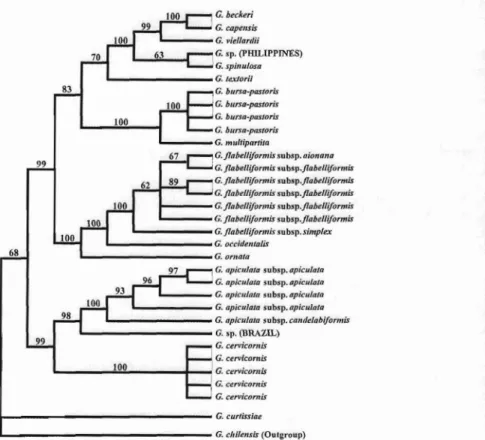
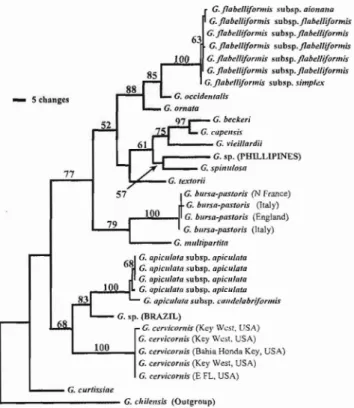
Due to the relatively small number of diagnostic characters, the taxonomy of Grucilaria at the species level has long been one of the most difficult, which was further complicated by the large number of described species. Maximum parsimony (MP) analysis "was performed as implemented in PAUP '" v.4.0, bet a 10 (Swofford, 2003) according to Fitch's criterion of equal weights for all substitutions (Fitch, 1971) and without the first 99 bp a alignment , for which too many missing data were present in most sequences. This is because it usually makes little sense to override this behavior by imposing specific values on the prior parameters in the Bayesian analysis. Bayesian analysis was performed by s ix chains of Mark in Chai n Monte Ca rlo (five hot, one cold), sampling one tree every 20 generations for 2,000,000 generations starting with a random tree. The reliability of a Bayesian consensus tree is given by the frequency at which each node appears among all saved trees after the "ignition" point, i.e.
This frequency corresponds to the true probability of the clades, posterior or probability (PP) (Ha ll, 2001). Types that are calculated based on unspecified distances as implemented by PA UP*. Among the 33 partial rbcL sequences, 1105 bp were identical and 362 bp differed at least once. Excluding the first 99 bp, there were 156 informative characters included in the MP analysis (including the outgroup sequence). Maximum parsimony analysis of the data set resulted in 33 equivalent spanning trees (MPT) of 378 steps, CI = 0.49 and RI = 0.62 (Fig.1). All inter-specific phylogenetic relationships among the 64 MPTs were identical.
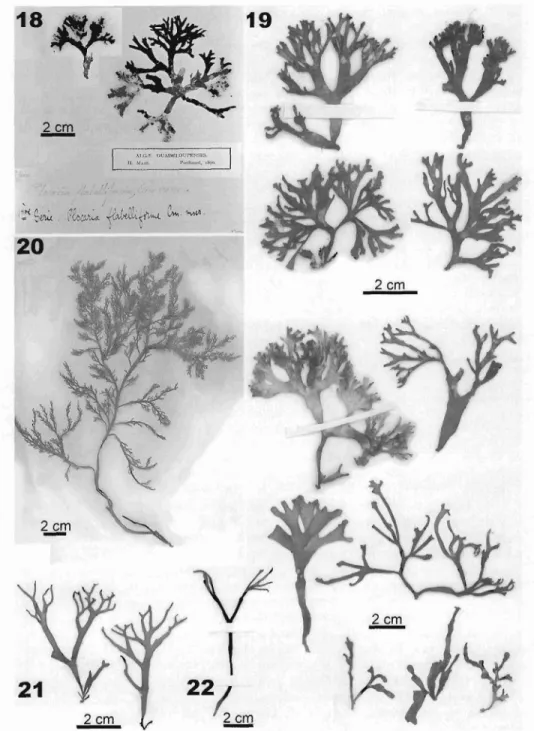
Fig.1.One of 64 most parsimonious trees.Maximum parsim op y phylog ra mofthe most derived clade of the genus Gracilaria sensu stricto based on an rbcs:DNA sequence analysis.Number. Bayesian consensus tree (= 50% majority rule consensus) of the most derived lineage in the genus Gracilaria sensu stricto, consensus composed of 99341+I trees saved after the Metropolis coup led Markov chain Monte Carlo run statio nari tyat gener atio reached 16,200. Gracilariaapiculatasubsp.apiculata of Mexico (#FG-149) .9:Phe notypicvariat ion of the habi t.10:Cystocar p position on term inal cylindr ica l bran ches.11:Cystoca rp pos ion on flat end main axis enmargina lcylindchran .
Description: Algae short and broad, up to 5.5 cm long, up to 4 mm wide, branched up to 6 (-8) orders, dull red to yellowish; cartilaginous, crusty;. adheres well to the paper when dry. A small, discoid, tenacious bear a cylindrical stem, up to 1 em long, that becomes compressed to flatten upwards and spans sub-d icotomes into alternate branches. Cystocarps prominent, narrowed at base when ripe; pericarp 350 pm thick, inner pericarp cells stellate (Fig. 29).
Presence of linear to branched tubular feeder cells connecting the gonirnoblasts to the inner pericarp cells and also to the cells of the floor of the cystocarp that are closer to the pericarp (Fig. 31). Sorus formation not distinct; tetrasporangia on both sides of the blades (Fig. 32). note: this is the first selection of a lectotype specimen for this taxon that we are aware of). Comments: As the generic names Gracilaria and Plocaria are feminine, the correct ending of the species name should be -is, and the spelling is therefore corrected to 'fiabelliformis' (Greuter et al., 2000,l CBN: Art. 23.5).
Grucilariajlubelliformissubsp.flabellifo rm is:Transverse sections.25:Cortical development close to the base of the main axis.26:Gradua lcortex to medulla transition at terminal region of thallu s.27:Me ulla composed of thick-walled, more or less uniformly sized cells. Description: Algae slender and up to 30 em high, main axis 1.0-2.2 mm wide, compressed; branching in one plane only, up to 5-6 orders, subdichotomous or alternate; branches sparsely distributed along the main axis above a small holder. Description: Algae erect, composed of compressed, linear, oblong or lanceolate main axes and branches; Shows a wide range of morphological variation in size and apex shape: up to 12 ern long, up to 1.8 cm wide.
40: Tubular nutrient filaments a mangikonektar iti gonimo-blas t iti perica rp, 41-42: Transection ti thallus, a mangipakpakita iti kellaat a panagbalbaliw manipud kadagiti dadakkel, napuskol ti paderna a met ular cells agingga kadagiti basbassit nga amang a selula ti cortex. ...
DISCUSSION
Our results suggest that they are more taxa-currently included in "G.cervico rn is-G. Our preliminary data suggest that G.[erox may be revived to include the distinct taxa represented here as" G.sp. However, the taxonomy of Gracilaria mammillaris (Mo n tagne) Howe was recently elucidated with newly collected specimens (G urgeletal.2004a), and it is a deep-water species from the Gulf of Mexico and the Caribbean.
Our results showing this taxon are on the most morphologically variable species of Gracilaria in the tropical western Atlantic, and because of that and despite its common occurrence, G. Graciluria tikvahiue is another morphologically variable species whose molecular and molecular nature. morphological variation has recently been studied across its geographic range (Gurgel et al., 2004c). Despite the already large number of described Gracilaria sens u stricto species (sens u Gurgel& Fredericq, 2004), the genus is still far more species-rich than previously known. The general lack of distinct diagnostic characters and ten overlapping species boundaries have led to much confusion of the taxa on om y of the genus Gracilaria, and the redescription of G.apiculata and G.jlabelli- [armis established in this study was only possible with guidance from informative molecular-basedrbcLphylogenies. Molecular techniques have been shown in this and other studies (eg Gurgel & Fredericq, 2004; Gurgel et al., 2003a,b, 2004a,b) to help resolve many systematic questions in Gracilaria sensu stricto at the species level.
So far, rbcL-based phylogenies have helped to identify eight new species (Gurgel et al., 2003a, b; 2004a) and five new subspecies (Gurgcl et al., 2004a; and herein), and to recognize that there are more than two other distinct taxa in G. cervicorn er- G.domingensiscomplex. The fact that G.sp. from Brazil with a "G.[erox morphology" is a distinct entity, suggests that G ferox may also be a discrete taxon to be More comprehensive collections and further studies are needed to resolve these questions. We also thank the staff at the Smithsonian Marine Station in Fort Pierce, Florida, as well as R.H. BELLORIN A.M., OLIVEIRA M.C., & OLIVEIRA E.c., 2002 - Phylogeny and systematics of the marine diatom family Gracilariaceae (Gracilariales, Rhodophyta) on small subunit rDNA and ITS sequences of Atlantic and Pacific species. Journal of Phycology.
B0RGESEN E, 1932 - Ti rebision ti alga ni Forsskal a nadakamat iti Flora lEf?yptico - Arabiko ken nasarakan idiay Herbariumna idiay Botaniko a Museo ti Unibersidad ti Copenhagen. GANESAN E.K., 1989 - Taxon om y dagiti ekolohikal a napateg a ruot ti baybay Venezue la,1.Gracilaria:G.lacinulata (Vahl) Kasano e Prox.Bulletin.ti lnsti tuto ti Oceanograpia ti Venezuela,Universid adeOrient e, Cum iti 28(l&2) :85-9 GREVILLER.K.,1830 - Algae Britann icae, wenno ti panangiladawan kadagiti marine ken dadduma pay nga awan ti artikulado a mula ti Isla ti Britania, a tagikua ti urnos ti Algae; nga addaan iti plato a mangiladawan iti gen ra. Ed ken b urg h, Mac l.
HARVEYW.H., 1853 - Nerdsbo reali-am ericana; 01; contribute to a history of the marine algae of the Atlantic and Pacific coasts south of North America. -BAUTISTA 1.& KAPRAUN D.F., 1995 - Aga ranalysis, quantification and characterization of the core genome of four agarophytes (Graci/aria) from the Mexican Gulf Coast. Journal of Applied Phycology amp; MADDISON WP, 2000 - MacClade4: analysis of phylogeny and character evolution. MILLAR AJ.K.,1997 - Some flattened species of Gracilaria from Australia.in:ABBOTT LA. ed.), Taxonomy of economic seaweeds, with reference 10 Some species from the Pacific Ocean.
ORT E G AM.M.,GO D iNEZIL.& GAR DUNO-S O LO RZAN O G.,2001 - Cauilogue dagiti bentiko nga algae dagiti aplaya ti Mehiko ti Golpo ti Mehiko ken ti Baybay Curibe. Apendise. Listaan dagiti sebbangan, lokasion ti panagkolekta, (dagiti) kolektor ken petsa, ken numero ti panagserrek ti GenBank ken dagiti panagsasaruno ti rbcLDNA (porsiento) iti daytoy a panagadal. Dagiti abbreviation ti autor: FG =CarlosF.