
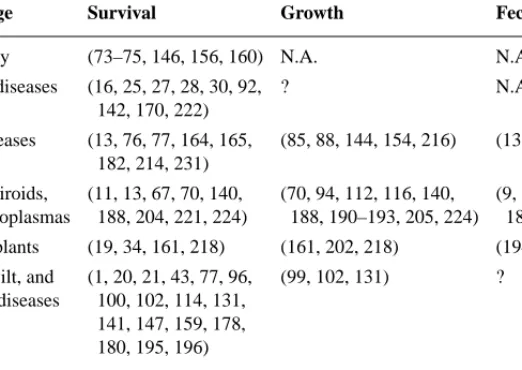
In this review, I address three broad areas of the role of plant diseases in natural plant ecosystems. In Table 1, I use this cross-categorization to summarize a collection of representative studies on the effects of disease on wild plants. Seeds of the common forest tree Strychnos mitis (Strychnaceae) in Uganda suffered 88% mortality, primarily from fungal attack, although fungal attack was nearly eliminated when the fruits were first handled by thrifty monkeys (146).
In the Appalachian Mountains of the eastern United States, flower gall of flame azalea (Rhododendron calendulaceum, Ericaceae) caused by Exobasidium vaccinii caused 50%. The past two decades have seen an expansion of our appreciation of the ecological dynamics of plant diseases in natural communities. Rust infection directly affected host competitive ability in addition to the effects of infection on plant growth.
For some species, but not others, the effects were associated with accumulation of Pythium in the soil, indicating host-specific effects of the cultivated pathogens (163). The removal of the host history has major effects on the plant community, with local resistant species then becoming dominant in the centers of infection (124). In high-diversity plant communities, such as tropical rainforests, the effects of disease on the spatial patterns and coexistence of plant species may be more complex and cluster within the framework of the Janzen–Connell hypothesis.
The first empirical tests of the role of plant diseases for the Janzen-Connell hypothesis were conducted by Augspurger and colleagues, as described above under Seedling diseases.
RAPID EVOLUTION AND LOCAL ADAPTATION The Red Queen Hypothesis
The effects of host community diversity and structure on fungal diversity and host specificity are largely unexplored, except for recent studies of the diversity and host specificity of wood-degrading polypore fungi in Central American tropical forests. In the high-diversity humid tropical forests of the BCI of Panama (103), none of 43 species showed significant host preferences, and in the medium-diversity dry tropical forest of Costa Rica (150), only 3 of 32 species showed host specificity. In contrast, the polypore fungal community is strongly dominated by only a few common species, each highly host-specific (107).
Considerable work has been done in agricultural settings on how plant group structure affects disease development (166). Additional research on the effects of host density, diversity and spatial structure on the diversity and specificity of pathogenic fungi is clearly needed to understand the dynamic effects of pathogens on competitive interactions in natural plant communities. Understanding the interplay between numerical and evolutionary dynamics in natural plant pathogen systems is a major challenge for the next decade (17, 22).
The ability of hosts to respond evolutionarily to selection pressure from pathogens will depend not only on generation time, but also on host genetic variability and outcrossing rates. They found that the outcrossed populations showed consistently higher overall levels of resistance, number of resistance phenotypes and levels of polymorphism for specific virulence factors in the pathogen. Many systemic fungal parasites castrate their host plants, allowing only clonal reproduction or autogamy and avoiding Red Queen challenges of sexual recombination in the host (68).
Both intrinsic variability in host crossover rates and pathogen manipulation of the host can affect the response to selection in evolutionary arms races. In addition, metapopulation structure, including effects of genetic drift and gene flow, may be equally important in determining the dynamics of reciprocal selection (200).
Local Adaptation and the Scale of Dispersal
However, these two models and all current empirical methods do not adequately measure or describe the tail of the dispersion curve; improving measurement capabilities and mathematical descriptors for dispersal tails is an important current area in spatial ecology. Although direct studies of pathogen dispersal in natural ecosystems are few, the available literature suggests that some fungal spores can travel hundreds of kilometers (176, 201). SPATIAL PATTERNS Our understanding of the role of the spatial extent of dispersal in structuring natural microbial communities and populations is growing rapidly.
Traditional phytosociological studies of the spatial extent of circulation in fungal communities should be supplemented with studies of the spatial distribution of individual species, populations and genotypes. Carroll (59) reviewed the distribution of endophytes and suggests that in trees height within the canopy is the most important determinant of spatial structure, while within individual branches leaf age is the most important. Unfortunately, our understanding of the effects of dispersal and environment on the large-scale biogeographic distribution of pathogens remains poor, except for important pathogens of widespread crops.
Isolates of the chestnut blight fungus Cryphonectria parasitica showed strong genetic structure, with isolates of the same genotype closer together than expected by chance (162). Understanding how different fungal life histories affect the scale of genetic structure will provide much insight into the pattern and likelihood of local adaptation in plant-pathogen interactions. Burdon & Thrall (53) provided a good review of the role of spatial structure for ecological and evolutionary dynamics of plant-pathogen interactions, with particular reference to its effects on co-evolutionary dynamics, both within single populations and across ' a metapopulation.
Plant-pathogen systems are among the few where both numerical and genetic dynamics have been studied in a spatial context, and where the genes under selection are unambiguous. Investigating the spatial context of the evolutionary ecology of plant-pathogen systems is important not only for disease ecologists, but also for the field of evolutionary ecology in general. LOCAL ADAPTATION If the evolutionary dynamics of plant-pathogen interactions are spatially heterogeneous, the dynamics described for interspecific interactions in the Janzen-Connell hypothesis and other forms of disease-driven host dynamics can be extended to ecological interactions between genotypes of the same host species.
On the other hand, Davelos et al. 78) performed reciprocal transplants of clonal prairie grass Spartina pectinata between patches with low and high incidence of Puccinia rusts. We still have a limited understanding of the extent of local adaptation of pathogens in natural ecosystems. Reciprocal transplantation and common garden experiments will provide important advances in our understanding of the extent of local adaptation in plant pathogen systems.
CONCLUSIONS
Relationships between vegetation and location of witness trees in the suburban forests of eastern West Virginia. Dendroecology and successional status of two contrasting old-growth oak forests in the Blue Ridge Mountains, USA. Seed dispersal of the tropical tree Platypodium elegans, and the escape of its seedlings from fungal pathogens.
Involvement of the soil community in plant population dynamics: utility of the feedback approach. Influence of site factors on dogwood anthracnose in the Nantahala Mountain Range of western North Carolina. Effect of the fungus Atkinsonella hypoxylon (Clavicipitaceae) on the reproductive system and demography of the grass Danthonia spicata.
Berry consumption by the American Robin, Turdus migratorius, and the subsequent effect on seed germination, plant vigor and spread of Lowbush Blueberry, Vaccinium angustifolium. The role of plant-parasitic nematodes and soil-borne fungi in the decline of Ammophila arenaria (L.) Link. Spatial and temporal dynamics of epidemics of the rust fungus Uromyces valerianae on populations of its host Valeriana salina.
Regional and local patterns in the spatial distribution of the flower-infecting blight fungus Sporisorium amphilophis in natural populations of its host Bothriochloa macra. Patterns of foliar pathogen infection in the understory of a Mexican rainforest: occurrence, spatial variation, and mechanisms of infection. Spatiotemporal dynamics of Floerkea proserpinacoides (Limnanthaceae), an annual plant in the deciduous forest of eastern North America.
Polymorphism at the ribosomal DNA spacers and its relation to reproductive structure in the widespread fungus Schizophyllum commune. Abundance and diversity of Schizophyllum commune spore clouds in the Caribbean revealed by selective sampling. Detection and identification of European stone fruit yellows and other phytoplasmas in wild plants in the environment of apricot chlorotic leaf roll affected plantations in southern France.
Spatial analysis of nuclear and mitochondrial RFLP genotypes in populations of the chestnut blight fungus, Cryphonectria parasitica. Dying: dynamics and management of Phytophthora cinnamomi in Jarrah (Eucalyptus marginata) forest in south-western Australia.
