Consolidated Set of the GRI
Standards
Consolidated Set of the GRI Standards
This document contains the complete set of GRI Sustainability Reporting Standards (GRI Standards). It includes the most recent versions of the Standards available as of 30 June 2022. The full contents of each Standard have been incorporated, including the original formatting and page numbering, but the cover pages between the Standards have been left out.
Responsibility
This Standard is issued by the Global Sustainability Standards Board (GSSB). Any feedback on the GRI Standards can be submitted to [email protected] for the consideration of the GSSB.
Due Process
This document was developed in the public interest and in accordance with the requirements of the GSSB Due Process Protocol. It has been developed using multi-stakeholder expertise, and with regard to authoritative intergovernmental instruments and widely held expectations of organizations relating to social, environmental, and economic responsibilities
Legal liability
This document, designed to promote sustainability reporting, has been developed by the Global Sustainability Standards Board (GSSB) through a unique multi-stakeholder consultative process involving representatives from organizations and report information users from around the world. While the GRI Supervisory Board, Management Board, and GSSB encourage the use of the GRI Sustainability Reporting Standards (GRI Standards) and related Interpretations by all organizations, the preparation and publication of reports based fully or partially on the GRI Standards and related Interpretations are the full responsibility of those producing them. Neither the GRI Supervisory Board, Management Board, GSSB, nor Stichting Global Reporting Initiative (GRI) can assume responsibility for any consequences or damages resulting directly or indirectly from the use of the GRI Standards and related
Interpretations in the preparation of reports, or the use of reports based on the GRI Standards and related Interpretations.
Copyright and trademark notice
This document is copyright-protected by Stichting Global Reporting Initiative (GRI). The reproduction and distribution of this document for information and/or use in preparing a sustainability report is permitted without prior permission from GRI. However, neither this document nor any extract from it may be reproduced, stored, translated, or transferred in any form or by any means (electronic, mechanical, photocopied, recorded, or otherwise) for any other purpose without prior written permission from GRI.
Global Reporting Initiative, GRI and logo, GSSB and logo, and GRI Sustainability Reporting Standards (GRI Standards) and logo are trademarks of Stichting Global Reporting Initiative.
© 2024 GRI. All rights reserved.
Contents
GRI 1: Foundation 2021 5
GRI 2: General Disclosures 2021 40
GRI 3: Material Topics 2021 94
GRI 11: Oil and Gas Sector 2021 121
GRI 12: Coal Sector 2022 209
GRI 13: Agriculture, Aquaculture and Fishing Sectors 2022 292
GRI 14: Mining Sector 2024 383
GRI 101: Biodiversity 2024 478
GRI 201: Economic Performance 2016 524
GRI 202: Market Presence 2016 540
GRI 203: Indirect Economic Impacts 2016 550
GRI 204: Procurement Practices 2016 558
GRI 205: Anti-corruption 2016 566
GRI 206: Anti-competitive Behavior 2016 579
GRI 207: Tax 2019 588
GRI 301: Materials 2016 606
GRI 302: Energy 2016 616
GRI 303: Water and Effluents 2018 632
GRI 304: Biodiversity 2016 657
GRI 305: Emissions 2016 669
GRI 306: Effluents and Waste 2016 691
GRI 306: Waste 2020 703
GRI 308: Supplier Environmental Assessment 2016 730
GRI 401: Employment 2016 741
GRI 402: Labor/Management Relations 2016 754
GRI 403: Occupational Health and Safety 2018 764
GRI 404: Training and Education 2016 794
GRI 405: Diversity and Equal Opportunity 2016 806
GRI 406: Non-discrimination 2016 818
1 The effluents-related content of the GRI Standard GRI 306: Effluents and Waste 2016 has been superseded by GRI Standard GRI 303: Water and Effluents 2018, and the waste-related content has been superseded by GRI 306: Waste 2020. The spills-related content in GRI 306: Effluents and Waste 2016 remains in effect.
GRI 407: Freedom of Association and Collective Bargaining 2016 827
GRI 408: Child Labor 2016 837
GRI 409: Forced or Compulsory Labor 2016 848
GRI 410: Security Practices 2016 858
GRI 411: Rights of Indigenous Peoples 2016 866
GRI 413: Local Communities 2016 876
GRI 414: Supplier Social Assessment 2016 888
GRI 415: Public Policy 2016 899
GRI 416: Customer Health and Safety 2016 908
GRI 417: Marketing and Labeling 2016 917
GRI 418: Customer Privacy 2016 927
GRI Standards Glossary 936
0 There are now 31 Topic Standards after the withdrawal of three Standards. The reason for withdrawal was that either their content was discontinued or incorporated in the revised Universal Standards.
Universal Standard
Effective Date
This Standard is effective for reports or other materials published on or after 1 January 2023 Responsibility
This Standard is issued by the Global Sustainability Standards Board (GSSB). Any feedback on the GRI Standards can be submitted to [email protected] for the consideration of the GSSB.
Due Process
This Standard was developed in the public interest and in accordance with the requirements of the GSSB Due Process Protocol. It has been developed using multi-stakeholder expertise, and with regard to authoritative intergovernmental instruments and widely held expectations of organizations relating to social, environmental, and economic responsibilities.
Legal Liability
This document, designed to promote sustainability reporting, has been developed by the Global Sustainability Standards Board (GSSB) through a unique multi-stakeholder consultative process involving representatives from organizations and report information users from around the world. While the GRI Supervisory Board, Management Board, and GSSB encourage the use of the GRI Sustainability Reporting Standards (GRI Standards) and related Interpretations by all organizations, the preparation and publication of reports based fully or partially on the GRI Standards and related Interpretations are the full responsibility of those producing them. Neither the GRI Supervisory Board, Management Board, GSSB, nor Stichting Global Reporting Initiative (GRI) can assume responsibility for any consequences or damages resulting directly or indirectly from the use of the GRI Standards and related
Interpretations in the preparation of reports, or the use of reports based on the GRI Standards and related Interpretations.
Copyright and trademark notice
This document is copyright-protected by Stichting Global Reporting Initiative (GRI). The reproduction and distribution of this document for information and/or use in preparing a sustainability report is permitted without prior permission from GRI. However, neither this document nor any extract from it may be reproduced, stored, translated, or transferred in any form or by any means (electronic, mechanical, photocopied, recorded, or otherwise) for any other purpose without prior written permission from GRI.
Global Reporting Initiative, GRI and logo, GSSB and logo, and GRI Sustainability Reporting Standards (GRI Standards) and logo are trademarks of Stichting Global Reporting Initiative.
© 2024 GRI. All rights reserved.
ISBN 978-90-8866-133-4
Introduction
GRI 1: Foundation 2021 introduces the purpose and system of the GRI Sustainability Reporting Standards (GRI Standards) and explains key concepts for sustainability reporting. It also specifies the requirements and reporting principles that organizations must comply with to report in accordance with the GRI Standards. GRI 1 is the first Standard that organizations should consult to understand how to report using the GRI Standards.
GRI 1 is structured as follows:
1. Purpose and system of GRI Standards
1.1 Purpose of the GRI Standards
Through their activities and business relationships, organizations can have an effect on the economy, environment, and people, and in turn make negative or positive contributions to sustainable development. Sustainable
development refers to ‘development which meets the needs of the present without compromising the ability of future generations to meet their own needs’ [8]. The objective of sustainability reporting using the GRI Sustainability Reporting Standards (GRI Standards) is to provide transparency on how an organization contributes or aims to contribute to sustainable development.
The GRI Standards enable an organization to publicly disclose its most significant impacts on the economy,
environment, and people, including impacts on their human rights and how the organization manages these impacts.
This enhances transparency on the organization’s impacts and increases organizational accountability.
The Standards contain disclosures that allow an organization to report information about its impacts consistently and credibly. This enhances the global comparability and quality of reported information on these impacts, which supports information users in making informed assessments and decisions about the organization’s impacts and contribution to sustainable development.
The GRI Standards are based on expectations for responsible business conduct set out in authoritative intergovernmental instruments, such as the Organisation for Economic Co-operation and Development (OECD) Guidelines for Multinational Enterprises [3] and the United Nations (UN) Guiding Principles on Business and Human Rights [5] (see the Bibliographies of the GRI Standards for a list of authoritative instruments used in developing the GRI Standards). Information reported using the GRI Standards can help users assess whether an organization meets the expectations set out in these instruments. It is important to note that the GRI Standards do not set allocations, thresholds, goals, targets, or any other benchmarks for good or bad performance.
1.2 Users
Any organization can use the GRI Standards – regardless of size, type, geographic location, or reporting experience – to report information about its impacts on the economy, environment, and people, including impacts on their human rights.
The reported information can be used by the organization in its decision-making, for example, when setting goals and targets, or when assessing and implementing its policies and practices.
Stakeholders and other information users can use the GRI Standards to understand what organizations are expected Section 1 introduces the purpose and the system of the GRI Standards.
•
Section 2 explains the key concepts that are used throughout the GRI Standards.
•
Section 3 specifies the requirements for reporting in accordance with the GRI Standards.
•
Section 4 specifies the reporting principles, which are fundamental to ensuring the quality of the reported information.
•
Section 5 presents recommendations for the organization to align its sustainability reporting with other types of reporting and to enhance the credibility of its sustainability reporting.
•
The Glossary contains defined terms with a specific meaning when used in the GRI Standards. The terms are underlined in the text of the GRI Standards and linked to the definitions.
•
The Bibliography lists authoritative intergovernmental instruments used in developing this Standard.
•
The Appendixes provide guidance on how to prepare a GRI content index.
•
to report about. Stakeholders can also use an organization’s reported information to assess how they are affected or how they could be affected by the organization’s activities.
Investors, in particular, can use the reported information to assess an organization’s impacts and how it integrates sustainable development in its business strategy and model. They can also use this information to identify financial risks and opportunities related to the organization’s impacts and to assess its long-term success. Users other than the organization’s stakeholders, such as academics and analysts, can also use the reported information for purposes such as research or benchmarking.
The term ‘information users’ in the GRI Standards refers to all these diverse users of the organization’s reported information.
1.3 System of GRI Standards
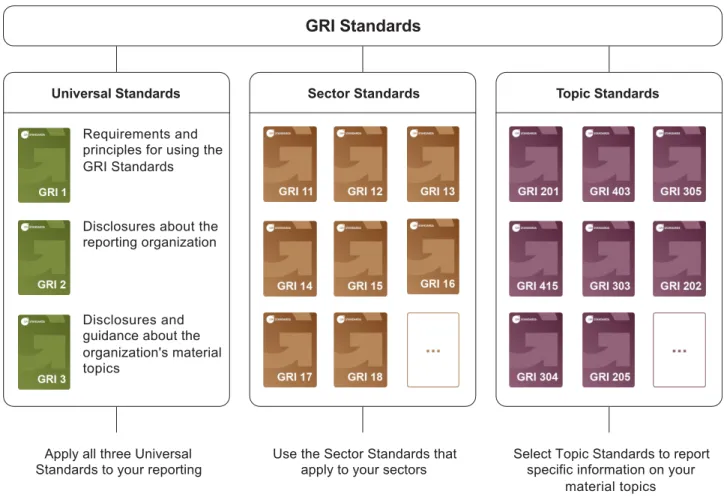
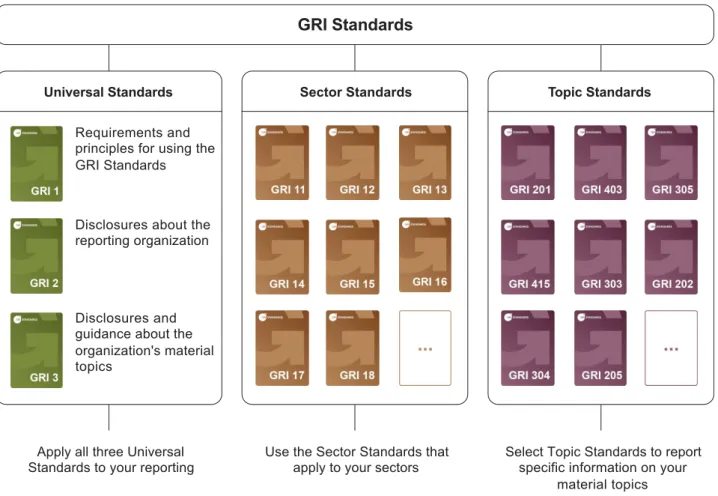
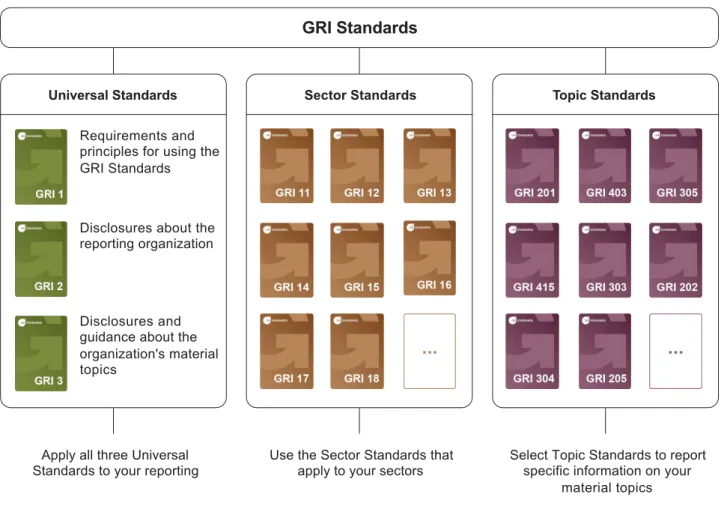
The GRI Standards are structured as a system of interrelated standards that are organized into three series: GRI Universal Standards, GRI Sector Standards, and GRI Topic Standards (see Figure 1 in this Standard). The Universal Standards are used by all organizations when reporting in accordance with the GRI Standards. Organizations use the Sector Standards according to the sectors in which they operate, and the Topic Standards according to their list of material topics.
Universal Standards: GRI 1, GRI 2 and GRI 3
An organization begins by consulting GRI 1: Foundation 2021. GRI 1 introduces the purpose and system of GRI Standards and explains key concepts for sustainability reporting. It also specifies the requirements and reporting principles that the organization must comply with to report in accordance with the GRI Standards.
GRI 2: General Disclosures 2021 contains disclosures that the organization uses to provide information about its reporting practices and other organizational details, such as its activities, governance, and policies. This information gives insight into the profile and scale of the organization and provides a context for understanding the organization’s impacts.
GRI 3: Material Topics 2021 provides step-by-step guidance on how to determine material topics. GRI 3 also contains disclosures that the organization uses to report information about its process of determining material topics, its list of material topics, and how it manages each topic.
Sector Standards
The Sector Standards provide information for organizations about their likely material topics. The organization uses the Sector Standards that apply to its sectors when determining its material topics, and when determining what information to report for the material topics.
Topic Standards
The Topic Standards contain disclosures for the organization to report information about its impacts in relation to particular topics. The Topic Standards cover a wide range of topics. The organization uses the Topic Standards according to the list of material topics it has determined using GRI 3.
Figure 1. GRI Standards: Universal, Sector and Topic Standards
Apply all three Universal Standards to your reporting
Use the Sector Standards that apply to your sectors
Select Topic Standards to report specific information on your
material topics Sector Standards
Universal Standards Topic Standards
GRI Standards
Requirements and principles for using the GRI Standards
Disclosures about the reporting organization
Disclosures and guidance about the organization's material topics
1.4 Using the GRI Standards
All disclosures in the GRI Standards contain requirements. The requirements list information that an organization must report or provide instructions that the organization must comply with to report in accordance with the GRI Standards.
If the organization cannot comply with a disclosure or with a requirement in a disclosure for which reasons for omission are permitted (e.g., because the required information is confidential or subject to legal prohibitions), then the organization is required to specify the disclosure or the requirement it cannot comply with, and provide a reason for omission with an explanation in the GRI content index. See Requirement 6 in this Standard for more information on reasons for omission.
If the organization cannot report the required information about an item specified in a disclosure because the item (e.g., committee, policy, practice, process) does not exist, it can comply with the requirement by reporting this to be the case. The organization can explain the reasons for not having this item or describe any plans to develop it. The disclosure does not require the organization to implement the item (e.g., developing a policy), but it is required to report that the item does not exist.
Requirements, guidance and defined terms The following apply throughout the GRI Standards:
Requirements are presented in bold font and indicated by the word 'shall'. An organization must comply with requirements to report in accordance with the GRI Standards.
Requirements may be accompanied by guidance.
Guidance includes background information, explanations, and examples to help the organization better understand the requirements. The organization is not required to comply with guidance.
The Standards may also include recommendations. These are cases where a particular course of action is encouraged but not required.
The word ‘should’ indicates a recommendation, and the word ‘can’ indicates a possibility or option.
Defined terms are underlined in the text of the GRI Standards and linked to their definitions in the Glossary. The organization is required to apply the definitions in the Glossary.
Reporting format
In the GRI Standards, the term ‘sustainability reporting’ refers to the process of reporting, which starts with an organization determining its material topics based on its most significant impacts and results in the organization publicly reporting information about these impacts.
The organization can publish or make information accessible in a range of formats (e.g., electronic, paper-based) across one or more locations (e.g., a standalone sustainability report, web pages, an annual report). The terms
‘report’ and ‘reported information’ in the GRI Standards both refer to information reported across all locations.
The GRI content index provides an overview of the organization’s reported information and shows the location where information users can find it. The content index also shows which GRI Standards and disclosures the organization has used.
If the organization intends to publish a standalone sustainability report, it does not need to repeat information that it has already reported publicly elsewhere, such as on web pages or in its annual report. In such a case, the
organization can report a required disclosure by providing a reference in the GRI content index as to where this information can be found (e.g., by providing a link to the web page or citing the page in the annual report where the information has been published).
Effective date
All GRI Standards have an effective date. This is the date from when the information published by an organization must make use of a particular GRI Standard. All information published after the effective date of a Standard must make use of that Standard.
For example, GRI 1: Foundation 2021 has an effective date of 1 January 2023. This means that the organization must make use of GRI 1 for the information it publishes on or after 1 January 2023.
Effective dates are set keeping in mind that organizations may need time to adopt a new or revised Standard.
Adoption of a Standard before its effective date is encouraged, as this allows the organization to report according to best practice.
2. Key concepts
This section explains the concepts that lay the foundation for sustainability reporting. Understanding how these concepts are applied in the GRI Standards is essential for those who collect and prepare information for reporting and those who interpret information that is reported using the Standards.
The key concepts covered in this section are: impact, material topics, due diligence, and stakeholder. The purpose of the Standards is to enable organizations to report information about their most significant impacts on the economy, environment, and people, including impacts on their human rights – in the GRI Standards these are referred to as material topics. Due diligence and stakeholder engagement help organizations identify their most significant impacts.
2.1 Impact
In the GRI Standards, impact refers to the effect an organization has or could have on the economy, environment, and people, including effects on their human rights, as a result of the organization’s activities or business relationships.
The impacts can be actual or potential, negative or positive, short-term or long-term, intended or unintended, and reversible or irreversible. These impacts indicate the organization’s contribution, negative or positive, to sustainable development.
The organization’s impacts on the economy refer to the impacts on economic systems at local, national, and global levels. An organization can have an impact on the economy through, for example, its competition practices, its procurement practices, and its taxes and payments to governments.
The organization’s impacts on the environment refer to the impacts on living organisms and non-living elements, including air, land, water, and ecosystems. An organization can have an impact on the environment through, for example, its use of energy, land, water, and other natural resources.
The organization’s impacts on people refer to the impacts on individuals and groups, such as communities, vulnerable groups, or society. This includes the impacts the organization has on people’s human rights. An
organization can have an impact on people through, for example, its employment practices (e.g., the wages it pays to employees), its supply chain (e.g., the working conditions of workers of suppliers), and its products and services (e.g., their safety or accessibility). Individuals or groups that have interests that are affected or could be affected by the organization’s activities are referred to as stakeholders (see section 2.4 in this Standard for more information).
The impacts on the economy, environment, and people are interrelated. For example, an organization’s impacts on the economy and environment can result in impacts on people and their human rights. Similarly, an organization’s positive impacts can result in negative impacts and vice versa. For example, an organization's positive impacts on the environment can lead to negative impacts on people and their human rights.
2.2 Material topics
An organization may identify many impacts on which to report. When using the GRI Standards, the organization prioritizes reporting on those topics that represent its most significant impacts on the economy, environment, and people, including impacts on their human rights. In the GRI Standards, these are the organization’s material topics.
Examples of material topics are anti-corruption, occupational health and safety, or water and effluents. A topic need not be limited to impacts on the economy, the environment, or people; it can cover impacts across all three
dimensions. For example, an organization might determine that ‘water and effluents’ is a material topic based on the impacts its water use has on ecosystems and local communities’ access to water. The GRI Standards group impacts into topics, like ‘water and effluents’, to help organizations report cohesively about multiple impacts that relate to the same topic.
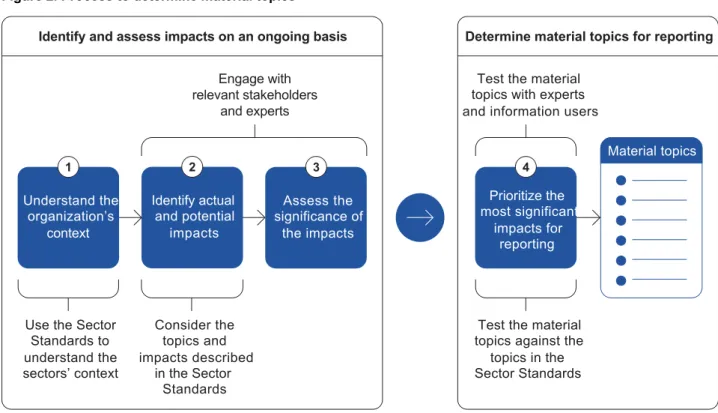
The process of determining material topics is informed by the organization’s ongoing identification and assessment of impacts. The ongoing identification and assessment of impacts involves engaging with relevant stakeholders and experts and it is conducted independently of the sustainability reporting process. See section 1 in GRI 3: Material Topics 2021 for more information on determining material topics.
Box 1. Sustainability reporting and financial and value creation reporting
The GRI Standards enable organizations to report information about the most significant impacts of their activities and business relationships on the economy, environment, and people, including impacts on their human rights. Such impacts are of primary importance to sustainable development and to organizations’
stakeholders, and they are the focus of sustainability reporting.
The impacts of an organization’s activities and business relationships on the economy, environment, and people can have negative and positive consequences for the organization itself. These consequences can be operational or reputational, and therefore in many cases financial. For example, an organization’s high use of non-renewable energy contributes to climate change and could, at the same time, result in increased operating costs for the organization due to legislation that seeks to shift energy use toward renewable sources.
Even if not financially material at the time of reporting, most, if not all, of the impacts of an organization’s activities and business relationships on the economy, environment, and people will eventually become financially material issues. Therefore, the impacts are also important for those interested in the organization's financial performance and long-term success. Understanding these impacts is a necessary first step in determining related financially material issues for the organization.
Sustainability reporting is therefore crucial for financial and value creation reporting. Information made available through sustainability reporting provides input for identifying financial risks and opportunities related to the organization’s impacts and for financial valuation. This, in turn, helps to make financial materiality judgments about what to recognize in financial statements.
While the impacts of the organization’s activities and business relationships on the economy, environment, and people may become financially material, sustainability reporting is also highly relevant in its own right as a public interest activity. Sustainability reporting is independent of the consideration of financial implications. It is therefore important for the organization to report on all the material topics that it has determined using the GRI Standards. These material topics cannot be deprioritized on the basis of not being considered financially material by the organization.
2.3 Due diligence
In the GRI Standards, due diligence refers to the process through which an organization identifies, prevents,
mitigates, and accounts for how it addresses its actual and potential negative impacts on the economy, environment, and people, including impacts on their human rights. The organization should address potential negative impacts through prevention or mitigation. It should address actual negative impacts through remediation in cases where the organization identifies it has caused or contributed to those impacts.
The way the organization is involved with negative impacts (i.e., whether it causes or contributes to the impacts, or whether the impacts are directly linked by its business relationships) determines how the organization should address the impacts. It also determines whether the organization has a responsibility to provide for or cooperate in the remediation of the impacts. The organization should:
If it is not feasible to address all identified impacts on the economy, environment, and people at once, the organization should prioritize the order in which to address potential negative impacts based on their severity and likelihood. In the case of potential negative human rights impacts, the severity of the impact takes precedence over its likelihood. See section 1 in GRI 3: Material Topics 2021 for more information.
Due diligence is elaborated by the United Nations (UN) Guiding Principles on Business and Human Rights [5], the Organisation for Economic Co-operation and Development (OECD) Guidelines for Multinational Enterprises [3], and
avoid causing or contributing to negative impacts through its own activities, and address such impacts when they occur by providing for or cooperating in their remediation through legitimate processes;
•
in the case of negative impacts that are directly linked to the organization’s operations, products, or services by its business relationships, seek to prevent or mitigate these impacts even if it has not contributed to them. The organization is not responsible for providing for or cooperating in the remediation of these impacts, but it can play a role in doing so.
•
the OECD Due Diligence Guidance for Responsible Business Conduct [2].
2.4 Stakeholder
Stakeholders are individuals or groups that have interests that are affected or could be affected by an organization’s activities. Common categories of stakeholders for organizations are business partners, civil society organizations, consumers, customers, employees and other workers, governments, local communities, non-governmental organizations, shareholders and other investors, suppliers, trade unions, and vulnerable groups.
In the GRI Standards, an interest (or ‘stake’) is something of value to an individual or group, which can be affected by the activities of an organization. Stakeholders can have more than one interest. Not all interests are of equal
importance and they do not all need to be treated equally. Human rights have a particular status as an entitlement of all people under international law. The most acute impacts the organization can have on people are those that negatively affect their human rights. The term ‘rightsholders’ refers to stakeholders whose individual human rights or collective rights (held by groups such as indigenous peoples) are or could be affected.
Stakeholder interests can be negatively or positively affected by the organization’s activities. Due diligence focuses on identifying stakeholder interests that are or could be negatively affected by the organization’s activities.
Stakeholders may not always have a direct relationship with the organization. For example, the workers in the organization’s supply chain can also be its stakeholders, or there can be individuals or groups living at a distance from the organization’s operations who can be affected or potentially affected by these operations. They may not be aware that they are stakeholders of that particular organization, especially if they have not yet been affected by its activities. The organization should identify the interests of these and other stakeholders who are unable to articulate their views (e.g., future generations).
Engaging with stakeholders helps the organization identify and manage its negative and positive impacts. Not all stakeholders will be affected by all activities of the organization. The organization should identify the stakeholders whose interests have to be taken into account in connection with a specific activity (i.e., ‘relevant stakeholders’).
Where it is impossible to engage with all relevant stakeholders directly, the organization can engage with credible stakeholder representatives or proxy organizations (e.g., non-governmental organizations, trade unions).
In addition to engaging with stakeholders, the organization can consult with experts in specific issues or contexts (e.g., academics, non-governmental organizations) for advice on identifying and managing its impacts.
Sometimes it is necessary to distinguish between stakeholders whose interests have been affected (i.e., ‘affected stakeholders’), and those whose interests have not yet been affected but could potentially be affected (i.e., ‘potentially affected stakeholders’). This distinction is important in due diligence. For example, if an organization’s activity leads to a safety hazard, workers who are injured because of the hazard are affected stakeholders, and workers who have not yet been injured but who are exposed to the hazard and could be injured are potentially affected stakeholders. The distinction between affected and potentially affected stakeholders helps identify which workers should receive remedy.
See reference [2] in the Bibliography.
3. Reporting in accordance with the GRI Standards
Reporting in accordance with the GRI Standards enables an organization to provide a comprehensive picture of its most significant impacts on the economy, environment, and people, including impacts on their human rights, and how it manages these impacts. This allows information users to make informed assessments and decisions about the organization’s impacts and its contribution to sustainable development.
The organization must comply with all nine requirements in this section to report in accordance with the GRI Standards.
Overview of in accordance requirements
Requirement 1: Apply the reporting principles
Requirement 2: Report the disclosures in GRI 2: General Disclosures 2021 Requirement 3: Determine material topics
Requirement 4: Report the disclosures in GRI 3: Material Topics 2021
Requirement 5: Report disclosures from the GRI Topic Standards for each material topic
Requirement 6: Provide reasons for omission for disclosures and requirements that the organization cannot comply with
Requirement 7: Publish a GRI content index Requirement 8: Provide a statement of use Requirement 9: Notify GRI
If the organization does not comply with all nine requirements, it cannot claim that it has prepared the reported information in accordance with the GRI Standards. In such a case, the organization may be able to claim that it has prepared the reported information with reference to the GRI Standards, provided it complies with the requirements specified in ‘Reporting with reference to the GRI Standards’ at the end of this section.
Requirement 1: Apply the reporting principles
Requirement 2: Report the disclosures in GRI 2: General Disclosures 2021
Guidance
Reasons for omission are permitted for all disclosures in GRI 2 except for:
If the organization cannot comply with a disclosure or with a requirement in a disclosure for which reasons for omission are permitted, then the organization is required to specify in the GRI content index the disclosure or the requirement it cannot comply with, and provide a reason for omission with an explanation. See Requirement 6 in this
The organization shall apply all the reporting principles specified in section 4 of GRI 1: Foundation 2021.
a.
The organization shall report all disclosures in GRI 2: General Disclosures 2021.
a.
Disclosure 2-1 Organizational details
•
Disclosure 2-2 Entities included in the organization’s sustainability reporting
•
Disclosure 2-3 Reporting period, frequency and contact point
•
Disclosure 2-4 Restatements of information
•
Disclosure 2-5 External assurance
•
Standard for more information on reasons for omission.
Requirement 3: Determine material topics
The organization shall:
Guidance
See section 1 in GRI 3: Material Topics 2021 for guidance on how to determine material topics.
The organization is required to determine its material topics based on its specific circumstances.
Using the GRI Sector Standards supports the organization in this process. The Sector Standards provide information for organizations about their likely material topics.
The organization is required to use the applicable Sector Standards when determining its material topics.
Guidance to 3-b
The organization is required to comply with Requirement 3-b only if GRI Sector Standards that apply to its sectors are available.
The organization is required to review each topic described in the applicable Sector Standards and determine whether it is a material topic for the organization. If the organization has determined any of the topics included in the applicable Sector Standards as not material, then the organization is required to list them in the GRI content index and explain why they are not material. See Requirement 7 in this Standard for more information on the content index.
See section 1 in GRI 3 and the GRI Sector Standards for guidance on how to use the Sector Standards to determine material topics.
Requirement 4: Report the disclosures in GRI 3: Material Topics 2021
The organization shall:
Guidance
Reasons for omission are only permitted for Disclosure 3-3 Management of material topics in GRI 3.
If the organization cannot comply with Disclosure 3-3 or with a requirement in Disclosure 3-3, then the organization is required to specify this in the GRI content index, and to provide a reason for omission with an explanation. See Requirement 6 in this Standard for more information on reasons for omission.
Requirement 5: Report disclosures from the GRI Topic Standards for each material topic
determine its material topics;
a.
review the GRI Sector Standard(s) that apply to its sector(s) and:
determine whether each topic in the applicable Sector Standard(s) is a material topic for the organization;
i.
list in the GRI content index any topics from the applicable Sector Standard(s) that the organization has determined as not material and explain why they are not material.
ii.
b.
report its process of determining material topics using Disclosure 3-1;
a.
report a list of its material topics using Disclosure 3-2;
b.
report how it manages each material topic using Disclosure 3-3.
c.
The organization shall:
Guidance to 5-a
For each material topic, the organization needs to identify disclosures from the GRI Topic Standards to report. The organization is required to report only those disclosures relevant to its impacts in relation to a material topic. The organization is not required to report disclosures that are not relevant.
There is no requirement for a minimum number of disclosures to report from the Topic Standards. The number of disclosures that the organization reports is based on its assessment of which disclosures are relevant to its impacts in relation to a material topic.
The organization may need to use more than one Topic Standard to report on a material topic. In addition, not all disclosures in a Topic Standard may be relevant for the organization to report. For example, an organization identifies pay equality as a material topic. The organization determines that the following disclosures are relevant to report on the topic: Disclosure 202-1 Ratios of standard entry level wage by gender compared to local minimum wage in GRI 202: Market Presence 2016, and Disclosure 405-2 Ratio of basic salary and remuneration of women to men in GRI 405: Diversity and Equal Opportunity 2016. The organization is not required to report other disclosures from these Standards (e.g., Disclosure 202-2 Proportion of senior management hired from the local community in GRI 202), as these disclosures do not address the topic of pay equality.
When a material topic is covered in the applicable GRI Sector Standards, the organization uses the Sector Standards to identify disclosures to report. See Requirement 5-b in this Standard for more information.
Reasons for omission are permitted for all disclosures from the Topic Standards. If the organization cannot comply with a disclosure or with a requirement in a disclosure, then the organization is required to specify in the GRI content index the disclosure or the requirement it cannot comply with, and provide a reason for omission with an explanation.
See Requirement 6 in this Standard for more information on reasons for omission.
The organization should provide sufficient information about its impacts in relation to each material topic so that information users can make informed assessments and decisions about the organization. If the disclosures from the Topic Standards do not provide sufficient information about the organization’s impacts, then the organization should report additional disclosures. These can include the additional sector disclosures recommended in the GRI Sector Standards, disclosures from other sources, or disclosures developed by the organization itself.
Disclosures that the organization reports from other sources or that are developed by the organization itself, should have the same rigor as disclosures from the GRI Standards, and they should align with expectations set out in authoritative intergovernmental instruments.
Reporting on material topics not covered in the GRI Topic Standards
When the organization's material topic is not covered by the disclosures in the GRI Topic Standards, the organization is required to report how it manages the material topic, using Disclosure 3-3 in GRI 3: Material Topics 2021. See Requirement 4-c in this Standard for more information.
In addition to reporting Disclosure 3-3, the organization should report other disclosures for that topic. These can include the additional sector disclosures recommended in the GRI Sector Standards, disclosures from other sources, or disclosures developed by the organization itself.
For example, an organization determines freedom of speech to be a material topic. As there is no Topic Standard that covers this topic, the organization should report disclosures from other sources or develop its own disclosures to report on the topic. The organization is still required to report how it manages the topic of freedom of speech, using Disclosure 3-3 in GRI 3.
Guidance to 5-b
The organization is required to comply with Requirement 5-b only if GRI Sector Standards that apply to its sectors are available. The Sector Standards provide information for organizations about their likely material topics.
The organization is required to review each topic described in the applicable Sector Standards and determine whether it is a material topic for the organization.
If the organization determines a topic in an applicable Sector Standard to be material, the Sector Standard helps the report disclosures from the GRI Topic Standards for each material topic;
a.
for each material topic covered in the applicable GRI Sector Standard(s), either:
report the disclosures from the GRI Topic Standards listed for that topic in the Sector Standard(s), or;
i.
provide the ‘not applicable’ reason for omission and the required explanation in the GRI content index.
ii.
b.
organization identify disclosures to report information about its impacts in relation to that topic. For each likely material topic, the Sector Standards list disclosures from the GRI Topic Standards for organizations to report. If any of the Topic Standards disclosures listed in the Sector Standards are not relevant to the organization’s impacts, the organization is not required to report these. However, the organization is required to list these disclosures in the GRI content index and provide ‘not applicable’ as the reason for omission for not reporting the disclosures. The organization is also required to explain in brief why the disclosures are not relevant to its impacts in relation to the material topic. See Requirement 6 in this Standard for more information on reasons for omission.
Note that when reporting the Topic Standards disclosures listed in the Sector Standards, the organization can still use any of the four reasons for omission included in Table 1 of this Standard if it cannot comply with the disclosure or with a requirement in the disclosure.
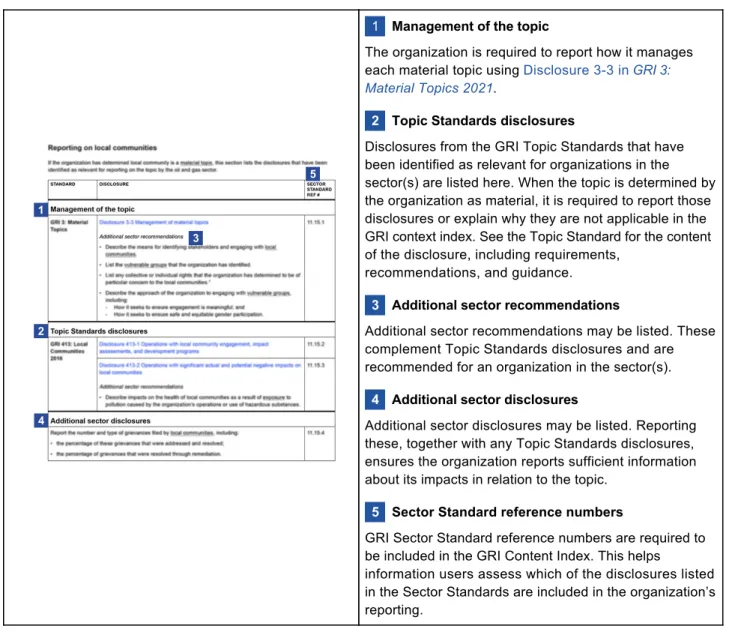
Besides the disclosures from the Topic Standards, the Sector Standards may list additional sector disclosures for organizations to report. Reporting these additional sector disclosures is a recommendation. The organization is not required to provide a reason for omission for the additional sector disclosures it does not report.
Requirement 6: Provide reasons for omission for disclosures and requirements that the organization cannot comply with
Guidance
Reasons for omission are permitted for all disclosures from the GRI Standards except for:
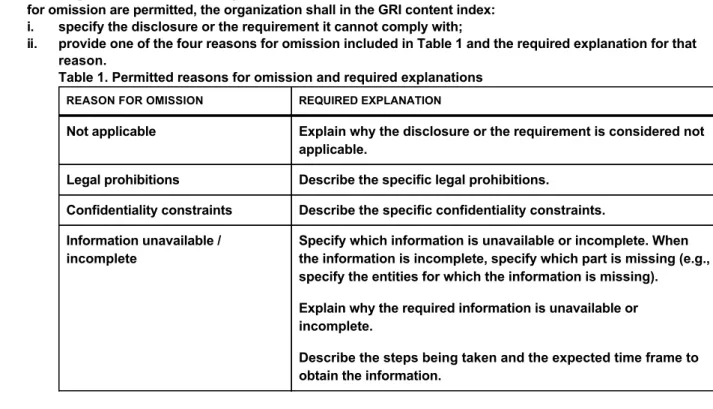
The organization is only permitted to provide one of the four reasons for omission included in Table 1 of this Standard:
Not applicable
The organization provides ‘not applicable’ as the reason for omission in the following situations:
If the organization cannot comply with a disclosure or with a requirement in a disclosure for which reasons for omission are permitted, the organization shall in the GRI content index:
specify the disclosure or the requirement it cannot comply with;
i.
provide one of the four reasons for omission included in Table 1 and the required explanation for that reason.
Table 1. Permitted reasons for omission and required explanations REASON FOR OMISSION REQUIRED EXPLANATION
Not applicable Explain why the disclosure or the requirement is considered not applicable.
Legal prohibitions Describe the specific legal prohibitions.
Confidentiality constraints Describe the specific confidentiality constraints.
Information unavailable / incomplete
Specify which information is unavailable or incomplete. When the information is incomplete, specify which part is missing (e.g., specify the entities for which the information is missing).
Explain why the required information is unavailable or incomplete.
Describe the steps being taken and the expected time frame to obtain the information.
ii.
a.
Disclosure 2-1 Organizational details
•
Disclosure 2-2 Entities included in the organization’s sustainability reporting
•
Disclosure 2-3 Reporting period, frequency and contact point
•
Disclosure 2-4 Restatements of information
•
Disclosure 2-5 External assurance
•
Disclosure 3-1 Process to determine material topics
•
Disclosure 3-2 List of material topics
•
When a disclosure or a requirement in a disclosure does not apply to the organization based on its characteristics
•
Legal prohibitions
The organization provides ‘legal prohibitions’ as the reason for omission when the law forbids collecting the required information or reporting it publicly.
Confidentiality constraints
There may be cases where the law does not forbid collecting or reporting the required information, but the organization considers the information confidential and cannot report it publicly. In such cases, the organization provides ‘confidentiality constraints’ as the reason for omission.
Information unavailable / incomplete
There may be cases where the organization has the item specified in a disclosure or in a requirement in a disclosure, but the information about the item is unavailable or incomplete. In such cases, the organization provides ‘information unavailable / incomplete’ as the reason for omission. For example, information is unavailable for Disclosure 305-3 in GRI 305: Emissions 2016 when the organization has other indirect (Scope 3) greenhouse gas (GHG) emissions, but it has not collected data on its other indirect (Scope 3) GHG emissions yet.
When the organization cannot report part of the required information it means the information is incomplete. When the reported information does not cover the complete scope required by a disclosure (e.g., the information is missing for certain entities, sites, geographic locations), then the organization is required to provide ‘information unavailable / incomplete’ as the reason for omission. The organization must specify the entities, sites, geographic locations, etc., for which the required information is missing and cannot be reported.
The required information, or part of the required information, can be unavailable when, for example, it cannot be obtained or is not of adequate quality to report. This may be the case when the information is collected from another organization, such as a supplier.
The reasons ‘confidentiality constraints’ and ‘information unavailable / incomplete’ should only be used in exceptional cases. Using ‘confidentiality constraints’ and ‘information unavailable / incomplete’ frequently as reasons for omitting information reduces the credibility and usefulness of the organization’s sustainability reporting. It does not align with the aim of reporting in accordance with the GRI Standards, which is to provide a comprehensive picture of the organization’s most significant impacts.
The organization is not allowed to use other reasons for omission than those included in Table 1 of this Standard.
The organization is required to report reasons for omission in the GRI content index. See Requirement 7 in this (e.g., size, type). For example, 2-15-b-iii in GRI 2: General Disclosures 2021 requires the organization to report whether conflicts of interest relating to the existence of controlling shareholders are disclosed to stakeholders.
This requirement does not apply to organizations that do not have shareholders (e.g., foundations).
In such cases, the organization is required to explain why the disclosure or the requirement does not apply to the organization.
However, there may be cases where a disclosure or a requirement in a disclosure applies to the organization, but the organization does not have in place the item specified in the disclosure or in the requirement (e.g., committee, policy, practice, process). For example, 2-23-b in GRI 2 requires the organization to describe its policy
commitment to respect human rights. This expectation applies to every organization. All organizations are expected to have a policy commitment to respect human rights, but not every organization may have developed such a policy commitment yet.
If the organization cannot report the required information about an item specified in a disclosure because the item (e.g., committee, policy, practice, process) does not exist, it can comply with the requirement by reporting this to be the case. It does not need to provide the ‘not applicable’ reason for omission.
In such cases, the organization can explain the reasons for not having this item or describe any plans to develop it.
The disclosure does not require the organization to implement the item (e.g., developing a policy), but to report that the item does not exist.
When a disclosure from the GRI Topic Standards that is listed in the applicable GRI Sector Standards is not relevant to the organization’s impacts in relation to a material topic. In such cases, the organization is required to explain why the disclosure is not relevant to its impacts in relation to the material topic.
•
Standard for more information on the content index.
Requirement 7: Publish a GRI content index
The organization shall:
Guidance
The information reported using the GRI Standards can be published or made accessible in a range of formats (e.g., electronic, paper-based) across one or more locations (e.g., a standalone sustainability report, web pages, an annual report). The GRI content index provides an overview of the organization’s reported information, shows where the reported information can be found, and helps information users access this information. The content index also shows which GRI Standards and disclosures the organization has used.
Appendix 1 of this Standard provides guidance on how to prepare the GRI content index when reporting in accordance with the GRI Standards. It includes an example that the organization can use to prepare the content index. The organization can use a different format for the content index than the one provided in Appendix 1, as long as it complies with the requirements for the content index.
Requirement 8: Provide a statement of use
Guidance
To state that the organization has reported in accordance with the GRI Standards, the organization must have complied with all nine requirements in this section.
The organization is required to insert the name of the organization and the start and end dates of its reporting period in the statement, for example:
‘ABC Limited has reported in accordance with the GRI Standards for the period from 1 January 2022 to 31 December 2022.’
The organization is required to report whether the highest governance body is responsible for reviewing and approving the reported information, including the organization’s material topics, under Disclosure 2-14 in GRI 2:
General Disclosures 2021.
Requirement 9: Notify GRI
publish a GRI content index that includes:
the title: GRI content index;
i.
the statement of use;
ii.
the title of GRI 1 used;
iii.
the title(s) of the GRI Sector Standard(s) that apply to the organization’s sector(s);
iv.
a list of the organization’s material topics;
v.
a list of the topics in the applicable GRI Sector Standard(s) determined as not material and an explanation for why they are not material;
vi.
a list of the reported disclosures, including the disclosure titles;
vii.
the titles of the GRI Standards and other sources that the reported disclosures come from;
viii.
when the organization does not report GRI Topic Standard disclosures for a material topic from the applicable GRI Sector Standard(s), a list of the disclosures and the required reason for omission;
ix.
the GRI Sector Standard reference numbers for the disclosures from the applicable Sector Standard(s);
x.
the location where the information reported for each disclosure can be found;
xi.
any reasons for omission used;
xii.
a.
if it publishes a standalone sustainability report and the GRI content index is not included in the report itself, provide a link or reference to the GRI content index in the report.
b.
The organization shall include the following statement in its GRI content index:
[Name of organization] has reported in accordance with the GRI Standards for the period [reporting period start and end dates].
a.
Guidance
The organization should include the following information in the email:
There is no cost associated with notifying GRI of the use of the GRI Standards.
Reporting with reference to the GRI Standards
The organization shall notify GRI of the use of the GRI Standards and the statement of use by sending an email to [email protected].
a.
The legal name of the organization.
•
The link to the GRI content index.
•
The link to the report, if publishing a standalone sustainability report.
•
The statement of use.
•
A contact person in the organization and their contact details.
•
Reporting with reference to the GRI Standards
An organization can report with reference to the GRI Standards if it cannot comply with all the requirements for
reporting in accordance with the GRI Standards. The organization should transition to reporting in accordance with the GRI Standards in time as it will provide a comprehensive picture of the organization’s most significant impacts on the economy, environment, and people, including impacts on their human rights.
The organization can also report with reference to the GRI Standards if it uses selected GRI Standards, or parts of their content, to report information about specific topics for specific purposes, such as complying with a reporting regulation on climate change.
The organization must comply with all three requirements in this section to report with reference to the GRI Standards.
The organization should also apply the reporting principles specified in section 4 of this Standard to ensure high- quality reporting. Additionally, the organization should explain how it manages its impacts for the topics it reports on using Disclosure 3-3 in GRI 3: Material Topics 2021.
Overview of requirements for reporting with reference to the GRI Standards
Publish a GRI content index Provide a statement of use Notify GRI
Publish a GRI content index
The organization shall:
Guidance
The information reported using the GRI Standards can be published or made accessible in a range of formats (e.g., electronic, paper-based) across one or more locations (e.g., a standalone sustainability report, web pages, an annual report). The GRI content index provides an overview of the organization’s reported information, shows where the reported information can be found, and helps information users access this information. The content index also shows which GRI Standards and disclosures the organization has used.
Appendix 2 of this Standard provides guidance on how to prepare the GRI content index when reporting with reference to the GRI Standards. It includes an example that the organization can use to prepare the content index. The
organization can use a different format for the content index than the one provided in Appendix 2, as long as it complies with the requirements for the content index. The organization can also use the content index specified for reporting in accordance with the GRI Standards in Appendix 1 of this Standard, if suitable. In such a case, the statement of use in Appendix 1, which is for reporting in accordance with the GRI Standards, must be replaced by the statement of use for reporting with reference to the GRI Standards.
Provide a statement of use
publish a GRI content index that includes:
the title: GRI content index;
i.
the statement of use;
ii.
the title of GRI 1 used;
iii.
a list of the reported disclosures from the GRI Standards, including the disclosure titles;
iv.
the titles of the GRI Standards that the reported disclosures come from;
v.
the location where the information reported for each disclosure can be found;
vi.
a.
if it publishes a standalone sustainability report and the GRI content index is not included in the report itself, provide a link or reference to the GRI content index in the report.
b.
Guidance
To state that the organization has reported with reference to the GRI Standards, the organization must have complied with all three requirements in this section.
The organization is required to insert the name of the organization and the start and end dates of its reporting period in the statement, for example:
‘ABC Limited has reported the information cited in this GRI content index for the period from 1 January 2022 to 31 December 2022 with reference to the GRI Standards.’
Notify GRI
Guidance
The organization should include the following information in the email:
There is no cost associated with notifying GRI of the use of the GRI Standards.
The organization shall include the following statement in its GRI content index:
[Name of organization] has reported the information cited in this GRI content index for the period [reporting period start and end dates] with reference to the GRI Standards.
a.
The organization shall notify GRI of the use of the GRI Standards and the statement of use by sending an email to [email protected].
a.
The legal name of the organization.
•
The link to the GRI content index.
•
The link to the report, if publishing a standalone sustainability report.
•
The statement of use.
•
A contact person in the organization and their contact details.
•
4. Reporting principles
The reporting principles are fundamental to achieving high-quality sustainability reporting. Therefore, an organization is required to apply the reporting principles to be able to claim that it has prepared the reported information in accordance with the GRI Standards (see section 3 in this Standard).
The reporting principles guide the organization in ensuring the quality and proper presentation of the reported information. High-quality information allows information users to make informed assessments and decisions about the organization’s impacts and its contribution to sustainable development.
Each reporting principle consists of a requirement and guidance on how to apply it.
Overview of principles
Accuracy
Requirement
Guidance
The characteristics that determine accuracy vary depending on the nature of the information (qualitative or quantitative) and the intended use of the information. The accuracy of quantitative information depends on the specific methods used to gather, compile, and analyze data. The accuracy of qualitative information depends on the level of detail and consistency with the available evidence. Information users require sufficient detail to make assessments about the organization’s impacts.
To apply the Accuracy principle, the organization should:
Balance
Accuracy
•
Balance
•
Clarity
•
Comparability
•
Completeness
•
Sustainability context
•
Timeliness
•
Verifiability
•
The organization shall report information that is correct and sufficiently detailed to allow an assessment of the organization’s impacts.
a.
report qualitative information that is consistent with available evidence and other reported information;
•
indicate which data has been measured;
•
adequately describe data measurements and bases for calculations, and ensure it is possible to replicate measurements and calculations with similar results;
•
ensure that the margin of error for data measurements does not inappropriately influence the conclusions or assessments of information users;
•
indicate which data has been estimated, and explain the underlying assumptions and techniques used for the estimation as well as any limitations of the estimates.
•
Requirement
Guidance
To apply the Balance principle, the organization should:
Clarity
Requirement
Guidance
To apply the Clarity principle, the organization should:
Comparability
Requirement
Guidance
Information reported in a comparable way enables the organization and other information users to assess the organization’s current impacts against its past impacts and its goals and targets. It also enables external parties to assess and benchmark the organization’s impacts against impacts of other organizations as part of rating activities, investment decisions, and advocacy programs.
To apply the Comparability principle, the organization should:
The organization shall report information in an unbiased way and provide a fair representation of the organization’s negative and positive impacts.
a.
present information in a way that allows information users to see negative and positive year-on-year trends in impacts;
•
distinguish clearly between facts and the organization’s interpretation of the facts;
•
not omit relevant information concerning its negative impacts;
•
not overemphasize positive news or impacts;
•
not present information in a way that is likely to inappropriately influence the conclusions or assessments of information users.
•
The organization shall present information in a way that is accessible and understandable.
a.
consider specific accessibility needs of information users, associated with abilities, language, and technology;
•
present information in a way that users can find the information they want without unreasonable effort, for example, through a table of contents, maps, or links;
•
present information in a way that it can be understood by users who have reasonable knowledge of the organization and its activities;
•
avoid abbreviations, technical terms, or other jargon likely to be unfamiliar to users or, if these are used, include relevant explanations in the appropriate sections or in a glossary;
•
report information in a concise way and aggregate information where useful without omitting necessary details;
•
use graphics and consolidated data tables to make information accessible and understandable.
•
The organization shall select, compile, and report information consistently to enable an analysis of changes in the organization’s impacts over time and an analysis of these impacts relative to those of other
organizations.
a.
present information for the current reporting period and at least two previous periods, as well as any goals and targets that have been set;
•
use accepted international metrics (e.g., kilograms, liters), and standard conversion factors and protocols, where applicable, for compiling and reporting information;
•
maintain consistency in the methods used to measure and calculate data and in explaining the methods and assumptions used;
•
maintain consistency in the manner of presenting the information;
•
report total numbers or absolute data (e.g., metric tons of CO2 equivalent) as well as ratios or normalized data (e.g., CO2 emissions per unit produced) to enable comparisons, and provide explanatory notes when using ratios;
•
provide contextual information (e.g., the organization’s size, geographic location) to help information users understand the factors that contribute to differences between the organization’s impacts and the impacts of other organizations;
•
Completeness
Requirement
Guidance
To apply the Completeness principle, the organization should:
If the organization consists of multiple entities (i.e., a parent entity and its subordinate entities), the organization is required to explain the approach used for consolidating the information under 2-2-c in GRI 2: General Disclosures 2021.
If the information for a disclosure or a requirement in a disclosure for which reasons for omission are permitted is unavailable or incomplete, then the organization is required to provide a reason for omission. When information is incomplete, the organization is required to specify which part is missing (e.g., specify the entities for which the information is missing). See Requirement 6 in this Standard for more information.
Sustainability context
Requirement
Guidance
Sustainable development has been defined as ‘development which meets the needs of the present without compromising the ability of future generations to meet their own needs’ [8]. The objective of sustainability reporting using the GRI Standards is to provide transparency on how an organization contributes or aims to contribute to sustainable development. For this purpose, the organization needs to assess and report information about its impacts in the wider context of sustainable development.
To apply the Sustainability context principle, the organization should:
present the current disclosures alongside restatements of historical data to enable comparisons if there have been changes from the information reported previously. This can include changes in the length of the reporting period, in the measurement methodologies, in the definitions used, or in other elements of reporting. The organization is required to report restatements of information under Disclosure 2-4 in GRI 2: General Disclosures 2021;
•
if restatements of historical data are not provided, explain the changes to provide contextual information for interpreting the current disclosures.
•
The organization shall provide sufficient information to enable an assessment of the organization’s impacts during the reporting period.
a.
present activities, events, and impacts for the reporting period in which they occur. This includes reporting information about activities that have a minimal impact in the short-term, but a reasonably foreseeable cumulative impact that can become unavoidable or irreversible in the long-term (e.g., activities that generate bio-accumulative or persistent pollutants);
•
not omit information that is necessary for understanding the organization’s impacts.
•
The organization shall report information about its impacts in the wider context of sustainable development.
a.
draw on objective information and authoritative measures on sustainable development to report information about its impacts (e.g., scientific research or consensus on the limits and demands placed on environmental
resources);
•
report information about its impacts in relation to sustainable development goals and conditions (e.g., reporting total greenhouse gas [GHG] emissions as well as reductions in GHG emissions in relation to the goals set out in the United Nations [UN] Framework Convention on Climate Change [FCCC] Paris Agreement [4]);
•
report information about its impacts in relation to societal expectations and expectations of responsible business conduct set out in authoritative intergovernmental instruments with which the organization is expected to comply
•
Understanding the sustainability context provides the organization with critical information to determine and report on its material topics (see GRI 3: Material Topics 2021). The GRI Sector Standards describe the sectors’ context and can help the organization understand its sustainability context.
Timeliness
Requirement
Guidance
The usefulness of information is closely tied to whether it is available in time for information users to integrate it into their decision-making. Thus, the Timeliness principle refers to how regularly and how soon after the reporting period the information is published.
To apply the Timeliness principle, the organization should:
See section 5.1 in this Standard for information on aligning the reporting periods and publishing schedules of sustainability reporting and other types of reporting.
Verifiability
Requirement
Guidance
It is important that the reported information can be examined to establish its veracity and to determine the extent to which the reporting principles have been applied.
To apply the Verifiability principle, the organization should:
See section 5.2 in this Standard for more information on enhancing the credibility of the organization’s sustainability reporting.
(e.g., Organisation for Economic Co-operation and Development [OECD] Guidelines for Multinational Enterprises [3], UN Guiding Principles on Business and Human Rights [5]) and in other recognized sector-specific, local, regional, or global instruments;
if operating in a range of locations, report information about its impacts in relation to appropriate local contexts (e.g., reporting total water use, as well as water use relative to the sustainable thresholds and the social context of given catchments).
•
The organization shall report information on a regular schedule and make it available in time for information users to make decisions.
a.
find a balance between the need to make information available in a timely manner and ensuring that the information is of high quality and meets the requirements under the other reporting principles;
•
ensure consistency in the length of reporting periods;
•
indicate the time period covered by the reported information.
•
The organization shall gather, record, compile, and analyze information in such a way that the information can be examined to establish its quality.
a.
set up internal controls and organize documentation in such a way that individuals other than those preparing the reported information (e.g., internal auditors, external assurance providers) can review them;
•
document the decision-making processes underlying the organization’s sustainability reporting
![Table 2. Example template for presenting information on employees by region [Reporting period]](https://thumb-ap.123doks.com/thumbv2/123dok/12263484.0/53.892.213.808.80.442/table-example-template-presenting-information-employees-region-reporting.webp)
![Table 1 lists industry groupings relevant to the oil and gas sector covered in this Standard in the Global Industry Classification Standard (GICS®) [4], the Industry Classification Benchmark (ICB) [3], the International Standard Industrial Classification o](https://thumb-ap.123doks.com/thumbv2/123dok/12263484.0/123.892.86.812.465.1014/groupings-standard-classification-classification-benchmark-international-industrial-classification.webp)