One of the major problems in the literature on both the International Trade Commission and trade regulation more generally has been the failure of scholars to consider both the supply and demand sides of the regulatory issue. In 1908, President Taft began his campaign with a promise to revise and reduce tariffs. Congress again took up the task, but powerful protectionist forces in the Senate managed to add 847 amendments, mostly raising tariffs, to the House version of the Tariff Review Act.2 The result was higher tariffs under the Payne-Aldrich Tariff Act of 1909. which was accepted and signed by Taft. The result was a major reorganization of the Commission, shortening the terms of the Commissioner and terminating all existing members, and allowing President Hoover to re-create a "more acceptable" agency.6 The agency's overall role remained essentially the same as under the 1922 act.
With this act, Congress transferred even more power to the executive branch by eliminating the agency's intermediary role. With the creation of the General Agreement on Trade and Tariffs (GATT) in 1947, the Tariff Commission's authority to regulate trade was revived. That is, they will determine the point at which further tariff reductions would pose a risk to the US. The president was not allowed to negotiate a tariff below this point without reporting to Congress.
Throughout the 1950s, Congress continued to renew the Trade Agreements Act, which gave the President the authority to lower tariffs, but also slowly increased the powers of the Tariff. Final decision-making authority in antidumping investigations was also taken out of the hands of the Treasury Department and given to the Tariff Commission.
LITERATURE REVIEW
He maintained that the nature of the labor force, technological differences, transportation costs, and other factors should be included in the study of trade patterns. A body of work on cross-industry studies has attempted to identify more general determinants of the regulation of trade. Godek claims to explain incentives for industries to demand protection by using the average wage in the industry to account for the comparative advantage of the US.
Total economic activity is measured by the unemployment rate, gross domestic product and capacity utilization in the United States. The USA's international competitive position is measured by the trade balance and the import market share. Also as an explanatory variable is the impact of the number of previous successful cases in the petition process on the demand for protection. There is no good reason to assume, as they do, that the number of investigations conducted is an indication of the ITC's propensity to grant protection.
Many factors have been identified that can explain the supply and demand for protection, but much of the literature highlights problems. Ignoring a sector's decision whether or not to file for protection can result in a self-selection bias when analyzing the supply of regulation.
THEORIES OF REGULATION WITH AN APPLICATION TO PROTECTIONISM PROTECTIONISM
These two approaches to the study of regulation comprise a literature that develops strategies and goals for the actors in the regulatory process. Furthermore, when an industry is granted regulation, the benefits to the industry are generally less than the societal costs due to deadweight loss. By less inefficient, Becker means that given the size of the benefits to the subsidized groups, deadweight loss is minimized.
Therefore the pressure depends on the size of the group and the amount of money it spends. Politically successful groups tend to be small compared to the size of the groups that are taxed to pay their subsidies. An increase in the size of the taxed group (nt) results in a decrease in group pressure t because the tax per member will decrease.
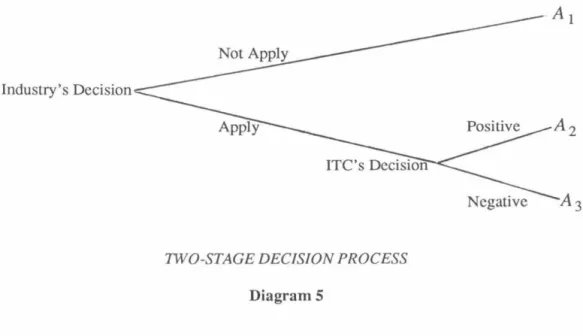
First, I look at the supply of regulation to understand the behavior of the ITC. Finally, I use a nested logit model (see McFadden, 1978) to incorporate both the supply and demand sides of the regulatory issue. Disregarding an industry's decision whether or not to apply may introduce self-selection bias in estimates of the offer to regulate.
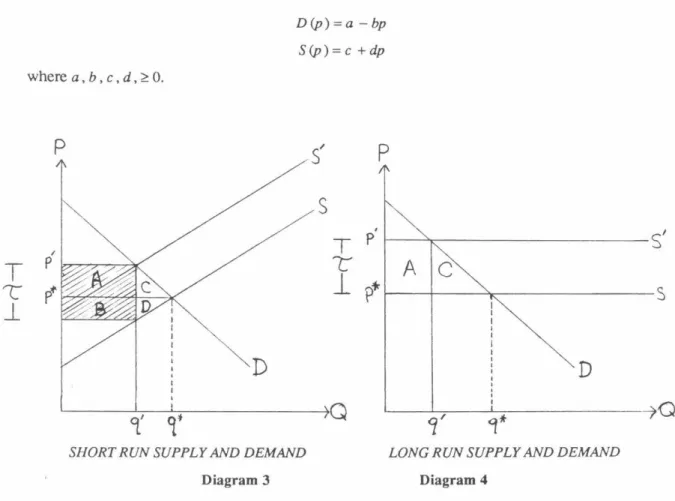
Regulation will be allocated to industries where the dead costs of the policy are lowest and subsidies are highest. A good measure of the dead cost of a tariff for a particular good is the elasticity of demand for that good. This notion encompasses Hypotheses 3, 4, and 5. Several variables will be used as proxies for measures of the degree of industry organization.
Most of the data used in this study are coded at the four-digit SIC level. If an industry's share of the domestic market falls from one year to the next due to increased imports, then it should be more likely to seek protection from foreign competition. Concentration is a measure of the percentage of output by the four largest firms in an industry.
Maximizing this with respect to pi yields the coefficients for the best fit of the si to the independent variables. Under the regulatory supply theory presented in this article, one would expect each of these variables to influence an industry's likelihood of obtaining protection for its goods.
LOG IT ESTIMATES OF THE DETERMINANTS OF LTC DECISIONS Dependent Variable: LTC Decision: 1 =protection, 0 = no protection. Another indicator of a need for protection is the percentage change in an industry's share of the domestic market. LOGIC SUMMARIES OF THE DETERMINATIONS OF INDUSTRY DECISIONS Dependent variable: Industry decision: 1 =applies, 0 =not applicable.
This vector is then included as an independent variable in estimating the likelihood that an industry will apply to LTC for protection. Along with the inclusive value, all previous variables believed to influence. Logit Estimates of Determinants of ITC Decisions Dependent Variable: lTC Decision: 1 = protection, 0 = no protection.
Record Assessment of determinants of decisions in the industry Dependent variable: Decision in the industry: 1 =use, 0 =do not use. This means that industries are likely to base their use decisions on their perception of maximum expected utility if the lTC grants them protection. For this reason, we will consider the nested logit model as a more valid representation of the observed phenomena.
There is potential in both the industry decision stage and the lTC decision stage of the nested logit model used here. The purpose of the Hausman test is to determine whether the coefficients (j3) from the conditional choice model given the two alternatives, A2 and A3, are the same as the corresponding coefficients from the three alternative multinomial logit (MNL) models. The coefficients of X are compared with the coefficients from the conditional model given in Table 4.
NESTED LOG IT MODEL (including labor intensity as a function of presidential party) Logit estimates of the determinants of lTC decisions. Logit estimate of the determinants of sector decisions Dependent variable: Sector decision: 1 = applicable, 0 = not applicable. 34; An Application of Nested Logit Models to the Labor Supply of Older Persons." Working Paper, Technical Report No. 22.
34; Import Trade Status Management: Options for Harmonizing Investigation Techniques and International Trade Commission Standards.". 34; The Costs of Protectionism: Estimates of the Hidden Tax of Trade Restriction." Center for the Study of American Business, Working Report no.