Invitation to AIEST members to participate in the Festschrift as a tribute to Prof. Peter Keller liked to discuss it within his activities: Innovation and tourism policy or the link of tourism with regional development.
Can Tourism Qualify for Interdisciplinary Research?
A European View
At the federal level in Germany, it is possible to emphasize the importance of the role of policy in the development of tourism studies. 6 Academia – politics – industry: three key components for the success of the development of tourism studies.
A Partial Polemic
And through this “behaviour” of the research community, a common (but potentially misleading) understanding of destination management has literally been created (perhaps for good). Therefore, competitiveness (as the ultimate outcome of any economic activity) should ultimately be judged based on the capacity of the SBFs (not the destination!) and their players, i.e.:
Tourism Policy and Development
Peter Keller: A Pioneer of a Sustainable Tourism Policy
The interdisciplinary nature of tourism policy is therefore twofold: externally in terms of framework conditions, internally within the field of tourism that is close to the market. The tourism policy objectives set out in the Concept emerged from higher level objectives.
Overall objective
Quelle: Tourismusberatungskommission 1979: Das Schweizer Tourismuskonzept, Bern 1979, S.
Social objectives
Economic objectives
The following illustration summarizes and hierarchically presents the tourism policy objectives included in the concept. The Report on the Confederation's Tourism Policy ("Bericht über die Tourismuspolitik des Bundes") (Seco 1996) was published in 1996, again under the direction of Peter Keller.
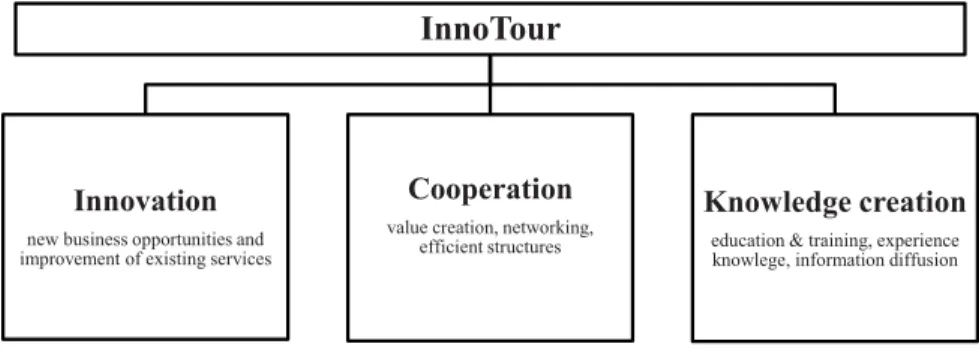
INNOTOUR: An Innovation in Tourism Policy
Rethinking the comparison of innovation between manufacturing and services: experiences from CBR SME research in the UK. Towards measuring innovation - A pilot study in small and medium-sized hotels.
Tourism Satellite Accounts as a Policy Tool – Some Critical Reflections
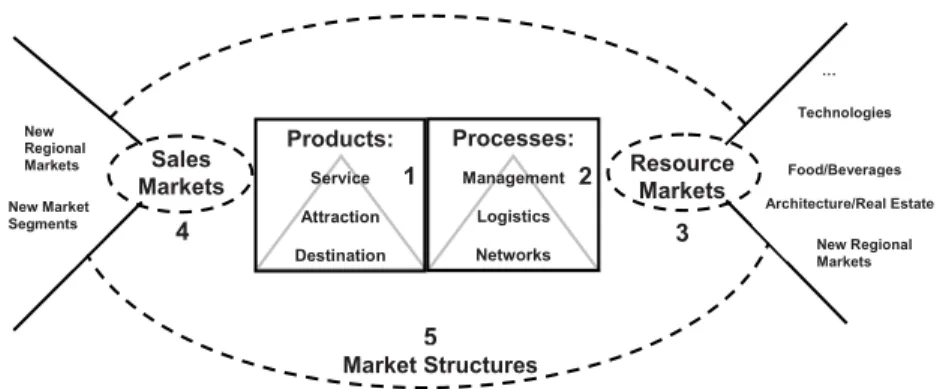
The same problems would arise if we only captured the tourism-generated employment effects based on the effects of the direct relationship between tourists and producers. An additional, albeit minor, problem is that TSA assumes that residents' business travel expenditures are part of final demand. However, consumption in production such as business trips by residents is not taken into account in the GDP calculations, so the TSA value added overestimates the impact of the sector in relation to GDP.
Although the calculations of the value added effects also take into account the non-tourism specific sectors, the employment effects are only calculated on the basis of the tourism specific and the tourism related sectors. In Germany, the direct and indirect effects of tourism generated an employment figure of 3.83 million persons in 2010 or 9.4% of total employment in the total economy (BMWi 2012). In Austria, the direct and indirect employment effects of tourism amounted to 0.33 million persons or 9.2% of total employment in terms of full-time equivalents.
In terms of tourism employment, the indirect effects amounted to about a quarter (Germany) and a fifth (Austria) of the total impact, respectively.
Some Directions for the Future Development of a Tourism Satellite Account: The Case of Investments
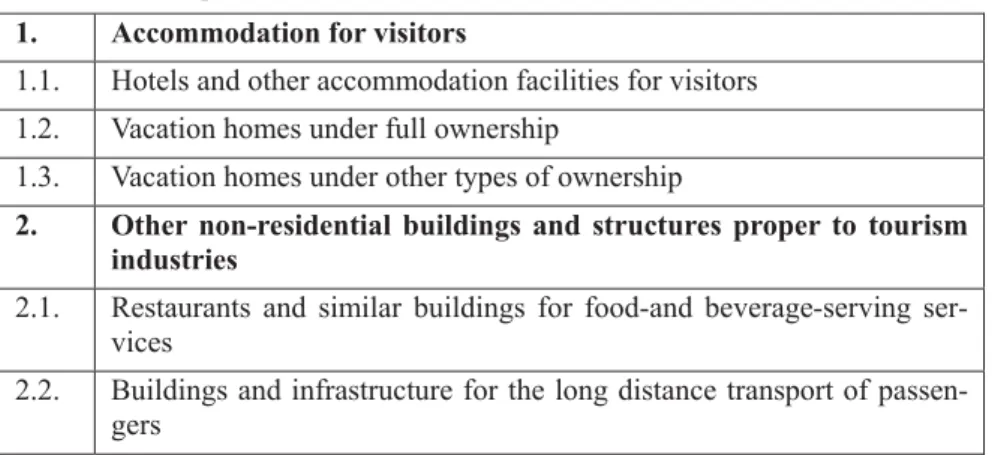
Other non-residential buildings and structures proper to tourism industries
Passenger transport equipment for tourism purposes 1. Land (including road and rail)
Other machinery and equipment specialized for the production of tourism characteristic products
However, of these 60 countries, few develop estimates for tourism investment (referred to here as Tourism Gross Fixed Capital Formation – TFCF) and/or Tourism Collective Consumption (TCC). One table is a simplified form of TSA:RMF Table 8 called "Gross Fixed Capital Formation by Typical Tourism Industries," for eight tourism industries. 4 Towards an improvement of the TSA in the case of gross fixed capital formation and the collective consumption of tourism.
A clearer conceptual differentiation between gross fixed capital formation in tourism industries and TGFCF. It should be remembered that TSA: RMF 2008 does not present Tourism Gross Fixed Capital Formation (TGFCF) as an aggregate for international comparison. Instead, it recognizes gross fixed capital formation of tourism industries as an important variable in the characterization of tourism industries.
A clearer distinction should be made between TGFCF and Gross Fixed Capital Formation of tourism industries.

Six of these dimensions can be of great importance when making a choice in favor of the tourism sector. We also refer to Sahli and Novak (2007): ‘government should implement policies (e.g. subsidies) to slow rural-urban migration in case of a tourism boom’. In its recent publication 'Sustainable Tourism Development', UNWTO (2013) underlines a fundamental demand of the tourism sector.
Although any generalization should be avoided, there are doubts about the role of tourism as a means of development in rich regions. The benefits of tourism development (income generation, employment generation, tax revenue generation, encouragement of entrepreneurial activity, balance of payments effects and improvement of the economic structure) apply to this type of region (Williams and Shaw, 1995; Telfer, 2002a, 2002b Vanhove, 2010). They examine the role of tourism as a conditioning factor in improving the population's standard of living.
The coefficient of the tourism indicator ranges from 0.12 to 0.14 indicating a positive short-term output elasticity of tourism.
Tourism as a Key Topic in Small-Scale Regional Development Processes
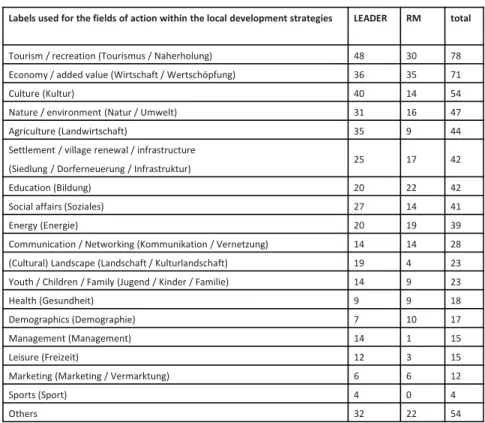
Nevertheless, a large part of the funds used for regional development are allocated according to top-down concepts. Around the same time frame, a second bottom-up regional development program was implemented in Bavaria. Consequently, coordination and definition of competencies in the tourism sector is a very important topic for many bottom-up regional development initiatives.
Before starting the regional development processes, the necessary documents must be prepared. In order to function effectively in dynamic regional development processes, regional managers must remain flexible in the implementation of planned projects. All in all, it turns out that tourism is one of the most important areas of activity in integrated regional development strategies.
Third, we strongly suggest a close study of the reasons behind the high popularity of tourism in regional development.
Swiss Tourism in the Past, Present and Future
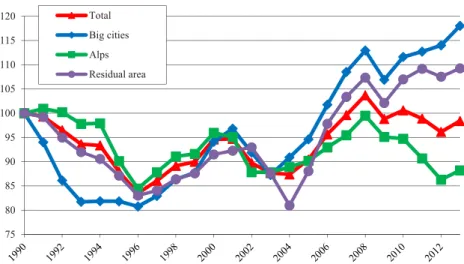
The following paper discusses the past development of the Swiss tourism industry since Peter Keller's article was published in 2003 and notes the value-based pricing approach. Reasons for this decrease include the reduction in disposable income as well as the appreciation of the Swiss Franc, which has led to a decrease in demand for Swiss tourism services. The poor position of the Swiss tourism industry in terms of competitiveness in terms of price is a major concern.
An in-depth look at the development of the corporate structure of the hotel industry reveals a continuous structural change since 1990. The gross operating result of the Swiss hotel industry developed positively from 2005 to 2008, in line with the number of overnight stays. A study of the development of the cable car industry reveals a significant increase in the amount of people transported in the last 20 years compared to the number of overnight stays in hotels.
New information technology has greatly improved the strategic development of the tourist suppliers in terms of price differentiation and price flexibility.
Destination Research
Management and Governance
Tourism Governance and the Influence of
Stakeholder Networks – A Case Study from Western Australia
First, an introduction to the case study area is given which is then followed by a stakeholder analysis that examines the complex relationships between the various public, private and non-profit actors in the context of the proposed Coral Coast Resort. In recent decades, tourism has become the largest and fastest growing sector of the Gascoyne economy. The research question is investigated by using the policy network approach (Pforr, 2006) as an analytical tool to describe and explain the complex nature of the interactions between the various stakeholders who contributed to or participated in the Maud's Landing political processes.
This analysis therefore focuses on issue-specific influence, reputation, collaboration and communication networks to measure mutual importance in the decision-making process leading to the rejection of the proposed Coral Coast Resort. In the following, the influential reputation network of the decision-making process in Maud's Landing is discussed in more detail. In the late 1990s, the Save Ningaloo campaign was set up to stop the proposed development of the marina.
The information exchange network in the Maud's Landing decision-making process reveals some rather surprising results compared to the previous levels of analysis.

Applying Business Intelligence for Knowledge Generation in Tourism Destinations – A Case Study
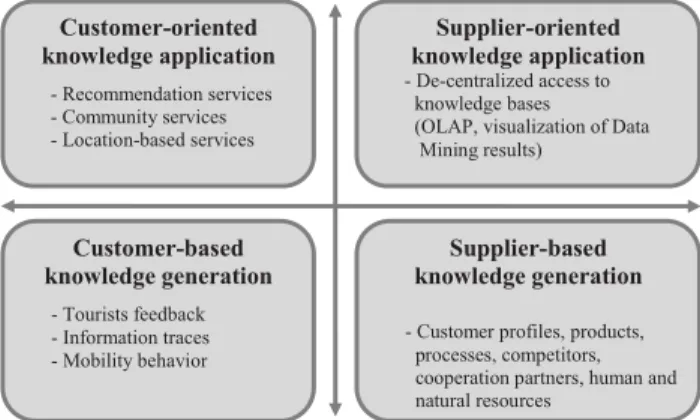
Since the advent of the WWW, a large part of tourism transactions has been handled electronically (Buhalis 2006; Fuchs et al. 2010a/2010b). The knowledge destination framework, introduced by Höpken et al. 2011), builds the foundation for a web-based infrastructure that collects customer-based data and creates and disseminates new knowledge to stakeholders at the destination. Moreover, knowledge about tourist buying behavior can be generated through mining transaction data (Höpken et al. 2014), while tourist mobility behavior can be tracked through GPS/WLAN-based positioning (Zanker et al. 2009).
On the supply side, BI-based management information systems enable the decentralized generation of knowledge relevant to the destination management organization (DMO) and private/public destination suppliers (Fuchs et al. 2011). Through a business process-oriented, multidimensional data modeling approach, these indicators are mapped to sequential destination processes, namely 'web navigation', 'booking' and 'feedback' (Höpken et al. 2013). Åre has been technically fully validated, tested and implemented as a real novelty in the tourist destination of Åre (Fuchs et al.
Text mining techniques are applied to semi-automatically extract single statements from each of the cross-referenced reviews (Schmunk et al. 2014).
The Case of Switzerland During the Last 20 Years
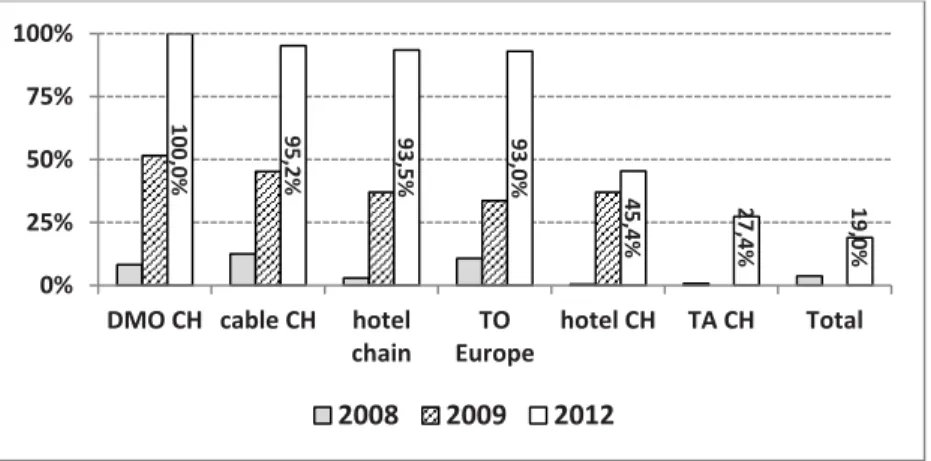
Research on the adoption of Web 1.0-related technologies by the Swiss tourism industry initially focused mainly on hotels and then extended to other sectors. All other Web 2.0-related technologies generally showed frequencies of less than <1%, and the sectoral analysis showed that adoption in the two international sectors was significantly higher than the average penetration across the board. Therefore, the study of the evolution and adoption of online sales channels in the Swiss hotel industry was a key issue of several surveys since 2003 (see Schegg, Stangl, Fux, & Inversini, 2013) for an overview of the results).
The majority (>50%) of hotelleriesuisse members are 3-star hotels and are therefore the most important element of the Swiss accommodation sector. On the other hand, one of the biggest themes for the Swiss tourism industry, especially the accommodation sector, is the growing dominance of OTAs. In the previous section we showed that the proportion of OTAs is growing very quickly, although the effects are different depending on the size and/or categories of hotels.
In 1979 he was in charge of the Swiss Tourism Concept, playing the central role of reporter.