UNHEALTHY DEMOCRACY: HOW PARTISAN POLITICS IS KILLING RURAL AMERICA
By
Michael E. Shepherd, Jr.
Dissertation
Submitted to the Faculty of the Graduate School of Vanderbilt University
in partial fulfillment of the requirements for the degree of
DOCTOR OF PHILOSOPHY in
Political Science August 31, 2021 Nashville, Tennessee
Approved:
Joshua D. Clinton (Co-Chair), Ph.D.
Larry M. Bartels (Co-Chair), Ph.D.
Allison P. Anoll, Ph.D.
Katherine J. Cramer, Ph.D.
Copyright © 2021 Michael E. Shepherd Jr.
All Rights Reserved
To Mom and Dad.
ACKNOWLEDGMENTS
This dissertation would not be possible without the countless contributions of many people. My first thanks go to my co-chairs, Larry Bartels and Josh Clinton. Each of these men deserve credit that I will never be able to fully describe. I decided I wanted to be a political scientist when I read Larry’sUnequal Democracy.
Larry’s kindness and generosity are only surpassed by his brilliance. Josh rescued me at one of the lowest points of my life. He’s provided constant feedback, friendship, and support through the toughest professional and personal times. Josh taught me how to think with data and how to focus on what my research was “really about.” I have been incredibly fortunate to have been mentored by two of the most genuine and leading minds in American politics.
Beyond my chairs, this dissertation benefited most from the guidance of Allison Anoll and Kathy Cramer.
Every facet of my dissertation from the literature review to my resulting job talk was improved directly by Allison’s advice. I only regret not having to been able to spend more time learning from her. Kathy and her book,The Politics of Resentment, are as responsible for the inspiration of this dissertation as every day I spent growing up in rural, Kentucky. Her book spoke to me as an early grad student like no other scholarship has since. Having the opportunity to have her serve as my outside committee member has been an amazing gift.
I have also benefited greatly from the advice and friendship of many other current and former Vanderbilt faculty members. Dave Lewis has provided constant friendship and support and I will always fondly remem- ber Lewis Lab. Eunji Kim, though late to my graduate school years, has provided encouragement and advice.
I will also always be thankful to Amanda Clayton for exposing me to the comparative politics literature that ultimately formed my thinking on this project and the opportunity to do field interviews with rural and urban Republicans. Cindy Kam, whether she knows it or not, has attended every conference practice talk I’ve given in the department. Her questions and comments have always been the hardest and have helped push my projects forward the most. Bruce Oppenheimer has been my lunch buddy, trivia host, and friend for years now. I will miss the stories and factoids. Jon Meacham has provided me with scholarly opportunities that I will never forget or be able to repay. Hye Young You was the first person at Vanderbilt to believe in and work with me. I would have never had the confidence to write this dissertation without her.
Several professors mentored and guided me prior to Vanderbilt. David Cohen, John Green, Daniel Coffey, and Cyndra Cole at the University of Akron taught me how think like a political scientist for the first time and helped me to believe in myself enough to apply to PhD programs. Winfield Rose at Murray State University gave life to my teaching and academic passions.
My times in CSDI at Vanderbilt have made graduate school enjoyable. Shannon Meldon-Corney has been my constant advocate and support system. I don’t know how I am supposed to accomplish much of anything without her. Mark Richardson, Scott Limbocker, Sheahan Virgin (not Sheahan’s plants), Darrian Stacy, James Matherus, and Mary Catherine Sullivan were wonderful friends and officemates. Sheahan became my roommate and one of my dearest friends during our times in CSDI and has been a constant source of support and classical music knowledge. Dan Alexander, Trish Kirkland, Jonathan Klingler, Shawn Patterson, Nick Eubank, and Adriene Fresh joined Vanderbilt as CSDI post-docs and each improved my scholarship. Dan, in particular, has always pushed me to be the best I can be and think critically about my research.
My Nashville trivia teams and close friends around the Vanderbilt program have made my time outside of work so much fun. Nicole Audette, Dave Connor, Spencer Hall, Adam Wolsky, Maggie Deichert, Drew Engelhardt, Marc Trussler, Kaitlen Cassell, Claire Q. Evans, Bryce Williams-Tuggle, Nick Bednar, Lauren Chojnacki, Sara Kirshbaum, Meredith McLain, Rho Townsley, and Mellissa Meisels have made even the toughest days of graduate school feel worth it. Mellissa, in particular, has helped me so many times.
I would not have made it to Vanderbilt without the support of three special friends from my time in Akron, OH. Jelena, Stew, and Ian believed in me before I did. Losing Ian in the middle of my time at Vanderbilt was incredibly painful; Ian more than any other person I have ever known believed in the power of politics and decent people to rid the world of injustice and pain. My college friends from Murray State have also been the most amazing people and have been so patient with me as I worked on this project. Playing with Amanda and The Bob Ukerz, spreading music and happiness during dark times, kept my focus on what matters most in life.
Finally, and most importantly, my family deserves the most gratitude of all. My mom and dad have sacrificed everything to make my dreams possible. Financially and emotionally, my parents have given their
all for me. My mom picked up every phone call between 8:00am and. . . well. . . 8:00am to console me during my struggles. My dad gave me my skeptical mind for the world of politics and a world of happy times away from work. I cannot wait for more days of fishing and live music now that writing this is over. My step-dad and his children have provided so much love and many happy times. My sister, her husband Matt, and her children are the happiest parts of my life; Finley and Elly are my joy.
I also owe more than describable to the many loved ones that I’ve lost during this experience. Graduate school, though wonderful professionally for me, was a time of constant turmoil and loss in my personal life.
To all of my loved ones gone too soon, I miss and thank you immeasurably. A special posthumous thank you to my grandfather, Roger Shepherd, who passed away as I was finishing my final chapters. Watching the morning news with my papaw as a child was how this journey began in the first place.
- Michael Shepherd, Franklin, KY
TABLE OF CONTENTS
Page
LIST OF TABLES . . . viii
LIST OF FIGURES . . . x
1 Introduction . . . 1
1.1 The Puzzle . . . 1
1.2 Previous Literature . . . 2
1.3 Contribution . . . 3
1.4 Overview of Chapters . . . 5
2 Under the Elephant: Rural Support for Government Health Insurance, 1960-2018 . . . 7
2.1 Why Rural White People Do Not Support Government Health Care . . . 9
2.2 Partisanship, Racial Attitudes, and Rural Whites’ Health Care Attitudes, 1960-2000 . . . . 12
2.3 Partisanship, Racial Attitudes, and Rural Whites’ Health Care Attitudes, 2012-2018 . . . . 16
2.4 Blame it on the Pained? Health Care Attitudes of Policy-Affected Rural Whites . . . 19
2.5 Discussion and Conclusion . . . 27
3 Down with the Sickness? Health Experiences, Rural Resentment, and Support for Govern- ment Health Insurance . . . 30
3.1 Blind or Resentful? How Bad Experiences Undermine Support for Government . . . 32
3.2 Less, Not More: Rural Reactions to Poor Local Health . . . 35
3.3 Rural Resentment and Support for Health Care Reform . . . 39
3.3.1 Rural Resentment: Concept and Measure . . . 39
3.4 Rural Resentment, Health Experiences, and Health Care Attitudes . . . 41
3.4.1 Are the Rural Poor Also Resentful? . . . 47
3.5 Discussion and Conclusion . . . 49
4 The Politics of Pain: Medicaid Expansion, the ACA, and the Opioid Epidemic . . . 51
4.1 Policy Feedback, Policy Effects, and Federalism . . . 54
4.1.1 The ACA, the Opioid Epidemic, and the Politics of Pain . . . 57
4.2 Data and Research Design . . . 62
4.2.1 Geographic Discontinuity Design and Medicaid Expansion Borders . . . 64
4.3 Medicaid Expansion, the Opioid Epidemic, and Voting Behavior . . . 67
4.4 Conclusion . . . 71
5 Dying for the Donald? The Politics of the Rural Hospital Crisis . . . 74
5.1 The Politics of the Rural Hospital Crisis . . . 76
5.2 How Citizens Respond in a Federalist System . . . 80
5.3 Data and Method . . . 82
5.3.1 Identification Strategy and Observational Analyses . . . 86
5.4 Presidential Voting in the Rural Hospital Crisis . . . 87
5.5 Gubernatorial Election Analyses . . . 90
5.6 Discussion of Mechanisms . . . 92
5.7 Conclusion . . . 95
References . . . 97
6 Chapter 2 Appendix . . . 105
6.1 Data Sources and Descriptive Statistics . . . 105
6.2 CCES Analyses . . . 107
7 Chapter 3 Appendix . . . 112
7.1 Data Sources and Descriptive Statistics . . . 112
7.2 Rural Resentment Index . . . 113
7.3 ANES Analyses . . . 118
7.4 YouGov Analyses . . . 120
7.5 CCES Analyses . . . 123
8 Chapter 4 Appendix . . . 129
8.1 Descriptive Statistics . . . 129
8.2 Research Design Assumption Tests . . . 135
8.2.1 Medicaid or Opioid Sorting? . . . 138
8.3 Voter Study Group and Opioid Severity . . . 140
8.4 Impact of Medicaid Expansion on Opioids . . . 141
8.5 Medicaid Expansion Placebo Test . . . 143
8.6 Main Election Results . . . 144
8.7 Election Robustness Tests . . . 146
8.8 Individual Election Results . . . 150
9 Chapter 5 Appendix . . . 152
9.1 Data Sources and Descriptive Statistics . . . 152
9.2 Mechanisms Analyses . . . 157
9.3 Presidential Results . . . 159
9.3.1 County-level Presidential Results . . . 159
9.4 Gubernatorial Results . . . 162
LIST OF TABLES
Table Page
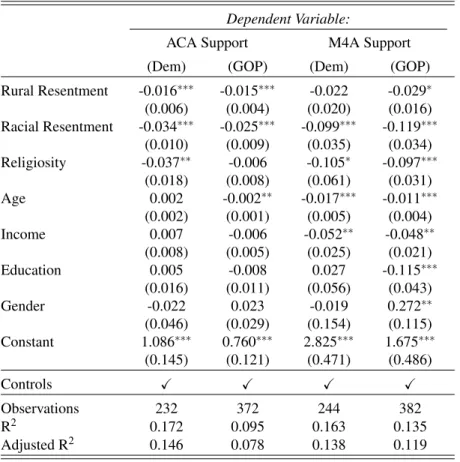
2.1 Partisanship, Racial Resentment, and Support for Government Health Insurance (CCES) . 19
3.1 Local Health Conditions and Rural Support for Government Insurance . . . 36
3.2 Rural Resentment Battery . . . 41
3.3 Rural Resentment and Support for Government Health Insurance . . . 46
3.4 Rural Resentment and Health Care Support Across the Party Divide . . . 47
3.5 Rural Resentment Across the Income Divide . . . 48
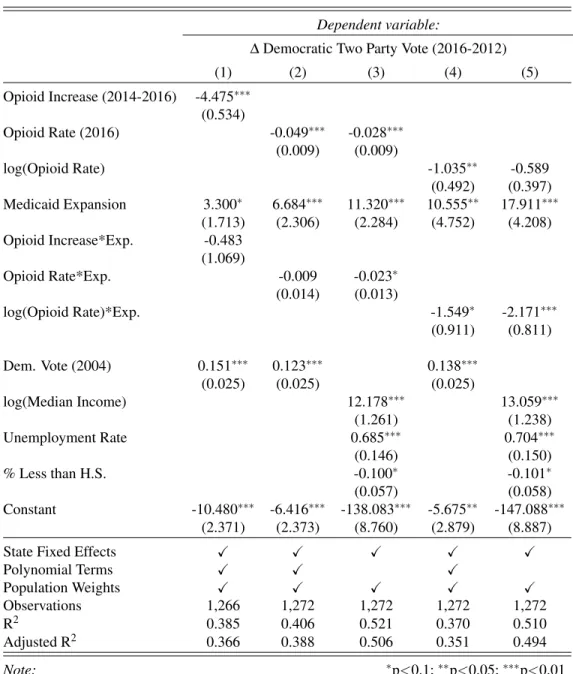
4.1 Effects of Opioid Epidemic and Medicaid Expansion on Voting Behavior . . . 73
5.1 Comparison of Treatment, Matched-Control, and All-Control Counties . . . 84
5.2 County Level Treatment Effect Estimates . . . 87
5.3 Presidential Voting Regression Results (by year) . . . 89
5.4 Individual Level Gubernatorial Election Results . . . 91
6.1 Descriptive Statistics for the CCES Rural White Sample (2018) . . . 106
6.2 Partisanship and Support for Government Health Insurance . . . 107
6.3 Partisanship, Racial Resentment, and Support for Government Health Insurance . . . 107
6.4 Rural White Support for the ACA, CCES (2012) . . . 108
6.5 Rural White Support for the ACA, CCES (2014) . . . 108
6.6 Rural White Support for the ACA, CCES (2016) . . . 109
6.7 Rural White Support for the ACA, CCES (2018) . . . 109
6.8 Government Insurance and Partisan Influences on Rural White Health Care Attitudes . . 110
6.9 Racial Attitudes, Partisanship, Personal Benefits, and Support for the ACA (CCES) . . . 111
7.1 Descriptive Statistics for the CCES Rural White Sample (2018) . . . 112
7.2 Rural Resentment Battery . . . 113
7.3 Local Health Conditions and Rural Support for Government Insurance (1972) . . . 118
7.4 Local Health Conditions and Rural Support for Government Insurance (1992) . . . 119
7.5 Rural Resentment and Support for Government Health Insurance . . . 120
7.6 Rural Resentment and Health Care Support Across the Party Divide . . . 121
7.7 Rural Resentment Across the Income Divide . . . 122
7.8 Rural Symbolic Support for Government Health Care . . . 123
7.9 Rural Symbolic Attachments and Support for Government Health Care . . . 124
7.10 Opioid Conditions and Rural Support for Government Health Care . . . 125
7.11 Years of Potential Life Lost and Rural Support for Government Health Care . . . 126
7.12 Percent of Population in Poor Health and Rural Support for Government Health Care . . 127
7.13 Obesity Rates and Rural Support for Government Health Care . . . 128
8.1 Expansion Status of each Status as of 2015 . . . 129
8.2 Descriptive Statistics for the GDD Border Sample . . . 129
8.3 Descriptive Statistics for GOP Expansion Border Sample . . . 129
8.4 Implied Substantive Relationship between Prescriptions and Deaths . . . 134
8.5 Balance Between Expansion and Non-Expansion Counties . . . 138
8.6 Impact of Medicaid Expansion on Migration . . . 139
8.7 Personal Knowledge and Community Opioid Severity (VSG) . . . 140
8.8 GDD: Effect of Medicaid Expansion on Opioid Prescriptions . . . 141
8.9 Non-Parametric RD Estimates of Effect of Medicaid Expansion on Opioid Usage . . . . 141
8.10 Placebo Test: Pre-treatment Changes in Opioid Rates in Expansion States? . . . 143
8.11 Effects of Opioid Epidemic and Medicaid Expansion on Voting Behavior . . . 144
8.12 GDD Dropping Polynomial Terms . . . 145
8.13 Effects of Opioid Epidemic Controlling for Other Health Effects . . . 146
8.14 Effects of Opioid Epidemic Controlling for Financial Effects of ACA . . . 147
8.15 Effects of Opioids Dropping Coal States . . . 147
8.16 GDD Results Dropping Bottom and Top 10% of Opioid Observations . . . 148
8.17 Heterogenous Effects of Medicaid and Opioid Effects, Full and GOP Samples . . . 149
8.18 Individual-Level Regression Results (Voter Study Group) . . . 150
9.1 States with Hospital Closures (by year) . . . 152
9.2 Demographics of Treated and Untreated Units . . . 152
9.3 Comparison of Treated and Untreated Respondents . . . 156
9.4 Mechanism Association Results . . . 157
9.5 Mechanism Results: Economic Retrospection and Health Care Attitudes . . . 158
9.6 Individual Level Presidential Election Results . . . 159
9.7 County Level Treatment Effect Estimates . . . 161
9.8 Individual Level Gubernatorial Election Results . . . 162
LIST OF FIGURES
Figure Page
1.1 Obesity Rates and Partisan Voting . . . 2
1.2 Lives Lost and Partisan Voting . . . 2
1.3 Population and Partisanship (1980) . . . 3
1.4 Population and Partisanship (2016) . . . 3
2.1 Cheap Government Insurance. . . 13
2.2 Government Insurance Scale . . . 13
2.3 Trends in Partisan Affiliation Among Rural Whites, 1960-2000 (ANES) . . . 14
2.4 ANES, (1960-1968) . . . 15
2.5 ANES, (1972-2000) . . . 15
2.6 Racial Attitudes and Rural Support for Government Health Insurance, 1972-2000 (ANES) 16 2.7 Urban/Rural ACA Support . . . 17
2.8 Rural Partisan ACA Support . . . 17
2.9 Racial Resentment and ACA Support (CCES) . . . 18
2.10 ACA Support (2012) . . . 20
2.11 ACA Support (2014) . . . 20
2.12 ACA Support (2016) . . . 21
2.13 ACA Support (2018) . . . 21
2.14 ACA Support, Uninsured. . . 22
2.15 ACA Support, Gov’t Insured . . . 22
2.16 Racial Resentment and ACA Support . . . 23
2.17 Partisan Effects of Government Health Insurance on Support for the ACA . . . 25
2.18 Effects Racial Resentment and Government Health Insurance on Support for the ACA . . 26
3.1 Local Health Conditions and Rural Support for the ACA . . . 38
3.2 Rural Resentment Index . . . 42
3.3 Rural Resentment and Education . . . 43
3.4 Rural Resentment and Income . . . 43
3.5 Rural Resentment and GOP Affect . . . 44
3.6 Rural and Racial Resentment . . . 44
3.7 Rural Resentment and “Religiosity”. . . 44
3.8 Years of Life Lost . . . 45
3.9 Opioid Prescription Rate . . . 45
3.10 Obesity Rate. . . 45
3.11 Rural Resentment and ACA Support . . . 46
3.12 Rural and M4A Support . . . 46
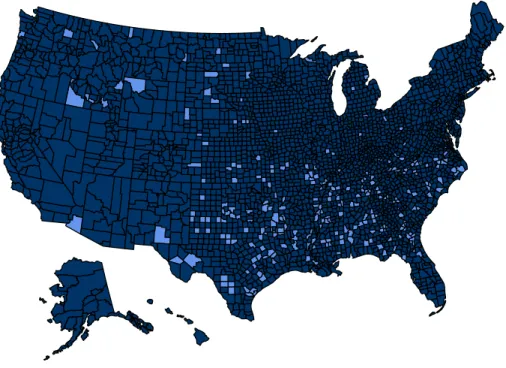
4.1 Medicaid Expansion Status (2015) . . . 59
4.2 Border Sample Status (2015) . . . 59
4.3 CDC Trends in Average Opioid Usage . . . 60
4.4 ∆Opioid Usage . . . 60
4.5 NYT Mentions of “Opioid”. . . 61
4.6 Trump Tweets . . . 61
4.7 County Level Opioid Prescription Rate (2016) . . . 64
4.8 Opioid Prescription Rate (2010) . . . 65
4.9 Democratic Vote (2008) . . . 65
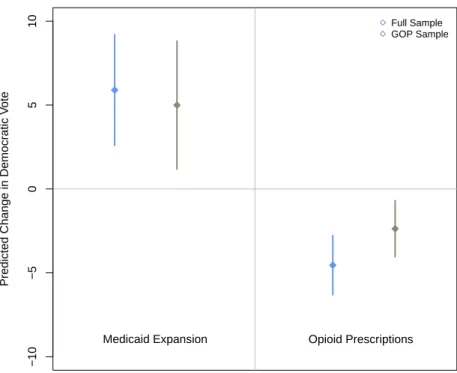
4.10 Impact of a Two-Standard Deviation Change in Variable (Full and GOP Samples) . . . . 70
5.1 US Hospital Closures, 2005-2020 . . . 77
5.2 US Hospital Closures (by state), 2010-2018 . . . 78
5.3 GOP and Non-Medicaid Expansion State Rural Hospital Closures . . . 79
5.4 Study Sample of Closure Affected and Matched Peer Communities . . . 85
5.5 Marginal Effect of Hospital Closure on Support for Trump by Partisanship . . . 90
5.6 Presidential Approval Trends by Hospital Closure Status and Partisanship . . . 93
5.7 Marginal Effect of Hospital Closure on Economic Evaluations and Support for the ACA . 94 7.1 Plausible Number of Factors for Rural Resentment Battery . . . 114
7.2 Dimension 1: Rural Cultural Pride . . . 115
7.3 Dimension 2: Rural Resentment . . . 115
7.4 Rural Resentment Additive Index . . . 115
7.5 Rural Resentment and GOP Affect . . . 116
7.6 Rural and Racial Resentment . . . 116
7.7 Rural Resentment and Religiosity. . . 116
7.8 Rural Resentment and Education . . . 116
7.9 Rural Resentment and Income . . . 116
7.10 Rural Resentment and ACA Support . . . 117
7.11 Rural and M4A Support . . . 117
8.1 Prescription Rates (2006-2016) . . . 130
8.2 log Prescription Rates (2006-2016) . . . 130
8.3 CDC and Wapo Opioid Data . . . 131
8.4 CDC and Death Data. . . 131
8.5 County Level Opioid Prescription Rate (2012) . . . 132
8.6 County Level WaPo Pills Rate (2012) . . . 133
8.7 Drug Related Deaths (2014) . . . 134
8.8 Evidence of Pre-Treatment Discontinuity? . . . 135
8.9 Evidence of Pre-Treatment Discontinuity? . . . 136
8.10 Distance to Border as Sharp Discontinuity . . . 136
8.11 Distribution of Counties across Running Variable . . . 137
8.12 Pre-treatment Parallel Trends in Democratic Vote Share . . . 138
9.1 Balance on Covariates via Matching . . . 153
9.2 Balance on Covariates via Matching . . . 154
9.3 Balance on Covariates via Matching . . . 155
9.4 Treatment and Control Parallel Trends . . . 160
CHAPTER 1
Introduction
The political divergence of urban and rural America is one of the most important facets of American politics.
As such, journalists and academics have provided considerable attention to this growing divide (Frank, 2004;
Bishop, 2009; Hochschild, 2018; Metzl, 2019; Nall, 2018; Rodden, 2019). These accounts have contributed to heightened public concern over the dismal economic and health care realities facing rural communities and have directed the public’s focus on how government policies have failed to meet the needs of rural people.
Along these lines, a 2018 Pew Research report found that majorities of rural, suburban, and urban people (71% among rural residents, 61% among suburban residents, and 57% among urban residents) believed that rural areas received less than their fair share from government (Parker et al., 2018).1 While these scholarly works have clearly helped raise social sympathy toward rural communities, many of them have also contained a palatable and often judgmental bewilderment towards why these forgotten rural people would turn away from government and the Democratic Party–both of which would presumably be likely to help alleviate their via public policy initiatives. Sociologist Arlie Russell Hochschild (2018) refers to this curious rural pattern of choosing the Republican Party and being anti-government despite facing grave personal and communal health and economic circumstances as “The Great Paradox.” This dissertation explores this “Great Paradox”
within the policy area of health care.
1.1 The Puzzle
Rural communities are less healthy, have lower insurance rates, and face more restricted access to medical care than urban communities (Hochschild, 2018). Moreover, the large health disparities the plague racial and ethnic minorities as well as other underserved groups tend to be most severe in rural areas (Smith, 2016;
Metzl, 2019; Case and Deaton, 2021). Despite this, rural people, especially rural white people, have become increasingly supportive of the Republican Party, even as the elites in the Republican Party have become stridently anti-government and less representative of the health and economic interests of rural areas (Hacker and Pierson, 2020; Schaffner et al., 2020).
These trends have caused one of the important stylized facts that undergirds the great paradox: the least healthy communities are now the most supportive of the anti-government Republican Party. For example, consider Figures 1.1 and 1.2, which plot the bivariate relationships between county-level obesity rates and
1Far fewer respondents in each residential category believe the same thing about cities, suggesting people on average believe rural people places are treated unfairly by government.
years of potential lives lost on support for the Democratic Party in the 2016 presidential election.2Figure 1.1 shows that communities with higher obesity rates, which are overwhelming rural, tend to be less supportive of the Democratic Party. Similarly, Figure 1.2 shows that (rural) communities that experience more premature deaths, measured here as the estimated number of years of potential life lost due to health conditions, are also less likely to support Democrats. In each figure, negative health experiences are associated with heightened Republicanism. Indeed, across many other health indicators not reported here, the least healthy communities–
most of which are rural–tend to be more Republican on average.
0 25 50 75 100
20 30 40
Percent Obese
Democratic Two Party Vote (2016)
Figure 1.1:Obesity Rates and Partisan Voting
0 25 50 75 100
10,000 20,000 30,000
Years of Potential Life Lost
Democratic Two Party Vote (2016)
Figure 1.2:Lives Lost and Partisan Voting
1.2 Previous Literature
Political science theories, in combination with popular discourse, offer several explanations for why it seems that sick rural people “vote against their interests” by supporting the Republican Party. Somewhat famously, Thomas Frank (2004) argued that patterns like this have emerged because rural America was blinded by social issues, in essence claiming that rural Americans had been dooped into believing Christian religious issues like abortion or same sex marriage were more important than economic issues, like government spending or health care policy. However, such views were fairly easily dismissed with the dearth of evidence supporting social issue voting or anti-economic voting, at least up to the 2004 election (Bartels, 2006, 2008). With the 2016 presidential election and rural America’s embrace of Donald Trump, many similar arguments of rural people being “blinded” by these religious-stoking social issues were re-offered to explain why rural people did not want government to help their health problems (Hochschild, 2018).
Other work suggests that rural white people’s attitudes about race and social groups undermine their sup- port for government assistance and the Democratic Party (e.g. Kinder and Sanders (1996); Carmines and Stimson (1989); Gilens (1999); Tesler (2016); Jardina (2019)). Racial attitudes shape individual-level de-
2The size of points varies based on the population of the county, darker areas represent more densely-clustered data. The regression line weights observations based on their population.
mands for a variety of social welfare programs and support for health care reform specifically (Schaffner et al., 2018; Mutz, 2018; Banks, 2014; Tesler, 2012; Winter, 2008; Gilens, 1999). Michael Tesler (2012), for example, demonstrates that President Obama’s association with the Affordable Care Act has connected whites’ health care and racial attitudes over the last decade. More forcefully, Jonathan Metzl (2019) argues that racial considerations cause rural whites to be directly “dying of whiteness,” where white, rural Ameri- can’s racial attitudes not only prevent them supporting government health care, but ultimately cause health decisions that undermine personal health.
1.3 Contribution
In this dissertation, I provide two primary additions and contributions to this debate. First, I argue that explanations that rely solely on rural social-issue blindness or racial attitudes are incomplete in explaining the patterns of rural health care attitudes and political behavior we observe. Instead, I contend that partisanship, especially Republicanism, is the key driver in undermining rural support for government health care. Over the past several decades, rural America has become generally more supportive of the Republican Party.3 Figure 1.3 displays the bivariate relationship between a county’s population (one common measure of rurality) and the Democratic Party’s share of the major party vote in 1980–the size of points varies based on the population of the county.4 Figure 1.3 demonstrates that the line is essentially flat with points scattered randomly about, indicating essentially no relationship between rural-ness and partisan support in 1980. However, as Figure 1.4 displays, by 2016 there was a strong positive relationship between how populated an area was and its support of the Democratic Party, implying considerable shifts in rural support for the Republican Party.
0 25 50 75 100
0 2,000,000 4,000,000 6,000,000
Population (1980)
Democratic Two Party Vote (1980)
Figure 1.3:Population and Partisanship (1980)
0 25 50 75 100
0 2,500,000 5,000,000 7,500,000 10,000,000
Population (2010)
Democratic Two Party Vote (2016)
Figure 1.4:Population and Partisanship (2016)
3Most of rural America was already Republican, as the South drives most of the growth (Bartels, 2006). However, there are more recent converts to the party, who have switched based on the increasing association between rural cultural images of the Republican Party (Achen and Bartels, 2016; Cramer, 2016; Ahler and Sood, 2018; Jacobs and Munis, 2019; Deichert, 2019).
4I use the US decennial Census estimates for the 1980 plot and the American Community Survey, US Census 2010 population counts for the 2016 plot. The regression lines weight counties by population.
As a result, more rural people simply rely on Republican elites for cues on difficult political issues like health care. Accordingly, as Republican elites have taken more stridently anti-government positions (Lerman, 2019; Hacker and Pierson, 2020), rural white Republicans have followed and become less supportive of gov- ernment health insurance (e.g Lenz (2013))–despite the worsening health conditions. Indeed, the COVID-19 pandemic has only further revealed the importance of partisanship in health care as many rural white Republi- cans opted out of life-saving social-distancing, mask-wearing, and vaccination practices that ultimately have saved the lives of many of their opposition-partisan peers (Kim et al., 2020; Clinton et al., 2021; DeMora et al., 2021). Based on these stark party differences and evidence from the COVID-19 pandemic, I argue that the vast majority of rural people simply follow their party lead to their own peril or promise.
The second major contribution of this dissertation is to challenge Hochschild’s (2018) and others’ premise that rural Americans are simply blind to their own needs, privileging social issues over local concerns. This view is far too simplistic and ignores how rural people respond to their local conditions in more nuanced ways. While the forces of partisanship and racial attitudes discussed above mute the influence of local health conditions and lived experiences on rural political behavior, rural white people do seem to respond to their local health conditions. However, they do so in ways that reflect either positive or negative experiences with health care and with rural considerations at the forefront of their minds. Drawing on Cramer’s (2016) pathbreaking study of Wisconsin, I argue that rural white people respond to their negative experiences by developing resentful attitudes toward government and cities. These resentful attitudes, in turn, undermine rural white support for government health insurance for rural white people of varying partisan loyalties.
According to this argument, the relationships between observed in Figures 1.1 and 1.2 would actually be reflective of reasonable grievances against government, even if misplaced.
The remainder of this dissertation dives deeper into these contributions in two parts. First, I focus on the major explanatory factors for why rural white people are less supportive of government health insurance than urban white people. I pay special attention to how rural people’s social attachments and lived experiences correlate with their levels of support for government health insurance. Second, I more rigorously examine how positive and negative health policy experiences shape rural white voting behavior within the American federalist electoral system. In conjunction, these chapters show that rural people are not unaware of or blind to their health care needs. Instead, rural people tend to blame the federal government, and especially the incumbent president, for their negative health experiences. This blame attribution pattern is clearly self- undermining for improving rural health care via government solutions, as often times the less responsible political actors (i.e., federal Democrats) are blamed for poor local health conditions caused by other actors.
Moreover, by wanting less and not more from government as things get worse, rural people are contributing to a vicious cycle where rural Republican elites benefit electorally from things worsening in their own rural
communities.
On a more positive note, these chapters demonstrate that rural peopleareretrospective and reactive. When rural people experience policy benefits (i.e. receive government health insurance, experience more favorable health conditions), they tend to become more supportive of government health insurance and the Democratic Party. As a result, public policy remedies and using the government to improve rural health care are potential paths forward for building rural support for government. So, while the vicious rural health care cycle is relentless, government policy seems to slow its spin.
1.4 Overview of Chapters
The first chapter of this dissertation, “Under the Elephant: Rural Support for Government Health Insurance, 1960-2018,” explores the historical trajectory of rural white opinion towards government health insurance from 1960 to the present. I show that rural whites tend to be more supportive of government health insurance than conventional wisdom suggests–though less supportive than urban whites. However, racial attitudes and especially Republican partisanship increasingly undermine rural whites’ support for government health care.
Republican partisanship has consistently predicted lower support for government health insurance, since at least the early 1960s. Rural white Republicans, even personally receiving government health insurance, are highly unsupportive of government health care. I also show that racial attitudes, from time-to-time, have been important for understanding rural white health care attitudes. From the late 1960s through the early 1980s and again from 2010 forward, rural white people who held more racist attitudes were substantially less likely to support government health insurance. However, unlike Republican partisanship, I show that the negative effects of racial attitudes are demonstrably reversed by policy benefits. Today, even the most racially resentful rural white people are highly supportive of government insurance if they are personally receiving it.
The second chapter, “Down with the Sickness? Health Experiences, Rural Resentment, and Rural Support for Government Health Insurance,” examines how local, rural health experiences shape rural health care demands from and support for government. Using data on roughly 100,000 rural white respondents and multiple measures of rural public health, I show that rural white people, on average, respond to more dismal health conditions by wanting less and not more government. Drawing on Cramer (2016), I develop an original rural resentment survey battery to assess the degree to which rural white people develop resentful attitudes in response to their health conditions and whether these attitudes, in turn, provide the prism through which rural people translate their lived experiences into political action. This chapter demonstrates that the most rurally resentful white people tend to live in the least healthy communities. Moreover, these resentful rural attitudes exert a strong, independent influence on support for government health insurance across the partisan divide.
These results suggest that poor health care environments and negative health experiences–among a host of
other negative conditions–lead rural white people to form resentful attitudes toward the government, blame the government for their experiences, and ultimately reject government assistance to improve their lives.
In the third chapter, “The Politics of Pain: Medicaid Expansion, the ACA, and the Opioid Epidemic,” I turn to the electoral effects of health experiences and health policy. I argue that the federalist structure of the American representational system complicates how health conditions are translated into voting behavior and ultimately which politicians are blamed for health care conditions. Building on Sances (2017), Rogers (2017), and Lee (2016), who all argue that the president is held accountable for the policy (in)actions of other levels and branches of government, I argue that the federalist structure of American government and the effects of the hyper-partisan loyalties displayed in Chapter 1 often similarly incentivize state-level Re- publican elites–who now represent most of rural America–to undermine their own constituent’s health care conditions–specifically because it is often the opposition party’s president that will be held responsible. I explore how these dynamics affected the trajectory and political influence of the opioid epidemic. Using data on the spread the opioid epidemic from 2006-2016, I show that the Affordable Care Act (ACA) reduced the severity of opioid usage in states that choose to expand Medicaid. In communities in expansion states that ex- perienced reductions in opioid usage, the Democratic Party performed more strongly in the 2016 presidential election. Conversely, in non-expansion states and where opioid conditions worsened, largely due to Republi- can decisions not to expand Medicaid, voters shifted their support toward Donald Trump. These results imply that the Republican voters shifted toward the Republican Party due to bad health experiences, even though Republican state politicians were more responsible for these outcomes.
In the final chapter, “Dying for the Donald? The Politics of the Rural Hospital Crisis,” I probe the electoral and attitudinal effects of declining access to health care in rural America. Specifically, I explore rural responses to the unfolding rural hospital closure crisis as source of exogenous variation in access to medical care. Since 2005, nearly 200 rural hospitals have closed, leaving much of rural America without access to emergency health care. The vast majority of these closures have occurred in Republican states that chose not to expand Medicaid under the ACA. Using data on all rural hospital closures in the US from 2010 to 2018, I find that hospital closings increased rural independents’ likelihood of voting for Donald Trump in the 2016 presidential election and reduced their support for the ACA and approval President Obama. However, consistent with prior chapters, I show that neither Republicans or Democrats were electorally influenced by the hospital closures in their communities. At the state level, I find no evidence that these rural hospital closings affected gubernatorial voting (or approval) for independent, Republican, or Democratic rural voters.
Building on the argument of the previous opioid, chapter, I show that state officials are often let off the hook for the roles they play in undermining rural public health.
CHAPTER 2
Under the Elephant: Rural Support for Government Health Insurance, 1960-2018
“[O]n a crusade in which one’s own material interests are suspended in favor of vague cultural grievances that are all-important and yet incapable of ever being assuaged.” - Thomas Frank
(2004), p. 121.
The quote above from Thomas Frank’s What’s the Matter with Kansas?, highlights a common, if not banal, depiction of the political attitudes and behaviors of rural white people. In Frank’s and others’ reason- ing, rural white voters’ focus on cultural issues distracts them from adopting policy positions more consistent with their “material interest.” Over the last decade, this type of logic has been extended, mostly by qualita- tive scholars, to attempt to better understand why rural people seem so unsupportive of government health insurance, even though many of them would assuredly personally benefit from it and despite the decreasing access to quality private health care in rural communities like theirs (Hochschild, 2018; Macy, 2018; Metzl, 2019; Case and Deaton, 2021). Specifically, these scholars argue that racism, culture war attitudes, and pure ignorance explain why rural white people, who would personally benefit from assistance, nevertheless do not support government health insurance. However, and despite the frequency and power of these narratives, little quantitative evidence exists to support these claims.
To probe this conventional wisdom, I perform a historical analyses examining the extent to which sym- bolic attitudes and group attachments–specifically partisanship and racial attitudes–explain rural whites’
health care attitudes from 1960 to the present.1 To do so, I use data from roughly 30 public and private mass opinion surveys from 1960-2018, including over 100,000 rural white survey respondents. I find that these symbolic attitudes and group attachments do indeed explain the vast majority of variation in rural whites’ health care attitudes from 1960-2000. However, and despite Frank’s and others assertions, these re- lationships do not appear to be new influences on rural whites’ health care attitudes. Regardless of decade, event, or health care salience, differences between Republicans and Democrats’ are the largest among rural social groups in terms of support for government health care. Republican partisanship in particular erodes support for government health insurance, as Democrats and independents both typically and similarly pre- fer government health insurance. Somewhat consistent with Frank (2004), however, the role of Republican partisanship hasincreasedover the last decade or so, but more modestly than typically assumed.
1To remain consistent with this previous work, I also focus rural white people. As a result, a limitation of this work is that it only speaks to whites’ health care attitudes. Racial and ethnic minorities–as well as other underserved and marginalized communities–
experience the worst health care outcomes in rural communities (e.g. Smith (2016)). These groups of people tend to respond to their negative experiences with less anger and resentment than their white peers (Phoenix, 2019) and with more resilience–adopting communal participatory norms to overcome social problems (White and Laird, 2020; Anoll, 2018).
Similarly, I find that racial attitudes are also historically key to understanding rural whites’ health care atti- tudes (e.g. (Metzl, 2019)). Especially following the creation of the Affordable Care Act (e.g. (Tesler, 2012)), rural white affect towards black people and racial resentment were heavily predictive of rural whites’ health care attitudes. However, the independent influence of racial attitudes on health care attitudes has become complicated by its relationship with partisanship, as partisanship seems to structure racial attitudes now more than the other way around (Engelhardt, 2018). Despite this, there is little doubt that racialized Republicanism and increased racial liberalism among white Democrats (e.g. Bartels (2020); Engelhardt (2019)), has cre- ated a hyper affectively-charged partisan political environment (e.g. Iyengar and Westwood (2015)) causing stronger, but fused roles for racial attitudes and partisanship in explaining rural policy attitudes (e.g.Westwood and Peterson (2020)).
Following this, I more formally test a key pillar of the existing conventional wisdom: that rural white people who would or are personally benefiting from government health insurance still reject it for the same symbolic motivations and group attachments. To do so, I examine the extent to which the previous findings hold for groups of uninsured and government-insured rural white people. I use data from the Cooperative Congressional Election Study (CCES) to examine the impact partisan and racial influences on rural whites who are among the population of potentially beneficiaries. Additionally, I test whether the positive policy feedback effects of government health insurance are moderated by these symbolic and group attachments (e.g. Clinton and Sances (2018, 2020)).
Across each of these analyses, even less well-off white rural people tend to be less supportive of gov- ernment health insurance if they are a Republican or hold racially resentful attitudes. The size of these relationships mirror those observed for the less policy-affect population of rural people, suggesting that sym- bolic considerations matter similarly for even for the people who must actually pay the costs of symbolic action. However, most rural white people do seem to increase their support of government insurance if they are personally receiving government health insurance. Partisans of all stripes–and especially rural Democrats and independents–as well as rural whites of all racial resentment levels tend to be more supportive of govern- ment health insurance if they are directly benefiting from it. Each of these groups of rural white respondents do tend to be more supportive of government health insurance when receiving it.
However, the overall influence of “personal benefits” on rural health attitudes varies heavily from group- to-group. For example, even though rural Republicans receiving government health insurance are modestly more supportive of government health insurance programs, this increase in support is trivial as fewer than 25% of rural Republicansactually on government health insurancesupported the ACA from 2012-2018. In stark contrast, and although racially resentful rural people were less supportive of government health insur- ance than the less racially resentful generally, estimated levels of support for the ACA were considerably
higher for racially resentful rural whites if they were personally benefiting from government health insur- ance. This massive increase in support suggests that, unlike Republican partisanship, racial attitudes become substantially less influential in undermining rural whites’ health care evaluations when benefits are received.
These findings provide nuance to our understandings of why rural people seem to have health care at- titudes that are against their material interests and how much of this is a new phenomenon. While Frank (2004) and others have pointed to massive rural changes in attitudes and behaviors, these results suggest that changes over time in rural behaviors, if any, have been more modest in scale. Rural white people have seem- ingly always been less supportive of government health insurance than urban white people. The major change has been the decreased number of rural Democrats over time and subsequent increased predictive power of Republican partisanship on health care attitudes. Moreover, while Metzl (2019), somewhat in the spirit of Frank (2004), and Tesler (2012) document more modern influences of racial attitudes on whites’ health care attitudes, this chapter suggests that this may be more the norm than realized, with racial attitudes predicting support for rural whites’ health care attitudes in early periods than formerly documented. However, it is these racial attitudes, and not partisan attachments, that appear to be most able to be overcome by positive policy benefits.
2.1 Why Rural White People Do Not Support Government Health Care
Popular depictions of rural white people and their political attitudes often highlight the perceived ignorance and irrational nature of their behavior. Political commentator Thomas Frank (2004) perhaps most famously proclaimed that America’s rural heartland was blinded by social issues and culture–to the neglect of their own well-being. While such claims have been empirically dismissed (Bartels, 2006, 2008), this folk wisdom persists in both academia and in popular political commentary. Indeed, with the rise of President Trump, his strong rural support, and contemporaneous declines in rural health care (Case and Deaton, 2021), many political observers have returned to and extended Frank’s theorizing, suggesting that rural voters ignore the unpleasant health realities facing them at home and instead focus their political energy on social grievances, political identities, and group attachments (Metzl, 2019; Sides et al., 2019; Mutz, 2018; Hochschild, 2018;
Gest, 2016).
Political scientists have long known that these types of symbolic social attachments and attitudes are likely to be foundational to most people’s political attitudes and behaviors (Campbell et al., 1960; Kinder and Kam, 2010; Achen and Bartels, 2016). Group attitudes and prisms are especially influential in issue areas like health care that are often difficult for voters to understand (Carmines and Stimson, 1980). As a result, the fact that group attachments matter significantly in rural whites’ health care attitudes is consistent with a long line of political science literature. For example, and perhaps most strongly, partisan identities and
attachments shape policy attitudes and evaluations of the political environment across space and time in US politics (Achen and Bartels, 2016; Bartels, 2002).
Partisan considerations are likely to be especially foundational to rural health care attitudes given the complexity of health care as an issue and the complicated network of overlapping private and public institu- tions that make up the American health care system (Carmines and Stimson, 1980; Mettler, 2011; Morgan and Campbell, 2011). Moreover, the Republican Party’s longstanding rejection of government health care and attempts to forestall health care reform under Presidents Truman, Johnson, Clinton, and Obama (e.g Zelizer (2015); Kruse (2015); Smith (2016); Cohn (2021)) have provided strong signals to the public for decades about the two parties’ positions on the issue (Zaller, 1992). These signals have been so strong that voters voters generally believe the Democratic Party “owns” the issue of health care (Petrocik, 1996).
Republican partisanship, in particular, is likely to have started substantially undermining rural white sup- port for health care between 1960 and 1964 when party elites forcefully partnered with medical interest groups, like the American Medical Association (AMA), to launch national advertising campaigns against
“socialized medicine.” While similar campaigns were launched during President Truman’s push for health care reform, the national campaign featuring Ronald Reagan during the early 1960s drew significant na- tional attention and specifically accused Democrats of pushing socialism during the early talks of what would eventually become Medicare and Medicaid under President Lyndon Johnson (Cohn, 2021; Zelizer, 2015).
From at least that point forward, partisanship is likely to be foundation to rural whites’ health care attitudes.
These previous theories lead to straight-forward partisan hypothesis related to support for government health insurance:
• H1a:Rural Republicans will be less supportive of government health insurance than rural Democrats and independents.
• H1b:Rural Republicans will be less supportive of government health insurance over time.
Beyond partisanship, whites’ attitudes towards public policies and politics more broadly are often influ- enced by race and racial attitudes (e.g Kinder and Sanders (1996); Carmines and Stimson (1989); Gilens (1999); Kinder and Kam (2010)). Racial attitudes shape individual-level demands for a variety of social welfare programs and support for health care reform specifically (Schaffner et al., 2018; Mutz, 2018; Banks, 2014; Tesler, 2012; Winter, 2008; Gilens, 1999). Racial attitudes are especially likely to explain whites’
public policy attitudes when elites, the media, or the policies themselves connect racial considerations with the policy (Bobo and Kluegel, 1993; Winter, 2008; Gilens, 1999). For example, Tesler (2012) demonstrates that President Obama’s association with the Affordable Care Act has connected whites’ health care and racial attitudes over the last decade. Additionally, the increased importance of white identity or whiteness, due to
the perceived threat of a declining white population in the US or President Obama’s national ascendency, has likely become a new and a important, racial predictor of rural whites’ modern health care attitudes (Metzl, 2019; Jardina, 2019; Abrajano and Hajnal, 2015).
Historically, and like many other American social institutions, the memory of slavery and the presence of Jim Crow affected the development of the modern American health care system (Katznelson, 2005; Smith, 2016; Acharya et al., 2018; Cohn, 2021). As such, race and racial attitudes have likely long been important to understanding whites’ health care attitudes. Across the urban and rural divide, racial and ethnic minorities experience the worst health care conditions (Smith, 2016; Hacker, 2019; Metzl, 2019). Highlighting these double inequities, David Baron Smith (2016) powerfully writes, “The organization of health services reflected all the divisions of the caste system. In the rural areas and small towns white hospitals either excluded blacks altogether or relegated them to a few beds in a colored ward” (6). Recognizing the power of health care to equalize, black medical professionals and civil rights activists organized and placed pressure on both Presidents Kennedy and Johnson to provide health care insurance for the poor and the elderly as part of the broader struggle for racial equality in America (Smith, 2016). These advocates were critical in the creation of Medicare and Medicaid and, with the help of mass media and elites, likely connected the issue of health care to race as early as the 1960s–if not earlier.
Racial considerations were also influential in the “socialized medicine” campaigns put on by medical groups. The AMA’s fear mongering during the 1960s no doubt reflected the AMA’s own racist preferences2, but also a strategic attempt to appeal to a racist white public (Smith, 2016). Indeed, accusations of “social- ism” have long been used to stoke racist white rejection of new social programs in the US (Du Bois, 1933) and white opinion towards health care in this era likely racialized in response. For example, not long after hospitals began integrating in order to be eligible to receive Medicare funds, a Georgia constituent mailed his senators a lengthly message insisting to them that, “Medicare should be amended so that integration and civil rights should have nothing to do with Medicare. Those over 65 can do very little, if anything about civil rights or integration and they should not be made the ‘Scapegoats’ under Medicare.”3All told, this suggests that political elites, mass media, and individual experiences with the integration of hospitals may have raised the importance of race and racial attitudes in health care attitudes at least as early as the 1960s. Moreover, we know from Tesler (2012) that President Obama’s association with the ACA similarly racialized white opinion towards health care from 2009 forward, leading to the following testable hypotheses:
• H2a:Racially resentful rural whites will be less supportive of government health insurance than their
2For example, up until the 1960s, across most of US, black physicians were educated in segregated medical schools, were employed at black hospitals, and were barred from entry into the AMA (Smith, 2016).
3Presented in Smith (2016), 142-143. Attributed to H.M. Yerkes. 1966. “Letters to Senators Herman E. Talmadge and Richard B.
Russell.” Robert Ball Correspondence Files, Social Security Administration.
less racially resentful rural peers.
• H2b: Racial attitudes will be more likely to explain rural whites’ health care attitudes during times when race is made salient and connected to health care.
These empirical traditions imply, simply as a matter of the balance of group attachments in rural society (i.e. large numbers of racially resentful white Republicans), that rural places will be less supportive of government health insurance than urban places on average. Moreover, these results imply that any observable effects of “material interests,” lived experiences, or local health conditions must first push through a myriad of fundamental group attachments and symbolic considerations–all of which cut against support for health care reform–ultimately to change the typical rural person’s political behavior or to increase the pool of rural white support for government health insurance. Finally, these strong group loyalties may mask how many rural white people are aware and resentful of the health care realities facing them (i.e. therefore they are not blind to them), but ultimately do not change their underlying political attitudes and behaviors.
2.2 Partisanship, Racial Attitudes, and Rural Whites’ Health Care Attitudes, 1960-2000
To begin testing the descriptive predictions from the prior section, I use the American National Election Studies (ANES) Cumulative Data file. Since 1964, the ANES has regularly asked respondents about their support for government health insurance as well as their partisan attachments and their attitudes toward various social groups. As a result, historical correlational analyses are possible from that point forward.
From 1956-1968 the ANES assessed support for government health care by asking respondents whether or not the government ought to provide, “doctors and hospital care at low cost.” From 1972-2016, the ANES asked respondents to array themselves on a seven-point scale of support for only private insurance through support for a universal government health insurance program. I use these items to measure respondents’
health care preferences.4Urban/rural geographic information is available for ANES respondents from 1964- 2000. As a result, urban and rural comparisons and subgroup analyses on rural white people are possible up until 2000.
Figures 2.1 and 2.2 plot yearly trends in whites’ support for government health insurance by whether the respondent lived in an urban or rural area (as defined by the ANES), using the two health care support measures from the ANES. In tandem, the figures suggest that rural white people, on average, were less supportive of government health insurance than urban white people from 1960 though 1988. However, as can be seen in Figure 2.1, over 70% of rural white peoplesupportedcheap government health insurance in 1960.
Despite high levels, rural white support plummeted immediately thereafter–perhaps reflecting the success of
4Exact question wordings presented in Appendix A1.
Urban and Rural Trends in Support for Government Health Insurance, 1960-2000 (ANES)
60 65 70 75
1960 1964 1968
Year
Support for Government Health Insurance
Group Rural Urban
Figure 2.1:Cheap Government Insurance
−0.50
−0.25 0.00 0.25 0.50 0.75
1972 1976 1984 1988 1992 1996 2000
Year
Support for Government Health Insurance
Group Rural Urban
Figure 2.2:Government Insurance Scale
Reagan’s AMA campaign. Interestingly, from 1988 through 2000 these urban rural differences became much more muted, ultimately disappearing by the turn of the century.
Changes in the partisan loyalties of white rural voters help explain historical trends in rural white support for government health insurance. Figure 2.3 plots the percentage of rural white people identifying with the Democratic and Republican parties from 1960-2000. To measure respondent partisanship, I code partisan- leaners and partisans dichotomously into their respective parties, omitting pure independents. In Figure 2.3, we can see that the number of rural whites identifying as Democrats fell from a high of over 60% in 1964 to under 45% by 2000. At the same time, Republican identification has increased, albeit not quite at equal rates through the year 2000. As a result of dwindling numbers of Democrats and rising Republicanism in rural areas (and vice versa in cities), the urban-rural geographic divergence in support for government health insurance is mostly a story of broader patterns partisan polarization on the issue and changes in the partisan composition of rural electorates.
Figure 2.3: Trends in Partisan Affiliation Among Rural Whites, 1960-2000 (ANES)
30 40 50 60
1960 1964 1968 1972 1976 1980 1984 1988 1992 1996 2000 Year
Percentage of White Rural Respondents by Party
Party Democrat Republican
Figure 2.4 demonstrates how the aggregate changes in the partisan identification of rural whites has likely contributed to changing levels of support for government health insurance in rural communities. We can see that in 1960 majorities of both rural Republicans and Democrats supported government health insurance, with Republicans being somewhat less supportive. At that time during dawn of Medicaid and Medicare, an astonishing 60% of white rural Republicans supported government health insurance. However, from 1960 to 1964 (following the AMA’s anti-socialized medicine campaign), white Republican opinion began moving strongly against government health insurance. Following the party lead (e.g. Lenz (2013)), majorities of Republicans no longer supported government health insurance by 1964–down to under 40% in favor. During this same period, Democratic opinion towards government health care remained unchanged, with nearly 70%
of Democrats consistently supporting government health insurance.5 Figure 2.5 shows that these partisan differences have only grown larger from 1972-2000. Rural white Democratic opinion has become more supportive of government health insurance over time. However, white Republican support for government health insurance over private insurance has remained at consistently low levels, declining at a somewhat more rapid pace from 1992-2000.
To historically sketch the influence of racial attitudes, I rely on the ANES Feeling Thermometer scores that ask respondents to provide their assessments or feelings toward African Americans as well as other social groups. These scores range from 0 to 100, where respondents are asked to rate groups they feel more
5Urban white Democrats during the same period were about 10-15% more supportive than their rural peers.
Partisan Trends in Rural Support for Government Health Insurance, 1960-2000
40 50 60 70
1960 1964 1968
Year
Support for Government Health Insurance
Group Democrat Republican
Figure 2.4:ANES, (1960-1968)
−0.5 0.0 0.5 1.0
1972 1976 1984 1988 1992 1996 2000
Year
Support for Government Health Insurance
Group Democrat Republican
Figure 2.5:ANES, (1972-2000)
warmly or positively towards at the higher end of the scale. While Tesler (2012) and other related studies have relied on other measures of animus, like racial resentment (Kinder and Sanders, 1996), I rely on feeling thermometer scores due to this study’s time frame pre-dating the creation of the racial resentment and other more modern measures.6
Figure 2.6 compares the health care attitudes of rural white individuals who scored above (“High Racial Animus”) and below the median (“Low Racial Animus”) in feelings toward black Americans for that survey year. Consistent with an earlier racialization of health care story than Tesler (2012) finds, Figure 2.6 shows that from 1972-1988, white rural Americans who scored more highly in racial animus (or who had less warm feelings toward black Americans) were also less likely to support government health insurance than less racially resentful peers. However, between 1988 and 2000, no significant differences in health care attitudes remained for rural white Americans of varying levels of racial animus. Performing similar analyses on data from all white respondents for 2000-2016–when rural geographic identifiers are not available in the ANES–
yields trends consistent with Tesler (2012), where white individuals with less warm feelings toward black Americans (higher in racial animus) were especially unsupportive of government health insurance from 2008 to the present–following Barack Obama’s ascendency to the presidency and his association with the ACA.
These relationships are similar in size to the racial attitude relationships observed in the 1960s-1980s.
6Results are robust to including these more modern scales in years where data permits. I use these modern scales on the 2012-2020 data.
Figure 2.6: Racial Attitudes and Rural Support for Government Health Insurance, 1972-2000 (ANES)
−0.6
−0.3 0.0 0.3 0.6
1972 1976 1984 1988 1992 1996 2000 Year
Support for Government Health Insurance
Group Least Racist Most Racist
2.3 Partisanship, Racial Attitudes, and Rural Whites’ Health Care Attitudes, 2012-2018
Next, I expand the ANES analyses from the previous section to trace patterns in rural support for government health insurance from 2012 to 2018.7 To do so, I use data from the Cooperative Congressional Election Study (CCES). During these years, the CCES asked 80,000 rural white respondents whether they supported the ACA or supported repealing the ACA–exact wording depending on the year.8 Figure 2.10 plots the percentage of urban and rural whites in support of the ACA from 2012 to 2018. As in the early period, rural white support for government health insurance (the ACA) is consistently 5-10 percentage points lower than urban white support. However, as Figure 2.11 demonstrates, partisan differenceswithinrural communities are considerably larger than the differences observedacrossthe urban rural divide. From 2012-2018, between 75 and 90% of rural white Democrats supported government health insurance, while Republican support was never above 25%. Interestingly, these massive partisan differences in rural support for government health insurance are not much larger than the differences observed in the 1980s and 1990s, suggesting the most of the “growing” urban/rural divide in support for government health insurance is likely attributable to the modestincrease in rural Republican partisan identification from the 2000s-today.9
7As best as the author can tell, no surveys from 2000 to 2012, which include geographic, partisan, racial, and health care attitudes, are publicly available.
8“Rural” is measured and defined here using the CCES data as the respondent living in a community in the bottom 50% of commu- nities in terms of population density. While many rural communities are likely excluded due to this measurement strategy, we can be more assured that this selective strategy has only picked rural people.
9More subtly, these stable differences and the raw data imply that rural America may be less dominated by strong Republicans and has more partisan diversity than typically assumed.
0 25 50 75 100
2012 2014 2016 2018
Year
Support for ACA
Group Rural Urban
Figure 2.7:Urban/Rural ACA Support
0 25 50 75 100
2012 2014 2016 2018
Year
Support for ACA
Party Democrat Republican
Figure 2.8:Rural Partisan ACA Support
The CCES has less consistently measured levels of respondent racial resentment.10 In the years where available, I scale respondent answers to two of the items from racial resentment battery from Kinder and Sanders (1996). I use rural white responses to the items: “Irish, Italians, Jewish and many other minorities overcame prejudice and worked their way up. Blacks should do the same without any special favors” and
“Generations of slavery and discrimination have created conditions that make it difficult for blacks to work their way out of the lower class.” I split respondents into above (“Most Racist”) and below (“Least Racist”) the median values in racial resentment. Consistent with Tesler (2012) and Metzl (2019), Figure 2.16 demonstrates that rural whites who are higher in racial resentment are less supportive of the ACA than their less racially resentful peers. Interestingly, however, these differences are far more muted than the partisan differences uncovered previously. Moreover, by 2018 over 70% of the most racially resentful rural whites supported the ACA, up from 35% in 2012–perhaps reflecting President Obama’s exiting of the national stage (i.e. Tesler (2012) in reverse).
10The CCES does not use the same racial resentment or racial animus items in every year. However, they do ask two of the same items in 2012 and 2018, one wave during the Obama presidency to be consistent with Tesler (2012) and another after to gauge potential changes after President Obama’s exit from the White House. I report results using these analyses to remain consistent across years.
Figure 2.9: Racial Resentment and ACA Support (CCES)
0 20 40 60 80
2012 2018
Year
Percent Supporting ACA
Group Least Racist Most Racist
ACA Support and Rural White Racial Attitudes
I next more rigorously examine the independent influence of the symbolic group attachments on rural whites’ support for the ACA in 2012 and 2018 separately.11 I estimate a linear probability model of support for the ACA of the following form:
Yi=αRacialResentmenti+βRepublicani+γDemocrati+Xi+ei (2.1) ,whereYirepresents an individual respondent’s probability of supporting the ACA,αRacialResentmenti are scaled respondent answers to two of four racial resentment items12,βRepublicani andγDemocrati are indicators for Republican and Democratic partisanship measured dichotomously with leaners coded as par- tisans,Xiis a series of demographic controls13, andeirepresents idiosyncratic error–results are presented in Table 5.4.
As Table 5.4 demonstrates, Republican partisanship continues to undermine rural support for government health insurance, as it has since the 1960s. These results imply that the probability a typical white, rural, Re- publican supported the ACA was about 0.27 less likely than the typical white rural independent. Democratic partisanship is also associated with increased support of the ACA by nearly identical offsetting amounts, implying a partisan gap in support between rural Democrats and Republicans of over 50 percentage points.
As in earlier decades, racial resentment also appears to be fundamental to explaining rural white health care attitudes. The results of column 2 of Table 5.4 imply that a single standard deviation increase in racial re- sentment is associated with a 14 percentage point decrease in support for the ACA in 2018, a substantively large relationship. Even after President Obama’s term ended (a la’ (Tesler, 2012)), racial attitudes continued to significantly predict rural white support for the ACA.
11Again, these are the years were racial resentment data is available.
12See appendix for details. Robust to using Black Feeling Thermometers as in the previous section.
13I control for the respondents’ age, family income, educational attainment, and gender.