Over half a century later, in the midst of the Second Industrial Revolution, it was a generation focused on building the future. For 200 years, Wiley has been an integral part of each generation's journey, enabling the flow of information and understanding needed to meet their needs and fulfill their aspirations. No part of this book may be reproduced in any form - by photoprint, microfilm or otherwise - or transmitted or translated into a machine language without the written permission of the publishers.
Preface
Enjoy reading this book, and if you find any mistakes or have suggestions for improvements, please let me know.
List of Contributors
Introduction to Hybrid Materials
Material properties of hybrid materials are usually changed by molecular scale modifications of the composition. One of the most prominent processes that meet these requirements is the sol-gel process. More detailed discussions of the sol-gel process can be found in the cited literature.
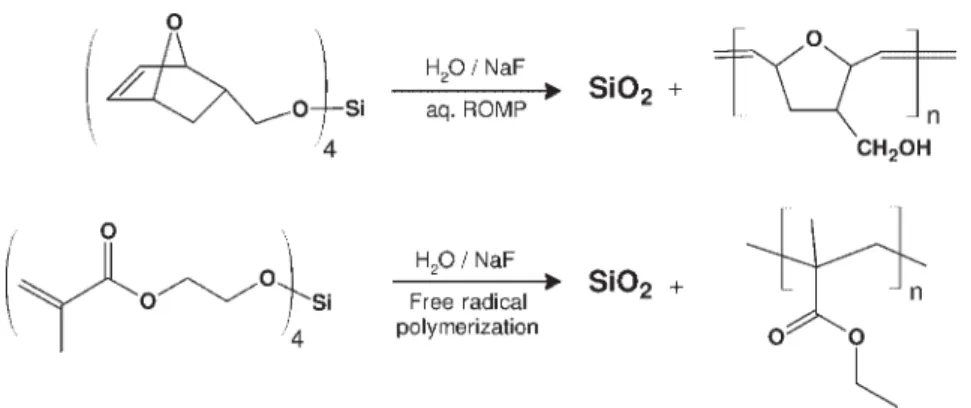
Uniform homogeneous materials can be obtained if the solvent of the sol-gel process is a monomer for a polymerization. For this purpose, essentially the same methods as in the case of ordered 3-D grids can be used. The simultaneous formation of inorganic and organic polymers can result in the most homogeneous type of interpenetrating networks.
The anionic oxide surface of the [SiO5/2]nn species mimics the surfaces of larger silica particles, which is why the polyhedral silicate clusters are also model systems for (nano)particles. Shifts in the binding energies provide additional chemical information (for example, the oxidation state of the element).

Nanocomposites of Polymers and Inorganic Particles
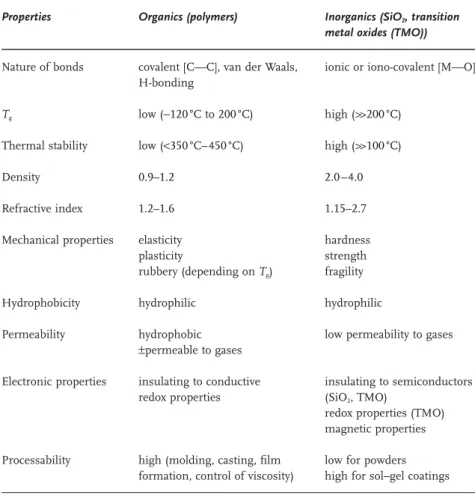
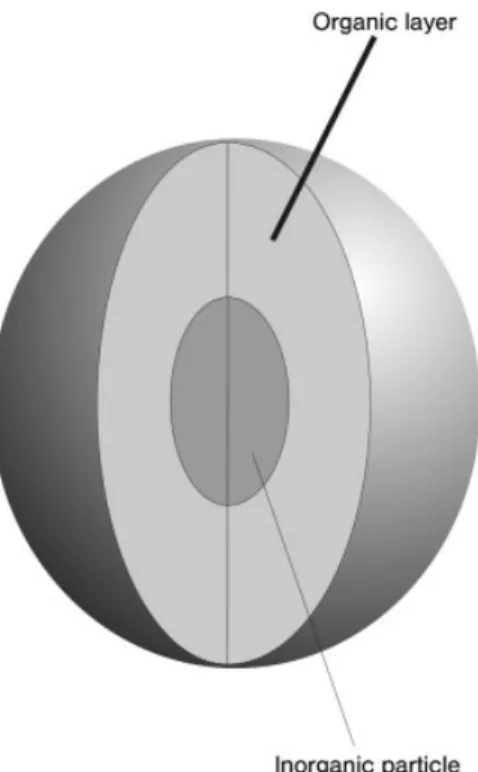
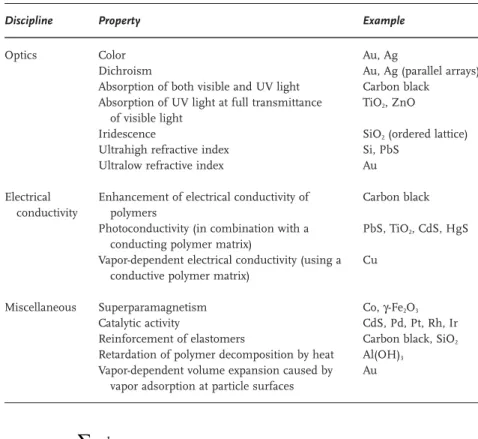
This shell can determine the dispersibility of the particles in the polymer matrix, but also for the creation of a firm interface between particles and polymer matrix. However, physical properties such as the refractive index of nanocomposites may depend on the volume fraction of the particles. A refractive index of the matrix of 1.5 was chosen, which is in the usual range of organic polymers (Table 2.3).
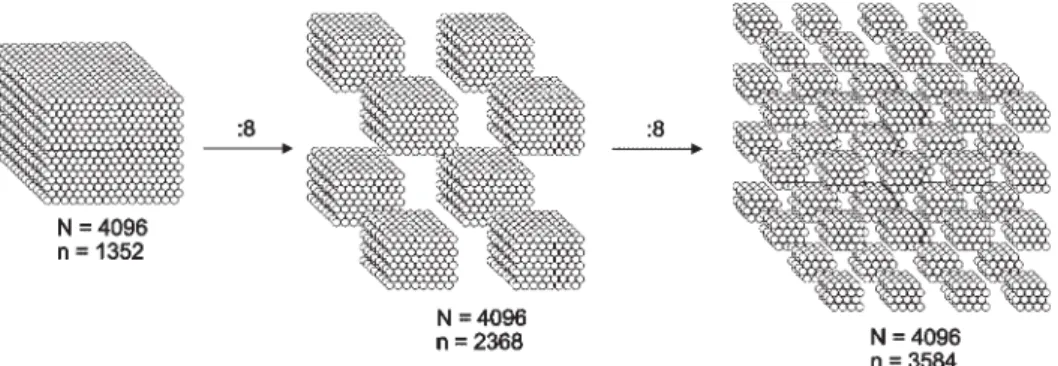
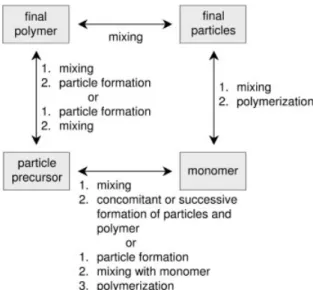
The interfacial area of particles in nanocomposites can be extremely large, which is illustrated by a simple model calculation. In the late 19th century, natural polymers (plant and animal fibers) were treated with solutions of gold or silver salts (such as silver nitrate, silver acetate, or gold chloride), whereby metal ions penetrated the fibers. Mixing of final or precursor components can take place, for example, in solution or in the polymer melt.
In the first case, the polymer and particles precipitate together (coprecipitation), and the nanocomposite can be collected by filtration or decantation of the open solution. Such processes remove soluble reaction by-products resulting from particle synthesis in situ. If appropriate modifications are made to the surfaces of the inorganic particles, the in-situ generated polymer can bind to the particle surface.
Annealing of the films leads to the formation of a single gold particle in each poly(ethylene oxide) core. In the latter case, the y-rays initiated both the reduction of the metal(II) ions to metal(0) atoms and the polymerization of acrylamide. As a consequence of the directive drawing process, these units oriented uniaxially in the drawing direction.
The refractive index of nanocomposites composed of gelatin and PbS, silicon or gold appeared to depend linearly on the volume content of the particles (Fig. 2.23).
Hybrid Organic/Inorganic Particles
The polymerization thus starts in the aqueous phase by the formation of free radicals by the initiator thermolysis and the addition of the first monomer units. This process is mainly driven by diffusion and also depends on the nature of the surfactant. Protons and hydroxyl ions adsorb on the surface of the oxide and protonate or deprotonate the MOH bonds according to:.
1) (2) The ease with which protons are added to or removed from the surface (eg acidity of the MOH group) depends on the nature of the metal. Such reactions are very sensitive to the nature of the solute (which can sometimes compete for complexation), the pH of the solution (which determines the surface charge of the particles and thus controls its interaction with ionic compounds), and the surface of the mineral particles. Experimental conditions used for polymerization (eg nature of initiator, surfactant or monomer and their respective concentrations).
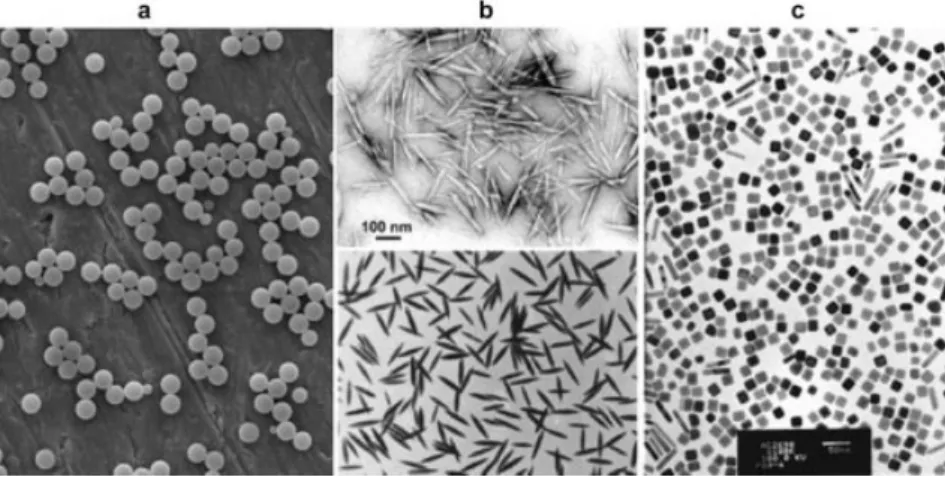
Poly(pyrrole) and poly(N-methylpyrrole)-gold composite particles have also been produced by reducing an aqueous solution of the corresponding monomer in the presence of gold colloids. The interaction of the initiator with the inorganic surface can be fine-tuned by changing its pH. Depending on the diameter of the silica beads, strawberry-like or core-shell morphologies can be produced with this technique.
Covalent grafting of polymer chains requires that an initiator (for NMP and ATRP) or a chain transfer agent (for RAFT) be chemically bound to the mineral surface. However, the main drawback is the multistep reaction required for the synthesis of the functionalized alkoxyamine. Combustion of the latex core resulted in the formation of hollow nanometer silica capsules.
Cavities were produced in a subsequent step by complete thermal oxidative degradation of the polymer core. The inorganic particles are located in the periphery (a), in the core (b), in the internal branches (c) or in the internal cavities of dendritic. A cross-linker can further be introduced into the formulation to promote the formation of the polymer network.
Intercalation Compounds and Clay Nanocomposites
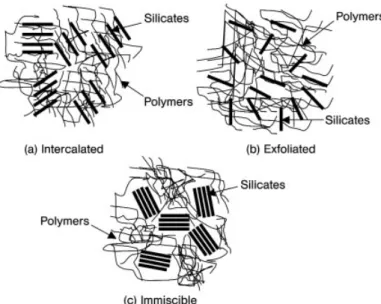
Both a low-magnification image, to show that the clay is well dispersed, and a high-magnification image, to allow the clay layers to be imaged, are required. Scientists at the US National Institute of Standards and Technology have used the NMR technique to assess the type of distribution of clay in the polymer. The formation of a PCN via melt crosslinking depends on the thermodynamic interaction between the polymer chains and the host silicates and the transport of the polymer chains from the bulk Fig.
It seems that if some functional groups can be attached to the clay cation, the possibilities for exfoliation are increased; this is shown schematically in the figure. This is most commonly used by preparing a masterbatch of the splitting copolymer, PP-g-MA, with organic modified clay and then combining it with the pure polymer so that the maleic anhydride content is not too high. These workers considered the formation of polymer-clay nanocomposites in terms of the solubility parameter.
In this case, the presence of the oligomer in the clay cation causes the clay layers to spread so that the polymer can enter. In this section, we will briefly address the work that has been done using graphite as a nano-dimensional material and, in the next section, we will examine those materials that have been produced using so-called double layered hydroxides and salts. Two systems have been used in the expanded graphite arena, potassium graphite and graphite.
Clay can act as a barrier to prevent the mass transport of volatile degradation products and can also prevent polymer degradation. The frequency dependence of the storage moduli of polystyrene (PS) nanocomposites with different nanostructures is shown in the figure. The initial finding was that polymer-clay nanocomposites have a significantly reduced peak heat release rate, which can be approximated to the size of fires.
The vast majority of work done to date has been with clay and a particular clay, montmorillonite.
Porous Hybrid Materials
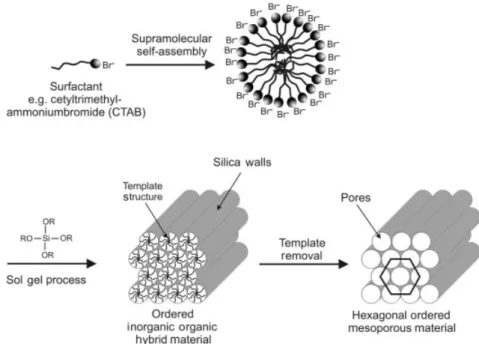
Materials characterized by different types of porosity in terms of the size and location of the pores. A porous material can be described in two ways: a) by the pores or b) by the pore walls. In addition, these materials can be distinguished by the arrangement of the pores – periodic or random – and the distribution of the pore radii, which can vary from either narrow with a fairly uniform pore size distribution to quite a wide distribution.
In the discussion of porous materials, not only the pore size distribution and pore diameter are of interest for subsequent applications, but also the connectivity of the pore system or its dimensions is of great interest. In addition to the dimensionality of the pore system, two different surfaces must be distinguished in porous materials. The outer or external surface is an outwardly curved surface (convex) with a completely different reactivity than the inwardly curved surface (concave) usually found inside the pores.
The integration of different components is often a top-down approach and therefore the structure and composition of the interfaces between the constituent parts is usually not under the control of the molecular scale. In addition, the material can be separated into macroscopic domains with sizes of the order of milli- or micrometers (see also macroscopic phase separation). Since their first discovery in the mid-18th century, zeolites were generally considered to be microporous crystalline aluminosilicates having ion-exchangeable cations and reversibly desorbable water molecules (analogous to natural zeolites).
The progress made can be to some extent related to the better understanding of the synthesis mechanism, which typically relies on host-guest reactions, with inorganic or organic cations as structure-directing agents. In zeolites, the pores are formed as an inherent feature of the crystalline inorganic framework - so they are also arranged periodically. When discussing pores in zeolites, the reader should be aware of the fact that one must distinguish between a cage, in which molecules can be accommodated, and the windows to this cage which are typically smaller than the actual cage.
The size of the cage (pore) must be large enough to accommodate at least one molecule.