To derive design principles for learning environments that broaden access to mathematics by grounding learning in aesthetics, I reviewed literature on the role of aesthetics in the production of the mathematical canon and in the production of. Once again, Sinclair's (2004) analysis of the evaluative, motivational, and generative roles of mathematical aesthetics provided a particularly compelling framework for my research. In this section I build a richer understanding of the evaluative role of aesthetics by connecting it directly to mathematics.
My first description of the motivational role of mathematical aesthetics appealed to the non-academic language of "urges" to describe how aesthetics drive mathematical inquiry. As with the motivational role of mathematical aesthetics, my description of aesthetics as generative for students' learning is based on my reading of the mathematical literature, because comparative studies between students and mathematicians do not exist for the generative role of the aesthetic. Another significant gap in the literature is about the generative role of mathematical aesthetics—the role of the aesthetic that facilitates mathematical insight and innovation.
This precludes opportunities to engage in one of the most important mathematical practices for participation in the field: the practice of posing interesting (non-trivial), meaningful (personally appealing), and valuable (significant to the community) mathematical problems . This study deepens the field's understanding of meaningful engagement with mathematical practices, both inside and outside the classroom. Children's voluntary participation, their freedom in how (and for how long) they engage with the exhibits, and the mathematical richness of the designed materials support our investigation into how children's aesthetic practices might support their engagement with mathematical practices.
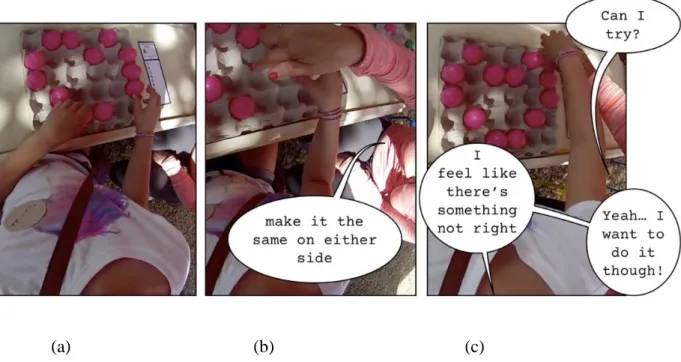
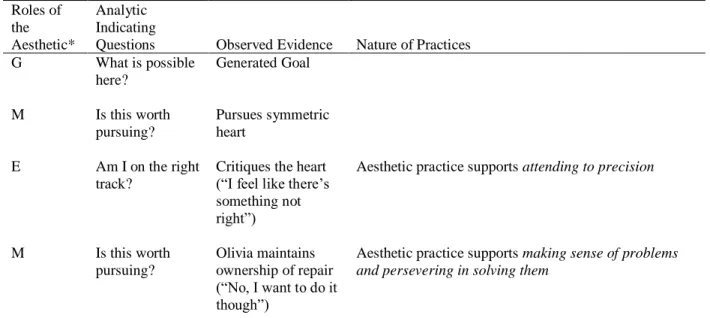
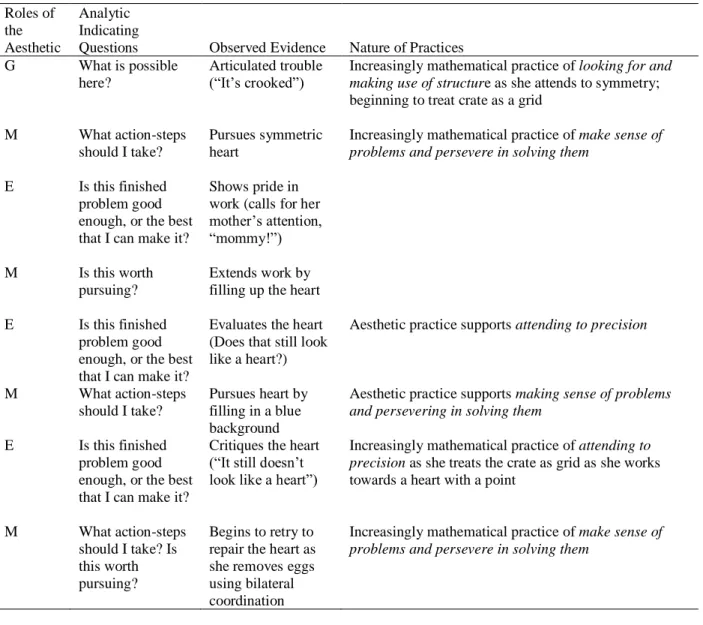
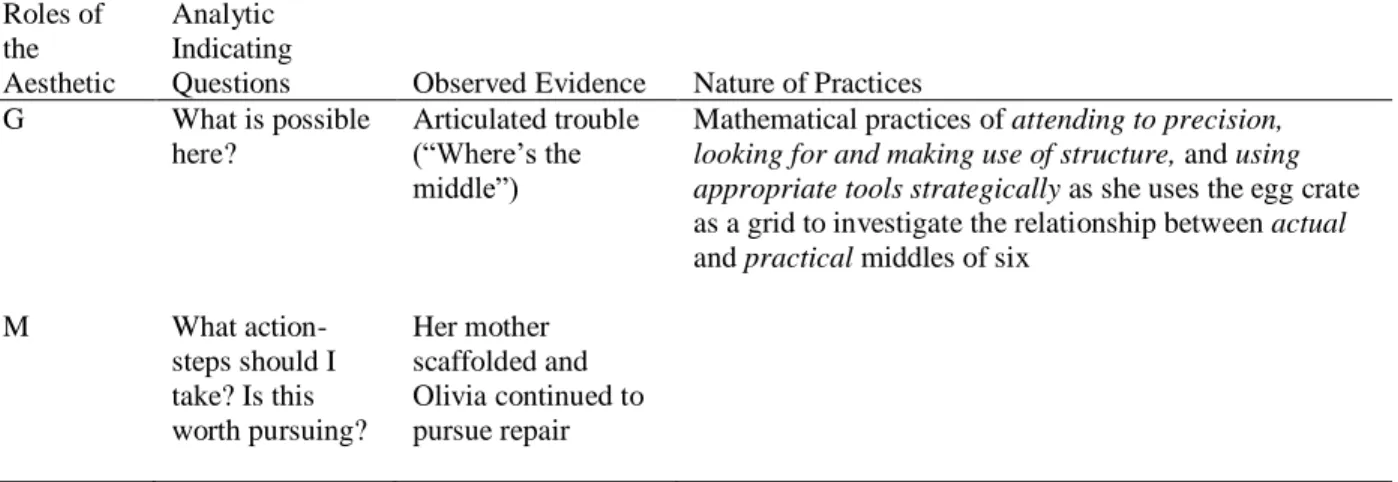
To identify when Olivia's aesthetic practices emerge, we look for the silent questions that signal each role of the aesthetic practices, as identified in the conceptual framework (see Table 2-1). When her mother tried to take over, Olivia maintained ownership of the construction of the heart ("No, I'll do it"), again demonstrating the motivating role of aesthetic practices. Instead, her identification of the crookedness of the heart was a tacit answer to the question: What is possible here.
Thus connecting her attention to the structure of the heart (and also the beginning of her attention to the structure of the box as a grid) to mathematical sensemaking about the properties of. But Olivia's aesthetic practice motivated her to fill up the heart, putting a pink interior in the heart and the blue background of the box. Her understanding of the problem changed from not looking like a heart (first cycle), to being crooked (second cycle), to missing an aisle (third cycle).
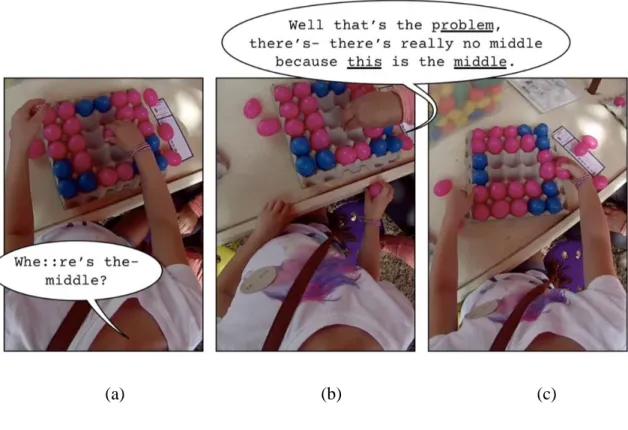
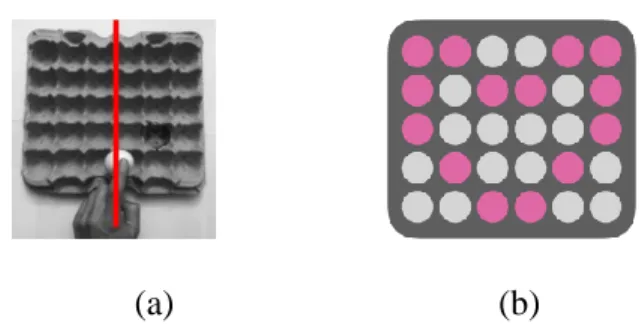
Importantly, when Olivia asked, “Where is the middle,” she moved the egg to either side of the actual middle in the egg crate (the midline of symmetry) and then rested the egg on the actual middle (Figure 2-7a). . Her aesthetic practices guided each of her (re)formulations of the problem in ways that generated increasingly productive potential solution paths. Engaging in Mathematical Practices Facilitates Mathematical Understanding Conceptually, Olivia's aesthetics provided a heuristic that facilitated her attention to the mathematical properties of the egg crate –– such as the presence or absence of a true middle –– and the relationships between them.
Hybridization of Activity
Coding the corpus
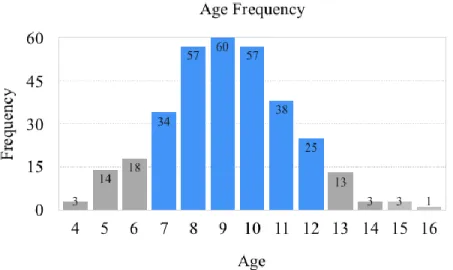
To manage our large data corpus, we watched all 345 videos and used StudiocodeTM software to code when participants were at each exhibition. Of the 127 hours of video we collected, 101 hours were of participants within our age group (n = 279 children) and 21 hours were of participants outside our age group (n = 66 children) at exhibitions. The remaining 5 hours of video contained recordings of participants engaging in transition activities such as checking in with their parents or eating snacks.
This first viewing familiarized us with the data and gave us a sense of the typical activity at each exhibit.
Data reduction
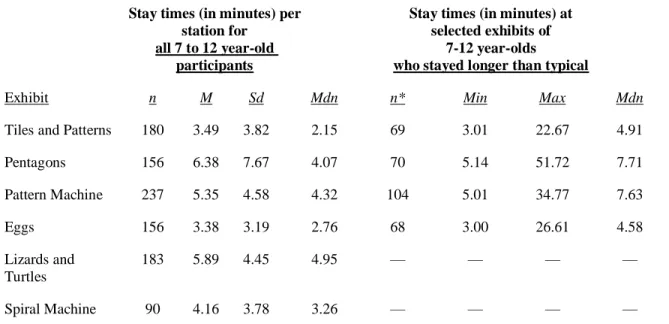
7We call these exhibit visits child-level incidents to distinguish that some participants attended stations more than once or stayed longer than typical at multiple exhibits, and are therefore counted multiple times in our 311 video clips (63 participants stayed longer than typical at more than one exhibit stayed ). In our analysis of the data, each distinct occurrence of participants' time at each exhibit is counted as a unique event. Thus, the score for "child-level incidents" does not reflect the number of children, but rather the number of times the station was visited for longer than the roof of the median display stay time for 7-12 year olds.
Analyzing patterns in engagement
Selecting focal participants for contrasting engagement
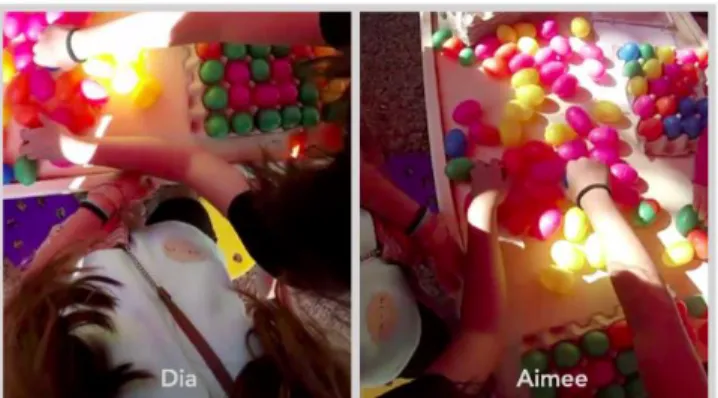
We'll call our two participants Aimee and Dia, 12-year-old girls who worked as friends. When we examined their cases in more depth, we discovered that they were our only two participants who stayed longer than normal at all four selected exhibitions, making them our two “most engaged” participants (following Gutwill & Allen, 2012). Although they were our two “most engaged” participants by this measure, their engagement was fairly representative by other measures as well.
For example, their residence times at each were longer than the median residence time for all 7- to 12-year-olds, but their residence times were generally closer to the median of all 7- to 12-year-olds than to the median of 7- to 12-year-olds which remained longer than typical (Table 3-2). As a note, 62 participants between the ages of 7 and 12 stayed longer than typical at more than one exhibit, with 13 of those 62 participants staying longer than typical at three exhibits, 45 participants staying longer than typical at 2 exhibits stayed, and two participants stayed longer than typical at only one exhibition. Their extensive involvement, friendship and co-navigation of MOAS provided a rich narrative record of their activity, fodder for interactional analysis.
To heighten our interest, Aimee and Dia claimed contrasting experiences of mathematics in their entrance examinations, with Aimee claiming mathematics as her favorite subject and Dia claiming mathematics as her least favorite subject. In fact, Dia seemed to think her aversion to math was either funny or awkward in our math activity survey at Math On-A-Stick as she laughed uncomfortably when answering the intake survey question (raised by a researcher) ) on her least favorite subject. However, Dia and Aimee had somewhat similar opinions about mathematics as they experienced it at school, as evidenced by our short Likert-scale exit survey.8 They both.
8 In particular, our videos were cut before the girls started their exit surveys, so it is possible that they copied each other's answers, but we think this is unlikely, as other questions in the survey have inconsistent answers, and also because , because our attendance data lead us to believe that such response copying was uncommon. Both also replied that it was up to the agencies themselves to determine whether their answers were correct or not. Interestingly, Dia –– whose least favorite subject is math –– provided a slightly higher agency response (strongly agree) than Aimee (agree).
In this way, we interpret Dia's dislike of math to be related not to her feelings of competence or agency, but to her feelings about whether or not math is interesting. Analyzing these two participants allows us to add nuance to what it means to engage in free-choice environments that invite hybridity.

Frame analysis of hybridity between school mathematics and play Based on Aimee’s and Dia’s extended engagement, their contrasting behaviors at
Although frequent negative grades are not equated with school mathematics in general, in this context it is often negative. Specifically, Dia framed her activity in a traditional version of school-mathematics norms and practices around authority and valuing, while Aimee framed her activity as play. This lack of inquiry also fits with the traditional authority norms of school mathematics, where assignments and appropriate.
Although enjoyment is indicative of a play frame, school mathematics is the leading frame for Dia's hybrid activity, as her comments suggest a reliance on the familiar norms and practices of authority and evaluation in tractional school mathematics to make sense of her activity. Because Dia's activity at MOAS involved an integration of play and traditional school mathematics norms and practices in a way that led to both cultural activities being only partially recognizable, we identify Dia's activity as hybrid. Unlike Dia, Aimee did not explicitly talk about school mathematics during her time at MOAS.
This is consistent with a traditional school mathematics framework, which typically provides cycles of work that include demonstration, practice and assessment. This evidence –– combined with Dia's explicit comments matching and contrasting the activity with school mathematics –– suggests a contrast in the way the girls constructed MOAS's mathematics play activity, with Dia hybridizing her play with the norms and practices of school mathematics. and not Aimee. In particular, we examined the question: how do children hybridize out-of-school mathematics activities with school mathematics norms and practices.
By considering the children's shaping of their activity, especially around the norms of authority and evaluation and the practices of traditional school mathematics, we found that the standards of traditional school mathematics regarding authority and evaluation often negatively shaped Dija's activity. It is important not to argue that Aimee did not hybridize her play with school mathematics at all, but rather that she did not hybridize her play with traditional school mathematics. Our study contributes to research on extracurricular STEM activities by providing a case study of how the norms and practices of traditional school mathematics can shape engagement outside of school.
In particular, we illustrated how Dia hybridized her activities at MOAS with traditional school mathematical norms of authority and evaluation. Our study contributes to the existing literature by providing some evidence on the influence of hybridity with traditional school mathematics norms and practices in free-choice mathematics environments.