The Impact of Value-Based Leadership on Teacher Commitment and Job Performance in Private Islamic Senior High
Nurdelima Waruwu1, Ahmad Kultur Hia2, Alex Winarno3*, Deni Hermana4, and Ran Liu5
1 Department of Educationnal Management, Universitas Islam Negeri Syarif Hidayatullah, Jakarta, 15412, Indonesia
2 Department of Business Administration, Politeknik Negeri Jakarta, Depok, 16424, Indonesia
3 Department of Business Administration, Universitas Telkom, Bandung, 40257, Indonesia
4 Department of Business Administration, STIA Bagasasi, Bandung, 40273, Indonesia
5 Department of Marketing, Central Connecticut University (CCSU), New Britain, CT 06050, USA
ARTICLE INFO ABSTRACT
Keywords:
Authentic Leadership, Contextual Performance, Innovative Performance, Organizational Commitment, Private Islamic Senior High School
Article History:
Received 2022-10-22
Received in revised form 2023-07-01
Received in revised form 2023-08-02
Received in revised form 2023-08-08
Accepted 2023-08-08
DOI: 10.22146/jlo.78568
* Corresponding Author at Department of Business Administration, Universitas Telkom, Jalan Telekomunikasi No.1 Terusan Buah Batu, Bandung, 40257, Indonesia.
E-mail address:
[email protected] (author#1),
[email protected] (author#2),
[email protected] (author #4),
[email protected] (author #5),
Introduction/Main Objectives: This study aims to analyze the impact of authentic leadership on teacher performance in private Islamic senior high schools (ISHS) mediated by commitment.
Background Problems: Authentic leadership as a value-based approach offers solutions to teacher performance, but there are complexities and doubts that require further exploration and empirical testing. Novelty: It provides an in-depth exploration of the role of authentic leadership in promoting commitment and performance. It consolidates existing knowledge and synthesizes relevant value-based leadership (VBL) and authentic leadership (AL) theories. It provides a valuable resource for further research and practical applications in this educational setting. Research Methods: This study applied an explanatory survey by using a set of questionnaires. The respondents consisted of teachers and administrative staff. This study successfully collected the data of 462 respondents randomly chosen. Finding/Results: The interaction between leaders and subordinates is a dynamic process that directly influences performance and organizational commitment. A leader's ethical, moral, and values guide their actions and interactions with followers, ultimately fostering commitment and driving performance. Conclusion: Authentic leadership not only directly influences commitment and performance but also indirectly affects performance by nurturing a strong sense of commitment among teachers. Research implications: AL's cultivated values act as a beacon for nurturing commitment and performance. Practical implications underscore the paramount role of values in authentic leadership to ensure and focus on strategies for cultivating authentic leadership values to pave the way for enhancing teacher commitment and performance.
JOURNAL OF LEADERSHIP IN ORGANIZATIONS
Journal homepage: https://jurnal.ugm.ac.id/leadership
1. Introduction
Efforts to enhance teacher performance in Islamic educational institutions such as tsanawiyah schools are challenging.
Compensation alone cannot drive performance (Prieto et al., 2023). Teacher performance is crucial, particularly in private Islamic senior high schools (Waruwu et al., 2022). Furthermore, the competitive environment demands more innovative performance among teachers (Zeng & Xu, 2020). It is essential to foster teacher performance through organizational commitment (Erlangga et al., 2021; Van Waeyenberg et al., 2022; Eliyana et al., 2019;
Liu & Werblow, 2019; Normianti et al., 2019).
Organizational commitment is the strong acceptance of individuals towards the goals and values of an organization (Allen &
Meyer, 1993; Robbins & Judge, 2013).
Organizational commitment is an emotional bond between employees and their work, leading to their willingness to continue participating (Saleem et al., 2019a). Zhou et al. (2023) defined it as a logical contract with the organization, while Rodríguez-Rad and Sánchez del Rio-Vázquez (2023) defined it as the degree of psychological attachment to organizational membership. The dimensions of organizational commitment include affective commitment, continuance commitment, and normative commitment (Ribeiro et al., 2018; Saleem et al., 2019;
Razzaq et al., 2019). Meredith et al. (2023) explained the importance of commitment to organizational life in educational institutions.
Performance is generally defined as work performance. Teachers' overall contribution in fulfilling their organizational functions is considered performance (Saleem et al., 2019a). Job performance consists of primary tasks, contextual behavior, and
counterproductive behavior (Limon, 2020).
Teacher performance is essential to education (Al-Zoubi et al., 2023) because it plays a crucial role in shaping students' knowledge, skills, and overall development.
Commitment and performance can be influenced by leadership with various styles.
However, various leadership styles in the context of educational institutions need to be further studied about performance (Saleem et al., 2019a). The selection of leadership styles should consider the responsibilities and behaviors of subordinates (Handayani &
Hakim, 2022; Cho et al., 2019). Assessing leadership styles is a complex cognitive process, and leadership is multidimensional (Da’as, 2020). Rabiul et al. (2021) demonstrated leadership as an organizational resource.
The leadership needed is leadership that structurally has the authority and power to direct and make decisions towards excellence (Tahir et al., 2017). Bahzar (2019) emphasized that leaders in Islamic educational institutions, known as madrasah heads, have characters that are derived from values with a high work ethic as leaders.
Leadership in Islamic educational institutions must be distinct from leadership values in Islam as a foundation (Brooks &;
Mutohar, 2018).
One of the styles that can be chosen in educational institutions is authentic leadership, a value-based leadership style.
Akdemir (2017) discussed the authentic leadership indicators demonstrating authentic characteristics. Alvesson and Einola (2019) proposed the extremely complex concept of authenticity as "knowing oneself" and "acting according to at least one's self." Furthermore, Alazmi and Al- Mahdy (2022); Zeb et al. (2020) defined the indicators of authentic leadership as self-
awareness, relational transparency, moral perspective, and process balance. The
"genuine concept" underpins authentic leadership.
The importance of values in leadership and organizational life has been emphasized by Prilleltensky (2000); Viinamäki (2009); and Graber & Kilpatrick (2008). Avolio and Gardner (2005), Mary Kay Copeland (2012) and McCullough (1989) proposed value- based leadership in authentic leadership.
Authentic leadership becomes an important style in the governance of educational institutions (Shie & Chang, 2022). Authentic leadership is based on values and influences performance and commitment (Bishop, 2013;
Hendrikz & Engelbrecht, 2019; K Sambu et al., 2021).
2. Literature Review
Authentic leadership influences commitment and plays a complex role in organizations (Alzghoul et al., 2018;
Purwanto et al., 2021; Ezzani et al., 2021; Tak et al., 2019; Lei et al., 2021; Srivastava & Dhar, 2019; Aria et al., 2019). Organizational commitment is related to performance (Farr- Wharton et al., 2021; Iqbal et al., 2022; Saleem et al., 2019; Razzaq et al., 2019). Additionally, there is a paradox in leadership (Yang et al., 2021). There are various style options in leadership with diverse levels of effectiveness (Zhang et al., 2022).
Organizational commitment serves as a mediator for leadership. Duarte et al. (2021), Hadian Nasab and Afshari (2019), Ribeiro et al. (2018), and Zhou et al. (2023) position organizational commitment as a mediator in building employee performance. Ribeiro et al. (2020) and Semedo et al. (2018) demonstrated commitment as a mediating factor between authentic leadership and the
required work behaviors to support organizational goals.
Organizational commitment mediates the influence of authentic leadership on performance (Hadian Nasab & Afshari, 2019;
Duarte et al., 2021). Authentic leaders, as role models, have a positive effect on organizational commitment, which can translate into emotional attachment and positive work behaviors. However, situational factors and context are important in understanding the role of authentic leadership (Jang, 2021; Mwesigwa et al., 2020). There are several doubts regarding the role of authentic leadership (Ribeiro et al., 2020; Duarte et al., 2021; Gill et al., 2018; Jung et al., 2021; Kim et al., 2023).
Further exploration is needed regarding the role of authentic leadership in improving teacher performance and commitment (Skourdoumbis, 2017). A study on authentic leadership as a style that can enhance commitment and performance must be empirically tested to gain a comprehensive understanding. The research contributes to developing the Value-Based Leadership literature by: 1) explaining the role of authentic leadership as a resource to encourage commitment and adaptive performance among teachers and staff at Islamic senior high schools, 2) presenting a literature review to serve as a framework for developing commitment and adaptive performance for teachers and staff at Islamic senior high schools, and 3) integrating the view of value-based leadership theory with the theory of teacher behavior in educational institutions as evidenced by organizational commitment and performance. Authentic leadership contributed evidence to leadership theories in Islamic senior high school reform. Moral-based leadership is critical for educational institutions, as
evidenced by the practice of authentic leadership (McCullough, 1989). This study examines the impact of value-based leadership for commitment and job performance among teachers in private Islamic senior high schools.
3. Method, Data, and Analysis
The research method was an explanatory survey of 462 randomly selected and affordable ISHS teachers in West Java, Indonesia. Before conducting the research, we submitted a recommendation request to the relevant institution, the West Java regional office of the Ministry of Religious Affairs. After obtaining the recommendation, we contacted schools, including the principals, vice principals, and staff, to conduct the research. Once connected, we distributed questionnaires to each madrasah through four field coordinators (research assistants). During the years 2021-2022, data was collected using a questionnaire.
Coordination was carried out with the ISHS, who served as the supervisor of the ISHS in each district and city in collecting research data.
The leadership in this study is the principal of madrasah aliyah indicated based on Avolio and Gardner (2005). AL as self- awareness, internalized moral perspective, relational transparency, and balanced processing. Organizational commitment is developed based on Meyer et al. (1993) who defined organizational commitment as
"being proud to be part of an institution.
Statement items include likes to discuss work with people in different offices where I work,
this job is my life and on which I rely."
According to the evolving demands of teacher performance, the development of teacher performance is based on the research conducted by Ramdhan et al. (2022). Job performance measurement refers to innovation in teaching and contextual performance, including new ways to achieve academic performance, new and practical ideas among students. Research variables are designed as unidimensional variables so that latent variables can be measured directly using their indicators (variable observed).
From 600 questionnaires distributed, this study enabled to collect questionaries of 462 respondents. This study employed the research assistants to facilitating the authors in data collection and quality checks, particularly in areas not covered by internet or offline surveys. In this study, respondents' answers were collected using a semantic differential scale consisting of five levels, namely not at all true (1), barely true (2), somewhat true (3), true (4), and very completely true (5). The research employed a multivariate approach called structural equation modeling (SEM) with the assistance of SPSS software version 25. The research process involved several stages: 1) developing a model based on theories and propositions regarding value-based leadership among employees, 2) converting the flow diagram model into equations and determining the specification of the measurement model, 3) selecting the maximum likelihood estimation method, checking the sample size used, examining assumptions such as normality and linearity,
and detecting outliers, 4) testing the goodness-of-fit (GoF) model to assess the fit with the observed data, including causal tests to examine the relationships between variables in the model, 5) conducting an overall evaluation of the GoF model, and 6) interpreting the results of the analysis and making improvements as necessary.
4. Result and Discussion
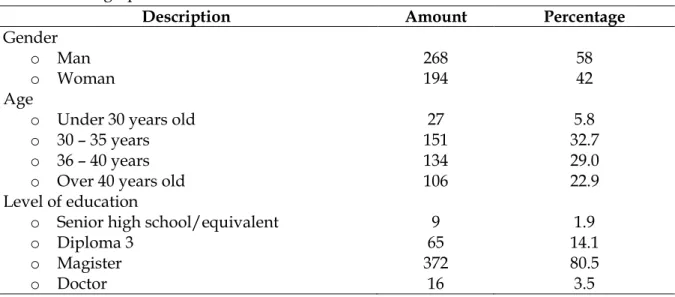
The following table is the characteristics of teacher respondents based on gender, age, and educational background. The
respondents were categorized based on gender, distinguishing between male and female teachers. The age range of the teacher respondents was considered to examine any potential variations based on different stages of their teaching careers. The educational background provides an understanding of the teachers' academic qualifications and expertise in specific subject areas, which may influence their teaching practices and approaches. Demographic characteristics are as follows below (see Table 1).
Table 1. Demographic characteristics
Description Amount Percentage
Gender o Man
o Woman 268
194 58
42 Age
o Under 30 years old o 30 – 35 years o 36 – 40 years o Over 40 years old
27 151 134 106
5.8 32.7 29.0 22.9 Level of education
o Senior high school/equivalent o Diploma 3
o Magister o Doctor
9 65 372
16
1.9 14.1 80.5 3.5 Source: research data processing 2022
According to the findings, 58% of respondents were male, and 42% were female.
This demonstrates ISHS's willingness to hire both male and female teachers. The gender ratio of teachers in the classroom is related to student achievement. According to the table, most teachers are of productive age, namely 30 to 35 by 32.7% and 36 to 40 by 30.2%. This demonstrates the potential for ISHS to grow with the availability of teachers of productive
age. Productive ages require assistance to maximize their potential. ISHS has 48 experienced teachers, or 23.8% are senior teachers. This means that ISHS is supported by teachers with prior experience teaching at ISHS and who have different personalities and identities than public school teachers. The research variables are described as follows (see Table 2).
Table 2. Description of variable
Variable Average STD
Authentic leadership (AL) 3.8 0.421
Organizational commitment (OC) 3.3 0.312
Job performance (JP) 3.3 0.518
Source: research data processing 2022
Based on the questionnaire survey results, it can be seen that, in general, the respondents' responses are in the "pretty good" category. With an average of 73% of the ideal score, Islamic senior high school leaders demonstrate characteristics of quite authentic leaders. The organizational commitment is moderate, accounting for 62%
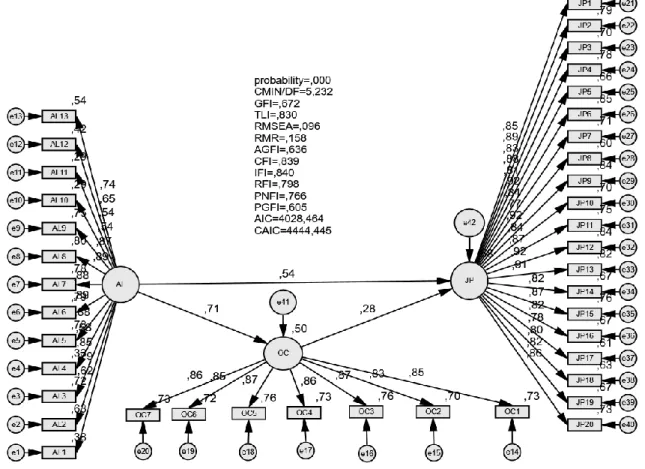
of the ideal score. In comparison, adaptive performance is 60%. Both OC and AL variables still need to be included regarding current performance demands, particularly with the Ministry of Religion's policy of change and quality orientation. Full model research results are as follows (see Figure 1).
Figure 1. Full model first order confirmatory analysis
Source: research data processing 2022
The construction of the model in the research, organized according to the theoretical framework, demonstrates that, overall, the model can explain the observed
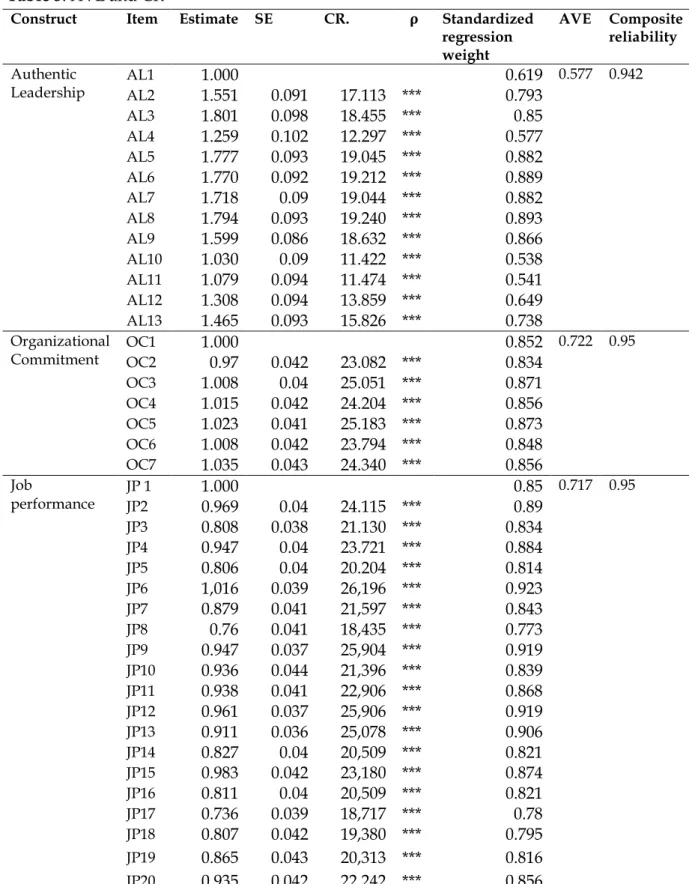
phenomena effectively. Table 3 shows the confirmatory factor analysis test results (convergent validity, average variance extracted (AVE), and composite reliability).
Table 3. AVE and CR
AVE = Average variance extracted, CR = Composite reliability, *** = 0.000 The test results showed that the AL1-
AL13 indicator had the highest correlation to the authentic leadership (AL) variable and
could explain 57.7% of the changes in the AL latent variables with a CR value of 0.942. The variable organizational indicators OC1-OC7 Construct Item Estimate SE CR. 𝛒 Standardized
regression weight
AVE Composite reliability Authentic
Leadership AL1 1.000 0.619 0.577 0.942
AL2 1.551 0.091 17.113 *** 0.793
AL3 1.801 0.098 18.455 *** 0.85
AL4 1.259 0.102 12.297 *** 0.577
AL5 1.777 0.093 19.045 *** 0.882
AL6 1.770 0.092 19.212 *** 0.889
AL7 1.718 0.09 19.044 *** 0.882
AL8 1.794 0.093 19.240 *** 0.893
AL9 1.599 0.086 18.632 *** 0.866
AL10 1.030 0.09 11.422 *** 0.538
AL11 1.079 0.094 11.474 *** 0.541
AL12 1.308 0.094 13.859 *** 0.649
AL13 1.465 0.093 15.826 *** 0.738
Organizational
Commitment OC1 1.000 0.852 0.722 0.95
OC2 0.97 0.042 23.082 *** 0.834
OC3 1.008 0.04 25.051 *** 0.871
OC4 1.015 0.042 24.204 *** 0.856
OC5 1.023 0.041 25.183 *** 0.873
OC6 1.008 0.042 23.794 *** 0.848
OC7 1.035 0.043 24.340 *** 0.856
Job
performance JP 1 1.000 0.85 0.717 0.95
JP2 0.969 0.04 24.115 *** 0.89
JP3 0.808 0.038 21.130 *** 0.834
JP4 0.947 0.04 23.721 *** 0.884
JP5 0.806 0.04 20.204 *** 0.814
JP6 1,016 0.039 26,196 *** 0.923
JP7 0.879 0.041 21,597 *** 0.843
JP8 0.76 0.041 18,435 *** 0.773
JP9 0.947 0.037 25,904 *** 0.919
JP10 0.936 0.044 21,396 *** 0.839
JP11 0.938 0.041 22,906 *** 0.868
JP12 0.961 0.037 25,906 *** 0.919
JP13 0.911 0.036 25,078 *** 0.906
JP14 0.827 0.04 20,509 *** 0.821
JP15 0.983 0.042 23,180 *** 0.874
JP16 0.811 0.04 20,509 *** 0.821
JP17 0.736 0.039 18,717 *** 0.78
JP18 0.807 0.042 19,380 *** 0.795
JP19 0.865 0.043 20,313 *** 0.816
JP20 0.935 0.042 22,242 *** 0.856
can explain the 72.6% variable commitment organizational value with a high CR level of 0.947. JP1-JP20 indicators have the highest correlation to job performance variables, explaining 71.7 % of the changes in JP with a CR value of 0.95, implying that composite reliability is so reliable. Each variable is constructed by the research context, namely
privately owned Islamic senior high school educational institutions.
4.1. Discriminant validity test
The results of the discriminant validity test revealed that each observed variable exhibits a stronger correlation with its corresponding latent variable than with other latent variables (see Table 4).
Table 4. Discriminant validity test
Construct Authentic
Leadership (AL)
Organizational
Commitment (OC) Job performance
(JP) Authentic Leadership (AL) 0.577
Organizational Commitment (OC) 0.156 0.722
Job performance (JP) 0.104 0.145 0.717
Source: Results of analysis using SEM 2023 The relationship between the observed variable Al and OC (0.156) and JP (0.104) is weaker than the latent variable AL. Similarly, the relationship between the observed variable OC and other latent variables is lower than their respective latent variables, including JP. These findings prove that the constructed model for each latent variable is satisfactory.
4.2. Correlation significance test
Testing the relationship between latent variables shows a significant relationship between latent variables. AL and OC have a beta coefficient of 0.62, while AL and JP have a beta coefficient 0.52. The beta coefficient of the relationship between OC and JP is 0.39.
4.3. Model fit test and model respecification
The results of the model fit test are as follows (see Table 5).
Table 5. Model fit test results
Goodness of fit criteria Stage 1 test
Results improve
Conclusion
Absolute fit measure:
p-value (Sig.) 0.000 0.00 Marginal Fit
CMIN 5.232 2.304 Fit
GFI (goodness of fit) 0.672 0.863 Marginal Fit
RMSEA (root mean square error of approximation)
0.096
0.053 Fit
RMR (root mean square residual) 0.158 0.044 Fit
Incremental fit measure:
AGFI (adjusted goodness of fit index) 0.636 0.83 Fit
CFI (comparative fit index) 0.839 0.957 Fit
IFI (incremental fit index) 0.840 0.957 Fit
RFI (relative fit index) 0.798 0.911 Fit
Parsimonious fit measure:
PNFI (parsimonious normed fit index) 0.766 0.765 Fit PGFI (parsimonious goodness of fit index) 0.605 0.68 Marginal Fit AIC (akaike information criterion) 4.028 1,835 Marginal Fit CAIC (consistent akaike information
criterion)
4.444
2,739 Marginal Fit Source: Results of analysis using SEM 2023
Based on the goodness of fit criteria testing results, each of the goodness of fit criteria, namely absolute fit indices, incremental fit indices, and parsimony indices, has not been represented as shown in Figure 1. As a result, improvements are made by increasing the relationship between indicators and indicators with latent variables based on the value of modification indices. After the repair, the test results show that the model is acceptable. There is a match between the data collected in the field via a
survey and the model developed in the study.
4.4. Causality test with regression analysis techniques (regression weight) and mediation effects
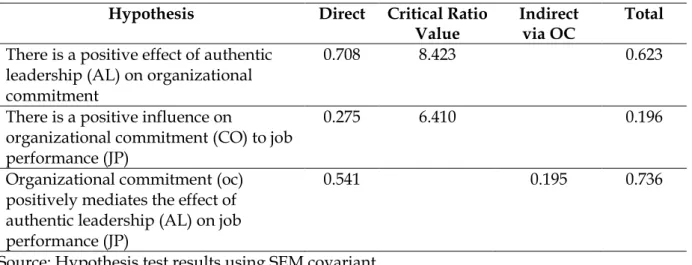
As shown in Table 6, the causality test results show a significant positive relationship between the variables, including the results of organizational commitment testing as a mediating variable.
Table 6. Hypothesis test results
Hypothesis Direct Critical Ratio
Value Indirect
via OC Total There is a positive effect of authentic
leadership (AL) on organizational commitment
0.708 8.423 0.623
There is a positive influence on
organizational commitment (CO) to job performance (JP)
0.275 6.410 0.196
Organizational commitment (oc) positively mediates the effect of authentic leadership (AL) on job performance (JP)
0.541 0.195 0.736
Source: Hypothesis test results using SEM covariant The test results show that authentic
leadership positively affects organizational commitment with a beta coefficient of 0.708 and a CR value of 8.425 or is in the high category. With a CR of 6.410, the organization's commitment (OC) to job performance (JP) is 0.275. The direct effect of authentic leadership on JP is 0.541, while the organizational commitment of 0.195 means that OC partially mediates the effect of authentic leadership on job performance. AL possesses a strategic position both directly and indirectly through organizational commitment.
5. Discussion
The study's results highlight the significance of value-based leadership in influencing subordinates, such as teacher performance directly or indirectly through organizational commitment. Prilleltensky (2000), Viinamäki (2009), although (Graber &
Kilpatrick, 2008). The significance of values in organizational life is demonstrated by (Nakamura et al., 2022). Their research findings underscore the inseparable relationship between values and leadership, particularly from a value-based leadership standpoint. Developing values in organizational and leadership aligns with (Walumbwa et al., 2008). Ethical values,
morals, and principles practiced by leaders play a vital role in fostering a strong emotional connection between leaders and followers. When followers witness their leaders upholding these values, they develop a deep sense of emotional attachment and a strong commitment to the organization's goals and values. They feel assured that their leaders prioritize the collective well-being and consistently act in alignment with the upheld values. Based on observing their leaders as role models, followers are motivated to perform well and are influenced by the leader's integrity and dedication to these values. This, in turn, can enhance followers' commitment and performance quality. Leaders create a work atmosphere that encourages ethical attitudes and behaviors among their subordinates by cultivating an environment focused on integrity, responsibility, and quality.
Establishing shared values requires leaders to navigate changing values, integrate diverse perspectives, and create alignment between personal and organizational values.
Value-based leadership reduces paradoxes, as stated by Yang et al. (2021), in leadership, such as autonomy and control, distance and closeness, and uniformity and individualization. Value-based leadership
focuses on the values that underlie a leader's actions and decisions, while authentic leadership emphasizes the leader's authenticity and integrity in their interactions with employees. In this context, VBL can facilitate the integration of seemingly conflicting elements in AL to coexist and interact synergistically. VBL involves identifying and understanding core values that are important to the organization and its followers. Leaders who adopt VBL lead by practicing and promoting these values in all aspects of organizational life.
Leaders prioritizing integrity, honesty, fairness, responsibility, and other positive values create a strong foundation for healthy, committed work relationships. By integrating VBL and AL, leaders align the organization's core values with their personal authenticity. They demonstrate alignment between what they say, do, and the values they uphold. Through consistency and built trust, leaders can facilitate employee commitment and engagement.
With alignment between organizational values and the leader's integrity, employees feel emotionally connected and are motivated to contribute to their fullest potential.
On the other hand, authentic leadership (AL) emphasizes the leader's authenticity and integrity in their relationships with employees. Leaders who adopt AL exhibit authenticity, transparency, honesty, and consistency in their actions and communication. They strive to understand and appreciate their employees' needs, values, and aspirations and create an environment where they feel heard and valued. According to the findings, AL significantly impacted organizational commitment and job performance.
Consistent with previous studies that
highlight the role of organizational commitment as a mediating variable in the relationship between leadership and performance, such as Ribeiro et al. (2020) and Semedo et al. (2018), the difference lies in the perspective of leadership values as the foundation for developing commitment and performance inherent in authentic leadership style.
Authentic leadership requires value- based leadership, especially in education.
According to McCullough (1989) and (Solinger et al., 2020). Authentic leadership is following the construction of educational leadership. Authentic leadership has a moral orientation and encourages subordinates, including the leader, to be self-aware and to internalize moral values when making decisions. Relationships are built on value- based transparency. The interaction between leaders and subordinates promotes performance, as identified by Ramdhan et al.
(2022) in different fields, namely innovation and contextual performance. Both performance dimensions have a moral foundation, which makes their implementation morally oriented (Alzghoul et al., 2018; Purwanto et al., 2021; Tak et al., 2019; Lei et al., 2021; Srivastava & Dhar, 2019). The role of AL in the organization is no longer ambiguous in terms of driving performance and commitment to the position of AL. Duarte et al. (2021) and Leroy et al.
(2012) suggested that the influence of AL on performance is commitment, as well as the commitment based on the concept proposed by (Farr-Wharton et al., 2021; Iqbal et al., 2022). Organizational commitment partially mitigates the impact of AL on performance.
This demonstrates that in educational institutions such as Islamic senior high school, the position of AL has been demonstrated to play a strategic role in
improving teacher performance and encouraging commitment. The values that become the foundation of AL direct the behavior of teachers and staff to be more value-oriented and moral. The values that underpin the AL conceptual framework, as well as in practice, link AL, organizational commitment, and performance. The research findings contribute to a broader understanding of AL. The study's findings address the gaps identified by Jang (2021) and Kim et al. (2023) regarding the diversity and scarcity of AL research. These findings highlight the AL's construction and role in educational institutions such as private Islamic Senior High Schools. As a result, the research findings can be used to develop a strategic framework for developing value- based commitment and performance. Islamic senior high school requires value-based leadership figures. Teachers and Islamic senior high schools guide AL. The teacher adopts and demonstrates a moral attitude toward work and is committed to the institution based on the values that become the leader's moral foundation.
According to Mary Kay Copeland (2012) and Sambu et al. (2021), Islamic senior high school encourages each individual to demonstrate values-based behavior (VBL).
Leaders model values through their actions, guided by fundamental moral principles, ethics, and values such as integrity, empowerment, and social responsibility.
Leaders foster value development through social interaction to help teachers recognize themselves as authentic individuals and apply orientation AL values in their work.
Principals with ISHS demonstrate that being authentic grows due to the authentic nature of impersonating individuals. Social interaction between leaders and subordinates is about value learning rather
than imitating behavior. The imitation of how a leader becomes authentic, develops himself as an authentic individual, and expands authentic meanings and practices is social interaction. Authentic leaders demonstrate genuine integrity in their daily lives, including under pressure. Authentic leaders live their values.
Personal beliefs shape authentic values, which develop through various interactions, reflections, and practices under various choices that challenge integrity. To become an authentic leader, you must first understand the characteristics of an authentic self. His experiences, struggles, and collaboration with subordinates have resulted in understanding the meaning of values that are characteristics of an authentic leader. These values combine to form a leader who exudes authenticity. Self- awareness, according to leaders, is essential to being an authentic leader.
Leading an Islamic senior high school differs from leading a high school or vocational school. Islamic senior high schools are Islamic educational institutions that represent a value-based education system. In the context of life, for example, in an Islamic senior high school, the function of leadership is to raise organizational awareness of the values in the organization's vision based on religious values as a source of innovation and changes. These values manifest in organizational structures, such as encouraging changes in innovative activities and technology to improve educational quality. Leaders encourage the development of intellectual maturity to reflect on moral values and implement values in order to develop and promote innovative activities.
Authentic leaders are not perfect leaders who can solve problems at any time. Authentic leadership strives to demonstrate loyalty to
oneself, and the values held dear. Authentic leaders typically show the way, trust subordinates, and motivate them to create a competitive advantage. They are even more concerned than their success or recognition.
An authentic leader recognizes weaknesses by remaining connected with people and attempting to empower others, inspire, unite teachers and staff in schools based on their visionary views and common goals, and create value for all stakeholders. The values that serve as the foundation for the development of authentic leadership are consistent with broader thinking about the meaning of leadership and the meaning of human limitations. A person's understanding of the true meaning of leadership grows over time. In general, the diversity of leadership styles provides room for exploring styles that are appropriate for the context, as suggested by (Zhang et al., 2022). These styles are adjusted to the context at hand.
6. Conclusion
AL influences commitment and performance. Self-awareness and internalization of moral views have influenced the teacher's decision to remain committed and work on moral grounds.
Relationships built transparently and supported by leadership character in decision-making have influenced teachers' views on their interest in remaining in the organization and continuing to innovate to produce new job problem-solving.
Organizational commitment mediated the effect of authentic leadership on performance.
6.1. Theoretical implications
Integrating the perspectives of value- based leadership and authentic leadership in
the context of Islamic educational institutions, such as Aliyah, provides an understanding that the appropriate leadership style enhances the effectiveness of leadership functions in promoting performance both directly and through commitment. The values developed in AL serve as a guiding principle for building commitment and performance. The concept of VBL within AL facilitates the creation of a committed and engaged work environment.
Through the consistency of values, personal integrity, and authenticity in leadership, leaders establish a strong foundation for harmoniously integrating seemingly conflicting elements, fostering teacher commitment, and driving high performance.
6.2. Practical implications
Values, as the foundation of AL, determine teacher commitment and performance. As a result, Islamic senior high school focuses on developing AL as an essential component of the teacher commitment and performance governance system. AL is unrelated to the individual. AL is a value system that directs how teachers act and behave. AL must be developed through a structured mechanism and social interaction between subordinates and superiors based on value. The interaction process is designed to uncover authentic teacher and principal values. The discovery of authentic values will encourage the development of authentic leadership.
Finding authentic values in teachers is on the future agenda.
6.3. Limitations
The study was limited to ISHS without distinguishing ISHS criteria based on accreditation or the type of education integrated with the boarding school system.
The choice of teachers randomly as
respondents were not restricted based on their years of service or employment status.
Further research should focus on conducting studies by incorporating control variables, such as accreditation status, and utilizing
data collection techniques like longitudinal research to implement mixed methods. The research scope should be expanded to include not only private Aliyah madrasahs but also public ones.
References
Akdemir, F. (2017). Choreographing Complexity: A Cross-Cultural Study on Authentic Leadership in Contemporary Dance Projects. Europa-Universität Viadrina Frankfurt.
Al-Zoubi, Z. H., Issa, H. M. B., & Musallam, F. Y. (2023). The Degree of Practicing Creative Leadership by Academic Leaders at Jordanian Universities and Its Relationship to the Level of Teaching Performance. Education Sciences, 13(2), 163.
https://doi.org/10.3390/educsci13020 163
Alazmi, A. A., & Al-Mahdy, Y. F. H. (2022).
Principal authentic leadership and teacher engagement in Kuwait’s educational reform context. Educational Management Administration and Leadership, 50(3), 392–412.
https://doi.org/10.1177/174114322095 7339
Allen, N. J., & Meyer, J. P. (1993).
Organizational commitment: evidence of career stage effects? Journal of Business
Research, 26(1), 49–61.
https://doi.org/10.1016/0148- 2963(93)90042-N
Alvesson, M., & Einola, K. (2019). Warning for excessive positivity: authentic leadership and other traps in leadership studies. Leadership Quarterly, 30(4), 383–
395.
https://doi.org/10.1016/j.leaqua.2019.
04.001
Alzghoul, A., Elrehail, H., Emeagwali, O. L.,
& AlShboul, M. K. (2018). Knowledge management, workplace climate, creativity and performance: the role of authentic leadership. Journal of Workplace Learning, 30(8), 592–612.
https://doi.org/10.1108/JWL-12-2017- 0111
Aria, A., Jafari, P., & Behifar, M. (2019).
Authentic Leadership and Teachers’
Intention to Stay: The Mediating Role of Perceived Organizational Support and Psychological Capital. World Journal of
Education, 9(3), 67.
https://doi.org/10.5430/wje.v9n3p67 Avolio, B. J., & Gardner, W. L. (2005).
Authentic leadership development:
getting to the root of positive forms of leadership. Leadership Quarterly, 16(3), 315–338.
https://doi.org/10.1016/j.leaqua.2005.
03.001
Bahzar, M. (2019). Authentic leadership in madrassas: Asserting Islamic values in teacher performance. Journal of Social Studies Education Research, 10(1), 259- 284.
Bishop, W. H. (2013). Defining the Authenticity in Authentic Leadership Defining the Authenticity in Authentic Leadership. Jounal of Values-Based Leadership, 6(1), 1–9.
Brooks, M. C., & Mutohar, A. (2018). Islamic school leadership: A conceptual framework. Journal of Educational Administration and History, 50(2), 54-68.
Cho, Y., Shin, M., Billing, T. K., & Bhagat, R.
S. (2019). Transformational leadership, transactional leadership, and affective organizational commitment: a closer look at their relationships in two distinct national contexts. Asian Business and Management, 18(3), 187–210.
https://doi.org/10.1057/s41291-019- 00059-1
Da’as, R. (2020). Between principals’ and a teacher’s perspective taking: the role of transformational and transactional
leadership styles. International Journal of Leadership in Education, 1–23.
https://doi.org/10.1080/13603124.202 0.1850871
Duarte, A. P., Ribeiro, N., Semedo, A. S., &
Gomes, D. R. (2021). Authentic Leadership and Improved Individual Performance: Affective Commitment and Individual Creativity’s Sequential Mediation. Frontiers in Psychology, 12, 675749.
https://doi.org/10.3389/fpsyg.2021.67 5749
Eliyana, A., Ma’arif, S., & Muzakki. (2019).
Job satisfaction and organizational commitment effect in the transformational leadership towards employee performance. European Research on Management and Business Economics, 25(3), 144–150.
https://doi.org/10.1016/j.iedeen.2019.
05.001
Erlangga, H., Mulyana, Y., Sunarsi, D., Solahudin, M., Aditya Dwiwarman, D., Imam Duta Waskita, N., Rozi, A., Danang Yuangga, K., & Purwanto, A.
(2021). The Effect of Organizational Commitment and Work Environment on Job Satisfaction and Teachers Performance. Turkish Journal of Computer and Mathematics Education, 12(7), 109–
117.
Ezzani, M. D., Brooks, M. C., Yang, L., &
Bloom, A. (2021). Islamic school leadership and social justice: an international review of the literature.
International Journal of Leadership in
Education, 1–33.
https://doi.org/10.1080/13603124.202 1.2009037
Farr-Wharton, B., Brunetto, Y., Wankhade, P., Saccon, C., & Xerri, M. (2021).
Comparing the impact of authentic leadership on Italian and UK police officers’ discretionary power, well- being and commitment. Policing, 44(5), 741–755.
https://doi.org/10.1108/PIJPSM-09- 2020-0156
Gill, C., Gardner, W., Claeys, J., &
Vangronsvelt, K. (2018). Using theory on authentic leadership to build a strong human resource management system.
Human Resource Management Review,
28(3), 304–318.
https://doi.org/10.1016/j.hrmr.2018.0 2.006
Graber, D. R., & Kilpatrick, A. O. (2008).
Establishing values-based leadership and value systems in healthcare organizations. Journal of Health and Human Services Administration, 31(2), 179–197.
Hadian Nasab, A., & Afshari, L. (2019).
Authentic leadership and employee performance: mediating role of organizational commitment. Leadership and Organization Development Journal,
40(5), 548–560.
https://doi.org/10.1108/LODJ-01- 2019-0026
Handayani, R. P., & Hakim, A. L. (2022). The Moderation Effect of Work Discipline:
Leadership Style on the Statistics Indonesia Employee Performance in Lamongan. Journal of Leadership in
Organizations, 4(2).
https://doi.org/10.22146/jlo.70553 Hendrikz, K., & Engelbrecht, A. S. (2019). The
principled leadership scale: An integration of value-based leadership.
SA Journal of Industrial Psychology, 45(1), 1–10.
https://doi.org/10.4102/sajip.v45i0.15
53
Iqbal, Z. A., Ali, M., Zafar, R., Hassan, Q., &
Rukh, L. (2022). Authentic Leadership Effects on Job Satisfaction and Organizational Commitment: Mediating Role of Leader Member Exchange.
International Journal of Information, Business and Management, 14(1), 2022.
Jang, E. (2021). Sustainable workplace:
impact of authentic leadership on change-oriented organizational citizenship behavior and the moderating role of perceived employees’ calling. Sustainability (Switzerland), 13(15), 8542.
https://doi.org/10.3390/su13158542 Jung, K. B., Ullah, S. M. E., & Choi, S. B.
(2021). The mediated moderating role of organizational learning culture in the relationships among authentic leadership, leader‐member exchange, and employees’ innovative behavior.
Sustainability (Switzerland), 13(19), 10802.
https://doi.org/10.3390/su131910802 K Sambu, J., Minja, D., & A Chiroma, J.
(2021). Value-based Leadership Across Teachers’ Ranks and Its Significance in Schools: A Case of Primary Schools in Kajiado North, Kenya. International Journal of Organizational Leadership, 10(Special Issue 2021), 44–66.
https://doi.org/10.33844/ijol.2021.605 35
Kim, T. Y., David, E. M., Chen, T., & Liang, Y.
(2023). Authenticity or Self- Enhancement? Effects of Self- Presentation and Authentic Leadership on Trust and Performance. Journal of Management, 49(3), 944–973.
https://doi.org/10.1177/014920632110 63807
Lei, S., Qin, C., Ali, M., Freeman, S., & Shi-Jie, Z. (2021). The impact of authentic leadership on individual and team creativity: a multilevel perspective.
Leadership and Organization Development Journal, 42(4), 644–662.
https://doi.org/10.1108/LODJ-12- 2019-0519
Leroy, H., Palanski, M. E., & Simons, T.
(2012). Authentic Leadership and Behavioral Integrity as Drivers of Follower Commitment and Performance. Journal of Business Ethics,
107(3), 255–264.
https://doi.org/10.1007/s10551-011- 1036-1
Limon, İ. (2020). Development of Teacher Job Performance Scale and Determining Teachers’ Job Performance Level * Öğretmen İş Performansı Ölçeğinin Geliştirilmesi ve Öğretmenlerin İş Performansı Düzeyinin Belirlenmesi Şenay SEZGİN-NARTGÜN. Journal of Theoretical Educational Science, 13(3), 564–590.
http://dergipark.gov.tr/akukegDOInu mber:http://dx.doi.org/10.30831/akuk eg.642340
Liu, Y., & Werblow, J. (2019). The operation of distributed leadership and the relationship with organizational commitment and job satisfaction of principals and teachers: A multi-level model and meta-analysis using the 2013 TALIS data. International Journal of Educational Research, 96, 41–55.
https://doi.org/10.1016/j.ijer.2019.05.0 05
Mary Kay Copeland. (2012). The Emerging Significance of Values Based Leadership:
A Literature Review. International Journal of Leadership Studies, 8(2), 105–135.
https://fisherpub.sjfc.edu/business_fac pub/5/
McCullough, L. B. (1989). Moral dimensions of leadership. In The Journal of the American College of Dentists (Vol. 56,
Issue 1).
https://doi.org/10.4324/978020398322 5-12
Meredith, C., Moolenaar, N., Struyve, C., Vandecandelaere, M., Gielen, S., &
Kyndt, E. (2023). The importance of a collaborative culture for teachers’ job satisfaction and affective commitment.
European Journal of Psychology of Education, 38(1), 43–62.
https://doi.org/10.1007/s10212-022- 00598-w
Meyer, J. P., Allen, N. J., & Smith, C. A. (1993).
Commitment to Organizations and Occupations: Extension and Test of a Three-Component Conceptualization.
Journal of Applied Psychology, 78(4), 538–
551. https://doi.org/10.1037/0021- 9010.78.4.538
Mwesigwa, R., Tusiime, I., & Ssekiziyivu, B.
(2020). Leadership styles, job satisfaction and organizational commitment among academic staff in public universities. Journal of Management Development, 39(2), 253–
268. https://doi.org/10.1108/JMD-02- 2018-0055
Nakamura, Y. T., Williams, E. N., Pyle, L., &
Grande, S. E. (2022). Cultivating Authentic Leaders: Toward Conceptual Coherence and Sustainable Practice. The Journal of Values-Based Leadership, 16(1), 19. https://doi.org/10.22543/1948- 0733.1430
Normianti, H., Aslamiah, & Suhaimi. (2019).
Relationship of Transformational
Leaders of Principal, Teacher Motivation, Teacher Organization Commitments With Performance of Primary School Teachers in Labuan Amas Selatan, Indonesia. European Journal of Education Studies, 2, 123–141.
Prieto, L. C., Phipps, S., & Vincent, V. (2023).
Alternative Compensation, Teacher Performance, and Policy Implications:
An Equity Theory Approach.
Compensation & Benefits Review, 55(1), 19–30.
https://doi.org/10.1177/088636872211 31727
Prilleltensky, I. (2000). Value-based leadership in organizations: Balancing values, interests, and power among citizens, workers, and leaders. Ethics and Behavior, 10(2), 139–158.
https://doi.org/10.1207/S15327019EB 1002_03
Purwanto, A., Asbari, M., Nuraeni Setiana, Y., & Fahmi, K. (2021). Effect of Psychological Capital and Authentic Leadership on Innovation Work Behavior. International Journal of Social and Management Studies, 2(1), 1–13.
http://www.ijosmas.org
Rabiul, M. K., Fee Yean, T., Patwary, A. K., Mohamed, A. E., & Hilman, H. (2021).
Construct validation of leaders’
motivating language in the context of the hotel industries of Bangladesh and Malaysia. International Journal of Contemporary Hospitality Management,
33(8), 2695–2720.
https://doi.org/10.1108/IJCHM-01- 2021-0096
Ramdhan, R. M., Kisahwan, D., Winarno, A.,
& Hermana, D. (2022). Internal Corporate Social Responsibility as a Microfoundation of Employee Well-
Being and Job Performance.
Sustainability (Switzerland), 14(15).
https://doi.org/10.3390/su14159065 Razzaq, S., Shujahat, M., Hussain, S., Nawaz,
F., Wang, M., Ali, M., & Tehseen, S.
(2019). Knowledge management, organizational commitment and knowledge-worker performance: The neglected role of knowledge management in the public sector.
Business Process Management Journal,
25(5), 923–947.
https://doi.org/10.1108/BPMJ-03- 2018-0079
Ribeiro, N., Duarte, A. P., Filipe, R., & Torres de Oliveira, R. (2020). How Authentic Leadership Promotes Individual Creativity: The Mediating Role of Affective Commitment. Journal of Leadership and Organizational Studies,
27(2), 189–202.
https://doi.org/10.1177/154805181984 2796
Ribeiro, N., Gomes, D., & Kurian, S. (2018a).
Authentic leadership and performance:
The mediating role of employees’
affective commitment. Social Responsibility Journal, 14(1), 213–225.
https://doi.org/10.1108/SRJ-06-2017- 0111
Ribeiro, N., Gomes, D., & Kurian, S. (2018b).
Authentic leadership and performance:
The mediating role of employees’
affective commitment. Social Responsibility Journal, 14(1), 213–225.
https://doi.org/10.1108/SRJ-06-2017- 0111
Robbins, S. P., & Judge, T. A. (2013).
Organizational Behavior (17th Editi).
England: Pearson Education Limited.
Rodríguez-Rad, C., & Sánchez del Rio- Vázquez, M. E. (2023). The relevance of
participation Behavior, organizational Commitment, and attitudinal loyalty to the management of professional associations. Journal of Business Research,
154, 113324.
https://doi.org/10.1016/j.jbusres.2022.
113324
Saleem, M. A., Bhutta, Z. M., Nauman, M., &
Zahra, S. (2019a). Enhancing performance and commitment through leadership and empowerment: An emerging economy perspective.
International Journal of Bank Marketing,
37(1), 303–322.
https://doi.org/10.1108/IJBM-02-2018- 0037
Saleem, M. A., Bhutta, Z. M., Nauman, M., &
Zahra, S. (2019b). Enhancing performance and commitment through leadership and empowerment: An emerging economy perspective.
International Journal of Bank Marketing,
37(1), 303–322.
https://doi.org/10.1108/IJBM-02-2018- 0037
Semedo, A. S., Coelho, A., & Ribeiro, N.
(2018). The relationship between authentic leaders and employees’
creativity: What are the roles of affective commitment and job resourcefulness?
International Journal of Workplace Health Management, 11(2), 58–73.
https://doi.org/10.1108/IJWHM-06- 2017-0048
Shie, E. H., & Chang, S. H. (2022). Perceived Principal’s Authentic Leadership Impact on the Organizational Citizenship Behavior and Well-Being of Teachers. SAGE Open, 12(2), 21582440221095004.
https://doi.org/10.1177/215824402210 95003
Skourdoumbis, A. (2017). Assessing the productivity of schools through two
“what works” inputs, teacher quality and teacher effectiveness. Educational Research for Policy and Practice, 16(3), 205–217.
https://doi.org/10.1007/s10671-016- 9210-y
Solinger, O. N., Jansen, P. G. W., &
Cornelissen, J. P. (2020). The emergence of moral leadership. Academy of Management Review, 45(3), 504–527.
https://doi.org/10.5465/AMR.2016.02 63
Srivastava, A. P., & Dhar, R. L. (2019).
Authentic Leadership and Extra Role Behavior: a School Based Integrated Model. Current Psychology, 38(3), 684–
697. https://doi.org/10.1007/s12144- 017-9634-4
Tahir, L. M., Khan, A., Musah, M. B., Ahmad, R., Daud, K., Al-Hudawi, S. H. V., ... &
Talib, R. (2018). Administrative stressors and Islamic coping strategies among Muslim primary principals in Malaysia: a mixed method study. Community mental health journal, 54, 649-663.
Tak, J., Seo, J., & Roh, T. (2019). The influence of authentic leadership on authentic followership, positive psychological capital, and project performance:
Testing for the mediation effects.
Sustainability (Switzerland), 11(21), 6028.
https://doi.org/10.3390/su11216028 Van Waeyenberg, T., Peccei, R., & Decramer,
A. (2022). Performance management and teacher performance: the role of affective organizational commitment and exhaustion. International Journal of Human Resource Management, 33(4), 623–
646.
https://doi.org/10.1080/09585192.202 0.1754881
Viinamäki, O.-P. (2009). Intra-organizational challenges of values-based leadership.
EJBO-Electronic Journal of Business Ethics and Organization Studies.
Walumbwa, F. O., Avolio, B. J., Gardner, W.
L., Wernsing, T. S., & Peterson, S. J.
(2008). Authentic leadership:
Development and validation of a theory-based measure. Journal of Management, 34(1), 89–126.
Waruwu, N., Arifin, F., & Alam, M. (2022).
The Principal’s Attitude on Teacher Performance: A Case Study of Senior High School in South Tangerang Area.
Nidhomul Haq : Jurnal Manajemen Pendidikan Islam, 7(1), 53–63.
https://doi.org/10.31538/ndh.v7i1.167 3
Yang, Y., Li, Z., Liang, L., & Zhang, X. (2021).
Why and when paradoxical leader behavior impact employee creativity:
Thriving at work and psychological safety. Current Psychology, 40(4), 1911–
1922. https://doi.org/10.1007/s12144- 018-0095-1
Zeb, A., Abdullah, N. H., Hussain, A., & Safi, A. (2020). Authentic leadership, knowledge sharing, and employees’
creativity. Management Research Review, 43(6), 669–690.
Zeng, J., & Xu, G. (2020). Linking ethical leadership to employee voice: The role of trust. Social Behavior and Personality,
48(8), 1–12.
https://doi.org/10.2224/sbp.9200 Zhang, C., Zha, D., Yang, G., & Wang, F.
(2022). The effect of differential leadership on employees’ thriving at work in China: a moderated mediating model. Chinese Management Studies,
16(1), 45–61. https://doi.org/10.1108/CMS- 02-2020-0044
Zhou, M., Wang, Y., Jiang, H., Li, M., & Li, G.
(2023). How Leadership Influences Open
Government Data (OGD)-Driven Innovation: The Mediating Role of Organizational Commitment.
Sustainability (Switzerland), 15(2), 1219.
https://doi.org/10.3390/su15021219