IN A 1,1-DIAZmE. SYNTHESIS AR> J:>FX.DnOOITIC»il CF [N-PIIFMir-('IIIRID-(AR> ERY'IBRO)-2-DFIJTERio-
1-ME'IHYLPROPYL) AMJID] NrmENE.
Thesis by DANIEL C. DUAN
In Partial Fulfillment of the Requirements for the Degree of
Doctor of Philosophy
California Institute of Technology Pasadena, California
1983
(Submitted August 30, 1982)
To My Parents and to Joseph Siefker
ACKN::M..EDGEMENTS
I want to thank my research director, Peter Dervan, for his advice and encouragement during this work. I also want to thank the members of the Dervan group for their help around the lab and through discussions. I am indebted to the staff of the chemistry department and the technicians in the chemistry shops who were always friendly and eager to help. Special thanks go to Chuck Wight and Mary Mandich for running ICR spectra and Jan CAven for typing this thesis.
Financial support of this research from the National Science
Foundation is acknowledged as well as a graduate fellowship from this same source. Finally I want to thank the friends I've found in
Pasadena and the Sierra Nevada for making my stay in california
enjoyable. Greetings are extended to anyone who happens to be reading this waiting for the elevator in Millikan.
ABSTRACI'
OlAPI'ER 1:
The mechanism of the formal 1,2-elirnination reaction of
1, 1-diazenes to alkenes is examined. 'fue syntheses and deccmposi tion of [N-phenyl-(1-methylpropyl)arnino]nitrene (6), [N-phenyl-
(erythro-2-deuterio-1-methylpropyl)arnino]nitrene (7) and
[N-phenyl-(tbreo-2-deuterio-1-rnethylpropyl)arnino]nitrene (8) are reported. Oxidation of 1-(1-rnethylpropyl)-1-phenylhydrazine (9) with nickel peroxide at lOOOC affords 1-butene, trans-2-butene,
£iQ-2-butene, butane and benzene in ratios of
0.59:0.30:0.097:0.005:1.00. Reaction of the corresponding
benzenesulfonarnide 10 with base at lOOOC affords similar ratios.
Oxidation of 1-(erythro-2-deuterio-1-methylpropyl)-1-phenylhydrazine (14) at lOOOC affords 1-butene, trans-2-butene (100±2% d1) and
~-2-butene (2.8+2% d1), and butane in ratios of
0.67:0.30:0.03:0.004. Oxidation of 1-(threo-2-deuterio-
1-rnethylpropyl)-1-phenylhydrazine (20) at lOOOC affords 1-butene, trans-2-butene (1.8±2% d1) and ~-2-butene (97.9+2% d1) and butane in ratios of 0.77:0.11:0.11:0.009. Reaction of the corresponding
benzenesulfonarnides 15 and 21 with base at lOOOC affords similar results. Primary kinetic isotope effects for 2-butene formation from the erythro and tbreo 1,1-diazene diastereorners were 3.5 and 3.4, respectively. The 1,1-diazene 1,2-elirnination reaction studied here is a stereospecific cis elimination process.
CHAPl'ER 2:
An attempt was made to observe chiral induction in a gas phase m multiphoton photolysis using a circularly polarized output from a TEA
~ laser. The molecule studied was trans-1,2-divinylcyclobutane (1) in the gas phase at 0.6 torr. Racemic samples were photolyzed at 977 em 1 ( =CHR bending) with 7 5 focused ( 0. 8-0. 9J) pulses. This resulted in about 33% conversion to 1,3-butadiene (2), 4-vinylcyclohexene (3) and 1. 5-cyclooctadiene ( 4) • A large nurrber of samples were combined and the 1 (44mg) and 3 (6 mg) were isolated by VPC. Neither showed optical activity.
OIAPTER 3:
The possibility that triazolenitrenes (2) are involved in the photodecomposition of s-tetrazines (1) is considered. It was found that oxidation of 1-amino-2,5-diphenyl-1,3,4-triazole (5) in the presence of tetramethylethylene gave a high yield of triazolenitrene trapping product 6. Photolysis of 3,6-diphenyl-1,2,4,5-tetrazine (4) under these conditions failed to yield the adduct 6. Unsuccessful attempts were also made to prepare
(2,5-di-tert-butyl-1,3,4-triazolidyl)nitrene (7) as a persistent species at low temperatures.
TABLE OF CDNI'ENTS
CHAPTER 1
Evidence for a Stereospecific 1,2-E1irnination Reaction in a 1,1-Diazene. Synthesis and Decomposition
of [N-Pheny1-(threo-(and e[Ythro)-2-deuteri~
1-methy1propy1)amino]nitrene
PAGE
A. Introduction. . . . 2
RESULTS B. Synthesis of 1-(1-rnethy1propy1)- 1-pheny1hydrazine (9) and the Benzenesulfonamide (10) . . . 5
C. Synthesis of 1- (Erythro- (and threo)- 2-deuterio-1-methy1propy1)-1- phenylhydrazine (14 and 20) and their Benzenesu1fonamides. (15 and 21)... 6
D. Generation and Decomposition of 1,1-Diazenes 6-8... 9
E. Discussion.. . . . 11
F. Experimental Section... 13
G. Generation and Decomposition of 1,1-Diazenes 6-8 by the Benzenesu1fonamide/Base Route •••••••••••••••••• 20 H. Generation and Decomposition of 1,1-Diazenes 6-8 by the Alkylpheny1hydrazine/Oxidation Route ••••••••••• 22 I. Deuterium Analyses •••••.•••.•••••..•.••••...••.••.•••••••• 23
PAGE J. Thermolysis of Tetrazene 22 ••••••••••••••••••••••••••••••• 24 K. References to Chapter 1 ••••••••••••••••••••••••••••••••••• 25
CHAPI'ER 2
Attempted Chiral Induction via Multiphoton Infrared Photolysis
A. Introduction •••••••••••••••••••••••••••••••••••••••••••••• 28 B. Results.. • • • • • • . • • • • • • • • • • • • • • • • • • • • • • • • • • • • • • • • • • • • • • • • • • 32 C. Discussion •••••••••••••••••••••••••••••••••••••••••••••••• 37 D. ~rinlental
Section...
38E. Photolysis Procedure •••••••••••••••••••••••••••••••••••••• 40 F. References to Chapter 2 •••••.••.•.••.•••••••.•••...••.•••. 43 CHAPI'ER 3
On the Intermediacy of Triazolenitrenes in the Photodecomposition of s-Tetrazines
A. Introduction •••••••••••••••••••••••••••••••••••••••••••••• 50 B. Results: Trapping Studies ••••••••••••••••••••••••••••••••• 55
c.
Results: Attempted Preparation of a PersistentTriazolenitrene ••••••••••••••••••••••••••••••••••••••••••• 56 D. Experimental Section •••••••••••••••••••••••••••••••••••••• 60 E. Photolysis Procedure •••••••••••••••••••••••••••••••••••••• 63 F. Oxidation of 8 at -780C with Basic Alumina
Filtration •••••••••••••••••••••••••••••••••••••••••••••••• 64 G. Very Low Temperature Attempts at Oxidation of 8... 65 H. References to Chapter 3 ••••••••••••••••••••••••••••••••••• 66
Chapter 1
Evidence for a Stereospecific 1,2-E1imination Reaction in a 1,1-Diazene. Synthesis and Decomposition
of [ N-Pheny1- (three- (and ecythro) -2-deuterio- 1-rnethy1propy1)amino]nitrene.
1,1-Diazenes (aminonitrenes, N-nitrenes) 1 unlike their more stable 1,2-diazene isomers (azo compounds) 2 are usually not isolated or detected by spectroscopic methods but rather are assumed
intermediates on the basis of a substantial body of chemical evidence.4,5 Recently the syntheses and characterization of
persistent 1,1-diazenes have allowed the first direct studies on this reactive species.6
R..._+ - R
N=N:
/
..
R
..
// N=N
..
2 R
There are several methods reported for the generation of 1,1-diazenes, those most versatile being the oxidation of
1,1-disubstituted hydrazines, the reduction of N-nitrosamines, and the base-induced decomposition of 1,1-disubstituted 2-sulfonylhydrazines.4
Scheme 1
CN-NH2
[0]r -
-,
0 N2
I I
0-NO
[H] I Io·-N: ..
I II
t
ICN-N=N-N:J
I I
OH N-N/
'so2R I I Io·- N=N: ..
I I Icr"
L - _ _j
~
CNH
HNF2Recent work from our laboratories raised the possibility that in certain cases 1,1-diazenes may undergo a 1,2-elimination reaction to alkene and monosubstituted-1,2-diazene.6f Small amounts of
1,1,3-trimethylcyclohexane (3) product were observed from the thermal decomposition of N-(2,2,6,6-tetramethylpiperidyl)nitrene (4). One mechanistic scheme considered was the radical chain decomposition? of a monosubstituted 1,2-diazene 5 derived from a formal 1,2-elimination of 1,1-diazene 4.6f
Q· -
N=N:.. ... GN=N,
H... Q
4 5 3
The presumed 1,2-elimination reaction of 1,1-diazenes to alkene could occur stepwise by single bond rupture to an inter.mediate
diazenyl biradical or by a one-step concerted process similar to amine oxides.8
II
L J
In this paper we report the stereochemical consequences of a 1,1-diazene 1,2-elimination reaction. The test system chosen was [N-phenyl-(1-methylpropyl)amino]nitrene (6) . Generation of this 1,1-diazene by two different routes affords a high yield of butenes, products of formal 1,2-elimination reactions. We describe here
...
6
the stereospecific syntheses of precursors for the generation of [N-phenyl-(erYtbro-2-deuterio-1-methylpropyl)arnino]nitrene (7) and [N-phenyl-(threo-2-deuterio-1-methylpropyl)amino]nitrene (8).
Examination of the deuterium label in the trans- and ~-2-butene
products should distinguish between a stereospecific
~-1,2-elimination process (path a) and a stepwise pathway via a comnon 1-methylpropyl radical intermediate (path b).
Scheme 2
CH
3!- ~Q -
N~-~~:CH3 : 0
H 7
'\ ~Q
CH3yN~~:
CH3~H
0 8
0
0
For a stereospecific cis-1,2-elimination process (path a) the erythro disastereomer should afford trans-2-butene-dl and
~-2-butene-do. Similarly, the tbreo diastereomer should afford trans-2-butene-do and ,cis.-2-butene-dl. The stepwise mechanism (path b) destroys one of the chiral centers that distinguish 7 and 8 and therefore each diastereorneric 1,1-diazene should afford similar ratios of partially deuterated trans- and ~2-butenes.
Results
Synthesis of 1-(l-Methylpropy1)-1-phenylhydrazine (9) and the Benzenesulfonamide (10). In this study 1,1-diazenes 6, 7 and 8 were not observed as persistent species, but are presumed transient
intermediates. Since the 1,1-diazenes were not directly observed and characterized, they were generated by two different routes in all cases. Product analyses were carried out for comparison from the oxidation reaction of 1-(1-rnethylpropyl)-1-phenylhydrazine 9 with nickel peroxide (diglyrne, lOOOC) and decomposition of
2-benzenesulfonarnido-1- (1-methylpropyl)-1-phenylhydrazine (10) with sodium 2- ( 2-ethoxyethoxy) ethoxide ( diglyme, lOOOC) •
Scheme 3
QJ Q Q
)N'NH2
(0)... )N"-
-..;:N:•
No OR)N'~so2Ph
100°
100°
9 6 10
1-(1-Methylpropyl)-1-phenylhydrazine (9) and its benzenesulfonamide derivative (10) were prepared as outlined in Scheme 4. Reaction of
N-(1-rnethylpropyl) aniline with freshly prepared 0-rnesitylenesulfonyl- hydroxylamine afforded 1-(1-rnethylpropyl)-1-phenylhydrazine (9).
Subsequent treatment of the alkyl phenylhydrazine 9 with benzenesulfonyl chloride affords the white crystalline
2-benzenesulfonamido-1-(1-methylpropyl)- !-phenylhydrazine (10).
Scheme 4
Q Q )N'~so Q 2 Ph
)NH ... )N'NH2 ...
9 10
Synthesis of 1-CEI;yt:hro-(and threol-2-deuterio-1-methylprqJ¥1)-1- {ilenyl.hydrazine (14 and 20} and their Benzensulfonamides (15 and 21).
Scheme 5 CH
3
H : OH
CH,l,.D
H II
..
15
!
CH3YNH
~Q
CH3~0
H 13
1-(E[Ythro-2-deuterio-1-rnethylpropyl)-1-phenylhydrazine (14) and its benzenesulfonarnide derivative (15) were prepared from trans-2-butene by known synthetic methodology as outlined in Schane 5.
Similarly, 1-(threo-2-deuterio-1-rnethylpropyl) -1-ph~nylhydrazine (20)
and its benzenesulfonamide derivative (21) were prepared from trans-2-butene as outlined in Scheme 6.
Scheme 6
H H H
4 ,, ,,cH
3CH
3x.OH CH
310Ts
0
... ..
,,,, H
CH3 :: D CH3
=
DCH3 H H
16 17 18
!
H,JQJ H,JQJ H,JQJ
HlN,~.,.S02Ph
H:r-- .. HlNH
..
NH2CH3 ~ D CH3
=
DCH3
=
DH H
R
21 20 19
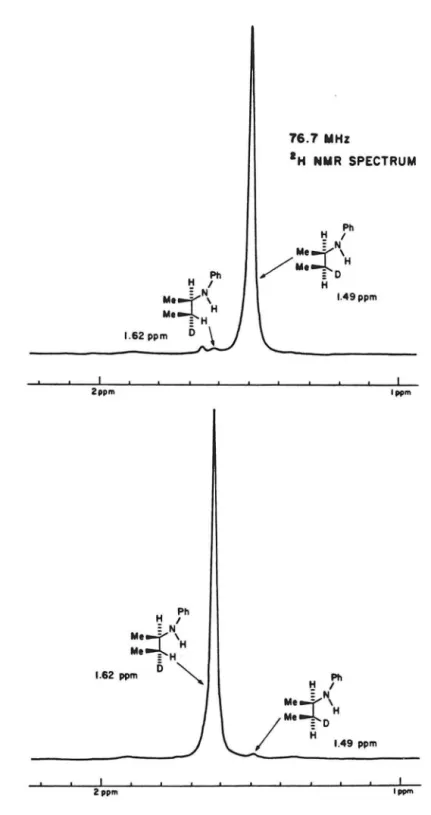
The diastereameric purities of the materials from Schemes 5 and 6 were shown to be >98% from proton decoupled high field (76.7 MHz) 2H NMR of the diasterameric arnines 13 and 19. The e{Ythro and tbreo amine
diastereomers, 13 and 19, give singlets at 1.49 and 1.62 ppn respectively (Figure 1).
2ppm
H Ph : N/
Me:r \H Me ; H
0 \
1.62 ppm ~
H I Ph : N Me-f \H Me-}-.H
0 "'
1.62 ppm ""'
2ppm
76.7 MHZ
1H NMR SPECTRUM
H Ph - I : N Me:r \ / M e § 0 H
H
1.49ppm
H I Ph : N Me:r \H
/
Me : 0 H 1.49 ppm
I ppm
I ppm
Figure 1. 2H ~ spectrum of amines 13 and 19.
Generation and Decalp>Sition of 1 ,1-Diazenes 6-8
The hydrocarbon products from the generation and decomposition of 1,1-diazene 6 by two routes were analyzed by analytical VPC and are shown in Table 1.
Table 1. Hydrocarbon Product Ratiosa from Generation and Thermolysis of 6 at 1oooc.b
Precursor
f f ( c © Ph'( _)-(_
9 59.3 30.4 9.7 0.5 100 <0.5 <0.3 10 58.8 30.6 9.6 1.1 75 <0.5 <0.3 aMolar ratios. bAbsolute yield of C4 hydrocarbon was typically 60%
by the benzensulfonarnide/base route and 13% by the hydrazine/peroxide route.
It can be seen that the formal 1,2-elirnination reaction is the major pathway for the decomposition of 6. The presence of small amounts of butane indicates that the stepwise process is probably occurring to some extent. The mechanism for the generation of the butenes cannot, however, be determined from these data. The presence of a high yield of benzene is consistent with either mechanism.
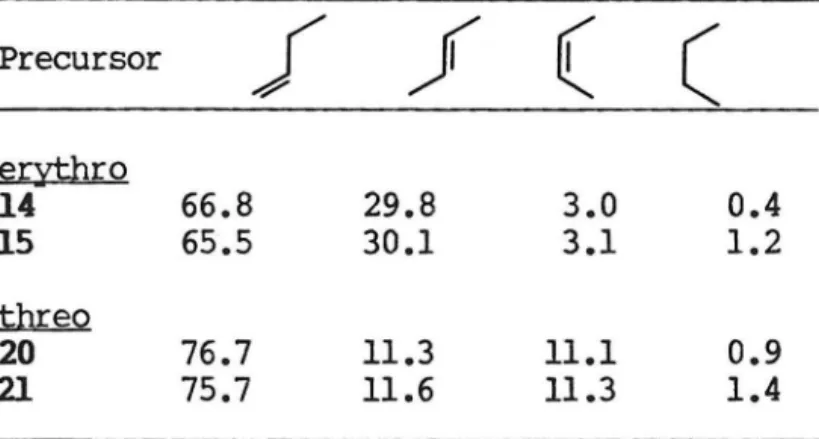
The relative C4 hydrocarbon ratios and the deuterium content for the butenes resulting from the thermolysis of 7 and 8 are presented in Tables 2 and 3. The hydrocarbon ratios were measured by analytical VPC against an internal standard. The hydrocarbon products were separated and isolated by preparative VPC for analysis of deuterium content by ion cyclotron resonance spectroscopy (ICR). OXidation of
1~CYttro-2-deuterio-1-rnethy1propyl)- 1-phenylhydrazine (14) at 1000 affords trans-2-butene (100±2% d1) and tie.-2-butene (2.8+2% d1).
Oxidation of 1-(tbreo-2-deuterio-1-rnethylpropyl)- 1-phenylhydrazine (20) at 100° affords trans-2-butene (1.8±2% d1) and ~-2-butene
(97.9+2% d1). Reaction of the corresponding benzenesulfonamides 15 and 21 with base at 100° affords similar results (Table 3).
Table 2. Hydrocarbon Ratios from Decomposition of 7 and 8 at 1oooca
Precursor
f f ( (
e1:;ythro
14 66.8 29.8 3.0 0.4
15 65.5 30.1 3.1 1.2
threQ
20 76.7 11.3 11.1 0.9
21 75.7 11.6 11.3 1.4
aMolar ratios
Table 3. Deuterium Content of 2-Butenes from Decomposition of 7 and 8 at 1oooca Precursor
ecyt.hro 14 15 threQ 20 21
trans
100+2 99.9+1
1.8±2 1.9+2 asee Experimental Section.
2.8+2 3.9±1 97.9+2 98.7±2
D:isalssion
The fact that the butene ratios and deuterium content for the oxidative and benzenesulfonamide decanposition routes match so closely
s~rts the notion that both routes are going through a c:amr:>n
intermediate, presumably the 1 ,1-diazene. Fran the data presented in Tables 2 and 3 the thermal decarp:>sition of [N-~enyl-Cer;ythrcr
2-deutericrl-methylpropyl)aminolnitrene (7) and
[N-phenyl-(threo-2-deutericrl-methylpropyl)amino]nitrene (8) to 2-butene is predominantly a stereospecific ~-1,2-elimination
reaction. The crossover deuterium content in .kl.Q-2-butene from er;ythro 7 and in trans-2-butene from tbreo 8 may simply be a
reflection of the diastereomeric purities of the starting materials (>98%). Importantly, the crossover deuterium content sets an upper lirni t of a few percent for the stepwise 1, 2-elimination process.
'!be data in Tables 1 and 2 permit the calculation of deuterium isotope effects for the elimination reactions of 7 and 8. From the undeuterated benzensulfonarnide 10, the ratios of
1-butene:traos-2-butene:~-2-butene products are 1.00:0.520:0.163 (Table 1). From the eryt.hro series 15, these ratios change to 1.00:0.460:0.047. Assuming the rate of 1-butene formation does not change the major c:Dservation is that for the er.yt.hro deuterated diastereomer 7 there is a decrease in ~-2-butene formation by a factor of 3.5, a prinary deuterium isotope effect. In addition, a small decrease in trans-2-butene formation occurs, which allO'tiS calculation of a secondary deuterium isotope effect for the 1,2-elimination reaction, ks/ko=l.l3. Similarly, fran the tbreo precursor 21, the ratios of 1-butene: traps-2-butene:W.-2-butene
products are 1.00:0.153:0.149 (Table I). In this case the major ooservation fran the threo deuterated diastereomer 8 is a decrease in trans-2-butene formation by a factor of 3.4, a primary deuterium isotope effect, and a small decrease in W.-2-butene production, affording the secondary deuterium isotope effect, ksfko=l.09. The primary deuterium kinetic isotope effects for several Cope elimination
reactions believed to be concerted are in the same range and are shown for comparison (Table 4).8
Table 4. Primary Kinetic Isotope Effects for 1 ,2-Elimination Reactions of 1 ,1-Diazenes 7 and 8 and Selected Amine Oxides.
Precursor Temp. ks/kn Reference
Diazene 7 lOOOC 3.5 a,b
Diazene 8 lOOOC 3.4 a,b
23 520C 3.0 8d
24 110-1200C 3.5 8c
25 90/llOOC 2.2 Be
aThis work. hThese numbers were calculated from the benzensulfonarnide data by assuming that the rate constants for formation of 1-butene are the same for 1 ,1-diazene 6-8 at lOOOC.
\f. \ I \f.
Ph.J~o- C::::XN'-
0.J:'o·
Ph O 0 CsHu 0
23 24 25
Experimental Section
Melting points were determined by using a Thomas-Hoover melting point apparatus and are uncorrected. Infrared spectra were recorded on a Perkin-Elmer 257 infrared spectrophotometer. Proton NMR spectra were obtained on a Varian Associates EM-390 spectrometer. Chemical shifts are reported as parts per million (ppm) downfield from
tetrarnethylsilane in
o
units and coupling constants are in Hertz (Hz).NMR data are reported in this order: chemical shift; multiplicity, s=singlet, d=doublet, t=triplet, rnFIDUltiplet; number of protons;
coupling constants. Deuterium NMR spectra were run on a Bruker v~500
spectrometer. Peak positions are given in ppn
o
units. OX::l3 was used as internal standard and assigned the value of 7. 25 ppm. Carbon NMR spectra were run on a Jeol FX-900. For capillary vapor phase chromatography (VPC) a Hewlett-Packard 5700A gas chromatograph equipped with a Hewlett-Packard 18704A inlet splitter and a flame ionization detector was used. Hydrogen was employed as the carrier gas and the makeup gas was nitrogen. Packed column analytical VPC was done using a Hewlett-Packard 5720A gas chromatograph equipped with a flame ionization detector and nitrogen carrier gas. This instrument was used with 0.125 in. packed stainless steel columns. Allquantitative VPC analysis was accomplished using a Hewlett-Packard 3390A electronic integrator. VPC response factors for normal
aliphatic hydrocarbons were assumed to be 1.00 relative to butadiene.
Quantitative analyses of other compounds were corrected for detector response. For preparative VPC a Varian 920 instrument equipped with a thermal conductivity detector and helium carrier gas was used. This instrument was used with 0.25 in. glass or 0.375 in. aluminum packed
colwnns. VPC colwnns used are listed below. The identities of butane and benzene were verified by coinjection techniques. Isotope
compositions of the butenes were determined using an ion cyclotron resonance spectrometer operated with an electron impact energy of 9 or 10 ev to provide ionization with negligible fragmentation. Gas
pressures were measured with an MKS type 221 capacitance manometer.
uv spectra were recorded using a Beckman Model 25 spectrophotometer.
VPC Columns Designation
Carbowax 20M capillary
Pennwalt
{3{3
DMS
Carbowax 20M
Description
50 Meter 0.31 mm ID fused silica Carbowax 20M capillary
6 ft.xl/4 in. glass; 28% Pennwalt 223 80/100 Chram R
20 ft.xl/8 in. stainless steel; 15%
~,~'-oxydipropionitrile on 100/120 Chrorn P--NAW
20 ft.x3/8 in. aluminum; 25%
2,4-dirnethylsulfolane on 80/100 Chrom P--NAW
10 ft.x3/8 in. aluminum; 25%
Carbowax 20M on 60/80 Chrorn
w-P-31-IM:S
Dichlorornethane was dried by distillation from calcium hydride.
Triethylamine and pyridine were dried over 4A molecular sieves.
Benzenesulfonyl chloride was distilled under an argon atmosphere. The procedure described by Pelletier was used for the purification of p-toluenesulfonyl chloride.9 Aniline was distilled from zinc dust at reduced pressure then dried over 4A molecular sieves.
N-(1-methylpropyl)aniline was distilled from zinc dust at reduced pressure. Diglyrne was fractionally distilled at reduced pressure then distilled from calcium hydride at reduced pressure just prior to use.
Nickel peroxide was prepared then activated with sodium hypochlorite according to the procedure of Nakagawa et al.lO Sodium
2-(2-ethoxyethoxy)ethoxide was prepared by dissolving sodium metal in 2- ( 2-ethoxyethoxy) ethanol. 3, 4-Dimethy lhexane was obtained from
Albany International and shown to be about an equal mixture of the two diastereomers by 13c ~m.ll Butadiene used as a VPC standard was purified by preparative VPC (DMS roan temperature). The p-xylene used as a VPC standard was also purified by preparative VPC (Carbowax 20M).
Elemental analyses were performed by Galbraith Laboratories,
Knoxville, TN. Reactions were carried out under a positive pressure of argon.
o-Mesity1enesulfonylhydroxylamine. This reagent was prepared fresh for each amination using the procedure described by Tamura et a1.12 NMR (CDCl3) o7.0 (s, 2H), 4.7 variable (s broad, 2-3), 2.6 (s, 6H), 2.2 (s, 3H).
1-(1-Metbylpropy1)-1-Phenylhydrazine (9). A 500 rnL round bottom flask was charged with 13.3g (0.089 mole) of N-(1-rnethylpropyl)aniline and 120 rnL of dichloromethane. This mixture was cooled to ooc then a solution of 19.8g (0.092 mole) of 0-mesitylenesulfonylhydroxylamine in
120 rnL dichloromethane was added dropwise with stirring. After addition was complete stirring was continued for 3 minutes. The cooling bath was then removed and stirring was continued for 20 minutes. The reaction mixture was combined with 25% aqueous sodium hydroxide and ether, then filtered through Celite. The organic phase was extracted several times with 3 N HCl. The acidic aqueous phase was cooled with ice and made strongly basic by adding 25% sodium
hydroxide solution. This was then extracted several times with ether.
The organic phase was dried (Na2S04) and the ether was removed by distillation. Fractional distillation at reduced pressure yielded 2.7g (18%) of 1-(1-methylpropyl)-1-phenylhydrazine (9) b.p. 69-770C
(0.3 torr). This was further purified by preparative VPC (Pennwalt, 1800C). IR (film) 3360, 2980, 1605, 1500, 1460, 1385, 1290, 1260, 1160, 1000, 875, 760, 700 cm-1; NMR (O:X:l3) 8 6.6-7.4 (m, 5), 3.5-3.9
(m, 1), 3.2 (s, broad, 2), 1.2-1.9 (m, 2), 0.8-1.1 (m, 6). Anal. calcd. for C10H16N2: C 73.13; H, 9.82; N, 17.05. Found: C, 72.97; H, 10.00; N, 16.92.
2-Benzenesulfooamido-1- (1-MethylprOP.fl) -!-Phenylhydrazine (10) . A flask was charged with 8 mL dry dichloromethane, 652 mg (4.0 m mole) of 1-(1-methylpropyl)-1-phenylhydrazine (9) and 436 rng (4.3 m mole) of dry triethylamine. This mixture was cooled to -2ooc and 700 mg (4.0 m mole) of freshly distilled benzenesulfonyl chloride was added dropwise with stirring. Stirring was continued for 15 minutes then the mixture was warmed to OOC and stored at this temperature for 2 days. The
mixture was then diluted with 25 ml of dichloromethane, washed 3 times with water, once with 10% HCl then once with saturated sodium
bicarbonate. The organic phase was then dried (Na2S04) and
concentrated affording a brown oil. This was then purified by preparative thin layer chromatography (silica gel/dichloromethane).
The resulting product was dissolved in dichloromethane/petroleum ether, treated with Norit SG, then filtered. This solution was then concentrated and the resulting oil allowed to solidify at -2ooc, then recrystallized fran petroleum ether to yield 325 mg (27%) of white crystalline benzensulfonamide 10. M.P. 81-81.50C; IR (CCl4) 3250, 2980, 1600, 1495, 1450, 1345, 1170, 1095 cm-1; NMR (CDCl3) 86.7-7.9
(m, 10) 6.5 variable (s, 1), 3.2-3.5 (m, 1), 1.1-1.8 (m, 2), 0.75-1.05 (m, 6). Anal. Calcd. for C16H20N2S02: C, 63.13; H, 6.62; N, 9.20.
Found: C, 63.38; H, 6.80; N, 9.25.
th.reo-2-Butanol-3-dJ. This compound was prepared from traos-2-butene using the procedure of Kabalka and Bowman.l3 NMR
(CDCl3) 8 3.5-3.85 (m, broad, 1), 2.0 (s, broad, 1), 1.2-1.6 (m, 1), 1.15 (d, 3, J=7Hz), 0.9 (d, 3, J=7Hz).
th.reo-2-Butanol-3-di ~late. AlL flask was charged with 27.3g (0.36 roles) of threo-2-butanol-3-dl and 525 mL dry pyridine. This mixture was cooled to ooc and 137g (0.72 moles) of p-toluenesulfonyl chloride was added with stirring. Stirring was continued until all material had dissolved. The mixture was allowed to stand at 0°C for 2 days, then poured into 3 .3L of ice water and extracted several times with ether. The combined organic phase was washed successively with cold 1:1 hydrochloric acid and water. The solution was dried
(K2C0:3/Na2S04), concentrated, taken up in a minimum volume of
petroleum ether, treated with Nor it SG, filtered, then slowly cooled to -780C. The petroleum ether was then transferred from the product.
Warming to roam temperature yielded 63.5g (77%) of a colorless oil.
IR (film) 2995, 1367, 1193, 1180, 910 crn-11 N-m (mcl3)
o
7.8 (d, 2, J=8Hz), 7.3 (d, 2, J=8Hz), 4.35-4.7 (m, 1), 2.4 (s, 3), 1.3-1.65 (m, 1), 1.2 (d, 3, J=6Hz), 0.8 (d, 3, J=7Hz).:.Cer;ythrcr2-Deutericrl-Methylpropyl)Ani.line (13). A flask was charged with 350 mL dry ether and 15.6g (0.17 mole). of aniline. This mixture was cooled to -780C then 0.17 moles of methyllithium-lithium branide complex in ether was added dropwise with stirring. Mter 0.5 hours the cold bath was removed and stirring was continued for 1 hour.
The mixture was cooled to ooc and 24.0g (0.11 mole) of
tbreo-2-butanol-3-dl tosylate was added dropwise with stirring. The mixture was warmed to room temperature and stirred for 2 days. Water and dichloromethane were added, the mixture was filtered through Celite, and extracted three times with 3 N hydrochloric acid. The combined aqueous phase was made strongly basic with 25% sodium hydroxide solution then extracted with ether. The organic solution was dried (Na2S04) and concentrated. The product was isolated by fractional distillation at reduced pressure yielding 8.9g (56%). IR
(film) 3420, 2980, 1610, 1510, 1320, 755, 695 cm-11 NMR (CDCl3)
o
7.0-7.25 (m, 2), 6.45-6.7 (m, 3), 3.15-3.5 (m, broad, 2), 1.35-1.7 (m, 1), 1.1 (d, 3, J=7Hz), 0.9 (d, 3, J=8Hz). Deuterium NMR (CHCl3) ol.49
(s) •
l-(e[Ythro-2-Deutericrl-Methylpropyl)-l-PbenyJh¥drazine (14).
This compound was prepared from N-(erythro-2-deuterio--
1-methylpropyl)aniline (13) using the procedure described for
1-(1-methylpropyl) -1-phenylhydrazine (9). NMR (Q)Cl3)
o
6.6-7.3 (m, 5), 3.5-3.85 (m, 1), 3.1 (broads, 2), 1.4-1.8 (m, 1), 1.05 (d, 3, J=6Hz), 0.9 (d, 3, J=7Hz).2-Benzenesulfonamic»-1- Cecythrc:r2-Deuterio-l-MethylprOP.f1) -!- Phenylhydrazine (15) • This compound was prepared from
1-(erythro-2-deuterio-1-methylpropyl)-1-phenylhydrazine (14) using the procedure described for the preparation of
2-benzenesulfonarnido-1-(1-rnethylpropyl)-1-phenylhydtazine (10). NMR (CDCl3)8 6.6-7.9 (m, 10), 6.5 (s, 1), 3.15-3.5 (m, 1), 1.4-1.8 (m, 1), 1.0 (d, 3, J=7Hz), 0.9 (d, 3, J=8Hz).
eryt:hqr-2-Butanol-3-dJ.. This compound was prepared from trans-2-butene using the procedure of Jackman and Bowman.l4 NMR
(CDC13)83.45-3.85 (broad m, 1), 2.4 (broad d, 1, J=3Hz), 1.25-1.65 (m, 1), 1.15 (d, 3, J=6Hz), 0.9 (d, 3, J=7Hz).
ecyt:hro-2-Butanol-3-dJ. 'I'osylate. This compound was prepared from erythro-2-butanol-3-dl using the procedure described for
threo-2-butanol-3-dl tosylate. IR (film) 2990, 1360, 1190, 1180, 910 crn-1; mR (CDCl3) 5 7.75 (d, 2, J=8Hz), 7.3 (d, 2, J=8Hz), 4.35-4.7 (m, 1), 2.4 (s, 3), 1.4-1.75 (m, 1), 1.2 (d, 3, J=6Hz), 0.8 (d, 3, J=8).
N-Cthreo-2-Deuterio-1-MethylprOP.fl)aniline (19). This compound was prepared from erythro-2-butanol-3-dl tosylate using the procedure described for :&-(ecythro-2-deuterio-1-methylpropyl)aniline (13). IR
(film) 3410, 2980, 1610, 1510, 1320, 750, 695 crn-1; NMR (CDCl3) 5 7.0-7.3 (m, 2), 6.4-6.75 (m, 3), 3.15-3.5 (m, 2), 1.2-1.6 (m, 1), 1.1
(d, 3, J=6Hz), 0.9 (d, 3, J=8Hz). Deuterium NMR (CHCl3) 51.62 (s).
1-(threo--2-Deuterio-1-Methylpropyl)-1-Phenylhydrazine (20). This compound was prepared from :&-(threo-2-deuterio-1-methylpropyl)aniline
(19) using the procedure described for
1-(1-methylpropyl) -!-phenylhydrazine (9). NrlR (CDCl3) 8 6.5-7.3 (m, 5), 3.5-3.9 (m, 1), 3.1 (broads, 2), 1.2-1.55 (m, 1), 1.05 (d, 3,
J=6Hz), 0.85 (d, 3, J=8Hz).
2-Benzenesulfonamido-1- Cthreo-2-Deuteri<r 1-Methylpropyl) -!- Phenylhydrazine (21) • This compound was prepared from
1-(tbreo-2-deuterio-1-rnethylpropyl)-1-phenylhydrazine (20) using the procedure described for 2-benzenesulfonarnido-1-(1-rnethylpropyl)-1- phenylhydrazine (10). NMR (CDCl3) 8 6.6-7.8 (m, 10), 6.3 (s, 1),
3.1-3.5 (m, 1), 1.05-1.4 (m, 1), 1.0 (d, 3, J=7Hz), 0.9 (d, 3, J=8Hz).
1,4 Di(l-Methylpropyl)-1,4 Di{ilenyl-2-'l'etrazene (22). A round bottom flask was charged with 25 rnL diethyl ether, 1.8g of nickel peroxide (equivalent to 15 m role· OH) and a magnetic stir bar. The mixture was cooled to OOC and a solution of 318 rrg (1.9 m role) of 1-(1-rnethylpropyl)-1-phenylhydrazine (9) in 2 rnL diethyl ether was added over about 15 seconds. Stirring was continued for 1 hour at ooc then l.hour at roam temperature. The mixture was filtered and the solvent removed at reduced pressure to yield a brown oil. This was crystallized by dissolving in a small volume of ethanol then cooling to -780C. This yielded 50 rrg (16%) of a light yellow solid. This was recrystallized to afford a white solid. M.P. 35.5-360C; IR (CCl4) 2980, 1600, 1495, 1060 crn-1; Nw1R (CDCl3) 86.8-7.45 (m, 10), 4.15-4.5
(m, 2), 1.4-2.2 (m, 4), 1.3 (d, 6, J=7Hz), 0.9 (t, 6, J=7Hz). Anal.
calcd. for C20H29N4: C, 74.03; H, 8.70; N, 17.27. Found: C, 74.15; H, 8.70; N, 17.23; UV (cyclohexane) 337 nrn ((19000), 305 nrn shoulder ((
12000), 257 nrn ((9400).
Generation and Decalp>sition of 1,1-Diazenes 6-8 by the Benzensulfonamide/Base Route. In a typical run 150-300 rng of the deuterium labeled benzenesulfonarnide 15 or 21 was dissolved in 1.5- 4
rnL of dry diglyrne and placed in one side of a 2 fingered sealable
reaction cell. The other finger was charged with 0.8 equivalents of sodium 2- ( 2-ethoxyethoxy) ethoxide in 2- { 2-ethoxyethoxy) ethanol and 2-4
mL diglyme. The reaction cell was degassed and sealed under vacuum.
After heating the cell to lOOOC in an oil bath, the base and benzenesulfonarnide solutions were mixed and heating at lOOOC was continued for 3-4.5 hours. The reaction mixture was frozen with liquid nitrogen, the reaction cell broken open and immediately connected to a vacuum manifold by means of a standard taper joint.
The reaction mixture was vacuum transferred to another tube and after warming to -780C the solution was analyzed for C1-c4 hydrocarbons by VPC (~~,ooc). For yield determination 1,3-butadiene was used as
internal standard. No C1-c3 hydrocarbons were observed in these reactions. The absolute yield of C4 hydrocarbons was typically 60%.
The mixture was connected to the vacuum line and the volatile
hydrocarbons were isolated by repeatedly exposing the reaction mixture to a large volume, isolating the reaction mixture and condensing the contents into a new tube. Finally, the volatile hydrocarbons were frozen with 0.25-0.3 mL of 2,2,4-trimethylpentane on the vacuum line.
This mixture was removed from the line, warmed to -780C and injected into a preparative VPC by means of a chilled syringe. The 1-butene, trans-2-butene and ~-2-butene were separated and isolated by
preparative VPC {IMS, 250). The isolated hydrocarbons were analyzed for purity by condensing small portions of the samples with
2,2,4-trirrethylpentane on a vacuum line for VPC analysis (f3~, ooc).
The isolated butene samples were dried by transferring them on a vacuum line from a tube at
-1aoc
to one cooled with liquid nitrogen.The dry purified butene samples were then analyzed for deuterium
content by ICR. The tm.labeled 1,1-diazene (6) was generated in a similar manner on a smaller scale. Benzene, 3, 4-dirrethylhexane and
(1-methylpropyl)benzene products were analyzed by analytical VPC (Carbowax 20 M Capillary, lOOOC) •
Generatim and Decalp>sition of 1,1-Diazenes 6-8 by the Alkyl- Phenylhydrazine/Oxidatioo Route. In a typical run 300-400 rng of the deuterium labeled 1-(1-methylpropyl)-1-phenylhydrazine 14 or 20 was dissolved in 25 rnL diglyme and placed in one chamber of a sealable reaction cell with 2 chambers separated by a Teflon vacuum valve. The other chamber was charged with a 10 fold excess of nickel peroxide in 25 rnL diglyrne. The reaction cell was degassed and sealed under
vacuum. After heating to lOOOC in an oil bath, the valve separating the chambers was opened and the solution of labeled
1-(1-methylpropyl)-1-phenylhydrazine was gradually mixed with the nickel peroxide over a 15 minute period while heating was continued.
After cooling, the mixture was analyzed and separated as described above for the benzenesulfonarnide route. The absolute yield of C4 hydrocarbons ranged 5-13%. No butadiene or methane was generated in these reactions. The unlabeled 1,1-diazene 6 was generated in a
similar manner from 9 on a smaller scale. Benzene, 3,4-dirnethylhexane and (1-methylpropyl)benzene products were analyzed by analytical VPC
(Carbowax 20M Capillary, lOOOC). Generation of labeled and unlabeled
{~phenyl~(l-methylpropyl)arnino]nitrene by this route also gave trace variable amounts of c2 and C3 hydrocarbons. The ranges observed for C2 and C3 hydrocarbons are given below as molar percent of the c2-c4 mixture: propene, ~0.4%; propane, ~0.2%; ethene, 0.4-5.7% ethane,
~.0%. Heating diglyme and nickel peroxide together at lOOOC in the
absence of 9 afforded no c1-c4 hydrocarbons.
Deuterium Analyses.lS The butenes that were isolated by VPC from decomposition of 1,1-diazenes 7 and 8 had the following isomeric
purities: 1-butene
>
99.99%; trans-2-butene>
99.0%; ~2-butene>
98.5%. The isotopic compositions of the 1-butene samples were
determined by dividing the ICR peak heights by respective peak masses.
For trans-2-butene and ~2-butene,corrections were applied where needed for the presence of the 13c peak in the ICR. For
trans-2-butene and ~-2-butene analyses, corrections were made for trace contamination by other butene isomers. These corrections were based on the concentrations, labeling and relative ionization cross sections of the contaminants. The contributions of non-deuterated 1,1-diazene precursor to the trans-2-butene and £iQ-2-butene data were then determined. The percentage of deuterated material in the
1-butene sample for a given run was recorded and taken as a measure of the isotopic purity of the 1,1-diazene (typically 98% d1). From this value, the butene product ratios for decomposition of 7 and 8, and the butene product ratios for the decomposition of unlabeled 6, it was possible to determine the unlabeled 1,1-diazene contribution to the rrv'e 56 peak of the trans and ill.-2-butene ICR spectra. These
contributions were subtracted from the ICR data before these data were used to calculate the isotopic compositions of the 2-butenes. The data in table 8 are corrected for the presence of wrong butene isomers but not adjusted to correspond to 100% D starting material. The data in table 3 are corrected to correspond to 100% D starting material and 100% isomerically pure butene products.
~le 8. Isotopic Compositions of Butenes from Thermolysis of (7) and (8) at lOOOC.
Precursor 15 14 21 20
98.2% D 98.8% D 98.5% D 98.7% D
97.9% D
98.6% D 1.8% D 1.8% D
F\
3.6% D 2.6% D 97.1% D 96.4% D
'lhermolysis of 'l'etrazene 22.
1,4-Di-(1-methylpropyl)-1,4-diphenyl- 2-tetrazene (22) was heated for 5.5 hours at lOOOC as a degassed solution in diglyme. This resulted in the formation of <0.1% C1-C4 hydrocarbons.
References
( 1) We are grateful to the National Science Foundation for generous support.
( 2) National Science Foundation Predoctoral Fellow, 1976-79 ( 3) Gamille and Henry Dreyfus Teacher-Scholar, 1978-83.
( 4) For reviews of 1,1-diazene behavior see: (a) Lemal, D.M. in
"Nitrenes", Lwowski,
w.,
Ed.; Interscience: New York, 1970;Chapter 10. (b) Ioffe, B.V.; Kuznetsov, M.A., Russ. Chern. Rev.
(Engl. Transl.) 1972, 41, 131.
( 5) For theoretical work on 1,1-diazenes see: (a) Baird, N.C.; Barr, R.F., Can. J. Chern., 1973, 51, 3303; (b) Lathan , W.A.;
Curtiss,L.A.; Hehre, W.J.; Lisle, J.B.; Pople, J.A.,.
Prog. Phys. Org. Chern. 1974, 11, 175 ; (c) Ahlrichs, R.;
Staernrnler,
v.,
Chern. Phys. Lett., 1976, 37 77;(d) Wagniere, G., Theor. Chim. Acta., lli,l, 31, 269;
(e) Baird, N.C.; Wernette, D.A., Can. J. Chern.,
m,
55,350; (f) Davis, J.H.; Goddard, W.A., J. Am. Chern. Soc., l!£[1_, 99, 7111; (g) Paste, D.J.; Chipnan, D.M. ibid, .J...21.2.,
101, 2290. (h) Casewit, C.J.; Goddard, W.A.; ..ll?..iQ., 1..9.00.,
102, 4057; (i) Gelbart, W.M.;Elert, M.L.; Heller, D.F.;
Chem. Rev., 12.llil, 80, 403.
( 6) (a) Hinsberg, W.D., III, Dervan, P.B., J. Am· Chern. Soc., ~'
100, 1608; (b) IQiQ, 1979, 101, 6142; (c) Schultz, P.G.;
Dervan, P.B., .llli.Q., 1980, 102, 878; (d) Schultz, P.G.;
Dervan, P.B., .IQ.iQ., 1981, 103, 1563; (e) Dervan P.B.;
Squillacote, M.E.; Lahti, P.M., Sylwester, A.P.; Roberts, J.D., llU,d., .19JU., 103, 1120; (f) Hinsberg, W.D., III; Schultz,
P.G.; Dervan, P.B., lb.iQ.., 1982,104, 766; (g) Schultz, P.G., Dervan, P.B., Ibid., ~' 104, in press.
( 7) Kosower, E.M., Ace. Chern. ReS.,~' 4, 193.
( 8) (a) Cope, A.C.; Trumbull, E.R., in "Organic Reactions" Volume 11;
Cope, A.C., Ed.; John Wiley, New York, 1960; Chapter 5.
(b) DePuy, C.H.; King, R.W., Chern. Rev., 1960, 60, 431.
(c) Bach, R.D.; Andrzejewski D.; Dusold, L.R., J. Org. Chern., 1973, 38, 1742. (d) Chiao, W.; Saunders, W.H., Jr., J.
Am·
Chern.12Qg_., ~' 100, 2802. (e) Kwart, H.; George, T.J.; Louw,
R.; Ultee,
w.,
J. Am. Chern. Soc., 1978, 100, 3927.(f) Kwart, H.; Brechbiel, M., J. Am. Chern. Soc.,~' 103, 4650.
(g) Saunders, Jr., W.H.; Cockerill, A.F. "Mechanisms of Elimination Reactions", John Wiley, New York, 1973.
( 9) See Fieser, L.F., Fieser, M.; "Reagents for Organic Synthesis", 1967, John Wiley, New York, 1. 1179.
(10) Nakagawa, K; Konaka, R.; Nakata, T., J. Org. Chern., ~'
Tl, 1597.
(11) Lindeman, L.P.; Adams, J. Q. , Anal. Chern., ill.l_, 43, 1245.
(12) Tamura, Y.; Minarnikawa, J.; Ikeda, M., Synthesis, rn:L, 1.
(13) Kabalka,G.W.; Bowrran, N.S., J. Org. Chern., Ull, 38, 1607.
(14) Jackman, L.M.; Bowrran, N.S., J. Am· Chern. Soc., 19.QQ., 88, 5565.
(15) We are grateful to Charles Wight and Mary Mandich in Professor J.L Beauchamp's group at the California Institute of Technology for their generous assistance with the ion cyclotron resonance spectroscopy (ICR) experiments.
Olapter 2
Attempted Chiral Induction via Multiphoton Infrared Photolysis.
Ch. 2
Dissymmetric molecules (i.e., those lacking an alternating axis of symmetry) are known to exhibit several unique and interesting optical properties. When plane polarized light is passed through a solution containing a dissymmetric species (and less than an
equivalent amount of its mirror image) the plane of polarization of the radiation is rotated. This property is understood by viewingl the plane polarized light as a superposition of right and left circularly polarized components of equal intensity. This is indicated in
figures2 1 and 2.
1
Plane of polarization
_Electric field
~f)f)f)f)f)
Direction of propagation Right circularly polarized light wave.Figure I
.~ ... ~ .. ··-·-· ... .
/ .. -... ·.
[ ~' '·:
\EL"·~.:t -~ER'
... ':E ...
... ··
E
/fj~;··
\
.... _... ...
.: __.. /
...
_
...Right and left circularly polarized electric field vectors combining to give plane-polarized field vector. (From C. Djerassi, "Optical Rotatory Dispersion," copy·
righ1, 1960. McGra~-Hi1! Book Companr, Inc.)
Figure 2
In a dissymmetric rnedium,3 the index of refraction for left circularly polarized (LCP) light nL will be different than that for
right circularly polarized (RCP) light nR. In other words, the speed of LCP light will differ from that of RCP light as they pass through the medium. The relative phases of RCP and LCP light will be changed after passing through the sample, as a result of this velocity
difference. If the light entering the sample is plane polarized, this will result in a rotation of the plane of polarization, relative to its original orientation.
Another fascinating property related4 to this manifests itself in the absorption of light by the molecule. The extinction coefficient for RCP light f R will be different from that for LCP light ( Lr when the absorbing species is a dissymmetric molecule. This phenomenon is known as circular dichroism (CD). The value of ( R for a
dissymmetric species will be equal to ( L for its mirror image.
If a racemic mixture of a dissymmetric species is irradiated with circularly polarized light, more light will be absorbed by one
enantiomer than by the other. Suppose now that the absorbing species does photochemistry upon irradiation. If a racemic mixture is
irradiated with circularly polarized light, one enantiomer will react faster than the other, due to the extinction coefficient difference.
This effect can result in asymmetric induction in three different ways. First, the starting material can be enriched in one enantiorner via simple preferential destruction of the other enantiorner (this is known as asymmetric destruction). The second mechanism can operate if the two enantiorners are photochemically interconvertible. In this case, one enantiomer is driven to its mirror image at a rate faster than the back reaction (this is known as partial photoresolution).
The third mechanism is possible when the photochemical product is
itself dissymmetric. Here, preferential reaction of one enantiomer can result in optically active products (this is called asymmetric synthesis) •
The possibility of using circularly polarized light as a chiral agent was discussed as early as the end of the 19th century by LeBelS and van't Hoff6. In 1896, Cotton? observed circular dichroism in electronic transitions. This made the possibility of chiral induction using circularly polarized light appear even more promising. A number of attempts to observe chiral induction in this manner were reported.
It was not until 1929, however, that any of them met with success. In this experiment, Kuhn and BraunS observed chiral induction in the CPL photolysis of ethyl- a -bromopropionate.
Since this initial breakthrough, there has been considerable work9 in the area of chiral induction via photolysis with CPL
involving ~tronic excitation. Induction has been observed9 via all three previously mentioned mechanisms (asymmetric destruction, partial photoresolution and asymmetric synthesis).
Despite considerable research activity involving optical activity in the UV-visible region and chiral induction employing CPL photolysis via electronic transitions, little was done (until recently) in the infrared. AttemptslO were made as early as 1954 to observe
vibrational circular dichroism (VCD) but (until very recently) none of them met with success. The difficulty was an experimental one.
Adequate IR light sources, optics and detection equipment were not available to successfully perform the experiment.
·starting in the late 1960's papers began to appear in the
chemical literature discussing the theoretical aspects of vibrational
optical activity. The stated purpose of the early papers was to
estimate the magnitudes of the dissymmetry factors g (g=((R-(L)/() for vibrational transitions, and to assess the types of useful molecular information that might be obtained from their experimental
measurement. It was hoped that such information would encourage further attempts at the experimental detection of VCD.
In 1968 and 1970, Deutsche and Moscowitzll,l2 published papers dealing with the vibrational optical activity of a helical charged mass distribution, representing an optically active polymer. The predicted g values were in the range lo-4 to lo-s. (It should be noted that g values for electronic transitions can be as large as lo-2).
In 1972, Holzwarth and Chabayl3 published a paper employing a model involving two coupled diatomic oscillators. These calculations estimated g values comparable to those calculated by Deutsche and Moscowitz.
VCD was observed in single crystalsl4 in 1973. Observed g values were on the order of Sxlo-4.
In 1974, the first observationl5 of vibrational circular
dichroism in the liquid phase was reported. The vibrational bands in which it was observed were the C*H stretch of
2,2,2-trifluoro-1-phenylethanol (CF3CHOH~H5) g
=
6.5xlo-5 and the C*D stretch of neopentyl-1-d-chloride ((CH3)3CCHDCl) g=
2xlo-s.The second observation of VCD in the liquid phase was by Stephens et all6. This work was also done with trifluoro-1-phenylethanol. In addition to the C*H stretch, however, VCD was also observed in the OH stretch. The g value reported in this paper for the C*H stretch was
4.3xlo-5, that for the OH stretch was 2.5xlo-5.
Stephens et al subsequently published two papers in 1976. One work reportsl7 the observation of VCD in the combination and overtone bands of camphor, 3-methylcyclohexanone, and ,B-pinene (l-31-£ range).
Typical g values ranged as high as 5xlo-5. In the other paperl8, VCD of C-H, o-H and N-H stretching bands is reported for a number of molecules. The observed g values range up to 5xlo-5.
During the past 5 years the field of vibrational optical activity has grown considerablyl9. The early work was restricted to high
frequencies for instrumental reasons. Keiderling and coworkers have recently published a series of papers reporting VCD spectra for IR transitions as low as 1300 cm-1.20 The early observations of g values in the range lo-4 - lo-5 appear to be typical of VCD spectra in
general.
The experimental observation of vibrational circular dichroism makes the possibility of chiral induction via infrared photolysis seem plausible. The fact that pulsed megawatt infrared lasers capable of
inducing chemical reactions21 have become available makes the
experiment now possible to perform. This experiment could potentially serve as a probe of the IR chiroptical properties of highly
vibrationally excited molecules. The work presented here involves the IR photolysis of a racemic sample of a chiral molecule in the vapor phase using a focused, circularly polarized output from a
TEA-C02
laser.
RESULTS
The molecule chosen for this study was trans-1,2-divinyl-
cyclobutane (DVB) (1). DVB has a mnnber of
characteristics indicating that it may be well suited for this experiment. The thermal chemistry of DVB has been thoroughly studied22. The maximum specific rotation23 is reasonably large
[a]365(0Cl4) = 342° and the absolute configuration is known22.
Pyrolysis22 of DVB (Ea
=
34 kcal/rnole) affords butadiene (2), 4-vinylcyclohexene (3) and 1,5-cyclooctadiene (4).3
0
4
Figure 3
Pyrolysis23 in the liquid phase (in decane at 146.50C) gives 4.0% 2, 70.4% 3 and 25.6% 4.
Berson and coworkers22 reported that when optically active
trans-1,2-divinylcyclobutane was pyrolyzed (liquid phase in decane at 146.5°C) the resulting 4-vinylcyclohexene showed 8% optical activity
(relative to the starting material). Racimization of the starting material occurred only to the extent of 16%. In this pyrolysis 57.7%
of the starting material reacted.
It was expected that trans-1,2-divinylcyclobutane could be
photolyzed with a pulsed 002 laser since the vinyl group should have two vibrational resonances in the tuning range of the laser (9.2 to
10
.s
11 ) •The gas phase (20 torr) infrared spectrum of trans-1,2-divinylcyclobutane is given in Figure 4.
. . .
i ::; ~ ~1-· : :·.:
:.!:;t. .. :: ~~-t : ... . ·1 -~. ·· i:
·.·-~ ,· · ; __ : ___ ,. ~..; :_ ' ; _:
:.r:~. ': • • : ;·;: , : :. :I' .... 1"1' .,
i
11' It~~~·,.:· ,: _:_~i ·~·- _,., ~-l~~- .... l"i~ .. ':"
:-jl1 '
:l
:;~~, ,
1.
!-:~:, '
- ~·. _._ J •••.• -~~- .•• •f""'• - .•
tiOO 1000 900 100
·'WAVENUM8ER CM-1
Figure 4. IR spectrum (20 torr gas phase) of
trans-1,2-divinylcyclobutane around tuning range of ~ laser (923-1086 crn-1).
The peak at 910 crn-1 is due24 to =CH2 out of plane bending and the peak at 990 crn-1 is due to =CHR bending. The peak centered at 990 cm-1 is more easily accessible with the laser and was used in this study.
The energy output of the laser is dependent on the rotation line used. A number of lines were tried in photolyses of
trans-1,2-divinylcyclobutane at their maximum usable energies. The one chosen was the R22 line of the 00°1-10°0 transition (977.2
cm-1=10.2311 ). The energy used was 0.8 to 0.9J/pulse.
In choosing the sample pressure at which to carry out the
photolysis, one is dealing with two opposing trends. Relatively high pressures will increase the amount of sample processed (necessary for measuring the optical rotation). However, higher pressures will also tend to increase the rate of intermolecular energy transfer due to increased collision rates. Since the success of the experiment depends on preferential absorption by one enantiomer over the other, this intermolecular energy exchange will potentially result in loss of the selectivity. This preferential absorption by one enantiomer over the other is very analogous to isotopic selectivity in multiphoton dissociation. The effect of pressure on the isotopically selective process may therefore provide some idea of the optimum pressure for the present work. Figure 5 shows 25 the effect of pressure on the isotopic selectivity in the
C02
laser photolysis of SF6•Pulses
L:. 50
0100
• 200 0400
to0~----~----~----~----~
0 0.5 1.0
PSF (torr) 6
Figure 5. Effect25 of pressure on the isotopic enrichment in the unreacted SF6 from the IR laser photolysis of SF6·