Backg R
Basic E
ground RPJMN
Educatio
Study N for Ed
on, Early
for the ucation
Part 1 Childho
2015
e Prepa n 2015
ood, Acce
aration 5 – 201
ess and
of the 9
Quality
Back Educ
Part 1
Publishe
© 2015
ISBN:
The Bac Childhoo years and The chap a small t by a ser stakehol governm The Back does not Governm Chapters recogniz quality a Part 1 c Quality A Measure Childhoo Part 2 c Upgradin Environm
kground cation 2
1: Basic E
d by:
M N Ja 9
kground Stu od through to
d identifies ch pters were pre eam of natio ries of Focus
ders from al ment organiza kground Stud t claim to be ment of Indon s of the Stud zed that issue
ssurance imp ontains the f Assurance an
d by Nation od Education contains the ng the Skills ment for Enha
d Study 2015 -
Educatio
Ministry of Nat National Deve
akarta 978-602-1154
dy is a serie o Higher Educ hallenges for epared jointly onal and inter
Groups, Wo l levels of g ation represen
dy is intended definitive and nesia nor any o y have been es such as a pact across the
following cha nd Minimum nal Exams; Q
and Develop following ch
of the Labo anced Produc
y for th 2019
n, Early C
tional Develo elopment Plan
-44-1
es of chapter cation. Each c
the future tog y by Bappena rnational expe rkshops and overnment, ntatives.
d to be a use d the views e other particul grouped in ccess, educa e whole secto apters: Access Service Stan Quality of Stu ment; and Te hapters: Achi or Force in I tivity in Indon
he Prep
Childhoo
opment Plann nning Agency
rs covering k chapter review gether with p as staff of the erts. The prep
Consultation also civil soc
eful summary expressed in t
lar organisati two books fo ation governa
or.
s to Quality E ndards for Ba udent Learni eacher Quality
ieving Unive Indonesia; St nesia; Educat
aration
od, Acces
ning/
y (BAPPENAS)
key issues in ws progress a proposed dire e Education an
paration of th ns in Jakarta ciety membe
y document o the documen
ons.
or the ease o ance, educati
Education; Ku asic Educatio ng as Measu y and Manage rsal 12 Years trengthening ion Financing
n of the
ss and Qu
n the educat nd achievem ctions.
nd Religious A he Backgroun
and Regiona ers, teachers,
of achieveme t do not repr
of the reader.
ion financing
rikulum 2013 n; Quality of ured by Inte ement.
s of Educatio Skills Provid g; and Govern
e RPJM
uality
ion sector fr ments over the
Affairs Directo nd Study was
al areas invo academics a
ents and chal resent the vie
r. However, it g, teacher qu
3; Character E f Student Lea ernational Te
on; Higher E ders and the nance and Edu
MN for
rom Early e past five
orate and enriched lving key and non-
llenges. It ews of the
t must be uality and
Education;
arning as ests; Early
ducation;
e Training ucation.
Background Study for the Preparation of the RPJMN for Education 2015 – 2019
Part 1
Basic Education, Early Childhood, Access and Quality
Foreword
We give praise to God the Almighty for blessing us in the completion of the Background Study for the Preparation of the RPJMN for Education Plan 2015-2019. This analytic work serves as one of the inputs for the development of the Technocratic Draft of the Plan (RPJMN) and will guide our efforts to constantly improve the quality of education for all Indonesians.
The overall approach to the Background Study has been to review current achievements, challenges faced, policy options and proposed directions for each sub-sector - early childhood, basic, secondary, vocational and higher education.
Specific issues examined within the sub-sectors included: access to quality education, review of the inputs to education (e.g. minimum service standards, character education and the quality of the teaching workforce);
analysis of the learning outcomes (as measured by national exams and international tests); and the environment for provision of quality education and skills training including the financing and governance of education and the role of the private sector in education, especially in vocational skills training and in higher education.
The Background Study drew on a considerable body of contemporary education research in Indonesia.
Additional secondary research was commissioned to fill in gaps and to address emerging issues such as the options for universal 12 years education and strengthening skills for the labour market. The complete Background Study is the product of an iterative cycle of analysis and consultation with counterparts and stakeholders drawn from government at national and local levels, education institutions, research institutions, civil society organisations and development partners.The Study was greatly enriched by the wise counsel of present and former senior government officials and education academics.
I would like to acknowledge the contributions of the following – Technical Coordinator:
Ir. Subandi Sardjoko, M.Sc., Ph.D. (Director of Education Bappenas) Technical Team Members in Bappenas:
Ir. Suharti MA, Ph.D; Drs. Amich Alhumami, MA, M. Ed., Ph.D.; Suprapto Budinugroho, ST, M.Eng.; Kalihputro Fachriansyah, ST; Dimas Suryo Sudarso, S.Mn.
I would also like to express my appreciation to our international partners, namely the Australian Department of Foreign Affairs and Trade (DFAT) and the World Bank for their contribution of international experts in specific topic areas. The Analytical and Capacity Development Partnership (ACDP), jointly funded by DFAT and the European Union and managed by the Asian Development Bank (ADB) also contributed experts and played a key role in managing the consultation processes, translation, printing and logistics.
Experts and Supporting Team Members:
Hetty Cislowski, Samer Al Samarrai, Susiana Iskandar, Pedro Cerdan-Infates, Andrew Ragatz, Amer Hasan, Rosfita Roesli, Cristobal Ridao-Cano, Gutama, Adam Rorris, Soebagyo Mulyodiharjo, Satryo Soemantri Brodjonegoro, Chris Majewski, Alan Prouty, Abdul Malik, John Virtue, David Harding, Basilius Bengoteku, Devi Suryani, Budiarti Rahayu, Hillary Saccomanno, Harry Achillini, Mayla Safuro Lestari Putri, Daim Syukriyah, Laura Kartika Wijaya.
It has been my pleasure to lead and work alongside this very dedicated team and to engage with and learn from the many committed and enthusiastic members of the focus groups and discussions held across Indonesia.
Finally, I would also like to express my deep gratitude and appreciation to Prof. Armida S. Alisjahbana, MA, Ph.D., Minister of National Development Planning/Chair of National Development Planning Agency (BAPPENAS) and Ir. Lukita Dinarsyah Tuwo, MA, Ph.D., Vice Minister of National Development Planning/Vice Chair of National Development Planning Agency (BAPPENAS) of the Cabinet United Indonesia II, 2009-2014, for their valuable guidance and support in the implementation of this Education Sector Review. I would also like to convey my great appreciation to Prof. DR. Fasli Jalal, Ph.D., Dr. Ir.Taufik Hanafi, MUP, Wolfgang Kubitzki Principal Social Sector Economist, Asian Development Bank and Ms Hannah Birdsey Counsellor Education and Scholarships from the Australian Department of Foreign Affairs and Trade, for their rich and valuable contributions in numerous discussions when the Background Study was first initiated and during implementation.
My earnest wish is that this document will provide guidance and direction for the government and stakeholders and that it will also stimulate continuing and robust enquiry into the very complex issues which affect the delivery of quality education for all Indonesians.
Dra. Nina Sardjunani, MA
Deputy Minister for Human Resource and Cultural Affairs,
Ministry of National Development Planning/National Development Planning Agency
Table of Contents Part 1
Foreword ... v
Abbreviations ... xiii
Overview ... xvii
Chapter 1. Access to Quality Education ... 1
Introduction ... 1
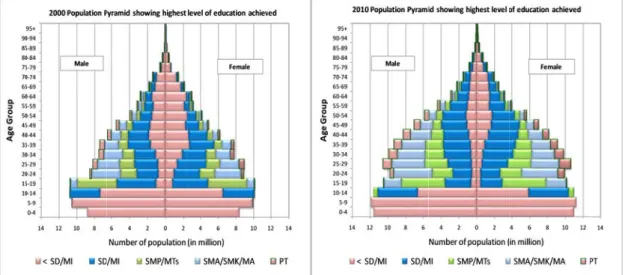
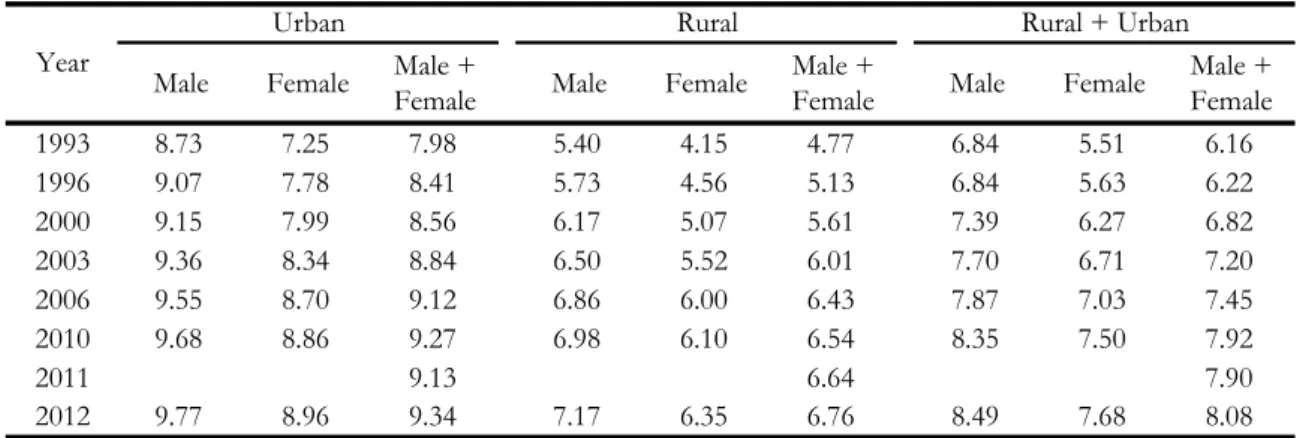
1. Progress in raising the educational attainment of the population ... 2
2. Trends in school enrolment and progression ... 5
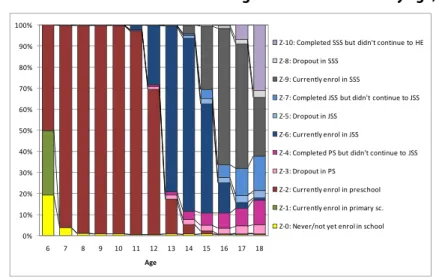
3. Zones of Exclusion: A model for identifiying the enrolment status and vulnerability of children aged 6-15 ... 8
4. Issues associated with Transition points in schooling ... 11
5. The remaining Gender Gap ... 12
6. The supply of basic education services ... 15
7. Conclusions ... 17
8. Recommendations for consideration by Government ... 19
Chapter 2. Kurikulum 2013 – What are Students Learning? ... 21
Introduction ... 21
1. The origins of the current curriculum in Indonesia ... 22
2. Overview of Kurikulum 2013 ... 23
3. Challenges in implementing Kurikulum 2013 ... 27
4. Proposed future directions for the curriculum ... 33
Appendix 1. Summary of Changes in Structure of Curriculum ... 36
Chapter 3. Character Education ... 39
1. Context – the Mental Revolution ... 39
2. Purpose and Outline of this paper ... 41
3. Character Education as part of non-cognitive skills development ... 41
4. Main Approaches to Character Education ... 42
5. Indonesia – brief overview of current situation ... 50
6. Overview of International Research ... 54
7. Character Education for the Mental Revolution ... 56
Chapter 4. Quality Assurance and Minimum Service Standards for Basic Education ... 59
Introduction ... 59
1. Quality assurance systems and processes ... 60
2. Snapshot of the extent to which the Government is meeting the MSS ... 66
3. Aligning the four quality assurance processes ... 71
4. Issues and challenges in implementing school quality assurance processes ... 74
5. Conclusions and recommendations ... 78
Appendix A. Compliance with MSS Indicators for Delivery of Primary Education ... 82
Appendix B. Compliance with MSS indicators for Delivery of Junior Secondary Education ... 84
Appendix C. Cost of Bridging the Gap to Fully Meet MSS for Basic Education ... 87
Chapter 5. Quality of Student Learning as Measured by the National Exams ... 91
1. The nature and importance of assessment ... 91
2. The national exams ... 92
3. Overview of student performance 2013 ... 94
4. Results for Senior Secondary (SMA and SMK) ... 99
5. Factors affecting performance on the exams ... 102
6. Challenges associated with the national exams ... 107
7. Proposed future directions for the national exam ... 113
Chapter 6. Quality of Student Learning as Measured by International Tests ... 115
Introduction ... 115
1. Why the tests matter ... 115
2. Caveats and limitations on the use of international test results ... 117
3. Summary of the international tests in which Indonesia participates ... 118
4. PIRLS – Progress in Reading International Literacy ... 119
5. TIMSS – Trends in International Mathematics & Science Study ... 120
6. PISA – Program for International Student Assessment conducted by the Organisation for Economic Cooperation and Development (OECD) ... 122
7. Key issues and challenges for improving performance ... 129
8. Recommended policy directions for consideration by government ... 134
Chapter 7. Early Childhood Education and Development ... 137
1. Why Indonesia should prioritise its investment in ECED ... 137
2. Overall Achievements ... 141
3. Remaining challenges and opportunities ... 141
4. Policy Options ... 156
Annex Table 1. Standards for Personnel in ECED ... 159
Chapter 8. Teacher Quality and Management ... 161
1. Context ... 162
2. Teacher Professional Development and Quality Improvement ... 169
3. Management of the Teacher Workforce ... 188
4. Conclusion ... 199
List of Figures Figure 1. Public expenditure on education, 2001-2013 ... xix
Figure 2. Education participation rates, 2003-2013 ... xx
Figure 3. Share of students at each PISA proficiency level in mathematics and reading in selected countries, 2006 and 2012 ... xx
Figure 4. PISA calculations of student resilience based on the percentage of top-scoring students coming from the lowest socio-economic quartile ... xxiii
Figure 5. Estimates of student learning over six years of Primary School based on teacher knowledge vs. degree ... xxiv
Figure 6. Population aged 19 years or over (millions) by highest level of educational attainment and gender, 1990–2010 ... 2
Figure 7. Trends in the of proportion of the population aged 15 or over achieving junior secondary education or higher, by province, in 2004-2009-2012 ... 3
Figure 8. Trends in literacy rate by age group, 2000-2012 ... 4
Figure 9. Trends in NER and GER from primary school to higher education, 2004 - 2012 ... 5
Figure 10. Average junior secondary NER for provinces showing range of district averages, 2012/2013 ... 6
Figure 11. Age Specific Enrolment Rates, 1994-2012 ... 6
Figure 12. Proportion of children who enroledin school by province and age, 2012 ... 7
Figure 13. Zones of Exclusion Model: CREATE 2007 ... 8
Figure 14. Educational zone of children aged 6-18 in Indonesia by age, 2012 ... 9
Figure 15. Educational Zone of Indonesian children aged 6-18 from the porest and richest quintiles, 2012 10 Figure 16. Estimates of education survival of population aged 13–15 by year of survey ... 11
Figure 17. Different school progression of students from different economic status, 2012 ... 11
Figure 18. Caterpillar plot showing district effects with 95% confidence intervals for log-odds of school continuation from primary to junior secondary school, comparing 2009 and 2012. ... 12
Figure 19. Gender parity index of Net Enrolment Rate (NER) for primary and junior secondary schools by province,2012 ... 13
Figure 20. Gender parity index of Gross Enrolment Rate (GER) for primary and junior secondary schools by province, 2012. ... 13
Figure 21. Scatter plot for Gender Parity Index (GPI) and Net Enrolment Rate (NER) at junior secondary level, 2012 ... 14
Figure 22. Scatter plot between Gender Parity Index (GPI) and Gross Enrolment Rate (GER) at junior secondary level, 2012 ... 14
Figure 23. Trends in the number of schools by level of education and type of provider, 1993-2011 ... 15
Figure 24. Distance (kilometers) to the nearest junior secondary school for villages without one, 2012 ... 16
Figure 25. Average national exam score by school size expressed by number of 9th grade students, 2010 . 17 Figure 26. Curriculum as the enabling mechanism to translate the goals of education into student learning outcomes ... 21
Figure 27. International comparison of instruction hours in Primary school, OECD report ... 30
Figure 28. Mobilising communities to produce the mental revolution ... 39
Figure 29. Explicit Character Development ... 43
Figure 30. Sample lesson plan with Knowledge, Skills and Attitudes support Character Education ... 48
Figure 31. Examples of how good pedagogy can influence character development ... 49
Figure 32. Table of lesson hours allocated to the non-cognitive domain ... 53
Figure 33. Quality assurance systems and processes for basic education ... 60
Figure 34. Proportional representation of types of schools in the 2013 MSS Survey ... 67
Figure 35. Relationship between MSS, National Standard Schools, BAN-SM and SSE ... 73
Figure 36. 2013 Grade 9 national exams – distribution of pure exam marks and school marks for each subject ... 95
Figure 37. Bi-modal distributions of Grade 9 Maths pure exam marks characteristic of Banten Province ... 96
Figure 38. Unit-modal distributions of Grade 9 Maths pure exam marks characteristic of Central Kalimantan Province ... 96
Figure 39. Grade 9 national exams comparison of the pure exam score, school marks and the final combined score for the 10 provinces with the highest average pure exam score and the 10 provinces with the lowest average pure exam score on Bahasa Indonesia and Maths... 98
Figure 40. 2013 Grade 9 national exams - comparisons of % passing (blue) and failing (red) using pure exam mark only vs the combined score for the 9 highest scoring provinces and the 9 lowest scoring provinces ... 99
Figure 41. Distribution of pure exam marks and school scores for all senior secondary schools. ... 100
Figure 42. 2013 Grade 12 national exams, academic high schools Science track, showing average pure exam marks, school marks and combined scores for maths all Provinces. ... 101
Figure 43. 2013 Grade 12 national exams – academic high school (SMA) Languages track average pure exam marks, average school marks and average combined mark for Maths for all provinces .... 101
Figure 44. 2013 Grade 12 national exams – vocational high school average pure exam marks, average school marks and average combined mark for Maths for all provinces ... 102
Figure 45. Average Grade 9 pure Exam Score by fathers’ highest education attainment ... 102
Figure 46. Average Grade 9 pure exam marks and school score by fathers’ occupation status ... 103
Figure 47. National exam scores at grade 9 by gender, 2013 ... 103
Figure 48. Pure exam scores, school marks and final scores for public and private junior secondary sekolah (SMP) ... 105
Figure 49. Pure exam scores, school marks and final scores for public and private junior secondary madrasah (MTs) ... 106
Figure 50. % students achieving at each of the PIRLS benchmark levels in Indonesia and some comparison countries ... 119
Figure 51. PIRLS 2006-11 Changes in average reading scores of Indonesian boys and girls ... 120
Figure 52. TIMSS 2011 Maths and Science Indonesia and country comparisons ... 121
Figure 53. TIMSS 2007–2011 Trend in Maths and Science and gender differences ... 122
Figure 54. PISA Maths 2012 - Performance for Indonesia and comparison countries ... 123
Figure 55. PISA Percentage in 3proficiency levels for Indonesia and comparison countries ... 124
Figure 56. PISA 2012 Literacy - Indonesia gender difference in performance ... 125
Figure 57. PISA 2000–2012 Reading: Trend in average scores ... 125
Figure 58. PISA Maths 2012: Performance by socio-economic status showing comparison of mean and “adjusted mean” scores ... 126
Figure 59. PISA calculations of student resilience based on percentage of top-scoring students coming from quartile 1 ... 127
Figure 60. Brain Development ... 138
Figure 61. Rates of Return of Human Capital Investment ... 138
Figure 62. Test scores in Primary school based on ECED attendance ... 140
Figure 63. Differential Impact on the poor in important child development outcomes ... 140
Figure 64. ECED gross enrolment rates (3-6 age group), 2008-2013 ... 142
Figure 65. Disparities in access to ECED, 2013 ... 142
Figure 66. Proportion of villages with an ECED facility, 2012 ... 143
Figure 67. Quality of ECED services in selected districts, 2013 ... 145
Figure 68. Qualifications profile of ECED Educators ... 146
Figure 69. Central government spending on ECED, 2008-2013 ... 151
Figure 70. Government spending on pre-primary as a percentage of total education spending ... 152
Figure 71. Estimated costs of expanding access to 80% of 3-6 year olds with ECED services that satisfy the minimum service standards ... 154
Figure 72. Local government increases in ECED spending, selected districts ... 155
Figure 73. Indonesia PISA Scores, 2000-2012 ... 164
Figure 74. Enrollment trend of senior secondary education by school type ... 165
Figure 75. Enrollments of higher education students in Indonesia, 2005–10 ... 166
Figure 76. National Exam Scores of New Teacher Candidates Compared with All Senior Secondary Graduate Cohorts, 2006-2009 ... 167
Figure 77. Public and Private teachers by school level and hiring type... 169
Figure 78. Teacher Quality Framework ... 170
Figure 79. An Integrated Framework: the Teacher Professional Management System ... 172
Figure 80. Estimates of student learning over six years of Primary School based on teacher knowledge vs. Degree ... 173
Figure 81. Teachers by Year Hired and Type ... 189
Figure 82. Teacher distribution by age and school level ... 191
Figure 83. Teacher distribution by age and type ... 191
Figure 84. Teacher distribution by age and education level ... 192
List of Tables Table 1. Average years of schooling of population aged 15 or over by urban/rural area and gender, 1993– 2012 ... 4
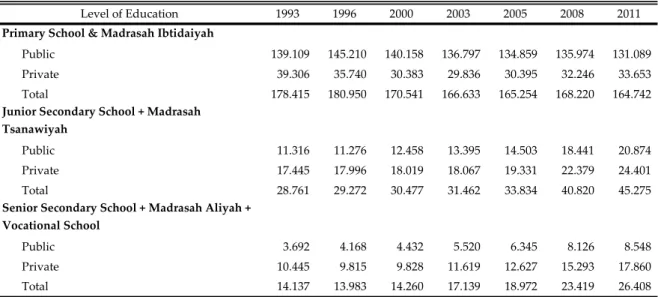
Table 2. Number of schools by level of education and type of provider, 1993 - 2011 ... 15
Table 3. Classification of schools ... 61
Table 4. Weighted value of items for scoring as a National Standard School (Junior Secondary) ... 62
Table 5. Number of schools accredited 2007-2012 ... 62
Table 6. Weighted value of items used in accreditation of primary schools/madrasah ... 63
Table 7. Number of schools accredited and % at level A – D by BAN-SM in 2013... 63
Table 8. Categories, indicators, questions and weighting used in SSE for primary schools ... 64
Table 9. Summary of Performance Indicators for Basic Education Minimum Service Standards ... 65
Table 10. Number of schools selected from each category of schools, 2013 survey ... 66
Table 11. MSS Indicators which are lagging in all schools and additional indicators which are lagging in each type of school ... 69
Table 12. Alternative costing scenarios for closing the gap in Purworejo, Central Java ... 71
Table 13. Current perceived incentives, sanctions and benefits at school level ... 75
Table 14. 2013 Grade 9 national exams – average pure exam marks and average school marks together with the lowest and highest scores and standard deviations ... 94
Table 15. Sample calculation of final exam mark for one subject e.g. Maths ... 97
Table 16. Estimates of variance attributable to district school or individual studenton 2013 pure national exams scores ... 106
Table 17. Participation in international tests ... 118
Table 18. PISA 2012 Indonesia Maths, Literacy and Science % at each proficiency level ... 124
Table 19. PISA Maths Indonesia – Impact of some school education management practices on school’s average PISA score, adjusted by student ECSC and by student + school EDSC ... 128
Table 20. Relationship of school location, ECSC rating and average performance in Maths ... 129
Table 21. Summary of performance on international tests ... 129
Table 22. Type of Services ... 141
Table 23. Coordination of Holistic-Integrated ECED services based on Perpres no. 60/ 2013 ... 149
Table 24. A proposed allocation of responsibilities across levels of government and elements of ECED
service provision ... 150
Table 25. Contribution of PNPM Rural to ECED in Gunung Kidul District ... 155
Table 26. Contribution of PNPM Rural in Sijunjung District ... 156
Table 27. International comparison of filters or screens used in the Teacher Training “pipeline” (with the addition of Indonesia) ... 183
Table 28. Comparison of teachers between 2010 and 2012 ... 190
Table 29. Roles and Responsibilities of the Five Ministries ... 192
List of Boxes Box 1. 2009-10 TIMSS Video Study (Andy Ragatz, World Bank) ... 30
Box 2. The 2014 ASEAN Business Outlook Survey ... 31
Box 3. The Hidden Curriculum ... 32
Box 4. India – 9 non-cognitive areas to be incorporated in all curriculum ... 41
Box 5. 21st Century Skills ... 42
Box 6. Ontario - The Character Development Initiative ... 46
Box 7. Teachers’ Personal and Social Competencies ... 47
Box 8. Indonesian Character Development Pilot Program ... 51
Box 9. Character development – Sample integrated lesson planning guide from Kurikulum 2013 ... 54
Box 10. Eight Non-cognitive Skills - Meta Analysis by Heckman & Kautz, 2013 ... 55
Box 11. Science equipment ... 68
Box 12. Cost of Bridging the Gap ... 70
Box 13. Comparing the two accreditation systems ... 72
Box 14. Official Seal Service Announcement ... 75
Box 15. Conclusion from World Bank Study - Governance and local education performance: a survey of the quality of local education governance in 50 Indonesian districts 2013 ... 77
Box 16. Findings of the ACDP study of principals’ and supervisors’ competencies ... 77
Box 17. Qualification for personnel in ECED sevices ... 146
Box 18. Basic assumptions for the cost projections ... 153
Box 19. Estimates of student learning based on teacher knowledge vs. teacher degree ... 173
Abbreviations
ACDP Analytical and Capacity Development Partnership AIDS Acquired Immune Deficiency Syndrome
AK Akademi Komunitas (Community Academy)
APBD Anggaran Pendapatan dan Belanja Daerah (sub-national budgets) APBN Anggaran Pendapatan dan Belanja Nasional (central government budget) AQRF ASEAN Qualifications Reference Framework
ASEAN The Association of Southeast Asian Nations
ATMI Akademi Tehnik Mesin Industri (Technical College for Mechanical Engineering)
BAN-PT Badan Akreditasi Nasional Perguruan Tinggi (National Accreditation Board for Higher Education)
BAN-SM Badan Akreditasi Nasional Sekolah Menengah (National Accreditation Board for Senior Secondary Education)
BEC-TF The multi-donor Basic Education Capacity Trust Fund
BERMUTU Better Education through Reformed Management and Universal Teacher Upgrading BKB Bina Keluarga Balita (Under-five Child Family Development)
BKD Badan Kepegaiwan Daerah (Regional Employment Board) BKN Badan Kepegawaian Nasional (National Employment Board) BLK Balai Latihan Kerja (Vocational Centres)
BLU Badan Layanan Umum (Public Service Agency)
BOPTN Biaya Operasional PTN (Operational Cost for Public University) BOS Bantuan Operasional Sekolah (School Operational Assistance Grant) BOSDA Bantuan Operasional Sekolah Daerah (Local School Grant)
BPKB Balai Pengembangan Kegiatan Belajar (Center for Learning and Development Activities) BRIICS Brazil, Russia, India, Indonesia, China and South Africa
BSM Bantuan Siswa Miskin (Program of assistance for poor students)
BSNP Badan Standar Nasional Pendidikan (National Education Standards Agency) CAS Creativity, Action, Service
CIMU Central Independent Monitoring Unit CME Civics and Moral Education
CPD Continuous Professional Development Program
CREATE Consortium for Research on Educational Access, Transitions and Equity CSR Corporate Social Responsibility
DACUM Develop A Curriculum
DAK Dana Alokasi Khusus (Special Allocation Fund)
DAPODIK Data Pokok Pendidikan (School Self Evaluation and Essential School Data) DAU Dana Alokasi Umum (General Allocation Fund)
DBH Dana Bagi Hasil (Shared Fund)
DFID UK Department for International Development DGHE The Directorate-General of Higher Education DID Dana Insentif Daerah (Regional Incentive Fund)
DITJEN DIKTI Direktorat Jenderal Pendidikan Tinggi (Directorate General of Higher Education) DIPA Daftar Isian Penggunaan Anggaran (Ministry Budget Implementation Documents) DISNAKER Dinas Tenaga Kerja (Local Government Labour Office)
DKI Daerah Khusus Ibukota (Capital City Special region) DSF Decentralization Support Facility
EAP East Asia and Pacific
EBTANAS Evaluasi Belajar (national exam prior to the current Ujian Nasional).
ECER The Early Childhood Environment Rating Scale EMIS Education Management Information Systems EQAS Education Quality Assurance System
ESCS Economic, Social and Cultural Status
EU European Union
GDP Gross Domestic Product
GER Gross Enrollment Ratio
GoI Government of Indonesia
GPI Gender Parity Index
GRDP Gross Regional Domestic Product
GTT Guru Tidak Tetap (Public school-hired teachers)
GTY Guru Tetap Yayasan (Permanent foundation-hired teachers HI ECED Holistic and Integrated Early Childhood Education Development HIV The Human Immunodeficiency Virus
HPEQ Health Professional Education Quality HRDF Human Resource Development Fund ICCS International Civics and Citizenship Study ICT Information, Communication and Technology
IDR Indonesian Rupiah
IEA International Education Association
IGTKI Ikatan Guru Taman Kanak-kanak Indonesia (Association of non-formal ECED and Kindergarten teachers)
ILEGI Indonesian Local Education Governance Indicator IMF International Monetary Fund
INAP Indonesian National Assessment Program
INPRES SD Instruksi Presiden untuk Sekolah Dasar (Presidential instruction for the elementary school construction program)
INSTIPER Institut Pertanian STIPER Yogyakarta (Yogyakarta Institute of Agriculture) IPB Institut Pertanian Bogor (Bogor Institute of Agriculture)
ITB Institut Teknologi Bandung (Bandung Institute of Technology) ITS Institut Teknologi Surabaya (Surabaya Institute of Technology) JPS Jaringan Pengaman Social (Social Safety Net)
KB Kelompok Bermain (Play Group)
KKG Kelompok Kerja Guru (Teacher Working Group)
KTSP Kurikulum Tingkat Satuan Pendidikan (School-based curriculum development) LAM Lembaga Akreditasi Mandiri (Independent accreditation agencies)
LKP Lembaga Keterampilan & Pendidikan (Institute for Skills development and Education)
LMIC Lower middle income
LMS Learning Management System
LPMP Lembaga Penjaminan Mutu Pendidikan (Institutes for Education Quality Assurance) LPTK Lembaga Pendidik dan Tenaga Kependidikan (Teacher Pre-service Training Institutes) M&E Monitoring and Evaluation
MenPanRB Menteri Pendayagunaan Aparatur Negara (Minister of State Apparatus and Bureaucratic Reform)
MET Measures of Effective Teaching
MGMP Musyawarah Guru Mata Pelajaran (Subject Teachers Forum) MI Madrasah Ibtidayah (private Islamic elementary school) MoEC Ministry of Education and Culture
MoF Ministry of Finance
MoHA Ministry of Home Affairs
MoMT Ministry of Manpower MOOC Mass Open Online Courses
MoRA Ministry of Religious Affairs
MoU Memorandum of Understanding
MP3EI Masterplan for Acceleration and Expansion of the Indonesia Economic Development
MSS Minimum Service Standards
MT Madrasah Tsanawiyah (private Islamic junior secondary school) MWA Majelis Wali Amanat (Board of Trustees)
NER Net Enrolment Ratio
NGO Non-Governmental Organization
NPSD National Program for Skills Development NQF National Qualifications Framework NSPK Norms, Standards, Procedures and Criteria
NUPTK Nomor Unik Pendidik dan Tenaga Kependidikan (Teachers’ unique ID number)
DL Open and Distance Learning
OECD The Organisation for Economic Co-operation and Development OMR Optical Mark Recognition
P2TKPAUDNI Pembinaan Pendidik dan Tenaga Kependidikan, Pendidikan Anak Usia Dini, Non-formal dan Informal (Professional Development program for educators and personnel in the ECED, Non-formal Education and Informal Education sectors)
P4TK Pusat Pengembangan Pemberdayaan Pendidik dan Tenaga Kependidikan (Centres for Development and Empowerment of Teachers and Education Personnel)
PBPU Program Bantuan Peningkatan Mutu (Quality Enhancement Support Program) PBS Pengakuan Sebelum Belajar (Recognition of prior learning)
PE Physical Education
PEDP Polytechnic Education Development Project
PENS Politeknik Elektronika Negeri Surabaya (Surabaya National Electronics Polytechnic)
PerMenPanRB Peraturan Menteri PANRB (Regulation from the Minister for State Apparatus and Bureaucratic Reform)
PIRLS Progress in International Reading Literacy Study PISA Program for International Student Assessment
PKG Penilaian Kinerja Guru (annual appraisal of work performance)
PMDK-PN Penelusuran Minat dan Kemampuan Politeknik Negeri (national selection for public polytechnics by invitation)
PMU Program Menengah Universal (Program for universal 12 years education) PNS Pegawai Negeri Sipil (civil servant)
PODES Pendataan Potensi Desa (Statistical indicator of village potential) PolMan Politeknik Manufaktur (Polytechnic for the manufacturing industries)
POM Performance Oversight and Monitoring (for the DFAT Education Partnership Program) Posyandu Pos Pelayanan terpadu (Integrated Services Post)
PP Peraturan Presiden (Presidential Decree)
PPAS Program Peningkatan Akses (Program to increase access to junior secondary education)
PPP Public–Private Partnerships
PTN-BH Perguruan Tinggi Negeri-Berbadan Hukum (Autonomous university)
QA Quality Assurance
QSL Quality of School Life questionnaire RENSTRA Rencana Strategis (strategic plan) RCGP Central Government within the Province
ROHIS Kelompok Rohani Islam (Islamic Student Spiritual Mentors)
RPJMN Rencana Pembangunan Jangka Menengah Nasional (National Medium Term Development Plan)
RPL Recognition of Prior Learning
RSBI Rintisan Sekolah Berbasis Internasional (International Standard Pilot School) SD Sekolah Dasar (Elementary School)
SMA Sekolah Menegah Atas (Academic Senior Secondary School) SME Small to Medium Enterprise
SMK Sekolah Menengah Kejuruan (Vocational Senior Secondary School) SMP Sekolah Menegah Pertama (Junior Secondary School)
SNMPTN Seleksi Nasional Masuk Perguruan Tinggi Negeri (National Entrance Test for Public Universities)
SPN Standar Pendidikan Nasional (National Education Standards) SSC Sector Skills Councils
SSE School Self Evaluation SSN National Standard Schools
Susenas Survei Sosial dan Ekonomi Nasional (National Social and Economic Survey) TAPP The Aceh Politeknik Program
TIMSS Trends in International Mathematics and Science Study TK Taman Kanak-Kanak (Kindergarten)
TMOE Taiwan Ministry of Education TP Tugas Pembantuan (Assistance Task)
TPA Day Care Center
TVET Technical and Vocational Sector UAS Ujian Akhir Nasional (National Exams) UGM University of Gajah Mada
UI University of Indonesia
UK United Kingdom
UKG Uji Kompetensi Guru (Competency Testing)
UKK Promotion Examination
UN Ujian Nasional (National Exam)
UNESCAP The Economic and Social Commission for Asia and the Pacific UNESCO The United Nations Educational, Scientific and Cultural Organization UT Universitas Terbuka (Open University)
UU Undang Undang (Law/Legislation)
WB The World Bank
WPB Work Plan and Budgeting
Overview
The role of education in achieving the broader goals of the RPJMN
Education can play a key role in achieving the overarching goal of the RPJMN for inclusive and sustainable development. Underlying this goal are three key principles. First, the plans outlined in the RPJM must be economically feasible and support strong economic growth. Second, the development path over the next five years must be socially acceptable. It will need to improve social harmony, encourage community participation and narrow inequalities across regions and between socio-economic groups. A third key principle underlying the RPJM is the need for greater sustainability and the need to protect the environment for future generations. A strong, vibrant and good quality education system can support all of these underlying principles.
The education sector can contribute significantly to the improvements in economic productivity required to sustain higher rates of economic growth. The provision of good quality education can equip all citizens with the skills the economy needs to raise productivity and prosper in a region that is becoming increasingly more competitive. Recent international research shows that ensuring all children leave school with strong foundation skills can raise annual per-capita growth by up to one percentage point. This shows the importance of the role that education can play in supporting the transformation necessary if Indonesia is to maintain its strong record of economic growth and avoid the middle-income trap other countries have fallen into.
A strong and good quality education system can also lay the foundation for more inclusive development.
Over the last five years, income inequality has been growing across regions and between different groups in Indonesia.Disparities in access to education are likely to be an important causal factor driving these growing inequalities. Failure to tackle this growing inequality has the potential to both lower future economic growth and also sow the seeds of future social tensions. Providing good quality educational opportunities to all children, regardless of the circumstances that they are born into, can reduce inequality and give children the skills they need to participate constructively in Indonesia’s economy and its lively democracy.
Education can also be an important vehicle for promoting social harmony and building an environmentally responsible nation. It has a vital role to play in promoting social cohesion and building a peaceful and secure Indonesia. Schools can provide children with the skills and understanding needed to live peacefully and to build an awareness and tolerance of the religious, ethnic and linguistic diversity of Indonesia.Schools are ideal places to highlight the importance of sustainability and to foster in young people personal behaviors that protect the environment for future generations. The education system can also support the development of the skills needed to encourage the necessary innovations to better adapt to the impacts of environmental change that will be seen in the coming years.
Strengthening the education system is imperative if Indonesia is going to fully exploit the opportunities that are likely to arise over the next five years. Between 2013 and 2025 the share of the population that is of working age will continue to increase. In the region as a whole, declining dependency ratios have been associated with more rapid per-capita growth because of the increased proportion of the population that is employed. The size of this demographic dividend will depend in part, on the ability of the education system to impart the skills the economy needs before the dependency ratio begins to increase again. Recent trends suggest that this will require improving access to post-basic education opportunities: since 2001, approximately 75% of the new jobs created have been for entrants with senior secondary or tertiary education. These trends are likely to continue with the closer integration of the ASEAN community.
Key strategies to underpin the steps towards 12 years quality education
Ensuring all children receive 12 years of good quality primary and secondary education is a key step towards Indonesia’s objective of inclusive and sustainable development. A good quality primary and secondary education system provides the basic cognitive and behavioral skills that employers are demanding and which labor market entrants increasingly need to be successful. It also provides young adults with a strong foundation to continue their studies to the tertiary level. While there are many strategies that will be needed to universalize access to 12 years of education they may be seen to fall under 4 main areas:
1. Raising the quality of primary and secondary education. Despite a considerable reform effort, international assessments of student achievement show that the quality of the education system remains low. Efforts to improve the quality of education need to be reinvigorated otherwise universalizing access to 12 years of education will not bring about the expected benefits in terms of development. While the required focus of quality improvement is in primary and secondary schools it is also important to strengthen early childhood development to ensure all children are ready to learn when they start primary school.
2. Increasing equitable access to senior secondary schooling. There are approximately 6 million children who do not complete 12 years of education. The challenge of extending opportunities to these children is enormous and will require a combination of increased supply as well as a range of demand side measures to support children from poor households.
3. Improving access to good quality educational opportunities for all. In order to universalize access to 12 years of good quality education it is vital to develop effective strategies to support regions and population groups that lag behind. Despite significant gains in educational attainment amongst poor and vulnerable households over the last 10 years, a concerted effort is still required to reach children that are being left behind.
4. Raising the efficiency of the education system. Efforts to raise levels of attainment and increase the quality of education will not be successful without adequate investment. However, a large part of the required investment will need to be realized from efficiency savings in the current education budget as well as strengthening partnerships with the private sector.
Strategies aimed at achieving good quality primary and secondary education can also support the RPJMN goals for tertiary education. Increasing demand for tertiary education graduates in the labor market implies a need to expand access. In particular, the overarching RPJMN goal of inclusive development places a priority on expanding tertiary access for the poorest households. In order to do this, it is vital that children from poor and vulnerable families are able to complete a full cycle of good quality primary and secondary education. Ensuring that the governance of tertiary education institutions enables good quality provision that is relevant for the labor market, is also a critical challenge for the RPJMN.
Achievements in the education sector over the last 5 years
Over the last ten years, significant progress has been made in implementing a comprehensive education reform agenda. In 2001, the responsibility for many aspects of basic education service delivery was devolved to local governments. Further reforms were introduced in 2003 that provided the legal basis for school based management and formalized school committees in an effort to encourage local community participation and to strengthen accountability of schools to their communities.The Teacher Law of 2005 addressed shortcomings in teacher pay and quality by introducing certification and a strengthened program of continuous professional development. At the same time, the national school grants program (BOS) was rolled-out and gave schools vital resources to support their adoption of earlier school based management reforms. These three reforms brought the Indonesian system of education in line with modern education world-wide.
Across all subsectors of education services, the government also developed processes for quality assurance including introduction of minimum service standards, expansion of the program for accreditation of the school and higher education sectors, new laws for governance of the higher education sector, performance assessment of teachers and the framework for continuous professional development (CPD) of principals.
Despite significant global turmoil in 2008, the reforms above were backed up with substantial increases in public education investments. In 2009, a constitutional obligation to devote a fifth of the national budget to education was achieved for the first time. This resulted in a more than doubling of public education spending in real terms between 2001 and 2009, a rate seen in few other countries.
Since then, public investment in education has continued to grow rapidly. Over the last four years (2009-2013), increases in the overall national budget have supported annual growth in public education spending of about 6.5 percent in real terms (Figure 1).
The reforms and increases in public investment have led to an expansion of educational opportunities, particularly for the poorest children. Universal primary enrolment has largely been achieved and by 2013, almost all children, including the poorest were in school between the ages of 7
and 12. Enrolment rates in secondary schooling also increased significantly (Figure 2) and are now comparable to other lower middle income countries. Enrolments in tertiary education have continued to rise. Overall, the share of 6 -22 year olds enrolled in education has increased from 66 percent in 2006 to 73 percent in 2013. This means that since the beginning of the current RPJM (2010) an additional 7 million children and young adults have enrolled in the education system.
The improved participation rate has been driven mainly by the increased participation in education of children from the poorest households and has led to significant reductions in educational inequality (Figure 2). While enrolment for the wealthiest children has remained high and largely unchanged over the current RPJM, enrolment rates for children from the poorest households have increased significantly. For example, the share of 15 year olds in the poorest 20 percent of Indonesian households enrolled in school has increased from 63 percent to 74 percent between 2009 and 2013. A similar trend for poor and wealthy households can be observed for later ages and illustrates the reduction in inequality seen over this period.
However, significant enrolment gaps remain. For example, in 2013, 59 percent of 18 year-olds in the wealthiest households were still in school compared to 29 percent in the poorest households.
Figure 1. Public expenditure on education, 2001-2013
Source: 2010-2013 revised plan budget laws, MoF, BPS for Susenas and GDP and CPI deflators
11 15
16
14 14 14 16 16
22 20 20
19 19
0 5 10 15 20 25
0 50 100 150 200 250 300 350 400
2001 2002 2003 2004 2005 2006 2007 2008 2009 2010 2011 2012 2013
Percent IDR Trillion (2012 Prices)
Central (LHS) Province (LHS)
District (LHS) % of GDP (RHS)
% of Government Spending (RHS)
Figure 2. Education participation rates, 2003-2013
Source: Susenas, 2003-2013
While increased investment has led to some notable achievements in increasing educational opportunity, changes in learning achievement have been more mixed. The teacher law and the certification program have increased the proportion of teachers with a bachelor’s degree from 36 percent to 63 percent between 2006 and 2012. This improvement in teacher qualifications is expected to improve the quality of teaching in the long-term. However, Indonesia has performed relatively poorly in international learning assessments when compared to other countries. For example, Indonesia fell below other countries in the region such as Thailand and Malaysia in the 2012 OECD PISA assessment. Trends in learning also show a mixed picture.
Since 2006, learning achievement amongst Indonesian 15-year olds has improved in Reading but has not shown improvement in Mathematics and Science.
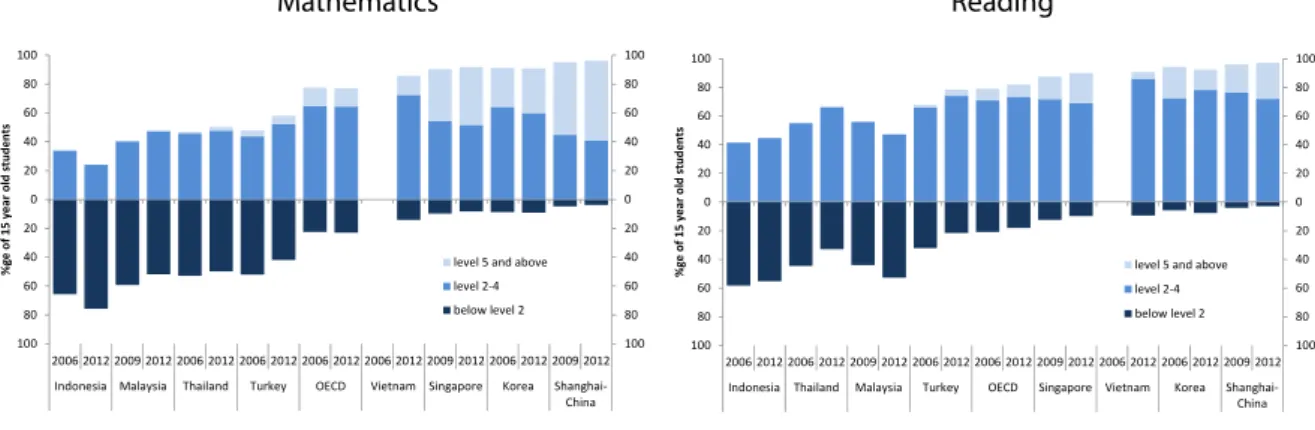
Average levels of learning hide significant differences across countries in mathematics and reading proficiency levels (Figure 3). In Indonesia, the majority of 15 year-olds fall below level 2 proficiency, a level that is associated, in some countries, with difficulties for students wishing to continue into higher education or transition into the labor force. In 2012, three-quarters of Indonesian students were at level 1 or below where students are able to do ‘very direct and straightforward mathematical tasks, such as reading a single value from a well-labeled chart or table’. Trend analysis also shows a drop in mathematics proficiency levels between 2006 and 2012.
Figure 3. Share of students at each PISA proficiency level in mathematics and reading in selected countries, 2006 and 2012
Mathematics Reading
Source: OECD PISA 2013
0%
10%
20%
30%
40%
50%
60%
70%
80%
90%
100%
6 7 8 9 10 11 12 13 14 15 16 17 18 19 20 21 22 2009 2013
Poorest 20% of households
0%
10%
20%
30%
40%
50%
60%
70%
80%
90%
100%
6 7 8 9 10 11 12 13 14 15 16 17 18 19 20 21 22 2009 2013
Wealthiest 20%
of households
100 80 60 40 20 0 20 40 60 80 100
100 80 60 40 20 0 20 40 60 80 100
2006 2012 2009 2012 2006 2012 2006 2012 2006 2012 2006 2012 2009 2012 2006 2012 2009 2012 Indonesia Malaysia Thailand Turkey OECD Vietnam Singapore Korea Shanghai‐
China
%ge of 15 year old students
level 5 and above level 2‐4 below level 2
100 80 60 40 20 0 20 40 60 80 100
100 80 60 40 20 0 20 40 60 80 100
2006 2012 2006 2012 2009 2012 2006 2012 2006 2012 2009 2012 2006 2012 2006 2012 2009 2012 Indonesia Thailand Malaysia Turkey OECD Singapore Vietnam Korea Shanghai‐
China
%ge of 15 year old students
level 5 and above level 2‐4 below level 2
Data from national examinations show significant disparities in learning between students, schools and regions. For example, students who have parents with low levels of education or low incomes tend to do less well at school. Moreover, female students tend to do better in national examinations than their male counterparts. These findings highlight the need to provide all children with access to good quality education opportunities in order for them to fulfil their full potential.
A comparison between the achievements and the increases in spending on education over the last five years highlights a concern over efficiency in the sector. In particular, a large proportion of additional education spending has been directed towards hiring new teachers and paying them more through professional allowances associated with the national teacher certification program. While increased spending on teachers has put significant additional burden on the education budget it is not clear that it has had an impact on education outcomes and particularly learning achievement. Weaknesses in the mechanisms used to allocate resources to local governments and schools have also reduced the impact of public spending increases on education outcomes.
Key challenges that must be addressed in the next five years
On the 2014 Pearson Learning Curve rating, which is a composite score based on international test results and assessment of adult competencies, Indonesia is ranked at 40/40. One of the key lessons identified by the Pearson Report which is pertinent for this moment in Indonesia is that “developing countries must teach basic skills more effectively before they start to consider the wider skills agenda. There is little point in investing in pedagogies and technologies to foster 21st century skills, when the basics of numeracy and literacy aren’t in place”.
With this in mind, a strong focus on the quality of basic education is still needed and the key priority for the next five years must be to improve the learning outcomes of students from schooling, from vocational skills training and from the higher education sector. High pass rates and high graduation rates have for many years masked the real level of achievement.Improvement and expansion to 12 years universal education will not deliver the desired individual or national outcomes if the quality is not really there.
A necessary step in improving learning outcomes should be careful consideration of the whole system and culture of learning assessment, including the exams, system monitoring of outcomes and school level assessment. The national exams appear to have the point where the imperatives to maintain high pass rates have seriously distorted the examination process and the results have little value. School marks are being awarded by teachers to ensure that all students pass and in doing so, provide a disproportionate bonus to the less able and lower performing students. While some may see this as an equalizing strategy across the disparate regions of Indonesia, it is unfair to students who have worked hard and earned their exam marks.
The imperative for all to pass is also one of the factors which sustain cheating, which in turn generates a high cost in human, social and fiscal terms and diminishes community confidence in the education system. The choices for government will be to reform and properly resource improvements to the existing assessment system or institute a totally new system of assessment. This is a hugely controversial area with many opposing ideologies but it will be very difficult, and maybe impossible, to drive effective improvement in teaching and learning in the absence of valid and reliable assessment on which to base improvement efforts and for monitoring progress.
If the quality of learning outcomes is not addressed with some urgency, and in a sustained and systematic way, the current low quality of learning outcomes could hold the nation back.For example, the potential of the anticipated demographic bonus will not be realized if the mass of students entering the workforce do not have adequate basic skills. The opening up of trade in the ASEAN community will create pressure for all countries to be more competitive and Indonesia must avoid the scenario in which it becomes primarily a source of semi-skilled labour in Asia, instead of leading in innovation, entrepreneurship and application of technologies.
The introduction of a new curriculum in 2013 had wide ranging and ambitious objectives for quality and relevance, including to drive new pedagogy and assessment, but the agenda was also driven by political
imperatives which did not allow sufficient time for consultation, review, trialling and preparation. Not surprisingly Kurikulum 2013 became highly controversial and is now under review. In moving forward on curriculum and assessment it is most important that the new government recognises the prime role of national standards and the subsidiary roles of curriculum and assessment as tools for quality teaching, quality learning and system monitoring.
In preparing young people for the workforce and for productive lives, the education system must include deliberate teaching of non-cognitive skills including character skills and the so-called 21st century learning skills.A considerable body of educational research suggests that non-cognitive skills (e.g. persistence, self- discipline, effective communication) are equally if not more influential than academic skills in predicting post-school outcomes. While there are many different approaches in which schools can develop character skills, including religious education, a key message from meta-analysis of relevant research is that good teaching, effective leadership and a positive school climate can develop character skills naturally as part of the effective teaching of academic skills. The implication of this is that real reform in teaching can have a positive flow-on effect to the personal quality of school graduates , the well-being of the country and its economic status in the region.
The reform of the teaching process can happen school by school, day by day, through the way that individual teachers, principals, supervisors and district officials view their job and take responsibility for their actions. This approach is consistent with the Mental Revolution proposed by President Joko Widodo, which calls for a new mindset in which citizens, including teachers and education officials, are empowered to make moral choices and behave in ways that will improve teaching and learning.
Principals, school supervisors and teachers themselves must be the leaders of change in this organic school- by school process which reaches into to every classroom.
Principals and teachers however cannot do this alone. They must be supported by a system that values and supports teachers through its selection methods, pre-service training, induction, school-based development procedures and effective performance management. National and local government must work together to ensure more effective management and deployment of the teaching workforce. This will result in more students having quality teachers who feel valued and act as professionals.
Part of the system-change required is to focus on school improvement. There are several, disconnected systems and tools for school quality assurance and accreditation. These need to be streamlined, aligned and implemented more rigorously, with appropriate incentives for improvement, sanctions for inaction and positive support for change. A key tool, the Minimum Service Standards (MSS) is not well understood and needs to be reviewed and reinforced as a responsibility of local government. From the 2013 MSS survey, around 70 percent of all schools did not meet MSS for text books and enrichment books and 40 percent did not have the required resources for teaching science. On these and other indicators, the MSS survey showed very large differences between public and private schools, highlighting a serious issue of inequity between the systems which has yet to be addressed effectively.
Having qualified, competent and motivated teachers and leaders in every school is the key to improving learning. Given the huge investment in teacher upgrading nation-wide, this is clearly achievable if there can be system adjustments to the way that school staffing entitlements are calculated and the ways that teachers are distributed and supported.
Even in the current situation, school level processes specified by the MSS should not be costly to improve (e.g. ensuring that every teacher has a lesson plan for every lesson, ensuring that principals visit classrooms and give constructive feedback to teachers) but will require principals and supervisors to provide professional leadership, support and supervision. This is lacking in many schools. Empowering parents and communities and encouraging their active engagement in schools, including in school committees and in school self-evaluation, will ensure they are better informed and better able to support school improvement.
The natural starting point for increased parent engagement in education is in the early years of child development, including education and support for good pre-natal care and child nutritution and the continuing expansion of quality community based early childhood development centres. These are all
examples of community-based programs which should be supported by a joint health-education approach in order to facilitate improved access, especially by the poor, to good quality pre-primary education.
Students who have two years of good quality pre-primary education will start school prepared for learning and continue to achieve more highly than those who missed that opportunity. The results on PISA tests of 15 year olds in Indonesia show that having two years of pre-primary education confers a benefit of 41 points, equivalent to being one year ahead in schooling, or 29 points if adjusted for socio-economic status. But sadly, twice as many rich students as poor students have this advantage. Poor students are more likely to start school late, experience early learning failure and repeat a grade - all factors which are associated with subsequent learning failure, drop out and, as a consequence, will continue the cycle of poverty.
The lasting impacts of socio-economic disadvantage on learning are also seen in analyses of the Indonesian PISA test results by equity quartile. The likelihood of a disadvantaged 15 year old “beating the odds” and scoring in the top performance quartile is described as an index of student resilience. On the Indonesian sample, a very low percentage of students, just 2.5 percent, who are top scorers on the PISA tests come from the bottom socio-economic quartile.
Figure 4. PISA calculations of student resilience based on the percentage of top-scoring students coming from the lowest socio-economic quartile
Evidence of continuing inequity in the quality of education offered and in the learning outcomes of students suggests that the increased investment of the past 5 years has not delivered the desired results. The most disturbing example is the lack of evidence , thus far, of teacher reforms demonstrating positive impacts on either teachers’ competence, or students’ learning: the majority of teachers fail the competence tests, and principals and supervisors as a group score even lower than the staff they must supervise. In retrospect, it appears that a high level of system inefficiency and weak accountability have prevented good reforms and policy instruments from being fully implemented as planned. While the challenges of scale and the diversity in the operating environment are daunting, investment in improved teacher selection and training and in teacher management and support must be continued .
The Joint Decree on teacher management provides a way forward for district governments to implement more innovative solutions to address teacher support needs and teacher management issues. At the same time, it can be seen that improved remuneration and conditions for teachers are beginning to raise the quality of entrants to the profession.
2.5 2.6
6.3 6.5 12.8
18.2 15.1
0 2 4 6 8 10 12 14 16 18 20
Figure 5. Estimates of student learning over six years of Primary School based on teacher knowledge vs. degree
Source: De Ree, 2013
Clearly the higher education sub-sector in Indonesia has a key role in skilling the nation and in teacher improvement in particular. The higher education sector, like the school sector, has grown very rapidly. There are now over 3,500 institutions established, many of which are very small, private, poorly funded institutions which cannot provide quality programs and would in many other countries be regarded as unviable. A more rigorous approach to accreditation and quality assurance is needed to halt the proliferation of low quality institutions for higher education and to help improve the quality of all. There is also a problem of relevance in which many institutions (large and small) are not providing programs relevant to the skill needs of the country. Even in the area of teacher training, which has become a “cash-cow” for many institutions, many graduates emerge with little, if any, practical training in pedagogy and low subject knowledge, having been taught by lecturers who are not experts in classroom teaching. As is shown above in Figure 5, teachers’
subject knowledge has a direct relationship with improved student learning.
Although enrolments in higher education have climbed steeply in response to both supply and demand factors, the enrolment is highly skewed across socio-economic profiles.While 66.6 percent of young people from the highest socio-economic quintile are enrolled in degree courses, just 2.5 percent of those from the lowest quintile are enrolled. These figures are an eerie reflection of the PISA resilience index of 15 year olds.
Such inequity requires a range of affirmative actions, not just scholarships, to be applied throughout the full continuum of schooling in order to prepare young people from every social background to enter and be successful in higher education.
In addition to addressing inequity arising from factors such as poverty, isolation and cultural difference, the policy reforms needed to improve quality in higher education include rationalizing and strengthening the institutional focus and mission of institutions and strengthening their processes for quality assurance, which are currently weak. Institutional support is also needed to address management and administration, the quality and qualifications of lecturers and their teaching and research skills as well as the capacity of individuals and institutions to reach out and serve the needs of industry and the workforce.
Efforts and incentives to improve the relevance of higher education will enhance individual employability and the quality and competitiveness of Indonesian businesses and entrepreneurial ventures. Decisions about priorities and reforms in both institutional governance and relevance need to be informed by consistent policy and research.More autonomy in governance and improved funds channeling could provide the impetus for locally-driven initiatives and reform to improve the quality of university teaching and research, extend partnerships with industry and business and reach out to remote areas.
Like the higher education sector, skills training in the technical and vocational sector (TVET) has also expanded rapidly and is poorly regulated. It is described as having an “aura of chaos” with many issues and opportunities similar to the higher education sector: the quality and relevance of courses provided and the
0 0.1 0.2 0.3 0.4 0.5 0.6
0 1 2 3 4 5 6
1 Standard Deviation increase in teacher knowledge Remaining teachers upgrade to S1
Remaining upgrade to S1, but control for knowledge
skills of teachers need to be greatly improved. Good quality TVET has an important role in increasing equity of opportunity by ensuring multiple pathways, flexible entry and re-entry, lifelong learning and transportable qualifications and credits within a national qualifications framework. Within such a framework, a more entrepreneurial, demand-driven approach, oriented to local needs and opportunities as well as regional and global opportunities, should fairly quickly generate more positive outcomes for students and raise national productivity.
The agenda sketched briefly above requires intense effort and coordination from national and local government.As a consequence of both the rapid expansion of local government entities and for many, their remote location and isolation from expertise that could be provided by others, the result has been low capacity of local government to manage and weak systems for data collection, management and analysis.
The systematic use of evidence for decision-making at both national and local level is a dream yet to be realized. Around 30 percent of local governments have been established in the last 10 years and many will need a decade to become fully effective. What is encouraging is that there is a strong link between better quality local governance and better education performance.
As the policy leader for education in Indonesia, the national government has huge responsibilities for management oversight