1
INDONESIA
CORPORATE
GOVERNANCE MANUAL
Second Edition
Swiss Confederation IN PARTNERSHIP WITH:
INDONESIA
CORPORATE GOVERNANCE MANUAL
Second Edition
Jakarta, June 2018
The material in this work is copyrighted. Copying and/or transmitting portions or all of this work without permission may be a violation of applicable law. IFC encourages dissemination of its work and will normally grant permission to reproduce portions of the work promptly, and when the reproduction is for educational and non-commercial purposes, without a fee, subject to such attributions and notices as we may reasonably require.
IFC does not guarantee the accuracy, reliability or completeness of the content included in this work, or for the conclusions or judgments described herein, and accepts no responsibility or liability for any omissions or errors (including, without limitation, typographical errors and technical errors) in the content whatsoever or for reliance thereon. The boundaries, colors, denominations, and other information shown on any map in this work do not imply any judgment on the part of The World Bank concerning the legal status of any territory or the endorsement or acceptance of such boundaries.
The findings, interpretations, and conclusions expressed in this volume do not necessarily reflect the views of the Executive Directors of The World Bank or the governments they represent.
The contents of this work are intended for general informational purposes only and are not intended to constitute legal, securities, or investment advice, an opinion regarding the appropriateness of any investment, or a solicitation of any type. IFC or its affiliates may have an investment in, provide other advice or services to, or otherwise have a financial interest in, certain of the companies and parties (including named herein).
The Indonesia Corporate Governance Manual second edition provides an overview of general corporate governance principles applicable to Indonesian limited liability companies. The Manual also addresses certain corporate governance principles for Indonesian companies that are active in the financial sector and are supervised by Indonesia’s Financial Services Authority (Otoritas Jasa Keuangan). Companies in specific sectors, such as oil and gas, mining, and power, may be subject to different requirements which are either additional to or variations of those discussed in this publication. The laws of the Republic of Indonesia are frequently amended, such that legal rules referenced in this edition may be superseded by new legislation following the publication of this Manual.
All other queries on rights and licenses, including subsidiary rights, should be addressed to IFC’s Corporate Relations Department, 2121 Pennsylvania Avenue, N.W., Washington, D.C. 20433.
International Finance Corporation is an international organization established by Articles of Agreement among its member countries, and a member of the World Bank Group.
All names, logos and trademarks are the property of IFC and you may not use any of such materials for any purpose without the express written consent of IFC. Additionally,
“International Finance Corporation” and “IFC” are registered trademarks of IFC and are protected under international law.
© 2018 International Finance Corporation. All rights reserved.
2121 Pennsylvania Avenue, N.W.
Washington, D.C. 20433 Internet: www.ifc.org
5
Foreword
6
It is my pleasure to present the 2nd edition of the Indonesia Corporate Governance Manual. Commissioned by IFC, this version updates the first edition of the Manual that was published in January 2014, incorporating recent corporate governance changes applicable to public and listed companies in Indonesia, as well as capturing major developments in the global landscape. Indonesia’s Financial Services Authority issued the first “comply or explain” corporate governance guidelines for public companies in 2015 and since then has adopted additional regulations to raise governance standards among Indonesian companies, promote transparency and accountability in the corporate sector, and enhance public trust and confidence in Indonesian capital markets.
IFC, a member of the World Bank Group, is the largest global development institution focused on the private sector in emerging markets. As an investor, IFC continues to engage with our clients to influence change and help address various challenges companies face in emerging markets. A key aspect of our advisory support is to help IFC clients strengthen their governance practices. I believe that Indonesian companies will
Indonesia, Malaysia, and TimorLeste
7
find this publication useful in providing guidance on Indonesia’s corporate governance regulatory framework and in aligning their governance with international best practices.
Regards, Azam Khan
IFC Country Manager for Indonesia, Malaysia, and Timor-Leste
8
I would like to congratulate IFC on the publication of the second version of its Indonesia Corporate Governance Manual.
OJK and IFC have maintained a close collaboration in improving corporate governance practices of listed companies in Indonesia since the launch of the IFC Corporate Governance Program for Indonesia in 2012. A key objective of the Program is to raise awareness on good corporate governance practices through publications and case studies. This Manual contains pertinent legal references and practical guidance for local companies to implement good corporate governance practices.
OJK issued an Indonesia Corporate Governance Roadmap in 2014 to improve the country’s regulatory framework and align governance practices of local companies with those of their peers in other ASEAN countries. As part of the implementation of the Corporate Governance Roadmap, OJK issued Regulation No.
21/POJK.04/2015 and Circular Letter No. 32/SEOJK.04/2015 on the Implementation of Corporate Governance Guidelines for Public Companies ("OJK CG Guidelines"), which is the country’s first “comply or explain” guideline. Our objective was to raise governance standards among public companies while at the same time providing some flexibility for companies to tailor governance practices to their specific situations. To continue the momentum, OJK has issued numerous regulations to govern key elements that are essential to fostering good governance among public and listed companies. Together these regulatory changes are aimed at enhancing accountability and transparency in the corporate sector in Indonesia.
Board of Commissioners Otoritas Jasa Keuangan
9
The second edition of the Indonesia Corporate Governance Manual takes into account major corporate governance regulations issued by OJK and other regulatory bodies, in addition to leading international practices and standards. The Manual provides Indonesian companies with an indispensable resource for guidance on corporate governance issues. The Manual also explains the rationale for adopting higher governance standards, which could be useful for reform- minded commissioners and directors to build the business case for implementing good governance practices across their organizations. The Manual will also be a valuable reference to academics, students, researchers, and other stakeholders in providing insights, sharing best practices, and documenting the corporate governance regime in Indonesia.
Corporate governance has an important role in promoting sustainable economic growth by building investor confidence, reducing the cost of capital, strengthening financial markets, and creating jobs. OJK hopes that this Manual will inspire Indonesian companies to adopt and implement good governance practices, not simply as an exercise in regulatory compliance, but as a means to create highly competitive, profitable, and well- governed companies.
Sincerely, Wimboh Santoso
Chairman of the Board of Commissioners Otoritas Jasa Keuangan
OJK Disclaimer
OJK does not guarantee the accuracy, reliability or completeness of the content included in this work, or for the conclusions or judgments described herein, and accepts no responsibility or liability for any omissions or errors (including, without limitation, typographical errors and technical errors) in the content whatsoever or for reliance thereon.
10
11
The Indonesia Corporate Governance Manual Second Edition was produced as part of IFC’s Corporate Governance Program in Indonesia. The Program has been in operation since 2012 with generous support from Switzerland’s State Secretariat for Economic Affairs (SECO). The Indonesia Corporate Governance Manual was prepared based on other corporate governance manuals published by IFC’s Corporate Governance Program and adapted to Indonesia’s corporate governance legal framework and practices.
The preparation and publication of this Manual would not have been possible without the efforts of a number of highly dedicated people. The Manual’s text was adapted under the direction of Mohsin Chaudhry, IFC Corporate Governance Officer, and Liana Lim Hinch, IFC Consultant. The content was revised with substantial contributions from Emir Nurmansyah, Partner at Ali Budiardjo, Nugroho, Reksodiputro, and his team members, Theodoor Bakker, Senior Foreign Council and Gustaaf Reerink, Foreign Council.
The team is also grateful for continuous support from the Financial Services Authority, including OJK’s Chairman Wimboh Santoso, Nur Sigit Warsidi, Director of Accounting Standards and Corporate Governance, and their team in the development of this Manual.
12
This Manual is divided into 15 chapters:
The Indonesia Corporate Governance Manual discusses key corporate governance elements that have been contextualized to take into account current Indonesian laws and regulations as well as international best practices. While it is recommended to read the entire Manual to gain a full understanding of the corporate governance framework in Indonesia, it is not necessary to read all the chapters in chronological order. The Manual includes examples, illustrations, and checklists to aid clarity and understanding.
An Introduction to Corporate Governance Company Governance Structure
Internal Corporate Documents
An Introduction to Shareholder Rights General Meeting of Shareholders Board of Commissioners
Board of Directors Corporate Secretary
Risk Management and Internal Control Information Disclosure
Material Corporate Transactions Dividends
Charter Capital Corporate Securities
Corporate Governance Framework of Indonesian State-Owned Enterprises
Chapter 1 Chapter 2 Chapter 3 Chapter 4 Chapter 5 Chapter 6 Chapter 7 Chapter 8 Chapter 9 Chapter 10 Chapter 11 Chapter 12 Chapter 13 Chapter 14 Chapter 15 : : : : : : : : : : : : : : :
13
The following tools will reappear at various intervals in the text:
The Chairman’s Checklist
The Chairman’s Checklist is intended to help the Chairman of the Board of Commissioners focus board discussions on key issues and common challenges surrounding a particular governance topic.
Best Practice
Best Practices illustrate recommended governance practices based on the OECD Principles of Corporate Governance and leading international standards/
examples.
Comparative Practice
Comparative Practices illustrate how other countries approach specific corporate governance issues.
They highlight red flags, such as common corporate governance abuses as well as exemplary governance models/practices.
14
AGMS AoA ASEAN ATMR BKPM BoC BoD CG COSO EGMS FY G20 GMS ICL IDX IFC IFRS ISO KPMM KSEI LPS MMT MOF MOLHR OECD OJK POJK PSAK PT SEOJK US GAAP
Annual General Meeting of Shareholders Articles of Association
Association of South East Asian Nations
Aset Terimbang Menurut Risiko (Balanced Assets based on Risk) Badan Koordinasi Penanaman Modal
(Indonesia Investment Coordinating Board) Board of Commissioners
Board of Directors Corporate Governance
The Committee of Sponsoring Organizations Extraordinary General Meeting of Shareholders Fiscal Year
The Group of Twenty, comprises 19 countries plus the European Union
General Meeting of Shareholders Indonesian Company Law Indonesia Stock Exchange
International Finance Corporation
International Financial Reporting Standards International Organization for Standardization Kewajiban Penyediaan Modal Minimum (Minimum Capital Provision Obligation) Kustodian Sentral Efek Indonesia (Indonesia Central Securities Depository)
Lembaga Penjamin Simpanan (Deposit Insurance Corporation) Ministry of Manpower and Transmigration
Ministry of Finance
Ministry of Law and Human Rights
Organization for Economic Co-operation and Development Otoritas Jasa Keuangan (Financial Services Authority) Peraturan OJK (OJK Regulation)
Peraturan Standar Akuntansi Keuangan (IFRS) Perseroan Terbatas (Limited Liability Company)
Surat Edaran Otoritas Jasa Keuangan (Circular Letter of OJK) United States Generally Accepted Accounting Principles
15
Table of
Contents
16
Foreword from IFC Foreword from OJK Acknowledgement How to Use this Manual Abbreviations
CHAPTER 1. An Introduction to Corporate Governance 1.1 Definition of Corporate Governance
1.1.1 A Brief History of Corporate Governance
1.1.2 International Standards of Corporate Governance 1.1.3 Distinguishing Corporate Governance
1.2 The Business Case for Corporate Governance
1.2.1 Increased Performance and Operational Efficiency 1.2.2 Access to Capital Markets
1.2.3 Improved Reputation
1.3 Corporate Governance Framework in Indonesia 1.3.1 Features of Corporate Governance in Indonesia 1.3.2 Legal and Regulatory Framework
1.3.3 Institutional Framework
CHAPTER 2. Company Governance Structure 2.1 Limited Liability Company
2.1.1 Definition of Limited Liability Company 2.1.2 Listed and Non-Listed Companies
2.1.3 Advantages and Disadvantages of Listed Companies 2.2 Governance Structure of Limited Liability Company
2.2.1 General Meeting of Shareholders
6 8 10 12 14 24 27 30 35 36 38 39 40 41 44 44 45 51 53 56 56 57 59 62 62 . . . . . . . . . . . . . . . . . . . . . . . . . . . . . . . . . . . . . . . . . . . . . . . . . . . . . . . . . . . . . . . . . . . . . . . . . . . . . . . . . . . . . . . . . . . . . . . . . . .
17 2.2.2 Board of Commissioners
2.2.3 Board of Directors 2.2.4 Board Committees 2.2.5 Corporate Secretary 2.2.6 Internal Auditor 2.2.7 External Auditor
CHAPTER 3. Internal Corporate Documents
3.1 Articles of Association 3.2 Internal Regulations
3.3 Indonesia’s Code of Good Corporate Governance 3.4 Company Code of Corporate Governance 3.5 Company Code of Ethics
CHAPTER 4. An Introduction to Shareholder Rights 4.1 Share Classifications
4.1.1 Common Shares 4.1.2 Preferred Shares
4.2 General Shareholder Rights 4.3 Specific Shareholder Rights
4.3.1 The Right to Vote 4.3.2 The Right to Information
4.3.3 The Right to Review Shareholder Register 4.3.4 The Right to Receive Dividends
4.3.5 The Right to Freely Transfer Shares
4.3.6 The Right of First Refusal and Pre-Emptive Rights 4.3.7 The Right to Demand Share Redemption
4.3.8 The Right to Summon a GMS
4.3.9 The Right to Nominate BoC and BoD Members 4.3.10 The Right to Sue the Company
4.3.11 The Right to the Company’s Assets During Liquidation 63 65 65 66 66 66 68 71 76 78 84 87 89 92 92 93 95 97 97 99 100 100 101 101 103 104 105 105 105 . . . . . . . . . . . . . . . . . . . . . . . . . . . . . . . . . . . . . . . . . . . . . . . . . . . . . . . . . . . . . . . . . . . . . . . . . . . . . . . . . . . . . . . . . . . . . . . . . . . . . . . . . . . . .
. . . . .
18
4.5.1 Shareholder Register 4.5.2 Company Register
4.6 Protection of Shareholder Rights
4.6.1 Guarantees in the Indonesian Company Law 4.6.2 Articles of Association
4.6.3 Shareholder Activism 4.6.4 Shareholder Agreements 4.7 Shareholder Responsibilities
4.7.1 Obligation to Make Full Payment for Subscribed Shares 4.7.2 Obligation to be Liable for Debt and Other Liabilities of
the Company 4.7.3 Other Obligations
CHAPTER 5. General Meeting of Shareholders
5.1 Authority of the General Meeting of Shareholders 5.2 Preparing for the General Meeting of Shareholders
5.2.1 Drafting the Agenda
5.2.2 Making Preliminary Decisions 5.2.3 Preparing the Shareholder List 5.2.4 Providing Proper Notice 5.2.5 Approving the Agenda
5.3 Conducting the General Meeting of Shareholders 5.3.1 Registering Shareholders
5.3.2 Verifying and Announcing Quorum
5.3.3 Opening the General Meeting of Shareholders 5.3.4 Presenting the Agenda and the Rules of Order 5.3.5 Discussing Agenda Items
5.3.6 Voting
5.3.7 Announcing Voting Results and Decisions 5.3.8 Closing the General Meeting of Shareholders
109 110 111 111 113 113 115 117 117
117 117 119 123 127 128 128 129 130 133 135 136 137 138 139 139 140 141 141 . . . . . . . . . . . . . . . . . . . . . . . . . . . . . . . . . . . .
. . . . . . . . . . . . . . . . . . . . . . . . . . . . . . . . . . . . . . . . . . . . . .
. . . . . . . . . . . . . . . . . . . . . . . . . . . .
19 5.4 Preparing Minutes of General Meeting of Shareholders
5.5 Extraordinary General Meeting of Shareholders 5.6 Circular Resolution
5.7 Decisions of the General Meeting of Shareholders 5.7.1 Decisions Requiring Simple Majority Vote 5.7.2 Decisions Requiring Supermajority Vote 5.7.3 Decisions Requiring Unanimous Vote 5.7.4 Filing a Lawsuit against GMS Decisions
CHAPTER 6. Board of Commissioners
6.1 Authority
6.2 Duties and Liabilities 6.2.1 Duty of Care 6.2.2 Duty of Loyalty 6.2.3 Conflicts of Interest 6.2.4 Confidential Information 6.2.5 Access to Information 6.2.6 Liabilities
6.3 Independence 6.4 BoC Committees 6.5 President Commissioner 6.6 Size and Composition 6.7 Qualifications 6.8 Election and Dismissal
6.9 Meeting and Working Procedures 6.10 Remuneration
6.11 Performance Evaluation Appendix 1
CHAPTER 7. Board of Directors
142 144 145 146 146 146 146 147 148 155 161 161 162 163 164 164 165 167 172 178 180 182 187 190 196 198 200 202 . . . . . . . . . . . . . . . . . . . . . . . . . . . . . . . . . . . . . . . . . . . . . . . . . . . . . . . . . . . . . . . . . . . . . . . . . . . . . . . . . . . . . . . . . . . . . . . . . . . . . . . . . . .
20
7.3 President Director 7.4 Size and Composition 7.5 Qualifications
7.6 Election and Dismissal 7.7 BoD Contract
7.8 Meeting and Working Procedures 7.9 Remuneration
7.10 Performance Evaluation
CHAPTER 8. Corporate Secretary
8.1 Authority, Duties, and Responsibilities 8.2 Qualifications
8.3 Appointment and Dismissal
CHAPTER 9. Risk Management and Internal Control
9.1. Risk Management 9.2 Internal Control 9.3 Board of Commissioners 9.4 Audit Committee
9.4.1 Function 9.4.2 Composition 9.4.3 Meeting
9.4.4 Access to Information and Resources
9.5 Internal Audit 9.6 External Audit
9.6.1 Rights and Duties of the Company 9.6.2 Appointment
9.6.3 Remuneration
209 210 212 214 216 218 220 224 225 228 234 236 237 240 243 249 251 252 254 255 256 257 260 262 263 266 . . . .
. . . . . . . . . . . . . . . . . . . . . . . . . . . . . . . . . . . . . . . . . . . . . . . . . . . . . . . . . . . . . . . . . . . . . . . . . . . . . . . . . . . . . . . . . . . . . . . .
21 9.6.4 Reporting
9.6.5 Liabilities
CHAPTER 10. Information Disclosure
10.1 Regulatory Framework 10.2 Information Classification
10.2.1 Confidential Information 10.2.2 Insider Information
10.2.3 Disclosure Versus Transparency 10.2.4 Liabilities for Non-Disclosure 10.3 Disclosure Items
10.3.1 Financial and Operating Results 10.3.2 Company Objectives
10.3.3 Major Share Ownership and Voting Rights 10.3.4 Information on Commissioners and Directors 10.3.5 Material Foreseeable Risk Factors
10.3.6 Corporate Governance Structures and Policies 10.3.7 Employees and Other Stakeholders
10.3.8 Prospectus 10.4 Voluntary Disclosure
10.4.1 Corporate Websites 10.4.2 Mass Media
CHAPTER 11. Material Corporate Transactions 11.1 Extraordinary Transactions
11.1.1 Valuing Extraordinary Transactions
11.1.2 Procedure for Approving Extraordinary Transactions 11.1.3 Disclosure Requirements
11.2 Affiliated (Related Party) Transactions 11.2.1 Approving Affiliated Transactions 11.2.2 Identifying Affiliated Transactions 11.2.3 Disclosure Requirements
267 268 269 273 275 275 276 278 278 279 281 290 290 295 298 299 302 302 303 303 304 305 308 309 309 310 312 317 317 318 . . . . . . . . . . . . . . . . . . . . . . . . . . . . . . . . . . . . . . . . . . . . . . . . . . . . . . . . . . . . . . . . . . . . . . . . . . . . . . . . . . . . . . . . . . . . . . . . . . . . . . . . . . . . . . . . . . . . .
22
CHAPTER 12. Dividends 12.1 General Provisions
12.1.1 Dividend Rights 12.1.2 Types of Dividends
12.1.3 Forms of Dividend Payments 12.1.4 Dividend Amounts
12.2 Procedures for Declaring and Paying Dividends 12.2.1 Declaring Dividends
12.2.2 Shareholder List 12.2.3 Paying Dividends
12.2.4 Information Disclosure on Dividends
CHAPTER 13. Charter Capital 13.1 General Provisions
13.1.1 Definition of Charter Capital
13.1.2 Legal Capital or Minimum Charter Capital 13.1.3 Charter Capital and Share Capital
13.1.4 Full Payment of Shares
13.1.5 Contributions to the Charter Capital 13.2 Increasing Charter Capital
13.2.1 Methods to Increase Charter Capital 13.2.2 Methods of Placement
13.2.3 Procedural Guarantees for Increasing Charter Capital 13.3 Protecting Charter Capital
13.3.1 Decreasing Charter Capital 13.3.2 Share Buybacks
13.3.3 Reciprocal Shareholdings 13.4 Statutory and Voluntary Reserves
13.4.1 Statutory Reserve
322 324 325 325 326 326 328 328 330 331 331 333 336 336 336 337 338 339 341 341 344 344 346 347 349 353 354 354 . . . .
. . . . . . . . . . . . . . . . . . . . . . . . . . . . . . . . . . . . . . . . . . . . . . . . . . . . . . . . . . . . . . . . . . . . . . . . . . . . . . . . . . . . . . . . . . . . . . . . . . . . . . . . .
23 13.4.2 Other Funds
CHAPTER 14. Corporate Securities
14.1 Overview of Corporate Securities 14.2 Types of Securities
14.2.1 Shares 14.2.2 Bonds 14.3 Issuing Securities
14.3.1 Decision Making Authority
14.3.2 Registering a Decision to Issue Securities 14.3.3 Approval of Securities Registration Dossier
14.4 Conversion of Securities 14.5 Derivatives
14.6 Raising Capital in International Markets
CHAPTER 15. Corporate Governance Framework of Indonesian State-Owned Enterprises
15.1 Origin of Indonesian State-Owned Enterprises 15.2 Legal and Regulatory Framework
15.3 Governance Challenges 15.3.1 The State as Owner
15.3.2 Responsibilities of the Board
15.3.3 Equitable Treatment of Shareholders 15.3.4 Stakeholder Relations
15.3.5 Transparency and Disclosure References
354 356 359 364 364 365 371 373 374 380 385 386 388
390 391 392 394 394 395 397 399 400 402 . . .
. . . . . . . . . . . . . . . . . . . . . . . . . . . . . . . . . . . . . . . . . . . . . . . .
. . . . . . . . . . . . . . . . . . . . . . . . . . . . . . . . . . . . . . . .
24 An Introduction To Corporate Governance
Table of Contents
CHAP TER 1.
An In
troduc tion to Corpo
rate
Gover
CHAPTER 1
An Introduction to Corporate
Governance
An Introduction To Corporate Governance 25 Table of
Contents Table of
Contents
THE CHAIRMAN’S CHECKLIST
Do the general meeting of shareholders (GMS), the board of
commissioners (BoC), and the board of directors (BoD) understand the concept of corporate governance and its significance to the company and its shareholders?
Are key officers familiar with the G20/OECD Principles of Corporate Governance as well as the legal and regulatory framework that is applicable to companies in Indonesia?
Do the BoC and BoD understand their roles and responsibilities?
Does the company have a robust internal control and risk management framework?
Has the BoC developed a clear governance policy?
Have steps been taken to improve the company’s corporate governance practices in accordance with this policy?
Does the company follow mandatory corporate governance
requirements and disclose information on compliance to shareholders and stakeholders in the annual report? Has the company adopted its own corporate governance code? Has the company included a report on its corporate governance structure and practice in the annual report?
26 An Introduction To Corporate Governance
Corporate governance has become a familiar term in Indonesia. The private sector’s role in promoting economic growth and creating jobs began to accelerate with the introduction of the Indonesian Company Law in 1995.
The two decades that followed brought increasingly sophisticated domestic production, private enterprise growth, and increased global competition. The downside to these developments has been the occurrence of major corporate scandals. While various domestic and international efforts have made corporate governance a household phrase, few Indonesian companies appear to truly appreciate the depth and complexity of this topic. Indeed, companies in Indonesia often introduce corporate governance reforms only at a superficial level, such as to support a public relations strategy. In doing so, they miss valuable opportunities to introduce the internal structures and processes that enable a company to maintain shareholders’ confidence, increase access to capital, and reduce vulnerability to financial crises.
This chapter defines corporate governance, makes a business case for its implementation, and provides an overview of the legal, regulatory, and institutional frameworks relevant to corporate governance in Indonesia today.
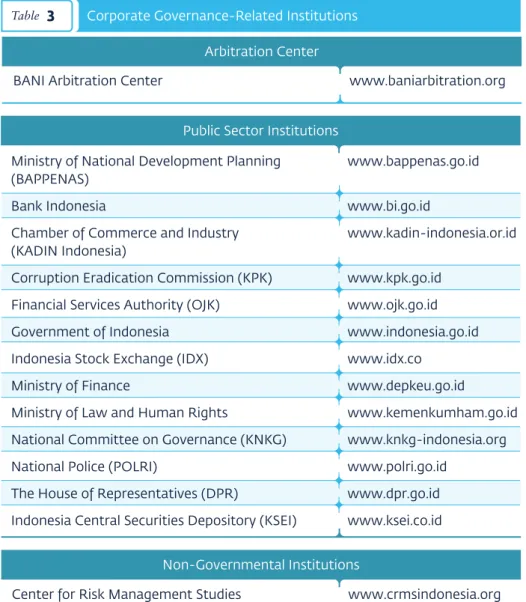
Is the company familiar with the main institutions active in the field of corporate governance that can serve as external resources?
An Introduction To Corporate Governance 27 Table of
Contents Table of
Contents
1.1 Definition of Corporate Governance
There is no single definition of corporate governance that applies to all situations and jurisdictions. Variations arise depending on the institution, national context, and legal tradition.
IFC defines corporate governance as “the structures and processes by which companies are directed and controlled.” The Organization for Economic Co-operation and Development (OECD), which published its Principles of Corporate Governance in 1999 and reviewed the Principles in 2004 and 2015, offers a more detailed definition:1
“Corporate governance involves a set of relationships between a company’s management, its board, its shareholders and other stakeholders. Corporate governance also provides the structure through which the objectives of the company are set, and the means of attaining those objectives and monitoring performance are determined.”
Most definitions that center on the company itself (an internal perspective) have certain elements in common. These can be summarized as follows:
• Corporate governance is a system of relationships, defined by structures and processes. For example, the relationship between shareholders (as the providers of capital), the company management, and stakeholders. Through their relationships, shareholders,
management, and stakeholders share a mutual interest in maximizing the rate of return from shareholders’ investment. Other specific relationships exist between a company’s BoD, BoC or other supervisory body, and its shareholders. The BoD must provide shareholders with financial and operational reports on a regular basis and in a transparent manner. The BoC performs a supervisory function over the BoD. As such, the BoD is accountable to the BoC, which in turn must be accountable to all shareholders through the GMS. The structures and processes that define these relationships typically center on specific management performance and reporting mechanisms.
1 G20/OECD Principles of Corporate Governance (Paris: OECD Publishing, 2015), 9.
28 An Introduction To Corporate Governance
• These relationships may involve parties with different and sometimes conflicting interests. The various company organs—the GMS, the BoC, and the BoD—can hold different interests at any given time.
Conflicting interests typically exist between shareholders (principals) and managers (agents), also known as the principal-agent problem.
A principal-agent problem arises when the person who owns a firm is not the same as the person who manages or controls it. For example, although shareholders are interested in maximizing shareholder value, the BoD may have other objectives, such as maximizing their salaries, which sometimes leads to excessive risk-taking at the expense of the company’s long-term interest. Conflicts may also exist within each governing organ, such as between shareholders (majority versus minority, controlling versus non-controlling, individual versus institutional) and company organs (executive versus non-executive, outsiders versus insiders, independent versus dependent). These tensions need to be carefully monitored and balanced.
• All parties are involved in the direction and control of the company.
The GMS, representing shareholders, makes fundamental decisions such as those concerning the distribution of profits. The BoC is generally responsible for providing guidance and oversight, reviewing and monitoring the implementation of company strategy, and overseeing the BoD’s performance. The BoD runs the day-to- day operations, such as implementing strategy, drafting business plans, managing human resources, developing marketing and sales strategies, and managing assets.
• Corporate governance is designed to properly distribute rights and responsibilities in order to promote stable, long-term value to shareholders. For instance, with appropriate balancing of the interests between shareholders, the BoC, and the BoD, minority shareholders will have the means to prevent a controlling shareholder from gaining undue benefits through related party transactions, tunneling, or other similar activity.
Figure 1 depicts the relationships between the governing bodies in a basic corporate governance system.
An Introduction To Corporate Governance 29 Table of
Contents Table of
Contents
The external perspective of corporate governance, on the other hand, concentrates on relationships between the company and its stakeholders.
Stakeholders are those individuals or institutions that have an interest in the company. Such interests may arise through legislation or contract, or by way of social or geographic relationships. Stakeholders include investors, as well as employees, creditors, suppliers, consumers, regulatory bodies and state agencies, and the local community or environment in which a company operates.
Many international codes, including the OECD Principles, discuss the role of stakeholders in the governance process. The stakeholder’s role in governance has been debated in the past, with some arguing that stakeholders have no claim on the company other than those specifically set forth in law or contract. This view is found in many countries with a common law tradition, such as the United Kingdom, the United States, and Australia. Others argue that companies fulfill an important social function, have a societal impact, and accordingly must act in the broader interests of society. This view, which is present in many countries with a civil law tradition, mostly in continental Europe, such as France,
Germany, the Netherlands, and their former regions of influence, recognizes that companies should, at times, act at the expense of shareholders to fulfill stakeholder requests.
Figure The Corporate Govenance System Shareholders [General Meeting of Shareholders]
Directors [Board of Directors]
Managers
Report and Respond to Elect, Terminate, and Guide
Commissioners [Board of Commissioners]
Supervise Appoint
Report to Appoint
30 An Introduction To Corporate Governance
Best Practice
A key aspect of corporate governance involves ensuring the flow of external capital to firms. Corporate governance is also concerned with finding ways to encourage shareholders to undertake socially efficient levels of investment in firm-specific human and physical capital. The competitiveness and ultimate success of a corporation is the result of teamwork that embodies contributions from a range of resource providers including investors, employees, creditors, and suppliers. Corporations should recognize that stakeholders’ contributions constitute a valuable resource for building competitive and profitable companies. It is therefore in the interest of the company to develop productive cooperation with its stakeholders, establish a governance framework to acknowledge the existence of these interests, and recognize their importance for the company’s long-term success.
A Brief History of Corporate Governance
Systems of corporate governance have evolved over centuries, often in response to systemic crises or corporate failures. The first significant example was the collapse of the British South Sea Company in 1720. This created the well- documented South Sea Bubble which revolutionized business law and practice in England. Similarly, much of U.S. securities law was put in place following the stock market crash of 1929. There has been no shortage of other crises, such as the secondary banking crisis of the 1970s in the United Kingdom, the U.S.
savings and loan debacle of the 1980s, the 1998 financial crisis in Russia, the 1997-1998 Asian financial crisis (the effects of which were particularly severe in Indonesia, South Korea, and Thailand), and the global financial crisis of 2008.
The history of corporate governance is also punctuated by a series of high- profile company failures. In the United Kingdom, the early 1990s saw the collapse of Barings Bank. The new century likewise opened with the dizzying fall of Enron in the United States, the near-bankruptcy of Vivendi Universal in France, the scandal at Parmalat in Italy, trading fraud at Société Générale, and
1.1.1
An Introduction To Corporate Governance 31 Table of
Contents Table of
Contents
the multi-billion dollar Madoff Ponzi scheme. Governments responded to each of these corporate failures–often resulting from lack of oversight, incompetence, or outright fraud–by implementing new governance frameworks such as the United States’ Sarbanes-Oxley Act for Public Company Accounting Reform and Investor Protection, other similar national corporate governance codes, and the current trend towards imposing stricter regulatory oversight on banking and financial institutions in many countries.
In Indonesia, the financial crisis of 1997-1998 sparked dramatic social, economic, and political effects. That event caused the Indonesian rupiah to depreciate by almost 80 percent, dramatically increasing poverty. As Furman and Stiglitz note, “The depth of the collapse in Indonesia is among the largest peacetime contractions since at least 1960 (excluding the experience of the transition economies of eastern Europe and the former Soviet Union).”² Many experts consider Indonesia’s recession to have been fueled by an extremely poor supervision of the financial sector and lax enforcement of central bank regulations, which compounded irregular banking practices.
Although there is still great need for improvement, the Indonesian business community’s awareness and understanding of the importance of corporate governance has improved dramatically since then. This change corresponds with ongoing advances made to the legal and regulatory corporate governance framework.
In recent years, Indonesia has implemented a number of initiatives to strengthen its corporate governance regime. These efforts include the establishment
of corporate governance institutions and the adoption of new laws (or amendments to existing regulations) that support the implementation of good corporate governance processes. These measures include the establishment of the National Committee on Corporate Governance in 1999 under the supervision of the Coordinating Minister for Economic Affairs. The committee issued Indonesia’s first Code of Good Corporate Governance (“CG Code”) in 1999, which was later amended in 2001 and 2006. The Capital Markets and Financial Institutions Supervisory Agency, now merged into the Financial Services
Authority (Otoritas Jasa Keuangan or OJK), also continues to advance and enforce its regulatory framework to improve investor protection. With respect to the banking sector, Indonesia’s central bank, Bank Indonesia, introduced corporate governance rules in 2006 which it actively monitors and enforces.
Table 1 illustrates key corporate governance developments, including those in Indonesia.
2 Jason E. Furman and Joseph E. Stiglitz, "Economic Crises: Evidence and Insights from East Asia,"
Brookings Papers on Economic Activity, no. 2 (1998), 3.
32 An Introduction To Corporate Governance
1600s
1776
1844 1931
1933-1934
1967
1968
1987
Early 1990s
1992
1994 1994-1995
1995
The East India Company introduces a Court of Directors, creating a basis for the separation of ownership and control (United Kingdom, the Netherlands).
Adam Smith in The Wealth of Nations warns of weak controls over and incentives for management (United Kingdom).
First Joint Stock Company Act (United Kingdom).
Berle and Means publishes its seminal work The Modern Corporation and Private Property (United States).
The Securities Act of 1933 is the first act to regulate the securities markets, notably registration disclosure. The 1934 Act delegates responsibility for enforcement to the Securities and Exchange Commission (United States).
Indonesia: The House of Representatives adopts Law No. 1 of 1967 on Foreign Investment.
The European Union adopts its first company law directive (European Union).
The Treadway Commission (COSO) reports on fraudulent financial reporting, confirms the role and status of audit committees, and develops a framework for internal control (United States).
The Polly Peck (£1.3 billion in losses), BCCI, and Maxwell (£480 million) business empires collapse, leading to calls for improved corporate governance practices to protect investors (United Kingdom).
The Cadbury Committee publishes the first code on corporate governance. In 1993, companies listed on the United Kingdom’s stock exchanges are required to disclose governance on a “comply or explain” basis (United Kingdom).
Indonesia: The House of Representatives adopts Law No. 2 of 1992 on Insurance Business.
Publication of the King Report (South Africa).
Rutteman (on internal controls and financial reporting), Greenbury (on executive remuneration), and Hampel (on corporate
governance) reports are published (United Kingdom).
Publication of the Vienot Report (France).
Table A Brief History of Corporate Governance
An Introduction To Corporate Governance 33 Table of
Contents Table of
Contents
Indonesia: Adoption of Law No. 1 of 1995 on Limited Liability Companies.
Indonesia: Adoption of Law No. 8 of 1995 on Capital Markets.
Publication of the Peters Report (Netherlands).
Publication of the Combined Code (United Kingdom).
The OECD publishes the first international benchmark on
corporate governance: OECD Principles of Corporate Governance (France).
Publication of the Turnbull guidance on internal controls (United Kingdom).
Indonesia: The House of Representatives adopts Law No. 5 of 1999 on Prohibition of Monopolistic Practices and Unfair Business Competition.
Indonesia: Establishment of the National Committee on Corporate Governance, later changed to the National Committee on
Governance.
Indonesia: Establishment of the Corruption Eradication
Commission by Law No. 31 of 1999, later amended by Law No. 3 of 2004.
Indonesia: Establishment of the Commission for the Supervision of Business Competition by Law No. 5 of 1999.
Indonesia: Adoption of Law No. 23 of 1999 on Bank Indonesia, later superseded by Law No. 3 of 2004.
Indonesia: The National Committee on Corporate Governance publishes the first Code of Good Corporate Governance (CG Code of 2000).
Enron Corporation, then the seventh largest listed company in the United States, declares bankruptcy (United States).
Publication of the Lamfalussy Report on the Regulation of European Securities Markets (European Union).
Indonesia: The National Committee on Corporate Governance publishes its second Indonesia’s Code of Good Corporate
Governance, an improvement of the previous version of the code (CG Code of 2001).
Indonesia: State-owned enterprises are required to implement corporate governance by the decree of Minister of SOE KEP-117/
1996 1998 1999
2000
2001
2002
34 An Introduction To Corporate Governance
M-MBU/2002 concerning the Implementation of Good Corporate Governance in State-Owned Enterprises.
Publication of the German Corporate Governance Code (Germany).
The Enron collapse and other corporate scandals lead to the Sarbanes-Oxley Act (United States); the Winter Report on company law reform in Europe is published (European Union).
The Higgs Report on non-executive directors is published (United Kingdom).
Indonesia: Establishment of the Center for Reporting and Financial Transaction Analysis (PPATK - Pusat Pelaporan dan Analisis Transaksi Keuangan), which is mandated by Law No. 15 of 2002 on Money Laundering. The Law is replaced by Law No. 25 of 2003.
Indonesia: The House of Representatives adopts Law No. 19 of 2003 on State-Owned Enterprises.
Indonesia: Adoption of Law No. 24 of 2004 on Deposit Insurance Corporation (Lembaga Penjamin Simpanan or LPS).
The Parmalat scandal shakes Italy, with possible European Union-wide repercussions (European Union).
Indonesia: The Central Bank issues a regulation that mandates the banking sector to implement corporate governance through PBI No. 8/4/PBI/2006 on Good Corporate Governance Implementation for Banks.
Indonesia: The National Committee on Governance publishes its third Indonesia’s Code of Good Corporate Governance (CG Code of 2006).
Indonesia: The House of Representatives adopts Law No. 40 of 2007 on Limited Liability Company, which replaces Law No. 1 of 1995, and Law No. 25 of 2007 on Investment, replacing the 1967 Foreign Investment Law.
The United Kingdom amends its Stewardship Code of 2010, marking a key development to enhance the role of institutional shareholders vis-à-vis investee companies (United Kingdom).
Following the global financial crisis in 2008, the OECD conducts a comprehensive review of its CG Principles and issues an updated set of Principles of Corporate Governance (France).
Indonesia: The Financial Services Authority issues Regulation No.
21/POJK.04/2015 and Circular Letter No. 32/SEOJK.04/2015 on the 2003
2004
2006
2007
2012
2015
An Introduction To Corporate Governance 35 Table of
Contents Table of
Contents Implementation of Corporate Governance Guidelines for Public
Companies.
Indonesia: The Financial Services Authority issues Regulation No.
55/POJK.03/2016 and Circular Letter No. 13/SEOJK.03/2017 on the Implementation of Corporate Governance for Banks.
The United Kingdom will issue revisions to its Corporate Governance Code, scheduled to take effect in June 2018. Among the revisions, the new code will force some 900 publicly listed company to reveal the pay ratio between management and employees (United Kingdom).
2016 - 2017
2018
a International Standards of Corporate Governance
The past decade witnessed the development of numerous codes of corporate governance principles worldwide. More than 200 codes have now been written across 103 countries and regions, some of which are designed to have international application. Most of these codes focus on the role of the BoC and/
or BoD in a company.
Among these, only the OECD Principles on Corporate Governance address both policymakers and businesses and focuses on the entire governance framework (shareholder rights, stakeholders, disclosure, and board practices).
First published in 1999 and revised in 2004, the OECD issued its latest revision in 2015 to address the developments arising out of changing circumstances in the corporate and financial sectors, including the complexity of the investment chain, the changing role of stock exchanges, and the emergence of new investors and trading practices. This version was expected to support investment as a powerful driver of growth. The OECD Principles have since gained worldwide recognition as a reference point for good corporate governance. Although the OECD Principles primarily focus on publicly traded companies, both financial and non-financial, they provide a useful benchmark for improving corporate governance practices of privately-held companies. Many national corporate governance codes, including Indonesia, were developed based on the OECD Principles.
The OECD corporate governance framework is built on four core values:
• Fairness: The corporate governance framework should protect
shareholder rights and ensure the equitable treatment of all shareholders,
1.1.2
36 An Introduction To Corporate Governance
including minority and foreign shareholders. All shareholders should have the opportunity to obtain effective redress for violations of their rights.
• Responsibility: The corporate governance framework should recognize the rights of stakeholders as established by law, and encourage active cooperation between companies and stakeholders in creating wealth and jobs and ensuring sustainability.
• Transparency: The corporate governance framework should ensure that timely and accurate disclosure is made of all material matters regarding the company, including financial status, governance structure, performance, and ownership.
• Accountability: The corporate governance framework should ensure the strategic guidance of the company, the effective monitoring of
management by the board, and the board’s accountability to the company and shareholders.
In 2017, the OECD issued the OECD Corporate Governance Factbook, which tracks individual countries’ implementation of the OECD Principles. The Factbook also offers a comprehensive set of recommendations to regulators for the development of sound corporate governance policies.
Although Indonesia’s CG Code and related regulations represent a positive step towards improving corporate governance practices in Indonesia, they are less comprehensive and stringent than other national codes. The OECD Principles provide an excellent reference point to offset these limitations and are highly recommended for those interested in understanding some of the principles that underline national corporate governance standards.
Distinguishing Corporate Governance
Corporate governance focuses on a company’s structure and processes to ensure fair, responsible, transparent, and accountable corporate behavior. It must be distinguished from public governance, which deals with governance structures and systems within the public sector. Corporate governance is also distinct from corporate management, which focuses on the tools required to operate a
1.1.3
An Introduction To Corporate Governance 37 Table of
Contents Table of
Contents
business. One area of overlap between management and governance is corporate strategy, which is dealt with at the corporate management level and incorporates key corporate governance considerations. Figure 2 illustrates the difference between corporate governance and corporate management.
Corporate governance also differs from concepts such as good corporate citizenship and business ethics. Good corporate governance may certainly reinforce ethical and responsible business practices by promoting healthy management systems. However, corporate governance exists as a distinct set of principles whose primary purpose is to ensure that the company is managed in the best interests of the company.
Figure
2
Comparison between Corporate Governance and Corporate ManagementCorporate Governance Strategic Management Corporate Management
Source: Robert I. Tricker, Corporate Governance, 1984 Accountability
and Supervision
Executive Management Decision and Control Operational Management
38 An Introduction To Corporate Governance
1.2 The Business Case for Corporate Governance
Good corporate governance promotes sustainable business growth by
facilitating companies’ access to capital and protecting the rights of shareholders and other stakeholders. Companies that insist upon the highest standards of governance and integrity by management by their nature reduce many of the risks inherent in investment. In doing so, these companies are better able to secure reliable access to capital at a lower cost, and as a result tend to outperform their less well-governed peers over the long-term.
Generally, well-governed companies are better contributors to the national economy and society. They tend to deliver greater value to shareholders, workers, communities, and countries in contrast with poorly governed
companies, which are more likely to undermine confidence in securities markets.
Some of the building blocks, or levels, and specific benefits of good governance are depicted in Figure 3 and discussed in further detail below.
Figure3 Benefits of Good Corporate Governance
The Four Levels of Corporate Governance
1
Compliance with legal
and regulatory requirements
2
Initial steps to improve
corporate governance
are made
3
Advanced corporate governance
system
4
Corporate governance
leadership
Better reputation for
the company
Lower cost
to capital Access to capital markets
Improved operational
efficiency Benefits
An Introduction To Corporate Governance 39 Table of
Contents Table of
Contents
Increased Performance and Operational Efficiency
There are several ways in which good corporate governance can improve performance and operational efficiency, as Figure 4 illustrates.
An improvement in the company’s governance practices leads to a better oversight and accountability system, thereby minimizing the risk of fraud or self-dealing by the company’s staff. Accountability for corporate actions, combined with effective risk management and internal controls, can bring potential problems to the forefront before the company faces a full-blown crisis.
Adherence to good corporate governance standards strengthens the decision- making process. For example, the BoC, BoD, and shareholders are more likely to make better informed and timely decisions when the company’s governance structure clearly defines their respective roles and responsibilities, and where internal communication within the company operates effectively. High quality corporate governance streamlines the company’s business processes, improving operational performance, and lowering capital expenditures, which may, in turn, contribute to the growth of sales and profits.
An effective system of governance also helps to ensure compliance with applicable laws and regulations, thus allowing companies to avoid costly litigation, including costs related to shareholder claims as well as other disputes resulting from fraud, conflicts of interest, corruption and bribery, and insider trading. Good corporate governance can help to facilitate the resolution of corporate conflicts between minority and controlling shareholders, between executives and shareholders, and between shareholders and stakeholders. In addition, company officers will be able to minimize the risk of personal liability.
1.2.1
Figure4 Advantages of Good Corporate Govenance
Better Oversight and Accountability
Better Compliance and Less Conflict Improved Decision Making
Increases Operational Efficiency and Stimulates Performance
40 An Introduction To Corporate Governance
Access to Capital Markets
Corporate governance practices can improve access to capital, because well- governed firms provide investors with greater confidence in their ability to generate returns and protect shareholder rights. From an investor’s point of view, the better a company’s corporate governance structure and practices, the more likely that assets will be used in the interests of the company and not tunneled or otherwise misused by managers. Corporate governance practices can also take on a particular importance in emerging markets, where shareholders do not always benefit from the same protections available in more developed economies and where political or economic instability and institutional weakness contribute to elevated levels of perceived investment risk.
This holds particularly true in emerging market countries where regulations and enforcement are at times inconsistent, and courts do not always provide investors with effective recourse when their rights are violated. This means that even modest improvements in corporate governance relative to other companies can make a large difference for investors and decrease the cost of capital.
Good corporate governance also promotes transparency, which provides investors with an opportunity to gain insight into the company’s business operations and financial data. Even if the information disclosed by the company is negative, shareholders will benefit from the decreased risk of uncertainty.
Figure 5 demonstrates that a significant percentage of investors are willing to pay a premium to invest in a well-governed company. For example, this premium amounts to 25 percent for Chinese companies.
1.2.2
Figure5 Premium for Better Corporate Governance
Source: McKinsey & Company, Global Investor Opinion Survey, July 2002 Russia
United States Poland Brazil China
Germany
10 20 30 40 50
38
23 24
25
14 13
An Introduction To Corporate Governance 41 Table of
Contents Table of
Contents

![Figure The Corporate Govenance System Shareholders [General Meeting of Shareholders]](https://thumb-ap.123doks.com/thumbv2/123dok/11967080.0/28.722.118.630.87.456/figure-corporate-govenance-shareholders-general-meeting-shareholders.webp)