THE INDONESIA CORPORATE GOVERNANCE MANUAL
First Edition
IFC Advisory Services in Indonesia In Partnership with:
i
THE INDONESIA CORPORATE GOVERNANCE MANUAL
First Edition
Jakarta, January 2014
ii
Disclaimer
IFC, a member of the World Bank Group, creates opportunity for people to escape poverty and improve their lives. We foster sustainable economic growth in developing countries by supporting private sector development, mobilizing private capital and providing advisory services.
The Indonesia Corporate Governance Manual (CG Manual) was commissioned by IFC as part of the Indonesia Corporate Governance Program that IFC is implementing in Indonesia since 2012.
This manual is distributed with the understanding that neither the authors, nor the organizations, countries they represent, nor the publisher are engaged in rendering legal or financial advice. The material in this Manual is set out in good faith for general guidance, and no liability can be accepted for any possible loss or expense in incurred as a result of relying on the information contained herein.
This publication is not intended to be exhaustive. It should not be relied upon as a basis for formulating business decisions. On all financial issues and questions, an accountant, auditor, or other financial specialist should be consulted. A lawyer should be consulted on all legal issues and questions. As the laws in the Republic of Indonesia are constantly changing, legal rules referred to herein may be obsolete or superseded by new legislation at the moment of the publication of this Manual.
All references to the male gender throughout this Manual apply to both sexes, unless otherwise indicated.
The conclusions and judgments contained in this report should not be attributed to, and do not necessarily represent the views of IFC or its Board of Directors or the World Bank or its Executive Directors, or the countries they represent. IFC and the World Bank do not guarantee the accuracy of the data in this publication and accept no responsibility for any consequences of their use.
This Manual is distributed subject to the condition that it shall not, by way of trade or otherwise, be lent, sold, hired out, or otherwise circulated on a commercial basis without International Finance Corporation’s prior consent.
iii
Foreword
In today’s globalized environments, companies are facing challenges and competition in global market place. Thus, the role of good corporate governance has become more important.
By strengthening the role and the responsibilities of their boards, increasing the amount and quality of disclosure and enhancing accountability of corporate executives, good corporate governance helps companies formalize business and decision making processes and establish the appropriate checks and balances. This, in turn, improves performance and builds trust between businesses and investors, employees, clients and the community as a whole.
IFC, a member of the World Bank Group, advocates and promotes good corporate governance practices in any market where it operates by helping its clients and partners address key challenges and achieve impactful results. In Indonesia, IFC set up a Corporate Governance Program in Indonesia in 2012 with the aim of improving market standards and creating an environment conducive to transparent, accountable and responsible practices.
As part of this Program, IFC has established a formal cooperation with Otoritas Jasa Keuangan (OJK). A key product of this cooperation between IFC and OJK is the development of this Indonesia Corporate Governance Manual, which serves as a learning instrument to benchmark existing standards and practices in Indonesia with internationally recognized best practices.
In this respect, this Corporate Governance Manual should be considered as a major tool for Corporate Governance in Indonesia as it targets a wide spectrum Sarvesh Suri
IFC, Country Manager, Indonesia
iv
of stakeholders, such as directors and commissioners, academics, policymakers, corporate governance experts and more generally, individuals and institutions interested to know about the corporate governance framework in Indonesia.
IFC is happy to be part of this initiative with OJK and remains committed to helping raise governance standards across the market and contribute to a sustainable private sector in Indonesia.
v
Foreword
Indonesia has experienced financial crisis in 1997/1998 in which one of the causes of the crisis is the weak implementation of corporate governance. We have also learnt that recent global financial crisis is due to poor corporate governance practices. Thus, the need for developing and improving corporate governance, in compliance with national regulations and in alignment with international best practices, is unavoidable.
Indonesia Financial Services Authority (OJK) is committed to promote corporate governance practices in Indonesia as part of financial stability efforts.
Therefore, OJK highly appreciates the initiative of IFC in developing the Indonesia Corporate Governance Manual for companies in Indonesia.
OJK believes that the Indonesia Corporate Governance Manual will benefit to all companies in Indonesia in developing their robust corporate governance practices.
Through the manual, company could benchmark its current governance implementation with best practices and identify the weaknesses that may contribute to a company’s financial vulnerability and make improvement accordingly. The improvement may cover the role of the Board of Commissioners, the role of the Board of Directors, shareholder rights, material corporate transaction, disclosure and transparency, and internal control.
As Indonesia will enter the Asian Economic
Community, it is inevitable that Indonesian company should improve its corporate governance practices that benchmarked on international best practices to improve Muliaman D. Hadad
Chairman of the Board of
Commissioners of OJK
vi
its competitiveness. These will increase investor confidence, reduce the cost of capital, and create sustainable company performance.
OJK hopes that the Indonesia Corporate Governance Manual will serve as a cornerstone for the implementation of good corporate governance in Indonesia so as to create conducive, stable and attractive financial sector which contribute to sustainable economic growth.
Jakarta, January 2014
vii
How to Use this Manual
This Manual is divided into 15 chapters:
Chapter 1: An Introduction to Corporate Governance Chapter 2: The General Governance Structure of a Company Chapter 3: The Internal Corporate Documents
Chapter 4: The Board of Commissioners Chapter 5: The Board of Directors
Chapter 6: The Role of the Corporate Secretary Chapter 7: An Introduction to Shareholder Rights Chapter 8: The General Meeting of Shareholders
Chapter 9: Corporate Governance Implications of the Charter Capital Chapter 10: Dividens
Chapter 11: Corporate Governance Implications of Corporate Securities Chapter 12: Material Corporate Transactions
Chapter 13: Information Disclosure Chapter 14: Control and Audit Procedures
Chapter 15: Overview of the Corporate Governance Framework of State Owned Enterprises (SOEs)
The 15 chapters of the Manual focus on the key corporate governance issues. All issues are closely examined through Indonesian law and regulations and when applicable, interbationally recognized best practices. While it is recommended to read the entire Manual to gain a full understanding of the corporate governance framework in
Indonesia, it is not necessary to read all the chapters in chronological order. the reader is encouraged to begin with a topic of interest and follow the links and references included in the text for guidance to other chapters.
Examples, illustrations, and checklists are included to make the Manual clear and useful.
The following tools will reappear at various intervals in the text:
The Chairman’s Checklist
The Chairman’s Checklist is intended to help the Chairman of the Board of Directors focus Board discussions on key corporate issues faced by the companies.
viii
Best Practices
Best Practices summarizes OECD Principles of Corporate Governance, as well as leading national standards from other countries.
Comparative Practices
Comparative Practices illustrates how other countries currently approach corporate governance issues. It highlights red flags, i.e. common corporate governance abuses as well as model company practices in good corporate governance.
Company Practices
• Mini-cases illustrate abstract concepts and show the real problems that companies face.
• Figures, tables, and other illustrations are included to illustrate key concepts.
• Detailed references to law and regulations refer the reader to original texts.
Mini-Case: Mini-Case 1
ix
Acknowledgement
The preparation and publication of the Indonesia Corporate Governance Manual (the Indonesia CG Manual) involved the participation and efforts of a significant number of dedicated people. The Indonesia CG Manual was prepared based on the other CG manuals published by various IFC’s Corporate Governance Programs and adapted to Indonesia’s corporate governance legal framework and practices.
The Indonesia CG Manual was produced as part of IFC’s Corporate Governance Program in Indonesia. The Manual’s text was adapted under the direction of Mr Moez Miaoui with major contributions from Mr Stefanus Handoyo, IFC, and Mrs Evi Sofiati, and IFC consultant. The development of the Manual was also contributed to by Mr Cornelius B. Juniarto, Partner, Hermawan Juniarto, and his team.
The development of the Manual received significant contributions from Otoritas Jasa Keuangan, OJK, the Indonesia Financial Services Authority. OJK’s Chairman Mr Muliaman Hadad and Mrs Nurhaida, Commissioner, as well as OJK’s Capital Market department provided continuous and strong commitment towards the development and publication of this Manual.
The Komite Nasional Kebijakan Governance, KNKG, or National Committee on Governance, also provided insightful comments and contributed significantly to the review of the latest drafts of the Manual, with in particular a strong involvement of Mr Mas Achmad Daniri and Mr Binhadi.
TABLE OF
CONTENTS
xi
Table of Contents
Foreword from IFC Foreword from OJK How to Use this Manual Acknowledgement
CHAPTER 1. An Introduction to Corporate Governance
A. Corporate Governance Explained 1. Defining Corporate Governance 2. The Role of Stakeholders
3. A Brief History of Corporate Governance
4. The International Scope of Corporate Governance 5. Distinguishing Corporate Governance
B. The Business Case for Corporate Governance
1. Stimulating Performance and Improving Operational Efficiency 2. Improving Access to Capital Markets
3. Lowering the Company’s Cost of Capital and Raising the Value of Assets
4. Building a Better Reputation C. The Cost of Corporate Governance
D. The Corporate Governance Framework in Indonesia 1. Specifics of Corporate Governance in Indonesia 2. The Legal and Regulatory Framework
3. The Corporate Governance Regulations Applicable to Listed Companies in Indonesia
4. The Institutional Framework
iii v vii ix
26
30 30 32 33 39 40 42 43 44
45 47 49 51 51 52
58 59
xii
CHAPTER 2. The General Governance Structure of a Company
A. What is a Limited Liability Company?
1. The Definition of a Limited Liability Company 2. Listed and Non-Listed Companies
3. The Advantages and Disadvantages of Limited Liability Public Companies over Other Legal Forms
B. The Governance Structure of a Limited Liability Company 1. The General Meeting of Shareholders
2. The Board of Commissioners 3. The Board of Directors 4. Board Committees 5. External Auditor 6. The Internal Auditor 7. The Corporate Secretary
CHAPTER 3. The Internal Corporate Documents
A. The Company Articles of Association (AoA) 1. Articles of Association Provisions 2. Form of the Articles of Association
3. When to Amend the Articles of Association?
4. Who can Amend the Articles of Association?
5. How to Amend the Articles of Association?
6. Objection to the Amendments of the Articles of Association 7. Acknowledgement and Approval from the Minister of Law and
Human Rights (MOLHR) to the Amendment of the Articles of Association Amendments
61
65 65 66
68 71 72 72 74 75 75 76 76
77
82 82 82 83 83 84 84
85
xiii
8. When does the Amendment of Articles of Association become Effective?
9. Disclosure of the Articles of Association B. The Internal Regulations of a Company
1. Types of Internal Regulations
2. How to Adopt and Amend Internal Regulations?
C. Company Codes of Corporate Governance
1. What is a Company Code of Corporate Governance?
2. Indonesian Company Code of Corporate Governance D. Company Code of Ethics
1. What is a Code of Ethics?
2. Why Adopt a Code of Ethics?
3. How to Implement a Code of Ethics?
4. Indonesian Code of Business Ethics
CHAPTER 4. The Board of Commissioners
A. The Board of Commissioners’ Authority
1. When to Establish a Board of Commissioners?
2. An Overview of the Board of Commissioners’ Authority B. The Election and Dismissal of Commissioners
1. The Election and Term of Commissioners 2. The Removal of Commissioners
C. The Composition of the Board of Commissioners 1. The Number of Commissioners
2. Who Can Be a Commissioner?
3. Qualifications of Commissioners 4. Categories of Commissioners
85 86 87 87 89 90 90 92 95 95 95 96 97
99
111 111 112 123 123 126 128 128 129 131 134
xiv
D. The Structure and Committees of the Board of Commissioners 1. President Commissioner
2. Committees Established by a Board of Commissioners 3. The President of Supporting Committee of a Board of
Commissioners
E. The Working Procedures of the Board of Commissioners 1. The President and Board of Commissioners Meetings 2. The Board of Commissioners Meetings
3. The First Board of Commissioners Meeting
4. The Schedule of Board of Commissioners Meetings 5. Who Has the Right to Convene a Board of Commissioners
Meeting?
6. Proper Notice for Board of Commissioners Meetings 7. The Quorum for Board of Commissioners Meetings
8. How Commissioners Can Participate in Board of Commissioners Meetings
9. The Consideration of Written Opinions (Absentee Ballots) 10. Board of Commissioners Decisions
11. The Minutes of Board of Commissioners Meetings
12. The Corporate Secretary and Board of Commissioners Meetings F. The Duties and Liabilities of Commissioners
1. The Duty of Care 2. The Duty of Loyalty
3. Commissioner Access to Information 4. Liabilities of Commissioners
5. When Are Commissioners Relieved from Liability and Responsibility in Respect of the Company Losses?
6. Who Can File a Claim against Commissioners?
140 140 142
147 148 148 149 150 151
152 152 154
154 156 156 157 158 160 160 161 165 166
166 167
xv
7. The Minutes of Board of Commissioners Meetings and Commissioner Liability
8. Protection from Liability for Commissioners
G. Evaluation and Education of the Board of Commissioners 1. Self-Evaluation by the Board of Commissioners 2. Education and Training
H. The Remuneration of Commissioners
I. Summary Checklist to Determine the Board of Commissioners’
Effectiveness
CHAPTER 5. The Board of Directors
A. The Board of Directors and Their Authorities 1. The Authority of the Board of Directors B. The Composition of the Board of Directors
1. Who Can Be a President Director or a Board of Directors’
Member?
2. Qualifications of the President Director and Board of Directors’
Members
3. The Composition of the Board of Directors
C. The Formation and Termination of the Board of Directors 1. The Election and Term of the Board of Directors’ Members 2. The Termination of the Authority of the Board of Directors D. The Working Procedures of the Board of Directors
1. The President of the Board of Directors 2. The Board of Directors’ Meetings
3. The Right to Call a Board of Directors’ Meeting 4. Meeting Notification
5. The Quorum of the Board of Directors’ Meetings
167 168 170 170 171 173
177
179
185 187 191
191
192 194 195 195 199 200 200 201 201 202 202
xvi
6. Voting During the Board of Directors’ Meetings 7. The Minutes of the Board of Directors’ Meetings
E. The Duties and Liabilities of the Members of Board of Directors F. Performance Evaluations
G. The Remuneration and Reimbursement of the Board of Directors 1. Remuneration Policy
2. Employment Contracts for Directors
3. Severance Payments to the President Director and Board of Directors’ Members
CHAPTER 6. The Role of the Corporate Secretary
A. The Role of the Corporate Secretary
1. The Need for and Importance of the Corporate Secretary 2. The Qualifications of a Corporate Secretary
3. The Independence of the Corporate Secretary 4. The Appointment of the Corporate Secretary B. The Authority of the Corporate Secretary
1. General Provisions
2. Developing Corporate Governance Policies and Practices 3. Legal and Organizational Support of the Board of Directors 4. Protecting Shareholder Rights
5. Providing for Information Disclosure and Transparency C. Professional Associations of Corporate Secretaries
203 203 205 206 207 208 210
212
214
218 218 220 222 223 226 226 228 228 232 233 236
xvii
CHAPTER 7. An Introduction to Shareholder Rights
A. General Provisions on Shareholder Rights 1. Reasons for Being a Shareholder 2. Classification of Shares
3. Types of Shareholder Rights B. Specific Shareholder Rights
1. The Right to Vote
2. The Right to Appeal Decisions of the General Meeting of Shareholders
3. The Right to Receive Information about the Company 4. The Right to Freely Transfer Shares
5. Pre-Emptive Rights
6. The Right to Demand the Redemption of Shares
7. Shareholder Rights during the Liquidation of the Company 8. The Right to Review the Shareholder List
9. The Right to File a Claim on Behalf of the Company 10. The Right to Receive Dividends
11. The Right to Summon a General Meeting of Shareholders 12. The Right to Nominate Candidates to be Elected as Members of
the Board of Commissioners and the Board of Directors 13. Restrictions on Founding Shareholders
C. The State as a Shareholder
1. The State as an Ordinary Shareholder 2. The State as the Holder of Privileged Rights 3. Exercising the Rights of the State as a Shareholder
237
242 242 243 245 249 249
254 255 256 257 260 261 262 263 264 264
265 265 266 266 266 267
xviii D. The Shareholder Register
1. The Company Share Register - Register Book of Shareholders 2. Registration for Obtaining the Effective Statement
3. Registration with Business Registrar E. The Protection of Shareholder Rights
1. Guarantees in the Indonesian Company Law 2. Judicial Protection
3. Non-Governmental Organizations for the Protection of Shareholder Rights
4. Company Articles of Association
5. Shareholder Activism and Collective Action 6. Shareholder Agreements
F. Responsibilities of Shareholders
1. Obligation to Make Full Payment for their Subscribed Shares 2. Obligation to be Liable to Debt and other Liabilities of the
Company 3. Other Obligations
CHAPTER 8. The General Meeting of Shareholders
A. General Provisions
1. Types of General Meetings of Shareholders
2. The Authority of the General Meeting of Shareholders B. Preparing for the Annual General Meeting of Shareholders
1. Drafting the Agenda
2. Making Preliminary Decisions 3. Preparing the Shareholder List 4. Providing Proper Notice
268 268 269 270 271 271 271
272 272 273 275 277 277
277 278
279
285 285 286 290 291 293 294 298
xix
5. Approving the Agenda - Shareholders’ Rights to Amend the Agenda
6. Preparing Draft Resolutions on Each of the Items on the Agenda C. Conducting the General Meeting of Shareholders
1. Shareholder Participation Options 2. Shareholder Registration
3. Verifying and Announcing the Quorum 4. Opening the General Meeting of Shareholders 5. Electing the Voting Committee
6. Inviting Outside Guests as Observers
7. Presenting the Agenda and the Rules of Order 8. Discussing Agenda Items
9. Voting
10. Counting and Documenting Votes
11. Announcing the Voting Results and Decisions 12. Closing the General Meeting of Shareholders 13. Archiving Voting Ballots
14. Preparing the General Meeting of Shareholders Minutes 15. Documents of the General Meeting of Shareholders
D. An Overview of the Extraordinary General Meeting of Shareholders 1. When to Conduct an Extraordinary General Meeting of
Shareholders
2. Preparatory Procedures
3. Circular Resolution of the Shareholders
E. Decisions of the General Meeting of Shareholders 1. Decisions Requiring a Simple Majority Vote 2. Decisions Requiring a Supermajority Vote
304 309 310 312 312 314 315 316 316 317 317 318 320 321 321 321 321 322 324
324 324 326 328 328 328
xx 3. Decisions Requiring a Unanimous Vote 4. Filing Lawsuit Against GMS Decision
CHAPTER 9. Corporate Governance Implications of the Charter Capital
A. General Provisions Related to the Charter Capital 1. The Definition of Charter Capital
2. Legal Capital or Minimum Charter Capital 3. Charter Capital and Share Capital 4. Full Payment for Shares
5. Contributions to the Charter Capital B. Increasing the Charter Capital
1. Methods of Increasing the Charter Capital 2. Methods of Placement
3. Internal Sources for Increasing the Charter Capital 4. Ownership Rights Protection When Increasing the Charter Capital
5. Procedural Guarantees for Increasing the Charter Capital C. Protecting the Charter Capital
1. Overview of Decreasing the Charter Capital 2. Share Buybacks
3. Reciprocal Shareholdings D. Statutory and Voluntary Reserves
1. The Statutory Reserve 2. Other Funds
3. Additional Paid-In Capital
329 329
331
335 335 335 336 337 338 341 341 344 344
345 346 349 350 354 358 359 359 359 360
xxi
CHAPTER 10. Dividends
A. General Provisions on Dividends 1. The Definition of Dividends 2. Distributable Profit
3. Dividend Rights 4. Types of Dividends
5. Forms of Dividend Payments
6. Decision-Making Authority Regarding Dividends 7. The Amount of Dividends
8. The Importance of Receiving Stable Dividends B. Procedures for Declaring and Paying Dividends
1. How Dividends are Declared 2. The Shareholder List for Dividends 3. When Declared Dividends are Paid
4. When the Company Cannot Declare Dividends 5. When the Company Cannot Pay Declared Dividends C. The Disclosure of Information on Dividends
D. Dividend Policy
CHAPTER 11. Corporate Governance Implications of Corporate Securities
A. An Overview of Corporate Securities
1. Basic Types of Securities - Shares and Bonds 3. Securities in Paper and Paperless Forms 3. Domestic Issuers on International Markets
361
365 365 365 366 366 367 368 368 369 370 370 372 372 373 373 375 377
379
383 383 386 386
xxii B. Types of Securities
1. Shares 2. Bonds C. Issuing Securities
1. Making the Decision to Place Securities 2. Registering the Decision to Issue Securities
3. Granting the Certificate for Public Offering of Securities 4. Public Offer of Securities
D. The Conversion of Securities E. Derivatives
F. Raising Capital in International Markets
CHAPTER 12. Material Corporate Transactions
A. Extraordinary Transactions 1. Definition
2. Valuing Extraordinary Transactions
3. Procedure for Approving Extraordinary Transactions 4. How Shareholders Can Protest Extraordinary Transactions 5. Disclosure Requirements
B. Affiliated (Related Party) Transactions 1. Definition
2. Approving Affiliated Transactions 3. Identifying Affiliated Transactions 4. Disclosure Requirements
5. Invalidation of Affiliated Transactions
6. Liability for the Violation of Procedural Requirements
388 388 389 395 397 398 400 404 410 411 413
414
419 419 422 423 425 425 427 427 433 434 435 437 437
xxiii
CHAPTER 13. Information Disclosure
A. An Introduction to Information Disclosure 1. Definition and Rationale
2. Principles of Disclosure
3. Confidential Information (Business Secret) 4. Inside Information and Insider Dealing
5. Disclosure in Listed and Public Non-listed Companies 6. Disclosure Versus Transparency
7. Personal Liability for Non-Disclosure B. Disclosure Items
1. Financial and Operating Results 2. Company Objectives
3. Major Share Ownership and Voting Rights 4. Information on Commissioners and Directors 5. Material Foreseeable Risk Factors
6. Employees and Other Stakeholders
7. Corporate Governance Structures and Policies
8. Disclosure During the Placement of Securities - Prospectus C. Voluntary Disclosure
1. Corporate Websites 2. Mass Media
CHAPTER 14. Control and Audit Procedures
A. The Board Of Commissioners
438
443 443 443 445 447 448 449 449 451 454 461 462 467 470 470 470 473 474 474 475
477
484
xxiv B. The Independent External Auditor
1. When an Annual Audit is Required
2. The Rights and Duties of the External Auditor 3. The Rights and Duties of the Company 4. The Appointment of the External Auditor 5. Compensation
6. Reporting
7. The External Auditor’s Liability
C. The Audit Committee of the Board of Commissioners 1. Functions
2. Composition 3. Meetings
4. Access to Information and Resources D. Internal Control Function
1. Internal Control Principles
2. Elements of the Internal Control System
3. Bodies and Persons Responsible for Internal Control 4. The Internal Auditor
CHAPTER 15. Overview of the Corporate Governance Framework of State Owned Enterprises (SOEs)
A. Introduction
1. The Origin of Indonesian SOEs 2. Turnaround
485 485 485 487 488 491 492 493 495 497 498 499 500 501 502 503 505 506
510
512 512 515
xxv
B. The Structure and Challenges for the Governance of Indonesian SOEs
1. The Legal and Regulatory Framework
2. The Position of the State as an Owner of SOEs 3. Equitable Treatment of Shareholders
4. Stakeholders Relations 5. Transparency and Disclosure
6. The Boards of SOEs (Responsibilities and the Appointment) C. Summary
Bibliography
515 515 517 520 521 523 526 529 530
AN INTRODUCTION TO CORPORATE
GOVERNANCE
1
Chapter
27
Table of Contents
A. CORPORATE GOVERNANCE EXPLAINED 1. Defining Corporate Governance
2. The Role of Stakeholders
3. A Brief History of Corporate Governance
4. The International Scope of Corporate Governance 5. Distinguishing Corporate Governance
B. THE BUSINESS CASE FOR CORPORATE GOVERNANCE 1. Stimulating Performance and Improving Operational Efficiency 2. Improving Access to Capital Markets
3. Lowering the Company’s Cost of Capital and Raising the Value of Assets
4. Building a Better Reputation
C. THE COST OF CORPORATE GOVERNANCE
D. THE CORPORATE GOVERNANCE FRAMEWORK IN INDONESIA 1. Specifics of Corporate Governance in Indonesia
2. The Legal and Regulatory Framework
3. The Corporate Governance Regulations Applicable to Listed Companies in Indonesia
4. The Institutional Framework
30 30 32 33 39 40
42 43 44
45 47
49
51 51 52
58 59
28
An Introduction To Corporate Governance The Chairman’s Checklist
Do all Director and other company organs understand the concept of corporate governance and its significance to the company and its shareholders?
Has the Board of Directors developed a clear and explicit governance policy, and a plan to improve the company’s governance practices? Have steps been taken to implement this plan?
Are key officers familiar with the OECD Principles of Corporate Governance, legal framework of Corporate Governance in Indonesia, and the Corporate Governance Code applicable to companies in Indonesia (the CG Code)
1? Does the company follow the requirements of the CG Code and disclose information on compliance to shareholders and stakeholders in its annual report? Has the company adopted its own Corporate Governance Code? Has the company included in financial reports a report on the corporate governance structure and practice?
Is the company familiar with the main institutions active in the field of corporate governance that can serve as external resources for the company?
The Chairman’s Checklist
1 Corporate Governance Code published by The National Committee on Governance (KNKG)
29
An Introduction To Corporate Governance The Chairman’s Checklist
Corporate governance has become a familiar and increasingly popular term in Indonesia. With the introduction of ICL 19952, the role of the private sector in economic development and job creation in Indonesia began to accelerate. The following two decades brought increasingly sophisticated domestic production, private enterprise growth and increased global competition. The downside to these developments has been the occurrence of major corporate scandals. While various domestic and international efforts have made corporate governance a household name, few Indonesian companies appear to truly appreciate the depth and complexity of this topic.
Indeed, corporate governance reforms are often introduced superficially and used as a public relations exercise, rather than as a tool to introduce the internal structures and processes that enable a company to hold the trust of its shareholders, increase the company’s ability to access capital and reduce vulnerability to financial crises.
But to successfully introduce these structures and processes, a company must fully and continually commit to the principles of fairness, transparency, accountability and responsibility.
This chapter defines corporate governance, makes a business case for its
implementation, and provides an overview of the legal, regulatory and institutional frameworks for corporate governance in Indonesia today.
2 ICL adopted by the Indonesia House of Representatives dated 7 March 1995, as repealed and replaced by the Company Law adopted by the House of Representatives dated 16 August 2007.
30
An Introduction To Corporate Governance Corporate Governance Explained
There is no single definition of corporate governance that can be applied to all situations and jurisdictions. The various definitions that exist today largely depend on the institution or author, country and legal tradition.
IFC defines corporate governance as “the structures and processes for the direction and control of companies.” The Organization for Economic Cooperation and Development (OECD), which in 1999 published its Principles of Corporate Governance, offers a more detailed definition of corporate governance as:
“The internal means by which corporations are operated and controlled […], which involve a set of relationships between a company’s management, its board, its shareholders and other stakeholders. Corporate governance also provides the structure through which the objectives of the company are set, and the means of attaining those objectives and monitoring performance are determined. Good corporate governance should provide proper incentives for the board and management to pursue objectives that are in the interests of the company and shareholders, and should facilitate effective monitoring, thereby encouraging firms to use resources more efficiently.”3
Most definitions that center on the company itself (an internal perspective) do, however, have certain elements in common, which can be summarized as follows:
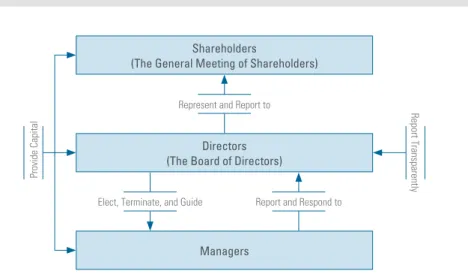
• Corporate governance is a system of relationships, defined by structures and processes: For example, the relationship between shareholders,management and stakeholder(s) that consists of the relationship between the capital provider, stakeholder (s) and the management to achieve certain rate of return and profit on their (shareholders’) investment. Board of Directors in turn are to provide shareholders with financial and operational reports on a regular basis and in a transparent manner. Shareholders also elect a supervisory body, often referred to as the Board of Commissioners, to represent their interests. This company organ essentially provides strategic direction to, and control over the company’s Board of Directors. Board of Directors are accountable to this Board of Commissioners, which in turn is accountable to shareholders
A. Corporate Governance Explained
1. Defining Corporate Governance
3 OECD Principles of Corporate Governance. (see also: www.oecd.org)
31
An Introduction To Corporate Governance Corporate Governance Explained
through the General Meeting of Shareholders (GMS). The structures and processes that define these relationships typically center on various management performance and reporting mechanisms.
• These relationships may involve parties with different and sometimes contrasting interests: Differing interests may exist between the organ of the company, i.e. the GMS, the Board of Directors, and/or Board of Commissioner (or other executive bodies). Contrasting interests exist most typically between owners and Board of Directors, and are commonly referred to as the principal- agent problem.4 Conflicts may also exist within each governing organ, such as between shareholders (majority vs. minority, controlling vs. non-controlling, individual vs. institutional) and Company’s Organ (executive vs. non-executive, outsiders. inside, independent vs. dependent). Each of these contrasting interests needs to be carefully observed and balanced.
• All parties are involved in the direction and control of the company:
The GMS, representing shareholders, takes fundamental decisions, for example the distribution of profits. The Board of Commissioner is generally responsible for guidance and oversight, accepting company strategy and controlling the Board of Director. Board of Director, finally, run the day-to-day operations, such as implementing strategy, drafting business plans, managing human resources, developing marketing and sales strategies, and managing asset.
• All this is done to properly distribute rights and responsibilities—and thus increase long-term shareholder value: For example, how outside, minority shareholders can prevent a controlling shareholder from gaining benefits through related party transactions, tunneling or similar means.5
4 The principal-agent problem is defined as follows by the Oxford Dictionary of Economics: “The problem of how Person (A) can motivate Person (B) to act for (A’s) benefit rather than following his self-interest.”
In a company setting, Person (A) is the investor (or principal) and (B) the manager (or agent). Managers at times may follow different goals than investors (e.g. building business empires rather than creating shareholder value), act dishonestly and, at times, even in an incompetent manner. This essentially creates three types of agency costs: (i) divergence costs (i.e. managers that do not maximize the investors’ wealth);
(ii) monitoring costs (investors have to develop and implement control structures), including replacement costs; and (iii) incentive costs (costs incurred by investors to remunerate and incentivize their managers).
The core role of a corporate governance system is to reduce total agency costs, thus maximizing the value of the company to investors.
5 Corporate Governance: A Framework for Implementation, the World Bank. See also: http://www-wds.
worldbank.org/external/default/main?pagePK=64193027&piPK=64187937&theSitePK=523679&men uPK=64187510&searchMenuPK=64187283&siteName=WDS&entityID=000094946_00082605593465
32
An Introduction To Corporate Governance Corporate Governance Explained
The basic corporate governance system and the relationships between the governing bodies are depicted in Figure 1.
Figure 1. The Corporate Governance System
Source: IFC, March 2004 Shareholders
(The General Meeting of Shareholders)
Elect, Terminate, and Guide
Represent and Report to Report Transparently
Provide Capital
Report and Respond to Directors
(The Board of Directors)
Managers
The external aspect of corporate governance, on the other hand, concentrates on relationships between the company and its stakeholders. Stakeholders are those individuals or institutions that have an interest in the company. Such an interest may arise through legislation or contract, or by way of social or geographic relationships.
Stakeholders include investors, but also employees, creditors, suppliers, consumers, regulatory bodies and state agencies, and the local community in which a company operates. Some commentators also include consideration of the environment as an important entry on the list of stakeholders.
Many international codes, including the OECD Principles, discuss the role of
stakeholders in the governance process. The role of stakeholders in governance has been debated in the past, with some arguing that stakeholders have no claim on the company other than those specifically set forth in law or contract. Others have argued that companies fulfill an important social function, have a societal impact and, accordingly, must act in the broad interests of society. This view recognizes that companies should, at times, act at the expense of shareholders. Interestingly, there is a consensus that modern
2. The Role of Stakeholders
33
An Introduction To Corporate Governance Corporate Governance Explained
companies cannot effectively conduct their businesses while ignoring the concerns of stakeholder groups. However, there is also agreement that companies which consistently place other stakeholder interests before those of shareholders cannot remain competitive over the long run.
Best Practices
A key aspect of corporate governance is ensuring the flow of external capital to firms. Corporate governance is also concerned with finding ways to encourage stakeholders to undertake socially efficient levels of investment in firm-specific human and physical capital. The competitiveness and ultimate success of a corporation is the result of teamwork that
embodies contributions from a range of resource providers including investors, employees, creditors and suppliers. Corporations should recognize that stakeholders’ contributions constitute a valuable resource for building competitive and profitable companies. It is, therefore, in the long-term interest of corporations to foster wealth-creating co-operation among stakeholders. The governance framework should acknowledge that the interests of the corporation are served by recognizing the interests of stakeholders and their contribution to the long-term success of the corporation. Therefore, it is in the interest of the company to stimulate productive co-operation with the stakeholders, establish a governance framework to acknowledge the existence of these interests and recognize their importance for the long-term success of the company.
Corporate governance systems have evolved over centuries, often in response to corporate failures or systemic crises. The first well-documented failure of governance was the South Sea Bubble in the 1700s, which revolutionized business laws and practices in England. Similarly, much of the securities law in the U.S. was put in place following the stock market crash of 1929. There has been no shortage of other crises, such as the secondary banking crisis of the 1970s in the U.K., the U.S. savings and loan debacle of the 1980s, the 1998 financial crisis in Russia, the 1997-1998 financial crisis in Asia
3. A Brief History of Corporate Governance
34
An Introduction To Corporate Governance Corporate Governance Explained
(especially in Indonesia, South Korea and Thailand) and the current global financial crisis which started in 2008 and has not shown signs of ending at the time of this book.
The history of corporate governance has also been punctuated by a series of well- known company failures. The early 1990s saw the Maxwell Group raid the pension fund of the Mirror Group of newspapers and witnessed the collapse of Barings Bank. The new century likewise opened with a bang, with the spectacular collapse of Enron in the U.S., the near-bankruptcy of Vivendi Universal in France, the scandal at Parmalat in Italy, the trading fraud which hit Société Générale and the most recent Madoff multi- billion dollar ponzi scheme, make other scandals pale in comparison. Each of these corporate failures, often occurring as a result of incompetence or outright fraud, was swiftly met by new governance frameworks, most notably the many national corporate governance codes, the Sarbanes-Oxley Act and the current trend towards imposing stricter regulatory oversight on banking and financial activities in various countries.
In Indonesia, the financial crisis in 1997-1998 has had dramatic social, economic and political effects. That event brought the Rupiah down by almost 80% and dramatically increased poverty. As noted by Furman and Stiglitz:” The depth of the collapse in Indonesia, if not unparalleled, is among the largest peacetime contractions since at least 1960, excluding the experience of the transition economies”6. According to several experts, the recession in Indonesia was fuelled by many institutional weaknesses, among which the lack or inadequate enforcement of the central bank’s regulations along with irregular banking practices and the extremely poor financial regulation7.
Since then, it is fair to say that, although there is still plenty of room for improvement, the awareness, enthusiasm as well as legal and regulatory framework on corporate governance in Indonesia has changed and improved dramatically in recent years.
Indonesia had done a lot of initiatives and efforts to implement good corporate governance, both from government side as well as private. Those initiatives and efforts include establishment of corporate governance institutions, adoption of new laws and amendments of existing ones to support corporate governance implementation process in the country. More specifically, Indonesia has taken several steps towards improving corporate governance standards and enhancing legislation. A national committee for Good Corporate Governance has been established in 1999 under the supervision of the Coordinating Minister for Economic Affairs and issued the first Indonesia’s Code
6 J. Furman and J. Stiglitz: “Economic Crises: Evidence and Insights from East Asia”. Paper prepared for the Brookings Panel on Economic Activity, Washington, D.C. November 1998.
7 D. Hartono and D. Hermann:” The Indonesian economic crisis and its impact on educational enrolment and quality”. Institute of Southeast Asian Studies, Number 7, May 2001.
35
An Introduction To Corporate Governance Corporate Governance Explained
of Good Corporate Governance in 2001, which was then amended in 20068. The Capital Market and Financial Institutions Supervisory Body (currently has merged into OJK)9 has continued to introduce and amend its regulation and enforced them, which resulted in improved investors’ protection. Corporate governance rules for banks were introduced in 2006 and Bank Indonesia has actively monitored and enforced their implementation. A number of other legislation reforms may also be cited such as: the Law on Foreign Investment10, adopted in 1967, and amended in 2007, ICL adopted in 199511, and amended in 2007, the Law on Insurance Business adopted in 199212, and the Competition Law adopted in 199913. All these are but some examples of the many positive changes to the legal and regulatory framework.
More specifically, the following major initiatives and/or laws and regulations may be considered:
• Establishment of National Committee on Corporate Governance in 1999 by decree of the Coordinating Minister of Economy, Finance and Industry.
• The National Committee on Corporate Governance was then changed to National Committee on Governance in 2004 to accommodate governance not only for corporate but to include public sector as well.
• Adoption of the Indonesian Company Law No. 1 of 1995 which superseded in 2007 with Law No. 40 of 2007 concerning the same.
• Law No. 8 of 1995 on Capital Market.
• Law No. 25 of 2007 on Investment, which supersedes the previous Law No. 1 of 1967 on Foreign Investment.
• Law No. 31 in 1999 on Corruption Eradication Commission, which by this law, Corruption Eradication Commission was established. Later, the Law was amended with Law No. 30 of 2002.
• Law No. 5 in 1999 on the Prohibition of Monopolistic Practices and Unfair Business Competition. As an implementation of that law, the Commission for The Supervision of Business Competition (KPPU - Komisi Pengawas Persaingan Usaha) was established on 1999.
• Law No. 30 of 1999 on Arbitration and Alternative Dispute Resolution.
8 KNKG has been replaced by the National Committee on Governance, NCG, on 30 November 2004.
http://www.knkgindonesia.com/
9 Based on Article 55, paragraph (2) of Law No. 21 of 2011, as of 31 December 2013 function duty and authority of the Capital Market and Financial Institution Supervisory Board (Bapepam-LK) as capital market supervisory and regulatory board was diverted to Financial Service Authority (OJK).
10 The FIL adopted by the Indonesia House of Representatives dated 10 January 1967
11 The Law on Limited Liability Company adopted by the Indonesia House of Representatives dated 7 March 1995 and replaced by a new law concerning the same dated 16 August 2007
12 The LIB adopted by the Indonesia House of Representatives dated 11 February 1992 13 The LOC adopted by the Indonesia House of Representatives dated 5 March 1995
36
An Introduction To Corporate Governance Corporate Governance Explained
• Establishment of Center for Reporting and Financial Transaction Analysis (PPATK - Pusat Pelaporan dan Analisis Transaksi Keuangan), which was mandated by the Law No. 15 in 2002 on Money Laundering. The Law was then amended with Law No. 25 of 2003.
• Regulation on obligation to implement GCG in SOE through the decree of the Minister of SOEs Kep-117/M-MBU/2002 in Implementation of GCG in SOEs.
• Law No. 19 of 2003 on State-Owned Enterprise.
• Law No. 3 of 2004 on Bank Indonesia superseding the Law No. 23 of 1999 concerning the same.
• Law No. 7 of 2009 on Deposit Insurance Corporation (LPS - Lembaga Penjamin Simpanan), superseding the Law No. 24 of 2004 concerning the same.
• Regulation on obligation to implement GCG in banking sector through Central Bank regulation PBI No. 8/4/PBI/2006 on GCG Implementation for Banks.
• Other Regulations which elaborate GCG principles to public companies through Capital Market and Financial Institutions Supervisory Agency (Otoritas Jasa Keuangan-OJK) regulations, such as regulations on disclosure, independent Commissioners, corporate secretary, audit committee, protection of minority shareholders and etc.
The adoption of the CG Regulations, although not heavy in detail, certainly must be hailed as another positive step for Indonesia corporate governance, providing the first ever set of corporate governance guidelines for companies in Indonesia, in general and listed companies in particular.
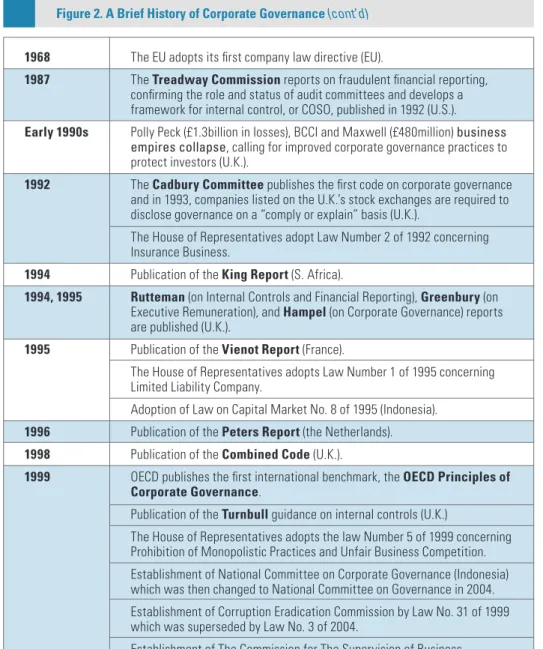
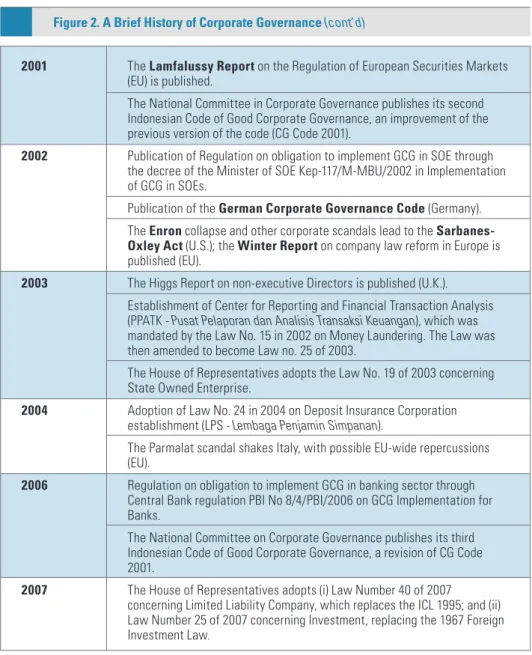
Figure 2 illustrates some highlights in the history of corporate governance, largely from the western world and Indonesia.
Figure 2. A Brief History of Corporate Governance
1600s 1776 1844 1931 1933/34
1967
The East India Company introduces a Court of Directors, separating ownership and control (U.K., the Netherlands).
Adam Smith in the “Wealth of Nations” warns of weak controls over and incentives for management (U.K.).
First Joint Stock Company Act (U.K.).
Berle and Means publishes its seminal work “The Modern Corporation and Private Property” (U.S.).
The Securities Act of 1933 is the first act to regulate the securities markets, notably registration disclosure. The 1934 Act delegates responsibility for enforcement to the SEC (U.S.).
The House of Representatives adopts Law Number 1 of 1967 concerning Capital Investment.
37
An Introduction To Corporate Governance Corporate Governance Explained
The EU adopts its first company law directive (EU).
The Treadway Commission reports on fraudulent financial reporting, confirming the role and status of audit committees and develops a framework for internal control, or COSO, published in 1992 (U.S.).
Polly Peck (£1.3billion in losses), BCCI and Maxwell (£480million) business empires collapse, calling for improved corporate governance practices to protect investors (U.K.).
The Cadbury Committee publishes the first code on corporate governance and in 1993, companies listed on the U.K.’s stock exchanges are required to disclose governance on a “comply or explain” basis (U.K.).
The House of Representatives adopt Law Number 2 of 1992 concerning Insurance Business.
Publication of the King Report (S. Africa).
Rutteman (on Internal Controls and Financial Reporting), Greenbury (on Executive Remuneration), and Hampel (on Corporate Governance) reports are published (U.K.).
Publication of the Vienot Report (France).
The House of Representatives adopts Law Number 1 of 1995 concerning Limited Liability Company.
Adoption of Law on Capital Market No. 8 of 1995 (Indonesia).
Publication of the Peters Report (the Netherlands).
Publication of the Combined Code (U.K.).
OECD publishes the first international benchmark, the OECD Principles of Corporate Governance.
Publication of the Turnbull guidance on internal controls (U.K.)
The House of Representatives adopts the law Number 5 of 1999 concerning Prohibition of Monopolistic Practices and Unfair Business Competition.
Establishment of National Committee on Corporate Governance (Indonesia) which was then changed to National Committee on Governance in 2004.
Establishment of Corruption Eradication Commission by Law No. 31 of 1999 which was superseded by Law No. 3 of 2004.
Establishment of The Commission for The Supervision of Business Competition with Law No. 5 of 1999.
Adoption of Law No. 23 of 1999 on Bank Indonesia which then supersedes by Law No. 3 of 2004.
The National Committee on Corporate Governance publishes the first Indonesian Code of Good Corporate Governance (Code of 2000).
Enron Corporation, then the seventh largest listed company in the U.S., declares bankruptcy (U.S.).
1968 1987
Early 1990s
1992
1994 1994, 1995
1995
1996 1998 1999
2000 2001
Figure 2. A Brief History of Corporate Governance (cont’d)
38
An Introduction To Corporate Governance Corporate Governance Explained
The Lamfalussy Report on the Regulation of European Securities Markets (EU) is published.
The National Committee in Corporate Governance publishes its second Indonesian Code of Good Corporate Governance, an improvement of the previous version of the code (CG Code 2001).
Publication of Regulation on obligation to implement GCG in SOE through the decree of the Minister of SOE Kep-117/M-MBU/2002 in Implementation of GCG in SOEs.
Publication of the German Corporate Governance Code (Germany).
The Enron collapse and other corporate scandals lead to the Sarbanes- Oxley Act (U.S.); the Winter Report on company law reform in Europe is published (EU).
The Higgs Report on non-executive Directors is published (U.K.).
Establishment of Center for Reporting and Financial Transaction Analysis (PPATK - Pusat Pelaporan dan Analisis Transaksi Keuangan), which was mandated by the Law No. 15 in 2002 on Money Laundering. The Law was then amended to become Law no. 25 of 2003.
The House of Representatives adopts the Law No. 19 of 2003 concerning State Owned Enterprise.
Adoption of Law No. 24 in 2004 on Deposit Insurance Corporation establishment (LPS - Lembaga Penjamin Simpanan).
The Parmalat scandal shakes Italy, with possible EU-wide repercussions (EU).
Regulation on obligation to implement GCG in banking sector through Central Bank regulation PBI No 8/4/PBI/2006 on GCG Implementation for Banks.
The National Committee on Corporate Governance publishes its third Indonesian Code of Good Corporate Governance, a revision of CG Code 2001.
The House of Representatives adopts (i) Law Number 40 of 2007 concerning Limited Liability Company, which replaces the ICL 1995; and (ii) Law Number 25 of 2007 concerning Investment, replacing the 1967 Foreign Investment Law.
2001
2002
2003
2004
2006
2007
Figure 2. A Brief History of Corporate Governance (cont’d)
39
An Introduction To Corporate Governance Corporate Governance Explained
Numerous codes of best practices and corporate governance principles have been developed over the last 10 years. Worldwide, more than 200 codes have been written in some 72 countries and regions.14 Most of these codes focus on the role of the Board of Commissioners or Board of Directors in a company. A handful is international in scope.15
Among these, only the OECD Principles address both policymakers and businesses, and focus on the entire governance framework (shareholder rights, stakeholders, disclosure and board practices). The OECD Principles have gained worldwide acceptance as a framework and reference point for corporate governance. Published in 1999 and revised in 2004, they were developed to provide principle-based guidance on good governance.
The OECD corporate governance framework is built on four core values:
• Fairness: The corporate governance framework should protect shareholder rights and ensure the equitable treatment of all shareholders, including minority and foreign shareholders. All shareholders should have the opportunity to obtain effective redress for violations of their rights.
• Responsibility: The corporate governance framework should recognize the rights of stakeholders as established by law, and encourage active co-operation between corporations and stakeholders in creating wealth, jobs, and the sustainability of financially sound enterprises.
• Transparency: The corporate governance framework should ensure that timely and accurate disclosure is made on all material matters regarding the company, including its financial situation, governance structure, performance and ownership.
• Accountability: The corporate governance framework should ensure the strategic guidance of the company, the effective monitoring of management by the Board, and the Board’s accountability to the company and shareholders.
Many national corporate governance codes have been developed based on the OECD Principles. Indonesia’s CG Code was also developed based on the OECD Principles and contains certain principles which conform to international best practices. For instance, the CG Code states that (i) they were developed to “. . . help ensuring the sustainable development of the securities market and contributing to a cleaner and healthier
4. The International Scope of Corporate Governance
14 For a complete list of country codes of corporate governance, see the website of the European Corporate Governance Institute at www.ecgi.org.
15 Corporate governance codes of international scope include the OECD Principles of Corporate Governance (www.oecd.org), the International Corporate Governance Network’s Statement on Global Corporate Governance Principles (ICGN - www.icgn.org), and the Commonwealth Association of Corporate Governance (CACG - www.commonwealthfoundation.com).
40
An Introduction To Corporate Governance Corporate Governance Explained
economy”, that (ii) “[The] regulations set out the basic rules of corporate governance with a view to protecting legitimate rights and obligations of shareholders, establishing standards for professional acts and morality of the Board of Directors, Board of Commissioner and the managers of the listed company”, and that (iii) “the regulations also serve as the basis for assessing the implementation of corporate governance of a listed company”.
Although they represent a good start in the right direction, the CG Regulations are much simpler in form in comparison to other national codes of corporate
governance. The CG Regulations are also likely to add more in volume over time, when corporate governance is taken more seriously by Indonesian companies. The OECD Principles can serve as an excellent reference point for international practices and are recommended reading for those interested in understanding some of the principles that underlie national standards.
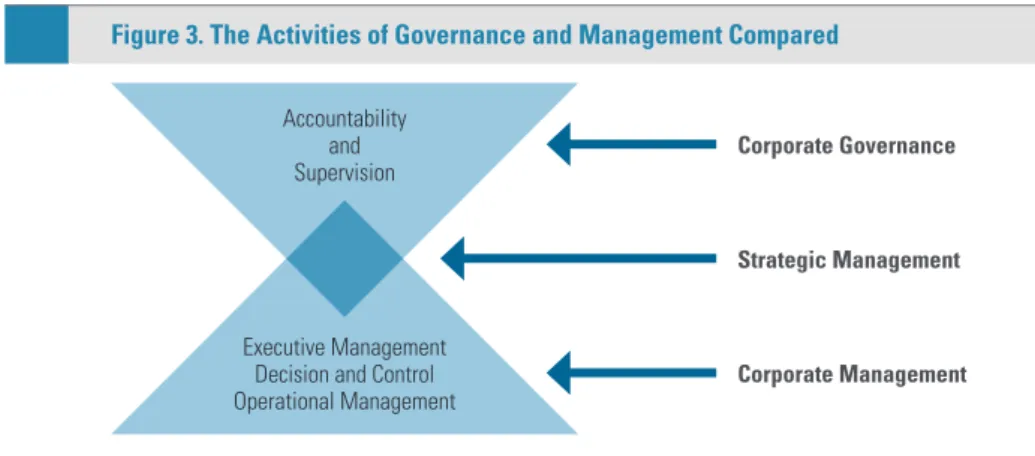
Corporate governance must not be confused with corporate management. Corporate governance focuses on a company’s structure and processes to ensure fair, responsible, transparent and accountable corporate behavior. Corporate management, on the other hand, focuses on the tools required to operate the business. Corporate governance is situated at a higher level of direction that ensures that the company is managed in the interests of its shareholders. One overlapping area is strategy, which is dealt with at the corporate management level and is also a key corporate governance element. Figure 3 illustrates the difference between corporate governance and corporate management.
5. Distinguishing Corporate Governance
Figure 3. The Activities of Governance and Management Compared
Source: Robert I. Tricker, Corporate Governance, 1984 Accountability
Supervisionand Corporate Governance
Strategic Management
Corporate Management Executive Management
Decision and Control Operational Management
41
An Introduction To Corporate Governance Corporate Governance Explained
Corporate governance must also not be confused with public governance, which deals with the governance structures and systems within the public sector. Corporate governance must further be distinguished from good corporate citizenship, corporate social responsibility and business ethics. Good corporate governance will certainly reinforce these important concepts. But while companies that invest in socially responsible projects, run charitable foundations or do not pollute often benefit with a superior reputation, public goodwill and even better profitably, corporate governance is and remains distinct from these concepts.
42
An Introduction To Corporate Governance The Business Case for Corporate Governance
Good corporate governance is important on a number of different levels. At the company level, well-governed companies tend to have better and cheaper access to capital, and tend to outperform their poorly governed peers over the long-term.
Companies that insist upon the highest standards of governance reduce many of the risks inherent to an investment in a company. Companies that actively promote robust corporate governance practices need key employees who are willing and able to devise and implement good corporate governance policies. These companies will generally value and compensate such employees more than their competitors that are unaware of, or ignore, the benefits of these policies and practices. Such companies, in turn, tend to attract more investors who are willing to provide capital at lower cost.
Generally, well-governed companies are better contributors to the national economy and society. They tend to be healthier companies that add more value to shareholders, workers, communities, and countries in contrast with poorly governed companies that may cause job and pension losses, and even undermine confidence in securities markets.
Some of the building blocks, or levels, and specific benefits of good governance are depicted in Figure 4 and discussed in further detail below.
B. The Business Case for Corporate Governance
Figure 4. Levels and Potential Benefits of Good Corporate Governance
Source: IFC, March 2004 The four levels of Corporate Governance Potential Benefits
Level 4:
Corporate governance
leadership Improved Operational Efficiency
Lower Cost to Capital
Better Reputation for the Company, its Directors, and Managers
Access to Capital markets Level 3: Advanced corporate
governance system Level 2: Initial steps to improve corporate governance are made Level 1: Compliance with legal and
regulatory requirements
43
An Introduction To Corporate Governance The Business Case for Corporate Governance
1. Stimulating Performance and Improving Operational Efficiency
There are several ways in which good corporate governance can improve performance and operational efficiency, as illustrated in Figure 5.
An improvement in the company’s governance practices leads to an improvement in the accountability system, minimizing the risk of fraud or self-dealing by the company’s officers. Accountable behavior, combined with effective risk management and internal controls, can bring potential problems to the forefront before a full-blown crisis occurs. Corporate governance improves the management and oversight of executive performance, for example by linking executive remuneration to the company’s financial results. This creates favorable conditions not only for planning the smooth succession and continuity of the company’s executives, but also for sustaining the company’s long- term development.
Adherence to good corporate governance standards also helps to improve the decision- making process. For example, Board of Comissioners, Board of Directors and shareholders are all likely to make more informed, quicker and better decisions when the company’s governance structure allows them to clearly understand their respective roles and responsibilities, as well as when communication processes are regulated in an effective manner. This, in turn, should significantly enhance the efficiency of the financial and business operations of the company at all levels. High quality corporate governance streamlines all the company’s business processes, and this leads to better operating performance and lower capital expenditures,16 which, in turn, may contribute to the growth of sales and profits with a simultaneous decrease in capital expenditures and requirements.
Figure 5. Advantages of Corporate Govenance
Source: IFC, March 2004 Better Oversight and Accountability
Improved Decision Making Increases Operational
Efficiency and Stimulates Performance Better Compliance and Less Conflict
16 Paul A. Gompers, Joy L. Ishii and Andrew Metrick, Corporate Governance and Equity Prices, NBER Working Paper No. w8449, August 2001.
44
An Introduction To Corporate Governance The Business Case for Corporate Governance
An effective system of governance practices should ensure compliance with applicable laws, standards, rules, rights, and duties of all interested parties. Furthermore, it should allow companies to avoid costly litigation, including costs related to shareholder claims and other disputes resulting from fraud, conflicts of interest, corruption and bribery, and insider trading. A good system of corporate governance will facilitate the resolution of corporate conflicts between minority and controlling shareholders, executives and shareholders, and between shareholders and stakeholders. Also, company officers will be able to minimize the risk of personal liability.
Corporate governance practices can determine the ease with which companies are able to access capital markets. Well-governed firms are perceived as investor friendly, providing greater confidence in their ability to generate returns without violating shareholder rights.
Good corporate governance is based on the principles of accessibility, accuracy, completeness, efficiency, timeliness and transparency of information at all levels. With the enhancement of tran