THE INFLUENTIAL FACTOR IN THE SHIFT OF PADOE DIALECT IN BUGINESE DE LANGUAGE IN MATOMPI VILLAGE
Thesis
Submitted in Partial Fulfillment of the Requirements for the Degree of Sarjana Humaniora in English and Literature Department of the Faculty of Adab and
Humanities of State Islamic of Alauddin Makassar
By:
RENI INDRIANI IBI 40300116138
ENGLISH AND LITERATURE DEPARTMENT ADAB AND HUMANITIES FACULTY
STATE ISLAMIC UNIVERSITY OF ALAUDDIN MAKASSAR 2022
ii
PERNYATAAN KEASLIAN SKRIPSI
Dengan penuh kesadaran penulis yang bertanda tangan di bawah ini menyatakan bahwa skripsi ini benar-benar adalah hasil karya penulis sendiri dan jika kemudian terbukti merupakan duplikat, tiruan plagiat atau dibuat orang lain secara keseluruhan ataupun sebagian, maka skripsi ini dan gelar yang diperoleh batal demi hukum.
Gowa, 23 Februari 2022 Penulis
Reni Indriani Ibi 40300116138
iii
iv
v
vi
ACKNOWLEDGMENT
Alhamdulillahi rabbil alamin. The researcher praises her highest gratitude to God Allah SWT who has been giving her the mercy and blessing for completing this thesis. Shalawat and Salam are addressed to our prophet Muhammad SAW, the greatest one who has shared inspiration, spirit, and power to the human. The researcher really thanks to the people who pray, guide and help her along this time, she realizes these people have a clot contribute during her research and writing this thesis.
1. The writer’s beloved parents, Agus Salim and Martina for their loves, cares, supports and prayers for the writer’s safety and successful.
2. The writer's beloved sister, Irmala Ibi S.E, Sazkia Ibi, and Syahruni Ibi for their support and sincere prayer for the writer’s success.
3. The writer’s beloved big family especially for Aunty Hasnah and Uncle Mursida, and my cousin Musdaria S.Si for their support and sincere prayer for the writer’s success.
4. The Rector of UIN Alauddin Makassar, Prof. Drs. Hamdan Juhannis, M. A., Ph.D. For his advice during the period when the writer studied at the University.
5. The Dean of Adab and Humanities Faculty Dr. Hasyim Haddade, S. Ag., M.
Ag and his staff, all of the vices of dean of Adab and Humanities Faculty, Dr.
Andi Ibrahim, S.Ag., S.S., M.Pd. Dr. Firdaus, M.Ag.,H. Muh. Nur Akbar Rasyid, M.Pd., M.Ed., Ph.D, the Head of English and Literature Department, Dr.Jumharia Djamereng, M.Hum. And Secretary of English and Literature
vii
6. Department, Sahruni Junaid, S.S, M. Pd. for their support, help and encouragement.
7. The deepest gratitude is sent to the writer‟s supervisor, Dr.Jumharia Djamereng, M.Hum. and Helmi Syukur, S.Pd., M.Pd. for their guidance, comments, correction, supports and their precious time during the process of the writer to finish this thesis.
8. Dr. Hj. Nuri Emmiyati, M.Pd. and Nirwana, S.Pd., M.Pd. the writers examiner who have given their suggestions and corrections.
9. The writer’s gratitude is also addressed to all the lecturers of Adab and Humanities Faculty, for their knowledge, enlightenment, and advices during the academic years also for the administrative officers of Adab and Humanities Faculty, for their help, services, and administrative support.
10. The writer’s thanks is addressed to the Sister Asma Dien Amaliah, S.Hum., who have guide and give many suggestion to the writer to fix her thesis well.
11. All my friends in AG 5.6 (2016) especially Ari Adyatmi, Afika, and Wardani thank you for the friendship, laugh, togetherness, travelling in every semester break and supporting her for the writer's in finishing this Thesis.
12. The writer’s thanks addressed to writer’s best support system, Muhammad Raiyan Supri and Family.
13. My beloved friends, Ayu Putri jumra (Tayoku), Suci Agustianti, Wira Adelia, Andriani, Dewi Sinta, Nurul Asmaul Husna, Nurul Ainun, Dedhy wahid, Ikhwanuddin and others who cannot be mentioned one by one but thank you so much for the attention and support given to writer’s.
viii
14. The writer’s thanks is addressed to the friends of writer in KKN, A Inda, Ummul, Sinar, Mawaddah, Nilam, Tawwif, Syafri, Herdi, and kak Sapar have given the writer support and advice.
15. The writer’s thanks is also addressed to all of people who helped the writer and those whom the writer can not mention one by one.
Romang Polong, 5th Maret 2022 The Writer,
Reni Indriani Ibi 40300116138
ix ABSTRACT Name : Reni Indriani Ibi
Reg. Number : 40300116138
Major : English and Literature Department Faculty : Adab and Humanities Faculty
Title : “The Influential Factor in The Shift Of Padoe Dialect in Buginese DeLanguage in Matompi Village”
Supervisor 1 : Dr. Jumharia Djamereng, M.Hum Supervisor II : Helmi Syukur. S.Pd., M.Pd
This study aimed to find out what factors influence the shift in the Padoe dialect in the Buginese De language to students studying at various campuses in South Sulawesi. Language shift occurs as the people decision to use the language among the community which usually shifted from the lower social language to the high social language or from the less powerful group to the dominant one. This research was conducted using a qualitative descriptive method and analyzed using Janet Holme’s theory, namely 4 factors that influence language shift, namely economic, social, political, and demographic factors. The results of this study indicate that the factors that greatly influence the shift in the padoe dialect are social factors related to social interaction and communication.
Keywords: Language Shift, University students, and Padoe dialect
x
TABLE OF CONTENTS
HALAMAN JUDUL ... i
PERNYATAAN KEASLIAN SKRIPSI ... ii
PERSETUJUAN PEMBIMBING ... iii
APPROVAL SHEET ... iv
PENGESAHAN SKRIPSI ... v
ACKNOWLEDGMENT ... vi
ABSTRAK ... ix
TABLE OF CONTENTS ... x
CHAPTER I: INTRODUCTION ... 1
A. Background ... 1
B. Research Questions ... 5
C. Objective of the Research ... 5
D. Significance of the Research... 5
E. Scope of the Research ... 5
CHAPTER II: REVIEW OF RELATED LITERATURE ... 7
A. Previous Studies... 7
B. Partinent Idea ... 10
1. Sociolinguistics ... 10
2. Definition of Monolingualism ... 11
3. Definition of Bilingualism ... 11
4. Language Shift ... 12
5. Factors Effect of the Languiage Shift ... 14
6. Padoe Dialect in Buginese DE Language ... 1
xi
CHAPTER III: RESEARCH METHODOLOGY ... 21
A. Population and Sample... 21
B. Technique in Collecting Data ... 22
C. Instrument of the Research ... 23
D. Technique in Data Analysis... 23
CHAPTER IV: FINDINGS AND DISCUSSION ... 24
A. FINDINGS ... 24
B. DISCUSSION ... 40
CHAPTER V: CONCLUSIONS AND SUGGESTIONS... 49
A. Conclusions ... 49
B. Suggestions ... 49
BIBLIOGRAPHY ... 51
APPENDIX ... 53
AUTOBIOGRAPHY ... 61
1 CHAPTER I INTRODUCTION A. Background
Language is the ability to communicate with others through the use of signs such as words and gestures. Language, on the other hand, is a tool for interacting or communicating, in the sense of conveying the mind, and feelings. Language, according to Widdowson (1996: 3), plays a central role in our lives. People obtain it during childhood. It includes our identity as individuals and social beings. It is a cognitive and communicative tool that allows us to think about ourselves and collaborate with others in our community. Language, according to Edward Sapir (1921:7), is a purely human non-instinctive means of expressing thoughts, feelings, and desires through a system of voluntary produced symbols.
In everyday life, language is a critical means of communication. Language used in communication and to socialize among people. They should express their thoughts, convince others, or make a promise. Language, according to Dougles Brown, is a system of arbitrarily conventionalized vocal, written, or gestural symbols that enable members of a community to communicate intelligibly with one another.
Language, on the other hand, is divided into several varieties as a means of communication. People from various countries, ethnic groups, and cultures speak different languages. Allah states about the varieties of language in surah Ar-Rum verse2
Translation :
“And among His signs isthecreation of the heavens and the earth, and the
difference of your languages and colors. Verily, in that are indeed signs for men of sound knowledge”
Quraish Shihab's interpretation of the above verse explains: And among the signs of the perfection of His power and wisdom, is the creation of the heavens and the earth with this very beautiful system. Also, including signs of his power, differences in your language and dialect, as well as differences in the color of your skin, black, white or other.
The relationship between the pieces of the verse above and the research to be carried out is where the verse explains that Allah has created a variety of different languages so that it is possible to shift language between one language and another.
Vaux, Bert, Golder, Starr, and Bo (2005) A regional language is a language spoken in an area of a sovereign state, whether it be a small area, a federal state or province, or some wider area.“Regional or minority languages,” as defined by the European Charter for Regional or Minority Languages, are languages that have traditionally been spoken within a given state's territory by nationals from a group that is numerically smaller than the rest of the population and are distinct from the state's official languages. It is important to distinguish between recognition of a regional or minority language and recognition as an official language. Language is
3
obviously an indispensable tool of human beings. Languages must be preserved because they aid in the improvement of society's political, legal, cultural, and economic conditions. There are numerous distinctions that define and demarcate dialect areas.
According to Crystal (2008)the gradual or sudden transition of languages is called language shift. Another addition fromWilley (1996) agrees with that, language shift is the change by the person or groups from one language to another.
Language extinction is the final result of language shift. Language shift phenomenon may result in the total extinction of a language, the extinction of all speakers of the language, or the extinction of a language in a specific community.
According to Holmes (2001), when all people who speak a language die, the language dies as well.Language shift, according to Appel and Muysken (1987), is a bridge to language extinction. It means that as the community's language shifts, the community's language dies slowly but steadily and unconsciously. In Indonesia, the shift in vernacular may result in the loss of mother tongue. It is exacerbated by the fact that the number of speakers is decreasing day by day.As a result, the vernacular will be on the verge of extinction.
According to Amar (2004), the language shift process is a historical event since the mother tongue of the group of speakers will eventually become extinct. This is in line with Mbete's opinion (2003: 14), according to which the depreciation of a language's basic functions usually happens over a long and slow period of time, beyond a generation.
Mbete (2003: 14-15) depicts the extinction of a language as a diminishing or even complete loss of local language used in family tales, such as between parents and children. Furthermore, the disappearance of culture fairy tales, as well as the
practice of telling stories to children before bedtime, is a significant factor, Traditional institutions that are failing as fortresses of society and traditions.
Generations of young people, on the other hand, are no longer able to comprehend the message and idea of that outlook on life found in old texts, fairy tales, idioms, and frozen style. Guyup's own words became clearer as serious signs of language extinction appeared. Furthermore, there are many open opportunities for English, Mandarin, or possibly another foreign language to displace Indonesian language, which will also be a smoothshift regional language in the near future.
Padoe dialect is atronesian languages that are spoken by Padoe tribe in South Sulawesi (Nuha, Malili, Mangkutana, Wasuponda and Towuti) and Central Sulawesi (Mori Atas, Morowali, Pamona Utara and Poso). According to linguistic scholars, Padoe is one of the dialects of the Mori language, which is spoken in the North Morowali district of Central Sulawesi.
Matompi is one area in located in Towuti sub district regency of luwuTimur.
The Matompi’s society who is mostly Padoe’setnic, who also speaks Padoe in their daily life. Besides Padoe ethnic, there are other languages that are spoken in the village, such as Buginese, Tae' language, Makassar language, Javanese language, and Indonesian language.
Because there is no research on language or shift of Padoe dialect in Buginese De language, the researcher is interested in analyzing it. And the participants in this study are university students from Matompi village. As a result, the researcher is interested in determining how university students use the Padoe dialect in their daily activities. Because of the large number of people who live in the village of Matompi, the researcher believes that this research is important because it is necessary to
5
understand what factors are causing the shift in the Padoe dialect, particularly among youth, so that the local government can take further action to ensure that the Padoe language or dialect does not die.
B. Research Questions
Based on the backgroundof the study above, the researcher formulates the research question as follows:“What are the influential factors in the shift of Padoedialect in Buginese Delanguage among Matompi society”?
C. Objective of the Research
Based on the problem statement above, the researcher aims at finding out the influential factor in the shift of Padoe dialect in Buginese De language among Matompi society
D. Significance of the Research
This research contributes both of theoretical and practical in the study of linguistic, especially concerning about language shift.
1. Theoritically, this research is expected to increase knowledge as a provision in theoretical knowledge to researchers, as well as the reader. This research can be used as an additional reference for students who want to conduct a research especially in the linguistic landscape.
2. Practically, the results of this research expected to be considered in terms of the government and local regional institutions in making policies relating to the preservation of the Padoe language, especially in the Matompi village area.
E. Scope of The Research
Based on the explanation above, the researcher analyzes the factors that influence the shift in the Padoe dialect in the Buginese de language in the village of
Matompi, Towuti sub-district, East Luwu district. Language shift can be influenced by various factors. Holmes (1992) suggested, there are some various factors which influence or lead a person or community to shift her/his own language to other language: politic, economic, social, demographic (p. 65-66). The informants involved in this research are students who study at universities in South Sulawesi and they come from the village of matompi.
7 CHAPTER II
REVIEW OF RELATED LITERATURE A. Previous Studies
Asmitazkirah (2013) the subject of this research is "Language Shift in Arabic Language in Medan". This study aims to (1) describe the factors that influence the shift in Arabic, (2) the pattern of language shift, and (3) the reasons for the shift from Arabic to Indonesian. The subjects of this study are 25 people (male and female) of Arab citizens who belong to the Arab community in Medan. They are divided into two groups; the second generation whose parents are immigrants from Arabia, the third generation is descended from the second generation. This study used descriptive qualitative method. And based on the results of the research conducted, it is known that there are six factors that influence the shift in Arabic in the second and third generations in Medan, namely; bilingualism, migration, economic and social factors, political factors, demographic factors, and the last is values and attitudes. But most affecting factor of it is bilingualism.
The difference between this research and Asmitazkirah's research is that this one focuses on the transition from Padoe to Indonesian in the village of Matompi, Towuti sub-district, Luwu Timur district, and the interviewees are university students from Matompi. While Asmitazkirah's research focuses on the field area's change from Arabic to Indonesian, the interviewees employed are Arab citizens in their second and third generations. The parallels are that they both discuss language shift and the study methodologies they used, which are both descriptive qualitative research approaches.
Djamareng and Jufriadi (2016) studied about “Pengaruh sikap dan peran orang tua terhadap pergeseran bahasa luwu dikalangan anak-anak pada masyarakat Luwu kota Palopo” The aim of the study is to determine the current state of the Luwu language shift among children in Palopo. In addition, it was investigated whether the attitude factor and parental position affected Luwunese usage. To address these issues, the researcher used the Palopo communities in districts of Wara, East Wara, Bara, and TelluWanua as the study's population. On the basis of data percentage analysis derived from questionnaires and interviews using note taking and recording as research methods. The findings revealed that language change occurred among children in Palopo City. The parents' use of Luwunese language was a major influence on the children's language shift, as evidenced by the respondents' lack of Luwunese use in their family relationships between children and parents. The parents' positive attitude toward the use of Luwunese, as indicated by the percentage on the questionnaire, had no effect on the Luwunese change in Palopo.
Amirullah (2017) this research was done to find out the shift of the Buginese language by community in Tandung village North Luwu Regency. This study uses a qualitative descriptive method that describes the language shift in the village of Tandung, North Luwu district. The sample used in this research is multi-stage sampling, taken a number of 1034 people from the village of Tandung. Data collection techniques are carried out by observation and interviews. The results of the study indicate that there has been a shift in language in the Tandung village, North Luwu district, especially in the use of the Buginese language by the community in the Tandung village. The majority of the Buginese language used is only the middle generation 26-49 (adults) and the older generation aged 50 years old.
9
Masruddin (2013) the subject of this research is “Influenced factor towards the language shift phenomenon of wotunese”. The aim of this study is to determine the factors that affect Wotunese language change. This research was conducted in two villages in Wotu District, East Luwu Regency, namely Lampenai Village and Bawalipu Village. The procedure used was a field survey involving the distribution of questionnaires, interviews, and direct observation of 400 Wotunese. The informant sample consisted of 400 Wotunese males and females who had lived in the Wotu region for at least 10 years. They range in age from 10 to 50 years old. The findings show that age, mobilization, bilingualism, and language attitude are major determinants of Wotunese language change. The government and Wotunese people should then take concrete steps to save the Wotu language from extinction.
The difference between this research and the three previous researches is that this one focuses on changing the Padoe dialect with the informants, who are university students from Matompi's village. Meanwhile, the research conducted by Djamareng and Jufriadi focused on the shifting the Luwu language by taking the children age group as the informants. Thus, other research conducted by Amirullah that focused on the shifting the Buginese language, and the research conducted by Masruddin focused on the shifting the Wotu language and they took all age groups as the informants.
The similarity of this research between the research conducted by Djamareng and Jufriadi, Amirullah, and Masruddin is the factors which all three also focus on language shift. The research locations also are similar that located in Luwu Raya, Djamereng and Jufriadi located in Kota Palopo, Amirullah in Luwu Utara, Masruddin in Wotu sub-district.
One of the effects of the transmigrants' arrival in East Luwu is that the indigenous people's language has changed significantly. Some indigenous people no longer teach their children Padoe and prefer to use Indonesian instead. This occurs because it is customary for them to communicate in Indonesian with other tribes or transmigrants. Due to the same reason, some transmigrants have lost their ability to communicate in the local language. Despite this, some residents retain their respective languages, which they use when interacting with family or fellow tribes.
B. Partinent Idea 1. Sociolinguistics
Sociolinguistics requires language shift. “Language change is the shift or displacement of one minority language mother tongue to a language of a larger society” According to Holmes (1992:56). Language shift occurs because the choice made by individuals, most importantly in the domestic domain, in accordance with their own motivation, expectation, and goal that they may or may not share with other members of their community (Coulmas, 2005:168).
J.A.Fishman (1972:4)sociolinguistics is the study of the characteristics of language varieties, the characteristics of their functions, and the characteristics of their speakers as these three constantly interact, and change one another within a speech community.
Terms "sociolinguistics" and "linguistics" are derived from the words "socio"
and "linguistic." Socio refers to the social word, or a group of people. Linguistics is a branch of science that studies and explained about language, especially its elements and interactions. So, sociolinguistics is a field of research that puts together ideas on how culture and language interact. Sociolinguistics studied and discussed aspects of social language, especially differences in language related to social factors, based on
11
previous understanding, Nababan (1993: 2). Based on some of the points made above, sociolinguistics not only learns about language, but also about aspects of language used by the group.
A sociolinguistic approach is used in this research. A qualitative analysis approach was used in this study. This approach is used in both natural and experimental settings. As a result, researchers must have access to hypotheses and diverse perspectives to aid them in data collection, study, and design of the items to be studied.The research center employs descriptive qualitative techniques to look for language variation in short message text that suggests action fraud. Keirl and Miler (in Moleong, 2002: 22) revealed that Qualitative research is a particular tradition in social science that is fundamentally dependent on observation, human beings, their own region, and relate to these people in their language and the terminology.
2. Definition of Monolingualism
According to Wardhaugh (1998 p, 96) stated that Monolingualism the ability to use only one language, is such a widely accepted norm in so many parts of the world that it is often assumed to be a world-wide phenomenon, to the extent that bilingual and multilingual individuals may appear to be unusual.’ Indeed, the people often have mixed feelings when they discover that someone who meet is fluent in several languages: perhaps a mixture of admiration and envy but also, occasionally, a feeling of superiority in that many such people are not ‘native’ to the culture in which they function. Such people are likely to be immigrants, visitors, or children of
‘mixed’ marriages and in that respect ‘marked’ in some way, and such marking is not always regarded favorably.
3. Definition of Bilingualism
Bilingualism According to Baleghizadeh (2008), bilingualism is the phenomenon of communication in two languages. Weinrich (1968)often accepts that bilingualism is the process of writing and speaking in two languages at the same time.
Bilingualism is the most obvious sign of a language change. It is also supported by Downes (1998), he considers that bilingualism is a factor which involves in leading the language shift. In the same manner, Fishman (cited in Extra and Verhoeven, 1999) argues that if language shift happens as a result of two languages interacting with unequal control, the weaker language would be dislocated from the stronger.
When people become bilingual with disproportionate influence in both languages, their second language will unconsciously take the place of their first or mother tongue. Thus, bilingualism is one factor that can cause the language shift.
Bloomfield (1933:76) says that the ability of the speaker to usethe two languages with the same good is bilingual, both their mother tongue and second language. The life of an immigrant with a minority language, for instance, using two languages in communication with other people. Bilingual state is ability to learn and master another language, to communicate efficiently, they need yet another panic.
The role of bilinguals in the majority of the linguistic society around them is a group of individuals who use twolanguages.
4. Language Shift
Language shift occurs as the people decision to use the language among the community which usually shifted from the lower social language to the high social language or from the less powerful group to the dominant one (Holmes, 1947:51).People want to reach a high social class by changing their language because the more powerful group is synonymous with status, prestige, and social achievement. Otherwise, Jendra (2010:141) argues said that language shift is a
13
language phenomenon that totally change the premous language into a new community as the demand from the speech community. Fishman (1991:1) describes the language shift as a great process of continuity where the heritage language is causing negative affect within few speakers, readers and writers from one generation to another generation. In recent years, the language shift occurs in Indonesia has mostly been carried out by young people while they are outside of their previous culture, such as while attending school or working. Immigrants are the words used to describe them. Ambarwati (2013).
According to Yuliawati (2008) Language shift mostly happen in bilingual or multilingual community which the result from language contact. Although not the language shift leads to language disappear from of a community, but the language situation on some region should be observed to avoid the language extinction. Many factors affect the shift of language such as, among others, industrialization, prestige, the influence of global culture, economic change, urbanization, migration, etc. Over all language shift implies to an abandoned language by the community of the native speakers. Which resulting when a language shift occurs, members of the language community positively prefer to use a new language rather than their previous language (regional language or mother tongue). In order to maintain language speakers.
According to Trudgill (2002:138), language shift is a phenomenon that causes language varieties to become extinct. Language shift is a stage of bilingualism in which a community gradually abandons its native tongue and adopts another.
Meanwhile Jendra (2010:140) Language shift was identified as a type of full-scale language change. The term refers to a situation in which a speech community a switches to a new language entirely, or in other words, stops using their previous
language for communication purposes. “When language shift occurs, it is usually shifted towards the language of dominant powerful group. A dominant group has little incentive to adopt the language of a minority”, Holmes (2008:57). “Language shift” can be defined as a process in which “the habitual use of one language is being replaced by the habitual use of another” in “bilingual towns, villages, or neighborhoods” Gal (1979:1).
According to Jendra (2010:142) a language phenomenon such as language shift has two different types which are non migrant and migrant shifting. Migrant shifting is a type of language shifting which led by the adaptation of community in a new land. Most of the time, the process of language shifting happens gradually.
Children experience the first contact to the language phenomenon because of school.
Children in school have to adapt the lessons taught in English and difficulties of performing communication to the friends using English. On the other hand, parents also need to adapt to another languages in their workplace. On the other side, non migrant shifting is the type of language shifting which left by certain condition where the speakers do not move to other place and still perform the language. This type of language shifting could be led by some factors such as politics, education and economy.
Meanwhile, Holmes (1947:51-56) states that there are at least three types of language shift in certain community which are migrant minorities, migrant majorities and non migrant community. Migrant minorities’ type is when the migrant people become the common people or part of the low level society. In this case, we can take Chinese citizens as example, when the Chinese citizens move to another country and become permanent citizen, they have to adapt to the new environment by shifting
15
their language to the native language in the land that they come to, and this process occurs gradually.
Fasold in Lukman (2000) states that language shifting and preservation are like two sides of a coin that cannot be separated from one another. It is the result of a joint agreement to use a particular language (language choice). When it comes to language preservation, the culture as a whole decides to keep using the language that is currently in use. There is a probability of a language change when a culture chooses a new language in the realm where the old language was originally used.
5. Factors Effect of the Language Shift
Language shift as language phenomenon has a big influence. Fasold (1984:217) as cited from Nambiar (2011:116) states that there are five factors that lead to the phenomenon of language shifting. They are migration, economic, prestige, industrialization and minority speaker. However, some research found that the main factor that leads to language shift is economic. Meanwhile, Nambiar (2011:117) states that the most important factor that pressed one community to shift their language is language policy. If economic factor is about choices, language policy is not.
Government plays an important role to choose which language should be the official language in Indonesia, for instance, Bahasa is chosen by the government to be the language to deliver the lesson in classroom. The societies then adapt and learn that bahasa is the only language to use at schools. This condition gradually leads the society to become bilingual. For some additional reasons, Bahasa is also considered as the most polite language not only in school but also in social contact. In addition to this research, Javanese “Ngapak” language performed by Banyumas people is considered impolite while Javanese “Krama” is rarely used. Gradually, people shift to
BI as an alternative language. From this phenomenon, we learn how the small sequences impact the language shift.
Language shift can be influenced by various factors. Holmes (1992) suggested, there are some various factors which influence or lead a person or community to shift her/his own language to other language: politic, economic, social, demographic (p. 65-66).
a. Social factor
People need a language to communicate each other. Monolingual community gets difficult to build a successful communication in bilingual or multilingual society.
It encourages them to lean a new language (majority) and use it (bilingual or multilingual) to communicate in bi or multilingual society. Like as a migrant minority group move to predominantly monolingual society dominated by one majority group language in all major institutional domains: school, TV, etc. learn the majority language and shift the native language will be unavoidable unless the community takes active steps to prevent it (Holmes, 1992, p. 65).
b. Economic factor
The most obvious factor lead the community to learn the second language and shift the native language is economic, Holmes (1992) stated, the most obvious reason to learn other language is economic, obtaining work. Like as in dominated Engish country, people learn English in order to get a job (65). Oher example is when people from rural area (Madura) come to big city (Jakarta), they shift Madura language to Indonesian (lingua franca) for obtaining work
c. Politic factor
The other influence factor in language shift is a situation where the government policies concerning language and education, the pressure of institutional
17
domains to use a language. Like as Indonesia which has various regions native language and the government chose Indonesian as the official language. Indonesian officially used in various institutional domains: government administration, court, politic, military, school.
d. Demographic factor
The other relevant factor which accounting for the speed of language shift is Demographic. Demographic factor contains of several factors: urbanization, size of community of speakers, intermarriage, and migration (Holmes, 1995, p.66).
Urbanization tend language shift be faster. TV, internet, telephone are agents of the language shift in urbanization. TV programs in Indonesia use Indonesian and almost all foreign programs are dubbed into Indonesian or Indonesian sub-title. It encourages shifting vernacular language (or languages) to official language. The second is the size of community of speakers. If the minority language has large number of speakers, language is shift slowest. The smaller number of the speaker tend more potential speaker shift to domain language. The third is intermarriage of different ethnic languages. Mother tends to influence her children’s language change by accelerating toward the dominant language or her native language (of the minority).
Like as in intermarriage family, wife and husband have each native language. They tend to influence language change of each other and to be bilingual or multilingual.
The fourth is migration. Like as rural migration community, it encourages language shift. They shift their native language to language of other society or dominant language. Jakarta is a big city which lived by multiethnic migrants, moved from many regions. All of them have different native language and they shift it with Indonesian as the dominant language.
6. Padoe dialect in Buginese DE language
The Buginese De language is basically not the same as the Bugis language.
This language is spoken by people living in Wawondula and Matompi Village, Towuti District, East Luwu Regency, Manurung Village, Malili District, East Luwu Regency, LeduLedu Village, Wasuponda District, East Luwu Regency, Matano Village, Nuha District, East Luwu Regency, South Sulawesi Province.
The Bugis De language consists of four dialects, namely (1) the Padoe dialect spoken in Wawondula and Matompi Village, Towuti District; (2) the Manurung dialect spoken in Manurung Village, Malili District; (3) Karunsia dialect spoken in LeduLedu Village, Wasuponda District; (4) and the More dialect spoken in Matano Village, Nuha District. This dialect grouping is based on the results of dialectometry calculations which show that all the compared areas are users of the same language, namely Bugis De language users with a percentage difference of around 68%-76%
(different dialects).
Based on the results of dialectometry calculations, the isolect of Bugis De is a language with a percentage difference of around 85%-91% when compared to languages in South Sulawesi, for example compared to Bugis, Toraja, and Wotu languages.
The Padoe (To Padoe) tribe is one of the tribes that live in the South, Central, and Southeast Sulawesi regions. The Padoe tribe is found in East Luwu Regency's districts of Wasuponda, Malili, Nuha, Towuti, Angkona, and Mangkutana, especially in the South Sulawesi region. The Padoe tribe's current population is estimated to be about 22,000 people.
The Bungku-Tolaki language family is related to the Padoe tribe linguistically. The Padoe tribe has lived in the Malili-Nuha region since the dawn of
19
civilization. After that, some of the families relocated to Central Sulawesi, to the Kanta region of Kayaka. About the XIV-XV century, this family returned to the Malili-Nuha region after several years. Meanwhile, the remaining clumps can be found in Angkona and Malili.
In the local language the term "Padoe" means "distant person" because it is also known as "To BelaE". In Tana Luwu they became one of the 12 tribal children under the leadership of Kedatuan Luwu (Luwu Kingdom). Many of the To Padoe tribes now live in the Pakatan area in M Transportana District; Angkona and Lakawali in Angkona District; Pabeta, Kore-korea (Tulantula) and Malili in Malili District; Laroeha, Kawata, Lasulawai, Amasi, Tawaki, Ledu-Ledu, Wasuponda and Tabarano in Wasuponda District; Wawondula, Lioka, Matompi in Towuti District;
Taliwan in North Mori District, North Morowali Regency, Central Sulawesi;
Mayakeli in PamonaPuselemba sub-district, Poso Regency, Central Sulawesi Province.
The Lahomua faith is the Padoe people's initial belief system. The worship of UeLahumoa is central to the Lahumoa faith. God is referred to as Ue (Mpue, Pue), and the Almighty is referred to as Lahumoa. Lahumoa is made up of two syllables:
Lahu and Moa. Moa means Fantastic and One, and Lahu means masculine form / existence. UeLahumoa translates to "one wonderful and masculine God".
UeLahumoa is the source of all blessings and goodness and therefore prayers are given periodically to an open roof part of the house called "tinungga." Apart from UeLahumoa there are also gods (Ue-Ue) who bring disaster and calamity. Ue-Ue is what is given to worship so as not to interfere with human life. Places that are considered sacred are considered to be the dwelling places of this Ue-Ue. This activity of making offerings is called "montuila."
Christian missionaries from the Netherlands started to reach the Padoe tribe's territory in the 1920s, bringing Christianity to the Padoe people. As a result of the Darul Islam movement of the Indonesian Islamic Army (DI / TII) led by Kahar Muzakkar, many Padoe citizens fled to Central Sulawesi in 1965. As a result, the Padoe tribe has been widely dispersed and has lived in Central Sulawesi until now.
Padoe dialect can be said to be one of the languages that has shifted after researchers made initial observations which showed that the use of Padoe language in some circles was very rare, such as in interactions carried out by children, adolescents, and adults under 30 years of age. Padoe language itself is only actively used by older people in their daily interactions.
Padoe is one of the languages spoken in East Luwu, South Sulawesi, and is spoken in Matompi village, Towuti sub-district, East Luwu Regency. The majority of Matompi village residents speak Padoe
.
21 CHAPTER III
RESEARCH METHODOLOGY
The research design applied in this study was descriptive qualitative method, since this study was conducted solely on the basis of facts or phenomena and empirically lived on its participants, the result will be the function of language, which has the nature of exposure as it is, Sudaryanto (1993:62). It aims to describe the influentialfactors in the shift of Padoe language by university students who are studying at various campuses in South Sulawesi with an age group of 19 to 25 years.
A. Population and Sample
Population and sample are very influential in conducting a research. A population, according to Donald Ary (2002: 56), is defined as all members of a well defined group of people, events, or objects. Analyze these problems the researcher may take the sample. According to Sugiyono (2010: 117), a population is a collection of subjects chosen by researchers to be investigated and conclusions produced. The number of people in a given area has a significant impact on population growth. If it is large, the researcher will most certainly face challenges in conducting the study, such as a lack of funding, energy, and time. To solve these issues, the researcher may take a sample.
According to Donald Ary (2002:78), a sample is a part of a population or a representation of a population. A sample is a subset of a population that has been chosen for observation and investigation. The sample is a representation of the total population. It's designed to make running the research more efficient. The findings and conclusions generated from the sample are representative of all respondents.
Therefore, the population sample obtained should be truly representative.
The population of this research taken from 45 university students who come from Matompi village and studying at various campuses in South Sulawesi based on the age group of 19 to 25 years old.
The technique that the researcher uses is multistage. Multistage sampling is a sample technique for conducting research that splits the population into groups (or clusters). It's a more complicated type of cluster sampling that's frequently referred to as multistage cluster sampling. Significant clusters of the selected people are broken into sub-groups at various points during this sampling process to make primary data collecting easier. As the samples, the researcher will take 25 students from 45 university students who are living in the village of Matompi.
B. Technique in Collecting Data 1. Observation
The research use participatory observation which is the researcher or observer is directly involved in observation activities in the field. The researcher acts as an observer and becomes part of the group being studied. The advantage of this type is that researchers become an integral part of various situations studied in the field, so that their presence does not affect the situation in the field.
The researcher collected data by going directly to the field to observe how the Padoe dialect was used among students. The researcher visited several places usually used by these students to gather for the purpose of observation and collect data for the purpose of relevant analysis.
2. Questionnaire
A questionnaire is a research tool that contains questions and statements that respondents must answer in order to collect data. As explained by Suharsimi,
23
Arikunto (1998:24). “The poll method is a method of collecting data by filling a list of questions so that it can be known data from knowledge, attitudes and opinions”.
There are eight criteria that form a reference in deciding which questions will be utilized in the questionnaire list while collecting data using questionnaires. These eight points are based on Jumharia Djamereng's past research in Tamil language research. Mobility, Bilingualism, Religion, Culture, Family, School/Office, Market, and Attitude are the eight elements.
3. Interviews
Interviewing is a data gathering approach that involves asking and answering questions one at a time, in a systematic manner, and in accordance with the study objectives. Meanwhile, according to Moleong "interview is a conversation with a purpose. The conversation was conducted by the two parties, namely the interview (interviewer) is asking the interviewee (interview) that provides an answer to that question” Referring of opinion on interviews conducted by the researcher and the respondents in this research room of the prescribed period and at the line with the agreement between the researcher and the respondent.
This interview was conducted by the interviewer using a list of questions taken from a list of previously used questionnaires, to explain the experiences and opinions of respondents regarding the use of the Padoe dialect.
C. Instrument Of the Research
In collecting data, the researcher use note taking, recordings, and interview lists as research instruments.
1. Note taking is an information recording system that is used to record all information obtained from interviews with interviewees about what factors affect language shift in Matompi village.
2. Recording is used to record all conversations carried out by the researcher with the interviewee.
3. Interview list was prepared to make it easier to interview and so that the questions given were more structured and clear.
D. Technique in Data Analysis
Researchers analyze data based on observation and interview result. This research analyzing the data based on Holmes theory (1992) there are four elements that support the linguistics shift: Social factor, economic, and demographic, and several theories that discuss language shift.
25 CHAPTER IV
FINDINGS AND DISCUSSION
This chapter presented findings and discussion part of this research. Findings provided data found by the researcher on the the shift of Padoe dialect in Buginese DE language among university student who come from Matompi village and studying at various campus in South Sulawesi. Meanwhile discussios part presented the explenations of the findings.
A. FINDINGS
After observing and distributing questionnaires to 25 respondents about the factors that influence the shift in the Padoe dialect in the Bugis de language in the village of Matompi, the results of the study are as follows:
Based on the theory employed in this study, namely Holmes' theory (1992), which states that there are four factors that influence language shift and is discussed below with a percentage table from the questionnaire used.
1. Social factor
Seven of the eight domains that the researcher studied included social factors.
Judging from the data taken by the researcher, the respondents who were taken focused on university students only and the focus of the research was on the use of the dialect itself which was grouped into several domains in their environment.
The use of Padoe dialect in the Buginese De language among University students A. Mobility
Table 01: The use of Padoe dialect in mobility of Matompi society Score
No Questionnaire Always Often Usual Rarely Never Total Do you often travel
from Matompi village to other areas of South Sulawesi?
8% 32% 36% 24% - 100%
Based on the result above, it shows that there are 25 university students as the respondents, 8% of them that always travel from Matompivillage. Meanwhile, there are 32% of them that often travel from Matompi village. There are 36% who the respondent also that usual travels from Matompi village. Then, between of them there are only 24% the respondent who that rarely travels from Matompi village.
Table 02: The use of Padoe dialectwhen their travel from Matompivillage to areas outside South Sulawesi.
No Questionnaire
Score
Total Always Often Usual Rarely Never
Do you often travel from Matompi village to areas outside South Sulawesi?
- 4% 4% 72% 20% 100%
On the table above, the use of Padoe dialect if respondents travel from Matompi village to areas outside from South Sulawesi. The table present 4% of the respondents often use Padoe dialect when travel from Matompi village, then 4% of the respondents choose usualand there are 72% of the respondents choose rarely.
27
Meanwhile only 20% of them that use never that used the dialect when travel from Matompi village.z
B. Bilingualism
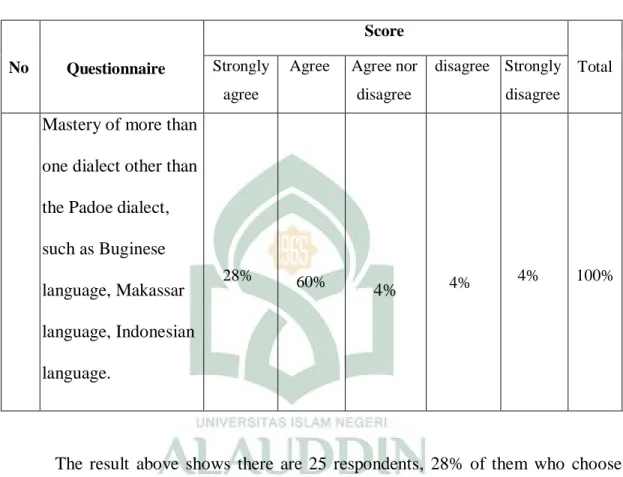
Table 03: Mastery of language use more than one dialect other than the Padoe dialect.
No Questionnaire
Score
Total Strongly
agree
Agree Agree nor disagree
disagree Strongly disagree Mastery of more than
one dialect other than the Padoe dialect, such as Buginese language, Makassar language, Indonesian language.
28% 60% 4% 4% 4% 100%
The result above shows there are 25 respondents, 28% of them who choose strongly agree in mastery of more than one dialect other than the Padoe dialect. There are 60% of them agree with mastery of more than one dialect and 4% who the respondents also neither choose Agree nor disagree mastery of more than one dialect.
While 4% of them disagree mastery of more than one dialect itself. Meanwhile, there are 4% respondents who strongly disagree when mastery of more than one dialect other than the Padoe dialect.
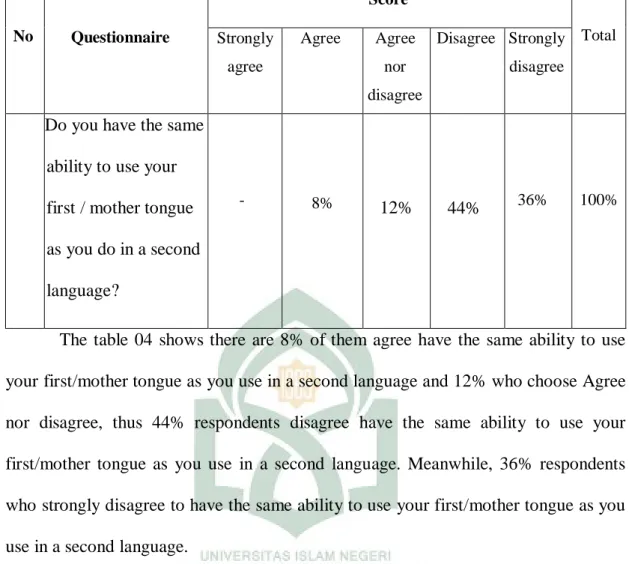
Table 04: The ability in use the first/mother tongue and the second language
No Questionnaire
Score
Total Strongly
agree
Agree Agree nor disagree
Disagree Strongly disagree
Do you have the same ability to use your first / mother tongue as you do in a second language?
- 8% 12% 44% 36% 100%
The table 04 shows there are 8% of them agree have the same ability to use your first/mother tongue as you use in a second language and 12% who choose Agree nor disagree, thus 44% respondents disagree have the same ability to use your first/mother tongue as you use in a second language. Meanwhile, 36% respondents who strongly disagree to have the same ability to use your first/mother tongue as you use in a second language.
C. Religious activity
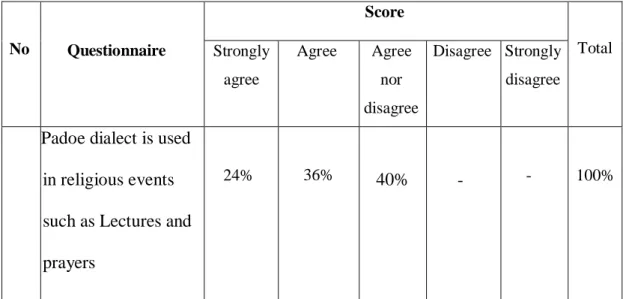
Table 05: The use of the Padoe dialect in religious activity
No Questionnaire
Score
Total Strongly
agree
Agree Agree nor disagree
Disagree Strongly disagree
Padoe dialect is used in religious events such as Lectures and prayers
24% 36% 40% - - 100%
29
From 25 respondents, there are 24% of the respondents who choose neither Strongly agree and 36% who agree respondents if Padoe dialect is used in religious events such as Lectures and prayers. Meanwhile, there are 40% respondents who agree nor disagree to Padoe dialect is used in religious events such as Lectures and prayers.
D. Cultural events
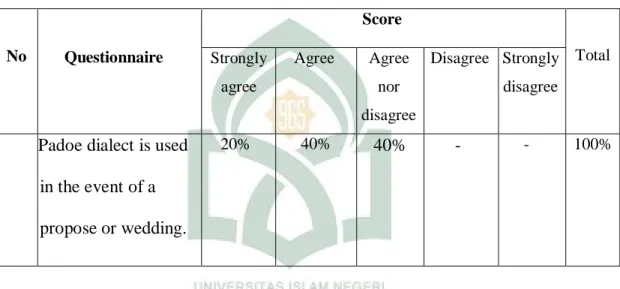
Table 06: The use of Padoe dialect in the propose or wedding ceremony
No Questionnaire
Score
Total Strongly
agree
Agree Agree nor disagree
Disagree Strongly disagree
Padoe dialect is used in the event of a propose or wedding.
20% 40% 40% - - 100%
The table above presents Padoe dialect is used in the event of a proposeor wedding. Based on 25 respondents, the researcher found 20% respondents who strongly agree Padoe dialect is used in the event of a propose or wedding, 40% of the respondents choose agree and 40% of them agree nor disagree if Padoe dialect used in a propose or wedding.
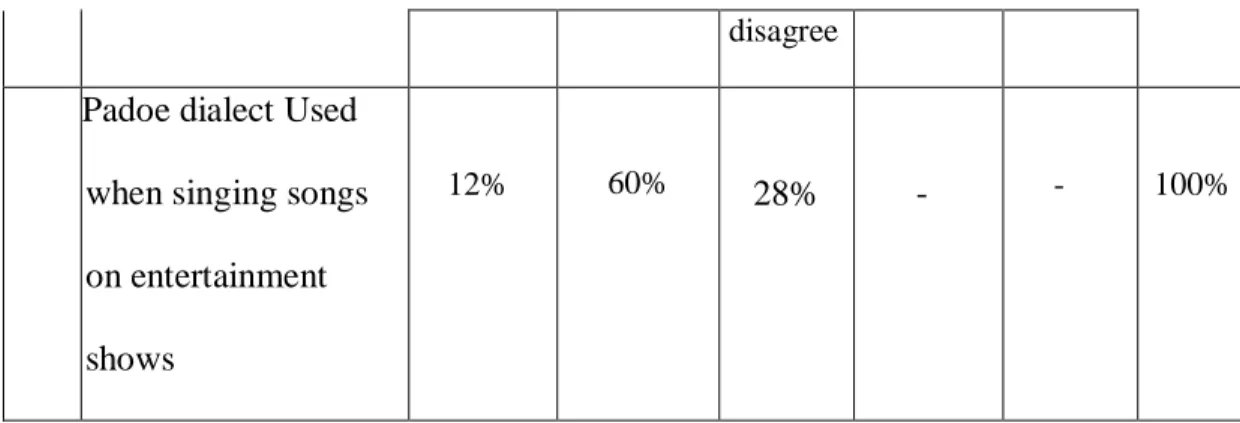
Table 07: The use of Padoe dialect when singing songs on entertainment shows.
No Questionnaire
Score
Total Strongly
agree
Agree Agree nor
Disagree Strongly disagree
disagree Padoe dialect Used
when singing songs on entertainment shows
12% 60% 28% - - 100%
The table 07 shows there are 12% of them strongly agreePadoe dialect used when singing songs on entertainment shows and 60% respondents AgreePadoe dialect used when singing songs on entertainment shows.Meanwhile, 28%
respondents who agree nor disagree if Padoe dialect used when singing songs on entertainment shows.
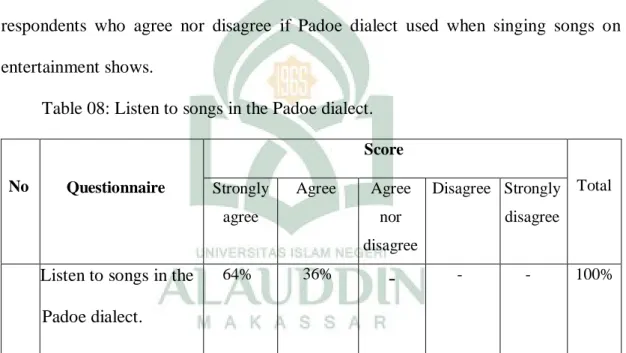
Table 08: Listen to songs in the Padoe dialect.
No Questionnaire
Score
Total Strongly
agree
Agree Agree nor disagree
Disagree Strongly disagree
Listen to songs in the Padoe dialect.
64% 36%
-
- - 100%The result above shows there are 25 respondents, 64% of them strongly agree if we listen to songs in the Padoe dialect and 36% strongly agree Listen to songs in the Padoe dialect.
E. Family
Table 09: The useof Padoe dialect when speak with their parents?
Score
31
No Questionnaire Always Often Usual Rarely Never Total Did you use Padoe
dialect when speak with their parents?
4% 8% 24% 24% 40% 100%
On the table above, it shows the use of Padoe dialect if the respondents speak with their parents. The table presents only 4% of the respondents always use Padoe dialect when speak with their parents. There are 8% of them often used the Padoe dialect and 24% who the respondents also usual use the Padoe dialect. While 24% of them who rarely use the dialect itself. Meanwhile, there are 40% respondents who never use Padoe dialect when speak with their parents.
Table10: The use of Padoe dialect when speak with their brother/sister?
No Questionnaire
Score
Total Always Often Usual Rarely Never
Did you use Padoe dialect when speak with their parents?
- 4% 4% 32% 60% 100%
From 25 respondents, there are 4% of the respondents who often and 4% who usual respondents use Padoe dialect when speak with their brother/sister, and 32%
respondents rarely use it. Meanwhile, there are 60% respondents never to use Padoe dialect.
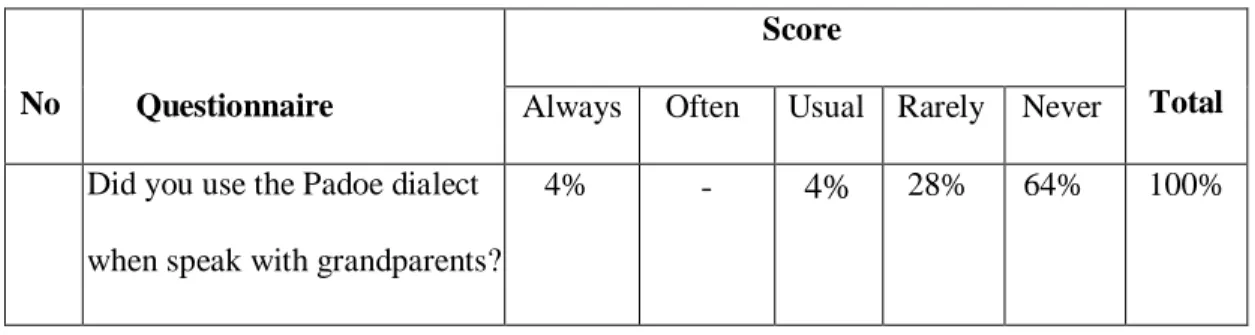
Table11: The use of Padoe dialect when speak with their grandparents?
No Questionnaire
Score
Total Always Often Usual Rarely Never
Did you use the Padoe dialect when speak with grandparents?
4% - 4% 28% 64% 100%
The table above presents the use of Padoe dialect when speaking with their grandparents, based on 25 respondents the researcher found 4% respondent who always use Padoe dialect, then 4% who usual use it. While 28% of the respondents choose rarely, and 64% of the respondents never use Padoe dialect when speaking with their grandparents.
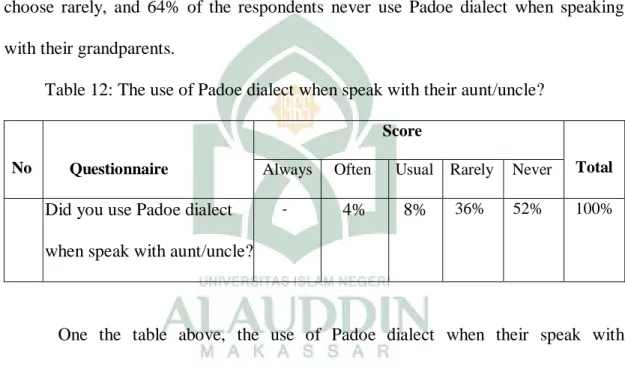
Table 12: The use of Padoe dialect when speak with their aunt/uncle?
No Questionnaire
Score
Total Always Often Usual Rarely Never
Did you use Padoe dialect when speak with aunt/uncle?
- 4% 8% 36% 52% 100%
One the table above, the use of Padoe dialect when their speak with aunt/uncle. The table present 4% of the respondents always use Padoe dialect when their speak with aunt/uncle, then 8% of the respondents choose usual and 36% of the respondents choose rarely. Meanwhile 52% of them that never use Padoe dialect when their speak with aunt/uncle.
Table 13: The use of Padoe dialect when speak with their cousins?
No Questionnaire
Score
Total Always Often Usual Rarely Never
33
Did you use Padoe dialect when speak with cousins?
- 12% 40% 24% 24% 100%
The use Padoe dialect when respondents speak with their cousins. From 25 respondents, there are 12% of the respondents often to use Padoe dialect, 40 % who also usual respondents use Padoe dialect and 24% of them who rarely use it.
Meanwhile, there are 24% never use Padoe dialect when speak with their cousins.
F. School and Office
Table 14: The use of Padoe dialect to your fellow Padoe people during recess and playing outside of class
No Questionnaire
Score
Total Strongly
agree
Agree Agree nor disagree
Diasgree Strongly disagree
Did you use the Padoe dialect to your fellow Padoe people during recess and playing outside of class?
- 16% 16% 32% 36% 100%
The table 14 shows there are 16% of them agree the use Padoe dialect to your fellow Padoe people during recess and playing outside of class and 16% who choose agree nor disagree, there is 32% respondents Disagree. Meanwhile, 36% respondents
who strongly disagree to the use Padoe dialect to your fellow Padoe people during recess and playing outside of class.
Table 15: The use of Padoe dialect to your fellow Padoe people when studying in class
No Questionnaire
Score
Total Strongly
agree
Agree Agree nor disagree
Disagree Strongly disagree
Did you use the Padoe dialect to your fellow Padoe people when studying in class?
4% - 4% 24% 68% 100%
The result above shows there are 25 respondents, 4% of them strongly agree to use Padoe dialect to your fellow Padoe people when studying in class and 4% who the respondents choose agree nor disagree, 24% choose disagree. Meanwhile, 68%
respondents strongly disagree the use Padoe dialect to your fellow Padoe people when studying in class.
Table 16: The use of Padoe dialect for teachers who are also Padoeese when studying in the classroom.
No Questionnaire
Score
Total Strongly
agree
Agree Agree nor disagree
Disagree Strongly disagree
Did you use Padoe dialect for teachers
35
who are also Padoeese when studying in the classroom?
- - - 40% 60% 100%
The table above presents the use Padoe dialect for teachers who are also Padoeese when studying in the classroom. Based on 25 respondents, the researcher found 40% respondents disagree, 60% of the respondents choose strongly disagree the use Padoe dialect for teachers who are also Padoeese when studying in the classroom
Table 17: The use of Padoe dialect for teachers who are also Padoeese when outside of class
No Questionnaire
Score
Total Strongly
agree
Agree Agree nor disagree
Disagree Strongly disagree
Did you use the Padoe dialect for teachers who are also Padoeese when outside of class ?
- 4% 24% 32% 40% 100%
From 25 respondents, there are 4% of the respondents who agree and 24%
agree nor disagree respondents the use Padoe dialect for teachers who are also Padoeese when outside of class. 32% respondents disagree. Meanwhile, there are
40% respondents who strongly disagree to use the Padoe dialect for teachers who are also Padoeese when outside of class.
Table 18: The use of Padoe dialect to (known) people who are also Padoe people when you meet at the office, such as village offices, sub- district heads, and health centers etc.
No Questionnaire
Score
Total Strongly
agree
Agree Agree nor disagree
Disagree Strongly disagree
You use the Padoe dialect to (known) people who are also Padoe people when you meet at the office, such as village offices, sub-district heads, health centers etc.
12% 56% 24% - 8% 100%
The table 18 shows there are 12% of them strongly agree the use Padoe dialect to people (known) who are also Padoe people when you meet at the office. 56% who neither choose Agree, and 24% of the respondents agree nor disagree. Meanwhile, 8% respondents who strongly disagree the use Padoe dialect to people (known) who are also Padoe people when you meet at the office, such as village offices, sub-district heads, health centers etc.
37
Table 19: The use of Padoe dialect for people (known) who Padoe people are also when you meet outside the office, such as village offices, sub- district heads, and health centers etc.
No Questionnaire
Score
Total Strongly
agree
Agree Agree nor disagree
Disagree Strongly disagree
You use the Padoe dialect for people (known) who are also Padoe people when you meet outside the office, such as village offices, sub-district heads, health centers etc.
36% 48% 12% - 4% 100%
The result above shows there are 25 respondents, 36% of them strongly agree if use Padoe dialect for people (known) Padoe people when you meet outside the office, such as village offices, sub-district heads, health centers etc. 48% who choose agree and 12% who the respondents agree nor disagree. While 4% of them choose strongly disagree if use Padoe dialect for people (known) Padoe people when you meet outside the office, such as village offices, sub-district heads, health centers etc.
G. Market place
Table 20: The use of Padoe dialect when you meet other Padoe people in the market