91 CHAPTER 4
FINDINGS AND DISCUSSION
This chapter aims at explaining the results of the research. Furthermore, this chapter is also mainly aimed to answer all research questions that are being addressed under this undergraduate thesis. In this chapter (i.e. findings and discussion), the researcher descriptively displays the implementation and the result of the data that were accumulated through the proper steps that relies to the research method.
4.1. Findings
In describing findings, the researcher was accumulating the data to be processed within this research through the proper utilization of three main research instruments (e.g. observation field note, documentation, and textual analysis).
Firstly, the utilization of observation field note and documentation were mainly aimed to capture the primary data of this research (i.e., the implementation of classroom debate strategy to enhance students’ critical thinking skills through argumentative writing). Secondly, the utilization of textual analysis (i.e., document analysis) was mainly aimed to capture the secondary data of this research (i.e., the result of classroom debate strategy to enhance students’ critical thinking skills through argumentative writing). In a purpose of gaining the objectives of the research, the researcher had scientifically analyzed the data in systematic and accurate manner. The data were analyzed to draw a communal result of the
objectives of the research. In this undergraduate thesis, the researcher described the finding into two parts. They were described in these following explanations.
The first part of findings was mainly aimed to describe the implementation of classroom debate strategy to enhance students’ critical thinking skills through argumentative writing. The research subjects were 19 students of STKIP PGRI Sidoarjo who were also currently mastering argumentative writing. Specifically, the contribution that the first part of findings gave was revolved around the concrete display of capturing entire process of implementing that was happened in the implementation of classroom debate strategy to enhance students’ critical thinking skills through argumentative writing. The process was divided into three. The decision of dividing into three was being initiated to the fact that the implementation of classroom debate strategy to enhance students’ critical thinking skills through argumentative writing had three meetings. Hence, to gain a detailed description, describing all of those three meetings were believed as the proper way of sorting, displaying, and verifying the first part of findings within this research.
The second part of findings was mainly aimed to describe the result of classroom debate strategy to enhance students’ critical thinking skills through argumentative writing. The research subjects were 19 students of STKIP PGRI Sidoarjo who were also currently mastering argumentative writing. Specifically, the contribution that the second part of findings gave was revolved around the concrete display of capturing the valid manifestation of proving the researcher of this thesis’
assumption in assuming that classroom debate strategy can enhance students’
critical thinking skills through argumentative writing. Descriptively, all of the valid
indicator of enhancement was accumulated in a main purpose of proving the tangible benefit in enacting a new paradigm. Hence, in the second part of findings, the researcher mainly aimed in displaying and describing subjects’ result in participating to the use of classroom debate strategy to enhance students’ critical thinking skills through argumentative writing.
4.1.1. The Implementation of Classroom Debate Strategy to Enhance Students’ Critical Thinking Skills through Argumentative Writing
In conducting the implementation of classroom debate strategy to enhance students’ critical thinking skills through argumentative writing, the researcher relied the sequenced process of implementation by pandering on Vasilescu’s framework in 2017. Generally, the implementation of classroom debate strategy to enhance students’ critical thinking skills through argumentative writing has seven steps. They were contained of (1) informing the rules of classroom debate; (2) displaying the matchups (i.e. debaters organization and roles within the classroom debate); (3) publishing the motion for each matchup; (4) setting up the case building time or discussion time; (5) starting the classroom debate that is being organized based on debater’s role; (6) adjudicating through debating ballot; and (7) conducting a communal evaluation. Hence, in a purpose of defining all of those main steps, the researcher explained each step through these following explanations.
Figure 3. The Completed Steps of the Implementation of Classroom debate strategy to enhance students’ critical thinking skills through
argumentative writing
Firstly, in the step of informing the rules of classroom debate, the researcher prioritized the rules of classroom debate that is derived from Vasilescu’s framework in 2017. Those classroom debate rules are (1) classroom debate consists of two sides of the house debate (i.e. affirmative and opposition), jury, chair-person, audience and time keeper; (2) the topic is named as a motion and the motion is launched after the teams settled for the chamber; (3) both sides of the house have to write their team members and speaker position in a paper; then, every side has to give it to the
Informing the Rules of Classroom Debate Displaying the Match-ups
Publishing the Motion for Each Match-up
Setting Up the Case Building Time or Discussion Time Starting the Classroom Debate That is Being Organized
Based On Debater’s Role
Adjudicating through Debating Ballot
Conducting a Communal Evaluation
chairperson; (4) time keeper catches the time of every speaker and the team keeper announces it after the speaker done the speech; (5) debaters have 10 minutes for case building; (6) any print material, data, newspaper, and books are allowed during the case building but debaters are not allowed to bring it with while they present their arguments; (7) any kind of communication tools must be turned off or in silent mode; (8) debaters are not allowed to use their cell phones during the debate and case building;
(9) POI (i.e. Point of Information) is allowed after 1 minute speech and it has 15 second length; (10) POI is only allowed during presentation, rebuttal and response stages and it must be done by raising hands; (11) debaters are required to give response to POI given whether rejecting or accepting; (12) during the summary, debaters are not required to present new arguments. If the adjudicators find it, the result might be disqualification for debaters; (13) debaters are prohibited to humiliate and to produce bad words (i.e. cursing) in their speech; (14) the winner is being determined by voting from the audience and decision from jury; (15) every student in the class is pleased to be cooperated in properly flowing the classroom debate; (16) the debate must be sportively applied a friendly competition. Thus, all of those steps were announced before the classroom debate began.
Secondly, in displaying the match-ups (i.e. debaters organization and roles within the classroom debate), the researcher pandered on the arrival of the subjects (i.e. debaters). For instance, deciding debaters that
will be battled in the first matchup was organized through the sequence of arrival of the students. It was being seen through the pace of the students in signing the attendance list. In displaying matchups, the researcher also revealed the organization or roles for each debater (e.g., deciding the affirmative position and the opposition position). In brief, the act of displaying the matchups in the implementation of classroom debate strategy to enhance students’ critical thinking skills through argumentative writing became to further step to arrange how the classroom debate will run.
Table 3. List of Motions in the Implementation of Classroom debate strategy to enhance students’ critical thinking skills through
argumentative writing
Meeting Motion
1st Meeting (26th of November 2019)
This House Regrets the Idea of Class Rank
This House Would Ban Homework
2nd Meeting (3rd of December 2019)
This House Would Transform All Traditional Learning Process into E-Learning
As Senior High School Teacher, This House Would Ban Mobile Phone during the
Classroom
This House Regrets the Idea of Full-Day School in Indonesia
3rd Meeting (10th of December 2019)
This House Believes that EFL Teacher should
Prioritize Teaching Speaking
more than Other English Proficiencies (e.g.
Writing, Reading, Listening)
As Teacher, This House Would Privatize Students’ Score
This House Believes that Grammar is Not Important in Speaking Practices
Thirdly, in the step of publishing the motion for each matchup, the researcher unveiled each motion for each matchup. In other word, after debaters in the matchup recognized their topic and the stance they were into, the act of publishing the motion were utilized as the first step for debaters to of officially start up their exploration. The list of motions in the above was the motions that were done to be discussed in the implementation of classroom debate strategy to enhance students’ critical thinking skills through argumentative writing. Debaters were required to be well-understood on how the motion goes and what contribution that they were mandated to represent their stances (e.g., affirmative or opposition). Furthermore, the researcher provided a session of motion
clarification in case any debaters need to be clarified in certain terms. Thus, the process of publishing the motion became a valid initiation for every stance.
Fourthly, in the step of setting up the case building time or discussion time, the researcher provided ten minutes for debaters in the matchup to prepare their arguments. The researcher guided every debater to engage with their team in a purpose of sharing ideas to each other. The researcher also encouraged every debater to maximize the given time in a purpose of constructing a well-built arguments. In a purpose of achieving credibility, the researcher distributed plain A4 paper for debaters with a main concern to avoid any cheats. The plain A4 paper was being distributed before the case building started. Furthermore, as the valid proof of debaters’ argumentation, the researcher collected all debaters’ case building paper to be saved.
Fifthly, in the step of starting the classroom debate that is being organized based on debater’s role, the researcher opened the debate based on each debater’s organization and roles. Based on Vasilescu’s framework in 2017, classroom debate began with A1 (i.e., first student of the affirmative team); O1 (i.e., first student of the opposing team); A2 (i.e., second student of the affirmative team); O2 (i.e., second student of the opposing team); RO (i.e., rebutter student of the opposing team; RA (i.e., rebutter student of the affirmative team). Thus, in starting the classroom
debate, the researcher was mandated a responsibility to form a classroom debate organization of delivering speech in a proper manner.
Sixthly, in the step of adjudicating through debating ballot, the researcher utilized the format of classroom debate ballot with the communal format from Vasilescu’s framework in 2017 and English Debate Sonic Linguistic in 2010. Furthermore, due to its credibility with the affiliation where the research subjects were classified, the researcher also legitimately infused the scoring rubric from STKIP PGRI Sidoarjo. In a purpose of creating a credible debate ballot that is in line with the major concentration of this undergraduate thesis, the researcher was combined the elements of scoring debate ballot with Inch. et al. theory in 2006 as the parameter. Moreover, as an active researcher, the researcher utilized video recording as an additional documentation. The use of video recording as an additional documentation had a main purpose to strengthen the decision of the researcher in scoring the debate ballot because being an active observer means that researcher holds numerous concentration to major.
Thus, adjudicating through debating ballot could be defined as the process of detecting every debater performance during the implementation of classroom debate strategy to enhance students’ critical thinking skills through argumentative writing.
Seventhly, in the step of conducting a communal evaluation, the researcher was providing an enrichment for every debater. The enrichment that was provided by the researcher was mainly in the form of defining the
motion and its possible arguments in deep. The step of conducting a communal evaluation was conducted after all matchups were finished. In brief, in the step of conducting a communal evaluation, the researcher was actively positioning himself to ensure every student understanding towards the motion in each matchup.
Table 4. The Meeting Schedule of the Implementation of Classroom debate strategy to enhance students’ critical thinking skills through
argumentative writing
Schedule of Meeting Date
First Meeting 26th of November 2019 Second Meeting 3rd of December 2019
Third Meeting 10th of December 2019
Furthermore, there were three meetings of the implementation of classroom debate strategy to enhance students’ critical thinking skills through argumentative writing with a detail that was envisioned through the table above. Thus, in displaying the implementation of classroom debate strategy to enhance students’ critical thinking skills through argumentative writing, the researcher described entire process of the implementation by dividing and organizing it into three main divisions.
Thus, these following explanations were contributing to provide a detail insight in every meeting.
4.1.1.1.The First Meeting of Classroom Debate Strategy to Enhance Students’ Critical Thinking Skills through Argumentative Writing
The first meeting of classroom debate strategy to enhance students’ critical thinking skills through argumentative writing was conducted at the 26th of November 2019. In detail, the first meeting took a place at D2 room of STKIP PGRI Sidoarjo. Furthermore, based on attendance list, out of 19, there were 14 students that participated to the first meeting of the implementation of classroom debate strategy to enhance students’ critical thinking skills through argumentative writing.
Pandering on the researcher’s framework of seven steps of implementation, the researcher described the first meeting of the implementation of classroom debate strategy to enhance students’
critical thinking skills through argumentative writing in detail based on those seven steps. They were contained of (1) informing the rules of classroom debate; (2) displaying the matchups (i.e.
debaters organization and roles within the classroom debate); (3) publishing the motion for each matchup; (4) setting up the case building time or discussion time; (5) starting the classroom debate that is being organized based on debater’s role; (6) adjudicating through debating ballot; and (7) conducting a communal evaluation. Thus, in these following passages, the researcher was
intended to descriptively describe the finding of the first meeting of the implementation of classroom debate strategy to enhance students’ critical thinking skills through argumentative writing.
Firstly, for classroom debate rules, as an initial move, the researcher informed the classroom debate rules that were accumulated from Vasilescu’s framework in 2017. The classroom debate rules were contained of 16 main steps that need to be pursued by every debater during the implementation of the first meeting of the implementation of classroom debate strategy to enhance students’ critical thinking skills through argumentative writing. Hence, after the implementation of the first meeting of the implementation of classroom debate strategy to enhance students’
critical thinking skills through argumentative writing, all of those rules were applied in a proper way although there were several obstacles that appeared. In brief, the classroom debate rules were well-implemented.
Secondly, the researcher displayed the match-up before revealing the motion in a purpose of creating a bonding to each debater. Dealing on the detail of subjects’ participation, there were 14 students that are able to participate and the other one was too late. Based on the numbers of research subjects’ availability, the debate was conducted in three match-ups. The decision of conducting three match-ups relied to the fact that there was a patent
requirement of the classroom debate organization for filling six students each match-up. The first match and the second match ran in well-applied of debaters’ organization. Unluckily, in the third match-up, there was a lack of debaters’ organization because there were only two students left. In brief, there was no tremendous issue in positioning all debaters to receive their rights to speak.
Furthermore, in a purpose of displaying a vivid manifestation on how the match-up was conducted, the researcher provide three following tables to display every match-up in the first meeting.
Table 5. The First Match-up Debaters of the First Meeting
Role Debater Position
A1 MSA 1st Speaker of Affirmative
Team
O1 MFR 1st Speaker of Opposition
Team
A2 SF 2nd Speaker of Affirmative
Team
O2 MDR 2nd Speaker of Opposition
Team
RA MSH 3rd Speaker of Affirmative
Team
RO AWPW 3rd Speaker of Opposition
Team
In the first match-up, there were six debaters (i.e. research subjects) that were organized based on their rules. Those debaters were having their rights to deliver the argument based on the settled set of organization. The classroom debate was opened by A1 and was
closed by RO. Hence, based on the result of the first match-up of the first meeting, the organization of classroom debate was conducted in a very proper way.
Table 6. The Second Match-up Debaters of the First Meeting
Role Debater Position
A1 PGM 1st Speaker of Affirmative
Team
O1 RES 1st Speaker of Opposition
Team
A2 SFAI 2nd Speaker of Affirmative
Team
O2 MM 2nd Speaker of Opposition
Team
RA HNM 3rd Speaker of Affirmative
Team
RO APD 3rd Speaker of Opposition
Team
In the second match-up, there were six debaters (i.e. research subjects) that were organized based on their rules. Those debaters were having their rights to deliver the argument based on the settled set of organization. The classroom debate was opened by A1 and was closed by RO. Hence, based on the result of the second match- up of the first meeting, the organization of classroom debate was conducted in a very proper way because the requirement of having full-set of six debaters that had its own roles was fulfilled.
Table 7. The Third Match-up Debaters of the First Meeting
Role Debater Position
A1 AF 1st Speaker of Affirmative
Team
O1 JRF 1st Speaker of Opposition
Team
Inopportunely, in the third match-up, there were two debaters (i.e.
research subjects) solely. Due to the fact that there was a lack of subjects’ attendance, the organization of classroom debate ended up in A1 (i.e. first speaker of affirmative team) and O1 (i.e. first speaker of opposition team). Equally, those two debaters were still having their rights to deliver the argument based on the settled set of organization. The classroom debate was opened by A1 and was closed by O1. Hence, based on the result of the third match-up of the first meeting, the organization of classroom debate was not conducted in its most proper and maximized way because of its’
lack of quantity of debater.
Thirdly, in publishing the motion, the researcher divided two main motions for each matchup. For the first match-up of the first meeting, the motion was This House Regrets the Idea of Class Rank. The affirmative team were required and were expected to develop a stance on supporting the motion through their arguments.
On the opposite, the opposition team had a responsibility to knock down the entire arguments from the affirmative team. Moreover,
for the second match-up and the third match-up of the first meeting, the motion was This House Would Ban Homework. The main reason why the motion between the second match-up and the third match-up had the same motion was mainly caused from the unequal burden for the third match-up debater (i.e., the match-up with two debaters solely). Hence, motion launch became the initialized act of opening the debate.
Fourthly, based on Vasilescu’s framework in 2017, every match-up had 10 minutes length of time for case building. In the first meeting of the implementation of classroom debate strategy to enhance students’ critical thinking skills through argumentative writing, all debaters were fulfilled its requirement. The researcher distributed plain paper in A4 size for all debaters during the case building time, thus none of them were able to cheat. Moreover, there was no debater that proposes an extended time for case- building. In the first meeting of the implementation, systematically, most of the students made a round with their partners to discuss the motion. Thus, it was concluded that the step of case building in the first meeting of implementation was conducted properly.
Fifthly, after those previous steps were conducted, the debate was officially opened. All debaters delivered their arguments based on the classroom debate organization. There was no inconvenient obstacles that appeared during the first speaker’s speech until the
last speaker’s speech. The classroom debate was conducted well for every debater. Unfortunately, in the first meeting of implementation, the researcher found no POI from every debater of the first match-up until the third match-up.
Sixthly, due to the role of the researcher as an active observer (i.e. involved observer), in adjudicating the whole classroom debate implementation, the researcher was utilizing the use of documentation instrument named video recording. Furthermore, in processing the whole result of the first meeting of the implementation, the act of adjudicating the classroom debate was conducted after all match-ups were finished. It was mainly aimed to gain and to absorb detailed results. Based on the tendency of the researcher in providing detailed result of adjudicating, the researcher also collected all the case building papers of every debater. Thus, the process of adjudicating the classroom debate ballot had its credibility because it was principally well- documented.
Seventhly, in conducting a communal evaluation, as an active observer, the researcher recalled everything that was happened during the first match-up until the third match-up. As a communal evaluation, the researcher concluded four main points.
The first point concerned on the intention of the researcher in understanding research subjects’ ability in manifesting their critical
thinking skills into an argumentative written and spoken works.
Most of debaters were unable to clarify their position by providing critical and logical reasoning. Some of them were unable to strengthen their stances. Most of them were unable to develop a case. The second point was about the classroom debate’s principle of manner. Certain individuals during the first meeting of the implementation were laughing over other speeches. It was inappropriate for debater. There was a patent to respect each other arguments, including our own arguments. The researcher also addressed the appreciation that needs to be given for every debater, including not using cellphone during someone else’s speech.
Moreover, the third point was related to the process of delivering arguments. Most of debaters had a tendency to deliver their speech hesitantly. Some of debaters still envisioned a shyness.
Furthermore, the fourth point was strongly related to POI, the researcher found no POI from every single debater.
Thus, the process of conducting a communal evaluation was mainly aimed to provide research subjects an enrichment. Due to the fact that the researcher played a role as an active observer, conducting a communal evaluation was the embodiment of developing a bonding between researcher and subjects, hence there was no altered behavior that could be possibly created.
4.1.1.2.The Second Meeting of Classroom Debate Strategy to Enhance Students’ Critical Thinking Skills through Argumentative Writing
The second meeting of classroom debate strategy to enhance students’ critical thinking skills through argumentative writing was conducted at the 3rd of December 2019. In detail, the first meeting took a place at D2 room of STKIP PGRI Sidoarjo. Furthermore, based on attendance list, out of 19, there were 18 students that participated to the first meeting of the implementation of classroom debate strategy to enhance students’ critical thinking skills through argumentative writing.
Concerning on the researcher’s framework of seven steps of implementation, the researcher described the second meeting of the implementation of classroom debate strategy to enhance students’
critical thinking skills through argumentative writing in detail based on those seven steps. They were contained of (1) informing the rules of classroom debate; (2) displaying the matchups (i.e.
debaters organization and roles within the classroom debate); (3) publishing the motion for each matchup; (4) setting up the case building time or discussion time; (5) starting the classroom debate that is being organized based on debater’s role; (6) adjudicating through debating ballot; and (7) conducting a communal evaluation. Thus, in these following passages, the researcher was
intended to descriptively describe the finding of the second meeting of the implementation of classroom debate strategy to enhance students’ critical thinking skills through argumentative writing.
Firstly, dealing with classroom debate rules, as an initial move, the researcher informed the classroom debate rules that were accumulated from Vasilescu’s framework in 2017. The classroom debate rules were contained of 16 main requirements that need to be pursued by every debater during the implementation of the first meeting of the implementation of classroom debate strategy to enhance students’ critical thinking skills through argumentative writing. Hence, after the implementation of the second meeting of the implementation of classroom debate strategy to enhance students’ critical thinking skills through argumentative writing, all of those rules were applied in a very proper way. There was a significant enhancement from the previous meeting. In brief, the classroom debate rules were really well-implemented.
Secondly, the next step was setting up the match-up. The researcher displayed the match-up before revealing the motion in a purpose of creating a bonding to each debater. Dealing on the detail of subjects’ participation, there were 18 students that are able to participate and the other one was too late. Based on the numbers of research subjects’ availability, the debate was conducted in three match-ups. The decision of conducting three match-ups relied to
the fact that there was a patent requirement of the classroom debate organization for filling six students each match-up. The first match until the third match ran in well-applied of debaters’ organization.
Moreover, in a purpose of displaying a vivid manifestation on how the match-up was conducted, the researcher provide three following tables to display every match-up in the second meeting.
Table 8. The First Match-up Debaters of the Second Meeting
Role Debater Position
A1 MSA 1st Speaker of Affirmative
Team
O1 AWPW 1st Speaker of Opposition
Team
A2 PGM 2nd Speaker of Affirmative
Team
O2 MFR 2nd Speaker of Opposition
Team
RA HNM 3rd Speaker of Affirmative
Team
RO . AF 3rd Speaker of Opposition
Team
In the first match-up, there were six debaters (i.e. research subjects) that were organized based on their rules. Those debaters were having their rights to deliver the argument based on the settled set of organization. The classroom debate was opened by A1 and was closed by RO. Hence, based on the result of the first match-up of the second meeting, the organization of classroom debate was conducted in a very proper way.
Table 9. The Second Match-up Debaters of the Second Meeting
Role Debater Position
A1 NS 1st Speaker of Affirmative
Team
O1 PIN 1st Speaker of Opposition
Team
A2 APD 2nd Speaker of Affirmative
Team
O2 RES 2nd Speaker of Opposition
Team
RA SF 3rd Speaker of Affirmative
Team
RO RYV 3rd Speaker of Opposition
Team
In the second match-up, there were six debaters (i.e. research subjects) that were organized based on their rules. Those debaters were having their rights to deliver the argument based on the settled set of organization. The classroom debate was opened by A1 and was closed by RO. Hence, based on the result of the second match- up of the second meeting, the organization of classroom debate was conducted in a very proper way.
Table 10. The Third Match-up Debaters of the Second Meeting
Role Debater Position
A1 NIZ 1st Speaker of Affirmative
Team
O1 JRF 1st Speaker of Opposition
Team
A2 MDR 2nd Speaker of Affirmative
Team
O2 MWH 2nd Speaker of Opposition
Team
RA CAAF 3rd Speaker of Affirmative
Team
RO MSH 3rd Speaker of Opposition Team
In the third match-up, there were six debaters (i.e. research subjects) that were organized based on their rules. Those debaters were having their rights to deliver the argument based on the settled set of organization. The classroom debate was opened by A1 and was closed by RO. Hence, based on the result of the third match- up of the third meeting, the organization of classroom debate was conducted in a very proper way.
Thirdly, in publishing the motion, the researcher divided three main motions for each matchup. For the first match-up of the second meeting, the motion was This House Would Transform All Traditional Learning Process into E-Learning. Moreover, for the second match-up of the second meeting, the motion wasAs Senior High School Teacher, This House Would Ban Mobile Phone during the Classroom. Furthermore, the third match-up of the second meeting was debating under the motion named This House Regrets the Idea of Full-Day School in Indonesia. Hence, motion launch became the initialized act of opening the debate.
Fourthly, based on Vasilescu’s framework in 2017, every match-up had 10 minutes length of time for case building. In the second meeting of the implementation of classroom debate strategy to enhance students’ critical thinking skills through argumentative
writing, all debaters were fulfilled its requirement. The researcher distributed plain paper in A4 size for all debaters during the case building time, thus none of them were able to cheat. Moreover, there was no debater that proposes an extended time for case- building. In the second meeting of the implementation, systematically, most of the students made a round with their partners to discuss the motion. Thus, it was concluded that the step of case building in the second meeting of the implementation was conducted properly.
Fifthly, after those previous steps were conducted, the debate was officially opened. All debaters delivered their arguments based on the classroom debate organization. There was no inconvenient obstacles that appeared during the first speaker’s speech until the last speaker’s speech. The classroom debate was conducted well for every debater. Similar to the first meeting, unfortunately, researcher found no POI from every debater of the first match-up until the third match-up.
Sixthly, due to the role of the researcher as an active observer (i.e. involved observer), in adjudicating the whole classroom debate implementation, the researcher was utilizing the use of documentation instrument named video recording. Furthermore, in processing the whole result of the second meeting of the implementation, the act of adjudicating the classroom debate was
conducted after all match-ups were finished. It was mainly aimed to gain and to absorb detailed results. Based on the tendency of the researcher in providing detailed result of adjudicating, the researcher also collected all the case building papers of every debater. Thus, the process of adjudicating the classroom debate ballot had its credibility because it was principally well- documented.
Seventhly, in conducting a communal evaluation, as an active observer, the researcher recalled everything that was happened during the first match-up until the third match-up.
Similar to the first meeting, as a communal evaluation, the researcher concluded four main points. The first point relied on the concern of the researcher about research subjects’ ability in manifesting their critical thinking skills into an argumentative written and spoken works. There was a significant enhancement that could be captured. Majorly, debaters (i.e. research subjects) tried to infuse the scientific role within their arguments. Although its number of quantity was not huge enough, there was an indicator of enhancement. The second point was about the classroom debate’s principle of manner. There was an enhancement for debaters’ manner understanding. There was numerous and tremendous claps of appreciation. There was no laugh over someone else’s speech. Furthermore, all debaters also showed
joyfulness and excitement in the second meeting of the implementation. Moreover, the third point was related to the process of delivering arguments. There was a light of confidence that can be captured by the researcher. The excitement of experiencing classroom debate from the previous meeting enhanced subjects’ willingness to enjoy the classroom debate.
Furthermore, the fourth point was strongly related to POI. Similar to the first meeting, the researcher found no POI from every single debater.
Thus, the process of conducting a communal evaluation was mainly aimed to provide research subjects an enrichment. Due to the fact that the researcher played a role as an active observer, conducting a communal evaluation was the embodiment of developing a bonding between researcher and subjects, hence there was no altered behavior that could be possibly created.
4.1.1.3.The Third Meeting of Classroom Debate Strategy to Enhance Students’ Critical Thinking Skills through Argumentative Writing
The third meeting of classroom debate strategy to enhance students’ critical thinking skills through argumentative writing was conducted at the 10th of December 2019. In detail, the third meeting took a place at D2 room of STKIP PGRI Sidoarjo. Furthermore,
based on attendance list, out of 19, there were 18 students that participated to the third meeting of the implementation of classroom debate strategy to enhance students’ critical thinking skills through argumentative writing.
Secondly, the next step was setting up the match-up. The researcher displayed the match-up before revealing the motion in a purpose of creating a bonding to each debater. Dealing on the detail of subjects’ participation, there were 18 students that are able to participate and the other one was too late. Based on the numbers of research subjects’ availability, the debate was conducted in three match-ups. The decision of conducting three match-ups relied to the fact that there was a patent requirement of the classroom debate organization for filling six students each match-up. The first match until the third match ran in well-applied of debaters’ organization.
Moreover, in a purpose of displaying a vivid manifestation on how the match-up was conducted, the researcher provide three following tables to display every match-up in the second meeting.
Table 11. The First Match-up Debaters of the Third Meeting
Role Debater Position
A1 APD 1st Speaker of Affirmative
Team
O1 PGM 1st Speaker of Opposition
Team
A2 MFR 2nd Speaker of Affirmative
Team
O2 MM 2nd Speaker of Opposition
Team
RA RYV 3rd Speaker of Affirmative Team
RO MSH 3rd Speaker of Opposition
Team
In the first match-up, there were six debaters (i.e. research subjects) that were organized based on their rules. Those debaters were having their rights to deliver the argument based on the settled set of organization. The classroom debate was opened by A1 and was closed by RO. Hence, based on the result of the first match-up of the third meeting, the organization of classroom debate was conducted in a very proper way.
Table 12. The Second Match-up Debaters of the Third Meeting
Role Debater Position
A1 MSA 1st Speaker of Affirmative
Team
O1 AWPW 1st Speaker of Opposition
Team
A2 MDR 2nd Speaker of Affirmative
Team
O2 PIN 2nd Speaker of Opposition
Team
RA NIZ 3rd Speaker of Affirmative
Team
RO SF 3rd Speaker of Opposition
Team
In the second match-up, there were six debaters (i.e. research subjects) that were organized based on their rules. Those debaters were having their rights to deliver the argument based on the settled set of organization. The classroom debate was opened by A1 and
was closed by RO. Hence, based on the result of the second match- up of the third meeting, the organization of classroom debate was conducted in a very proper way.
Table 13. The Third Match-up Debaters of the Third Meeting
Role Debater Position
A1 MWH 1st Speaker of Affirmative
Team
O1 SFAI 1st Speaker of Opposition
Team
A2 JRF 2nd Speaker of Affirmative
Team
O2 RES 2nd Speaker of Opposition
Team
RA AF 3rd Speaker of Affirmative
Team
RO HNM 3rd Speaker of Opposition
Team
In the third match-up, there were six debaters (i.e. research subjects) that were organized based on their rules. Those debaters were having their rights to deliver the argument based on the settled set of organization. The classroom debate was opened by A1 and was closed by RO. Hence, based on the result of the third match- up of the third meeting, the organization of classroom debate was conducted in a very proper way.
Thirdly, in publishing the motion, the researcher divided three main motions for each matchup. For the first match-up of the third meeting, the motion was This House Believes that EFL Teacher should Prioritize Teaching Speaking more than Other
English Proficiencies (e.g. Writing, Reading, Listening)..
Moreover, for the second match-up of the third meeting, the motion was As Teacher, This House Would Privatize Students’ Score.
Furthermore, the third match-up of the third meeting was debating under the motion named This House Regrets the Idea of Full-Day School in Indonesia. Hence, motion launch became the initialized act of opening the debate.
Fourthly, based on Vasilescu’s framework in 2017, every match-up had 10 minutes length of time for case building. In the third meeting of the implementation of classroom debate strategy to enhance students’ critical thinking skills through argumentative writing, all debaters were fulfilled its requirement. The researcher distributed plain paper in A4 size for all debaters during the case building time, thus none of them were able to cheat. Moreover, there was no debater that proposes an extended time for case- building. In the third meeting of the implementation, systematically, most of the students made a round with their partners to discuss the motion. Thus, it was concluded that the step of case building in the third meeting of the implementation was conducted properly.
Fifthly, after those previous steps were conducted, the debate was officially opened. All debaters delivered their arguments based on the classroom debate organization. There was no inconvenient
obstacles that appeared during the first speaker’s speech until the last speaker’s speech. The classroom debate was conducted well for every debater. Similar to the first and second meeting, unfortunately, researcher found no POI from every debater of the first match-up until the third match-up.
Sixthly, due to the role of the researcher as an active observer (i.e. involved observer), in adjudicating the whole classroom debate implementation, the researcher was utilizing the use of documentation instrument named video recording. Furthermore, in processing the whole result of the third meeting of the implementation, the act of adjudicating the classroom debate was conducted after all match-ups were finished. It was mainly aimed to gain and to absorb detailed results. Based on the tendency of the researcher in providing detailed result of adjudicating, the researcher also collected all the case building papers of every debater. Thus, the process of adjudicating the classroom debate ballot had its credibility because it was principally well- documented.
Seventhly, concerning about a communal evaluation, as an active observer, the researcher recalled everything that was happened during the first match-up until the third match-up.
Similar to the first and second meeting, as a communal evaluation, the researcher concluded four main points. As a very important
move, the third meeting of the implementation captured the most satisfying scenery of the academic and scientific atmosphere of implementing classroom debate. Most of debaters (i.e. research subjects) were able to deliver the argument in well-structured way (i.e. most of students were able to give credible arguments).
Unfortunately, there were 3 students that were still unable to interpret the motion, but those three were still able to construct an argument. The rest of them was quite good. The second point was about the classroom debate’s principle of manner. All research subjects were quite good in applying every point of classroom debate’s principle of manner and classroom debate rules.
Numerous and tremendous claps of appreciation were given. There was no laugh over someone else’s speech. Furthermore, all debaters also showed joyfulness and excitement in the third meeting of the implementation. Moreover, the third point was related to the process of delivering arguments. Most of debaters had a tendency to deliver their speech hesitantly. Some of debaters still envisioned a shyness. Furthermore, the fourth point was strongly related to POI, the researcher found no POI from every single debater.
Thus, the process of conducting a communal evaluation was mainly aimed to provide research subjects an enrichment. Due to the fact that the researcher played a role as an active observer,
conducting a communal evaluation was the embodiment of developing a bonding between researcher and subjects, hence there was no altered behavior that could be possibly created.
4.1.2. The Result of Classroom Debate Strategy to Enhance Students’
Critical Thinking Skills through Argumentative Writing
Legitimately, in displaying the result, the researcher accumulated two sources of data, namely individual score in classroom debate ballot and research subjects’ document transcripts (i.e. preliminary research result and final-term examination result in argumentative writing). Hence, in formulating the result, there were two lenses that were functioned as the validation of describing the result.
Figure 4. Scoring Accumulation of Classroom Debate Ballot Result The first lens of finding the result of classroom debate strategy to enhance students’ critical thinking skills through argumentative writing was seen through the analysis of classroom debate ballot scoring
AP D
A WP
W JRF M
M MS
A M DR
MF
R NIZ PINPG M
RE S
RY V
SF
AI SF AF HN M NS
M W H
MS H 1st Meeting 2 2 1 1 2 1 2 0 0 1 2 0 2 1 1 1 0 0 3 2nd Meeting 1 3 2 0 3 3 3 2 1 2 2 3 0 1 2 3 1 2 3 3rd Meeting 2 4 1 2 4 3 3 1 2 2 3 4 2 1 2 3 0 2 4
2 2 1 1
2 1
2
0 0 1
2
0 2
1 1 1 0 0
3
1 3
2
0
3 3 3 2
1 2 2
3
0 1
2 3
1 2
3 2
4
1 2
4 3 3
1 2 2
3 4
2 1
2 3
0 2
4
0.501 1.52 2.53 3.54
Scoring Accumulation of Classroom Debate Ballot Result
accumulation from three meetings that were conducted. Based on the result of adjudicating the classroom debate ballot during the implementation of classroom debate strategy to enhance students’ critical thinking skills through argumentative writing, the communal accumulation of scoring was made. It was being envisioned through the figure above. From the communal result of scoring accumulation of classroom debate ballot result, there were several points were made.
The first point was dealing with the number of research subjects’
availability. From the result, it can be captured that there were 12 students who were completed its attendance availability (i.e. three meetings).
Moreover, there were 6 students who fulfilled two meeting or two times availability solely. For one meeting availability, there was only one student that was able to participate to the implementation of classroom debate.
Furthermore, there were 5 students that were completely unavailable in participating to the classroom debate
In order to clarify in detail, the second point was concerning about research subjects’ numbers in progressing. Firstly, there were seven research subjects with dynamic progress. The criteria of research subjects that has a dynamic progress was captured through its completed attendance and its move from the first meeting until the third meeting. Secondly, there were 10 research subjects with a mixed of dynamic and static progress.
The criteria of research subjects with a mixed of dynamic and static progress was envisioned through its plain move and its non-completed
attendance. Both of those embodiments of enhancement captured the essence of the researcher’s authority in providing a consideration for the validator or the lecturer of argumentative writing. This framework relied to the fact that every decision for final justification was in the hand of the lecturer of the research subjects. Hence, those three types were captured within the scoring accumulation of classroom debate ballot result.
Figure 5. Research Subjects Progress of Critical Thinking Skills Enhancement
The second lens of finding the result of classroom debate strategy to enhance students’ critical thinking skills through argumentative writing was seen through the analysis of research subjects’ document transcript (i.e. preliminary research result and final-term examination result in argumentative writing). The act of textually analyzing research subjects’
document transcript (i.e. preliminary research result and final-term
AP D
A W P W
JR F
M M
M SA
M DR
M FR
NI Z
PI N
PG M
RE S
RY V
SF
AI SF AFHN MNS
M W H
M SH Preliminary Research 1 1 1 1 2 1 2 1 1 1 1 2 1 1 1 1 1 1 1 Final Examination 4 4 4 3 4 4 4 4 4 4 4 4 4 4 4 3 3 3 3
1 1 1 1 2
1 2
1 1 1 1 2
1 1 1 1 1 1 1 4 4 4
3
4 4 4 4 4 4 4 4 4 4 4
3 3 3 3
0 0.5 1 1.5 2 2.5 3 3.5 4
Research Subjects Progress of Critical Thinking Skills Enhancement
examination result in argumentative writing) was mainly aimed to find the proof for researcher’s assumption in assuming that classroom debate can enhance students’ critical thinking skills through argumentative writing.
Therefore, the researcher absorbed the research subjects’ document transcript (i.e. preliminary research result and final-term examination result in argumentative writing) from the third party. The third party was the lecturer of argumentative writing of 2018 A class, namely Siti Aisyah, M.Pd. Communally, the figure above showed that every research subject was progressively enhanced its critical thinking skills.
Moreover, in order to display a detailed explanation, the researcher displayed those two lenses of defining the result of classroom debate strategy to enhance students’ critical thinking skills through argumentative writing. The result was not made in communal findings. The researcher provided individual’s report of progress, namely individual’s report of scoring during the implementation of classroom debate strategy to enhance students’ critical thinking skills and individual’s report of scoring from secondary data (i.e. research subjects’ document transcript or preliminary research result and final-term examination result in argumentative writing) through these following explanations. Those two lenses of analysis in individual progress’ track record was initiated under the theory that was employed under this research. The theory that was being used was Bowen’s theory in 2009. The theory emphasized on the use of documents analysis in qualitative research method with a purpose of avoiding biases.
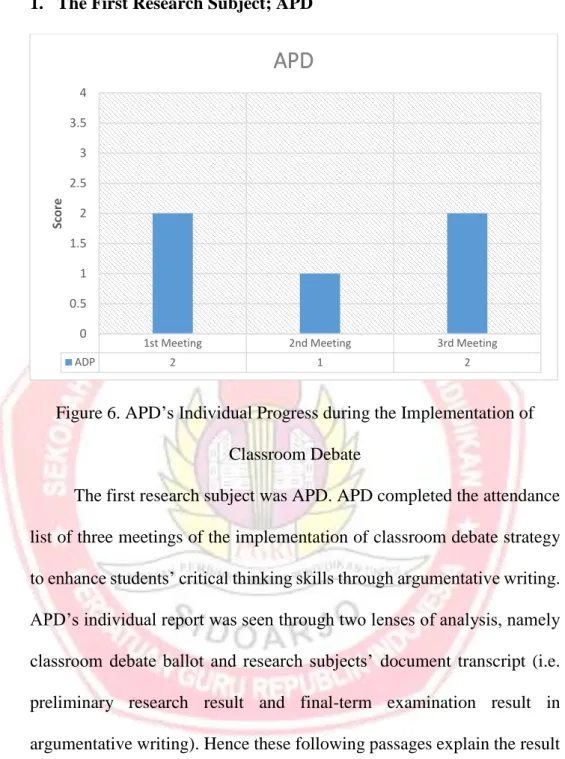
1. The First Research Subject; APD
Figure 6. APD’s Individual Progress during the Implementation of Classroom Debate
The first research subject was APD. APD completed the attendance list of three meetings of the implementation of classroom debate strategy to enhance students’ critical thinking skills through argumentative writing.
APD’s individual report was seen through two lenses of analysis, namely classroom debate ballot and research subjects’ document transcript (i.e.
preliminary research result and final-term examination result in argumentative writing). Hence these following passages explain the result of APD in detail.
The first lens of analyzing APD’s individual report was seen through the analysis of APD’s classroom debate ballot. Furthermore, in detail, the graphic of APD’s progress of enhancement was accumulated from APD’s
1st Meeting 2nd Meeting 3rd Meeting
ADP 2 1 2
0 0.5 1 1.5 2 2.5 3 3.5 4
Score
APD
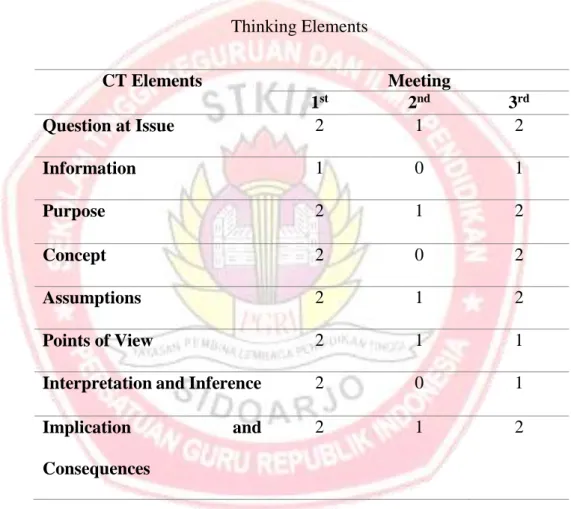
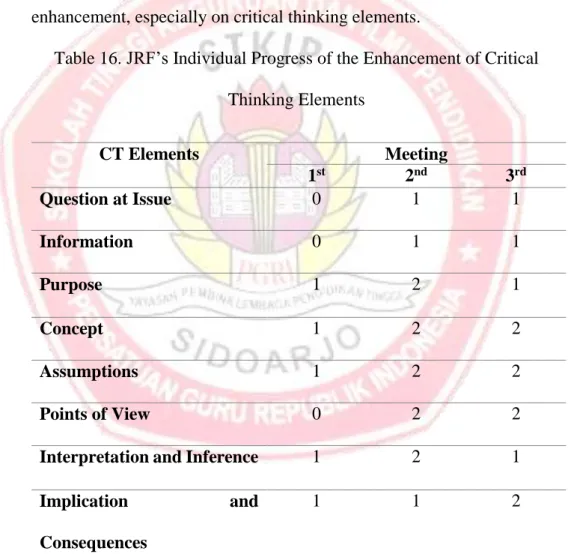
classroom debate ballot. The detailed classroom debate ballot was built by the integration of Inch. et al. theory in 2006. Hence, as an active observer and adjudicator, the researcher captured APD’s progress of enhancement from every meeting. The table below was ADP’s detailed progress of enhancement, especially on critical thinking elements.
Table 14. APD’s Individual Progress of the Enhancement of Critical Thinking Elements
CT Elements Meeting
1st 2nd 3rd
Question at Issue 2 1 2
Information 1 0 1
Purpose 2 1 2
Concept 2 0 2
Assumptions 2 1 2
Points of View 2 1 1
Interpretation and Inference 2 0 1
Implication and
Consequences
2 1 2
The second lens of analyzing APD’s individual report was seen through the analysis of research subjects’ document transcript (i.e.
preliminary research result and final-term examination result in argumentative writing). Firstly, based on the analysis of APD’s initialized condition of critical thinking skills (i.e. the condition was captured on
APD’s result of the preliminary research), APD was categorized as one of the research subjects with lack of critical thinking skills. This was due to the fact that APD was solely able to snatch the D or 1 category. D or 1 category was referred to the poor proficiency in critical thinking. APD was unable to fulfill eight elements of critical thinking skills in a proper execution. There were numerous lacks of understanding in APD’s case.
For the further step, after the classroom debate strategy was conducted and was given to APD, the researcher tried to analyze APD’s final examination result. The examination result was in the form of argumentative writing work in which it was similar as the object to be analyzed in the preliminary research. Analyzing APD’s preliminary research result (i.e. before experiencing classroom debate strategy) and final examination result (i.e. after experiencing classroom debate strategy), the researcher came in agreement that there was an enhancement of APD’s critical thinking skills. Based on the result of the researcher’s analysis in critically analyzing APD’s final examination result (i.e. the final examination result was derived from the lecturer of argumentative writing major of study for batch 2018 A; Siti Aisyah, M.Pd). APD was successfully snatching higher score than APD’s preliminary research result.
APD’s detailed explanation on APD’s enhancement progress was being conceptualized under this part of analysis. To begin with, APD’s detailed result of preliminary research was indicating the lack of capacity
of APD in thinking critically. They were (1) APD’s score for the first element of critical thinking (i.e. question at issue) was 1 or D; (2) APD’s score for the second element of critical thinking (i.e. information) was 1 or D; (3) APD’s score for the third element of critical thinking (i.e. purpose) was 1 or D; (4) APD’s score for the fourth element of critical thinking (i.e.
concept) was 1 or D; (5) APD’s score for the fifth element of critical thinking (i.e. assumptions) was 1 or D; (6) APD’s score for the sixth element of critical thinking (i.e. points of view) was 1 or D; (7) APD’s score for the seventh element of critical thinking (i.e. interpretation and inference) was 1 or D; and (8) APD’s score for the eighth element of critical thinking (i.e. implication and consequences) was 1 or D. Thus, communally, APD’s score for the preliminary research (i.e. the result of APD’s critical thinking skills before experiencing classroom debate strategy) was snatched 1 or D solely.
As a result, after three meetings of the implementation, the enhancement of critical thinking (i.e. beneficial contribution) was absorbed. APD’s critical thinking skills in which it was captured through APD’s argumentative writing final examination result was progressively enhanced. Detailed result of APD’s enhancement in critical thinking skills’
was captured into these following explanations. They were (1) APD’s score for the first element of critical thinking (i.e. question at issue) was 3 or B; (2) APD’s score for the second element of critical thinking (i.e.
information) was 4 or A; (3) APD’s score for the third element of critical
thinking (i.e. purpose) was 3 or B; (4) APD’s score for the fourth element of critical thinking (i.e. concept) was 3 or 4; (5) APD’s score for the fifth element of critical thinking (i.e. assumptions)was 4 or A; (6) APD’s score for the sixth element of critical thinking (i.e. points of view) was 4 or A;
(7) APD’s score for the seventh element of critical thinking (i.e.
interpretation and inference) was 4 or A; and (8) APD’s score for the eighth element of critical thinking (i.e. implication and consequences) was 4 or A. Hence, as a conclusion, APD’s score for the preliminary research (i.e. the result of APD’s critical thinking skills after experiencing classroom debate strategy) was enhanced from 1 or D to 4 or A.
The final conclusion of the enhancement of APD’s critical thinking skills was drawn. The result came in agreement that the use of classroom debate progressively enhanced APD’s critical thinking skills.
Furthermore, for its validity and its legality, the final conclusion was verified by the lecturer of argumentative writing of the research subjects (i.e. Siti Aisyah, M.Pd). Preliminary research of APD was able to snatch 1 or D score solely. Progressively, after experiencing classroom debate strategy, APD was able to reach 4 or A. The range of being categorized under 4 or A category was 80 – 100 (i.e. excellent) and APD’s final result was 80. Thus, classroom debate strategy beneficially contributed to the enhancement of APD’s critical thinking skills.
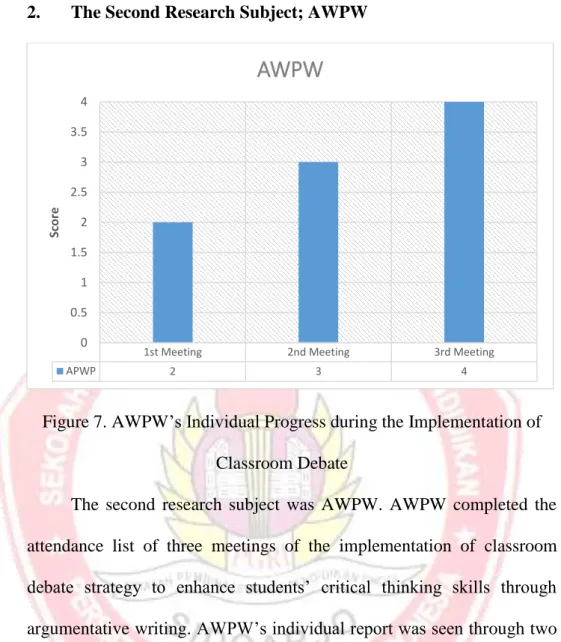
2. The Second Research Subject; AWPW
Figure 7. AWPW’s Individual Progress during the Implementation of Classroom Debate
The second research subject was AWPW. AWPW completed the attendance list of three meetings of the implementation of classroom debate strategy to enhance students’ critical thinking skills through argumentative writing. AWPW’s individual report was seen through two lenses of analysis, namely classroom debate ballot and research subjects’
document transcript (i.e. preliminary research result and final-term examination result in argumentative writing). Hence these following passages explain the result of AWPW in detail.
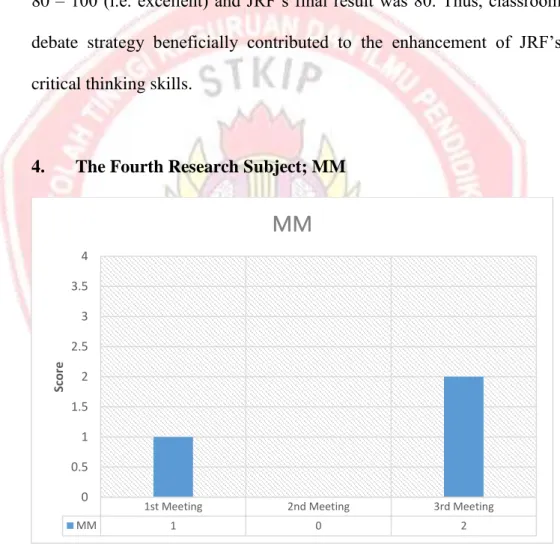
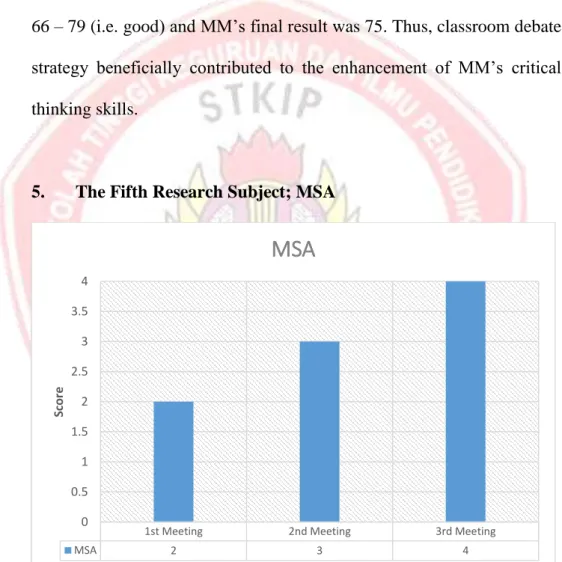
The first lens of analyzing AWPW’s individual report was seen through the analysis of AWPW’s classroom debate ballot. Furthermore, in detail, the graphic of AWPW’s progress of enhancement was accumulated
1st Meeting 2nd Meeting 3rd Meeting
APWP 2 3 4
0 0.5 1 1.5 2 2.5 3 3.5 4
Score
AWPW
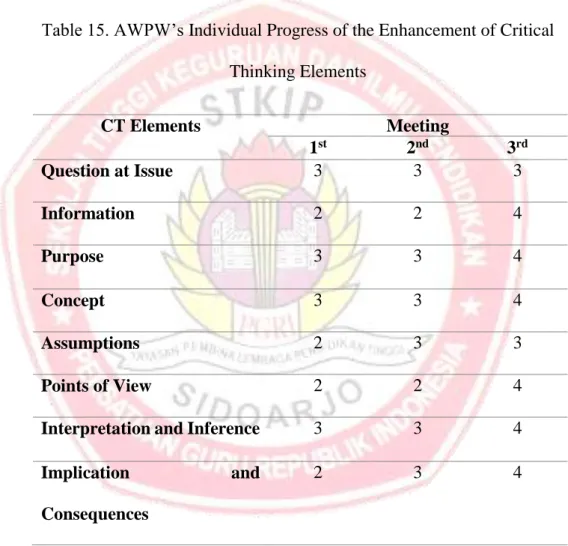
from AWPW’s classroom debate ballot. The detailed classroom debate ballot was built by the integration of Inch. et al. theory in 2006. Hence, as an active observer and adjudicator, the researcher captured AWPW’s progress of enhancement from every meeting. The table below was AWPW’s detailed progress of enhancement, especially on critical thinking elements.
Table 15. AWPW’s Individual Progress of the Enhancement of Critical Thinking Elements
CT Elements Meeting
1st 2nd 3rd
Question at Issue 3 3 3
Information 2 2 4
Purpose 3 3 4
Concept 3 3 4
Assumptions 2 3 3
Points of View 2 2 4
Interpretation and Inference 3 3 4
Implication and
Consequences
2 3 4
The second lens of analyzing AWPW’s individual report was seen through the analysis of research subjects’ document transcript (i.e.
preliminary research result and final-term examination result in argumentative writing). Firstly, based on the analysis of AWPW’s
initialized condition of critical thinking skills (i.e. the condition was captured on AWPW’s result of the preliminary research), AWPW was categorized as one of the research subjects with lack of critical thinking skills. This was due to the fact that AWPW was solely able to snatch the D or 1 category. D or 1 category was referred to the poor proficiency in critical thinking. AWPW was unable to fulfill eight elements of critical thinking skills in a proper execution. There were numerous lacks of understanding in AWPW’s case.
For the further step, after the classroom debate strategy was conducted and was given to AWPW, the researcher tried to analyze AWPW’s final examination result. The examination result was in the form of argumentative writing work in which it was similar as the object to be analyzed in the preliminary research. Analyzing AWPW’s preliminary research result (i.e. before experiencing classroom debate strategy) and final examination result (i.e. after experiencing classroom debate strategy), the researcher came in agreement that there was an enhancement of AWPW’s critical thinking skills. Based on the result of the researcher’s analysis in critically analyzing AWPW’s final examination result (i.e. the final examination result was derived from the lecturer of argumentative writing major of study for batch 2018 A; Siti Aisyah, M.Pd). AWPW was successfully snatching higher score than AWPW’s preliminary research result.
AWPW’s detailed explanation on AWPW’s enhancement progress was being conceptualized under this part of analysis. To begin with, AWPW’s detailed result of preliminary research was indicating the lack of capacity of AWPW in thinking critically. They were (1) AWPW’s score for the first element of critical thinking (i.e. question at issue) was 2 or C;
(2) AWPW’s score for the second element of critical thinking (i.e.
information) was 2 or C; (3) AWPW’s score for the third element of critical thinking (i.e. purpose) was 1 or D; (4) AWPW’s score for the fourth element of critical thinking (i.e. concept) was 1 or D; (5) AWPW’s score for the fifth element of critical thinking (i.e. assumptions)was 1 or D; (6) AWPW’s score for the sixth element of critical thinking (i.e. points of view) was 1 or D; (7) AWPW’s score for the seventh element of critical thinking (i.e. interpretation and inference) was 1 or D; and (8) AWPW’s score for the eighth element of critical thinking (i.e. implication and consequences) was 2 or C. Thus, communally, AWPW’s score for the preliminary research (i.e. the result of AWPW’s critical thinking skills before experiencing classroom debate strategy) was snatched 1 or D solely.
As a result, after three meetings of the implementation, the enhancement of critical thinking (i.e. beneficial contribution) was absorbed. AWPW’s critical thinking skills in which it was captured through AWPW’s argumentative writing final examination result was progressively enhanced. Detailed result of AWPW’s enhancement in critical thinking skills’ was captured into these following explanations.