STUDENTS' PERCEPTIONS ON ONLINE LEARNING FOR
INTERMEDIATE LISTENING COURSES THROUGH E-LEARNING DURING THE
COVID-19 PANDEMIC
Bradhiansyah Tri Suryanto1 Hirtsul Arifin2
Khalid Al-Madani3
1 Universitas Nurul Jadid, Indonesia
2,3 STAI Nurul Abror Al-Rabbaniyin, Indonesia Email: 1[email protected]
Approve:
2021-10-23 Review:
2021-11-15 Publish:
2021-12-25
Abstract
This study aims to determine the perceptions of English Education students at Nurul Jadid University, Probolinggo towards online learning for intermediate listening courses via E-learning during the Covid-19 pandemic. After one semester's learning process, the qualitative descriptive method was carried out by distributing questionnaires using Google Form to 48 2nd
semester students of English Education at Nurul Jadid University, Probolinggo. The results of this study stated that the performance aspects of using UNUJA's E- learning for Intermediate Listening courses are as expected, the effort aspect of using E-Learning UNUJA for Intermediate Listening courses are as expected, social factors of using E-Learning UNUJA for Intermediate Listening courses are still less than expected, aspects of conditions that facilitate the use of E-Learning UNUJA for Intermediate Listening courses are considered very good, student interest in using E-Learning UNUJA for Intermediate Listening courses is very high, and behavioural aspects of using E-Learning UNUJA for Intermediate Listening is good.
Keywords: Intermediate Listening, E-Learning, Covid-19 Pandemic
Abstrak
Penelitian ini bertujuan untuk mengetahui persepsi mahasiswa Pendidikan Bahasa Inggris Universitas Nurul Jadid, Probolinggo terhadap pembelajaran daring mata kuliah intermediate listening via E-learning pada masa pandemi Covid-19. Metode deskritif kualitatif dilakukan dengan menyebar angket kuesioner menggunakan Google Form kepada 48 mahasiswa semester 2 program Studi Pendidikan Bahasa Inggris, Fakultas Sosial dan Humaniora, Universitas Nurul Jadid, setelah menyelesaikan proses perkuliahan mata kuliah Intermediate Listening selama satu semester. Hasil dari penelitian ini menyatakan bahwa aspek kinerja
penggunaan E-learning UNUJA untuk mata kuliah Intermediate Listening sudah sesuai dengan yang diharapkan, aspek upaya penggunaan E-Learning UNUJA untuk mata kuliah Intermediate Listening sudah sesuai dengan yang diharapkan, faktor sosial penggunaan E-Learning UNUJA untuk mata kuliah Intermediate Listening masih kurang dari yang diharapkan, aspek kondisi yang memfasilitasi penggunaan E-Learning UNUJA untuk mata kuliah Intermediate Listening dinilai sangat baik, minat mahasiswa menggunakan E- Learning UNUJA untuk mata kuliah Intermediate Listening sangat tinggi, dan aspek perilaku penggunaan E-Learning UNUJA untuk mata kuliah Intermediate Listening baik.
Kata Kunci: Intermediate Listening, E-Learning, Pandemi Covid-19
Introduction
The world was shocked by the emergence of a new pneumonia outbreak from Wuhan, Hubei Province, China, in early 2020, then it spread quickly to hundreds of countries in the world (Contini et al., 2020). The pneumonia case was initially referred to as the 2019 novel coronavirus (Salehi et al., 2020), then the World Health Organization (WHO) announced a new name for Coronavirus Disease (Covid-19). On March 11, 2020, WHO declared this case a
global pandemic On March 11, 2020 (Cucinotta & Vanelli, 2020). As one of the countries affected by Covid-19, the pandemic has greatly affected several aspects of life, such as the decline in the economy, disruption of social activities, and even impact on the education system in Indonesia. The government is forced to temporarily suspend face-to-face learning activities in the classroom and replace them with online learning to continue the learning process.
One of the actions of the Indonesian government to deal with cases in the field of education was by issuing a Circular Letter of the Minister of Education and Culture Number 4 of 2020, which regulated the Implementation of Education Policies in the Emergency Period of the Spread of Covid-19 which contained an appeal for teaching and learning activities to be carried out at home (Hamid et al., 2020). The regulation stated that the learning process was conducted at home online, or on the network (Kemdikbud, 2020). This way was conducted as anticipation to prevent and break the chain of the spread of the Covid-19 virus, to maintain the safety and security of students and educators in schools and universities while maintaining the teaching
and learning process.
The health crisis caused by the COVID-19 outbreak has spearheaded simultaneous online learning almost all over the world (Goldschmidt, 2020). As essential elements in the teaching and learning process, teachers and educators are required to make an unprecedented massive change from conventional face-to-face education to online education or distance education (Bao, 2020). The existence of the industrial revolution 4.0, causing technological developments to be increasingly unlimited, can support online learning to run effectively so that the learning process can be carried out even though educators and students are in different places (Verawardina et al., 2020).
In addition, online learning was carried out as an alternative so that the learning process continues and participants can still learn as usual even though face-to-face learning cannot be carried out directly (Bali & Musrifah, 2020). Online learning is expected to solve the problem of student delays in acquiring knowledge with more flexible conditions and time.
Universities that previously conducted face-to-face learning directly, now have to adapt to distance learning or online learning models. Online learning can be done by utilizing technology and internet media. The advantage of using online learning is that the teaching and learning process is independent and has high interactivity, can improve memory, and provide more learning experiences with video, text, audio, and animation, all of which can convey information provide convenience in learning delivery, updating content, downloading (Arnesti &
Hamid, 2015). In addition, students can also send electronic messages to their friends, use chat rooms, exchange comments on discussion forums, and share video conference links that can be used to communicate face-to- face (Bali & Holilah, 2021). Online learning has emerged as an alternative for students because it does not require them to be present in class. In addition, online learning can also encourage students to be more interactive and can create independence in learning. As for lecturers, the online learning process can impact work professionalism due to changes in conventional face-to-face teaching styles. The
online learning model also allows lecturers to be more efficient in assessing and evaluating each student's learning progress (Zhafira et al., 2020).
The current Covid-19 pandemic urged lecturers and students to do online learning which forced them to immediately adapt and innovate related to using technology in learning (Iwai, 2020). Adaptations that can be applied in online learning (in networks) are by utilizing platforms in applications, websites, social networks, and Learning Management Systems (Ahmed & Ganapathy, 2021). One application that can be used to assist online learning activities is E-Learning. E-Learning, provided by Nurul Jadid University starting now referred to as E- Learning UNUJA, is a website-based platform that can carry out lecture activities without having to meet physically. In addition, using E-Learning can support the needs of lectures wherever and whenever they are.
E-learning is structured to use an electronic system or computer so that it can support a learning process (El Mhouti et al., 2018). E-Learning UNUJA is a website-based learning platform built by the Nurul Jadid University
Information Technology team to support the learning process since the beginning of the COVID-19 pandemic. E- Learning UNUJA is a website-based application that is a liaison medium for Nurul Jadid University lecturers and students to carry out online lectures to stay connected wherever and whenever (Jadid, 2020a). In the E-Learning UNUJA, lecturers can provide materials, assignments, and exams that students must follow and do. In addition, in E- Learning UNUJA, lecturers and students can also interact through the discussion feature.
Nurul Jadid University, Probolinggo as one of the educational institutions also participated in implementing the prevention of coronavirus infection by conducting online lectures to protect the entire academic community through the Circular of the Leader of the Nurul Jadid
University, Probolinggo Number: NJ-
T06/0233/A.4/03.2020 concerning Termination of Office and Lecture Activities and replacing them with work from home activities and online lectures using E-Learning UNUJA (Jadid, 2020b). The activities were conducted to prevent the spread of the Covid-19 virus infection so that it
required that face-to-face learning activities directly in the classroom were also replaced with online learning processes that are carried out at their respective homes.
Firman & Rahayu researched online learning examined online learning amid the Covid-19 pandemic.
The results show that online learning has flexibility in its implementation and can stimulate student motivation to be more active and independent in learning (Firman &
Rahayu, 2020). Meanwhile, research conducted by Maulana
& Hamidi on student perceptions of online learning in practical courses in vocational education with research results showing that student perceptions are positive with details of teaching and learning aspects of 66.4%, capability aspects (lecturers' abilities) by 74.6%, and aspects of facilities and infrastructure by 72.7% (Maulana & Hamidi, 2020).
Based on previous research, their findings generally indicate the application of online learning in general.
However, they have not discussed more specific and in- depth research on the application of online learning that is used for learning in a particular subject in a department or
study program at a university. Therefore, this study was conducted to fill the void by knowing students' perceptions of the English Education Department at Nurul Jadid University, Probolinggo towards online learning for the Intermediate Listening course via E-Learning during the Covid-19 pandemic. The intermediate Listening course is one of the listening comprehension lessons taken by students during their undergraduate studies, requiring students to be able to interpret the messages they hear. To know or realize the meaning of a word or message, students as listeners in the lecture context must use their knowledge of vocabulary, grammar, and background knowledge about messages and specific situations in the context of the material presented (Suryanto, 2019). In addition, grammar, a communication support system that is learned to communicate better, is needed and has a significant role in listening comprehension (Suryanto, 2018). The results of this study are expected to help the online learning process for the Intermediate Listening course to find out student responses to the use of E- Learning UNUJA during the Covid-19 period.
Method
This study uses a qualitative descriptive method.
Qualitative research intends to understand the phenomena of what is experienced by research subjects holistically and utilize descriptions in the form of words and language, in a unique natural context and by utilizing various natural methods (Nayak & Singh, 2021). This method examines the perceptions of English Language Education students at Nurul Jadid University, Probolinggo towards online learning for the Intermediate Listening Course via E- Learning UNUJA during the Covid-19 pandemic.
The subjects of this study were 48-second semester students of English Education at Nurul Jadid University, Probolinggo for the 2020/2021 academic year who took the Intermediate Listening course online via E-Learning UNUJA. The sample was collected using a non-probability sampling technique with a purposive sampling approach.
Non-probability sampling is a sampling technique that does not provide equal opportunities or opportunities for each element or member of the population to be selected as a sample. At the same time, purposive sampling is a
sampling method done by selecting subjects based on specific criteria set by the researcher (Alfabeta, 2017).
Data was collected by distributing online questionnaires using Google Forms with 25 questions students accessed through E-Learning UNUJA. The students were asked to be willing to fill out the questionnaires distributed after the online learning process was carried out. The questionnaire used a five-point Likert scale, namely Strongly Agree (SA), Agree (A), Neutral (N), Disagree (DA), and Strongly Disagree (SDA). The data obtained from the questionnaire was presented in tabular form to determine the tendency of students' perceptions of online lectures for Intermediate Listening courses using the E-Learning UNUJA platform during the Covid-19 pandemic.
Analysis of the data from the results of this study used a qualitative interactive model consisting of three stages, namely data reduction, data display, and conclusion drawing and verification. First, the data reduction stage was when collecting all the information needed from the results of the questionnaire and then grouping the data.
Second, the data display stage was the stage of exposing the data needed in research. Third, the conclusion drawing and verification stage was the interpretation stage of research data and then conclusions were drawn based on the phenomena that had been obtained (Supena et al., 2021).
Results and Discussion
After going through the analysis process, the research results are presented in a table by looking at the highest percentage to determine student perceptions of E- Learning UNUJA during online learning for the Intermediate Listening course.
Performance Expectations on the use of E-Learning UNUJA The result of the performance expectations on the use of E-Learning UNUJA are as follows table 1.
Table 1. The Result Performance Expectations on the Use of E-Learning UNUJA
Performance
Expectations SA A N DA SDA I feel that E-Learning
UNUJA can help make online learning activities easier for Intermediate Listening courses.
20,8% 45,8% 29,2% 4,2% 0%
I feel that E-Learning
UNUJA is relevant for 10,4% 47,9% 37,5% 2,1% 2,1%
Performance
Expectations SA A N DA SDA online learning activities
for Intermediate Listening courses.
I feel that E-Learning UNUJA provides benefits in online learning activities for Intermediate Listening courses during the covid19 pandemic.
27,1% 52,1% 20,8% 0% 0%
I feel that E-Learning UNUJA provides a new experience in online learning activities for Intermediate Listening courses during the covid19 pandemic.
20,8% 47,9% 27,1% 4,2% 0%
By using E-Learning UNUJA can be more efficient to establish communication between lecturers and students.
4,2% 14,6% 45,8% 31,3% 4,2%
By using E-Learning UNUJA can increase the chances of successful Intermediate Listening learning that has been planned.
12,5% 39,6% 45,8% 2,1% 0%
I feel that the ability of information technology is a necessary provision to be able to use E-Learning UNUJA.
16,7% 56,3% 25% 2,1% 0%
I feel that E-Learning UNUJA can increase productivity during the covid-19 pandemic.
14,6% 45,8% 33,3% 4,2% 2,1%
I feel that E-Learning 12,5% 33,3% 43,7% 6,3% 4,2%
Performance
Expectations SA A N DA SDA UNUJA facilitates me to be
more creative in learning during the covid-19 pandemic.
Average 15,5% 42,6% 34,2% 6,3% 1,4%
Table 1 shows the results of the questionnaire with the criteria for performance expectations. As many as 20.8%
of students strongly agree that E-Learning UNUJA can help facilitate online learning activities for Intermediate Listening courses, 45.8% of students agree, 29.2% are neutral, and 4.2% of students disagree. Furthermore, 10.4%
of students felt that E-Learning UNUJA was relevant for online learning activities for Intermediate Listening courses, 47.9% of students agreed, 37.5% of students were neutral, 2.1% of students disagreed, and 2.1% students strongly disagreed. 27.1% of students strongly agree that E- Learning UNUJA benefits online learning activities for Intermediate Listening courses during the Covid-19 pandemic, 52.1% of students agree, and 20.8% of students are neutral. In terms of E-Learning UNUJA provides a new experience in online learning activities for Intermediate Listening courses during the covid19 pandemic, 20.8% of
students strongly agree, 47.9% agree, 27.1% neutral, and 4.2% disagree. A total of 4.2% of students stated that using E-Learning UNUJA can be more efficient in establishing communication between lecturers and students, 14.6%
agreed, 45.8% were neutral, 31.3% disagreed, and 4.2%
students strongly disagreed. Using E-Learning UNUJA, as many as 12.5% of students strongly agreed, 39.6% agreed, 45.8% neutral, and 2.1% students disagreed can increase the chances of successful Intermediate Listening learning planned. Then as many as 16.7% of students strongly agree that information technology skills are an essential provision to use E-Learning UNUJA, 56.3% agree, 25% are neutral, and 2.1% disagree. Furthermore, 14.6% of students strongly agree that E-Learning UNUJA can increase productivity during the covid-19 pandemic, 45.8% agree, 33.3% are neutral, 4.2% disagree, and 2.1% strongly disagree. Moreover, 12.5% of students strongly agree that E-Learning UNUJA makes it easier for them to be more creative in learning during the covid-19 pandemic, while 33.3% agree, 43.7% are neutral, 6.3% students disagree, and 4.2% strongly disagree. So that is calculated on average
15.5% of students strongly agree, 42.6% agree, 34.2%
neutral, 6.3% disagree, and 1.4% strongly disagree with E- Learning UNUJA performance expectations in Learning Intermediate Listening courses online.
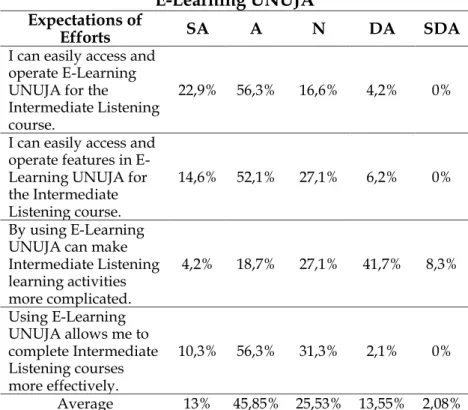
Expectations of Efforts on the use of E-Learning UNUJA The results of the expectations of efforts on the use of E-Learning UNUJA are as follows table 2.
Table 2. The Result Expectations of Efforts on the Use of E-Learning UNUJA
Expectations of
Efforts SA A N DA SDA
I can easily access and operate E-Learning UNUJA for the
Intermediate Listening course.
22,9% 56,3% 16,6% 4,2% 0%
I can easily access and operate features in E- Learning UNUJA for the Intermediate Listening course.
14,6% 52,1% 27,1% 6,2% 0%
By using E-Learning UNUJA can make Intermediate Listening learning activities more complicated.
4,2% 18,7% 27,1% 41,7% 8,3%
Using E-Learning UNUJA allows me to complete Intermediate Listening courses more effectively.
10,3% 56,3% 31,3% 2,1% 0%
Average 13% 45,85% 25,53% 13,55% 2,08%
Table 2 shows the questionnaire results with the criteria for effort expectations on the use of E-Learning UNUJA for Intermediate Listening courses. Students' perspectives regarding the ease of accessing and operating E-Learning UNUJA for Intermediate Listening courses are 22.9% strongly agree, 56.3% agree, 16.6% neutral, and 4.2%
strongly disagree. Meanwhile, regarding the ease of accessing and operating features in E-Learning UNUJA for Intermediate Listening courses, 14.6% of students strongly agree, 52.1% agree, 27.1% are neutral, and 6.2% disagree.
Regarding students' perspectives on using E-Learning UNUJA which can make Intermediate Listening learning activities more complicated 4.2% of students strongly agree, 18.7% agree, 27.1% neutral, 41.7% disagree, and 8.3%
strongly disagree. Furthermore, as many as 10.3% of students strongly agree, 56.3% agree, 31.3% neutral, and 2.1% disagree that Using E-Learning UNUJA allows them to complete Intermediate Listening courses more effectively. So, on average, students' perspectives regarding the expectation of effort on using E-Learning UNUJA 13%
strongly agree, 45.85% agree, 25.525% are neutral, 13.55%
disagree, and 2.075% strongly disagree.
Social Factors in the use of E-Learning UNUJA
The results of the social factors in the use of E- Learning UNUJA are as follows table 3.
Table 3. The Results of the Social Factors in the Use of E-Learning UNUJA
Expectations of
Efforts SA A N DA SDA
I use E-Learning UNUJA for
intermediate Listening courses because of the influence of other people.
4,2% 8,3% 22,9% 52,1% 12,5%
I am comfortable using E-Learning UNUJA because several people help me use E-
Learning UNUJA for Intermediate Listening courses.
4,2% 20,8% 33,3% 33,3% 8,4%
I use E-Learning UNUJA because the learning process for the Intermediate Listening course expects me to use E- Learning UNUJA.
10,4% 60,4% 22,9% 6,3% 0%
Average 6,27% 29,83% 26,37% 30,57% 6,97%
Table 3 above shows that students use E-Learning UNUJA for Intermediate Listening courses because of the influence of others as much as 4.2% strongly agree, 8.3%
agree, 22.9% neutral, 52.1% disagree, and 12.5% strongly disagree. Then on the aspect of student convenience in using E-Learning UNUJA because several people were helping them use E-Learning UNUJA for Intermediate Listening courses, 4.2% of students strongly agree, 20.8%
agree, 33.3% are neutral, 33.3 % disagree, and 8.4% strongly disagree. Furthermore, the students' perspective was that they use E-Learning UNUJA because the learning process for Intermediate Listening courses expected them to use E- Learning UNUJA, 10.4% strongly agreed, 60.4% agreed, 22.9% neutral, and 6.3 % did not agree. So, on average, students' perspectives on social factors in the use of E- Learning UNUJA, 6.27% stated strongly agree, 29.83%
agreed, 26.37% neutral, 30.57% disagreed, and 6.97%
strongly do not agree.
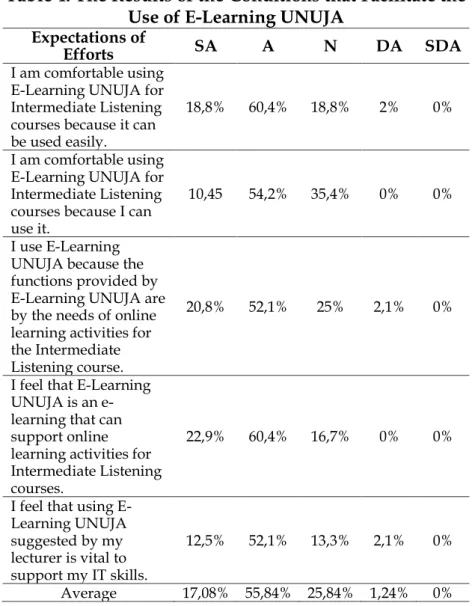
Conditions that Facilitate the Use of E-Learning UNUJA The data on the results of students' perspectives on the facilitating conditions in the use of E-Learning UNUJA is in the following table 4.
Table 4. The Results of the Conditions that Facilitate the Use of E-Learning UNUJA
Expectations of
Efforts SA A N DA SDA
I am comfortable using E-Learning UNUJA for Intermediate Listening courses because it can be used easily.
18,8% 60,4% 18,8% 2% 0%
I am comfortable using E-Learning UNUJA for Intermediate Listening courses because I can use it.
10,45 54,2% 35,4% 0% 0%
I use E-Learning UNUJA because the functions provided by E-Learning UNUJA are by the needs of online learning activities for the Intermediate Listening course.
20,8% 52,1% 25% 2,1% 0%
I feel that E-Learning UNUJA is an e- learning that can support online learning activities for Intermediate Listening courses.
22,9% 60,4% 16,7% 0% 0%
I feel that using E- Learning UNUJA suggested by my lecturer is vital to support my IT skills.
12,5% 52,1% 13,3% 2,1% 0%
Average 17,08% 55,84% 25,84% 1,24% 0%
From the data above, students who are comfortable using E-Learning UNUJA for Intermediate Listening
courses because it can be used easily stated 18.8% strongly agree, 60.4% agree, 18.8% neutral, and 2% disagree. Then, students who are comfortable using E-Learning UNUJA for Intermediate Listening courses because they can use it stated that 10.45 strongly agree, 54.2% agree, and 35.4% are neutral. Furthermore, 20.8% of students stated strongly agree, 52.1% agree, 25% neutral, and 2.1% disagree that they use E-Learning UNUJA because the function provided by E-Learning UNUJA is for the needs of online learning activities for the Intermediate Listening course. In addition, 22.9% of students strongly agree, 60.4% agree, and 16.7%
state neutral that E-Learning UNUJA is e-learning that can support online learning activities for Intermediate Listening courses. Then 12.5% strongly agree, 52.1% agree, 13.3% neutral, and 2.1% neutral feel that E-Learning UNUJA suggested by lecturers is essential to support their IT skills. So, on average, the students' perspectives on aspects of conditions that facilitate the use of E-Learning UNUJA 17.08% strongly agree, 55.84% agree, 25.84% are neutral, and 1.24% disagree.
Interest in Utilizing E-Learning UNUJA
The data on the results of students' interest in Utilizing E-Learning UNUJA is in the following table 5.
Table 5. The Results of the Interest in Utilizing E- Learning UNUJA
Expectations of Efforts SA A N DA SDA I want to continue to use
E-Learning UNUJA for online learning activities for Intermediate
Listening courses.
16,7% 39,6% 41,7% 2% 0%
I used E-Learning UNUJA because my classmates agreed to use E-Learning UNUJA for Intermediate Listening courses.
12,5% 41,7% 41,7% 4,1% 0%
Average 14,6% 40,65% 41,7% 3,05% 0%
From the data above, it can be stated that 16.7% of students strongly agree to continue using E-Learning UNUJA for online learning activities for Intermediate Listening courses 39.6% agree, 41.7% are neutral, and only 2% disagree. While the perspective of students who stated that they used E-Learning UNUJA because their classmates agreed to use E-Learning UNUJA for Intermediate Listening 12.5% strongly agree, 41.7% agree, 41.7% neutral, and 4, 1% disagree. So on average, the student’s interest in
using E-Learning UNUJA for intermediate listening courses was 14.6% strongly agree, 40.65% agree, 41.7%
neutral, and 3.05% disagree.
Usage Behavior on the use of E-Learning UNUJA
The following is data on student behavior in the use of E-Learning UNUJA (table 6).
Table 6. The Results of the Usage Behavior on the use of E-Learning UNUJA
Expectations of
Efforts SA A N DA SDA
I can use E-Learning UNUJA easily in online learning activities for Intermediate Listening courses.
20,8% 54,2% 22,9% 2,1% 0%
I felt that E-Learning UNUJA for
Intermediate Listening was
confusing when I first used it, so I was lazy to use it again.
6,3% 12,5% 20,8% 45,8% 14,6%
Average 13,55% 33,35% 21,85% 23,95% 7,3%
From the data above, it can be seen that students stated that 20.8% strongly agree, 54.2% agree, 22.9%
neutral, and 2.1% disagree that they can use E-Learning UNUJA easily in online learning activities for Intermediate
Listening course. Then as many as 6.3% of students strongly agree, 12.5% agree, 20.8% neutral, 45.8% disagree, and 14.6% strongly disagree if E-Learning UNUJA for Intermediate Listening is confusing when they first use it, so they feel lazy to use it again. So that on average on the behavioral aspect of using E-Learning UNUJA, 13.55% of students stated strongly agree, 33.35% agreed, 21.85% were neutral, 23.95% disagreed, and 7.3% of students stated strongly disagree.
Conclusion
From the explanation above, the results of research on the perspectives of students of the English study program at Nurul Jadid University, Probolinggo, towards online learning for intermediate level listening courses through E-Learning UNUJA during the COVID-19 pandemic can be concluded that the performance aspect of using E-learning UNUJA is as expected, the effort aspect of using E-Learning UNUJA is as expected, the social factor of using E-Learning UNUJA is lacking, the aspect of conditions that facilitate the use of E-Learning UNUJA is
excellent, students' interest in using E-Learning UNUJA is very high, and the behavioral aspect of using E-Learning UNUJA is good.
REFERENCES
Ahmed, A. A. A., & Ganapathy, A. (2021). Creation of Automated Content with Embedded Artificial Intelligence: A Study on Learning Management System for Educational Entrepreneurship. Academy of Entrepreneurship Journal, 27(3), 1–10.
Arnesti, N., & Hamid, A. (2015). Penggunaan Media Pembelajaran Online – Offline Dan Komunikasi Interpersonal Terhadap Hasil Belajar Bahasa Inggris. Jurnal Teknologi Informasi & Komunikasi Dalam Pendidikan, 2(1).
Bali, M. M. E. I., & Holilah, N. (2021). The Role of Foster Caregivers in the Effectiveness of Online Learning in Pesantren. Edukasi Islami: Jurnal Pendidikan Islam, 10(1), 339–362.
Bali, M. M. E. I., & Musrifah. (2020). The Problems of Application of Online Learning in the Affective and Psychomotor Domains During the Covid-19
Pandemic. Jurnal Pendidikan Agama Islam, 17(2), 137–154.
Bao, W. (2020). COVID‐ 19 and online teaching in higher education: A case study of Peking University.
Human Behavior and Emerging Technologies, 2(2), 113–
115.
Contini, C., Di Nuzzo, M., Barp, N., Bonazza, A., De Giorgio, R., Tognon, M., & Rubino, S. (2020). The novel zoonotic COVID-19 pandemic: An expected global health concern. The Journal of Infection in Developing Countries, 14(03), 254–264.
Cucinotta, D., & Vanelli, M. (2020). WHO declares COVID-19 a pandemic. Acta Bio Medica: Atenei Parmensis, 91(1), 157.
El Mhouti, A., Erradi, M., & Nasseh, A. (2018). Using cloud computing services in e-learning process:
Benefits and challenges. Education and Information Technologies, 23(2), 893–909.
Firman, F., & Rahayu, S. (2020). Pembelajaran online di tengah pandemi covid-19. Indonesian Journal of Educational Science (IJES), 2(2), 81–89.
Goldschmidt, K. (2020). The COVID-19 pandemic:
Technology use to support the wellbeing of children. Journal of Pediatric Nursing, 53, 88.
Hamid, R., Sentryo, I., & Hasan, S. (2020). Online learning and its problems in the Covid-19 emergency period.
Jurnal Prima Edukasia, 8(1), 86–95.
Iwai, Y. (2020). Online learning during the COVID-19 pandemic what do we gain and what do we lose when classrooms go virtual. Scientific American, 13.
Jadid, U. N. (2020a). Kebijakan E-Learning di Universitas Nurul Jadid.
Jadid, U. N. (2020b). Surat Edaran tentang Perkuliahan (NJ- T06/0233/A.4/03.2020). Universitas Nurul Jadid.
Kemdikbud, P. W. (2020). Surat Edaran Pencegahan COVID-19 pada Satuan Pendidikan. A Vailable at:
Https://Www. Kemdikbud. Go.
Id/Main/Blog/2020/03/Surat-Edaran-Pencegahan- Covid19-Pada-Satuan-Pendidikan.
Maulana, H. A., & Hamidi, M. (2020). Persepsi mahasiswa terhadap pembelajaran daring pada mata kuliah praktik di pendidikan vokasi. Equilibrium: Jurnal
Pendidikan, 8(2), 224–231.
Salehi, S., Abedi, A., Balakrishnan, S., &
Gholamrezanezhad, A. (2020). Coronavirus disease 2019 (COVID-19): a systematic review of imaging findings in 919 patients. American Journal of Roentgenology, 215(1), 87–93.
Suryanto, B. T. (2018). Written Grammar Feedback on Students’ Writing with Visual Learning Style.
PEDAGOGIK: Jurnal Pendidikan, 5(1), 1–18.
Suryanto, B. T. (2019). How to Teach Listening in Senior High School. IJOEEL: International Journal of English Education and Linguistics, 1(1), 42–48.
Verawardina, U., Asnur, L., Lubis, A. L., Hendriyani, Y., Ramadhani, D., Dewi, I. P., Darni, R., Betri, T. J., Susanti, W., & Sriwahyuni, T. (2020). Reviewing online learning facing the Covid-19 outbreak. Talent Development & Excellence, 12.
Zhafira, N. H., Ertika, Y., & Chairiyaton. (2020). Persepsi Mahasiswa Terhadap Perkuliahan Daring Sebagai Sarana Pembelajaran Selama Masa Karantina Covid-19. Jurnal Bisnis Dan Kajian Strategi
Manajemen, 4(1), 37–45.