Verbal Interpersonal Communication between Teacher-Student in English Classroom at Pharmacy Department
Rifqah Ulzani Jupri S.S Prof. Dr. Kisman Salija S.Pd., M.Pd Prof. Murni Mahmud S.Pd., M.Hum., Ph.D
English Education Department, Graduate Program State University of Makassar, Indonesia
ABSTRACT
Interpersonal communication used in the classroom is important to investigate.
Therefore the objective of this research is to explore interpersonal communication that occurs between teacher-student and student-student in English classroom especially in the pharmacy department. This research was conducted at Pharmacy department of Megarezky University. This study focused on one class which employed English conversational class. For collecting data, the researcher employed descriptive qualitative method based on conversational analysis as a part of discourse analysis approach by using video and voice recorder. Findings of this research revealed that there are some interpersonal communication used by teacher-student in the classroom.
In teacher talk, they were encouraging students to continue, confirming that answers are correct, attempting to be humorous, clarifying, summarizing the ideas of students, asking questions to which the answer is anticipated giving information, telling students who have made a mistake the correct response, giving direction, and request. In student talk, they used student response, silence, and laughing. Findings of this study are relevant in the development of English language teaching, particularly in effort to make a good communication between teacher-student and student-student.
Keywords: Interpersonal communication, teacher talk, student talk, classroom interaction
INTRODUCTION
One of the crucial things in human life is communication. A human cannot live without doing communication with others. A human typically engages in the amount of conversation during a day. Hamilton (2008) mentioned that people sharing thoughts, ideas and feelings with each other in commonly understandable ways through
communication; either it is in verbal communication or nonverbal communication.
Verbal communication is sent with words that consist of oral or written. On the other hand, nonverbal communication requires neither words nor language. Moreover, we learn about other people’s thoughts and feelings not only by listening to their words but also observing their body language—watching their facial expressions, seeing how they move and gesture, and taking note of their eye contact.
Bothverbal and nonverbal communication which is happened intimate between two persons or more and then the information exchange including feeling and meaning are able to make good relation in social life such as between teacher and student;
student and student; employer and employee; buyer and seller; doctor and patient;
parents and children and so forth. To understand one another through communication will not surely just appear out of nowhere. It has to draw on it and it will take a properly deal of effort which places human beings - the communicators - to the most responsible ones for developing it (Rasyid & Muhayyang, 2016).
In spite of this, the language which is used in communication sometimes misinterpreted by the listener that will make misunderstanding of each other. This misunderstanding can happen because meaning is fragile. It is important to be aware of the workable for communication. One of the reasons for the misunderstanding is the word or word interprets differently with different people.
Talking about foreign language, in medical school especially in pharmacy major, English teacher teaches the English language in basic, this is one of a subject which students have to pass. The English subject gives a great contribution to many
fields to communicate their ideas and thoughts through oral or written. The English language itself used by the non-English student in specific needs like as for communication need, to access the information and technology, academic need, economy, and business need. To be supported, Shamsipour & Allami (2012) said that an effective teacher should try to improve second language classrooms and promote learning for doing it and it is ineffective too for the foreign language classrooms.
To improve English skills and competence for non-English student, teachers or lecturers must have an effective strategy in teaching because they have a different needed. Therefore, whether as a second language or a foreign language will give a change for their thought ways in the English learning process (Brown, 1994). It will be a reason too for the teachers to present their strategies using interpersonal communication to make the student easier to understand English subject. Considering it, teaching, whatever subject is taught, is communicating, directing, guiding, inspiring and transferring virtues in the frame of knowledge, skills, attitudes, and values (Rasyid
& Muhayyang, 2016).
Based on my preliminary observation the researcher found that in student cases, learning a foreign language embodies cognitive as well as effective features on the part of the students. Anxiety is one of the most frequently observed problems in relation to the affective domains in the language learning process (Incecay, 2010), especially for pharmacy student, another barrier in the learning process is the students not pay attention to the teacher because they do not know what the teacher’s talks or what the teacher’s means. That is why the teacher sometimes mixes the foreign language
(English) to their first language (Indonesia) verse Versa or switches the foreign language (English) to their first language (Indonesia) verse Versa. These ways are useful to make the students more understand the material and not making bored in the classroom.
Based on the reasons above, it is interesting to apprehend how human beings pick the language cues to accomplish a number of personal and relationship goals in their communication, especially in teacher-students relations and student-student relations in using the interpersonal communication which can decrease the barriers in classroom interaction.
The novelty in this research is the researcher will use Foreign Language Interaction (FLINT) method to find out English teacher’s talk in verbal interpersonal communication when she communicates with the student in direct and indirect talk and students’ talk when they talks to their teacher. While, some other preceding researchers studied the perception of EFL students on the lecturer’s verbal and nonverbal interpersonal communication that they experience and expect to foster their positive attitudes and nurture their motivation in learning English at State University of Makassar, Indonesia (Rasyid, 2015), it is also the studied based on Sofyan & Mahmud (2018). In their study, they analyzed teacher talk in classroom interaction based on the Foreign Language Interaction Analysis (FLINT) system in the speaking classroom of English department of Language and Literature Faculty of State University of Makassar.
This paper attempts on interpersonal communication between teacher and student in the English subject of pharmacy major. This idea shows up to help the teacher in teaching English effectively to their student especially for a medical student in a pharmacy major, to help the teacher to choose the best language in teaching, to exchange information and to enrich the knowledge in the ESP field.
RELATED LITERATURE
INTERPERSONAL COMMUNICATION
Interpersonal communication has been defined by communication scholars. Lustig &
Koester (2010) defined interpersonal communication as “a form of communication that includes a small number of individuals who are interacting exclusively with one another and who therefore have the ability both to adapt their messages specifically for those others and to obtain an immediate interpretation from them”. McCornack (2010) defined interpersonal communication as “a dynamic form of communication between two (or more) people in which the messages exchanged significantly influence their thoughts, emotions, behaviors, and relationship”. Rasyid (2015) For implication in classroom context, interpersonal communication “refers more specifically to communication that occurs among teacher-students and student-student which allows them to communicate both verbally and nonverbally in an effort to generate shared meaning and accomplish academic and social goals which creates a personal bond among them in terms of socially and psychologically perceived appropriate distance”.
To sum it up, interpersonal communication is a transactional form of human communication that happens between people or more that contain messages which are usually for the purpose of managing relationships.
VERBAL INTERPERSONAL COMMUNICATION
Devito (2013) mention principles of verbal message that consist of 10 principles, such as: 1) Messages are packaged. Your entire being works as a whole—
verbally and nonverbally—to express your thoughts and feelings. Both of them occur simultaneously. 2) Meanings are in people. It means that we are not receive meaning, but we create meaning, we construct meaning out of the message based on our experience. 3) Meanings are denotative and connotative. The denotation of a word is its objective definition while the connotation is its subjective or emotional meaning. 4) Messages vary in abstraction. Effective verbal messages include words at many levels of abstraction. At times an abstract, general term may suit your needs best; at other times a more concrete, a specific term may serve better. 5) Messages vary in politeness.
Forms of politeness are responsive to two needs that each person has: each of us wishes to be viewed positively by others, to be thought of favorably; this is referred to as maintaining positive face and each of us desires to be autonomous, to have the right to do as we wish; this is referred to as maintaining negative face. 6) Messages can deceive.
Some messages are truthful and some are deceptive. Although we operate in interpersonal communication on the assumption that people tell the truth, some people do lie. 7) Messages can criticize and praise. Throughout your communication experiences, you’re expected to criticize, evaluate, and otherwise to render judgment
on some person or on something someone did or created. Especially in helping professions such as teaching, nursing, or counseling, criticism is an important and frequently used skill. 8) Messages vary in assertiveness. It is important to know that assertive people speak their minds and welcome others to do likewise but keep in mind that assertiveness is not always the most desirable response. Assertive people are assertive when they want to be, but they can be nonassertive if the situation calls for it.
9) Messages can confirm and disconfirm. In confirmation, you not only acknowledge the presence of the other person but also indicate your acceptance of this person, of this person’s definition of self, and of your relationship as defined or viewed by this other person. Whereas, disconfirmation is a communication pattern in which you ignore a person’s presence as well as that person’s communications. 10) Messages vary in cultural sensitivity. Perhaps the best way to develop nonracist, nonheterosexist, nonageist, and nonsexist language is to examine the preferred cultural identifiers to use in talking to and about members of different groups.
CLASSROOM INTERACTION
Mahmud (2017) said that Classroom interaction is important since it provides information on how teachers and students interact. It covers classroom behaviors such as turn-taking, questioning, and answering, negotiation of meaning and feedback (Chaudron, 1998). In classroom interaction also the collaborative exchange of thoughts, feelings or ideas, between two or more people where students can increase their language store and use all languages through interaction (Afrin, 2018). So that
the effective classroom interaction will result in successful teaching in all activities by teachers and students in the class.
Interaction seems like a simple thing to do but actually, there are many obstacles in building a good interaction or relationship to others (Sofyan & Mahmud, 2018) especially with the student because sometimes teachers take all the time in teaching.
Therefore, to make the interpersonal communication doing by teacher and student running well in the classroom interaction, Moskowitz in Brown (2000) make a model known as Foreign Language Interaction (FLINT) to code interaction occurs in the classroom. This model divided into teacher talk and student talk.
RESEARCH METHOD
This research used descriptive qualitative research. The aims of this research were to find out what kinds of verbal interpersonal communication used between the teacher- student of pharmacy while teaching learning process.
The result of this research performed descriptively. The variables in this study was the verbal communication between English teacher and student of pharmacy in the classroom. The data sources of this research were the English teacher-student of the Pharmacy department and student-student of the Pharmacy department in Megarezky University. More specifically the researcher recorded the interpersonal communication between teacher-student in English class at the Pharmacy department.
The research focused on the verbal interpersonal communication used by the teacher- student during the classroom activity. The subjects of this research were the English teacher and the pharmacy students who were in that classroom. The researcher selected
about 2 students and a teacher to do an interview for each meeting. The researcher chose one class which employed English conversational class. The data was collected through observation and interview techniques. The observation conducted in the classroom by using audio/video recording, and observation checklist as the instrument of this research. Then, the interview technique conducted after all the data in observation was finished. The instrument for the interview was the interview protocol.
There were five meetings to do the research in the classroom.
FINDINGS
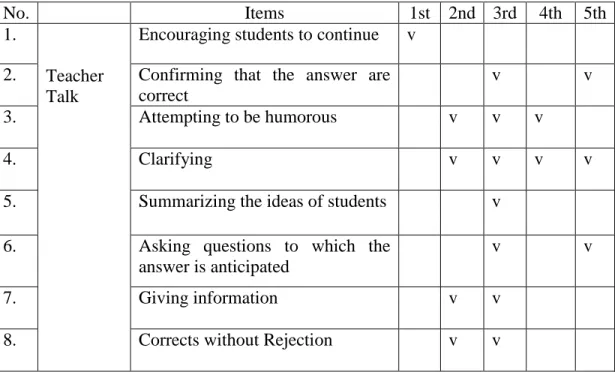
After analyzing the data from the recording, some verbal interpersonal communication used by teacher –student in the classroom were identified. They are explained as follows:
TABLE 1. Verbal interpersonal communication of teacher and students’ summary observation
No. Items 1st 2nd 3rd 4th 5th
1.
Teacher Talk
Encouraging students to continue v 2. Confirming that the answer are
correct
v v
3. Attempting to be humorous v v v
4. Clarifying v v v v
5. Summarizing the ideas of students v
6. Asking questions to which the answer is anticipated
v v
7. Giving information v v
8. Corrects without Rejection v v
9. Telling students who have made a mistake the correct response
v v
10 Giving direction v v
11. Request or command v v
1. Student Talk
Student Response v v v v v
3. Laughing v v v v v
VERBAL INTERPERSONAL COMMUNICATION 1. Verbal interpersonal communication used by teacher-student a. Teacher’s verbal interpersonal communication
Extract 1: Encouraging Students to Continue M: But not your boyfriend?
S1: No
M: Oke, yes, yes,yes and then?
S1: And then sebenarnya nggak berdua , tapi lagi rame cuman nggak sampingan (And then actually we are not only two, but there are many people around us, but they aren’t close to us)
M: Em, and then your parent yang dapati?
(Em, and then your parent gapped you?) S1: No, boyfriend
From the extract 1 above, M as a teacher try to encourage S as a student to keep told a story about her experience in using English. The sentence showed us that M as a teacher wants S as a student to continue the story, she was curious to know the next story. Afterwards, S continued the story about her experience but she stopped again because she did not know how to say it in English. So that, M tried to encourage again.
This was one way to make the student wants to continue the story with giving a simple question which can be understand. Both of the sentences also showed that M tried to
use interpersonal communication. She asked a question to the student like as a friend.
So that, the student feel enjoy to answer it and continue the story.
Extract 2: Confirming that Answer is Correct S: Yes,
M: Saya hapus saja supaya jelas, put the following nouns in the right column, car? Kalau dia singular jadi a car, klo dia plural jadi cars. Chair, countable or uncountable? Chair, kursi? (I erase it to make it clear, put the following nouns in the right column, car? If it singular it will be a car, if it plural it will be cars. Chair, countable or uncountable? Chair “kursi”?)
S: Countable,
M: Countable. So, a chair, chairs. Begitu yang kalian kerja ya? (Countable. So, a chair, chairs. Are you doing like that?)
S: Yes
In the extract 2, the teacher, representative with M, asked the students about their understanding of the countable and uncountable material that already explained to make sure the students understand it well. Then one of the student spontaneously answered it,” Countable”. To confirm that the answered is correct, the teacher replayed the student’s answered,” Countable. So, a chair, chairs.
Extract 3: Attempting to be Humorous
S: Face
T: Yes, if I look at your eyes, you will have 2 husbands @mislanya@
Ss: @@@
T: Jadi ini misalnya misalnya saja ya, cuman pura pura. If I am look at your palm. Kalau saya liat garis tanganmu oh you will get married with rich person (so, for example, ya, just for pretend. If I am look at your palm. If I see your palm oh you will get married with rich person).
Ss: @@@
T: Okey, okey, I want you to predict your friend, come on, come on, saya minta satu prediksi untuk teman anda in the next ten year (Okey, okey I want you to predict your friend, come on, come on, I want one prediction to give it to your friend in the next ten year).
In the extract 3, teacher made a humor when she explained more with giving some example about the material. She said, “Yes, if I look at your eyes, you will have
2 husbands @mislanya@”. This humor made all of the students laugh but still understand the material with a humor. Then, the teacher gave another humor to make it clear explanation. Attempting to be humorous or make a joke when teaching is one of the way to make a good atmosphere in the classroom.
Extract 4: Clarifying
M: Nah, bagaimana kalau you are the customer service. What would you do?(Well, how if you are the customer service. What would you do?)
S: I didn’t give M: You didn’t give?
S: Yes
In extract 4, S, as a student try to answer the question of the teacher using her own idea. She said that,” I didn’t give”. M, as a teacher tried to make a clarification.
She said,” You didn’t give?”. Then the student said” Yes”.
Extract 5: Summarizing the Ideas of Students M: Now look at this, I never wear, put a or an?
S: A
M: A watch, okey . please, give me…
S: A
M: Jadi ingat klo uncountable tidak pakai a atau an, ya, jadi yang bisa pakai a atau an itu hanya countable yang bisa di hitung. Klo dia tidak bisa di hitung tidak pakai article. Please give me milk. Anna is wearing …. Apa ini? (So, remember if uncountable it does not need a or an, ya. So just countable need a or an which is can count. If it could not count, it does not need article. Please give me milk. Anna is wearing … what is the answer?)
In extract 5, the teacher, M, tried to summarize the students’ answer about countable and uncountable noun. She also give more simple explanation about it to make a complete summarize.
Extract 6: Asking Question to which the Answer is Anticipated M: Rice?
S: Uncountable M: University?
S: Countable M: Book?
S: Countable
M: Countable, jadi bisa satu buku dua buku? (Countable, so can it be one book two book?)
S: Yes, M: Man?
S: Countable M: Envelope?
S: Countable M: Sand? Money?
S: Uncountable
Form the extract 6 indicated that the teacher, M, ask question to the students to see that all of the students can answer it, understand the material, and to see their participation in the learning process. Those were simple questions to ask but very meaningful for the teacher to know how students’ progress, how they easy to understand the material.
Extract 7: Giving Information
M: Ya sate Madura, and etc. now what is your impression of the food from your mother country? Bagaimana kesanmu terhadap masakan di negaramu?
Misalnya nih I am from palopo terkenal dengan kapurungnya (Yes, Sate Madura, and etc. Now what is your impression of the food from your mother country? Translated with “bagaimana kesanmu terhadap masakan di negaramu? For example, I am from Palopo, Kapurung is one of the famous food)
Ss: Ya…
M: So, my impression is kapurung is very healthy food. Kenapa healthy because there are many vegetables inside. Ada banyak sekali sayurannya, and the taste is very spicy. (So, my impression is Kapurung is very healthy food. Why?
Because there are many vegetables inside. Translated with “ada banyak sekali sayuran”, and the taste is very spicy)
From extract 7 above, the teacher give information and example all at once about the impression of the food from her city. Then she add the explanation about the
taste and what kapurung is. Those information can motivate students to speak up in the classroom, explore their ideas, and give a communicative answer.
Extract 8: Telling Student who have Made a Mistake the Correct Response M: A ring on her finger. Mary doesn’t eat … meat?
S: A
M: Mm?… meat itu bisa di hitung atau tidak? (Mm?... could meat be counted or not?)
S: Tidak (No)
M: Jadi klo tidak bisa di hitung. No need to put a or an (So, if it could not be counted. No need to put a or an)
S: Nda pake (No need)
M: Mary doesn’t eat meat. Give me a pen to write … letter
S: A
From the extract 8, the teacher telling the student who had made a mistake with a correct response in a clue. When the teacher asked, “Mary doesn’t eat … meat?”, the student gave a wrong answer. Next, the teacher gave a clue to make her think more about the answer. That explanation is the example of interpersonal communication, because the teacher gave the explanation in a good way, so the students easy to understand it and did not felt bad.
Extract 9: Giving Direction S: Assalamu ‘alaikum T &Ss: Wa’alaikum salam (silent)
T: Terbaca? (Is it clear?)
Ss: Tidak bu, silau lampunya (No, mam, is it too bright)
T : So, we want to talk about stay healthy and emergency. Jadi kita selesaikan dulu conversation ini with your partner after that we will do our final test but don’t worry test nya sangat mudah.so, here I want you to do in partner, dengan patner nya masing masing ya two of you, two of you, okey pas. So, we will talk about stay healty and emergency. How often do you? Seberapa pernah kamu? Jadi ini yang nanti akan di bicarakan sama partner nya ya. So how often do you? Seberapa sering kamu? 1. Go to your dentist. Kalau misalnya, mm any board marker, please? (So, we want to talk about stay healthy and emergency. So, we do the conversation firstly with your partner
after that we will do our final test but don’t worry, the test is so easy. So, here I want you to do in partner, do it with your own partner yes, two of you, two of you, okey enough. So, we will talk about stay healthy and emergency. How often do you? How often do you ever do that? So this is the question which you have to discuss with your partner, right. So, how often do you? 1. Go to your dentist. For example, mm any board marker, please?)
In the extract 9, the teacher giving direction to the students in the beginning of study. This direction is to make the student understand what they would do in this meeting, firstly they have to discuss some questions from the teacher with their partner and then they will do final examination.
Extract 10: Request
M: Ada countable, ada uncountable noun. So, what is countable noun? Any board market? Ada yang bawa board market? What is countable noun? Dari kata count, from the word count (There is countable, there is uncountable noun. So, what is countable noun? Any board marker? Anyone bring board marker? What is countable noun? From the word, count, from the word count) S: Hitung (count)
M: Mm? noun? What is noun ka? Kata ben.. (Mm? noun? What is noun?
S: Benda (Noun)
In the conversation on the extract 10, the teacher had a request, she said, “…Any board market? Ada yang bawa board market?... (…Any board marker? Anyone bring board marker?...), because she wanted to explain more about countable and uncountable noun to her students using white board, but the teacher did not see any board marker on the table, so she made a request.
b. Student’s verbal interpersonal communication Extract 11: Student Response
S2: Oh, air kelapa? (Oh, coconut water?)
T: Yes, air kelapa. What else?(Yes, coconut water. What else?) S2: Apa lagi? (What else?)
T: Kalau teh bisa tidak? (How about tea? Could it be?)
S5: Tidak bisa ya? (it couldn’t be, right?) S2: Air kelapa saja (just coconut water) T: I remember my neighbor
S2: Kopi hitam (Dark coffee)
T: Kopi hitam juga?(Also dark coffee?)
S1: Iya, biar keluar racunnya (Yes, to make the poison running out)
Another strategy showed in the extract 11, the teacher (T) gave a topic with a set of question based on the student’s background. It was about healthy, so the student easy to answer it.
Extract 12: Laughing
T: Okey, what will you do?
S2: Kaget (Shock)
S3: Panggil orang (Calling someone) T: Untuk? (For what?)
S3: Untuk menolong (For help) T&ss: @@@
T: Okey, jadi percayakan sama orang lain? (Okey, so you believe someone to do that)
Ss: @iya@ (@yes@)
Extract 12 indicated how teacher and students laughing in during teaching and learning process. It happened because of one of the student (s3) answered the question of the teacher spontaneously. She just gave the answered based on her personal experience while the answer was ambiguity, when she said, “Panggil orang (Calling someone)”, the teacher and another student confused about the meaning, so the teacher asked, “untuk? (for what?)”, then the student 3 answered, “Untuk menolong (for help)”. That was the reason why the teacher and the student laughing.
DISCUSSION AND CONCLUSION
There were twelve extracts of conversations presented in the research finding to answer the first question about interpersonal communication between teacher and student that conducted based on FLINT system analysis which divided into teacher talk and student talk.
In the teacher’s talk, the researcher found some of verbal interpersonal communication that teacher used. They are: encouraging student to continue, Based on the findings, teacher usually encouraging students to communicate up in the technique of gaining knowledge of English. She encouraged some of the students to speak up in every question. The interpersonal communication that the teacher always uses to encourage them to speak are “then?, what will you do?, what about you?”, simple question to encourage a student to speak up, but it is meant to make them speaking during the class. Brown (2007) also stated that encouragement can help the students with low achievement to learn. Besides that, encouraging student can build their confidence to speak.
Confirming that the answer was correct is another important thing to make the students felt the teacher to make the student realize the teacher care to them was when the teacher confirming that the answer was correct. This situation could motivate them to study English. Besides it, when the teacher confirming the students’ answer was correct, it will grow up confidence for them and trying to give another best. Attempting to be humor, in making a joke or attempting to be humor in the teaching and learning process could give the student confidence to study without pressure, motivation to learn
and booster their moody especially, when student felt bored in the class or they did not pay attention while studying. Berk & Nanda, 1998; Wanzer & Frymier, (1999) cited that humor is determined in some research to promote a sense of immediacy and connection between teacher and students, to limit anxiety, and to enlarge enjoyment of and activity in the class.
Clarifying and summarizing the ideas of students with the aid of the teacher is wanted in the effectiveness of educating and studying language. As we can see in the extract 12 until 15, those extracts showed use ideas of students can give them a chance and opportunities to participate in the learning process. The teacher could also know their contribution in the classroom interaction. Then, asking question according to Cohen (1995) in Naz, Khan, Khan & Daraz (2013) the purposes in asking questions as follows: to arouse interest and curiosity concerning a topic, to focus interest on a precise problem or concept, to strengthen an lively approach to learning, to stimulate students to ask question by themselves and others, to diagnose unique difficulties inhibiting student learning, to express a genuine interest in the ideas and feelings of the students, to supply an opportunity for students to assimilate and replicate upon information.
Giving information, the important to remember that teaching is all about building a relationship with students because an effective teacher not only focuses on what but also why and how she is teaching. Giving information in the process of teaching and learning can open students’ mindset, and explore their knowledge too.
Corrects without rejection, a teacher who cares about the student can transfer his/her knowledge affectively and has a good interaction with them. With using interpersonal communication too, it could make a students have supportive relationships with their teacher and they feel more motivated and engaged in the learning process. In Giving direction and request, the teacher’s role in giving direction gave a big effect in the language learning. Based on the findings teacher in giving direction to the students always mix the language, she used Indonesian and English, or sometimes she translate the English into Indonesian. This way was so effective to make students easy to understand the rules of the role play did in each meeting. Moreover, giving direction was also useful in this class, because this class is English conversation, so the students have to know the rules before they did role play or discussion. Giving direction in a good interaction can facilitates students to improve and explore their language ability through communication with the others. They will carve it themselves, when they are motivated to find out the way.
Teachers and students are recommended to be aware of the interpersonal communication used by teacher-student and student-student in classroom interaction to encourage the teaching and learning process especially to study English, because studying a language needs a good communication between teacher and student, also to make a good relation among them. Hence, this study wishes to be further explored, particularly in terms of interpersonal communication in the teaching and learning process.
REFERENCES
Arfin, T. (2018). The role of classroom interaction in improving learners’ Speaking skills: A Case Study of Private Universities. BRAC Institute of Languages, BRAC UNIVERSITY.
Berk, R., & Nanda, J. (1998). Effects of jocular instructional methods on attitudes, anxiety, and achievement in statistics courses. Humor, 11(4), 383–409.
Brown, D. (2000). Teaching by principles. San Fransisco State University. United State of America: Pearson Longman.
Chaudron, C. (1988). Second language classrooms: Research on Teaching and Learning. Cambridge: Cambridge University Press.
DeVito, J. (2013). 12th Ed. The interpersonal communication book. Boston: Pearson Education, Inc.
Hamilton, C. (2008). Communicating for results. Belmont, CA: Wadsworth.
Incecay, G. (2010). The role of teacher talk in young learners’ language process.
Procedia Social and Behavioral Sciences 2 (2010) 277–281. ELSEVIER.
Lustig, M.W. & J.Koester. (2010). Intercultural competence: Interpersonal communication across cultures. Boston: Pearson Education, Inc.
McCornack, Steven. (2010). Reflect & relate: an introduction to interpersonal communication. Second Edition. Boston: Bedford/St. Martin’s.
Naz, A., Khan, W., Khan, Q. & Daraz, U. (2013). Teacher’s questioning effects on students communication in classroom performance. Journal of Education and Practice. Vol.4, No.7, 2013.
Rasyid, M. A. (2015). Interpersonal communication that inspires in EFL teaching. In ELT WorldWide. Vol.2 No.2. July 2015.
Rasyid, M. A & Muhayyang, M. (2016). Interpersonal communication: A social harmony approach. 1st Edition. Badan Penerbit Universitas Negeri Makassar.
Shamsipour, A & Allami, H. (2012). Teacher talk and learner involvement in EFL Classroom: The case of iranian setting. Theory and Practice in Language Studies, Vol. 2, No. 11,: 2262-2268, November 2012. ACADEMY PUBLISHER Manufactured in Finland.
Sofyan, R.R & Mahmud, M. (2018). Teacher talk in classroom interaction: A study at an English department in Indonesia. ELT WorldWide Vol. 1 No.1.
Wanzer, M. B., & Frymier, A. B. (1999). The relationship between student perceptions of instructor humor and students’ reports of learning. Communication Education,
48, 48–62. Walsh, S. (2002). Construction or obstruction: Teacher talk and learner involvement in the EFL classroom. Language Teaching Research, 6, 3–
23.