--- How to cite this article
Zuhra, I., Nofriati, E., & Dewi, S. L. (2023). An investigation of plagiarism in EFL thesis graduates of almuslim university. Premise: Journal of English Education and Applied Linguistics, 12(1), 315–341.
https://doi.org/10.24127/pj.v12i1.6933
DOI: 10.24127/pj.v12i1.6933
---
AN INVESTIGATION OF PLAGIARISM IN EFL THESIS GRADUATES OF ALMUSLIM UNIVERSITY
by Intan Zuhra*
English Department, Faculty of Teacher Training and Education, Universitas Almuslim, Indonesia
[email protected] Eli Nofriati
English Department, Faculty of Teacher Training and Education, Universitas Almuslim, Indonesia
[email protected] Silvi Listia Dewi
English Department, Faculty of Teacher Training and Education, Universitas Almuslim, Indonesia
*Corresponding author
(Article History: Received: 2023-01-01.Revised1: 2023-02-05 Revised2: 2023-02-06 Accepted: 2023-02-14 Published: 2023-02-27).
Abstract:
Along with many plagiarism issues in the academic world, types of Plagiarism and its linguistic patterns are still under investigation. This study focuses on how Almuslim University EFL graduates perceive Plagiarism. The data for this study were gathered through documents and interviews using a descriptive qualitative design. Fifteen theses were used as samples to determine Plagiarism types and linguistic patterns, and 15 respondents were interviewed to determine the factors that influence Plagiarism. The documents were coded based on the types of Plagiarism, and the respondents were asked five questions during the interview. The findings revealed that 12 of the 15 theses samples had plagiarism rates greater than 25%, and three were found to have a small percentage of Plagiarism. According to the samples, most EFL graduates completed their theses using patchwriting instead of verbatim Plagiarism. In both types of Plagiarism (literal Plagiarism and intelligence).Furthermore, the interview results revealed that Plagiarism could occur due to various factors, including a lack of information, a desire to finish it quickly, an adverse environmental influence, and viewing the thesis as a graduate formality.
Furthermore, the findings of this study can be used to educate others about the various types, causes, and contributing factors to Plagiarism. As a result, lecturers and universities can take precautionary measures to avoid Plagiarism in the future.
Keywords: patchwriting; plagiarism; verbatim Abstrak:
Seiring dengan banyaknya isu plagiarisme di dunia akademik, jenis-jenis Plagiarisme dan pola linguistiknya masih dalam tahap investigasi. Studi ini berfokus pada bagaimana lulusan EFL Universitas Almuslim memandang Plagiarisme. Data penelitian ini dikumpulkan melalui dokumen dan wawancara dengan menggunakan desain kualitatif deskriptif. Lima belas tesis
--- Volume 12 No 1, Februari 2023,
http://creativecommons.org/licenses/by/4.0
digunakan sebagai sampel untuk menentukan jenis Plagiarisme dan pola linguistik, dan 15 responden diwawancarai untuk menentukan faktor-faktor yang mempengaruhi Plagiarisme.
Dokumen-dokumen tersebut diberi kode berdasarkan jenis Plagiarisme, dan responden ditanyai lima pertanyaan selama wawancara. Temuan mengungkapkan bahwa 12 dari 15 sampel tesis memiliki tingkat plagiarisme lebih besar dari 25%, dan tiga ditemukan memiliki persentase kecil Plagiarisme. Menurut sampel, sebagian besar lulusan EFL menyelesaikan tesis mereka menggunakan patchwriting alih-alih Plagiarisme kata demi kata. Dalam kedua jenis Plagiarisme (Plagiarisme literal dan kecerdasan).Selanjutnya, hasil wawancara mengungkapkan bahwa Plagiarisme dapat terjadi karena berbagai faktor, termasuk kurangnya informasi, keinginan untuk menyelesaikannya dengan cepat, pengaruh lingkungan yang merugikan, dan melihat tesis sebagai formalitas lulusan. Selanjutnya, temuan penelitian ini dapat digunakan untuk mengedukasi orang lain tentang berbagai jenis, penyebab, dan faktor penyebab Plagiarisme. Akibatnya, dosen dan universitas dapat mengambil tindakan pencegahan untuk menghindari Plagiarisme di masa depan.
Kata kunci: patchwriting; plagiarisme; Verbatim
INTRODUCTION
The recent rise in academic dishonesty suggests that education quality is deteriorating, particularly in Indonesia. It can be seen in academic violations, ranging from minor to severe ones, that result in academic degrees being revoked and the perpetrators being imprisoned.
Plagiarism is an example of academic deception. Plagiarism is the intentional or unintentional copying of another person's words, sentences, ideas, or concepts in any form and claiming to be his. Plagiarism is always committed in the academic world through student or tutor writings. It is difficult to determine whether or not a scientific work contains Plagiarism because Plagiarism can occur accidentally. According to Mohammed et al. (2015), Plagiarism is divided into two types: intentional and unintentional.
Some previous studies related to Plagiarism have been conducted by researchers worldwide. They tried to figure out the factor that may influence the students to commit Plagiarism and provide a solution on how to avoid it. Orim (2014) investigated Plagiarism among Nigerian university students. The findings revealed that the primary causes of students' textual Plagiarism were related to their awareness of the concept of mastery of required academic writing skills. Furthermore, students cannot acquire and transfer skills from the technical writing course offered in their first or second year. Coughlin (2015) conducted a similar study and proposed that academic institutions cultivate a consensus among faculty and students to foster professional ethics to prevent and detect Plagiarism. Furthermore, Andayani et al. (2021) proposed two main strategies for avoiding Plagiarism in thesis writing in their current study, namely paraphrasing and properly putting citations and references.
--- Volume 12 No 1, Februari 2023,
http://creativecommons.org/licenses/by/4.0
In the academic field, Plagiarism cannot be separated from academic writing since the most common problem in academic manuscripts is Plagiarism. All research students, lecturers, professors, and researchers publish their works and the results of their studies in academic conference proceedings, books, and journals (Hockenos, 2013). Academic writing is one of the essential components for solidifying thinking. Academic writing is one of the steps in the academic research process by which scientists report instances of thought, experience, observation, and application/testing as the solution to a specific scientific problem. In addition to following the general rules of a text genre, "academic writing" or
"scientific writing" refers to all principles considered when reporting academic research and the process of textualizing it (Bahar, 2014). Numerous types of academic writing include theses, articles, papers, projects, and posters. Typically, these types involve the composition of a research process report. Academic articles are the most common form of academic writing because scientists publish their research reports by writing numerous articles for their academic careers (Deniz & Karagöl, 2017, p. 148).
The aspects of academic writing can be broken down into four distinct categories: the process, the text, the form, and the ethics (Bahar, 2014). The steps involved in reporting and publishing content derived from a subset of the subject are contained within the process dimension. Textuality denotes a level of mastery over all aspects of written communication, including but not limited to spelling, punctuation, word choice, sentence structure, and flow from paragraph to paragraph. In addition to language and stylistic characteristics, the form dimension includes visual criteria. According to Murray and Moore (2006), to create a piece of academic writing, it is required to organize the information sequentially and present it in a disciplined and proper manner. The ethical dimension "can be explained as a set of moral rules that researchers must follow regarding the data collection, synthesis, evaluation, interpretation, and publication of results when seeking a solution for a problem" (Aydin, 2015, p. 39). In other words, the ethical dimension concerns how researchers should gather, analyze, interpret, and publish their findings. When impartiality is questioned, professional dignity, respectability, and responsibility are not maintained, illegal actions compromise integrity, and efforts are made to get privileges over other researchers. It violates ethical standards, according to a report published in the Turkish Academy of Sciences (Kozak, 2014).
The different types of ethical violations in academic research are classified as "duplication,"
--- Volume 12 No 1, Februari 2023,
http://creativecommons.org/licenses/by/4.0
"slicing," "not specifying the supporting institution," "removing the names of active contributors," "changing the order of authors or adding authors," and "secrecy" (Kozak, 2014).
Plagiarism among students is an elusive phenomenon that necessitates scientific investigation. On the other hand, several scientific studies have been conducted to determine Plagiarism in terms of origin and operation. Plagiarism has become a significant issue in the Indonesian educational system since many students have been identified as academic plagiarists. Several studies, for example, have been conducted at Yogyakarta State University to determine the types of Plagiarism found in students’ theses. Sujarwo et al.
(2012)discovered 1,260 plagiarized theses of Yogyakarta State University postgraduate students, primarily from the education faculty.
Plagiarism is an infringement on intellectual property. Plagiarism has many consequences, according to the Regulation of the Minister of Education of the Republic of Indonesia number 17 of 2010, ranging from warnings to the revocation of academic degrees to severe penalties. According to Groth et al. (2021), Plagiarism is always in the form of quotes, paraphrases, or references. According to Murray and Hughes (2008), failing to write a quote is a form of Plagiarism. This theoretical foundation exemplifies the importance of citation in academic writing. If the author fails to do so, he may be considered a plagiarist, though many students still need to understand how to write a citation.
Although there are many views about Plagiarism in the academic world, it always leads to the same conclusion, namely fraud. According to Park (2017), Plagiarism is a concept related to various aspects of life that are then viewed as a problem in the academic sector.
According to Razek (2017), Plagiarism is the intentional use of another person's language, original work, or ideas without crediting the source. Plagiarism has evolved from a more straightforward concept that initially emphasizes the 'stealing' of another person's work or idea into a more complex one (Orim, 2015). This later became more complicated, encompassing copyright, legal, ethical, academic, and technological concerns. Students who do not quote correctly are accused of stealing other people's work. Stout (2013) discovered that people freely reused text in early history, which we now call "plagiarism." However, over time, the perception shifted. This shift occurred due to Gutenberg's invention of the printing press in 1450, which increased publications and the number of people who could read.
--- Volume 12 No 1, Februari 2023,
http://creativecommons.org/licenses/by/4.0
The increased demand for literature by more literate people created a desire for individuals to claim rights to their work (Sutherland-Smith, 2010). Academic institutions, researchers, and organizations have all attempted to define Plagiarism, and they share some similarities and differences in scope, complexity, intention, focus, and explicitness. The policy document at Coventry University presents a very detailed view of Plagiarism that is based in part on an accepted definition used by the Higher Education Academy for England and Wales, which states that Plagiarism is defined as the unacknowledged use of another person's work, which can take the form of reproduction without acknowledgment and poor academic practice that is unintentional. Furthermore, Dolzhenko et al. (2016) asserted that Plagiarism occurs when someone misinterprets the words or ideas of others as their own without referencing the source.
Plagiarism is dangerous for perpetrators because it is a case against the law and shows their academic incompetence. According to Fishman (2009), Plagiarism is an academic offense not because anyone has been deprived of tangible goods but because the harm does not stem solely from taking, deceiving, or distributing the plagiarized information. It is harmful because the students receive no benefit from the work, but they want to be recognized for receiving benefits (learning outcomes) they did not earn. Saeed et al. (2011) portrayed Plagiarism in higher education institutions as a threat to academic standards. Where there is a lack of understanding of academic ethical values, there will be violations of academic conventions. These violations have ramifications for the students, the institution, and society.
Power (2009) stated in support of this viewpoint that plagiarism "presents a problem for all educators" in a variety of ways (Power, 2009, p. 643). Schmitt (2007, p. 66) states that plagiarism is "an imprecise concept with ill-defined boundaries that assigns ownership of words to individual writers." Schmitt stated that students could only effectively reference once they have spent significant time reading around the discipline to understand its key concepts, theoretical underpinnings, values, and controversies.
Students are in a learning stage as they learn to write and adhere to academic conventions. At this stage, some writers attempt to meet the academic writing requirement by learning self-expression in a language that is not their native tongue (Pecorari, 2003). That stage is called patchwriting by Howard (2001) because it usually results in the student needing more support on the language of their sources. She explained that patchwriting could
--- Volume 12 No 1, Februari 2023,
http://creativecommons.org/licenses/by/4.0
be due to the student's poor reading comprehension, resulting in an inability to rephrase the idea, or it could be due to their lack of experience in the field, resulting in a lack of a distinct voice. Chemir and Kitila (2022) argued that academic writing is challenging because students need grammatical standards and adequate vocabulary. Although some researchers consider patchwriting a stage in the learning process, others consider it Plagiarism and frame it as a criminal offense similar to theft (Park, 2004).
Even though Plagiarism has become the most significant issue in the academic world, it can be managed through several strategies, such as quoting, citing, and paraphrasing. Groth et al. (2021) state that an author's work must be based on previous people's ideas, so the author must quote and include them in the body of the work. The process of entering other people's thoughts is known as quoting. According to Groth et al. (2021), in-text citations must appear in the body of the text and be written appropriately. It is critical because it will refer to complete information from the written material to the reference list at the end of the writing.
They claimed that in-text citations are only sufficient with a list of references. Depending on the number of ideas presented, there are two direct citation standards to be aware of. The author's initial word or phrase should be separated into new paragraphs when it exceeds four lines. Quoted paragraphs must be distinguished by changing the font size, making it italic (where the concept is directly expressed in a foreign language), and adjusting the indentation to the left and right by up to 1 cm. Second, if the quote is less than four lines long, it is inserted into the author's words without being marked as a new paragraph. It must, however, be denoted by quotation marks.
Plagiarism has various types and categories, making it easier for people to identify.
Sastroasmoro (2007) classified Plagiarism into four categories: (1) plagiarizing based on rigged aspects, such as idea plagiarism, content plagiarism, authorship plagiarism, and true Plagiarism; (2) based on the proportion of people who were cheated, such as mild (30%), moderate (30%-70%), and severe (70%>); (3) based on the pattern of Plagiarism, such as word plagiarism, mosaic Plagiarism, and self-plagiarism; and (4) intentional and unintentional. Wray and Bloomer (2012) also stated that there are two types of Plagiarism:
intentional and accidental. Intentional Plagiarism occurs when someone intentionally uses another person's work and pretends to be the original work. One of these forms is asking or even paying someone else to write academic work and passing it off as the work of the
--- Volume 12 No 1, Februari 2023,
http://creativecommons.org/licenses/by/4.0
inquirer or actual buyer. The second type of Plagiarism is "accidental plagiarism," which occurs when an author is unaware that he or she has committed Plagiarism.
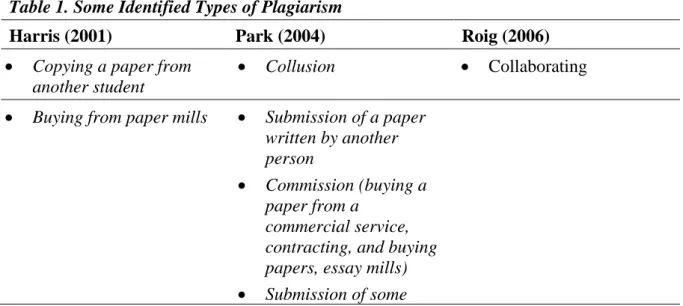
With different perspectives on how institutions and individuals perceive Plagiarism, it is unsurprising that people have different ideas about what constitutes Plagiarism. Several researchers have identified various types of Plagiarism, and a few examples are given in Table 1 (Harris, 2001, Park, 2004, Roig, 2006). According to their perspectives on the different types of Plagiarism (Table 1), all of these authors consider it to be acts consistent with the definition of Plagiarism used in this study. However, the scope varies in areas such as ideas and collusion. In Table 1, Harris (2001) emphasized inappropriate text use in writing, which he defined as copying, translating, cutting and pasting, false citation, paraphrasing, and summarizing without attribution, as well as source use: online and paper mills. Park (2004), on the other hand, classified plagiarism types based on source use, such as 'online' and 'paper mills,' in addition to his view of plagiarism types as inappropriate text-use in writing (copying or paraphrasing inappropriately), while Roig (2006) went beyond both text and source-use to introduce 'ideas.' False citations, while academic misconduct, are not always considered Plagiarism. According to Harris (2001), there is, however, an underlying similarity. The authors' perspectives on Plagiarism differ in terms of 'appropriation,' 'acknowledgement,' or 'concealment' of sources. 'Appropriation' and 'acknowledgement' refer primarily to incidents involving how sources are used or collaborated with others. Meanwhile, 'source concealment' is usually intentional and can occur when commissioning others to do one's work or purchasing ready-made work.
Table 1. Some Identified Types of Plagiarism
Harris (2001) Park (2004) Roig (2006)
• Copying a paper from another student
• Collusion • Collaborating
• Buying from paper mills • Submission of a paper written by another person
• Commission (buying a paper from a
commercial service, contracting, and buying papers, essay mills)
• Submission of some
--- Volume 12 No 1, Februari 2023,
http://creativecommons.org/licenses/by/4.0
Harris (2001) Park (2004) Roig (2006)
other student’s work
• Duplication of work for more than one
submission
• Self-plagiarism
• Use of free online resources without attribution
• Copying from internet
• Translating into English without acknowledgment
• Cutting and pasting from different sources
• Quoting without acknowledgment
• Copying whole phrases and changing some words
• Paraphrasing without attribution
• Summarizing without attribution
• Use of false citations
• Copying or
paraphrasing a paper without appropriate acknowledgment
• Use of ideas without appropriate
acknowledgment
• Copying text
• Summarizing without attribution
• Paraphrasing without appropriate
acknowledgment
There are many types of Plagiarism introduced by experts, as we can see in the previous paragraphs, but researchers only focus on two types: verbatim and patchwriting.
Verbatim incorporates direct copies of sentences but leaves out citations (Walker, 2010). The condition in which someone submits someone else's words verbatim in his or her name without even mentioning him or her publicly is known as verbatim. Copying and pasting text from a published article without referencing it is a common form of verbatim Plagiarism. It is most commonly found in a manuscript's introduction and discussion sections.
Furthermore, patchwriting refers to closely paraphrased work or minor changes to the source material; citation is either presented or not (Zafarghandi et al., 2012). Patchwriting makes novice writers incapable of writing autonomously in a new discourse(R. M. Howard, 1999). Patchwriting is distinct from prototypical Plagiarism in two ways: it lacks the element of deliberate deception and is not the final stage. Because there was no evidence of intentional
--- Volume 12 No 1, Februari 2023,
http://creativecommons.org/licenses/by/4.0
deception in these writing samples, today's patch-writer can become tomorrow's competent academic writer. Furthermore, Pecorari (2003) argued that patchwriting is a type of textual Plagiarism caused by chance rather than intent to deceive for future writing development.
Nevertheless, the researchers also want to explain Plagiarism based on its linguistic patterns introduced by (Alzahrani et al., 2012) through the taxonomy of Plagiarism. They divided Plagiarism into two types, namely literal Plagiarism and intelligent Plagiarism. In its most straightforward form, Literal Plagiarism is a pervasive practice, and those who engage in it do not put much effort into covering up the academic dishonesty they have committed. For instance, all they do is cut and paste text from various websites on the internet. Meanwhile, intelligent Plagiarism is a severe form of academic dishonesty in which the perpetrator tries to deceive readers by changing the contributions of others to appear as if they were their own.
Intelligent plagiarists attempt to conceal, obscure, and alter the original work through text manipulation, translation, and idea adoption. The taxonomy of Plagiarism can be seen in the Figure.Onebelow.
Figure 1. Taxonomy of plagiarism adopted from Alzahrani et al. (2012)
--- Volume 12 No 1, Februari 2023,
http://creativecommons.org/licenses/by/4.0
Several instances of Plagiarism occur among students, particularly when completing academic assignments. The researchers discovered that almost all of the students lacked a basic understanding of Plagiarism and were unaware that they had plagiarized while working on an academic assignment. It is due to the students' misunderstanding of plagiarism and how to avoid it. This assumption leads to the conclusion that if students do not understand Plagiarism, it will harm the quality of their thesis, which may be plagiarized. This viewpoint is supported by the researchers' initial observations in the library where undergraduate students' theses were archived. We discovered that almost all theses lacked proper citations and paraphrases, which could imply Plagiarism.
Following that, the researchers intend to look into Plagiarism committed by Almuslim University EFL graduates between 2020 and 2022. The investigation of Plagiarism is considered novel at Almuslim University. In contrast to previous studies, this study used Turnitin to detect Plagiarism, and all detected sentences were coded to reveal the types of Plagiarism. This research aims to identify the different types and causes of student plagiarism, and thus the research questions are formed.
The first research question focuses on the different types and linguistic patterns of Plagiarism found in the theses of EFL graduates. The second research question focuses on the factors that may lead EFL graduates to plagiarize while writing their theses. This study focused on 15 theses from Almuslim University's English Department graduates from 2020 to 2022. This research is critical because Plagiarism is a problem frequently occurring during the preparation of student theses. Anticipating this, researchers investigate the types, linguistics patterns, and causes of Plagiarism that EFL graduates frequently commit to finding solutions to prevent future Plagiarism.
The following research question (RQs) are addressed in this study:
1. What types of plagiarism and linguistics patterns do Almuslim University EFL graduates commit?
2. What motivates EFL graduates to plagiarize in their theses?
--- Volume 12 No 1, Februari 2023,
http://creativecommons.org/licenses/by/4.0
METHOD Design
The study adopted a case study research design using a descriptive qualitative method to investigate and describe the phenomenon through in-depth exploration from various perspectives (Simons, 2009; Newman, 2014). The study aimed to determine the various forms of Plagiarism (such as verbatim and patchwriting) and linguistics patterns (such as literal and intelligent Plagiarism) that graduates of EFL programs committed. In addition, one of the things that are looked into in this current study is why people plagiarize other people's work.
Participant
The participants were Almuslim University EFL graduates who completed their thesis between 2020 and 2022. This study included 15 participants whose data were collected through interviews to answer the second research question. All the participants have filled out the form of consent to participate in this study. The studies were completed by four participants in 2020, five in 2021, and six in 2022. The participants were selected purposively based on the thesis that was used as a sample.
Instrument
In this study, documentation and interviews were used to collect the data. Both techniques were used to investigate Plagiarism in EFL theses graduates of Almuslim University. There were 15 theses of EFL graduates employed as the document to be analyzed.
Besides, the researchers conducted an unstructured interview with five questions to find data regarding what factors lead the EFL graduates of Almuslim University to do Plagiarism. An interview is a form of self-report that is a relatively simple approach to data collection that can produce a wealth of information and cover any number of content areas (Marczyk et al., 2006). Marczyk et al. said that an interview is a relatively inexpensive and efficient way to collect a wide variety of data that does not require formal testing.
Data collecting technique
This plagiarism study was administered to 15 Almuslim University EFL graduates theses from 2020-2022. Turnitin is used to find sentences categorized as Plagiarism in all theses. The data is then coded to aid in investigating the types of Plagiarism committed by
--- Volume 12 No 1, Februari 2023,
http://creativecommons.org/licenses/by/4.0
Almuslim University EFL graduates. Furthermore, all EFL graduates whose theses were chosen were invited to participate in an interview to determine the factors that may have influenced them to plagiarize. The participants were asked five questions during the interview section, and the researchers transcribed the answers.
Data analysis technique
The information gathered was analyzed qualitatively and descriptively. When you code quantitative data, you arrange the variables' measures into a machine-readable format for statistical analysis, organize them into conceptual categories, and develop themes or concepts (Neuman, 2014). Qualitative coding is an essential part of data analysis. Miles et al. (2018) developed an interactive model for analyzing data in this study, which included data condensation, data presentation, drawing conclusions, and verification. Data condensation is selecting, simplifying, focusing, abstracting, and converting rough data into field notes.
Furthermore, the data compiled from the data reduction results are presented in text and described in a narrative research conclusion. Furthermore, research data is described and interpreted in words to describe field facts and meaning or to answer research questions derived from the essence. To summarize, the validity is determined at each stage of the process. Lastly, the organization of cited works employs an “ Offline Automatic” model using Mendeley Desktop as proposed by a previous researcher(Turmudi, 2020,p.59).
RESULT AND DISCUSSION Result of plagiarism
The researchers examined 15 theses to determine the types of Plagiarism perceived by Almuslim University English Education graduates from 2020 to 2022. We took the theses from the English Department in Social Humanities, and Turnitin stages have been completed for all theses. The data has been coded based on the type of Plagiarism being studied, namely patchwriting and verbatim. Furthermore, several examples of plagiarism sentences based on their linguistic patterns are served in the table below.
--- Volume 12 No 1, Februari 2023,
http://creativecommons.org/licenses/by/4.0
Table 2. Plagiarism was revealed in a sample of 15 theses at Almuslim University
Discipline Theses Number
of words
Plagiarism percentage
Number of sentences
Type of Plagiarism Patchwriting Verbatim Social
Humanities
S1-2020 12330 20% 209 179 30
Social Humanities
S2-2021 11460 68% 454 182 272
Social Humanities
S3-2021 8669 64% 325 125 200
Social Humanities
S4-2021 9100 44% 237 146 91
Social Humanities
S5-2021 9189 57% 327 265 62
Social Humanities
S6-2020 11145 67% 356 135 221
Social Humanities
S7-2021 9665 47% 308 206 102
Social Humanities
S8-2020 11654 45% 319 57 262
Social Humanities
S9-2020 10733 57% 440 301 139
Social Humanities
S10-2022 7381 31% 168 166 2
Social Humanities
S11-2022 27336 18% 330 301 29
Social Humanities
S12-2022 11643 26% 259 240 19
Social Humanities
S132022 9632 34% 280 269 11
Social Humanities
S14-2022 13917 43% 415 309 106
Social Humanities
S15-2022 9687 24% 195 180 15
Based on the data presented above, the percentage of English Education graduates who engage in Plagiarism remains high. There were 12 theses with more than 25% plagiarism among the 15 samples. Furthermore, only three thesis samples had a low percentage of Plagiarism. According to the samples, most English Education graduates completed their theses using patchwriting rather than verbatim Plagiarism. Following this, the researchers provided numerous examples of Plagiarism from EFL graduate theses classified as verbatim and patchwriting. In addition, the taxonomy of Plagiarism, as depicted in Figure 1, serves linguistic patterns divided into two typical types: literal and intelligent.
--- Volume 12 No 1, Februari 2023,
http://creativecommons.org/licenses/by/4.0
Figure 2. Example of verbatim and patchwriting in student 1 (S1) writing
Verbatim Patchwriting
Original: Writing is the process of expressing ideas, information, knowledge, or experience and understanding the writing to acquire the knowledge or some information to share and learn.
Original: Writing is the final product of several separate acts that simultaneously are hugely challenging to learn.
Plagiarized: Writing is the process of expressing ideas, information, knowledge, or experience and understanding the writing to acquire the knowledge or some information to share and learn.
Plagiarized: Wallace (2004, p. 15) states that writing is the final product after students learn several stages of writing separately.
Source: White (1986, p.10) Source: (Wallace et al., 2004)
The first thesis sample contained 20% plagiarism from 12330 words. There were 179 patchwriting sentences and 30 verbatim sentences among the 209 plagiarized sentences. The writer committed complete and utter Plagiarism by rewriting the entire document word for word without attributing any of the sources used. The writer, meanwhile, adopted a semantic- based meaning through paraphrasing and committed intelligent Plagiarism in patchwriting type. Even though the author paraphrased some of the sentences, she needed to give proper credit or convey the original meaning.
Figure 3. Example of verbatim and patchwriting in student 3 (S3) writing
Verbatim Patchwriting
Original: Speaking is a way of communication, and it makes people from different countries comfortable interacting and communicating.
Original: Speaking is a productive skill that can be directly and empirically observed. Those observations are invariably colored by the accuracy and effectiveness of a test-takers listening skill, which compromises the reliability and validity of the oral production test.
Plagiarized: Speaking is a way of communication that makes people from different countries comfortable interacting and communicating.
Plagiarized: According to Brown, as quoted by Fitri (2017: 2), speaking is a productive skill that can be observed directly and empirically by the listener. This observation is always complemented by the accuracy and effectiveness of the test taker's listening skills, which sacrifices the reliability and validity of the oral production test.
Source: Rahayu (2015, p. 2) Source: (Brown, 2003, p. 140).
--- Volume 12 No 1, Februari 2023,
http://creativecommons.org/licenses/by/4.0
The third sample contained 64% plagiarism out of 8669 words. It contained 325 plagiarized sentences, 125 patchwriting sentences, and 200 verbatim sentences. The writer committed literal Plagiarism by making an exact copy of the whole document without providing a citation while using the verbatim form of the document. While this was happening, the author used text manipulation combined with morpho-syntactic paraphrasing to commit intelligent Plagiarism in the patchwriting type. The author manipulated the original source by adding several phrases to the sentence and then combining them with another sentence. Although Brown was the author of the primary source, the writer cited the secondary source by Fitri.
Figure 4. Example of verbatim and patchwriting in student 10 (S10) writing
Verbatim Patchwriting
Original: A population is a group of elements or cases, whether individuals, objects, or events, that conform to specific criteria and to which we intend to generalize the result of the research.
Original: One pre-test and post-test design was a single group that measured or observed not only after exposure to treatment but also before.
Plagiarized: A population is a group of elements or cases, whether individuals, objects, or events, that conform to specific criteria and to which we intend to generalize the result of the research.
Plagiarized: Pre-experimentalsynonym is a research design in which a group synonym of samples is measured or observed before and after exposure to the treatment.
Source: (McMillan & Schumacher, 2001, p. 169). Source: (Frankel & Wallen, 2009, p. 265)
The tenth sample contained 31% plagiarism (7381 words). There were 168 plagiarized sentences, 166 in patchwriting, and two in verbatim form. The writer engaged in literal Plagiarism by employing verbatim copy throughout the entire document, which constitutes an example of the verbatim type. In addition, the author used a form of Plagiarism known as
"intelligent plagiarism," which involves manipulating the text so that underlined words are replaced with synonyms and short phrases are inserted to change the appearance of the text without altering the meaning of it. The text was manipulated using lexical and syntactical paraphrasing, which resulted in the majority of its appearance being altered.
--- Volume 12 No 1, Februari 2023,
http://creativecommons.org/licenses/by/4.0
Figure 5. Example of verbatim and patchwriting in student 11 (S11) writing
Verbatim Patchwriting
Original: Program MBKM merupakan salah satu kebijakan yang bertujuan untuk mendorong pelajar Indonesia menguasai berbagai kelompok ilmu disertai dengan keterampilan yang dibutuhkan saat memasuki dunia kerja.
Original: In order to adopt the policy, a study program must compile or adapt the curriculum to the implementation model of
Independent Campus policy.
Plagiarized: MBKM program is one policy that aims to encourage Indonesian students to master various knowledge groups and the skills needed when entering the world of work.
Plagiarized: In implementing the policy of Kampus Merdeka, the universities, especially study programs, must develop and adapt the curriculum to the implementation model of Kampus Merdeka policy.
Source: (Directorate General of Higher Education, 2020).
Source: (Krishnapatria, 2021)
The eleventh sample contained 18% plagiarism from 27336 words. There were 330 plagiarized sentences, 301 in patchwriting form, and 29 in verbatim form. The writer committed the form of Plagiarism known as "intelligent plagiarism" by using an exact translation from Indonesian into English without providing a citation for it in the verbatim form. In addition, the writer used text manipulation in the patchwriting type by employing lexical and morpho-syntactic paraphrasing to manipulate the original source. The addition of several short phrases accomplished it.
Figure 6. Example of verbatim and patchwriting in student 13 (S13) writing
Verbatim Patchwriting
Original: Reading is the transfer of meaning from mind to mind.
Original: Reading is accessing and acquiring additional language and domain knowledge.
Plagiarized: Reading is the transfer of meaning from mind to mind.
Plagiarized: Reading is not only about comprehension but also involves accessing and acquiring additional language and domain knowledge.
Source: Smith (l 994) Source: Hirsch (2003, p. 21)
From 9632 words, the thirteenth sample contained 34% plagiarism. There were 280 plagiarized sentences, with 269 being patchwriting and 11 being verbatim. The writer committed literal Plagiarism by typing the entire document verbatim, thus using an exact copy of the original. In the meantime, the writer plagiarized text in patchwriting type by
--- Volume 12 No 1, Februari 2023,
http://creativecommons.org/licenses/by/4.0
manipulating text through lexical and morpho-syntactic paraphrasing, which constitutes intelligent Plagiarism.
Based on the samples above, patchwriting was most widely used by EFL graduates when completing the theses. The graduates committed both literal and intelligent Plagiarism.
In verbatim types, they tend to use exact copies of the whole document without putting the citation. Meanwhile, text manipulation was commonly used through lexical and morpho- syntactical paraphrasing in patchwriting type. Even though some words are replaced with synonyms and short phrases are inserted to change the appearance, those sentences are considered plagiarism without proper citation. Citing the original author and providing citations for any ideas that have been borrowed is required when paraphrasing in order to preserve the original semantic meaning.
Interview result
The second research question in this study was answered using an interview. It is used to determine what factors may influence English Education graduates to commit Plagiarism in their theses. The researchers asked the respondents five questions adapted from Orim (2014), who conducted a similar study. The researchers interviewed 15 respondents (R) with the following questions (Q) and excerpts from them to determine the perception of the English graduates regarding thesis plagiarism.
Table 3. Respondents’ Perception of Plagiarism
Question Answer
(Q1) What is your perception of Plagiarism? (R1) “In my opinion, plagiarism is an academic violation that should not be committed by anyone considering that every idea or work of others is an intellectual property that must be appreciated.”
(R11) “Plagiarism is a situation when people plagiarize other people's work which is then claimed as their own. The action is tremendously irritating. As intellectuals and educated people, avoiding
--- Volume 12 No 1, Februari 2023,
http://creativecommons.org/licenses/by/4.0
Plagiarism must be at the top of mind.”
The first question was used to discover views on graduates’ Plagiarism regarding perception. The researchers want to know their knowledge about Plagiarism. Based on their response to the first question, the researchers concluded that they understand plagiarism well.
Nevertheless, they still commit Plagiarism in their thesis, although they know about the term.
It could happen because the term Plagiarism itself has a broad meaning not only in the academic world but also in other aspects such as music, design, painting, etc. Hence, understanding a particular term as a whole is extremely important.
Table 4. Respondent's awareness of plagiarism
Question Answer
(Q2) What was your experience of Plagiarism at Almuslim University?
(R2) “When I was in college, my knowledge of Plagiarism was minimal. Perhaps, that was why my plagiarism rate is high when I finished my thesis.”
(R3) “It seems that plagiarism on campus is a common thing that is done by most students because of a lack of knowledge about the consequences of plagiarism.”
The second question was related to graduates’ awareness of Plagiarism. The researchers found that the graduates’ knowledge about aspects of Plagiarism in the academic field could be much higher. It can be seen from the level of Plagiarism they committed where the results were still high. Even though they generally understand the term, they still do Plagiarism because almost all of their friends do that. This was used as justification for the lack of awareness of the consequences that could result from such fraud. With all the convenience they get in completing their thesis, they do not want to put in extra effort and even put aside the effects that might be caused.
Table 5. Respondents’ opinions about plagiarism causes
Question Answer
--- Volume 12 No 1, Februari 2023,
http://creativecommons.org/licenses/by/4.0
Question Answer
(Q3) What do you think are the causes? (R12) “Based on my personal experience, I have less knowledge about plagiarism and there is no information from the campus about what is included in plagiarism and what are the consequences if I do it.”
(R10) “I believe that most students are too lazy to read sources related to their research, but they want to be able to finish their thesis quickly by using sources from other people that are not cited.
Furthermore, environmental influences are another factor in which most students plagiarize in order to mimic what their peers do when writing thesis manuscripts.”
The third question focused on the graduates' views that may influence them to commit Plagiarism when completing their theses. Based on the respondents’ answers, the researchers discovered that most of them need more understanding of what aspects are included in Plagiarism, especially in academic writing. They argued that they still needed to get this information at the university. Furthermore, some who understand Plagiarism tend to ignore it and choose to do it for reasons of laziness. Some are also influenced by their friends who did such things. Therefore, this case has yet to be resolved because both sides are equally ignorant.
Table 6. Plagiarism form of respondents’
Question Answer
(Q4) What form does it take? (R5) “The majority of my Plagiarism was verbatim, which is evidenced by the fact that it had a high percentage of
--- Volume 12 No 1, Februari 2023,
http://creativecommons.org/licenses/by/4.0
Question Answer
Plagiarism before I revised it.”
(R15) “Patchwriting was the type of Plagiarism I committed. Even though the plagiarism index is not excessive, it is still considered Plagiarism and should be avoided.”
The fourth question indicated the form of Plagiarism that the respondent committed.
From the excerpts in Table 6, the researchers discovered that the EFL graduates used both types of Plagiarism (verbatim and patchwriting). Respondents who use much verbatim have a high level of Plagiarism, while those who use patchwriting tend to have a lower percentage of Plagiarism. Despite these two conditions, there is no justification for committing fraud. They think they can speed up the completion of their theses with this action, but they have to revise it several times to reduce their level of Plagiarism. If they want to do it right from the start, it will make it easier for them to complete their work perfectly.
Table 7. Respondent's suggestion to reduce plagiarism
Question Answer
(Q5) What can be done to reduce it? (R9) “I believe the university should have a strict policy against thesis plagiarism.
Furthermore, special training in writing a thesis correctly, including citing sources and paraphrasing to avoid Plagiarism, is required. “
(R8) “Socialization about the dangers of Plagiarism, in my opinion, is critical for future generations. If not properly managed, the quality of human resources will suffer due to a lack of motivation to learn.”
--- Volume 12 No 1, Februari 2023,
http://creativecommons.org/licenses/by/4.0
The last question is related to the EFL graduates’ point of view on what can be done to reduce Plagiarism. They came up with several suggestions based on their experience when committing Plagiarism. They said that the university must have strict regulations to deal with Plagiarism because some do it on purpose. Because many do not understand Plagiarism in the academic world, it is necessary to provide training on how to write correct academic writing.
Moreover, Socialization about the dangers of Plagiarism is also vital because there are regulations governing this matter, and perpetrators may be subject to penalties.
From the description above, most English Education graduates preserved Plagiarism due to several factors. Most of the EFL graduates obtained Plagiarism because they lacked information about the term and did not know that plagiarism was considered a violation.
Moreover, some argued that they committed Plagiarism because of the environmental influence. Most of them conducted plagiarism because they followed their peers who committed Plagiarism to finish their theses instantly. On the other hand, some thought theses were just a graduate formality, so they could have tried to finish them better.
Discussion
Plagiarism is a significant issue for EFL graduates of Almuslim University because it is prevalent. There were 12 theses with a plagiarism index greater than 25% out of 15 samples. Three of these samples had a plagiarism index of less than 25%. When completing their thesis, most students used patchwriting rather than verbatim, which is the focus of this study. (Coughlin, 2015) conducted a similar study, and the results revealed that the current examination of 150 Licenciatura and MA theses from five large Mozambican universities revealed that 75% contained significant Plagiarism. As a result, it is possible to conclude that Plagiarism is a global problem that occurs frequently.
Based on the taxonomy of Plagiarism, EFL graduates committed two types of linguistic patterns, both literal and intelligent Plagiarism. Literal Plagiarism with almost every verbatim category contains an exact copy of the entire document. In addition, text manipulation and idea adoption were most frequently encountered in patchwriting for instances of intelligent Plagiarism. Almost all types of patchwriting plagiarism manipulated
--- Volume 12 No 1, Februari 2023,
http://creativecommons.org/licenses/by/4.0
the source using lexical and morpho-syntactic paraphrases. Additionally, idea adoption with semantic-based meaning can be found in these samples, though text manipulation differs from text manipulation. Alzahrani et al. (2012) conducted a similar study to present a new taxonomy of Plagiarism that distinguishes between literal and intelligent Plagiarism.
According to the findings of their study, the taxonomy facilitates an in-depth understanding of various linguistic patterns associated with Plagiarism, such as changing texts into semantically equivalent but differently worded and organized versions, shortening texts with concept generalization and specification, and adopting others' ideas and significant contributions.
According to the findings of the interviews, many students perceived Plagiarism due to a variety of factors. Most students plagiarize unintentionally due to a lack of knowledge about it. It is consistent with Azwati et al. (2022), who discovered that the ability to synthesize became the lowest achievement of students' writing skills. Some stated that they wanted to finish their theses as soon as possible, unaware that Plagiarism is a violation. This finding is consistent with Orim’s (2014) findings, who stated that Plagiarism in students revealed issues related to a lack of awareness, study skills, and mastery of required academic writing skills.
Furthermore, some students responded that they were influenced by their surroundings, where most of their friends plagiarized their theses because they thought it was just a graduation formality. Lack of interest in reading and writing is the cause of Plagiarism;
students tend to take someone else's work instead of paraphrasing. It is supported by Octaberlina (2007), who had similar research findings where the potential cause of Plagiarism in Indonesia is that the students need to be adequately familiar with writing, especially the referencing ethic.
CONCLUSION AND IMPLICATION Conclusion
Based on the study's findings, the percentage of Plagiarism among EFL graduate theses remains high. There were 12 theses with a plagiarism index greater than 25% and only three with a lower index among the 15 samples. Regarding the two types of Plagiarism,
--- Volume 12 No 1, Februari 2023,
http://creativecommons.org/licenses/by/4.0
patchwriting and verbatim, most EFL graduates chose patchwriting over verbatim. Further, the EFL graduates committed both literal and intelligent forms of Plagiarism. The most common strategies employed by these alums of EFL programs were whole-document lexical, morpho-syntactic paraphrasing, and an exact copy.
Furthermore, the interview results revealed several factors influencing EFL graduates to commit Plagiarism. They claimed they plagiarized unintentionally due to a lack of knowledge about properly citing and paraphrasing the source to avoid Plagiarism.
Furthermore, they said they were subjected to negative peer pressure to complete their theses quickly as a graduation requirement.
Limitation
This current study, however, is still subject to several limitations. Firstly, the number of these samples for the current study is only 15. The researchers strongly advise future researchers to broaden the scope of their research so that they have a wide range of topics to discuss. Secondly, the researchers only take EFL thesis graduates as samples. Meanwhile, many other study programs require a thesis to complete the study. Hence, other researchers interested in conducting a similar study take samples from various study programs.
Implication
The findings of this study will assist lecturers and Almuslim University in taking preventive measures in dealing with plagiarism cases among students when completing theses. They can decide on the most appropriate action to take at the university, such as implementing plagiarism policies, holding a workshop on how to write good theses, and paying attention to students' writing from the start. The findings of this study provide additional information that could be helpful to future researchers who want to conduct studies on topics related to Plagiarism.
ACKNOWLEDGEMENT
This research was conducted under the University Grant Scheme provided by Universitas Almuslim. The authors thank the participating EFL graduates who were genuinely cooperative.
BIO-PROFILE:
--- Volume 12 No 1, Februari 2023,
http://creativecommons.org/licenses/by/4.0
Intan Zuhra was born and raised in Kutablang Bireuen, Aceh. She completed her undergraduate program at Almuslim University in 2016 and fulfilled her master's program at Syiah Kuala University in 2019. She is now a lecturer at the English Education Department of Almuslim University. [email protected]
Eli Nofriati was born in Lhokseumawe on November 5, 1981. She is the second daughter in her family. She completed her elementary studies in 1993, her junior studies in 1996, and her senior studies in 1999. Then she pursued her studies at Almuslim University and graduated in 2006. She received her master's degree from Syiah Kuala University in 2016 and has been a lecturer at Almuslim University's English Department for 14 years. [email protected] Silvi Listia Dewi has been a permanent lecturer at Almuslim University since 2005. She got her master's degree at Syiah Kuala University and completed her Doctoral Education at Malang State University in 2017. Silvi Listia Dewi teaches TEFL, Critical Reading, Drama, and Language Learning courses Assessment at English Education Study Program. She actively makes English teaching videos for the Primary School Teacher Education study program at Almuslim University. [email protected]
--- Volume 12 No 1, Februari 2023,
http://creativecommons.org/licenses/by/4.0
REFERENCES
Alzahrani, S. M., Salim, N., & Abraham, A. (2012). Understanding linguistic plagiarism patterns, textual features, and detection methods. IEEE Transactions on Systems, Man, and Cybernetics, Part C (Applications and Reviews), 42(2), 133–149.
https://doi.org/10.1109/TSMCC.2011.2134847
Aydin, G. (2015). Türk dili ve edebiyat{\i} hizmet öncesi ö{\u{g}}retmen e{\u{g}}itiminde yans{\i}t{\i}c{\i} ö{\u{g}}retim uygulamalar{\i}n{\i}n akademik yazma becerilerine etkisi.
Azwati, A., Setiawan, S., & Purwati, O. (2022). EFL postgraduate students ’ critical thinking beliefs and their ability in writing research methodology. CELTIC: A Journal of Culture, English Language Teaching, Literature and Linguistics, 9(1), 39–52.
Bahar, M. A. (2014). Lisansüstü e{\u{g}}itimde akademik yazma ve önemi. International Journal of Language Academy, 2(4), 209–233.
http://www.tuik.gov.tr/PreHaberBultenleri.do?id=13425
Chemir, S., & Kitila, T. (2022). English for academic purposes learners ’ needs analysis : Language difficulties encountered by university students in Ethiopia. Celtic: A Journal of Culture, English Language Teaching, Literature and Linguistics, 9(1), 97–119.
Coughlin, P. E. (2015). Plagiarism in five universities in Mozambique: Magnitude, detection techniques, and control measures. International Journal for Educational Integrity, 11(1), 2. https://doi.org/10.1007/s40979-015-0003-5
Deniz, K. I., & Karagöl, E. (2017). Akademik yazma açisindan makale hakem değerlendirme formlari. Electronic Turkish Studies, 12(34).
Djamba, Y. K., & Neuman, W. L. (2002). Social research methods: qualitative and quantitative approaches. Teaching Sociology, 30(3), 380.
https://doi.org/10.2307/3211488
Dolzhenko, A. V, Khan, T. M., & Dolzhenko, A. V. (2016). Strategies and technologies for preventing plagiarism in modern higher education. In Handbook of Research on Applied Learning Theory and Design in Modern Education (pp. 840–865). IGI Global.
https://doi.org/10.4018/978-1-4666-9634-1.ch041
Fishman, T. (2009). We know it when we see it is not good enough: toward a standard
definition of plagiarism that transcends theft, fraud, and copyright. In Proceedings of the Fourth Asia Pacific Conference on Educational Integrity (4APCEI). University of
Wollongong, NSW, Australia. 2009, September, 1–5.
http://www.opsi.gov.uk/RevisedStatutes/Acts/ukpga/1968/cukpga_19680060_en_1#pb1- l1g1%0Ahttp://ro.uow.edu.au/cgi/viewcontent.cgi?article= %0A1037&context=apcei Gourlay, L. (2008). The handbook of academic writing: a fresh approach. London Review of
Education, 6(3). https://doi.org/10.18546/LRE.06.3.11
Harris, R. A. (2002). The plagiarism handbook: Strategies for preventing, detecting, and