Available online at https://e-journal.unair.ac.id/JEBIS doi:10.20473/jebis.v9i2.34072
INVESTMENT DECISION OF DKI JAKARTA MILLENNIALS IN ISLAMIC PEER-TO- PEER FINANCING DURING THE COVID-19 PANDEMIC
Destiana Rahmawati Dewia Laily Dwi Arsyiantib
ab Department of Islamic Economics, Faculty of Economics and Management, IPB University
Email : [email protected] a; [email protected] b
ARTICLE HISTORY Received:
23 March 2022 Revised
06 September 2023 Accepted:
13 November 2023 Online available:
01 December 2023 Keywords:
Investment Decisions, Millennials,
Islamic P2P Financing, Binary Logistics Regression, COVID-19.
*Correspondence:
Name: Laily Dwi Arsyianti E-mail:
ABSTRACT
DKI Jakarta is the region with the highest proportion of internet users from the total population of each province on the island of Java, including in terms of the use of Financial Technology (FinTech).
Islamic Peer-To-Peer Financing (IP2PF) is one type of FinTech that is an investment choice for millennials, but Islamic FinTech users from the investor side are still very few, especially during the COVID-19 pandemic. This research aims to find out the factors that influence the investment decisions of DKI Jakarta millennials in IP2PF during the COVID-19 pandemic through a sample of 100 DKI Jakarta millennial investors. The methods used are descriptive analysis and binary logistic regression with IBM SPSS Statistics 22 software tools.
The results showed that during the COVID-19 pandemic, Islamic financial literacy, IP2PF knowledge, trust, social environment, gender, and income had a significant positive effect on investment decisions in IP2PF. Therefore, the IP2PF should closely build engagement to their customers, enlarge literacy coverage in supported by government to build the ecosystem.
INTRODUCTION
Rapid technological advancements and increasingly strong communication infrastructure support have brought about technological innovations in the financial industry, known as Financial Technology (FinTech). Based on the type of innovation, the Financial Stability Board FSB, (2017) divides FinTech into four categories, first crowdfunding and peer-to-peer lending (P2PL), the second payment, clearing, and settlement, third market aggregator, and fourth risk management and investment. Amongst the four types of FinTech, it can be seen in Figure 1 that P2PL FinTech companies in Indonesia dominate the most in 2019-2020.
271
Figure 1. FinTech Growth in Indonesia 2019-2020 Source: FinTechnews.sg, 2020; Wijaya, 2019
The existence of P2PL FinTech, which is now growing, has given birth to sharia-based FinTech or what is called Islamic Peer-to-Peer Financing (IP2PF). There are currently only 10 IP2PF companies out of 149 P2PL FinTech companies OJK, (2021). As an intermediary between financiers and borrowers at IP2PF, IP2PF FinTech companies need to gather credible financiers. The financiers who can be considered credible in supporting the development of IP2PF come from the millennial generation age group. The millennial generation is a potential target for the financial industry sector because with their gadgets they will easily know about financial products (Yusuf, 2019). This is supported by data from the Indonesia Millennial Report IDN MEDIA, (2020) that the millennial generation is digitally literate because 94% of them access the internet in 2020. Widespread use of the internet is an opportunity for IP2PF companies to continue to grow while paying attention to investor decision factors, especially for the millennial generation in DKI Jakarta who are already proficient in using the internet. Even though 85% of the population has access to the internet, there are still very few who use IP2PF as a means of investing. Even during the COVID-19 pandemic, the number of P2P investors experienced a large decline in growth compared to 2019 (OJK, 2021). Current popular investments such as IP2PF FinTech require extensive external information. Furthermore, the decision to invest depends on internal preference or previous investment experience. In this study, the scope of the investment decisions studied is limited to deciding whether to invest or not to invest in IP2PF.
The decision factor of the millennial generation to invest in IP2PF is one of the important factors in the development of IP2PF because IP2PF as a new investment option certainly has several advantages and disadvantages. The advantages and disadvantages of the IP2PF FinTech will be considered by millennials who are determining their investment plans. This research is expected to provide conclusions and suggestions to increase millennial interest in IP2PF. Moreover, the increasing penetration of the coronavirus affects the level of investment decisions of some investors Burhanuddin & Abdi, (2020) and leaves many companies in uncertainty, including P2P FinTech companies (Junaedi, 2020). If IP2PF FinTech cannot innovate, it will be left behind by conventional P2PL which develops faster.
Based on the description above, the objectives of this study are to 1) Identify the characteristics of the millennial generation in DKI Jakarta who invest in IP2PF during the
Published by University of Airlangga.
This is an open access article under the CC BY license (https://creativecommons.org/licenses/by-nc-sa/4.0/)
COVID-19 pandemic, 2) Analyze the factors that influence the decision of the millennial generation to invest in IP2PF during the COVID-19 pandemic. IP2PF FinTech was chosen because it is still relatively new and the factors that influence the decision of the DKI Jakarta millennial generation to become IP2PF financiers during the COVID-19 pandemic have never been studied before.
LITERATURE REVIEW
Islamic Peer-to-Peer Financing (IP2PF)
Islamic Peer-to-Peer Financing (IP2PF) brings together funders with those who need funds with financing contracts through platforms that use the internet (Baihaqi, 2018).
IP2PF and P2PL are the same, namely lending and borrowing funds between people, but in this case, IP2PF applies an investment system through financing principles that are following Islamic sharia (Zustika, 2019). IP2PF applies the maqasid sharia foundation to fulfill the benefit of the people and avoid damage in this world and the hereafter. Islam provides good corporate governance by focusing on society, the environment without neglecting its business objectives. Therefore, there are two separate contracts in the IP2PF mechanism: 1) Between the IP2PF company and the financier, a wakalah bi al-ujrah contract is used. 2) Between the IP2PF company and the borrower, wakalah bi al-ujrah, murabahah, mudarabah, musharrakah, ijarah or qard contracts can be used depending on the model used.
According to the DSN-MUI Fatwa Number 117/DSN-MUI/II/2018 concerning Information Technology-Based Financing Services Based on Sharia Principles, IP2PF can be carried out with the following models: 1) Invoice financing, namely financing in the form of receivable-based collection management services invoice, whether accompanied or not accompanied by a bailout (qard) given to the business actor who issues the invoice to a third party (payor). 2) Financing for the purchase of goods ordered by a third party (purchase order financing), namely providing financing for business actors who obtain orders or work orders from third parties to purchase goods. 3) Financing for the procurement of goods for online selling business actors (online seller financing), namely financing provided to business actors who transact online buying and selling on e- commerce/marketplace platforms that have cooperated with the IP2PF platform. 4) Financing for the procurement of goods for online sales business actors with payments through payment gateways, namely providing financing to online sellers through self- managed distribution channels, and for payment using online payment authorization service providers (payment gateways) who have cooperated with the IP2PF platform. 5) Funding for employees (employee financing), namely financing provided to employees who need consumptive financing through a joint salary reduction plan through the employer's institution. 6) Community-based financing, namely providing financing to community members who need financing and coordinating payment plans through the coordinator/community manager.
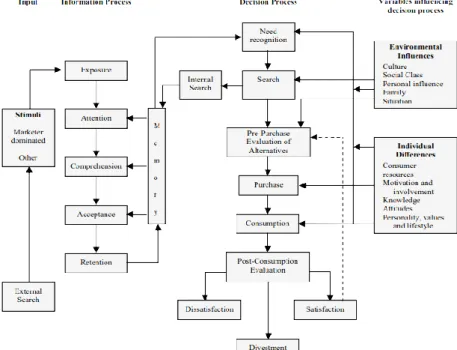
273 Consumer Decision Model
Consumer Decision Theory is a model that was coined by Engel, Kollat, and Blackwell in 1968 and continuously revised until the end of the model as shown in Figure 2. This model is composed of seven points of the decision process, namely: 1) Recognition of needs, needs arise out of differences between the situation with the desired state. If the nonconformity exceeds a certain level or limit, the need will be identified. 2) Information search, after the need is recognized, the possible solution is to search internally in memory or external search. Information search is determined by situation, product, retailer, and consumer characteristics (knowledge, involvement, beliefs and attitudes, and demographic characteristics). 3) Evaluation of alternatives, after collecting information about alternative answers to the identified needs, then narrowing the choice to the desired alternative. 4) Purchase, namely deciding whether consumers will buy or not based on the choices that have been made. In this case, purchases include what, when, where, and how consumers buy and pay. 5) Consumption, at this stage the consumer uses an alternative purchase followed by the act of using the product. 6) Post-purchase evaluation, after consuming, consumers assess whether the chosen alternative meets their needs and expectations which leads to a satisfied or dissatisfied response. 7) Divestment is the final stage of the consumption process, and the purchased product is likely to be disposed of at some point after it is consumed.
Figure 2. Consumer Decision Model Source: Blackwell et al. (2001)
To examine the investment decisions of the millennial generation, the researchers chose the Consumer Decision Model by Engel, Kollat, and Blackwel as the basis of this research. The model offers 3 main factors that influence the consumer decision process, namely the stimulus due to marketing efforts, environmental influence factors, and individual differences. Consumer decision theory is important in this study because it is
Published by University of Airlangga.
This is an open access article under the CC BY license (https://creativecommons.org/licenses/by-nc-sa/4.0/)
used to explain consumption decisions, which in this case is the consumption of services, namely investments based on sharia contracts, both investments that have been in demand for a long time and those that are newly popular.
The Concept of Millennial Generation Investment Decisions in Islamic Peer-to-Peer Financing (IP2PF)
Investment decisions are decisions to allocate assets/capital owned with investment options (L. R. P. Wijaya & Wibawa, 2010). According to Wulandari and Iramani (2014), investment decisions are a matter of how one should distribute funds or invest their capital in forms of investment that can bring profits in the future. In the Islamic concept, investment does not only place funds/capital in an investment instrument for-profit purposes but also pays attention to the concept of maslahah by sharia principles (Masruroh, 2014). The sharia investment product that is based on financial technology and is starting to be in demand by millennials is Islamic Peer-to-Peer Financing (IP2PF). In this study, investment decisions are the degree to which millennials have the opportunity to choose IP2PF as their investment option during the COVID-19 pandemic. Hence, the relevant variables from previous research and the Consumer Decision Model by Engel, Kollat, and Blackwell were chosen to predict the factors that will influence the millennial generation's investment decisions in IP2PF during the COVID-19 pandemic, among others:
1) Islamic Financial Literacy
Based on the Consumer Decision Model, one of the main factors that influence the consumer decision process is the factor of individual differences, namely knowledge, attitudes, and personality. This knowledge, attitude, and personality form a concept called financial literacy. If adapted from the definition of financial literacy by the OJK, Islamic financial literacy is a person's ability to manage financial resources by utilizing financial knowledge, financial skills, and assessing relevant information to achieve prosperity by Islamic law (avoiding elements of maysir, gharar, usury). A high level of Islamic financial literacy can lead to the growth of development financing because it is based on public awareness to save and invest in Islamic financial institutions (OJK, 2017). Therefore, financial literacy, especially Islamic financial literacy, plays an important role in supporting the creation of investment culture. Ramadhani and Cahyono (2020) research proves that the investment plans made by the community to manage their finances by Islamic provisions are significantly influenced by the Islamic financial literacy variable they have.
Then, the hypothesis of this variable is: H1=Islamic Financial Literacy has a positive and significant impact on investment decisions of DKI Jakarta Millennials in IP2PF during the COVID-19 pandemic.
2) Knowledge of IP2PF
Based on the Consumer Decision Model, one of the main factors that influence the consumer decision process is the individual difference factor, namely knowledge.
275
Consumer knowledge will influence purchasing decisions, because consumers who have more knowledge will be more efficient and precise in managing information, so they can make better decisions. As research by Handida and Sholeh (2019), both partially and simultaneously the level of knowledge has a positive and significant effect on the decision of the Muslim community to use Islamic banking products in the Special Region of Yogyakarta (DIY). Therefore, the researcher formulates that IP2PF knowledge is all information owned by a person about products, contracts, mechanisms, and other knowledge related to IP2PF. The better one's knowledge of IP2PF, the higher the probability of deciding to invest in IP2PF. Then, the hypothesis of this variable is: H2=Knowledge of IP2PF has a positive and significant impact on investment decisions of DKI Jakarta Millennials in IP2PF during the COVID-19 pandemic.
3) Risk Perception
Based on the Consumer Decision Model, one of the main factors influencing the consumer decision process is the psychological factor, namely the stimulus obtained from marketing efforts. Because this research is about investment decisions, every potential investment profit cannot be separated from risk, so the stimulus generated by potential investors is in the form of risk perception. Risk perception is an investor's view of the possible losses that will be received due to uncertainty in decision-making. The high perception of a person's risk indicates that he tends to have a high level of prudence in considering and analyzing the risks that arise. This high level of prudence is based on his expertise, namely that investors already know the acceptable level of risk and will make better investment decisions. According to research conducted by Latha (2016) on investor behavior towards investment interests, risk perception has a significant influence on investment interests. Sarawatari (2020) research also shows that the risk perception variable has a significant effect on investment decisions in IP2PF. Then, the hypothesis for this variable is: H3=Risk perception has a positive and significant impact on investment decisions of DKI Jakarta Millennials in IP2PF during the COVID-19 pandemic.
4) Trust
Based on the Consumer Decision Model, the psychological factor that also influences the consumer's decision process is trust. Because this research is about investment decisions in IP2PF, potential investors must also have confidence in the platform. Ichwan and Kasri (2019) prove that the potential of young people to invest in P2PL is positively influenced by their belief in P2PL. Correspondingly, the results of research by Abidat et al. (2019) shows that the investment intentions of IP2PF investors depend on trust in IP2PF. The higher a person's trust in IP2PF, the more likely it is that someone will use FinTech or invest through IP2PF. Then, the hypothesis of this variable is: H4=Trust has a positive and significant impact on investment decisions of DKI Jakarta Millennials in IP2PF during the COVID-19 pandemic.
Published by University of Airlangga.
This is an open access article under the CC BY license (https://creativecommons.org/licenses/by-nc-sa/4.0/)
5) Social Environment
Based on the Consumer Decision Model, one of the main factors that influence the decision process is external environmental factors such as culture, social class, personal influence, and family. Culture, social class, individual influence, and the family form a concept called the social environment. Social environment can influence a person or a group to take action and change individual behavior (Sobaya et al., 2016). By understanding the condition of the surrounding environmental factors, investors can increase their investment vigilance and make appropriate investments in accordance with prevailing environmental conditions. Then, the hypothesis of this variable is: H5=Social Environment has a positive and significant impact on investment decisions of DKI Jakarta Millennials in IP2PF during the COVID-19 pandemic.
6) Gender
Based on the Consumer Decision Model, one of the main factors that influence the consumer decision process is the individual's lifestyle. In this study, lifestyle is represented by gender differences. Physically, men and women are different, but the habits, behavior, and daily activities of each individual can be the same or even different. Men are more confident than women, so it can be explained that men are more willing to take investment risks than women (Barber & Odean, 2001). Statistical data for P2PL FinTech (OJK, 2021) shows that until December 2020, P2PL customers are dominated by the male gender. The largest proportion is occupied by male lenders/financiers 62.60%, while male borrowers are 52.70%. This means that men are more courageous, and women are more careful in making decisions, especially when discovering new things such as FinTech. Then, the hypothesis of this variable is: H6=Gender has a positive and significant impact on investment decisions of DKI Jakarta Millennials in IP2PF during the COVID-19 pandemic.
7) Income
Based on the Consumer Decision Model, individual factors that also influence the consumer decision process are consumer resources such as economic resources/income.
People with higher incomes tend to have the ability to plan and control their finances well.
This is because people with high incomes will try to use their money by gaining information and understanding (Arianti, 2020). That is, the higher the income, the higher a person's responsibility for financial behavior, which in this case is an investment decision. Then the hypothesis of this variable is: H7=Income has a positive and significant impact on investment decisions of DKI Jakarta Millennials in IP2PF during the COVID-19 pandemic.
This study uses the same research object as that conducted by Abidat et al. (2019) and Darmansyah et al. (2020), namely IP2PF. IP2PF was chosen because the majority of the Indonesian population is Muslim, so this should be a big opportunity in the development of IP2PF FinTech considering that the number is still very small compared to conventional P2PL. The sample in this study is in line with Lestari (2019) research, namely the millennial
277
generation, but is more focused on the millennial generation in DKI Jakarta. Respondents are devoted to the millennial generation because they are one of the largest groups interested in P2P (OJK, 2021), so the millennial generation is one of the most important parties in the development of IP2PF. The election of DKI Jakarta is due to the accumulation of the most P2P financier accounts in Indonesia, which are in DKI Jakarta, so it is necessary to examine what makes people, in this case, the millennial generation of DKI Jakarta who chooses or not choose IP2PF as one of their investment instruments during the current COVID-19 pandemic. In addition, the province of DKI Jakarta is the province with the highest percentage of internet users from the total population per province in Java, which is 85%
(APJII, 2020). The widespread use of the internet and smartphones in Indonesia is the background for the high number of FinTech transactions (Fidhayanti, 2020). The timing of the research was during the COVID-19 pandemic because during the COVID-19 pandemic there was a decline in growth in the number of financiers, so researchers were interested in studying this because it had never been studied before.
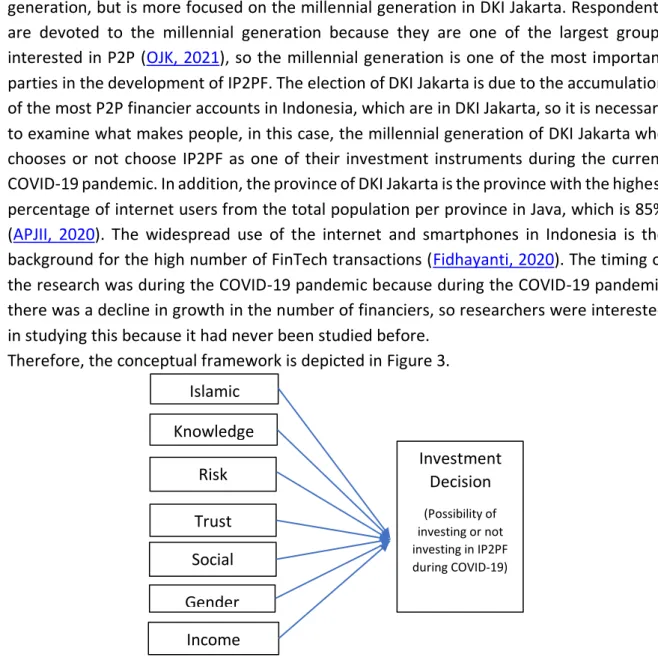
Therefore, the conceptual framework is depicted in Figure 3.
Figure 3. Conceptual Framework
RESEARCH METHODS
This research applies a quantitative approach. Quantitative research methods are used to examine certain populations or samples, data collection using research instruments, data analysis is quantitative/statistical, to test established hypotheses (Sugiyono, 2013). The population of this study is the millennial generation who live/have a DKI Jakarta ID card. Meanwhile, the number of samples in this study was determined using the Slovin method at a real level of 10% and obtained 100 respondents, of which 50 people who have/are investing in IP2PF during the COVID-19 pandemic and 50 people who have never invested in IP2PF but actively invests in other investment instruments during the COVID-19 pandemic. The data used in this study include the types of primary and secondary data. Primary data was obtained through an online questionnaire that had been tested for validity and reliability by filling out a questionnaire using a Likert scale because this study wanted to measure a person's attitudes, opinions, and perceptions (Sugiyono,
Investment Decision
(Possibility of investing or not investing in IP2PF during COVID-19)
Islamic financial Knowledge
Risk Perception
Trust Social environment
Gender Income
Published by University of Airlangga.
This is an open access article under the CC BY license (https://creativecommons.org/licenses/by-nc-sa/4.0/)
2013). This study uses 4 Likert scales, strongly agree = 4, agree = 3, disagree = 2, and strongly disagree = 1. Secondary data in this study were obtained from agencies related to research as well as literature studies from many kinds of literature that are relevant to the topic of this research.
The factors that influence the investment decisions of the DKI Jakarta millennial generation in IP2PF during the COVID-19 pandemic, which researchers have summarized from previous research and are also related to the Consumer Decision Model by Engel- Blackwell-Miniard are Islamic Financial Literacy, IP2PF Knowledge, Risk Perception, Trust, Social Environment, Gender, and Income. To analyze these variables, the researcher used binary logistic regression analysis. Binary logistic regression is a data analysis model that can explain the relationship between one or more independent variables (independent variable) and the dependent variable (dependent variable) which is binary/dichotomous.
Binary variables only have 2 possible values, namely 0 and 1, y=0 indicates the dependent variable has no criteria, while y=1 indicates the dependent variable has specified criteria.
The models used are:
Yi = Ln (Pi / 1─Pi) = α + β1X1 + β2X2 + β3X3 + β4X4 + β5X5 + β6X6 + β7X7 ... (1)
where: Yi=The decision of DKI Jakarta millennial generation to invest in IP2PF during the COVID-19 pandemic, Pi=Invest in IP2PF, 1─Pi=Not to invest in IP2PF, α=Intercept, βi=Parameter of variables, X1=Islamic financial literacy, X2=Knowledge of IP2PF, X3=Risk perception, X4=Trust, X5=Social environment, X6=Gender, and X7=Income.
The model is used to test whether the millennials chose to invest or not to invest in IP2PF based on factors proposed in the Consumer Decision Model by Engel, Kollat, and Blackwell and other previous relevant studies. The possibility of not investing arises when the decision is made during COVID-19. Therefore, binary logistic regression fits to answer the research question.
RESULT AND ANALYSIS Demographic Characteristics
The total number of respondents in this study is 100 people. The general description of the demographic characteristics of the respondents in detail can be seen in Table 1. The majority of respondents are domiciled in the city of South Jakarta and are male. Overall, millennial juniors (ages 24–31) predominate this study. Most of the respondents have a bachelor's degree in education with a job as a private employee. In this study, the majority of respondents have income > 5.000.000,00 IDR per month. Both before the pandemic and during the pandemic, respondents used the internet > 5 hours per day. The majority of respondents' investment experience in this study was 1 year with the initial goal of investing for the short & long term.
Table 1
Demographic Characteristics Characteristic
s Classification Invest in
IP2PF
No Investment
in IP2PF Total
Domicile West Jakarta 4 8 12
279
Characteristic
s Classification Invest in
IP2PF
No Investment
in IP2PF Total
North Jakarta 3 3 6
East Jakarta 12 10 22
South Jakarta 22 22 44
Central Jakarta 8 6 14
Thousand Islands 1 1 2
Gender Man 30 27 57
Woman 20 23 43
Age 24–31 39 43 82
32–40 11 7 18
Education Junior High School/equivalent 0 1 1
High School/equivalent 5 5 10
Diploma 3 5 8
Strata 1 (Bachelor) 36 33 69
Strata 2 (Master) 4 6 10
Strata 3 (Doctorate) 2 0 2
Profession Government Employees 7 4 11
Private Sector Employee 33 34 67
Entrepreneur 9 9 18
Other: Government Employees
Non-Civil Servants (PPNPN) 1 3 4
Monthly Income
Before the pandemic
≤ 1.500.000,00 IDR 3 4 7
> 1.500.000,00 – 2.500.000,00 IDR 12 18 30
> 2.500.000,00 – 3.500.000,00 IDR 4 0 4
> 3.500.000,00 – 5.000.000,00 IDR 9 7 16
> 5.000.000,00 IDR 22 21 43
During a pandemic
≤ 1.500.000,00 IDR 9 9 18
> 1.500.000,00 – 2.500.000,00 IDR 7 14 21
> 2.500.000,00 – 3.500.000,00 IDR 3 0 3
> 3.500.000,00 – 5.000.000,00 IDR 12 9 21
> 5.000.000,00 IDR 19 18 37
Internet Usage Intensity (Per
Day)
Before the pandemic
≤ 2,5 hours 4 10 14
> 2,5 hours – 5 hours 16 20 36
> 5 hours 30 20 50
During a pandemic
≤ 2,5 hours 3 3 6
> 2,5 hours – 5 hours 7 10 17
> 5 hours 40 37 77
Long Invest ≤ 1 year 24 21 45
> 1 – 3 years 21 15 36
> 3 years 5 14 19
The Initial Purpose of Investing is to
Short Term Investment 7 3 10
Long Term Investment 13 14 27
Short- & Long-Term Investment 30 33 63
Source: Data Processed (2021)
Based on the experience of 50 financiers investing in IP2PF, the majority of them have invested in IP2PF for 1 year, which is 30 people or 60%. There are 17 people or 34%
of financiers with experience investing in IP2PF for >1–2 years, or 34%, and only 3 people or 6% who have invested for >2 years. Prior to the COVID-19 pandemic, the majority of financiers had invested in IP2PF 1 time, totaling 31 people or 62%. During the COVID-19
Published by University of Airlangga.
This is an open access article under the CC BY license (https://creativecommons.org/licenses/by-nc-sa/4.0/)
pandemic, there were 26 people or 52% of financiers who had/is investing in IP2PF.
Although the frequency of investing 1 time before the pandemic to during the pandemic has decreased, the frequency of 2-3 times investment during the pandemic has increased, from 8 people before the pandemic to 15 people who invested during the pandemic. Based on the amount of money that has been spent while investing in IP2PF, before the COVID- 19 pandemic, the majority of financiers spent 500.000,00 IDR as many as 23 people or 46%.
During the COVID-19 pandemic, the majority of financiers also spent 500.000,00 IDR as many as 18 people or 36%. Overall, the majority of financiers during the COVID-19 pandemic have/are currently investing in IP2PF by funding the invoice financing model, which is 29 people or 58%. Of the 50 financiers in this study, the majority of financiers invest through the Dana Syariah platform, as many as 19 out of 50 financiers.
Validity and Reliability
Test the validity and reliability in this study by giving questionnaires to 30 respondents from the research population but outside the research sample (Singarimbun
& Effendi, 1995). Each question item compares its calculated r-value with the r-table. For the sample or N=30, the r table at a significance level (α) of 0,01 is 0,4629. If r count >
0,4629 then the questionnaire is declared valid. If the resulting Cronbach's alpha value is >
0,6 then the questionnaire is declared reliable.
The results of testing the validity and reliability of 38 questions are presented in Table 2. All questions have met the reliability criteria. For the validity criteria, there are 3 invalid questions, namely on the social environment variable with the indicator "form of community life". After being tested again by not using this indicator, the value of Cronbach's alpha on that variable became 0,880 and the 5 questions on that variable were all valid. Therefore, in further data collection, the questions in these indicators were not reused by researchers.
Table 2
Validity and Reliability Test Results
Variable Number of
Questions
Number of Valid Questions
Cronbach's Alpha Value
X1 (Islamic Financial Literacy) 12 12 0,928
X2 (Knowledge of IP2PF) 9 9 0,950
X3 (Risk Perception) 3 3 0,811
X4 (Trust) 6 6 0,944
X5 (Social Environment) 8 5 0,741
Source: Data Processed (2021)
Binary Logistics Regression Analysis
The research data were processed using the SPSS software type IBM SPSS Statistics 22 by testing the feasibility of the model by including the independent variables in the Omnibus Tests, the Nagelkerke R Square test on the Summary Model, the significance test
281
on the Hosmer and Lemeshow Test, the model classification accuracy test, and the Wald test. Here are the results of the analysis:
1) Simultaneous Test Results (Omnibus Test)
This Omnibus Test proves that there is at least 1 independent variable that affects the dependent variable. The output result is a proper significance value if the value is <
0,05. The results of the Omnibus Test in this study can be seen in Table 3.
Table 3
Omnibus Tests of Model Coefficients
Step 1 Chi-Square df Sig.
Step Block Model
107,698 7 0,000
107,698 7 0,000
107,698 7 0,000
Source: Data Processed (2021)
Based on Table 3, the significance value of the model is 0,000 which is < 0,05. This shows that simultaneously the independent variables in the model have a significant effect or there is at least 1 independent variable that affects the investment decisions of the millennial generation of DKI Jakarta in IP2PF during the COVID-19 pandemic. Therefore, this research model is feasible and analyzed further.
2) The Results of the Model Summary
The value on the Nagelkerke R Square describes the diversity of the dependent variable that can be explained by the model. The results of the Model Summary of this study are shown in Table 4.
Table 4 Model Summary
Step -2 Log likelihood Cox & Snell R Square Nagelkerke R Square
1 30,932a 0,659 0,879
Source: Data Processed (2021)
Based on Table 4, the value of Nagelkerke R Square is 0,879, which means that the factors that influence the investment decisions of the millennial generation of DKI Jakarta in IP2PF during the COVID-19 Pandemic can be explained by the model of 87,9%, while the remaining 12,1% is explained by other factors outside the model.
3) Hosmer and Lemeshow's Goodness of Fit Test Results
Hosmer and Lemeshow's Goodness of Fit Test aims to assess whether or not the predicted data is by the model. The results of the Hosmer and Lemeshow's Goodness of Fit Test in this study can be seen in Table 5.
Table 5
Hosmer and Lemeshow Test
Step Chi-Square df Sig.
1 0,817 8 0,999
Source: Data Processed (2021)
Based on Table 5, the Chi-Square Hosmer and Lemeshow Test value in this study was 0,817, the Chi-Square value in table df 7-1 with a significance level of 0,05 was 12,5916.
If the two Chi-Square values are compared, the Chi-Square Hosmer and Lemeshow Test value < Chi-Square df and the significance value of this model is 0,999, which is far above
Published by University of Airlangga.
This is an open access article under the CC BY license (https://creativecommons.org/licenses/by-nc-sa/4.0/)
the significance level used (0,05). Therefore, the model can be accepted because it has sufficiently explained the data (fit).
4) Model Classification Accuracy Test Results
The accuracy of the classification of the following model explains how well the model divides cases into two groups, namely those who invest in IP2PF and those who do not invest in IP2PF.
Table 6
Logit Parameter Estimation Observation
Predicted Decision
Percentage Correct No Investment in IP2PF Invest in IP2PF
Decision No Investment in IP2PF 46 4 92
Invest in IP2PF 3 47 94
Overall Percentage 93
Source: Data Processed (2021)
Based on Table 6, the overall model accuracy results from 100 respondents, amounting to 93% or as many as 93 respondents which can be predicted accurately by this binary logistic regression model. The classification results also show that of the 50 respondents who did not invest in IP2PF 4 respondents were misclassified, this showed a sensitivity of 92%, while of the 50 respondents who invested in IP2PF 3 respondents were misclassified, so the sensitivity level was 94%.
5) Partial Test Results (Wald)
This partial test or Wald's test explains the comparison of the opportunity to invest in IP2PF with not investing in IP2PF or what is known as the odds ratio.
Table 7
Factors Influencing the Investment Decisions of DKI Jakarta Millennials in IP2PF during the COVID-19 Pandemic
Variabel Parameter / B P-Value / Sig. Odds Ratio / Exp(B)
X1 (Islamic Financial Literacy) 0,964 0,008* 2,623
X2 (Knowledge of IP2PF) 1,199 0,001* 3,316
X3 (Risk Perception) -,219 0,621 0,803
X4 (Trust) 1,075 0,008* 2,929
X5 (Social Environment) 0,813 0,011** 2,255
X6 (Gender) 2,293 0,068*** 9,906
X7 (Income) 1,026 0,025** 2,790
Constant -102,240 0,001 0,000
Detail: * significant at real level 0,01, ** significant at real level 0,05, *** significant at real level 0,1.
Source: Data Processed (2021)
The independent variable can be categorized as significant to the dependent variable if the significance value is < significant level (0,01/0,05/0,1). Based on Table 7, the independent variables that have a significant effect on the dependent variable are Islamic financial literacy, IP2PF knowledge, trust, social environment, gender, and income. The binary logistic regression models that can be formed are:
283
Yi = Ln (Pi / 1─Pi) = -102,240 + 0,964 Islamic Financial Literacy + 1,199 Knowledge of IP2PF + 1,075 Risk Perception + 0,813 Social Environment + 2,293 Gender + 1,026 Income.
a. Sharia Financial Literacy Variables
The Islamic financial literacy variable has a positive influence on the investment decisions of the DKI Jakarta millennial generation in IP2PF during the COVID-19 pandemic.
This means that the relationship between Islamic financial literacy is directly proportional to the investment decisions of the millennial generation of DKI Jakarta in IP2PF during the COVID-19 pandemic. The P-Value is indicated by the value of sig. of 0,008 significant at 0,01 level of significance with the odds ratio value indicated by exp(B) on the Islamic financial literacy variable of 2,623. This means that the higher the level of Islamic financial literacy, the millennial generation in DKI Jakarta has a 2,623 times greater chance to invest in IP2PF during the COVID-19 pandemic.
During this COVID-19 pandemic, many people are financially affected by poor asset management caused by a lack of financial literacy, especially Islamic financial literacy. This is due to the lack of knowledge of respondents about the existence of Islamic investment products. The importance of Islamic financial literacy, especially knowing that Islamic investment products such as IP2PF will be very useful for life, especially during the COVID- 19 pandemic in managing finances. The higher the Islamic financial literacy, the wiser in managing and making financial decisions, such as investing. The results of this study are in line with the research of Handida and Sholeh (2019), namely the level of Islamic financial literacy is significantly positive in the decision to use Islamic banking products in DIY in Muslim communities. Ramadhani and Cahyono (2020) in their research also show that the Islamic financial literacy variable has a significant influence on investment plans. Therefore, it can be concluded that the hypothesis in this study can be accepted.
b. IP2PF Knowledge Variables
The IP2PF knowledge variable has a positive influence on the investment decisions of the DKI Jakarta millennial generation in IP2PF during the COVID-19 pandemic. This means that the relationship between IP2PF knowledge is directly proportional to DKI Jakarta millennial generation's investment decisions in IP2PF during the COVID-19 pandemic. The P-Value of 0,001 is significant at the 0,01 level of significance with the odds ratio value on the IP2PF knowledge variable being 3,316. This means that the higher the level of knowledge of IP2PF, the millennial generation of DKI Jakarta has a 3,316 times greater chance to invest in IP2PF during the COVID-19 pandemic.
The results of this study are in line with research by Ramdhani (2020) when the knowledge variable of BPRS Botany influences the decision to use BPRS Botanical financing products significantly positively. Consumer knowledge will influence purchasing decisions, because consumers who have more knowledge will be more efficient and precise in managing information, so they can make better decisions (Sumarwan, 2017). Therefore, more information and knowledge are needed regarding the legal status of various IP2PF
Published by University of Airlangga.
This is an open access article under the CC BY license (https://creativecommons.org/licenses/by-nc-sa/4.0/)
platforms to increase public interest in IP2PF. When prospective financiers have more knowledge about the legal status of the IP2PF platform, then someone's tendency to invest in IP2PF will increase. Therefore, it can be concluded that the hypothesis in this study can be accepted.
c. Risk Perception Variables
The P-Value of this risk perception variable is 0,621. This value is greater than the 0,1 level of significance so it is not significant and the hypothesis in this study cannot be accepted. The thing that causes the insignificant effect of risk perception on the investment decisions of the millennial generation of DKI Jakarta in IP2PF during the COVID-19 pandemic is that the characteristics of respondents in this study tend to consider profit-oriented.
Based on information obtained from the websites of each IP2PF company, in addition to having a high risk, the IP2PF platform promises a fairly large return, starting from 15−24%
per year. This value is rarely found in other investment products, so respondents feel interested in it and ignore the possible risks that will be experienced.
The results of this study contradict the research of Dewi et al. (2017) when the perception of risk has a positive effect, namely the high risk of making investors' interest in investing even greater because investors already have sufficient knowledge about the capital market. However, this study is in line with Lestari (2013) research, namely risk perception does not influence entrepreneurial investment decisions through gender as a moderating variable. In Putri and Yuyun (2020) research the perception of risk also does not affect investment decisions, because investors are less careful and too bold to invest in uncertain stocks.
d. Trust Variable
The trust variable has a positive influence on the investment decisions of the DKI Jakarta millennial generation in IP2PF during the COVID-19 pandemic. This means that the relationship between trust is directly proportional to the investment decisions of the millennial generation of DKI Jakarta in IP2PF during the COVID-19 pandemic. The P-Value of 0,008 is significant at the 0,01 level of significance with the odds ratio value on the confidence variable of 2,929. This means that the higher the trust in IP2PF, the millennial generation in DKI Jakarta has a 2,929 times greater chance to invest in IP2PF during the COVID-19 pandemic.
Based on respondents' answers, respondents feel that IP2PF services will not necessarily meet what consumers expect. The service itself is related to how the company can show and provide services appropriate to consumers by paying attention to aspects of tangibles, reliability, responsiveness, assurance & certainty, and empathy (Parasuraman et al., 2005). The responsibility for this service is not only by the customer service department but also must be the concern and responsibility of all company personnel. The better the service quality of the IP2PF company, the superiority of the company will fulfill the wishes and increase consumer confidence. This will influence consumers to use the IP2PF platform
285
as a means of investing. The results of this study are in line with the research of Abidat et al. (2019) and Ichwan and Kasri (2019). Nurfadilah and Samidi (2021) has found that government indirectly influence attitude behavior of using Islamic fintech through perceived usefulness, where perceived usefulness was proved to have favorable influence of millennials intention to invest in P2P lending (Lim, Lo, & Yeo, 2023). This indicates legal recognition by authority can boost trust that can increase the possibility of millennials to invest in IP2PF.
e. Social Environment Variables
The social environment variable has a positive influence on the investment decisions of the millennial generation of DKI Jakarta in IP2PF during the COVID-19 pandemic. This means that the relationship between the social environment is directly proportional to the investment decisions of the millennial generation of DKI Jakarta in IP2PF during the COVID-19 pandemic. The P-Value of 0,011 is significant at the 0,05 level of significance with the odds ratio value on the social environment variable being 2,255. This means that the higher the influence of the social environment, the millennial generation in DKI Jakarta has a 2,255 times greater chance to invest in IP2PF during the COVID-19 pandemic.
The social-environmental factor that greatly influences the investment decisions of DKI Jakarta's millennial generation in IP2PF during the COVID-19 pandemic is the influence/recommendations/suggestions from friends. If the investor's attitude towards decision making is positive (the investor supports investing in IP2PF) but his friends do not support his attitude/do not invest in IP2PF, then the investor may discourage his intention to invest in IP2PF. The results of this study are in line with the research of Pranyoto and Siregar (2015) which states that the social environment such as friends and family influences interest and investment decisions. Therefore, it can be concluded that the hypothesis in this study can be accepted.
f. Gender Variable
The gender variable has a positive influence on the investment decisions of the DKI Jakarta millennial generation in IP2PF during the COVID-19 pandemic. This means that the relationship between gender is directly proportional to the investment decisions of the millennial generation of DKI Jakarta in IP2PF during the COVID-19 pandemic. The P-Value of 0,068 is significant at the 0,1 level of significance with the odds ratio value on the gender variable being 9,906. This means that the male DKI Jakarta millennial generation has a 2,255 times greater chance of investing in IP2PF during the COVID-19 pandemic than women.
Male investors pay more attention to goals, return on investment, and have ambitions for greater profits so they tend to be brave to take high risks, while female investors are concerned about many things and have a low tolerance for risk, so they tend to play it safe. This study is in line with the research of Christanti and Mahastanti (2011) that demographic aspects such as gender influence investors in considering investment decisions. In Violeta & Linawati (2019) research gender also has a significant influence on
Published by University of Airlangga.
This is an open access article under the CC BY license (https://creativecommons.org/licenses/by-nc-sa/4.0/)
the investment decisions of the people of Surabaya. Therefore, it can be concluded that the hypothesis in this study can be accepted.
g. Income Variable
The income variable has a positive influence on the investment decisions of the DKI Jakarta millennial generation in IP2PF during the COVID-19 pandemic. This means that the relationship between income is directly proportional to the investment decisions of the millennial generation of DKI Jakarta in IP2PF during the COVID-19 pandemic. The P-Value of 0,025 is significant at the 0,05 level of significance with the odds ratio value on the income variable of 2,790. This means that the higher the income level of DKI Jakarta's millennial generation, the opportunity to invest in IP2PF during the COVID-19 pandemic is 2,790 times greater.
Financial respondents invest more in IP2PF when they have a large income (Table 1). The majority of IP2PF companies set a minimum investment capital for financiers of 500.000,00−1.000.000,00 IDR, as a result of course they don't reach millennials with limited funds. Low-income individuals often find it difficult to invest and set aside their income.
This is because their income is limited to meet their daily needs, especially during the current pandemic. Therefore, based on respondents' answers, investment decisions will increase if the income level is higher, so it is concluded that the hypothesis in this study can be accepted. This research is in line with research by Violeta & Linawati (2019), namely that the demographic factor that constantly influences a person's investment decisions is income.
CONCLUSION
Based on this study, the general characteristics of DKI Jakarta's millennial generation respondents who invested in IP2PF during the COVID-19 pandemic were domiciled in South Jakarta, male, aged 24−31 years, last educated S1, as a private employee with income >5.000.000,00 IDR per month, using the internet >5 hours per day, investing for a short and long term, investing in IP2PF 1 year, during the COVID-19 pandemic: the frequency of investment in IP2PF is 1 time, the amount of money invested in IP2PF is 500.000,00 IDR, the most widely funded financing model is invoice financing, and the most widely used platform is Dana Syariah.
The results of the binary logistic regression analysis of this study indicate that the variables of Islamic financial literacy, IP2PF knowledge, trust, social environment, gender, and income have a significant positive effect on investment decisions for the millennial generation of DKI Jakarta in IP2PF during the COVID-19 pandemic, while risk perception does not have a significant positive effect on investment decisions. influence. Therefore, the researcher provides several recommendations to sharia FinTech companies to 1) Register with the OJK so that their legal status is recorded, hence the engagement to build trust with customers will increase. 2) Improve the clarity of funding information on the
287
website such as the number of financiers, the number of borrowers, the accumulation of loan disbursements, and the success rate (TKB). 3) Provide convenience and responsiveness in handling consumer complaints by providing customer service through live chat on the website or through social media such as WhatsApp Business. 4) Maintain or even improve the ease of use of FinTech applications for consumers, so that consumers remain loyal to the use of IP2PF FinTech. 5) Due to the use of the internet by the public, especially the millennial generation during the COVID-19 pandemic, >5 hours per day, IP2PF FinTech companies must be able to make the best use of digital marketing through social media such as Instagram, TikTok, YouTube, Twitter, Facebook, etc. 6) Collaborating with well- known brand ambassadors to bring good influence to improve the company's image. 7) Lowering the minimum investment capital provisions to reach the younger generation who have limited funds to invest.
The Financial Services Authority (OJK) as the regulator must also be able to follow up illegal FinTech quickly so as not to harm consumers. To intensify socialization and education activities regarding Islamic financial literacy and IP2PF knowledge to the younger generation, starting from students so that they can be educated from an early age, such as holding webinars, campaigns, competitions, or providing interesting content such as glossaries, investment tips, video series, etc. For the Indonesian Sharia FinTech Association (AFSI), following its first mission, namely increasing the penetration of financial inclusion through sharia FinTech in Indonesia, it can be implemented to create a forum/media/group for each IP2PF platform for sharing for financiers regarding the IP2PF platform that he chose. The hope is that it can encourage the interest of prospective financiers to invest in IP2PF because it has been described how the impressions and messages from financiers directly.
Not only for related parties, the public as consumers/investors must also further improve Islamic financial literacy by deepening knowledge about Islamic investment products, including knowledge of IP2PF. In addition to knowing the legality of FinTech companies, the public must also ensure the logic of how the investment/funding process at the FinTech company can provide profits/returns for investors. Even though investing during a pandemic has a high level of uncertainty, people should continue to invest even though the COVID-19 pandemic is over and then the same thing happens again, so people are certainly more prepared mentally and financially.
There are limitations in this study, such as the number of respondents analyzed.
Therefore, it is hoped that further research can increase the research sample to obtain more comprehensive results. Adding other variables such as promotion and minimum investment capital in IP2PF to become a benchmark for how much investors are willing to invest in IP2PF. Changing the statement sentence on the Islamic financial literacy variable into multiple-choice questions to produce a more concrete value/measurement.
ACKNOWLEDGEMENT
Authors highly appreciate all contributors who helped this research done and published.
Published by University of Airlangga.
This is an open access article under the CC BY license (https://creativecommons.org/licenses/by-nc-sa/4.0/)
AUTHORS CONTRIBUTION
Dewi did this research under the supervision of Arsyianti in pursueing her undergraduate degree. The revised and edited version, as well as submitting the manuscript to this journal were done later by both authors.
REFERENCES
[APJII] Asosiasi Penyelenggara Jasa Internet Indonesia. (2020). Laporan Survei Internet APJII 2019 – 2020. Asosiasi Penyelenggara Jasa Internet Indonesia, 2020, 1–146.
https://apjii.or.id/survei
[DSN-MUI] Dewan Syariah Nasional-Majelis Ulama Indonesia. (2018). Fatwa Dewan Syariah Nasional-Majelis Ulama Indonesia No: 117/DSN-MUI/II/2018 Tentang Layanan Pembiayaan Berbasis Teknologi Informasi Berdasarkan Prinsip Syariah. 14.
[FSB] Financial Stability Board. (2017). Financial Stability Implications from Fintech:
Supervisory and Regulatory Issues that Merit Authorities’ Attention. Financial Stability Board, June, 1–61. www.fsb.org/emailalert
[OJK] Otoritas Jasa Keuangan. (2017). Strategi Nasional Literasi Keuangan Indonesia (Revisit 2017). Otoritas Jasa Keuangan, 1–99. https://www.ojk.go.id/id/berita-dan- kegiatan/publikasi/Documents/Pages/Strategi-Nasional-Literasi-Keuangan-
Indonesia-(Revisit-2017)-/SNLKI (Revisit 2017).pdf
[OJK] Otoritas Jasa Keuangan. (2021). Perkembangan Fintech Lending Desember 2020.
Januari, 1–15. https://www.ojk.go.id/id/kanal/iknb/data-dan- statistik/fintech/Pages/-Statistik-Fintech-Lending-Periode-Desember-2020.aspx Abidat, A. H., Handayani, P. W., & Azzahro, F. (2019). Analysis of Factors Affecting People’s
Intentions in Investing Through Sharia Peer-To-Peer Lending. Proceedings of 2019 International Conference on Information Management and Technology, ICIMTech 2019, 1, 224–229. https://doi.org/10.1109/ICIMTech.2019.8843790
Arianti, B. F. (2020). Pengaruh Pendapatan Dan Perilaku Keuangan Terhadap Literasi Keuangan Melalui Keputusan Berinvestasi Sebagai Variabel Intervening. Jurnal Akuntansi, 10(1), 13–36. https://doi.org/10.33369/j.akuntansi.10.1.13-36
Baihaqi, J. (2018). Financial Technology Peer-To-Peer Lending Berbasis Syariah Di Indonesia.
TAWAZUN: Journal of Sharia Economic Law, 1(2), 116–132.
https://doi.org/10.21043/tawazun.v1i2.4979
Barber, B. M., & Odean, T. (2001). Barber, Brad M. / Odean, Terrance (2001): Boys Will Be Boys: Gender, Overconfidence, and Common Stock Investment, Quarterly Journal of Economics 116, 261–292. Quarterly Journal of Economics, 116(1), 261–292.
Blackwell, R. D., Miniard, P. W., & Engel, J. F. (2001). Consumer Behavior (9 ed.). Orlando:
Harcourt.
Burhanuddin, C. I., & Abdi, M. N. (2020). Ancaman Krisis Ekonomi Global Dari Dampak Penyebaran Virus Corona (Covid-19). AkMen, 17(1), 90–98.
https://doi.org/https://doi.org/10.37476/akmen.v17i1.866
Christanti, N., & Mahastanti, L. A. (2011). Faktor-Faktor Yang Dipertimbangkan Investor Dalam Melakukan Investasi. Jurnal Manajemen Teori dan Terapan| Journal of Theory and Applied Management, 4(3), 37–51. https://doi.org/10.20473/jmtt.v4i3.2424 Darmansyah, Fianto, B. A., Hendratmi, A., & Aziz, P. F. (2020). Factors determining
behavioral intentions to use Islamic financial technology: Three competing models.
289
Journal of Islamic Marketing, 1–19. https://doi.org/10.1108/JIMA-12-2019-0252 Dewi, N. N. S. R. T., Adnantara, K. F., & Asana, G. H. S. (2017). Modal Investasi Awal Dan
Persepsi Risiko Dalam Keputusan Berinvestasi. Jurnal Ilmiah Akuntansi, 2(2), 173–190.
https://doi.org/10.23887/jia.v2i2.15636
Fidhayanti, D. (2020). Pengawasan Bank Indonesia Atas Kerahasiaan Dan Keamanan Data/Informasi Konsumen Financial Technology Pada Sektor Mobile Payment.
Jurisdictie, 11(1), 16. https://doi.org/10.18860/j.v11i1.5829
Fintechnews.sg. (2020). Indonesia Fintech Report 2020. https://fintechnews.sg/wp- content/uploads/2020/12/Fintech-Indonesia-Report-2020.pdf
Handida, R. D., & Sholeh, M. (2019). Pengaruh Tingkat Pengetahuan, Kualitas Layanan, Dan Tingkat Literasi Keuangan Syariah Terhadap Pengambilan Keputusan Masyarakat Muslim Menggunakan Produk Perbankan Syariah Di Daerah Istimewa Yogyakarta.
Jurnal Ekonomi dan Pendidikan, 15(2), 84–90.
https://doi.org/10.21831/jep.v15i2.23743
Ichwan, I., & Kasri, R. (2019). Why Are Youth Intent on Investing Through Peer To Peer Lending? Evidence From Indonesia. Journal of Islamic Monetary Economics and Finance, 5(4), 741–762. https://doi.org/10.21098/jimf.v5i4.1157
IDN MEDIA. (2020). Indonesia Millennial Report 2020. IDN Research Institute, 01, 49.
https://cdn.idntimes.com/content-documents/Indonesia-millennial-report-2020-by- IDN-Research-Institute.pdf
Junaedi, N. L. (2020). Menimbang untung rugi startup fintech P2P lending di tengah pandemi. Ekrut media. https://www.ekrut.com/media/startup-fintech-p2p-lending- di-tengah-pandemi
Lim, K. B., Lo, C. Z., & Yeo, S. F. (2023). Understanding of Peer-to-Peer Lending Platform Intention: Evidence among Millennials. Global Business & Management Research, 15.
Latha, D. R. (2016). Investor’s Behavior Toward Investment Intention: A Study of Investors of Mutual Funds in Nagapattinam District. Journal of Innovation Research and Advanced Studies. (IJRA), 3(9).
Lestari, N. P. M. (2019). Pemahaman Generasi Milenial Berinvestasi di Peer-to-Peer Lending. Jurnal Manajemen Bisnis, 16(3), 17–30.
Lestari, W. (2013). Religiusitas Dan Persepsi Risiko Dalam Pengambilan Keputusan Investasi Pada Perspektif Gender. Journal of Business and Banking, 3(2), 189.
https://doi.org/10.14414/jbb.v3i2.236
Masruroh, A. (2014). Konsep Dasar Investasi Reksadana. SALAM: Jurnal Sosial dan Budaya Syar-i, 1(1), 1–14. https://doi.org/10.15408/sjsbs.v1i1.1526
Nurfadilah, D., & Samidi, S. (2021). How The Covid-19 Crisis is Affecting Customers' intention to Use Islamic Fintech Services: Evidence from Indonesia. Journal of Islamic Monetary Economics and Finance, 7, 83-114.
Parasuraman, A., Zeithaml, V. A., & Malhotra, A. (2005). E-S-QUAL is a multiple-item scale for assessing electronic service quality. Journal of Service Research, 7(3), 213–233.
https://doi.org/10.1177/1094670504271156
Pranyoto, E., & Siregar, N. Y. (2015). Literasi ekonomi, hubungan pertemanan, sikap, norma dan kontrol diri terhadap minat masyarakat Lampung untuk berinvestasi di pasar modal. Jurnal Manajemen Dan Bisnis, 5(2), 196–216.
Putri, R. A., & Yuyun, I. (2020). Faktor-Faktor Yang Mempengarui Keputusan Investasi Pada Investor Saham Di Surabaya. Jurnal Ilmu Manajemen, 8(1), 197–209.
Ramadhani, D. F., & Cahyono, H. (2020). Pengaruh Literasi Keuangan Syariah Terhadap
Published by University of Airlangga.
This is an open access article under the CC BY license (https://creativecommons.org/licenses/by-nc-sa/4.0/)
Rencana Investasi di Pasar Modal Syariah Pada Mahasiswa Ekonomi Islam di Surabaya.
Jurnal Ekonomika dan Bisnis Islam, 3(2), 56–71.
http://repository.umy.ac.id/bitstream/handle/123456789/17056/12.JURNAL PUBLIKASI.pdf?sequence=12&isAllowed=y
Ramdhani, R. (2020). Faktor-Faktor Yang Memengaruhi Keputusan Masyarakat Kampus Terhadap Produk Pembiayaan. IPB University.
Sarawatari, Y. A. (2020). Pengaruh Persepsi Risiko, Ekspektasi Return, Behavioral Motivation Dan Kemajuan Teknologi Terhadap Keputusan Investasi Di Peer To Peer Lending Syariah. Universitas Islam Negeri Syarif Hidayatullah Jakarta.
Singarimbun, M., & Effendi, S. (1995). Metode Penelitian Survei. LP3ES.
Sobaya, S., Hidayanto, M. F., & Safitri, J. (2016). Pengaruh literasi keuangan dan lingkungan sosial terhadap perencanaan keuangan pegawai di universitas islam indonesia
yogyakarta. Madania, 20(01), 1–14.
https://doi.org/http://dx.doi.org/10.29300/madania.v20i1.90
Sugiyono, P. D. (2013). Metode Penelitian Kuantitatif, Kualitatif, dan R&D (19 ed.).
ALFABETA, CV.
Sumarwan, U. (2017). Perilaku Konsumen (R. Sikumbang (ed.); 4 ed.). Ghalia Indonesia.
Violeta, J., & Linawati, N. (2019). Pengaruh Anger Traits, Anxiety Traits, Dan Faktor Demografi Terhadap Keputusan Investasi. Jurnal Manajemen Pemasaran, 13(2), 89–
96. https://doi.org/10.9744/pemasaran.13.2.89-96
Wijaya, L. R. P., & Wibawa, B. A. (2010). Pengaruh Keputusan Investasi, Keputusan Pendanaan, dan Kebijakan Dividen Terhadap Nilai Perusahaan. Simposium Nasional Akuntansi XIII Purwokerto. https://doi.org/10.34204/jiafe.v6i2.531
Wijaya, R. (2019). FinTech Landscape di Indonesia.
https://klcfiles.kemenkeu.go.id/2019/08/4-Reynold-Wijaya-Fintech-Landscape-di- Indonesia.pdf
Wulandari, D. A., & Iramani, R. (2014). Studi Experienced Regret, Risk Tolerance, Overconfidance Dan Risk Perception Pada Pengambilan Keputusan Investasi. Journal of Business and Banking, 4(1), 55–66. https://doi.org/10.14414/jbb.v4i1.293
Yusuf, M. (2019). Pengaruh Kemajuan Teknologi dan Pengetahuan terhadap Minat Generasi Milenial dalam Berinvestasi di Pasar Modal. Dinamika Manajemen dan Bisnis, 2(2), 1–13. https://core.ac.uk/download/pdf/232939084.pdf
Zustika, A. F. (2019). Financial Technology (Fintech) Berbasis Sistem Peer to Peer Lending (P2PL) Dalam Perspektif Hifdzu Mal (Studi Kasus Perusahaan Investree). In Skripsi.
Universitas Islam Negeri Sunan Ampel Surabaya.