DIVISION OF ALLIED HEAL TH SCIENCES OF THE SCHOOL OF MEDICINE
,....
co co
O>
,....
I
INDIANA UNIVERSITY
Bulletins for the following academic divisions of the University may be obtained from the Office of Records and Admissions, Bryan Hall, Indiana University, Bloomington, Indiana 47401, unless specified otherwise.
COLLEGE OF ARTS AND SCIENCES DIVISION OF OPTOMETRY
SCHOOL OF BUSINESS SCHOOL OF DENTISTRY SCHOOL OF EDUCATION*
DIVISION OF GENERAL AND TECHNICAL STUDIES GRADUATE SCHOOL
SCHOOL OF HEALTH, PHYSICAL EDUCATION, AND RECREATION NORMAL COLLEGE OF THE AMERICAN GYMNASTIC UNION SCHOOL OF LAW
GRADUATE LIBRARY SCHOOL SCHOOL OF MEDICINE
DIVISION OF ALLIED HEALTH SCIENCES SCHOOL OF MUSIC
SCHOOL OF NURSING
DIVISION OF REGIONAL CAMPUSESt GRADUATE SCHOOL OF SOCIAL SERVICE SUMMER SESSIONS
DIVISION OF UNIVERSITY EXTENSIONt
* Two Bulletins are issued: graduate and undergraduate.
t Write to this Division (Owen Hall) for a Bulletin, specifying the particular regional campus.
i Brochures on the Correspondence Study Bureau, Bureau of Public Discussion, Labor Education and Research Center, and Audio-Visual Center are available from this Division (Owen Hall).
cu cu
J))])J))])
cu cu
BULLETIN OF THE
DIVISION OF ALLIED HEAL TH SCIENCES OF THE SCHOOL OF MEDICINE
IN DIANA
UNIVERSITY
ADMINISTRATIVE OFFICERS Of the University
ELVIS J. STAHR, B.C.L., LL.D., President of the University
HERMAN B WELLS, A.M., LL.D., Chancellor of the University; President of the Indiana University Foundation
SAMUEL E. BRADE~, Ph.D., Vice-President, and Dean for Undergraduate Development J. A. FRANKLIN, B.S., Vice-President, and Treasurer
LYNNE L. MERRITT, JR., Ph.D., Vice-President for Research, and Dean of Advanced Studies
JosEPH L. SUTTON, Ph.D., Vice-President, and Dean of the Faculties
DoN SCHERER, Registrar, and Director of the Office of Records and Admissions
Of the Division of Allied Health Sciences
KENNETH E. PENROD, Ph.D., Provost of the Medical Center GLENN W. lRwIN, JR., M.D., Dean of the School of Medicine JOHN J. MAHONEY, Ph.D., Associate Dean of the School of Medicine ARTHUR D. LAUTZENHEISER, B.S., Business Manager
LYNN ARBOGAST, M.D., Director of the Division of Allied Health Sciences ELTON RIDLEY, M.B.A., Director of Hospitals
MAYNARD K. HINE, D.D.S., Dean of the School of Dentistry
BYRUM E. CARTER, Ph.D., Dean of the College of Arts and Sciences SMITH HIGGINS, Ph.D., Dean of the Division of University Extension
VICTOR M. BooLE, Ph.D., Dean of the Kokomo Campus RALPH E. BROYLES, Ph.D., Dean of the Fort Wayne Campus JOHN C. BuHNER, Ph.D., Dean of the Northwest Campus EDWIN W. CROOKS, Ph.D., Dean of the Southeastern Campus
JosEPH T. TAYLOR, Ph.D., Acting Dean of the Indianapolis Downtown Campus LESTER M. WOLFSON, Ph.D., Dean of the South Bend-Mishawaka Campus
Of the Junior Division
JoHN WILLIAM SNYDER, Ph.D., Dean of the Junior Division
C. WAYNE FREEBERG, A.M., Assistant to the Dean (Northwest Campus) ROBERT K. HAssELL, A.B., Assistant to the Dean (Fort Wayne Campus) E. JACK LAIR, A.M., Assistant to the Dean (South Bend Campus) ERIC LEVY, A.M., Assistant to the Dean (Kokomo Campus)
Of the Division of General and Technical Studies
JoHN F. MEE, Ph.D., Dean, and Mead Johnson Professor of Management
WILLIAM R. KENDALL, Ed.D., Associate Dean and Professor of Educational Technology VERNON H. BROERTJES, Ed.D., Director of Institutional Programs and Associate Pro-
fessor of Educational Technology
ROBERT MARTZ, M.S., Director of Planning and Systems Design KEITH STAPLEY, M.S., Director of Funding and Facilities
CARL BrcKLEY, Ed.D., Director of the Division of General and Technical Studies Pro- grams, Fort Wayne
INDIANA UNIVERSITY BULLETIN
(OFFICIAL SERIES)
Second-class postage paid at Bloomington, Indiana.
Published thirty times a year (five times each in November, January; four times in December; twice each in October, March, April, May, June, July, September; monthly in February, August) by Indiana University from the Univer- si ty Office, Bloomington, Indiana 47401.
Vol. LXIV, No. 21 Bloomington, Indiana Oct. 30, 1966
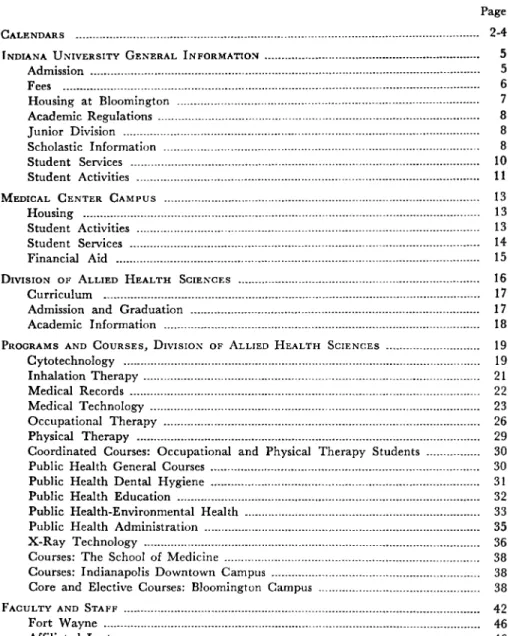
Table of Contents
CALENDARS
fNDIANA UNIVERSITY GENERAL INFORMATION •...•..••...•...••••..•••••••••.••...•••.••••••••••..•
Admission ···-····-···-···-·--···-·-··-···--·-·
Fees
Housing at Bloomington ... . Academic Regulations ···---·-·--·--··-··-···---·-··-··---·---···-·-····-···
Junior Division ---·--·----·---·--··-·-·--····--·-·-····-···-···-···-···-·-·-···-···
Scholastic Information ···-···-····-···---·-···--···-···-···-····-···-·
Student Services ·-····--···-···--···--···-···-·-····
Student Activities ---·-···-···---···-····-·--·-··-·-··-···
MEDICAL CENTER CAMPUS ··-···-···-···---··-···--···--··--···-·-···-··-·
Housing ··-····-···-····---···--·-··---···--···-··-····---·
Student Activities ···---·--···--···-··-···---··--·--·-···-···---··-··
Student Services ····-···-···-····-·--··-··-···--···-····---···--···--··----····
Financial Aid ···-····-··--···-··-··-···-····-···-·-···---·--···-··-·-···
DIVISION OF ALLIED HEALTH SCIENCES ···--···--···--··-·--···-····--···
Curriculum ---·-·--·-··---····-·---···-··-··---··-·--·--·-···-·-···-·--- Admission and Graduation -····-·-··-··-··---····-··-····--··-··-·-···---·--- Academic Information ---·--·-·-··---·-··-·-··-··---···-·-·---·-·
PROGRAMS AND COURSES, D1v1sION OF ALLIED HEALTH SCIENCES ---···-··--·-··-··
Cytotechnology ---···----·-··-·-····--···--·-··-····-··-··-··----·-··-·-··--···-··---·-···
Inhalation Therapy ---···-·-··-···-···-··--··---···-·--···
Medical Records ···--·-···-···-···--··-···-···---·-··-·- Medical Technology ... . Occupational Therapy ... . Physical Therapy ···---·-····---····-···---·-···-···-··-·-··--··-·
Coordinated Courses: Occupational and Physical Therapy Students ... . Public Health General Courses ···-···-·--···-···--·-····--···
Public Health Dental Hygiene --···-··--···-···--·--···-···-···
Public Health Education ·-··-···-···-···-···-····-·--···-·--·-·- Public Health-Environmental Health ... . Public Health Administration ···-···-·-····-···-···--·-····- X-Ray Technology ··---·-···-···-····-···-··-··-··----···--···-·
Courses: The School of Medicine -···-·-·-···-···--···-··-··--··-··
Courses: Indianapolis Downtown Campus -···-····-···--···-···-··-··
Core and Elective Courses: Bloomington Campus -···-··-···-···
FACULTY AND STAFF ·-·-···-···-·-···---·-···-··-·--·---··-··----
Fort Wayne ---·-···-····-·---··-·--·-·--·-··-··--··----····-·-·---·-··-·-··-····-··-·--·--·---··-·--·-··-·--·-- Affiliated Lecturers -·--·-·-··--·--··--··--···-····--···-···-···--·---·-·-·-··---·----·-·
(I)
Page 2-4 5 5 6 7 8 8 8 10 11 13 13 13 14 15 16 17 17 18 19 19 21 22 23 26 29 30 30 31 32 33 35 36 38 38 38 42 46 46
Calendars
Bloomington Campus
1966-67 1967-68
First Semester
New 5.tudcnt mcctings-
Junior Division ... Sept. 12, M ... Sept. 10, Sun, 7:30 p.m.
Transfer and graduate ... Sept. 12 M ... . ... Sept. 11, M, 9 a.m.
Counseling... . .... Sept. 12,' 13; M, T.. . ... Sept. 11, 12; M, T Registration ... Sept. 14, 15; W, Th ... Sept. 13, 14; W, Th Classes begin... . ... Sept. 16, F, 7:'.JO a.m. . ... Sept. 15, F, 7:30 a.m.
Mid-term reports due .. Nov. 11, F, 5 p.m. . ... Nov. 8, W, 5 p.rn.
Thanksgiving recess begins
(after last class).. . ... Nov. 23, W ... Nov. 21, T
Classrs resume... . ... !'\ov. 28, M, 7:30 a.m... . ... Nov. 27, M, 7:30 a.m.
Christma:; recess begin'>
(after last class) Classes resume ..
Advance registration
Dec. 21, W ..
... Jan. 4, W, 7:30·a.m. ... Dec. 20, W ... Jan. 3, W, 7:30 a.m . (for· second semt'ster) ... Jan. 4-18. .... .
Classes end.. . ... Jan. 18, W ... . .. ... Jan. 3-17 . ... Jan. 17, W Exams bC'g"in ... . ... Jan. 20, F, 7:45 a.rn. . ... Jan. 19, F, 7:45 a.m.
Exams end ... Jan. 27, F, 5:15 p.m. . ... Jan. 26, F, 5:15 p.m.
New student meetings ... . Counseling ..
Registration ... . Classes begin .. . Mid-term reports due Spring recess begins
(after last class).
Clas~;es resume ..
Founders' Day* ... . Advance rcgistra tion
Second Semester
... Jan. 31, T.. . ... Jan. 30, T
. ... Feb. 1, 2; W, Th.. . ... Jan. 31, Feb. 1; W, Th . ... Feb. 3, 4; F, S... . .... Feb. 2, 3; F, S
. ... Feb. 6, M, 7:30 a.m.. . ... Feb. 5, M, 7:30 a.m.
. .. Mar. 24, F, 5 p.m. . ... ~Iar. 29, F, 5 p.m.
..Mar. 24, F ..
.... Apr. 3, M, 7:30 a.m . ... May 3, W. ..
.. Apr. 5, F
. .... Apr. 15, M, 7:30 a.m . . ... May I, W
(for first semester) ... - ... May 15-27... . .. May 13-25
Classes end... . ... May 27, S. 12:15 p.m... ..May 25, S, 12:15 p.m.
Exams begin. ... . ... May 29, M, 7:45 a.m... . ... May 27, M, 7:45 a.rn.
Memorial Day holiday... May 30, T. ... May 30, Th Exams end... . ... June 6, T, 5:15 p.m. . .... June 4, T, 5:15 p.m.
Commencement... . ... .June 12, M, 10 a.m. . ... June 10, M, 10 a.m.
Summer Sessions Intersession
Counseling and registration ... June 6, T... . ... . Classes begin.. June 7, W, 7:30 a.m .. . Classes end ... ..] unc 21, W ..
Regular Session
New student meetings and
. .. June 4, T ..June 5, W, 7:30 a.m . ... June 19, W
counseling.. . ... .June 20, T. ... June 18, T
Registration... . ... .June 21, W. . ... June 19, W Classes begin... .June 22, Th, 7:30 a.m... . ... June 20, Th Monday classes meet.. . ... Tune 24, S ... ... . ... June 22, S lnd<·pcndcnce Day holiday ... July 4, T ... July 4, Th Tuesday classes meet... .July 8. S.... ... ..,July 6, S Wednesday classes meet... . ... July 22, S .. .
Thursday classes meet Aug. 5, S.. . ... :::::::.:::::::::Aug. 3, S Cla»es end... . ... Aug. 10, Th... . ... Aug. 9, F
Postsession
Counseling ..
Registration Classes begin .... . Classes end ... .
.. ... Aug. 9. W ... Aug. 8, Tb ... Aug. 10, Th ... Aug. 9. F
..Aug. 11, F ... Aug. 10, S . ... Aug. 26, S ... Au.~. 24, S
* 9:30, 10:30, 11:30, and 12:30 classes do not meet.
(2)
1966-67
Registration ... ·-···---·----···-··--···
Classes be11in .... ----···-···
Thanksgivmg recess begins-5 p.rn ... . Classes resume--8 a.m .... - ... . Christmas recess begins-5 p.m ... ·-····
Classes resume-8 a.m .... - .. ---···
Classes end-5 p.rn .... --···-···-···-··
Exams begin ... ·-···-···
Exams end.. ...•... ·--·-···-···
Registration ... ·-··-···---····
Classes begin .... ·-···-··-···-···
Spring recess begins-5 p.ID---···-···
Classes resume--8 a.m ... ----···- Founders Dayt ... ·-··-···-···-···
Classes end-5 p.m ... ·-···-···--···
Exams begin ... ·-···----·-···-···
Exams end ... ----·---···----···
Commencement 10 a.m ... . l.T.
F, S, Sept. 16-17 M, Sept. 19 T, Nov. 22 M, Nov. 28 Th, Dec. 22 T, Jan. 3 T, Jan. 17 W, Jan. 18 F, Jan. 20 F, S, Feb. 3-4 M, Feb. 6 F, Mar. 24 M, Apr. 3 W, May3 S. May 20 M, May 22 M, May 29 M, June 12 Registration ... ·---···-··· 1 W, June 14 Classes begin-S a.m ... ·-··-··-··-··-·-··· W, June 14 Classes end-5 p.m ... ·-··-··-··-···-···-·· F, Aug. 25
1967-68
Registration .... ···-··-··---·
Classes begin ... ---·-····----··-·----··-·--- Thanksgiving recess begins-5 p.m ...
Classes resume-8 a.m ... . Christmas recess begins-5 p.m ... . Classes resume-8 a.m ... . Classes end-5 p.m ... . Exams begin ... . Exams end ... .
Registration ... . Classes begin ... . Spring recess begins-5 p.m.
Classes Resume--8 a.m ... . Founders' Dayt ... .
Classes end-5 p.m ... . Exams begin.... . ... . Exams end ____ ... .
Commencement-10 a.m ... . l.T.
W. Sept. 13 F, Sept. 15 T, :Nov. 21 M, Nov. 27 W, Dec. 20 W, Jan. 3 W, Jan. 17 F, Jan. 19 F, Jan. 26 M, Jan. 29 M, Jan. 29 S. Apr. 6 M, Apr. 15 W, May 1 F, May 17 M, May 20 W, May 22 M, June 10 Registration...
I
~:f June 17~l~~~~ :~~:::::::::::: ~~-:~:~~ ... ::·:·:_::::~:~~:-~~~~~~::.~ t/~;.e l~
Calendars
Division of Allied Health Sciences M.Rec.
F, Sept. 9 W, Sept. 7 T, Nov. 22 M, Nov. 28 Th, Dec. 22 T, Jan. 3 T, Jan. 17 W, Jan. 18 F, Jan. 20 Th, Feb. 2 Th, Feb. 2 and 23 S, Apr. 8 M, Apr. 17 W, May3 Arr.
~f, June 12
M. Rec.
F. Sept. 8 W, Sept. 6 T, Nov. 21 M, Nov. 27 W, Dec. 20 T, Jan. 2 T, Jan. 16 W, Jan. 17 F, Jan. 19 M, Jan. 29 M, Jan. 22 Th, Apr. 11 M, Apr. 22 W, May I F, May 3 Arr.*
M, June 10
First Semester M. Tech. O.T.
F, Sept. 9 F, Sept. 9 l\i, Aug. 15 M, Sept. 12 W, Nov. 23 T, Nov. 22 M, Nov. 28 M, Nov. 28 W, Dec. 21 Th, Dec. 22 T, Jan. 3 T, Jan. 3 T, Jan. 17 T, Jan. 17
Arr. W, Jan. 18
F, Jan. 20
Second Semester
M, Jan. 16 W, Jan. 25 W, Mar. 22
T, Mar. 28 W, May3 Arr.
M, June 12
Summer
I
w~ W, June 14 Aug. 23M, Jan. 23 S, Apr. 8 M, Apr. 17 W, May3 F, May 19 M, May 22 Th, May 25 M, June 12
Session First Semester
I
M. Tech. 0.T.
F, Sept. 8 M, Sept. 11 F, Aug. 25§ T, Sept. 12 W, Nov. 22 T, Nov. 21 M, Nov. 27 M, Nov. 27 F, Dec. 22 W, Dec. 20 T, Jan. 2 T, Jan. 2
Arr. T. Jan. 16
W, Jan. 17 F, Jan. 19
Semester Second
M, Jan. 22 M, Jan. 22 Th. Apr. 11§
T, Apr. 16 W, May l Arr.
M, June 10
SumlT'er
I
M, May 27 F, Aug. 23 Arr.
M, Jan. 29 W. Jan. 24 Th. Apr. 11 M, Apr. 22 W. May I F, May 17
~f. May 20 W, May 22 M, June 10 Session
I
Clinical PracticeP.T.
F, Sept. 9 M. Sept. 12 T, Nov. 22 M, Nov. 28 Th, Dec. 22 T, Jan. 3 T, Jan. 17 W, Jan. 18 F, Jan. 20 W, Jan. 25 M, Jan. 23 S, Apr. 8 M, Apr. 17 W, May 3 F. May 19 M, May 22 Th, May 25 :I.I. June 12
P.T.
M, Sept. 11 T, Sept. 12 T, Nov. 21 M, Nov. 27 W, Dec. 20 T, Jan. 2 T. Jan. 16 W, Jan. 17 F, Jan. 19 M, Jan. 29 W. Jan. 24 Th, Apr. II M, Apr. 22 W, May l F, May 17 M, May 20 W, May 22 M, June 10
I
M, June 24 F, Aug. 16
t Vacations begin at 12 noon.
P.H. Group Th, Sept. 15 Th, Sept. 15 T, Nov. 22 M, Nov. 28 Th, Dec. 22 T, Jan. 3 T, Jan. 17 W, Jan. 18 F, Jan. 20 W, Jan. 25 M, Jan. 23 S, Apr. 8 M, Apr. 17 W, May 3 F, May 19 M, May 22 Th, May 25 M, June 12
PH. Group F, Sept. 8 M, Sept. 11 T, No-.r. 21t M, Nov. 27 W, Dec. 20t T, Jan. 2 Th, Jan. 11 M, Jan. 15 F, Jan. 19 M, Jan. 29 M, Jan. 29 F, Apr. 5 M, Apr. Li W, May 1 Th, May 23 F. May 24 W, May 29 M, June 10
*Medical Records Finals before May affiliation. Core courses end May 3.
t Qualified students are excused to attend the ceremonies. § Subject to earlier starts by some students.
D.Hyg.
M, Sept. 19 T, Sept. 20 T, Nov. 22 M, Nov. 28 Th, Dec. 22 T, Jan. 3 T, Jan. 17 W, Jan. 18 F, Jan. 20 M, Feb. 6 M, Feb. 6 S, Apr. 8 M, Apr. 17 W, May 3 F, May 26 F, June 2 M, June 12
D. Hyg.
F, Sept. 8 M, Sept. 11 T, Nov. 21 M, Nov. 27 Th, Dec. 21 T, Jan. 2 Th, Jan. 11 M, Jan. 15 F, Jan. 19 M, Jan. 22 M, Jan. 22
"ih, Apr. 4 M, Apr. 15 W, May l Th, May 23 F. May 24 W, May 29 M, June 10
X-Ray M, Sept. 18 M, Sept. 11 W, Nov. 22t j\;f, Nov. 27 W, Dec. 20t T, Jan. 2 T, Jan. 16 W, Jan. 17 F, Jan. 26 M, Feb. 5 M, Feb. 5 T, Apr. 9 Th, Apr. 18 F, May 17 M, May 20 F, May 24 Sun, Aug. 25
I
Clinical PracticeCalendar
Medical Center Campus
1966-67 1967-68
First Semester Registration: freshmen and sophomores; fall
quarter begins, juniors and seniors ... Sept. 6, T... . ... Sept. 5, 6, 7, T, W, Th Classes begin, freshmen and sophomores. ... _ .... Sept. 9, F ... Sept. 8, F
Thanksgiving recess begins, 5 p.m., freshmen and
sophomores ... Nov. 22, T... . .. Nov. 22, W, 5 p.m.
Classes resume, 8 a.m., freshmen and
sophomores.. ... - ... Nov. 28, M... ..Nov. 27, M, 8 a.m.
Winter quarter begins, 8 a.m., juniors and
seniors ... _Dec. 1, Th... . .. Dec. I, F Christmas recess begins, 5 p.m., freshmen
and sophomores ... Dec. 22, Th.... . .. Dec. 22, F, 5 p.m.
Classes resume, 8 a.m. freshmen and
sophomores ... - ... .] an. 3, T... . ... Jan. 2, T, 8 a.m.
Classes end, 5 p.m., freshmen and sophomores ... Jan. 12, T ... . Reading and exam period begins, freshmen
and sophomores ... Jan. 13, W... . ... Jan. 17, W Reading and exam period ends, freshmen
and sophomores ... Jan. 19, Th... . .. Jan. 23, T Second Semester Registration: freshmen and sophomores ... Jan. 20, F ... . .... Jan. 24, W Classes begin, B a.m., freshmen and sophomores ... Jan. 20, F .... . . ... Jan. 25, T Spring quarter begins, 8 a.m., juniors and
seniors ... Feb. 28, T. .. . . ... Mar. 5, T Good Friday ... Mar. 24, F ... . . ... Apr. 12, F Spring recess begins, 5 p.m., freshmen and
sophomores ... Apr. 8, Sat, 12 n1.. ... Apr. 11, Th Spring recess ends, 8 a.m., freshmen and
sophomores ... Apr. 17, M ... Apr. 22, M, 8 a.rn.
Founders Day ... - ... May 3, W... . ... May !, W Alumni Day ... - ...•.. May 10, W ... May 8, W Freshman classes end, 5 p.m ... May 18, Th .... May 23, Th Freshman reading and exam period begins ... May 19, F ... May 24, F Freshman reading and exam period ends ... May 25, Th ... May 29, W Memorial Day ... May 30, T ... May 30, Th Sophomore classes end, 5 p.m ... _ ... May 24, W ... May 29, W Sophomore reading and exam period begins ... May 25, Th ... May 31, F Sophomore reading and exam period ends ... J une I, Th... . ... June 6, Th Spring quarter ends, juniors and seniors ... June 1, Th... . ... June 6, Th Commencement, 10:00 a.m ... June 2. F... . ... June 10, M
1967 1968
Summer quarter begins, 8 a.m., juniors and
seniors ... ·-···---···-···--·--·-··· June 2, F ... June 9, S Independence Day ... July 4, T ... July 4, Th Summer quarter ends, juniors and seniors ... Sept. 4, M ... Sept. 2, M
(4)
..i...
Indiana University General Statement
Indiana University. Created in 1820 by an act of the general assembly, Indiana University has grown until it is now ranked the twelfth largest university in the nation in terms of full-time enrollment. The University is composed of ten academic schools and divisions, with a faculty exceeding 2,500. To meet the needs of approxi- mately 41,000 full- and part-time students, the University offers 5,000 courses of in- struction in more than 100 departments. Its graduate divisions offer 36 advanced degrees in 62 areas.
Students from all 50 states and from many foreign nations are enrolled on its Bloomington, Medical Center, and regional campuses. Indiana University at Bloomington is in year-round operation, with two regular semesters and a three-session summer program which is one of the largest in the nation.
Campuses. The main campus of the University at Bloomington comprises 2,000 acres of woodland traversed by the meandering stream known to generations of students as the Jordan River. Most major academic buildings are confined to the area between Third and Tenth Streets and Indiana and Jordan Avenues, while residence halls, fraternity and sorority houses, and University service divisions border this area. Build- ings for the most part are constructed of native limestone, enhancing the natural beauty
of the campus. -
Regional campuses and centers, most of them in new buildings and expanded settings, are located in East Chicago, Fort Wayne, Gary, Indianapolis, Jeffersonville, Kokomo, Richmond, South Bend, and Vincennes.
Additional University facilities include Bradford Woods, Crooked Lake, the Geologic Field Station in Montana, the Lake Monroe biology site, the Goethe Link Observatory, and Camp Brosius at Elkhart Lake, Wisconsin.
ADMISSION
An Indiana resident who ( 1 ) graduates from a commissioned (or accredited) high school, ( 2) ranks in the top half of his class, ( 3) makes scores above average for a high school senior on the College Board Scholastic Aptitude Test (SAT) or the American College Test (ACT), and ( 4) completes application procedures at the ap- pointed time may expect admission to Indiana University. Most divisions enrolling freshmen use the same procedures and standards. The Admissions Committee is authorized to make exceptions to the above standards and invites students to submit evidence of unusual skills or abilities. The Division of General and Technical Studies has different admission policies; please inquire.
Preparatory courses should include four years of English (one-half unit each of speech and journalism may be included) and nine or more units in mathematics, science, foreign language, and social studies. Students seeking admission to the College of Arts and Sciences, School of Nursing, Division of Allied Health Sciences, should in- clude two or more years each of mathematics, science, and foreign language.
Out-of-state freshmen will be selected from applicants whose rank and test scores are in the top fourth of high school seniors.
Transfer applicants from Indiana whose grades at all colleges attended average at least C (2.0 on a 4.0 system), whose records of conduct are clear, and whose ap- plications have been completed at the appointed time may expect admission.
Out-of-state transfer students will be admitted from applicants with an average of B or better.
(5)
Applications may be filed after completion of the junior year in high school.
Early admission will be granted to superior students who have completed the required tests and are taking the necessary senior subjects. Transfer applicants may apply during the school year preceding proposed entry. Closing dates for applications are January 5 for second semester, May 15 for summer sessions, and July 15 for Sep- tember. A fee of $10 is required of each applicant who is new to the University. All questions concerning admission should be directed to the Office of Admissions, Bryan Hall, Indiana University, Bloomington, Indiana 47401.
Inter-Campus and Intra-University Transfers. Students who have been regularly admitted to Indiana University, who have attended at one campus or in one degree- granting division and who have maintained a 2.0 accumulative grade-point average may transfer to another campus or another degree-granting division or program by complying with established procedures. For this purpose compliance with prescribed filing dates given above is essential.
Transfer students applying for admission to Indiana University, to a program within the Division of Allied Health Sciences, will NOT be admitted by the Admissions Office. The Admissions Office will forward to the Division of Allied Health Sciences Office the transfer credit report. The Division Office will, in turn, forward this report to the Program Director for his/her recommendation. This procedure requires extra time; therefore, applications should be filed early. Similarly, admissions to the Division of General and Technical Studies will be forwarded for action.
FEES
Indiana University does not charge resident students a tmt10n fee for the cost of instruction. Fees charged nonresidents cover in part the cost of instruction. A portion of fees is allocated for cultural and recreational uses and for health services.
Fees are paid at the time of registration each semester and are subject to change by action of the Trustees.
Fee Courtesy. Faculty and staff members and their wives receive 50 per cent reduction in basic fees; there is no reduction in special fees, rentals, or deposits.
Basic Costs. Expenses for attending Indiana University at Bloomington for an academic year, including in-state fees, housing (room and board), and books and supplies, total approximately $1,315. Expenditures for clothing, travel, entertainment, and personal items are not included in this estimate.
Schedule of Fees,
1967-68Junior Division ... . Arts and Sciences ... . Business (undergraduate) ... . Graduate School of Business ... . Dietetics ... . Education ... . Graduate ... . Health, Physical Education, and Recreation ... . Law: Bloomington Division ... . Law: Indianapolis Division ... . Music ... . Normal College, A.G.U ... . Nursing ... . Allied Health Sciences* (except regional campuses) ... . Library Science ... . Social Service ... .
Rates In-State
$11 11 11 13 11 11 11 11 13 15 11 11 11 11 11 11
per Credit Hour Out-of-State
$32 32 32 34 32 32 32 32 34 34 32 32 32 32 32 32
* A special supervisory fee of $50 is charged in the Occupational and Physical Therapy Programs.
DIVISION OF ALLIED HEALTH SCIENCES
Regional Campuses
Undergraduate ... . Graduate ... . Summer Sessions
Undergraduate ... . Graduate ... . (Graduate fees vary for Graduate School of Business, School of Law, Division of Optometry, and for certain workshops and field programs.)
15 18 11 11
23 26 32 11
7
Rates In-State
per Year Out-of-State
Medicine ... $655
Dentistry ... 500
Optometry ... 500
X-Ray Technology ... 140 Correspondence Study
High School Work ... . $18 per course Residents and Nonresidents ... . 13 a credit hour
$1,255 1,000 1,000 140
Adult Education Courses Fees as announced by each
campus Fee Refund Schedule
First and Second Semester
First Week (until class change day) ... . Second \Veek ... . Third Week ... . Fourth Week ... . Thereafter ... . Summer Session
First Week (until class change day) ... . Second Week ... . Thereafter ... .
100%
75%
50%
25%
0 100%
50%
0 Special Fees (in addition to basic fees)
Applied Music ... . $35 a semester Student Teaching ... .
Special Examination ... . Credit by Examination ... . Late Enrollment or Re-Enrollment ... . Other incidental special fees include laboratory, rentals, break- age, deposits, etc.
HOUSING AT BLOOMINGTON
1 7 for summer session 50
5 10 25
The Halls of Residence system at Indiana University, recognized as outstanding among universities throughout the country, includes housing units for graduate, married, and single students. All freshman women are required to live in either Uni- versity Halls of Residence or in officially approved private dormitories, except those exempted by the Dean of Students on the basis of employment or local residence with relatives. Other housing accommodations are available in private homes, approved by the University, and in fraternity and sorority houses.
Rates in the Halls of Residence range from $680 to $980 an academic year for single housing and from $50 to $155 a month for married housing apartments or trailers. Less expensive accommodations for single students are provided in cooper- ative and residence scholarship housing units. Fraternity and sorority housing runs slightly higher than Halls of Residence. When requesting housing accomodations in the University Halls of Residence, the student must enclose a $25 deposit with his application. The Off-Campus Housing Office maintains a list of private rooms. The Housing Offices are located at 801 North Jordan, Indiana University, Bloomington, Indiana 47401.
ACADEMIC REGULATIONS
Degree Requirements. The student is held responsible for understanding all requirements for graduation and for completing them by the time he expects to graduate. Information concerning a specific school or division can be obtained by consulting the bulletin of that school.
Total hours required for the baccalaureate degree are 122 to 124, determined by the individual school. A minimum cumulative grade-point average of 2.0 (on a 4.0 basis) is necessary. Class standing is based on credit hours completed: freshman, fewer than 27; sophomore, 27-55; junior, 56-85; senior, 86 or more.
JUNIOR DIVISION
All students entering Indiana University directly from high school and all stu- dents transferring to the University during their freshman year enter the Junior Division.
The chief purpose of the Junior Division is to guide the freshman student toward his educational goal.
Counseling. Each freshman is assigned a faculty counselor (usually in his major department), who advises him in his program planning and assists him with any aca- demic questions or problems.
Orientation and Registration. All new freshmen should participate in the pre- registration program held from mid-July through early August, and all freshmen will be expected to participate in the fall orientation program on campus, which acquaints them with organizations and services of the University and instructs them in study techniques.
SCHOLASTIC INFORMATION
Minimum and Maximum Semester Enrollment. Students are not permitted to enroll in fewer than 12 or more than 17 hours except with permission of the Dean.
Normally a student must have earned a grade-point average of 3.0 or higher in his last completed semester to receive permission to carry more than 1 7 hours. Only in very exceptional cases may a student's semester enrollment exceed 19 hours.
Grades. The quality of a student's work is indicated by the following grades:
A-Unusual degree of academic performance.
B-Above average achievement.
C-Average achievement.
D-Passing work but below desired standards.
F-Failure in a course or failure to complete a course without an authorized withdrawal.
S-Satisfactory. May be used only with approval of the Dean of the College and the Dean of the Faculties. Credits earned with the grade S count toward graduation but are not computed in the grade-point average. The grade S is assigned where credit by examination is awarded by the University when the examination is of passing quality but does not clearly merit an A grade.
W-Withdrawn. Given automatically when the student, with the approval of his academic adviser and the Dean, officially withdraws during the first three weeks of a semester or first two weeks of a summer session. After these deadlines the grade W is given, in the instance of an approved and properly executed withdrawal, only if the student is passing at the time of withdrawal.
WF-Withdrawn failing. Given when the student withdraws after three weeks of a semester or two weeks of a summer session, if his work is not passing at the time of withdrawal.
I-Incomplete. May be given only when the completed portion of a student's work in the course is of passing quality. When an Incomplete is assigned, a record must be maintained in the office of the department in which the grade was given.
DrvrsION OF ALLIED HEALTH SCIENCES 9 The record will include a statement of the reason for recording the Incomplete and an adequate guide for its removal, with a suggested final grade in the event of the departure or extended absence of the instructor from the rampus.
When the grade of Incomplete is given because the student missed the final examina- tion, he will be allowed to remove the Incomplete by taking the examination only if he has the approval of the Committee on Absence and the instructor.
The student may not register in a course in which he has a grade of Incomplete.
These regulations do not apply to research and reading courses in which completion of the work of the course is not necessarily required at the end of the semester. Once a student has graduated, nothing in these regulations shall prohibit the Incomplete from remaining on the record.
Withdrawals. A grade of W is given automatically to the undergraduate student who withdraws during the first three weeks of a regular semester and during the first two weeks of a summer session on the date of his withdrawal. Thereafter, it is given only when the student withdraws with the approval of his dean, based on urgent reasons relating to health or equivalent distress, and if the student is passing on the date of withdrawal. If the student is failing on the date of withdrawal, the grade recorded on that date shall be WF (withdrawn, failing). If a student is not in attendance during the last several weeks of a semester, the instructor may report a grade of I (indicating the work is satisfactory at the end of the semester but has not been completed) if he has reason to believe the absence was beyond the student's control; if not, he shall record a grade of F. A grade of Incomplete must be re- moved within one cakndar year of the date of its recording or the dean of the school in which the student is enrolled will authorize the grade to be changed to F. A grade of Incomplete may be removed if the student completes the work within the time limit or if the dean authorizes the change of the Incomplete to W.
Addition of Courses. No course may be added by undergraduate students after the first two weeks of a regular session or one week in a summer session unless the instructor of the course petitions that an exception be made and the request is approved by the dean of the school in which the course is offered and the dean of the school in which the student is enrolled.
Absences. Illness is usually the only acceptable excuse for absence from class and must be officially confirmed. A student's excessive absence will be reported by his instructor to the Dean of Students.
A student who misses a final examination and who has a passing grade up to that time is given temporarily a grade of incomplete if the instructor has reason to believe the absence was beyond the student's control. The Committee on Absence of the Office of the Dean of Students reviews excuses for absences from final exam- inations and notifies instructors of its decisions.
Academic Probation and Dismissal. A student is on academic probation whenever his accumulative average is below C ( 2.0). He is also on probation for the duration of the next regular semester or summer session in which he is enrolled, following the one in which he failed to attain a C (2.0) average.
Every student on academic probation must comply with such restrictions as the Office of the Dean of Students or the dean or director of the school or campus in which the student is registered may deem necessary.
Dismissal. Specific minimum standards must be met in order to be retained as a candidate for a baccalaureate degree. Junior division students will be dismissed if:
1. At the end of one semester their grade point average falls below 0.8.
2. At the end of the second semester if their accumulative grade point average falls below 1.5.
3. At the end of the third semester if their accumulative grade point average falls below 1.89.
Students in the Division of Allied Health Sciences are dismissed when in the judge- ment of the council of program directors they have ceased to make progress toward a degree. When a student has failed to attain a C (2.0) average in two consecutive semesters and has an accumulative average below C (2.0), or when he has failed to make higher than a D ( 1.0) average in any one semester, he will be dismissed as not making progress toward his degree.
Opportunities for Superior Students. The honors program, offered by some schools of the University, allows the student of superior ability and achievement to follow a course of independent study and research. Special sections for accelerated work are offered in some courses, and, by special examination, one may establish advanced standing or gain exemption from certain required courses. Further infor- mation on specific honors programs may be obtained by consulting the department head or the dean of the school.
Students satisfying the requirements of a departmental honors program are granted degrees with Honors. The University also recognizes high cumulative grade averages by awarding degrees with various designations of "Distinction," "High Dis- tinction," and "Highest Distinction."
Credit by Examination. The student may receive credit for certain courses by performance on placement examinations in English, French, German, Latin, Spanish, government, history, chemistry, mathematics when validated by taking and passing an advanced course in the same subject, and by successful performance on appropriate examinations while at Indiana University. The student who believes he is eligible for special credit because of superior preparations or independent study is especially urged to accelerate his college program in this manner.
STUDENT SERVICES AT BLOOMINGTON
Scholarships and Financial Aids. Information concerning scholarships and loans available to undergraduate students may be obtained from the Director of Scholar- ships and Financial Aids, Room 205, Maxwell Hall, Indiana University, Bloomington, Indiana 47401. Graduate students may obtain information on scholarships and fellow- ships through the Office of the Graduate School.
Employment. The Student Employment Office lists openings for part-time jobs in halls of residence, campus offices, libraries, Bookstore, Indiana Memorial Union, and fraternity and sorority houses. Students seeking suitable employment should contact the Student Employment Office, Indiana University, Bloomington, Indiana 47401.
Libraries. Ranked eleventh in size among university libraries in America, the Indiana University Library system contains more than 4,500,000 items. Most of the books and periodicals have been selected by the faculties of the various departments to facilitate both instruction and research. Comprising the University library system are a main library, for graduate and faculty use; an undergraduate library; the Lilly Library, for special collections and rare books; the several libraries at the regional campuses; school libraries, such as Music, Medicine, Law, etc.; and collections at housing units in the Halls of Residence system. In addition, many departments have collections centered around their specific areas of interest.
The Student Health Service. Available to all regularly enrolled students on the Bloomington Campus, the health service provides: an evaluation of the physical exami- nation required of all students coming to the Bloomington Campus for the first time;
outpatient medical care similar to that expected from the student's family physician;
admission to the 108-bed infirmary for treatment of minor and many major medical problems; a Psychiatric Clinic for evaluation and short-term therapy; a program in Environmental Health and Preventive Medicine; and assistance in the administration of the Student Group Hospital Insurance Plan. The Health Center is located at the corner of Tenth Street and Jordan Avenue.
DrvrsION OF ALLIED HEALTH SCIENCES 11 Clinical Services. Students have access to several clinics at the University. The Reading and Study Skills Clinic helps students to improve reading speed and com- prehension. The Remedial Speech and Hearing Clinic provides therapy for students who have speech and hearing defects, while the Psychological Clinic and the Counseling Office of the Dean of Students Division help students with personal problems or with special problems in choosing careers.
Placement Services. The University maintains three job placement bureaus which serve students free of charge. The Bureau of Educational Placement registers qualified students for teaching and associated positions. The Business Placement of the School of Business arranges interviews with recruiters from business and industry for students of all schools and divisions and for University alumni. It also publishes a list of positions open in business and industry. The Government Placement Office in Ballantine Hall helps students to find employment with local, state, and federal agencies, including civil and foreign service agencies.
Indiana Memorial Union. Centrally located on campus, the Union provides numerous services. The Commons and Kiva are popular for snacks, the Cafeteria for self-service meals, and the Tudor Room for leisurely dining. Also in the Union are barber and beauty shops; a newsstand and post office; meeting rooms; three large lounges; a browsing room; a bowling alley; and a billiards room. Guest rooms for visitors are available in the Union's Biddle Continuation Center.
The Bookstore, also located in the Union, carries required and supplementary texts, used books, and supplies, as well as University insignia apparel and souvenirs.
It also maintains a check-cashing service for the convenience of students and faculty.
This self-supporting department of the University has two branch stores, one in Gresham Hall of Foster Quadrangle, and one in Clark House of Daniel Read Hall.
STUDENT ACTIVITIES AT BLOOMINGTON
Students are encouraged not only to attend but to take part in extracurricular programs and activities, including athletics, theatre presentations, the more than forty musical organizations on campus, debate and public speaking activities, and programs of the Department of Radio and Television. Others become interested in working with student publications, such as The Indiana Daily Student, campus newspaper; the yearbook, Arbutus; and creative writing magazines.
Recreation. In addition to recreational programs of the halls of residence, social events of fraternities and sororities, and activities of independent groups, a program of indoor sports and recreation including bowling, table tennis, billiards, television, cards, and chess is maintained by the Indiana Memorial Union. A well-equipped Craft Shop is available to students without charge. The Union Board sponsors such events as Campus Quiz Bowl, formal dances and dinners, and pop concerts with nationally known dance bands and top entertainers. Special interest groups such as Spelunkers, Sailing, and Rifle Clubs offer a variety of activity. Beechwood Heights, the University's 33-acre recreational area on Lake Lemon, provides facilities for swimming, sailing, pic- nicking, and outdoor games. Large state forest preserves and state parks are also within easy driving distance of the campus.
Cultural Events. The world's leading concert artists, professional Broadway plays, musicals, and ballets come to the campus for performances on the Auditorium and Celebrity Series. Free convocations feature outstanding lecturers and distinguished presentations in politics, public affairs, sciences, and the arts. Reading and discussion series and forums and art exhibits also are among the cultural opportunities available for students. The School of Music presents professionally acclaimed student productions in the fields of opera, recital, and ballet. The University Theatre offers a full season of the best in drama on campus and in its summer seasons of the Brown County Playhouse and Showboat Majestic.
Social and Traditional Events. Homecoming, President's Ball, Little 500 Week- end, Military Ball, and Christmas Eve on Campus are among the traditional events on campus.
Athletic Events. Indiana University is a member of the Big Ten Conference and participates in all Big Ten sports: football, baseball, basketball, golf, tennis, track, swimming, wrestling, and gymnastics. A large new stadium and field house are supple- mented by other facilities including several sports fields, swimming pools, golf courses, and tennis courts.
An extensive intramural sports program provides recreational opportunity for every student. The finest facilities for swimming, golf, tennis, volleyball, archery, and bowling are available.
Student Government. All students are urged to take part in the activities of student government, ranging from those of their living unit to the all-campus student government represented by the Executive (student body president and his cabinet), Legislative (Student Senate), and Judicial (Student Supreme Court) branches.
Student Organizations. There are approximately 150 student organizations on campus other than fraternities, sororities, and residence hall groups, as well as repre- sentative groups of many local, state, national and international organizations.
Scholastic Honoraries. Indiana University has chapters of the freshman scholastic organizations Alpha Lambda Delta, for women, and Phi Eta Sigma, for men. Other selective honoraries, such as Phi Beta Kappa of the College of Arts and Sciences, Order of the Coif of the School of Law, and Phi Delta Kappa of the School of Education, are described in the specific school bulletins.
Recognition Honoraries. Mortar Board for senior women and Blue Key for junior and senior men are national activity honoraries on campus which recognize their members for scholarship, leadership, and service. Other campus recognition groups for men include Tomahawk, independent sophomores; Flame Club, independent sophomores or above; Skull and Crescent, organized sophomores; Falcon, organized juniors; and Sphinx, organized seniors. For women, groups are Enomene for sophomores, and Pleiades for organized juniors and seniors.
Religious Organizations. All church denominations welcome students into their worshipping congregations, and many churches sponsor specialized programs for stu- dents. General religious groups on campus conduct extensive religious, social, and service activities. The Beck Chapel, near the center of the campus, serves all faiths and beliefs.
Medical Center Campus
The Indiana University Medical Center consists of 80 acres and includes the Schools of Medicine, Dentistry, and Nursing, and the Division of Allied Health Sciences, the Robert W. Long Hospital, the James Whitcomb Riley Hospital for Children (in- cluding the Kiwanis Wing), the Rotary Building, the Clinical Building, the William H. Coleman Hospital for Women, the Union Building, the Medical Science Building, and the new Adult Hospital, which is now under construction. Located adjacent to the Medical Center are Marion County General Hospital, Veterans Hospital, and the LaRue D. Carter Memorial Hospital. Such a situation is ideal for study in all programs of the health sciences. Students are admitted to all of the University hospitals and clinics for training and observation.
Also located in Indianapolis are the Indianapolis Regional Campus, the University's Division of Social Service, the Indianapolis Division of the School of Law, and the Normal College of the American Gymnastic Union.
HOUSING AT INDIANAPOLIS
Official housing applications for Indianapolis Medical Center campus housing may be obtained from Philip McQuillen, Director of Housing, Indiana University Medical Center, 440 North Winona Street, Indianapolis, Indiana 46202. A small photograph and a $25 loss and breakage deposit must accompany the application. Space assign- ments are made on the basis of the date the deposit is received. The Housing Office also maintains a file of approved off-campus facilities which may be checked in person in this office.
Dormitories for unmarried students are located adjacent to, and directly connected with the Union Building. Rates are: double, $46.50 per month; single, $67.50 per month (single-rate facilities are limited and rarely available). Each floor includes a lounge, and at the top of the building is a roof lounge for parties and informal social meet- ings. Each room includes storage space, campus telephone, and air conditioning.
Central bathrooms are available on each floor. The dormitory wing is accessible to the ·main cafeteria and lounge of the Union Building.
Winona Village (for men only) consists of temporary barrack-type units with 35 double rooms accommodating 70 men, located west of the Union Building. Rates are: double, $33 per month; single, $42 per month (if available).
Unfurnished apartments for married students include efficiency, one-bedroom, and two-bedroom accommodations. The rentals range from $53 to $105 per month.
Furnished apartments include efficiencies at $93 per month and one-bedroom apart- ments at $115 per month.
STUDENT ACTIVITIES AT INDIANAPOLIS
The city of Indianapolis has much to offer the student. The nationally famous Indianapolis Symphony presents concerts throughout the winter season. Several civic theatre groups as well as frequent visits of touring troupes provide a widely varied program of plays. Both Indiana and Purdue Universities maintain regional campuses in Indianapolis. Butler University, Indiana Central College, and Marian College are all located in Indianapolis. Art galleries, libraries, and museums enrich the city.
There are seven radio stations, three te.levision studios, and many movie houses to entertain the Indianapolis resident.
(13)
INDIANA UNIVERSITY
The proximity of Bloomington also allows an evening's entertainment on the campus. A series of inviting programs of theatre, music, and lectures which the Medical Center student may attend, are scheduled on the Bloomington Campus. Indiana Uni- versity basketbaJJ and footbaJJ tickets are available at student prices and many Medical Center students plan weekends on the Bloomington Campus as part of their social calendar.
A variety of recreational activities is offered to students. Facilities are available for dances, teas, parties, movies, tennis, archery, ping pong, baseball, badminton, basket- ball, swimming, and bicycling.
Student Union Board. The Student Union Board is the central student organization whose objective is to provide cultural, social, and recreational activities for the student body. The organization is composed of two representatives from the eight school divisions of Indiana University in Indianapolis. These include the Schools of Medicine, Nursing, Dentistry, Law (Indianapolis Division), Divisions of Social Service and Allied Health Sciences, Normal College of American Gymnastic Union, and Indianapolis Downtown Campus. This council, representative of all the schools on the campus and the down- town regional campus, sponsors dances, movies, and mixers. Eight medical and dental fraternities add to the social scene, as do the activities of the various schools and classes.
Music. The campus chorus, Medical Center Choraliers, is open to all students
<>n the Medical Center Campus. It provides music for school and civic occasions.
Religious Activity. The Medical Center chaplain's office is open for personal appointments at any time. A chaplain is available for students of each faith to provide spiritual leadership to individuals and to their religious groups.
Campus religion groups include: the Inter-Varsity Christian Fellowship, and the Newman Club, primarily for Catholic students.
STUDENT SERVICES AT INDIANAPOLIS
Union Building. This campus is one of the few Medical Centers in the country that has its own Union Building. The Union Building provides a variety of activities and services to students, faculty, and staff, and to visitors and guests of the University.
Eating facilities include a snack bar and cafeteria. A barber and beauty shop also are located in the Union.
The bookstore carries all necessary textbooks and supplies for the Schools of Medicine, Dentistry, and Nursing, and for the Allied Health Science courses. Maga- zines, supplies, novelties, and toilet articles may also be purchased.
Library. The combined libraries of the Schools of Medicine and Nursing are located in the Medical Science Building. The library contains 65,000 volumes and subscribes to 1,252 foreign and domestic periodicals. Many of the journal files are complete and gaps are being filled through exchange of duplicate volumes with other medical libraries, by gifts and through direct purchase. Current issues of some 400 periodical titles received are always available in the periodical reading room. The library seats 170 persons, and ready access to reference materials is provided by 2,500 volumes of selected indices, encyclopedias, and dictionaries placed on open shelves in the main reading room. The library of the School of Dentistry is also available to Allied Health Sciences students.
Student Health Service. This service is available to students of the Schools of Medicine, Nursing, and Dentistry, the Division of Allied Health Sciences, the Normal College of the American Gymnastic Union, and the Division of Social Service, as well as to the staff and faculty of the University. It offers complete clinical and laboratory examinations, immunizations, dispensary or infirmary care for minor illnesses, and limited hospital care for major illnesses or surgical operations. Optional health insur- ance, which provides coverage for dependents and which extends coverage to the student when away from the Medical Center campus, is also available.
DIVISION OF ALLIED HEALTH SCIENCES 15 FINANCIAL AID
General University scholarships and financial aids are available to students in Allied Health, as well as scholarships and loans available only to Allied Health students.
Scholarships and Educational Opportunity Grants. General University scholarships are available to students of high academic achievement. Students whose parents are able to provide limited financial assistance are eligible to be considered for the Educational Opportunity Grant Program established under the Higher Education Act of 1965.
Loans. The Student Loan Program was established under the National Defense Act of 1958, and loans are available to full-time or half-time students who need financial assistance. The loan and interest thereon of any borrower who is employed full-time in the teaching profession in a public or private institution at any level, elementary, secondary, or higher education may be canceled up to a maximum of 50 per cent at the rate of 10 per cent a year.
The guaranteed loan program was established under the Higher Education Act of 1965. Loans made by commercial banks or other lending institutions are guaranteed by federal funds provided under the Act. Interest is paid by federal funds for students whose family income is under $15,000 during the time the student is in school, and 3%
of the interest is paid by federal funds during the repayment period which begins nine months after graduating or leaving school.
Applications. Application for financial aid should be made to the Office of Scholar- ships and Financial Aids, Indiana University, Bloomington, Indiana. Incoming freshman students should apply before February 15. Upperclass students should apply by April 1 for renewal of previous awards and for consideration for new awards.
Employment. Any student wishing employment in the various departments of the University may apply to the Student Employment Office on the Bloomington Campus or to the Personnel Department at the Medical Center.
The federal Work-Study Program for which students in Allied Health also are eligible expands employment opportunities for students who must finance the major portion of their education. Application for the Work-Study P