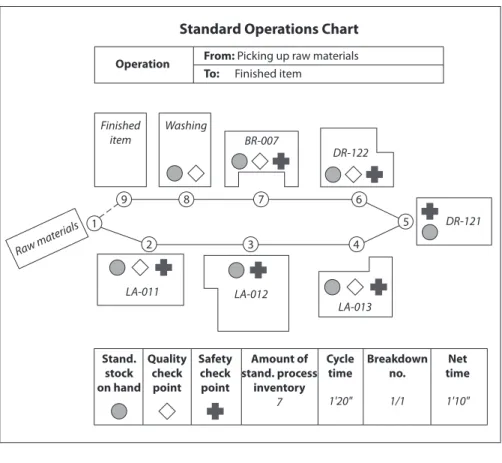
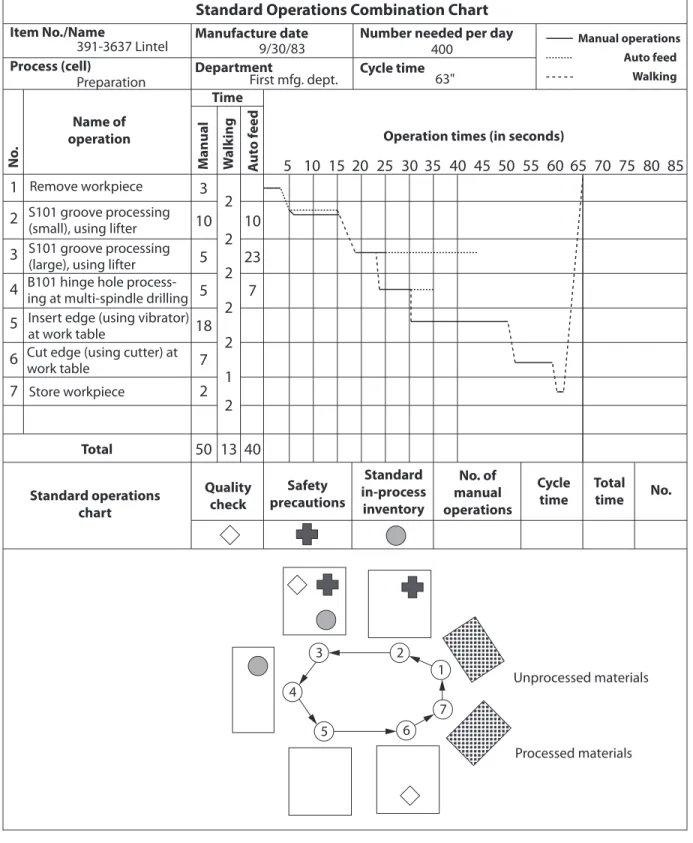
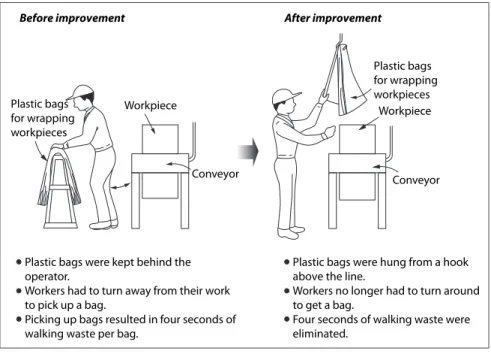
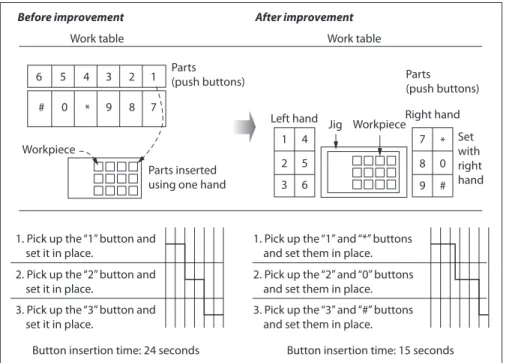
We must also remember that, like any improvement, improvement in standard operations is a never-ending process. Operators should use this chart to check how well they are following standard operations.
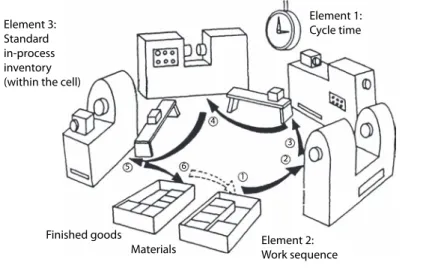
How to Establish Standard Operations
This schematic chart will provide a visual aid to quickly learn the machine layout, work sequence and other important factors.
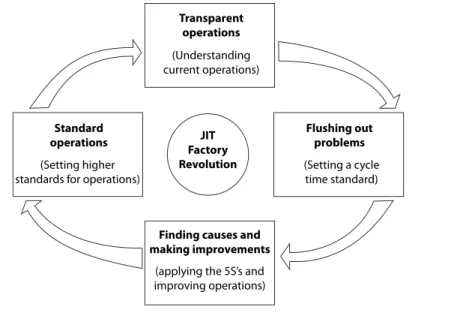
How to Make Combination Charts and Standard Operations Charts
Enter the cycle time
Enter the net time
Usually, both the standard operation combination diagram and the standard operation diagram are completed by the same operator.
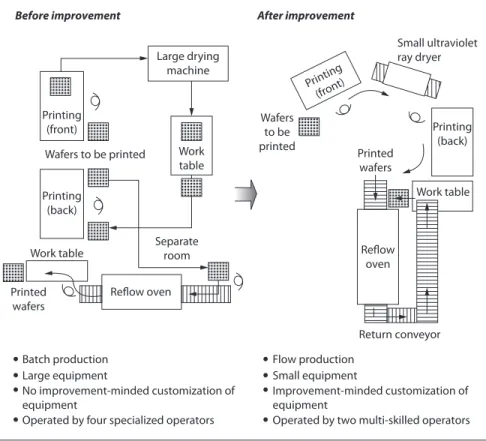
Standard Operations and Operation Improvements
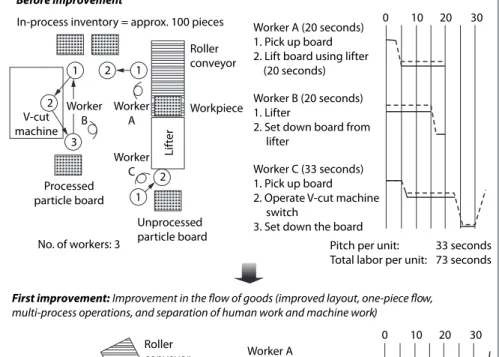
The roller conveyor did not have a power cable and could be moved freely, although they ended up "curving" the roller conveyor so that its output end was close to the V-cut machine, as shown at the bottom of Figure 13.16. They tried to attach a guide plate to the side of the roller conveyor to prevent the chipboard from falling.
How to Preserve Standard Operations
- Commandment 1: Standard operations must be established factory-wide
- Make sure everyone understands what standard operations mean
- Workshop leaders must be confi- dent in their skills when training others in stan-
- Post reminders in the workshop
- Post standard operations signs in obvious places
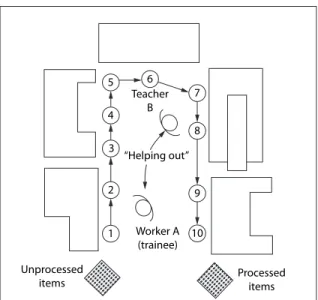
- When necessary, get a third person to help out
- Commandment 7: Reprimand the workshop leader when standard operations are not being main-
- Reject the status quo
- Commandment 9: Conduct periodic improvement study groups
- Take on the challenge of estab- lishing new standard operations
The following are "ten commandments" that have evolved over the years for maintaining standard operations. When workers' actions or work sequences differ from those prescribed by standard operations, we have proven that standard operations are not maintained.
Jidoka
Steps toward Jidoka
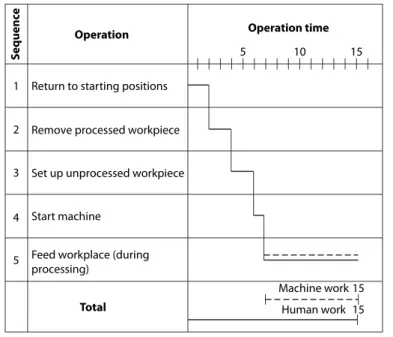
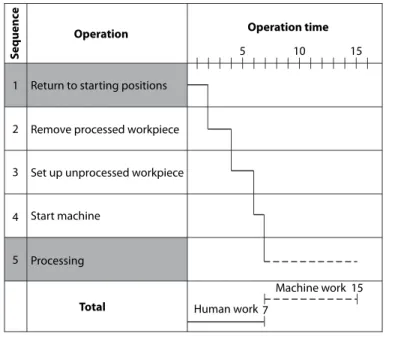
We have reached a stage where the work is divided between the worker and the machine, but the worker still does the lion's share. The worker simply places the workpiece near the machine and presses a switch to start the machine. The worker can leave the machine alone at that point, but there is no way to know if the machine is producing faulty goods.
As with the automation step, the worker simply sets up the workpieces, presses the ON switch and exits the machine to perform the operation. The machine itself detects when a defect has occurred and switches itself off automatically.
The Difference between Automation and Jidoka
When they add up all the costs, it turns out that they are losing out with automation. In contrast, jidoka allows factories to keep equipment running without human assistance or supervision. Current equipment can be cheaply upgraded as “human-automated” machines that actually work while moving and do not disrupt the flow of goods.
First, we must analyze the worker's operations, and then apply jidoka to each of them, one at a time. And, interestingly, the more money we spend on automation, the more the new equipment is likely to disrupt the flow of goods.
The Three Functions of Jidoka
The reason for this very common problem is that machines are allowed to "move" instead of "work". Or rather, people think that as long as the machines are moving, they are working. To do this, we need to apply human wisdom to change machines that just "move" into ones that "work". Developing fault prevention devices for automated equipment is the heart and soul of jidoka. Machines must be able to detect themselves when faults occur, stop themselves and sound an alarm to inform people of anomalies.
The machine does not need to be able to tell what kind of deviation has occurred. Jidoka calls for the gradual shift of all human work to machine work, separating humans from machines.
Separating Workers: Separating Human Work from Machine Work
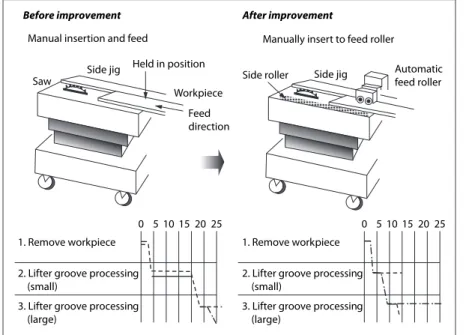
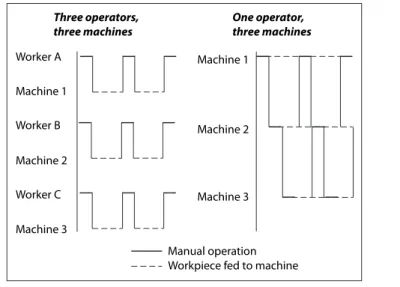
If the machine is a drill, the operator must set up the measuring jig and the V-block. By applying jidoka to the "feed" step, we can begin to separate the worker from the machine. Our first improvement separated the worker's right hand from the machine by automating the "feed" motion.
This allows the worker to be separated from the machine during the entire drilling operation. After the second improvement, the worker can only be separated from the machine while the workpiece is in progress.
Ways to Prevent Defects
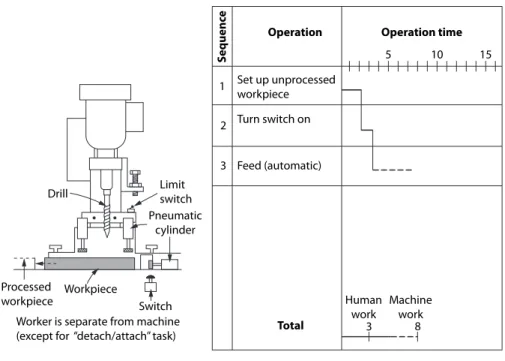
How to prevent errors in threads Figure 14.12 shows an example of an error prevention device used in threads. This device effectively prevents any workpieces with irregular edges from reaching the final assembly process. The error prevention device consists of a plate attached to the inlet side of the drill hole finishing machine.
When the downhole finishing machine processes one part of the work, the defect prevention device tests the other on the conveyor by lowering two rods through the drill holes. When one of the limit switches is activated, the drilling and finishing machines are stopped and an andon alarm is activated, as shown in Figure 14.14.
Extension of Jidoka to the Assembly Line
When there is an abnormality or other problem on the assembly line, such as the assembly line, the assembly workers press the stop button to stop the line immediately to identify the problem and solve it in the right way. Whenever any assembler notices an abnormality, he must immediately press the SOS button to stop the line and investigate the problem. The supervisor immediately enters the process where the abnormality has occurred and tries to identify and solve the problem while the line is still operating.
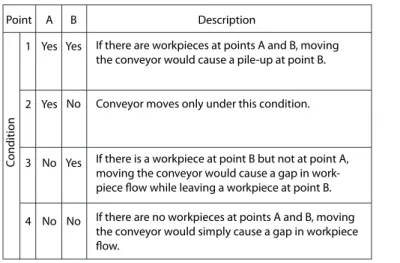
Finally, the supervisor decided that the assembly line would have a poka-yoke device that would prevent products without nameplates from continuing on the line. If the product does not have a nameplate, the indicator lights up, a buzzer sounds and the line stops when it reaches the preset position.
Maintenance and Safety
Existing Maintenance Conditions on the Factory Floor
It wasn't difficult at all to come up with this list of nearly twenty objectionable disorders. In fact, this list is based only on my observations in and around factory equipment; it would be a much longer list if I included all the other undesirable conditions I have encountered in other parts of factories.
What Is Maintenance?
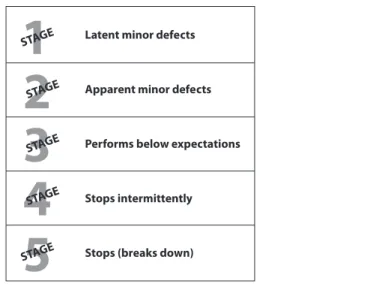
For example, the machine can no longer meet the required quality standards and can stop every now and then. Although it's hard to see or hear, the machine's rotating parts work under increasing friction and its fastened parts loosen a little. At this point it became difficult to operate the machine with the desired accuracy and within the dimensional tolerances.
At this stage, the machine must be shut down quite often to make adjustments to bring the product quality back into line. In this last stage, the machine functions so poorly that it stops itself, i.e. it breaks.
CCO: Three Lessons in Maintenance
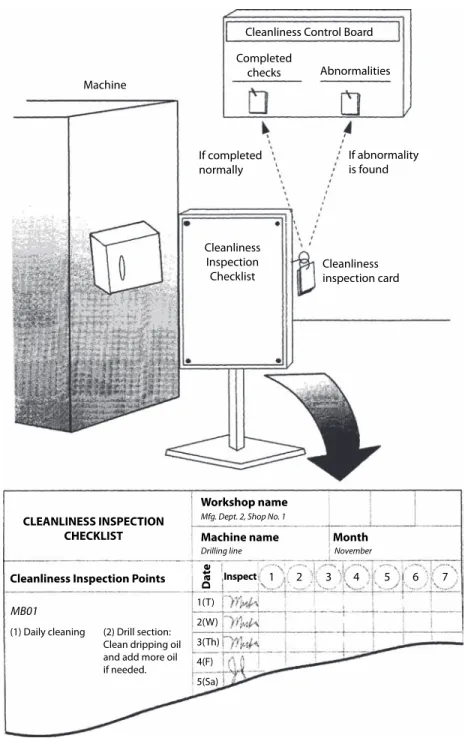
As part of 5S, cleanliness (seiso) is the routine housekeeping work that is essential to maintaining the daily health of the factory. As it applies especially to equipment, keeping it clean is the best way to do a daily inspection of equipment. To help operators stay on top of their MCO duties, shop supervisors should post a "Cleanliness Inspection Checklist". in the workshop, which operators can use to keep track of how well daily cleaning tasks are being performed.
Verification is undoubtedly a part of maintenance activities, but not something that should be left entirely to maintainers. Recognizing the operator's superior qualifications as an equipment checker, we should not underestimate his or her checking tasks by leaving them to "spare time" or "time."
Preventing Breakdowns
Kanbans are color-coded to indicate which type of oil and which inlet port to use, and to mark other materials, such as oil cans and oiling tools. Likewise, some types of factory hardware are stronger and less likely to break, while other types are weaker and tend to break more easily. In general, the types of equipment that tend to break down the most are those that operate using more complex moving parts, such as limit switches and cylinders.
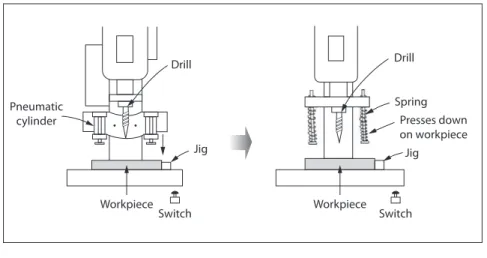
The types of equipment that have a stronger constitution are those that operate by means of simple coupling devices such as cams and gears. If one of the pneumatic cylinders fails, there is a safety hazard as the cylinder may start to operate while the worker is still setting up the workpiece and the worker may have a pinched hand.
Why Do Injuries Occur?
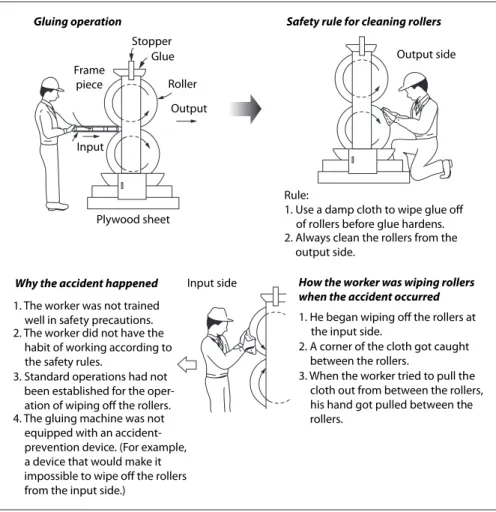
When the worker tried to pull the fabric from between the rollers, his hand was pulled between the rollers. For example, a device that would disable the wiping of rollers from the input side.). When wiping the rollers on the input side, the edge of the cloth would sometimes get pulled between the rollers.
The worker relied on his reflexes to pull the cloth back before the rollers got a grip on it. The safety rule that says workers must wipe the rolls from the output side is written in the book, but not in the mind of the worker.
What Is Safety?
Workers should make 5S maintenance and safety compliance so commonplace that they rarely have to think about it. Along with training to learn the habit of following the rules, establishing safety-aware standard operations and maintaining them with visual control tools will allow everyone to understand how things should be done. Develop devices that prevent injuries and accidents No matter how well the rules are taught and enforced.
We can still help prevent injuries and accidents caused by human error by developing devices that make it difficult or impossible to make mistakes in an unsafe way. We need to expand the poka-yoke concept and create "safety poka-yoke" devices that prevent accidents.
Strategies for Zero Injuries and Zero Accidents
Likewise, standard operation requires the creation of operating standards to help eliminate injuries and accidents. Standard operations are like the pillar that supports safe operations, and training workers to maintain standard operations is like a crossbar connected to this pillar. Of course, the specific safety standards are outlined in the standard operations manual and operating instructions to keep workers informed about safety-conscious procedures and safety precautions.
Every company must invest enough resources to thoroughly educate and train workers in standard operations that help ensure safety. Since careless human behavior is a major cause of accidents, safety poka-yoke devices can provide a very effective way to prevent accidents.