Journal homepage: www.ejournal.uksw.edu/jeb ISSN 1979-6471 E-ISSN 2528-0147
*Corresponding Author
Entrepreneurial leadership and employee creativity: Moderation and mediation perspectives
I Nengah Aristana
a*, I Made Bayu Wisnawa
b, Anak Agung Ketut Sriasih
c, Ni Made Ernila Junipisa
da Faculty of Economics and Business, Universitas Mahasaraswati Denpasar, Denpasar, Indonesia;
b Faculty of Business and Tourism, Universitas Triatma Mulya, Badung, Indonesia;
c Faculty of Business and Tourism, Universitas Triatma Triatma Mulya, Badung, Indonesia;
d Faculty of Business and Tourism, Universitas Triatma Mulya, Badung, Indonesia;
A R T I C L E I N F O Article History:
Received 10-01-2021 Revised 02-16-2022 Accepted 05-25-2022
Kata Kunci:
Kepemimpinan wirausaha, kreativitas karyawan, teknologi informasi, berbagi
pengetahuan
Keywords:
Entrepreneurial leadership, employee creativity, information techonology, knowledge sharing
A B S T R A K
Penelitian ini bertujuan untuk menganalisis dan menjelaskan pengaruh kepemimpinan wirausaha, teknologi informasi dan kreativitas karyawan serta menguji peran berbagi pengetahuan sebagai pemoderasi dan teknologi informasi sebagai pemediasi.
Populasi penelitian adalah seluruh usaha kecil menengah yang bergerak dalam bidang kerajinan di Bali yang berjumlah 42 usaha.
Penentuan sampel dilakukan dengan menggunakan metode proporsional sampling yang melibatkan pimpinan, supervisor dan karyawan dengan jumlah sampel 126 orang. Hasil penelitian ini menunjukkan kepemimpinan wirausaha berpengaruh positif tidak signifikan mempengaruhi kreativitas karyawan. Sedangkan kepemimpinan wirausaha secara positif signifikan mempengaruhi teknologi informasi. Informasi dan berbagi pengetahuan secara langsung berpengaruh positif dan signifikan terhadap kreativitas karyawan. Untuk peran moderasi berbagi pengetahuan terbukti sebagai pemoderasi pengaruh kepemimpinan wirausaha terhadap kreativitas karyawan, namun peran yang ditunjukkan memiliki kecenderungan melemahkan. Serta berbagi pengetahuan tidak terbukti sebagai pemoderasi pengaruh teknologi informasi terhadap kreativitas karyawan. Teknologi informasi terbukti sebagai pemediasi penuh (fully mediation) pengaruh kepemimpinan wirausaha terhadap kreativitas karyawan.
A B S T R A C T
This research aims to analyze and explain the influence of entrepreneurial leadership, information technology and employee creativity and to examine the role of knowledge sharing as the moderator and information technology as the mediator. The
population in this research was all the small and medium enterprises engaged in handicrafts in Bali, amounting to 42 businesses. The determination of the sample was done by using a proportional sampling method involving leaders, supervisors and employees and the total sample in this research was 126 people.
The result of this study indicates that entrepreneurial leadership has no significant, positive effect on employee creativity.
Meanwhile, entrepreneurial leadership has a significant, positive effect on information technology. Information and knowledge sharing directly have a positive and significant effect on employee creativity. The moderating role of knowledge sharing has been proven to moderate the influence of entrepreneurial leadership on employee creativity, but the role shown has a weakening tendency.
Meanwhile, knowledge sharing is not proven as moderating the influence of information technology on employee creativity.
Information technology is proven to be a full mediation (fully mediating) the influence of entrepreneurial leadership on employee creativity.
INTRODUCTION
Currently, small and medium enterprises (SMEs) have been facing a more fierce competition than before (Helmy et al., 2019). Developments in technology and knowledge have forces SMEs to be more flexible in adapting themselves so that they can survive the pressure of competition (Tampoe, 1994). Such a situation requires SMEs to focus more on innovation as the drive for sustainable competitive advantage (Ghosh, 2015; Hon & Lui, 2016; Rasheed et al., 2021), which will-later on-contribute in increasing the SMEs’ performance (Tajasom et al., 2015). Employee creativity is one of the prerequisites for fostering organizational innovation (Amabile, 1988;
Çekmecelioğlu & Günsel, 2013; Hon, 2013). According to (Lee et al., 2017; Para- González et al., 2018) production process improvement is done by maximizing employee competence so that the organization becomes more effective. According to (Chen & Chang, 2013) performance improvement is highly dependent on the ability to develop products and processes.
Business development does not always depend on the capacity of internal environment, but also needs creativity to pay attention to creating opportunities to be able to identify external solutions (Zanjirchi et al., 2019). SMEs are a sector that requires employee creativity, various ways are done to stimulate employee creativity.
Employee creativity is an initial thought in generating new ideas which are useful for developing products, procedures, and processes (Liu et al., 2013). Pan et al. (2015) mentioned that many factors affect creativity, but special attention is given to the impact of the leader in enhancing employee creativity.
Several studies suggest that leadership has a relationship in accelerating and slowing down employee creativity (Gu et al., 2015; S. Liu et al., 2013; Mainemelis et al., 2015; McMahon & Ford, 2013; Mumford et al., 2008). However, the tools for
leaders to increase employee creativity have not been thoroughly studied (Amabile et al., 2004). Chen & Hou (2016) found out that leadership is related to creativity if it is mediated by innovative climate. However, Ma et al. (2013) stated that ethical leadership is related with employee creativity. This is in line with Mittal & Dhar (2015) who found out that transformational leadership can increase employee creativity at work. Several research found out the important role of leadership in enhancing employee creativity.
This research attempts to investigate the impact of entrepreneurial leadership on employee creativity. Entrepreneurial leadership is one type of leadership that is associated with employee creativity (Cai et al., 2019). Newman et al. (2018) stated that entrepreneurial leadership is able to increase employee creativity in carrying out their work. According to Chen & Chang (2013), entrepreneurial leadership has the ability to make changes by building commitment and motivating employees.
Entrepreneurial leader is a type of leader who is able to provide energy to employees to channel their talents to achieve organizational goals (Ling & Jaw, 2011). The abilities possessed by entrepreneurial leaders is expected to be able to encourage employee creativity so that the goals of SMEs can be achieved (Gundry et al., 2014).
However, Chen (2007) found different results in which entrepreneurial leadership has no effect on employee creativity. Based on this gap, the researcher tries to re-measure the impact of entrepreneurial leadership in an effort to enhance employee creativity within SMEs. However, this research tries to include information technology as the inseparable aspect in the development of business world nowadays. SMEs are no exception, since they are a sector that really needs employee creativity and a touch of technology in it.
Employee creativity can develop well if it is supported by knowledge sharing practices (Akturan & Çekmecelioğlu, 2016). Yan et al. (2013) suggested that organizations, especially SMEs, carry out knowledge management by facilitating knowledge sharing to contribute to the creation of knowledge that has an impact on employee creativity. Carmeli & Paulus (2015) explained that the process of internal and external knowledge sharing can overcome creativity problems. Besides that, knowledge sharing can improve the relationship between leadership and employee creativity. The existence of good knowledge management can increase employee creativity so that it will have an impact on organizational performance (Sung & Choi, 2012). Hu & Zhao (2016) mentioned that knowledge sharing can increase the creative self-efficacy among the employees. The application of knowledge sharing is expected to increase employee creativity. In addition, this study tries to place knowledge sharing as a moderator. The aim is to determine the important role of knowledge sharing in the relationship of entrepreneurial leadership with employee creativity. In addition to sharing knowledge, technological developments make all efforts to improve organizational management (Iqbal et al., 2018). Through the adoption of information technology, the effectiveness of the organization in achieving its goals increases
(García-Sánchez et al., 2018; Lee et al., 2014). El-Kassar & Singh (2019) and Maskudi (2014) explained that the adoption of information technology can help employees in completing their work more innovatively (García-Sánchez et al., 2018; Lee et al., 2017). Like any other organization, SMEs today must be open to information technology and use it creatively to overcome barriers (Hsu et al., 2019). However, the operation of information technology depends on the role of employees (Lee et al., 2017; Maskudi, 2014). In addition, the use of information technology helps in generating new ideas (Garcia-Morales et al., 2018). Similar to knowledge sharing, information technology has an important role in developing SMEs today. The concept of information technology is included in the model to determine its role in increasing employee creativity. Besides that, it is also used as a moderator of the relationship between entrepreneurial leadership and employee creativity.
Based on the background description, this study aims to analyze and explain the effect of 1) entrepreneurial leadership on employee creativity, 2) entrepreneurial leadership on information technology, 3) information technology on employee creativity, 4) knowledge sharing on employee creativity, 5) the role of knowledge sharing as a moderator of the influence of entrepreneurial leadership and information technology on employee creativity and 6) the role of technology as a mediator of the influence of entrepreneurial leadership on employee creativity.
Research Benefits
The theoretical benefits provided from this research are related to the role of information technology and knowledge sharing in measuring entrepreneurial leadership on employee creativity. While the practical benefits being offered by this study are the considerations for SMEs in increasing employee creativity, knowing that creativity has the important role in producing products, especially in export-oriented handicraft SMEs.
LITERATUREREVIEWANDHYPOTHESESFORMULATION Employee Creativity
Companies need to develop employee creativity as a unique and useful solution in dealing with problems at work. According to Çekmecelioğlu & Günsel (2013) creativity is the implementation of creative ideas about new practices, procedures and services (Hassan & Din, 2019). The creative behavior shown by employees is said to be the production of new and useful ideas for the organization (Kyvik et al., 2012;
Riana et al., 2020; Rubin & Callaghan, 2019). Jia et al. (2018); Liu et al. (2019); Liu et al. (2013); Men et al. (2020) expressed creativity as a new and useful idea for developing products, procedures and processes. Creative ability is always faced with the ability to face challenges and the environments (Lin et al., 2017). Saraç et al.
(2014) mentioned employee creativity as a complex behavior which includes social
and intellectual competencies. Simply put, creativity is a process of generating new ideas that are useful for solving problems (Akturan & Çekmecelioğlu, 2016; Omar, 2019).
Creativity is an important factor that needs to be considered to create an organization's competitive advantage (Riana et al., 2020). Whenever a creative idea can be realized, then the organization has something new. Ghosh (2015) stated that individual creativity has a role in increasing innovation and has an impact on organizational performance. Individual creativity can maximize and support organizational efficiency (Sigala & Chalkiti, 2015). In addition, individual creativity is compatible with organizational innovation (Peng et al., 2014). Through creativity, employees can generate ideas and be able to take advantage of existing opportunities (Gundry et al., 2014). Creativity is considered a resource for innovation and can improve sustainable competitiveness in order to improve organizational performance (Jiménez-Jiménez & Sanz-Valle, 2011). Creative employees can encourage the creativity of employees as a whole so that they can help with all the tasks they do (Shalley & Gilson, 2004).
Entrepreneurial Leadership
Entrepreneurial behavior is described as the processes, practices, and decision- making activities that lead to entrepreneurial activity (Lumpkin & Dess, 1996).
According to Chen (2007) and Dabić et al. (2021) the key entrepreneurial processes include autonomy, innovation, risk taking, proactiveness, and competitive aggressiveness. Currently entrepreneurial behavior is often adopted by leaders in carrying out organizational operations. Bagheri & Akbari (2018) and Kansikas et al.
(2012) stated that entrepreneurial leadership is a type of leadership which is able to identify opportunities through the flow of existing information. Through the information obtained by entrepreneurial leaders, it stimulates employees to develop their creativity. The ability to articulate a vision that leads to the future enables entrepreneurial leadership to motivate employees to always think creatively (Newman et al., 2018; Ruvio et al., 2010).
In some studies, measuring entrepreneurial leadership is done through being innovative, proactive, and risk-taking (Jones & Crompton, 2009; Karimi et al., 2011;
Kuratko, 2007; Sarabi et al., 2020; Wahab & Tyasari, 2020). On the other hand, Fontana & Musa (2017) had a different opinion by mentioning that entrepreneurial behavior must show motivation. The ability to motivate is the most basic thing in growing creative ideas and creating knowledge (Bass, 1985). From various measurements developed in previous research, innovativeness, proactiveness, and risk taking are used to measure entrepreneurial leadership (Jones & Crompton, 2009;
Karimi et al., 2011; Kuratko, 2007; Sarabi et al., 2020; Wahab & Tyasari, 2020).
Knowledge Sharing
Every organization can develop knowledge sharing practices for the advancement of its business. Knowledge sharing is a way to create new knowledge by combining the existing knowledge (Christensen, 2007; Riana et al., 2020). Arsawan et al. (2020) and Friesl et al. (2011) stated that knowledge sharing is an activity to identify existing knowledge to be accessed and transferred in order to complete tasks more effectively and efficiently. Knowledge sharing is considered as a way for employees to exchange knowledge so that they can contribute to the application of knowledge that can result in the organization's competitive advantage (Abukhait et al., 2019; Wang & Noe, 2010). Knowledge sharing is a process of translating organizational knowledge into individual knowledge and individual knowledge into organizational knowledge which will be beneficial for supporting organizational activities (Trong Tuan, 2017; Wu & Wang, 2012). Dodokh (2019) and Mittal & Dhar (2015) stated that knowledge sharing is a process of exchanging information owned by employees through interaction and communication which can increase employee creativity. Measurement of knowledge sharing uses two indicators, namely knowledge donation and knowledge collection (Giustiniano et al., 2016; Horvat et al., 2015; Liao et al., 2018; Nonaka, 1994; Hassan & Din, 2019; Hooff & Weenen, 2004). Knowledge donation is the process of donating knowledge carried out by leaders, employees and parties related to the organization. The knowledge possessed by each individual within the company that is donated becomes the knowledge of a group or organization and will be able to increase the availability of knowledge (Giustiniano et al., 2016; Horvat et al., 2015; Liao et al., 2018; Hassan & Din, 2019). Knowledge gathering is defined as the process of gathering the existing knowledge both from the internal and external environments of the organization. This knowledge collection must be based on interactions that exist between individuals, through personal contacts and trust (Nonaka, 1994).
Information Technology
Information technology is expressed as a device that can be used by individuals in completing their work (Anggraeni, 2020; Maskudi, 2014). Zamani et al. (2022) mentioned that the appropriate applications of information technology provide guarantees in achieving the goals that have been set. The results of the study showed that technology is compatible with today's developing business concepts (Aloini et al., 2022). Industry 4.0 is said to be a new phase of industrial change by integrating technology as a solution offered for traditional businesses. In addition, capital support will provide a more effective cross-border industry solution (Nakano & Washizu, 2018). Santos & Santos (2017) and Zhang et al. (2020) explained that information technology can be an organizational strategy so that it requires financial support to develop it. Measurement of information technology uses four dimensions, namely, software, hardware, database, and brain ware (Meiryani & Susanto, 2018).
The influence of entrepreneurial leadership on employee creativity
Leaders become the driving force in creating a change in a company (Noruzy et al., 2013). Organizations need entrepreneurial leadership in developing employee creativity. Entrepreneurial leadership always strives for the subordinates’ creativity to improve the innovative ability of the organization (Huang et al., 2013). Entrepreneurial leadership also has the ability to motivate people to continually recognize and act on opportunities, to be creative, and agile to adapt to changes (Fontana & Musa, 2017).
Based on the understanding of existing studies, it can be seen the important role of entrepreneurial leadership in fostering employee creativity. The results of the study showed that leaders have an important role in developing the creativity of their employees (Kuratko, 2007). Entrepreneurial leadership authentically affects employee job satisfaction, so employees are eager to explore themselves (Jensen & Luthans, 2006). Chen & Hou (2016) developed ethical leadership by adopting a proactive measurement dimension of entrepreneurial leadership, finding that ethical leadership is related to employee behavior. The leader's ability to provide motivation can maximize employee creativity (Fontana & Musa, 2017; Gu et al., 2015; Riana et al., 2020). The results found that the motivation shown in leadership has a positive impact on the creativity of employees. Leaders can inspire employees to develop their creativity (Pan et al., 2015). Jyoti & Dev (2015) stated that entrepreneurial leadership can be more effective in increasing employee creativity. Based on those results, the first hypothesis is formulated as follows:
H1: There is an influence of entrepreneurial leadership on employee creativity.
The influence of entrepreneurial leadership on information technology
Leadership behavior is broadly stated as having an important influence on technology acceptance and adoption (Neufeld et al., 2007). Basically, the use of perceived benefits and perceived ease of use of technology greatly affects employee behavior, so that leaders’ empowerment is needed as a predictor to improve behavior (Kuo & Lee, 2011). The flow of information movement becomes an important thing and is followed by the development of information technology. Thus, effective leaders are needed to develop an organizational culture that is conducive to the success of information technology (Kaushal, 2011). Davis (2002); Hickman & Akdere (2018) stated that information technology-based leadership requires formal mentoring and transformation processes. Leaders with technical skills and experience tend to develop a long-term vision and commitment to using information technology (Ingebrigtsen et al., 2014). Conceptual performance seen from strategic behavior and innovative behavior through information technology capabilities encourages organizational effectiveness (Palladan et al., 2016; Thite, 2000). E-business oriented leadership always supports the development of information technology to enhance collaborative relationships with consumers (Peterson & Fairchild, 2003). Based on the support and
contributions shown by leaders in technology application and adoption, the author formulates the second hypothesis as follows:
H2: There is an influence of entrepreneurial leadership on information technology.
The influence of information technology on employee creativity
The development of information technology requires companies to make changes in various lines, including improving the level of creativity of employees.
Khani et al. (2016) found out that information technology has a positive correlation with organizational creativity. Through the development of information technology, individual and group creativity in solving technical problems can be increased (Cooper, 2000). Dewett (2003) specifically revealed the relationship of information technology to creative action, which is very dependent on the knowledge exploration and modification. Korzynski et al. (2019) revealed that personal understanding of new technologies significantly enhances creativity. This should be supported by social network construction and knowledge management. Thus, it takes work discretion to strengthen the proactive personality towards creativity (Chen et al., 2015). Technology can be a major source of creativity in enhancing employee-customer relationships (Kandampully et al., 2016). The use of information technology (social media) can affect employee creativity. This is because individuals can identify their needs through creative social network management (Sigala & Chalkiti, 2015). Based on the existing empirical evidence, the author formulates the third hypothesis as follows:
H3: There is an influence of information technology on employee creativity.
The influence of knowledge sharing on employee creativity
The important role of knowledge sharing in enhancing employee creativity is inseparable. Roper et al. (2017) stated that the intensity of knowledge gathering based on interactive collaboration can support partnerships which will have an impact on increasing employee creativity. In this context, collaboration means the absorption of shared knowledge and the increasing trust associated with creative behavior (Zach &
Hill, 2017). The process of seeking knowledge and contributing to knowledge can generate employee creativity in the workplace (Ji et al., 2021; Yan et al., 2013).
Traditional companies are more likely to apply implicit knowledge sharing so that they can face challenges in a sustainable manner (Girdauskienė & Savanevičienė, 2012).
Knowledge is considered an important and valuable resource because it is an intangible asset. The application of knowledge management helps the development of creativity (Sigala & Chalkiti, 2015). Sung & Choi (2012) explained that with a sufficient supply of knowledge, employees will find it easier to develop creativity.
According to Akturan & Çekmecelioğlu (2016) knowledge sharing can empower
employees and increase their creativity. Giustiniano et al. (2016) stated that employee activities to collect knowledge can positively increase employee creativity. Ma et al.
(2013) explained that knowledge sharing helps employees to increase their creativity.
Individual as well as team creativity can be increased by the practice of knowledge sharing (Dong et al., 2017). Through knowledge gathering done by both the internal and external of organization, can increase the creativity of employees (Carmeli &
Paulus, 2015). Knowledge sharing supports individual innovation and creativity (Hu
& Zhao, 2016). Based on previous findings, the author formulates the fourth hypothesis as follows:
H4: There is an influence of knowledge sharing on employee creativity.
Moderating role of knowledge sharing
Knowledge has become a part of organizational growth. Various studies have shown the role of knowledge in increasing individual capacity. Khan et al. (2015) confirmed that knowledge sharing culture owned by the organization can improve the relationship of practical talent management with innovative behavior. Moderation of knowledge sharing helps employees to increase creativity in improving performance (Yamin, 2020). Lin (2017) explained that knowledge sharing has been proven to have a moderate effect in strengthening the organization's ability to diffuse supply change management. According to the existing empirical findings in the context of manufacturing companies, knowledge sharing has become part of the activities being carried out (Huang et al., 2010).
The desire to share the knowledge possessed by employees has been proven to assist leaders in increasing organizational knowledge development efforts that can assist managerial practices (Dey & Mukhopadhyay, 2018). Lai & Hsieh (2013) amd Mittal & Dhar (2015) revealed that knowledge sharing practices can improve the relationship of self-efficacy with employee creativity. To be more specific, knowledge sharing helps the role of leaders in their efforts to foster employee creativity at work (Afsar et al., 2019; Liao et al., 2018). Lee et al. (2018) and Thuan & Thanh (2020) explained that knowledge-sharing behavior of leaders and followers has an impact on the creative performance of the team. However, the role of knowledge sharing is not always able to foster creativity, Asad et al. (2021) found out that knowledge sharing is not able to moderate the relationship between transformational leadership and creative self-efficacy. Liao et al. (2017) considered the right leadership style in developing learning to increase creativity/innovation in the future. Furthermore, through knowledge management practices, especially knowledge sharing, it can directly help employees during the technological transition period (Liao & Wu, 2010).
Through the exploration of new knowledge and exploiting existing knowledge serves to develop creativity, especially encouraging the relationship of information technology in it (Benitez et al., 2018; García-Sánchez et al., 2018). The role of
knowledge sharing has been proven to be a full mediator of the influence of information technology on employee performance (Aristana & Dewi, 2022). The results of previous studies show the important role of knowledge sharing in improving the relationship between variables. Thus, the author formulates the fifth hypothesis as follows:
H5a: Knowledge sharing has been proven to moderate the influence of entrepreneurial leadership on employee creativity.
H5b: Knowledge sharing has been proven to moderate the influence of information technology on employee creativity.
Currently, information technology has become a part of human life (Sigala &
Chalkiti, 2015). The exploitation of information technology (social media) is very useful for creative purposes and helps leaders to study employee behavior. The use of online networks in particular can build creativity in building new connections (Korzynski et al., 2019). On the other hand, through the role of information technology, it can facilitate employee innovative behavior (Hussain et al., 2020;
Palladan et al., 2016). García-Sánchez et al. (2018) suggested the continuous use of technology to improve employee skills. Currently, technology is the main source of creative innovation in combining human resources (employees and customers) (Kandampully et al., 2016). Chais et al. (2018) stated that technological transformation is very useful in changing the habits of organizational members. However, the successful use of information technology is highly dependent on the ability of users, in this case, the employees (Zamani et al., 2022). Boulesnane & Bouzidi (2013) expressed that the managers are enabled to manage employees more effectively by identifying new managerial practices including technology. A different finding was presented by Shaar et al. (2015) in which information technology synergies do not mediate top management support in creativity and innovation. This is confirmed by Bunjak et al. (2021) who stated that excessive technology adoption will cause cognitive absorption to experience fatigue and can reduce worker creativity. The ability to combine leadership, culture, and information technology will have a different impact (Kaushal, 2011). Thus, the author formulates the sixth hypothesis as follows:
H6: Information technology acts as a mediator of the influence of entrepreneurial leadership on employee creativity.
Research Model
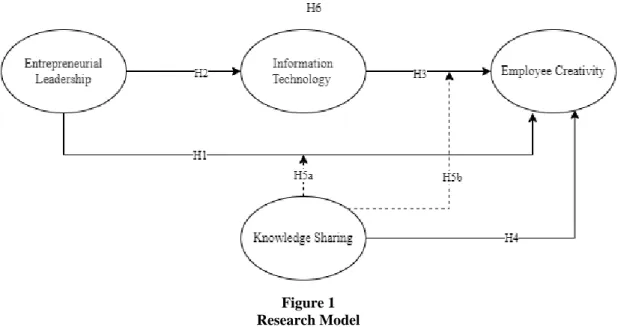
Figure 1 below shows the research model that the author did, employee creativity on the right is influenced by three variables, namely; entrepreneurial leadership, information technology and knowledge sharing. The information
technology variable acts as a mediator and the knowledge sharing variable becomes a moderator. Thus, these variables are predicted to affect employee creativity by involving mediators and moderators.
Figure 1 Research Model
RESEARCH METHOD
This study analyzes and explains the influence of entrepreneurial leadership on employee creativity which is moderated by knowledge sharing and mediated by information technology. The research population is all small and medium enterprises that are engaged in handicrafts and have an export orientation in Bali, totaling 42 businesses. The criteria used are export-oriented handicraft SMEs that have business consistency shown from a business license or are registered in Bali Provincial Trade Office and have been in business for more than five years. Sampling determination was carried out using the proportional sampling method involving three leaders, supervisors and employees from each SME with the provision that they were involved in product development activities at export-oriented handicraft SMEs in Bali so that the number of samples involved became 126 respondents. The purpose of using three samples from each SME is to get a closely related perception of employee creativity in export-oriented SMEs in Bali. The sample determination steps started with finding some information first whether the objects met the criteria to be used as the sample The use of export-oriented craft SMEs is they are the most dominant in applying employee creativity. Data was done by means of interviews and questionnaires in two stages. The first stage was carried out by collecting data from 30 respondents to test the research instrument through validity and reliability tests. Validity test is done by looking at the correlation coefficient of product moment (r) which is higher than 0.3 (r > 0.3). The reliability test was carried out by fulfilling the Cronbach's Alpha value higher than 0.6 (CA > 0.6) (Hair et al., 2017). The second stage after the instrument was declared feasible, then proceed to the process of distributing questionnaires to all
targeted respondents. The design of this study uses a quantitative approach and the analysis used is a structural equation model (SEM) based on partial least squares (PLS) with the application of WarpPLS 7.0.
ANALYSIS AND DISCUSSION Characteristics of Respondents
Based on the data collected, it can be seen that the characteristics of the handicraft SME managers are dominated by women by 57.9 percent, with an age range of 27 to 36 years 53.2 percent, high school / vocational education 67.5 percent, and a working period of 6 to 10 years 60.3 percent. From those characteristics, it can be seen that the management of SMEs is mostly done by women considering the role of women in Balinese society is very central, so it requires flexible time. In addition, the respondent's age and education level have the potential to cause a sense of reluctance to try new things. This is indicated by the working period of more than five years (Appendix 1).
Descriptive Analysis of Research Variables
The interpretation of the score from the perception given by the respondent for each question in the research instrument is described in Table 1. The results of descriptive statistical analysis show an overview of the research variables of entrepreneurial leadership (X), employee creativity (Y), knowledge sharing (M1) and information technology (M2) as follows:
Table 1
Research Variable Scores Interpretations Scores
Entrepreneurial Leadership Employee Creativity / Knowledge Sharing / Information Technology
1.00-1.80 Very low Very low
1.81-2.61 Low Low
2.62-3.42 Moderate Moderate
3.43-4.23 Good High
4.24-5.00 Very good Very high
Source: Umar (2013)
Description of entrepreneurial leadership variable (X)
Entrepreneurial leadership is recognized as a type of leadership with the ability to position handicraft SMEs in Bali in such a way that those SMEs can survive in the midst of competition. Entrepreneurial leadership is measured by three dimensions, namely innovative, proactive, and risk taking. Each dimension will be measured using several indicators described in the questionnaire, so that the respondents' perceptions of the entrepreneurial leadership variable can be seen in Table 2.
Based on the data in Table 2, it can be explained that entrepreneurial leadership in handicraft SMEs in Bali is in good category with an average score of 3.98. Of the three dimensions measuring entrepreneurial leadership, the highest score is the risk- taking dimension, with an average score of 4.05. This shows that the success of a leader in developing handicraft SMEs is very dependent on how brave they are in making decisions even though it must be based on a short-term orientation. In addition, leaders must also dare to be responsible for every result obtained, aa well as dare to take every opportunity that is created through the ability to absorb the uncertainty that occurs in the environment.
Table 2
Description of entrepreneurial leadership variable
Source: Primary data, processed, 2021
The proactive dimension is also in the good category with a score of 3.97 in strengthening entrepreneurial leadership in operating handicraft SME activities in Bali. The ability of entrepreneurial leaders to act quickly in facing changes, greatly helps handicraft SMEs in Bali to survive in the competition. In addition, entrepreneurial leaders always provide positive responses to every incident, always take the initiative to find new methods, are always aggressive in competing, observant to see opportunities that arise and respond quickly to innovative ideas that arise in the company.
The last dimension that measures entrepreneurial leadership is innovativeness, with an average value of 3.93, which means good category. This shows that entrepreneurial leadership has the ability to make changes to handicraft SMEs in Bali.
In addition, leaders also involve employees in developing new production processes.
Leaders also play a role in developing creative thinking in handicraft SMEs in Bali and are always active in seeking new ideas.
No Indicators Average STDEV Notes
Innovative 3.93 0.5905 Good
1 Have the ability to make changes 4.02 0.5995 Good
2 Develop creative thinking 3.96 0.6621 Good
3 Always active in looking for new ideas 3.76 0.7203 Good 4 Involve employees in product development 3.97 0.6383 Good
Proactive 3.97 0.7042 Good
1 Take the initiative to find new methods 3.96 0.8523 Good
2 Always aggressive in competing 3.95 0.8472 Good
3 Respond quickly to innovative ideas 3.89 0.7613 Good
4 Give positive feedback 4.02 0.8293 Good
5 Be observant of the opportunities that arise 3.94 0.8030 Good
6 Act quickly on changes 4.04 0.7940 Good
Risk-taking 4.05 0.6330 Good
1 Leaders dare to take advantage of every opportunity 4.06 0.8130 Good 2 Make decisions based on goal orientation 4.15 0.8007 Good
3 Able to absorb uncertainty 3.91 0.7901 Good
4 Be responsible for results 4.08 0.8353 Good
Entrepreneurial Leadership 3.98 0.5141 Good
Description of information technology variable (Y1)
Information technology is a technology that can be used by export-oriented handicraft SMEs in Bali to create, convert, store and disseminate information.
Information technology applied to handicraft SMEs in Bali is measured by four dimensions, namely, hardware, software, database, and brainware. Each dimension is measured by several indicators described in the research instrument. Statistical results from the description of information technology variables are shown in Table 3.
Table 3
Description of information technology variable
No Indicators Average STDEV Notes
Hardware 4.20 0.497 High
1 Have a computer device to help in operations activities
4.20 0.505 High
2 Have an internet network as a means of support 4.20 0.546 High
Software 4.23 0.606 Very High
1 Install a computer security system (anti-virus) to prevent data corruption
4.24 0.731 Very High
2 Use job support applications 4.22 0.566 Very High
Data base 4.19 0.493 High
1 Stored data is well organized 4.18 0.541 High
2 Through stored data, data can be processed quickly and easily
4.20 0.558 High
Brainware 4.27 0.349 Very High
1 The information system applied is easy to understand
4.22 0.432 Very High 2 The information system used is easy to operate 4.31 0.470 Very High
Information Technology 4.22 0.405 Very High
Source: Primary data, processed, 2021
The data shown in Table 3 reveals that information technology in handicraft SMEs in Bali is classified as very high. This can be shown from the average score of the information technology variable of 4.22. This shows that export-oriented handicraft SMEs in Bali realize that the need for technology is highly demanded. The most dominant dimension explaining information technology is the brainware indicator, with an average score of 4.27, which belongs to very high category. This explains that the high level of information technology is very dependent on the existing human capabilities. The availability of information technology will be determined by the extent to which employees can understand and use it. Furthermore, the software dimension has an average score of 4.23, which is in the very high category. The software dimension shows that the applications being used to help work can be maintained with the use of antivirus to protect information and data from damage. In addition, the hardware dimension also reflects information technology with high category average value of 4.20. This explains that the use of computers and internet networks can help handicraft SMEs in Bali. The last dimension of information technology is the data base with an average value of 4.19 which is included in the high category. Through well-organized and stored data, it can help processing the data needed by handicraft SMEs in Bali.
Description of employee creativity variable (Y2)
Employee creativity in this study is a form of implementation of ideas owned by employees that are useful for the advancement of export-oriented handicraft SMEs in Bali. In this study, employee creativity was measured using four dimensions, namely, person, process, press and product. The results of descriptive statistics of employee creativity can be seen in Table 4.
Table 4
Description of employee creativity variable
No Indicators Average STDEV Notes
Person 4.05 0.535 High
1 Creativity depends on intelligence 3.97 0.644 High
2 Knowledge helps increase creativity at work 4.10 0.612 High 3 Personality helps support creativity at work 4.09 0.566 High
Process 4.12 0.547 High
1 Have the ability to think creatively 4.21 0.679 High
2 Have the ability to elaborate ideas 4.03 0.724 High
Pressure 3.98 0.655 High
1 Creativity comes from employee passion 4.10 0.679 High 2 Creativity that you own comes from desire 3.86 0.724 High
Product 4.11 0.528 High
1 Through creativity, employees can produce new works
4.18 0.557 High
2 Through creativity, employees can combine existing products
4.03 0.644 High
Employee Creativity 4.07 0.484 High
Source: Primary data, processed, 2021
The data depicted in Table 4 shows that the creativity of employees in handicraft SMEs in Bali is high. This can be seen from the average score of the employee creativity variable of 4.07. The dimension that determines employee creativity the most is the process indicator, with an average score of 4.12. This explains that employee creativity tends to be carried out during the work process, where employees can implement creative thinking skills and the ability to elaborate ideas dengan kategori tinggi. The product dimension shows that through the creativity of SME employees, handicrafts in Bali can produce new products or combine them with the existing products. In addition, the person dimension also reflects the creativity of employees with the average value of 4.05 which means high. This explains that the success of employees in implementing their creativity depends on the individual personality. This can be seen from the knowledge possessed, the personality, as well as the level of intelligence, so that from this personal ability the creativity of employees can be seen. The last dimension is pressure or the push that comes from within, with the average value of 3.98 which means the category is high. This creativity usually arises from the passion and desire of each individual.
Description of knowledge sharing variable (M1)
Knowledge sharing is an action carried out without any element of coercion in disseminating information by employees, either with individuals or groups of employees, at export-oriented handicraft SMEs in Bali. This is measured by two dimensions, namely, knowledge donation and knowledge collection. Each dimension is measured by several indicators described in the research instrument. The statistical results of the description of the knowledge sharing variable are shown in Table 5.
Table 5
Description of knowledge sharing variable
No Indicators Average STDEV Notes
Knowledge Donation 3.99 0.543 High
1 Share knowledge with coworkers without having to be asked
4.10 0.558 High
2 Receive knowledge from coworkers without asking 3.95 0.668 High 3 Sharing new knowledge is a common thing 3.84 0.742 High 4 Provide knowledge that you have without having
to be asked
4.01 0.651 High
5 When I learn something, I always share it with my coworkers
4.05 0.631 High
Knowledge Gathering 4.01 0.647 High
1 Share knowledge if asked 3.95 0.691 High
2 Share skills if asked 3.95 0.714 High
3 Ask coworkers for knowledge if needed 4.08 0.652 High
4 Colleagues provide knowledge if necessary 404 0.814 High
Knowledge Sharing 4.00 0.488 High
Source: Primary data, processed, 2021
Table 5 shows that knowledge sharing has a good role in handicraft SMEs in Bali, with a score of 4.00. Of the dimensions that measure knowledge sharing, the most dominant is knowledge collection with an average value of 4.01 which means the good category. Following that, is the knowledge donation dimension with an average value of 3.99 which means the good category. These results provide the view that handicraft SMEs in Bali need knowledge as a medium to develop those SMEs. Knowledge gathering can be done within the organization by asking colleagues. Meanwhile, employees can donate or share their knowledge. From this process, new knowledge will be created that is useful for the advancement of handicraft SMEs in Bali. In addition, by sharing knowledge, employees can improve their individual abilities and be able to increase their creativity.
The measurement of the effect shown from each construct was carried out using WarpPLS through two stages, namely, evaluation of the measurement model or outer measurement model and evaluation of the structural model or inner model.
Evaluation of the measurement model or outer measurement model
Evaluation of the measurement model aims to determine the validity and reliability of the constructs used. Through this measurement it can be seen whether the
model is declared valid and reliable. The stages of the evaluation of the measurement model are convergent validity, discriminant validity, and composite reliability.
Convergent Validity
At this stage, a reflective indicator must meet the convergent validity criteria to be declared valid. This evaluation is based on the value of the outer loading coefficient of each indicator on the latent variable. (J. Hair et al., 2010) stated that an indicator is declared valid if it has an outer loading value of 0.4. Based on the results of data processing shown in Table 6, it can be seen that all indicators used are declared valid because they have an outer loading value in accordance with the criteria.
Table 6
Outer loading value indicators
Variables Indicators Outer Loading
Entrepreneurial leadership (X) Innovative(X1) 0.824
Proactive (X2) 0.771
Risk-taking (X3) 0.476
Employee creativity (Y2) Person (Y2.1) 0.882
Process (Y2.2) 0.794
Pressure (Y2.3) 0.884
Product (Y2.4) 0.544
Knowledge sharing (M) Knowledge donation (M1) 0.955
Knowledge gathering (M2) 0.955
Information Technology (Y1) Hardware (Y1.1) 0.888
Software (Y1.2) 0.740
Database (Y1.3) 0.825
Brainware (Y1.4) 0.782
Source: Primary data, processed, 2021
Discriminant validity
After seeing the value of the outer loading of each indicator used, it is continued by looking at the value of each construct. Discriminant validity is based on the average variance extracted (AVE) value and the average variance extracted (√AVE) squared value with construct correlation (rule of thumb: AVE > correlation between constructs) with a cut off value of ≥ 0,50 (Hair et al., 2010). The analysis carried out shows that the discriminant validity value is in the adequate category. The results of the analysis are presented in Table 7 below:
Table 7
AVE Value, √AVE, composite reliability, Cronbach alpha, Q2 coefficients and VIFs
Variables AVE √AVE CR CA Q2
coef. VIFs R-Sq.
Entrepreneurial leadership 0.500 0.707 0.741 0.781 - 2.014 - Information Technology 0.657 0.811 0.884 0.824 0.358 2.075 0.364 Employee creativity 0.621 0.788 0.864 0.785 0.487 1.588 0.579
Knowledge sharing 0.912 0.955 0.954 0.903 - 2.362 -
Source: Primary data, processed, 2021
Composite reliability
Table 7 presents the information that all constructs meet the criteria for composite reliability with a value criterion of 0.7 (CR ≥ 0.7) and Cronbach Alpha value with a criterion value of greater than 0.6 (CA ≥ 0.60). From the results obtained, all constructs are declared feasible because they have met the reliability criteria. In addition, the results also confirm the value of the variance inflation factor (VIFs) below 3.3 (VIFs < 3.3) so that it can be explained that there is no multicollinearity in the model. Furthermore, the values of the dependent variable Q2 coefficients of 0.358 and 0.487 indicate that the model has a significant goodness of fit (GoF) (Hair et al., 2017).
Structural model atau inner model evaluation
Evaluation of the structural model aims to measure how much influence the variation of certain exogenous latent variables has on endogenous latent variables. The approach used is, Q-Square predictive relevance (Q2), effect size and hypothesis testing.
Q-Square predictive relevance (Q2)
Measurement of Q-Square predictive relevance (Q2) is carried out by calculating the R-square value of the endogenous variable as shown in Table 7. As for the R-square value of each endogenous information technology variable (0.364) and employee creativity (0.579), then the Q-Square predictive relevance (Q2) calculation is carried out with a formulation that refers to Geisser (1975) and Stone (1974), as follows:
Q2 = 1 – (1 – R12) (1 – R22) ……. (1 – Rp 2) ... 1 Q2 = 1 – (1 – 0.3642) (1 – 0.5792)
Q2 = 1 – (1 – 0,132) (1 – 0,335) Q2 = 1 – (0,868) (0,665) Q2 = 1 – 0,577 = 0,423
From the calculation of Q-Square predictive relevance (Q2), the result is 0.423 so it can be explained that the relationship that is built can predict the model by 42.3 percent, while 57.7 percent is influenced by errors or other variables not explained in the model.
Effect size
According to Hair et al. (2013a) the measurement of effect size has three categories, namely weak (0.02), moderate (0.15), and strong (0.35). The results of the analysis show the correlation of entrepreneurial leadership with employee creativity (0.024) in the weak category, entrepreneurial leadership with information technology (0.364) in the strong category, knowledge sharing with employee creativity (0.297) in the medium category, information technology and employee creativity (0.177) in the medium category, moderation of knowledge sharing on entrepreneurial leadership (0.057) in the weak category, and moderation of knowledge sharing on information
technology (0.024) in the weak category Hypothesis Testing
After evaluating the model using the SEM-PLS approach with the WarpPLS 7.0 analysis tool then the test results are obtained based on the path coefficient and p- value, which can be seen from Figure 1 and Table 8 below:
Figure 2
Full Model Analysis of SEM-PLS Table 8
Path coefficients Relationship between
variables Path coefficients p-values S.E Notes
EL→EC 0.057 0.259 0.088 Not supported
EL→TI 0.604 <0.001 0.077 Supported
TI→EC 0.332 <0.001 0.082 Supported
KS→EC 0.465 <0.001 0.080 Supported
KS*EL→EC -0.201 0.010 0.085 Supported
KS*TI→ EC 0.098 0.131 0.087 Not supported
Source: Primary data, processed, 2021
Notes: Entrepreneurial Leadership (EL), Information Technology (TI), Employee Creativity (EC) and Knowledge Sharing (KS).
Figure 1 and Table 8 give the information that entrepreneurial leadership has no significant, positive effect on employee creativity which is seen from the path coefficient value of 0.057 and p-value 0.259 (not supported). Entrepreneurial leadership has a significant positive effect on information technology as indicated by the path coefficient value of 0.604 and p-value <0.001 (supported). Information
technology has a significant positive effect on employee creativity as seen from the path coefficients 0.332 and <0.001 (supported). Knowledge sharing has a significant positive effect on employee creativity with path coefficients value of 0.465 and p-value
<0.001 (supported). The results of the analysis also show the role of knowledge sharing as pure moderation of entrepreneurial leadership on employee creativity with path coefficients -0.201 and p-value >0.001 (supported). While the role of knowledge sharing as a moderating predictor of the influence of information technology on employee creativity with a path coefficient value of 0.098 and a p-value of 0.131 (not supported).
Mediation testing uses Sobel's (1982) formulation, which aims to determine its significance. The formulation is as follows:
𝑍 𝑣𝑎𝑙𝑢𝑒 = 𝑎𝑏
√(𝑏2.𝑆𝐸𝑎2)+(𝑎2.𝑆𝐸𝑏2)
... 2
𝑍 𝑣𝑎𝑙𝑢𝑒 = 0,349 . 0,173
√(0,3322. 0,0772) + (0,6042. 0,0822)
Z value = 3.5977956
Based on the calculation, the Z value has a value of 3.5977956 which is higher than the value of 1.96 at an error rate of 5 percent (a = 0.05), from this value it means that this test is significant. Thus, it can be concluded that information technology plays a role in mediating the influence of entrepreneurial leadership on employee creativity.
(Hair et al., 2010) explained that if the direct effect of exogenous variables on endogenous variables is not significant, while the effect of exogenous variables on mediating variables is significant and the mediating variables have a significant effect on endogenous variables, then the mediating variable is proven to be a full mediator.
From this explanation, it can be seen that hypothesis 7, which states that knowledge sharing mediates the effect of entrepreneurial leadership on employee creativity, is supported.
Discussion
The analysis conducted shows that entrepreneurial leadership has a positive and insignificant effect on employee creativity. This shows that the application of leadership with an entrepreneurial approach has not been able to increase employee creativity so that the first hypothesis is not supported. Employee creativity basically arises from within employees and has a tendency to come from their own desires, so that it cannot be influenced by other people, including the leaders. A leader with an entrepreneurial approach that puts forward innovative, proactive and risk-taking behavior that is more appropriate as a strategy to achieve goals by maximizing the opportunities created. This also illustrates that leaders with an entrepreneurial spirit who are always actively looking for new ideas have not been able to increase the creativity of their employees. Likewise, foresight in seeing opportunities does not make employees more creative. To be able to increase employee creativity, leaders are
not only fixated on organizational achievements, but they must be able to motivate employees (Fontana & Musa, 2017; Gu et al., 2015; Riana et al., 2020). In addition, leaders must provide space for employees to develop their abilities and creativity (Jyoti
& Dev, 2015). This finding shows a different result compared with the previous studies. Chen (2007) explained that leadership with an entrepreneurial approach can stimulate team creativity. Fontana & Musa (2017); Huang et al. (2013) stated that entrepreneurial behavior possessed by leaders always strives for creativity so that they are able to adapt to changes (Cai et al., 2019; Noruzy et al., 2013).
Entrepreneurial leadership significantly and positively influences information technology. This result explains that the application of entrepreneurial leadership can support/increase the use of information technology in SMEs. This also reflects that the leaders have the ability to develop changes so that they can quickly adapt to technological developments. Thus, the use of hardware, software, databases, and brainware can support export-oriented handicraft SMEs in Bali. This is because entrepreneurial leaders who have an orientation towards organizational achievement strongly support the use of information technology in their organizations (Hickman &
Akdere, 2018; Neufeld et al., 2007). In addition, entrepreneurial leadership basically has the technical ability to develop a vision by maximizing information technology to encourage organizational effectiveness (Ingebrigtsen et al., 2014; Palladan et al., 2016). Currently, the concept of e-business becomes an alternative for business actors as a medium, and surely it requires leaders to support the use of information technology to improve relationships and collaboration with consumers (Peterson &
Fairchild, 2003). Given the information that technology has now become an important part of human life including organizations, it is natural that information technology becomes a priority for leaders and business departments in the future because it will offer convenience for businesses to enter the markets. Maximizing the role of information technology can assist organizations in marketing their products.
A positive and significant effect is also shown by information technology on employee creativity. These results indicate that the better the adoption of information technology, the more it can increase employee creativity. This is because employees can find out new things through the media that can be accessed through information technology. The application of information technology can help improve the intelligence capabilities of employees. In addition, through information technology employees can access many things that can help in their works (Cooper, 2013).
Furthermore, through developed information technology, employees are more creative to learn, apply and develop new things (Dewett, 2003). The use of information technology can be a source of creativity as long as it is balanced with knowledge management (Korzynski et al., 2019). Chen et al. (2015); Kandampully et al. (2016) mentioned the use of information technology to increase organizational creativity in improving customer relationships by utilizing social networks (Sigala & Chalkiti, 2015). This finding supports the previous research which revealed that information