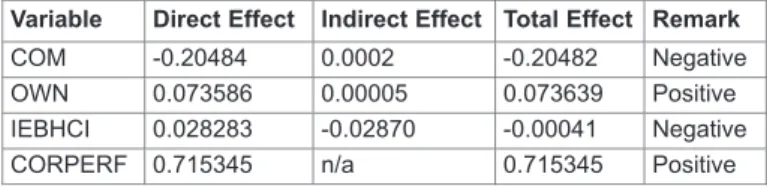
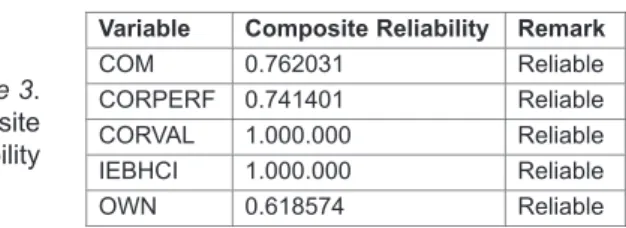
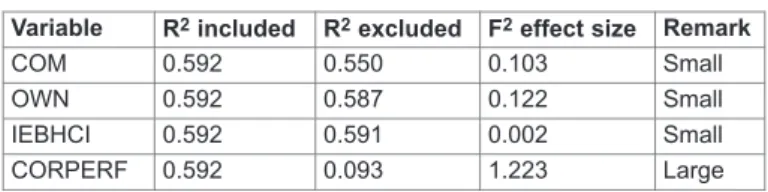
Convergent validity value is the value of the loading factor in the latent variables with their indicators. 2006). The Impact of Internal and External Governance on Agency Costs of Debt: International EvidenceURL:. 2008).Dasar. The Relationship between Corporate Governance and the Value of the Firm in Developing Countries: Evidence from Bangladesh. The International Journal of Applied Economics and Finance. Vol.
SIMILARITY INDEX
INTERNET SOURCES
PUBLICATIONS
STUDENT PAPERS
Corporate governance and corporate value: The mediating role of human capital-based investment performance.
Instructor
PAGE 2
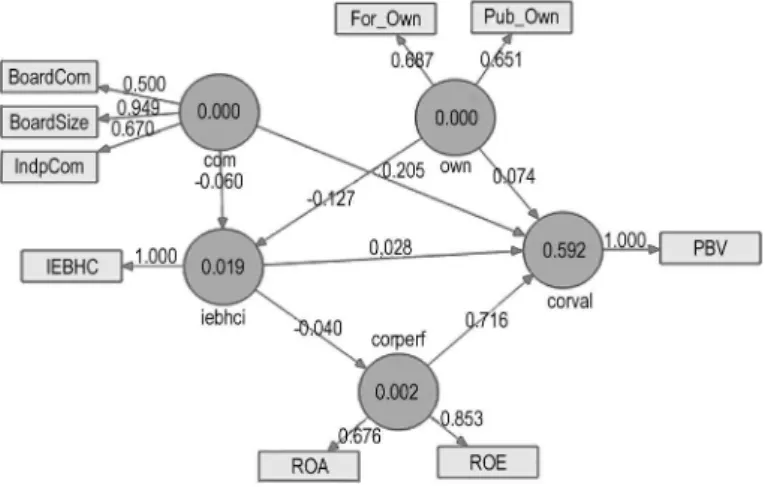
Corporate governance and firm value: The mediating role of investment efficiency based on human capital (Article). The study offers a new concept and theoretical framework for future investment efficiency theory development based on human capital (IEBHC), which combines agency theory and resource-based theory to fill the research gap between corporate governance and firm value. The results show that IEBHC is a significant mediator between corporate governance and corporate value.
Corporate governance enforcement, audit quality and audit report delay: The moderating role of legal compliance. The Impact of Corporate Governance Mechanisms on Firm Value Evidence from Iran's Food Industry (2012) Journal of Basic and Applied Scientific Research, 2 (5), p. 2011) Corporate Governance and Intellectual Capital DelCema University MCMLXXVIII. Impact of Corporate Governance and Financial Leverage on the Value of American Firms (2013) International Research Journal of Finance and Economics, (91), p. 2001) The Impact of Foreign Board Membership on Firm Value, p.
The relationship between corporate governance and firm value in developing countries: Evidence from Bangladesh. Corporate Governance and Firm Performance: A Study of Sri Lankan Manufacturing Companies (2013) Journal of Economics and Sustainable Development, 4 (3), p.
380 Citations
Subject area: Business, Management and Accounting: Business and International Management Business, Management and Accounting: Strategy and Management.
782 Documents
Quality - Access to Success
Evolution of the total number of journal citations and self-citations received by a journal's published papers over the previous three years. Evolution of the number of total citations per document and external citations per document (i.e. self-citations removed from journals) received by a journal's published papers over the previous three years.
CONTENTSCONTENTS
QUALITY MANAGEMENT
Introduction
QMS as a factor of increasing the competitiveness of enterprises
Integration of the Quality Management and Strategic Management Systems into Unified Management System of Enterprises
Tatyana ANDREEVA 1 , Lola POPOVA 2* , Marina YASHINA 3 , Liliya BABYNINA 4 , Nadezhda YAKSANOVA 5 , Elena NATSYPAEVA 6
Integrating of quality management and strategic management into a single
4.Diagnostic audit of the organization's current management system (in terms of strategic management and quality management). During the audit of existing management systems, an expert evaluation of the documentation governing the activities of the organization takes place. 5. Determine the configuration of the integrated management system and the organizational structure of the company after its integration.
This will help to remove or level the barriers that arise in the management system processes as a result of their overlap on the functional structure of the organization, and to increase the efficiency of the activity. This algorithm includes a diagnostic self-assessment procedure based on the criteria developed to determine the level of maturity of the management systems operating in the company. The subject of management: the organizational and economic relationships that arise in the integration and mutual functioning of the systems of strategic management and quality management.
Management approaches to management system integration: scientific; process, system, based on risk management. 10. Integration model – quality management processes based on the process approach and the basic principles of quality management (customer focus, continuous improvement, etc.) are embedded in the model of the strategic management system (containing the main stages of the management system). ment system).
The advantages of using an integrated management system based on the example
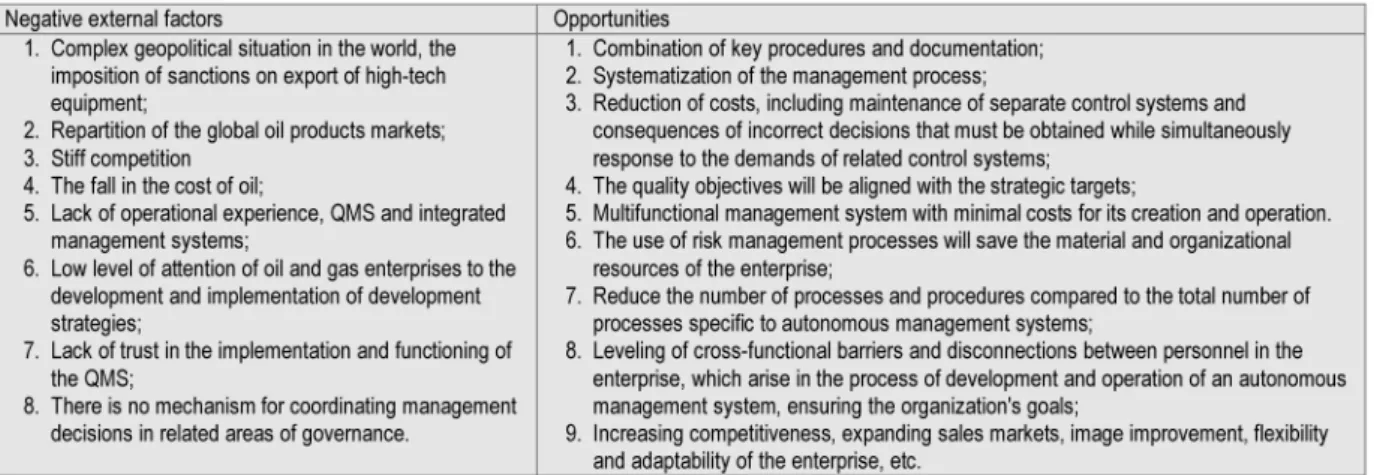
171/August 2019 Approach to SuccessQUALITY 12. Results: unified policy of the organization; optimal use of 12. Results: unified policy of the organization; optimal use of. 13. Advantages of integration: multi-functionality of the management system with minimal cost for its creation and operation; complex planning of enterprise development, which takes into account all interested parties and their requirements: shareholders, investors, consumers, personnel, society; market preferences; reducing the level of conflicts and possible contradictions between functional activities; efficient allocation of resources through an analysis of the effectiveness (efficiency) of costs and risks of planned activities; reducing the number of processes and procedures compared to the total number of specific processes for autonomous management systems; leveling interfunctional barriers and disconnections between personnel in the enterprise that arise in the process of development and operation of an autonomous management system, ensuring the goals of the organization; financial preferences; administrative advantages; legal benefits (assessment and determination of legal requirements, compliance with legislation, improved interaction with regulatory authorities); Expansion of intangible assets: patents, brand value, business reputation, business traditions of the enterprise, level of management within the enterprise, etc.; increasing competition, expanding product markets, improving image, etc.
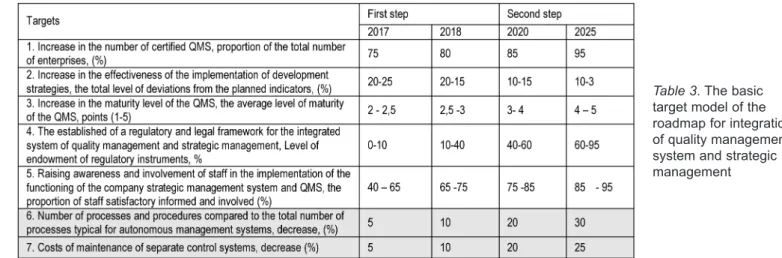
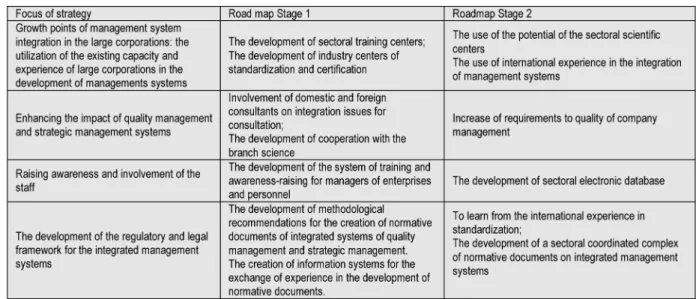
Matrix of integration of quality management and strategic management in the aspect of BSC's custom system and quality management methods used. The basic goal model of the roadmap for the integration of the quality management system and strategic management. Such a development scenario is provided in the designed roadmap for the sustainable development of oil and gas companies under the strategic initiative of the integration of the quality management system and strategic management (Tables 2-4).
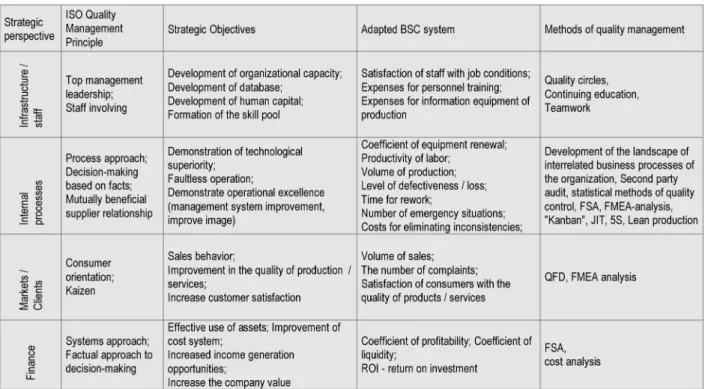
Roadmap for the Strategic Initiative
34;Integration of the Quality Management and Strategic Management System"
Conclusion
Optimizing the Education Process of a Company Employees by BPMN (Business Process Modeling & Notation)
Anna ČEPELOVÁ 1* , Darina KOREŇOVÁ 2
- Education of employees as a part of company processes
- Employee training
- Process approach and process maps
- Research and methodology
- Results
- Conclusion
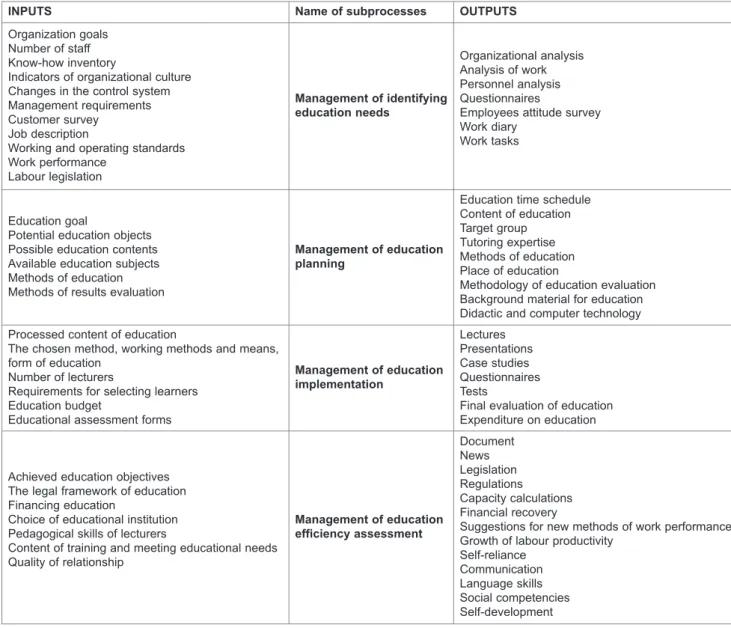
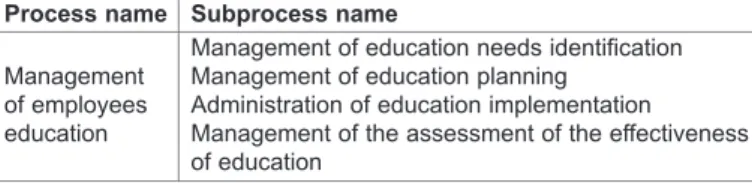
The first phase of the education process is to identify the needs of education and employee development. The third sub-process is the realization of the own process of education and development. Mostly, the literature describes process divisions according to the importance and purpose of the process.
The article presents a model of the process of employee training in large and medium-sized companies. The aim of the article is to design a model for the process of employee training in companies as a tool for optimizing business processes. Analysis and description of the business processes in preparation for the workload and work content;
Process description as a basis for the introduction of new systems, applications of the business information system. Improving the quality of the educational process and the quality of the knowledge that the graduate acquires during the educational process.
Optimisation of Milk Run Logistics
- Literature Review
- Overview of the manufacturer in this study
- Problem Definition
- Logistics activities of the manufacturer
- Procurement and Distribution
- The Method of Bill-to, Ship-to
- Methodology
- Participant Observation
- Value Stream Mapping
- Scope of Scrutiny
- Results
- Conclusion
- Limitations and Future Scope
- Literature Overview
- Quality Function Deployment
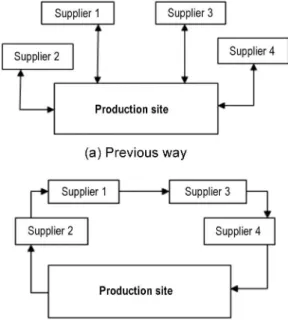
A self-reliant group that was fully focused on reducing carbon dioxide emissions launched "The Milk Run". Results have shown that the milk run system is cheaper than the conventional system (Moura and Botter, 2016). The milking schedule for trucks T1 and T2 is as shown in Table 2 and its corresponding current state value current map in Figure 4.
Manufacturing plant/LOG Delivers: Raw materials, semi-finished products, empty containers Table 2. Current timetable for milk delivery to the industrial area. The milk schedule for truck T1 is as shown in Table 3, and its corresponding value stream map is as shown in Figure 5. The milk schedule for truck T2 is as shown in Table 5, and its corresponding value stream map is as shown in Figure 6.
Future Value Stream Map of Milk Run in the Industrial Area Milk Run in the Industrial Area. The manufacturer has improved its milk production operation to synchronize procurement activities with that of production activities through participant observation and value stream mapping.
Determining the Importance of Customer Requirements in QFD – A New Approach based on Kano Model
The Quality Function Deployment (QFD) method was first introduced in the late 1970s (Akao, 1990) and is now ranked as one of the most widely used integrative approaches supporting a better understanding of customer requirements. This slightly technocratic approach is designed to define the parameters of a “better product” – one that better meets customer requirements. One of the crucial factors for the proper use of QFD is correctly identifying and understanding the importance of the customer's requirements.
Several methods have been developed to explicitly and implicitly determine the importance of customer requirements with varying degrees of accuracy. Accuracy is important because the less inaccuracy there is in determining the importance of the customer's requirements, the more likely it is that the QFD will not only be verified, but validated. At the same time, accurately expressing the importance of customer requirements is a critical factor that affects everything that follows.
A comparison of the results of applying multiple methods will ensure better informed decisions when selecting appropriate methods to determine the importance of customer requirements in the design or redesign of products. This study includes a comparison of four existing methods for determining the importance of customer requirements along with one newly developed method.
It is a method which allows the psychological/non-technical aspects of quality (customers' voice) to be linked with the technical aspects (engineers' voice) (Violante, 2015). Practical experience also shows that the determination of importance is the most critical step in the adequate use of QFD because it affects all the following steps (Nahm, 2013). Although the literature includes several studies that compare different methods for determining the importance of requirements in QFD, they almost always compare only two at a time.
It is only possible to assess the accuracy of the methods included in the given study. The present paper aims to fill this research gap and discusses the methods of determining the meaning of requirements with the aim of better understanding the voice of the customer. The original Japanese name for QFD was “hin shitsu ki no ten kai”, where hin shitsu means quality or properties/attributes, ki no means function or mechanization and ten kai means implementation, diffusion or development (Chaudha, 2010).
This method became popular after its successful application in the automotive industry in the 90s and was gradually refined in the area of product design improvement, achieving maximum customer satisfaction or supporting decision-making processes (Kuo, 2012). The first matrix – product planning matrix – translates CRs into TRs, the second one – part planning matrix – translates important TRs into product/part attributes, the third one – process planning QUALITY.
Peter MADZÍK 1 *, Ľudmila LYSÁ 1, Pavol BUDAJ 1
2019 Archive
2018 Archive
2017 Archive