KORESPONDENSI JURNAL IREME
Judul Artikel : Development of 18 DOF Salamander Robot Using CPG Based Locomotion for Straight Forward Walk
Penulis : M. Munadi, Mochammad Ariyanto, Kharisma A. Pambudi, Joga D. Setiawan Nama Jurnal : International Review of Mechanical Engineering (IREME)
Volume Jurnal: 13, Nomor Jurnal: 1, Tahun Terbit Jurnal: 2019, Halaman: 70-77, ISSN: 2532-5655, Penerbit: Praise Worthy Prize
No Kegiatan Tanggal Keterangan
1
a Submit manuscript to IREME 16 November 2018 OJS:
The initial original manuscript received
b Confirm editorial staff to author
16 November 2018 Email c Confirm author to editorial
staff
24 Januari 2019 Email 2 a Request for revision 1:
Editor and comments from reviewers
03 Maret 2019 Email
(Decision of manuscript: minor revision)
b Revision-1 18 Maret 2019 - Email
- Revised manuscript - Review response 3 a Request for revision 2:
Accepted with minor revisions
25 Maret 2019 Email
b Revision-2 1 April 2019 Final manuscript
4 a Editor Decision (Final) 02 April 2019 Email b Confirm author to editorial in
chief
05 April 2020 - Email
- Treatment of personal data and copyright transfer agreement c Confirm editorial to author 10 April 2019 Email
d Post -publication services 08 Mei 2019 Email
Note:
Komentar untuk karya penelitian : 'Judul Artikel: Development of 18 DOF Salamander Robot Using CPG Based Locomotion for Straight Forward Walk, Penulis: Munadi M., Mochammad Ariyanto, Kharisma A. Pambudi, Joga D. Setiawan, Nama Jurnal: International Review of Mechanical Engineering (IREME), Volume Jurnal: 13, Nomor Jurnal: 1, Tahun Terbit Jurnal: 2019, Halaman: 70-77, ISSN: 2532- 5655, Penerbit: Praise Worthy Prize, DOI: https://doi.org/10.15866/ireme.v13i1.16464': Artikel ditulis di Jurnal Int bereputasi. Tetapi kelengkapan Jurnal Kurang, tidak ada tanggal submission, reviewed dan accepted. Pengusul diminta menyertakan bukti korespondensi dengan pihak jurnal.
International Review of Mechanical Engineering (I.RE.M.E.), Vol. xx, n. x
Development of 18 DOF Salamander Robot Using CPG Based Locomotion for Straight Forward Walk
M. Munadi
1, Mcochammad Ariyanto
2, Kharisma A. Pambudi
3, Joga D. Setiawan
4Abstract – The utilization of mechatronics, robotics, and control systems has been widely spread in many areas over the last few decades. Robotics research is widely used for industrial purposes such as wheeled robots and manipulators, but now many robot research incorporating biomimetic science that we often call biorobotics. This paper will present a preliminary research in the field of biorobotics with a robot salamander model that can walk straightforward using a central pattern generator (CPG). This robot model uses a legged locomotion system that has 18 degrees of freedom (DOF). The CPG based locomotion model will be developed for controlling the gait cycle when the robot walks.
The motions of joint angle inputs resulted from CPG model will be simulated using SimMechanics 3D Animation and implemented on the proposed salamander robot for straightforward walk. Based on the result in both virtual reality simulation and experimental work, the predefined joint angle inputs in salamander robot can be used to drive the robot to do straightforward walk that can mimic the walking of the real salamander naturally.
Keywords: Robot Salamander; 18 DOF; Central Pattern Generator (CPG); 3D Animation
I.
Introduction
In some cases of disasters such as flood, earthquake, tsunami, or landslide are often found to be buried or trapped in an avalanche or ruin. In such a case it is not possible to send people to enter the gaps or holes formed.
Therefore it is necessary to create a system that can solve this problem. One alternative is a robot that can enter the hole/slit and can move on land or in the water bringing the camera to see in the dangerous conditions. Based on this condition, salamander robot is chosen because the salamander is one of the amphibian reptiles that can move both on land and water.
In this research, the proposed salamander like-robot model adapts the salamander robot that has been researched in the previous studies [1-4]. The robot [1,2]
has 27 DOF, 11 DOF on the spine and four DOF on each leg [2]. The robot uses a servo motor as its actuator. The legged locomotion of the salamander like-robot is developed by using central pattern generator (CPG) method.
The salamander robot [1-4] which has been developed used two types of locomotion that is terrestrial locomotion to walk on the land and aquatic locomotion to swim on the water. In this study, the proposed salamander robot only used terrestrial locomotion
because the research study focused on the motion of straightforward walking on the land. The swimming mode of the salamander like-robot will be developed in the future study
CPG Based locomotion inspired scientists and engineers to build robots by mimicking spinal cord of the animals. CPG is the key mechanism of generating adaptive and versatile locomotion in animals [5]. CPG generates motion system instantly on a legged robot-like spine-based control system [6]. CPG based locomotion has been successfully implemented in legged robot research such as snake robot locomotion [6-9], hexapod robot [10-11], robotic fish [5,12- 14], salamander robot [1-4], and quadruped robot [15].
The proposed of salamander like-robot in this paper uses a smaller number of DOF i.e. eight on the spine, three on each front leg and two on each rear leg. The simplification of DOF is conducted to reduce the number of actuators so that the design becomes simpler and the salamander robot will have a smaller dimension than the previously developed robot as in reference [2]. This is done to meet the initial goal of creating a salamander like-robot that is applicable for Search and Rescue (SAR) purpose.
In the developing of the kinematics locomotion based on central pattern generator (CPG) for each joint, the model of salamander like-robot uses CPG approach by dividing the salamander robot body into smaller segments that can represent the segmentation function of the actual salamander
1a
body as performed by ref. [1]. The CPG based locomotion of the spinal cord of the salamander like-robot is represented by eight joints with nine links from head to tail model. Each left and right of the front leg has three DOF that can determine the direction of the straightforward walk. Each rear leg has two DOF because of its more passive movements than the robot's front legs.
After building the CPG based locomotion, the results of CPG model is implemented in 3D animation under SimMechanics First Generation environment, such as in reference [16]. To verify the legged locomotion based on CPG model in 3D animation simulation, the CPG model is embedded on the robot salamander microcontroller using 32 bit Arduino Due. The robot is tested on the straightforward walking as in the 3D simulation.
II.
Salamander Robot Model
II.1. 3D CAD Design
In this paper, the development of 3D CAD model on salamander like- robot was conducted in parallel with robotic prototype assembly. 3D CAD design of the salamander like-robot model was performed using SolidWorks computer-aided design (CAD) software. The SolidWorks CAD software was chosen because of its ease of use. 3D CAD models and the prototype of salamander like-robot that had been developed can be shown in Fig. 1.
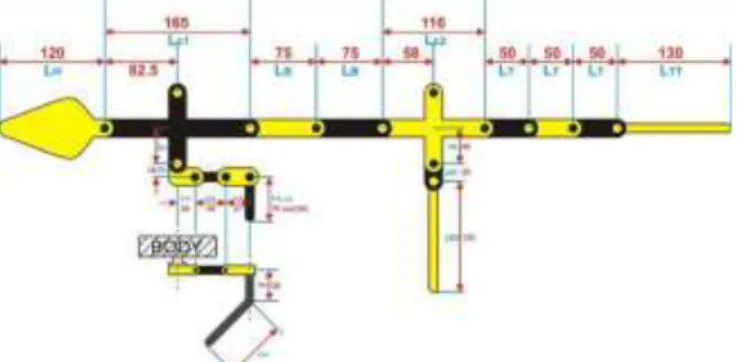
The dimension of the salamander robot can be seen in Fig. 2. From Fig. 2, it can be seen that the dimensions of the body part in the front legs and the rear legs are not similar. The forelimbs of the front legs were used for the controller's place and the rear legs were used for the battery’s place. The result of 3D salamander robot model from CAD software as shown in Fig. 1 was exported in SimMechanics block diagram under MATLAB/Simulink environment using SimMichanics Link plugin. The plugin can be downloaded freely from the Mathworks website. The results of SimMechanics block diagram will be used as 3D animation of salamander robot motion. The 3D animation will visualize the motion of salamander robot on straightforward walk in 3D view environment.
SimMechanics toolbox from MATLAB/Simulink software is a powerful tool for 3D animation purpose of a mechanical system. It can simulate the motion of mechanical system by giving it with the joint input in 3D view environment. SimMechanics 3D animation had been successfully developed for 3D virtual of five DOF robotic hand on the previous works [17,18]. The 3D animation of robotic hand can be driven by giving the revolute joint angle inputs for each finger in SimMechanics block diagram. This salamander like- robot model for 3D animation used revolute joints to model the joint body of the proposed salamander robot in SimMechanics.
Fig. 1. 3D CAD assembly of the proposed 18 DOF salamander robot
II.2. Gait Cycle for Straight-Forward Walking Movement
In Fig.1, there is a shaft supporting the body of a salamander robot model between the two joints of the body and the front legs. This is because the point is the front Central Pattern Generator (CPG) which becomes the reference on the straightforward walk. The point/CPG in the salamander robot model does not move against time. The next thing to do is to develop the kinematics equation of motion (EOM) based on CPG legged locomotion, starting from the head to tail tip. When walking, the salamander form S-shape standing wave with a length of 1 λ from head to tail tip. Two points that become the reference when doing straightforward walking movement is the center point of the connecting body of the front legs (front CPG) and the center point of the rear legs connecting body (rear CPG).
The movement of the front legs adjusts the body movements of the robot salamander. As the front body of the salamander robot leans to the right, the left front leg goes forward. When the front body of the salamander robot is leaning to the left, the left front leg retreats as it moves forward. Rear legs movement is the opposite of the front legs movement. When the left front leg stepped back, the rear right leg stepped back simultaneously. While the rear left leg moves with the tip of the foot forward. Both the front legs and rear legs have same distance step. So make the salamander robot can walk straightforward
Fig. 2. The dimension of the body links in the salamander robot
III.
CPG Based Locomotion Model
In this section, the straightforward walk kinematics motion of the salamander robot would be developed to determine the angles formed by each joint on the head, body, legs, and tail of the salamander robot. The front CPG was used as a reference to the straightforward walking movement of salamander robot. The joint angles on the head, body, and tail can be shown by Fig. 3. The body angle on the front CPG oscillated by θC1 to the centerline, as shown in Fig. 3. The initial angle of θC1 is 0°, so it can be written in a sinusoidal equation using the parameters as shown in Fig. 2, and it can be expressed by equation (1).
1 1(max)
1 4( ) (max) 1
1 1 1(max)
1 4( ) 1
0 2 1 2 2 2 1
sin( t)
cos cos cos( )
sin sin sin( )
S S sin ( cos ) sin( )
C C
f C C f f top f
C f f
C C f f top f
C C b b b C b
d D L L
S D L L
D L L
=
= + − −
= + −
= + + −
− = + + −
(1)
Fig. 3. Joint angles in the salamander robot.
III.1. Head Movement (θH)
The head of the salamander robot is always facing forward, in the other words the head angle θH always parallel to the centerline. Then the angle on the joint of the head must be opposite direction and equal to θC1. The angular equation for the head joint can be written as in equation (2).
H = −C1 (2) III.2. Body Movement (θC2, θB1, θB2, θB3) The length of the two joints in front body LC1 and the length of two joints on the rear body have the same distance to the centerline. The value of θC2 can be defined as expressed in equation (3).
2 1 1
2
sin C C sin C
C
L
= L (3) The abdomen of the salamander robot forms half wave. There are four links on the abdomen, so to form a half-wave joint in the middle must be the peak of the wave. The second and third links have the opposite angle of the direction and the same magnitude towards the centerline that is half of C1, B1can be defined as in equation (4).
1 1
1
B 2 C
= − (4)
From the equation (4), the joint angles of θB2 and θB3 can be calculated using equation (5), and (6).
2 1
B C
= − (5)
3 2 1
B C B
= − (6)
III.3. Tail Movement (θT)
In the straightforward walking motion, the salamander robot 's tail forms half wave opposing its body. In the CPG based locomotion model, there are four links for the tail system. The rear leg connecting body and tail tip links forms an equal angle to the centerline and opposites to each other.
The magnitude of the joint angle on the tail for the motion of straightforward walking is equal, so it can be defined as written in equation (7).
2
1
T 2 C
= − (7)
III.4. Front Leg Movement
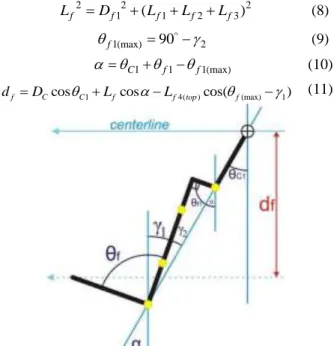
The straightforward walking pattern strategy for the front leg is the end of the link always following the offset of the centerline with the df distance obtained according to the θf1
value and determined from the front leg position at the maximum θC1. The value of θf1 is predetermined and can vary between 0 ° - θf1 (max). The front leg tip is always following the offset of the centerline with the distance df by adjusting the value of θf. The value of θf is range from 0° to 90°. From the description above and Fig. 4, the kinematics motion can be written for the front leg as follows:
2 2 2
1 ( 1 2 3)
f f f f f
L =D + L +L +L (8)
1(max) 90 2
f = − (9)
1 1 1(max)
C f f
= + − (10)
1 4( ) (max) 1
cos cos cos( )
f C C f f top f
d =D +L −L − (11)
Fig. 4. Front leg movement
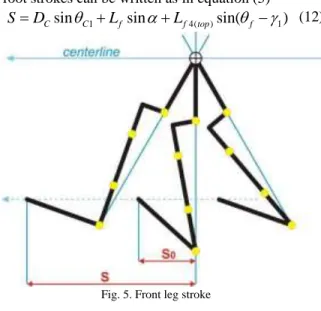
Before presenting the equations of motion on the rear legs, note that forward strokes on the front legs and rear legs go simultaneously and equal in length, so that no slip conditions occur. S0 is the stroke at the initial position and S is the actual stroke as shown in Fig. 5. The equation of foot strokes can be written as in equation (5)
1 4( ) 1
sin sin sin( )
C C f f top f
S=D
+L
+L
−
(12)Fig. 5. Front leg stroke
III.5. Front Leg Movement
Stroke on the rear leg adjusts to the front foot. In Fig.
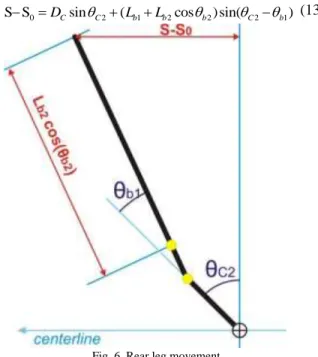
6, the starting position of the rear foot opposite to the front foot because when contact with the ground, the front, and rear legs are in opposite position. The equations of the rear foot motion can be written as in equation (12).
0 2 1 2 2 2 1
S S− =DCsinC +(Lb +Lb cosb )sin(C −b) (13)
Fig. 6. Rear leg movement
IV.
Salamander Like-Robot Prototype
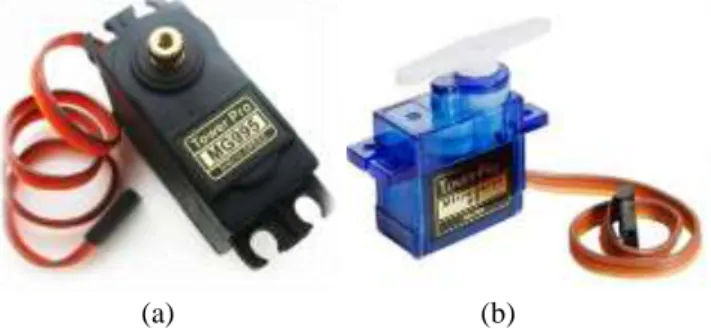
The prototype of a salamander like-robot was developed using 3D printing technology. The body of the robot was printed by using polylactic acid (PLA) material. The main part of the salamander robot was printed using a 3D delta type printer with a nozzle diameter of 0.2 mm, maximum width of 17 cm and a maximum height of 22 cm. Two servo motors, servo Tower Pro MG995 and Tower Pro SG90 were used on this salamander-like robot as shown in Fig. 7. The Servo Tower pro MG995 has torque varying from 9.4 kg.cm at 4.8 V to 11.00 kg.cm at 6 V. This metal gear servo has the mass of 55 g and it can rotate from 00 to 1800. This servo was used for lift motion on the robot's foot because it had a large enough torque to lift the body load of the salamander robot.
While Servo Tower Pro SG90 has a torque of 1.8 kg.cm and the dimensions are quite small that is 22.2 x 11.8 x 31 mm.
This servo was used for the vertical axis joint motion of the salamander like-robot body because it was not affected by gravity and has small dimensions.
Since the CPG-based locomotion on this robot required complex and heavy computation, the Arduino Due microcontroller was selected and used in this study. Arduino Due is a project board variant of the Arduino microcontroller that uses the Atmel SAM3X8E ARM Cortex-M3 CPU.
Arduino Due is the first Arduino Development Board to use a 32-bit ARM processor. Development board has a GPIO of 54 pins (12 of which are PWM pins), 12 analog pins, 4 UART / serial port hardware, clock count / clock with 84 MHz frequency, USB OTG connection, 2 DAC (digital-to-analog converter) , 2 TWI (Two Wire Interface, compatible with I2C protocol from Phillips), standard power supply jack (5.5 / 2.1 mm) jack, SPI header connector, JTAG header connector, reset button, and an erase button). The drawback of the Arduino Due compared to other Arduino variants that use MCU Atmega is the absence of integrated EEPROM. To control the salamander like-robot using Arduino Due only needed general purpose input/output (GPIO) pin because in this early research did not use the remote control.
(a) (b)
Fig. 7. The utilized servo motors on salamander like-robot, (a) Tower Pro MG 995 (b) servo Tower Pro SG90
The final prototype of the built salamander like-robot is shown in Fig. 8. The robot has nine joints with eight links from head to tail. The nine joints used metal gear servo Tower
Pro SG90. Each left and right of the front leg has three DOF while each rear leg had two DOF because of its more passive movements than the robot's front legs. The joints on both front and rear legs utilized metal gear servo Tower Pro MG995.
Fig. 8. The resulted salamander like-robot
V.
Results and Dicussion
In this section, the kinematics motion based on the developed CPG based legged locomotion was implemented in simulation under virtual reality and real salamander like-robot to walk in straightforward motion.
The 3D animation in virtual reality is conducted using SimMechanics First Generation feature in MATLAB- Simulink software. For the embedded programs on the prototype of salamander like-robot, it used Simulink Support Package for Arduino Hardware.
V.1. Straightforward walk in simulation and virtual reality
The SimMechanics - First Generation toolbox under MATLAB/Simulink environment was chosen because it was simpler and conforms to the problem limitation of not discussing robot dynamics, only its kinematics. The 3D virtual reality model of the salamander robot was imported from * .xml and * .stl files created by exporting the robot model in Solidworks CAD software assemblies using the Sim Mechanics Link plugin. When the * .xml file was imported using the 'mechimport' command function in MATLAB, the software will automatically generate the auto-generate block diagram of the salamander robot in the Simulink environment according to the Solidworks assembly. The diagrams that were formed need to be tidied up in order to remember the many parts and joints to make it easier in the next programming of the block diagram in Simulink.
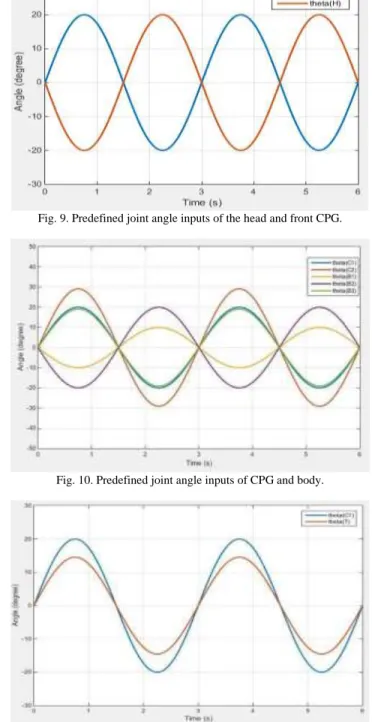
The joint angles of salamander robot would be determined using equation from (1) to equation (12). The results of joint angles are presented by the corresponding plot from Fig. 9 to Fig. 13. Fig. 9 shows θC1 and θH
corresponding to the equation (2), the value of θH is opposite to θC1. The joint angles in the salamander’ body,
front CPG, and rear CPG are resulted from equation (4) to equation (6) as shown in Fig. 10. The resulted joint angle motion in tail can be presented in Fig. 11. The joint angle in the tail is less than the joint angle in front CPG. The joint angles in rear legs and front legs are presented in Fig. 12 and Fig. 13 respectively.
Fig. 9. Predefined joint angle inputs of the head and front CPG.
Fig. 10. Predefined joint angle inputs of CPG and body.
Fig. 11. Predefined joint angle inputs of front CPG and tail.
Fig. 12. Predefined joint angle inputs of front CPG and front leg.
Fig. 13. Predefined joint angle inputs of front CPG and rear leg.
The motions of joint angle inputs from Fig. 9 to Fig.
13 would be simulated using SimMechanics 3D Animation for the straightforward walk on the 3D model of salamander robot. The result of 3D animation simulation in SimMechanics environment after given equation of motion input can be seen in Fig. 13. From the simulation results in 3D virtual reality of the salamander robot motion, the robot model succeeded in forming a curve that resembles standing wave with the head always forward. The front leg always moves parallel to the centerline line when the contact was in contact with the ground. Rear leg stroke was in accordance with the front leg stroke opposite side. Every 1.5 second the salamander body becomes straightforward. These result of 3D animation motion of the robot showed that the developed model of CPG based legged locomotion can be always forward. The front leg always moves parallel to the centerline line when the contact was in contact with the ground. Rear leg stroke was in accordance with the front leg stroke opposite side. Every 1.5 second the salamander body becomes straightforward. These result of 3D animation motion of the robot showed that the developed model of CPG based legged locomotion can be implemented to drive the proposed salamander robot on straight walk conditions.
Fig. 14. The sequence of motion of Salamander robot in SimMechanics 3D Animation from 1 s to 6 s.
V.2. Straightforward walking in the real salamander like- robot
In order to verify the effectivity of the developed CPG based locomotion model in virtual reality simulation as presented in section V.A. The kinematics equation developed from CPG based legged locomotion as presented in equation (1) through equation (12) was developed using block diagram under MATLAB Simulink environment.
After the CPG based locomotion model as in equation (1) through (12) had been built in Simulink block diagram. The resulted motions of joint angle inputs from Fig. 9 to Fig. 13 will be utilized as joint motion input in servo motor command of the salamander like-robot prototype as shown in Fig. 8.
The command of servo motor was implemented using Standard Servo Write block. The block diagram of CPG model was embedded in Arduino Due using Simulink Support Package for Arduino Hardware. The model run with the sampling rate of 50 Hz. The Arduino Due microcontroller can run the CPG model in real time without overrunning in computation.
Based on the experimental results, the proposed of salamander robot prototype succeeded in forming S-curve that resembles a standing wave with the head always forward on the straightforward walk. The motion of the salamander robot’s body links had similar motion as shown in virtual reality simulation results.
In the experimental result, the front leg always moved parallel to the centerline line when the foot contact was in contact with the ground. Rear leg stroke was in accordance with the front leg stroke opposite side. Both in virtual reality simulation and experimental had the same initial condition
i.e. 0 degree. Every 1.5 second, the salamander body became straightforward both in the virtual reality simulation and experiment. Based on the legged locomotion result in the experimental work, the developed CPG based locomotion had been verified that the salamander like-robot can walk straightforward effectively.
Fig. 15. The sequence of images of salamander like-robot walks straightforward
VI.
Conclusion and Future Work
The proposed salamander like-robot uses CPG approach by dividing the salamander robot body into smaller segments that can represent the segmentation function of the actual salamander body. The CPG based locomotion of the spinal cord of the salamander like- robot is represented by eight joints with nine links from head to tail model. The effective CPG based legged locomotion for 18 DOF salamander like-robot has been successfully developed and implemented both in virtual reality simulation and experimental work.
Based on the simulation, the predefined joint angle inputs in salamander robot can be used to drive the robot to do straightforward walk that can mimic the walking of the real salamander naturally. Based on the legged locomotion result in experimental work, the developed CPG based locomotion had been verified that the salamander like-robot can walk straightforward effectively. The research has succeeded in the developing of a low-cost 18 DOF salamander like-robot using 3D printing technology that can walk naturally like a salamander.
In the future research, the motion of the salamander robot in turn right and turn left will be developed and embedded into the proposed salamander robot. After the CPG based locomotion is embedded into the robot, it will be used as a low-cost amphibious robot that can be implemented to support Search and Rescue (SAR)
especially in disaster areas such as flood, earthquake, tsunami, or landslide
References
[1] Ijspeert, Auke Jan, Jean-Marie Cabelguen, “Gait Transition from Swimming to Walking: Investigation of Salamander Locomotion Control Using Nonlinear Oscillators,” In: Kimura, Hiroshi, Kazuo Tsuchiya, Akio Ishiguro, Hartmut Witte. (eds.) Adaptive Motion of Animals and Machine, 2005, pp. 177-186
[2] Horvat, T. , K. Karakasiliotis, K. Melo, L. Fleury, R. Thandiackal and A. J. Ijspeert. Inverse kinematics and reflex based controller for body- limb coordination of a salamander-like robot walking on uneven terrain. IEEE/RSJ International Conference on Intelligent Robots and Systems (IROS), Hamburg, 2015, pp. 195-201
[3] K. Karakasiliotis and A. J. Ijspeert, "Analysis of the terrestrial locomotion of a salamander robot," 2009 IEEE/RSJ International Conference on Intelligent Robots and Systems, St. Louis, MO, 2009, pp. 5015-5020.
[4] A. Crespi, K. Karakasiliotis, A. Guignard and A. J. Ijspeert,
"Salamandra Robotica II: An Amphibious Robot to Study Salamander- Like Swimming and Walking Gaits," in IEEE Transactions on Robotics, vol. 29, no. 2, pp. 308-320, April 2013.
[5] Li, L., Wang, C. and Xie, G., A general CPG network and its implementation on the microcontroller. Neurocomputing, 167, pp.299- 305, 2015.
[6] Billah, M.M. and Khan, M.R., February. Bio-inspired snake robot locomotion: A CPG-based control approach. In Information Technology: Towards New Smart World (NSITNSW), 2015 5th National Symposium on (pp. 1-6).
[7] Bing, Zhenshan, Long Cheng, Kai Huang, Mingchuan Zhou, and Alois Knoll. CPG-based control of smooth transition for body shape and locomotion speed of a snake-like robot. In Robotics and Automation (ICRA), 2017 IEEE International Conference on, pp. 4146-4153.
IEEE, 2017.
[8] Wang, Z., Gao, Q. and Zhao, H., 2017. CPG-inspired locomotion control for a snake robot basing on nonlinear oscillators. Journal of Intelligent & Robotic Systems, 85(2), pp.209-227.
[9] Zhang, Dong, Qing Xiao, Zhengcai Cao, Ran Huang, and Yili Fu.
Smooth transition of the CPG-based controller for snake-like robots.
In Robotics and Biomimetics (ROBIO), 2017 IEEE International Conference on, 2017 pp. 2716-2721.
[10] Rostro-Gonzalez, H., Cerna-Garcia, P.A., Trejo-Caballero, G., Garcia- Capulin, C.H., Ibarra-Manzano, M.A., Avina-Cervantes, J.G. and Torres-Huitzil, C., A CPG system based on spiking neurons for hexapod robot locomotion. Neurocomputing, 170, pp.47-54, 2015.
[11] Barron-Zambrano, J.H., Torres-Huitzil, C. and Girau, B. Perception- driven adaptive CPG-based locomotion for hexapod robots.
Neurocomputing, 170, pp.63-78, 2015.
[12] Zhao, W., Hu, Y., Zhang, L. and Wang, L. Design and CPG-based control of biomimetic robotic fish. IET control theory & applications, 3(3), pp.281-293., 2009.
[13] Hu, Y., Tian, W., Liang, J. and Wang, T. Learning fish-like swimming with a CPG-based locomotion controller. In Intelligent Robots and Systems (IROS), 2011 IEEE/RSJ International Conference on, 2011 pp. 1863-1868.
[14] Wang, L., Wang, S., Cao, Z., Tan, M., Zhou, C., Sang, H. and Shen, Z., 2005, December. Motion control of a robot fish based on CPG. In Industrial Technology, 2005. ICIT 2005. IEEE International Conference on, 2005 pp. 1263-1268.
[15] Wang, M., Tang, Z., Chen, B. and Zhang, J. Locomotion control for quadruped robot based on Central Pattern Generators. In Control Conference (CCC), 2016 35th Chinese pp. 6335-6339.
[16] M. Munadi, M. S. Nasir, M. Ariyanto, Norman Iskandar, and J. D.
Setiawan, Design and simulation of PID controller for lower limb exoskeleton robot. AIP Conference Proceedings, 2018. Vol. 1983, No.1, pp. 060008.
[17] R. Ismail, M. Ariyanto, W. Caesarendra and A. Nurmiranto, Development of robotic hand integrated with SimMechanics 3D animation, 2016 International Seminar on Intelligent Technology and Its Applications (ISITIA), Lombok, 2016, pp. 629-634.
[18] M. Ariyanto, R. Ismail, A. Nurmiranto, W. Caesarendra, Paryanto and J. Franke, Development of a low-cost anthropomorphic robotic hand driven by modified glove sensor and integrated with 3D animation, 2016 IEEE EMBS Conference on Biomedical Engineering and Sciences (IECBES), Kuala Lumpur, 2016, pp.
341-346.
Authors’ Information
1Department of Mechanical Engineering, Diponegoro University,
Semarang, Indonesia, E-mail: [email protected]
2Department of Mechanical Engineering, Diponegoro University,
Semarang, Indonesia,
E-mail: [email protected]
3Department of Mechanical Engineering, Diponegoro University,
Semarang, Indonesia,
E-mail: [email protected]
3Department of Mechanical Engineering, Diponegoro University,
Semarang, Indonesia,
E-mail: [email protected]
Dr. Eng. Munadi received the B.E. degree in Mechanical Engineering from Diponegoro University, Semarang, Indonesia in 2001. From 2001-2005 he joined Pura Group Corp., Kudus, Indonesia. In 2007, he received the M. Eng. degree from Mechanical Engineering, Bandung Institute of Technology, Bandung, Indonesia. In 2011, he received the Dr. Eng. degree from the Graduate School of Engineering, University of Fukui, Fukui, Japan. He is currently a lecturer in the Department of Mechanical Engineering, Diponegoro University, Indonesia. His current research interests relate to hybrid adaptive and learning controller for robot manipulators, intelligent control, and soft robot
Mr. Mochammad Ariyanto received B.Sc. and M.Sc. degrees from Department of Mechanical Engineering, Diponegoro University, Indonesia, in 2010 and 2013 respectively.
Currently, he is a junior lecturer at Diponegoro University, Semarang, Indonesia. He has published more than 35 papers in international journal, book chapter, and conference proceeding. His research interests are biorobotics, mechatronics, soft robot, and intelligent control.
Mr. Kharisma A. Pambudi received B.Sc. degree from Department of Mechanical Engineering, Diponegoro University, Indonesia, in 2016.
Currently, he is a master student at Department of Mechanical Engineering, Diponegoro University, Semarang, Indonesia. His research interests are biorobotics, mechatronics, and soft robot.
Dr. Joga D. Setiawan received the B.Sc. degree in Mechanical Engineering from Northeastern University, Boston, USA in 1992; and the M.Sc. degree in Aeronautics/Astronautics from Massachusetts Institute of Technology (MIT), Cambridge, USA in 1996. He received the Ph.D. degree in Mechanical Engineering from Michigan State University, USA in 2001.
He is currently a lecturer in the Mechanical Engineering Department of Diponegoro University, Indonesia. Dr.
Joga has published more than 45 papers of book chapter, international journal, and conference proceedings in the area of control system, intelligent system, and mechatronics. He is member of The Institute of Electrical and Electronics (IEEE).
1/1
[IREME] Submission Acknowledgement
Dari: Editorial Staff ([email protected]) Kepada: [email protected]; [email protected] Tanggal: Jumat, 16 November 2018 17.04 WIB
Yahoo Mail - [IREME] Submission Acknowledgement
Dear Dr. Munadi, Mr Mochammad Ariyanto:
Thank you for submitting your manuscript entitled "Development of 18 DOF Salamander Robot Using CPG Based Locomotion for Straight Forward Walk" to our journal International Review of Mechanical Engineering (IREME).
With the online journal management system that we are using, you will be able to track its progress through the editorial process by logging in to the journal web site:
Manuscript URL:
https://www.praiseworthyprize.org/jsm/index.php?journal=ireme&page=author&op=submission&path[]=16464 Username: munadi2018
and clicking on My Journals->Active submissions.
With this submission the review process starts.
According to the review procedures, your proposal will be send to the Editor-in-Chief that, after evaluated the publication suitability of the paper, will indicate three reviewers for a full evaluation.
More info regarding the review process can be found at the following link:
http://www.praiseworthyprize.org/jsm/index.php?journal=ireme&page=about&op=editorialPolicies#peerReviewProcess If you have any questions, please don't hesitate to contact me. In all the
correspondence please indicate in the subject of your e-mail the identification number of the paper that is Id 16464.
Thank you for considering this journal as a venue for your work.
Best regards, Editorial Staff
International Review of Mechanical Engineering (IREME)
__________________________________________________________
PRAISE WORTHY PRIZE PUBLISHING HOUSE Editorial Staff
++++++++++++++++++++++ ATTENTION ++++++++++++++++++++
This e-mail is directed uniquely to the interested party,
which is the exclusive addressee of any information contained herein.
For any abuse about the content of this message, Praise Worthy Prize will claim compensation for damages occurred to third parties as well.
You are receiving this email because you are a Praise Worthy Prize's account holder or email subscriber.
In case the e-mail should be addressed to other than you, or the content should reveal any transmission errors or manipulations, please contact us at the following address:[email protected]
---
Praise Worthy Prize respects your right to privacy. To see the types of information we may hold or collect about you and how we may use that information, please see our Privacy Policy here:
http://www.praiseworthyprize.com/privacy.htmor contact our Data Protection Office here:[email protected]
1b
2/2/2021 Yahoo Mail - Paper Status titled [IREME] Development of 18 DOF Salamander Robot Using CPG Based Locomotion for Straight Forward …
1/1
Paper Status titled [IREME] Development of 18 DOF Salamander Robot Using CPG Based Locomotion for Straight Forward Walk
From: [email protected]
To: [email protected]; [email protected] Cc: [email protected]; [email protected] Date: Thursday, January 24, 2019, 04:16 PM GMT+7
Dear editor-in-chief of International Review of Mechanical Engineering (IREME)
We have sent a paper review to International Review of Mechanical Engineering (IREME) titled "Development of 18 DOF Salamander Robot Using CPG Based Locomotion for Straight Forward Walk". Until now, we did not know the current status of our paper in review stage process.
We looking forward to hearing from you regarding our paper status in the review stage.
Best regards, Munadi
Department of Mechanical Engineering Diponegoro University, Indonesia
1c
1/2
[IREME] Editor Decision
We have reached a decision regarding your paper ID 16464: "Development of 18 DOF Salamander Robot Using CPG Based Locomotion for Straight Forward Walk", submitted to: International Review of Mechanical Engineering (IREME).
The paper has been accepted with minor revisions.
You should change the paper according to the remarks of the reviewers included at the foot of this email, then you should re-submit the revised paper by our on-line submission system, selecting the cited paper and uploading the Author Version in the section "Editor Decision".
The new text and the modifications introduced for answering the remarks of the reviewers should be indicated in red colour.
Sincerely,
Dr. Ethirajan Rathakrishnan, Editor-in-Chief of International Review of Mechanical Engineering (IREME)
Remarks of the Reviewers:
Reviewer: 1
Recommendation: Accepted as it is.
Comments:
The paper is interesting and well structured. I suggest the acceptance.
Reviewer: 2
Recommendation: Accepted with minor revisions.
Comments:
1
The English needs editing for grammatical errors and style. We suggest to use our service “English Language Editing”. More information can be found to http://www.praiseworthyprize.com/english_service.htm
2
In the introduction section the authors should more underline the contribution of the paper to the state of the art on the topic.
Reviewer: 3
Recommendation: Accepted with minor revisions.
Comments:
1- Computational details for different movements should be displayed in the article. Adding block diagram in Simulink could also be helpful.
2- Units should be more clarified, specifically in the figures (for instance, fig 2)
--- For any questions don't hesitate to contact us.
Best regards, Editorial Staff Praise Worthy Prize Publishing House
__________________________________________________________
PRAISE WORTHY PRIZE PUBLISHING HOUSE Editorial Staff
Dari: Editorial Staff ([email protected]) Kepada: [email protected]; [email protected] Tanggal: Minggu, 3 Maret 2019 01.58 WIB
Dear Dr. Munadi, Mr Mochammad Ariyanto:
Yahoo Mail - [IREME] Editor Decision
2a
2/2 ++++++++++++++++++++++ ATTENTION ++++++++++++++++++++
This e-mail is directed uniquely to the interested party,
which is the exclusive addressee of any information contained herein.
For any abuse about the content of this message, Praise Worthy Prize will claim compensation for damages occurred to third parties as well.
You are receiving this email because you are a Praise Worthy Prize's account holder or email subscriber.
In case the e-mail should be addressed to other than you, or the content should reveal any transmission errors or manipulations, please contact us at the following address: [email protected]
---
Praise Worthy Prize respects your right to privacy. To see the types of information we may hold or collect about you and how we may use that information, please see our Privacy Policy here:
http://www.praiseworthyprize.com/privacy.htm or contact our Data Protection Office here: [email protected]
Yahoo Mail - [IREME] Editor Decision
1/2 Dari: [email protected]
Kepada: [email protected] Cc:
Bcc:
[email protected]; [email protected] Tanggal: Senin, 18 Maret 2019 19.52 WIB
Dear editor in chief of IREME,
On behalf of the authors, we have revised the paper as suggested by the reviewers.
We also upload the revised paper. The revised word is signified by the red color.
We also attached the review response in this email.
Please let us know regarding the next step publication process.
Remarks of the Reviewers:
Reviewer: 1
Recommendation: Accepted as it is.
Comments:
The paper is interesting and well structured. I suggest the acceptance.
Reviewer: 2
Best Regards, Author
Pada Selasa, 5 Maret 2019 15.58.53 WIB, [email protected] menulis:
Dear Dr. Ethirajan Rathakrishnan, Editor-in-Chief of International Review of Mechanical Engineering (IREME)
Thank you very much for the information regarding our paper status.
We will revise the manuscript as soon as possible and send back to the journal submission system next week.
Best regards, Author
Pada Minggu, 3 Maret 2019 01.58.45 WIB, Editorial Staff <[email protected]> menulis:
DearDr.Munadi,Mr Mochammad Ariyanto:
We have reached a decision regarding your paper ID 16464: "Development of 18 DOF Salamander Robot Using CPG Based Locomotion for Straight Forward Walk", submitted to: International Review of Mechanical Engineering (IREME).
The paper has been accepted with minor revisions.
You should change the paper according to the remarks of the reviewers included at the foot of this email, then you should re-submit the revised paper by our on-line submission system, selecting the cited paper and uploading the Author Version in the section "Editor Decision".
The new text and the modifications introduced for answering the remarks of the reviewers should be indicated in red colour.
Sincerely,
Dr. Ethirajan Rathakrishnan, Editor-in-Chief of International Review of Mechanical Engineering (IREME)
Yahoo Mail - Re: [IREME] Editor Decision
Re: [IREME] Editor Decision
2b
2/2 Journal IREME Salamander Robot_Revised.docx
3MB
review_result_and _review_response.docx 155.4kB
Recommendation: Accepted with minor revisions.
Comments:
1
The English needs editing for grammatical errors and style. We suggest to use our service “English Language Editing”. More information can be found to http://www.praiseworthyprize.com/english_service.htm
2
In the introduction section the authors should more underline the contribution of the paper to the state of the art on the topic.
Reviewer: 3
Recommendation: Accepted with minor revisions.
Comments:
1- Computational details for different movements should be displayed in the article. Adding block diagram in Simulink could also be helpful.
2- Units should be more clarified, specifically in the figures (for instance, fig 2)
--- For any questions don't hesitate to contact us.
Best regards, Editorial Staff Praise Worthy Prize Publishing House
__________________________________________________________
PRAISE WORTHY PRIZE PUBLISHING HOUSE Editorial Staff
++++++++++++++++++++++ ATTENTION ++++++++++++++++++++
This e-mail is directed uniquely to the interested party,
which is the exclusive addressee of any information contained herein.
For any abuse about the content of this message, Praise Worthy Prize will claim compensation for damages occurred to third parties as well.
You are receiving this email because you are a Praise Worthy Prize's account holder or email subscriber.
In case the e-mail should be addressed to other than you, or the content should reveal any transmission errors or manipulations, please contact us at the following address: [email protected]
---
Praise Worthy Prize respects your right to privacy. To see the types of information we may hold or collect about you and how we may use that information, please see our Privacy Policy here:
http://www.praiseworthyprize.com/privacy.htm or contact our Data Protection Office here: [email protected]
Yahoo Mail - Re: [IREME] Editor Decision
International Review of Mechanical Engineering (I.RE.M.E.), Vol. xx, n. x
Development of 18 DOF Salamander Robot Using CPG Based Locomotion for Straight Forward Walk
M. Munadi
1, Mcochammad Ariyanto
2, Kharisma A. Pambudi
3, Joga D. Setiawan
4Abstract – The utilization of mechatronics, robotics, and control systems has been widely spread in many areas over the last few decades. Robotics research is widely used for industrial purposes such as wheeled robots and manipulators, but now many researchers incorporate biomimetic science that we often call biorobotics. This paper will present a preliminary research in the field of biorobotics with a robot salamander model that can walk in straight walking using a central pattern generator (CPG). This robot model uses a legged locomotion system that has 18 degrees of freedom (DOF). The CPG based locomotion model will be developed for controlling the gait cycle when the robot walks.
The motions of joint angle inputs resulted from CPG model will be simulated using SimMechanics 3D Animation and implemented on the proposed salamander robot for straight walking. Based on the result in both virtual reality simulation and experimental work using CPG locomotion approach, the predefined joint angle inputs in salamander robot can be used to drive the robot. The proposed CPG locomotion can mimic the walking of a real salamander naturally in straight walk.
Keywords: Robot Salamander; 18 DOF; Central Pattern Generator (CPG); 3D Animation
I.
Introduction
In some cases of disasters such as flood, earthquake, tsunami, or landslide are often found to be buried or trapped in an avalanche or ruin. In such a case, it is not possible to send people to enter the gaps or holes formed.
Therefore, it is necessary to develop a system that can solve this problem. One alternative is a robot that can enter the hole/slit and move on land or in water bringing the camera to see in the dangerous conditions. Based on this condition, salamander robot is chosen because the salamander is one of the amphibian reptiles that can move both on land and on water.
In this study, the proposed salamander like-robot model adapts the salamander robot that has been researched in the previous studies [1-4]. The robot [1,2]
has 27 DOF, 11 DOF on the spine and four DOF on each leg [2]. The robot uses a servo motor as its actuator. The legged locomotion of the salamander like-robot is developed by using central pattern generator (CPG) method.
The salamander robot [1-4] which has been developed used two types of locomotion that is terrestrial locomotion to walk on the land and aquatic locomotion to swim on the water. In this research, the proposed salamander robot only uses terrestrial locomotion
because the research study focuses on the motion of straight walk on a floor or land. The swimming mode of the salamander like-robot will be developed in the future study.
CPG Based locomotion inspired scientists and engineers to build robots by mimicking spinal cord of the animals. CPG is the key mechanism of generating adaptive and versatile locomotion in animals [5]. CPG generates motion system instantly on a legged robot-like spine-based control system [6]. CPG based locomotion has been successfully implemented in legged robot research such as snake robot locomotion [6-9], hexapod robot [10-11], robotic fish [5,12- 14], salamander robot [1-4], and quadruped robot [15].
In this paper, the proposed of salamander like-robot uses a smaller number of DOF i.e. eight on the spine, three on each front leg and two on each rear leg. The simplification of the number of DOF is conducted to reduce the number of actuators so that the design becomes simpler and the salamander robot will have a smaller dimension than the previously developed robot as in reference [2]. This is conducted to meet the initial goal to create a salamander like- robot that is applicable for Search and Rescue (SAR) purpose.
In this study, we developed the governing equation of motion using a central pattern generator (CPG) for each robot on a straight walk. This paper proposes the CPG model of 18 DOF Salamanders like-robots by dividing the salamander robot body into smaller segments that are performed by ref.
[1]. In straight walk locomotion, the CPG model can be driven
2b
Lampiran 1
by using a sinusoidal wave. The proposed CPG based locomotion of the spinal cord of the robot is represented by eight links from head to tail model. Each left and right leg of the front has three DOFs that can determine the direction of the straight walk. Each DOF has two rear legs.
They are more passive movement than the robot's movement front legs. After building the CPG based locomotion, the results of the CPG model are implemented in 3D animation under the SimMechanics of First Generation environments, such as in reference [16].
To verify the legged locomotion based on CPG model in 3D animation simulation, the CPG model is embedded on the robot salamander microcontroller using 32-bit Arduino Due. The robot is tested on the straight walk gait as in 3D simulation.
II.
Salamander Robot Model
II.1. 3D CAD DesignIn this paper, the development of 3D CAD model on the salamander like- robot was conducted in parallel with robotic prototype assembly. 3D CAD design of the salamander like-robot model was performed using SolidWorks computer-aided design (CAD) software. The SolidWorks CAD software was selected because of its ease of use. The 3D CAD model and the prototype of salamander like-robot that had been developed can be shown in Fig. 1.
The dimension of the salamander robot can be seen in Fig. 2. It can be seen that the dimensions of the body part in the front legs and the rear legs are not similar. The forelimbs of the front legs were used for the controller's place and the rear legs were used for the battery’s place.
The result of 3D salamander robot model from CAD software as shown in Fig. 1 was exported in SimMechanics block diagram under MATLAB/Simulink environment using SimMichanics Link plugin. The plugin can be downloaded freely from the Mathworks website. The results of SimMechanics block diagram will be used as 3D animation of salamander robot motion. The 3D animation will visualize the motion of salamander robot on straight walk in 3D view environment.
SimMechanics toolbox from MATLAB/Simulink software is a powerful tool for 3D animation purpose of a mechanical system. It can simulate the motion of mechanical system by giving it with the joint input in 3D view environment. SimMechanics 3D animation had been successfully developed for 3D virtual of five DOF robotic hand on the previous works [17,18]. The 3D animation of robotic hand can be driven by giving the revolute joint angle inputs for each finger in SimMechanics block diagram. This salamander like- robot model for 3D animation used revolute joints to model the joint body of the proposed salamander robot in SimMechanics.
Fig. 1. 3D CAD assembly of the proposed 18 DOF salamander robot
II.2. Gait Cycle for Straight Walking Movement In Fig.1, there is a shaft supporting the body of a salamander robot model between the two joints of the body and the front legs. This consideration is taken because the point serves as the front Central Pattern Generator (CPG) which becomes the reference on the straight walk. The point/CPG in the salamander robot model does not move against time. The kinematics equation of motion (EOM) is developed based on CPG legged locomotion, starting from the head to tail tip. When walking, the salamander form S- shape standing wave with a length of 1 λ from head to tail tip.
Two points that become the reference when performing straight walking movement is the center point of the connecting body of the front legs (front CPG) and the center point of the rear legs connecting body (rear CPG).
The movement of the front legs adjusts the body movements of the robot salamander. As the front body of the salamander robot leans to the right, the left front leg goes forward. When the front body of the salamander robot is leaning to the left, the left front leg retreats as it moves forward. Rear leg movement is the opposite movement of the front leg movement. When the left front leg stepped back, the rear right leg stepped back simultaneously. While the rear left leg moves with the tip of the foot forward. Both the front legs and rear legs have the same distance step. This same step makes the salamander robot can walk straightforward
Fig. 2. The dimension of the body links in the salamander robot with (all units in mm)
III.
CPG Based Locomotion Model
In this section, the straightforward walk kinematics motion of the salamander robot would be developed to determine the angles formed by each joint on the head, body, legs, and tail of the salamander robot. The front CPG was used as a reference to the straightforward walking movement of salamander robot. The joint angles on the head, body, and tail can be shown by Fig. 3. The body angle on the front CPG oscillated by θC1 to the centerline, as shown in Fig. 3. The initial angle of θC1 is 0°, so it can be written in a sinusoidal equation using the parameters as shown in Fig. 2, and it can be expressed by equation (1).
1 1(max)
1 4( ) (max) 1
1 1 1(max)
1 4( ) 1
0 2 1 2 2 2 1
sin( t)
cos cos cos( )
sin sin sin( )
S S sin ( cos ) sin( )
C C
f C C f f top f
C f f
C C f f top f
C C b b b C b
d D L L
S D L L
D L L
=
= + − −
= + −
= + + −
− = + + −
(1)
Fig. 3. Joint angles o the salamander robot.
III.1. Head Movement (θH)
The head of the salamander robot is always facing forward, in the other words the head angle θH always parallel to the centerline. Then the angle on the joint of the head must be opposite direction and equal to θC1. The angular equation for the head joint can be written as in equation (2).
H = −C1 (2) III.2. Body Movement (θC2, θB1, θB2, θB3) The length of the two joints in front body LC1 and the length of two joints on the rear body have the same distance to the centerline. The value of θC2 can be defined as expressed in equation (3).
2 1 1
2
sin C C sin C
C
L
= L (3) The abdomen of the salamander robot forms half wave. There are four links on the abdomen. In order to form a half-wave, the joint in the middle must be the peak of the wave. The second and third links have the opposite angle of the direction and the same magnitude towards the centerline that is half of C1, B1can be defined as in equation (4).
1 1
1
B 2 C
= − (4)
From the equation (4), the joint angles of θB2 and θB3 can be calculated using equation (5), and (6).
2 1
B C
= − (5)
3 2 1
B C B
= − (6)
III.3. Tail Movement (θT)
In the straight walking motion, the salamander robot 's tail forms half wave opposing to its body. In the CPG based locomotion model, there are four links for the tail system. The rear leg connecting body and tail tip links forms an equal angle to the centerline and opposites to each other. The magnitude of the joint angle on the tail for the motion of straight walking is equal, it can be defined as written in equation (7).
2
1
T 2 C
= − (7)
III.4. Front Leg Movement
The straight walking pattern strategy for the front leg is the end of the link always following the offset of the centerline with the df distance obtained according to the θf1 value and determined from the front leg position at the maximum θC1. The value of θf1 is predetermined and can vary between 0 ° - θf1 (max). The front leg tip is always following the offset of the centerline with the distance df by adjusting the value of θf. The value of θf is range from 0° to 90°. From the description above and Fig. 4, the kinematics motion can be written for the front leg as follows:
2 2 2
1 ( 1 2 3)
f f f f f
L =D + L +L +L (8)
1(max) 90 2
f = − (9)
1 1 1(max)
C f f
= + − (10)
1 4( ) (max) 1
cos cos cos( )
f C C f f top f
d =D +L −L − (11)
Fig. 4. Front leg movement
Before presenting the equation of motion on the rear legs, note that forward strokes on the front legs and rear legs go simultaneously and equal in length, so that no slip conditions occur. S0 is the stroke at the initial position and S is the actual stroke as shown in Fig. 5. The equation of foot strokes can be written as in equation (5)
1 4( ) 1
sin sin sin( )
C C f f top f
S=D +L +L − (12)
Fig. 5. Front leg stroke
III.5. Front Leg Movement
Stroke on the rear leg adjusts to the front foot. In Fig.
6, the starting position of the rear foot opposite to the front foot because when it contact with the ground, the front, and the rear legs are in opposite position. The equations of the rear leg motion can be written as in equation (12).
0 2 1 2 2 2 1
S S− =DCsinC +(Lb +Lb cosb ) sin(