Abdul-Majid Wazwaz
Linear and Nonlinear Integral Equations
Methods and Applications
Abdul-Majid Wazwaz
Linear and Nonlinear Integral Equations
Methods and Applications
With 4 figures
~ lH! -:tr HIGHER EDUCATION PRESS It i >j: Pt.~l f1 Springer
THIS BOOK IS DEDICATED TO
my wife, our son, and our three daughters
for supporting me in all my endeavors
Preface
Many remarkable advances have been made in the field of integral equa- tions, but these remarkable developments have remained scattered in a vari- ety of specialized journals. These new ideas and approaches have rarely been brought together in textbook form. If these ideas merely remain in scholarly journals and never get discussed in textbooks, then specialists and students will not be able to benefit from the results of the valuable research achieve- ments.
The explosive growth in industry and technology requires constructive ad- justments in mathematics textbooks. The valuable achievements in research work are not found in many of today’s textbooks, but they are worthy of ad- dition and study. The technology is moving rapidly, which is pushing for valu- able insights into some substantial applications and developed approaches.
The mathematics taught in the classroom should come to resemble the mathe- matics used in varied applications of nonlinear science models and engineering applications. This book was written with these thoughts in mind.
Linear and Nonlinear Integral Equations: Methods and Applicationsis de- signed to serve as a text and a reference. The book is designed to be acces- sible to advanced undergraduate and graduate students as well as a research monograph to researchers in applied mathematics, physical sciences, and en- gineering. This text differs from other similar texts in a number of ways. First, it explains the classical methods in a comprehensible, non-abstract approach.
Furthermore, it introduces and explains the modern developed mathematical methods in such a fashion that shows how the new methods can complement the traditional methods. These approaches further improve the understand- ing of the material.
The book avoids approaching the subject through the compact and clas- sical methods that make the material difficult to be grasped, especially by students who do not have the background in these abstract concepts. The aim of this book is to offer practical treatment of linear and nonlinear inte- gral equations emphasizing the need to problem solving rather than theorem proving.
The book was developed as a result of many years of experiences in teach- ing integral equations and conducting research work in this field. The author
viii Preface has taken account of his teaching experience, research work as well as valu- able suggestions received from students and scholars from a wide variety of audience. Numerous examples and exercises, ranging in level from easy to dif- ficult, but consistent with the material, are given in each section to give the reader the knowledge, practice and skill in linear and nonlinear integral equa- tions. There is plenty of material in this text to be covered in two semesters for senior undergraduates and beginning graduates of mathematics, physical science, and engineering.
The content of the book is divided into two distinct parts, and each part is self-contained and practical. Part I contains twelve chapters that handle the linear integral and nonlinear integro-differential equations by using the modern mathematical methods, and some of the powerful traditional meth- ods. Since the book’s readership is a diverse and interdisciplinary audience of applied mathematics, physical science, and engineering, attempts are made so that part I presents both analytical and numerical approaches in a clear and systematic fashion to make this book accessible to those who work in these fields.
Part II contains the remaining six chapters devoted to thoroughly ex- amining the nonlinear integral equations and its applications. The potential theory contributed more than any field to give rise to nonlinear integral equa- tions. Mathematical physics models, such as diffraction problems, scattering in quantum mechanics, conformal mapping, and water waves also contributed to the creation of nonlinear integral equations. Because it is not always pos- sible to find exact solutions to problems of physical science that are posed, much work is devoted to obtaining qualitative approximations that highlight the structure of the solution.
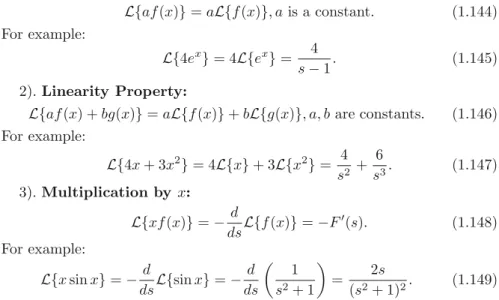
Chapter 1 provides the basic definitions and introductory concepts. The Taylor series, Leibnitz rule, and Laplace transform method are presented and reviewed. This discussion will provide the reader with a strong basis to understand the thoroughly-examined material in the following chapters.
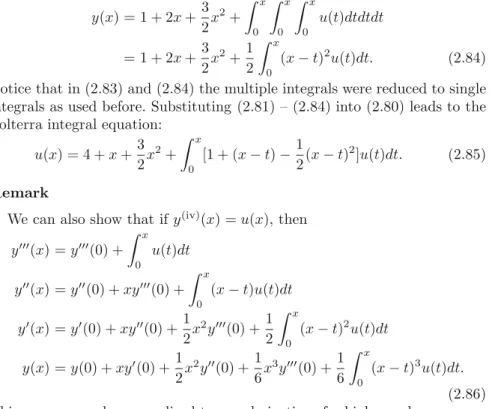
In Chapter 2, the classifications of integral and integro-differential equations are presented and illustrated. In addition, the linearity and the homogene- ity concepts of integral equations are clearly addressed. The conversion pro- cess of IVP and BVP to Volterra integral equation and Fredholm integral equation respectively are described. Chapters 3 and 5 deal with the linear Volterra integral equations and the linear Volterra integro-differential equa- tions, of the first and the second kind, respectively. Each kind is approached by a variety of methods that are described in details. Chapters 3 and 5 provide the reader with a comprehensive discussion of both types of equa- tions. The two chapters emphasize the power of the proposed methods in handling these equations. Chapters 4 and 6 are entirely devoted to Fred- holm integral equations and Fredholm integro-differential equations, of the first and the second kind, respectively. The ill-posed Fredholm integral equa- tion of the first kind is handled by the powerful method of regularization combined with other methods. The two kinds of equations are approached
Preface ix by many appropriate algorithms that are illustrated in details. A compre- hensive study is introduced where a variety of reliable methods is applied independently and supported by many illustrative examples. Chapter 7 is devoted to studying the Abel’s integral equations, generalized Abel’s inte- gral equations, and the weakly singular integral equations. The chapter also stresses the significant features of these types of singular equations with full explanations and many illustrative examples and exercises. Chapters 8 and 9 introduce a valuable study on Volterra-Fredholm integral equations and Volterra-Fredholm integro-differential equations respectively in one and two variables. The mixed Volterra-Fredholm integral and the mixed Volterra- Fredholm integro-differential equations in two variables are also examined with illustrative examples. The proposed methods introduce a powerful tool for handling these two types of equations. Examples are provided with a sub- stantial amount of explanation. The reader will find a wealth of well-known models with one and two variables. A detailed and clear explanation of ev- ery application is introduced and supported by fully explained examples and exercises of every type.
Chapters 10, 11, and 12 are concerned with the systems of Volterra in- tegral and integro-differential equations, systems of Fredholm integral and integro-differential equations, and systems of singular integral equations and systems of weakly singular integral equations respectively. Systems of inte- gral equations that are important, are handled by using very constructive methods. A discussion of the basic theory and illustrations of the solutions to the systems are presented to introduce the material in a clear and useful fashion. Singular systems in one, two, and three variables are thoroughly in- vestigated. The systems are supported by a variety of useful methods that are well explained and illustrated.
Part II is titled “Nonlinear Integral Equations”. Part II of this book gives a self-contained, practical and realistic approach to nonlinear integral equa- tions, where scientists and engineers are paying great attention to the effects caused by the nonlinearity of dynamical equations in nonlinear science. The potential theory contributed more than any field to give rise to nonlinear in- tegral equations. Mathematical physics models, such as diffraction problems, scattering in quantum mechanics, conformal mapping, and water waves also contributed to the creation of nonlinear integral equations. The nonlinearity of these models may give more than one solution and this is the nature of nonlinear problems. Moreover, ill-posed Fredholm integral equations of the first kind may also give more than one solution even if it is linear.
Chapter 13 presents discussions about nonlinear Volterra integral equa- tions and systems of Volterra integral equations, of the first and the second kind. More emphasis on the existence of solutions is proved and empha- sized. A variety of methods are employed, introduced and explained in a clear and useful manner. Chapter 14 is devoted to giving a comprehensive study on nonlinear Volterra integro-differential equations and systems of non- linear Volterra integro-differential equations, of the first and the second kind.
x Preface A variety of methods are introduced, and numerous practical examples are explained in a practical way. Chapter 15 investigates thoroughly the existence theorem, bifurcation points and singular points that may arise from nonlin- ear Fredholm integral equations. The study presents a variety of powerful methods to handle nonlinear Fredholm integral equations of the first and the second kind. Systems of these equations are examined with illustrated examples. Chapter 16 is entirely devoted to studying a family of nonlinear Fredholm integro-differential equations of the second kind and the systems of these equations. The approach we followed is identical to our approach in the previous chapters to make the discussion accessible for interdisciplinary audience. Chapter 17 provides the reader with a comprehensive discussion of the nonlinear singular integral equations, nonlinear weakly singular inte- gral equations, and systems of these equations. Most of these equations are characterized by the singularity behavior where the proposed methods should overcome the difficulty of this singular behavior. The power of the employed methods is confirmed here by determining solutions that may not be unique.
Chapter 18 presents a comprehensive study on five scientific applications that we selected because of its wide applicability for several other models. Because it is not always possible to find exact solutions to models of physical sciences, much work is devoted to obtaining qualitative approximations that highlight the structure of the solution. The powerful Pad´e approximants are used to give insight into the structure of the solution. This chapter closes Part II of this text.
The book concludes with seven useful appendices. Moreover, the book introduces the traditional methods in the same amount of concern to provide the reader with the knowledge needed to make a comparison.
I deeply acknowledge Professor Albert Luo for many helpful discussions, encouragement, and useful remarks. I am also indebted to Ms. Liping Wang, the Publishing Editor of the Higher Education Press for her effective coop- eration and important suggestions. The staff of HEP deserve my thanks for their support to this project. I owe them all my deepest thanks.
I also deeply acknowledge Professor Louis Pennisi who made very valuable suggestions that helped a great deal in directing this book towards its main goal.
I am deeply indebted to my wife, my son and my daughters who provided me with their continued encouragement, patience and support during the long days of preparing this book.
The author would highly appreciate any notes concerning any constructive suggestions.
Abdul-Majid Wazwaz Saint Xavier University Chicago, IL 60655 April 20, 2011
Contents
Part I Linear Integral Equations
1 Preliminaries . . . 3
1.1 Taylor Series . . . 4
1.2 Ordinary Differential Equations . . . 7
1.2.1 First Order Linear Differential Equations . . . 7
1.2.2 Second Order Linear Differential Equations . . . 9
1.2.3 The Series Solution Method . . . 13
1.3 Leibnitz Rule for Differentiation of Integrals . . . 17
1.4 Reducing Multiple Integrals to Single Integrals . . . 19
1.5 Laplace Transform . . . 22
1.5.1 Properties of Laplace Transforms . . . 23
1.6 Infinite Geometric Series . . . 28
References . . . 30
2 Introductory Concepts of Integral Equations. . . 33
2.1 Classification of Integral Equations . . . 34
2.1.1 Fredholm Integral Equations . . . 34
2.1.2 Volterra Integral Equations . . . 35
2.1.3 Volterra-Fredholm Integral Equations . . . 35
2.1.4 Singular Integral Equations . . . 36
2.2 Classification of Integro-Differential Equations . . . 37
2.2.1 Fredholm Integro-Differential Equations . . . 38
2.2.2 Volterra Integro-Differential Equations . . . 38
2.2.3 Volterra-Fredholm Integro-Differential Equations . . . 39
2.3 Linearity and Homogeneity . . . 40
2.3.1 Linearity Concept . . . 40
2.3.2 Homogeneity Concept . . . 41
2.4 Origins of Integral Equations . . . 42
2.5 Converting IVP to Volterra Integral Equation . . . 42
xii Contents
2.5.1 Converting Volterra Integral Equation to IVP . . . 47
2.6 Converting BVP to Fredholm Integral Equation . . . 49
2.6.1 Converting Fredholm Integral Equation to BVP . . . 54
2.7 Solution of an Integral Equation . . . 59
References . . . 63
3 Volterra Integral Equations. . . 65
3.1 Introduction . . . 65
3.2 Volterra Integral Equations of the Second Kind . . . 66
3.2.1 The Adomian Decomposition Method . . . 66
3.2.2 The Modified Decomposition Method . . . 73
3.2.3 The Noise Terms Phenomenon . . . 78
3.2.4 The Variational Iteration Method . . . 82
3.2.5 The Successive Approximations Method . . . 95
3.2.6 The Laplace Transform Method . . . 99
3.2.7 The Series Solution Method . . . 103
3.3 Volterra Integral Equations of the First Kind . . . 108
3.3.1 The Series Solution Method . . . 108
3.3.2 The Laplace Transform Method . . . 111
3.3.3 Conversion to a Volterra Equation of the Second Kind . . . 114
References . . . 118
4 Fredholm Integral Equations. . . 119
4.1 Introduction . . . 119
4.2 Fredholm Integral Equations of the Second Kind . . . 121
4.2.1 The Adomian Decomposition Method . . . 121
4.2.2 The Modified Decomposition Method . . . 128
4.2.3 The Noise Terms Phenomenon . . . 133
4.2.4 The Variational Iteration Method . . . 136
4.2.5 The Direct Computation Method . . . 141
4.2.6 The Successive Approximations Method . . . 146
4.2.7 The Series Solution Method . . . 151
4.3 Homogeneous Fredholm Integral Equation . . . 154
4.3.1 The Direct Computation Method . . . 155
4.4 Fredholm Integral Equations of the First Kind . . . 159
4.4.1 The Method of Regularization . . . 161
4.4.2 The Homotopy Perturbation Method . . . 166
References . . . 173
5 Volterra Integro-Differential Equations . . . 175
5.1 Introduction . . . 175
5.2 Volterra Integro-Differential Equations of the Second Kind . . . 176
5.2.1 The Adomian Decomposition Method . . . 176
5.2.2 The Variational Iteration Method . . . 181
Contents xiii
5.2.3 The Laplace Transform Method . . . 186
5.2.4 The Series Solution Method . . . 190
5.2.5 Converting Volterra Integro-Differential Equations to Initial Value Problems . . . 195
5.2.6 Converting Volterra Integro-Differential Equation to Volterra Integral Equation . . . 199
5.3 Volterra Integro-Differential Equations of the First Kind . . . 203
5.3.1 Laplace Transform Method . . . 204
5.3.2 The Variational Iteration Method . . . 206
References . . . 211
6 Fredholm Integro-Differential Equations . . . 213
6.1 Introduction . . . 213
6.2 Fredholm Integro-Differential Equations of the Second Kind . . . 214
6.2.1 The Direct Computation Method . . . 214
6.2.2 The Variational Iteration Method . . . 218
6.2.3 The Adomian Decomposition Method . . . 223
6.2.4 The Series Solution Method . . . 230
References . . . 234
7 Abel’s Integral Equation and Singular Integral Equations. . . 237
7.1 Introduction . . . 237
7.2 Abel’s Integral Equation . . . 238
7.2.1 The Laplace Transform Method . . . 239
7.3 The Generalized Abel’s Integral Equation . . . 242
7.3.1 The Laplace Transform Method . . . 243
7.3.2 The Main Generalized Abel Equation . . . 245
7.4 The Weakly Singular Volterra Equations . . . 247
7.4.1 The Adomian Decomposition Method . . . 248
7.4.2 The Successive Approximations Method . . . 253
7.4.3 The Laplace Transform Method . . . 257
References . . . 260
8 Volterra-Fredholm Integral Equations. . . 261
8.1 Introduction . . . 261
8.2 The Volterra-Fredholm Integral Equations . . . 262
8.2.1 The Series Solution Method . . . 262
8.2.2 The Adomian Decomposition Method . . . 266
8.3 The Mixed Volterra-Fredholm Integral Equations . . . 269
8.3.1 The Series Solution Method . . . 270
8.3.2 The Adomian Decomposition Method . . . 273
8.4 The Mixed Volterra-Fredholm Integral Equations in Two Variables . . . 277
xiv Contents
8.4.1 The Modified Decomposition Method . . . 278
References . . . 283
9 Volterra-Fredholm Integro-Differential Equations . . . 285
9.1 Introduction . . . 285
9.2 The Volterra-Fredholm Integro-Differential Equation . . . 285
9.2.1 The Series Solution Method . . . 285
9.2.2 The Variational Iteration Method . . . 289
9.3 The Mixed Volterra-Fredholm Integro-Differential Equations . . . 296
9.3.1 The Direct Computation Method . . . 296
9.3.2 The Series Solution Method . . . 300
9.4 The Mixed Volterra-Fredholm Integro-Differential Equations in Two Variables . . . 303
9.4.1 The Modified Decomposition Method . . . 304
References . . . 309
10 Systems of Volterra Integral Equations . . . 311
10.1 Introduction . . . 311
10.2 Systems of Volterra Integral Equations of the Second Kind . . . 312
10.2.1 The Adomian Decomposition Method . . . 312
10.2.2 The Laplace Transform Method . . . 318
10.3 Systems of Volterra Integral Equations of the First Kind . . . 323
10.3.1 The Laplace Transform Method . . . 323
10.3.2 Conversion to a Volterra System of the Second Kind . . . 327
10.4 Systems of Volterra Integro-Differential Equations . . . 328
10.4.1 The Variational Iteration Method . . . 329
10.4.2 The Laplace Transform Method . . . 335
References . . . 339
11 Systems of Fredholm Integral Equations . . . 341
11.1 Introduction . . . 341
11.2 Systems of Fredholm Integral Equations . . . 342
11.2.1 The Adomian Decomposition Method . . . 342
11.2.2 The Direct Computation Method . . . 347
11.3 Systems of Fredholm Integro-Differential Equations . . . 352
11.3.1 The Direct Computation Method . . . 353
11.3.2 The Variational Iteration Method . . . 358
References . . . 364
Contents xv
12 Systems of Singular Integral Equations . . . 365
12.1 Introduction . . . 365
12.2 Systems of Generalized Abel Integral Equations . . . 366
12.2.1 Systems of Generalized Abel Integral Equations in Two Unknowns . . . 366
12.2.2 Systems of Generalized Abel Integral Equations in Three Unknowns . . . 370
12.3 Systems of the Weakly Singular Volterra Integral Equations . . . 374
12.3.1 The Laplace Transform Method . . . 374
12.3.2 The Adomian Decomposition Method . . . 378
References . . . 383
Part II Nonlinear Integral Equations 13 Nonlinear Volterra Integral Equations . . . 387
13.1 Introduction . . . 387
13.2 Existence of the Solution for Nonlinear Volterra Integral Equations . . . 388
13.3 Nonlinear Volterra Integral Equations of the Second Kind . . 388
13.3.1 The Successive Approximations Method . . . 389
13.3.2 The Series Solution Method . . . 393
13.3.3 The Adomian Decomposition Method . . . 397
13.4 Nonlinear Volterra Integral Equations of the First Kind . . . . 404
13.4.1 The Laplace Transform Method . . . 405
13.4.2 Conversion to a Volterra Equation of the Second Kind . . . 408
13.5 Systems of Nonlinear Volterra Integral Equations . . . 411
13.5.1 Systems of Nonlinear Volterra Integral Equations of the Second Kind . . . 412
13.5.2 Systems of Nonlinear Volterra Integral Equations of the First Kind . . . 417
References . . . 423
14 Nonlinear Volterra Integro-Differential Equations. . . 425
14.1 Introduction . . . 425
14.2 Nonlinear Volterra Integro-Differential Equations of the Second Kind . . . 426
14.2.1 The Combined Laplace Transform-Adomian Decomposition Method . . . 426
14.2.2 The Variational Iteration Method . . . 432
14.2.3 The Series Solution Method . . . 436
14.3 Nonlinear Volterra Integro-Differential Equations of the First Kind . . . 440
xvi Contents 14.3.1 The Combined Laplace Transform-Adomian
Decomposition Method . . . 440
14.3.2 Conversion to Nonlinear Volterra Equation of the Second Kind . . . 446
14.4 Systems of Nonlinear Volterra Integro-Differential Equations . . . 450
14.4.1 The Variational Iteration Method . . . 451
14.4.2 The Combined Laplace Transform-Adomian Decomposition Method . . . 456
References . . . 465
15 Nonlinear Fredholm Integral Equations. . . 467
15.1 Introduction . . . 467
15.2 Existence of the Solution for Nonlinear Fredholm Integral Equations . . . 468
15.2.1 Bifurcation Points and Singular Points . . . 469
15.3 Nonlinear Fredholm Integral Equations of the Second Kind . . . 469
15.3.1 The Direct Computation Method . . . 470
15.3.2 The Series Solution Method . . . 476
15.3.3 The Adomian Decomposition Method . . . 480
15.3.4 The Successive Approximations Method . . . 485
15.4 Homogeneous Nonlinear Fredholm Integral Equations . . . 490
15.4.1 The Direct Computation Method . . . 490
15.5 Nonlinear Fredholm Integral Equations of the First Kind . . . 494
15.5.1 The Method of Regularization . . . 495
15.5.2 The Homotopy Perturbation Method . . . 500
15.6 Systems of Nonlinear Fredholm Integral Equations . . . 505
15.6.1 The Direct Computation Method . . . 506
15.6.2 The Modified Adomian Decomposition Method . . . 510
References . . . 515
16 Nonlinear Fredholm Integro-Differential Equations . . . 517
16.1 Introduction . . . 517
16.2 Nonlinear Fredholm Integro-Differential Equations . . . 518
16.2.1 The Direct Computation Method . . . 518
16.2.2 The Variational Iteration Method . . . 522
16.2.3 The Series Solution Method . . . 526
16.3 Homogeneous Nonlinear Fredholm Integro-Differential Equations . . . 530
16.3.1 The Direct Computation Method . . . 530
16.4 Systems of Nonlinear Fredholm Integro-Differential Equations . . . 535
16.4.1 The Direct Computation Method . . . 535
16.4.2 The Variational Iteration Method . . . 540
Contents xvii
References . . . 545
17 Nonlinear Singular Integral Equations . . . 547
17.1 Introduction . . . 547
17.2 Nonlinear Abel’s Integral Equation . . . 548
17.2.1 The Laplace Transform Method . . . 549
17.3 The Generalized Nonlinear Abel Equation . . . 552
17.3.1 The Laplace Transform Method . . . 553
17.3.2 The Main Generalized Nonlinear Abel Equation . . . . 556
17.4 The Nonlinear Weakly-Singular Volterra Equations . . . 559
17.4.1 The Adomian Decomposition Method . . . 559
17.5 Systems of Nonlinear Weakly-Singular Volterra Integral Equations . . . 562
17.5.1 The Modified Adomian Decomposition Method . . . 563
References . . . 567
18 Applications of Integral Equations. . . 569
18.1 Introduction . . . 569
18.2 Volterra’s Population Model . . . 570
18.2.1 The Variational Iteration Method . . . 571
18.2.2 The Series Solution Method . . . 572
18.2.3 The Pad´e Approximants . . . 573
18.3 Integral Equations with Logarithmic Kernels . . . 574
18.3.1 Second Kind Fredholm Integral Equation with a Logarithmic Kernel . . . 577
18.3.2 First Kind Fredholm Integral Equation with a Logarithmic Kernel . . . 580
18.3.3 Another First Kind Fredholm Integral Equation with a Logarithmic Kernel . . . 583
18.4 The Fresnel Integrals . . . 584
18.5 The Thomas-Fermi Equation . . . 587
18.6 Heat Transfer and Heat Radiation . . . 590
18.6.1 Heat Transfer: Lighthill Singular Integral Equation . . 590
18.6.2 Heat Radiation in a Semi-Infinite Solid . . . 592
References . . . 594
Appendix A Table of Indefinite Integrals . . . 597
A.1 Basic Forms . . . 597
A.2 Trigonometric Forms . . . 597
A.3 Inverse Trigonometric Forms . . . 598
A.4 Exponential and Logarithmic Forms . . . 598
A.5 Hyperbolic Forms . . . 599
A.6 Other Forms . . . 599
xviii Contents Appendix B Integrals Involving Irrational Algebraic
Functions. . . 600
B.1 Integrals Involving √txn−t,nis an integer,n0 . . . 600
B.2 Integrals Involving √txn2−t,nis an odd integer,n1 . . . 600
Appendix C Series Representations . . . 601
C.1 Exponential Functions Series . . . 601
C.2 Trigonometric Functions . . . 601
C.3 Inverse Trigonometric Functions . . . 602
C.4 Hyperbolic Functions . . . 602
C.5 Inverse Hyperbolic Functions . . . 602
C.6 Logarithmic Functions . . . 602
Appendix D The Error and the Complementary Error Functions. . . 603
D.1 The Error Function . . . 603
D.2 The Complementary Error Function . . . 603
Appendix E Gamma Function. . . 604
Appendix F Infinite Series . . . 605
F.1 Numerical Series . . . 605
F.2 Trigonometric Series . . . 605
Appendix G The Fresnel Integrals. . . 607
G.1 The Fresnel Cosine Integral . . . 607
G.2 The Fresnel Sine Integral . . . 607
Answers . . . 609
Index. . . 637
Part I
Linear Integral Equations
Chapter 1
Preliminaries
An integral equation is an equation in which the unknown function u(x) appears under an integral sign [1–7]. A standard integral equation inu(x) is of the form:
u(x) =f(x) +λ h(x)
g(x) K(x, t)u(t)dt, (1.1) whereg(x) andh(x) are the limits of integration,λis a constant parameter, and K(x, t) is a function of two variables x and t called the kernel or the nucleus of the integral equation. The functionu(x) that will be determined appears under the integral sign, and it appears inside the integral sign and outside the integral sign as well. The functionsf(x) andK(x, t) are given in advance. It is to be noted that the limits of integration g(x) andh(x) may be both variables, constants, or mixed.
Anintegro-differential equationis an equation in which the unknown func- tionu(x) appears under an integral sign and contains an ordinary derivative u(n)(x) as well. A standard integro-differential equation is of the form:
u(n)(x) =f(x) +λ h(x)
g(x)
K(x, t)u(t)dt, (1.2) whereg(x), h(x), f(x), λ and the kernelK(x, t) are as prescribed before.
Integral equations and integro-differential equations will be classified into distinct types according to the limits of integration and the kernelK(x, t). All types of integral equations and integro-differential equations will be classified and investigated in the forthcoming chapters.
In this chapter, we will review the most important concepts needed to study integral equations. The traditional methods, such as Taylor series method and the Laplace transform method, will be used in this text. More- over, the recently developed methods, that will be used thoroughly in this text, will determine the solution in a power series that will converge to an exact solution if such a solution exists. However, if exact solution does not exist, we use as many terms of the obtained series for numerical purposes to approximate the solution. The more terms we determine the higher numerical
A-M. Wazwaz, Linear and Nonlinear Integral Equations
© Higher Education Press, Beijing and Springer-Verlag Berlin Heidelberg 2011
4 1 Preliminaries accuracy we can achieve. Furthermore, we will review the basic concepts for solving ordinary differential equations. Other mathematical concepts, such as Leibnitz rule will be presented.
1.1 Taylor Series
Letf(x) be a function with derivatives of all orders in an interval [x0, x1] that contains an interior point a. The Taylor series off(x) generated at x=ais
f(x) = ∞ n=0
f(n)(a)
n! (x−a)n, (1.3)
or equivalently f(x) =f(a) +f(a)
1! (x−a) +f(a)
2! (x−a)2+f(a)
3! (x−a)3+· · · +f(n)(a)
n! (x−a)n+· · ·.
(1.4)
The Taylor series generated by f(x) ata= 0 is called the Maclaurin series and given by
f(x) = ∞ n=0
f(n)(0)
n! xn, (1.5)
that is equivalent to f(x) =f(0) +f(0)
1! x+f(0)
2! x2+f(0)
3! x3+· · ·+f(n)(0)
n! xn+· · · . (1.6) In what follows, we will discuss a few examples for the determination of the Taylor series atx= 0.
Example 1.1
Find the Taylor series generated byf(x) =ex atx= 0.
We list the exponential function and its derivatives as follows:
f(n)(x) f(x) =ex f(x) =ex f(x) =ex f(x) =ex f(n)(0) f(0) = 1, f(0) = 1, f(0) = 1, f(0) = 1,
...
and so on. This gives the Taylor series forexby ex= 1 +x+x2
2! +x3 3! +x4
4! +· · · (1.7) and in a compact form by
ex= ∞ n=0
xn
n!. (1.8)
Similarly, we can easily show that
1.1 Taylor Series 5 e−x= 1−x+x2
2! −x3 3! +x4
4! +· · · (1.9) and
eax= 1 +ax+(ax)2
2! +(ax)3
3! +(ax)4
4! +· · · (1.10) Example 1.2
Find the Taylor series generated byf(x) = cosxatx= 0.
Following the discussions presented before we find
f(n)(x)f(x) = cosx,f(x) =−sinx,f(x) =−cosx,f(x) = sinx,f(iv)(x) = cosx f(n)(0)f(0) = 1, f(0) = 0, f(0) =−1, f(0) = 0, f(iv)(0) = 1,
.. .
and so on. This gives the Taylor series for cosxby cosx= 1−x2
2! +x4
4! +· · · (1.11) and in a compact form by
cosx= ∞ n=0
(−1)n
(2n)!x2n. (1.12)
In a similar way we can derive the following cos(ax) = 1−(ax)2
2! +(ax)4
4! +· · ·= ∞ n=0
(−1)n
(2n)!(ax)2n. (1.13) Forf(x) = sinxand f(x) = sin(ax),we can show that
sinx=x−x3 3! +x5
5! +· · ·= ∞ n=0
(−1)n
(2n+ 1)!x2n+1, sin(ax) = (ax)−(ax)3
3! +(ax)5
5! +· · ·= ∞ n=0
(−1)n
(2n+ 1)!(ax)2n+1.
(1.14)
In Appendix C, the Taylor series for many well known functions generated at x= 0 are given.
As stated before, the newly developed methods for solving integral equa- tions determine the solution in a series form. Unlike calculus where we deter- mine the Taylor series for functions and the radius of convergence for each series, it is required here that we determine the exact solution of the integral equation if we determine its series solution. In what follows, we will discuss some examples that will show how exact solution is obtained if the series solution is given. Recall that the Taylor series exists for analytic functions only.
Example 1.3
Find the closed form function for the following series:
6 1 Preliminaries f(x) = 1 + 2x+ 2x2+4
3x3+2
3x4+· · · (1.15) It is obvious that this series can be rewritten in the form:
f(x) = 1 + 2x+(2x)2
2! +(2x)3
3! +(2x)4
4! +· · · (1.16) that will converge to the exact form:
f(x) =e2x. (1.17)
Example 1.4
Find the closed form function for the following series:
f(x) = 1 +9
2x2+27
8 x4+81
80x6+· · · (1.18) Notice that the second term can be written as (32!x)2, therefore the series can be rewritten as
f(x) = 1 +(3x)2
2! +(3x)4
4! +(3x)6
6! +· · · (1.19) that will converge to
f(x) = cosh(3x). (1.20)
Example 1.5
Find the closed form function for the following series:
f(x) =x+1 3x3+ 2
15x5+· · · (1.21) This series will converge to
f(x) = tanx. (1.22)
Example 1.6
Find the closed form function for the following series:
f(x) = 1 +x− 1 2!x2− 1
3!x3+ 1 4!x4+ 1
5!x5+· · · (1.23) The signs of the terms are positive for the first two terms then negative for the next two terms and so on. The series should be grouped as
f(x) = (1− 1 2!x2+ 1
4!x4+· · ·) + (x− 1 3!x3+ 1
5!x5+· · ·), (1.24) that will converge to
f(x) = cosx+ sinx. (1.25)
Exercises 1.1
Find the closed form function for the following Taylor series:
1.f(x) = 2x+ 2x2+4 3x3+ 2
3x4+· · · 2.f(x) = 1−3x+9 2x2−9
2x3+27 8x4+· · ·
1.2 Ordinary Differential Equations 7 3.f(x) =x+ 1
2!x2+ 1 3!x3+ 1
4!x4+· · · 4.f(x) = 1−x+ 1
2!x2+ 1 3!x3+ 1
4!x4− 1 5!x5− 1
6!x6+· · · 5.f(x) = 3x−9
2x3+81
40x5−243 560x7+· · · 6.f(x) = 2x+4
3x3+ 4
15x5+ 8
315x7+· · · 7.f(x) = 1 + 2x2+2
3x4+ 4
45x6+· · · 8.f(x) =9 2x2+27
8x4+81 80x6+· · · 9.f(x) = 2−2x2+2
3x4− 4
45x6+· · · 10.f(x) = 1 +x−1
6x3+ 1
120x5− 1
5040x7+· · · 11.f(x) =x+1
3x3+ 2
15x5+ 17
315x7+· · · 12.f(x) =x−1
3x3+ 2
15x5− 17
315x7+· · · 13.f(x) = 2 + 2x+ 1
2!x2− 1 3!x3+ 1
4!x4+ 1
5!x5+· · ·. 14. 2 +x− 1
2!x2+ 1 4!x4− 1
6!x6+· · ·
1.2 Ordinary Differential Equations
In this section we will review some of the linear ordinary differential equa- tions that we will use for solving integral equations. For proofs, existence and uniqueness of solutions, and other details, the reader is advised to use ordinary differential equations texts.
1.2.1 First Order Linear Differential Equations
The standard form of first order linear ordinary differential equation is
u+p(x)u=q(x), (1.26)
wherep(x) andq(x) are given continuous functions onx0< x < x1. We first determine an integrating factor μ(x) by using the formula:
μ(x) =exp(t)dt. (1.27) Recall that an integrating factorμ(x) is a function ofxthat is used to facil- itate the solving of a differential equation. The solution of (1.26) is obtained by using the formula:
u(x) = 1 μ(x)
x
μ(t)q(t)dt+c
, (1.28)
8 1 Preliminaries where c is an arbitrary constant that can be determined by using a given initial condition.
Example 1.7
Solve the following first order ODE:
u−3u= 3x2e3x, u(0) = 1. (1.29) Notice that p(x) = −3 and q(x) = 3x2e3x. The integrating factor μ(x) is obtained by
μ(x) =e0x−3dt=e−3x. (1.30) Consequently,u(x) is obtained by using
u(x) = 1 μ(x)
x
μ(t)q(t)dt+c
=e3x x
3t2dt+c
=e3x x3+c
=e3x(x3+ 1),
(1.31) obtained upon using the given initial condition.
Example 1.8
Solve the following first order ODE:
xu+ 3u= cosx
x , u(π) = 0, x >0. (1.32) We first divide the equation byxto convert it to the standard form (1.26).
As a result, p(x) = 3x andq(x) = cosx2x. The integrating factorμ(x) is μ(x) =ex3tdt=e3 lnx=x3. (1.33) Consequently,u(x) is
u(x) = 1 μ(x)
x
μ(t)q(t)dt+c
= 1 x3
xtcostdt+c
= 1
x3(cosx+xsinx+c) = 1
x3(cosx+xsinx+ 1),
(1.34) obtained upon using the given initial condition.
Exercises 1.2.1
Find the general solution for each of the following first order ODEs:
1.u+u=e−x, x >0 2.xu−4u=x5ex, x >0 3. (x2+ 9)u+ 2xu= 0, x >0 4.xu−4u= 2x6+x5, x >0 5.xu+u= 2x, x >0 6.xu−u=x2sinx, x >0 Find the particular solution for each of the following initial value problems:
7.u−u= 2xex, u(0) = 0 8.xu+u= 2x, u(1) = 1 9. (tanx)u+ (sec2x)u= 2e2x, u
π 4
=eπ2 10.u−3u= 4x3e3x, u(0) = 1
1.2 Ordinary Differential Equations 9 11. (1 +x3)u+ 3x2u= 1, u(0) = 0 12.u+ (tanx)u= cosx, u(0) = 1
1.2.2 Second Order Linear Differential Equations
As stated before, we will review some second order linear ordinary differential equations. The focus will be on second order equations, homogeneous and inhomogeneous as well.
Homogeneous Equations with Constant Coefficients
The standard form of the second order homogeneous ordinary differential equations with constant coefficients is
au+bu+cu= 0, a= 0, (1.35) where a, b,and c are constants. The solution of this equation is assumed to be of the form:
u(x) =erx. (1.36)
Substituting this assumption into Eq. (1.35) gives the equation:
erx(ar2+br+c) = 0. (1.37) Sinceerxis not zero, then we have the characteristic or the auxiliary equation:
ar2+br+c= 0. (1.38)
Solving this quadratic equation leads to one of the following three cases:
(i) If the rootsr1andr2are real andr1=r2, then the general solution of the homogeneous equation is
u(x) =Aer1x+Ber2x, (1.39) whereA andB are constants.
(ii) If the roots r1 and r2 are real and r1 = r2 = r, then the general solution of the homogeneous equation is
u(x) =Aerx+Bxerx, (1.40) whereA andB are constants.
(iii) If the rootsr1 andr2 are complex andr1=λ+iμ, r2=λ−iμ, then the general solution of the homogeneous equation is given by
u(x) =eλx(Acos(μx) +Bsin(μx)), (1.41) whereA andB are constants.
Inhomogeneous Equations with Constant Coefficients
The standard form of the second order inhomogeneous ordinary differential equations with constant coefficients is
10 1 Preliminaries au+bu+cu=g(x), a= 0, (1.42) where a, b,and c are constants. The general solution consists of two parts, namely, complementary solution uc, and a particular solution up where the general solution is of the form:
u(x) =uc(x) +up(x), (1.43) whereuc is the solution of the related homogeneous equation:
au+bu+cu= 0, a= 0, (1.44)
and this is obtained as presented before. A particular solutionuparises from the inhomogeneous part g(x). It is called a particular solution because it justifies the inhomogeneous equation (1.42), but it is not the particular solu- tion of the equation that is obtained from (1.43) upon using the given initial equations as will be discussed later. To obtain up(x), we use the method of undetermined coefficients. To apply this method, we consider the following three types ofg(x):
(i) Ifg(x) is a polynomial given by
g(x) =a0xn+a1xn−1+· · ·+an, (1.45) thenup should be assumed as
up=xr(b0xn+b1xn−1+· · ·+bn), r= 0,1,2, . . . (1.46) (ii) Ifg(x) is an exponential function of the form:
g(x) =a0eαx, (1.47)
thenup should be assumed as
up=b0xreαx, r= 0,1,2, . . . (1.48) (iii) Ifg(x) is a trigonometric function of the form:
g(x) =a0sin(αx) +b0cos(βx), (1.49) thenup should be assumed as
up=xr(A0sin(αx) +B0cos(βx)), r= 0,1,2, . . . (1.50) For other forms ofg(x) such as tanxand secx, we usually use thevariation of parameters method that will not be reviewed in this text. Notice that r is the smallest nonnegative integer that will guarantee no term in up(x) is a solution of the corresponding homogeneous equation. The values ofrare 0,1 and 2.
Example 1.9
Solve the following second order ODE:
u−u= 0. (1.51)
The auxiliary equation is given by
r2−1 = 0, (1.52)
and this gives
r=±1. (1.53)
1.2 Ordinary Differential Equations 11 Accordingly, the general solution is given by
u(x) =Aex+Be−x. (1.54) It is interesting to point out that the normal form ODE:
u+u= 0, (1.55)
leads to the auxiliary equation:
r2+ 1 = 0, (1.56)
and this gives
r=±i. (1.57)
The general solution is given by
u(x) =Acosx+Bsinx. (1.58) Example 1.10
Solve the following second order ODE:
u−7u+ 6u= 0. (1.59)
The auxiliary equation is given by
r2−7r+ 6 = 0, (1.60)
with roots given by
r= 1,6. (1.61)
The general solution is given by
u(x) =Aex+Be6x. (1.62) Example 1.11
Solve the following second order ODE:
u−5u+ 6u= 6x+ 7. (1.63)
We first finduc. The auxiliary equation for the related homogeneous equation is given by
r2−5r+ 6 = 0, (1.64)
with roots given by
r= 2,3. (1.65)
The general solution is given by
u(x) =αe2x+βe3x. (1.66) Noting thatg(x) = 6x+ 7, then a particular solution is assumed to be of the form
up=Ax+B. (1.67)
Since this is a particular solution, then substituting up into the inhomoge- neous equation leads to
6Ax+ (6B−5A) = 6x+ 7. (1.68)
12 1 Preliminaries Equating the coefficients of like terms from both sides gives
A= 1, B = 2. (1.69)
This in turn gives
u(x) =uc+up=αe2x+βe3x+x+ 2, (1.70) whereαandβ are arbitrary constants.
Example 1.12
Solve the following initial value problem
u+ 9u= 20ex, u(0) = 3, y(0) = 5. (1.71) We first finduc. The auxiliary equation for the related homogeneous equation is given by
r2+ 9 = 0, (1.72)
where we find
r=±3i, i2=−1. (1.73)
The general solution is given by
u(x) =αcos(3x) +βsin(3x). (1.74) Noting that g(x) = 20ex, then a particular solution is assumed to be of the form:
up=Aex. (1.75)
Since this is a particular solution, then substituting up into the inhomoge- neous equation leads to
10Aex= 20ex, (1.76)
so that
A= 2. (1.77)
This in turn gives the general solution
u(x) =uc+up=αcos(3x) +βsin(3x) + 2ex. (1.78) Since the initial conditions are given, the numerical values forαandβshould be determined. Substituting the initial values into the general solution we find
α+ 2 = 3, 3β+ 2 = 5, (1.79)
where we find
α= 1, β= 1. (1.80)
Accordingly, the particular solution is given by
u(x) = cos(3x) + sin(3x) + 2ex. (1.81)
Exercises 1.2.2
Find the general solution for the following second order ODEs:
1.2 Ordinary Differential Equations 13 1.u−4u+ 4u= 0 2.u−2u−3u= 0 3.u−u−2u= 0
4.u−2u= 0 5.u−6u+ 9u= 0 6.u+ 4u= 0 Find the general solution for the following initial value problems:
7.u−2u+ 2u= 0, u(0) = 1, u(0) = 1 8.u−6u+ 9u= 0, u(0) = 1, u(0) = 4 9.u−3u−10u= 0, u(0) = 2, u(0) = 3 10.u+ 9u= 0, u(0) = 1, u(0) = 0 11.u−9u= 0, u(0) = 3, u(0) = 9 12.u−9u= 0, u(0) = 1, u(0) = 0 Use the method of undetermined coefficients to find the general solution for the following second order ODEs:
13.u−u= 1 14.u+u= 3 15.u−u= 3x 16.u−u= 2 cosx Use the method of undetermined coefficients to find the particular solution for the following initial value problems:
17.u−u= 6, u(0) = 3, u(0) = 2 18.u+u= 6ex, u(0) = 3, u(0) = 2 19.u−u=−2 sinx, u(0) = 1, u(0) = 2
20.u−5u+ 4u=−1 + 4x, u(0) = 3, u(0) = 9
1.2.3 The Series Solution Method
For differential equations of any order, with constant coefficients or with variable coefficients, with x= 0 is an