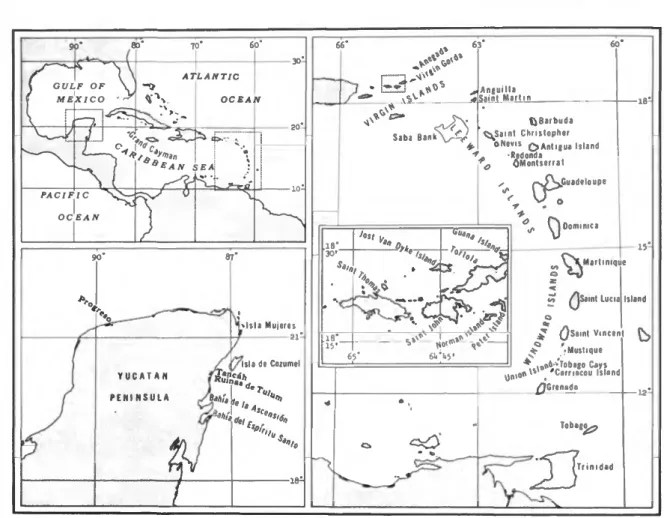
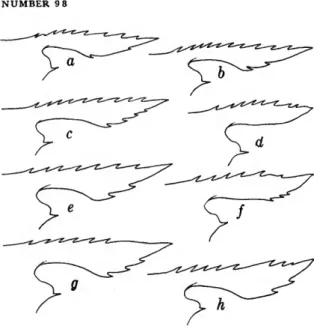
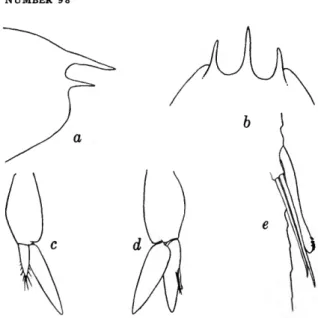
A complete list of occupied marine stations is available from the Department of Invertebrate Zoology, Smithsonian Institution. The species have been assigned consecutive numbers to facilitate cross-referencing between the keys and the discussion of the species in the text. On the other hand, only 6 of the 70 marine species now known from the Yucatan region have not yet been recorded on any of the West Indian islands.
Two of the West Indian islands, Cuba and Trinidad, appear to have transitional faunas.

To the Bermudas, but not to the continental United
To the Gulf of Mexico, but not to the east coast of
Metapenaeopsis gerardoi Perez Farfante
DISTRIBUTION.—Bahamas, Florida Keys, West Indies, and Caribbean coasts of Central and South America; surface at least 299 meters.
Metapenaeopsis hobbsi Perez Farfante
DISTRIBUTION. – Cuba and Honduras to Estado do Rio de Janeiro, Brazil; to a depth of 192 meters. DISTRIBUTION. Cuba and Yucatan to Estado do Rio de Janeiro, Brazil (except between Estado do Maranhao and Estado da Bahia); to a depth of 732 meters. DISTRIBUTION. North Carolina and the Gulf of Mexico to French Guiana; to a depth of 420 meters.
DISTRIBUTION. - North Carolina and the Gulf of Mexico to Estado do Para, Brazil; to a depth of 42 meters.
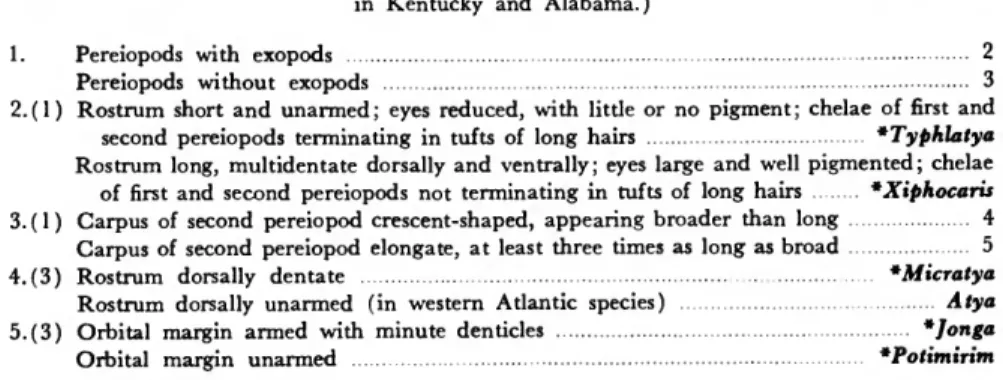
Leptochela carinata Ortmann
Xiphocaris elongate (Guerin-MeneviUe) DISTRIBUTION.-Restricted to the West Indian ice- Hippolyte elongatus Guirin-Meneville, 1855: pi. DISTRIBUTION.-Known only from the ovigerous female holotype from the Bermudas; at a depth of about 30 metres. HABITAT.-Cracks in rocks and corals. DISTRIBUTION.-Bermudas, Florida Keys, Barbuda, and Madeira; littoral and sublittoral.
Third maxilliped without exopod 12 2.(1) Eyes without pigment. Restricted to underground fresh water.) Troglocubanus Eyes pigmented 3 3.(2) Rostrum dorsally armed with series of prominent teeth 4 Rostrum usually unarmed dorsally, at most with 1 or 2 subapical denticles 11 4.(3) Rostrum with hepatic spine on lateral surface far posterior to anterior margin 5 Carapace without hepatic spine 8 5.(4) Telson bearing 2 pairs of terminal spines and usually 1 or 2 pairs of setae 6 Telson bearing 3 pairs of terminal spines 7 6.(5) Three posterior pereiopods with biangled dactyls *Brachycarpus Three posterior pereiopods widi dactyls simple, without auxiliary tooth on bending edge *Macrobrachium 7.(5) Rostrum without lateral flange; shell with antennal spine on anterior margin; 3 posterior pereiopods 7-segmented, ischium and merus distinct *Periclimen.es Rostrum with lateral flange; shell without antennal spine on anterior margin; 3.

Brachycarpus holthuisi Fausto Filho
Three (rarely 2) teeth of dorsal rostral row located on carapace posterior to level of orbital margin; ventral margin of rostrum armed with 3 or 4 teeth; sixth abdominal somite shorter than telson; antennular stalk with distal margin of basal segment not extending beyond distolateral tooth; second pereiopod with carpus about as long as chela. Antennal scale (Figure 3f) more than three times as long as wide, narrowing slightly in distal half;. First pereiopod (Figure 3m) reaching nearly as far anteriorly as antennal scale; fingers about as long as palm; carpus about twice as long as chela and noticeably longer than merus.
Fourth pereiopod (Figure 3q) exceeds antennal scale by most of length of dactyl; propodus more than twice as long as dactyl and nearly one and a half times as long as carpus, but slightly shorter than merus.
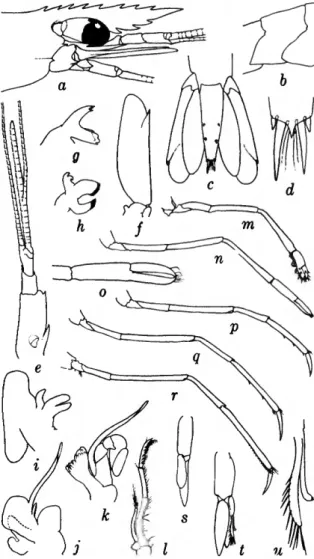
Rostrum with 2 or more dorsal teeth 2 Rostrum with single dorsal tooth or unarmed 3
Sixth somite (figure 6c) almost twice as long as the fifth, but slightly shorter than telson. Dorsal spines of telson (Fig. 6d) quite small, proximal pair clearly located distal to mid-segment, distal pair equidistant between proximal pair and end of telson; intermediate marginal spines at posterior end of telson (Figure 6e) not quite twice as long as the mesial pair. Sixth somite (figure 8c) almost three times as long as the fifth and slightly but clearly longer than telson.
Both pairs of dorsal spines of telson distinct (Figure fid), proximal pair situated near mid-length of segment, distal pair equal between proximal pair and edge of telen; intermediate marginal spines on distal end of telson (Figure 8e) more than twice as many as mesial pair.

Periclimenes pauper Holthuis
Periclimenes perryae Chace
Sixth somite noticeably longer than fifth, slightly more than half as long as telson. Antennal scale (Figure 9e) reaching about as far as the end of the antennal peduncle, about twice as long as wide; lateral margin convex, distal tooth very large, projecting distal margin of blade. Sixth somite noticeably longer than fifth, slightly more than half as long as telson.
Antennal scale (Figure 10/) extending about as far as end of antennular peduncle, slightly less than twice as long as wide; lateral margin convex, distal tooth very large, overreaching rounded distal margin of blade.

Pontonia unidens Kingsley
According to the figures of the Banners, the palm of the great chela is about 1.90 times as long as it is high; in 15 copies of A. NOTES. The brush of hairs on the movable finger of the small first pereiopod places this species in the Laevimanus (or Gambarelloides) group. The basal segment of the antennal stalk (basicerite) would be clearly spiny dorsally in S.
The blade of the antennal scale is said to be narrow (7 to 8.5 times as long as wide) in S. The distal segment of the antennal spindle (carpocerite) was stated to be about 3.7 times as long as wide in S. Carpus of the second pereiopod should be about 9.5 times as long as wide in S.
The merus of the third pereiopod was described as about 4 times as long as wide, or less, in S.

The absence of obvious rostral teeth in most specimens and the simple dactyls of the three posterior pairs of pereiopods distinguish H. NOTES. In the general shape of the rostrum and the absence of accessory spines on the dactyls of the three posterior pereiopods, this species shows a superficial resemblance to L. The presence or absence of an accessory branch on the dorsolateral flagellum of the antennule.
The antennal scale has its lateral margin distinctly concave, instead of almost straight, and the mesial edge of the blade is straight or convex distally, instead of concave. The only obvious difference is in the number and possibly the consequent arrangement of the dorsal rostral teeth. Carpus of first pereiopod varies from less than three-quarters length to slightly longer than palm of frons; the other male in the series containing the specimens shown in Fig. 56 has the merus only three-quarters as long as the palm.
The number of accessory spinules on the flexor margin of the dactyl of the male third pereiopod varies from 5 to 10, without apparent correlation with other characters. This can only be positively determined if De Man's specimen has 4 pairs of spines on the distal margin of the telson and a tooth near the base of the lateral margin of the styloserite. The third pereiopod is conspicuous in the four males in which both members of the pair have not been lost.
The proportional number of females in the size range comprising the majority of males is therefore considerably greater than in T. HABITAT.—Records of the Smithsonian-Bredin expeditions show that this species is not restricted to any particular ecological niche.

Thomas in 1958
- Periclimenes americanus 121. Alpheus bouvieri
- Periclimenes americanus 117. Alpheus bahamensis
- Periclimenes americanus
- Periclimenes rathbunae 121. Alpheus bouvieri
- Brachycarpus biunguiculatus 90. Periclimenes rathbunae
- Penaeus (Melicertus) aztecus subtilis 7. Penaeus (Melicertus) brasiliensis
- Leander tenuicornis 115. Alpheus armatus
- Periclimenes americanus 126. Alpheus formosus
- Periclimenes americanus 148. Synalpheus apioceros
- Periclimenes americanus 173. Synalpheus townsendi
- Metapenaeopsis smithi
- Lucifer faxoni 36. Leptochela bermudensis
- Brachycarpus biunguiculatus
- Periclimenes americanus 130. Alpheus normanni
- Periclimenes americanus 92. Periclimenes yucatanicus
- Trachypeneopsis mobilispinis
- Brachycarpus biunguiculatus 99. Pseudocoutierea antillensis
- Anchistioides antiguensis
- Periclimenes americanus 105. Typton tortugae
- Periclimenes americanus 82. Periclimenes longicaudatus
- Lucifer faxoni
- Periclimenes americanus 115. Alpheus armatus
- Leander tenuicornis 187. Latreutes fucorum
- Periclimenes americanus 116. Alpheus armillatus
- Metapenaeopsis smithi 108. Gnathophyllum americanum
- Metapenaeopsis goodei
- Metapenaeopsis goodei 75. Periclimenes americanus
- Periclimenes yucatanicus 113. Alpheopsis trigonus
- Sicyonia parri 44. Leander tenuicornis
- Periclimenes pedersoni
- Penaeus (Melicertus) duorarum notialis 35-5 Norman Island; Treasure Point; shore collecting;
- Leander tenuicornis 150. Synalpheus bousfieldi
- Leander tenuicornis 148. Synalpheus apioceros
- Brachycarpus biunguiculatus 187.. Latreutes fucorum
- Periclimenaeus caraibicus 75. Periclimenes americanui
- Penaeus (Melicertus) brasiliensis 22. Lucifer faxoni
- Metapenaeopsis martinella 38. Leptochela serratorbita
- Typhlatya monae
- Penaeus (Melicertus) brasiliensis
- Brachycarpus biunguiculatus 116. Alpheus armillatus
- Periclimenes americanus 113. Alpheopsis trigonus
- Periclimenes americanus 200. Thor manningi
- Metapenaeopsis smithi 132. Alpheus paracrinitus
- Metapenaeopsis martinella 17. Sicyonia parri
- Periclimenes longicaudatus
- Potimirim glabra
- Periclimenes americanus 81. Periclimenes iridescens
- Metapenaeopsis martinella 7. Penaeus (Melicertus) brasiliensis
- Macrobrachium crenulatum 48. Macrobrachium faustinum
- Neopontonides beaufortensis 184. Hippolyte nicholsoni
- Periclimenaeus caraibicus 75. Periclimenes americanus
- Pontonia mexicana 157. Synalpheus fritzmuelleri
- Periclimenes bowmani
- Periclimenes finlayi
- Jonga serrei 28. Micratya poeyi
- Sicyonia parri 1 Alpheus bahamensis
- Leander tenuicornis
- Leander tenuicornis 75. Periclimenes americanus
- Metapenaeopsis goodei 1 Trachypeneopsis mobilispinis
- Rhynchocinetes rigens 44. Leander tenuicornis
- Leander tenuicornis 88. Periclimenes pedersoni
- Pontonia miserabilis 148. Synalpheus apioceros
- Leander tenuicornis 130. Alpheus normanni
- Periclimenes rathbunae 115. Alpheus armatus
- Periclimenes pedersoni 90. Periclimenes rathbunae
- Periclimenaeus bredini 152. Synalpheus brooksi
- Brachycarpus biunguiculatus 75. Periclimenes americanus
- Periclimenes americanus 137. Alpheus viridari
- Palaemon (Palaeander) northropi 66. Periclimenaeus atlanticus
- Penaeus (Melicertus) brasiliensis 125. Alpheus floridanus
- Penaeus (Melicertus) brasiliensis 8. Penaeus (Melicertus) duorarum notialis
- Metapenaeopsis smithi 90. Periclimenes rathbunae
- Palaemon (Palaeander) northropi 117. Alpheus bahamensis
- Palaemon (Palaeander) northropi 137. Alpheus viridari
- Metapenaeopsis smithi 116. Alpheus armillatus
- Metapenaeopsis smithi 66. Periclimenaeus atlanticus
HABITAT. Most specimens were collected from a sea wall, rocky shores, a swampy tree stump and a shipwreck, sometimes to a depth of 5J/2 metres. A preliminary key to the shrimps of the family Penaeidae, with special reference to American forms. The Caridea and Stomatopoda from the second Templeton Crocker-American Museum expedition to the Pacific.
Alpheid Shrimp of Thailand: Alpheid Shrimp of the Gulf of Thailand and adjacent waters. A collection of Anomuran and Macruran crustaceans from the Gulf of Panama and fresh waters of the canal zone. Notice of Occurrence of the Alpheid Shrimp Leptalpheus forps Williams in the Northern Gulf of Mexico.
About the carcinological collections of the cabinets of natural history in the United States: with a list of the species found therein and descriptions of new species. The larval development of two Penaeid shrimps from Bermuda of the genera Sicyonia and Penaeopsis. The recent genera of the Caridean and Stenopodid shrimps (Class Crustacea: Order Decapoda: Supersection Natantia) with keys for their determination.
Dagiti Pakaammo iti Amianan nga Amerikano a Caridea idiay Museo ti Peabody ti Akademia ti Siensia idiay Salem, Mass. Iti koleksion dagiti krustaseo manipud idiay Virginia, Amianan a Carolina, ken Florida, nga addaan iti rebision dagiti henero ti Crangonidae ken Palaemonidae.

Descrizione di nuove specie di crostacei Provenant du Voyage auxlies du Cap-Vert de MM. Zoologia adriatica o Catalogo ragionato degli animali del Golfo e delle lagune di Venezia; preceduto da una tesi sulla storia fisica e naturale del Golfo; e accompagnato da memorie e osservazioni di fisica, storia naturale ed eco-.
Some Cuban Crustacea: With Notes on the Astacidae, by Walter Faxon, and a List of Isopoda, by Harriet Richardson. Report on the Macrura, Anomura and Stomatopoda collected by the Barbados-Antigua Expedition of the University of Iowa in 1918. Decapod and Other Crustacea Collected on the Presidential Cruise of 1938 (with introduction and station data).
General Supplement to the Annual Report of the Board of Regents of the Smithsonian Institution for 1956. General Supplement to the Annual Report of the Board of Regents of the Smithsonian Institution for 1958. In Verrill, Smith, and Harger, Catalog of the Marine Invertebrates of the South Coast of New England, and the adjacent Waters.
The animals of the vineyard sound and adjacent waters, with an account of the physical characters of the region. In Reports on the results of excavations, under the supervision of Alexander Agassiz, on the East Coast of the United States, during the summer of 1880, by the U.S. on several genera and species of Penaeidae, chiefly from recent excavations of the United States Fish Commission States.
Descriptions of new genera and species of Macurous crustaceans from the coast of North America.
Index to Scientific Names
Publication in Smithsonian Contributions to Zoology