Biol. Rev. (2004), 79, pp. 121-186. © Cambridge Philosophical Society 121 DOI: 10.1017/S1464793103006237 Printed in the United Kingdom
Male•female conflict and genitalia: failure to confirm predictions in insects and spiders
William G. Eberhard
Smithsonian Tropical Research Institute, and Escuela de Biología, Universidad de Costa Rica Ciudad Universitaria, Costa Rica (E-inail: [email protected])
{Received 9 May 2002 ; revised 4 March 2003 ; accepted 1 March 2003)
ABSTRACT
Some recent models suggest a new role for evolutionary arms races between males and females in sexual selec- tion. Female resistance to males is proposed to be driven by the direct advantage to the female of avoiding male- imposed reductions in the number of offspring she can produce, rather than by the indirect advantage of selecting among possible sires for her offspring, as in some traditional models of sexual selection by female choice. This article uses the massive but hitherto under-utilized taxonomic literature on genitalic evolution to test, in a two- step process, whether such new models of arms races between males and females have been responsible for rapid divergent evolution of male genitalia. The test revolves around the prediction that 'new arms races' are less likely to occur in species in which females are largely or completely protected from unwanted sexual attentions from males (e.g. species which mate in leks or in male swarms, in which males attract females from a distance, or in which females initiate contact by attracting males from a distance).
The multiple possible mechanical functions of male genitalia are summarized, and functions of male genitalic structures in 43 species in 21 families of Diptera are compiled. Functions associated with intromission and insemination (e.g. seizing and positioning the female appropriately, pushing past possible barriers within the female, orienting within the female to achieve sperm transfer), which are unlikely to be involved in new arms races when females are protected, are shown to be common ( > 50 % of documented cases). This information is then used to generate the new arms race prediction: differences in genitalic form among congeneric species in which females are protected should be less common than differences among congeneric species in which females are vulnerable to harassment by males. This prediction was tested using a sample of 361 genera of insects and spiders. The prediction clearly failed, even when the data were adjusted to take into account several possible biases. Comparative analyses within particular taxonomic groups also failed to show the predicted trends, as did less extensive data on other non-genitalic male display traits. Arms races, as defined in some recent models, seem to have been less important in male•female coevolution of genitalic structures than has been suggested. By elimination, alternative interpretations, such as traditional female choice, which do not predict associations between female protection from harassment and rapid divergent evolution, are strengthened.
Key words: genitalic evolution, sexual selection, cryptic female choice, male•female conflict.
CONTENTS
I. Introduction 122 II. Methods 128 III. Results 143 (1) Functions of male genitalic structures in Diptera 143 (2) Comparisons of groups with protected and unprotected females 157 (a) Totals of genus-by-genus counts 157 [h) Analyses at higher taxonomic levels 161 IV. Discussion 162 (1) Genitalic functions in Diptera 162
122
William G. Eberhard
(2) Comparisons of groups with protected and unprotected females 163 (a) Genus-by-genus comparisons 163 (i) Totals 163 {ii) Possible limitations of the analyses 163 (A) Data on genitalia 163 (B) Data on mating behaviour 164 (C) The analyses 166 (D) Summary of limitations 166 (b) Large taxa with uniformly protected females 166 (c) Other hypotheses and data 167 (3) Non-genitaHc traits 167 (4) Can one generalize from genitalia? 168 V. Conclusions 169 VI. Acknowledgements 169 VII. References 169
I. INTRODUCTION
Recent empirical and theoretical developments have suggested new interpretations of sexual selection. Some evolutionary phenomena that were previously explained by mate choice may be better explained by coevolution of males and females resulting from conflicts of interest between the sexes over control of copulation and fertilization (Parker, 1979; Chapman et al., 1995, 2003; Rice, 1996; Alexander, Marshall & Cooley, 1997; Holland & Rice, 1998, 1999;
Rice & HoUand, 1999;Johnstone & Keller, 2000; Michiels, 1998; Gavrilets, Arnqvist & Friberg, 2001; Pitnick, Brown
& Miller, 2001 a; Pitnick, Reagan & Holland, 2001 ¿; Stutt
& Siva-Jothy, 2001; Moore et al., 2001). These recent dis- cussions emphasize one particular class of direct benefits that a female could derive from resisting male sexual behaviour: avoidance of male-inflicted reductions in her ability to produce offspring. Evolutionary interactions between males and females are thought to be driven by selection on females to avoid these costs that are imposed by the male, resulting in subsequent male countermeasures.
For instance, in their 'chase away' model, Holland and Rice (1998) listed the possible costs of mating for females as mating 'too often, [or at a] less-than-ideal time or place'.
Gavrilets et al. (2001) contrasted the proposed benefits to females from rejecting males under their sexual conflict model as a 'side-effect of females evolving to reduce the direct costs of mating' instead of ' traditional explanations of costly female mate choice, which rely on indirect genetic benefits' (p. 531). Alexander et al. (1997) were less explicit about female costs in their discussion of genitalic evolution, but argued specifically against indirect Fisherian payoffs to females. They mention that conflicts 'are always mediated by ecological factors ' (p. 8), and the examples they used of benefits to females from resisting males were avoidance of direct costs such as loss of foraging or oviposition oppor- tunities, and loss of benefits from additional matings that would result from unduly long copulations. Other possible direct female costs include increased exposure during copulation to prédation and venereal diseases, and inter- ference of copulation with the ability to carry out vital
activities such as feeding, sheltering, or resting. Costs could also be imposed on females after copulation ends, as a result of male effects on her reproductive physiology, such as causing her to make disadvantageously large or premature investments in oviposition due to male induction of egg maturation or oviposition, or to lose the benefits (direct or indirect) that she might obtain from other males due to male-imposed suppression of her receptivity (Chen, 1984).
Males and females are envisioned as being engaged in co- evolutionary arms races for control of the events that are associated with copulation, insemination, and ultimately fertilization of the female's eggs. Explicit models of this sort have been proposed for both classic, pre-copulatory female rejections (the 'chase-away' model of Holland & Rice, 1998; Gavrilets et al., 2001), and female rejection during or following coupling (the male•female conflict model of Alexander et al., 1997). These ideas will be referred to here as 'new arms race' models. As noted by Gavrilets et al.
(2001) they contrast with 'traditional' ideas that emphasize other possible types of benefits that a female could derive from rejecting some types of conspecific males (reviewed by Andersson, 1994). Setting aside the probably small subset of species in which females gain direct benefits (Andersson, 1994), the distinction between the new arms race models and the traditional female choice models involves selection on the female that favours fecundity (new arms races) and selection on the female that favours offspring quality (traditional female choice).
It is important to clarify that the distinction being made here does not imply that male•female conflict/fer se is limited to the new arms race contexts. Any female that exercises classic female choice and does not accede to the attempts of a particular male to fertilize her eggs will be acting against the best interests of that male. The new arms race models thus do not differ from traditional ideas in supposing that male•female conflicts occur (Rosenthal & Servedio, 1999;
Getty, 1999; Rice & HoUand, 1999; Soulier-Perkins, 2001 on genitalia). In fact, males under traditional sexual selec- tion by female choice are also engaged in ' arms races ' with females : males are selected to win in competition with other males by evolving ever more effective ways of stimulating
Male-female conflict and genitalia
123females to permit them to fertilize their eggs; and females are under selection to filter males ever more effectively in favour of those with the most potent stimulating mechan- isms, by denying less well-equipped males access to their eggs. What is different, and potentially important in the new arms race models, is the proposed direct payoff to the female from making such a rejection. New arms race models emphasize the direct benefits just mentioned, and specifically exclude indirect payoffs via superior offspring (Alexander et al, 1997; Rice & Holland, 1999; Gavrilets et al, 2001).
This distinction leads to differences in both the expected designs of female structures employed in sexual interactions with males (Eberhard, 1997), and in the ecological contexts in which male•female struggles are expected to occur (Alexander et al., 1997). This review exploits these predicted ecological differences to test the new arms race models against traditional ideas.
Data on male genitalia from the immense but hitherto under-utilized taxonomic literature can be used to test the new arms race hypotheses for a wide range of taxonomic groups. In groups in which male genitalic traits have been especially useful in distinguishing closely related species, male genitalia can be characterized as having undergone especially rapid divergent evolution. Both new arms race models and the traditional sexual selection ideas predict frequent rapid divergent evolution of male genitalia. But they differ with respect to both the ecological contexts in which such evolution is expected, and the genitalic functions that are expected to evolve. These differences involve differ- ences in the degree of possible male coercion in initiating male•female interactions, as noted by Alexander et al.
(1997).
In some animals (for instance, grasshoppers and water striders), females are subject to sexual attacks by males (the 'coercive' male acts of Alexander et at., 1997) while they feed, oviposit, or perform other reproductively important activities. Females of such species may sometimes benefit, under natural selection, from traits that enable them to elude or otherwise defend themselves against copulations resulting from male harassment. At the genitalic level, selection in such species is likely to favour female traits that make it more difficult for male genitalic structures to seize the tip of her abdomen and position his intromittent genitalia for pen- etration. Under such circumstances, the new arms race models predict that coevolutionary arms races will arise between males and females to control the initiation of copulation. In other species, male-female encounters only occur when the female has actively sought out the male (for instance, by approaching a male that is calling with a song or a pheromone • the 'luring' male acts of Alexander et at., 1997), or by initiating the entire interaction herself (for instance, by emitting her own long-distance attractant pheromone). In many of these species there are no resources associated with the male which would make it otherwise advantageous for the female to approach him. In such species, male•female conflict involving naturally selected costs of copulation is less likely, because females are rela- tively ' protected ' from unwanted male attentions (hereafter, 'protected females'). A protected female would presumably seldom if ever encounter a male except when circumstances
such as depletion or lack of sperm make copulation advan- tageous for her. Females of such species would be able to more readily avoid unwanted interactions, including both forceful male mating attempts as well as antagonistic seduction (e.g. Holland & Rice, 1998), and thus be less likely to engage in coevolutionary morphological arms races with males to avoid unwanted copulations. Any female resistance to males that might be observed in such a species would be more likely to occur because of the benefit that the female derives indirectly through improved quality in sires, rather than because of direct payoffs from avoiding copulation, such as avoiding prédation or disruption of feeding and oviposition, as envisaged in new arms race models.
Luring versus coercion is a continuum (Alexander et at., 1997), however, and these predictions are not always black and white. For instance, a female might sometimes arrive at an aggregation of males and mate with one of them, but then be unable to escape before being accosted and mating additional, unwanted times. Similarly (and more import- andy for this review), male genitalia can have multiple func- tions. Copulation and insemination are often multi-stage processes, and male•female cooperation at one stage could be followed by conflict at a later stage (or vice versa). A male cricket, after luring a female with his song, might forcefully hold on to her longer than is convenient for her. It is necessary to analyse different functions separately, because the expectations regarding male•female conflict vary. More specifically, conflicts over holding and positioning the female genitalia so that intromission can occur (a probable function of male genitalic claspers in many species • see Table 1 and below), over prying open or penetrating deeper to reach optimal sperm deposition sites after initial intromission (e.g. Eberhard, 1993 a; Eberhard & Kariko, 1996; Tallamy et at., in press), or over preventing or in- hibiting the female from subsequently discarding the male's sperm, are not expected to occur in groups in which females are protected from male harassment. This is because a protected female will presumably not come into contact with a male except in order to receive sperm. Reduction in new arms race conflict in protected females is also ex- pected for genitalic functions involving removal of sperm or sperm plugs. This is because the payoffs to the female from resisting the male (e.g. resist male attempts to remove sperm deposited by previous males) seem likely to be in- direct (screening potential sires), rather than the direct non- selective avoidance payoffs proposed in the new arms race models.
By contrast, new arms race models predict that other possible genitalic functions might nevertheless be subject to conflict in protected females. There could be conflict, for instance, over whether the female oviposits without mating with additional males ; over whether the male damages the female's reproductive tract so as to make it less likely that she will remate or that rematings will result in sperm transfer (Wing, 1982; Eberhard, 1993«; Crudgington & Siva-Jothy, 2001; Blanckenhorn et at., 2002); over whether the male uses his genitalia to grasp the female for longer than necessary for sperm transfer so as to guard her from other males (Alcock, 1994), and thus interferes with other female activities such as feeding or predator defence ; over whether
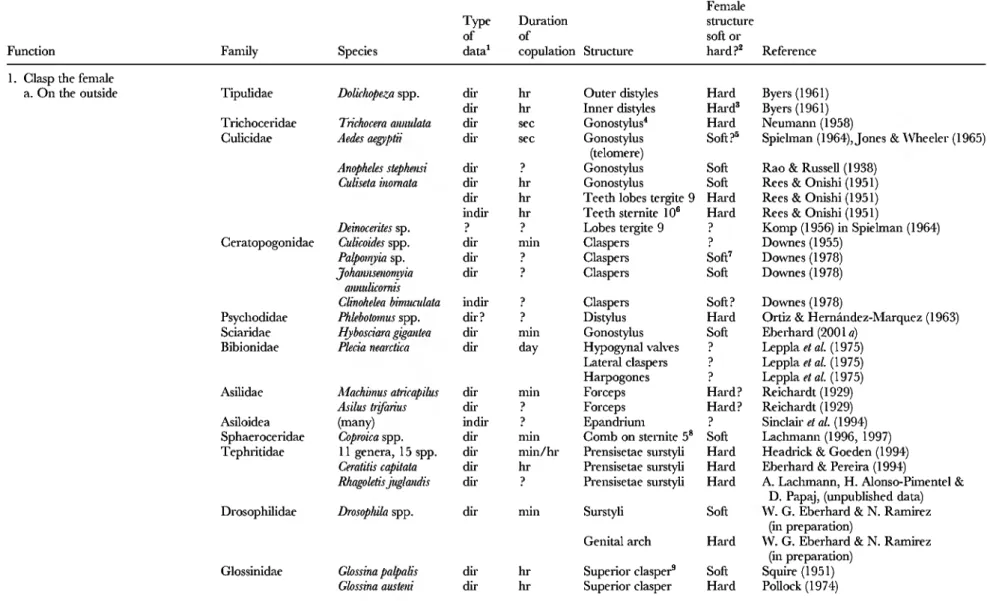
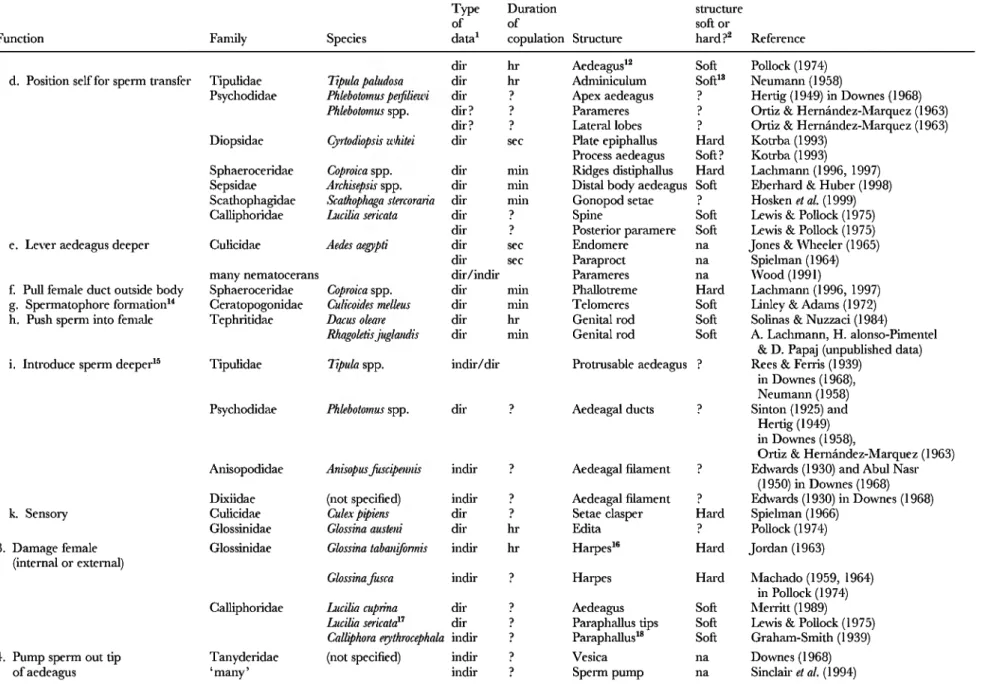
Table 1. Mechanical functions attributed to male genitalic structures in published studies of Diptera. In the many cases in which multiple functions are probable (for example, pushing past internal structures is facilitated and probably often dependent on a firm external grip), the most immediate function mentioned by the authors is given.
Reasons to expect (or not expect) that male-female conflict would occur if the female were protected are given in the Section II. Further hints regarding possible conflict are given by copulation duration, which gives an indication of the likelihood of male-female conflict costs to the female if the male extends the duration longer than is in the best interests of the female (a possible function of clasping male genitalia). Male-female conflict over copulation duration is less probable in shorter copulations, ('sec' indicates
< 1 min; 'min' indicates < 1 hour; 'hr' indicates < 1 day). Similarly, contact with soft female structures may be less likely to result in coevolutionary races with males that would select for rapid morphological divergence in male genitalia, because female morphological defences against the male, such as hard processes that fend him off or otherwise impede eifective contact, are missing
4^
Function
Female
Type Duration structure
of of soft or
Family Species data^ copulation Structure hard?^ Reference
Tipulidae Dolkhopeza spp. dir hr Outer distyles Hard Byers(1961)
dir hr Inner distyles Hard" Byers(1961) Trichoceridae Trkhocera annulata dir sec Gonostylus'' Hard Neumann (1958)
Culicidae Aedes aegyptii dir sec Gonostylus
(telomere)
Soft?^ Spielman (1964), Jones & Wheeler (1965) Anopheles stephensi dir ? Gonostylus Soft Rao & Russell (1938)
Culiseta inomata dir hr Gonostylus Soft Rees&Omshi(1951)
dir hr Teeth lobes tergite 9 Hard Rees&Omshi(1951) indir hr Teeth sternite 10" Hard Rees&Omshi(1951)
Deinocerites sp. ? ? Lobes tergite 9 •^ Komp (1956) in Spielman (1964)
Ceratopogonidae Culicoides spp. dir min Claspers p Downes (1955)
Palpomyia sp. dir •? Claspers Soft' Downes (1978)
Johanmenomyia dir ? Claspers Soft Downes (1978)
annulicomis
Clinohelea bimuculata indir p Claspers Soft? Downes (1978)
Psychodidae Phlebotomus spp. dir? p Distylus Hard Ortiz & Hernández-Márquez (1963)
Sciaridae Hybosciam gigantea dir min Gonostylus Soft Eberhard (200la)
Bibionidae Plecia nearctica dir day Hypogynal valves Lateral claspers Harpogones
Leppla (;¿ a/. (1975) Leppla ei a/. (1975) Leppla ei a/. (1975)
Asilidae Machimus atricapilus dir min Forceps Hard? Reichardt(1929)
Asilus tnfarius dir ? Forceps Hard? Reichardt(1929)
Asiloidea (many) indir ? Epandrium -? Sinclair «Z fl/. (1994)
Sphaeroceridae Coproica spp. dir min Comb on sternite 5* Soft Lachmann (1996, 1997) Tephritidae 11 genera, 15 spp. dir min/hr Prensisetae surstyli Hard Headrick&Goeden(1994)
Ceratitis capitata dir hr Prensisetae surstyli Hard Eberhard & Pereira (1994)
Rhagoktis juglandis dir ? Prensisetae surstyli Hard A. Lachmann, H. Alonso-Pimentel &
D. Papaj, (unpublished data) Drosophüidae Drosophila spp. dir min Surstyli
Genital arch
Soft Hard
W. G. Eberhard & N. Ramirez (in preparation)
W. G. Eberhard & N. Ramirez (in preparation)
Glossinidae Glossina palpalis dir hr Superior clasper^ Soft Squire (1951) Glossina austeni dir hr Superior clasper Hard Pollock (1974) 1. Clasp the female
a. On the outside
f
P
w cr
n
b. On the inside 2. Interact with internal
structures to facilitate sperm deposition a. Pry open, straighten,
push past female structures
(to facilitate deeper penetration) CuUcidae
dir hr Sternite 5 Hard Pollock (1974) !>
Muscidae Musca domestica dir hr Lateral process
Sternite 5
Soft? Graham-Smith (1939)
1-
dir hr" Arch segment 7 -? Graham-Smith (1939), dir hr
(2""^ forceps)
Cerci Soft
DegrugiUier & Leopold (1973) Graham-Smith (1939)
Scathophagidae Calliphoridae
Scathophaga stercoraria Calliphora
aythrocephala
dir dir dir indir
min min
? p
Sternal forceps Claspers
Lateral process of Sternite 5 Appendage of anal
Soft?
Soft?
Soft?
Soft?
Hoskeneia/. (1999) Hoskeneia/. (1999) Graham-Smith (1939) Graham-Smidi (1939)
»
Si,
Lucilia sericata dir p Sternite 5, inferior tergum Soft Lewis &. Pollock (1975) Sepsidae Archisepsis spp. dir
dir
min min
and superior forceps ' Spiny Arch ' 'Paddle'
Soft Soft
Eberhard Sí Huber (1998) Eberhard & Huber (1998)
b. Seal (presumably promote sperm transfer)
c. Engage to anchor
Tipuhdae Dolichopeza spp. dir hr Gonapophyses Soft Byers(1961)
Trichoceridae Trichocera annulata dir sec Paramere Soft Neumann (1958)
Cuhcidae Aedes aegfptii dir sec Gonocoxa Soft Spielman(1964)
dir sec Paraprocts Hard Spielman(1964),
Jones & Wheeler (1965) dir sec 9* Tergal lobes Hard? Jones & Wheeler (1965) dir sec Teeth aedeagus Hard Jones & Wheeler (1965)
Psychodidae Phlebotomus spp. dir? ? Aedeagus Soft? Ortiz & Hernández-Márquez (1963), Ilango & Lane (2000)
Tephritidae Ceratitis capitata dir hr Basal sac glans Soft Eberhard &. Pereira (1995) Glossinidae Glossina palpalis dir hr Inferior clasper Hard Squire (1951)
Glossina austeni dir hr Inferior clasper" Hard PoUock(1974)
Sphaeroceridae Coproica spp. dir min Postgonite Soft Lachmann (1996, 1997)
dir min Telomere Hard Lachmann (1996, 1997)
Scathophagidae Scathophaga stercoraria dir min Paramere Gonopod
Soft?
Soft?
Hosken eí a/. (1999) Hosken eí a/. (1999)
Muscidae Musca domestica dir hr Endophallus Soft Graham-Smiüi (1939),
DegrugiUier & Leopold (1973)
Cuhcidae Aedes aegfptii dir sec Lobes aedeagus Soft Spielman(1964)
sec Anal cone Soft Spielman(1964)
sec Paraprocts Hard Spielman(1964)
Sphaeroceridae Coproica spp. dir min PhaUotreme Hard Lachmann (1996, 1997)
Calliphoridae Chtysomya bezziana dir p Prepuce aedeagus Soft? Spradbery & Sands (1976) Glossinidae Glossina austeni dir hr Flaps aedeagus Soft? PoUock (1974)
Tipuhdae Tipula paludosa dir hr Parts gonostylus Hard? Neumann (1958)
Otitidae Tetanops myopaeformis dir p Aedeagal setae Soft Klostermeyer & Anderson (1976) Glossinidae Glossina palpalis indir hr Appendices aedeagus Soft Squire (1951)
Glossina austeni dir hr Median apophysis Soft Pollock (1974) NO
Table 1. (Cont) NO Female
Type Duration structure
of of soft or
Function Family Species data^ copulation Structure hard?^ Reference
dir hr Aedeagus'^ Soft Pollock (1974)
d. Position self for sperm transfer Tipulidae Tipula paludosa dir hr Adminiculum Softie Neumann (1958)
Psychodidae Phlebotomus perfiliewi dir ? Apex aedeagus •^ Hertig (1949) in Downes (1968)
Phlebotomus spp. dir? ? Parameres •^ Ortiz & Hernández-Márquez (1963)
dir? p Lateral lobes p Ortiz & Hernández-Márquez (1963) Diopsidae Cyrtodiopsis whitei dir sec Plate epiphallus
Process aedeagus
Hard Soft?
Kotrba(1993) Kotrba(1993)
Sphaeroceridae Coproica spp. dir min Ridges distiphallus Hard Lachmann (1996, 1997) Sepsidae Archisepsis spp. dir min Distal body aedeagus Soft Eberhard c& Huber (1998) Scathophagidae Scathophaga stercoraria dir min Gonopod setae p Hosken «¿a/. (1999) Calliphoridae Lucilia sericata dir ? Spine Soft Lewis & Pollock (1975)
dir ? Posterior paramere Soft Lewis C& Pollock (1975)
e. Lever aedeagus deeper Culicidae Aedes aegfpti dir sec Endomere na Jones & Wheeler (1965)
dir sec Paraproct na Spielman(1964)
many nematocerans dir/indir Parameres na Wood (1991)
f. PuU female duct outside body Sphaeroceridae Coproica spp. dir min PhaUotreme Hard Lachmann (1996, 1997) g. Spermatophore formation" Ceratopogonidae Culicoides melleus dir min Telomeres Soft Linley& Adams (1972) h. Push sperm into female Tephritidae Dacus oleare dir hr Genital rod Soft Solinas c& Nuzzaci (1984)
Rhagoktis juglandis dir min Genital rod Soft A. Lachmann, H. alonso-Pimentel
& D. Papaj (unpublished data) i. Introduce sperm deeper^^ Tipulidae Tipula spp. indir/dir Protrusable aedeagus p Rees& Ferris (1939)
in Downes (1968), Neumann (1958)
Psychodidae Phlebotomus spp. dir ? Aedeagal ducts •^ Sinton (1925) and
Hertig (1949) in Downes (1958),
Ortiz & Hernández-Márquez (1963) Anisopodidae Anisopus fuscipennis indir ? Aedeagal filament 7» Edwards (1930) and Abul Nasr
(1950) in Downes (1968) Dfadidae (not specified) indir p Aedeagal filament p Edwards (1930) in Downes (1968)
k. Sensory Culicidae Culex pipiens dir ? Setae clasper Hard Spielman (1966)
Glossinidae Glossina austeni dir hr Edita p Pollock (1974)
3. Damage female Glossinidae Glossina tabanifoimis indir hr Harpes^'' Hard Jordan (1963)
(internal or external) p
Glossinafusca indir p Harpes Hard Machado (1959, 1964)
in Pollock (1974)
P
Calliphoridae Lucilia cuprina dir ? Aedeagus Soft Merritt(1989)
Lucilia sericata^'' dir ? ParaphaUus tips Soft Lewis & Pollock (1975)
Calliphora etythrocephala indir p Paraphallus^* Soft Graham-Smith (1939) n
^1
4. Pump sperm out tip Tanyderidae (not specified) indir p Vesica na Downes (1968) ^
p
of aedeagus ' many ' indir p Sperm pump na Sinclair «Z a/. (1994)
a
5. Remove sperm of previous males^^
6. Remove sperm plug or spermatophore of previous male 7. Deposit plug in female 8. Mould for part of
spermatophore 9. Stimulate female^"
Scathophagidae Scathophaga stercoraria dir min Diopsidae Cyrtodiopsis whitei indir sec
No examples known in Diptera
Sepsidae Archisepsis spp. indir min Diopsidae Cyrtodiopsis whitei indir sec Tipulidae
Sciaridae Sepsidae Sphaeroceridae
Tipula paludosa Hybosciara gigantea Archisepsis, Microsepsis
Coproica spp.
dir dir dir dir
hr min min min
Scoop on aedeagus'^ Soft Hosken et al. (1999) Body epiphallus na Kotrba(1993)
Distal body aedeagus na Aedeagus na Two Tufts of setae Hard Gonostylus Soft Surstyli Soft Comb sternite 5^" Soft
Eberhard & Huber (1998) Kotrba(1993)
Neumann (1958) Eberhard (2001 a) Eberhard (2001 ¿) Lachmann (1996, 1997)
4h
%
s Si,s
1. ' dir ' = direct observations by author and statement of possible function ; ' indir ' = author directly mentioned possible function, but used deductions from shape and size rather than observations of copulating pairs.
2. The structure of the female which the male structure contacts is soft (membrane) or hard (sclerite).
3. Contrary to expectations of new arms race ideas, female 'hypovalves are pocketed on their inner surfaces to receive the tips of the inner distyles of the male, in order to effect a firm attachment in copulation' (Byers, 1961, p. 692).
4. First used to grasp the female, and then to hold her as he pushed the rest of his genitalia against her.
5. The telomere of the clasper seizes female cercus (hard), but its distal claw inserts in the soft membranous region at the base of the cercus (Jones c& Wheeler, 1965).
6. The male genital parts work against each other and probably squeeze female sternum 8.
7. Tip of gonostylus presses intersegmental membrane, but slighüy more basally the gonostylus presses against the female tergite.
8. Sustained series of rhythmic squeezing movements of the male indicate both clasping and stimulation functions for spine comb on male sternite, which presses on the intersegmental membrane between female tergites 7 and 8.
9. Male superior clasper digs into and damages cushions of tissue on female segment 6. The soft area in the sternite is not indicative of a female resistance structure ; on the contrary, the rhythmic squeezing movements during apparent copulatory courtship with the male's middle and hind legs, and the increased squeezing when the female becomes restless, suggest a courtship function. No damage occurs in G. fusca, G. longipalpis.
10. Grasp occurs in pouch inside male body, but on the outside surface of the ovipositor.
11. May help align female with male (function 2d).
12. Aedeagus frequently buckles due to force with which it grasps and pulls on the female genital papilla and thus straightens the spermathecal ducts ; this may facilitate entry of sperm.
13. Is close to but does not engage the mouth of the female duct.
14. Each telomere is repeatedly withdrawn and then thrust deeply into the intersegmental membrane of the female. They move in strict alternation and each is extended about once every 4 s, usually for 1 s min or more. The authors supposed that the movements 'are connected with' spermatophore, apparently because the spermatophore is formed during this same period. The movements seem more appropriate, however, for stimulating the female than for spermatophore formation.
15. Some of the tubular structures proposed to function in deeper penetration for sperm deposition could function instead to remove sperm by sucking them from the female; removal seems less likely, however, because there are no structures described associated with the tip of the male structure and the associated sperm pumps that could possibly separate sperm to be removed from sperm to be deposited.
16. A tough shield protects the anterior end of the uterus and the entrance of the common oviduct; this is an apparent female defensive structure.
17. The damage, documented by scars in the female reproductive tract, presumably functions to facilitate entrance of male seminal products into female haemocoel; but Lewis &
Pollock (1975) argue, because of the absence of muscles associated with the paraphalli, that the female actively participates in producing this 'damage ' by contracting circular muscles of her bursa so that it becomes abraded.
18. The female sacs into which barbed extremities of paraphaUus fit have very thick walls, so penetration not certain.
19. Description mentions male removing (inefficiently) his own sperm from the bursa; but if sperm from previous males are ejected from the spermatheca by the female, they would also be removed. The authors concluded that '... it is likely that sperm removal is incidental rather than adaptive '.
20. Stimulatory function deduced from rhythmic movements with no mechanical effect other than squeeze or brush against female. For other possible cases, see footnotes 11, 10
and 18. NO
128
William G. Eberhard
he is able to plug her genital opening (Boorman & Parker, 1976) and deny her possible naturally selected benefits (e.g.
nutrition) fi-om fiarther matings; or over whether he opens holes in her reproductive tract or otherwise facilitates in- troduction of seminal products into her body cavity, where they can act to induce her to make either larger or more precipitous investment in offspring (Chen, 1984; Eberhard, 1996; Sheldon, 2000), or to suffer reduced survivorship (Chapman et al, 1995; Wolfner, 1997).
On balance, the predicted association of conflict with coercive pre-copulatory interactions made by Alexander et al. (1997) is less categorical than they suggested; species in which females are protected from male harassment to initiate copulation wul not necessarily lack all types of male•female conflict over genitalic functions. By the same token, my previous discussions of this topic (Eberhard, 1997, 1998a) were over-simplified, because I also treated the prediction too categorically. There are various possible functions of male genitalia; some of these functions but not others could result in new arms races even when the female is not coerced by the male in pre-copulatory behavioural interactions.
This means that in order to make the kind of comparison advocated by Alexander et al. (1997), it is first necessary to check the relative importance of different types of genitalic functions in general. New arms race ideas predict that the frequency and intensity of conflict over certain genitalic func- tions (in particular, functions associated with initiation and facilitation of intromission and insemination) should be perceptibly reduced when females are protected from harassment. If such potentially non-conflicting functions are common for genitalia in general, then it is reasonable to expect, if new arms race models are correct, that species with protected females wiU show reduced tendencies toward rapid divergence in male genitalia. If, on the other hand, such potentially non-conflicting genitalic functions are rare, then the new arms race ideas predict that female protection or lack of protection would have only a minor effect on genitalic evolution.
The first part of this review considers the different poss- ible functions of male genitalia documented in previous studies of male and female genitalic function in a sample of species in the order Diptera. The results confirm that potentially non-conflicting functions are indeed common in Diptera. If one assumes that Diptera is representative of other insects and spiders with respect to the different func- tions performed by male genitalia, this finding justifies making the 'new arms race' prediction that rapid and divergent genitalic evolution wul be more common in these groups when females are unprotected than when they are protected. Traditional female choice hypotheses, by con- trast, do not predict a difference in genitalic evolution between species in which females are and are not protected from male harassment. Under female choice, other factors, such as whether and how often females remate (Eberhard, 1985«; Arnqvist, 1998) and whether morphologically uni- form male genitalia are nevertheless moved in species- specific ways during copulation (Eberhard, 1985«, 1998é, 2001 fl,¿) are expected to influence the evolutionary diver- sification of male genitalia.
The second part of this review then tests this prediction in 343 genera of insects in which behavioural observations have established that females are or are not protected from male harassment. A similar test of new arms race predictions is made in 18 genera of spiders using morphology to infer behaviour. Some spiders have exaggerated sexual size di- morphism (dwarf males and giant females). Tiny males are especially unlikely to be able to coerce giant female spiders, with their genitalia or otherwise, because the female can simply convert harassing suitors into food (see Elgar, 1991 ; Elgar, Schneider & Herberstein, 2000, and Bukowski, Linn
& Christenson, 2001 for cases of such cannibalism, which include such radical female solutions to possible conflict as interrupting copulation to pull the male free and eat him).
New arms races are thus less likely in species with especially small males, so species-specific genitalic differences are pre- dicted to be reduced. Again, traditional female choice makes a contrasting prediction: because the intensity of classic female choice is not expected to correlate with differences in the male's physical ability to coerce the female, no corre- lation is predicted between relative male size and the degree of genitalic divergence.
New arms race models have seldom been tested with respect to genitalic evolution. Huber (1998) argued against new arms race ideas on the basis of a summary of behav- ioural data from 151 species of spiders. He found that males typically lure rather than coerce females to mate, and that females typically cooperate actively with the male to bring about copulation. He also noted that spider genitalia are generally especially important characters for dis- tinguishing species, and concluded that the male•female conflict hypothesis was thus not supported. Soulier-Perkins (2001) found apparently higher degrees of homoplasy in female genitalic traits than in male genitalic traits, and argued that this supported the idea of sexual conflict rather than classic female choice. The logic of the prediction is not clear, and in any case the difference in homoplasy was not significant (x^=1.3, d.f = 1, P=Q.21). The author's citations indicate that she included classic Fisherian sexual selection by female choice as conflict.
II. METHODS
Data on genitalic functions in Diptera were taken from papers on genitalic mechanics in 43 species in 21 families.
Functions were classified as potentially conflicting or not potentially conflicting in species in which females are pro- tected from male harassment as follows.
Facilitation of sperm transfer : this function was taken not to be potentially conflictive, because protected females wul have sought out the male in order to receive sperm. While it is true that sperm transfer may often result in dilution or displacement of the sperm of previous males (see footnote 15 in Table 1), this male•male conflict is unlikely to generate male•female conflicts of the types envisioned in the new arms race models. It could bias paternity; but it is unlikely to reduce female production of offspring, which is the cost proposed in the new arms race models (unless females are
Male-female conflict and genitalia
129sperm-limited and the loss of sperm from previous males results in a reduction in the number of offspring she can produce).
Clasping and anchoring: these functions, which occur both on the outside and within the female, could be both potentially conflictive and potentially non-conflictive. They would not be expected to be conflictive when they serve to facilitate intromission. Potential conflict could occur, how- ever, if clasping or anchoring served to hold the female for longer than necessary for insemination, and if being held this way interfered with other female activities severely enough that female losses in offspring (the costs postulated by the new arms race models) were greater than the indirect benefits that she received from having sons capable of holding females this way (Cordero & Eberhard, 2003).
Damaging the female: this function was taken to be potentially conflictive, although if the female gained more in indirect benefits from having sons capable of producing such damage than she lost from the consequences of the damage, it could be potentially non-conflictive (Cordero & Eberhard, 2003).
Removal of sperm from previous males : this function is unlikely to be potentially conflictive, because in most cases the expected loss to the female from sperm removal would not be a reduction in her ability to produce offspring, but rather a change in paternity. An exception would occur in the seemingly unlikely case that the female lost nutritional benefits from the ejaculatory products of the previous male, or if females were sperm-limited and the loss of stored sperm resulted in reduced reproduction.
Stimulation : this was not expected to be potentially con- flictive because stimulation per se is unlikely to inflict costs to the female in reduced ability to produce offspring.
PuU part of female reproductive tract inside-out: this would seem potentially damaging to the female, and was thus considered to be potentially conflictive. However, the females of species in which this occurs apparently cooperate actively (Lachmann, 1996, 1997), as the male's phallotreme is not long enough to reach the vaginal plate which it grasps to pull, so the female presumably must move the plate posteriorly to enable him to grasp it.
Further indications regarding possible conflict were available from copulation duration and from female struc- tures. Male•female conflict over copulation duration (and thus male clasping functions) is expected to be less probable in shorter copulations. Soft female genitalic structures that are contacted by the male are less likely to be able to fend off the male genitalia, and are thus unlikely to be involved in coevolutionary races with males that would select for rapid morphological divergence in male genitalia. By contrast, hard processes that could fend him off or otherwise impede effective contact, would be more likely to present effective resistance and to select for male morphology able to over- come this resistance.
Data on genitalic evolution were collected from published taxonomic descriptions and accounts of mating behaviour.
I used several strategies to attempt to reconcile the ideal of a large and taxonomically varied sample that was not biased in favour of groups with particular combinations of traits, and the practical impossibility of checking more than a small
fraction of the available literature. Several possible sampling pitfalls and their effects on the results are enumerated in Section IV. 2. Since data on mating behaviour are much more scarce than data on genitalia, the first step was to make a list of groups for which data on mating behaviour were available. Fortunately, extensive recent reviews of mating behaviour are available (Thornhill & Alcock, 1983; Tyler, Brown & Wilson, 1994; Choe & Crespi, 1997; Aluja &
Norrbom, 2000). I also consulted several general works (Jacobson, 1972; Edmunds, Jensen & Berner, 1976), and John Sivinski kindly loaned me his reprint collection on swarming insects, which was especially extensive for Díp- tera. I subsequenüy expanded the list to include additional species whose behaviour I have studied or with which I was otherwise familiar, and a few additional genera encountered as I searched the taxonomic literature (these additions are marked with '$' in Tables 2•4). The overall objective was not to obtain a complete list of species of insects, but rather to assemble an extensive sample including different mating behaviour in a variety of taxonomic groups.
Insect females were classified as protected from harass- ment if sexual encounters between males and females occur in the following contexts: at leks; in swarms that are not near resources needed by females; at male territories that are not near resources needed by females; after females approach males that use long-range attractant signals (e.g.
songs) and males are not near resources needed by females ; and after females attract males with long-range signals (e.g. pheromones) of their own. Females were classified as unprotected from male harassment in species in which males occur near female feeding or oviposition sites and attempt to mate with females there, and in which males are associated with sites where adult females emerge from immature stages and mate with them there. In the spiders, females of species with dwarf males or giant females (Hormiga, Scharff &
Coddington, 2000) were considered protected, while species with less extreme dimorphism were considered unprotected.
I then attempted to track down information on genitalia from taxonomic descriptions in the genera on the list. Once again it was not possible to be exhaustive, and greater ease of access to taxonomic literature led to more thorough reviews of certain groups. I used electronic searches in the Zoological Record for access to literature on many groups.
I attempted to use descriptions of the genitalia of the same species whose behaviour had been observed. This was not always possible, however, because of some missing species names in the original lists, the vagaries of electronic searches and journal subscriptions, early publication dates or obscure journals, the lack of recent taxonomic work on some groups, and time constraints. I read more extensively in Díptera, in which good coverage of the taxonomic literature was facilitated by the large review works of Lindner (1925•
1980), Carpenter & LaCasse (1955), and McAlpine et al.
(1981, 1987). Access to reprints and expert advice on the taxonomy of parasitoid wasps facilitated data collection in this group. I concentrated on New World mayflies because of the books by Edmunds et al. (1976) and Berner & Pesca- dor (1988), but on Old World caddisflies because of the book by Malicky (1983). I followed up leads to additional genera in three groups because they promised to give especially
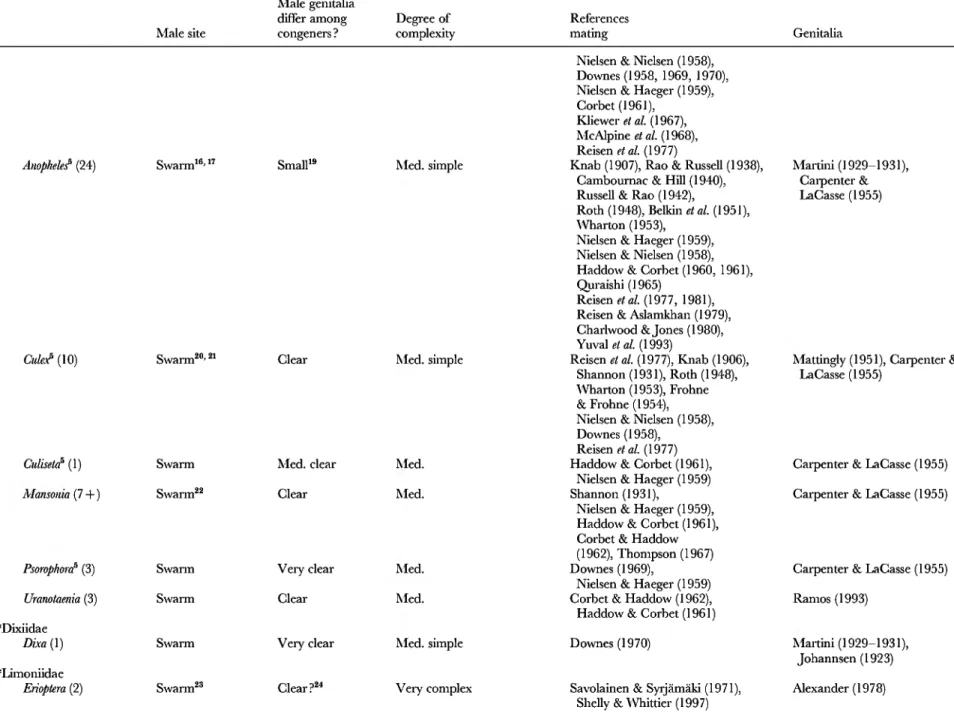
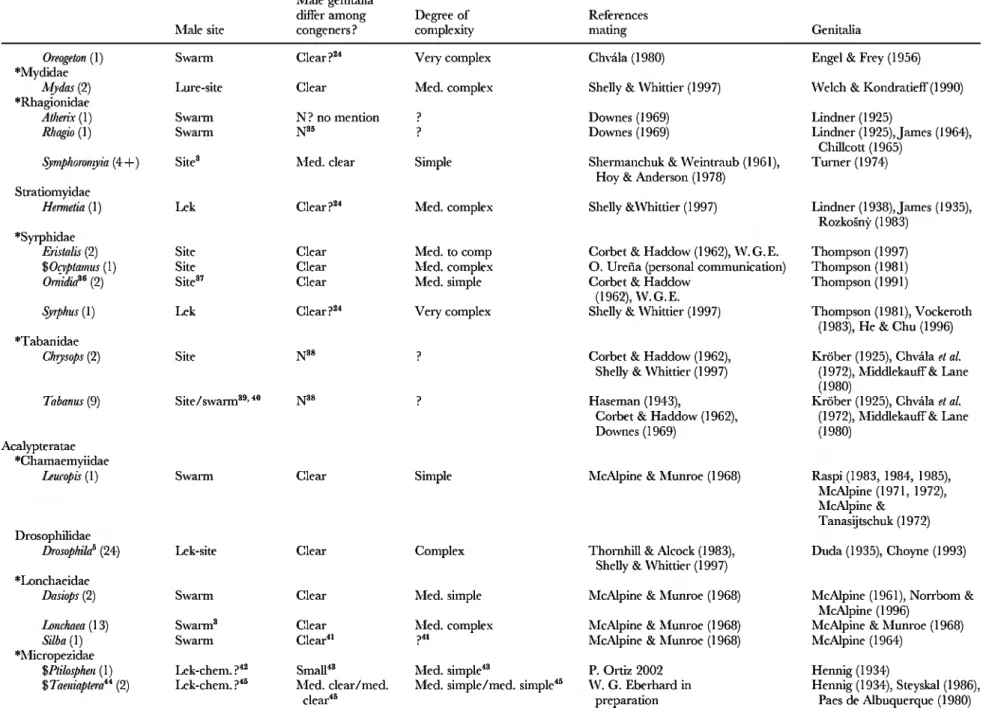
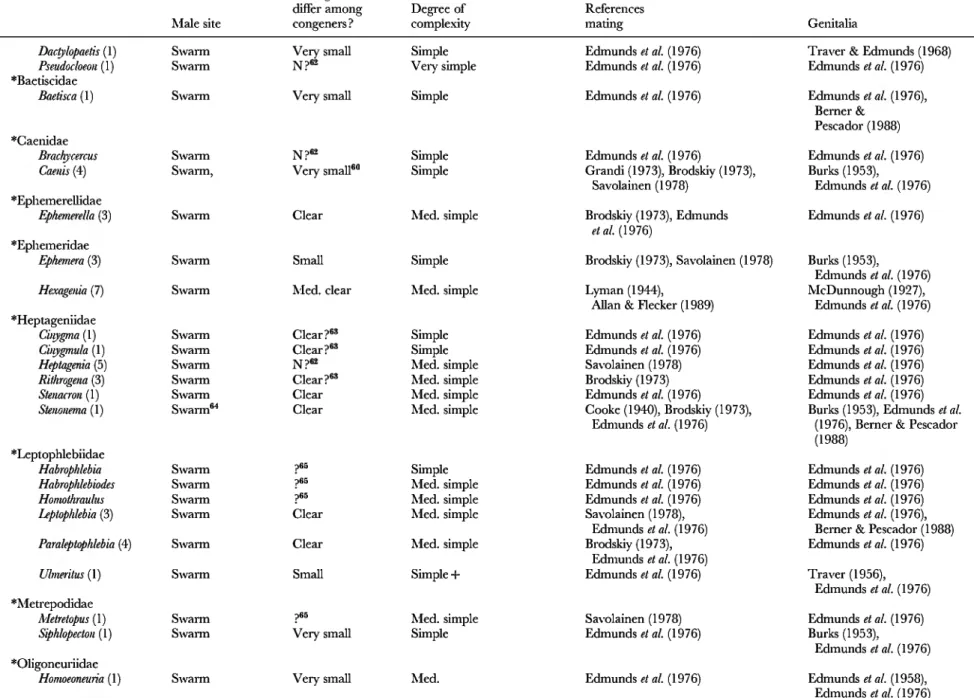
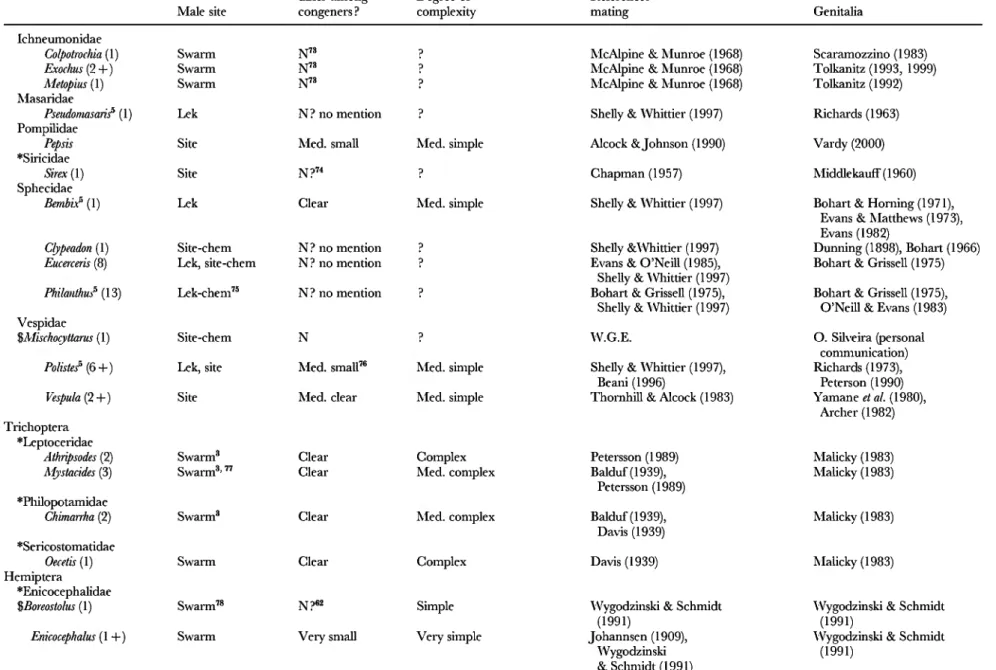
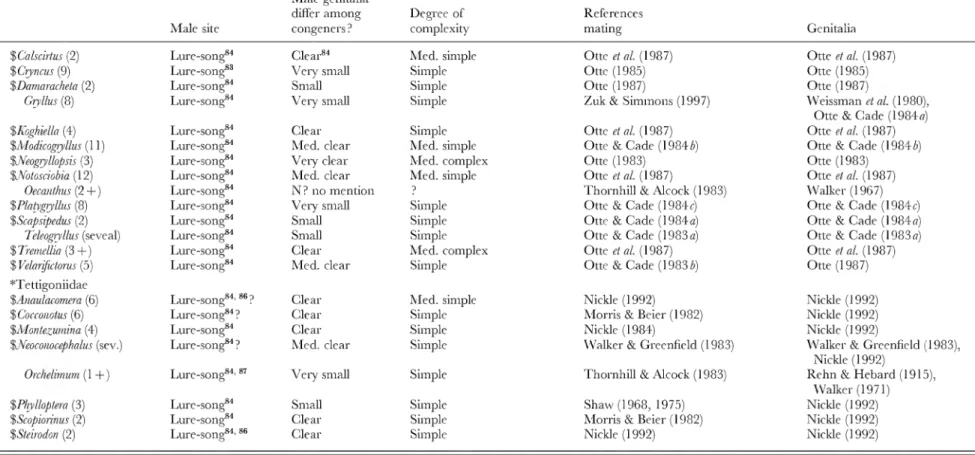
Table 2. Genitalic traits in genera in which females are relatively protected from sexual harassment by males. 'Swarm' refers to groups of flying males concentrated in space, usually at apparendy arbitrary markers (above tree tops, over light-coloured objects, etc.); 'lek' refers to groups of sexually active, territorial males at sites lacking resources needed by females; 'lure' refers to species in which sexually active males are not grouped, are not associated with resources needed by females, and which either emit signals that attract males ('chem.' = chemical male signals; 'vis.'= visual male signals; ' song' = auditory male signals) orare at arbitrary sites (such as hilltops). The lines of division betwen swarm, lek, and site were not always clear, but in any case females are protected from male harassment in all three. For those species in which no information on the mating behaviour was included other than that given in a review, reference is made only to the review, rather than the original descriptions of behaviour.
Numbers in parentheses are numbers of species for which mating system was observed ; ' + ' is used when ' spp. ' were mentioned in publications without mentioning specific numbers. 'W. G. E.' refers to own unpublished observations; ' sev.' = several ; 'N'=no; 'N?'= probably no, because genitalia were not mentioned or because of other reasons (see associated footnotes) ; ' med. ' = medium. Genera included because I happened to be familiar with their mating behaviour or because of directed reading after the original list was complete are marked with ' $ ', and families without genera with unprotected females (Table 4) are indicated with ' * '. When more than one genitalic structure was characterized, they are separated by ' / ' (e.g. small/medium clear)
oo o
Male genitalia
differ among Degree of References
Male site congeners ? complexity mating Genitalia
Díptera Nematocera
*Anisopodidae
Anisopoda (2) Swarm Clear Med. simple Edwards (1928) Lindner (1930 ¿)
*Blephariceridae
Philorus^ (1) Swarm^ Clear Very complex Hogue (1973) Lindner (1930 a),
Hogue (1973)
*Cecidomyüdae
Amrete (2) Swarm^' * Clear Med. simple Chiang (1961), Chiang &
Okubo (1977), Chiang «¿a/. (1978)
Kim (1968)
Ceratopogonidae Ceratopogoninae
Ceratopogonini
Ceratopogorf Swarm Med. clear Simple Downes (1955) Goetghebuer SL
(several) Lenz (1934)
Culicoidini
Culicoidef' (24) Swarm^' " Med. clear Simple Downes (1955), Blanton&Wirth(1979)
Palpomyiini
Bezzia' (1) Swarm Clear Simple
Palpomyk^ (sev.) Swarm N? no mention p
Sphaeromüni Probezzia (1) Stilobezzini
Swarm N' ?
Linley& Adams (1972),
Glukhova c& Dubrovskaya (1974), CampbeU & Ketde (1979), Zimmerman et al. (1982) in Blackwell eí a/. (1992), Neems«Za/. (1992), Blackwell eZ a/. (1992) Downes (1955) Downes (1955, 1978) Downes (1955)
Goetghebuer SL Lenz (1934)
Goetghebuer & Lenz (1934)
Wirth (1994)
3
P w
cr n
Serromyia (1) Swarm Med. clear Med. simple Dowries (1955)
Stilobezzia (1) Swarm Med. clear Simple Dowries (1955)
Forcipomyinae
Atrkhopogorc' (1) Swarm^ Clear Med. simple Dowries (1955)
Forcipomyiif (2) Swarm Small, clear Simple Dowries (1955),
Kaufmann (1974) Leptoconopinae
Leptoconops (2) Swarm Clear« ?(not drawn) Smith & Lowe (1948).
Downes (1955)
*Chaoboridae
Chaoborus (2) Swarm^ Med. clear Med. simple McGowan (1975)
Chironomidae'"
Ablabesmyia (1) Swarm Clear Med. complex Knab (1907)
AUochironomus (1) Swarm Clear Med. complex Syrjämäki (1964)
Chinmomm^ (6) Swarm^ Small, clear Med. simple Gibson (1945),
HilsenhoflF(1966), Syrjämäki (1966), Koskinen(1969), Downe & Caspary (]
Cladotanytarsus (sev.) Swarm Clear Med. complex Lindeberg (1964) in
Downes (1969)
Cricotopus (1) Swarm Clear Rel. simple Syrjämäki (1963) in
Koskinen(1969)
Diamesa (1) Swarm^ Very clear Med. complex Young (1969)
Limnophyes (1) Swarm^ Clear Med. simple Syrjämäki (1968)
Metriocnemus (2) Swarm Clear Med. simple Gibson (1945)
Propsilocems^^ Swarm Clear Med. complex Kon«Za/. (1986)
Smittia (1) Swarm^^ Clear Med. simple Syrjämäki (1968)
Spaniotoma^^ (2) Swarm^"' " Clear Med. simple Gibson (1945)
Stictochinnomus (1) Swarm Small Simple-med.
complex
Syrjämäki (1965)
Tanytarsus (sev.) Swarm^ Med. clear^' Med. complex Gibson (1945),
Paasivirta (1972), Lindeberg (1964) in Downes (1969) Culicidae
^«(/«i^ (26) Swarm"-!* Med. small Med. simple Roth (1948),
973)
Borkent&Bissett(1990) Goetghebuer & Lenz (1934) Goetghebuer & Lenz (1934),
Boesel(1973) Utmar&Wirth(1976),
Wirth & Spinelli (1993) Smith & Lowe (1948)
Martini (1929-1931), Borkent (1979) Goetghebuer & Lenz
1936, Pinder (1978), Murray &
Fittkau(1989)
Goetghebuer & Lenz (1936) Pinder (1978),
Cranston et al. (1989 a)
Pinder (1978),
Cranston et al. (1989 A) Goetghebuer & Lenz
(1936), Pinder (1978) Goetghebuer & Lenz
(1936), Pinder (1978) Goetghebuer & Lenz
(1936), Pinder (1978) Goetghebuer & Lenz
(1936), Pinder (1978), Saether(1989) Saether& Wang (1996) Goetghebuer & Lenz (1936),
Pinder (1978)
Goetghebuer & Lenz (1936) Pinder (1978), Cranston
et al. {1989 a)
Goetghebuer & Lenz (1936), Pinder (1978), Cranston et al.
(1989¿), Lindeberg (1967)
Carpenter & LaCasse (1955)
4h
1.
s Si,
s
Nielsen & Grève (1950), Frohne & Frohne (1952, 1954), Nielsen & Nielsen (1953),
Table 2. iConÚ
NO
Male site
Male genitalia differ among congeners ?
Degree of complexity
References
mating Genitalia
Anophèles^ (24) Swarm^"'" Smalli" Med. simple
Cukif (10) S 20 21 warm • Clear Med. simple
Culiseta^ (1) Mansonia (7 -
Swarm Swarm^^
Med. clear Clear
Med.
Med.
Nielsen & Nielsen (1958), Downes (1958, 1969, 1970), Nielsen &Haeger (1959), Corbet (1961),
Kliewer«/a/. (1967), McAlpine«ifl/. (1968), Reisen «¿a/. (1977)
Knab (1907), Rao & RusseU (1938), Cambournac & Hill (1940), Russell & Rao (1942),
Roth (1948), Belkin d al. (1951), Wharton (1953),
Nielsen &Haeger (1959), Nielsen & Nielsen (1958), Haddow & Corbet (1960, 1961), Quraishi(1965)
Reisen ei a/. (1977, 1981), Reisen & Aslamkhan (1979), Charlwood & Jones (1980), Yuvalrfa/. (1993)
Reisen et al. (1977), Knab (1906), Shannon (1931), Roth (1948), Wharton (1953), Frohne
&Frohne(1954), Nielsen & Nielsen (1958), Downes (1958),
Reisen «¿a/. (1977) Haddow & Corbet (1961),
Nielsen &Haeger (1959) Shannon (1931),
Nielsen &Haeger (1959), Haddow & Corbet (1961), Corbet & Haddow (1962), Thompson (1967)
Psonphora" (3) Swarm Very clear Med. Downes (1969),
Nielsen &Haeger (1959)
Uranotaenia (3) Swarm Clear Med. Corbet C& Haddow (1962),
Haddow & Corbet (1961)
*Dixiidae
Dixa (1) Swarm Very clear Med. simple Downes (1970)
*Limoniidae
Erioptera (2) Swarm^ä Clear ?^^ Very complex Savolainen & Syrjämäki (1971).
SheUy&Whittier(1997)
Martini (1929-1931);
Carpenter &
LaCasse (1955)
Mattingly (1951), Carpenter &
LaCasse (1955)
Carpenter & LaCasse (1955) Carpenter & LaCasse (1955)
Carpenter & LaCasse (1955) Ramos (1993)
Martini (1929-1931);
Johannsen (1923) Alexander (1978)
P
w cr
n*Sciaridae
%Hybosciara (1) Swarm^'^ Clear ?"'^'= Med.
Simulidae
Prosimulium (I) Swarm^' Small Med. simple
Simulium (8) Swarm" Small-med. Med. simple
*TipuUdae Tipulc^^ (1)
*Trichoceridae Trichocera (4) Brachycera
Bombyliidae Ceratolaemus (1) Lordotus (1) Empididae
Empidinae Bicellaria (I)
Empii
Empimorphx?^
Hilará" [Ç, + ) Ocydromiinae Anthalia (1) Euthyneura (1) Leptopeza (1) Oedaha (3) Trichina (I) Microphorinae
Microphoms (3) Atelestinae
Atekstus (2) Meghyperns (1) Clinocerinae
Clinocera (2 + ) Oreogetoninae
Anthepiscopus (1) G/oma (1) Hormopeza Iteaphila (1)
Swarm
Swarm"' ^^
Lure-site Lek
Swarm Swarm"' "^
Swarm"^
Swarm"' "^
Swarm Swarm Swarm Swarm Swarm Swarm Swarm Swarm Swarm Swarm Swarm Swarm Swarm
Very clear
Clear
Complex
Med.
N?""
N? no mention
Med. complex p
Med. clear Very clear
Med. complex Complex
Clear Very clear
Complex Med. complex
N?"2 ?
N?"" ? Clear?"*
Clear Very clear
?
Med. complex Med. complex Very clear Med. complex
Clear Med. complex
N ? no mention ?
Very clear Complex
Clear Very clear
Med. complex Complex
Clear Med. complex
Clear Med. complex
Eberhard & Flores (2002) Davies & Peterson (1956) Frohne & Frohne (1954),
Downes (1958, 1969), Service (1970), Hunter (1979a) Perry (1979)
Dahl (1965), Downes (1969), Savolainen &. Syrjämäki (1972)
Thornhill & Alcock (1983) Shelly &Whittier (1997)
Chvála (1980) Kessel (1959)
Kessel (1959) Poulton(1913),
Downes (1970)
ÍCessel(1959), Forrest (1985) Chvála 1980)
Chvála 1980) Chvála Chvála Chvála
1980) 1980) 1980) Chvála 1980) Chvála 1980) Chvála 1980) Chvála 1980) Chvála Chvála
1980) 1980) Chvála 1980) Chvála 1980)
Eberhard (2001 ¿) Rubtsov (1989) Rubtsov(1989)
Mannheims & Theowald (1951-1980)
Lindner (1930)
Hesse (1938) Hall (1954)
Engel & Frey (1956) Engel & Frey (1956),
Downes (1970), Chvála (1980) Comn(1961) Engel & Frey (1956)
Engel & Frey (1956), Chvála (1984) Engel & Frey (1956),
Collin(1961) Collin(1961) Chvála (1981) Collin(1961) Engel & Frey (1956) Engel & Frey (1956),
Collin(1961) Engel & Frey (1956) Engel & Frey (1956) Engel & Frey (1956) Engel & Frey (1956),
Collin(1961) Engel & Frey (1956),
Sinclair (1995) Engel & Frey (1956)
4h
%
s Si,s
Table 2. [Cont) Ü0
•4^
Male site
Male genitalia differ among congeners ?
Degree of complexity
References
mating Genitalia
Oreogeton (1)
*Mydidae Mydas (2)
*Rhagionidae Atherix (1) '(1) Symphoromyia (4 - Stratiomyidae
Hermetia (1)
*Syrphidae Eristalis (2)
%Ocyptamus (1) Omidia^" (2) Syrphus (1)
*Tabanidae Chrysops (2)
Tabanus (9)
Swarm Lure-site Swarm Swarm Site^
Lek
Clear?" Very complex
Clear Med. complex
N ? no mention p p Med. clear Simple
Site Site Site^' Lek
Site
Site/swarm^^'
Clear?"
Clear Clear Clear Clear?"
N^i
N^i
Med. complex
Med. to comp Med. complex Med. simple Very complex
Chvála(1980)
Shelly &Whittier (1997) Downes (1969)
Downes (1969)
Shermanchuk & Weintraub (1961), Hoy & Anderson (1978)
Shelly &Whittier (1997)
Corbet & Haddow (1962), W. G.E.
O. Ureña (personal communication) Corbet & Haddow
(1962), W.G.E.
Shelly &Whittier (1997)
Corbet & Haddow (1962), Shelly c&Whittier (1997) Haseman (1943),
Corbet & Haddow (1962), Downes (1969)
:alypteratae
*Chamaemyiidae
Leucopis (1) Swarm Clear Simple McAlpine & Munroe (1968)
Drosophilidae
Dwsophila' (24) Lek-site Clear Complex Thornhill&Alcock(1983),
Shelly c&Whittier (1997)
*Lonchaeidae
Dasiops (2) Swarm Clear Med. simple McAlpine & Munroe (1968)
Lonchaea (13) Swarm^ Clear Med. complex McAlpine & Munroe (1968)
Silba (1) Swarm Clear^i p41 McAlpine & Munroe (1968)
*Micropezidae
IPtilosphm (1) Lek-chem. p42 Small*^' Med. simple*"' P. Ortiz 2002
Waeniaptera^* (2) Lek-chem. p45 Med. clear/med.
clear*^
Med. simple/med. simple''^ W. G. Eberhard in preparation
Engel & Frey (1956) Welch & Kondratieff (1990) Lindner (1925)
Lindner (1925), James (1964), Chillcott (1965)
Turner (1974)
Lindner (1938), James (1935), Rozkosny(1983)
Thompson (1997) Thompson (1981) Thompson (1991)
Thompson (1981), Vockeroth (1983), He & Chu (1996) Kröber(1925), Chválatía/.
(1972), Middlekauff & Lane (1980)
Kröber(1925), Chválaei-a/.
(1972), Middlekauff & Lane (1980)
Raspi(1983, 1984, 1985), McAlpine (1971, 1972), McAlpine &.
Tanasijtschuk (1972) Duda (1935), Choyne( 1993)
McAlpine (1961), Norrbom c&
McAlpine (1996)
McAlpine & Munroe (1968) McAlpine (1964)
Hennig(1934)
Hennig (1934), Steyskal (1986), Paes de Albuquerque (1980)
P m
n
*Milichiidae Müichiella (1)
*Otitidae Physiphora (1)
*Platypezidae Calotarsa (2) Platypezina (1) Tephritidae
Anastrephé (12) Blepharoneura (many) Ceratitis (1)
Myklie^ (1)
Procecidochares (1) r?7/)«Za' (1) Cyclorrhapha
*Galliphoridae Chrysomyia (2)
*Cutebridae Cutebra (6) Gasterophilus (1)
*Muscidae Fannia (3+)
Hydrotaea (
OjOÄjra (1)
*Oestridae Cephenemyia (2) Hypoderma (1) Ephemeroptera^^
*Baetídae
&eto (4)
Callibaetis (1) Centroptilum (2)
Swarm p46 Med. complex
Lek''-" Clear?"" Complex"*
Swarm Med. clear Med.
Swarm^ Clear ?2" Med. complex
Lek, site-chem.^' ^ Small"' Simple""
Lek^»
Lek-chem.^' ^^
Small/clear'^i
?/Clear5i
Med. simple/med.
complex^' Simple / complex^"
Lek Very small/med.
olear
Simple/med. comj Lek
Lek
N ? no mention 7 7
Site Med. clear Med. complex
Site"-'^^ N?56 Complex
Site, lek Med. clear Med. complex
Swarm" Med. clear Med.
Swarm
Swarm Lek-site Lek
Swarm
Swarm Swarm
N?58
N?58
Med. clear Med. clear
Very small"'
Med. simple
Med. simple Med.
Med.
Very simple
Simple Very simple
McAlpine c& Munroe (1968) Shelly &Whittier (1997)
Kessel & Kessel (1961), Kessel (1963) Kessel & Kessel (1961) Aluja et al. (2000),
Norrbom et al. (2000) Condon & Norrbom
(1994, 2000) Eberhard (2000 a) Han & Wang (1997) Shelly &Whittier (1997) Han (2000)
Corbet c&Haddow (1962) ThornhiU & Alcock (1983),
Shelly &Whittier (1997) ThornhiU & Alcock (1983),
SheUy&Whittier(1997) Chillcott (1960), McAlpine
&Haddow(1968), Hunter (1979 ¿>) Huckett (1954)
Shelly &Whittier (1997) Shelly &Whittier (1997),
ThornhiU & Alcock (1983) Shelly &Whittier (1997)
Cooke (1942), Brodskiy (1973), Edmunds et al. (1976), Savolainen (1978) Edmunds et al. (1976) Brodskiy (1973),
Edmunds et al. (1976)
Hennig (1937 a), Brake (2000) Hennig(1940), Hardy &
Delfinado (1980)
Kessel & Maggioncalda (1968) Kessel & Maggioncalda (1968) Steyskal(1977),
Norrbom (1997)
Condon & Norrbom (1994), Condon & Steck (1997) M.deMeyer (personal
communication), W.G.E.
Han & Wang (1997) Aldrich(1929) Foote (1960)
Zumpt(1956)
Bau (1930), Bennett (1955), Sabrosky (1986)
Grunin (1969)
Chillcott (I960*), Hennig (1964) Sabrosky (1949),
Huckett (1954), Hennig (1964) Hennig (1964)
Bennett & Sabroski (1962), Grunin (1966)
Grunin (1965)
Edmunds et al. (1976), Berner & Pescador (1 Edmunds et al. (1976) Edmunds étal. (1976)
4h
s Si,
s
Table 2. {Cont) Ü0
Male site
Male genitalia differ among congeners ?
Degree of complexity
References
mating Genitalia
Dadylopaetis (1) Swarm Very small Simple
Pseudocloeon (1) Swarm N?«2 Very simple
jjaeusciuae
Baetisca (1) Swarm Very small Simple
'Caenidae
Brachycercus Swarm N?''^ Simple
Camis (4) Swarm, Very small''" Simple
•Ephemerellidae
Ephemerella (3) Swarm Clear Med. simple
•Ephemeridae
Ephemera (3) Swarm Small Simple
Hexagenia (7) Swarm Med. clear Med. simple
•Heptageniidae
Cinygma (1) Swarm Clear ?"=• Simple
Cinygmula (1) Swarm Clear ?"=' Simple
Heptagenia (5) Swarm N?e2 Med. simple
Rithrogena (3) Swarm Clear?«' Med. simple
Stenacron (1) Swarm Clear Med. simple
Stemnema (1) Swarm"* Clear Med. simple
•Leptophlebiidae
Habrophlebia Swarm ?65 Simple
Habrophlebiodes Swarm ?65 Med. simple
Homothrautus Swarm ?65 Med. simple
Leptophlebia (3) Swarm Clear Med. simple
Paraleptophlebia (4) Swarm Clear Med. simple
Ulmeritus (1) Swarm Small Simple +
•Metrepodidae
Metretopus (1) Swarm ;)65 Med. simple
Siphhpecton (1) Swarm Very small Simple
'Oligoneuriidae
Homoeoneuria (1) Swarm Very small Med.
Edmunds et al. (1976) Edmunds et al. (1976) Edmunds et al. (1976)
Edmunds et al. (1976)
Grandi (1973), Brodskiy (1973), Savolainen (1978)
Brodskiy (1973), Edmunds rfa/. (1976)
Brodskiy (1973), Savolainen (1978) Lyman (1944),
Allan & Flecker (1989) Edmunds et al. (1976) Edmunds et al. (1976) Savolainen (1978) Brodskiy (1973) Edmunds et al. (1976) Cooke (1940), Brodskiy (1973),
Edmunds et al. (1976)
Edmunds et al. (1976) Edmunds et al (1976) Edmunds et al. (1976) Savolainen (1978),
Edmunds et al. (1976) Brodskiy (1973),
Edmunds et al. (1976) Edmunds et al. (1976)
Savolainen (1978) Edmunds et al. (1976)
Edmunds et al. (1976)
Traver & Edmunds (1968) Edmunds étal. (1976) Edmunds étal. (1976),
Berner &
Pescador (1988) Edmunds étal. (1976) Burks (1953),
Edmunds et al. (1976) Edmunds étal. (1976)
Burks (1953),
Edmunds et al. (1976) McDunnough(1927),
Edmunds et al. (1976) Edmunds étal. (1976) Edmunds et al. (1976) Edmunds et al. (1976) Edmunds et al. (1976) Edmunds et al. (1976) Burks (1953), Edmunds et al.
(1976), Berner & Pescador (1988)
Edmunds étal. (1976) Edmunds et al. (1976) Edmunds «Z a/. (1976) Edmunds étal. (1976),
Berner & Pescador (1 Edmunds étal. (1976) Traver (1956),
Edmunds et al. (1976) Edmunds étal. (1976) Burks (1953),
Edmunds et al. (1976) Edmunds étal. (1958),
Edmunds et al. (1976)
3
P w
cr n
Lachlania (2)
*Polymitarcyidae Campsums (1) Ephoron (1) Tortopus (1)
*Potamanthidae Potamanthus (1)
*Siphloneuridae Isonychia (2) Siphlonums (3) Siphlonisca (1) Hymenoptera
*Anthophoridae
CCTíJíS^ (1) Xylocopi (7) Apidae
^/)w*'*' (sev.) BombuS' (3) Euglossa (1) Eulaema (1) Braconidae
Blacus (5)
Formicidae
Acromyrmex (1) Formica (6) Lasius (2) Leptothorax (3)
Myrmica (6)
Phddole (1) Stenamma (1)
Swarm
Swarm Swarm Swarm
Swarm Swarm Swarm Swarm
Lek Site-chem.'
Swarm Lek, site Lek-chem Site-chem Swarm•
Lek Lek, site Swarm Site
Site
Swarm Site
Small Simple
Small
Simple Simple Med. complex
N?«2 Simple
Small Simple
Clear Med.
Clear? Med.
Very clear/med.
clear'''
C omplex/ simple*'
Very clear Complex
Clear Clear
Med. complex Complex N/clear''''
Clear
Med. simple Med. complex N
N?'i Small
Very small
N? no mention
Small N'2
Med. simple Med. simple Simple
Med. simple
Edmunds et al. (1976)
Morgan (1929) Edmunds et al. (1976) Grandi (1973),
Edmunds et al. (1976) Edmunds et al. (1976) Cooke(1942),
Edmunds et al. (1976) Savolainen (1978),
Edmunds et al. (1976) Edmunds et al. (1976)
Shelly &Whittier (1997) Shelly &Whittier (1997),
ThornhiU & Alcock (1983) Michener (1974)
ThornhiU & Alcock (1983), Shelly c&Whittier (1997) Shelly &Whittier (1997) Shelly &Whittier (1997)
Stelfox (1944), Southwood (1957), Van Achterberg (1975), Syrj ämäki (1976), Van Achterberg (1977) Shelly &Whittier (1997) Chapman (1954, 1957),
Shelly &Whittier (1997) Collingwood (1958)
CoUingwood (1957, 1958, 1963)
Wheeler (1919), Chapman (1954, 1957), Hubbard&Nagell(1976), Collingwood (1958) ThornhiU & Alcock (1983) Kannowski (1958)
Edmunds (1951), Koss &. Edmunds (1970) Edmunds et al. (1976) Edmunds et al. (1976) Traver (1950)
Edmunds et al. (1976) Edmunds et al (1976),
Berner & Pescador (1988) Clemens (1915), Burks (1953),
Edmunds et al. (1976) Edmunds et al (1976)
Snelling(1984) Hurdc&Moure(1963)
Simpson (1970)
Richards (1927), Laverly et al.
(1984)
Dressler (1978a, ¿>, 1982a,-í) Ospina-Torres (1998) Van Achterberg (1975)
Schultz «Z a/. (1998) Wilson (1976),
TinautRanera(1989) Mackay & Mackay (1994) Tinaut Ranera (1982),
Buschinger
(1982), Heinze (1989), Heinze
&Alloway(1991), Mackay (2000) Radchenko(1994)
Ogata (1982) Dubois (1998)