A Thesis
This Thesis was examined on March 24‘ , 2016 by the Board of Examiners
Approval
This Thesis was examined on March 24th 2016 by the Board of Examiners
Board of Examiners
Prof. Dr. Lince Sihombing, M.Pd NIP. 1961 0425 1986 6012 001
Dr. Rahmad Husein, M.Ed NIP. 19620629 198803 1 002
Prof. Amrin Saragih, M.A.,Ph.D NIP. 19550113 198203 1 002
Prof. Dr. Sumarsih, M.Pd NIP. 19581021 198303 1 002
PERNYATAAN TIDAK MELAKUKAN FLAGIAT DAN MEMALSUKAN DATA
Saya yang bertanda tangan di bawah ini: Nama
NIM Sri Wahyuni Hasibuan8146112038 Angkatan : XXIV
Prodi : Linguistik Terapan Bahasa Inggris (LTBI)
Judul Tesis : Male and Female Students’ Language in Performing Request
Dengan ini menyatakan bahwa:
1. benar tesis saya adalah karya sendiri, bukan dikerjakan orang lain, 2. saya tidak melakukan flagiat dalam penulisan tesis saya,
3. saya tidak merobah atau memalsukan data penelitian saya.
Jika temyata dikemudian hari saya terbukti telah melakukan sala satu dari hal tersebut, maka saya bersedia dikenai sanksi yang berlaku berupa pencopotan gelar saya.
Demikan pemyataan ini saya buat dengan sebenamya.
Medan. 23 Februari 2016 Saya yang membuat pemyataan.
i
ABSTRAK
Hasibuan, Sri Wahyuni. NIM 8146112038. Bahasa Siswa dan Siswi dalam Menyampaikan Permintaan. Tesis. Program Studi Linguistik Terapan Bahasa Inggris, Sekolah Pascasarjana, Universitas Negeri Medan, 2016.
Penelitian ini mengenai bahasa siswa dan siswi dalam menyampaikan permintaan. Tujuan dari penelitian ini adalah 1) untuk mencari tahu jenis-jenis permintaan yang digunakan oleh siswa dan siswi dalam berinteraksi pada konteks informal, 2) untuk menjabarkan cara permintaan secara linguistic disampaikan oleh siswa dan siswi dalam berinteraksi pada konteks informal, serta3) untuk menyediakan alasan- alasa mengapa siswa dan siswi menyampaikan permintaan dengan cara mereka. Penelitian ini dibuat dengan menggunakan desain deskriptive kualitatif. Penelitian ini dilaksanakan di SMA Dharmawangsa Medan yang melibatkan 3 siswa dan 3 siswi. Data diperoleh dengan mengobservasi, merekam dan mewawancarai mereka. Data di penelitian ini adalah 44 ujaran siswa dan 42 ujaran siswi yang diambil di 3 area sekolah; kantin, di depan kelas, dan di tempat parkir. Penemuan ini menunjukkan bahwa 1) jenis sintaktikal dan jenis leksikal ditemukan dalam ujaran mereka. Keempat jenis sintaktikal yaitu imperative, interrogatif, deklaratof dan modal auxiliary juga ditemukan dalam ujaran mereka. 2) Cara permintaan disampaikan secara linguistic oleh siswa adalah dengan cara yang langsung. Sama halnya, cara permintaan disampaikan secara linguistik oleh siswi adalah dengan cara yang langsung. 3) Ada 2 alasan mengapa siswa dan siswi menyampaikan permintaan dengan cara mereka yaitu lawan bicara dan usia.
ii
ABSTRACT
Hasibuan, Sri Wahyuni. NIM 8146112038. Male and Female Student’ Language in Performing Request. A Thesis. English Applied Linguistics Study Program. Postgraduate School. State University of Medan. 2016.
This study deals with the male and female students’ language in performing request. The objective of this study were 1) to find out the kinds of request used by male and female students in doing interaction at informal context, 2) to elaborate the way request linguistically performed by male and female students in doing interaction at informal context, and 3) to provide the reasons why male and female students perform request in the way they are. It was applied by using descriptive qualitative research. It was conducted at Dharmawangsa Senior High School in Medan involving 3 male and 3 female students. The data were collected through observing, recording and interviewing them. The data of this study were 44 male students’ utterances and 42 female students’ utterances which were taken in three area of school: canteen, area in front of the class, and parking lot. The findings showed that 1) syntactical realization and lexical realization were found in students utterances. The fourth kinds of syntactical realization namely imperative, interrogative, declarative, and modal auxiliary also found in their utterances. 2) The way of requests linguistically performed by male students was the direct way. Similarly, the way of requests linguistically performed by female students was the direct way. 3) There were two reasons why male and female students perform request in the way they are namely interlocutors and age.
Keyword: Male and Female Students, Gender, Request
iii
ACKNOWLEDGEMENT
Alhamdulillahirabbil’alamin. All praise is given to Allah SWT for the
strengths and blessing given to the writer in completing this thesis successfully.
This thesis is aimed at fulfilling one of the requirements for the Degree of
Magister Humaniora at English Applied Linguistics Program, Postgraduate
School, State University of Medan. The writer comes upon a lot of difficulties
during the writing of the thesis due to her limited knowledge and experience. It
would not have been completed without guidance, suggestions from other people.
As the appreciation of this thesis, the writer expresses her deepest gratitude for:
Dr. Rahmad Husein, M.Ed, head of English Applied Linguistics
Program.
Prof. Sri Minda Murni, M.S, secretary of English Applied Linguistics
Program.
Prof. Lince Sihombing, M.Pd, first supervisor.
Dr. Rahmad Husein, M.Ed, second supervisor.
Prof. Amrin Saragih, M.A, Ph.D, first board examiner.
Prof. Hj. Sumarsih, M.Pd, second board examiner.
Dr. I Wayan Dirgeyasa M.Hum, third board examiner.
Drs. Sutrisno, head of Dharmawangsa Senior High School.
Mr. Farid, administration staff of English Applied Linguistics Program.
The writer also gives thanks to her beloved parents, H.Kulipa Hasibuan,
iv
would like to gratitude her beloved sister Drg.Putripa Rizki Hasibuan
and Ahmad Kodri Fauzi Hasibuan.
A lot of thanks to LTBI B2 2014 for their cheerfulness, loyal friendship
and care. The special thanks to beloved friend Hendri Batubara, S.Pd for
his help, support, and guidance.
The writer hopes this study provides contribution for quality development of
educational practice in English Applied Linguistics Program.
Medan, February 2016 The Writer
vi
CHAPTER IV: DATA ANALYSIS, FINDINGS, AND DISCUSSION
4.1 Data Analysis ……… 40
4.1.1 Kinds of Request ……… 40
4.1.1.1 Kinds of Request Performed by Male Students …. 41 4.1.1.2 Kinds of Request Performed by Female Students . 45 4.1.2 The Students' Way in Performing Request ………… 48
4.1.2.1 The Male Students' Way in Perfoming Request …. 49 4.1.2.2 The Female Students' Way in Performing Request . 53 4.1.3 Students' Reasons in Performing Request in the Way They are ……… 57
4.2 Findings ………. 59
4.3 Discussion ………. 60
CHAPTER V: CONCLUSIONS AND SUGGESTIONS Conclusions ………. 66
Suggestions ………. 66
REFERENCES ……….. 68
vii
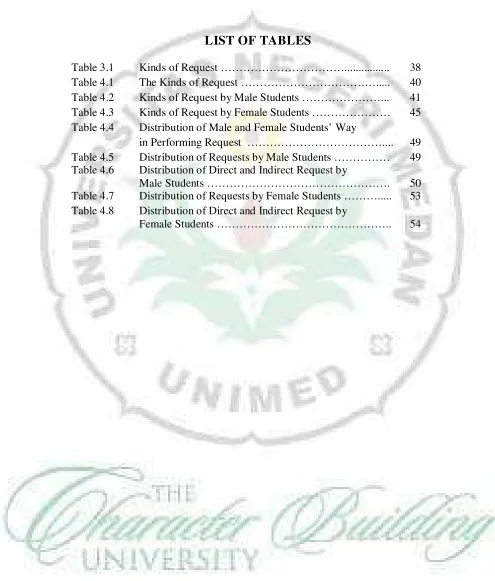
LIST OF TABLES
Table 3.1 Kinds of Request ………... 38
Table 4.1 The Kinds of Request ………... 40
Table 4.2 Kinds of Request by Male Students ………... 41
Table 4.3 Kinds of Request by Female Students ……… 45
Table 4.4 Distribution of Male and Female Students’ Way in Performing Request ……….... 49
Table 4.5 Distribution of Requests by Male Students ……… 49
Table 4.6 Distribution of Direct and Indirect Request by Male Students ………. 50
Table 4.7 Distribution of Requests by Female Students ………... 53
viii
LIST OF APPENDICES
Appendix 1 The Data Transcription of Male and Female Students ….. 71 Appendix 2 The Data Transcription of Male and Female Students’
1
CHAPTER I
INTRODUCTION
1.1 The Background of the Study
From childhood males and females are different in many ways, both
physiologically and psychologically. They are not only different in their physical
appearance, but also in the way they use their language. Each person has different
style of communicating with other people. To say one intention, someone can say
it in different ways. Holmes (1992:4) stated that language provides a variety of
ways of saying the same thing. It depends on a lot of things: where people come
from, educational background, age, and it also depends on gender.
Eckert and Ginet (2003:17) state that gender is a collaborative affair that
one must learn to perform as a male or a female, and that these performances
require support from one’s surroundings. Indeed, people do not know how to
interact with another human being (or often members of other species), or how to
judge them and talk about them, unless people can attribute a gender to them.
Most of people’s interactions are colored by performance of people own gender,
and by attribution of gender to others. The different of performance and
communication leads the gender differences.
There are two main bodies of research on gender differences in
communication styles; academic research and popular literature. Academic
research points out major differences in conversation characteristics and traits
2
conversation styles between men and women. Popular research also points out
common pitfalls and areas of conflict due to gender differences in communication
style of men and women (Merchant, 2012).
Academic research on psychological gender differences has shown that
while women use communication as a tool to enhance social connections and
create relationships, men use language to exert dominance and achieve tangible
outcomes (Leaper, 1991). Women are, overall, more expressive, tentative, and
polite in conversation, while men are more assertive, and power-hungry (Basow &
Rubenfield, 2003).
On the other hand, popular works by John Gray and Deborah Tannen
show that while men view conversations as a way to establish and to maintain
status and dominance in relationships, women see the purpose of conversation to
create and foster an intimate bond with the other party by talking about topical
problems and issues they are communally facing (Gray, 1992; Tannen, 1990).
The characteristics of women in communication are women give more
priority to connections or a good relationship and intimacy, avoid superiority,
more emotional, and reduce different opinions. In non-verbal communication,
women are proved more to use eye contact (67.5 %), body language (75.5 %), and
smile (83.7 %).While men communicate, they communicate to report facts and in
short phases with little or almost negligible (Griffin,1999). To say about getting
food they serve different ways. Questions are more common in women’s
3
that tell the audience to do something (e.g., “Let’s go get some food”) are more
likely to be found in men’s conversational contributions.
Tannen (1990) distinguishes men and women communication pattern.
According to her, the men communication pattern is considered “report talk, while
women communication pattern is considered by “rapport talk”. Rapport Talk and
Report Talk term break down the differences between men and women
communication so language users are able to understand those differences in our
everyday lives and apply our communication adaptations. These terms
differentiate the language characteristics between men and women. The
characteristics include questions, apologies, compliments, longer talk, taking
blame, giving advice, thanking and performing request.
In daily communication, people always ask others to do things. Speaker
asks a person to give him something, or ask the person to do some actions. These
are all requests. Request refers inclusively to an utterance that is intended to
indicate the speaker’s desire to regulate the behavior of the listener that is, to get
the listener to do something (Becker, 1982) as cited in Achiba (2003).
A request is made when a speaker asks a hearer to do something (Levent,
2013). In other words, the speaker is imposing on the hearer. The hearer has to
pay the cost of carrying out the request and the speaker usually gains the profit out
of it. The concept of request is important because it helps to understand the way in
4
In social interaction, people sometimes perform request to do things they
want. It happens not only in community surrounding but also at school. At school,
people especially students perform request in some places; in the classroom,
canteen, library or in laboratory. Performing request isn’t a part of inseparable of
communications. Men and women are different in performing the request.
Tannen (1990) states men tend to use direct request when speaking to others. For
example: “Close the door!”, “Switch on the light!”. Men speak most directly to
the point while women tend to use indirect request. For example: “Won’t you
close the door?”.
Based on the observation done in Dharmawangsa School at informal
context, it was found that male students performed request in the direct ways. As
the example when a male student knew that his friend wanted to go to canteen, he
asked him to buy mineral water. He said “Buy me mineral water! Here is the
money”. This utterance shows that a male student perform request directly since
his utterance is coded by imperative and right to the point. It means, the intention
of the speaker is clear.
But, it was different in another male student. In this case, he performed
request indirectly. In a case when he wanted to ask his friend, female student, to
throw rubbish which was in front of them, he prefers to say “This area is not
clean, the rubbish everywhere.” His interlocutor didn’t understand his intention so
she just said “I don’t know who throw the rubbish here”, so that the he threw the
5
These two phenomena describe that men are not always in direct position.
There are some factors that influence them to choose direct or indirect ways. They
can be from interlocutors, situation, social status, or gender.
The main rule of a request is to bring the requestee or interlocutor to the
awareness that some action is desired of him, but there are various ways in which
this action can be achieved. According to the structure and pattern of sentences,
request can be realized linguistically into syntactical realization (imperative,
interrogative, declarative, modal auxiliary) and lexical realization (Sadock, 1974).
The example “Buy me mineral water!” which said by male students is called
imperative request while “This area is not clean, the rubbish everywhere” is called
declarative request. These two kinds of request occur when they had interaction at
informal context. Therefore, the study will find out the other requests that will be
performed by male and female students in doing interaction at informal context.
linguistically means that the researcher doesn’t focus with the other way like body
language or higher intonation but focuses on the linguistic characteristics.
Therefore, the study will elaborate the way request linguistically performed by
male and female students with reference to Tannen theory direct and indirect
6
Therefore, the consistency of male and female language characteristic is
still debated. It is because language characteristics of men and women are not
regarded as an absolute condition caused by gender differences. Connel (2002:
51) asserts that category gender differences in language are not a fixed category.
This is due to the specific and situational differences that sometimes arise in
communication between men and women. These differences could have been
influenced by other factors beside gender like the atmosphere communication and
the level of speaker social status. Hence, the study of language and gender has to
examine the relationship of several types of factors that affect the level of
communication.
As already described above, it is interesting to study the language
characteristics of men and women in performing request. This study will explore
male and female students’ language in performing request. It will be conducted in
Dharmawangsa Senior High School in Medan.
1.2 The Problem of the Study
Based on the background in the previous part, the study attempts to answer
the following questions:
1. What kinds of request performed by male and female students in doing
interaction at informal context?
2. How are the requests linguistically performed by male and female students in
7
3. Why are the requests performed by male and female students in doing
interaction at informal context the way they are?
1.3 The Objective of the Study
This study is aimed to find out:
1. The kinds of request performed by male and female students in doing
interaction at informal context.
2. The way request linguistically performed by male and female students in doing
interaction at informal context.
3. The reasons of male and female students perform request in doing interaction at
informal context the way they are.
1.4 The Scope of the Study
This study is talking about language and gender. The researcher will
elaborate the different ways of male and female students in performing request at
Dharmawangsa Senior High School. The gender language of them in performing
request will be observed through their utterances in informal context; canteen,
area in front of the class, and parking lot.
1.5 The Significance of the Study
Various factors are very important to the significance of this study.
Theoretically, the result of this study is useful for the enrichment of linguistics
8
Practically, the results are useful for both male and female students in performing
requests. They have to consider who are their interlocutors and should use the
appropriate request in order to create a good atmosphere of communication and
66
CHAPTER V
CONCLUSIONS AND SUGGESTIONS
5.1 Conclusions
After analyzing the data, conclusions are drawn as the following.
1. The syntactical realization and lexical realization request occur in male and
female students’ utterances while performing the request. The fourth kinds of
syntactical realization namely imperative, interrogative, declarative, and modal
auxiliary are also found in their utterances.
2. Both male and female students perform request in the direct way dominantly.
3. There are two factors causing students performed requests in the way they are
namely interlocutors and age.
5.2 Suggestions
In relation to the conclusion above, suggestions are stated as the following.
1. For Senior High School students to perform request in more polite one
whenever they are requesting something even though it is done for the same
age since there is no special words used in Bahasa Indonesia in performing
request. Students should add the word “tolong” before the words of request
67
2. For teachers to equip students to be able to perform request appropriately in
doing interaction due to the consideration that in students’ syllabus they study
various language function requesting, giving and refusing service etc.
3. For other researchers to conduct other study relating to gender and request
strategies, not only students in adolescence age as subject of study but also
other societies in adulthood age.
The findings of the study imply both male and female students can consciously
perform request through selecting appropriate request to their interlocutors. Male
and female students can perform indirect request when talking to the older people
at school. They also can perform direct request to their friend by adding of
“please” makes the request utterances seem more polite.
68
REFERENCES
Aubed, M. 2012. Polite Requests in English and Arabic: A Comparative Study.
Theory and Practice in Language Studies, Vol. II, 5, pp. 916-922
Balc, B. 2009. A Comparative Study on The Performance of Requests and Apologies by Turkish and American Teenagers: A Pragmatic Competence Point of View. Turkey: University of Cukurova.
Basow, S. A., & Rubenfeld, K. 2003. “Troubles talk”: Effects of gender and gender typing.Sex Roles, Vol. III, pp. 183–187.
Becker & Achiba, M. 2003. Learning to Request in a Second Language: a Study of Child Interlanguage Pragmatics. New York: Multilingual Matters.
Bogdan, C. R. & Biklen, K. S. 1992. Qualitative Research for Education; An Introduction to Theory and Methods. Boston: Allyn and Bacon.
Braedyn, S. 2010. The Impact Gender has on Effective Communication. Illinois: IRWIN Professional Publihing.
Brown, P & Levinson, S. 1978. Universals in Language Usage: Politeness Phenomena In Goody E.Questions and Politeness. Cambridge: Cambridge University Press.
Butler, J. 1990. Performative Acts and Gender Constitution: An Essay in Phenomenology and Feminist Theory. In S. Case (Eds.), Performing Feminisms: Feminist Critical Theory and Theatre. Baltimore: Johns Hopkins University Press.
Connel, R. 2002. Gender. Cambridge: Polity Press in Association with Blackwell Publishing Ltd.
Denzin, N. 1970. The Research Act in Sociology. Chicago: Aldine.
Eckert, P & Sally, M. 2003. Language and Gender. New York: Cambridge University Press.
Goodwin, C. 2000. Language and Gesture. New York: Cambridge University Press
69
Griffin, D. 1999. Gender Differences in Verbal Communication. Georgia: Valdosta State University.
Heritage, J. 1984. Garfinkel and Ethnomethodology. Polity Press: Cambridge.
Holmes, J. 1992. An Introduction to Sociolinguistics.New York: Longman.
Hornby, A. S. 1976. Guide to Patterns and Usage in English. Oxford: Oxford University Press.
Hussein, A. M. 1984. Realization of Request in English and Arabic: A Contrastive Study. Iraq: University of Basrah.
Hymes, D. 1989. Ways of Speaking, in R. Bauman and J. Sherzer (eds)
Explorations in the ethnography of speaking. Cambridge: Cambridge University Press.
Ishikawa, Y. 2013 Gender Differences in Request; A Statistical Analysis of American English in the NICT JLE Corpus. Humanities and Management Sciences (IJHMS) Vol I.
Kuang D, Maya K & Zuraidah, M. 2006. Requests: Voices of Malaysian Children. Multilingua,VolI
Lakoff, R. 1976. Language and Women’s Place. New York: Octagon Books. Leaper. C. 1991. Influence and Involvement in Children's Discourse: Age,
Gender, and Partner Effects. Child Development, Vol VI.
Leech, G. 1983. Principles of Pragmatics. London: Longman Group Ltd.
Levent, G. 2013. Requesting Preferences of Turkish EFL Learners: Age, Gender, anf Proficiency Level. Vol VI, p. 737-754
Linclon, Y & Guba, G. 1985. Naturalistic Inquiry. London: Sage Publication.
Menarian, P. 2012. The Use of Request Strategies in English by Iranian Graduate Students: A Case Study. Thesis: Eastern Mediterranean University
70
Miles, M & Huberman, A.M. 1984. Qualitative Data Analysis. Beverly Hills: California Sage Publication.
Nemati, A & Bayer, J. 2007. Gender Differences in the Use of Linguistic Forms in the Speech of Men and Women: A Comparative Study of Persian and English. India: University of Mysore.
Newman, et al. 2008. Gender Differences in Language Use. Discourse Processes
Vol 45.
Palmer, F. 1981. Semantics. Cambridge: Cambridge University Press.
Rizki, H. 2014. Gender Differences on Commentators’ Comment in Indonesian Idol 2014. Medan: Unpublished Thesis
Romaine, S. 1994. Language in Society: An Introduction to Sociolinguistics.
Oxford: Oxford University Press.
Sadock, J. M. 1974. Towards a Linguistic Theory of Speech Acts. New York: Academic Press.
Schegloff, E. 2000. Overlapping Talk and the Organization of Turn-taking for Conversation. Language in Society 29,Vol I, 2.
Shapiro, J. 1981. Anthropology and the study of gender. Soundings: An Interdisciplinary, Vol 64, pp 446-65.
Sofwan, A & Rusmi. 2011. Ragam Jurnal Pengembangan Humaniora Vol. XI,2.
Swan, M. 1982. Practical English Usage. Oxford: Oxford University Press. Tannen, D. 1990. You Just Don’t Understand: Women and Men in Conversation.
New York: Ballantine Books.
Thomas, J. 1995. Meaning in interaction: an Introduction to Pragmatics. London: Longman Group Limited.
Trosborg, A. 1994. Interlanguage Pragmatics: requests, complaints and apologies. Berlin: Mouten de Gruyter.
71