Financial assistance to the author in the form of a National Science Foundation Fellowship and fellowships and research assistantships from the California Institute of Technology is gratefully acknowledged. In the flow of a gas-particle mixture through a nozzle, a normal shock may occur in the diverging part of the nozzle. The thickness of this zone, which is the total shock thickness in gas-.
In the present work, an asymptotic solution, which is responsible for the area change, is obtained for the flow of a gas-particle mixture downstream of the shock in a nozzle, under the assumption of small S.ip between the particles and gas. The shock solution, valid in the region near the shock, is fitted to the known small-slip solution, valid in the flow downstream of the shock, to obtain a composite solution valid for the entire flow region.
INTRODUCTION
5 They presented a theory, based on the change of the effective density and specific heat of the gas due to the presence of the particles, which agreed with their measurements. The attenuation is calculated from the increase in entropy due to irreversible transfer of heat and momentum between the particles and the gas. A direct calculation leads to expressions for attenuation and dispersion as functions of the sound frequency.
The calculation method used by Temkin and Dobbins clearly shows the attenuation and scattering mechanism due to gas-particle interactions. This approach will be used here to calculate sound attenuation and scattering in a gas-vapor mixture containing condensing liquid droplets.
GOVERNING EQUATIONS
Thus, in the continuum description of the flow, local variations on the scale of the particle dimensions do not enter. The equilibrium vapor pressure at the drop .ternature P e (T ) can be expressed by the equilibrium vapor. That is, the total pressure is assumed not to vary on the microscopic scale of in-.
In the general problem, the particle radius appears explicitly in the expressions for the equilibration times '!"v, 'l"T and TD, and must be included as one of the dependent variables. The following consideration of the acoustic problem may therefore also apply to a sublimating particle-gas flow.
ACOUSTIC PROBLEM
This assumption is valid if the thermal conductivity of the liquid is much greater than that of the gas. However, for some systems such as water droplets in air, the conductivity of the liquid is of the same order as that of the gas, and thermal relaxation within the droplets can be significant. If the gas equation of state is used to eliminate the perturbation pressure P, the equations to be solved can be written.
For this set of equations to have a non-trivial solution, the determinant of the coefficients must be zero. Expanding the determinant and setting the result equal to zero gives the following equation for the complex wavenumber K in terms of the frequency w.
THERMAL RELAXATION WITHIN DROPLETS
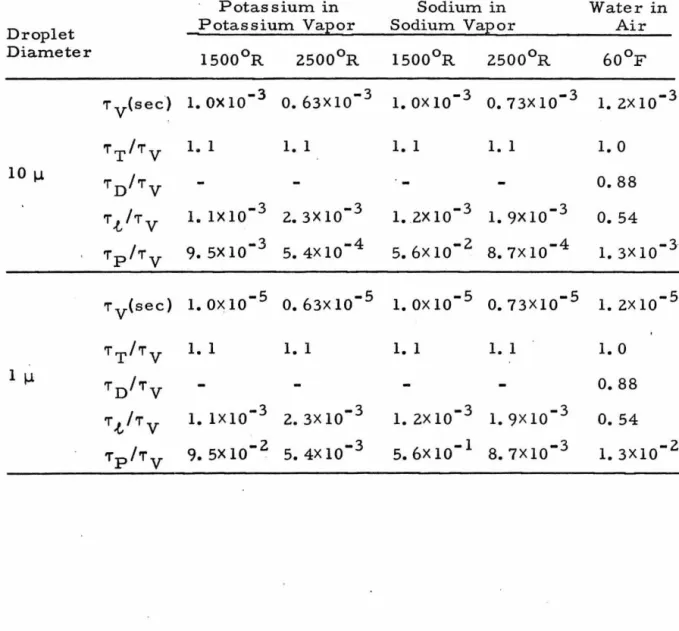
The Prandtl and Schmidt numbers are of the order of unity for most gases, so Tv, TT and TD are usually approximately equal. Since the specific heats of the liquid and the gas are of the same order of magnitude and the Prandtl number of the order of unity, the thermal relaxation time of the droplets is only significant if the thermal conductivities of the liquid and the gas-vapor mixture are of the same order of magnitude. 48 gives the following determinant, which must be set equal to zero for a solution to exist.
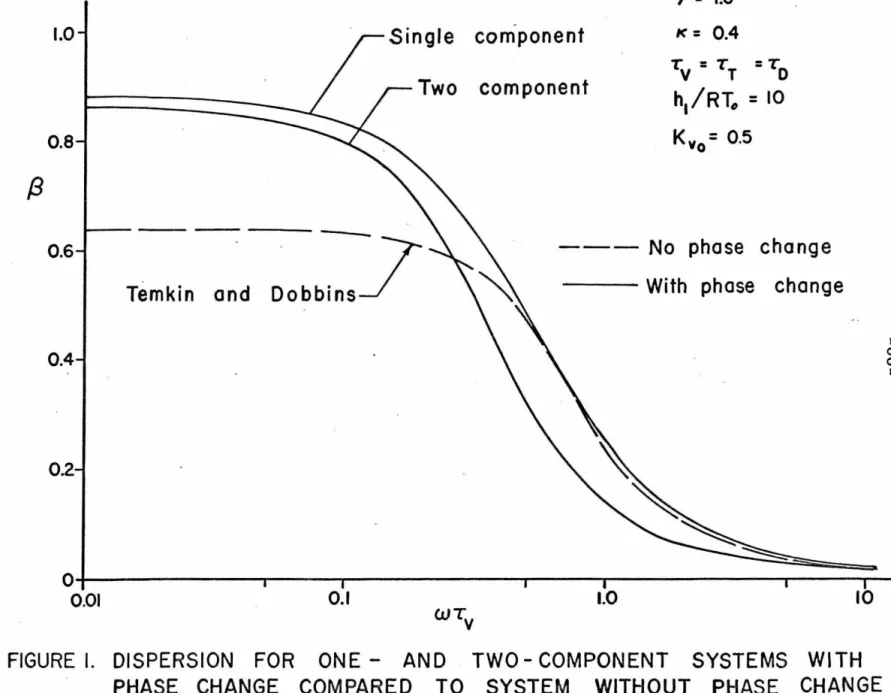
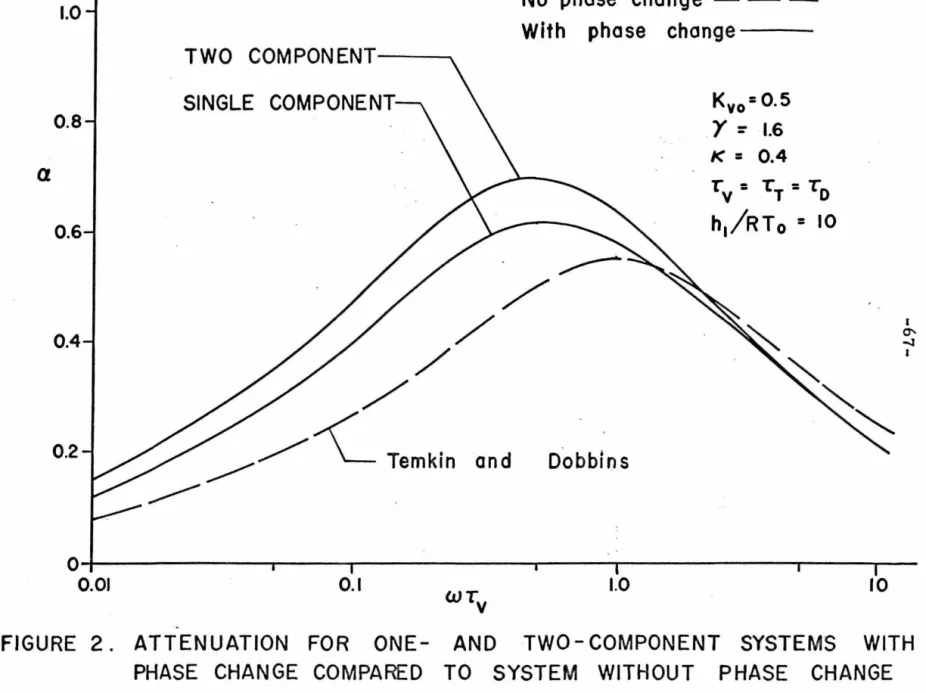
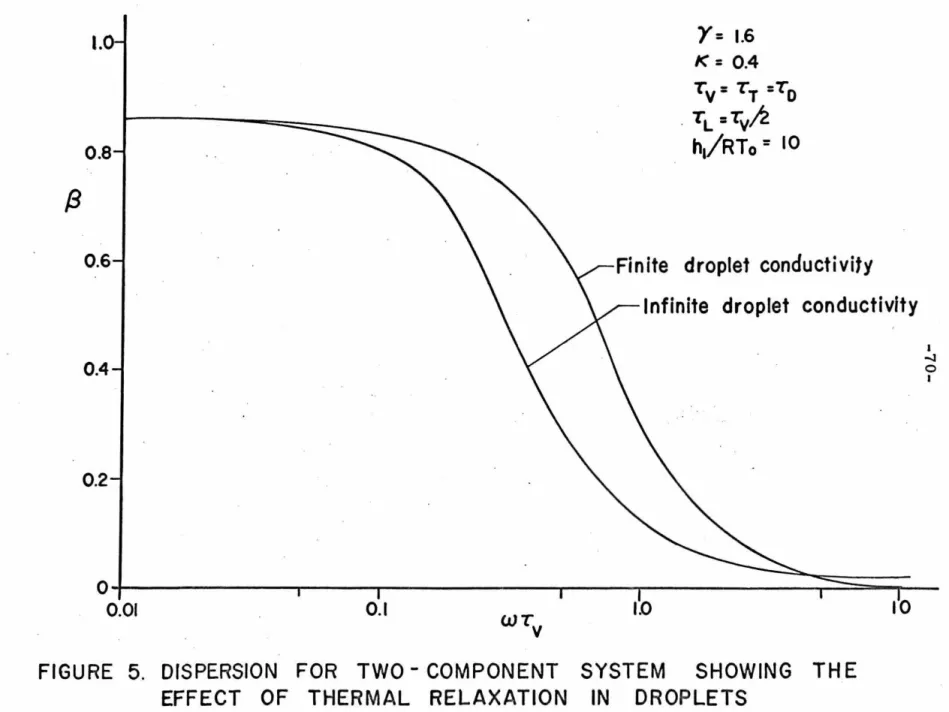
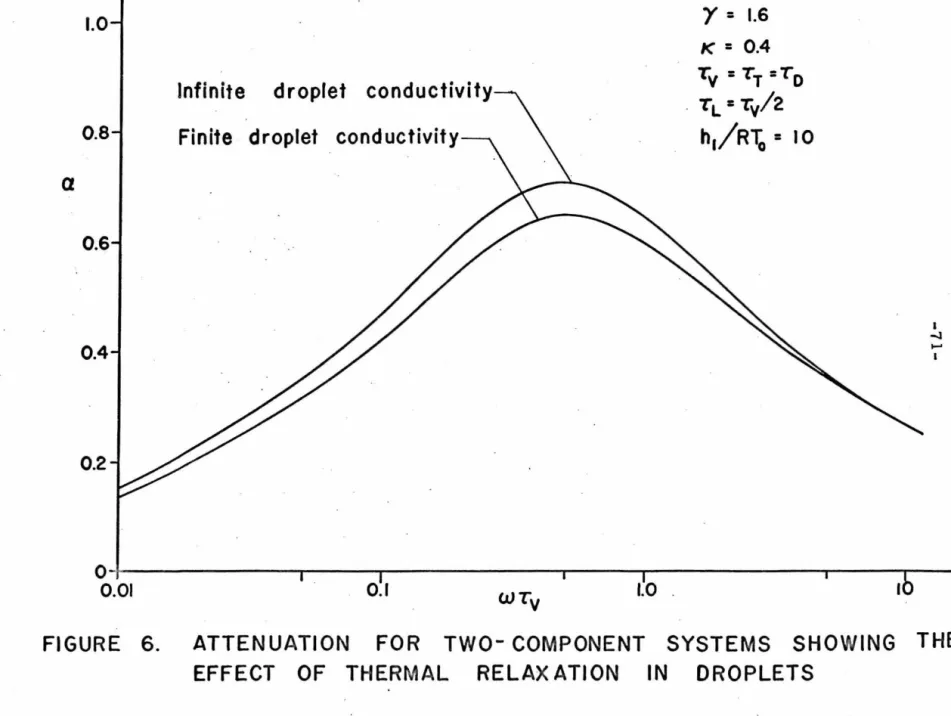
62 is plotted in Figures 5 and 6 and compared with the previous calculation for no thermal relaxation within the droplets.
LIMITING CASES FOR FROZEN AND EQUILIBRIUM INTERAC-
This result gives only the frozen speed of sound without attenuation, independent of the value of T. If the thermal conductivity of the liquid is very large compared to that of the gas, so that T:t,. Since the particle temperature is constant in this case. the vapor pressure at the surface of the droplets is also constant.
However, they will not be discussed here, as they do not add much to clarifying the roles played by equilibrium processes. If the flow is in equilibrium and/or frozen with respect to all equilibrium processes, the attenuation is zero and the effect of the droplets is to change the speed of sound from what it would be in the absence of droplets.
EFFECT OF PRESSURE RELAXATION
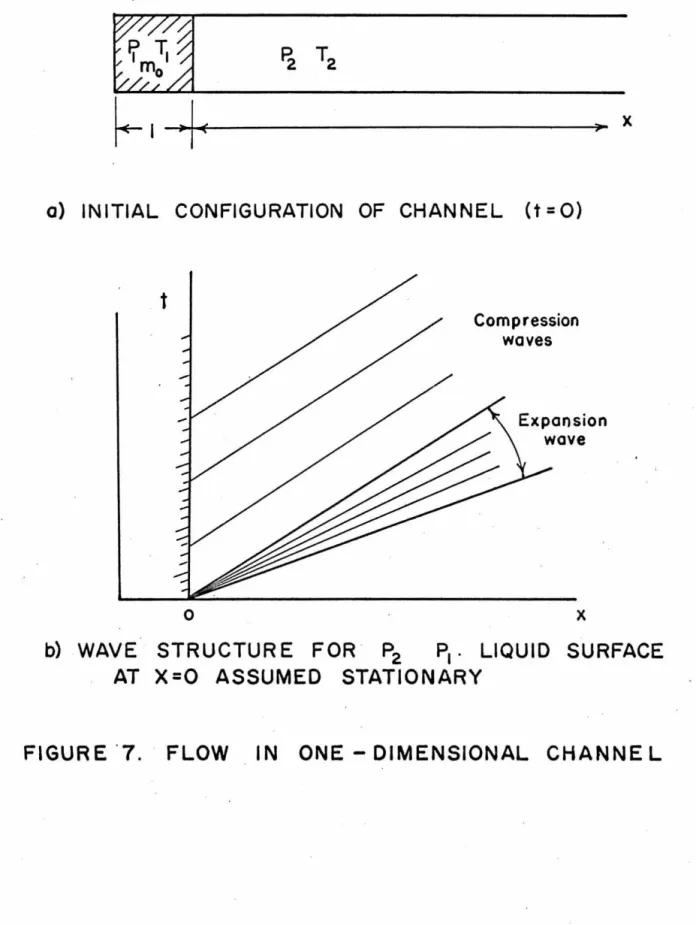
Assume that there is initially a pressure discontinuity at the liquid surface. and write down the initial conditions as follows. t) = velocity of the fluid interface. Equating the rate of increase of the mass of the liquid to the vapor mass flow rate at the liquid surface, we get This assumes that the pressure relaxation occurs before a significant amount of heat is conducted to the surface.
It is equivalent to the assumption that the pressure relaxation time is small compared to the thermal relaxation time TT • The conditions for this to be true are obtained below. Assume that the vapor pressure at the liquid surface is given by the Clausius-Clapeyron equation. This raises the temperature of the liquid, which in turn increases the vapor pressure P .t· so that compression waves propagate into the vapor, which follows the expansion.
1 a similar equilibration process occurs, except that the leading wave is a compression followed by a series of expansion waves as the liquid is cooled by evaporation. We will only be concerned with the vapor quantities at the liquid surface, so let all prepared vapor quantities in the following refer to values at x = 0. 1 represents the excess non-latent heat carried by the condensing vapor to the liquid surface.
During the pressure relaxation of a droplet of finite conductivity, the liquid surface is hotter or colder than the interior as condensation or evaporation occurs. If the pressure equilibrium occurs quickly compared to the time for heat to be. Assume that at any time greater than zero the total heat carried by condensation to the liquid surface, in a layer of.
DISCUSSION OF RESULTS
A necessary condition for this type of treatment is that the volume of the problem is large compared to the dimensions of the droplet. This is the familiar form for the time rate of change of quantity Ak t in a volume moving with a fluid. Thus, the relationship for the change in momentum of the gas phase is perfect. and convert the surface integral to lJ.
A similar argument can be applied to the change in momentum of the corresponding collection of liquid droplets. It is interesting to note that the sum of the two momentum equations, equation A. The energy change with respect to time of the gas-vapor mixture in a volume V at time t is.
That is. the counterpart of the known thrust associated with the source flow in an ideal fluid. 25 to subtract the kinetic energy terms, the energy equation of the gas mixture can be written as. The sum of the energy equations, the equations of A. 30, by means of the equations of A., which is the energy equation for a composite system.
First, the Reynolds number of the drop motion through the gas is assumed low enough for the Stokes approximation to be valid. At the droplet surface, the partial pressure of vapor must thus be that which corresponds to the droplet's surface temperature. By the definition of the mass fraction and using the continuity equation for the gas phase, equation A.
The transport properties of the gas phase, of course, depend on the thermodynamic state of the gas-vapor mixture. Similarly, if k , the thermal conductivity of the gas mixture and pD are assumed to vary as~.
SINGLE COMPONENT
- SMALL SLIP SOLUTION
- SHOCK SOLUTION
- COMPOSITE EXPANSION
- APPLICATION TO A CONICAL NOZZLE
- POSITION OF SHOCK IN A NOZZLE
1£ the nozzle area changes significantly above the relaxation zone downstream of the shock in a diverging nozzle, the shock solution to. One is referred to the paper by Marble 1 for the formulation of the equations governing one-dimensional gas-particle flow. The first-order gas quantities are written in the form of the known zero-order solution as
1 is the equilibrium condition at which the flow would approach well downstream of the shock if it were in a con- . To illustrate the procedure, use the gas velocity u • The two-term external expt. pan ion for the gas velocity is. Application of the known relations of OIJ.e-dimensional gas dynamics to the zero-order external flow described by Eqs.
The gas-particle flow just upstream of the shock is assumed to be a known equilibrium flow. The problem is to calculate the flow far downstream of the shock using the assumption that. First, the internal, or shock, resolution is calculated, as it is completely determined by the known upstream conditions •. The upstream variables at the shock are indicated by u , P , T. conventional shock relations, equations ·2. the initial conditions of the inner solution.
Equation 2 is used to obtain the dependence on the physical coordinate. The result in terms of T It is not necessary to calculate the detailed first-order inner solution unless second-order terms of the outer solution are required. The stagnation conditions upstream of the nozzle 'are assumed fixed so that the flow, for a given system, is fully specified for an ideal nozzle by the outlet pressure, P • Die.