This includes the internet, but also the other information systems that support our businesses, infrastructure and services." The strategy illustrates the critical infrastructure needed for society's everyday activities (Ibid). The healthy functioning of cyberspace is therefore essential for our economy and our national security." The definition emphasizes the critical infrastructure rather than network services, information content or service users (Ibid).

Cyber Activism
Twitter and Facebook, and internet services were almost completely disabled on the night of Friday, January 28. By breaking down social communication, the government aimed to prevent people from organizing, shutting down their situational awareness and coordination through cyberswarming.
Cybercrime
Cyber Espionage
Cyberterrorism
A cyber terrorist considers only information, communication and infrastructure as targets; attacking them can generate fear and terror or use the attack as a force multiplier along with other means of attack (Jacobs et al.2010). Where the cybercriminal aims for financial gain, the cyberwarrior fights for his military objectives and the cyberterrorist pursues his agenda.
Cyber Warfare
In this case, the cyber attacks constitute a cyber conflict in a low-intensity conflict, as was the case with Estonia in 2007. The cyber campaign mainly used denial of service (DOS) attacks targeting web servers, email servers, DNS servers and routers, among others (Ottis2008).
Cyber World Vulnerabilities
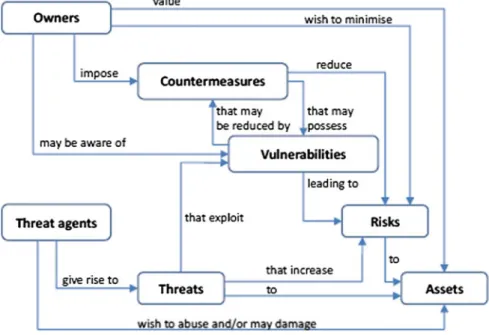
Cyberattacks change the risk profile of certain actions, and usually in ways that make those options more attractive. Cyber attacks need not be directed at adversaries, although the risks of creating new enemies if the source of cyber attacks is discovered are obvious.
Cyber Operations
Cyber Weaponry
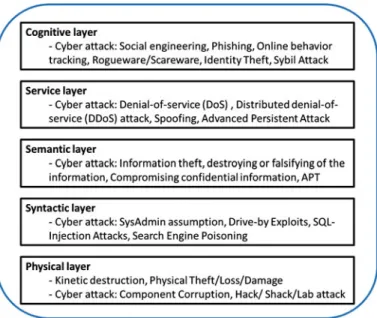
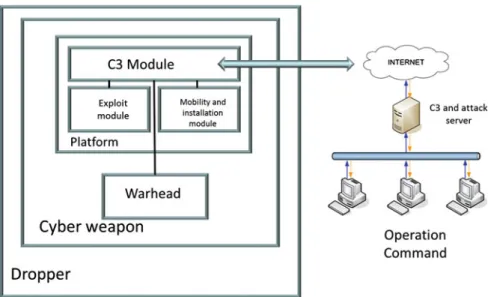
Then, the delivery vehicle, made up of the modules mentioned above, will inject one or more actual warheads into the target. By combining the attack methods and techniques with Libicki's four-layer model, we get the synopsis shown in Figure 4.
Society ’ s Critical Structures as Targets
The Finnish view of critical infrastructure can be derived from the threat scenarios defined in the strategy for securing the functions important to society. The aim of the European Critical Infrastructure Protection Program (EPCIP) would be to ensure that there are adequate and equal levels of protection assurance on critical infrastructure, minimal single points of failure and fast, tested recovery arrangements across the Union (EU Green Paper 2005).
Critical Information Infrastructure
The technical dimension includes technological progress, including its use, and all practical solutions and measures that states and companies take to safeguard the functioning of their critical infrastructure during possible disruptions (HVK2013). According to the definition of the Finnish National Emergency Supply Agency, critical infrastructure consists of the equipment and devices, services and IT systems that are so essential to the nation that their failure or destruction would affect national security, the national economy, general health and safety . the efficient functioning of the central government (HVK2013).
Scada
The cybersecurity strategy also has a master plan for the implementation of the strategy and concrete action plans for each activity. They can be used to focus the more detailed analysis of the cyber world on the most important issues from a security planning and implementation perspective.
The Main Concepts of the Cyber World
This interpretation of the concept of the cyber world makes it possible to deal with the essential questions and phenomena emerging from this new domain. This approach makes it possible to study the phenomena and characteristics of the cyber world without locking the study to the structural limitations of any technology.
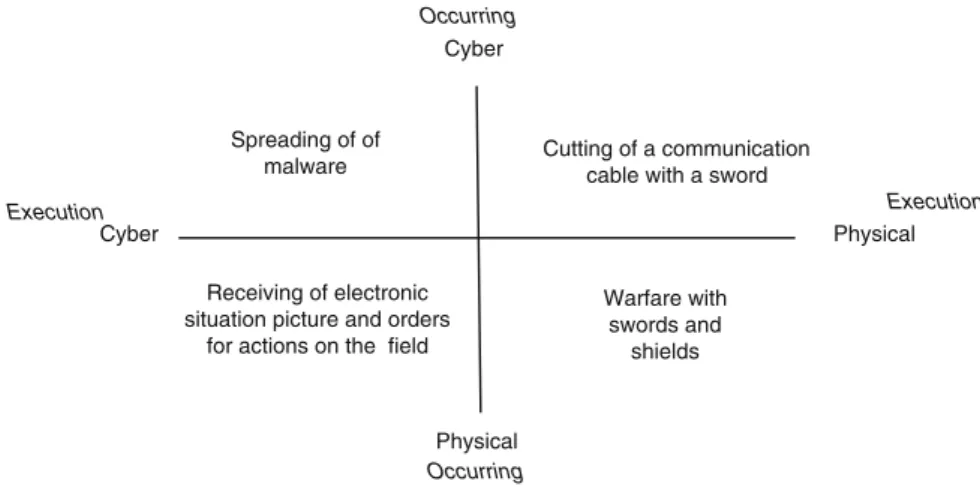
The Physical and the Cyber World Framework
Kinetic cyber concerns the effects that occur in the physical world caused by activities executed in the cyber world. If the warrior cuts a communication cable with his sword, he would be performing an activity that is executed in the physical world but takes place in the cyber world.
The Content Analysis of the Cyber World
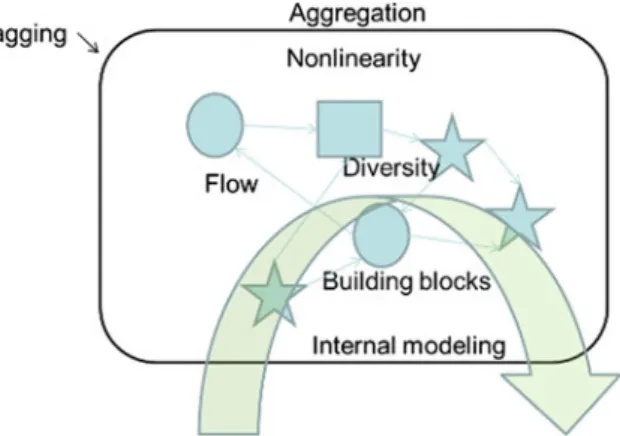
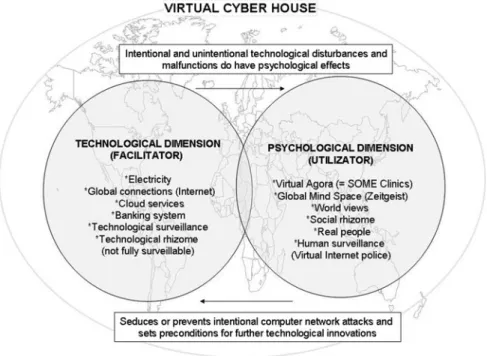
The cyber world can be considered as a complex adaptive system of complex adaptive socio-technological systems. These phenomena can be identified by approaching the cyber world from a chosen worldview and point of view.
A Social System Model as a Worldview to the Cyber World
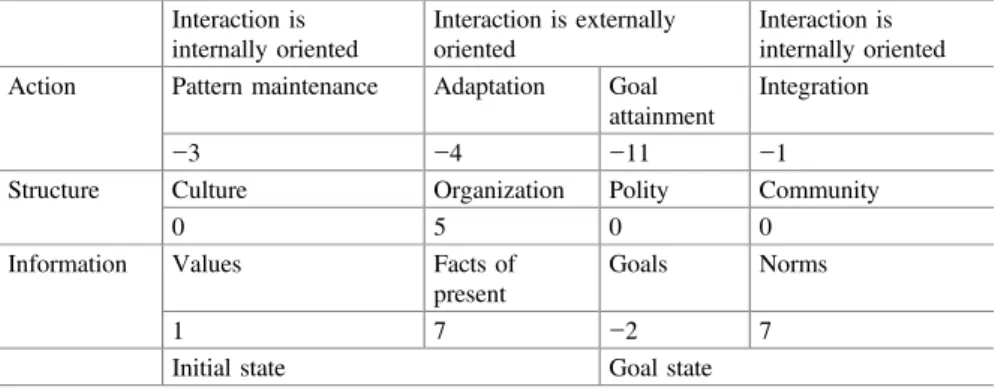
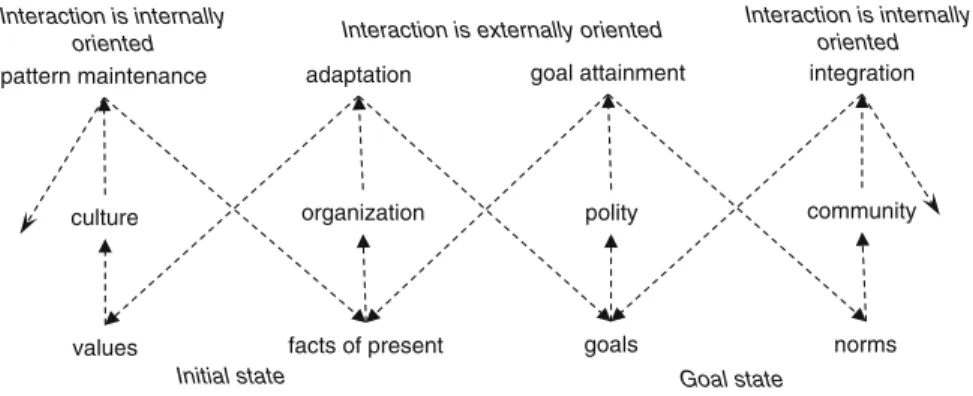
The primary actors in the cyber world are people, so the use of a social system model was chosen as the method to model the content of the cyber world. The media studies show that the issues of the cyber world are discussed publicly, but the focus of the discussions changes over time.
Information Assurance
According to the State Council of Finland, cyber is rarely used as an independent word, but usually as a qualifier, eg, the word security (cybersecurity). Despite some disgruntled comments from a "religious couch" discussant, the discursive baiting was not effective enough. But the power dimension hasn't really changed - the corporate/government world still dominates and has the potential to expand as the world's cultures tend to coalesce.
As the principles of neuroscience "invade" the cyber world, the integration of these technologies can create a new world with new rules that go far beyond the cyber/physical divide mentioned in the section. The legal foundations of State responsibility, which are codified in the Articles of the International Law Commission on State Responsibility (hereinafter also referred to as the "Articles"), define that a wrongful act or omission against a State (a) is attributable to a State under international law; and (b) constitutes a breach of that country's international obligation (International Law Commission 2001).
Strategic Analysis
The operational environment assessment process identifies phenomena within the cybersecurity environment, drafts the definitions required for the strategy, and identifies national cybersecurity projects already underway, including supporting plans and projects. The benchmarking process takes input from other countries' cyber security strategies and identifies such best practices that can be used locally. Benchmarking also offers the opportunity to foster international cooperation as part of a national cyber security strategy.
Strategic Priority
Through the process of strategic decision-making, a desired end state is selected from among various options, including the actions necessary to achieve it. The various versions of the draft strategy shall be circulated as widely as possible in order to receive a sufficient number of comments for consideration. The preparation phase ends with the presentation of the strategy and its acceptance by the political leadership.
Implementing the Strategy
The Security Committee draws up an action plan for national implementation, but this is dependent on the views of the administrative branches. The Security Committee will report annually to the Government on the implementation of the cyber security strategy. Sections of the cyber security strategy are likely to be incorporated into the security strategy for society when it is next updated.
Dimensionality Reduction
The t parameter controls the neighborhood scale in addition to controlling the given bye scale. It has been shown (see Coifman et al.2005 for a proof) that the diffusion distance can be expressed in terms of the appropriate eigenvectors of P:. Since the kernel eigenfunctions form the basis of the set of functions in the training set, f can be decomposed as
Clustering Techniques
Total Client Packets - the total number of packets that were sent by the client in the packet area;. Client Average Packet - the average size of the packets sent by the client in the packet area;. Server Average Packet - the average size of the packets sent by the server in the packet area;.

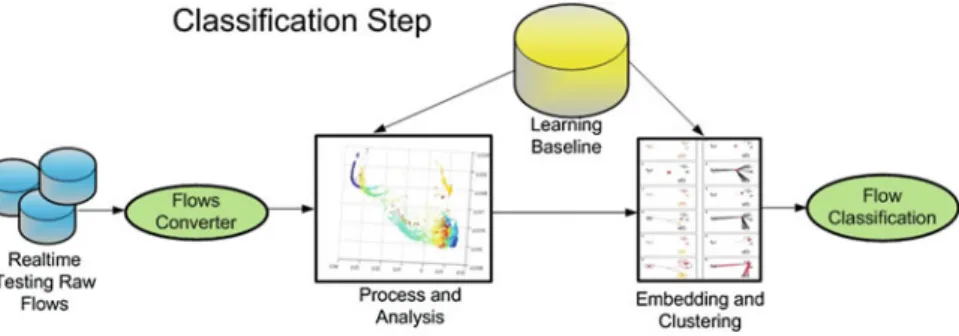
Outline of the Real-Time Protocol Classification Process
It classifies each newly arrived data point as one of the already known protocols (normal, according to the training phase) or abnormal (does not belong to any of the clusters from the training set). Each cluster is classified as one of the application families described in Sec. The distances between the embedded vector of the newly arrived data points and the K centroids (were calculated and stored in the training step) are calculated according to the weighted Euclidean distance (the weight vector was calculated and stored in the training step).
Protocol Classification and Recognition
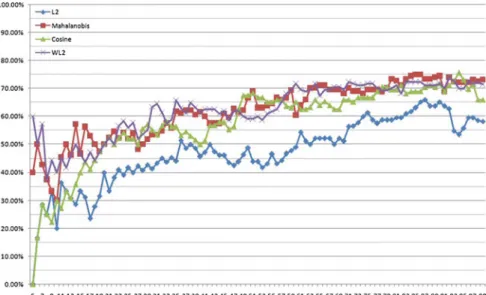
The inter-cluster coverage results from the classification algorithm according to different distance metrics and according to different K-Means values. Figure 6 shows the inter-cluster accuracy results from the PCR algorithm according to four different distance metrics and according to different K where the accuracy is 95. Figure 9 shows the inter-cluster coverage results from the PCR algorithm according to four different distance metrics and according to different K values where clustering accuracy is 95.
UCI Datasets
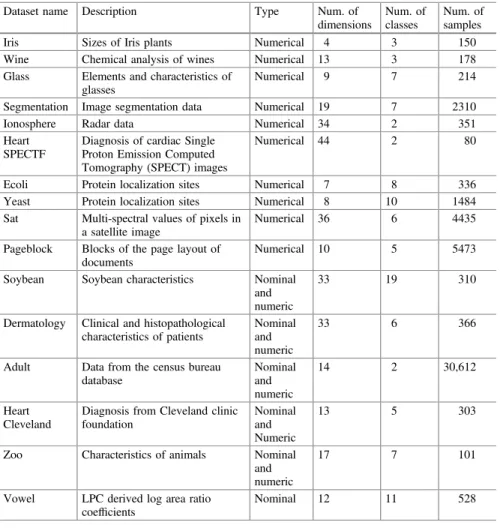
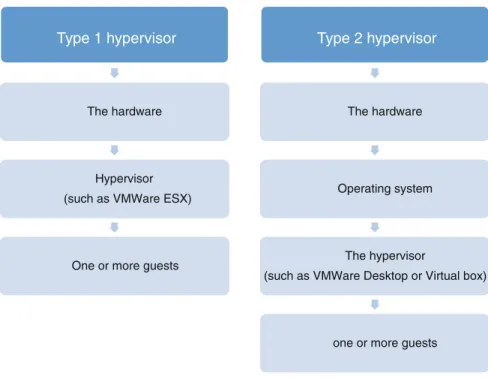
In the classification phase, each stream (data point) in the test dataset was associated with one of the basic clusters according to the PCR algorithm. The last column in this table shows the type of data each algorithm is designed to cluster: some algorithms are designed to cluster numerical data, some nominal data, and a combination of numerical and nominal data. The hypervisor starts as a user process, but is given full control over the system (getting the user to run the process at all is another problem).
Local Hypervisor Red Pills—Direct and Sub-channel Attack
The hypervisor treats the guest operating system in a similar way that operating systems treat processes. The hypervisor manages the memory map for multiple operating systems in a similar manner to the operating system's MMU for processes. This led to subchannel blue pill indirect attacks by measuring the side effects of hypervisor performance (Rutkowska2006).
Remote Hypervisor Red Pills
Kennell and Jamieson (2003) argue that if a host uses a hypervisor, various side effects are bound to occur. If the host is using an efficient emulator that also mimics all the side effects, the response will take too long. If the username is locked, it is possible that attacker activities have been detected.
GameCube DVD Password Attack
The attacker can use the exact username to find the password (using dictionaries or brute force) or use the exact username for other attacks. Assuming an attacker only wants to find the exact username, it would be critical that all failure screens look identical. Furthermore, even if the response occurs on some network that adds random delay (but similar random delay for both the correct username and the incorrect username - an attacker may still be able to guess the password (Domke 2004).
AES Software Implementation
Cache Memory
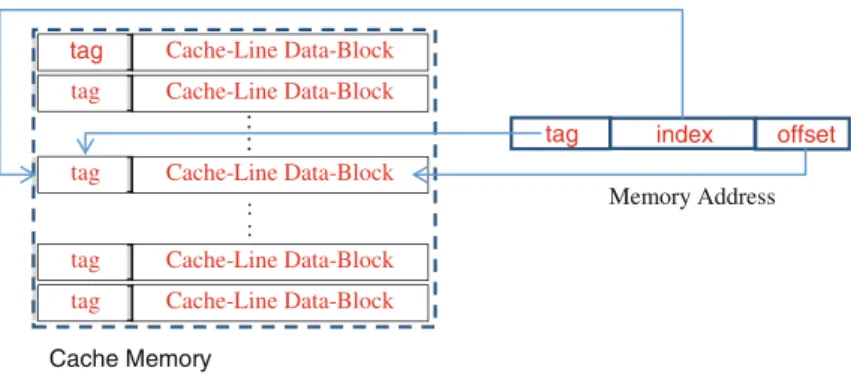
The tag is used to determine the exact memory location of the memory line currently in the memory slot. LSBits are the offset field and define the offset of the memory element within the cache line. When a new cache line is filled, only one slot needs to be evicted to make room for the new line.
Side Channel Attacks on AES
However, multiplication has different power requirements for bits containing 0 (hereafter "0-bits") compared to bits containing 1 (hereafter "1-bits"). Protection against stream-based attacks involves performing similar operations for "0-bits" and "1-bits" by performing random calculations for "0-bits". It is also still vulnerable to attack as the computation is not 100% identical, but it has been shown that by adding random CPU work to "0-bits" the power consumption gap between "0-bits" and "1-bits " be eliminated.
Fingerprinting
Anomaly Detection
Knowledge discovery is a high-level term for the entire process of deriving actionable knowledge from databases. Presenting data mining as part of the knowledge discovery process places the technical challenges in a broader spectrum. The knowledge discovery from databases (KDD) process suggests the steps needed to extract business knowledge from available data (Brachman and Anand1996; Fayyad et al.1996a,b,c).
Databases
Selection
Preprocessing
Transformation