Most of my work at Caltech was done in close collaboration with John Carpenter. In Taurus, the purpose of my optical photometric/spectroscopic survey was specifically to probe for a population of intermediate-age pre-main sequence stars outside the young subclusters known to contain most of the young Taurus population.
Motivation
Star Formation in Clusters and Associations
Our working knowledge of how isolated stars are born is not fundamentally different from the view presented by Shu et al. 1987) in their seminal paper "Star Formation in Molecular Clouds: Observations and Theory". In this work Shu et al. Groups of stars formed by the same molecular cloud, which are not gravitationally bound to each other, are called stellar associations.

Observational Challenges to Observing Nearby Star Forming RegionsStar Forming Regions
The large number of very young stars and apparent lack of more evolved post T-Tauri stars (~3–10 Myr-old star; hereafter PTTSs) in star-forming regions contrasts with ages of tens of megayears (e.g. e.g. Blitz & Shu 1980 ) derived for molecular clouds because it implies that star formation only takes place for a small fraction of the cloud's lifetime. If a more evolved population of low-mass stars exists in these associations, by 5–10 Myr it would likely have spread away from active star-forming regions, and probing stars only within small subclusters does not necessarily reflect the properties of the association as a whole.
Thesis Overview
In chapter 6, I assess the observed age distribution for low-mass stars and brown dwarfs as derived from an HR diagram. In chapter 8 I discuss continued and future directions for this work, and in chapter 9 I give a brief summary of all results.
New Observations
The Saga
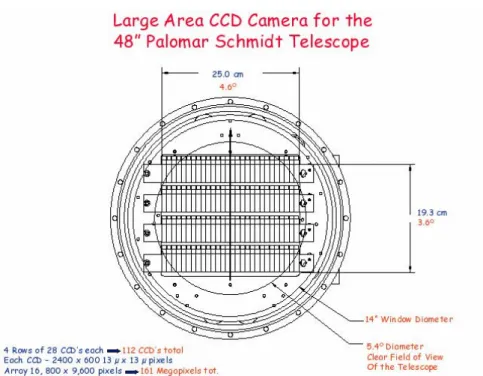
Quest-2 Camera and Yale Reduction Pipeline
Each of the four rows looks at the air through a separate filter, in this case, U BRorI. The bias level for a given column of the CCD is calculated by median combination of 25 rows in the overscan area.
Post-“Yale Reduction Pipeline” Pipeline
- Source Matching
- Calibration to the Sloan System
- Night-to-Night Calibrations
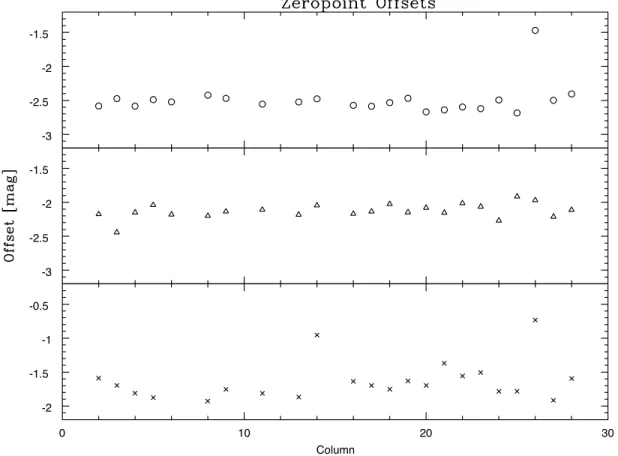
Because each CCD functions as an independent detector, calibrations must be derived for each of the 112 CCDs separately. Thus, because some of the data were taken through thick clouds (≥2 mag of extinction), most faint sources were not detected in all 12 scans.
Precision, Accuracy, and Completeness
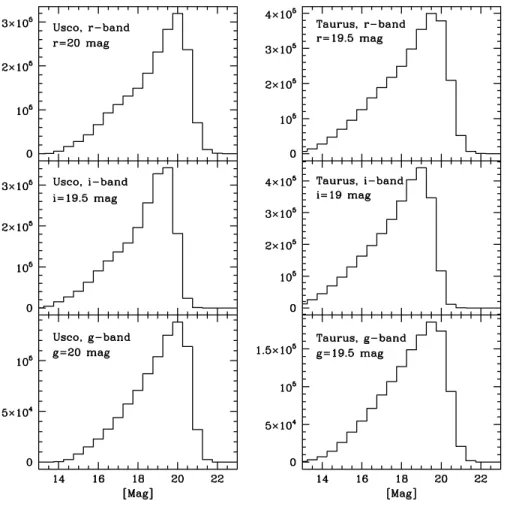
The observed differences in < Δmag > between the three filters correlate directly with the observed differences in the mean matched magnitude; i.e. the mean matcheddg magnitude is ∼1 mag fainter than the mean matched i magnitude, and thus <Δg> is systematically larger than <Δi >. The corresponding panels on the right show data taken with the same CCDs in the Taurus region.

Summary of Quest-2 Photometric Survey
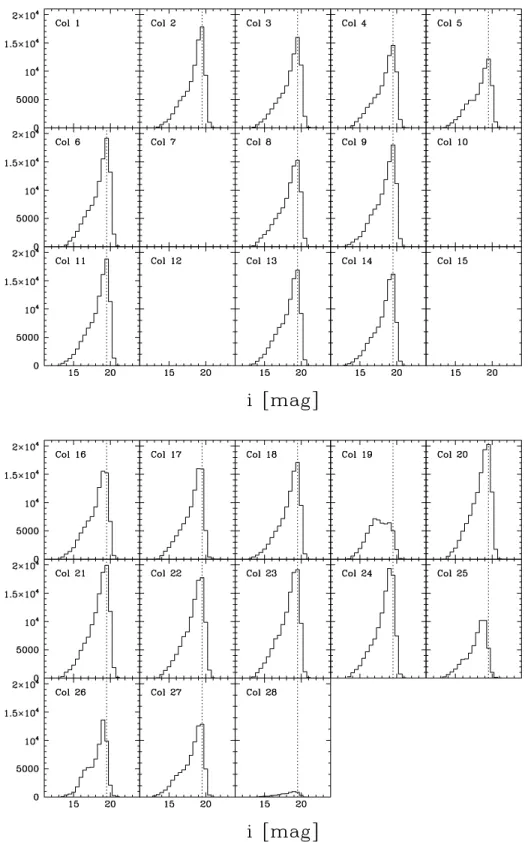
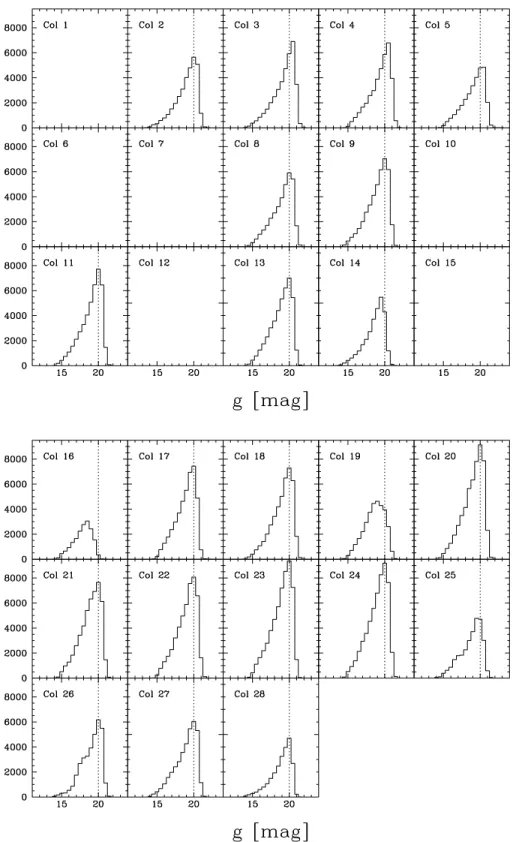
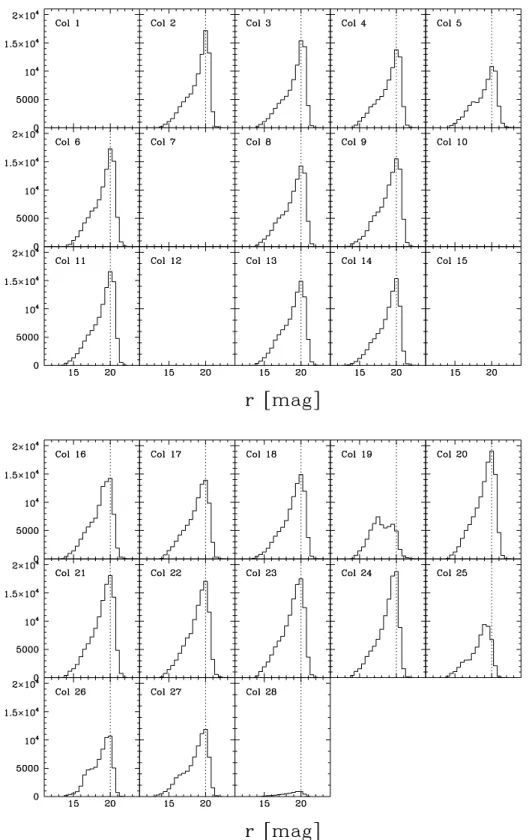
The completeness cycle for all CCDs in the r filter as an ensemble is shown in each panel as a dotted line at r=20 mag. The completeness cycle for all CCDs in the g filter as an ensemble is shown in each panel as a dotted line at g=20 mag.
Optical Spectroscopic Surveys of Photometrically Selected Pre-Main
PMS Star Candidate Selection
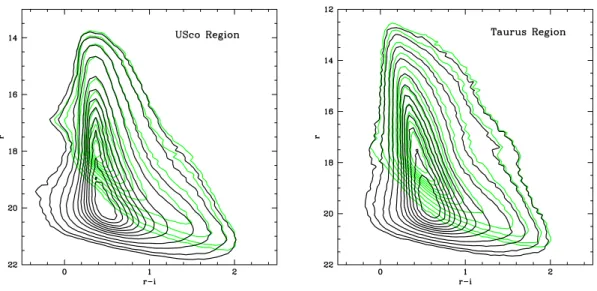
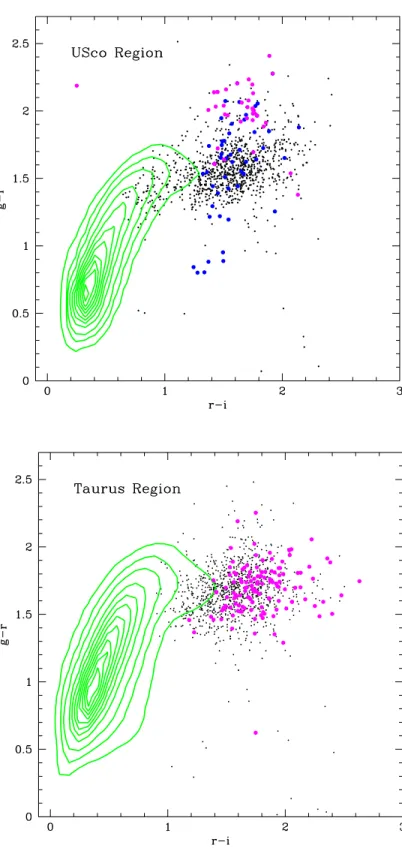
For the spectroscopic observations presented here, I considered as potential candidate PMS stars all sources red towards a linear approximation of the 1% data contour in an r, r−i CMD (see Figure 3.3). Although g-band data were not used in the selection criteria, ~50% of the candidates in each region have a g detection. g −r) color-color diagram for all data with r, i, g detections and 2MASS detections.
Palomar Spectroscopy
- Temperature Classification
- Surface Gravity Classification
- Image Processing
- Sky Subtraction
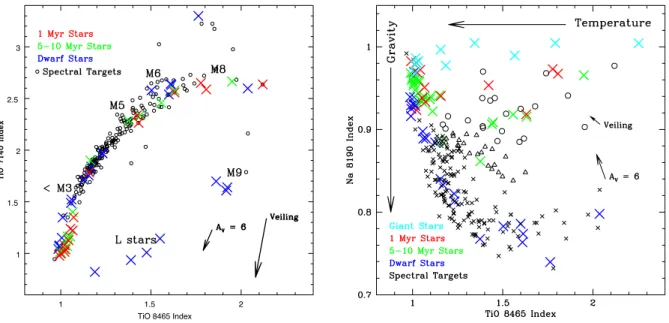
The light and dark shaded regions indicate the location of the TiO and continuum bands used in the spectral classification, respectively. Blue X are measured indicators for dwarf stars and members of the Hyades, Pleiades and AB Dor (age >75 Myr). The light and dark shaded regions indicate the location of the Na I and continuum bands used in the surface gravity analysis, respectively.
Summary of Candidate Selection and Spectro- scopic Observationsscopic Observations
I saw no evidence of He absorption in any of the spectra and thus concluded that my survey did not probe B or O-type stars. So far, I have derived detailed classifications (at the ~0.5 subclass level) from this data only for those stars whose colors and magnitudes meet all the selection criteria described in §3.1. The remaining stars are mostly earlier than spectral type ∼M2 and are discussed in more detail in Chapter 8.
A Distributed Population of Low Mass Pre-Main Sequence Stars
Motivation
The large numbers of very young stars and apparent lack of more evolved (5–10 Myr-old) objects in star-forming regions contrast with ages of a few tens of megayears (e.g. Blitz & Shu 1980 ) inferred for molecular clouds. The largest optical/near-infrared imaging survey to date that has searched for Taurus members is that of Luhman (2006) who used a combination of USNO and 2MASS magnitudes to find young brown dwarfs within a 15× 15 deg2 area centered on the known 1 Myr -old subclusters. The survey specifically aimed to identify young brown dwarfs with colors and sizes similar to known ∼1 Myr-old substellar Stier members and did not aim to find older objects or comparable aged low-mass stars.
Observations
This effect causes a discrepancy between the positions of the green Xs and triangles in the right panel of Figure 4.1. Telluric absorption A) seen in the spectra of GJ 866 and USco CTIO 53 affects both the continuum band and the Na I band, causing systematically high measurements of the Na-8190 index. Both GJ 866 and USco CTIO 53 were observed at high air mass and telluric absorption A) affects both the continuum band and the Na I band, causing systematically high measurements of the Na-8190 index.
Discussion
- Spatial Distribution of New PMS Stars
Understanding the relationship of the newly identified PMS population to known members of Taurus requires distances to new PMS stars that I cannot determine based on the current data set. I observe two spatial concentrations of young PMS stars: one near the known Taurus members at α≈68o, and a second in the eastern part of the cloud centered around α≈82o. To further define the new PMS population and evaluate this possibility, I divide my PMS stars into 3 groups: those that lie in the same RA range as 98% of the known Taurus sample (60o ≤ α ≤ 75o ), those to the east (α > 75o) and those to the west (α <60o) of this RA range.

A New Distributed Population and the PTTS ProblemProblem
Given the large number of imaging/spectroscopic surveys in the Taurus region, a natural question to ask is how the PMS stars presented here were not discovered before my survey. Low-mass stars discovered in early CCD surveys (e.g. Brice˜no et al. 2002 ) are saturated in the Quest-2 data. The spatial distribution of the PMS stars identified far from the known members does not match that of the stars associated with the Taurus subclusters.
Future Work
A Large-Area Search for New
Brown Dwarfs and Low Mass Stars in Upper Scorpius 1
Motivation
Many previous large-scale efforts in the USA have successfully used data from Einstein (Walter et al., 1994) or the ROSAT All Sky Survey (RASS; Preibisch et al. 1998; Preibisch & Zinnecker 1999) to identify hundreds of low- and intermediate-mass objects. members of the association. Given the above US IMF and assuming that high- and low-mass objects have the same spatial distribution, Preibisch et al.
Observations
Green In both panels, black symbols are measured indices for USco PMS candidates observed at Palomar. Seventeen of the 145 PMS stars identified here have been previously discussed in the literature, including 12 with previous spectral type determinations.
Discussion
- HR Diagram for New USco Members
- A Possible Binary
- Emission Line Objects
- Spatial Distribution of Low Mass Stars
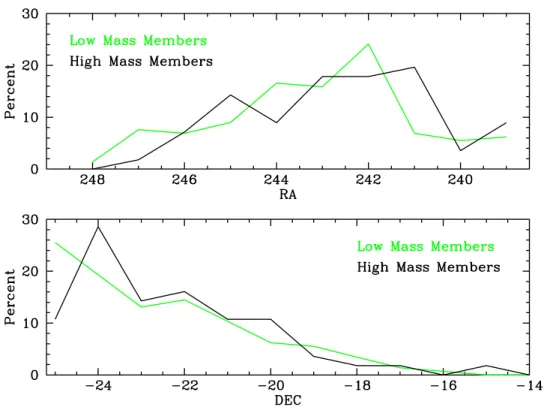
The blue half of the observed spectra for each accretion source is shown in either Figure 5.4 or Figure 5.5. Contours show the percentage of 243 spectroscopically observed candidates found to be bona fide USco members. Figures 5.9 and 5.10 show histograms as a function of RA (Figure 5.9) and DEC (Figure 5.10) of the total number of spectroscopically observed candidates versus the number found to be bona fide USco members.
Summary
The lower panels show the percentage of observed candidates determined to be USco members as a function of RA and DEC. The bottom panel shows the percentage of observed candidates determined to be USco members as a function of RA. The bottom panel shows the percentage of observed candidates determined to be USco members as a function of DEC.
Mass and Age Distributions in Young Associations
Age and Mass Distributions for Low Mass Members of Young
Age/Mass Distributions of the Low Mass Pop- ulation in the ONC
- HR Diagram for Substellar Objects in the ONC
- The ONC’s Low-Mass IMF
- Comparison to Previous ONC IMF Determinations
- Summary of ONC Survey
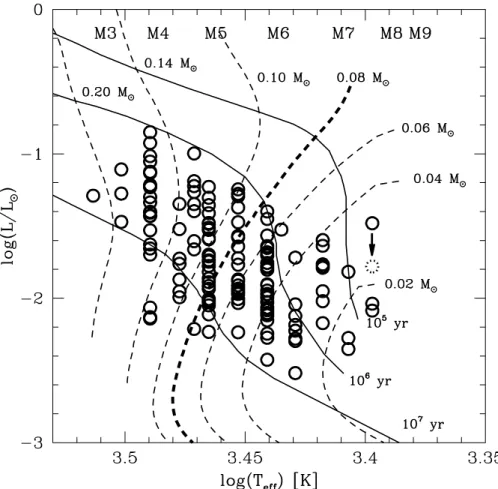
The ONC is one of the most massive star-forming regions with the Sun and the most populous young cluster within ∼2 kpc. In Figure 6.1 I present an HR diagram for those objects within the inner 5.'1×5.'1 of ONC (the HC00 survey area) for which new spectral types were obtained. From this data I made an HR diagram and possibly discovered a previously unknown population of ~10 Myr old low-mass stars within the inner regions of the cluster.
Age/Mass Distributions of the Low Mass Pop- ulation in UScoulation in USco
- HR Diagram for Low Mass Members of USco
- USco’s Low-Mass IMF
- Summary of USco Survey
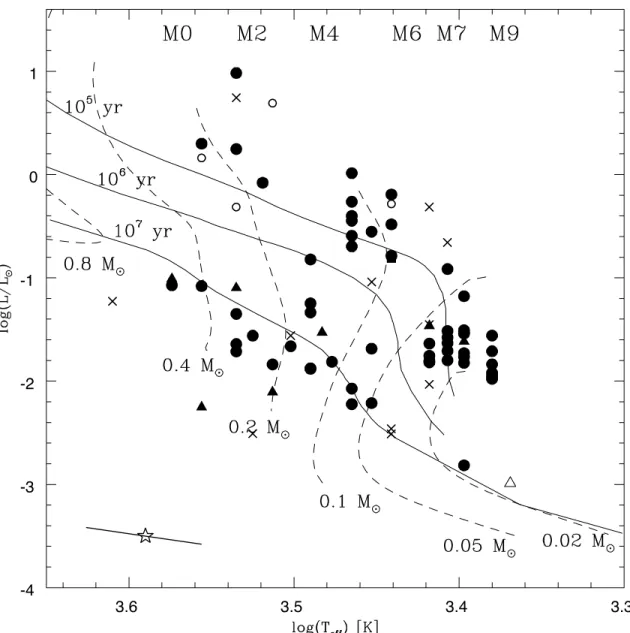
Therefore, if the inferred ages from the HR diagram are correct, the spectrum of a 14.4 million year old star should have noticeably higher Na I absorption. A literal interpretation of the HR diagram reveals a population with a median age of ~4.1 million years and an age range of <1 million years to >10 million years. So far, I have spectroscopically observed only about 15% of the photometric PMS candidates in the USco region.

Comparisons between Star-Forming Regions
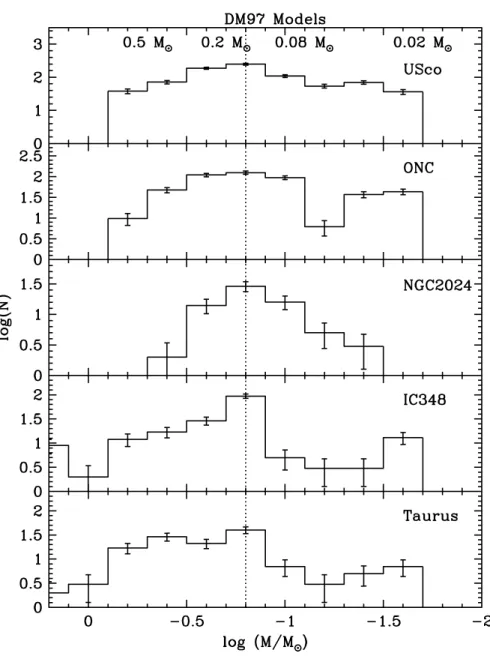
I find that the derived mass functions for three associations, USco, ONC and NGC 2024, are consistent with drawing from the same distribution (probabilities >5%–30%). Regarding the IMFs generated from the DM97 traces (figure 6.14), I find a common peak for all regions (although in Taurus this may be a secondary peak). Thus, this mechanism may be responsible (at least in part) for the larger number of low-mass stars and brown dwarfs seen in the two clustered regions of ONC and NGC 2024. the number of associated low-mass stars.
Circumstellar Properties of Intermediate-Age PMS Stars
Spitzer Observations of 5 Myr-old Brown Dwarfs in Upper Scorpius
- Introduction
- The Evolution of Circumstellar Disks with Mass
- The Evolution of Circumstellar Disks with Age
- Summary and Conclusions
I have included only the 27 brown dwarfs from Scholz et al. 2007) work with spectral types M6-M8 to compare uniform samples. IC 348 is shown as a triangle because only 14/24 brown dwarfs were detected at 8μm in the Lada et al. The disc frequency of IC 348 is shown in Figure 7.5 as a triangle because only 14/24 brown dwarfs were detected at 8μm in the Lada et al.

Research in Progress
Hydra Spectroscopic Observations
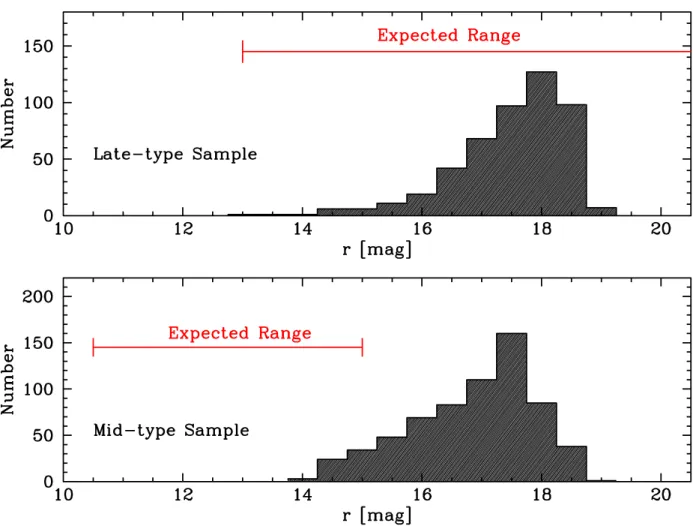
Of the stars with Hydra spectra not discussed in chapter 5, ~400 spectral types have late-K to M-types, which I will refer to as 'late-types'. As can be seen from figures 8.1 and 8.2, most of the stars classified as late type can be bona fide members of USco. Most of the stars classified as middle type do not appear to be members of USco based on their observed magnitudes and spectral types.
Palomar Spectra of High-Variability Stars
To that end, I was given 3 nights at Palomar to begin acquiring spectra of newly identified variable stars in the USco region. The red lines show the empirical boundary between variable and non-variable stars in each column. However, I hope they will give dozens of additional PMS stars to this region.
HIRES Spectra of PMS Stars near Taurus
Only stars observed in more than half of the 24 monitoring scans (i.e. >12 times) are considered variable candidates. Once the observations are complete, I will use the high-resolution spectroscopic data to derive additional information about the kinematics (i.e. radial velocities) and ages (i.e. Li-equivalent widths) of the newly identified PMS stars that will help infer their origin to solidify and relationship with Taurus. The detection of Li in these objects will serve as an independent control of the surface gravity assessment and further confirm youth.

Thesis Summary