Measuring Subtle and Blatant Prejudice: A New Assessment tool for Guatemala’s Bilingual Education Program
By Sagen Eatwell
Thesis
Submitted to the Faculty of the Graduate School of Vanderbilt University
in partial fulfillment of the requirements for the degree of
MASTER OF ARTS in
Latin American Studies May 8, 2020 Nashville, TN
Approved:
Edward F. Fischer, Ph.D.
Xiu Chen Cravens, Ph.D
Copyright © 2020 by Sagen Eatwell All Rights Reserved
Esta tesis está dedicada a los organizadores del Movimiento Maya. Que los que sigan en esa lucha tengan ánimo y éxito.
ACKNOWLEDGEMENTS
I sincerely believe that this project would not have been possible without the effort of many important people. I want to thank those who have encouraged me from before I started at Vanderbilt. Beginning with my parents, both of whom worked towards getting a university degree but were unable to due to forces outside of their control. Their persistent efforts in pushing me to pursue higher education and supporting me in all the ways one can support someone are the primary reasons I have made it here and finished my degrees. I would also like to thank my mentors from Whitworth University, Linda Hunt, Leonard Oakland, and Jason Wollschleger. Without their guidance for preparation and being successful in graduate school, academically, socially, spiritually, I would not have started and may not have finished. I also must thank my friends who have talked with me through this project, offering support, ideas, and friendship. Specifically, Ingrid Sub Cuc who has offered direct feedback and Shashank Poudel for helping me with small things at critical times.
At Vanderbilt, the faculty and staff of the Center for Latin American Studies and International Education Policy and Management programs have been invaluable. My advisors Ted and Xiu are both experts in their fields. It was an honor to work with both of them. I am continuously grateful for you how both helped me solidify the idea for this project, connected me with my collaborators, and heard out my thoughts over the last three years. You both challenge me to write and think better in ways I have not always found elsewhere. Thank you, Nicolette, for sharing the possibility that I could work on both MA and MEd degrees together, helping to organize my plan of study, and helping me process my thoughts and plans the past three years.
Thank you to Alma and Colleen for offering daily support, helping to solve many little problems, and finding lots of free food. Thank you to my friends in Nashville and at Vanderbilt. For me, community makes a place and you all make my community. I am especially grateful to my friends and collaborators in Guatemala – Raxche’, Ixyamanik, Tat Wel, and the teachers of Maya Wuj. It is a special honor to know, study with, and collaborate with you all. It is something I do not take lightly. Your interest in this study and willingness to partner with me are foundational for this project. You are doing the good work and I am thankful to have worked with you. I hope this study is useful for your larger projects of linguistic and cultural revitalization as you work to make Guatemala a more just place. Sib’alaj maltyox chech alaq!
I would like to thank Vanderbilt’s Center for Latin American Studies (CLAS) and the Foreign Language and Area Studies (FLAS) fellowship for financial support. The FLAS fellowship enabled me to study Maya K’iche’ in Nashville and Guatemala, while funding my MA degree. The Norma Antillión award from CLAS gave me the financial support to carry out my thesis research in Guatemala City. Additionally, the financial aid offered by the Peabody College for Education and Human Development allowed me to spend an extra year working on my MEd degree and this project.
Finally, I am extremely thankful for the love and support of my lovely partner, Maya. She has been the one most present for my joys and frustrations through this process, the one reading the most drafts, and the one finding me snacks when I need them.
TABLE OF CONTENTS
Page
DEDICATION ... iii
ACKNOWLEDGEMENTS ... iv
LIST OF TABLES ... vi
LIST OF FIGURES ... vii
Chapter Introduction ... 1
I. Historical Background and Political Context: National Identity, Multiculturalism, and Bilingual Education in Guatemala ... 5
National Identity and Education ...6
Multiculturism (1996-present) ... 11
The Pan-Maya Movement ... 16
Moving Forward ... 25
II. Theoretical Framework: Intergroup Contact Hypothesis & the Subtle and Blatant Prejudice Scale ... 27
Measuring Subtle and Blatant Prejudice ... 31
A Guatemalan Application ... 40
III. Exploratory Study ... 42
Sampling Strategy ... 44
Measures ... 40
Data Analysis Strategy ... 48
Findings ... 52
Limitations ... 61
Discussion of Results ... 63
IV. Conclusions ... 72
Appendix A. Survey Used for Research ... 75
LIST OF TABLES
Table Page
1. Subtle and Blatant Prejudice Scale ... 33
2. Response Rates ... 45
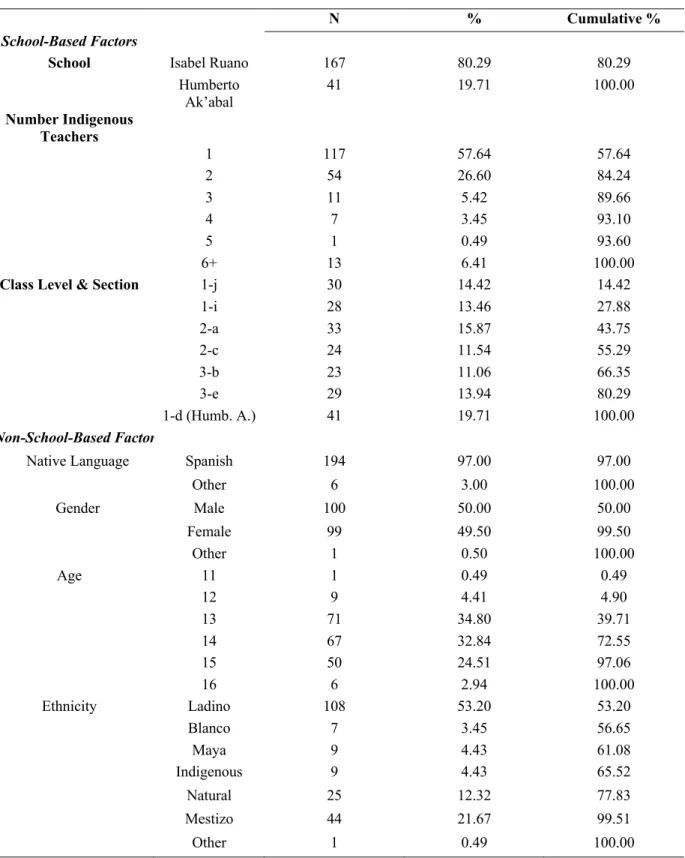
3. Descriptive Statistics for Independent Variables and Demographic Information ... 50
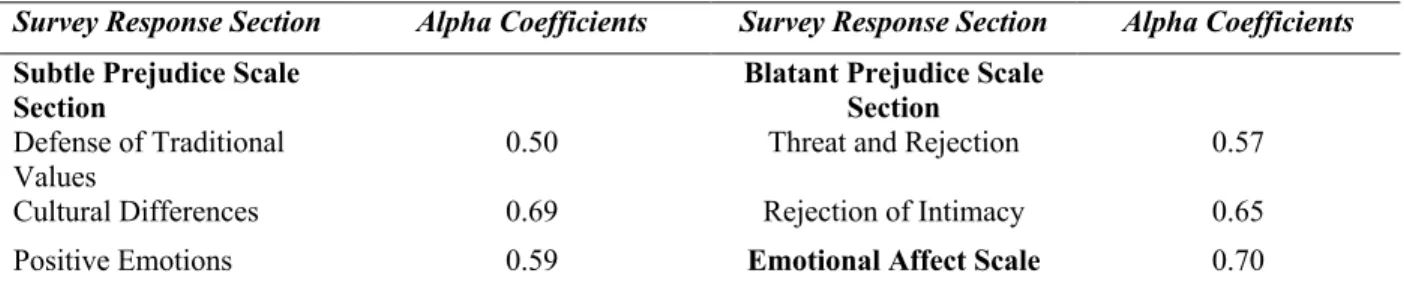
4. Results of Cronbach’s Alpha Tests for Subtle and Blatant Prejudice Scale ... 55
5. OLS Models for Research Question 1 ... 59
6. OLS Models for Research Question 2 ... 61
7. Distribution of Prejudice Types by Ethnicity ... 66
LIST OF FIGURES
Figure Page
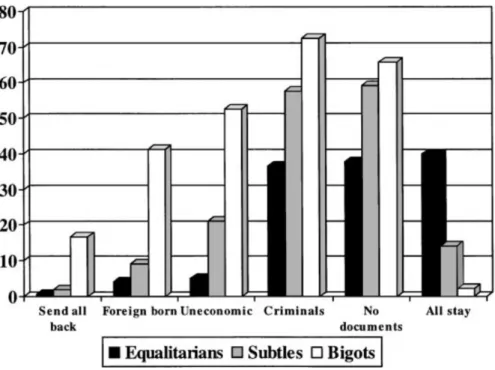
1. Typology of Prejudice ... 34 2. Three prejudice types and preferred immigration policies before recoding for independent response ... 37 3. Three prejudice types and preferred immigration policies after recoding for independent
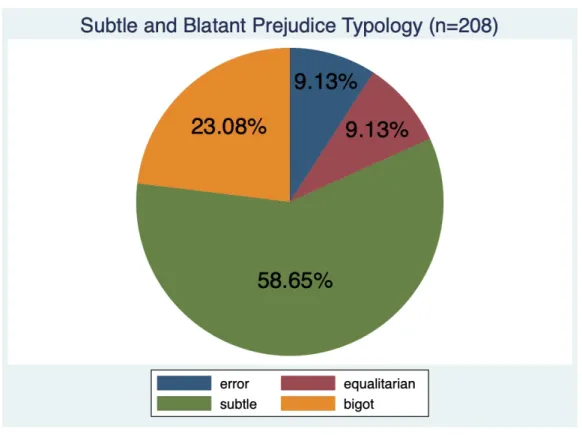
response ... 37 4. Distribution of students surveyed based on Subtle and Blatant Prejudice
typology ... 54
Introduction
The room is painted a cheerful mint green, sparse in decorations, but full of energetic teenage children. The teacher is dressed in a corte and huipil, traditional Maya Kaqchikel clothing, as she teaches her language and culture to a class of mostly Spanish-speaking, non- indigenous students in Guatemala City. Within living memory people from Maya communities in Guatemala were punished in schools for speaking their native languages. The civil war ended only 24 years ago. It was marked by violence, including genocide, towards Guatemala’s
indigenous communities. This teacher has little time to teach many students, but her presence is significant. Her class is the result of decades of organizing, study, and political engagement leading to today’s version of the Bilingual and Multicultural Education Program. As it stands, all students in Guatemala are required to learn two national languages, meaning Spanish and an indigenous language.
This version of the bilingual education program comes in light of the 1996 Peace Accords which officially ended Guatemala’s 36-year civil war. National policy in the Post-Peace Accord era is largely characterized by efforts “to overcome the historic discrimination towards the indigenous peoples” through “the transformation of mentalities, attitudes, and behavior of all citizens” (MINUGUA, 1996, p. 194). One of the primary apparatuses for doing so is the
Bilingual and Multicultural Education program, under the Ministry of Education. Despite these important goals, there is currently no monitoring or evaluation regarding the extent to which this program may be successfully transforming mentalities and attitudes towards indigenous people.
To shed light on this issue, this exploratory study pilots a verified survey tool to measure changes in students’ self-reported prejudice in bilingual education classrooms at two schools in Guatemala City.
Guatemala is one of the few countries in the Americas that maintains a very large indigenous population. According to the 2018 census data, there are 14.9 million citizens living in Guatemala. Of this number about 6.49 million people self-identify as indigenous with 6.2 million, or about 42%, identifying as Maya (INE, 2018). While definitions of indigeneity can be complicated and fluid (Cumes, 2007), the vast majority of the country has some indigenous heritage. However, the forces of colonialism and racism discourage many people from claiming their indigenous identities. Markers of indigenous identity include language spoken (Fischer 1996), wearing traditional dress or political projects (Cumes, 2007). In addition to the population of Guatemalans living within the Guatemalan state boundary, many live outside of the country, most notably in the United States. As of 2017 there were an estimated 864,000 Guatemalans living in the United States (Noe-Bustamante et al., 2019).
This research was done in partnership with a Maya owned and staffed organization in Guatemala called Maya Wuj. This organization has a number of projects including developing the bilingual education curriculum used in Guatemala City, training and placing Maya language teachers, producing Maya-styled business wear for professionals, and publishing books. Maya Wuj is largely funded through the sale of these items. In 2018, the time of my field research, Maya Wuj employed 12 teachers in Guatemala City, four teacher coaches, and two
administrative coordinators. This team was responsible teaching over 10,000 students and served as the sole entity providing Maya language curriculum in the capital city.
This thesis has four chapters. The first presents a historical review of nation, state and nationalism in Guatemala. It begins with the emergence of Guatemala as nation state in the 19th Century and examines how Spanish language and bilingual education programs have been used in attempts to build a national identity, including the post-war goals of multiculturalism. This is
followed by an overview of some political and economic consequences of these systems, with special attention paid to the relationship between these policies and indigenous communities.
This background information highlights the connections between language, ethnicity, and their political consequences in Guatemala concerning bilingual education.
The second chapter is a theoretical review to frame the survey and this study’s methods.
It is based in Gordon Allport’s intergroup contact theory (1954), claiming that intergroup contact with the correct mediating factors is often associated with prejudice reduction. Building off this theoretical body, Pettigrew and Meertens’ (1995) developed an assessment of subtle and blatant prejudice and intergroup contact. This assessment was later adapted and implemented to measure prejudice and intergroup contact among Guatemalan University students by Mendoza Casaús (2006). This study presents an updated and modified version of her instrument to explore what factors may be associated with levels and types of prejudice among students attending Maya language and culture classes in the bilingual education program in Guatemala City.
Chapter Three presents my exploratory study in piloting the survey instrument, and the analytic strategy for the quantitative analysis of its results. Under the direction of Maya Wuj, two schools were selected for this study – here called the Instituto Básico Isabel Ruano and the Instituto Básico Humberto Ak’abal. The names of these schools have been changed to protect to privacy of those who work and study there. My research explores two central questions. The first asks whether school-based factors or non-school-based factors may be associated with the
reduction of prejudice. The second examines if, among the students surveyed, intergroup contact with indigenous people has an impact on attitudes of prejudice. This chapter concludes with a brief discussion of the implications of this project.
Chapter Four discusses the concluding thoughts of this thesis. Drawing on the value of educational program evaluation, it offers some suggestions for how this study’s assessment tool may benefit both Maya Wuj and the broader bilingual education program. This paper calls for greater institutional support and accountability to meet the goals of reducing prejudice through teaching indigenous languages and culture to students in Guatemala. It invites further study into specifying what classroom factors might affect students’ attitudes towards indigenous
Guatemalans, with specific focus on development of positive emotional association and support for healthy mediating factors for classroom intergroup contact situations.
CHAPTER ONE
Historical and Political Context: Multiculturalism and National Identity in Guatemala
Like many other Latin American countries, the modern Guatemalan nation-state emerged in the 1820s. Early nation builders sought to develop a cohesive idea of Guatemala among the inhabitants within the newfound state boundaries by imposing a European model of the modern, liberal nation-state. This project, led by Creole elites, attempted to homogenize numerous groups divided by language, ethnicity, and geography through segregation, education policies, and violently enforced assimilation. Since the end of the Civil War in 1996, Guatemalan national identity has been officially located in a multiculturalism that seeks to shift from past nation building efforts of assimilation to acknowledgement and inclusion of the numerous ethnic and linguistic groups within the country. Despite the optimistic rhetoric of post-war multiculturalism espoused by the government and international organizations, the national concept remains contested and, in many ways, it continues to resemble forms of compulsory assimilation to hegemonic projects and internal colonialism. While the literature highlights these issues, it also shows a lack of measured outcomes demonstrating to what extent the national project may (or may not) be successfully meeting its proclaimed post-Civil War multi and pluri-cultural goals. I suggest addressing this need by piloting a previously verified survey tool to measure the
bilingual education program’s outcomes.
This chapter reviews Guatemala’s concept of multiculturalism as national identity and how educational systems contribute to the national project to both frame the emergence of today’s Bilingual and Multicultural Education program and its need for assessment. To do so I present historical currents that illuminate the challenges and complexities faced by those working
nationalism (Anderson, 1983; Hobsbawm, 1992, 2010; Calhoun, 1997) followed by a historical outline of education policy and nation building leading up to the Peace Accords (Richards and Richards, 1996). Next, I integrate several key works to understand the concept of a multicultural Guatemalan nation (Morales, 2002; Tetzaguic and Grigsby, 2004; Bastos, 2007), including the emergence of pan-Maya organizing and ethnic nationalism (Rodríguez, 1992; Warren, 1998;
Fischer, 2001). Finally, I review the effects of multicultural policies, like the bilingual education program, on Maya people (Maxwell, 2009; Cojtí, 2015), Ladino people’s understanding of themselves in relation to Mayas (Hale, 2006), and the role of Mayas in politics (Hale, 2004).
This chapter concludes with thoughts regarding how the work of my collaborators fits into this context and my suggestions for moving forward.
National Identity and Education
The terms nation and state, and their multifarious meanings, are contested concepts.
According to Hobsbawm, “Nationalism comes before nations. Nations do not make states and nationalisms but the other way around” (1992, p. 10). For Hobsbawm, the modern state serves as a rational, administrative apparatus to establish political boundaries, establish who is within these boundaries, and convince those inside and outside of its legitimacy. Regarding the nation,
Calhoun (1997) suggests, that it is associated with “passion and identification” (p. 3). Nations often find strength in communicating that they are primordial in nature, yet in fact they are modern, “invented traditions” (Hobsbawm & Ranger 2010, p. 1). Hobsbawm finds “three overlapping types” of invented traditions, all of which are relevant to the case of Guatemala: “a) those establishing or symbolizing social cohesion or the membership of groups, real or artificial communities, b) those establishing or legitimizing institutions, status or relations of authority,
and c) those whose main purpose was socialization, the inculcation of beliefs, value systems and conventions of behavior” (2010, p. 9). Where Hobsbawm would categorize nations as “groups, real or artificial communities” (p. 9), Benedict Anderson refers to them as “an imagined political community” (1983, p. 6). As such, most members of a nation will never meet one another, though they share not only an awareness of each other’s existence, but also “an image of their communion” (p. 6) and even “a deep, horizontal comradeship” (p. 7). The modern imagined community is made possible in part due to mass communication, including the advent of print media, and state institutions, including public education. The state apparatus works to draw upon the link between nationalism and identity to build a nation.
While notions of state, nation, and nationalism may vary from one place to another, in the case of Guatemala, the state came before the nation and utilized ideas of nationalism to fuel its nation building project. Shortly after the Spanish arrived in 1524, colonizers and Creole elite forced indigenous communities into reducciones and congregaciones in order to collect, pacify, and manage disparate peoples into more manageable European-patterned towns. This transition was followed by policies of “castilianization” which imposed the Spanish language and
Christianity onto the native population (Richards and Richards, 1996, p. 209). In 1821, the European “module” of a modern nation-state was “transplanted” to Guatemala by the national Creole elite (Anderson, 1983) as the country became independent of Spain. After observing the fragmentation of New Spain and the United Provinces of Central America, Guatemalan national leaders wanted to avoid the disintegration of their new nation-state into indigenous groups or territories autonomously governed by regional Creole elites. Thus, the state sought to establish its national identity and legitimacy, in order to designate the status of its citizens and their
relationship to authority. Despite the state’s early, violent efforts to castilinize its indigenous peoples, most remained monolingual in their indigenous language until the late 20th century.
The year 1965 brought a wave of influential language policy change in Guatemala as the state sought to socialize its citizens, inculcating beliefs, value systems and conventions of behavior among Maya communities. The new constitution of that year declared Spanish as the official language of Guatemala and that “the state was to play a key role in facilitating
indigenous groups into the ‘national culture’ (article 110)” (Richards and Richards 1996, p. 210).
These attempts at homogenizing the population into a cohesive, non-indigenous national identity were characteristic of state policies towards indigenous communities in Latin America, named indigenista policies (Barre, 1982). Generally, indigenista policies understood indigenous peoples as socially and economically inferior, in need of integration into national culture, but also with some positive aspects that should be developed as part of the national project (Batalla, 1981, p.
14). Despite the slight recognition of value in indigenous communities, these policies served to exclude indigenous people and their own projects from the national agenda (Fischer 1996, p. 53).
That same year, the state implemented the Ley Orgánica de Educación which required education at all levels be carried out in the national language, with the exception of teaching more
prestigious foreign languages or a Mayan language with the purpose of castilianization.
Guatemala’s first bilingual education program, called the Castellanización Bilingüe, was also implemented in 1965. The program trained native Mayan speakers who spoke Spanish as
“bilingual promoters” to enter schools and “castilianize the children, alphabetize the adults, and contribute to the social and economic development of the country” (Richards and Richards 1996, p. 211). In contrast to the explicit goals of later bilingual education programs, this program sought to assimilate Mayas into the national culture through the imposition of Spanish and the
reduction of Mayan languages. By 1982, this policy had expanded to include 13 linguistic groups, 1,200 bilingual promoters, and 57,000 students (Richards and Richards 1996, p. 210).
Despite the problematic nature of forced assimilation and associated violence during this period, the program did successfully increase Maya achievement in school and reduce dropout rates.
The process of nation building and maintenance led to extreme levels of violence during the Civil War (1960-96). The most violent period was from 1981-83 under Ríos Montt’s military regime. In response to this violence, “The Memory of Silence Commission for Historical
Clarification” aimed to assess what occurred during the Civil War. This multi-lateral, UN- mediated examination analyzed documented cases of violence and human rights abuses. It concluded that the Guatemalan State committed acts of genocide towards Maya people in the western highlands (CEH 1999, p. 41). In total, more than 200,000 Guatemalans were believed to have been killed or disappeared during the Civil War, and 83% of these victims were Maya (CEH 1999, p. 41). After the overthrow of Ríos Montt in 1983, the first iterations of
multicultural policy in Guatemala began to emerge. One element of these new policies was the founding of the Programa Nacional de Educación Bilingue (PRONEBI) in 1984. PRONEBI implemented a parallel model of bilingual education for the first time, offering instruction in both Spanish and the local indigenous language through the fourth grade. This vanguard program was both the project of and contributed to the emergent Pan-Maya movement—an effort for Mayan cultural revitalization and pan-indigenous identity formation that worked both inside and outside the given political framework for its own subversive interests. Though PRONEBI was in its infancy and no political camps were satisfied with it, it marked the first time that a
government policy attempted to recognize and integrate multiple identities within the
Guatemalan nation without officially seeking to castillianize them. As such, it was an important victory in Pan-Maya organizing.
Bilingual education policy in Guatemala today is constitutionally dependent on provisions for regional linguistic variation created by the constitution of 1985. Article 76 on bilingual education states, “In the schools established in zones of predominantly indigenous population, teaching should preferably be done in a bilingual form” (1985). Along with this, Article 143 states, “the official language of Guatemala is Spanish. Vernacular languages form part of the cultural patrimony of the Nation” (1985). Section 3, Article 66 explicitly states that
“the State recognizes, respects and promotes their (indigenous communities’) ways of life, customs, traditions forms of social organizing, use of men’s and women’s indigenous dress, languages and dialects” (1985). Additionally, Article 58 officially recognizes the cultural identity of indigenous communities, specifically including their languages.
The “official” end of the war was marked by the signing of the 1996 Peace Accords between the Government of the Republic of Guatemala and the Unidad Revolucionaria Nacional Guatemalteca (URNG). The Peace Accords and CEH report serve as the official account of the wartime violence and specify a path towards a “firm and lasting peace” in newly proclaimed pluricultural, multilingual, and multiethnic Guatemala. Within the Peace Accords, the Acuerdo sobre Identidad y Derechos de los Pueblos Indígenas (AIDPI)is the accord that most directly addresses the problem of ethnic discord and cohesion in Guatemala. It states that, “to overcome the historic discrimination towards the indigenous peoples requires the transformation of mentalities, attitudes, and behavior of all citizens,” in part through the expansion of educational coverage, funding, and curriculum reforms to more accurately align with indigenous values (MINUGUA 1996, p. 194). The Peace Accords, however, are not law in Guatemala. In the same
year, 1996, Guatemala signed on to the International Labour Organization Convention 169, called the Indigenous and Tribal People’s Convention (1989). Within the context of the
Universal Declaration of Human Rights (1948), the International Covenant on Economic, Social and Cultural Rights (1976), and the International Covenant on Civil and Political Rights (1966), ILO C169 sets international standards to prevent discrimination “with a view to removing the assimilationist orientation of the earlier standards” (1989), that protect indigenous people’s
“identities, languages and religions, within the framework of the States in which they live”
(1989). To be a signatory on this convention is to officially declare that the Guatemalan State agrees with and is working towards the convention’s mandate, which necessitates reform from previous educational policies described above.
Multiculturalism (1996-present)
Currently, Guatemalan national identity is officially housed in the ambiguously defined and often contradictory concept of multiculturalism. The emphasis on a multicultural national identity is in part a response to the Civil War, where a combination of state forces and organized resistance of non-state actors, produced a de jure national project of multicultural identity. Social theorist Nestor García Canclini’s view of cultural and political hybridization helps us to
understand how the state has attempted to develop the post-war Guatemalan nation. He writes that, “hybridization, as a process of intersection and transaction, is what makes it possible for multicultural reality to avoid tendencies toward segregation and to become cross-cultural reality.
Policies of hybridization can serve to work democratically with differences, so that history is not reduced to wars between cultures... we can choose to live in a state of war or in a state of
hybridization” (2005, p. xxxi). While the State of Guatemala seeks to produce a hybridized
national identity under the label of democratic inclusion, the Pan-Maya movement seeks to revitalize its own indigenous culture as a distinct identity within the nation, understanding the hybridized national culture as an erasure of their own culture and voice.
Mario Roberto Morales, a Ladino novelist and scholar from Guatemala, represents Guatemalan scholars who are skeptical of Maya cultural revitalization projects. Growing up in the early parts of the civil war and educated in the United States, his work focuses on both violence and the role of indigenous people in Guatemala’s recent history. In his book, La Articulación de las Diferencias o el Síndrome de Maximón (2002), Morales argues that
“intercultural mestizaje” is the solution to the so-called “interethnic problem” impeding Guatemala’s intercultural and political national project. Intercultural mestizaje is the idea that different cultural groups should unite together under a common identity and goals, elevating their shared identity over group identities. He uses postmodern deconstruction to argue that Maya attempts to reclaim a pure cultural identity is more accurately understood as the invention of tradition and then claiming the invented tradition as their heritage. Though he claims to not be against Maya regional autonomy or the state officially adopting Mayan languages, he believes that policies that support ethnic differences lead to greater division within Guatemala. According to Morales, as neither Maya nor Ladino culture exist in a “pure” form, rather as the result of discursive historical processes, identity politics that emphasize differences support the concept that to be Maya or Ladino are fundamentally different things. In his view, reducing ethnic
differences in favor of a common national identity ideally forms “an inter-classist and interethnic popular subject capable of being the protagonist in a national-popular political project that is, itself, inter-classist and interethnic” (Morales 2002, p. 61). The goal of this perspective is to form
an interethnic, democratic alliance against political and economic forces that fracture a cohesive national identity in Guatemala.
Multicultural Education Policies
In 2004, UNESCO International Bureau of Education published a study entitled,
“Curriculum Change and Social Cohesion in Multicultural Guatemala,” (Tetzaguic and Grigsby, 2004) as part of the larger volume titled Education, Conflict and Social Cohesion. The study offers an optimistic view of the post-war education reforms from the perspective of an
international organization. The authors claim in the newly declared “pluricultural, multilingual, and multiethnic” Guatemala “education is now considered to be a decisive factor for promoting the cultural identity of each of the peoples that make up the country and for affirming the
national identity. It is through education that a peaceful and harmonious coexistence between the people and communities is fostered – a coexistence based on inclusion, tolerance, solidarity, respect, equality, equity and a mutual enrichment that eliminates all discriminatory
manifestations” (Tetzaguic and Grigsby 2004, p. 110).
In order to carry out these goals, the Ministry of Education implemented a number of curricular reforms. One of the most consequential arenas for the effort was, as previously mentioned, the bilingual education programming. The 1995 shift from bilingual education to bilingual intercultural education under the direction of the newly founded General Directorate of Bilingual Intercultural Education (DIGEBI) was important turning point. This organization began the difficult work of regionalizing educational practices, recognizing and teaching culturally appropriate curriculum about the value of various ethnic and linguistic groups, and requiring that Guatemalan public-school students receive education in their first language and
one other language through the fourth grade. Concepts such as social cohesion, reconciliation, and the official embrace of multiculturalism are generally positive, and indeed, the optimistic view of education reform as a panacea is in the best interest of UNESCO. However, these concepts have proven to lack the power to implement significant change resulting in positive social or material consequences for marginalized groups, as outlined by the human development data below. Meaning, starting new programs or changing existing program names often mask the fact that many of these programs do not have proper resources, support, or means to effectively measure their success and therefore, cannot enact meaningful change.
Santiago Bastos (2007) critiques the views of multiculturalism that Morales and UNESCO reviewed above. He raises the important questions of what inclusion of various voices and stakeholders really means and whether that translates into differences in people’s lived experiences. Bastos synthesized the conclusions from four meetings of academics and
policymakers on the contested concept of multiculturalism and policy that occurred in Guatemala leading up to 2007. In his study, he defines multiculturalism in Guatemala as “an umbrella category, a container of all the alternative forms of national, liberal assimilation in vogue since the 19th century” (p. 14). His point illustrates how, despite changing the official national agenda and efforts to build a corresponding identity inclusive of marginalized groups and their political desires, hegemonic systems still persist in maintaining their power. Bastos would likely agree with García Canclini that hegemonic powers are not monolithic. However, he deviates by
recognizing that while hegemonic powers may officially include subaltern voices, the hegemonic project remains dominant.
In contrast to Morales’ understanding that multicultural hybridity creates a democratic bloc to eliminate segregation, Bastos believes that multicultural rhetoric obscures the fact that
segregation still persists and patterns of historic oppression and imbalance of power favoring Ladino people over indigenous people have not gone away. This reproduction of historic inequalities is due in part to the fact that that Guatemala’s project of cultural mestizaje does not empower or result in material improvement for those it seeks to include.
The UN Human Development Report on Guatemala (2000) finds that national cohesion is inhibited through social, political and economic exclusion. The report outlines these three
dimensions as such:
1. The economic dimension, including structural limitations that hinder access to and participation in the markets, which, at the same time, curtails access to resources and income;
2. the political-judicial dimension, implying that the traditional mechanisms of social participation are inadequate to express the interests of the most vulnerable groups and, rather impose barriers that prevent citizens from exercising their rights; and
3. the social exclusion dimension, ranging from a lack of knowledge of identities and particularities regarding ethnic groups, gender, and religion to the
preferential treatment of certain individuals and social groups (United Nations System in Guatemala 2000).
The above report does not directly mention who is subject to the exclusions, but the historical and political framework above combined with human development data show that indigenous populations, women and indigenous women are the most excluded groups in the country. For example, non-indigenous men earn about 250% more per month than indigenous women (República de Guatemala, 2006, p. 4) and while 59.5% of Guatemala’s population lives below the poverty line (World Bank, 2018), 79.2% of the indigenous population lives below the poverty line (Instituto Naciónal de Estadística, 2014).
This analysis demonstrates that existence of multicultural policy efforts, including in educational systems, does not necessarily result in meaningful change. Rather, if the government does not dedicate resources to teacher training, quality curriculum, and measurement and
reporting of their programs’ impact, the same cycles of internal colonialism that were
characteristic of earlier national policies of assimilation may repeat, just under a new name. In this way, as Bastos argues, multicultural policy becomes one of the “alternative forms of national, liberal assimilation,” (2007, p. 14) characteristic of pre-Peace Accord nation-building.
The Pan-Maya Movement
Maya identity as it appears today is a recent construct, dating back to pan-Maya political efforts in the 1980s. Pan-Maya organizing is largely responsible for the emergence of bilingual education policy as it is currently found in Guatemala, so, to understand these policies it is necessary to understand the pan-Maya movement. Prior to the 1980s, indigenous identity was more closely linked with region and language group, rather than centered on a broader pan-Maya consciousness. This construction of pan-Maya identity and organization of its political projects began shortly after the most extreme violence of the war. It took advantage of the new and more- democratic government of 1985 as evidenced by the launch of PRONEBI. Aura Cumes (2007) writes, “Mayanism can be understood as an ideological current of politics and philosophy that seeks to positively reunderstand what it means to be indigenous as a political connotation centered primarily in ethnic and cultural difference” (p. 87).
Kay Warren points out that Pan-Maya organizing was initiated by Maya public
intellectuals to create an imagined community of sub-state nationalism using Benedict Anderson- like methods. The activist intellectuals, such as Demetrio Cojtí and Rodríguez, worked for the promotion of Maya language learning and literacy through efforts inside the state by working in government positions and outside of the state through academic and internationally collaborative projects. They distributed print media with accompanying cassette and video tapes in such a
fashion that built “a sense of identification that transcends face-to-face community” (Anderson, 1998, p. 22). This is what Anderson would call “an imagined political community” (1983, p. 6), to foster “an image of their communion” (p. 6) with one another, despite differences in specific region or language. This effort, Warren adds, is about culture creation and constitutes “an interplay of local, national, and international cultures, movements, and individual relationships”
(p. 27). Pan-Maya nationalism also creates the form of nationalism Hobsbawm refers to as “those establishing or symbolizing social cohesion or the membership of groups, real or artificial
communities” (2010, p. 9). Cojtí calls this movement “at once predominantly conservative on the cultural plane and predominantly innovative and revolutionary on the political and economic plane” (1997, p. 78).
The cultural revitalization and political action of the pan-Maya movement involves developing a form of ethnic nationalism akin to essentializing Maya identity. Fischer (2001) argues that the State of Guatemala has long essentialized indigenous identities as part of social engineering projects for nation building. However, the emergence of pan-Maya identity is something distinct. Fischer writes that,
“Maya scholars turn to discourses of modernist essentialism rather than multiculturally sensitive constructivism to justify their reconstructions of ethnic identity. The scientific exactitude of modernist discourse helps Maya activists’ legitimate claims on the
Guatemalan state, claims largely based on positions of cultural authority and authenticity rendered through cultural continuity” (2001, p. 11).
While the pan-Maya movement is informed and intentional, not all scholars agree with its approach. García Canclini would point out that the movement to create pan-Maya identity and
culture is the result of hybridization and as such inauthentic, while Morales advocates for mestizaje as the solution to interethnic violence. Additionally, in the book, Maya Nationalisms and Postcolonial Challenges in Guatemala (2009), Emilio de Valle Escalante suggests that “the
‘interethnic problem’ does not deal with the construction of new identity constructs, such as
‘Maya’ but rather with the resurgence of a historic struggle that modern nation-states have been unable to end: economic and ethnic inequality, especially among Maya populations” (p. 122). In order to move forward and exit the cycles of inequality he advocates that the Maya movement should move away from the discourse of cultural politics that seeks to recover an identity
stemming from specific biological, regional, and linguistic pasts. Rather, Mayanness as a concept and its corresponding politics should become an alliance of subaltern groups united through “a historical experience and an affective and political relationship from which to think and act” (p.
140). Subtly different from other approaches, his approach seeks to maintain group saliency but to break down perceived binaries between Maya and Ladino, rural and urban, traditional and modern, and male and female by organizing around power dynamics rather than identity politics.
Specifically, within the educational system, he argues that this organizing should confront the coloniality of power and “show how the experiences of exploitation, racism, and marginalization lived during the colony have not ended” (p. 123).
Raxche’ Demetrio Rodriguez’s analysis highlights how the counter approaches to the pan- Maya movement outlined above fail as he calls for a “pluralistic” model of development. Despite the optimism of de Valle Escalante above, breaking down binary categories of Maya and Ladino within a context where Ladinos hold much more political and economic power results not in a multicultural, democratic bloc where subaltern group saliency persists, but rather in the silence of indigenous voices and projects (Rodríguez, 1992, p. 24). In this view, reducing Maya ethnic
saliency is reminiscent of political projects that see the culture of Maya people as a “problem”
that “represents the antithesis of what they (Ladinos) aspire to, namely, a unified, thoroughly modern, Western-based nation-state” (Fischer, 1996, p. 52). Cumes (2007) adds that
“egalitarian rhetoric (hegemonic liberal) in this country (Guatemala) has become, by in large, an illusion that hides behind it problems of segregation and racial/ethnic hierarchy based in mechanisms of domination. The social inequality that is experienced now has its origins, precisely, in the way that this country was constructed in ethnic/racial terms” (p.
187).
She points out that dominant groups sometimes view naming ethnic divisions and differences as divisive to national unity. However, she argues that, this egalitarian, multicultural rhetoric is bringing to light that within the multicultural milieu calls to respect differences as an end in itself are too ambiguous and insufficient to enact meaningful change. “Adopting the discourse in this manner, in a politically correct way, brings more advantages to those who benefit from the social order as it has existed and is perfectly compatible with defending the supposed ‘national unity’
of today” (p. 188). To simply acknowledge the value of cultural differences does not remove inequality. Subaltern groups must claim alternative kinds of power, otherwise they risk becoming supporters of the unequal systems that oppress them.
Rodríguez’s pluralistic approach seeks to develop Guatemala in an overlapping, convivial manner among the diverse people groups in the country as Maya people solidify their identity.
He argues not for elimination of Maya people and culture, nor to integrate certain indigenous elements of it into the wider Ladino framework, but rather to “neither ladinize the Mayas, nor Mayanize the ladinos” (1992, p. 24). Pluralism resists a monolithic national identity in favor of one the draws on the values of each cultural group present, in this case highlighting the
contributions of Maya communities and allowing them to maintain salience not through
integrating their identity into an interethnic mestizaje, but through crystallization of a distinct and shared Maya identity. For Rodríguez, one step towards a pluralistic Guatemala is to “break the centuries-long cultural domination that the Ladino community has maintained over the Maya community” (p. 23). As Pan-Maya movement leaders forged their identity through promotion of Mayan language learning and literacy among Maya people themselves, they also seek to achieve the pluricultural goals outlined by Rodríguez through the bilingual education program by
teaching Mayan language and culture to non-indigenous students.
That a bilingual and intercultural education program would exist as a permanent institution in Guatemala’s Ministry of Education is a testament to the decades of work by pan- Mayanists within the constellation of national and international political forces. Yet, as Maxwell’s (2009) chapter “Bilingual Bicultural Education: Best Intentions across a Cultural Divide” points out, this step does not necessarily result in positive interethnic relationships. In fact, if the government does not treat the program properly, this program invented to reform national consciousness and build a diverse and pluri-cultural national identity may serve to reproduce historically problematic attitudes and social relations. The three significant problems with bilingual education that Maxwell (2009) identifies are economics, personnel, and
curriculum. She points out that the program is chronically underfunded, resulting in a too few trained teachers and in too few classrooms to reach more very many communities. Additionally, it has been challenging to find the “trained linguists, educators with advanced degrees, and computer and graphics specialists” in a number of Guatemala’s 22 languages necessary to create and implement a bilingual education program (Maxwell, p. 89). Finally, and most importantly, the national curriculum as produced by the government celebrates cultural diversity but remains
ethnocentric. It is designed with “stories based on other places and climates, language
conventions that show different social classification, lesson plans based on other cultural bases, lessons showing Mayan cultural institutions and practices as folklore, and lessons on Mayan religion as polytheistic and supplanted” (Maxwell, p. 90). The effects of these problems in the curriculum are nonsensical lessons at best and affirmation and perpetuation of historical inequalities at worst. These problems with the curriculum serve to de-legitimize Mayan
intellectual roots, spiritual perspectives, and cultural institutions and place them as subject under the Creole and Ladino-imposed values and institutions. Though not using violence to
delegitimize and subjugate Maya people, the national educational curriculum is still a powerful force for creating the concept of identities and social positions.
Mayan intellectual and former Vice Minister of Education Dr. Demetrio Cojtí Cuxil made significant and positive advancements for bilingual and intercultural education during his tenure in the ministry of education. Notably, Acuerdo Gubernativo de Generalización de la Educación Bilingue Multicultural e Intercultural 22-2004 establishes “bilingualism in national languages as national policy, which will apply to all students of the public and private sector. A student’s mother language will be the first one learned, the second another national language, and the third should be foreign” (Presidencia de la República 2004, Article 1). This change is vital as it addresses the previously unidirectional transition programs of bilingual education designed to castillinize indigenous language speakers. The pre-2004 transition program model resulted in reinforcing a colonial concept of hierarchy of languages moving from supposedly more primitive and less useful indigenous languages, to supposedly more sophisticated and useful European languages. Previously, students in private schools were not required to learn another language and if they did choose to study another language, it was often English or
French rather than an indigenous language). However, with the new policy, non-indigenous students are now required, for the first time, to receive instruction in an indigenous language.
Even as accord 22-2004 was developed under Demetrio Cojtí’s time as Vice Minister, he later critiques the results of this very policy in his book Descolonización y Educación Bilingue (2015). He argues that even with the new changes, the education system perpetuates colonial cycles of oppression. He shows that within the social and economic context of Guatemala, Mayan languages and Spanish still do not have equal social status, economic affiliations, or power structures (Cojt, 2015, p. 36-37). Considering this and the fact that Educación Bilingüe Multicultural e Intercultural only requires this programming through the 4th grade, lacks
sufficient funding for quality curriculum and teacher training, results in only cursory instruction.
These factors reinforce the idea that indigenous languages, and by association culture and thought, are less valuable or sophisticated than their European counterparts. He argues that, despite the ostensibly positive steps of the Acuerdo 22-2004, the result is a new form of internal colonialism of indigenous people by Ladino people similar to what has been experienced by Guatemalans dating back to the 19th century. Rather than physical reducciones and
congregaciones of the colonial era, hegemonic powers use the education system now to create manageable linguistic, cultural and political reducciones of indigenous people that lack the power to challenge the imposed political or economic orthodoxy.
In a turn from much of the other literature, Charles Hale writes on the experience and attitudes of Ladino Guatemalans in the post-war era. The title of Hale’s book, Más que un Indio (2006), is telling for the transitions of identity and power that have occurred in the past few decades. He points out that previously, the phrase más que un Indio (more than an Indian) would have expressed an indigenous person’s “self-denigrating desire for upward mobility in a racist
society” (p. 11). However, the meaning has now switched to capturing Ladino attitudes of racial ambivalence towards indigenous people. Through ethnographic research in Chimaltenango, he finds that most Ladinos profess that Maya people deserve to be treated better, their culture should be respected, that racism should be eliminated, and that all should have equal rights. Yet, these same people express anxiety about Maya ascendancy, which influences their actions and inhibits the multiculturalism they claim to endorse. As Hale puts it, “Ladinos manifest racial ambivalence when they repudiate racism, express support for the ideals of cultural equality, and view themselves as practicing these ideals, and yet, maintain a strong psychic investment in their dominance and privilege in relation to Indians” (Hale, p. 19). In this sense, Ladinos feel that they are más que un Indio. Hale believes that this racial ambivalence is correlated with neoliberal reforms in Guatemala. In a neoliberal system, economic transitions to strengthen the private sectors, weaken the state apparatus, and further individualize Guatemalans would provide ample room for multicultural, yet lacks much accountability beyond what the market regulates. Hale refers to this concept as “neoliberal multiculturalism,” which represents a space where racial ambivalence can perpetuate “a rough equivalent to the twentieth-century ideologies of mestizaje, assimilation, and unitary citizenship for the new millennium” (p. 20).
Hale claims that this form of government thrives on cultural difference to its advantage,
“not by denying indigenous rights, but by the selective recognition of them” (p. 35). Including indigenous people in the Guatemalan national rhetoric of multiculturalism, and even in
government positions, yet by in large preventing economic and social equity, is not the
pluricultural nation that Rodríguez (1992) advocates for above. Rather, it proceeds in such a way as to signal inclusion in acceptable ways while proceeding with the same, Ladino, economic and political projects. Hale’s neoliberal multiculturalism is of a similar vein to Bastos’ (2007)
understanding of multiculturalism, seeing it as a new category that holds the same old items, even as Hale roots it economically in neoliberal reform.
In addition to Más que un Indio, Hale’s article “Rethinking Indigenous Politics in the Era of the ‘Indio Permitido’” (2006) has become part of the canon on indigenous politics in
Guatemala. The indio permitido is the concept of an indigenous intellectual or activist who is given a position of power or leadership in a government organization, maybe even in one of the indigenous-focused ones such the Defensoría de los Derechos de los Pueblos Indígenas branch of the Procuraduría de los Derechos Humanos, and the Comisión Presidencial Contra la Discriminación y el Racismo (CODISRA). This gives the appearance of inclusion within the state. However, they are not able to go beyond pre-established limits to make decisions or enact changes that improve the conditions of their communities. As he puts it, “This category transmits a straightforward message: one can affirm Mayan culture and identity while also reinforcing the legitimacy and authority of the Ladino-controlled state” (2006, p. 297). Thus, the “indio” is permitted in certain positions and spaces, yet tokenized and restricted by Ladinos from having any meaningful power within that space.
Hale’s argument does make sense given that little has changed in terms of material gains for indigenous communities or viable state bilingual education programming. However, it must be noted that Maya people who have achieved high-ranking positions in the government have made important advancements. For example, during Dr. Demetrio Cojtí Cuxil’s appointment as Vice Minister of Education, he was able to maintain indigenous administrators and teachers, begin curricular reforms, and pass Accord 22-2004, until he was replaced by the subsequent presidential administration. Additionally, as director of the new iteration of PRONEBI, called DIGEBI (Dirección General de Educación Bilingüe-Pluricultural), Raxche’ Demetrio Rodríguez
Guaján piloted teaching the Kaqchikel language to Spanish-speaking children from Kaqchikel families, while designing new teacher training materials and methodologies. After stepping down from his position, he has gone on to form Maya Wuj, now the primary provider of bilingual education curriculum, teachers, and teaching in Guatemala City. To say that these two were simply permitted and ineffective is to misunderstand their dedicated work and achievements for teaching and learning of Mayan languages in Guatemala.
Moving Forward
A review of this literature raises important critiques of the multicultural policies in Guatemala. It points to various ways in which national rhetoric and political frameworks ostensibly serve noble purposes, but in effect can be fraught with problems. These arguments, however, are complicated by the presence and work of Maya Wuj in Guatemala. Indeed, multiculturalism in the neoliberal context can be a different box for the same things. But at the same time, the characteristics of deregulation and weakening of the state apparatus within the context of multicultural nationalism has afforded space for Maya Wuj to develop and find success. As the state has largely failed to fulfill its official goals to promote indigenous rights and language learning, Maya Wuj as a private entity has found space to leverage this political framework of multiculturalism for the benefit of Maya people and bilingual education. Being a Maya owned and staffed company, it is an example of a subaltern group developing new kinds of power and political saliency in its distinct identity both by generating new economic projects and improving implementation of policy where the state has repeatedly failed. Above, Maxwell (2009) identifies curriculum, personnel, and economic issues as major inhibitors to successful bilingual education in Guatemala. Through their work, Maya Wuj seeks to meet all of these
needs- an improved curriculum, the right personnel, and improved economic opportunities for those they employ. While the ills of neoliberal multiculturalism persist, Maya Wuj stands out as an important example of Maya ascendancy.
While Guatemala may now proclaim itself to be a pluricultural, multilingual, and multiethnic nation, it is clear that these ideals are not yet achieved. These texts illuminate the deep-rooted contributions of racism to inequitable material consequences for Guatemalans, as well as the layers of complexity involved in meaningful policy solutions. Despite, or perhaps because of these issues, there is also a consistent lack of empirical data and measurement. The CEH found Guatemala to historically be “an authoritarian State which excluded the majority of the population, was racist in its precepts and practices, and served to protect the economic interests of the privileged minority” (1999, p. 17). How then can Guatemala “overcome the historic discrimination towards the indigenous peoples” through “the transformation of mentalities, attitudes, and behavior of all citizens” (MINUGUA, 1996) without examining to what extent the mentalities, attitudes and behaviors” are transforming? The census, UN human development, and ethnographic data that do exist are very important to frame these problems.
However, specific measurement pursuant to these goals is necessary. As of now, it appears that Mendoza Casaús’s (2006) study on kinds of prejudice and intergroup contact among four Guatemalan universities is the only attempt to fill this gap. As such, in this study I collaborate with Maya Wuj and propose to build upon Mendoza Casaús’s work by piloting a new version of her survey instrument to measure student learning outcomes in bilingual education classrooms of Guatemala City.
CHAPTER TWO
Theoretical Framework: Intergroup Contact Hypothesis and the Subtle and Blatant Prejudice Scale
To empirically examine the underlying causes in a racially inequitable system at the individual level requires an examination of the attitudes of the individuals in that system. In colloquial use, racism is often used to describe a discriminatory action or prejudiced attitude.
However, scholarship on these topics generally identifies racism as characteristic of a system in which one racial group is oppressed by another under the belief that the dominate group is superior (Wilson, 1973). A racist system is supported by discriminatory behavior of individuals based on their prejudiced attitudes (Quillian, 2006). This is true in Guatemala, as it is in other parts of the world. For Guatemala the groups in question are roughly divided into two – indigenous people (Maya, Xinka, and Garifuna) and non-indigenous people (Ladino and Criollo). The Commission for Historical Clarification’s (CEH) post-war (1999) findings highlight the contribution of racist ideology to the state violence towards indigenous people during the war period. This is, in part, why the bilingual education program’s potential to changed prejudiced attitudes is so important.
If an educational program can help to change non-indigenous people’s minds about indigenous people, it may help to change their behavior towards those groups. To study the extent to which that may be happening in a given context, the literature points to an examination of intergroup contact and prejudice. The theoretical foundations for studies of prejudice are largely based on Gordon Allport’s Intergroup Contact Hypothesis (1954), while the measurement of kinds and levels of prejudice, is most often operationalized with Pettigrew and Meertens’
Subtle and Blatant Prejudice Scale (1995). This chapter reviews the literature on the Intergroup
and challenges of the Subtle and Blatant Prejudice Scale (Pettigrew and Meertens, 1995). The chapter concludes by raising some questions about the utility of applying this survey tool in Guatemala.
Intergroup Contact Hypothesis is the most well-established theoretical framework supporting studies of prejudice and intergroup contact (Brewer & Miller, 1984; Ihlanfeldt &
Scatidi, 2002; Phinney & Rotherham, 1987). This, and associated theories of aversive racism (Dovidio and Gaertner, 1986), provide the theoretical support for the survey tool used in this study. In 1954 Gordon Allport published his seminal book The Nature of Prejudice. Here he proposed the Intergroup Contact Hypothesis (ICH), which states that positive contact including certain conditions, also called mediating factors, with an outgroup leads to reduced prejudice towards the outgroup. He defines prejudice as, “an antipathy based upon a faulty and inflexible generalization’ (1954 p. 10). Prejudice remains an inflexible antipathy until it is met with the right kind of contact with the outgroup to which the prejudice is directed. The mediating factors for the ideal contact situation are equal status, intergroup cooperation, common goals, and support by a normative structure or institutional authority. Since 1954 studies generally support the conditions for Allport’s positive intergroup contact (Brewer & Miller, 1984; Ihlanfeldt &
Scafidi, 2002; Phinney & Rothehram, 1987). Additionally, many publications have supported Allport’s hypothesis, demonstrating that positive intergroup contact reduces explicit self-reported prejudice towards Black neighbors, the elderly, gay men, and people with disabilities (Works, 1961; Caspi, 1984; Vonofakou, Hewstone, & Voci, 2007; Yuker & Hurley, 1987).
In 2006 Pettigrew and Tropp carried out a meta-analysis of all previously published studies on Intergroup Contact Hypothesis. Their study analyzed 515 studies including 250,089 individuals from 38 countries. The authors conclude that “those samples that experienced
carefully structured contact situations designed to meet Allport’s optimal conditions achieved a markedly higher mean effect size than did other samples” (p. 766) and that unstructured contact can still contribute to prejudice reduction. To summarize this concept Everett (2013) writes,
“Allport’s proposed conditions should be best seen as of a facilitating, rather than an essential, nature.” Al-Ramiah and Hewstone (2011) find negative correlation between prejudice and levels of intergroup contact even in sub-optimal with effect sizes similar to the negative relationships between condom use and sexually transmitted HIV and secondhand smoke with lung cancer at work. Pettigrew and Tropp (2008) find that the effect of contact on prejudice reduction works in two directions, by decreasing negative affect (such as inter-group anxiety) and by contributing positive affect process (such as empathy and perspective taking). In addition to prejudice
reduction, several studies point to other positive outcomes of direct intergroup contact. Findings show that it is associated with out-group trust (Tam et al., 2009), forgiveness (Hewstone et al., 2007), and positive attitudes towards others, as opposed to simply the absence of negative attitudes (Christ et al., 2010; Vonofakou, Hewstone and Voci, 2007).
Measurement of prejudice by explicit self-reporting is useful but limited in that it introduces internal validity threats through self-report bias. Aberson and Haag (2007) seek to address this by employing implicit measures of prejudice through computer reaction tasks. They find that intergroup contact helps reduce implicit associations of “good” for one’s own in-group, and “bad” for an out-group. Beyond these findings, Blascovich et.al. (2001) find association between positive intergroup contact and reduced psychological threat towards out-groups and Walker et al. (2008) find contact to contribute to perceived similarity in how the brain processes faces of in and out-group members. Researchers also find reduced cortisol reactivity during contact, which indicates a decrease in stress (Page-Gould, Mendoza-Denton, and Tropp, 2008).
For this theory to have relevance in policy interventions we must address whether the positive outcomes of intergroup contact are generalizable beyond a direct contact situation and whether Intergroup Contact Hypothesis may encourage or inhibit social change. It is in these areas that critics raise the main critiques to Allport’s hypothesis. Several critics argue that the extent to which individual’s attitude shifts resulting associated with intergroup contact may affect societal change is under-researched (Dixon et al., 2005; Forbes, 1997) and that the recorded changes in beliefs may not lead to sustainably equitable outcomes. In response, Hewstone and Swart (2011) suggest that prejudice should not be the sole focus of intergroup contact encounters, rather the contact situation should explicitly address structural inequalities while emphasizing similarities between groups during the contact situation.
Hewstone and Swart (2011) take into account much of the research regarding Allport’s hypothesis during the past 50 or so years. They consider critiques that the literature is lacking in the areas of longitudinal studies regarding duration of positive effect and along with behavior modifications based on attitudinal change. In addition, others raise questions to what extent changes in individual prejudice affect collective process (Forbes 1997), and how the contact situation may have the unintended effect of souring intergroup relations (Pettigrew 2008). Even weighing these needs for further research, Hewstone and Swart (2011) argue that Allport’s core assertion that positive intergroup contact has a sufficiently verified ability to reduce implicit and explicit prejudice, is repeatedly proven enough to be elevated from Intergroup Contact
Hypothesis to Intergroup Contact Theory (ICT).
To employ the Intergroup Contact Theory for this study, two issues must be considered.
First, to what extent can changes in attitudes towards out-groups be measured? And second, what is the cross-cultural viability of this North American and Western European theory to a Latin
American context? The first question is explored below by psychometricians Pettigrew and Tropp (1995) who developed a survey tool to measure changes in attitudes towards out-groups.
The second question is addressed by a number of scholars who examine the ways in which this theory and associated survey tools may, or may not, be applicable in Latin America (Mendoza Casaús, 2006; Cárdenas, 2010; Arancibia-Martini et al., 2016; Unagaretti et al. 2018).
Measuring Prejudice: Subtle and Blatant Prejudice
The measure of how prejudiced attitudes may be changing as part of Guatemala’s Bilingual Education Program requires a verified psychometric tool. The preeminent survey tool for these purposes is Pettigrew and Tropp’s (1995) Subtle and Blatant Prejudice Scale. As previously mentioned, this tool was previously used to examine prejudice among university students in Guatemala by Mendoza Casaús (2006), who combined it with Rueda and Navas’s (1996) Emotional Affect Scale. She interpreted her survey results using Dovidio and Gaertner’s (1986) theory of aversive racism, finding that prejudice among students surveyed is transitioning from manifest forms to more subtle forms, producing what Dovidio and Gaertner (1986) call aversive racism. The section that follows explores these survey tool and theoretical frameworks, examining the merits challenges they present and demonstrating why they are useful for
adaptation into an assessment tool for the bilingual education program.
Dovidio and Gaertner (1986) find a general trend that racial prejudice is shifting from manifest forms, which translate into openly racist actions, to subtle forms, which translate to aversive racism. An aversive racist defends that they are not racist. They often “support public policies that, in principle, promote racial equality” (p. 62). However, they feel anxious at doing or saying something that may be perceived as racist when in the presence of an ethnic outgroup.
The negative effect that an aversive racist has for the outgroup is not hate, but rather “discomfort, uneasiness, disgust and sometimes fear, which tend to motivate avoidance rather than
intentionally destructive behaviors” (p. 63). Despite these feelings, they perceive their
interactions with an outgroup as positive. The occurrence of aversive racism has strong parallels to what Hale (2006) calls "racial ambivalence” among Ladino people in Guatemala. Given the stated goals of the Bilingual Education Program, empirically measuring this phenomenon in Guatemala as an outcome (or not) of the Bilingual Education classes would be important for assessing the extent to which the program is meeting its political goals.
Pettigrew and Meertens (1995) draw on the phenomenon of aversive racism with their survey instrument to measure subtle and blatant prejudice. In their words blatant prejudice is the
“traditional, often studied form; it is hot, close, and direct” (p. 57). While subtle prejudice is “the modern form; it is cool, distant and indirect” (p. 57). Using seven independent, national samples from Western Europe they seek to empirically measure both kinds of prejudice. They develop a psychometric tool that consists of subtle prejudice scales and blatant prejudice scales, with factors indicating several dimensions of each. The subtle indicators capture what they refer to as
“covert components (of subtle prejudice), each of which is deemed normative and acceptable in western societies” (p. 58). Using exploratory factor analysis, they selected 10 questions out of an initial group of 50 along three dimensions of subtle prejudice. The dimensions they chose based on relevant literature are defense of traditional values, exaggeration of cultural differences and denial of positive emotions. Using the same methodology for the blatant prejudice measures they identified 10 factor items along two dimensions, threat and rejection, and anti-intimacy (see Table 1).
Table 1: Pettigrew and Meertens’ Subtle and Blatant Prejudice Scale (Pettigrew and Meertens, 1995 p. 23)
Each of the 10 factor items associated with each style of prejudice is posed as a question on a Likert scale. Responses range from 1-5, which correspond with strongly disagree to strongly agree, respectively. The responses sort participants into a typology with categories of
equalitarians, subtles, and bigots. Those who score low on the subtle prejudice scale and low on the blatant prejudice scale are identified as equalitarians. Those who score high on the subtle prejudice scale and low on the blatant prejudice scale are identified as subtles. Those who score high on the subtle prejudice scale and high on the blatant prejudice scale are identified as bigots.
Additionally, those who score low on the subtle prejudice scale and high on the blatant prejudice scale are labeled as an error, representing less than 2% of respondents (see figure 1). Of
particular interest to them are the so-called subtles. Low scores are 30 and below while high scores are 31 and above on a possible range of 10-50.
Figure 1: Typology of Prejudice (Pettigrew and Meertens 1995, p. 24)
Previous research indicates that there are positive correlations between prejudice and nine