MECHANISMS OF INFOHMATION PROCESSING IN THE CHICK
1besis by Larry I. Benowitz
In Partial Fulfillments of the Requirements for the Degree of
Doctor of Philosophy
Califoniia Institute of Technology Pasadena, Califoniia
1973
(Submitted October 11, 1972)
ii
Acknowledgments
I wish to thank Professor R. W. Sperry for useful suggestions, assistance with manuscripts, and for encouraging the pursuit of one's oltm interests amidst an atmosphere of diverse interests and free exchange of ideas.
I also thank Professors D. McMahon, J. Olds, R. Russell and A. van Harreveld for reviewing this thesis.
I am grateful to Drs. Geoffrey Magnus and Evelyn Lee-Teng, with whom I worked closely during my first three years, as well as other members of this laboratory from whom I have derived many ideai. Part I of the thesis was done in collaboration with Dr. Magnus, while Experi- ment III was done together with Dr. Lee-Teng.
I wish to thank my i:arents and my wife Brooke for encouragement and support (moral and otherwise) during the long course of my education.
Brooke also assisted in the prei:aration of several µLrts of the thesis.
This work was supported by the California Institute of Technology and by the National Institutes of Health, Public Health Service (Grant MH-03372 awarded to Dr. R. W. Sperry and Training Grants GM-0086 and GM-02031).
ABSTRACT
The kinetics of neurobiological phenomena involved in 1he formation of a memory trace were examined in the first two experiments. Trans- cranial subconvulsive current was administered to large groups of chicks at various intervals following an aversive training experience. The resulting retrograde amnesia data indicate that immediately upon train- ing a metastable mnemonic process becomes activated (S'IM) which then remains at a constant intensity. Within a minute S'IM induces a more permanent form of mernory (Pre-L'IM) to grow at a st~dily declining rate, apparently as some restricted neural substrate of mErnory becomes exhausted. S'IM may continue to function as behaviorally accessible memory for the next few hours, during which time the behaviorally latent
I
.:Pre-L'IM trace undergoes a subsequent transition into permanent memory'.
I I
An investigation of the retrograde amnesia resulting from a sequence of two training-current sessions provides support to the existence of these mechanisms and indicates that fractional engrams summa.te togeth~r
in a simple fashion.
To examine the participation of different cerebral structures in information processing, chicks having various telencephalic lesions were tested in either a passive avoidance task or an appetitive dis- crimination. The hippocam.pus was found to be involved in reversal but not acquisition of the pattern discrimination, and in acquisition but not retrieval of the passive avoidance task. On the other hand, the amygdala seems to be important both for,retrieval and acquisition of
passive avoidance conditioning, but only for early stages of acquiring
iv
the i;attern discrimination. rrontal ablations resulted in a deficit to retrieval but not to acquisition of i;assive avoidance conditioning, and caused some motivational changes independent of chicks' learning ability in the performance of the appetitive task. A compirison of these results with those following lesions in homologous mammalian limbic system structures suggests that the infonna.tion processing of
both classes is based upon cerebral mechanisms which have remained unchanged despite their divergent evolution.
Mechanisms of memory processing and interhemispheric transfer were further studied in chicks having extensive unilateral ablations of the dorsal telencepha.lon, a region critical for visual learning. Al- though chicks were able to acquire a pissive avoidance response equally
well using either the eye ipsilateral or that contralateral to the surgery, subsequent extinction conditioning could be learned only through the ipsilateral eye. Since retinal projections cross com- pletely at birds' optic chiasma., these results suggest that anatom- ically distinct systems, one bilaterally represented, the other. later- alized, respectively mediate the acquisition and extinction of the aversive response. An inability or la.teralized memory to transfer through the comrnissures is indicated by the absence of interocular transfer for monocularly learned extinction.
v
Table of Contents
Abstract ••••••••••••••••••••••••••••••••••••••••••••••••••••••••• iii Introduction ••••••••••••••••••••••••••••••••••••••••••••••••••••• 1 Part I. Memory Storage Processes Following One-Trial Aversive
Conditioning in the Chick.
Experiment I. '!he temporal course and interrelationship of early mnemonic processes following a training experience Introduction ••••••••••••••••••••••••••••••••••••••••••• 6 Materials and Methods •••••••••••••••••••••••••••••••••• 7
Results •••••••••••••••••••••••••••••••••••••••••••••••• 9 Discussion ••••••••••••••••••••••••••••••••••••••••••••• 14 Experiment II. The integration of fractional memory traces
Introduction ••••••••••••••••••••••••••••••••••••••••••• 19 Materials and Methods •••••••••••••••••••••••••••••••••• 20 Results ••••••••••••••••••••••••••••••e••••••••••••••••• 21 Discussion ••••••••••••••••••••••••••••••••••••••••••••• 24 Part II. Anatomical 4.spects of Memory Storage and Retrieval
Experiment III. The effects of forebrain ablations on avoid- ance learning
Introduction ••••••••••••••••••••••••••••••••••••••••••• 27 General Method~ •••••••••••••••••••••••••••••••••••••••• 28 Section A: Retention of the presurgically acquired
response ••••••••••••••••••••••••••••••••••••••••••
Procedure ••••••••••••••••••••••••••••e••••••••••••
Results ~··•••••••••••••••e••••••••••••••••••••••••
Section B: Post-surgical acquisition of the response •••
Procedure •••••••••••••••••••••••••••••••••••••••••
Results •••••••••••••••••••••••••••••••••••••··~···
Section C: Localization of the region responsible
for the complete loss of the avoidance response •••
Procedure •••••••••••••••••••••••••••••••••••••••••
Results •••••••••••••••••••••••••••••e•••••••••••••
Histological Analysis ••••••••••••••••••••9•••••••••••••
Discussion •••••••••••••••••••••••••••••••••••••••••••••
32 32 33
35 35
3~39 39 40 42 47
Experiment IV. Contrasting effects of three telencephalic ablations on discrimination learning and reversal
Introduction ••••••••••••••••••••••••••••••••••••••••••• 51 Methods •••••••••••••••••••••••••••••••••••••••••••••••• 52 Results •••••••••••••••••••••••••••••••••••••••••••••••• 56 Discussion ••••••••••••••••••••••••••••••••••••••••••••• 61 Experiment V. Bilateral memory following aquisition but not
extinction of monocularly presented aversive conditioning in chicks
Introduction ••••••••••••••••••••••••••••••••••••••••••• 66 Materials and Methods •••••••••••••••••••••••••••••••••• 68 Results •••••••••••••••••••••••••••••••••••••••••••••••• 70 Discussion ••••••••••••••••••••••••••••••••••••••••••••• 78 Summary and Conclusions •••••••••••••••••••••••••••••••••••••••••• SJ Appendices ••••••••••••••••••••••••••••••••••••••••••••••••••••••• 88 References ••••••••••••••••••••••••••••••••••••••••••••••••••••••• 93
Introduction
The means by which an organism modifies its behavior on the basis of relevant experience remains one of the most important yet elusive problems in neuroscience. The scope of the problem becomes apparent when one considers the complexity of the neural organization underlying infonnation processing and the probable subtlety of any changes in this organization that would accompany leaming. And to further complicate the matter, the classical work of Lashley (1950) has indicated the difficulty of localizing a memory trace on even a relatively gross level.
Yet despite these obstacles, considerable contributions have been I
ma.de towards understanding physiological bases of learning and memory.
Among the approaches which have been successfully applied, two that have been adapted in the present studies include investigating the involvement of various brain structures in memory storage and retrieval and studying the effects of either electrical stimulation or of various biochemical agents on learning. While the .former method attempts, in a sense, to establish cerebral subroutines used in infonnation pro-
ceasing, the latter is directed towards gaining insight into neuro- biological phenomena underlYi.ng memory storage.
'lhe idea that "complete information about the internal organiza- tion of the nervous system of a lower vertebrate would be of great assistance as our guide through the complicated structure of the cen- tral nervous system of mammals and of man" (van Gehuchten, 1895) led
c.
J. Herrick to devote much of his life towards studying the detailed2
anatomical organization underlying the salamander's behavior. In an analogous vein, it would seem that fundamental mechanisms underlying learning and memory can be profitably investigated using vertebrates somewhat less sophisticated than mammals. Towards this end, the work described in this thesis examined mechanisms of memory storage in the
chick, an animal which has an effective yet relatively restricted cap:i.- city to store and retrieve memory, and whose memory is a blank slate upon hatching.
In order to investigate the nature of neurobiological phenomena underlying memory storage, con~olidation experiments have examined the effects of electrical or chemical brain stimulation on learning (see review: McGaugh, 1966; McGa.ugh & Dawson, 1971). These studies first developed from the observation that memory is laid down over a rela- tively long period of time, as indicated by the retrograde amnesia of human i:atients suffering brain damage (Russell, 1969). Subsequent sys- tematic. investigations in animals have shown that a semi-permanent memory trace is formed over a period of seconds (Chorover & Schiller, 1965; Lee-Teng & Sherman, 1966) or minutes (McGa.ugh, 1966) after train- ing. Various inhibitors of protein or RNA synthesis or a chemoconvulsant drug can subsequently prevertthe formation of long-term memory if given within several hours of training (Agranoff ~ ~., 1967; Barondes &
Cohen, 1967; Cherlcin, 1966). On the other hand, an app:i.rently indepen- dent short-term memory trace for an experience can be selectively imi:aired without affecting long-term memory (Kesner & Conner, 1972; Lee-Teng ~
!].., 1970), and vice versa (Geller
&
Jarvi.le, 1968).3
The first experiment described in Part I was directed to"Wards clarifying the nature and interrelationship of the dif'ferent mnemonic processes indicated by the multiplicity of these amnestic effects. Use of chicles' one-trial learning paradigm is particularly suitable for quantitatively investigating this issue, due to the availability of large numbers of genetically similar subjects and the simplicity of the experimental design (Lee-Teng & Sherman, 1966; Cherkin, 1966). In the second experiment of Part I, the manner in which fractional memory traces summate together was examined. This was done to gain insight into mechanisms which allow an animal to integrate a sequence of similar experiences, as well as to examine hypotheses concerning the mnemonic processes suggested by the results of the first experiment.
Traditionally, the intelligence of birds has been thought to be predicated upon a neuroanatomical organization quite different from that of mammals (Ariens-ICappers ~., 1936; Kuhlenbeck, 1938; Stettner
& Matyniak, 1968). In the view of Ariens-Kappers, Huber
&
Crosby (1936), while the mammalian neocortex represented a proliferation of pallial portions of the reptilian telencephalon, the greater p:i.rt of the avian cerebrum was thought to have evolved from an exi:ansion of the basal ganglia (and was thus considered to be a "striata.l" derivative). How- ever, more recent embryological (Kallen, 1962) and histochemical (Ba.ker- Cohen, 1968) studies have demonstrated that only the most ventral portions of the bird's telencephalon are homologous with the basal ganglia; the preponderance of avian cerebral components once thought to be "stria.tum"are in fact derived from the embryological cell colwnns W'lich give rise
4
to the neocortex in mammals (Kallen, 1962; Nauta & Karten, 1971; see also Appendix A). Yet in contrast to the familiar laminated arrange- ment of neocortical units in manunals, the homologous cells in the avian brain appear to be arranged in a nuclear fashion (Karten, 1969; Nauta &
Karten, 1971) having seemingly less convoluted interconnection (Jones &
Levi-Montalcini, 1958) than in the mammalian brain. It would therefore seem possible that the i:attern of cerebral interrelationships underlying memory processes might be more comprehensible in birds than in mammals.
Much attention has recently been directed towards examining the roles that sensory-specific co,mponents of the avian telencepha.lon play
I
in information processing. Studies by Karten and co-workers indicate that ascending visual projections to birds' cerebrum. are organized in a fashion similar to that of mammals (Ka.rten, 1965; Karten & Hodos, 1970; Karten & Nauta, 1968). Furthermore, visual structures that are homologous in the two classes seem to play similar roles in information processing (Hodos & Karten, 1970; Hodos
!1 !1•
in pre:i:aration; Diamond&
Hall, 1969; Casagrande ~!:1•,
1972). Ascending auditory (Karten, 1969) and somatosensory (Delius & Bennette, 1972) projections have also recently been traced in the telencephalon. However, w.i.th a few excep- tions (e.g., Stettner&
Schultz, 1967; Zeier, 1971), the functions of portions of the avian telencephalon which do not receive direct sensory afferentation have not been extensively investigated. Studies in mammals have shown those non-sensory specific components that comprise thelimbic system to be intimately involved in learning (see reviews: Adey
& Tokizane, eds., 1967; Grossman, 1967; Smythies, 1966), although the
5
bases for these functions remain unclear. It would therefore seem that investigating the functions of the limbic system in birds 'WOuld be of value both for developing a more integrated view of how different i:arts of the avian brain i:articii:ate in infonna.tion processing and for allow- ing a comi:arative approach to be applied towards understanding the role of a system prominent in all vertebrate classes (Herrick, 1948; Riss
!S !l·,
1969).The experiments of Part II were directed, then, towards determining which p.rts of the avian brain are involved in memory storage and retriev-
al, with i:articular emphasis placed on examining the functions of the limbic ff{Stem. Experiments III and IV studied the roles that cerebral structures play, respectively, in avoidance learning and in appetitive conditioning. Experiment V studied similar questions using a somelilat different approach. Since retinal projections cross canpletely at the optic chiasma. (Cowan
!1
~' 1963) and the neocomm.issures are absent (Ariens-Kappers ~il••
1936), birds can be regarded as "split-bra.in"animals for which each hernishpere might be expected to have some degree of autonomous functioning. Thus, several questions concerning the functional organization of the avian telencephalon were studied by com- bining brain lesions with interocular transfer studies.
6
Part I
MPNORY STOMGE PROCESSES FOLLOWING ONE-TRIAL
AVERSIVE CONDITIONING
IN
THE CHICK1m>EltIMFllT I: The temporal course and interrelationship of early mnemonic processes following a training experience
Introduction
A central problem that faces us in attempting to understand how memory is stored is to clarify the nature and interrelationship of the various mnemonic processes that have been shown to result from a training experience (Cherkin, 1965, 1969; Kesner & Conner, 1972; Lee-Teng, Magnus, Kanner & Hochman, 1970; McGaugh & Dawson, 1971; Weiskrantz, 1966). In baby chicks, long-term memory for an aversive response task can be dis- rupted by electroshock within 45 sec of training (Lee-Teng & Sherman, 1966) or by a chemoconvul.sant drug given within 24 hr (Cherkin, 1969). On the other hand, electro.shock given a minute after training interferes with retrieval for 30 min but not at longer intervals (Lee-Teng~ al. 1970).
1 The two experiments of Part I will be published together in Behavioral Biology. Dr. J. Geoffrey Magnus is second author.
7
These amnesic effects can be interpreted as indicating the existence of an electroshock-insensitive memory trace which forms during the first minute, a current-susceptible process which induces the growth of that trace, a permanent engram consolidated over a period of hours, and an independent, electroshock-sensitive memory trace present during the first few hours.
By using quantitative methods in the analysis of retrograde amnesia data, the present experiment examined the temporal course and interrelation- ship of processes giving rise to short- and long-term memory in chicks.
From our results, it would appear that the current-insusceptible memory trace formed during the first 45 sec grows with simple exponential kinetics, possibly as some restricted memory substrate becomes saturated. A metasta- ble process which induces this growth is activated immediately upon train- ing and apparently continues at a constant intensity thereafter, perhaps serving as behaviorally accessible short-term memory for the next hour or so.
Methods
One hundred twenty newly-hatched White Leghorn cockerels were ob- tained daily from Kimber Farms, Pomona, Calif. (Strain.k-137 and K-155).
Upon arrival at the laboratory, chicks were briefly anesthetized in a mixture of 3% halothane (Ayerst Labs.) in air. Small fishhook electrodes were then bilaterally placed subcutaneously behind the eye and above the ear. The electrodes were attached to about 30 cm of fine insulated wire that were later connected to the pulse generator. Chicks remained in in-
8
dividual cartons throughout the experiment in a room maintained at 88°F a.nd 40% humidity; the room light was on from 6:30 AM to 6:30 PM. Chicks were allowed at least 3.5 hr to adapt to their cartons before training be- ge.n ( 2 : 00 PM ) •
Training procedure
Chicks were presented with a metal bead, 3 mm in diameter, attached to a thin wire and coated with methyl anthranilate, MeA. When this lure was placed about l cm from the beak, a chick would typically orient towards
it, peck within 2 sec, and give a characteristic head-shaking (disgust) response after tasting the MeA. Chicks failing to peck within 5 sec (about 10%) or to shake their heads within an additional 10 sec (another 5%) were · discarded. The onset of the disgust response was taken to indicate the beginning of memory formation, and training-current intervals (TCI's) were measured from this point (Lee-Teng & Sherman, 1966).
Experimental Groups Series A
Chicks were shocked after training at intervals of O, 2, 4, 6 or 10 sec, or 17 hr using a subconvulsive current
(sec)
pulse of 12 ma, 60 Hz, 280 msec duration (Groups A1 - A6, Table 1). Time intervals were con- trolled by an oscilloscope-calibrated decade tim··er placed in series with the pulse generator and initiated at the onset of the head-shaking response by the experimenter.
9
Series B
Chicks were shocked at either 2, 8 or 10 sec after training using a briefer SCC pulse of 250 msec duration, 12 ma, 60 Hz (Groups B
1 - B 3, Table 1). TCI measurements were not automated.
Control groups One Group (C
1) was trained but not shocked to establish the prob- ability of pecking on Day-2 for chicks having no induced amnesia; another Group (c
2) was sham-trained using a dry lure not coated with MeA.
All chicks were tested for retention one day later (2:30 PM). Ex- perimental groups were pseudorandomly mixed together and testing was blind.
The indicant of induced amnesia was the fraction of chicks in a group that pecked at the lure within 5 sec of presentation in the retention trial (the peck score) •
Results
Series A
Analysis of the retrograde amnesia gradient for this series indi- cates that the SCC-insusceptible memory trace grows exponentially with time after training.
The peck-score of trained chicks given current at 17 hr (A
6) did not differ from that of trained controls given no current (c
1) (x2
=
0.7,p > 0.6). The peck score of these groups combined, which was 0.26, repre-
sents the probability of pecking in the absence of any amnesia. On the
10
Table l
Experiment I: Retrograde amnesia induced by passing transcranial SCC at either of two pulse durations following the aversive training trial.
Training Retention test Group Na Lure TCI Peck Fraction
used (sec) Score c
amnesia d
c2 293 dry o. 96 (1. 00)
Al 226 MeA 0 0.90 0.92
A2 209 MeA 2 o. 81 0.79
A3 219 MeA 4 0.76 0.12
A4 209 MeA 6 0.70 o.63
A5 267 MeA 10 o.64 0.50
Cl+A6 505b MeA 0.26 (0.00)
Bl 204 MeA 2 o.68 0.59
B2 217 MeA 8 o.55 0.38
B3 228 MeA 10 o. 53 0,37
aN
=
final number of chicks in a group.b Includes 295 chicks trained but not shocked and 208 chicks trained and given current after 17 hr.
c Peck score
=
fraction of chicks in a group that pecked at the lure within 5 sec in the retention trial.~raction amnesia
=
(peck score of group minus peck score of c1 + A6)
divided by (peck score of c
2 minus peck score of
c
1 + A 6).
other hand, the peck-score of the sham-trained controls (C
2), which was 0.96, indicates the probability of pecking for chicks having no aversive conditioning. Peck-scores for other Groups (A
1 - A
5) were normalized be- tween the limits determined by the control groups. The resulting normalized
"fraction amnesia" values [c.f. "induced peck score" of Cherkin (1969)]
reflect the fraction of memory formation disrupted by passing current at time TCI (Table 1). Current induced clonic or tonic convulsions in about
6%
of the chicks. Whether or not chicks suffered convulsions did not affect peck scores (for Groups A1 - A
5,
x2 =
1.97, df=
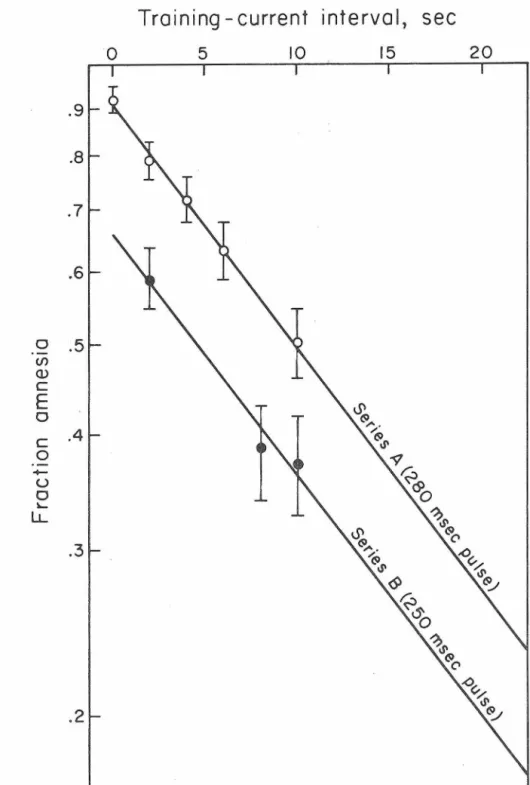
4, p > 0.7).As shown in Fig. 1, the logarithm of the fraction amnesia (FA) de- creases linearly with increasing TCI values. A least-squares analysis of these data indicates the relationship between FA and TCI to be empirically described by
ln FA
=
-0.059 TCI + ln 0.91.The last term in the above expression shows that some portion of the mem- ory that forms does not depend upon the time at which current had been passed. That this TCI-invariant portion of memory is formed even when current is given immediately after training is shown by the peck score of Group A
1 being significantly below that of Group
c
2 (x
2
=
5.3, p < 0.05).This phenomenon can be better understood if instead of FA we now consider its complement, or the "fraction of retrieval" (FR), a measure of the amount of memory that forms when storage processes have been disrupted at time TCI.
Since FA= 0.91 e-o.o59 TCI, then FR= 1 - 0.91 e-o.o 59 TCI, or
FR
=
0.91 (1 - e-o.o59 TCI) + 0.09 (1).Thus, FR can be considered as having two components; the magnitude of one
12
Training-current interval, sec
0 5 10 15 20
.9
.8
.7
.6
0 .5
(/) Q) c
E ~
0
.4 ,.. .
c /(0 IS'
0 --;
-
0 u ~ 6>0~
LL ~IS'
.3 ~
,..
. {QC''°v
'to IS'
<9 ~ (0./
~
s-o
~IS'
(O('
.2
Figure 1. The exp~>nential decline in the retrograde amnesia in- duced
by sec
administered at increasing intervals following the training experience. 'lhe briefer SCC pulse used in Series B allowed a larger portion of memory fonna.tion to continue after µ:i.ssage of current than in Series A. Ba.rs indicate plus or minus one standard deviation.13
of these depends upon the time at which current is passed, while the mag- nitude of the second does not. Assuming a simple relationship between re- trieval and memory 2 , equation (1) suggests that the sec pulse given at time TCI causes most of a first-order exponential growth process to halt while allowing a small part of it to continue unabated (i.e., the second term can be considered as 0.09 (1 - e-o.o 59 t ), and t becomes very large).
Series B
Use of a briefer SCC pulse following the training trial increases the fraction of memory storage processes not affected by the passage of
current. As was done with Series A, peck scores for groups in Series B were normalized between the score of the unshocked trained controls and that of the sham-trained controls (Table 1). A least-squares analysis of these normalized data indicates that for chicks shocked with a 250-msec pulse after training the fraction amnesia is empirically described by
2 The actual nature of the transfer function relating memory and beha- vior can be specified on the basis of results from Experiments I and II. We have observed that the retrograde amnesia gradients have first-order inetics, which we can reasonably assume to reflect the properties of the underlying menory fonna.tion processes. In this case, the relationship between the fraction amnesia, \lbich we measure, and the fraction of the memory trace remaining to be completed (FIMT) must be such that the exponential kinetics of both are retained.
Formally, i f both are first-order functions, then FIMT = FAx, ldlere x is greater than
o.
Consolidation studies often assume that the time course of memory growth is similar to that of the RA gradient, or that x is in the order of 1. If this is not the case, then the traction of Pre-L'IM induction that continues after SCC is given, as well as the rate-constant of Pre-L™ growth, would differ from the values suggested by our behavioral observations, although the basic relationships among the different mnemonic processes would still hold.14
ln FA
=
-0.060 TCI + ln 0.66(Fig. 1). Additional data obtained using the same shock parameters as in Series B have been reported for TCI values up to 3 hr (Lee-Teng, 1969); these show little deviation from the above regression line (x2
=
2.8,df
=
8, p > 0.80).The complement of FA, the "fraction of retrieval" can be expressed in this case by
FR
=
o.66 (1 - e-0.060 TCI) + 0.34 ( 2).A comparison of equation (2) with equation (1) indicates that the nature of the exponential component of the memory formation does not depend upon the duration of the sec pulse used. However, use of a 250-msec rather than a 280-msec disrupting pulse incr'eases the relative amount of the memory formed that is unrelated to the time at which current is passed. In sum- mary, then, the growth of FR as a function of time 1 a~er training is
-0.059 t %
described by FR
=
l - e • Passage of SCC at time TC! halts 91 of the growth of FR using the 280-msec pulse or 66% of it using the 250-msec pulse.Discussion
The foregoing results indicate that in the first minute after train- ing an electroshock-insusceptible memory trace is formed by a mechanism having first-order exponential kinetics2
• However, some portion of the memory formation process apparently continues undisturbed after sec is given (Mah, Albert & Jamieson, 1972), as suggested by the component of the
15
"fraction of retrieval" not included in the exponentially increasing terms of Equati-0ns (1) and (2). A comparison of the two equations indicates that the magnitude of this undisturbed portion increases if a briefer disrupt- ing pulse is used3• On the other hand, an electroconvulsive shock (ECS) longer and more intense than the pulses used here allows no significant memory formation to continue after disruption (Lee-Teng, 1969b).
The memory trace that grows within ~he first 45 sec does not appear to be the permanent form of memory storage, but rather an antecedent to it. Lee-Teng et al. (1970) have shown that at least 30 min is required before this trace develops into a behaviorally-manifest form, while studies
I
by Gherkin (1969) indicate that ~ chemoconvulsant drug given within 24 hr after training can also disrupt the consolidation of permanent memory. It would therefore seem that the trace whose formation has been studied here might be appropriately termed Pre-LTM, a long-term memory precursor.
The rate at which Pre-LTM grows decreases continuously as the memory trace is formed. These first-order kinetics suggest that some re- stricted substrate of the memory trace becomes increasingly saturated as the growth of Pre-LTM proceeds. In conformance with this, one of us
(Benowitz, 1972) has shown that in a population of trained chicks tested
3 A reviewer has suggested that some }'.8rt of the rel-invariant portions of Equations (1) a.nd (2) might be attributable to memory fo:nna.tion beginning as early as 0.5 sec prior to the time considered here.
While this is plausible, memory formation would have to begin
1.63
sec earlier than we have considered to fully account for the undis- turbed portion of memory fonnation in Series A and 7.01 sec earlier for Series B. Thus, although the estimates of theportion of undis- turbed memory formation might be somewhat high, this would not be very significant.
16
several times under reinforcing conditions, the average peck score for the group does not improve from trial to trial and the peck-frequency histogr9l!l has a binomial distribution. These observations indicate that a single training experience causes a saturation of each chick's learning capacity, and are consistent with the notion that the amount of memory substrate remaining unsaturated is rate-limiting in the growth of Pre-LTM.
The process which induces the formation of Pre-LTM appears itself to remain at a constant intensity following the training experience. This is indicated by the rate of Pre-LTM growth depending strictly upon the amount of the trace remaining to be formed, as well as by the TCI-invari- ance of the portion of memory formation continuing undisturbed after cur-'
rent is given. Fig. 2 illustrates the temporal course of mnemonic pro- ceases effected by the training experience and the manner in which SCC affects these processes, as suggested by our results. Immediately upon training, a metastable induction process is initiated which then continues at a constant intensity. Prior to the passage of current, this causes Pre-LTM to grow at a rate that varies with the amount of memory substrate remaining unsaturated. In proportion to its intensity {Lee-Teng, 1969 a,b) and duration {McGaugh, 1966), SCC can allow the induction of Pre-LTM to continue in a segment of the memory substrate. Since the induction process is time-invariant, the fraction of it which is undisturbed by current is independent of TCI. Since this model can be regarded as sec causing one fraction of the exponential growth of Pre-LTM to halt at TCI while allowing the remainder to continue, it is consistant with the observed exponential kinetics of Pre-LTM formation, the TCI-invariance of the undisturbed portion
1.00
Induction Process ---==~~~~~-- -
(STM) Q)u ,, ,,,,, ,,,,,
0 L +-/
,,
.,,, " Exponential growth of Pre-L TM continues >.. /"' in a fraction of the memory substrate L 0E
Q)E
'+-- 0 c 0·-
+-u
0 L LL/
/ / / o--~~~__..__~~~--~~~~--~~~~~~
0
10TCI 20 30 Time ofter training (sec)
Figure 2. Schema.tic representation of the temporal course of the induction phase (S'IM) and the current-insusceptible msnory trace (Pre-L'IM) for the case in which the 250-msec sec pulse is given 10 sec after training. S'IM is activated immediately upon training and begins to induce the exponential growth of Pre-L'IM; passage of current allows Pre-L'IM induction to continue undisturbed in a fraction of the memory substrate (see fO'Otnote4).
Dashed lines indicate the temporal course of S'!M and Pre-L'IM if no current were given.~
18
of memory that forms, and the presence of measurable learning in chicks given current almost immediately after training.
The mnemonic process which induces Pre-LTM growth may function as behaviorally accessible memory for the first hour or so after training.
In this period, during which Pre-LTM is not in a retrievable state, an independent, sec-sensitive trace has been shown to provide chicks with short-term memory (STM) (Lee-Teng et al. 1970). Our results indicate that the sec-sensitive induction process continues at a constant intensity dur- ing the period in which Pre-LTM is formed, and it might conceivably continue to do so for longer periods. It thus seems possible that the induction process and the behaviorally manlifest STM trace may be one and the same. 4 A similar relationship has recently been proposed by McGaugh & Dawson (1971).
On the basis of reviewing the effects of amnesic agents on memory for aversive conditioning in mammals, these authors have suggested that "STM is essential for LTM. ECS impairs consolidation by speeding the decline of STM. The asymptote of LTM is determined by the duration of STM." Our model suggests that sec does not speed the decline of STM, but rather acts to completely arrest one fraction of it (otherwise, saturation of the mem-
4 Although L'IM induction islargely destroyed by SCC, a substantial amount of S'IM has nevertheless been shown tO persist for a few hours after current is p!i.ssed (Lee-Teng et al. 1970• Geller & Jarvik 1968; McGaugh & La.ndfield, 1970). -Yt-;,:U.d th~s seem that for this notion (and for that of McGa.ugh & Dawson (1971)) to be consistent, one must postulate that
sec
does not completely disrupt S'IM but rather reduces it such that it can less successfully induce1L'IM.The reduction of S'IM shown in Figs. 2 and 3 should not be considered, then, to reflect the reduction of S'IM's behavioral potency, but
rather of its cai::a.city to induce L'IM.
19
ory substrate would eventually occur for all vaues of TCI). The time scales of various species' memory formation also seem to differ greatly: the rise of STM seems to be immediate from the present results but requires more than 5 sec in rats; the rise of Pre-LTM occurs in the order of 30 min in rats, as contrasted with 45 sec here.
EXPERIMENT II: The integration of fractional memory traces
Introduction
In Experiment II, we examined the manner in which two fractional memory traces summate together (Chorover & Schiller, 1965; Kesner et al.,
- -
1970; Nachman & Meinecke, 1969; Wyers & Deadwyler, 1971). The formation of each memory trace was limited by administration of SCC shortly after training. While this study was initially intended to investigate the
mechanisms by which an animal integrates a succession of similar experiences, it also allowed us to critically examine the hypotheses drawn in Experiment I. If the mnemonic processes described above were the only determinants of memory formation, then we might expect a second training to reactivate STM, which in turn would induce the growth of Pre-LTM to proceed at a rate depending only upon the amount of memory substrate remaining to be satu- rated. On the other hand, if memory actually formed after the first experience were not fully manifest behaviorally, then the second training might be expected to cause a disproportionate improvement in performance
(Quartermain
.!:l!!·•
1970; Zinkin & Miller, 1967). Alternatively, memories from the two experiences might not become fully integrated together, possi- bly due to the use of different neural substrates for the registration of20
each experience. Results from this experiment indicate that the two mnemonic processes described in Experiment I are the sole determinants of partial memory trace integration.
Methods
Series D
The first of two trainings was given to chicks interspersed among those of Series A described above. Chicks in Series D were given current 2, 4, or 6 sec following training, using the 280-msec SCC pulse. Seventeen hours later, these were trained ~ain and given current at intervals after '
training as shown in Table 2 for Groups D
1 -
n
4. Chicks that failed to peck on the retraining trial were discarded. All chicks were tested blind for retention 7 hr later.Series E
Chicks trained together with those of Series B were given a 250-I
msec sec pulse at 2 or 8 sec after training. The second training was given 6 hr later, with memory formation allowed to proceed for the inter- vals shown for Groups E
1 and E
2 in Table 2. Chicks failing to peck in the retraining trial were discarded. The retention test was given blind on the following afternoon.
Results
The second training caused the memory trace to continue growing exponentially from the point at which its formation after the first train- ing had been halted.
Series D
As shown in Table 2 (top), the fraction amnesia values resulting from two partial memory formations are negatively correlated with the sum of the two training-current intervals, and do not depend upon the order in
. 2
which the sessions were administered (X
=
0.12, p > 0.7). If, as suggested above, the second training were to cause Pre-LTM to continue growing from Ithe point at which its formation had previously been halted, then the re- sultant FA after first TCI
1 and then TCI
2 sec of memory formation would be
It should be noted that in making this prediction we need consider that a portion of each of the two memory formations should be unaffected by the passage of current, as found in Experiment I. For example, we would expect the FA after first 6 and then 4 sec of TCI to be somewhat lower than that
a~er 10 sec of continuous memory formation. The values of FA predicted using the above formula show little deviation from the four experimental
values obtained for the selected populations of Series D (Table 2) (x 2
=
1.16,df
=
3, p > 0.7).Table 2 Summation of fractional memory traces. Chicks were given two training sessions, each fol- lowed by post-trial SCC {280-msec duration for Series D, 250-msec for Series E). Selected populations include only chicks that pecked in the second training session, while unselected groups include those that did not peck as well. Chicks not pecking on retraining were given an additional TCI2 + 5 sec of consolidation. Predicted values assume the second training to cause the first-order growth of Pre-L'IM to continue from the point at which its formation had been interrupted. Initial traini~ Retraini!!i!j Retention test Fraction Amnesia Na TCI 1 (sec) b Group TCI 2 (sec) N 2 Peck score, Peck score, Selected Predicted 1 Selected Pop. Unselected Pop. Dl 252 2 4 204
o.61
0.56 0.50 0.53 o.68 0.62 D 273 4 2 208 0.60 0.53 2 ~"' D3 253 4 6 207 0.57 0.55 o.45 o.42 D4 298 6 4 203 0.53 0.50 0.39 o.42 El 204 2 8 120 0.42 0.42 0.20 0.19 E2 196 8 2 84 0.42 0.33 0.20 0.198N
1=
Size of population to exclusion of chicks not pecking on retraining. bN 2=
Number of chicks that pecked on retraining and were thus retrained in the selected populations.I\) I\)
23
Series E
FA values experimentally obtained using a 250-msec pulse to disrupt each of two memory formations are shown in Table 2 (bottom). Predicted values in these cases would be
FA= e-0.060 (TCI1 + TCIJ+ 2 ln 0.66
again considering that each of the partial memory formations would be incompletely disrupted by SCC. As with Series D, the two experimental values for the selected populations of Series E are quite close to pre- dictions based on the assumption that the second training allows a resump- tion of the exponential memory trace growth.
In order to compare the memory resulting from a succession of two training-SCC sessions with theoretical predictions, we have used selected populations consisting only of chicks that pecked on retraining. This comparison is based upon the assumption that subgroups that did or did not peck do not differ from each other, but rather that excluded chicks repre- sent the portion of a uniform population probabilistically expected not to peck. However, if after the first training the excluded chicks had a lower probability of pecking than those retained, the experimental FA values tor selected populations would be too high an estimate of the mem- ory resulting from the desired summation of fractional memory traces. Our experimental procedure allowed chicks that did not peck upon the second presentation an additional TCI
2 + 5 sec of exposure to the conditioned
stimulus, during which time considerable aversive associations were probably formed (the strength of which could not be predicted by our model). Yet,
24
even if we were to combine the final retention test scores for chicks that had not pecked in retraining (and whose peck scores would be expected to be inflated) together with scores of the selected populations, FA values still do not differ from those predicted by our model at a conventional level of significance (x2
=
10.9, df=
5, 0.10 > p > 0.05; using selected populations,x
2=
2.0, df=
5, p ~o.8).
Discussion
The foregoing results indicate that a second training experience causes Pre-LTM to continue growing from the point at which its formation had previously been interrupted. This swmnation of the two memory traces appears to occur in the absence of active mental associations (Quartermain et al., 1965; McGaugh & Alpern, 1966), insofar as passage of transcranial electroshock does not prevent it from taking place. This may perhaps be attributable to the use of a rather unique learning paradigm in which attentional and motivational factors do not seem to vary. While such conditions might not be expected for other learning situations and species (e.g. Wyers & Deadwyler, 1971; Kesner et
- -
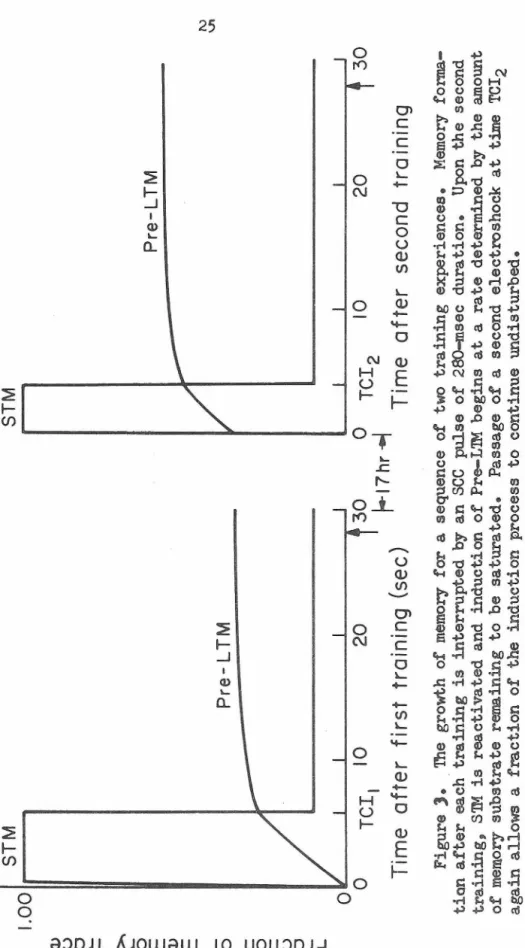
al., 1970), our results suggest that under proper circumstances, physiological memory systems allow a succession of similar experiences to cause a continued modification of the same memory substrate.The memory storage mechanisms discussed in Experiment l (Fig. 2) seem to underlie the continued exponential growth of the memory trace resulting from the second training experience (Fig. 3). It would appear
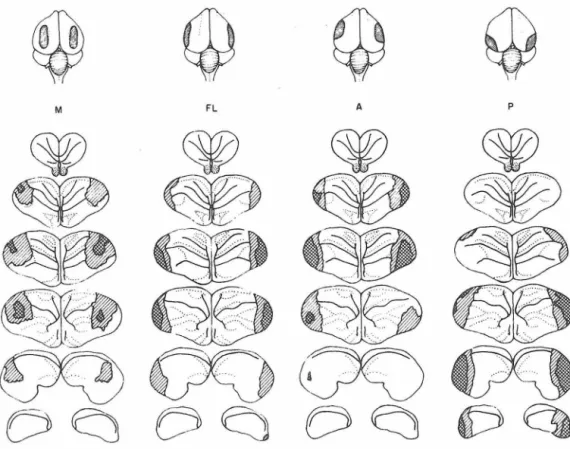
Figure ). 'Ille growth of memory for a sequence of two training experiences. Memory .forma- tion after each training is interrupted by an
sec
pulse of 280-msec duration. Upon the second training, S™ is reactivated and induction of Pre-L'IM begins at a rate determined by the amount of memory substrate remaining to be saturated. Passage of a second electroshock at time TCI 2 again allows a fraction o.f the induction process to continue undisturbed.26
that upon retraining, STM is immediately reactivated and again continues at a constant intensity. This in turn induces the growth of Pre-LTM to proceed at a rate determined only by the amount of memory substrate still remaining to be saturated. Passage of suboptimal sec disrupts most of the induction process but again allows some of it to continue the forma- tion of the Pre-LTM in a segment of the memory substrate.
Summary and Conclusions
I
These experiments indicate that the growth of memory following aversive conditioning in chicks involves two early mnemonic phases.
Initially, a metastable process is activated and seems to continue at a constant intensity. Within 45 sec, this induces the growth of an electro- shock-insusceptible memory trace (Pre-L'l'M). The first-order kinetics describing the growth of Pre-LTM, along with the observation that a single training trial causes a saturation of chicks' memory capacity (Benowitz, 1972), indicate that some restricted substrate of memory becomes saturated as the memory trace grows. SCC halts most of the induction process but allows some of it to continue undisturbed. Within the first few hours after training, during which time the latent Pre-LTM trace becomes con- solidated into long-term memory (Cherkin, 1969; Lee-Teng et al., 1970;
- -
McGaugh & Dawson, 1971), the mnemonic process which had induced the growth of Pre-LTM appears to function as behaviorally retrievable short-term memory. The results of the memory additions study support this model, and indicate that in the presence of a partial memory trace, a second ex- perience simply results in the continued saturation of the Pre-LTM substrate.
27
Pa.rt II
ANATOMICAL ASPECTS OF MEMORY STORAGE AND RETRIEVAL
Exper:iment III: 'Ihe effects of forebrain ablations on avoidance learning5
Introduction
The extensive ability or birds to learn has traditionally been thought to be predicated upon a neuroanatomical organization quite divergent from that of mammals (e.g., Ariens-Kappers, Huber & Crosby, 1936; Stettner
&
Matyniak, 1968). However, fundamental similarities in the prosencephalic structures of birds and mammals have recentlyI
been indicated (Kallen, 1962; Karten, 1969). Thus it is possible that a comp:Lrison of the neurological bases of lea.ming in birds and mammals may be of relevance in understanding behavioral mechanisms of both classes. Recent studies have begun investigating the involvement of avian forebrain regions in processing sensory infonnation and in medi- ating behavior (e. g., Hodos & Karten, 1970; Karten & Hodos, 1970;
Lee-Teng & Sherman, 1969; Pritz, Mead
&
Northcutt, 1970; Stettner &5 This experiment will be published in Physiology and Behavior, 1972
28
Schultz, 1967; Zeigler, 1963), yet the functional significance of much of the telencephalon remains to be determined.
In the present experi~ents, gross morphological units were selected
I
for ablation as an initial attempt to discern which forebrain areas are involved in learninp,. The behavioral task involved learning to suppress an innate res:ponse tendency as a result of one-trial experience. The
I
task is a suitable one for use here since retention of the one-trial experience is quite sensitive to the degree of impairment to memory
mechanisms, as indicated by consolidation studies (e.g., Lee-Teng
&
Sherman, 1966). While several of the ablations included direct sensory-- specific projection ~reas, some of the findings seem to reflect damage to structures hanologous with i:arts of the mammalian limbic system.
METHODS
Subjects
A tota1 of 375 one-day old White Leghorn cockerels (Kimber Farms, Pomona, Calif.) were used over a five month period. Upon arrival at the laboratory chicks were placed in individual cartons from which they were removed only during surgery. No food or water were provided since sufficient nutrients are provided from the yolk sac for the first few days after hatching. The experimental room was maintained at 88°F and 40% humidity. Room,light was on from 6:30 A.M to 6:30 PM.
Training task
The learning used throughout this study was that of suppressing,
29
usually after one training trial, an innate pecking response. A small metallic bead, 3 mm in diameter, mounted at the end of a wire and
coated with methyl anthranilate (MeA) was used for training and testing for retention. Upon presentation of the lure, naive chicks typically orient towards it, peck, and give a characteristic disgust (head- shaking) response after tasting the MeA. In training, chicks were al.lowed 5 sec to peck at the lure and an additional 10 sec to shake their heads; those that failed to peck or shake during training were discarded (about 15%). Upon re-presentation of the lure, approximately
75% of trained chicks refrain from pecking and often avoid actively, while only
4%
of mock-trained chicks fail to peck (Lee-Teng & Shenna.n, 1966). This behavioral task is i:articularly attractive for studying surgically induced learning deficits since gross behavioral imi:airments, which would probably result in a decrease in pecking, can readily be distinguished from specific learning deficits that result in an in- crease in pecking.Surgery
Chicks were held in place between the ear bars of a small-animal stereotaxic apparatus. The beak was inserted into a fUnnel, through which vaporized halothane anesthesia (Ayerst Labs) or an alternative fresh air supply were administered by means of a foot pedal. Small incisions were made on either side of the median suture above areas to be ablated, leaving one side of bone flap uncut to allow replacement after surgery. Brain tissue was bilaterally removed by gentle suction. Gelfoa.m (Upjohn Co.) was inserted to replace ablated tissue, the bone
30
flap was closed and Gelfilm {Upjohn) was placed over incisions in cases where the ablations were near the midline. The skin was then dravn together, held in place, and collodion was applied. The mortality rate, almost exclusively due to excess anesthesia, was about 10%. A total of eight types of surgery, which are described below, were included in the study. Sham-operated controls followed a similar procedure which included anesthesia and incisions which caused superficial brain damage; bleeding from the large superficial blood vessels was allowed to continue for about the same length of time as in operated animals.
Histology
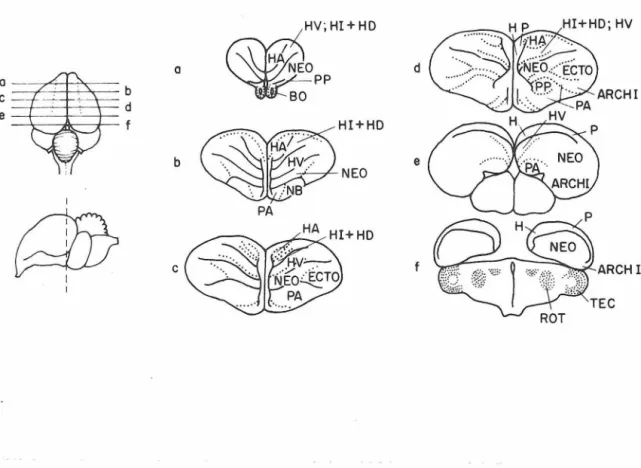
Following completion of behavioral testing one he.lf of the chicks were sacrificed and perfused with chick Ringer's solution and Bodian fixative. Their brains were removed, dehydrated, embedded in p:1.raffin and sectioned at a fixed plane (see Fig. 4) at 15 microns. One-fifth of the sections were retained and stained with cresyl violet. These were then projected and the extent of surgery was indicated on
standardized brain outlines to al.low comparison of ablations.
Genez:..~ procedure
'lbree sep:Lrate studies are described. In the first, chicks were trained once before surgery and were later tested for retention and relearning. In the second study, postoperative acquisition was examined in groups similar to those which
md
demonstrated an ability to retain or relearn the avoidance in the first study. Onegroup in the first31
~:V ; H!+HO
0 0 d
pp
b BO
e d
f HI+HD
b e
NEO
I
~
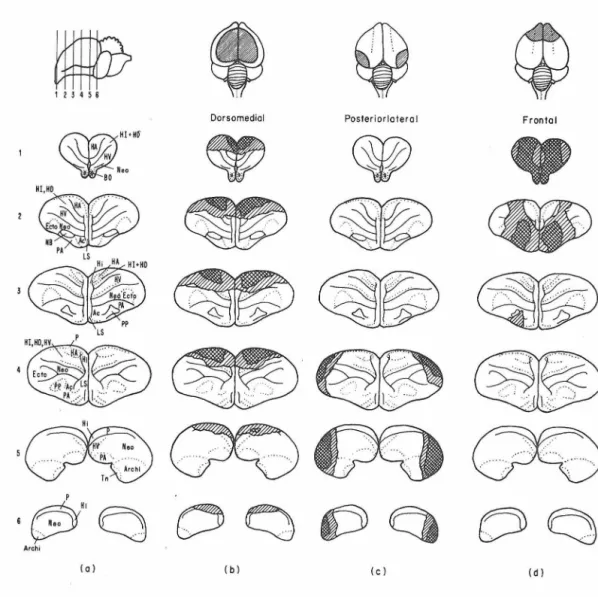
I c PAFigure 4. transverse sections through chick brain. Figures to the left show plane of section. ARCH! = archistria.tum, BO
=
bulbus olfac- torius, &:TO=
ectostriatum, H=
hippocampa.l area, HA=
hyperstriatum accessorium, HD=
hyperstriatum dorsale, HI=
hyperstriatum intercala.- tus, HV = hyperstriatum ventrale, NB-: nucleus basalls, NEO = neostri- atum, P=
prepyriform area, PA=
pa.leostriatum augmentatum, PP=
pa.leostriatum primitivum, ROT = nucleus rotundus, TEC
=
optic tectum.32
study had shown no post-surgical retention or relearning, and the third study sought to localize this effect. At all times different groups of chicks were randomly mixed together and run with unoperated controls such that the experimenter did not know a chick's type of surgery or record on previous tests. The only exceptions to this were sham- operated controls, which were added afterli.rards. Preliminary studies had indicated that the different operations cause differinG types of learning deficits, which suggested that it was unnecessary to control for non-specific behavioral impairments. Sham-operated controls were, however, included later for double checking.
Section A: Retention of the presurgically acquired response
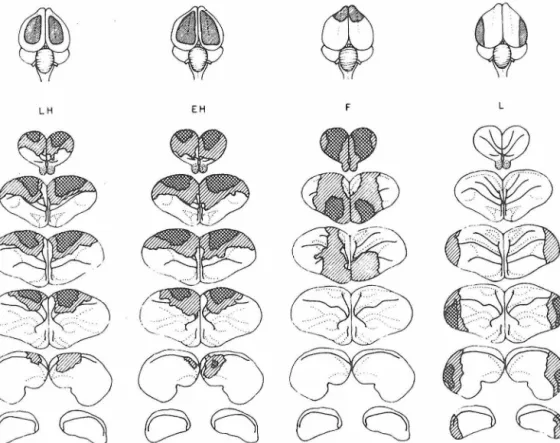
Retention and relearning of a preoperatively acquired response were studied in four groups. The original intention of including the limited and extensive hyperstriatal ablations was to further study the nature of learning deficits reported for varying degrees of dorsomedial damage in birds (Hodos, Karten & Bonbright, in prep.; Lee-Teng &
Sherman, 1969; Pritz ~
!!•,
1970; Stettner & Schultz, 1967; Zeigler, 1963). 'Ihe frontal and lateral regions were selected for investigation arbitrarily.Procedure
Chicks were given one training trial using the MeA lure at 2:00 P.M. of Day 1. Surgery was begun 3 hr later. The approximate extent of the four operations is shown in the top of Fig.
5.
Two days a~er surgery operated chicks alonp, with sham- and unoperatedcontrols vere tested for avoidance four times, at 9:00 A.M., 11:30 A.M.,
33
2:00 P.M. ~nd 4:30 P.M. Testing was done using the MeA lure so that these were additional training trials for chi~ks that failed to avoid.
Results
As summarized in Table 3, the lateral ablations resulted in complete loss of retention and relearning, while less severe deficits were
suffered by the frontal and extensive hyperstriatal groups. The number of trials in which a chick avoided the lure in the four Day-3
retention trials determined individual scores. These were then averaged for all chicks in a group. A one-way analysis of variance indicates the difference in retention and relearning amon~ the different proups to be highly significant (F
=
12.1, n1 • 5, n2 ~ 133, p <.001). The 14 sham-operated controls did not differ significantly from 59 unoper- ated chicks (t=
1.59, two tailed, 0.2>p>.Ol), and these two groups were pooled together to form the control group (C) in Tablea.
Thelimited hyperstriatal chicks (LH) also did not differ from the controls (t
=
1.00, 0.4>p>.03), and these may therefore.be regarded as anoperated control group for this experiment. Chicks having more extensive damage to the hyperstriatum (EH) averaged significantly lower than
controls (t
=
3.0, p<.01), as did the frontal chicks (t=
2.8, p<.01).By far the most severe loss of learned avoidance, however, was seen in chicks with lateral ablations (L). Despite successive retrainings, their pecking rate remained almost as high as that found in untrained I
chicks (Lee-Teng
&
Sherman, 1966).A somewhat unexpected finding was that in each of the groups studied the retention scores measured on the first test of Day 3 were not
34
Table .3
E~fects of forebrain ablations on retention and relearning of avoidance I
learning. Chicks were trained once prior to Day 1 surgery and tested four times on Day 3 under reinforcing conditions.
Group N
Controls (C) 73
Limited hyperstriatal ( LII) 17 Extensive hyperstriatal (EH) 16
Frontal (F) 18
Lateral (L) 15
Avoidances in four trials, Day 3
M am
2.78 0.12
2.46
o.
34**
0.281.87
1.94
**
0.33 0 .27**
,a 0.15 b· ---
a: Differs from other operated groups at· p<. 01.
b .
Experimental value of am exceeds by more than 70% the value of
. **
am which would result if all chicks within the group had the same probability of avoiding. In other groups, the experimental
value of am exceeds predicted value for a uniform population by 13%-48% .
Significantly differs from the control group at p<.01 (two-tailed t-test).
35
improved upon by the three subsequent retrainings. That is, although
failure to avoid on any trial presumably resulted in reinforcement, the
average number of chicks in a group that avoided did not chanv,e from
test to test. This strongly sugeests that the Day 1 trainine trial
caused a complete saturation of chicks' learning capacity for the task.
Thus "relearning" trials can simply be used to e;et a statistically more
accurate measure of postoperative retention.
Section B: Post-surgical acquisition of the response
Learning was studied in operated chicks that were not trained prior to surgery. By contrasting new acquisition wj:'-h the retentional deficits round in Section A, it could be determined whether the areas studied were differentially involved in storage and retriefal mechanisms.
This section also served as a control to ascertain whether avoidance round in Section A had in fact been due to retention or was instead a non-contingent effect of surgery. These two alternatives could
readily be distinguished by seeing whether naive operated chicks all
I
pecked during the training trial. Only groups that had demonstrated avoidance behavior in Section A were studied here. Lateral chicks had
shown no relearning ability, and it was asstUned that new acquisition would also be absent.
Procedure
This study followed the procedure of the first section except that there was no preoperative training. The first presentation