There are very few - if any - compilations focusing on mobile media research, especially in Asia where smartphones are more ubiquitous than in any other part of the world. These state-of-the-art studies show that there is still more to learn about how mobile media affects us and the world around us.
Editor and Contributors
Editor
Contributors
Chapter 1
The Mobile Phone and Political Participation in Asia: Theorizing
- The Mobile Revolution in Asia
- Goals and Signifi cance
- The Rise of Mobile Phones as Civic Media
- Mobile Media for Social Change in Asia
- Patterns of Mobile Political Communication in Asia
- Asian Contexts for Global Signifi cance
- Scope of Study and Core Concepts
- Organization and Structure of the Book
Studies of mobile media in politics in Asian countries will illuminate the participatory nature of mobile communication beyond private chat. Studies in this volume explore these questions and enrich the understanding of mobile media's role in Asia's ongoing social transformation.
Acknowledgements
In addition, researchers here examine how mobile media help shape innovative solutions for communities large and small, all of which apply to issues related not only to democracy, but also to elections, peacekeeping, conflict religious, health care, climate change and any number. of issues affecting populations around the world (Dryzek 2006. What was once a simple communication device has become a powerful avenue for self-fulfillment as well as international diplomacy.
The ability for anyone to create multimedia messages (using photos, videos, text and social media posts) anywhere, anytime and at low cost, and 24/7 connectivity means that smartphones are no longer just private communication, but about civic activism and political participation. Envisioning Green Virtual Public Space for Social Change: A Study of Internet Activism and Online Environmental Collective Action in China.
Part I
Asian Mobile Communication Research in Global Perspective
Chapter 2
Mobile Media as a Political Institution
Introduction
In short, smartphones and mobile media have become a central part of everyday life in Asia. Increasing evidence points to the direction in which mobile media is developing as an institution for political communication.
The Evolution of Mobile Media Research
- Mobile Media as an Emerging Political Institution
- Method Journal Selection
- Results
- Results on Articles About Civic and Political Engagement
- Conclusions and Discussion
- Chapter 3
Finally, RQ5 examined the conclusions reached in 28 articles regarding the role of mobile media as a political institution. The results show a remarkable increase in scholarly production for mobile media in Asian countries over time (from 17 to 75).
Developing Political Associational Ties on Mobile Social Media: A Cross-National
- Introduction
- Previous Research, Hypotheses and Research Question
- Method
- Findings
- Discussion
The results of this study will fill the void in the mobile social media literature. Note: Ranks are ranked by mobile social media usage (per 100), from highest to lowest.
Part II
Mobile Communication and Civic Engagement
Political Conversations as Civic Engagement
Examining Patterns from Mobile Communication Logs in Japan
- Introduction
- Review of Previous Studies
- Method
- Results
- Discussion
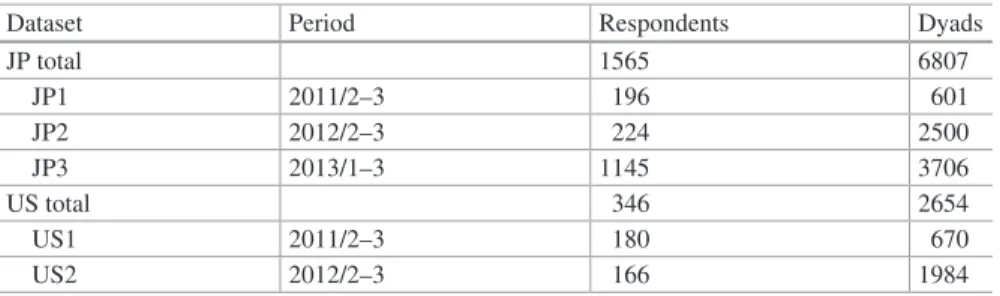
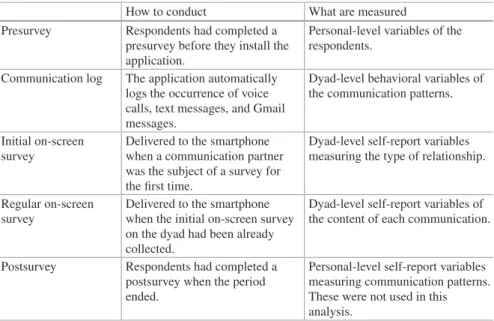
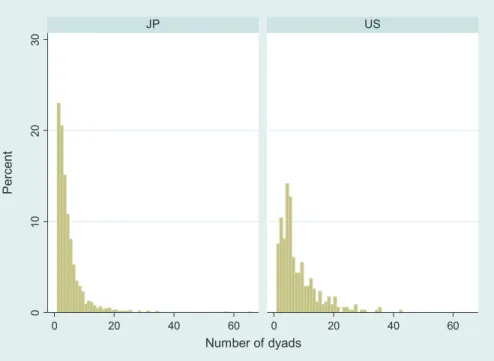
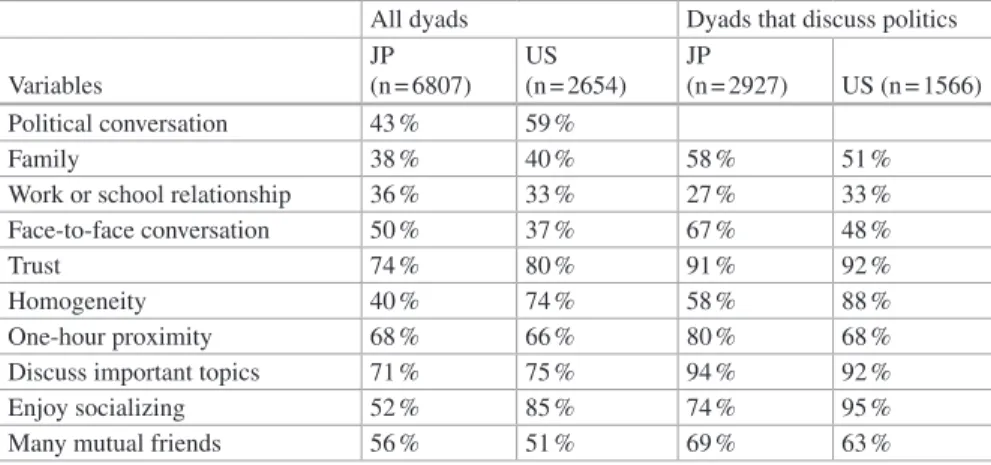
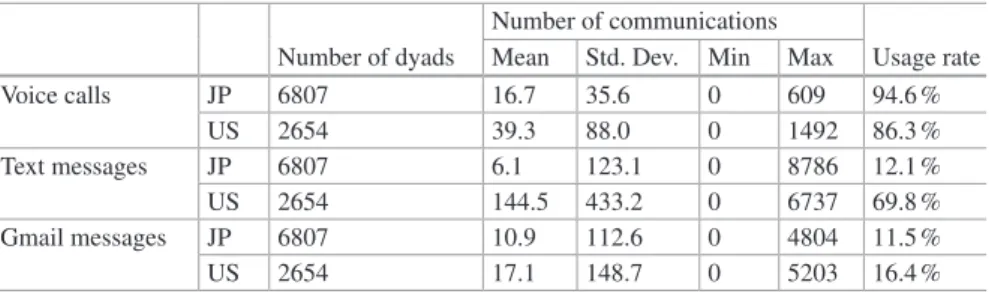
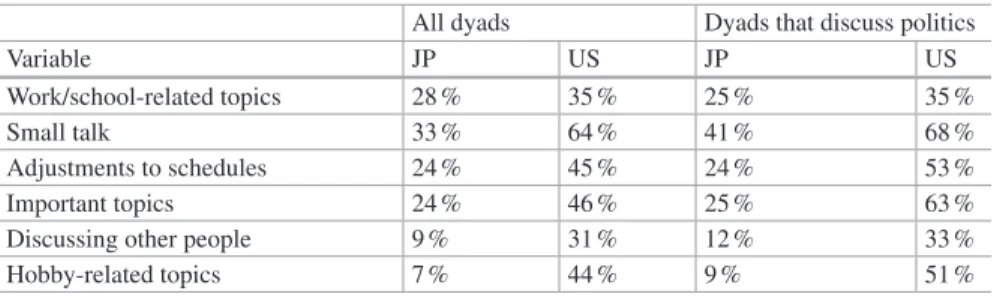
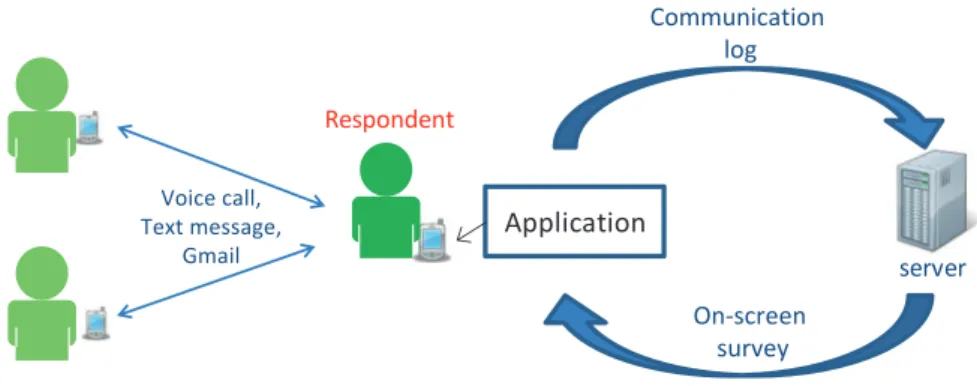
In practice, while political talk is common in the US, Bennett et al. 2000), but fewer people talk about political topics and do so less frequently in Japan (Richardson and Beck 2007; Ikeda 2005). Descriptive statistics First, we report the number of dyads and communications in JP and US. To calculate the differences in the number of text messages and Gmail between Japan and the US, we had to consider the following facts.
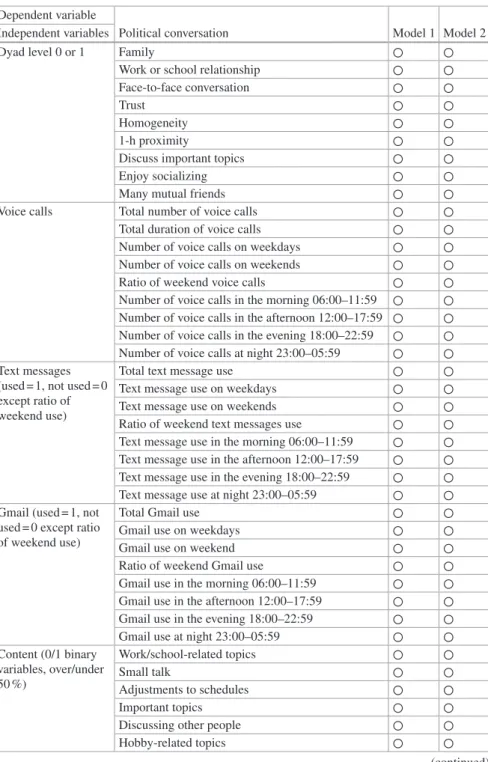
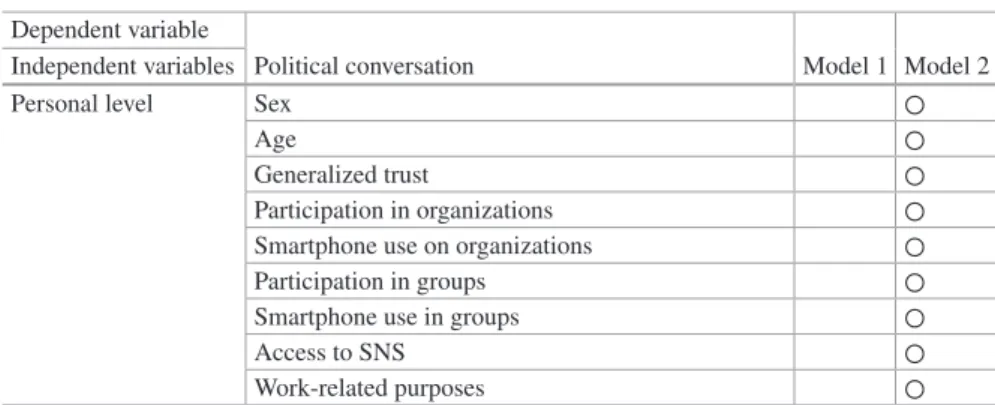
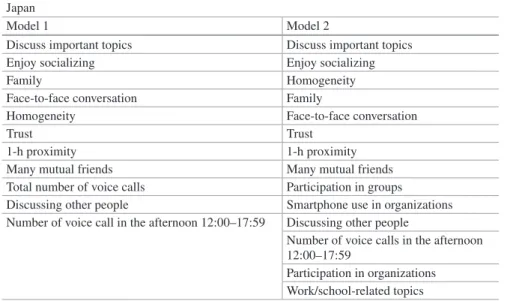
For communication logs, the number of afternoon voice calls was selected in all models. As Table 4.9 shows, for both countries, the results show that discussion of important topics and number of afternoon voice calls were significant predictors of political talk.
Appendix: Wording of Survey Items Initial On-screen Survey
Chapter 5
Public Discourse on Genetically Modifi ed Foods in the Mobile Sphere: Framing Risks,
Introduction
Thus, this study examines public debates about genetically modified foods in China and analyzes how these opinions have been manifested through mobile social media. RQ1: How do mobile social media users describe the responsibility for the safety of GM foods by the parties involved, as manifested in their posts on mobile social networks. How choice of risk/opportunity frames relates to attitude valence toward GM foods as manifested in their postings on mobile social networks.
In addition to the general risk/opportunity perceptions, the public discussion about GM food in mobile social media can identify specific risks and opportunities related to it. How do mobile social media users discuss the specific types of risks and/or opportunities of GM foods as manifested in their mobile social media posts.
How mobile social media users adopt risk-only, opportunity-only, and compensate frames to describe GM foods as manifested in their mobile social media posts. All posts about GM foods that were published that Tuesday were included in our sample. Given the language difference, social media discussions about GM foods in Chinese sometimes also use GM to refer to genetically modified foods.
(4) the government, policy makers and legal advocates, including the individuals and organizations associated with making laws and advocating for their adoption, regulations and policies related to GM foods; (5) ordinary consumers who consume GM food;. Presence of risks/opportunities The authors coded expressions about both the risks and opportunities related to the topic of GM foods.
Results
For specific types of responsible parties, mobile social media users often attributed responsibility for the safety of genetically modified foods to scientists and scientific institutions (30.2%) and to government, policymakers, and legal advocates (8/31. An international agricultural company was called to task because China imports GM foods from countries such as the U.S. RQ2 addressed the general tone of messages about the risks and opportunities of GM foods discussed in mobile social media.
This result indicates that more than 40% of the messages expressed a negative attitude towards genetically modified foods without mentioning what factors prompted this judgment. The general pattern suggests that some mobile social media users described the potential benefits of GM foods as related to the potential of GM technologies as scientific advances in agriculture and biotechnology (see Table 5.5.
Most of the posts placed responsibility for the safety of GM foods on scientists and the government, especially those in China. Mobile social media users were more likely to blame these two entities when things went wrong with GM foods. Third, the safety risk framework is very unique to the issue of GM foods in China.
The current analysis captured the strong opposition to GM foods expressed in mobile social media posts in 2014. This exploratory study of the discourse about risks, opportunities, and responsibility for GM foods on mobile social media in China produced substantial evidence of social opposition. . to GM foods.
Chapter 6
Examining the Role of Mobile Media in Public Engagement with GMO Foods Among Chinese
- Introduction
- Literature Review Public Attitudes Toward GMO
- Method
- Results
- Discussion
- Chapter 7
H1: Use of mobile media for GMO information will predict positive attitudes toward GMO among Chinese consumers. H4: Mobile media use for GMO information will predict self-efficacy among Chinese consumers. H1 predicted a direct relationship between mobile media use for GMO information and attitudes toward GMO.
Instead, findings indicated that informational use of mobile media about GMOs would influence self-efficacy and elaborative processing, which in turn shape attitudes toward GMOs. Our findings indicate that self-efficacy and elaborative processing mediated the relationship between mobile media use and public attitudes toward GMOs.
Civic Engagement in Myanmar: The Promise and Threat of Mobile Communication
- Introduction
- Literature Review
- Methods
- Findings
- Discussion and Conclusion
- Chapter 8
A third of the respondents in the sample never had a mobile phone, nor did they use the Internet. We stored all props and accessories for work in the house of the quarter president. I think the political changes that many in the country are looking forward to would actually be a farce.
He nevertheless saw great potential for social media in the party's campaign for the 2015 General Election (Fig. 7.3. In the context of Myanmar's emerging communications techno-ship, we found evidence to support the latter conceptualization of nationalism support
The Impacts of Mobile Social Media on Collective Action: Two Case Studies
Introduction
Therefore, the potential impacts of mobile social media may be more significant than other forms of social media platforms. As such, there is an urgent need for more research to examine mobile social media in the context of Asia. This chapter aims to fill the gap by exploring the political impacts and use of mobile social media using two cases as examples of collective action.
At its core, mobile social media refers to social media applications installed on one's mobile phone (most likely a smartphone). The impacts of mobile phones are magnified with the ability to tap into mobile social media applications for such purposes.
The Cases of Study
The use of mobile social media was significant: in Indonesia, the penetration of mobile social media is much higher than the penetration of the Internet via desktop and laptop computers. Case study 1: The White Paper and the use of mobile social media for information sharing in Singapore. News of the protest went viral on social media and was picked up and spread by various social political blogs.
The first two protests raise questions about how social media has mobilized a politically apathetic population. Those who shared information about the protest via mobile social networks perceived themselves to be closest to the activists (either knowing them directly or knowing someone who knows them), M = 1.47.
Case 2: Mobile Social Media for Confl ict Transformation in Indonesia
- Discussion
- Conclusion
Through our qualitative interviews and analysis, we found two main uses of mobile social media within the group. For example, in the first case, the use of mobile social media to share information about the protest was not as popular as other modalities such as social media platforms and word of mouth. Another theme concerns language: much of the work on mobile social media in the existing literature is based on the English language.
In other words, mobile social media can be the key to mobilizing people for collective action. Our cases show that mobile social media can be the way to form such meaningful networks for collective action.
Part III
Mobile Communication and Political Activism
Chapter 9
Social Media, Mobile Communication, and the Elections: Examining Independent
- Purpose of Study
- Local People’s Congress Elections and Independent Candidates
- Method Data
- Findings
- Conclusion and Discussion
- Chapter 10
RQ2: How did the use of mobile devices affect the characteristics of social media posts made by independent candidates. RQ4: How was the use of mobile social media related to the election process and outcome. When it comes to the topics of social media posts, interesting differences were found.
According to Table 9.4, the data showed that frequent use of social media, regardless of the platforms used, was associated with dropout. Campaigning on Weibo: Independent Candidates' Use of Social Media in Local People's Congress Elections in China.
The Effects of Social Media and Mobile Apps Use on Political Participation in Taiwan
- Introduction
- Signifi cance of Study
- The Sunfl ower Movement in Taiwan
- Mobile Media, Online Expression , and Political Participation
- Research Questions and Hypotheses
- Method
- Measurement
- Statistical Analysis
- Results
- Discussion
- Chapter 11
H1: Mobile social media use has an impact on political participation in the Sunflower Movement, and the strength of the relationship between them is greater for those who engage in online expression more frequently. Do you pay attention to information from the Sunflower Movement when your family, friends, colleagues or neighbors are discussing politics?" These items are combined to construct an additive index. Items include "Have you ever entered the Legislative Yuan to participate in a protest and advocate for the Sunflower Movement?",.
The relationship between social media use and political participation in the Sunflower Movement was not moderated by online expression. Hypothesis two states that the use of mobile applications will influence political participation in the Sunflower movement and the strength of the relationship between.
Exploring the Potential for Mobile
Communications to Engender an Engaged Citizenry: A Comparative Study of University
Introduction