MOLECULAR DYNAMICS SIMULATION OF A NANOSCALE DEVICE FOR FAST SEQUENCING OF DNA
By
Christina M. Payne
Dissertation
Submitted to the Faculty of the Graduate School of Vanderbilt University
in partial fulfillment of the requirements for the degree of
DOCTOR OF PHILOSOPHY in
Chemical Engineering December 2007 Nashville, Tennessee
Approved:
Peter T. Cummings
ii
To my mother, Janice, for her unconditional love and support and
To my friends, for their endless encouragement
ACKNOWLEDGEMENTS
This work has been made possible through the financial support of the
Department of Energy Computational Science Graduate Fellowship under grant number DE-FG02-97ER25308. I am extraordinarily grateful to have been a part of such an incredibly gifted and unique group of individuals comprising the CSGF fellows.
Additional financial support for related research performed at Oak Ridge National Laboratory was provided by the National Institutes of Health under grant number 1R21HG003578-01.
I am grateful for all of the support and guidance I have received during my research from my advisor, Professor Peter T. Cummings. I would also like to thank the members of my Dissertation Committee for offering valuable insight and suggestions as well as Dr. Paul Crozier at Sandia National Laboratory for his exceptional mentorship and assistance.
I would like to thank Dr. James W. Lee of the Chemical Sciences Division of Oak Ridge National Laboratory for introducing the proposed nanoscale sequencing device and for helpful discussions. Dr. Lukas Vlcek is due special thanks for his help implementing electrode charge dynamics in LAMMPS.
Finally, I would like to thank my family and friends for their unconditional love
iv
TABLE OF CONTENTS
Page
DEDICATION ...ii
ACKNOWLEDGEMENTS...iii
LIST OF TABLES ...vi
LIST OF FIGURES...vii
Chapter I. INTRODUCTION ... 1
Conceptual Device Design ... 3
Design Variables... 7
Applied Electrical Fields ... 7
Materials of Construction... 10
Electrode Gap Width... 11
Sample Length and Sequence... 12
Molecular Dynamics Simulations ... 13
II. PRELIMINARY SIMULATIONS ... 15
System Setup of Nanoscale Device for Simulation... 15
Computational Method ... 18
Results and Discussion of Initial Simulations... 21
Interaction Potentials for Metals and Non-metals ... 39
Magnitude and Velocity Relationship ... 40
Identifying Optimal Controlling Mechanism... 42
Simulation Details... 42
Results and Discussion of Flow Simulations ... 42
III. ELECTROPHORETIC RESPONSE OF DNA IN SOLUTION ... 48
Motivation ... 48
Simulation Details ... 49
Results and Discussion ... 51
Conclusions ... 57
IV. MOLECULAR DYNAMICS SIMULATION OF ssDNA TRANSLOCATION THROUGH A COPPER NANOELECTRODE GAP ... 58
Electrode Charge Dynamics... 59
Computational Method ... 62
Results... 66
UFF Potential... 66
ECD Method... 70
Discussion ... 73
Conclusions ... 78
V. ELECTROPHORESIS OF ssDNA THROUGH NANOELECTRODE GAPS: IMPACT OF GAP WIDTH... 81
Introduction ... 81
Computational Method ... 82
System Setup ... 82
Force Fields ... 83
ECD Platinum Parameters... 84
Simulation Details... 88
Results... 89
Conclusions ... 99
VI. ELECTROPHORESIS OF ssDNA THROUGH NANOELECTRODE GAPS: IMPACT OF SAMPLE LENGTH... 100
Introduction ... 100
Computational Method ... 100
Results... 102
Shaped Nanogate Effects on Translocation ... 108
System Setup and Simulation Details ... 108
Results ... 109
Effect of pre-threading on translocation ... 111
Conclusions ... 112
VII. CONCLUSIONS... 118
Synopsis ... 118
Future Work ... 120
vi
LIST OF TABLES
Table Page
1. Interaction parameters for use with modified-Morse potential for Pt (111)... 87 2. Translocation velocity as obtained from the slope of the change of
center-of-mass over time and change from initial configuration in end-to-end
distance of the molecule ... 105 3. Translocation velocity for pre-threaded ssDNA samples as obtained from the
slope of the change of center-of-mass over time and change from initial
configuration in end-to-end distance of the molecule. ... 116
LIST OF FIGURES
Figure Page
1. Nanoscale sequencing device concept developed by researchers at ORNL... 6 2. Proposed synchronization and coordination of applied electric fields... 9 3. A top view shown without the upper mica plate for clarity and side view of the
sequencing device initially examined using molecular dynamics. Platinum is
shown in tan, and gold is shown in green... 16 4. Representation of the definitions of “nanogate entrance” and “nanogate size” ... 17 5. Snapshots of the –0.05 V/Å applied field simulation of ssDNA (C8T8) in water
at (a) 0 ps, (b) 150 ps, (c) 275ps, and (d) 500 ps... 23 6. Change in direction vs. time based on the center of mass with an applied
electrical field of –0.05 V/Å ... 24 7. Change in direction vs. time based on the center of mass with an applied
electrical field of –0.02 V/Å ... 26 8. Change in direction vs. time based on the center of mass with an applied
electrical field of –0.01 V/Å ... 27 9. Change in direction vs. time based on the center of mass with an applied
electrical field of –0.0075 V/Å ... 29 10. Change in direction vs. time based on the center of mass with an applied
electrical field of –0.005 V/Å ... 30 11. Change in direction vs. time based on the center of mass with an applied
electrical field of –0.002 V/Å ... 33 12. Relationship of velocity to applied field magnitude. Also, the difference between
viii
15. Equilibrated device with visualized water molecules... 41 16. Snapshots of the 0.05 kcal/mol-Å magnitude force simulation of ssDNA (C8T8)
in water at (a) 0 ps and (b) 1000 ps ... 44 17. Change in direction vs. time based on the center of mass with an applied force of
0.0001 kcal/mol-Å... 46 18. End-to-end distance vs. time of DNA under an applied force of
0.0001 kcal/mol-Å... 47 19. Center of mass motion in the z-direction for the ssA5 molecule versus time for
applied fields 0.003, 0.03, 0.04, and 0.05 V/Å. The open triangles, circles, squares, and filled squares are not representative of data points but merely a
method of differentiating lines... 52 20. Center of mass motion in the z-direction for the dsA5 molecule versus time for
applied fields 0.003, 0.03, 0.04, and 0.05 V/Å. The open triangles, circles, squares, and filled squares are not representative of data points but merely a
method of differentiating lines... 53 21. Drift velocity of ssA5 and dsA5 as a function of applied electric field. The dashed
and dot-dashed lines are the linear fits of the ssA5 and dsA5 drift velocity vs. electric field data, respectively, through which electrophoretic mobility was determined. The experimental velocities are obtained from Equation (6) using the experimental
electrophoretic mobilities. ... 55 22. Change in position in x-direction vs. time based upon the center of mass resulting
from the application of an external electric field (UFF potential simulations).
Figure a shows the four lowest magnitude applied fields. Note that the origin of each curve is shifted upwards by 10Å for clarity. Figure b shows the four highest magnitude applied fields... 68 23. Snapshot of the 0.01 V/Å simulation at 1 ns utilizing (a) UFF and (b) ECD... 69 24. Change in position in x-direction vs. time based upon the center of mass resulting
from the application of an external electric field (ECD potential simulations).
Figure a shows the four lowest magnitude applied fields. Note that the origin of each curve is shifted upwards by 10Å for clarity. Figure b shows the four highest magnitude applied fields... 72 25. Translocation velocity vs. electric field magnitude for UFF and ECD
simulation sets... 74
26. Density profile across the nanogate utilizing the UFF and ECD potential.
Note that the distance between the peaks at each surface is approximately 2.5 nm for the ECD method ... 79 27. (a) Density profile across mica surfaces utilizing the UFF and ECD potential.
(b) Bulk area from which density profile in (a) was obtained is marked by the
square in the upper left of the device picture... 80 28. Modified-Morse potential fit for Pt(111) ECD parameters. (a) Energy as water
molecule is moved vertically from the surface and (b) energy as water molecule is tilted from the surface holding the oxygen atom 2.43 Å above the platinum
top-site. ... 86 29. Change in position in x-direction vs. time based on the center of mass resulting
from the application of an external electric field ... 90 30. Snapshot of 1.75 nm gate width simulation after 1 ns production run (water not
shown for clarity). ... 92 31. Snapshot of 3.25 nm gate width simulation after 1 ns production run (water not
shown for clarity). ... 94 32. End-to-End distance vs. time measured between the carbon atoms of the first and
sixteenth residues ... 95 33. Snapshots of the 0.02 V/Å applied field simulation of ssDNA (C8T8) in water through
the 3.25 nm gate at (a) 0 ps, (b) 250 ps, (c) 500ps, and (d) 1000 ps. Red indicates positive charge, and blue indicates negative charge. White is the mid-point of the charge gradient. ... 98 34. Change in position in x-direction vs. time based on the center of mass resulting
from the application of an external electric field ... 104 35. Snapshots of the –0.02 V/Å applied field simulation of 4CTAG in water through
a 3.0 nm gate at (a) 0 ps, (b) 250 ps, (c) 500ps, and (d) 1000 ps ... 106 36. Snapshots of the –0.02 V/Å applied field simulation of 4CTAG in water through
the shaped nanogate at (a) 0 ps, (b) 250 ps, (c) 500ps, and (d) 1000 ps... 110
x
39. Summary of translocation velocities for different length ssDNA segments.
The results shown consist of the simulations exhibiting translocation in Table 2 (CTAG, 2CTAG, 6CTAG, 12CTAG) and the results reported in Table 3 in which the molecules were placed 1 nm inside the nanogap. The average translocation velocity is 43±8 A/ns. If the outlying result (4CTAG) is removed, the average
translocation velocity is 46±4 A/ns. ... 117
CHAPTER I
INTRODUCTION
Interest in technology capable of low-cost (less than $1000), high-throughput genome sequencing has risen significantly since the completion of the first sequencing effort in the Human Genome Project1. Such a technology could be a revolutionary tool in the advent of individualized medicine. In order for such a tool to be of use to a medical practitioner, however, sequencing of an individual’s DNA would need to occur at speeds thousands times faster and at orders of magnitude lower cost than current available technology can offer.
A novel nanotechnology concept has been proposed to detect single molecules using a nanoelectrode-gated device, which, theoretically, has the capability of performing genome sequencing at a rate of 106 base pairs per second. Computational modeling of this nanoscale device has the potential to provide valuable insight into the behavior of the system for use in development of actual nanotechnology devices for application. In particular, molecular dynamics simulations that solve Newton’s equations of motion to produce a trajectory for each atom can be useful in evaluating macroscopic properties such as velocity, diffusion coefficients, and molecular conformation2. These techniques
2
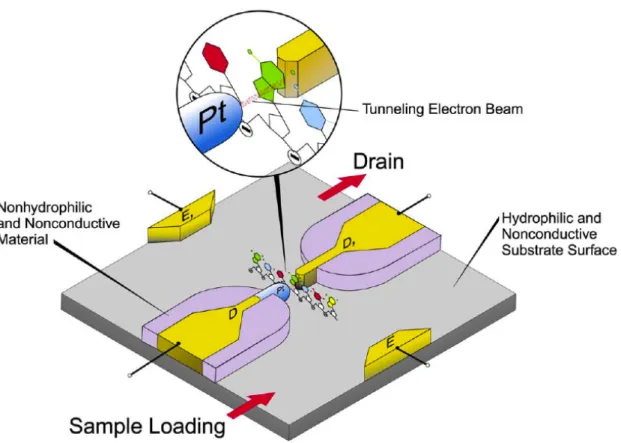
uniquely identified by characteristic tunneling conductance properties (that is, current, I, versus applied voltage, V, curves)3. The device concept developed to take advantage of this property consists of two nanoelectrodes positioned anywhere from two to five nanometers apart on a nonconductive surface. This gap will serve as the detection gate through which tunneling conductance measurements will be made to identify the base pair directly between the nodes (see Figure 1).
There exists a multitude of possibilities for the design of this sequencing device concept. Structurally, the types of materials chosen for the surface and nodes are variable and could possibly influence molecular motion of the DNA strand. Additionally, the gap between the two nodes could be so large as to yield inaccurate tunneling conductance measurements or too small to allow unhindered passage of the DNA molecule. In the simulation of the sequencing device, properties such as the length of the DNA strand as well as the solvent in which it is contained may also be significant factors in the behavior of the conformational movement of the DNA.
A method for inducing and, consequently, controlling the translocation of the DNA strand through the gap in the nodes is also of significant interest. It has been
experimentally shown that an electrical driving force in the range of 25-110 pN can pull a single-stranded DNA molecule through a 2 nm α-hemolysin nanopore4. The appropriate type of programmable applied electric field could plausibly allow for controlled motion at the desired velocity for sequencing the DNA strand. Another possible method for
controlling the sequencing velocity is through the induction of Poiseuille flow in the solution, as in a nanofluidic device.
In addition to applied fields designed to direct horizontal motion of the DNA strand through the detection gates, a vertical field perpendicular to the applied field directing motion may be necessary. If the sequencing device were constructed of one surface, the DNA strand would need to be constrained to the surface in a particular position to prevent molecular drift and to aid in the positioning of the nucleotide between the nodes of the detection gate. Molecular drift could also be prevented by the use of two surface plates to contain the solution.
In short, there are many possibilities all within the realm of investigation through molecular dynamics simulations. This disseration will discuss the various simulations performed and the corresponding results in an attempt to satisfy my objectives for this project including (I) determining the magnitude of the controlling force necessary to produce the desired motion, (II) identifying the best possible method for controlling the transport and conformational motion of the DNA strand, and (III) evaluating the effects of the above mentioned design variables on the molecular conformation and transport properties of the translocating DNA introduced into the system.
I.1 Conceptual Device Design
The concept of polymer translocation through nanometer-sized pores is prevalent in biology. Many experimental and simulation studies have focused on a variety of
4
driving forces4-9. For the most part, the research relevant to the aims of this project has occurred within the past ten years, and only recently has research on similarly structured nanoscale systems become the focus of genomic sequencing efforts.
In conjunction with the experimental development of this project at Oak Ridge National Laboratories (ORNL), a basic device concept has been developed as shown in Figure 1. This conceptual device design is based on the precision electrolytic
nanofabrication technique patented by Lee and Greenbaum at ORNL15, 16 by which metallic atoms can be precisely deposited on the nonconductive and hydrophilic surface with an extremely small distance (1-10 nm) between the nanoelectrode tips. A pair of macroelectrodes will provide the electrophoretic field required to induce translocation of the DNA strand through the nanogap in the detection electrodes. The DNA sample molecules will be loaded into the device using micropipetting and/or microfluidic techniques.
The sequencing of the individual nucleotides as the DNA sample travels through the electrodes will be accomplished through the application of a tunneling electron beam across the metal electrodes. In theory, each of the four nucleotides has a unique
corresponding conductance measurement. Measurement of this conductance will
ultimately yield the sample sequence. In practice, this characteristic has yet to be proven either theoretically or in experiment. Additionally, theoretical studies of nucleotide conductance have been inconclusive. The most positive results indicating conductance sequencing techniques are a possibility have been published by Lagerqvist, et al.17, 18. They concluded through a combination of quantum-mechanical calculations of current and molecular dynamics simulations of DNA translocation that, in the absence of
structural fluctions, ions, and water, it is very likely DNA can be sequenced through a nanopore should dynamics be controllable. A second study of the feasibility of
transversal DNA conductance measurement was reported by Zhang, et al.19. This study used first-principles calculation to determine transverse conductance across DNA fragments between gold nanoelectrodes. The conclusion presented here is that the conductance measurements of the four nucleotides differ only as a result of geometrical size (i.e. the space remaining between the sample and the electrodes). As this would be extraordinarily difficult to control in an on-the-fly sequencing device, they suggest this method of sequencing is not viable as a matter of convenience. The drawback to both of the theoretical studies of tunneling conductance measurements is their highly idealized simulation setups. Both examine DNA in the absence of realistic environments, such as the presence of solvent and counterions. Additionally, the first-principles study presented by Zhang does not represent the behavior of DNA at finite temperatures. Lacking a decisive conclusion on the feasibility of tunneling conductance sequencing techniques, we have continued the molecular dynamics study of transport behavior of such a device as presented here.
6
Figure 1: Nanoscale sequencing device concept developed by researchers at ORNL20
I.2 Design Variables
I.2.A Applied Electrical Fields
As mentioned before, there exist several variables in the conceptual design that may have significant effects on the functional operation of the nanoscale device. The variable at the forefront of this investigation is the use of an electrophoretic field to control
translocation of the DNA strand. The importance of this applied electric field lies in the necessity of providing sufficient residence time between the nanogap and maintaining vertical stability of the molecule. Without an external driving force, the DNA strand likely will not move between the nanogap or maintain a velocity suitable for the purpose of base pair detection.
DNA is a negatively charged molecule having a charge of –1 per base pair.
Positively charged counterions exist in solution around the DNA molecule to maintain a charge-neutral system and the proper conformation of the molecule. When an electric field is applied to the DNA in solution, the entire strand should move toward the anode while the counterions will move in the opposite direction. Many experimental studies have been performed using a voltage bias to induce movement of DNA in solution. In particular, Meller et al.4 used an electrophoretic driving force to force single-stranded DNA through a 2 nm diameter α-hemolysin nanopore.
8
a pulsing field in a molecular dynamics simulation presents a problem due to the
timescale relation to reality. Experimental pulsing of a field includes a ramp-up period of approximately 10 ns and, likewise, a ramp-down period of 10 ns in addition to the pulse period. Thus, modeling a realistic electrical pulse would require simulation times of at least 20 ns. These timescales are not completely unattainable; however, the
computational cost of such simulations strongly suggests studying a uniform electric field initially. Investigation of the electrical driving force is primarily for determining an appropriate magnitude.
In the experimental design, there is also a need for a perpendicular holding field to properly align the DNA strand between the detection electrodes and retain it on the surface of the sample plate. The negatively charged phosphate groups along the backbone of the DNA will serve to align the DNA strand with the application of a
perpendicular field as seen in the inset of Figure 1. An additional applied field across the detection nodes is necessary to perform the tunneling conductance measurements by which nucleotide sequence will be determined.
Figure 2: Proposed synchronization and coordination of applied electric fields
10 I.2.B Materials of Construction
The material chosen for the prototype design of the nanoscale-sequencing device has been determined to suit both experimental and simulation needs. The surface of the sample plates must be constructed out of a nonconductive and hydrophilic material. The sample plates must be nonconductive as to not interfere with the tunneling conductance measurements and hydrophilic so that the solvent will wet the surface and not create any adverse interactions that may affect the movement of the DNA strand. The device must also be designed to minimize leakage current to potentially improve the detection sensitivity. Initially, the surface material of interest was silicon dioxide; however, this material proved to be too rough at 1 nm, approximately the size of the molecules of interest in simulations. A paper by Leng and Cummings21 presents results of the
molecular dynamics simulations of water confined between two mica surfaces indicating that water confined between mica surfaces of the separation distance needed for the nanoscale device (~ 3 nm) does not exhibit abnormal fluidic behavior. Thus, mica surfaces have been used in simulations.
The electrodes must be conductive to achieve the intended purpose as tunneling current detection nodes. The electrolytic nanofabrication technique mentioned previously has been developed to precisely fabricate (approximately 100 atoms per step) a gap as narrow as 1 to 10 nm by deposition or depletion of metal. Consequently, metal nodes are ideal for the purpose of molecular detection nodes in the proposed sequencing device.
Currently, the experimental plans call for platinum and/or gold nodes though, as will be shown, we have also made use of copper electrodes in many of our simulations. Again, the issue of current leakage is a factor in the sensitivity of the nanoelectrode-gated
detection system. It is only possible to use charge transport through the molecule as a means of detection when the leakage current is less than the tunneling current. This can be controlled by the addition of insulating shields around the sides of the detection
electrodes, which should be constructed of a hydrophilic, nonconductive substrate such as silicon nitride (SiN). This is not reflected directly in simulations, however, because of the discrepancy in scale.
A final element in construction of the sequencing device is the choice of solvent in which the DNA sample is contained. The device has been developed under the
assumption that the solvent will be water. For now, the simulations are being carried out in an aqueous environment, but it may be necessary to incorporate a more viscous solvent to achieve the desired control over the motion of the DNA sample.
I.2.C Electrode Gap Width
Experimentally, the gap distance between the electrodes can be fabricated as small as 1 nm creating a natural lower bound to the gap distance. Additionally, the electrodes must be within a few nanometers to observe a large tunneling current for detection purposes, resulting in an upper bound. The diameter of the DNA helix, 2 nm22, gives a good estimate as to the actual value to choose.
While some stretching of bonds during translocation is acceptable, significant
12
However, the experimental studies performed by Meller, et al.4 utilized a 2 nm diameter α-hemolysin pore in effectively allowing passage of a single-stranded DNA sample with clear evidence of elongation but no bond breakage.
Furthermore, large gap distances allow for folding of the sample as it passes through the detection gate. Studies by Storm, et al.7 indicate that a pore diameter of 10 nm allows for the passage of DNA in a folded conformation. For proper nucleotide detection, the DNA must pass through the gap a single base pair at a time. Thus, the gap must be much smaller than 10 nm, most likely, closer to the lower distance constraint.
I.2.D Sample Length and Sequence
In 2001, Meller, et al.4 performed experiments in which single-stranded DNA polymers were driven through a single α-hemolysin pore (2 nm in diameter and 5.2 nm depth) by an applied electrical field with the purpose of measuring current blockage across the length of the pore as the DNA strand is in residence as well as time distribution as it is related to length of the strand. Using the current blockade measurement to estimate residence time, and thus velocity, the authors conclude that strands longer than the length of the pore travel at a constant velocity while the velocity of shorter strands increases with decreasing length.
Storm, et al.7 experimentally investigated the relationship of translocation time and length of double-stranded DNA electrophoretically driven through a 10 nm diameter silicon oxide pore of approximately 20 nm in depth. They observed a power-law scaling of translocation time with length. Though this likely will not hold true for smaller
diameter pores, these studies indicate the importance of sample length with regard to pore
length. The majority of the simulations presented here use a single-stranded DNA sample of 16 nucleotides, which is approximately 5.5 nm in length. We also present a sample length simulation study in which the largest sample molecule is 48 nucleotides long. We are limited in sample length by simulation device design. The length of the pore, or gate, of the current design in this dissertation is approximately 2 nm. Hence, in our cased, the DNA length is longer than the pore length. On the basis of the Meller, et al.4 experiment, we should expect to see constant translocation speed through the “pore”
created by the nanoelectrodes.
I.3 Molecular Dynamics Simulation
In this work, the simulations being performed are known as classical molecular dynamics simulations. This method of simulation determines atomic trajectory by using an
integrator, such as the Verlet Integrator23, to solve Newton’s second law of motion,
€
mi d2ri
dt2 = fi (1) for every atom in the system where mi is the mass of atom i, ri is the atom’s position vector, t is time, and fi is the force acting upon the atom as given below.
€
fi =−∇riU (2) In Equation (2), the potential energy or force field, denoted by U, is a description of how
14
Other technical issues associated with simulation methodology are discussed in the computational methods section of each chapter.
CHAPTER II
PRELIMINARY SIMULATIONS
II.1 System Setup of Nanoscale Device for Simulation
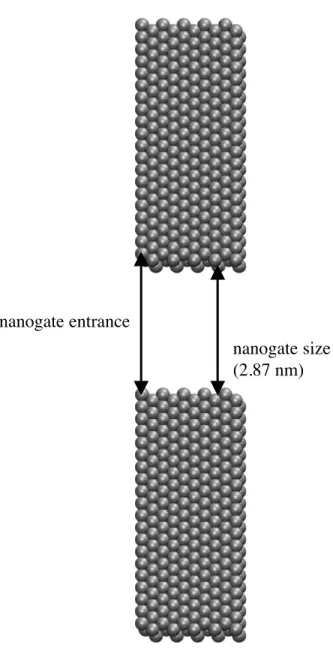
Using the device concept developed for experimental studies, a simulation prototype was developed. Figure 3 illustrates the actual device as used in the initial simulations. The initial device under examination consisted of two mica plates separated by approximately 3 nm. Each plate measured 20.7 nm x 14.4 nm. The detection nodes were constructed of a single gold node and a single platinum node each measuring 2 nm x 5 nm x 3 nm and separated by a 2.87 nm gap (as measured from center-to-center of the outermost atoms, shown in Figure 4). The DNA strand consisted of a single-strand of 16 base pairs, eight consecutive cytosines followed by eight consecutive thymines, which was solvated in water of 1 g/cc density. The ssDNA strand is surrounded by 15 sodium ions to make the total system charge neutral. The first residue of the ssDNA was placed approximately 1 nm from the entrance to the nanogate. The entrance of the nanogate is defined as the center of the external metal atoms closest to the ssDNA. The total dimension of the simulation box was 20.7 nm x 14.4 nm x 5 nm.
16
Figure 3: A top view shown without the upper mica plate for clarity and side view of the sequencing device initially examined using molecular dynamics. Platinum is shown in tan, and gold is shown in green.
Figure 4: Representation of the definitions of “nanogate entrance” and “nanogate size”
nanogate entrance
nanogate size (2.87 nm)
18 II.2 Computational Methods
The software package known as LAMMPS (Large-scale Atomic/Molecular Massively Parallel Simulator) was used to carry out the molecular dynamics simulations in this proposal24, 25. The interaction potentials varied based on the atom type. The DNA molecules were described using the CHARMM27 all-hydrogen potential26, 27 which means that all hydrogens are explicitly taken into account as opposed to united atom models which do not have explicit hydrogens (e.g., CH3 groups represented as a single interaction sphere). In the CHARMM27 potential, bond stretching interactions are described a harmonic potential. Angle bending is represented by a harmonic potential on the angle, and dihedral angles are represented with a cosine series. Improper torsions are occasionally enforced with a harmonic term. Non-bonded atoms are described with a 12- 6 Lennard-Jones plus Coulombic interaction
€
Uij
( )
r = qiqjr +4εij σij r
12
− σij r
6
(3) where Uij is the non-bonded potential energy, r is the distance of separation, q is point charge, ε is an energy parameter, and σ is a distance parameter. The sodium ions were represented by a potential developed by Beglov and Roux28. The water was described by the rigid water model known as TIP3P29 that describes the oxygen by a Lennard-Jones site and the hydrogens as bare charge sites. This particular water model is somewhat crude compared to newer models; however, because the CHARMM27 potential was parameterized to be used with the TIP3P potential, and a detailed description of the solvent in these simulations is unnecessary, the computationally efficient TIP3P model was chosen to represent water. TIP3P has three rigid interaction sites described by
Lennard-Jones and Coulombic terms. The mica surface potential was represented by the CLAYFF force field which was developed for hydrated crystalline compounds and their interfaces with fluid phases30 which reduces to a Lennard-Jones term plus Coulombic interaction with the mica surfaces being held fixed as we have in all our simulations.
Lastly, the force field temporarily being used to describe the platinum and gold electrodes is called UFF (Universal force field)31. The use of the UFF potential for metals is
expected to be somewhat inaccurate since it does not take into account the response of valence electrons in the metal to the motion of charges in solution (commonly referred to as image charges when the metal surface is infinitely large and molecularly smooth).
Thus, the search for a more realistic force field to model metal-charge interactions was necessary as will be discussed in the preliminary results. When two species described by different potentials interact, the interaction is typically estimated by a Lennard-Jones potential with parameters determined by using the Lorentz-Berthelot mixing rules shown in Equation (4) to combine individual parameters.
€
σij = 1
2
(
σi+σj)
εij = εiεj
(4)
Long-range Coulombic interactions were computed using a particle-particle particle- mesh (PPPM) solver32.
The simulations were setup to have periodic boundary conditions in the x and y
20
across boundaries in the x and y direction and reduces computational expenditure, since the 3-D slab geometry technique is less computationally demanding than using a 2-D Ewald method33.
All simulations were equilibrated for 1 ns using the NVT ensemble at 300 K with a Nosé-Hoover thermostat34-36. The hydrogen bonds being simulated were constrained through the use of the SHAKE algorithm. Because we are not interested in the dynamical behavior of the mica sheets or the electrodes, these atoms were excluded from the
integration performed using the Velocity Verlet algorithm. This left the total mobile atoms in the simulations at 80,448 from a total of 134,208 atoms. The initial
equilibration timestep was 0.0005 fs to allow for the extremely non-ideal atomic positions to relax to more energetically favorable positions. The remainder of the integration was carried out with a 2 fs timestep.
After the 1 ns equilibration, the simulations were restarted with the addition of an applied uniform external electrical field of varying magnitude. This was originally not part of the functionality of LAMMPS, so we developed a modular addition to the original code that implements an additional force to chosen atoms based on the equation below.
€
F= qE (5) This addition has been included in the latest version of the LAMMPS software package.
The simulations run with the addition of an external field were run under the exact same conditions as the equilibration simulation for 1 ns.
Upon applying the electric field to the system, this force became the primary contribution to DNA drift dynamics. Diffusion and conformational dynamics contributed
little to the forward motion of the molecules due to the magnitudes of the applied fields except for the case of very weak applied fields.
II.3 Results and Discussion of Initial Simulations
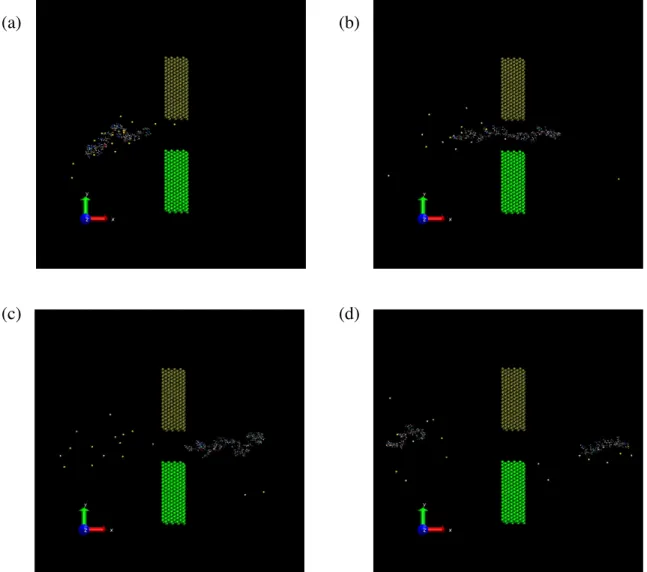
The first in a series of simulations designed to develop a relationship between the velocity of the DNA sample and the applied field magnitude was the simulation of an applied field of magnitude –0.05 V/Å in the x direction. This magnitude is considerably larger than the experimentally suggested magnitude of –0.01 to –0.02 V/Å. The purpose behind simulating an applied field much larger than necessary was to insure that motion was indeed induced as well as to provide insight into the range of velocities produced over varying magnitudes. Snapshots of the simulation results shown below in Figure 5 illustrate the progression of the DNA strand as it translocates though the electrodes, continues past the boundary plane, and then reappears within the simulation box. Sample simulation movies are available for viewing at
http://flory.vuse.vanderbilt.edu:16080/~christy. The sodium counterions travel in the opposite direction of the DNA as a result of their charge and disperse throughout the simulation box. The mica plates have not been visualized for clarity.
Using the center of mass of the DNA sample as a position reference, the velocity was determined by taking the difference of the current position from the original position
22
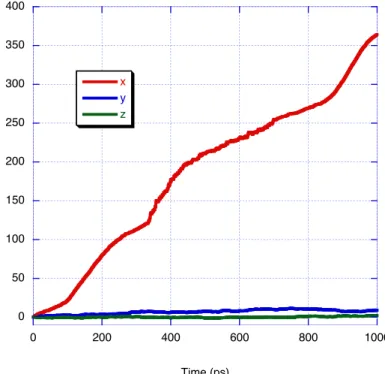
molecule appears to be traveling at a velocity of approximately 200 Å/ns before it reaches the nanogate and increases velocity in the vicinity of the nanogate to 415 Å/ns.
These values are substantial departures from the desired value of 1 to 2 Å/ ns to µs. As expected, there is little motion in y and z-directions of the simulation because the field was applied in x-direction.
(a) (b)
(c) (d)
Figure 5: Snapshots of the –0.05 V/Å applied field simulation of ssDNA (C8T8) in water at (a) 0 ps, (b) 150 ps, (c) 275ps, and (d) 500 ps
24
0 50 100 150 200 250 300 350 400
0 200 400 600 800 1000
x y z
Change in Direction (Å)
Time (ps)
Figure 6: Change in direction vs. time based on the center of mass with an applied electrical field of –0.05 V/Å.
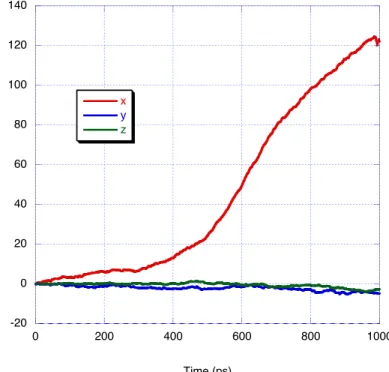
As a result of obtaining such remarkable velocity with the –0.05 V/Å applied field, the next simulation in this series implemented a field of less than half that magnitude at –0.02 V/Å. As expected, the lower magnitude electrical driving force resulted in slower translocation of the DNA sample. The sample translocated through the electrodes a single time in the case of the –0.02 V/Å field. Again, as illustrated in Figure 7, the velocity observed as calculated through the displacement from the original center of mass position has two distinct regimes, bulk velocity and approaching translocation.
The bulk velocity appears to be around 50 Å/ns while the velocity increases to near 220 Å/ns as the DNA strand approaches and passes through the nanogate. Movement in the y and z-directions is negligible in comparison to x-directional velocity. Like the resulting velocity from the applied field of –0.05 V/Å, the induced velocity from the –0.02 V/Å field is much larger than desired.
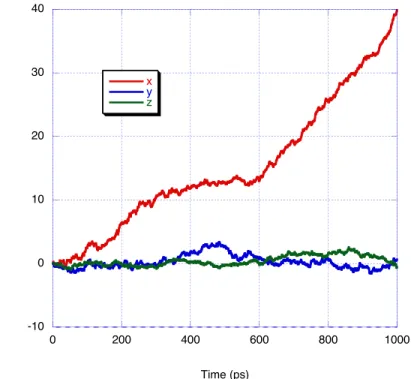
Continuing the series of simulations attempting to evaluate the relationship of applied field magnitude to induce velocity, we simulated the application of a –0.01 V/Å magnitude field. The DNA sample did not completely translocate through the electrodes during the 1 ns production run. Figure 8 shows that, despite the fact that complete translocation did not occur, there remains a definite distinction between the velocity of the sample in the bulk water and when the sample is near the nanogate. In this case, the velocity of the sample in the bulk is approximately 24 Å/ns; whereas, the velocity of the
26
-20 0 20 40 60 80 100 120 140
0 200 400 600 800 1000
x y z
Change in Direction (Å)
Time (ps)
Figure 7: Change in direction vs. time based on the center of mass with an applied electrical field of –0.02 V/Å
-10 0 10 20 30 40
0 200 400 600 800 1000
xy z
Change in Direction (Å)
Time (ps)
Figure 8: Change in direction vs. time based on the center of mass with an applied electrical field of –0.01 V/Å
28
The next simulation in this series was that of an applied field of –0.0075 V/Å.
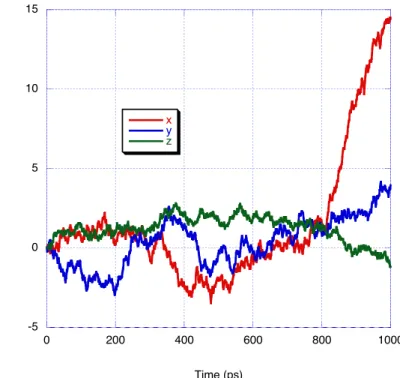
The –0.0075 V/Å magnitude applied field resulted in less definitive bulk motion in comparison to previous simulations. As shown in Figure 9, the DNA seems to exhibit somewhat oscillatory velocity at 4 Å/ns in the x-direction as the strand creeps toward the nanogate over a period of 800 ps. When the sample reaches a point near the nanogate, the velocity increases to approximately 65 Å/ns. This is roughly the same velocity in the vicinity of the electrodes as the resulting velocity of a –0.01 V/Å applied field. Under this lower magnitude applied field, the motion in the y and z-directions becomes more noticeable; however, the application of an external field in the x-direction will override motion in the y-direction. The z-direction is fixed due to the presence of the mica surfaces above and below the sample solution.
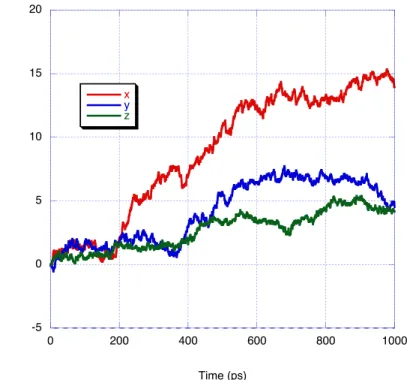
Following the –0.0075 V/Å simulation with a –0.005 V/Å simulation, we are presented with seemingly contradictory results. In Figure 10, one can see that the oscillatory behavior at approximately 5 Å/ns reappears under the low magnitude applied field; however, this behavior is only exhibited over 200 ps before the DNA reaches the pull of the nanogate and increases in velocity to 19 Å/ns.
-5 0 5 10 15
0 200 400 600 800 1000
xy z
Change in Direction (Å)
Time (ps)
Figure 9: Change in direction vs. time based on the center of mass with an applied electrical field of –0.0075 V/Å
30
-5 0 5 10 15 20
0 200 400 600 800 1000
x yz
Change in Direction (Å)
Time (ps)
Figure 10: Change in direction vs. time based on the center of mass with an applied electrical field of –0.005 V/Å
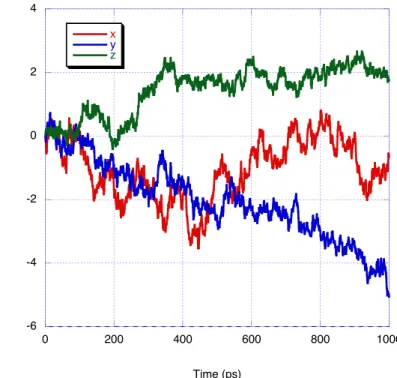
Continuing to lower the magnitude of the applied field to –0.002 V/Å results in entirely oscillatory motion of nearly the same velocity in all directions resulting in no appreciable net motion as seen in Figure 11. This and the behavior of the –0.0075 V/Å and –0.005 V/Å simulation leads to the conjecture that an apparent energy barrier to motion exists which must be overcome before the molecule begins its approach to the nanogate. It is my opinion that should the simulation of the –0.002 V/Å applied field be continued beyond the 1 ns production run, the DNA molecule would eventually begin progressing toward the electrodes as the molecule did previously under larger magnitude fields.
Examining the relationship of the magnitude of the electric field with respect to the apparent velocity of the center of mass of the molecule requires examining both the bulk velocity and the velocity in proximity of the nanogate. As previously shown, these two situations within the simulation result in drastically different behaviors. Figure 12 is a compilation of the velocities resulting from the above-mentioned simulations.
Position relative to the nanogate was delineated by the marked acceleration of the molecule. The ssDNA molecules appeared to accelerate when the first base pair was within 0.5 nm of the entrance to the gap. All molecules, with the exception of the smallest magnitude applied electric field (-0.02 V/Å), entered the device gap to some
32
stronger than –0.01 V/Å which was in agreement with previous similar simulations14; however, under smaller magnitude fields, the motion fell into somewhat oscillatory behavior, perhaps as a result of the short length of the simulation and possible energetic barriers to translocation. The relationship of the velocity near the nanogate to the field magnitude appeared to be nonlinear given the set of velocities available. One could compare this to what is known for non-biological polymers translocating through nanopores, for which a consensus on the expected behavior of polymers translocating through nanopores has not been reached at this time. Over small ranges of applied fields, the drift velocity of polymers varied linearly with potentials38; however, over wider ranges, the relationship appeared to be more quadratic in form4. This could be attributed to the large number of variables involved in determining this relationship such as the pore material/polymer interactions, length of the polymer affecting velocity, and energetic barriers to translocation in general. Despite my conjectures, definitive relationships cannot be determined from this limited set of data.
-6 -4 -2 0 2 4
0 200 400 600 800 1000
xy z
Change in Direction (Å)
Time (ps)
Figure 11: Change in direction vs. time based on the center of mass with an applied electrical field of –0.002 V/Å
34
0 100 200 300 400 500
0 0.1 0.2 0.3 0.4 0.5
Bulk Nanogate
Velocity (Å/ns)
Field Magnitude (V/nm)
Figure 12: Relationship of velocity to applied field magnitude. Also, the difference between bulk and nanogate velocity increases with applied field. Note that both bulk and nanogate velocities exhibit the same overall trend with increasing field.
A comparison of the observed bulk velocities in the previously discussed
simulations to the capillary electrophoresis mobility study performed by Stellwagen and Stellwagen39 reveals order of magnitude consistency in velocity measurements. The experiments made use of a technique known as capillary zone electrophoresis, which is the electrophoretic technique that most closely approximates the bulk behavior of the simulated nanoscale device. In this experimental study, single and double strand DNA 20 base pair oligomers in a buffer of 40mM Tris-Cl, 0.1 mM EDTA at 7.6 pH were electrophoresed through a capillary coated with polyacrylamide 38.8 cm long and 100µm in diameter at 200 V/cm (2 x 10⁻⁶ V/Å). Stellwagen noted that free solution mobility of DNA increases with increasing molecular weight up to a plateau that occurs around 170 base pairs. A relationship between sequence and mobility was also observed in this experiment; however, for the purpose of assessing consistency between simulation and experiment, all sequence mobilities observed in this experiment were in the range of 2.894 x 10⁻⁴ and 2.944 x 10 –4 cm2V-1s-1. With an electrophoretic field of 200 V/cm, these mobilities correspond to velocities in the range of 0.00578 to 0.00588 Å/ns. The
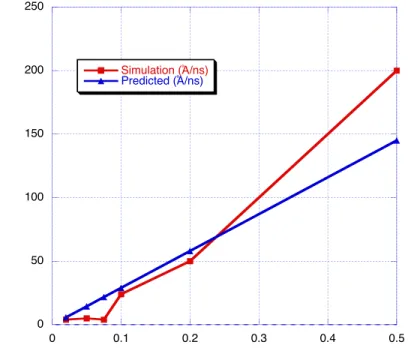
electrophoretic field, at 0.000002 V/Å, is much smaller than the smallest applied field, 0.002 V/Å, in simulations described above. Figure 13 is an illustration of the predicted velocities based on an assumed linear relationship to electric field magnitude compared to observed bulk simulation velocities. Given the slight differences in the experimental and
36
0 50 100 150 200 250
0 0.1 0.2 0.3 0.4 0.5
Simulation (Å/ns) Predicted (Å/ns)
Velocity (Å/ns)
Electric Field Magnitude (V/nm)
Figure 13: Relationship of velocity to applied field magnitude in bulk solution compared to velocities predicted based on electrophoretic experiments
An additional behavior of note observed in each simulation as the DNA sample passes through the nanogate is molecular elongation. This is somewhat expected due to the size of the nanogap at 2.87 nm. Furthermore, this may be a root cause of the increase in velocity as the DNA translocates due to the repulsion forces created to achieve the energetically favorable relaxed conformation after translocation. Elongation was quantitatively observed by tabulating the end-to-end distance of the molecule as a
function of time as shown in Figure 14. In the event that the DNA sample enters the gap between the electrodes, the end-to-end distance increases by almost 30 Å as the DNA passes through the nanogate which is roughly 55% of the initial length. While the helix geometry does not maintain rigidity, the molecular structure does not appear to stretch beyond reasonable expectations. In the simulation of the –0.05 V/Å magnitude applied field, this elongation pattern is observed twice as the molecule reentered the simulation boundary and translocated a second time.
Additional analysis of factors such as the radius of gyration and the root mean square distribution have thus far yielded no additional insights about the nature of motion of the DNA sample.
38
40 50 60 70 80 90 100
0 200 400 600 800 1000
-0.5 V/nm -0.2 V/nm -0.1 V/nm -0.075 V/nm -0.05 V/nm -0.02 V/nm
End-to-End Distance (Å)
Time (ps)
Figure 14: End-to-end distance vs. time of DNA under an applied electrical field
II.4 Interaction Potential for Metals and Non-metals
A significant fault of the preliminary simulations is the lack of an adequate interaction potential for describing the behavior of non-metal atoms interacting with metal atoms. A visualization of the equilibrated system in which the water molecules are shown, Figure 15, exemplifies the inadequate description. One can see how the metallic surface appears hydrophobic and the water molecules form lower density pockets around the surface of the metal.
One of the most important tasks to be accomplished within this project is to properly implement a new potential into LAMMPS to account for the metal/non-metal interactions. The current behavior of the water at the electrode surface may possibly be interfering with the forward motion of the DNA molecule. Additionally, the repulsion from the electrodes is not limited in its effects to water and may explain the reluctance of the DNA strand to translocate under lower magnitude electric field application.
This behavior occurred because the implemented potential failed to properly reproduce the varying charge density in response to Coulombic forces acting on the metal. In the past, this has been accounted for by a method known as the image charge method40. Spohr and Heinzinger41 have previously used this method successfully to model the platinum/water interface; however, their implementation is only valid for simple macroscopic geometries that cross the periodic boundary conditions essentially
40
electrode charge dynamics methodology in more detail as well as limitations to its implementations and the resulting simulations in a future chapter.
II.5 Magnitude and Velocity Relationship
A conclusion has yet to be made as to the relationship of the applied electric field magnitude to resulting velocity of the DNA sample. It is clear that more simulations must be performed to explore this relationship. With the new metal/non-metal potential implemented, the –0.05, -0.02, -0.01, -0.0075, -0.005, and –0.002 V/Å applied field simulations have been repeated extending the length of the simulations to 2 ns.
The task of simulating production runs to develop the magnitude/velocity relationship will require re-equilibration using the newly implemented potential. Each production run of 1 ns takes approximately two days to complete on 64 Opteron processors.
Figure 15: Equilibrated device with visualized water molecules
42 II.6 Identify Optimal Controlling Mechanism
The possibility exists that the application of a uniform electric field will not be sufficient to control the translocation of the DNA sample as intended. As mentioned before, the implementation of a pulsed electric field within molecular dynamics would require increased computational resources. This hurdle has forced our initial investigation into controlling mechanisms to focus on inducing flow within the solution.
II.6.A Simulation Details
The physical setup of the simulated device was exactly the same as the setup used in the electric field magnitude studies mentioned previously, including the use of the same forcefields.
The induction of flow was achieved by imposing an additional external force of equal magnitude on every atom in the solution. Production runs of 1 ns were performed for each magnitude tested.
II.6.B Results and Discussion of Flow Simulations
Simulations were performed with 0.5, 0.25, 0.05, 0.005, and 0.0001 kcal/mol-Å magnitude forces on the solution atoms. Assuming linear response behavior (i.e., that Navier-Stokes hydrodynamics is valid), these forces correspond to very large pressure drops (~ 0.5 MPa to 8 MPa over 20.7 nm) over the length of the simulation box;
however, with respect to molecular dynamics, these pressure drops are negligible in comparison to fluctuations in pressure (~ 10 MPa) typically observed in molecular dynamics simulations. The simulations of 0.5, 0.25, 0.05, and 0.005 kcal/mol-Å
magnitude forces all resulted in very similar behavior to varying degrees. Figure 16 is an illustration of this behavior in which the forces on the solution atoms are so strong that the stationary constraint imposed on the electrodes cannot be maintained. Additionally, one can see that the solution atoms are moving so fast that they create void space behind the electrodes. This is clearly too fast (~ 600 m/s) to be of use in the sequencing device.
44
(a) (b)
Figure 16: Snapshots of the 0.05 kcal/mol-Å magnitude force simulation of ssDNA (C8T8) in water at (a) 0 ps and (b) 1000 ps
In contrast, the simulation of the 0.0001 kcal/mol-Å applied force produced much more promising results. Not only did the applied force not create the void space behind the nodes, the electrodes remained stationary objects within the simulation. As in the applied electric field simulations, the velocity of the DNA strand was determined through the evaluation of the change in direction of the center of mass from its original position.
Figure 17 is the plot of this change in direction for the 0.0001 kcal/mol-Å simulation.
The molecule appears to have net motion away from the initial position of about 1 Å;
however, the velocity varies over the course of the simulation.
Elongation of the DNA strand was noted as it was in the applied electrical field simulations. The elongation in the 0.0001 kcal/mol-Å induced flow simulation was similar to those observed in the applied field simulations. Note that applied electric field should not elongate a uniformly charge object. The molecule’s end-to-end distance increased by approximately 10 Å over the course of a nanosecond as shown in Figure 18.
More extreme elongation was not seen in this simulation likely because the molecule did not come close enough to the nanogate.
Preliminary simulations provide promising results that indicate induced flow may be used as a controlling mechanism. Ideally, more simulations of induced flow need to be performed at a variety of magnitudes between 0.0001 kcal/mol-Å and 0.005 kcal/mol-Å, implementing the proper metal/non-metal potential, to better understand the relationship
46
-1 0 1 2 3 4
0 200 400 600 800 1000
x yz
Change in Direction (Å)
Time (ps)
Figure 17: Change in direction vs. time based on the center of mass with an applied force of 0.0001 kcal/mol-Å
40 45 50 55 60 65
0 200 400 600 800 1000
e2e (Å)
End-to-End Distance (Å)
Time (ps)
Figure 18: End-to-end distance vs. time of DNA under an applied force of 0.0001 kcal/mol-Å
48 CHAPTER III
ELECTROPHORETIC RESPONSE OF DNA IN SOLUTION
III.1 Motivation
Initial simulations of a given configuration of the conceptual device have shown that DNA behaves differently in the bulk solution than it does when in proximity to the electrode gate. Motivated by the similarity of the comparison of the transport properties of the ssDNA molecule in bulk solution to experimental capillary electrophoresis data and as part of the investigation into the ideal configuration of the sequencing device, we decided to perform molecular dynamics simulations of ssDNA and dsDNA in a bulk aqueous environment to directly compare the electrophoretic mobility calculated by simulation to experiment. We will examine the relationship between simulated electrophoretic mobility and experimental as a means of validating implemented force fields.
The examination of simulated electrophoretic mobility will again make use of the capillary zone electrophoresis mobility study performed by Stellwagen and Stellwagen39 for comparison. The experimental capillary zone electrophoresis technique is easily approximated in simulation by the application of an external electric field. In this experimental study, as described in the previous chapter, single and double strand DNA 20 base pair oligomers in a buffer of 40mM Tris-acetate-EDTA at 7.6 pH were
electrophoresed through a capillary coated with polyacrylamide 38.8 cm long and 100µm in diameter at 200 V/cm (2 x 10⁻⁶ V/Å). Stellwagen noted that free solution mobility of
DNA increased with increasing molecular weight up to a plateau that occurred around 170 base pairs. A relationship between sequence and mobility was also observed in this experiment; however, for the purpose of assessing consistency between simulation and experiment, we focused on two oligomers. All sequence mobilities observed in this experiment were in the range of 2.894 x 10⁻⁴ and 2.944 x 10⁻⁴ cm2V-1s-1. With an electrophoretic field of 2 x 10⁻⁶ V/Å, these mobilities corresponded to velocities in the range of 0.00578 to 0.00588 Å/ns.
III.2 Simulation Details
We performed a series of simulations of both single and double strand DNA molecules in pure water similar to single-stranded RNA MD simulations performed by Yeh and
Hummer14 in order to more directly compare simulation results to experiment. The experiment authors, Stellwagen and Stellwagen, electrophoresed several different configurations of single strand DNA molecules as well as several double strand DNA molecules. We chose to compare our simulations to the experimental results of
Stellwagen over another ssDNA electrophoretic mobility study by Hoagland43 because of the smaller oligomers used in the Stellwagen study. Hoagland, et al. studied the
electrophoretic mobility of ssDNA molecules consisting of tens of thousands of base pairs. This simulation study focused on the ssDNA oligomer denoted ssA5, which
50
The MD simulations of ssA5 and dsA5 were performed using LAMMPS with the CHARMM 27 all-hydrogen force field26, 27. Explicit water was described by the TIP3P model29. The sodium counterions were represented by a potential developed by Beglov and Roux28. Initial coordinates for the ssA5 and dsA5 molecules were generated using Nucleic Acid Builder (NAB)44, 45. The molecules were solvated and neutralized with sodium (Na+) counterions using a script within the LAMMPS software package. At a density of 1 g/cc, 3802 water molecules solvated the ssA5 molecule in addition to 20 sodium counterions. The dsA5 molecule was solvated with 3486 water molecules and 40 sodium counterions.
The simulations utilized periodic boundary conditions and were equilibrated for 1ns using the NPT ensemble at 300 K and 101 325 Pa with the Nosé-Hoover thermostat46 and barostat47. Time integration was performed using the velocity-Verlet algorithm2 with a timestep of 2 fs. The hydrogen bonds were constrained using the SHAKE algorithm48. Long-range Coulombic interactions were computed using a particle-particle-particle- mesh (PPPM) solver32.
After the equilibration period, the simulations were restarted with the addition of an applied uniform external electric field of varying magnitudes (0.003, 0.03, 0.04, and 0.05 V/Å) and run for 1.5 ns. As in the previous simulations, these applied field
magnitudes were significantly larger than those typically used in capillary electrophoresis experiments due to the timescale limitations of molecular simulation.
III.3 Results and Discussion
In order to evaluate the electrophoretic mobility of the simulated DNA molecules, we first had to determine the drift velocity of the molecule. Figures 19 and 20 show the change in position of the ssA5 and dsA5 molecules, respectively, from their original position in the z-direction (the direction of the applied electric field). The change in position was evaluated by monitoring the center of mass of the molecule. The drift velocity for each applied field magnitude was determined from the slope of the relatively linear change in position over time. In most cases, the change in position over time increased as the applied field magnitude increased resulting in a larger drift velocity. The behaviors of the ssA5 molecule when the 0.03 and 0.04 V/Å fields were applied were the only exceptions. These two cases seemed to oscillate in roughly the same positions resulting in approximately the same drift velocities despite the varying field magnitude.
We note that for the larger magnitude applied fields, there appeared to be an emergent
“step pattern” in the change in position versus time though this behavior was not as apparent in visualizations. We conjecture that averaging Δz(t) over many trajectories may eliminate the steps evident in the current single trajectory results reported here. This requires further study. Such behavior was not evident in electrophoresis experiments as the applied fields used experimentally were of significantly lower magnitude than those applied in simulation.
52
Figure 19: Center of mass motion in the z-direction for the ssA5 molecule versus time for applied fields 0.003, 0.03, 0.04, and 0.05 V/Å. The open triangles, circles, squares, and filled squares are not representative of data points but merely a method of differentiating lines
.
Figure 20: Center of mass motion in the z-direction for the dsA5 molecule versus time for applied fields 0.003, 0.03, 0.04, and 0.05 V/Å. The open triangles, circles, squares, and filled squares are not representative of data points but merely a method of differentiating lines
54
Figure 21 illustrates the correlation of the drift velocities obtained as above with the applied electric field. There is an assumed linear relationship between electric field magnitude,
€
E r , and drift velocity,
€
v r , where the electrophoretic mobility, µ, is a proportionality constant, i.e.
€
v =r µr
E (6)
Based on this relationship, we have extrapolated an experimental drift velocity for each of the simulated electric field magnitudes for comparison to simulated drift velocity. As one can see, the simulated drift velocities were somewhat lower than the extrapolated experimental values for the larger magnitude electric fields; however, the simulated drift velocities of both ssA5 and dsA5 for the 0.003 V/Å magnitude were consistent with experiment.
Figure 21: Drift velocity of ssA5 and dsA5 as a function of applied electric field. The dashed and dot-dashed lines are the linear fits of the ssA5 and dsA5 drift velocity vs.
electric field data, respectively, through which electrophoretic mobility was determined.
56
The values of the simulated electrophoretic mobility were calculated from the slope of the linear fit to the drift velocity data. Significantly strong electric fields can result in nonlinear electrophoretic mobilities49; however, in experimental capillary electrophoresis and in this simulation study, the linear regime was applicable. Here, electrophoretic mobility from simulation was calculated to be 1.8 x 10⁻⁴ and 9.8 x 10⁻⁵ cm2 V-1 s-1 for ssA5 and dsA5, respectively. Compared with the experimental values for ssA5 at 2.87 x 10⁻⁴ and dsA5 at 2.89 x 10⁻⁴ cm2 V-1 s-1, we can see that simulation in the above described manner resulted in a lower electrophoretic mobility (by 35% for ssA5 and by 65% for dsA5). This could result from the viscosity difference of using pure water as the solvent in simulations as opposed using the buffer used in experiments.
Additionally, the simulations had no physical boundary such as the experimental capillary, which could augment mobility, though in theory, this effect was corrected for in the experiments. Of more concern was that the simulated electrophoretic mobility of the larger molecule, dsA5, was smaller than that for the ssA5 molecule, while the
experimental observations indicated that the larger molecule should have a slightly larger mobility. The experimental results were counter-intuitive (i.e., the experimental result indicated that the larger molecule had slightly higher mobility), and so the significance of the disagreement in the trends between simulation and experiment was difficult to gauge.
Additionally, we note that the experimental mobilities for ss and dsDNA may not be statistically significantly different, once error estimates were taken into account. Though Stellwagen and Stellwagen reported no error values for the normalized mobilities, error propagation of the measured values to the normalized values used in this study indicated that the mobilities of both dsA5 and ssA5 were statistically the same.
It is interesting to note that the mobilities calculated in the bulk simulations (i.e., with no nanogate present) were lower than those found in the bulk regime of the nanogate simulation. One possibility was that the convective motion induced in the solvent by the field acting on the DNA and its counterions was enhanced in the presence of the nanogate because of the collimating effect of the nanogate, thus resulting in greater directionality of the DNA motion in the direction of the applied field. This could be tested by
simulations in the presence of the nanogate in which the field is applied perpendicular to the nanogate opening.
III.4 Conclusions
We have performed simulations of two DNA molecules, ssA5 and dsA5, in bulk aqueous solution using classical molecular dynamics simulations in order to determine
electrophoretic mobilities. Results from the ssA5 and dsA5 simulations in bulk water compared to initial simulations of ssDNA confined between two mica plates and experimental capillary electrophoresis experiments were inconsistent at larger applied electric field magnitudes. The simulated electrophoretic mobilities were notably smaller likely due to freedom of motion through periodic boundary conditions. Future work in this area will include the constraint of the DNA molecules in the x and y-directions as well as examining lower magnitude fields over longer timescales.