Month 1:
Prepare for
Social Marketing
In Part II you’ll begin building for your social media campaign. Following the Hour a Day for- mat makes it easy. Because you will add to your skills sequentially, you’ll first establish a solid base and working knowledge of the tools that are avail- able to you as a marketer and only then add social media elements to your plan. Importantly, you’ll also learn the etiquette and rules of social engage- ment. In social media–based marketing, perhaps more than any other single factor, the under- standing and adherence to etiquette (along with emerging “best practices”) will make or break the effectiveness of the campaigns you create. “What goes around comes around,” and nowhere is this more true than on the Social Web.
Chapter 4 Week 1. Web 2.0: The Social Web Chapter 5 Week 2. The Social Feedback Cycle Chapter 6 Week 3. Touchpoint Analysis Chapter 7 Week 4. Influence and Measurement
II
49■Week 1: Web 2.0: The Social Web
Chapter Contents
Social Networks: The Power of the Collective Social Media Begins Here
Engaging with Social Media The Main Points
Week 1: Web 2.0:
The Social Web
This chapter offers specific examples of social media (a.k.a. “Web 2.0”) tools and applications.
In it, I pull out a few examples that are being used in business now. Each day, you’ll spend an hour or so looking at the selected examples and applica- tions so that by the end of the chapter you’ll have worked through a range of social media applica- tions, and seen first-hand how they fit together and can be used in a business context.
4
50
chapter 4:Week 1: Web 2.0: The Social Web■
Social Networks: The Power of the Collective
Relax. This is not about communal living, although in a weird, virtual way it may seem close. The power of the collective is all about the power that arises directly from the ways in which the Social Web is organized and what it conveys to its participants as a result. although this may seem a bit of a divergence — after all, the clock is running and you haven’t started building a plan yet — pay attention here, as this chapter pre- pares you for the mental shift that will help you later when you get to the tactical issues of building your plan. Understanding how network organization affects the flow of information is central to your successfully making the case for social media within your organization. Ultimately, you need to be able to make that case, for the right reasons.
i am not going to try to sell you on the idea that social media is “good” simply because everyone is using it. That in itself does not make a business case for the invest- ment of your time or marketing dollars. as often as not, “because everyone is doing it” actually makes the case for not doing it. What does make the case is being able to demonstrate that social media — done right — can offer a boost to your marketing efforts. Presenting this to your colleagues — and winning the discretionary budget dol- lars you’ll need — means understanding how this “social” benefit comes about.
So, i am going to start with the fundamental notion of network value. Though it’s a bit geeky, i’ll answer — or at least frame — the question “Why is social media such an important phenomenon?” Three basic laws apply here — together they’ll give you a sense of why the Social Web is becoming important even when compared to proven work-horse media like television, radio, and print. There are three network- value-governance laws: They speak to the fundamental value of a network from the perspective of those connected to it. These laws ascribe a potential value to any given network on the basis of how participants are connected: to a central source, to each other, and so on. The laws that govern the value of social networks and the Social Web itself are presented in order of increasing importance with regard to the use of social media.
Network Value
A quick word on “value” is important here. When I talk about “value” and “power,” what I am really talking is about is the value of the network from the participant’s perspective. There is certainly no guarantee that the economic value of an email list with 100 million unique, active, opted-in, etc. addresses is 100 times more valuable to a marketer than a cable program that reaches “only” 10 million viewers even though both are fundamentally broadcast implementa- tions. Obviously, a lot of other factors enter into the economic value calculation. Instead, what I am referring to is the power or value of the network from a member’s perspective. If I can reach anyone, anytime with a specific and personalized message, this is potentially more valuable from a marketer’s perspective than one which constrains me to always reaching the entire network with a single message. Learning to leverage social media is the key to understanding how to translate this potential into reality.
51■Social NeTWoRkS: The PoWeR of The collecTive
Sarnoff’s Law
David Sarnoff was a pioneer in the broadcasting business: he founded the National broadcasting company (Nbc) and led the Radio corporation of america (Rca).
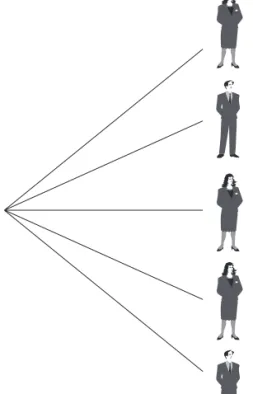
Sarnoff’s law, which was framed to relate the value of a radio station to the number of listeners, holds that the value of the network increases in direct proportion to the number of listeners (or other participants, these days) on that network. This basic law, shown in figure 4.1, underlies the reach component of most media pricing models: in the typical broadcast application, a single voice is sent to millions of listeners. a net- work with 100 people is therefore 10 times as valuable in terms of reach as a network with only 10, all other things being roughly equal.
Figure 4.1 A network representative of Sarnoff’s Law
Metcalfe’s Law
Metcalfe’s law is named after Massachusetts institute of Technology (MiT) graduate Robert Metcalfe, one of the co-inventors of ethernet and founder of the networking firm 3com. for networks that support communication between members — rather than only from a single source — the network value grows as the square of the number of users. Think of this as arising out of the fact that people can talk in both directions, and with more than one conversation occurring simultaneously. This is shown in
52
chapter 4:Week 1: Web 2.0: The Social Web■
figure 4.2. The telephone and basic internet communications — email, minus email groups — are examples of networks that follow Metcalfe’s law. a network of 100 people is roughly 100 times as valuable as a network of only 10 members.
Figure 4.2 A network representative of Metcalfe’s Law
Reed’s Law
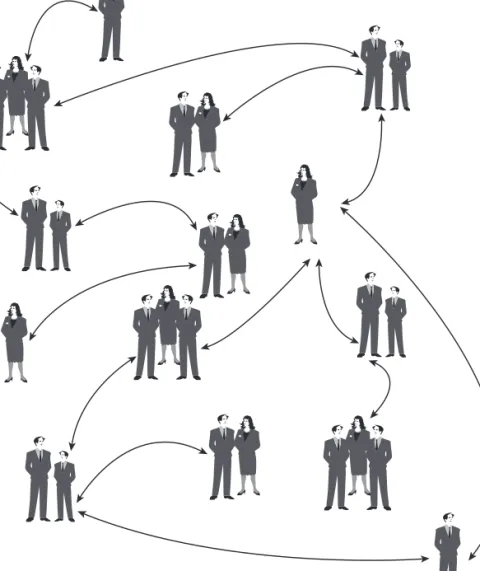
computer Scientist David P. Reed is known for his work at MiT in the area of com- puter networking. Reed’s law — also called “The law of the Pack” — holds that the value of the network grows more powerfully than either Sarnoff or Metcalfe would suggest with the formation of groups (which in turn give rise to communities) and the interconnections between them, as shown in figure 4.3. compared with a network of 10 people, a network of 100 people that can talk not only with each other as they would under Metcalfe but also within groups of people is 290 (2 raised to the 90th power)
53■Social NeTWoRkS: The PoWeR of The collecTive
which for all practical purposes is an exceedingly large number. Reed’s law applies to the typical social networks in use today.
Figure 4.3 A network representative of Reed’s Law
Tip:
Contemporary social networks follow Reed’s Law.look back at the three network types covered and consider two networks, one with 10 people and one with 100. Under Sarnoff, think Tv, Radio, and most large- audience, centrally managed websites. The gain in value by attracting 10 times the
54
chapter 4:Week 1: Web 2.0: The Social Web■
(unique) members is of course 10× . Now consider your personal email or your mobile phone: These operate on bidirectional networks. i can talk to you while you talk to me, and while chris is talking with Pat. for these networks — which follow Metcalfe — a tenfold member increase boosts their value by a factor of 100 compared to what it would have been for a simple one-way broadcast-style network.
Reed’s law adds another layer: groups. Specifically, Reed’s law speaks to the impact on network value by recognizing and supporting groups of members. The ability to talk in groups can result in more efficient filtering, vetting, and emphasis on “necessary” information. This may occur through well-connected power users, for example, who often exert a larger-than-expected influence on group behavior.
Social networks — which encourage the formation of and communication between subgroups — follow Reed’s law. The incredible power of communities is in this sense
“tapped” by fundamental organization and administrative policies of social networks.
The Impact of Control
Do you wonder what happens when a social network is strongly controlled by a central governing body? It devolves toward the most basic networking model, Sarnoff! Think about it this way: In an essentially anarchic social network, members are free to tap Reed’s law to the fullest. As rules are imposed, and especially those that constrain self-expression, there is a throttling-down of the free flow of content between members. If you place constraints on who can talk by permitting only a central authority or editorial body to post, you devalue the network.
ok, enough theory and math. What does all this have to do with social media, and why should you care about it? it’s simple, you know, like radar. ordinary people — the kinds of people you are trying to reach — are finding that group-oriented (a.k.a.
“social”) networks are very effective when it comes to receiving and sharing informa- tion as compared with the largely one-way channels such as television, radio, and print that are still following Sarnoff’s law and early radio value models. These highly interconnected social networks are equally perceived as effective in vetting that infor- mation, and it is the combined impact that makes social networks along with user- generated content and social media so powerful from a consumer’s perspective. They are using these networks to evaluate everything you say. it may have been true, as a trenchant New Yorker cartoon once pointed out, that on the internet “no one knows you’re a dog.” With the newer social networks, however, dogs get pegged as dogs pretty quickly. online community members are discovering that it is very easy to find, learn about, and share information that directly contributes to an informed choice. it is for this reason that people are moving en masse to the Social Web, and it is for this reason that you should be there, too.
55■Social MeDia begiNS heRe
Let Your Fingers Do the Walking
Want a simple example of why it makes sense to follow the information value of the network?
Think back — way back — to the early campaigns touting the value of the Yellow Pages. “Let your fingers do the walking” spoke directly to the value of the “Yellow Pages community” — the collection of local merchants who supported a central, easy-to-use directory that was offered to consumers as an alternative to the time-consuming task of driving around town looking for someone who embroidered baseball caps. For member merchants, the Yellow Pages served as a one-to-one network. The Yellow Pages are an analog example of Metcalfe’s Law: compared with TV advertising of the day, the Yellow Pages combined with the telephone allowed any merchant to connect with any consumer. The more recent tagline “We wrote the book on local search”
underscores the present-day importance of the Yellow Pages and its use in marketing even in the face of online local search: In 2005, AT&T’s Directory Services segment net income was about $2 billion, accounting for over 40 percent of AT&T’s total net income.
Social Media Begins Here
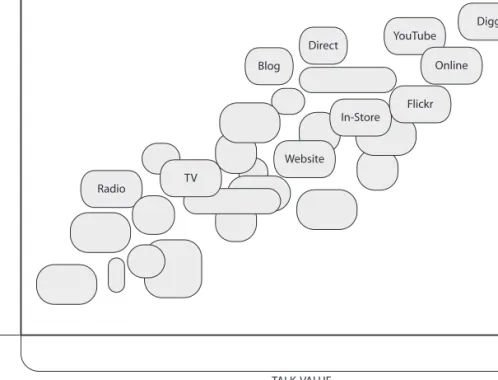
Think back to the basics of integrated marketing and a concept or model that you’ve probably worked with: the touchpoint map. a hypothetical touchpoint map is shown in figure 4.4. Note that this representation is not suggestive of your touchpoint map, though it is clearly intended to elicit a questioning response. What if? This simple diagram — which places the customer at the center of all potential brand-related experiences — is based on the Social Web reality that all of the communications that a particular individual is exposed to shape her ultimate perception of your brand, prod- uct, or service. You’ll spend more time on the touchpoint map in the upcoming chapters.
for now note that all communication — everything you say, along with everything that your customers say — plays a role. This includes your advertising and the actual prod- uct experience as well as the conversations occurring on the Social Web.
The touchpoint map delineates not only a collection of the media and market- ing channels you are using now, but also a collection of social media components.
These elements — combined — contribute to the formation of an opinion or perception.
Specific to marketing and its core objectives, these perceptions generally (and certainly hopefully) contribute to a conversion. it is in this way that social media ties directly into your marketing toolbox: These social components — blogs, wikis, podcasts, and more — surround the conversion process and are central to the usefulness of social media in marketing. as you jump into social media, keep the following tip in mind.
Tip:
Social media contributes to informed choices by aggregating and making available to an inter- ested individual the collective experience and resultant conversation.56
chapter 4:Week 1: Web 2.0: The Social Web■
YouTube
PERFORMANCE
TALK-VALUE
Radio TV
Website
In-Store
Online Flickr
Digg Blog
Direct
Figure 4.4 Touchpoint Map
Ready to jump in? ok, everyone in the pool. first up in your hour a Day work (as if you’ve read everything up until now in your off-time!) is experiencing social networks. if you’re already a member of one or more, that’s great. You can use those and follow along or try the suggested networks in addition to social networks you are a member of now. This week’s objectives are designed to get you familiar with a wide range of social applications. You’ll no doubt recognize many of them, and you are probably using a few of those listed or applications that are similar to those listed.
here is what you are going to do:
l
• ook at a variety of social media activities.
l
• earn how these activities can be used to weave social experiences together.
R
• eview a sample of online social media tools that you can use through selected real-world business examples.
Note:
Many companies have policies that prohibit or control the use of the Internet using company equipment. Check with your Human Resources (HR) or Information Technology (IT) groups to learn about your company’s specific policies. If your corporate policies prohibit viewing or using any of the applica- tions, services, or networks suggested in this book from the corporate network, either complete the exercise at home or ask your IT Director or Systems Administrator to suggest an alternative that you are permitted to use. Please do not place yourself at risk by circumventing established corporate policies.57■Week 1: eNgagiNg WiTh Social MeDia
Week 1: Engaging with Social Media
This week your exercises focus on a survey of the content that makes up the Social Web. There is a good chance that you have seen some of this, in which case you can use this time to visit other similar sites that you may not have made the time for. following the hour a Day format, each exercise is designed to be done in an hour…or less.
Tip:
A set of worksheets covering this week’s exercises can be found in the appendix of this book.In addition to these printed worksheets, you can also download electronic copies and access related resources at the website accompanying this book. Complete information regarding these resources and the website is included in the appendix.
Monday: The Written Word
The written word is a fundamental building block of “permanent” communications.
online, “permanent” takes on at least two meanings:
i
• t is something you can reference later, in its original form.
i
• t may live forever, whether you want it to or not.
The first meaning is generally considered good. it’s that second one you’ll want to watch out for.
look at nearly any news article, blog, web page, super-slick flash interface and you’ll see mostly text. given that the Web supports multimedia — recall its origins as both a structured document language and a replacement for the gopher-esque “read the text and click here for the picture” forerunners of the contemporary Web — it’s surprising that so much of the Web is still fundamentally text. but it is, so that’s a great place to start exploring the world of social media.
Monday’s One-Hour Exercise: Blogs and Wikis
Today you’re going to spend an hour looking at several different blogs and wikis. if you have favorites of your own, feel free to substitute them for the examples but do note the different roles that the examples i’ve provided play in creating and disseminat- ing shared information.
let’s first be certain about what blogs and wikis are, and how they differ from each other. as a marketer, you can use both. a blog is basically a diary that others can comment on. as it turns out, it is the “comment on” part that makes a blog so differ- ent from a diary or journal you may have kept yourself in the past. The wiki is similar in that it is also participative; however, rather than being a sequential journal that gives rise to a collective conversation, the end result of the wiki is a single entry that reflects the collective consensus. like the blog, the wiki is built by a combination of its owners
58
chapter 4:Week 1: Web 2.0: The Social Web■
and readers. Unlike the blog — where each sequential owner-generated post (typically date-ordered, most recent first) is followed by reader-generated comments — the wiki allows readers and owners alike to directly modify the primary post.
got that? Table 4.1 shows a simple illustration of the difference:
PTable 4.1 Comparison of Blog and Wiki Entries
Blog Wiki
Original Post New York is on the west coast. New York is on the west coast.
Final Result New York is on the west coast.
[on 1/24/2008 daveevans said]
Get a map. New York is on the east coast
New York is on the east [1] coast
[1]Corrected 1/24/2008 by daveevans.
Where the blog is an ongoing diary that invites user-generated comments and thereby initiates conversations, the wiki is a collection of entries that evolve over time according to the consensus of the owners and readers acting together. in the case of the blog, the entire conversation is immediately visible: With the wiki, the discussion on the merits of each “correction” or update is often placed in a separate area or page with only the present status of the entry immediately visible.
Note the difference between these two types and the way each can be used in business. The blog is a great placed to start dynamic conversations about things that interest your customers. The wiki is a natural place to build your product faQ: Post your frequent questions, or suggest an answer, and then let your customers refine those answers over time based on their actual, collective experience.
Using Blogs and Wikis
in the next hour, visit the suggested blogs and wikis and ask yourself the questions i’ve posed. as you do this, do your best not to judge the content itself — it may appear pure folly that someone has actually taken the time to create some of the entries you’ll encounter. let it go. Try instead to see the larger view — the gestalt if you will — that underlies the experience of blog and wiki participation. Focus on understanding why these sites exist and why they are popular.
Fac t:
About 100 million hours have been spent, in total, building Wikipedia as it sits now. If that seems like a lot of time, and in particular if that seems to you like a waste of time, consider that Ameri- cans, taken together, spend the same amount of time, about 100 million hours, watching TV advertising every weekend.59■Week 1: eNgagiNg WiTh Social MeDia
Some examples of blogs to visit are suggested in the following list. for this exer- cise, limit yourself to 15 minutes. Don’t get yourself fired for surfing. i just want you to get an idea of what blog consumption is all about. Reading — not writing — is what most users still do, so start with reading.
Tip:
I’ve included the URLs for this exercise; however, the easiest way to find the following blogs and wikis is by searching for them.Blogs to visit:
b
• oing boing (http://www.boingboing.net) S
• ocialMediaToday (http://www.socialmediatoday.com) M
• ashable (http://mashable.com)
• CommunityGuy.com (written by this book’s technical editor, Jake Mckee, at http://www.communityguy.com)
Questions to consider while reviewing these blogs:
1. What is the central theme?
2. Who would read this on a regular basis? Why?
3. is this person (possibly) a customer? if so, what other blogs does he read?
4. What could you add to this conversation?
5. are you getting drawn in — that is, are you starting to follow posts via com- ments and winding up in unexpected places?
6. how could you use this in your business?
Wikis to visit:
W
• ikipedia (http://en.wikipedia.org/wiki/Social_media) o
• ne laptop per child (http://wiki.laptop.org) i
• bM Wikis (http://www-941.ibm.com/collaboration/wiki) Questions to consider:
1. are the entries evolving over time?
2. Who is in charge?
3. is the Updates section or Discussion page visible? if not, how does not being able to see the entry evolve over time change your view of the end result?
4. how could you use this in your business?
60
chapter 4:Week 1: Web 2.0: The Social Web■
Finding Social Content
So you’re now about halfway or a bit more through your first hour. You’ve visited a few blogs and a wiki or two. it’s likely — especially if this was your first exposure to blogs and wikis — that this was more or less a spectator sport. That’s ok, although the real experience arises out of participation. Don’t let today be your last experience.
find some blogs and wikis you like, and in particular look for some that provide examples of how these tools can be used in your business as marketing channels and relationship builders. above all, participate.
So just how do you find more blogs? More wikis? i’m glad you asked: That’s where you’re going next. for starters, finding social media is as easy as using google.
Type in a phrase or keyword, and there is a very good chance that the first page of results will contain blogs and wikis along with typical web pages.
The following tools will help you find and make sense of social content. You’ll spend the remainder of today’s hour looking at them. at the top of the list is Tech- norati. Technorati is one of the more popular blog indexes and certainly one of the most useful. from Technorati comes this description of what it’s all about:
Welcome to Technorati.
Currently tracking 112.8 million blogs and more than 250 million pieces of tagged social media.
Technorati is the recognized authority on what’s happening on the World Live Web, right now. The Live Web is the dynamic and always-updating portion of the Web. We search, surface, and organize blogs and the other forms of independent, user-generated content (photos, videos, voting, etc.) increasingly referred to as “citizen media.”
Technorati isn’t the only tool or course that helps you make sense of the blogo- sphere, as the collection of all blogs is often called. as with any set of tools, different tools are used for different purposes. Where Technorati gives you a “what’s hot” view with the addition of search, analytical marketing tools like blogPulse come at the prob- lem of making sense of the Social Web from a different perspective. blogPulse is an analytical social marketer’s best friend — it allows you to quickly see the trend in the occurrence of specific words or phrases as used within the blogosphere. launching a new product? Use blogPulse to quickly find out who is talking about it.
for the rest of the hour (but do save a few minutes for the wrap-up) think of something related to your business and use the following suggested tools to research it on the Social Web. for example, search for a product you recently launched or the name of your company or that of your fiercest competitor. if you are working in or
61■TUeSDaY: The Web coMeS alive WiTh MUlTiMeDia
around politics, search for the various candidates in national, state, and local elections.
compare these results with those for your favorite pop culture icons (brands or people).
Social Media Content Tools:
T
• echnorati (http://www.technorati.com/) g
• oogle blogsearch (http://blogsearch.google.com) b
• logPulse (http://www.blogpulse.com) b
• logPulse Trend (http://www.blogpulse.com/trend)
Monday’s Exercise Guide and Wrap-Up
based on today’s exercise, you should have a better idea of not only how to find blog content and how to subscribe to it, but also how you might use a blog for your own business, or as one element of a social-media-based campaign. for example, you might create a blog that announces the launch of new product and then use that blog to elicit customer comments that inform the future versions of your product. or, you could use the blog yourself and talk about the kinds of issues that your service or product is meant to address, giving your customers a way to talk back to you and let you know whether or not they agree, see the value, or have other ideas about what you could do to serve them.
Today you got your feet wet. You started with the text — blogs and wikis — and explored how they formed the first of the basic social media building blocks. Tomorrow you’ll head into multimedia, and by the end of the week you’ll have seen how every- thing is tied together with one of the most important advancements on the Social Web: RSS.
Tuesday: The Web Comes Alive with Multimedia
among the original promises of the Web was the ability to read, see, and hear content simultaneously. This was both a part of the original intention for the Web and one of the earlier problems in the development of the hTTP protocol.
Note:
Geek Alert: The next section will be interesting for some, and less so for others. If you’re into the history of the Web and how some of what we now take for granted came about, you’ll enjoy it. If not, you can skip directly to Tuesday’s One-Hour Exercise.The following is an exchange between Marc andreessen, founder of Netscape, who was at the time in school and working at the National center for Supercomput- ing applications (NcSa) in chicago, and Tim berners-lee, credited as the primary
62
chapter 4:Week 1: Web 2.0: The Social Web■
inventor of the Web while working at ceRN (conseil européen pour le Recherche Nucléaire, which in english is “european council for Nuclear Research”).
from Marc:
multimedia files over httpd
Marc Andreessen ([email protected]) Fri, 5 Mar 93 00:15:36 -0800
Some people using NCSA Mosaic 0.9 have noticed that they can’t put multimedia files on their own httpd servers and retrieve them correctly with Mosaic. What’s happening in most cases is that the WWW Daemon is prepending <PLAINTEXT> to the head of those files.
Basically, if you hack this so it just sends back files with unrecognized extensions (or some set of extensions that your server would like to serve) without prepending anything, things will work.
The only gotcha I’ve found is that anything on the server without the extension .txt will no longer be given a free ride as <plaintext> from the server to the client.
An alternate solution is to put your images, sound files, etc. on your anonymous FTP server or (shudder) your Gopher server and then point to them at that location from your HTML documents.
Cheers, Marc
Reply from Tim:
Re: multimedia files over httpd
Tim Berners-Lee ([email protected]) Fri, 5 Mar 93 08:45:47 +0100
> Basically, if you hack this so it just sends back files with unrecognized extensions (or some set of extensions that your server would like to serve) without prepending anything, things will work.
This is a hack — the suffix is NOT supposed to mean anything in HTTP and there are servers which serve things with no suffix at all, and have totally un-filelike names for objects. So beware.
Or use the not quite released Daemon 1.0 which will MIME-wrap them according to HTTP2.
Sorry for the delay... I should answer [even] less mail :-}
Tim
63■TUeSDaY: The Web coMeS alive WiTh MUlTiMeDia
Wow! Two of the most influential individuals with regard to the realization of the World Wide Web, sorting how out to manage the transfer of multimedia files.
Now here we are — 15 years later — and it seems everyone is slinging homemade multimedia around the Web like child’s play. in fact, it is child’s play, or more accu- rately, schoolwork. i recently sat in on a conference at my son’s first-grade class. They were engaged in an independent study of animation. They use digital video cameras (i know, big whoop — but wait, it gets better) to record vignettes at home, out-of-doors, at school, to do video interviews. They carry the files around on their USb drives (they wear them around their necks…) before uploading them where the class views them.
They use MP3 recorders in class to record spontaneous thoughts because it’s much faster and more “in the flow” than writing. i learned a new term, too, and found out it applies to me: DSl — as in “Digital as a Second language.” for my son and his bud- dies, “digital” is a first language. he was navigating his way through Toy Story on his iMac at 18 months, before he could speak, and he’s hardly alone in that regard.
What’s important about the prior discussion is this: if you have any doubt as to whether or not Millennials — and in particular teens to those near 30 — view the Social Web differently than boomers or even gen X…forget it. for the Millennials — who increasingly comprise and influence your markets — the use of the Social Web is simply part of everyday life. Think back to the touchpoint map and the ideas of inte- grated marketing. add to the traditional forms of media a set of digital channels that fit as naturally into their daily experiences as watching Tv does for boomers.
on the Social Web multimedia plays an increasingly large role from both a consumption and production perspective. Multimedia makes up a large component of all social media — and sooner rather than later will likely account for the majority of social media. Think about it: experience something and then find a keyboard or pad on which you can type an extended passage and blog about it…or grab your video phone, click record and then upload. The preferred path is pretty obvious. flickr (purchased by Yahoo!), Photobucket (purchased by MySpace), YouTube (purchased by google), Seesmic and others are the direct result.
Tuesday’s One-Hour Exercise
The multimedia sites you will visit today are shown in the following list. Remember:
this is a survey. Spend only 5 or 10 minutes on each site. This isn’t enough time to fully explore and become part of the communities. instead your goal is to get a sense for the content and the ways in which members of these sites are sharing and using this content to exchange everything from personal stories to viewpoints on the news to experiences with products and services. You’re likely to confirm a couple of common thoughts about these sites — yes, there is content that doesn’t legally belong there, and yes some of what you’ll find is nonsense — but as well you’ll also come away thinking,
64
chapter 4:Week 1: Web 2.0: The Social Web■
“hey, that’s cool! i didn’t know you could do that!” That’s the “aha!” you are looking for today: Those are the insights that consumers find valuable.
Multimedia sites to visit:
f
• lickr (http://www.flickr.com) P
• hotobucket (http://www.photobucket.com) Y
• ouTube (http://www.youtube.com) S
• eesmic (http://www.seesmic.com) M
• etacafe (http://www.metacafe.com) P
• ersonallifeMedia/DishyMix (http://personallifemedia.com) Questions to consider:
W
• hat service does this provide?
W
• ho would use this on a regular basis? Why?
W
• hat content could you add to these sites?
a
• re you getting “drawn in” — that is, are you starting to follow posts via com- ments and winding up in unexpected places?
i
• n addition to looking at the content in the site (for example, looking for product or brand information), ask yourself about the social motivation for the site.
P
• ick out content that is interesting to you and think about why the person who posted this content did so. What was his or her motivation?
W
• hat did you come away with as a result of the content you looked at having been posted?
Tuesday’s Exercise Guide and Wrap-Up
as you are summarizing your work so far this week, take the time to think about any content that you may have uploaded and why you did this. if you’ve not uploaded content, and especially if you’ve never transferred content from a digital camera to the internet, take a break here and try it.
Part of mastering social media is discovering the simple joy of seeing your own con- tent online and in sharing it with other people. as you progress with later exercises, expe- rience with the basics — like photo sharing — will help you get more out of this book and as a result will help prepare for the use of social media in your marketing program.
Tip:
In general, the newest digital cameras are much simpler when it comes to transferring content to a computer or even directly to the Internet than those just a few years old. Don’t make yourself nuts try- ing this. Searching online for help is often a good idea if you get stuck. It’s also a great way to experience support forums, something you will spend more time on in Chapter 9, “Social Platforms.”65■TUeSDaY: The Web coMeS alive WiTh MUlTiMeDia
Today you covered a lot — multimedia accounts for much of the content that powers the Social Web — and came away with your first big, practical insight into the effective use of social media in business. The attraction of social media — as the name implies — has as much or more to do with how the content is connected and reinterpreted than it does the content itself. in other words, the focus is on the social connections, and only as a by-product on the media itself. The act of sharing is more important than what is being shared. This is the antithesis of the traditional advertising approach, where everything is tightly controlled and the focus is on the message.
as you roll into Wednesday, keep the idea of “social connections” forefront in your head. connections will form the central theme of nearly everything you do from this point on.
Tuesday Bonus: An Additional Exercise
having looked at a handful of content sites, you’re probably thinking “ok, i see where i could have some fun and spend a lot of time.” This is — in a serious way — certainly part of the social media dynamic as it impacts your current marketing programs. Peo- ple who frequent these sites typically spend less time with other forms of media, most notably Tv. but that is only half of it: The other question you’re probably asking is
“What can i do here as a marketer? how can i participate and in the process promote my product?”
The following links will help answer this. i’ve used the Nike+ Running Shoe as the example. The essential learning in today’s remaining exercise is this: like any inte- grated marketing effort, social media channels do not exist in isolation. in fact by defi- nition they are connected: Users who participate in blogs also post pictures, and create videos and podcasts, and watch Tv and listen to the radio. often, they do all of this at the same time. The phrase is “continuous partial attention.”
look at these links, in the order presented. You’ll start with a woman explaining the Nike+ and how it enables those who wear them to connect with each other around their shared passion of running. in her video, she also ties in well-known athletes, sug- gesting a connection to an additional community. after viewing this, you’ll jump over to flickr. here, searching for “Nike” (i’ve provided the search result URl for you) you’ll find a photo of a “hacked” running shoe. The owner of this hacked shoe has posted photos of how to “install” the apple widget that powers Nike+ into his favorite (non-Nike) shoe.
Tip:
Social Media isn’t about the content itself: it is about the way in which consumers of content are connected and about the conversations that result.66
chapter 4:Week 1: Web 2.0: The Social Web■
Social Media Example: The Nike+ Running Shoe T
• he Nike+ explained on YouTube (http://www.youtube.com/watch?v=rtFi5wlvP2k) N
• ike on flickr (http://www.flickr.com/search/?q=nike) T
• he Running Shoe Modification (http://www.flickr.com/photos/
callumalden/347076681/) T
• he Discussion of the Modification (http://www.metacomment.com/
blog/2007/01/06/diy-nike-plus-hack/)
Wednesday: Microblogs and Tagging
on Monday and Tuesday you surveyed some basic content. You looked at blogs, wikis, photo and video sharing, and more. You experienced a significant element in the attrac- tion to social media and to its usefulness: it’s the connections that count. on Monday you looked as well at how blog search tools and related analytical services help find or track content. Today you’ll dive into microblogs and the concept of tagging. Microb- logs are short sentences or thoughts: Think status updates. Tags are little descriptive bits that you apply to content so that you (and others) can find it again later.
if you’re wondering how these concepts relate, it’s the fact that both are quick, isolated actions that over time lead to something more substantive. The Social Web is built up of small, connected parts. The World Wide Web by comparison is certainly built up of connected parts, but they aren’t necessarily small. Want proof? go to your boss, right now, and request a meeting with iT. Tell everyone that that you want to rebuild your corporate website, you know, just to make it better. Watch them glaze over, and then look at the iT director squirming at the prospect of yet another year- long (or more!) project. No, the components of the traditional Web are not small. The Social Web, by comparison, is the world of quick comments, connections, and mash- ups: Small parts, connected, to do big things. The microblog is simply a word, a phrase, or a number that is injected into a stream of similar content and thereby adds meaning, clarification, or information to the stream. Think about the status updates in MySpace of facebook, or social tools like Twitter. These streams can spark blog entries, articles, and even whole books! or — if no one picks up on them — they simply vanish.
Tags are single words or very short phrases that are attached to social content to make it easy to find (increased utility) and easy to share (increased value). for example, if i am visiting a formula 1 enthusiast website, i might tag it “motor sports.” if i am visiting a pool chemical supplier’s how-to page, i might tag that “green murky water.”
Perhaps you’ve been there too.
Tags are often organized into clouds or simple lists. importantly, the tag collec- tion around any specific content object is the result of a collective effort: if i tag some- thing as “racing” and you tag the same object as “sports” then a third-party searching for either “racing” or “sports” will find the object. because anyone can add tags, there
67■TUeSDaY: The Web coMeS alive WiTh MUlTiMeDia
needs to be some way to ensure relevance and prevent mischief, and the Social Web provides for that. over time, the tags are ranked (the voting thing again…) by the use that each tag receives: those used most often to locate the object rise to the top, making that object more accessible to more people. connections — and consensus — power the Social Web.
Wednesday’s One-Hour Exercise
Today the assignment is easy. You’re going to take a quick look at some popular micro- blog and tagging services. The point of today’s exercise — as with all exercises this week — is to quickly survey the social media landscape and simply get a sense of what is available and how it is being used. by taking this time now, you’ll have a firm basis and working knowledge across the range of activities that are available to you on the Social Web.
it is very possible that you are already participating in some of the activities cov- ered on any given day. if so, you can either use this exercise as a review or extension, or you can use that tie to explore a similar activity that you may not have made the time to do. Regardless, for each of the exercises, do take the time to look, do, play, explore.
The more you get involved yourself in social media as a participant, the more sense it will make when you consider the ways that social media can be used for marketing.
Microblog Services to Visit T
• witter (http://twitter.com/) P
• ownce (http://pownce.com/) T
• umblr (http://tumblr.com/) P
• lurk (http://plurk.com) S
• eesmic (http://seesmic.com)
Note:
In the above URLs, there is no “www.” That’s on purpose. They aren’t websites, per se. They are social media services.as a starting point, Twitter is a good choice. first, it has lots of members, so there is a steady stream of content. Second, it has a nice public display of the main con- tent stream — you don’t have to sign up or do anything to look at what others are gen- erating. You’ll want to sign up though: it’s easy and fast. a word to the wise: The raw stream itself probably won’t make sense any more than randomly tapping into a phone switchboard would. however, in that analogy is the actual value. imagine that instead of the raw stream you saw only a small subset of friends and colleagues with whom you really wanted to keep up-to-date. You’d see that Deb was heading for the beach or that Max was thinking about writing a book. You could jump into the conversation — or ignore it — as you wanted. of course, instead of imaging this you could sign up and
68
chapter 4:Week 1: Web 2.0: The Social Web■
try it! c’mon, go for it. if you’re like me, you won’t get it at first. but then, over a few days…or a few minutes…as you add friends, family, colleagues, and start to build off of their connections, you’ll figure it out as you become more connected with others. it’s hard to explain, easy to experience.
Questions to consider:
1. What is the attraction to following the activities of others?
2. how could you use these services? in your business? internally? externally?
Personally?
Tagging Services to Visit:
D
• el.icio.us (http://del.icio.us) S
• tumble Upon (http://www.stumbleupon.com) M
• a.gnolia (http://ma.gnolia.com/)
Delicious is one of the core tagging services in a class called “social bookmark- ing.” Users of Del.icio.us “tag” their favorite websites and add them to their personal, remotely stored bookmark list. if you are still maintaining a browser-based favorites list, consider that your list is personal, to you only, and as such does not benefit your friends or colleagues. all of the work that you have done in building your list — the value that you have created by compiling resources and references — is off limits to everyone else. likewise, the efforts of others who have similarly created local favorites lists is off limits to you. how much better would it be if you pooled resources? This, by the way, is something that Millenials are generally very good at and do naturally:
author henry Jenkins made this point recently while speaking at South by Southwest interactive festival (SXSW) in austin when he talked about the difference between the
“we” language of contemporary political marketing versus the “me” language of more traditional campaigns.
at a more practical level, your browser-based favorites are only available when you are using the computer on which your favorites list is saved. at a friend’s house down the street? or an internet café in barcelona? Sorry, no favorites for you! Del.icio.
us solves this problem while at the same time bringing you not only the power of the collective in finding more sites like the ones you have bookmarked, but also an indica- tion of the relative worth of each specific site based on how others have tagged or shared that same site.
Note:
At the time of this writing, another leading microblog service — Jaiku, recently acquired by Google — was not accepting new members and is instead in an invitation-only stage. Do check it out.69■TUeSDaY: The Web coMeS alive WiTh MUlTiMeDia
StumbleUpon takes basic tagging and bookmarking one step further: Stumble- Upon combines a basic recommendation system with a website index: You find a site you have an opinion about (“like it, don’t like it”) and you rate it. Your fellow Stumblers — people whose interests match yours — then benefit from your recommendations when they look at similar sites, something you’ll spend more time on in chapter 11, “Reviews, Ratings, and Recommendations.” for example, if you visit a site about an art exhibit and
“like it,” your friends who are into art will see that you liked this site the next time they look at art sites through StumbleUpon.
An Additional Exercise
if you haven’t already, take some time to set up some of the social tools you’ve covered.
create a Twitter account, for example, or make a copy of selected bookmarks from your current favorites list at Del.icio.us. if you’re really bold, export your browser favorites and then delete them from your browser entirely: Make a clean break to social bookmarking. if you find yourself starting to shake after a week, you can always import and restore your list. but do try as many of the tools and services as you’re comfortable with. Social media is, after all, a participatory sport. like a high school dance, the action is out on the floor, not along the wall.
Viral Marketing
Here’s a quick word on viral marketing as it relates to social media. The two terms are often used interchangeably, but they are not the same. Just as a room full of toddlers sets up the conditions under which a virus can spread, the Social Web is an environment through which your message can spread. However, just because you have a room full of toddlers does not mean that a virus will spread. They could all be washing their hands; stranger things have happened. I point this out because I often hear people say “We need to be on the Social Web so that we can infect it, so that our message will go viral.” Don’t count on it. Savvy Social Web citizens wash their hands frequently. Unless people — in large numbers — value and accept the content, viral campaigns have little chance of “infecting” anything.
Wednesday’s Wrap-Up
Today you covered tagging, social bookmarking, and small quick text-streams called
“microblogs.” You looked at the role the collective plays — typically through the acts of filtering, compiling, and rating — in the culling of Web-based content. This has a direct impact on your business and your traditional offline/online marketing programs.
Thumbs up, and your efforts get amplified as your message gets spread through social connections. Thumbs down…and you have to work a whole lot harder to achieve the same results.
70
chapter 4:Week 1: Web 2.0: The Social Web■
Thursday: RSS
You started off your first week in the hour a Day program looking at content. Mid-week you were looking at highly fluid, tiny conversations along with social tagging and rec- ommendation services. combined, the result is a Social Web that supports everything from impromptu, transient bursts to entries that develop a fixed permanence over time based on consensus. in a nutshell, you’ve looked at the content that’s available to Social Web participants and at the tools that allow them to discover, rate, and share this con- tent. i hope you’ve jumped in and participated.
Today’s exercises focus on one thing, and one thing only: collecting and orga- nizing social content. Today, you’ll change your overall Web experience from “you go out and find it” to “it comes to you when it’s fresh.” You’re going to learn about RSS (Really Simple Syndication). RSS is fundamentally important to the Social Web.
You’re probably wondering something like this: “i have my favorites list (hope- fully maintained at Del.icio.us!). Why do i need to have this same stuff sent to me? i already get too much!” The answer is, RSS will make your life on the Social Web eas- ier. because it will make it so much easier, chapter 12, “Social interactions,” is almost entirely devoted to the ideas and practices that originated in RSS. RSS provides two basic benefits, both of which are very important. Unlike email — where anyone can send you anything — RSS allows you to control what you receive, not like a filter but more like a smart magnet. Using RSS, you attract what you want rather than blocking what you don’t. Think back to Twitter for a minute: The whole point of the service is to let you know what your friends and colleagues are up to. Who wants to run to the Web, or go to Twitter, and check to see if there are updates? To help with this, Twitter offers SMS-based text notices and an RSS feed. The SMS notices are useful if you want Twitter updates on-the-go. That benefit is clear. The RSS feed, however, duplicates the information you’ll get if you simply go to Twitter and view someone you follow. So why set up RSS?
Multiply your use of social applications like “Twitter” by 10 and you’ll start to get the idea. Social web users typically use more than one social application. look at your own website favorites list: in a study done in 2004, the average number of bookmarks was 184. Now imagine that these were all social sites, and that they were all talking to you at random intervals. Social sites are updated whenever participants feel like updating them. by comparison, typical websites are never updated. Social sites behave more like “breaking news” in that updates, which is to say content changes, are driven by random external factors. how would you keep up with this? Would you really want to log into each of your social sites every day or every week just to see if something had changed? of course not. instead, you’d instruct each site to ping you when something changes. This is what RSS, atom, and similar protocols do. for
71■TUeSDaY: The Web coMeS alive WiTh MUlTiMeDia
simplicity, i’ll use RSS in the following examples. The others operate in a substantially similar fashion.
To say that RSS powers the Social Web is an understatement. Without RSS, none but perhaps a handful of blogs would have survived. Without RSS, a blog — to the external audience — is no different than any other website. To read it, you have to go to it. of all the websites in your favorites list, how many did you visit last week? one?
Three? Thirteen? Probably not 184. Without RSS, only the most popular blogs would have maintained any sort of traffic flow. The long tail…would get bobbed. let’s face it, if no one reads a blog what’s the point of having it? but what if the audience could be made aware of new posts, as they are posted? That would change things. RSS allows blog posts to be sent to its readers, whenever it is updated or shortly thereafter. With an RSS reader — now built into most contemporary browsers email programs and dedicated tools like google Reader — you simply subscribe to the blogs you want and then look periodically to see what’s new. it’s a lot like checking your phone messages:
Rather than calling all of your friends to see if any had called while you were out, you press a button and hear something like “You have seven new messages.” You can deal with them as you’d like, on your time.
So what about multimedia? can RSS help with that, too? Would i be asking this if it couldn’t?
Dave Winer, one of the architects of RSS, introduced a new feature called
“enclosures” into RSS in late 2000. Think of enclosures as a way to package and deliver content other than text. among the first uses of this new feature was sending audio files on a subscription basis. The podcast had been born. a podcast is after all nothing more than a scheduled sequence of audio files, typically downloaded to a computer and then transferred to a portable media device — initially via iTunes to the iPod, hence the name “podcasting.” audio podcasting and its relative, video podcast- ing, are now standard tools in the social marketers’ toolkit.
Thursday’s One-Hour Exercise
Today you’re going to pull together everything you’ve done so that you’re ready for tomorrow when you visit some social networks. begin by opening your web browser:
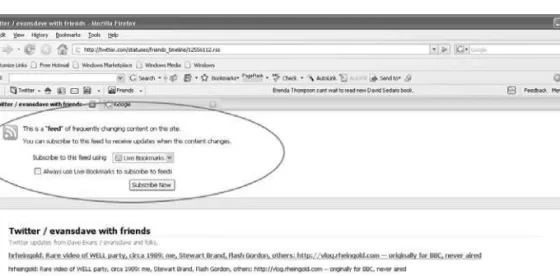
let’s look at where RSS feeds live and how to work with them.
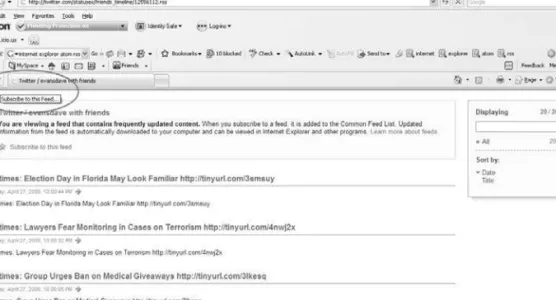
figures 4.5 and 4.6 show internet explorer, version 7, and firefox, version 2.
open up your feeds list (don’t worry if it’s empty, you’ll fill it).
Sites to visit:
T
• witter (You have set this up, right?) (http://twitter.com) b
• oing boing (http://www.boingboing.net) S
• eesmic (http://seesmic.com)
72
chapter 4:Week 1: Web 2.0: The Social Web■
Things to do:
locate the RSS/atom subscription icons for each of the suggested services. add these to your feeds list. although you won’t see much right away, take a look at your feeds tomorrow and see what’s new.
Figure 4.5 Subscribing to a Feed on Internet Explorer
Figure 4.6 Subscribing to a Feed on Firefox
73■TUeSDaY: The Web coMeS alive WiTh MUlTiMeDia
Thursday’s Exercise Guide and Wrap-Up
Today you looked at RSS, the universal connector that sits between social content and content subscribers. RSS enables the scheduled delivery of the content you want, freeing you from having to go out and search for it again after you or someone in your social circle has located it once. You can think of RSS as a sort of digital labor-saving device. importantly, RSS isn’t simply for social content: it’s for any content that is “better when delivered.” This applies to news, service subscriptions, marketing updates, downtime alerts, and more.
Friday: Social Networks
i waited until friday to introduce social networks for a reason: You’ve spent four days on social media and haven’t visited a social network yet. What should be clear, then, is that the Social Web and social media are not the same thing as social networks. Social networks are simply one element of the Social Web. Social networks wouldn’t exist — at least not in the context most people think of them now — without the technologies and broadly adopted online social practices associated with the social media services you explored earlier in the week. The usefulness of the featured services — along with RSS — have made joining and actively participating in social networks possible. To be clear, community members don’t need a lot of what you’ve now seen if they are satis- fied with belonging to one community — but who wants to spend all day in one com- munity? if social media and its application to marketing were truly centered around single communities, you could buy banner ads on MySpace or facebook and be done with it. fortunately for everyone involved, there is much, much more to do on the Social Web.
consider that aol’s membership peaked at about 26 million in 2002. aol is proof of the size of the “walled garden” community — that is to say, a community that really does intend for its members to get the vast majority of service, experiences, and interactions within the confines of that community — that can be built with fairly basic community tools. at the same time, america online (aol) also makes a pretty good case for the impact of the richer toolset you’ve seen this week. by 2006, aol’s membership had dropped to about half of its peak levels driven at least in part by the realization that a wider set of social tools — Del.icio.us, blogs, Wikipedia, the things you’ve seen this week — and a growing number of increasingly focused online social communities exist outside of aol. You name the interest and there is a community for it — these communities exist right alongside big mainstream communities such as MySpace and facebook and compete for attention. The ability to easily manage subscriptions, to connect community experiences, and to efficiently keep track of the information flowing into, out of, and through multiple communities has made the