Month 3: Complete Your Plan
You’ve seen how basic techniques — touchpoint analysis and the integration of the purchase funnel and Social Web — can be combined with metrics to quantitatively indicate the degree of success of your campaigns. You’ve looked at individual channels — blogging, photo and video sharing, white-label and location-based social networking and more.
As you gear up for the final steps in develop- ing your plan, the important best-practices come not from Parts II and III but from Part I: Cam- paigns will emerge on the Social Web that are counter to the long-term viability of social media–
based marketing. How you choose to proceed — what you choose to do in response to others’
questionable practices — will in large determine the availability of these important social channels for your future use.
Chapter 13: Week 1: Objectives, Metrics, and ROI
Chapter 14: Week 2: Develop and Present Your Social Media Plan
IV
289■Week 1: Objectives, Metrics, and rOi
Chapter Contents
The Basis for Social Media Metrics Choosing Social Media Metrics Real-World Connections Planning for Measurement The Main Points
Week 1: Objectives, Metrics, and ROI
Walking into a ballgame, you’ll often hear some- one shouting “Programs! Get your programs!
Can’t tell the players without a program!” I can’t think of a better analogy for this chapter: it’s all about nailing down — in writing — what you are trying to do so that you know what to mea- sure, so that in turn you’ll know when you have achieved your goals. Knowing what to measure — and indeed what social media channels to apply — begins with your business objectives and your audience.
13
290
chapter 13:Week 1: Objectives, Metrics, and rOi ■
The Basis for Social Media Metrics
in any marketing program, it’s usually safe to assume that the fundamentals of the pro- gram are at some level found in the business objectives of the firm or organization. For many marketers and the work that they do, this is in fact a valid assumption. However, it’s not universally true. it should be. it may be that everything you do begins with a firm grasp or statement of business objectives. just as likely, though, it may be that what you are doing as a marketer is actually distanced a bit from operations — per- haps by internal departments (aka silos), or control and ownership issues. the result is one or two degrees of separation between business objectives and marketing efforts.
When applying social media, it is critical — and perhaps more so than with traditional marketing — that your business objectives and social marketing efforts be tightly linked.
Why? think back to your touchpoint map and the social feedback cycle. each marketing touchpoint — recall the airline advertisement speaking to on-time arrivals — triggers a conversation. so too, each operational touchpoint — recall the chili’s “to go” signage and separate entrance — results in a conversation that also follows the social feedback cycle. With traditional advertising and marketing, you get to do the talking. You get to tell your potential customers what to expect, why whatever it is that you offer carries value, and how your customers will benefit from choosing you over a competitor. if something goes wrong — for example, if an item is out of stock or a flight doesn’t arrive on time — you can fix it after the fact by offering an apology, pro- viding a future discount, or making some other similar gesture. the important point is this: not only can you make amends with your inconvenienced current customer, your next potential customer will still see your original ad, along with the original promise and implied benefit intact. With traditional media, preexisting brand or product issues aside, you are in effect always starting with a clean slate.
this is not the case on the social Web. to be sure, you can make amends with a customer who feels wronged. it’s also true that in so doing, that customer may tell others that you stepped up and addressed the issue, and the resultant word of mouth may in fact have a beneficial impact. but there again is the difference between social and traditional media: if you assume that this customer will tell others you fixed some- thing, you’ve got to assume as well that any similarly disaffected customers (including any you may not know about) are also telling others that your original promise was not met. Unlike traditional marketing, where all potential customers see your original message, on the social Web each successive wave of potential customers sees the actual experience of the last wave, at least to the extent that it is reflected in social media–
based conversations. Your first customer hears “We have on time flights to new York.”
Your second customer, listening to the first, hears “they got me there late and i missed dinner, but they apologized and gave me a free flight coupon. they were nice about it,
291■tHe basis FOr sOcial Media Metrics
so sure, i’ll fly them again.” the second customer — as a result of that conversation — has a different expectation of your performance and, therefore, a different basis on which to evaluate a purchase or competing offer than did the first.
You are no doubt saying “Well sure, but that’s a rather negative example. What about positive examples? What about flights that get in early?” Fair enough — flights do get in early, and positive conversations most certainly exist. according to ed keller of keller-Fay and a recent Zenith Optimedia study, positive references outnumber negatives by about 7:1 in word-of-mouth conversations. One of the biggest reasons that you should be present in the conversations taking place via social media on the social Web is to ensure that these positive stories are told, and that in the process the sto- ries of the detractors are balanced or even negated. there is plenty that you can do to accentuate the positive, and do it you should.
that said, i’d also bet that your biggest challenge today is not looking at every- thing that is working perfectly and thinking about how great life is as a marketer! i’d bet that even if things are going well — really well — you are being pressed to do more, to deliver more traffic, to reduce expenses, and to improve margins, right? if so, i’d maintain that a lot of the gain you seek will come from improving what isn’t working while taking care not to mess up what is in the process. so, yes, there is a proper focus on the “negative,” or shall we say, the “opportunities to do better.” that’s why they call it “continuous improvement.”
Define Your Objectives and Audience
What all of this adds up to is this: regardless of where your directives for traditional media come from, your directives for social media must be tightly coupled with operations-based efforts and your business objectives. this is a straightforward result of the basic social media dynamic that links experiences — not promises — with the resulting conversations and the development of your ability to influence these conversa- tions. this linkage — shown in Figure 13.1 along with the conversations and resultant actions — is at the core of what social media metrics are all about.
CONSIDERATION
AWARENESS PURCHASE EXPERIENCE
Business Objectives
Social Feedback Cycle
Figure 13.1 Objectives drive social media metrics.
292
chapter 13:Week 1: Objectives, Metrics, and rOi ■
On the social Web, conversations are driven by actual experiences, which are themselves driven by operations policies and processes. Outside of conversations about your marketing campaigns — think “subservient chicken” and its impact on the burger king brand — the conversations that directly drive sales are the ones that directly reference the things you sell. these conversations are rooted in product and service experiences. the corollary to this is that viral campaigns — especially those with con- versations that focus on the ad rather than the experience — function much more like traditional media than social media. the ad may spread across the social Web and that can impart a benefit, generally in terms of awareness. awareness is a traditional media strength. accepting that the conversations that really help you are ultimately based on what happens when people try your product or service means that your social media metrics must be linked to your business objectives.
so, before you start into a social media program, meet not only with your mar- keting team but also with your product managers, business unit leaders, and opera- tions team. review customer service calls and look at product returns and the issues that drive them. talk to Hr. tie your social media objectives to the specific business objectives that drive improvement, and in doing so identify not only your choice of social media channels but also the metrics that will indicate success (or lack of) within those channels. then — and only then — apply the social media-based marketing techniques covered in Part iii as you work toward those objectives from a holistic marketing perspective.
Featured Case: Sony: Backstage101
Sony, working with social media provider Powered to market on social networks, placed interactive elements and widgets in these networks to create a branded experience within the community.
The branded experience, called Backstage101, centered on a social site that makes consumers smarter and creates engagement at the same time. Backstage101 is split into four categories:
digital photography, digital video, home electronics, and personal computing. Not coincidentally, these categories line up with Sony products. From a consumer’s standpoint, the connection to the brand is established through information that answers questions such as “What is HD?” and “What does 1080pi mean?” The program offers this type of information through a series of articles, flash tutorials, videos, and even free online classes. From a social standpoint, the site engages users by facilitating participant-to-participant interaction. As examples, participants can rate and review content, connect through profiles, and discuss issues through forums. For brands, structuring social programs around products can actually create a built-in measure of ROI.
293■tHe basis FOr sOcial Media Metrics
Featured Case: Sony: Backstage101 (continued)
Backstage101 has generated compelling results. Among them:Over 77 percent of participants are more likely to purchase;
•
Over 62 percent of participants are likely to be “Promoters” as measured using the Net
•
Promoter score methodology;
Over 90 percent learned something they did not previously know about the categories;
•
Nearly 91 percent of participants believe the program to be a satisfying experience.
•
There’s a valuable lesson from this case for brands thinking about social media as part of their mix. Increasingly, social media practitioners are talking about a “build or join” decision around community and social. This case illustrates that a successful build effort should be accompanied by a compelling reason for a consumer to participate, especially when there are so many other social media choices on the Web. A way to create that “reason to participate” is to help a con- sumer spend smarter and be smarter about the products they own. To maximize engagement, the participants’ experience should be built with a combination of practical and emotional rewards, such as learning (the practical benefit) and sharing that knowledge (the emotional benefit).
Behaviors that Drive Metrics
With your business objectives defined, next up is establishing the types of metrics that are both available to you (or could be) and that fit with your organizational or business culture. For example:
i
• f your business or organization is highly motivated by sales conversions, then tie your metrics into the pathway that leads through the purchase funnel to conversion;
i
• f your organization is all about visibility, then tie instead to the metrics that indicate your relative presence on the social Web and its change over time within your specific audience.
in selecting your key metrics, it is equally important to think through the kinds of social activities that your audience — or various components of it — may be engag- ing in. Your audience may be actively reading blogs, but not at all interested in actually blogging themselves. these types of differences in behavior will certainly impact your choice in the activities you offer them and hence the types of metrics that are available for analysis.
294
chapter 13:Week 1: Objectives, Metrics, and rOi ■
What and Where to Measure
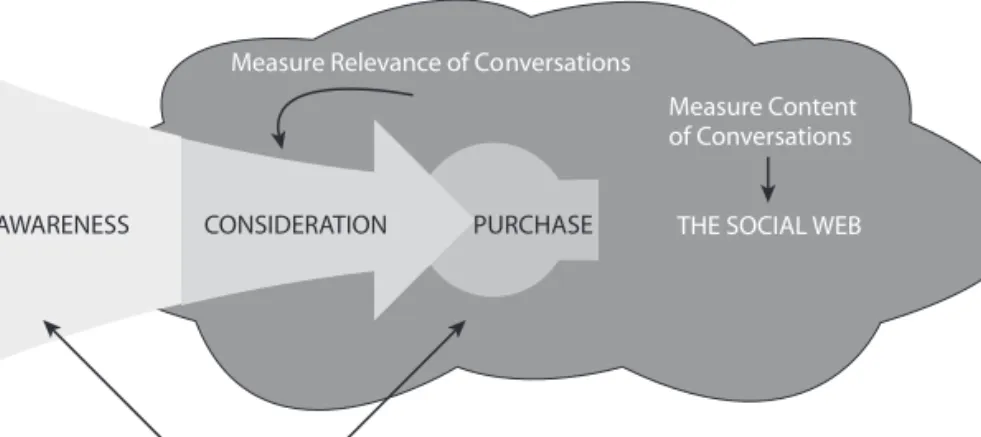
Measuring different aspects of social media allows you to evaluate what is happening at various points in the purchase process and on the social Web, something shown in Figure 13.2. in the next section, you’ll revisit the metrics tables from chapter 7, “influ- ence and Measurement,” and chapter 8, “build a social Media campaign.” this time you’ll select the metrics that are essential to you and then integrate them into your plan.
THE SOCIAL WEB CONSIDERATION
AWARENESS PURCHASE
Measure Impact of Conversations
Measure Content of Conversations Measure Relevance of Conversations
Figure 13.2 Metrics and the Social Feedback Cycle
looking at Figure 13.2, you’ll see various applications of metrics as they are col- lected at specific points. in the next section, i’ll present various measurement points.
You can use one or more, or all of them, to help build a robust measurement platform for your campaigns.
Tip:
In addition to measurements and the metrics you can identify and collect, be sure to tap resources like For- rester Research and eMarketer for baseline data and the trends that provide context to your quantitative objectives.Both Forrester and eMarketer offer a free newsletter in addition to subscription services. Featuring timely data and quick insights, both should be part of your regular reading.
eMarketer: http://www.emarketer.com
Forrester Research: http://www.forrester.com
Tip:
Because social media is a “moving target,” you’ll want to establish a baseline for each of the metrics you choose to collect and then track that metric over time. It is often the change — and not the absolute value — in a given metric that is important in establishing an ROI for social media-based campaigns.295■tHe basis FOr sOcial Media Metrics
the three types of metrics that i suggest collecting are those aimed at:
Q
• uantifying content: the social conversations and artifacts themselves.
Q
• uantifying relevance: the degree to which what is being said matters to you.
Q
• uantifying impact: the bottom line, the net benefit, the direct measure of the change in desired outcomes following exposure to a socially created and deliv- ered message.
just as social media is a complement to your existing campaigns, the metrics that apply to social media are a complement to your existing measures. For example, you looked at the purchase funnel and saw the social feedback cycle that links post- purchase measures of satisfaction and the likelihood of a positive recommendation.
recommendations and similar conversations are the drivers of what happens in the consideration phase, between awareness and purchase. the metrics that quantify them are just as much a part of your marketing program as rating points and market share.
Social Content Creation
the recommended starting point in gathering social media metrics is the social Web itself. it’s the most direct indication you can get with regard to understanding and tracking what is being said about you. if you measure nothing else, at least measure the relevant conversations as they occur on the social Web. there are numerous plat- forms — i’ve talked about nielsen|buzzmetrics’ blogPulse and cymfony’s Orchestra platform. techrigy and diYdashboard and many others offer great tools as well that are geared toward the measurement of online conversations. Figure 13.3 shows the techrigy social Media dashboard. Of course, you are always welcome to build your own. beginning with tools such as blogsearch and Google alerts, you can go a long way toward gathering and tracking useful social data.
beginning with content measurement has the nice added benefit of setting you up to listen to what your customers are telling you. if this is your first marketing effort outside of traditional media, this can be an especially insightful starting point. One of the most valuable aspects of the social Web for marketers, and specifically with regard to the role of social media, is in its ability to provide a clear, detailed picture of what it is that the people who matter to you are saying about you and what they are telling others. there are an estimated 3.2 billion word-of-mouth conversations, worldwide, each day. about 2.3 billion reference a brand, product, or service, either directly or through a reference to associated advertising or media. the absolute number of con- versations that reference your firm or organization directly may be small — but if you expand what you are listening to so that it includes your industry, suppliers, competi- tors, and customers, you’ll find that a larger conversation is surely happening one that is definitely worth hearing.
296
chapter 13:Week 1: Objectives, Metrics, and rOi ■
Figure 13.3 Techrigy Social Media Dashboard
One of the easiest ways that a listening program built on the social Web can be started is by setting up and running private learning communities. think of these as a sort of community/focus group hybrid: a place where a dedicated group — usu- ally composed of a few hundred people — is regularly consulted in situ on a range of issues that often have relevance to marketers and product developers. although these are not social Web communities per se — they have been formed by design and are maintained primarily for purposes of research — they do represent a significant source of knowledge and are great step up from one-off focus groups. Firms like communis- pace specialize in these types of listening applications. You saw two examples of com- munispace applications, one for Hallmark in chapter 3, “What is social Media?” and another for Glaxo kline smith in chapter 5, “the social Feedback cycle.” naturally, these types of listening applications provide detailed metrics and are well worth your consideration.
Tip:
Attention B2B marketers: The potential for using the Social Web to follow not only your firm and your competitors but also your suppliers and customers is huge. They may not be hanging out on MySpace (or, depend- ing on your industry, maybe they are!) but they are on the Social Web. Look for the communities that support them.Participate, pay attention, and take notes on what you find there.
297■tHe basis FOr sOcial Media Metrics
Tip:
Thinking back to Chapter 12, “Social Interactions,” it is essential when considering the use of managed applications that you get involved and stay involved. Unlike traditional media campaigns that begin and end on command, or focus groups where your brand is often anonymous, social applications result in visible, durable rela- tionships between people and your brand that take on a life of their own. By being involved, and by thinking clearly about how a managed program will evolve and play out, you not only benefit from the program itself, but you set in place the basis for a true community built around your brand and the larger experiences you provide as your overall social media program expands later on.Relating Social Content and Specific Offers
it can be useful to gauge the relevance of specific social media channels as the conver- sations they carry enter the consideration phase of the purchase process. by relevance what i mean is the degree to which the conversation helps a potential customer relate to your particular offer. this kind of measurement can be helpful in prioritizing social media channels. in prior sections, for example, i referenced the application of social media and listening to b2b marketers. social media is applicable to suppliers and partners right along with customers and competitors. You are probably interested in what your customers are talking about if your business objectives center on boosting sales. alter- natively, if you are looking for a competitive advantage, you may find the conversations between your suppliers and partners to be valuable.
this same sort of thinking applies to essentially any listening application involv- ing social media. in all cases, you’ll want to track the references to specific terms, or mentions of specific sources, as they show up in the conversations that your customers are having. For example, in order to locate the most useful social applications from the perspective of your customers, you need to know what they are participating in. this can help you to design and guide your own social media campaigns as well as provide insight into some of the marketplace dynamics that drive your business.
The Ultimate Goal: Conversion
Finally, social media can have a pronounced impact on the standard purchase funnel.
in chapter 5, i offered the following tip:
Tip:
Your promise minus your delivery equals what you do at the point-of-sale.to recap, if the social Web is full of beneficial conversations about what you offer, you’ll need to do less than you would otherwise to get a potential customer across the goal line and talking about you. if the social Web is working against you,
298
chapter 13:Week 1: Objectives, Metrics, and rOi ■
you will have to work harder instead. You can actually tap your basic purchase funnel dynamics and use them to gauge the impact of your social campaigns, often without collecting any data beyond what you are collecting now.
consider the assessment of effectiveness for traditional ad spending. by com- paring changes in awareness with changes in conversions at the point of sale, classical marketing analysis draws a relationship between the spending required to achieve cer- tain levels of awareness and certain levels of consumption. You’ve likely gathered (and will need to gather before launching social media campaigns) a reasonable base of just this type of information. You probably already know how changes in awareness drive changes in purchase behavior. You know the lower limits of “enough awareness,” in other words the lower limit of ad spending below which the impact is roughly the same as not advertising at all, as well as the upper spending limits above which saturation occurs and incremental sales per dollar spent begins to slow or even drop. between these points, if you’ve got the data, you can draw a fairly robust baseline relationship.
enter social media. beneficial conversations on the social Web have a neutral to positive impact on the conversion rates for the portion of your audience that comes into contact with them. this, by the way, is why it’s so important to establish both your business objectives and your audience behaviors before you start your campaigns. if you’re all over Youtube — but your audience isn’t — then your viewership metrics are meaningless and your business gains will be minimal at best.
Choosing Social Media Metrics
in the previous section, i presented a basic approach to the design of your social media metrics: begin with your business objectives and the capabilities or social media- related behaviors of your intended audience. at the macro level, you looked at content, relevance, and resultant impact as a primary guide in what you want to be measuring.
if you’re starting out, focus on content and get a firm handle on what (if anything) people are saying about your brand, product, or service. if you’ve got a blog, or a basic support forum or community, if there is evidence of a meaningful conversation about your offer, focus on the consideration phase or your actual conversions and look for the impact of social media.
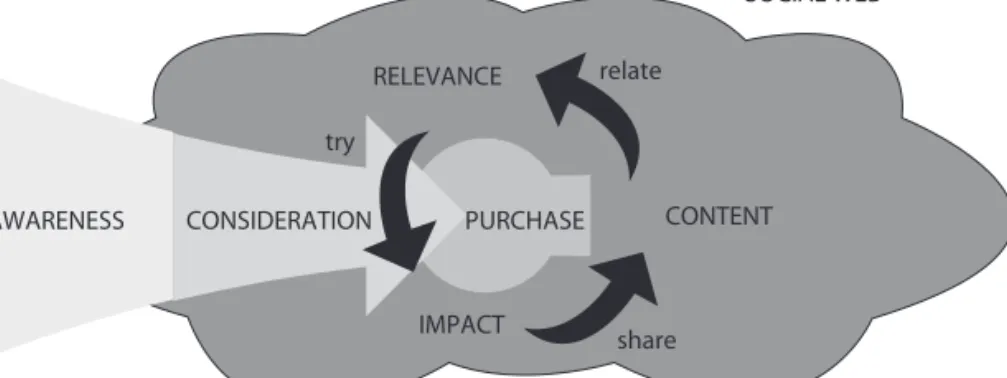
in the next section, you’ll put all of this together as you define your starting set of social media metrics. look at Figure 13.4. recognizing a bit of a chicken and egg scenario, the logical flow of social media-based content that i’ll assume — and the met- rics that stem from that flow of content — begins on the social Web with the content itself, with the conversations that are of interest to you. this is, essentially, a listening approach to collecting and tracking metrics: they talk, you listen, and then track the changes in what is being said over time and evaluate how it helps or hurts you. Your study of metrics continues with the relevance of this content and its entry into your world at the point of consideration: How are these conversations being used? are the
299■cHOOsinG sOcial Media Metrics
conversations central to the benefits of what you offer? For example, are people specifi- cally calling out a product feature that your competitors don’t have, or one that your product lacks — or is the conversation more generic, more focused on the industry as a whole? the former tells you that your overall message — or that of your competitor — is getting through. the latter says, at least as viewed through these conversations — that either you have a “me-too” or undifferentiated product, or you are operating in a low-interest segment. This is still very useful data: it provides guidance on how to market. Your social media metrics help quantify the ultimate impact of these conversa- tions on the purchase funnel: the changes in conversion rates that result when social media — and with a bit of luck and lot of good planning, beneficial social media — is applied in a marketing context.
SOCIAL WEB
CONSIDERATION
AWARENESS PURCHASE CONTENT
IMPACT share RELEVANCE
PURCHASE FUNNEL
try
relate
Figure 13.4 Metrics and the Social Feedback Cycle
Metrics in Motion
social media metrics are evolving as the discipline of social media marketing evolves and the drive for robust metrics across a range of marketing and advertising applica- tions intensifies. as a result, developing a solid metrics base for your activities often involves a combination of well-understood data — for example, the time spent on your company website — along with trends that you develop over time based on the wider range of data available to you. this underscores one of the keys to establishing a solid quantitative base: measure and collect more than you think you’ll need, and then dig into the trends you observe. in so doing, you’ll uncover the key relationships that that matter in your particular business and your use of social media.
Content Metrics
beginning with the metrics associated with social Web content, table 13.1 shows the relationship between content measures aimed at quantifying your audience — who is talking about you and your industry, and what they are saying. if you only do this much, you’ve made great use of the social Web and social media. the metrics that you
300
chapter 13:Week 1: Objectives, Metrics, and rOi ■
can collect will be used to indicate how the total of everything else you are doing — including the actual delivery experience — is perceived.
You can use this data strategically to isolate the contributions of your evangelists as well as the fallout from your detractors. Of course, you can also use this data in a highly tactical way (for example, to prioritize product improvements or schedule your response to competitive moves). note as well the return of the net Promoter score:
while the actual net Promoter score methodology involves directly questioning your audience and applying a specific ten-point scale, phrases that you can pick up and mea- sure on the social Web that begin “i’d highly recommend…” can certainly be used as a directional indicator in assessing the overall health of your brand. as well, you may find your own promoters being picked up on the social Web.
PTable 13.1 Content Fundamentals and Metrics with Suggested Sources
Fundamental Metric Source Reveals
Audience Blog Posts for Brand, Competition Product or Service
Recommendations Tweets and similar Widget Views
BlogPulse, Google Alerts, Cymfony, Techrigy, Blog- search, Technorati Net Promoter Social Media Platform Provider
Who is talking about you;
What people are saying about you and your industry
the collection method you use can be as simple as tracking Google alerts, for example, and then making note of the source of the content referenced in the alert.
this kind of analysis, though it may be a bit labor intensive, needn’t cost you a ton of money.
alternatively, you can enlist any of a number of service providers to collect, distill, and report this data for you. some of these service providers — in particular cymfony — offer social media dashboards that include offline audience measures
Tip:
Do not skip the formal Net Promoter score, as presented in Chapter 7, in favor of an abbreviated assess- ment. You will not get the reliable data that you need in regard to this foundational social media metric unless you adhere to the methodology presented in the “The Ultimate Question.”Tip:
Consider using an intern if you approach the collection of data manually. The opportunity to explore the Social Web and extend some of the basic social media metrics tools aimed at content is rewarding and a great first step toward a marketing career. This can be beneficial to both you and your intern.301■cHOOsinG sOcial Media Metrics
in addition to online. by combining online and offline information, you can more effectively tie your social campaigns to your traditional marketing efforts. cymfony’s reporting module, listing online Hybrid conversations, is shown in Figure 13.5.
Figure 13.5 Capturing Content Metrics
Relevance Metrics
continuing with the flow of content on the social Web, the metrics associated with relevance — again, in the sense of social media experiences that link or relate the inter- ests of potential customers with what you have to offer — are typically of interest to marketers. although not perfect, the idea here is to link the metrics around the conver- sations on the social Web that you covered in the prior section with the actual impact on your desired conversions, something you’ll cover in the next section. table 13.2 shows the relationship between the selected relevance measures that help quantify the contributions of social conversations in terms of influence, engagement, and loyalty.
Unlike the content metrics, many of the relevance metrics are associated with your own social media efforts — your company website, or other properties or assets for which you have access to the underlying analytical data. in evaluating relevance, what you are looking for in these metrics is an indication that the associated content is being used as a part of the decision-making process. You are specifically focusing on the application of these metrics and the weight given to the social media content as it enters into the consideration processes that support conversion. this can be a fairly
302
chapter 13:Week 1: Objectives, Metrics, and rOi ■
subjective process, but even so it is worthwhile. as with nearly all social media metrics, the key is to track what you find over time. You will discover the elements that are most important to you and those that are most valuable in specific situations.
PTable 13.2 Relevance Fundamentals and Metrics with Suggested Sources
Fundamental Metric Source Reveals
Influence Time on Site Bounce Rate
Web Analytics: Google Analytics, Omniture, Web Trends
The value of the opinions and conversations to those interested in purchase.
Engagement Pass Alongs
Comment to Post Ratio Diggs, Stumbles, and bookmarks
Podcast Listens and Views
Web Analytics, Google Analytics, Omniture, Web Trends, DoubleClick, Digg,
StumbleUpon, Del.icio.us Feedburner
The interest levels in your message: Are customers willing to pass a referral along given a potential gain or loss of personal
“social capital”?
Loyalty Blog Posts for Brand, Recommendations Tweets and similar
BlogPulse, Google Alerts, Cymfony, Techrigy, Blog- search, Technorati
The context and intensity of blog posts. Are people sticking up for you? This can have a direct impact on whether or not this information makes it to the consideration process.
Impact Metrics
the prior sections — content and relevance metrics — covered information picked up by listening on the larger social Web. this was then enhanced by gauging its relevance through the analysis of data available from social media tools that you may be using now (for example, a company blog or support forum). by taking an additional step — connecting the metrics associated with social media content and its relevance to the consideration processes within the purchase funnel — you can use the same tools you have in place now for measuring advertising and marketing effectiveness to assess the net impact of social media on your marketing program. table 13.3 shows the relation- ship between content measures aimed at quantifying the impact of social media and indeed the entire social feedback cycle within your purchase funnel.
Tip:
Social media measurement is based as much on heuristics — using what is available to make the best of what you have — as it is more traditional quantitative and statistical analysis. Don’t be afraid to go with your gut:your experience is worth a lot when it comes to making sense of these new channels.
303■real-WOrld cOnnectiOns PTable 13.3 Impact Fundamentals and Metrics with Suggested Sources
Fundamental Metric Source Reveals
Audience Referrers, Demographics Web Analytics, Google Analytics, Omniture, Web Trends, DoubleClick
To whom your social media campaign is appealing.
Influence Loyalty Time on Site Bounce rate
Web Analytics, Google Analytics, Omniture, Web Trends Repeat Customers
How involved your audi- ence is with your message and brand, product, ser- vice as a result of exposure to social media
Action Conversions
Reviews Recommendations Tweets and similar
Web Analytics, Google Analytics, Omniture, Web Trends Reviews and Ratings Platform
Net Promoter
The number of times a desired outcome occurs following exposure to your holistic campaign. Tweets or similar references to a definite purchase or action reveal this as well.
looking at metrics from the point of the view of conversion impact brings the value (positive or negative) of social media home. When looking at your web analytics (for example, in evaluating your online commerce results, promotional offer uptake, or simply your incoming requests for more information), the first thing you want to estab- lish is a baseline. if there is already some degree of social conversation happening then your current conversion measures reflects this. this is your baseline.
When you combine this with the additional historical data that you have around spending, awareness, and conversion, you can place bounds on the deviations from your straight awareness/conversion curve to account for competitive moves, economic condi- tions, and many of the other details that complicate the real life calculation of impact around any single media channel. sure, this is a fundamentally empirical approach — that is to say, based on observation rather than hard science — but is nonetheless a valid approach. Precisely because it is empirical it has the nice side benefit of placing you in direct contact with the flow of social media and the data associated with it. the benefit of approaching metrics in this way cannot be overstated — especially for a relatively new discipline such as the use of social media in marketing — in an application where sales, market share, bonuses, and people’s jobs are at stake. take the time to work through the underlying metrics and build your baseline cases: this is, after all, the real show. this is not a dress rehearsal.
Real-World Connections
in the previous section, i presented the fundamental indicators and the associated social media metrics. the intent was to provide an explanation of how these metrics
304
chapter 13:Week 1: Objectives, Metrics, and rOi ■
can be derived from conversational and analytical data. this is important because there is no social media sensor that you can wave over the Web to see what’s going on — at least not yet. instead, you have to measure what is visible, track it, and then derive the results based on what you see. in the next section i’ll tie these fundamentals to five key areas of interest to most marketers: audience, influence, engagement, loyalty, and action. Within each of these areas, as shown in Figure 13.6, you’ll see how the sug- gested metrics can be used to establish a baseline and then build on it as your social media program is put into practice.
Engagement Influence
SHARE
Audience (shoppers)
Loyalty Influence Action TRY
Audience (customers)
RELATE
Figure 13.6 Connections to the Social Feedback Cycle
Audience
an understanding of your audience adds depth to the conversations you uncover by telling you who is leading them versus who is being led. What they are saying — the actual conversation — is only part of the story. knowing who is saying it and who is listening gives you very valuable insight when planning your social media campaigns.
by tracking not only the content but also its sources, you can pinpoint your influencers.
the sources of conversations are available in most of the commercial tools referenced:
this is a great feature to look for when selecting a metrics partner.
taking audience measures one step further, once that audience arrives at your site — surely armed with whatever the social Web offered up — what you are likely to be interested in is what they are doing. Here, you can turn to your own commerce or
305■real-WOrld cOnnectiOns
conversion analytics and supplement that with your web analytics (for example, refer- rer data which is good, but not always reliable) or tracking data from a third party like doubleclick (which is much better) when and where applicable.
Tip:
Use audience measures to answer questions such as “Who are the influencers?” and “Are those they influence more or less likely than others to follow along?”Influence
influence, one of the key drivers of the interest in the use of social media in marketing, is present as a factor in both relevance — the likelihood that a conversation will lead someone to consider or reconsider your offer — and impact — the actual increase (or decrease!) in the likelihood of a purchase based on social media exposure. influence is evident in two fundamental metrics that are easily obtained: time spent and bounce rate.
time spent, as its name implies, indicates how much time people spend with your site, blog, or other online content that you maintain. More time spent generally correlates with higher interest: in the social sense, higher interest typically follows from an experience that has been relatively more influential. think about this way: if a trusted source that you know to be a domain expert tells you to go and look at some- thing, even if you don’t understand why right away, you will tend to spend more time considering it, precisely because it’s been recommended by a trusted source. that is influence.
Tip:
If you measure conversations that include strong indicators of active recommendations, look for increases in time spent at the destination point (e.g., your site or offer page).Bounce rate is a sort of inverse indicator: generally, you want it as low as pos- sible. bounce rate measures the percentage of landing page terminations compared with all landing page arrivals. a bounce rate of 100 percent means that everyone who landed looked and split.
Tip:
More and more contemporary sites are built with AJAX and similar Web 2.0 technology that has a peculiar and significant impact on page views, bounce rate, and similar metrics that evolved in a Web 1.0 page-oriented context. A discussion of these technologies is beyond the scope this book, but do take the time to understand how your applications are built so that you can properly assign significance to the metrics you collect.306
chapter 13:Week 1: Objectives, Metrics, and rOi ■
Unless your entire campaign is built on a single page and has no clickable call to action, the bounce rate is a clear indicator of arrivals who lost interest and moved on to some other search area or site rather than looking at your offer in further depth (i.e., clicking into your site). like time spent, bounce rate is related to influence: higher influence in directing people to your site, all other things being equal, will lower the bounce rate.
Engagement
Often talked about but seldom grounded in hard numbers, engagement is one of the more elusive social media measures. engagement, in the context of social media mar- keting means simply the degree to which someone feels attached to your product, brand, or service and the social media elements that are involved with it.
engagement — or at the least, a very good surrogate for it — shows up in the consideration phase as action taken. examples are the number of items sent to a friend and the comment-to-post ratio on your blog or those of others that reference your brand, product, or service. send-to-a-friend actions are particularly good, as these indicate the degree to which someone spent enough mental energy to conclude that what you offer would be perfect…for someone else. if you are simultaneously tracking sources, then you can also get a sense for engagement as it regards that source. When you see a disproportionate share of traffic arriving from a certain site or community, you can conclude that a relatively high degree of engagement exists within that com- munity. this is a point that robert scoble has made with regard to digg. When your content generates diggs, you get a lot of traffic. digg is an engaged community. look at digg, stumbleUpon, and del.icio.us as indicators of engagement for your own social media content. if you are using podcasts, look at the numbers of downloads using the great toolset available at Feedburner.
if you are maintaining a blog — or if you are evaluating a blog as a source of influence and interest in your content — the ratio between posts and comments indi- cates relative participation: More comments per post indicates that your audience is doing relatively more of the talking. that’s generally good.
Tip:
If you measure conversations that include strong indicators of active recommendations and your bounce rate is still high (e.g., over 50 percent) or is starting to climb, look at the landing page and check that the experience it provides is consistent with the likely interests or motivations of those arriving. If it’s inconsistent, fix it.Tip:
Comment to Post or Post to Comment? You’ll find this measure expressed both ways. While “posts to comments” is more popular, “comments to posts” is the measure that actually rises in value as the thing you are generally after — audience participation — improves. Either way, they both tell the same story. Be sure you know which measure you’re looking at when talking about which way the needle needs to move.307■real-WOrld cOnnectiOns
Loyalty
loyalty means spending time with something or someone on a repeat basis: coming back for more as a result of consistently choosing this over its competing alternatives.
in the context of social media marketing and relevance, it means coming back to the point of consideration, moving consistently from the general conversations on the social Web back to the social media-driven entry point into the purchase funnel. the more that someone is coming back to make or consider a purchase, the stronger the indication that this person has a relatively high degree of loyalty (or would be will- ing to develop a high degree of loyalty if you ultimately do your part). Once purchase intent is expressed, you can turn to things like cart abandonment, analogous in com- merce to bounce rate in landing pages, and similar measures that indicate loyalty and ultimately conversion.
repeat customers — and the conversations they provide through ratings, rec- ommendations and reviews — are an obvious indicator of loyalty. tracking an index based on your repeat customers along with what they are saying and then tying this to conversational metrics gives a forward-looking (i.e., predictive) metric with a time- line roughly equivalent to your sales cycle. How? simplified, it works like this: if your sales cycle is 90 days and your typical repeat customer buys from you twice per year then when your repeat customer conversational index begins to dip, you can expect to see a magnified impact about two quarters from now. it’s an early warning. You have 90 days to jump into the conversational data and find out what the cause is, and then develop a proactive response through a combination of efforts (for example, targeted email and social media) that are specific to your repeat customer base.
Action
action is the bottom line: did the conversion happen or not? did social media play a role in this happening — or nOt happening? the most straightforward way to approach your development of action-oriented metrics is by looking at your conversion rates and comparing them with your benchmarks for conversion rates in the absence of social media. the best way to assess impact — and to get a handle on rOi (see related sidebar) — is to establish a robust baseline that describes the relationship between the marketing activities you are currently engaged in (spending levels, awareness, and sales, for example) and then compare this to what you observe as you introduce social media into the mix.
Many of the metrics you are likely to have at hand are related to both conver- sion and the number of people expressing intent versus the number who actually convert. add to this the direct observation of social media: reviews, recommendations, posts on twitter, and similar social forums, all of which provide guidance in under- standing the role that social media is playing in driving (or dissuading) conversion.
look to your web and commerce analytics tools, your reviews or review platform, and of course to your net Promoter score and its trend over time.
308
chapter 13:Week 1: Objectives, Metrics, and rOi ■
Assessing ROI
Fundamental to measuring or assessing ROI is determining what constitutes the return. You opened this chapter with the requirement of setting business objectives: this was no coincidence.
You can measure conversions of nearly all types: subscriptions, purchases, requests for more information or a call, etc. Essential in developing a robust indicator of ROI is tracking all of this over time to measure the effectiveness of specific marketing activities as they relate to your busi- ness objectives. This gets to the heart of empirical measure. Ultimately, if you sort through the data you have — or could have — you can create a reasonable measure of ROI. Create a baseline for your current activities and a wide range of marketplace scenarios, and then use this data to separate the various contributions of specific marketplace efforts. As you introduce social media, look at the changes in what you observe, and from this make your case for ROI. As much as I’d love to say “just measure this,” there is no single source for measuring as complex an environ- ment as a marketplace. Data — lots of it — combined with your own skill and judgment as a marketer is your best way forward.
Planning for Measurement
based on what i’ve presented in this chapter, the exercises this week will lead you through the identification of specific metrics — based on your business objectives — that are most useful in guiding your social media implementation. the exercises this week focus on set- ting objectives, evaluating the data sources that you looked into in chapter 7 and chapter 8.
this week you’ll be identifying a starting set of metrics to support your plan.
Featured Case: Jig-a-Loo: Grassroots Social Marketing
Jig-A-Loo is a silicone-based lubricant and water-repellent spray. It has been used in the commercial and industrial sectors in Canada since 1958. It was launched in 1998 to the Canadian mass retail market and launched globally in 2007. The campaigns’ goals were to drive online awareness of Jig- A-Loo ideally resulting in consumer trial of the product and an increase in frequency of product use.
Fanscape’s Grassroots department instigated strategic online buzz and fan activation in social online venues in 2008. The strategy behind Fanscape’s approach was two-fold:
1. Focus on extremely targeted social media gathering places that would be responsive while tapping Fanscape’s knowledge of the social media space and its relationships with site owners along with analytics tools such as Quantcast and comScore MediaMetrix.
2. Engage the target audience by presenting solutions to common problems that could be solved by the use of Jig-A-Loo while being fully transparent with the messaging as shown in Figure 13.7.
309■PlanninG FOr MeasUreMent
Featured Case: Jig-a-Loo: Grassroots Social Marketing (continued)
As of the end of May, the team had conducted over 20 extremely targeted responses on Question and Answer sites, posted 7 videos across user-generated how-to video sites resulting in over 2,000 video views, and posted a highly researched text and photo “how-to” post across five sites.
The Yahoo Answers screen shot shows a typical question and answer. Note the number of direct, overt references to the connection between the respondent and the product. This is a great example of the transparent use of social media, amplified by the fact that this response was also chosen as the best.
Figure 13.7 Jig-a-Loo Forums Participation
Monday: Your Business Objectives
today you’re going to spend an hour finalizing your business objectives. this is the opening exercise for the creation of the metrics portion of your social media market- ing plan.
310
chapter 13:Week 1: Objectives, Metrics, and rOi ■
Monday’s One-Hour Exercise r
• each back to your exercise from chapter 5, and look at the business objectives and success metrics you defined when you created your social feedback cycle. at the same time, pull together the larger business objectives that define your com- pany or organization’s success goals for the coming years.
c
• onnect each of your specific goals and success metrics set in chapter 5 to one or more of your overall goals.
d
• efine each of the success metrics, and identify the source of the data that you’ll need to support this metric.
Monday’s Wrap-Up
today you pulled your business objectives into your social media plan: this is the essen- tial first step in setting up for success since it grounds your plan in the things that are valuable and as a result, actually drive your business. don’t worry that you haven’t actually connected your business objectives to your plan yet: you will.
Tuesday: Your Audience
now that you’ve defined your business objectives and established in them the basis for your social media campaign, today’s exercise is all about understanding your audience.
knowing what they do online — reading, creating content, commenting or offering reviews, or doing nothing at all — is essential in developing a social campaign.
Featured Case: NBC’s “Chuck”
Chuck is an American action-comedy television program created by Josh Schwartz and Chris Fedak. The series is about an “average computer-whiz-next-door” who receives an encoded email from an old college friend now working in the CIA; the message embeds the only remain- ing copy of the world’s greatest spy secrets into Chuck’s brain.
The supporting campaign, created and implemented by Fanscape, ran in two parts: an early creative build and a later online marketing effort. The overall campaign objective was to drive online awareness for the NBC series premiere of Chuck.
2007 Campaign: Creating a Social Presence
Fanscape created Chuckssecret.com, a Chuck online universe complete with every aspect of Chuck’s personality and habits. The overall social campaign incorporated leading Web 2.0 sites through a series of “spokes,” each designed to appear as icons on Chuck’s desktop. These icons lead to real-world profiles of Chuck on sites such as MySpace, Facebook, LastFm, Twitter, Flickr, Stickam, YouTube, Geek2Geek, Ning, Delicious and more. Fanscape staff regularly maintained these 10 Web 2.0 properties for the fictional character “Chuck Bartowski,” even sending regular tune-in reminders to friends who had subscribed. The site brought the character of Chuck to life
311■PlanninG FOr MeasUreMent
Featured Case: NBC’s “Chuck” (continued)
and allowed viewers the opportunity to observe and interact with him online leading up to the show launch.
The graphic below and larger Figure 13.8 shows the Chuckssecret website sitting at the center of the social wheel: each of the spokes — the profiles and social presences created for the charac- ter “Chuck” — are shown around the central site.
The success of this approach was measured by the number “friends” and other WOM interactions (views, etc.) the profiles garnered (over 700 MySpace friends, over 300 Facebook friends, over 600 Twitter followers, 6,500 profile views on Stickam, 72 Last.fm friends with 30,000 profile tracks played) along with traffic to the website (74,000 visits).
Figure 13.8 “Chuck’s” Social Presence
Tuesday’s One-Hour Exercise
today you’re going to pull together the data you need to make an informed choice about the social media channels that might apply. You are not going to pick them today; you’ll do that in chapter 14 when you make you plan.
312
chapter 13:Week 1: Objectives, Metrics, and rOi ■
in chapter 9, “social Platforms,” i referenced Groundswell by charlene li and josh bernoff. the book takes a detailed look at the impact of social media and related technology, and the resulting transformation of consumers. Pulling from the extensive Forrester research studies, they’ve identified fundamental consumer behaviors for vari- ous demographic groups. For example, they have separated people involved in content creation — making and posting a video or writing a blog — from those who would rather simply comment. they’ve identified active participants versus spectators versus nonparticipants. this is a solid framework for today’s exercise, as well as for your regular use when mounting social media marketing campaigns.
to complete today’s exercise, do the following:
i
• dentify each of the audience segments — using standard age groups and demo- graphic — that you are interested in with regard to your social media campaign.
G
• ather internal data (or pull from your own knowledge) a picture of what each of your specific segments does when online.
i
• f you do not have this data — or if you simply want to check your data against the Forrester research studies — use the free profile tool found at the Ground- swell website.
F
• or each segment in your audience, create a profile of the typical behaviors you expect: are they content creators? do they write reviews? do they watch tv all day?
Tuesday’s Wrap-Up
You now have a good handle on your audience and your business objectives. keep this information in mind as you move forward this week.
Wednesday: Content Metrics
now that your business objectives and audience behaviors are defined, it’s time to look at the metrics open to you. Over the next three days, you’ll work through the metrics that characterize conversations, the metrics that are indicators of interest and intent, and those that are directly associated with your purchase funnel. each day, as you fin- ish, you’ll be adding one more set of metrics to your developing social media plan.
Tip:
An excellent — and free — profile tool that provides a quick snapshot of your audience with regard to its use of social media can be found at Forrester’s Groundswell website:http://www.forrester.com/groundswell/profile_tool.html
In addition to the Groundswell tools, the eMarketer newsletters referenced earlier in this chapter are an excellent source of high quality trend and behavioral data.
313■PlanninG FOr MeasUreMent
Wednesday’s One-Hour Exercise
today you’re going to focus on conversational metrics: the things that define and indi- cate the intensity and polarity of what is being said about your brand, product, or ser- vice on the social Web.
today’s exercise consists of the following items:
l
• ook back at Figure 13.1 and the definition of your audience and your business objectives. confirm that there is something for people to talk about, and that the audience or audience segments you are focused on are themselves likely to be talking about it.
l
• ist the specific features or unique attributes of your brand, product, or service.
c
• reate the same list, except do it for your competitors.
U
• sing blogsearch, blogPulse and technorati, search for these items and write down (or summarize) what you find.
U
• sing Google, search for these same items on the Web and write down (or sum- marize) what you find.
t
• race the posts that you found back to their source. see if you can identify the type of audience member that contributed each item and ensure that you have accounted for this segment in yesterday’s exercise.
When you have completed these items, integrate this data and its sources into the metrics section of your social media dashboard and report card that you created in chapter 8. if you’d like to use this data to create your baselines for your selected measures, do so now. Otherwise, this should be your first action when you set up your metrics program and begin building your social media reporting tools.
Wednesday’s Wrap-Up
the point of today’s exercise is to create the beginnings of a baseline, and to validate the existence of conversations that reference the products and services you sell or offer.
importantly, you may or may not find your brand name or your specific feature. very likely, however, you will find information that is useful to someone who is considering your product or that of a competitor. if so, and you begin to track it over time, you can develop a solid understanding of the things that potential customers are encountering when they are doing their online research. this can be very helpful in identifying other marketing opportunities, competitive advantages or disadvantages, and gauging the perception of your industry.
Thursday: Relevance Metrics
today you are after the connectors, the metrics that help you link the relevant conver- sations on the social Web with your actual conversion process. What you are looking