• Tidak ada hasil yang ditemukan

PDF Month 3: Create Demand with Facebook Ads

N/A
N/A
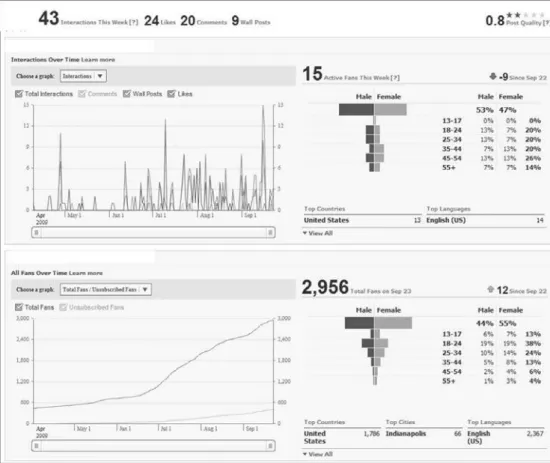
Protected

Academic year: 2024

Membagikan "PDF Month 3: Create Demand with Facebook Ads"

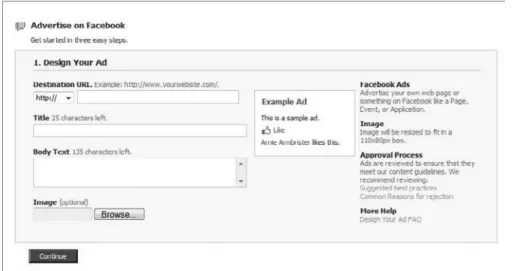
Copied!
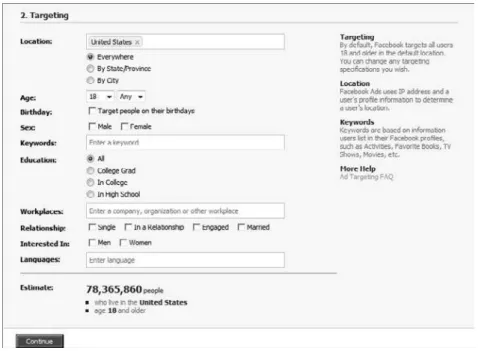
30
0
0

Teks penuh

(1)Month 3: Create Demand with Facebook Ads Facebook advertising is one of the best deals today in Internet marketing; nowhere else can you target users as surgically as you can on Facebook. of the same targeting on other Internet properties and offline outlets. Even so, you should paradoxically temper your expectations. Facebook ads. 6. work differently than banner ads or search engine click-through ads. Users respond differently to Facebook ads, and depending on demographics and social norms, some ads work better than others. Success with Facebook advertising requires aggressive monitoring, experimentation, patience, and creativity.. Chapter Contents Week 1: Learn the Basics of Facebook Advertising Week 2: Build the Dashboard and College Data Week 3: Refine Your Campaign Using A/B and Multivariate Testing Week 4: Analyze and Adjust the Campaign. 127 ■ M o n t h 3 : C r e at e D e m a n d w i t h Fac e b o o k Ad s. Better yet, you can do it for a fraction of the cost. (2) Week 1: Learn the Basics of Facebook Advertising Before we get started with a campaign, we’ll review some basic concepts of Internet advertising. All Internet advertising campaigns set out to influence consumer behavior in one way or another. Campaigns range from simple awareness to image building to specific calls to action based on the manager’s goals. These goals are determined based on the context of a specific situation within an organization: a company may be looking to improve its image, a nonprofit may be looking to expand its volunteer base, or a government agency may be looking to inform users of a new site that will improve their operating efficiency. Regardless of the intent, Internet advertising, if properly harnessed, can help achieve those goals. For more information on Internet marketing metrics and derivative statistics, please skip ahead to Chapter 9, “The Analytics of Facebook.”. Monday: Review Opportunities in Facebook Advertising. chapter. 6:. M o n t h 3 : C r e at e D e m a n d w i t h Fac e b o o k Ad s ■. 128. Facebook advertising can help with a variety of problems when you decide to hit the accelerator on creating demand for whatever Internet properties you are marketing. Specifically, Facebook advertising is great if you want to do the following: •. Create more traffic or visibility for your Facebook presence. •. Test the effectiveness of a change or addition you’ve made on your Facebook presence and see how effective that change is at converting traffic to something more meaningful (fans, friends, group members, leads, application users, and so on). •. Tap into the Facebook audience to promote an external website or campaign. I​​ f your organization wants to use Facebook advertising in the future for a large campaign, you may want to learn on a lower-priority project. It’s better to get a feel for it without pressure to perform—just make sure you measure it and learn from the process! Whatever your motivation, Facebook advertising can help with any/all of these things if you have the budget to pay for the impressions or clicks and if you have the wherewithal to do the work necessary to effectively monitor your progress. If you have the budget to do the work but you won’t have the time to learn how to analyze the data, you are wasting an opportunity to get smarter and become more efficient with your ad spend. It’s a self-serve advertising model, which means that with a little patience and learning you can learn how to turn it from something seemingly esoteric in the. (3) beginning to a ship you can steer with remarkable precision. Alternatively, you may want an expert to create an advertising strategy that fits your needs and learn from that process. Either way, you really can turn Facebook into a machine where you put money into one end and get traffic and attention from customers on the other end. That’s the goal here.. Tuesday: Choose Success Metrics. 129 ■  W e e k 1: L e a r n t h e B a s i c s o f Fac e b o o k Adv e rt i s i n g. Facebook is not unlike any other Internet marketing effort you may undertake. First, you determine your goals for the effort. Make sure you can measure outcomes that will tell whether you’ve succeeded. If you’re lucky, this will only require you to do a lot of manual work to collect the data. If you aren’t so fortunate, you’ll have to get colleagues to cooperate and provide you with the data you need and at the right reporting cadence. Here’s one example from a recent client engagement. The client wanted to know how an increased emphasis on publishing regular updates to their Facebook fan page with links to their website would impact that website’s traffic. We worked with the client to find the right person in the organization to provide data on page views. Two weeks later, we got the data—but it was reported on a monthly basis and not a daily basis as we’d requested. We were told that reports on daily traffic would take a month or longer to produce. For our specific situation, it wasn’t a terribly handy or workable solution. Only much later did we actually receive those reports, and then the data was 60 days old! So, to some degree, the metrics you will use are a negotiation between what would be ideal and what you can actually get. Traditional Internet marketing metrics (page views, unique users, and so on) can be used to measure success and are generally available in a standard web analytics software package, Google Analytics, or a variety of other online sources. Fortunately, Facebook makes a variety of metrics available quite visibly (Facebook fans, group members, and so on) when you run Facebook advertising campaigns. We’ll cover a few measurements that will indicate success for your efforts. Assume for a moment that you are running a Facebook group. You’ll add people, lose people, and interact with these people over time. You’ll need a measure that tells you that, at the end of the day, you are consistently growing your Facebook group over time. The same goes for profiles, fan pages, and applications. Table 6.1 summarizes the statistics you can measure on Facebook and the derivative metrics that can be measured on an ongoing basis to tell you what is happening. You will measure progress over time—daily, weekly, and/or monthly—to see the impact of your efforts.. (4) P. Table 6.1 ​Basic Facebook Success Metrics. Presence. Core Metrics. Derivative Metrics. Profile. # of friends # of Wall posts. Net # of fans/friends added/lost per day # of “likes” per day Ratio of “likes”/Wall posts Ratio of comments/Wall posts. Fan page. # of fans # of “likes” # of comments # of Wall posts # of group members # of daily active users # of fans. Group Applications. chapter. 6:. M o n t h 3 : C r e at e D e m a n d w i t h Fac e b o o k Ad s ■. 130. In addition, Facebook is improving their insights product to enable page administrators to track impressions and interactions against each post: with this additional set of metrics you’ll be able to measure the Click-Through Rate and Engagement Rate for your content appearing in the Facebook News Feed. If a user clicks on one of your posts, that will be counted as Stream CTR. If a user likes or comments on one of your posts, that will be counted in the Stream ETR. (See: http://www.facebook.com/ help/?faq=15215 and http://www.allfacebook.com/2010/01/facebook-post-insights). Get Your Baseline Before launching a Facebook advertising campaign, find out how your Facebook presence does on its own—without any demand generation. Know how many fans/friends your site attracts before and after advertising to make sure you know exactly what advertising does for you.. Wednesday: Review Data Reporting via Facebook Insights Facebook takes all the data collection and analysis one step further on fan pages with a specific feature called Facebook Insights. Insights is the most comprehensive set of Internet marketing data that Facebook provides. Insights includes the following: • A summary of the activity on the fan page over the last week as measured by interactions, “likes,” comments, and Wall posts •. T he Post Quality metric, which is a measurement of how engaging posts are over the last seven days. (5) •. A graph of interactions over time along with data on the demographics of fans who have interacted on the fan page. •. A chart of the total number of fans you’ve had over time, along with demographics details on your fans as a group. Insights is currently only a feature of the fan page—you cannot get similar reports for a profile or a group. Consider this yet another argument for opting for a Facebook fan page for your presence. Figure 6.1 shows a sample Insights dashboard for a client that will remain nameless.. 131 ■  W e e k 1: L e a r n t h e B a s i c s o f Fac e b o o k Adv e rt i s i n g. Figure 6.1 ​Facebook fan page Insights. These metrics are perfect for a simple analysis of your fan page effort. You can learn who your fans are, where they live, the age groups they represent, and the languages they speak. You can learn the same things about your most active and engaged fans—there may be differences between people who just casually follow you and those who regularly interact with you.. (6) In addition to the charts you see, Facebook offers other charts of time-series data to help you analyze your progress. In the Interactions Over Time chart, you can click the drop-down menu to access other metrics: Interactions Per Post  ​A measure of how engaging your content is after removing the frequency of your posts Post Quality ​Relevance of your posts over time Posts ​Number of times you and your users (if you’ve allowed them to post) have put things on your Wall Discussion Posts ​Number of posts on your Discussion tab Reviews  ​Number of times Facebook users have reviewed something on your fan page (if you’ve enabled this feature) Mentions ​Number of times Facebook users have mentioned your fan page in a status update. chapter. 6:. M o n t h 3 : C r e at e D e m a n d w i t h Fac e b o o k Ad s ■. 132. Of these, interactions and posts metrics will likely be the most active and interesting charts. In the drop-down menu of the All Fans Over Time section, Facebook offers other metrics as well: Total Fans / Unsubscribed Fans ​Total number of fans over time, overlaid with the total number of fans who have chosen to hide your posts in their News Feed (unsubscribers). New / Removed Fans Charts ​This breaks down the Total Fans chart into the number of people who have become new fans and the number of people who removed themselves from your fan page by date. This is particularly useful to see how/if your actions are annoying your fans. Top Countries  ​This is a visualization of where your fans reside over time, which is particularly helpful if you run international campaigns. Demographics ​This is a visualization of gender and age over time. Page Views ​This is the trending data of page views and unique visitors to your fan page over time—note this does not include the number of times your updates appear on fans’ News Feeds. Unsubscribes/Resubscribes  ​This is the number of people who unsubscribe from your fan page by day—another way to tell whether your actions are annoying fans. Media Consumption  ​This is the number of views of specific content that you upload to Facebook—audio, video, and photo. Note this does not count YouTube videos or links to other external media that you may reference on your fan page. So, in this gaggle of statistics, what is critically important? In most cases, you can get keen insight by keeping track of a few things. The number of posts per day tells you whether you are hitting your operational goals. The number of comments/“likes”. (7) per post tells you whether your content is interesting or relevant. The number of fans/friends per day tells you whether your overall presence and brand is of interest to Facebook users. If you cover these things, you’ll have a good picture of what is happening. Discussions, reviews, and mentions are very specific and oftentimes don’t occur enough for you to draw important conclusions, especially if you don’t prioritize them as part of your campaign. Page Views is a nice metric, but since it doesn’t include the number of times people see your posts on their fan pages, it is mostly irrelevant. It is pretty rare today for people to spend a lot of time on different pages within a fan page. Demographic information is more typically used for a snapshot in time unless you do specific advertising or other demand generation in particular countries. If you do that, you’ll want an indication that your campaign targeting is successful. More on that in a bit.. Thursday/Friday: Create Your First Ad. Figure 6.2 ​Facebook Ads and Pages, first visit. 133 ■  W e e k 1: L e a r n t h e B a s i c s o f Fac e b o o k Adv e rt i s i n g. You can get started with advertising on Facebook by going to http://www.facebook .com/advertising. Facebook also occasionally displays a Create An Ad link in the upper-right corner of fan pages that you administer with a “Get More Fans” green button. There is also an Advertising link on the footer of most all web pages on Facebook. Any of these options will get you started. The first time you visit Ads and Pages, you’ll see a screen similar to Figure 6.2. If you’ve already run an ad on Facebook, the first screen you will see in Ads and Pages is a summary of results of ads you’ve already run (see Figure 6.3). You’ll need to click Create An Ad to put a new advertisement into the system regardless of whether you have already used Facebook advertising.. (8) Figure 6.3 ​Facebook ad manager, results. chapter. 6:. M o n t h 3 : C r e at e D e m a n d w i t h Fac e b o o k Ad s ■. 134. I​​ f you want to advertise a fan page, group, or application, you will have to become an administrator of it first. Facebook will not allow you to advertise something you don’t run. On the ad entry screen, you will create your first advertisement by adding text to the fields on the left side of the screen. Meanwhile, your ad will update on the right side of the screen—this will show you how your ad will appear to Facebook users. You have 25 characters for your title and only 135 characters for the body of the advertisement, which are firm limits. Be careful as you write your ad copy because Facebook won’t allow you to add more characters once you reach your limit. We have certainly written our fair share of ad copy with partially written words because we weren’t careful here! You may also notice links to suggested best practices, common reasons for rejection, and an FAQ. Take a few moments to review these, especially if you are creating your first advertisement. Facebook has strict rules about the types of ad copy they accept, and they think nothing of rejecting your ad if it doesn’t meet the guidelines. When you are finished, definitely add an image to your ad—this can be a logo, an icon, a picture—anything relevant to the advertisement that you think will improve the chances of getting people to click it. Some studies show that the ad picture is the top factor that impacts your click-through rate. After you’ve entered your ad copy, you’ll have an opportunity to target particular users. Remember Chapter 4, “Month 1: Creating the Plan and Getting Started,” when we discussed profile data? Here’s where you get to tap into it as an advertiser! Figure 6.4 shows where you enter criteria of Facebook users that you’d like to target for your advertisement. Make the choices you’d like, and Facebook will automatically update the number of people who may see your ad at the bottom of the screen.. (9) 135. Think of the possibilities. You can target Facebook users in a variety of ways, including the following: •. People older than 65 in New York state. •. Engaged women between the ages of 30 and 34 in Spain. •. Male college graduates in Chicago. •. Single people on their birthdays. •. Employees of companies you want to target for business purposes. The possibilities are truly endless. In addition, Facebook will soon be launching the ability to target users in real-time. This is a huge development and good news for marketers. The final step in the self-serve process is to define your campaign and set what you are willing to spend on advertisements. Figure 6.5 shows you the options you have in this final step. Three things are most critical here: •. Set your daily budget. This is very important so your costs don’t spiral out of control. Early in a project we like to set the daily budget lower than we’ve budgeted so we can learn and get an idea of what will happen.. •. Schedule your ad campaign. This is necessary if you have a date at which the ad is no longer relevant or if the offer isn’t available any longer. If the ads can run. ■  W e e k 1: L e a r n t h e B a s i c s o f Fac e b o o k Adv e rt i s i n g. Figure 6.4 ​Targeting. (10) indefinitely, and if you plan to monitor your campaign regularly, there isn’t any reason to set a drop-dead date. •. Pay for impressions or clicks. Facebook gives you two options—impressionbased advertising or click-through advertising. Based on the options you’ve chosen for targeting, Facebook will also estimate the cost and the number of impressions or clicks that you are likely to receive on a given day.. chapter. 6:. M o n t h 3 : C r e at e D e m a n d w i t h Fac e b o o k Ad s ■. 136. Figure 6.5 ​Campaign types and pricing. After you’ve paid for the ad, your ad is sent to Facebook for final approval. Facebook personnel will review your ad to make sure it meets their guidelines before “lighting it up” on Facebook. This process can take as little as a few minutes or as long as a few days depending on their queue and whether you’ve run a similar ad in the past. Either way, Facebook will notify you of its decision via e-mail. If your ad is accepted, it will start running almost immediately. If your ad does not meet Facebook’s standards, you will get a rejection e-mail asking you to resubmit the ad. Facebook typically doesn’t give you the exact reason why your ad was rejected, so if you’re doing this regularly, you may ultimately become both a detective and an expert in Facebook advertising guidelines!. ​​ hen you get started, it’s important to collect statistics on what is happening. So, get a few ads running as soon as W you can and leave them alone. Once you get a week of data on your ads, you’ll be in a better position to experiment and make changes.. (11) Impressions or Clicks? Which Is Better for You? Are you having trouble deciding between impression-based advertising and click-through advertising? The answer lies in what you’re trying to achieve. Impression-based advertising guarantees you a certain number of impressions, or placements on the screen. When you bid 50 cents for an impression-based advertising campaign, you are agreeing to pay 50 cents for 1,000 impressions. This is known as the CPM, or cost per mil (thousand). Because you only pay for the impressions, any clicks you get out of the deal are free. Click-through advertising guarantees that the only time you pay for advertising is when a user clicks your ad. So, if you bid 50 cents per click, your 50 cents is spent the first time someone clicks your ad—regardless of whether it is the first impression for your ad or the millionth. This is typically the best way to guarantee that a certain number of people will act upon your offer every day.. Week 2: Build the Dashboard and Collect Data By now, you should have at least one ad approved by Facebook and running for your customers to see. This week, you’ll monitor the campaign, analyze results, make changes, create more ads for existing campaigns, and establish new campaigns. Why go to all this effort? At a minimum, you’ll want to make sure you aren’t just blowing your money. But if you’re going to spend money on advertising, it also makes sense to make that spend as efficient as possible. Those of you who report to more demanding executives who want proof of at least something resembling a return on investment are particularly under pressure to show how dollars move the needle. Remember also that you’re experimenting with a variety of approaches designed to reach customers as effectively as you can. This takes a little care and feeding—your campaign won’t optimize itself just because you took out a half hour to create a single ad!. 137 ■  W e e k 2 : B u i ld t h e Da s h b oa r d a n d C o ll e c t Data. Sometimes, you’ll find that you can get better deals on your intended type of advertising by using the other. For instance, you may want 50 clicks per day, but that will cost you 50 cents each for a total of $25 per day. You may find that you can get roughly 50 clicks per day by budgeting for only $15 in impression-based advertising. The same goes for impressions. You may want 30,000 impressions, but the cheapest way to do it may be by bidding 50 cents each for clicks. The effectiveness of your ad copy and your experimentation will determine what is best for your particular situation if you want to save a little money by managing it closely.. (12) Monday: Know What Data Can Tell You To truly understand the impact of your marketing approach, you need intelligence on what happens with your web properties before, during, and after an advertising campaign. The standard cocktail of Internet marketing metrics apply: page views, unique users, fans/followers/friends, conversations, and so on (see Chapter 9 for a refresher). The metrics you choose are really up to you—and the right answer depends entirely on your specific business situation. Facebook Insights may also have given you some ideas of new metrics to consider. No matter what, you’re trying to understand the impact of your marketing efforts: Marketing reach ​If you increase advertising spend by $X, you’ll get Y more fans/page views/interactions/new customers. Investment ​Every new fan costs you $X and generates $Y in lifetime revenue, for a lifetime return on investment of $Z.. chapter. 6:. M o n t h 3 : C r e at e D e m a n d w i t h Fac e b o o k Ad s ■. 138. Comparison ​Interactions on Facebook cost $X, which compares to $Y on Google, $Z through traditional print advertising, and $A on Yahoo! Targeting ​Reaching fans in <insert country> costs $X on Facebook, compared to $Y on Google, $Z through traditional print advertising, and $A on Yahoo! Competitive ​If you don’t get 5,000 fans on Facebook as inexpensively as possible, your competitor will crush you. Although different businesses have different pressures, just about all businesses today are looking for ways to do things as inexpensively and effectively as possible. Fortunately, you can set up your campaigns to understand the economics of Facebook advertising and optimize your campaigns to make the most of whatever resources you have.. Tuesday: Make Final Decisions About Your Data Reporting Cadence First things first—you need to create the tool or dashboard that you will use to analyze campaigns. We think there is no better tool for Internet marketing analysis than Microsoft Excel. Sure, Facebook has its Insights, and you can get some data through Google Analytics or advanced statistical packages. But there is a lot of value in collecting molecular data in a spreadsheet, which you can later roll up into whatever view you need to inform yourself and your management team. Last week, you decided the statistics that you’ll track, and you probably also now know exactly what it will take for you to get the numbers you need. Make sure you collect the core metrics on a regular yet consistent basis—either daily, weekly, biweekly, or monthly. Otherwise, you’ll analyze one set of data against a slightly different period of time than another, and it will make your analyses inaccurate. Consistency is critical so you’re always comparing like data day-to-day.. (13) Wednesday: Set Up and Populate the Dashboard For the sake of examples in this book, we’ll show how to set up a dashboard of daily data for a hypothetical Facebook marketing and advertising campaign. We’ll also assume a fairly common scenario—tracking the performance of a Facebook fan page alongside followers of a corporate Twitter account. Now if you refer to Table 6.1, you’ll see that we should record at least one of a number of metrics: number of fans, number of “likes,” or number of comments. Let’s keep this one simple and record the number of fans this particular page has every day. We’ll do the same thing with the Twitter follower count. We’ll also add a column to track the number of new fans/followers we have added each day—this number is generated by subtracting yesterday’s number for each from today’s number. Figure 6.6 is the beginning of our dashboard.. Figure 6.6 ​Basic dashboard. 139 ■  W e e k 2 : B u i ld t h e Da s h b oa r d a n d C o ll e c t Data. Daily data collection is generally the safest and most revealing way to go. By choosing daily reporting, you are collecting data in its most useful molecular form. You can go back to any day in the past and see exactly what happened, but only if you’ve committed to recording data in a spreadsheet or other format that you can save to your hard drive. Otherwise, you are leaving it up to Facebook, Google, or any other service to save data for you. You can also roll up data over a period of time—say a week, a month, and so on—and analyze how your campaign improved or maxed out at various stages of the project. Most important, you can analyze it on any vector you choose—be it the net number of fans you’ve added, total cost of your campaign, cost per fan, click-through cost, or any other metric you’d like to see. Now there is one downside of choosing a daily reporting—like it or not, someone is on weekend duty! If you’ve missed a day, it may not be a big deal, though. If you’re collecting data on the net number of fans you have each day, you can make some educated guesses for days you aren’t able to get in front of your computer. Daily advertising data can be pulled into your dashboard in a variety of ways well beyond the day after. But don’t make a common practice of this because it will poison your data over time and make assessments about how your properties do on different days of the week useless.. (14) As you populate your dashboard, you may notice that Facebook records your data in a variety of ways. Some metrics are recorded automatically and are accessible for a long time via Facebook Insights or other parts of the platform. Others, such as the number of “likes” you create, are recorded only when you intervene and count them manually. Yet both sets of numbers are helpful at different times and perhaps might be useful later when you want to analyze your performance over time and compare the data to other situations. So today, and probably for the next few days, you’ll need to get into the habit of collecting data that you think may very well be overkill. That’s OK—you will want the record of what has happened later. For now, just make sure you populate the dashboard religiously at a consistent time of day as often as you can.. Thursday: Understand Moving Averages. chapter. 6:. M o n t h 3 : C r e at e D e m a n d w i t h Fac e b o o k Ad s ■. 140. Now let’s review a concept that we’ll use quite a bit—moving averages. Moving averages are a daily average of a consistent backward-looking period of time (7 days, 14 days, 28 days, and so on). They’re calculated every day and then charted to give a longerterm perspective on what is happening. They’re also good for reducing “spikes” in data that happen for understandable reasons (like weekends) and for reasons you’ll never totally understand. Moving averages help clear up data that might ordinarily distract you from noticing the general trend of the impact of your marketing efforts. Moving averages have a significant role to play in the dashboard and in reporting. We’ll go through that later in this chapter. But for now, we’ll add moving averages to our basic dashboard—we’ll simply add two columns next to the FB Fans/Day column, and label them 7 DMA and 28 DMA for a one-week and four-week moving average calculation. To do this, you’ll need to average the current day and the previous six days to get your 7-day moving average. The same goes for the 28 DMA column; you’ll average the present day along with the 27 previous days of data. This is all very easy to do in Microsoft Excel or other spreadsheet application. If you don’t have enough data yet, hold off until you do. Otherwise, you won’t have a full 7- or 28-day moving average, and it will skew your data. Take Figure 6.7, for example.. Figure 6.7 ​Moving averages chart. (15) This is a chart of the number of Facebook Fans we have attracted for a 28-day period—a common chart we like sharing with clients. Notice that the solid line is all over the map; that is the daily outcomes. If we determined success or failure by daily performance, we’d have some violent ups and downs—some really good and really bad days! Moving averages are much more insightful when looking at long-term trends to see whether your tactics are working. The value of 7- and 28-day moving averages is to share progress on both short-term and longer-term perspectives. If you’ve done this properly, your dashboard will look much like Figure 6.8.. 141. One final note on the dashboard: we’re simply tracking outcomes because most marketing managers want to be able to understand and communicate improvements to the most important metrics. Your specific situation may require you to add columns in your dashboard to track activity—how well you are doing your job to keep the presence fresh and how well customers respond with direct feedback (“likes,” comments, and so on). The more data you have, the better—you can always ignore or hide certain columns in your dashboard when that data isn’t necessary.. ​​ ant to really impress colleagues with the depth of your analysis of daily data? After you’ve updated your spreadW sheet for six to eight weeks or more, add a column in your spreadsheet with corresponding days of the week for each date. Then sum and average all the totals for each day of the week to see what days do well and which days don’t. When you show your colleagues data that proves your Facebook presence does best on Tuesdays and worst on Fridays, you’ll get that much more credibility for being on top of things.. ■  W e e k 2 : B u i ld t h e Da s h b oa r d a n d C o ll e c t Data. Figure 6.8 ​Dashboard with moving averages. (16) Friday: Make a Backup of Your Dashboard Once the dashboard is established, it really does become your best friend—whatever you do, don’t lose this file. It will contain all the data you need to create the insights you need to provide your colleagues on an ongoing basis, and it will answer basic questions. Where have we been? Is this working? What happened when I made a change? How does advertising impact our ability to attract new fans? Data from the dashboard can inform even the most routine decisions. Be sure to back up this file regularly—ideally you’d be running it from a secure online/offline storage service like Microsoft Live Mesh, or you’d keep the spreadsheet in Google Docs. You don’t want a catastrophic computer hardware failure to annihilate your dashboard and all the metrics you’ve so painstakingly recorded. In the example in Figure 6.8, you should record all your key metrics and extend your moving average numbers to keep them up-to-date. As circumstances warrant, you can use this spreadsheet to create charts showing your progress or how different tactics have made you more or less successful.. chapter. 6:. M o n t h 3 : C r e at e D e m a n d w i t h Fac e b o o k Ad s ■. 142. Week 3: Refine Your Campaign Using A/B and Multivariate Testing Now that you have a functional albeit basic dashboard and you know how to create an ad on Facebook, it’s time for you to send your campaign into high gear. What do we mean by this? Running multiple ads and campaigns makes a lot more sense when you have the infrastructure in place to see how you’ve done and how you can improve. And that’s what you’ve built with your dashboard—a simple system for you to test cause and effect. At the end of the day, you’re looking to turn your efforts into a system where your every action can produce a somewhat predictable reaction.. Monday: Learn the Basics of A/B and Multivariate Testing In its simplest form, A/B testing is understanding the impacts of doing things two different ways. We’ll go through it in a little more detail here, assuming you are marketing a Facebook fan page. For example: •. W hat is the average number of net new fans on days you posted content? What is the average number of net new fans on days you didn’t post new content?. •. W hat is the average number of net new fans you get on days you post content about international politics? Other types of content?. •. W hat is the cost per click on advertising run in the United States vs. the United Kingdom vs. Canada?. Notice that in each case, there is an either/or. You’re evaluating two or more things but leaving every other variable consistent across all the things you test.. (17) •. Jane is a product manager running an impression-based Facebook advertising campaign across four English-speaking countries: the United States, Canada, Australia, and the United Kingdom. These ads target groups and pages that are updated infrequently. Which ads generate the lowest cost per click?. •. Tom wants to see how both ad copy and geography impact performance of his nonprofit’s click-through marketing campaign. Which combination of ad copy and geography does the best job of getting people to sign up for his newsletter?. •. Jennifer has three different sets of images that she can use for her Facebook advertising campaigns, but she doesn’t know whether one set is best. She’ll set up the same ad copy across three different versions of ad copy. Which set gives her the lowest cost per new fan?. Multivariate testing is a great option when you have a number of different criteria you’d like to test but no earthly idea of how individual elements impact performance metrics. It’s good for a scattershot approach to give the marketer a quick idea of what works. The marketer can then drill deeper by isolating specific criteria with A/B tests to optimize an advertising campaign.. Tuesday: Understand the Basics of Great Ad Copy Turn your attention now to best practices for creating great ad copy. As we’ve mentioned, Facebook Ads and Pages gives you 25 characters for a title for your ad and. 143 ■  W e e k 3 : R e f i n e Yo u r C a mpa i g n U s i n g A / B a n d M u lt i va r i at e T e s t i n g. Answers to the previous questions are critical to optimizing a campaign, but only as long as you have enough activity to pass the “red-face” test of statistical validity. In other words, if you rely on a few days of feedback, you may just choose days when people are particularly or unfriendly to your cause. Running things for a longer period of time will turn your hunches into knowledge. The bar is not true statistical validity but more of a feeling that you’ve run things for long enough, with different characteristics, and with enough eyeballs that you feel like you could defend the thought process to even the most demanding people in your organization. Take the first example mentioned, for instance—if you never post content on Saturday, you are likely affecting what should be a totally objective outcome had you posted content every day of the week. If Facebook traffic turns out to be 25 percent lower on Saturdays than other days of the week, a 15 percent lower fan conversion rate may actually indicate success because you’re doing better than Facebook does! Without randomness and context for your assertions, you can actually draw the wrong conclusions and make bad decisions for your organization. Sometimes you don’t want to test just two potential outcomes. Maybe you want to see how three or more different things can impact outcomes on a website. This is called multivariate testing. Here are a few anecdotal examples of multivariate testing as it relates to Facebook advertising:. (18) 135 characters for the body. Ads appear on the right side of users’ News Feed, profile, events, groups, fan pages and other major pages on Facebook, and they refresh upon every new click made within Facebook—including when a user clicks on the tabs on a profile, group or fan page. If you are advertising a Facebook fan page, the title will be the name of your page, and you won’t be able to edit it. If you are advertising an application, a group, or a website, you will be able to edit the title. All told, you have 160 characters to make your case to users that they should pay attention to you, along with the opportunity to present an image. Images that you upload will be resized to 110×80 pixels, and this will be presented to you on the right side of the screen after you choose the image you want. Be sure to take a look to ensure your image looks good at that size. When it comes to effective ad copy, you need to do a few things:. chapter. 6:. M o n t h 3 : C r e at e D e m a n d w i t h Fac e b o o k Ad s ■. 144. •. B e clear. Tell people exactly why your offer is compelling and why they should care.. •. B e human. Your ad appears alongside ads from other companies. Speak to people as a person and not as a company or large organization.. •. Appeal to segments of your market. Facebook ads can be created to reach very specific market segments. Use this to your advantage to see what works best.. •. Don’t oversell. Overpromising is a great way to make people angry about the fact that they’ve clicked your ad. Make it a positive experience.. •. Try different things. Customers can view your company or brand in a variety of different ways. Use different approaches to engage.. •. I nclude a “call to action.” Don’t leave it to a customer to interpret what they should do if they like your ad. Tell them what they need to do next.. Facebook doesn’t just run every ad you place. They have a set of guidelines that you must follow for your ad to be approved. We won’t cover them in detail here, but you can check them out at www.facebook.com/ads/mistakes.php. You can also refer to Facebook’s best practices at www.facebook.com/ads/best_practices.php. We’ll now show you an example of two different sets of ad copy for a local restaurant. The real name of the restaurant will be withheld to protect the innocent. Both of the following ads sent Facebook users of all ages near the restaurant to a reservations page on the Joe’s Bar and Grill website: Advertisement #1. Joe’s Bar and Grill. Joe’s serves the area’s best steaks, seafood, and other local favorites. Make a reservation today.. (19) Advertisement #2. Eat at Joe’s. Nothing is the spirit of the Pacific Northwest quite like Joe’s Bar and Grill. Come in today!. Advertisement #3. Eat at Joe’s. Enjoy the Pacific Northwest’s finest steaks and seafood. Make a reservation today. Advertisement #4. Eat at Joe’s. Nothing is the spirit of the Pacific Northwest quite like Joe’s Bar and Grill. Make a reservation today. In ad #3, we refer to the types of food that are served at Joe’s, but we went with the casual title. We also changed the call to action. In ad #4, we kept the same call to action, but the remainder of the ad features the same ad copy as ad #2. So, we ran three different ads about the same restaurant in an attempt to isolate the exact words and phrases that optimize Joe’s advertising campaign. We don’t suppose anything; rather, we use the data that comes back after the ads run for long enough to feel confident in the outcome. This is typically a week or more if we have that much time to let things run and see what happens.. 145 ■  W e e k 3 : R e f i n e Yo u r C a mpa i g n U s i n g A / B a n d M u lt i va r i at e T e s t i n g. Let’s break down these two ads. The first has a more formal flair, talks about the food, and suggests a call to action for people to make a reservation. The second is a little less formal but has a weaker call to action. Conventional wisdom says that Ad #1 would be better. Which ad do you think did better? This is a bit of a trick question. After 10 days of running both ads, it turned out that the second ad did better than the first. Owners of the restaurant speculated that customers did not respond well to formality. But at the same time, the first ad had a few good elements. The call to action was a lot stronger, and the owner liked that it mentioned the types of food someone could order at Joe’s. So, what did we do to figure out how to best optimize this particular ad? We scrapped ad #1, declaring it a loser in the A/B test for these two ads. But we decided to compare ad #2 to two additional new ads to create an A/B/C test across ads #2, #3, and #4:. (20) chapter. 6:. M o n t h 3 : C r e at e D e m a n d w i t h Fac e b o o k Ad s ■. 146. So, which ad do you think was the best? It turns out that advertisement #4 was the right combination of casual language and a useful call to action, but the results were close. We actually ran both advertisements #3 and #4, but we budgeted more money for #4. Joe was happy, and he increased traffic in his restaurant significantly through this advertising approach—but only after running a few tests to see how his customers responded to ads that appeared to be similar on first glance. As you can see, slight variations in ad copy can play a very significant role in the outcome of a Facebook advertising campaign. You’d be amazed at how a single word can dramatically increase or decrease performance. Now this matters differently for impression-based advertising than click-through campaigns. You are rewarded for creating great ad copy for impression-based or CPM ads, because your clicks are truly free. In the case of click-through ads, your clicks aren’t free, but your impressions are. Bad or very specific ad copy targeting certain people can work in your favor because you can get a lot of free impressions when your ads don’t compel people to click as often as they could.. Wednesday: Create Ad Variations Earlier in this chapter, we covered the basics of creating your first ad, so for the purposes of this day, we’ll assume you have already created your first ad. Now it’s time to create some variations on that first ad that you will later use to compare against each other for effectiveness. The good news is that Facebook knows this is a common scenario for marketers. So, there is a Copy An Existing Ad option in the Ads and Pages application that streamlines most of the process. Just get into the Ads and Pages application, and click the green Create An Ad button. It is accessible via the drop-down menu at the top of the screen. Choose the ad you’d like to copy, and Facebook will import the settings from that ad into the screen for you—the destination URL, ad title/copy, targeting options, and bid will all be preserved for you. All you need to do is get into the self-serve settings and change whatever you’d like. Your old ad will serve as the control group, and the new ad will be the test, which is not unlike the scientific method. You just want to know which one performs best for the metric you’d like to optimize. Ideally you will run them at the same time for a true apples-to-apples comparison. Feel free also to create many variations—the key is to leave a few things consistent across all the ads so you can isolate the drivers of better/worse performance. There is no point in doing this if you don’t get smarter.. Thursday: Judge Ad Performance So, in the previous example, how did we determine that #2 did better than #1 and #4 did better than #2 and #3? It all comes down to the numbers. Let’s first take a look at the numbers that Facebook provides you and define what these different numbers mean.. (21) Figure 6.9 is the summary view of five ads that ran within a single sample campaign.. Figure 6.9 ​Basic Facebook ad statistics. For each individual ad, you see the following numbers:. Status ​This is whether the ad has run for its allotted time, whether it is paused, or whether it is running. Bid  ​This is the amount of money you are willing to pay for an impression or a click. Type ​Whether the ad was a Pay for Impressions (CPM) or Pay for Clicks (CPC). Clicks ​This is the total number of clicks that you’ve received for the time period. Impressions ​This is the total number of impressions that you’ve received for the time period. CTR (%)  ​This is the click-through rate, calculated as total clicks divided by total impressions. This tells you how frequently people click the ad. Average CPC  ​This is the effective price of every click, even if you decided to purchase impression-based ads. This is calculated as the total amount you’ve spent divided by total number of clicks for the time period. Average CPM ​This is the effective cost per thousand impressions, even if you chose clickthrough ads. This is calculated as the total amount you’ve spent divided by the total number of impressions divided by 1,000. Total spent ​This is the overall spend for this particular ad for the time period. This view is a great way for you to look at how individual ads do relative to one another, but only as long as you look at relative numbers instead of absolute numbers. Absolute numbers like clicks, impressions, and the total amount of money you’ve spent on advertising really tell only part of the story. In other words, when analyzed by themselves, you don’t know whether those numbers are good or bad. For example, you may have put a lower bid in for a particular ad, and it may not have gotten the traffic. 147 ■  W e e k 3 : R e f i n e Yo u r C a mpa i g n U s i n g A / B a n d M u lt i va r i at e T e s t i n g. Ad name  ​This is the descriptive name you’ve given your ad—be sure to name your ad accurately so you can know what you see at this summary view.. (22) chapter. 6:. M o n t h 3 : C r e at e D e m a n d w i t h Fac e b o o k Ad s ■. 148. necessary to generate as many clicks as another ad. Instead, you should look at relative numbers like click-through rate, cost per click, and cost per thousand impressions to see how individual ads truly perform relative to each other. In Figure 6.9, we ran an impression-based campaign across all the ads (CPM). You may notice that the effective CPM is a bit lower than the amount we bid. Why does this happen? Bids are truly run like an auction on Facebook—this is also how it is done with Google AdWords, Yahoo! Overture, and Microsoft’s adCenter. When you set up your ad, Facebook suggests bid amounts that will guarantee that your ad will get enough impressions to meet your daily budget. But if they can’t find other advertisers that meet similar criteria to fill the auction, you’ll pay less. Oftentimes, we have seen the effective CPM turn out to be 10–25 percent less than the bid amount, which is all the better for the cash-conscious marketer! It’s yet another advantage for impressionbased advertising on Facebook. So, refer to Figure 6.9 again to see how we’d analyze the numbers and how that would inform the next round of changes to our advertising approach. Let’s start by looking at the relative numbers—CTR%, Average (effective) CPC, and Average (effective) CPM. We started this campaign by creating three ads all targeting the same general demographic—they are appropriately named General Ad #1, General Ad #2, and General Ad #3. General Ad #3 was the best in terms of click-through rate. So, if you’re looking to generate the most clicks you can per impression and thus get the lowest cost per click, you’ll want to put more ad budget into this ad. You’ll also want to look at the ad copy for that ad and the targeting options you’ve chosen to make a mental note of the fact that it worked better than any other ad. If you want to delve further, you can create a few similar ads by using the same targeting options but by slightly tweaking the ad copy of General Ad #3 to see whether you can do even better. We generally kill the worst-performing ad when we test three ads against each other; then we tweak the best performing ad to get a variant, and we keep the second best ad. We then run these three against each other for another week or two to gauge effectiveness, and then we repeat one final time. We’ll similarly look at the worst performance from a CTR % perspective. In this case, Ad #4, which targeted men, did the worst. Again, we’ll look at ad copy and any further targeting to make a mental note that this ad didn’t work well at all relative to the others. It could be because this particular offer doesn’t resonate well with men, or it could be the ad copy. At this point, you can shut down the ad altogether, or you can run an alternative ad against the same demographic to see whether something else will work. Some people prefer experimentation even with poorly performing ads, while others are willing to make relatively quick decisions to retire underperforming ads. There is no right/wrong way to do it—either approach will work. At the end of the day, if you repeat the overall process, you will get gradually more efficient with your advertising spend.. (23) Friday: Educate Stakeholders on the Process. Week 4: Analyze and Adjust the Campaign Last week, you spent a lot of time going through the analysis of a particular ad or series of ads. The great news is that you can “uplevel” all of that work, put ads into groups, and analyze everything at a campaign level.. Monday: Perform Basic Analysis of a Campaign To see the full campaign view, go to the Facebook Ads and Pages application, or if you’re still in the individual ads interface, click the Back button on your browser or click the View All Ads link on the left side of the screen. You’ll be directed to something that looks like Figure 6.3—the main interface for the Facebook ad manager. That screenshot shows the results of campaigns we created across several scenarios. We used the same ad copy across all five campaigns to compare its effectiveness in the United States, Australia, Canada, and the United Kingdom. We also ran a series of different subject-area ads to see how results would differ from more general ads we ran in. 149 ■  W e e k 4 : A n a lyz e a n d Adj u s t t h e C a mpa i g n. Stakeholders likely cannot, and should not, understand the idiosyncrasies of running and optimizing a campaign. That’s your job, right? But this is a good opportunity to educate your colleagues, especially as you kick off your first Facebook advertising campaign with ad copy and the beginning of A/B and multivariate testing. This has all the elements that demonstrate well—creativity, a reasoned approach to a difficult problem, a systematic means for collecting relatively unimpeachable feedback from customers, and data as the final arbiter of any dispute. When social media marketing disintegrates into people shouting opinions over each other with no data to support their assertions, everyone is wasting time. This is probably the right time to sit down with supporters and hecklers alike to show them what you are doing. Think of it as a confidence-building exercise where you can explain things, answer questions, and, more important, educate folks on the fact that metrics and success criteria are indeed being watched carefully and that you’re doing everything you can to make it work. Regardless of what anyone in your company tells you, there is no way of knowing what the right answers are in advance. We remember one particular engagement where the client was convinced that a certain type of image was going to result in a better outcome, because it had always worked that way before. Ads run with these images actually created new fans at a cost of 3.5 times more than ads run without the imagery altogether. The clients didn’t believe us until we showed them the statistics! This is the kind of insight you need—and another prime example of why you need to experiment. What you think will work and what actually works can be two entirely different things. Let data be the judge, jury, and executioner.. (24) chapter. 6:. M o n t h 3 : C r e at e D e m a n d w i t h Fac e b o o k Ad s ■. 150. different English-speaking countries. What you see in Figure 6.3 are the outcomes after running five ads for each campaign without having made any changes or edits. Overall, we spent $560.82 on 2,575 clicks for an average click-through cost of 22 cents per click. Although it isn’t calculated on this particular screen, we achieved just under a $0.20 effective cost per thousand impressions as well. By dividing your click-through cost by the impression cost and multiplying by 1,000, you can calculate exactly how many impressions it takes on average to generate a single click. In this case, the answer is roughly 1,100. Why is this important? You can do the same analysis for individual campaigns or specific ads and use the metric to gauge effectiveness of your ad copy. Generally speaking, if it takes fewer impressions to generate a click, the ad copy is more effective, and vice versa. If you’re particularly obsessive about costs, you can convert ads with better ad copy to impression-based ads and those with worse ad copy to click-throughs as long as the economics makes sense. If you look at CTR % and effective cost per click, the most effective advertising was in the United Kingdom. Perhaps our brand or our message resonates particularly well there for cultural reasons or our ad copy works particularly well in the United Kingdom. No other experimental campaign did as well. Ads in Australia and Canada had mediocre performance relative to the United States and the United Kingdom. Look at the spend in Australia and the United Kingdom—it was exactly the same, $36, but we got almost 100 additional clicks in the United Kingdom! Now that’s performance. Subject-area ads, with the second lowest CTR % and the highest average click-through cost, didn’t fare nearly as well as the general ads we ran. Looking at this simple chart, we’d first conclude that all the advertising is a pretty good deal for this advertiser, which was looking to extend its brand to Facebook. Very few advertising options anywhere give you such granular targeting, and the interactivity social media provides for the low cost of a $0.20 CPM—not e-mail, banner ads, billboards, television, radio, or anything in print. It’s unprecedentedly inexpensive to reach people on Facebook today. We’d also conclude that if we wanted to optimize for efficiency, we’d devote almost all the ad budget to the United Kingdom. Clicks cost only 14 cents each, and one person clicks our ad for every 651 impressions targeting residents of the United Kingdom. That is by far the best overall performance of any of our campaigns. U.S. ads are also a good investment, while those in Canada and Australia need work.. Tuesday: Recalibrate Advertising How confident can you be in the conclusions you draw from you analysis? It depends on what you are assessing. We like to run ads for at least a week or two to get enough data to draw conclusions. Similarly, it’s nice to run a similar amount of impressions across all ads before making comparisons. In the previous case, it’s entirely feasible. (25) that we hit people in the United Kingdom on a good week and that the numbers will worsen if the ad is run for more time. Conversely, it’s possible that the numbers should be even better in the United Kingdom. We don’t know for sure, because in this case we got only one-tenth of the number of impressions that we got for the United States. So in this case, you have two options: •. L eave it alone, and compare numbers based on the page views that you have.. •. Devote more budget to the United Kingdom, Canada, and Australia to even out the page views.. Wednesday: Review and Spice Up Your Dashboard The previous examples illustrate yet another reason why you need to monitor your results through a dashboard and not through Facebook’s interface. Facebook does a great job of showing you lifetime numbers and results over the past week, but currently it does not give you time-series results to show you when certain tactics and advertising campaigns are no longer optimal for you. It can’t be programmed to help you isolate ads or campaigns that don’t have sufficient budget or traffic to tell you that the data it provides is valid and comparable to results elsewhere. It also doesn’t help you learn which marketing tactics provide you with the second or third-level outcomes you need to be successful. If you use Facebook’s tools to assess your progress alone, you’ll be doing a lot of guesswork when you can know so much more.. 151 ■  W e e k 4 : A n a lyz e a n d Adj u s t t h e C a mpa i g n. It isn’t perfect—you won’t quite have an apples-to-apples comparison with data from other geographies because you’re running the ads at different times of the year. So, you’re remedying one problem (discrepancy in page views) but creating another (discrepancy in when the ads run). But it is a judgment call that you’ll need to make based on your hunch and what colleagues think you should do if they are involved in the decision-making process. Ideally, you would’ve noticed the discrepancy as you monitored the campaign all along. In the case of the subject-area specific campaign, we probably have enough data with more than 700,000 impressions to suggest that these probably didn’t work. But that isn’t to say that some individual ads didn’t do remarkably well. In each case, regardless of overall performance of the campaign, it makes a lot of sense to quickly drill down into the campaign to see what ads performed well and which didn’t. You may find that the numbers are very poor at the campaign level, but you may have had one spectacular ad that holds the keys to success for that campaign. So, you’d undergo the same recalibration process again to make sure you can indeed draw valid conclusions from the data—pause some ads, increase budgets on other ads, determine whether you have enough information already, and so on.. (26) Here are some features of Microsoft Excel that you can use regularly to help visualize data and isolate issues in a Facebook advertising campaign: Heat maps and conditional formatting ​Red, yellow, and green tells an analyst very quickly where there are problems and successes. Standard deviation ​Knowing the degree to which data spikes tells you whether you need to investigate why certain ads/tactics/days/approaches are succeeding and why others are not. Charts/graphs ​These are handy for reporting and further visualization of data.. Thursday: Analyze Your Numbers Further with Moving Averages So, how does all this work in practice? Let’s take a look in more detail at how you can use your basic dashboard to assess your own performance. Figure 6.10 is a chart made from the data we captured in our basic spreadsheet on the number of Facebook fans added in a given day.. chapter. 6:. M o n t h 3 : C r e at e D e m a n d w i t h Fac e b o o k Ad s ■. 152. This is where it is also handy to roll up data by week and month. There you can look for performance specifically to see whether the campaign, advertising, or tactics you’re using are getting stale and are in need of some revision. You can also calculate a variety of derivative statistics inside Excel—usually in columns that are not visible to you until you want to view them later. These are also ideal places to use data analysis tools such as heat maps—derivative statistics can be difficult to understand without visuals to show how they compare to one another.. Figure 6.10 ​Fans per day. Now this chart isn’t terribly insightful—it has the basic ups and downs of daily data. The spike at the end of June reflects the creation of an ad campaign. We tripled the ad budget on June 29, and we brought it back down to pre–June 29 levels on July 14. We stopped running ads on August 20 and relaunched them several weeks later. You can see the impacts in Figure 6.10, but overall it’s a pretty noisy chart. Figure 6.11 is an overlay of the seven-day moving average—the average of the previous seven days’ worth of activity.. (27) Figure 6.11 ​Fans per day with seven-day moving average. Figure 6.12 ​Fans per day 28-day moving average. Notice how the 28-day moving average creeps along early in May and early June. That’s understandable—we didn’t run any advertising in May and early June, but we did slightly increase the regularity with which we posted content. This can easily explain the 28-day moving average increase from approximately 4 per day to 8 per day. We launched advertising for this account in late June, so the 28-day moving average. 153 ■  W e e k 4 : A n a lyz e a n d Adj u s t t h e C a mpa i g n. As we’ve discussed, this has the impact of smoothing out the outcomes to make the data a little easier to read. You can see peaks relative to the norm for the seven-day moving average on or around May 25, July 13, August 3, August 15, and again on September 17. This is an indication of the overall impact of tactics you undertake—this can be more attentive content posting, interactions with your customers, more effective advertising, new campaigns, or the result of additional advertising budget. So, be sure your dashboard has a record of the things you are doing differently at different points in the timeline. You’ll want a good history of what you’ve done after the fact to better explain how things are changing. Now let’s take a look at the fans per day 28-day moving average in Figure 6.12. This is where the data gets a lot more interesting and provides greater insight into your performance.. (28) number increased dramatically. Ads ran on and off until early August, when they were shut down for well over a month. Notice that the 28-day moving average levels off around September 5. No ads were run in the preceding 28-day period. What does this tell us? It gives us an opportunity to measure metrics on our performance in several scenarios. Table 6.2 is another way of reading the numbers. P. chapter. 6:. M o n t h 3 : C r e at e D e m a n d w i t h Fac e b o o k Ad s ■. 154. Table 6.2 ​Analysis of Moving Average Chart. Time Period. Approximate Date. Estimated Fans/Day. Before daily content After daily content Advertising campaign Post-advertising Incremental fans/day as a result of daily content Incremental fans/day gained after advertising. May 6 June 1 July 27 September 4 3 9.5. 3.5 6.5 29 16. The net increase as a result of advertising gives us a sense of the lasting benefit of the advertising campaign. But how can an advertising campaign have a continuing impact if no impressions are being displayed to users or if we aren’t buying clicks? There are a few ways this happens. First, it stands to reason that as you have more fans or participants in your Facebook presence, you’ll have more chances to impact people. More eyeballs on your content equals more reactions, more feedback, more sharing with friends, and so on. Take a simplistic case of the performance of a fan page with 100 fans compared to one with 10,000 fans. To get a single “like” or a comment, you’d need 1 percent of fans in the first case to respond, whereas you’d need only 0.01 percent of fans in the second case. If the same 1 percent of fans responded in the second case, you’d get a whopping 100 responses to your content. Sharing has even a bigger impact. Let’s say that 1 percent of fans in each case decided to share some of your content with friends—1 vs. 100. Let’s also assume that each Facebook fan on average has 75 friends. When 1 percent of fans shares your content with friends, that content appears on 75 News Feeds in the first case but on 7,500 in the second. So, the total impact of your piece of content is 100 of your fans + 75 random Facebook people for a total of 175 News Feed impressions in the first case. In the second case, you have 10,000 fans + 7,500 random people for a total of 17,500 News Feed impressions for a single piece of content. Now let’s further assume that you got 9,000 of the 10,000 fans in the second case directly through Facebook advertising, and you stopped advertising. You still have the benefit of reaching people through content after the advertising campaign has long ended because you don’t just lose the fans after the advertising ends.. (29) ​​​If you really want to learn as much as you can about how Facebook advertising impacts your success, you may want to consider making frequent changes. Run an ad campaign for a few weeks, and then pull it for a month. Observe what happened before, during, and after the ad campaign. Next, put your ads back on the network after making a few tweaks—ad copy or targeting options, for instance. Raise your ad budget to see how that impacts the sevenday moving averages and then lower it again. If you mix your advertising tactics, you can begin to get a feel for how you can use ad budget to get the results you need.. Figure 6.13 ​Suggestions section. Friday: Review Your Work with Advertising and Start Anew Facebook advertising is a great way to generate demand for your Facebook presence. Ads are currently the most inexpensive option you have in Internet advertising on a CPM basis. If you can temper your expectations and make your advertisement fit the social context, you can be very successful. Just make sure you track what happens so you have the knowledge and insight you need to make it work the most for you.. 155 ■  W e e k 4 : A n a lyz e a n d Adj u s t t h e C a mpa i g n. Another way your advertising campaign can have a major impact well after the fact is in how Facebook presents relevant information to users on the News Feed. Figure 6.13 illustrates the Suggestions section of the upper-right part of the News Feed screen—showing us that one of our friends is a fan of the Redskins Insider Facebook fan page. Facebook finds people and fan pages that friends like and displays them to a user in that Suggestions box. The user can also click the See All link in the Suggestions box to get a list of all the suggested friends and fan pages that Facebook deems relevant. So, if several of a person’s friends have become a fan of your fan page, it’s altogether possible that you will get a free listing here and occasionally on their News Feed.. (30) So, let’s summarize the steps necessary to optimize a campaign:. 1.. Create multiple ads of similar themes.. 2. Organize them into campaigns. 3.. Let them run for a week or two while recording daily outcomes.. 4. Analyze statistics/outcomes. 5. Retire underperforming ads, and run new A/B tests by creating variations on better ads. 6. Go back to step 3, and repeat until you have optimized your numbers.. chapter. 6:. M o n t h 3 : C r e at e D e m a n d w i t h Fac e b o o k Ad s ■. 156. If you haven’t done some of these things, review that part of this chapter, and progress from there. With each iteration, you should get smarter, and you should learn new things about your advertising approach. Over time, you should be generating outcomes more cheaply and efficiently. As long as this happens, you should continue to iterate. But after a month or so of building and optimizing an advertising campaign, you may notice that the campaign isn’t doing as well as it used to do. What happened? Just about all Facebook advertising has a bit of a “shelf life”—an amount of time that the combination of your ad copy and the demographics that you target will provide great results. But as people begin to see your ad repeatedly—and some people see it even after having acted upon it—your numbers will naturally drop a bit. That’s OK; it’s the surest sign that you’ve captured the available opportunity! Here you have a few options: •. Continue running the ads because, even though your numbers aren’t as good as they used to be, they’re still acceptable.. •. Run a different ad at the same demographic.. •. Run the same ads at different demographics.. The possibilities are truly endless. Just keep in mind that you’ll need to track how your ad performs over time, because at a certain point you’ve maximized the benefits from that specific campaign and it’s time to make a decision—make changes, continue, or move on to something else.. (31)

Gambar

Figure 6.1   Facebook fan page Insights
Figure 6.2   Facebook Ads and Pages, first visit
Figure 6.4   Targeting
+7

Referensi

Dokumen terkait