MORPHOLOGICAL COMPETENCE, SELF-REGULATED LEARNING, AND READING COMPREHENSION
(A Correlational Study)
THESIS
By:
MUHAMMAD MUZAKKY 2119014000005
MASTER PROGRAM OF ENGLISH EDUCATION DEPARTMENT FACULTY OF EDUCATIONAL SCIENCES
SYARIF HIDAYATULLAH STATE ISLAMIC UNIVERSITY JAKARTA JAKARTA
2022/1441 H
MORPHOLOGICAL COMPETENCE, SELF-REGULATED LEARNING, AND READING COMPREHENSION
(A Correlational Study)
THESIS
Completed as Partial Requirement for a Completion of Master Degree at English Department, Faculty of Educational Sciences
Syarif Hidayatullah State Islamic University Jakarta
By:
MUHAMMAD MUZAKKY 2119014000005
MASTER PROGRAM OF ENGLISH EDUCATION DEPARTMENT FACULTY OF EDUCATIONAL SCIENCES
SYARIF HIDAYATULLAH STATE ISLAMIC UNIVERSITY JAKARTA JAKARTA
2022/1441
STATEMENT OF ORIGINALITY
I hereby declare that the thesis entitled “Morphological Competence, Self-Regulated Learning, And Reading Comprehension (A Correlational Study)” represents my original work and that I have used no other sources except as noted by citations. All data, tables, figures and text citations which have been reproduced from any other sources have been explicitly acknowledged as such. I have read and understood the Ministry of National Education (MoNE) of Indonesia Decree No. 17 Year 2010 regarding plagiarism in higher education, therefore I am responsible for any claims in the future regarding the originality of my thesis.
Jakarta, 29 January 2022
THE APPROVAL SHEET
This is to declare that the thesis entitles “Morphological Competence, Self-Regulated Learning, and Reading Comprehension (A Correlational Study)” has been examined by the committee at the Faculty of Educational Science State Islamic University Syarif Hidayatullah Jakarta on Wednesday, January 26th 2022. The thesis has been revised as suggested by the examiners to fulfill the requirements for the academic tittle of “M.Pd.” in the Master Program of English Education.
Ciputat, 29 January, 2022.
The Head Master of Program FITK Date Signature
Prof. Dr. Ratna Sari Dewi, MPd. (January 29th 2022) ( ___________ ) NIP. 19720501 199903 2 013
Examiner I
Dr. Farida Hamid, M.Pd. (January 29th 2022) ( ___________ ) NIP. 1963101019910320003
Examiner II
Dr. Alek, M.Pd. (January 29th 2022) ( ___________ ) NIP. 196909122009011008
Acknowledge by
The Dean of Faculty of Educational Sciences
Dr. Sururin, M.Ag.
NIP. 19710319 199803 2 001
5 MORPHOLOGICAL COMPETENCE, SELF-REGULATED LEARNING,
AND READING COMPREHENSION (A Correlational Study)
THESIS
Completed as Partial Requirement for a Completion of Master Degree at English Department, Faculty of Educational Sciences
Syarif Hidayatullah State Islamic University Jakarta
Written By:
Muhammad Muzakky 2119014000005
Approved by:
Advisor I Advisor II
Dr. Fahriany, M.Pd. Prof. Dr. Ratna Sari Dewi, MPd.
NIP. 19700611 199101 2 001 NIP. 19720501 199903 2 013
MASTER PROGRAM OF ENGLISH EDUCATION DEPARTMENT FACULTY OF EDUCATIONAL SCIENCES
UIN SYARIF HIDAYATULLAH JAKARTA
2022/1441
i ABSTRACT
Muzakky, M. 2022. Morphological Competence, Self-Regulated Learning, and Reading Comprehension (A Correlational Study)
This study was aimed to look at the relationship among morphological competence, self-regulated learning (SRL), and students’ reading comprehension. This study applied quantitative method with correlational design. Random sampling technique was used in choosing the sample. The total number of the sample was 84 students.
The data of this study were collected through tests and non-test. The findings revealed that (1) there was a positive relationship between morphological competence and reading comprehension which means the higher students’ morphological competence understanding, the easier it will be for them to comprehend the reading text (2) there was a positive relationship between SRL and reading comprehension that implies students with high self-regulated learning will get an advantage on their way to comprehend the text (3) there was a positive relationship among morphological competence, self-regulated learning and reading comprehension. Based on the result, it can be concluded that the students who have high morphological competence and SRL will positively benefit their understanding in reading. These findings add to growing literature on the contribution of morphological competence and SRL to reading comprehension
Keywords: morphological competence, self-regulated learning, reading comprehension
ii ABSTRAK
Penelitian ini bertujuan untuk mengetahui hubungan antara kompetensi morfologis, pembelajaran mandiri, dan pemahaman bacaan. Metode yang digunakan pada penelitian ini adalah metodi kuantitatif dengan desain korelasi. Responden pada penelitian ini adalah 84 mahasiswa semester III pendidikan bahasa Inggris fakultas Ilmu Tarbiyah dan Keguruan, Universitas Islam Negeri Syarif Hidayatullah Jakarta.
Instrumen yang digunakan pada penelitian ini adalah tes dan angket. Temuan mengungkapkan bahwa (1) ada hubungan positif antara kompetensi morfologi dan pemahaman membaca yang berarti semakin tinggi kompetensi morfologi mahasiswa, semakin mudah bagi mereka untuk memahami teks bacaan (2) ada hubungan positif antara pembelajaran mandiri dan pemahaman bacaan yang menunjukan bahwa siswa dengan tingkat pembelajaran mandiri yang tinggi akan mendapatkan pemahaman bacaan yang tinggi juga (3) ada hubungan positif antara kompetensi morfologis, pembelajaran mandiri, dan pemahaman bacaan yang menunjukkan bahwa mahasiswa yang memiliki kompetensi morfologi dan pembelajaran yang tinggi akan lebih memahami bacaan. Serara umum, dapat disimpulkan bahwa ketiga variabel penelitian saling berhubungan secara positif. Hal ini berarti semakin tinggi kemampuan morfologis dan pembelajaran mandiri siswa, semakin mudah bagi mereka memahami teks bacaan Temuan ini menambah bukti yang berkembang tentang kontribusi kompetensi morfologi dan pembelajaran mandiri terhadap pemahaman membaca di kalangan mahasiswa Indonesia.
kata kunci: kompetensi morfologis, pembelajaran mandiri, pemahaman bacaan
iii
ACKNOWLEDGEMENT
All praises be to Allah SWT the most beneficent and the most merciful, because of his blessing and mercies the writer could finish his thesis. Peace and salutation always due to the prophet Muhammad SAW (peace be upon him) who has brought his followers to the rightest religion, Islam.
After going through long and hard process of writing and revising this thesis finally could be finished. Firstly, the authhor would like to express gratitude to the advisors, Dr. Fahriany, M.Pd. and Prof. Ratna Sari Dewi, M.Pd. for their guiding and correcting research work, their enthusiastic and encouragement and useful critiques for his thesis. Also, special gratitude to the examiners, Dr. Alek, M.Pd. and Dr. Farida Hamid, M.Pd. who have completed the suggestion and critics to this paper.
Then, thanks to the family, for support. It also should be noted that this thesis will not be accomplished without the help and supports from the people around the author. Therefore, the author would like to give sincere gratitude and appreciation to:
1. Prof. Ratna Sari Dewi, M.Pd. as the head of Master Program of FITK UIN Jakarta and all the structural Magister PBI
2. All the lecturers in Master Program of English Education Department who had transferred the spirit and knowledge
3. All the students in the third semester of English Education program FITK UIN Jakarta
4. All the teachers and staff of SMPIT Al Muqorrobin
5. And all of the people who participated in the process of writing this thesis.
May Allah bless them all, Amin.
Finally, this thesis has not been perfect yet. Therefore, the author would like to appreciate any suggestions to make this thesis better.
Jakarta, January 2022
The Author
.
iv
TABLE OF CONTENTS
ABSTRACT ... i
ACKNOWLEGEMENT ... iii
TABLE OF CONTETNT... iv
LIST OF TABLES ... viii
LIST OF FIGURES ... ix
LIST OF APPENDICES ... x
CHAPTER I INTRODUCTION ... 1
A. Background ... 1
B. Identification of The Problem ... 8
C. Limitation of The Study ... 8
D. Research Questions ... 9
E. Research Objectives ... 9
F. Research Significance ... 9
CHAPTER II LITERATURE FRAMEWORK ... 10
A. Morphological Awareness ... 10
1. The Nature of Morphological Competence ... 10
2. Morphological Analysis ... 11
3. Types of Morphological Words ... 14
4. Morphological Competence and Reading Comprehension ... 17
B. Self-Regulation ... 18
1. The Nature of Self-Regulated Learning ... 18
2. The Components of Self-Regulated Learning ... 19
3. Measurement of Self-Regulated Learning ... 20
4. Self-Regulated Learning and Reading Comprehension ... 22
C. Reading Comprehension ... 22
1. The Nature of Reading Comprehension ... 22
2. The Importance of Reading Comprehension ... 23
3. The Components of Reading Comprehension ... 24
v
4. The Process of Reading Comprehension ... 25
5. The Measurements of Reading Comprehension ... 27
6. The Factors of Reading Comprehension ... 28
D. Previous Study ... 29
E. Conceptual Framework ... 30
F. Theoretical Hypothesis ... 32
CHAPTER III METHODOLOGY ... 34
A. Research Design ... 34
B. Population and Sample ... 34
C. Research Instrument ... 35
D. Validity and Reliability ... 40
E. Data Collecting Technique ... 47
F. Data Analysis ... 47
G. Statistical Hypothesis ... 49
CHAPTER IV FINDING AND DISCUSSION ... 51
A. Data Description ... 51
1. The Result of Morphological Competence Test ... 51
2. The Result of Self-Regulated Questionnaire ... 53
3. The Result of Reading Comprehension Test ... 55
4. Requirement Test Analysis ... 58
a. Normality Test ... 58
b. Homogeneity Test ... 59
c. Linearity Test ... 60
5. Hypothesis Test Analysis ... 64
a. The Relationship between Morphological Competence and Reading Comprehension ... 65
b. The Relationship between Self-Regulated Learning and Reading Comprehension ... 66
vi
c. The Relationship among Morphological Competence, Self-
Regulated Learning, and Reading Comprehension ... 66
B. Discussion ... 67
1. The Relationship between Morphological Competence and Reading Comprehension ... 67
2. The Relationship between Self-Regulated Learning and Reading Comprehension ... 68
3. The Relationship among Morphological Competence, Self-Regulated Learning, and Reading Comprehension ... 70
CHAPTER V CONCLUSION AND SUGGESTION... 72
A. Conclusion ... 72
B. Suggestion ... 73
C. Implication ... 75
REFERENCES ... 77
APPENDICESCES ... 86
vii
LIST OF TABLES
Table 2.1 The Example of Prefixes ... 12
Table 2.2 The Example of Suffixes ... 14
Table 2.3 Inflection Words ... 15
Table 2.4 Derivation Words ... 15
Table 2.5 Compounds Word ... 16
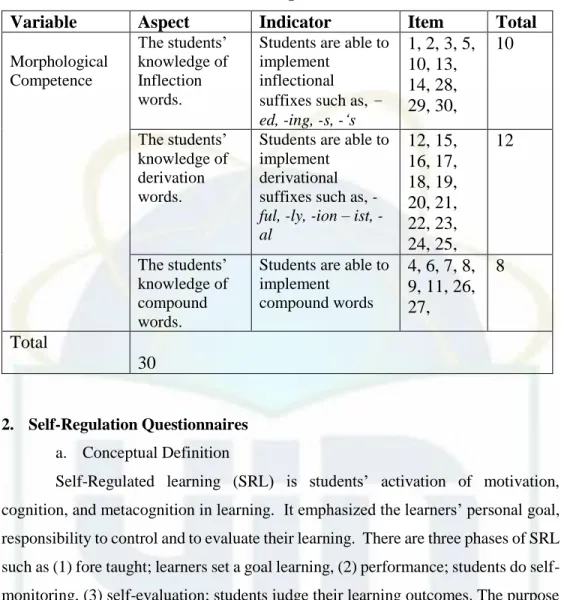
Table 3.1 The Blueprint of Morphological Competence Test ... 35
Table 3.3 The Self-Regulation Questionnaire Guideline ... 36
Table 3.4 The Blueprint of Reading Comprehension Test ... 37
Table 3.5 R Coefficient Correlation (Validity) ... 38
Table 3.6 Classification of Reliability ... 40
Table 3.7 The Validity of Morphological Competence Test ... 40
Table 3.8 The Reliability of Morphological Competence Test ... 41
Table 3.9 The Validity of Self-Regulated Questionnaire ... 41
Table 3.10 The Reliability of Self-Regulated Questionnaire ... 42
Table 3.11 The Validity of Reading Comprehension Test ... 42
Table 3.12 The Reliability of Reading Comprehension Test ... 43
Table 4.1 Statistics Data of Morphological Competence ... 48
Table 4.2 Distribution Score of Students’ Morphological Competence ... 48
Table 4.3 Statistic Data of Self-Regulated Learning ... 50
Table 4.4 Distribution Score of Students’ Self-Regulated Learning ... 51
Table 4.5 Statistic Data of Students’ Reading Comprehension ... 53
Table 4.6 Distribution Score of Reading Comprehension ... 54
Table 4.7 Normality Test of Students' Morphological Competence, Self- Regulated Learning and Reading Comprehension ... 55
Table 4.8 Variance Homogeneity Test of Y on X1 ... 56
Table 4.9 Variance Homogeneity Test of Y on X2 ... 57
Table 4.10 Linearity of Morphological Competence (X1) with Reading Comprehension (Y) ... 57
viii
Table 4.11 Linearity of Self-Regulated Learning (X2) with Reading
Comprehension (Y) ... 58 Table 4.12 Table 4. 12 Coefficient Correlation Interpretation ... 59 Table 4.13 The Relationship between Students’ Morphological Competence and their Reading Comprehension ... 60 Table 4.14 The Simple Regression test of Y on X1 ... 60 Table 4.15 The Relationship between Students’ Self-Regulated Learning and their Reading Comprehension ... 61 Table 4.16 The Simple Regression test of Y on X2 ... 62 Table 4.17 The Relationship between Students’ Morphological Competence, Self-Regulated Learning and their Reading Comprehension ... 63 Table 4.18 The Multiple Regressions between Students’ Morphological
Competence, Self-Regulated Learning and their Reading Comprehension ... 63
ix
LIST OF FIGURES
Figure 2.1 Types of Morphemes ... 11
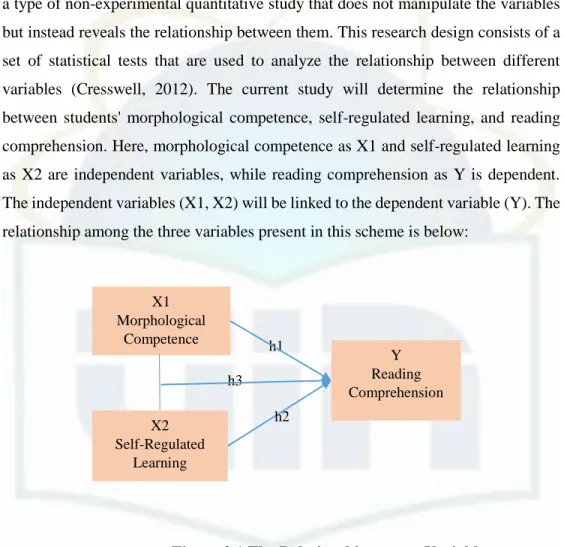
Figure 2.2. The Model of Reading Comprehension Process ... 27 Figure 3.1 The Relationship among Variables ... 33x
LIST OF APPENDICES
Appendix 1 Research Instrument ... 83
Appendix 2 Students’ Score
... 96Appendix 3 The Result of Piloting Study ... 101
Appendix 3 Research Letter Legalization ... 108
CHAPTER I INTRODUCTION
A. Background
Reading is an important skill in language learning. Students having good reading skills will affect their successful learning. The vocabularies, phrases, and sentences put a big role in comprehending the text. To have this ability, students have to know the word-formation in English that is highlighted in the morphological competence. Reading is also a skill that needs a good mental process to get an understanding of a text. Students have to set the goal, control, and evaluate their reading. This individual mental process is conceptualized in self-regulated learning.
In other ways, reading is a complex process that involves students' linguistic ability and physiological aspects. Morphological competence as the knowledge of words help students in understanding complex words in the text. Then, self-regulated learning, as the students' ability to control their goal, strategy, and evaluation during reading, also benefits reading comprehension. In sum, this paper investigated students' reading comprehension, morphological competence, and self-regulated learning.
Recognizing as a receptive skill that the students should achieve, reading is fundamental property to our educational lives. Individuals need to require reading skills during the educational process to improve overall knowledge. It indicates that reading is an axiomatically crucial skill to develop in an academic context (Heidari, 2020; Squires, 2014) because it has a substantial impact on cognitive development (Cartwright et al., 2020), developing adequate knowledge (Cho et al., 2021), and establishing linguistic ability (Johann et al., 2020). Of course, it means that students are entailed to read a lots and understand reading material to achieve successful learning outcomes. In contrast, those with poorer reading performance are likely less to the attribute of success (Frijters et al., 2018). In addition, reading also improves one's language ability due to while reading, students get many texts' exposures.
Students will learn new words unconsciously along with the grammar function
entailed in the word. That is to say, having a good skill in reading is particularly important to help learners accomplish academic performance especially in the domain of language learning. Understanding that reading is crucial, therefore, all governments worldwide have made reading a concerning program to push at schools (Simbolon et al., 2020).
In Indonesia, reading is a compulsory subject mandated by the government.
For example, at the high educational level, reading is categorized as a general skill that develops logical, critical, systematic, and creative thinking, referring to the National Education Qualifications Framework (KKNI) level 6. As the ministry of education suggested, every varsity should align reading course with KKNI. For a case, in the third semester of English education, State Islamic University Syarif Hidayatullah Jakarta, here students learn Reading For English International Standardized Test subject which has several objectives: (1) students are required to show the understanding of the course, think critically, and to comprehend various kinds of international reading test, (2) students are expected to have the basic concept of the three English international standardized tests, (3) students are able to master reading strategies in answering questions in the Reading Paper-based test: TOEFL, IELTS, and TOEIC, (4) students can present the results of their readings both orally and in writing report as well as provide an analysis of the reading topic using a digital platform (RPS Reading Reading For English International Standardized Test, 2021 UIN Syarif Hidayatullah Jakarta).
According to the goal of RPS above, students are mainly supposed to understand types of reading paper-based tests and determine how to answer each question on the test. To answer the reading passage, students must comprehend the text well with the proper strategy. Then as written on RPS, one of the considered strategies is the ability to infer the meaning from word-formation clues such as roots, affixes, and morphemes. Understanding what a morpheme signifies help in comprehending or guessing the meaning of words (Amirjalili, et al 2018) since word recognition is a critical component of reading. The more quickly a reader recognizes words, the more fluent the reader becomes (Yucel-Koc, 2015). To be successful in a
reading course, students have to understand various strategies to comprehend the text.
One critical strategy is recognizing the meaning in structural clues of words.
Having said that reading puts significant consequences on educational performance, Indonesia still has to struggle with this concern; several international assessment surveys show that Indonesian students scored lower than other countries on their literacy level. According to PISA in 2019 (OECD, 2019), Indonesia is in 72 out of 77 countries on its reading score. Only 30% of students attained at least Level 2 proficiency in reading which they can identify the main idea, find explicit information, and reflect the purpose of a text. International Reading Literacy Study (PIRLS) also noted that more than 50% of Indonesian students had not mastered basic reading skills. In general, there appears to be some evidence to indicate that Indonesia is still remarkably low in reading. As a result, reading has remained a critical issue to examine, and any aspects related to reading must also be investigated.
The evidence presented in the data above suggests that the main problem of reading is to comprehend proficiently what is being read. Comprehending the text becomes the main purpose of reading as well (Suggate et al., 2018). To comprehend the intended meaning of a text, readers, therefore, should involve a complex set of language (Zhao et al., 2019), cognitive development (Shihab, 2011), and manipulation of the semantic information (Xie et al., 2019). That is to say, reading comprehension is not simply just our fluency in reading printed text while our eyes pass over it. A reader needs to decode all written symbols, building strategy, and recognizing the author’s idea to infer meaning in the text. Qrqez & Rashid (2017) also said that comprehending reading text needs the interaction between the text and the reader. Here, a reader has to connect prior knowledge with the information that existed in the text. This condition will help construct meaning by visualizing the situation described in the text and anticipating what will come next. However, comprehending reading text is challenged when the learners get to the upper level because of the increasing morphologically complex words (Zhang et al., 2020).
In Indonesian high education level, based on preliminary observation, students tend to face difficulty reading text with longer words and sentences. EFL learners encounter ambiguous words and unfamiliar vocabulary in the text, which
become the main obstacle in understanding the meaning. Also, the selected reading topics seem to be difficult such as scientific, political, and other disciplines far away from education. It was supported by Chen (2016) who claimed that vocabulary and letter pattern complexity may add to the difficulty for advance students. However, reaching number of vocabularies target in the English academic context may take a long time and be ineffective. Therefore, to deal with this condition, students may gain the vocabulary more effectively with morphological enhancement because academic English vocabulary is composed of words origins from Greek and Latin with morphologically complex structures. Therefore, a reader needs to become familiar with letter patterns in the text. Having the ability to manipulate pattern words in a passage, called morphological competence, will facilitate the reader to identify the word's meaning (Wang et al., 2006). In sum, morphological competence is highly required to overcome the reading difficulty as the predictor that might influence comprehending the text.
Morphological competence, later called MC, is the knowledge of morphemes and morphological structures. It is defined as the fundamental reading ability that facilitates the understanding meaning of single words (Zhao et al., 2019). MC have to be mastered at morphemic structure and morphological structure (Liu et al., 2013) due to the fact that it is critical for successful reading comprehension in the EFL context (Ruan et al., 2018). It implies that morphological competence as the ability to know the internal word formation is important to support students reading comprehension. By having this ability, students are allowed to decode the words meaning. For example, the word “childhoods” is constructed by the root “child” and suffix “–hood” “-s”. Here, each morpheme means ‘child’ means early youth people,
‘hood’ means a state of being, and –s means plural form—this morphological competence help students in identifying the words meaning. Even if the learners are unfamiliar with that word, they can identify the words meaning of ‘child’ as the root.
De Freitas et al. (2018) also said that MC might help readers comprehend morphologically complex terms in a text by encouraging them to use recognized morphemes. Oliveira et al. (2020) have also said MC can contribute to reading comprehension indirectly through listening comprehension. In other ways, MC is
highly required to comprehend the reading text because it helps readers know the complex word and uncover unfamiliar words. Also, morphological competence remains an important skill that might contribute significantly to reading comprehension.
Furthermore, besides the linguistic ability, comprehending the text also involves the mental process because reading is more than simply understanding the words. It has to do with the individual mental representation of text, a process that requires integration across the interest, motivation challenges, and self-control (Danaei et al., 2020; Al-Jarrah & Ismail, 2018). In short, reading is an activity that frequently carries out psychological aspects. However, according to UNESCO (2020), the index of Indonesian reading interest stands at 0,01 per cent, which means only one in every ten Indonesian children enjoys reading. This means that students continue to be unmotivated to read. Furthermore, based on the limited observation, students tend to feel lazy to read certain English texts in terms of self-control. As a result, they struggle to complete certain reading assignments. In sum, interest, motivation, and self-control are very pressing issues to address because they play a crucial role in reading. Theoretically, this integration of individual mental processes is highlighted in self-regulated learning (SRL) that monitors someone's cognition, metacognitive, and motivation in certain activities. With these challenges at hand, it becomes essential for students to develop self-regulation to achieve more successful reading comprehension.
Zimmerman & Schunk (2011) viewed SRL is a multifaceted activity that entails cognitive, metacognitive, affective, and behavioral self-activities that enable the learner to plan, monitor, and evaluate learning goals. According to Paris & Paris (2001), self-regulation in learning has many advantages: deeper comprehension, self- management, self-control, and learning process-concentration. Learners with good self-regulation are responsible for their learning (Connor, 2014). Specifically, SRL is crucial in reading comprehension due to it is a goal-directed behaviour allowing learners to establish a particular objective when interacting with the text, to make inferences from prior information, and to activate prior knowledge (Woolley, 2011).
In short, self-regulated learning is the process by which students direct their
motivation, metacognition, and cognition toward a specific learning purpose. For example, in the motivational component of SRL, students like to read the challenging text to achieve a high reading score. Then, cognitively, learners know how to read effectively with apocopate strategy. These skills are particularly important for the reader while interacting with the text. That is to say, self-regulated learning is the other variable that may facilitate better reading comprehension.
In view of all that has been said thus far, one might suppose that morphological competence and self-regulated learning link to reading comprehension. Here, students' reading problems is the difficulty of long sentences and complex words involved in the text. Then, to deal with this, the competence to manipulate the word, which is called morphological competence, is required to investigate whether this competence will impact reading comprehension.
Furthermore, based on the limited observation, the other issue of reading is that students tend to lack motivation in reading and self-control. Then, Self-regulated learning should be explored to know whether students with high self-regulated learning will affect their reading comprehension or not. In sum, this paper aims at investigating the relationships among students' reading comprehension, morphological competence, and self-regulated learning.
Over the years, a considerable amount of study has been published on the relationship between morphological competence and reading comprehension. First, the research results carried out by Zhang et al. (2020) provided the relevance of reading comprehension with morphological awareness which is mediated by morphological analysis and vocabulary in upper grades of elementary school.
Levesque et al. (2017) have also shown an indirect and direct relationship between morphological competences to comprehension in the 3rd grade native speaker students. Through the complex word morphological students have, they easy to understand a text when reading. Zhang and Koda (2013) revealed that young Chinese learners reading L2 was due to the combined effects of lexical exposure to L2 in the Chinese context. Similarly, Zhao et al. (2019) asserted that morphological awareness could strongly predict reading skills by recognizing characters and longitudinal reading fluency. Last, De Freitas et al. (2018), it was found that morphological
awareness is critical for word reading and comprehension in Portuguese-speaking children. The studies presented thus far provide evidence that morphological competence is strongly related to reading comprehension, which is mediated by morphological analysis. Moreover, in the EFL context, students with good morphological knowledge got easier to understand the English text.
Furthermore, numerous studies thus far have linked self-regulated learning with reading comprehension. Skibbe et al. (2019) published a paper in which they described that children who have self-regulation earlier had improved their literacy and language skills. It was significant correlated with upper learners' level of both decoding and reading comprehension. On the other hand, in lower education levels, Kamgar and Jadidi (2016) reaches different conclusions, self-regulation components such as formulating a plan, monitoring and evaluating do not correlate with the ability in comprehending the text from beginner and intermediate learners. The other study using experimental, Berkeley & Larsen (2018) revealed that self-regulation might impact students' reading skills through goal setting and self-monitoring. Last, Mohammadi et al. (2020) showed that self-regulated learning instruction was significantly important in increasing EFL students' learning strategies, reading problem-solving, and reading comprehension. Together these studies provide important insights into the positive relationship between self-regulated learning and reading comprehension at the high educational level. Students with high self- regulated learning abilities, such as goal-oriented, good internal motivation, activating their self-control, and good strategy while reading, remain readers with good comprehension skills. However, self-regulated learning does not affect education levels, such as elementary or middle school. At a young age, students tend to lack responsibility for their learning. They still need support from the teacher and parents.
As explained above, it is clear that most research in this study concentrated on basic and intermediate students. Therefore, to broaden the contribution of morphological competence and self-regulated learning to reading comprehension, a larger group of learners at higher levels can be taken into account (Mohammadi et al., 2020; De Freitas et al., 2018; Jiang et al., 2015). The current study will examine the
MC and SRL in EFL high education level due to little attention has been paid to this level. This study will then extensively combine three variables in a correlational research design that the prior studies merely connect two variables. Therefore, it attempts to fill the gap. Also, MC will concern with inflection, derivation, and compound words process. Then, it will capture three aspects of self-regulated learning: cognitive, metacognitive, and motivation during reading comprehension activity.
B. Identification of the Problem
This study highlights the following issues based on the explanation of the background statements:
1. Reading comprehension is one of difficult skill that faced by the students 2. Students come across unclear words in the text.
3. Morphological competence is one of strategies to discover unfamiliar words in reading text
4. Students are lack of motivation to read, they tend to be lazy in reading English textbook.
5. Self-regulated learning is one of important factors to develop in adult learners as students can plan, monitor, and evaluate their reading activity.
C. Limitation of the Problem
As a part of the study, several limitations have been concerned. This study analyses explicitly three variables; morphological competence, self-regulated learning, and reading comprehension. In morphological competence, it will examine the derivational, inflectional, and compound words. Self-regulated learning indicators concern students' cognitive, metacognitive, and motivation self-aspects while reading. Regarding reading comprehension, it will focus on varsity reading tests.
D. Research Questions
The following research questions can be formulated in light of the background reaserch.
1. Was there any relationship between morphological competence and students’
reading comprehension?
2. Was there any relationship correlation between self-regulated learning and reading comprehension?
3. Was there any relationship among morphological competence, self-regulated learning, and students' reading comprehension?
E. Research Objectives
According to the research question as a guide, the following is the study's objective:
1. To know and to describe the relationship between morphological competence and students’ reading comprehension.
2. To know and to describe the relationship between self-regulated learning and reading comprehension.
3. To know and to describe the relationship among morphological competence, self-regulated learning, and students' reading comprehension.
F. Research Significances
The purpose of this study is to make a theoretical and practical contribution to students, lecturer, university stakeholders, and future researchers through the conduct of this study.
- For Students:
This research will assist them in developing a greater awareness of morphological competence and self-regulated learning to help them in comprehending the text. Students can recognize the meaning of word reading through morphemic structures. Also, they know how to regulate their learning strategy while reading.
- For Teachers:
For the educational instructors, teachers and lecturers need to include morphology and self-regulated learning in teaching reading. Teachers can provoke students to pay more attention to word-formation to help them infer the meaning and guess unfamiliar words.
- For University Stakeholders:
Morphological competence should be taught in the early year of the college curriculum. It is due to the benefits of morphology to the reading found significant. As a result, the earlier this course is given, the more likely the benefits students will get for reading comprehension.
- For Further Researchers:
The study's findings can be used as the previous study data for further research. It strengthens previous studies that reported a positive relationship among morphological competence, self-regulated learning, and reading comprehension.
CHAPTER II LITERATURE REVIEW
This chapter presents the theoretical background of three main variables:
morphological competence, self-regulated learning, and reading comprehension. The theoretical framework is according to the experts' view and the previous studies' results.
A. Morphological Competence
1. The Nature of Morphological Competence
Morphological competence (MC) is individual competency in morphology, the study of the internal word-formation. MC refers to someone’s knowledge of the morphemic structure of words and their ability to reflect on and manipulate that structure (Carlisle, 1995; cited in McCutchen et al., 2008). Petrovska (2011) briefly defines MC as the ability to recognize the existence of morphemes in words. It emerges from the acquisition of the beginning spoken language and further will be enhanced with children's exposure to extensive text input (Ku & Anderson, 2003).
Then, Archibald & Libben (2018) argued that morphological competence is the ability of a language speaker to employ the meaningful substrings within a word to enable the processing of new forms. As noted by Booij (2007), who claimed that new words are made based on patterns of form-meaning correspondence between existing words. For example, electricity is created of two morphemes; electric as the root and –ity as the suffix. Along with the experts, Flowerdew & Richardson (2018) simply put that MC is the understanding of which forms ‘go with' particular properties. To put in other ways, MC is the ability to manage the form of morphemes and the ways new words are formed (word-formation). This skill is important to support students' reading comprehension because it is the basic concept to recognize the word so it helps students to recognize words' meaning and discover new words.
2. Morphological Analysis
At the morphological level, a word may be formed by more than one morpheme.
Words are divided into different kinds of morphemes, and it is useful to analyze them morphologically. Having good morphological analysis is important to classify the structure and formation of words. Here are some word classifications in morphology.
a. Morpheme
Morpheme structure is the smallest unit of meaning in language. Booij (2005) defines “Morpheme is the morphological building blokes of word, are defined as the minimal linguistics units with a grammatical meaning”. Also, Lieber (2015) said that morphemes as the meaningful unit are used to form the words. For instance, the word
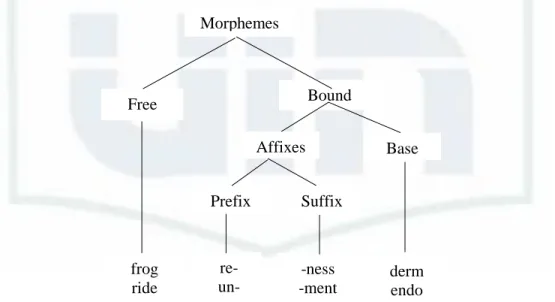
‘establishments’ is made up by three morphemes: establish, -ment, -s; establish is the root and –ment, -s as the suffix. The root of a word is the central morphological unit to which all other morphological units are attached. In other ways, morpheme is a unit of language worked with grammatical meaning. Lieber (2009) has classified morphemes into several types, as showed in figure 2.1, such as free morpheme and bound morpheme as follow:
Figure 2.1 Types of Morphemes (Lieber, 2009, p. 34) Bound
Affixes Prefix Suffix
Base
re- un-
-ness -ment
derm endo Morphemes
Free
frog ride
1) Free Morpheme
A single word has a meaning by itself called a free morpheme. According to Lieber (2009), free morphemes can stand alone as words. For example, the word book in notebooks, without adding other properties, has meaning on its own. In a word, it should consist of free morpheme. As supported by the theory of Bishop (2009), who said free morphemes is the former that can stand alone as words.
2) Bound Morpheme
Bound morpheme is a morpheme that needs other morphemes to achieve meaning. It cannot stand alone (Lieber, 2009). In the examples above: notebooks, the bound morpheme is (–s), which adds to the word's end. It means that bound morpheme needs the combination to make a word meaning. As stated by Booij (2005), “Bound Morpheme is a morpheme that cannot function as a word on its own".
The other often seen bound morphemes are -s/es, ed, ing, est, en, and er, which introduce the grammatical function of a word. As a result, we can conclude that a bound morpheme is a morpheme that cannot exist independently. and must be coupled to another morpheme in order to generate a new word meaning. Bound morphemes come into different varieties, such as prefixes and affixes. The term prefix and suffix are commonly called affixes in English. Below is the explanation:
a) Prefix
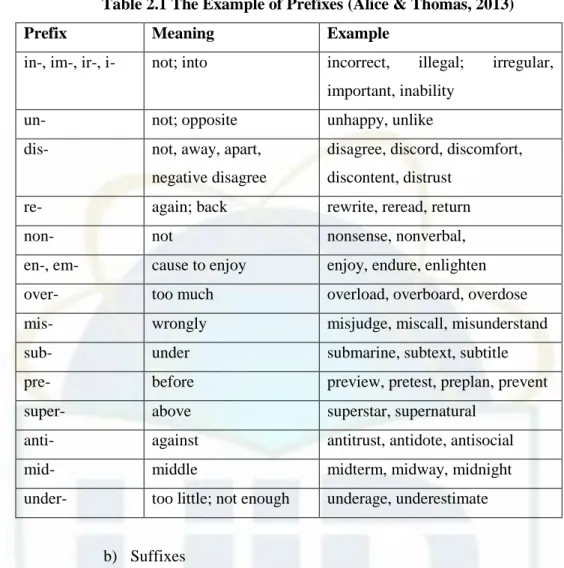
Prefixes precede the root: e.g. un- of untrue, out-of outnumber, etc.(Tokar, 2012). According to Lieber (2009), a prefix is an affix introduced to the beginning of words. Additionally, a prefix can be used to create a new term with a distinct meaning. That is said, the prefix is the adding bound morpheme to the roots in the beginning. Here, table 2.1 is the example of the prefix:
Table 2.1 The Example of Prefixes (Alice & Thomas, 2013)
Prefix Meaning Example
in-, im-, ir-, i- not; into incorrect, illegal; irregular, important, inability
un- not; opposite unhappy, unlike
dis- not, away, apart, negative disagree
disagree, discord, discomfort, discontent, distrust
re- again; back rewrite, reread, return
non- not nonsense, nonverbal,
en-, em- cause to enjoy enjoy, endure, enlighten
over- too much overload, overboard, overdose
mis- wrongly misjudge, miscall, misunderstand
sub- under submarine, subtext, subtitle
pre- before preview, pretest, preplan, prevent
super- above superstar, supernatural
anti- against antitrust, antidote, antisocial
mid- middle midterm, midway, midnight
under- too little; not enough underage, underestimate
b) Suffixes
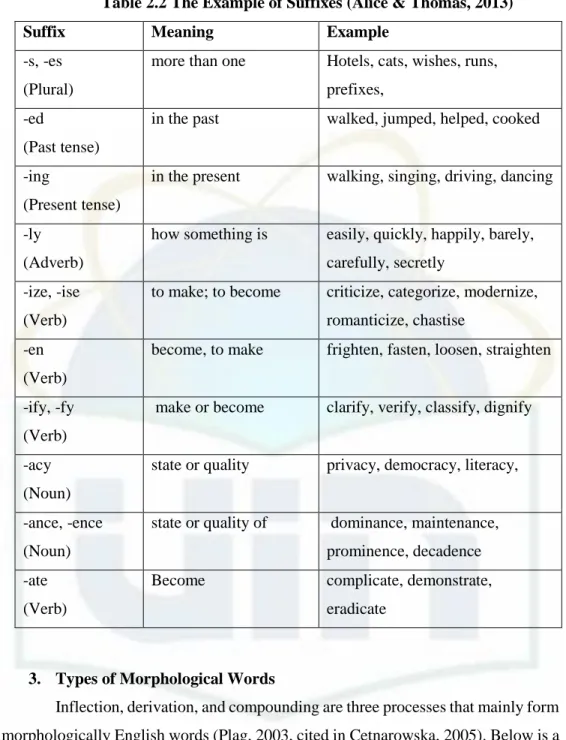
Suffixes are affixes that follow the root: e.g. -er of teacher, -y of cloudy, etc.(Tokar, 2012). According to Lieber (2009), a suffix is an affix applied to the end of root nouns. Suffixes typically have specific restrictions about the kind of bases to which they can attach. The following are common examples of English suffixes that Alice Thomas presented in table 2.2 as follow:
Table 2.2 The Example of Suffixes (Alice & Thomas, 2013)
Suffix Meaning Example
-s, -es (Plural)
more than one Hotels, cats, wishes, runs, prefixes,
-ed
(Past tense)
in the past walked, jumped, helped, cooked
-ing
(Present tense)
in the present walking, singing, driving, dancing
-ly (Adverb)
how something is easily, quickly, happily, barely, carefully, secretly
-ize, -ise (Verb)
to make; to become criticize, categorize, modernize, romanticize, chastise
-en (Verb)
become, to make frighten, fasten, loosen, straighten
-ify, -fy (Verb)
make or become clarify, verify, classify, dignify
-acy (Noun)
state or quality privacy, democracy, literacy,
-ance, -ence (Noun)
state or quality of dominance, maintenance, prominence, decadence -ate
(Verb)
Become complicate, demonstrate,
eradicate
3. Types of Morphological Words
Inflection, derivation, and compounding are three processes that mainly form morphologically English words (Plag, 2003, cited in Cetnarowska, 2005). Below is a further explanation of each category.
a. Inflection words
According to Zhang and Koda (2013), inflection words are shaped from root and affix combinations. The inflected words are constructed by attaching a root with
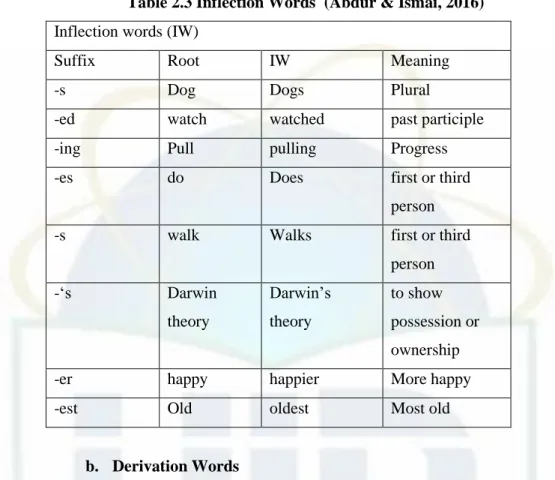
an inflection suffix, such as -ed (past tense) or -s (plural), which changes the grammatical role. Table 2.3 is the examples of inflection words
Table 2.3 Inflection Words (Abdur & Ismai, 2016) Inflection words (IW)
Suffix Root IW Meaning
-s Dog Dogs Plural
-ed watch watched past participle
-ing Pull pulling Progress
-es do Does first or third
person
-s walk Walks first or third
person
-‘s Darwin
theory
Darwin’s theory
to show possession or ownership
-er happy happier More happy
-est Old oldest Most old
b. Derivation Words
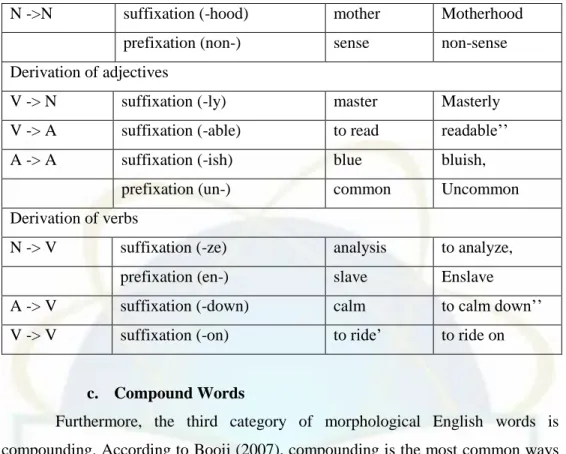
Derived words are generated by attaching them with a derivative affix, as er (agentive) and -ly (adverb), which alters its context and sometimes the grammatical rules (Tariq et al., 2020). Acquiring derivational morphology takes time and deliberate effort to produce (Nagy et al., 2014). Below, the table 2.4 presents the derivation words.
Table 2.4 Derivation Words (Booij, 2007, p.52) Derivation of nouns
A -> N suffixation (-remove ful) beautiful Beauty
V -> N suffixation (-er) speak Speaker
suffixation (-ion) dominate Domination
N ->N suffixation (-hood) mother Motherhood
prefixation (non-) sense non-sense
Derivation of adjectives
V -> N suffixation (-ly) master Masterly
V -> A suffixation (-able) to read readable’’
A -> A suffixation (-ish) blue bluish,
prefixation (un-) common Uncommon
Derivation of verbs
N -> V suffixation (-ze) analysis to analyze,
prefixation (en-) slave Enslave
A -> V suffixation (-down) calm to calm down’’
V -> V suffixation (-on) to ride’ to ride on
c. Compound Words
Furthermore, the third category of morphological English words is compounding. According to Booij (2007), compounding is the most common ways to make a new lexeme. It is combining two different words, in which one word changes the other word meaning, the head. The example of compound words as in Table 2.5 follows:
Table 2.5 Compounds Word (Brinton & Brinton, 2010, p.105) Compounding Phrase
V + V Freeze Dry freeze-dry
A + V White Wash Whitewash
N + V Machine Wash machine-wash
A + N Red cabbage red cabbage
prefixation (non-) Sense non-sense Compounding with inflection words (IW)
IW + N girls’ school girls’ school
women’s magazine women’s magazine
down’s syndrome down’s syndrome
Swimming competition swimming competition
N+ IW Mountain climbing mountain-climbing
Compounding with derivation words (DW)
N + DW Milk farmer milk farmer
Magazine Seller magazine seller
A -> V suffixation (-down) Calm to calm down’’
V -> V suffixation (-on) to ride’ to ride on
Compounding with from Greek and Latin words
Bio Logy bio-logy
Geo graphy Geography
Tele Phone tele-phone
Ice Berg ice berg
In sum, English has three distinct morphological structures: inflection, derivation, and compounding. Inflection words are made to add the grammatical function, derivation words are created to manipulate the context of words, and compound words combine two words with a new meaning. These three types are made up by adding suffix, prefix, and other lexical words in a root.
4. Morphological Competence and Reading Comprehension
Morphological Competence (MC) could help the reading process, and it contributes to the growth of word recognition and vocabulary. Learners may discover the meanings of unfamiliar words from a known morpheme (Deacon & Kirby, 2004).
According to Nagy et al. (2014), MC also encourages inference meaning of complex words while reading. It helps learners overcome vocabulary gaps and increases reading comprehension. Moreover, readers may use syntactic signs provided in derivation and inflection forms to analyze complex phrases. To put in other ways,
MC, which stands to the ability to know the morphological structure, can help the reader cover the unfamiliar words in a text and make an inference.
According to Kuo and Anderson (2006), the relationship between morphological competence and reading is both reciprocal and directional; if the relationship is reciprocal, both reading and morphological awareness contribute to each other's development; if it is directional relationship, morphological awareness led directly to reading skills. In the process of reading, morphological competence leads students to detect the morphological word structure, for example vulgar, vulgarize, and vulgarization that can help them to know the word meaning. In short, the remarkable contribution of morphological competence sheds light on its acknowledgeable vocabulary meaning. As stated by Nagy and Anderson in Ghasemi
& Vaez-Dalili (2019), 60% of unfamiliar vocabularies encountered by the readers on its meanings deduced from morphology constituent parts. By obtaining a better understanding of word production processes, a reader will be better equipped to deduce the words meaning and will thus be able to more effective in comprehending the text.
B. Self-Regulated Learning
1. The Nature of Self-Regulated Learning
Self-Regulated learning or further said as SRL, is described as "processes whereby learners personally activate and sustain cognitions, affects, and behaviors that are systematically oriented toward the attainment of personal goals"
(Zimmerman & Schunk, 2011). It emphasized the learners’ personal responsibility to control their learning (Mohammadi et al., 2020). In a general concept, SRL has arisen as a motivational, cognitive, and metacognitive of learning. According to Paris &
Paris (2001), self-regulation abilities emphasized the individual's autonomy and control in regulating, directing, and monitoring action based on goal information.
They further stated three intervention for students to be a self-regulated learner; it includes:
1) As an authentic guide, teachers may indirectly convince students to become self-regulated learners through repetitive practices.
2) Specific advice should be given and taught explicitly in the class regarding self-regulated learning.
3) Engaging students in self-regulatory activities for self-regulated learning acquired.
They argued that several beneficial come out within self-regulated learning.
For example, it appears to imply, for instance, more in-depth comprehension, self- development of thought, self-control, and personal knowledge of various forms of learning. Also, self-regulated learners are ultimately responsible for their learning (Connor, 2014)
2. The Components of Self-Regulated Learning
According to the conceptual definition, SRL are classified into three aspects;
cognition, metacognition, and motivation (Paris & Winograd, 2003). Successful SRL will depend on the synchronization of cognitive and metacognitive and processes, as well as a student's motivational orientation. These components explanation as stated by Zimmerman (2011):
a. Cognition
Cognition requires the skills required to encode, memorize and retrieve information. Cognitive views of self-regulation define this futuristic focus in terms of targets and have tried to improve it by different approaches, such as intermediate target setting, self-instruction and self-evaluation.
b. Metacognition
Metacognition requires the abilities that enable pupils to monitor and understand their cognitive processes. Self-regulated learners will schedule, coordinate, self-monitor, set goals, and self-assess their learning process (Mohammadi et al., 2020). These mechanisms allow them to be self-conscious, knowledgeable and determining their learning model. For instance, as mentioned in Dunlosky & Ariel, (2011), students may notice that if they have no progress of understanding concept in a class, they then subsequently control their learning by doing extra homework, seeking tutoring, or even asking peer learner about the topic.
As students finish these activities, it will help their way to achieve the learning goal.
c. Motivation
Motivation involves behaviors and values that affect the production and use of cognitive and metacognitive abilities. Self-regulated learners have a high level of self-attributions, self-efficacy, and intrinsic task interest in terms of motivational systems. (Zimmerman, 2001). He believed that the continued motivation of students relied on the monitoring of their performance.
3. The Measurement of Self-Regulated Learning
Several measurement techniques are often used to assess self-regulated learning achievement. Then, self-reports, teacher judgments, and traces are commonly used to evaluate SRL. The explanation of each measurement is mentioned by (Winne, 2015) as follow:
a. Self-Report Measures of SRL
Self-report emphasizes to the own description of SRL. To conduct the self- report, the research identified three frequently utilized techniques: think-aloud protocols, interviews, and inventories.
1) Think-Aloud Protocols
It is empirical studies that rely on verbal reports as data. The student is instructed to discuss what occurs mentally from the time the work is offered until it is accomplished. The instructions include the phrase, 'Describe everything you can about how you think while working on the assigments.' Students' remarks are recorded and then coded. Numerous characteristics of SRL are being questioned, including goals established, plans made, feelings elicited, monitoring, and evaluation.
(Azevedo et al., 2010).
2) Interview Protocols
The interview protocols concentrate on the characteristics of SRL which the student recalls from recently completed assignments of daily learning. The guiding question is developed specifically by Zimmerman (2011). For instance, the question's thrust is as follows: "The number of learners believe that it is critical to complete homework and ready for school while they are at house. Do you even have any unique
methods to increase your home learning?" If the learner is unable to respond appropriately to the required prompting, the following follow-up is provided: "What if you run into difficulties? Is there a certain technique that you employ?" The responses of students will then be examined for emergent themes and characteristics.
3) Questionnaires
Questionnaires are the common method in searching someone SRL among the methods of self-report. This is due to the time savings and simplified scoring that can be accomplished through the administration of questionnaires. It was supported by Callan (2014) attributed the questionnaires that is relative ease of administration and scoring, time and resource efficiency, and wide availability of questionnaire measures. The guideline elements include declarative statements including such 'I attempt to connect topics within what I have been learning' or condition relations like 'While the task is hard, I either avoid it or do straightforward to the easy sections.' Then, students reply to these inventories on a likert scale ranging from 1 (very uncharacteristic of me) to 5. (very much typical of me).
b. Teacher Ratings Scale
This technique is strongly predictive of future success and may more accurately represent real student regulation (Callan, 2014). Here, a teacher, is asked to score their students' SRL on a five-point scale ranging from 1 never to 5 always. It elicits learners' use of a tactic, such as requesting assistance from a teacher or looking for information. Other activities need teachers to use a strategy to assess observable results, like whether tasks were finished on schedule or ahead of time.
c. Traces
Traces are the artefacts that students create while they accomplish a task. From well-designed traces, SRL occurrences can be inferred. The student is utilizing application system to mark Webpages, spotlight content in Web sites, develop terminology for the purpose of creating a glossary, and take notes about the information they discover while doing an Internet search for project information (Winne and Hadwin, 2013). This track software also can be viewed as student metacognitively monitoring awareness while creating today's remark, determining
that the content of a specific note previously made might be beneficial, and showing motivation to evaluate a certain information by locating and accessing the note, all of which are indicators of metacognitive control.
4. Self-Regulated Learning and Reading Comprehension
Related to reading comprehension, according to Cirino et al. (2017), certain elements of SRL associated with reading involve the usage (activation) of prior knowledge, self-efficacy strategy use, motivation, and performance goal orientations.
Also, Kamgar & Jadidi (2016) revealed in their study that self-regulation skills as planning, observing, and assessing can help advanced EFL learners improve their reading comprehension ability. However, it was not found in beginner and intermediate learners. Furthermore, students that exhibit self-regulation are better able to comprehend an English reading material by inferring. (Jafarigohar &
Morshedian, 2014) and focusing while reading a passage (Abbasian & Hartoonian, 2014). To put it another way, self-regulated learning is students' activation of cognition, metacognition, and motivation. The effect is amplification. It motivates students to read challenging texts and achieve high reading scores. Once this is accomplished, students can read effectively. This skill is essential when interacting with the text. In short, SRL components can help students read better.
C. Reading Comprehension
1. The Nature of Reading Comprehension
Reading comprehension is a fundamental aspect of the reading process.
According to Robertson (2017), reading is the process of constructing and extracting meaning toward the text's involvement. Furthermore, reading comprehension is also a complex process of making meaning from the text to get a general understanding (Woolley, 2011). It is categorized as a receptive skill that enables learners to acquire language input such as vocabulary and syntactic patterns. Reading comprehension entails prior knowledge, text structure knowledge, and active information searching to build meaning (Kao et al., 2016). In other ways, reading comprehension is a
complex process involving a set of language understanding to gain detailed information from the text.
To assess reading comprehension requires four components involved; prior knowledge, word-level process, reading strategies, and motivation challenges (Danaei et al., 2020). The test-administers have to focus on the process of reading that turns on while students read. It is a complex instruction involving the lower and high-level process that can affect different text and reading formats (Paris & Paris, 2007 cited in Varita, 2017). So, it does not draw into the same level of cognitive areas. The lower and higher thinking order mutually incorporate and interact in a complete reading account (Kendeou et al., 2016).
2. The Importance of Reading Comprehension
Reading is particularly important for students especially reading English text.
It has been noted out by Harmer (2015), who claimed that several reasons are surfaced in the importance of reading as follow:
a. Reading gives many exposures to students’ language acquisition Students will learn new words unconsciously along with the grammar function entailed in the word meaning. While students are reading, they get many different texts which expose their language ability. This condition is repeated as students memorize the word and some language features easily.
b. Reading texts provide a good model for English
Having a good model of English text is crucial to be administered in learning- teaching English. It will help students recognize the structure of words, phrases, and sentences within the text. Furthermore, the importance of reading is connected not only to the growth of knowledge but also to the ability of individuals to think (Harrison, 2004). This skill will provide the foundation for emotional, moral, and linguistic intelligence development. It can be said that reading is not only beneficial for reading skills but also for other skills too. Last, Goodman et al. (2016) state that it is important to learn reading because it (1) helps in learning a new language, (2) improves in the development of a larger vocabulary, (3) benefits in the comprehension of written English.
From the benefits of reading listed above, individuals will gain many advantages in their lives. Students must read to improve their knowledge and the way they think, linked to the development of moral, emotional, and linguistic intelligence.
Besides, the language exposures presented in reading text will be useful for one in language acquisition. Reading text also will develop students' awareness in decoding a printed language and recalling the meaning.
3. The Components of Reading Comprehension
Understanding the reading component process is necessary to effectively and efficiently encounter reading comprehension difficulties (Kendeou et al., 2016).
Nuttall (1982) cited in Andreani et al (2021) mentioned that to comprehend the text well, students must master five components: determining the main idea, locating reference, making an inference, detailed information, and understanding vocabulary.
a. Identifying the Main Idea
The main idea is a sentence that implies the author's point on the topic.
Stevens et al. (2019) stated that the most important idea within a particular section, or paragraph, of the passage. Understanding the author’s main idea is crucial due to it can help readers not only recognizing the early paragraph but also remember the whole text and. The paragraph's main idea is typically found in the first sentence, but it can also be found in the paragraph's middle or end. As a result, a reader has to struggle to find the location of the main idea.
b. Locating Reference
Since it has been used, the referent word repeated the same word or term many times (Olvivanti, 2012). Having acknowledge in reference word as well as having the ability to recognize the reference word helps reader to comprehend the reading text. Reference words are typically n form of pronoun and it is short. Referent words, for example: he, she, it, they, her/him, this, and many others, are typically short and in pronouns. Students are expected to evaluate how pronouns are used in sentences, such as pronouns used to indicate people, places, or circumstances, while describing reference.
c. Understanding Vocabulary
In the reading text, students will come across certain words or phrases in the sentences. At this stage, students are entailed to read word by word and discover the meaning of each vocabulary in the text. Each word or phrases should not be defined.
Therefore, interpreting the meaning from context is an important skill. Context helps students making a general prediction about the meaning (Sharpe, 2005). Making predictions from the context will help students understand the meaning of a vocabulary without looking at the dictionary.
d. Making Inference
An inference is an information extracted from previous context or recollection through reading to fill in information not in the text (Elbro & Buch- Iversen, 2013). Making inference entails readers to connect the information among the sentences. In addition, to make inference, the students are expected to combine clues from the text with their background knowledge. It means that the text clues will assist students in concluding the text's statements. Even the words in a passage is unfamiliar for readers but with making inference, they still understand what the whole text means by guessing the meaning with context and words analysis.
e. Detail Information
The answer to 5W 1H questions normally includes detailed information.
Finding detail involves reading selectively to accomplish clear reading purposes, such as locating a name, place, number, or date. When a reader needs to find a certain piece of material but doesn't grasp the rest of the text, this detailed information is used (Olvivanti, 2012). In other ways, finding the detail information is also important in comprehending the text because of most text involves the information which triggers reader to know what, who, where, why, when and how one text delivers.
4. The Process of Reading Comprehension
Reading comprehension is a complex process. Merisuo-Storm (2007) briefly argues that while reading, someone activates their previous knowledge about the topic. According to Brown (2004), reading is the process of negotiation meaning. The readers, therefore, will put their prior knowledge to the reading text to build meaning.
It means that the comprehension of the text by the readers is the consequence of an interaction between their cognitive development and the text meaning. It is supported by Spratt et al. (2005), who describe reading as a corresponding process between readers' pre-knowledge and the process of meaning making of a text being read. In making meaning of information, readers link new information and what they already know. The process of connecting new information to readers' previous knowledge would help them remember the information better. The more background information related to the text the reader processes, the easier it is for him to understand the text.
Davies & Pearse (2002) proposed a model of the reading comprehension process. He further said some sub-skills are involved in the reading process as follows:
a. Remembering the meaning of words b. Inferring the word meaning in context c. Looking for correct answer
d. Knowing author’s idea, purpose, and tone e. Analyzing the authors’ technique
f. Arranging the passage’s structure
Reading comprehension, according to his framework, makes use of several systems. To begin, readers form preconceived notions and expectations about the materials they are about to read. The readers are then asked to identify the texts' vocabulary, syntax, and generic structure in order to aid in their comprehension.
Furthermore, the readers should activate their prior knowledge and connect it to the topic of the texts. The readers formed an assumption on what will happen next based on the already established points. The process of reading comprehension is presented in figure 2.2 as below:
Figure 2.2. The Model of Reading Comprehension Process (Davies &
Pearse, 2002)
5. The Measurements of Reading Comprehension
Reading measurement is a systematic technique for gathering information and drawing judgments about a student's ability to use a teaching reading (Richards
& Schmidt, 2002). Some reading measurements must be carried out to collect information on the students’ progression in reading comprehension. Different from speaking and writing skills, reading assessment cannot be seen physically as a product. For this reason, all reading measurements must be done based on inference.
When developing a reading evaluation, several factors must be considered, such as the many sorts of written text genres and reading comprehension components.
Some reading assessments have been listed by Brown (2004) that noted out that the assessment of reading is affected by the students reading performance. He proposed some types of assessment related to students' perspective of the text, interactive, selective, and extensive reading. Below are the types of reading measurements that are commonly used:
1. Multiple Choice
Multiple-choice questions give the vocabulary and grammatical elements and the context for assessing the students' comprehension of the text. The context is established by presenting a pair or section of a text, followed by questions to which the students must appropriately reply. The multiple-choice format includes same/different, circle the answer, true/false, choose the letter, and matching.
Reading Comprehension Recognize the vocabulary
Identify grammar and generic structure Activate
the prior knowledge,
link to the topic
Establish a guess of what will come next
2. Short Answer
Short answer questions are a type of question that can be used in exams or as part of an assessment job. They're usually open-ended inquiries that challenge pupils to come up with an answer on their own. The questions involve a concise and concentrated response that is factual and interpretative.
3. Impromptu Reading Plus Comprehension
This type of assessment is the most common technique used in which students are asked to read the text and directly answer the given question. The impromptu reading questions address the components of reading comprehension such as a main idea, expressions/idioms/words in context, inference, grammatical features, detail information, finding implicit meaning, and recognizing vocabulary in context.
6. The Factors of Reading Comprehension
According to Dennis (2008), reading comprehension is a set complex of identifying written signs and interpreting the meaning beyond the text. He states several factors affecting someone reading comprehension. It involves text complexity, motivation, and word recognition or decoding words. First, the texts' complexity indicates the readers' fluency to comprehend a text's broad meaning. As many read