Submitted in partial fulfillment of the requirements for the
Nursing
Retention in the Post‐Covid Era:
Can Inclusive Leadership Slow the Hemorrhaging?
David W. Brown, Mary Luallen, & R. Wesley Swen
Capstone Advisor: Dr. Jeanie M. Forray
A CKNOWLEDGMENTS
We are immensely grateful to our family and friends who cheered us on and provided moral and emotional support during this rigorous academic journey.
Your words of encouragement, your acts of kindness, and your patience were pivotal in helping us to attain this milestone. Our success is your success!
To the AdventHealth Shawnee Mission team: we wholeheartedly thank you for collaborating with us in fulfilling our capstone research requirement. Your participation in the project was invaluable, and we have taken particular note of your willing and cooperative posture in providing us with the information resources we needed. Special thanks to Michael, Gina, and Raimonda for being the best capstone partner team that we could have asked for.
To our advisor, Dr. Jeanie Forray: your guidance and thought-provoking
questions pushed us to tailor our research in a manner that was both practical and substantive. Without the need to reinvent the wheel, you challenged us to see the bigger picture while ensuring that we captured the pertinent minutia.
We appreciate your role in preparing us for this noteworthy juncture in our lives.
Table of Contents
Execu�ve Summary ... 5
Organiza�onal Context ... 8
Organiza�onal Leadership ... 9
Problem of Prac�ce ... 9
Research Relevance to AHSM ... 11
Stakeholders ... 12
Literature Review ... 13
Nurse Reten�on ... 13
Inclusive Leadership Framework ... 13
Inclusivity Through Belongingness and Uniqueness ... 14
Examining Inclusive Leadership ... 16
Inclusive Leadership Impacts Nurse Reten�on ... 16
Inclusive Leadership Management Training ... 16
Conceptual Framework ... 17
Research Ques�ons ... 18
Project Design ... 19
Study Popula�on ... 19
Survey Instrument ... 20
Measures ... 21
Data Collec�on and Analysis Sequence ... 22
Changes to the Original Data Collec�on Plan ... 23
Data Cleaning and Prepara�on ... 24
Data Analysis ... 25
Survey Responses ... 25
Descrip�ve Analysis ... 25
Inclusive Leadership and Intent to Stay ... 29
Tenure at AHSM and Intent to Stay ... 31
Limita�ons ... 32
Findings ... 36
Finding #1 ... 36
Finding #2 ... 37
Finding #3 ... 38
Recommenda�ons ... 39
Recommenda�on #1 ... 39
Recommenda�on #2 ... 40
Recommenda�on #3 ... 41
Conclusion ... 42
References ... 45
Appendix A ... 51
Appendix B ... 53
Appendix C ... 55
Appendix D ... 56
Appendix E ... 57
E XECUTIVE S UMMARY
The overarching goal of this study was to fulfill AdventHealth Shawnee Mission’s quest to garner a deeper understanding of how to retain its nurses through the lens of inclusive leadership behaviors. This project is of par�cular interest to the ins�tu�on considering recent and
concerning nurse atri�on rates, despite efforts to stem voluntary departures. The center of its opera�ons pivots on both the passion of its nursing staff as well as leadership’s ability to keep nurses mo�vated enough to remain on the job. AdventHealth Shawnee Mission generally wants to know (i) whether there is a rela�onship between front-line nurses’ percep�ons of their nurse managers’ inclusive leadership prac�ces and front-line nurses’ intent to stay and (ii) the nurse managers’ percep�ons of the organiza�on’s support to become more inclusive managers.
Having recently conducted a system-wide internal evalua�on of its adherence to the core principle of inclusion, AdventHealth Shawnee Mission is keen on acknowledging and mi�ga�ng unfavorable percep�ons of inclusive leadership and ul�mately cauterizing its atri�on numbers by advancing strategies that will foster greater collabora�on between front-line nurses and their managers in the decision-making process.
To support this effort, we used a cross-sec�onal survey design to gauge the nurses’ percep�ons of inclusive leadership and analyzed the quan�ta�ve data to arrive at our recommenda�ons.
Prior to the dissemina�on of the survey, delving into our problem of prac�ce, we conducted a literature review that focused on inclusive leadership and reten�on. While researching this space, we zoomed in on the dimensions of belongingness and uniqueness, which have been conceptualized in the Inclusion Framework (Shore et al., 2011). The problem of prac�ce, literature review, and conceptual framework led us to develop three project ques�ons.
P
ROJECTQ
UESTIONS1. What are the percep�ons of Advent Health Shawnee Mission nurses with respect to their manager’s inclusive leadership?
2. What are the percep�ons of nurse managers with respect to how AdventHealth Shawnee Mission supports their efforts to become inclusive leaders?
3. Is there a rela�onship between the percep�ons of inclusive leadership and reten�on among nursing staff at AdventHealth Shawnee Mission?
K
EYF
INDINGS1. Front-line nurses reported that their supervisors encouraged integra�on of and synergy among work units less than they do for the other dimensions of inclusive leadership, as described in the Inclusive Leadership Ques�onnaire (Li, 2021).
Ostensibly, this suggests that nurse managers could more effec�vely integrate front- line nurses’ ideas, sugges�ons, and opinions into the decision-making process within the work units.
2. Nurse managers perceive that AdventHealth Shawnee Mission’s leadership provides support in crea�ng a sense of inclusiveness between nurse managers and front-line nurses; however, the same level of support was not being provided equally across work units.
3. Nurses intending to remain at AdventHealth Shawnee Mission for at least five years indicated that their nurse managers engaged in inclusive leadership behaviors more frequently, on average, than nurses who intended to stay at the hospital for less than five years.
R
ECOMMENDATIONS1. Promote more robust collabora�on opportuni�es within and across work units.
The hospital’s leadership should develop ini�a�ves that foster more engagement among employees including, but not limited to: (i) establishing advisory commitees to advise leadership on high-priority internal issues, (ii) streamlining job rota�on and work collabora�on processes to allow for new learning and knowledge exchange, and (iii) conduc�ng regular cohort-wide mee�ngs (based on nurse class years) where
nurses can provide their sugges�ons and feedback on maters under discussion, and pose their ques�ons directly to hospital leaders.
2. Assess the level of support the organiza�on provides to individual nurse managers vis-à-vis teams with respect to inclusive leadership training.
Crea�ng team goals can be an effec�ve modera�ng tool for improving interpersonal rela�onships. AdventHealth Shawnee Mission should evaluate whether current nurse manager trainings are sufficient in mee�ng the needs of all members of the various work units and determine whether implementa�on of such training has been equally applied across work teams. Poignantly, the organiza�on should seek to
“codify” and promote the inclusive leadership prac�ces of its high-performing nurse managers which would redound to the benefit of all its nurses.
3. Ac�vely incen�vize nurse managers’ engagement in inclusive leadership prac�ces.
Importantly, the hospital’s leadership should directly convey its inclusive leadership expecta�ons to the nurse managers. However, this should be done in a manner that reinforces a posi�ve view of inclusive leadership habits and makes such behaviors atrac�ve goals for nurse managers to atain. To accomplish this, AdventHealth Shawnee Mission is encouraged to, among other things: (i) outline specific related behaviors and prac�ces associated with inclusive leadership by incorpora�ng them into performance evalua�ons, (ii) promote a sense of inclusion and empowerment by providing avenues for anonymous feedback, and responsively addressing such feedback, and (iii) implement a recogni�on and rewards system which highlights and celebrates inclusive leadership behaviors.
O RGANIZATIONAL C ONTEXT
Opening in 1962, AdventHealth Shawnee Mission (AHSM) is a non-profit medical center located in Merriam, Kansas. It is part of the mul�-state Seventh-Day Adven�st Church-affiliated
AdventHealth Hospital System (AdventHealth) which is based in Altamont Springs, Florida. The AdventHealth medical care system boasts 50 hospitals in 9 states and over 1,400 ancillary doctor offices and clinics. In addi�on to the main hospital building in Kansas, AHSM has
outpa�ent surgical facili�es, a community health and educa�on building, and a childcare center.
Applying its "whole-person care" philosophy, the ins�tu�on serves the Kansas City Metropolitan Area (KCMA) residents in general emergency medicine, oncology, cardiovascular health, OBGYN services, orthopedics, neurology, geriatrics, and surgical procedures. Importantly, the KCMA encompasses 14 coun�es straddling Kansas and Missouri's state border.
U.S. News & World Report ranks AHSM as the fourth-best hospital in the KCMA and the third- best in Kansas. AHSM employs more than 700 physicians working in over 50 different medical special�es. Approximately 3,300 associates support these healthcare providers, and together they work to provide quality healthcare to the residents of KCMA, whose popula�on has
exceeded 2.1 million people (about the popula�on of the state of New Mexico). According to US census data, and zooming in closer to the hospital's home base, Kansas City (Kansas side) has a per capita income of $22,500, a poverty rate of 19.2% (double that of the metro area), and a medically uninsured rate of 20% which is 12 percent above the na�onal average (U.S. Census Bureau, n.d). AHSM, therefore, serves a vital role in providing medical services to the
communi�es that rely on it.
I.
O RGANIZATIONAL L EADERSHIP
Our partnership with AHSM was strengthened by the robust engagement with key execu�ves.
These include the President of the AHSM, Michael Knecht, who has broad oversight for the implementa�on of the recommenda�ons that will eventually address the nurse turnover challenges at AHSM. Daniel Fontoura, Chief Opera�ng Officer, atends to the overall opera�ons and programming at the facility. Another key stakeholder is Gina Creek, who has charge over personnel in AdventHealth's Mid-America Region. While having regional responsibili�es, she is based at AHSM and is a 2021 Vanderbilt University's Leadership and Learning in Organiza�ons (LLO) Program graduate. Creek's stake in our project stems from her interest in nurse welfare at AHSM and her commitment to the LLO program's con�nued success. Also of import is the hospital's Chief Nursing Officer, Raimonda Shelton, who we an�cipate will use the data and the research findings to guide future decisions on team building and personal development efforts for her nurses.
P ROBLEM OF P RACTICE
At the height of the COVID-19 pandemic, the na�onal spotlight shone on the grit and commitment of the country's healthcare workers as doctors and nurses were called upon to work extended hours while large segments of the popula�on remained home under voluntary or mandatory stay-at-home protocols. Nurses have and con�nue to stand on the frontline in providing healthcare to pa�ents. They are part of a cadre of healthcare professionals who put their own wellbeing at risk to tend to the needs of the sick, the distressed, and the des�tute during a �me when most others were isolated at home to limit the spread of COVID-19. For some nurses, that degree of sacrifice has become overwhelming, and many have opted to leave the profession (Nursing Solu�ons, Inc., 2022). While nurse atri�on is not a new issue in the healthcare industry (Bugajski et al., 2017; Tang & Hudson, 2019), the trend has taken center stage recently. In fact, worldwide nursing shortages have plagued healthcare systems and communi�es for decades (Interna�onal Council of Nurses, 2021).
II.
The United States, despite being a more affluent country than many of its global neighbors and having access to a vast amount of healthcare resources, has not escaped the nurse staffing shortages that have been exacerbated by COVID-19 (Eriksson et al., 2022). Lee and Jang (2020) note that atri�on worries have been further complicated by a pre-exis�ng worldwide shortage of nurses. In a study conducted by the U.S. Department of Health and Human Services (2017), the demand for registered nurses is projected to hit more than 3.6 million by 2030. Therefore, one crucial and immediate step toward addressing nursing shortages is to stem the �de of nurses leaving their jobs in hospitals and healthcare centers.
Despite healthcare workers' heroism, we also witnessed hospital systems strain under pressure to deliver quality service to pa�ents. Caving to the lures of the "Great Resigna�on" and buckling under the demands of their working environment, 25.9% of healthcare workers opted to leave their posts in 2022, represen�ng a 6.4% increase over the previous year. Nursing Solu�ons Inc.
(2022) has been conduc�ng an annual survey of hospital workers since 2000 and reported that, for the first �me since the survey's incep�on, the na�on's average registered nurse (RN)
turnover surpassed 27.1%. Notably, RNs employed in surgical services, women's health, and pediatrics accounted for the lowest atri�on rate, while their counterparts working in step-down telemetry and emergency services recorded the highest turnover rate (Nursing Solu�ons, Inc., 2022).
A major concern for many hospital systems is the atri�on rate of first-year nurses.
Approximately 24% of nurses leave their jobs within their first 12 months of employment, while those with at least 5 years of service in their posts tend to leave at a lower rate (Plescia, 2021).
Larger hospitals (500 or more beds) have less turnover, but those with between 200 and 349 beds have seen some 23% of their nurses leave (Plescia, 2021). With the rising numbers in nurse atri�on, there is a substan�al increase in RN vacancy rates across hospitals – 17%, signifying a 7.1% rise year over year (Nursing Solu�ons, Inc., 2022). So, what does this all mean for hospitals and their ability to thrive and atend to their pa�ent’s healthcare needs? It comes down to the botom line. Labor cost is a key budget item for any hospital. The average hospital is losing between $5.2M and $9M each year because of RN atri�on, with each hired nurse saving the
hospital around $210,000. Addi�onally, for those hospitals that turn to travel nurses to
supplement their staff, elimina�ng 20 travel nurses saves about $4.2M (Nursing Solu�ons, Inc., 2022).
R ESEARCH R ELEVANCE TO AHSM
The urgent need for nurses in the United States aligns with the global trend. Using predic�ve modeling, Juraschek et al. (2019) forecast a shortage of one million nursing jobs in the United States by the year 2020 and calculated the deficit to increase by 2030. Having reviewed the literature, Haddad et al. (2023) corroborated this need, sta�ng that registered nurse vacancies would top the list of available openings with a projected growth rate of 9% from 2016 to 2026, which was faster than any other occupa�on. Of interest to AdventHealth's Mid-America region will be the impending need for approximately 76,000 nurses in the mid-west; 4,000 of those posi�ons are in Kansas, where the AHSM is located (Bureau of Labor Sta�s�cs, 2022).
According to Nursing Solu�ons Inc. (2022), the North Central region of the country represents the area with the highest hospital turnover rates at 28.6%. This region includes Kansas, the loca�on of AHSM, and neighboring Missouri. The numbers tell the story, and AHSM has its own chapter in this na�onal narra�ve. In speaking with the hospital's Chief People Officer, we were the daun�ng challenge that the ins�tu�on faces in retaining its nursing staff seized our research team's aten�on. Creek informed us that the organiza�on had recently conducted a system- wide review and noted that many of its nurses were leaving between their first and third years of employment. Of note, AHSM had seen a steady rise in nurse turnover, with 15.94% (180 nurses) at the end of the 2017-18 fiscal year to 25.22% (243 nurses) at the close of the 2021-22 fiscal year. This is despite the year-over-year growth in the number of hires over the same four- year period. With a renewed focus on inclusion and collabora�on, the hospital's management is keen on developing an apprecia�on for how inclusive leadership efforts can contribute towards its goal of reducing its nurse atri�on rate by 5% over the next year or two. This goal is
important to the organiza�on as it seeks to (i) stem the bleeding of its financial resources and (ii) strengthen its organiza�onal culture by reinvigora�ng the bonds among staff members.
The management's assump�on was that those nurses who felt more included in the decision- making processes ins�tuted at the hospital were more likely to be loyal and, thereby, choose not to leave the hospital prematurely. While AHSM had raw data on voluntary separa�ons, its leadership partnered with our research team to survey their nurses, poten�ally interview select managers and execu�ves on the current state of inclusive leadership at the organiza�on, and learn whether policy changes are warranted.
This capstone project aimed to work with AHSM in applying research to iden�fy leadership strategy impera�ves to reduce nurse atri�on concerns and develop recommenda�ons to address gaps in inclusive leadership prac�ces. Hospital systems are complex organiza�ons that require high coordina�on and coopera�on across many components. Implemen�ng changes in the wrong places or at inappropriate �mes may not facilitate the desired transforma�on.
Through this capstone project, system leaders could leverage neutral third par�es' addi�onal exper�se and knowledge. This support will help them look beyond internal biases toward departments, programs, or personnel as they chart a prac�cal and dynamic path forward, maximizing both impact and outcomes.
S TAKEHOLDERS
The primary beneficiaries of hospital services are pa�ents who consistently rely on nurses to deliver above-standard healthcare. This project will also have significant implica�ons for internal stakeholders at AHSM, par�cularly the nurses. Floor nurses and nurse managers are two key groups of nursing staff likely to be affected by the recommenda�ons of this project. Floor nurses are the frontline healthcare staff who work closely with pa�ents to provide direct care and are o�en the pa�ents' first point of contact. The recommenda�ons from this project focus mainly on leadership behaviors that impact nurse job sa�sfac�on and reten�on rates. Nurse managers are responsible for managing frontline nurses, implemen�ng policies, and being accountable for the overall delivery of high-quality pa�ent care. The project's findings may influence how nurse managers manage their staff, create a posi�ve work environment, and priori�ze learning opportuni�es for themselves and their teams.
L ITERATURE R EVIEW
N URSE R ETENTION
Considering the universal nurse shortage, staff reten�on is a high priority for healthcare systems (Halter et al., 2017). Reten�on, as defined by Tang and Hudson (2019), is the ability of an
organiza�on to maintain the employment of an individual once hired. Unfortunately, lucra�ve salary offers, sign-on bonuses, other en�cing benefits, and travel contracts (which some�mes pay as much as three �mes the going rate for a full-�me nurse) have some nurses shopping around for what they deem as beter employment opportuni�es.
Turnover costs can be emo�onal and financial (Tang & Hudson, 2019; Gillet, 2013). Managers who create environments with posi�ve social capital increase job sa�sfac�on. In fact, job
sa�sfac�on is reported as the factor most impac�ul to a nurse's intent to remain at their current place of employment (Kida et al., 2021; Nicholson, 2021; Tang & Hudson, 2019). Given the bonds that are formed over �me among co-workers, emo�ons play a great deal in the decision- making process, impac�ng both the nurses who leave and those who remain.
Tang and Hudson (2021) described factors that influence nurse workplace sa�sfac�on. Many of these elements incorporate inclusive behaviors such as cohesion, support, autonomy, and involvement. Halter et al. (2017) widened the defini�on of inclusion to integrate empowerment, shared control, and social support, lis�ng these traits as crucial factors in nurses' inten�on to stay. An inclusive environment created by leadership directly affects the performance and sa�sfac�on of the work unit par�cipants.
I NCLUSIVE L EADERSHIP F RAMEWORK
The study of inclusivity and its rela�onship to nurse reten�on prompted our search for an appropriate framework from which to approach our study. Using ProQuest, we used the search terms "diversity, equity, and inclusion" and "nurse reten�on," which presented results for the Op�mal Dis�nc�veness Theory ("ODT") and Belonging Theory. Narrowing the search to include
III.
only "inclusion" and "nurse reten�on" neted the Inclusion Framework presented by Shore et al.
(2011). This framework has deep roots stemming from ODT, which describes a tension and need for balance between the valida�on of individua�on and similarity. Thus, Shore et al. (2011) defined inclusion as "the degree to which an employee perceives that he or she (they) are an esteemed member of the work group through experiencing treatment that sa�sfies his or her needs for belongingness and uniqueness" (p. 1265).
Reviewing all studies that cited Shore et al. (2011) resulted in the discovery of work by Randel et al. in 2018. Randel et al. (2018) noted the importance of leadership's recogni�on and
acceptance of belongingness and uniqueness within groups, leading them to conceptualize the Inclusive Leadership Framework around those two concepts. The framework uses
belongingness and uniqueness as managerial goals to nurture rela�onships within work groups for crea�ng an inclusive environment. Shore and Chung (2022) refined this framework by classifying five leadership behaviors suppor�ng belongingness and uniqueness. The five dimensions of belongingness and uniqueness are:
i. Belonging Behavior One: suppor�ng group members ii. Belonging Behavior Two: ensuring jus�ce and equity iii. Belonging Behavior Three: shared decision-making
iv. Uniqueness Behavior One: encourage diverse contribu�ons
v. Uniqueness Behavior Two: helping group members fully contribute
I NCLUSIVITY T HROUGH B ELONGINGNESS AND U NIQUENESS
Research conducted by Shore et al. (2011) highlighted that several studies and resultant policies have focused on equitable workforce representa�on by diverse groups, and rightly so.
Notwithstanding, an inclusive working group, which goes beyond mere diversity in numbers, is just as important for the hiring and reten�on process. This no�on was supported by Vanderbilt lecturer Dr. Sherard Robbins (personal communica�on, June 16, 2022), who remarked that
"recruitment without reten�on is diversity without inclusion." Shore and Chung (2022, p. 724)
have defined inclusion as "the degree to which an employee perceives that he or she is an esteemed member of the work group through experiencing treatment that sa�sfies his or her needs for belongingness and uniqueness."
Cockshaw et al. (2013) separated belongingness into two different categories. The first is the level of acceptance that an individual believes that he or she has within the community. This would be the degree to which a person sensed that they fit in and to what extent they felt welcomed by the other members of the group. The second category is the self-assessed level of the individual's intrinsic rela�onal value. This is simply the perceived value that an individual has of themself within the team. Borrot et al. (2016) agrees and have spoken specifically to a
nurse’s need for other members of their work team to accept them and to feel that there are those in their work groups that they could trust and confide in.
Uniqueness, on the other hand, is the valued difference that an individual brings to the group (Shore et al., 2011). Expanding the defini�on, Simsek & Yalınçe�n (2010) place a reflec�ve value on being a unique individual, allowing for freedom of choice and a willingness to interact within the social environment. This supports the self-verifica�on theory Shore et al. (2011) men�oned when they modeled their Inclusion Framework. Randel et al. (2018) focus on the individual's need to contribute their unique perspec�ve and to feel safe in doing so.
Rela�onships built within an inclusive social environment enhance team rela�onships
(Hofmeyer, 2013), and a healthy rela�onal network creates posi�ve workplace condi�ons. This has advantageous implica�ons for workplace sa�sfac�on and creates team building through bonding and bridging (Xu et al., 2020). In their work with nursing units, Kida et al. (2021)
conclude that building social capital within nursing units inten�onally improves an environment of inclusivity. Lastly, tying the concept of workplace inclusion to reten�on, Nishii and Mayer (2009) reiterated the importance of authen�c, inclusive leadership at all organiza�onal levels and found that the percep�on of a genuine, inclusive work environment directly affects an employee's intent to stay. This strongly supported our premise that nurse managers’ inclusive management style at AHSM can influence nurse turnover by crea�ng an environment where individuals feel included through the facilita�on of belongingness and valuing uniqueness.
E XAMINING I NCLUSIVE L EADERSHIP
Inclusivity in leadership prac�ce is "a mul�-dimensional construct" that requires leaders to treat all employees equitably and respec�ully; encourage homogeniza�on of and collabora�on among employee groups; and promote organiza�onal diversity, equity, and inclusion (DEI) related strategies that support inclusion and prevent exclusion within the work unit while encouraging individual uniqueness (Li, 2021). This encapsulated the descrip�on of inclusive leadership put forward by Randel et al. (2018), which posited facilita�ng belongingness while valuing uniqueness. Inclusive leadership traits include openness, equality, accessibility (Bass, 1985; Randel et al., 2018), cultural humility, and an authen�c self (Nikpour et al., 2022).
Inclusive leaders foster diverse contribu�ons and assist group members in ac�vely contribu�ng to ensure that all voices are heard (Randel et al., 2018). Mitchell et al. (2015) concurred and added that leaders who possess these quali�es remove the barriers to a cohesive work environment by reducing status, social, and economic differences. These ac�ons strengthen team connec�vity, community affilia�on, and atachment.
I NCLUSIVE L EADERSHIP I MPACTS N URSE R ETENTION
In rela�on to nursing prac�ce, Stenhouse (2021) points to organiza�onal culture and support as principal factors in crea�ng organiza�onal diversity, equity, and inclusion. As healthcare workers con�nue to work in silos, through professional diversity and inclusiveness, leaders act to create cohesive healthcare teams. Halter et al. (2017) carried out a literature review and found that a transforma�onal (par�cipa�ve) management style was most indica�ve of a nurse's intent to stay. This management style has been linked to many of the inclusive leadership traits previously men�oned.
I NCLUSIVE L EADERSHIP M ANAGEMENT T RAINING
The modern-day workforce is as unique as it has ever been, and corpora�ons need to embrace inclusive leadership when leveraging diverse human capital (Nishii & Mayer, 2009). Studies of inclusive leadership show posi�ve correla�ons to psychological safety, crea�vity, produc�vity, and overall team performance (Shore & Chung, 2023). The development of nurse managers
who effec�vely create inclusive work environments can directly affect the work-life sa�sfac�on of floor nurses, their reten�on, and the botom line (Nishii & Mayer, 2009). Establishing an inclusive workplace environment does not happen organically but can be nurtured by well- trained, supported, and fully resourced nurse managers.
Simmons and Yawson (2022) put forward three goals for inclusive leadership training. The first goal is crea�ng a common purpose (i.e., a happy workplace with successful pa�ent outcomes) along with a sense of belonging. The second is trea�ng all workers on the unit with dignity and respect regardless of posi�on, educa�on, or training. The last goal is to facilitate engagement by all unit members to ensure full par�cipa�on with equal considera�on. A similar inclusive
leadership training was developed by LEAD IncSM (HC Vantage, 2022) through a series of
workshops that also incorporate the goals outlined by Simmons and Yawson. The workshops are designed to "Set" the leaders with inclusive leadership skills, then "Shape" the new skills
learned, and finally "Sustain" the inclusivity training through con�nuous improvement, accountability, and inspiring others.
C ONCEPTUAL F RAMEWORK
The Inclusion Framework (Shore et al., 2011) is most applicable for our capstone project
because it models, in a rela�vely intui�ve manner, the human impulse to atain social iden��es through belongingness, recogni�on, and acceptance, even in the work se�ng. The framework explores how leaders within the workplace can shape the development of personnel under their supervision through the forma�on and maintenance of strong working rela�onships (Shore & Chung, 2023). Conversely, research shows that when workers feel ostracized by their colleagues or perceive a lack of support from their manager, their moods are nega�vely
impacted and they change their behavior to guard against threatened needs for inclusion (Hales et al., 2016).
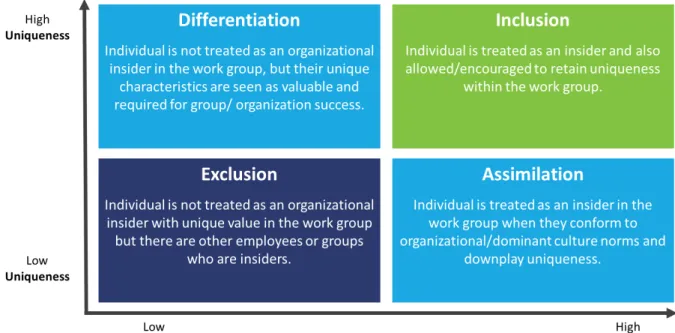
Using the dimensions of the theore�cal framework, our project examines the interplay among the contextual factors that contribute to one's feelings/percep�ons of inclusion based on the
IV .
V.
ac�ons of leaders: exclusion, assimila�on, differen�a�on, and inclusion. These ac�ons result in various outcomes: (i) low belongingness, (ii) high belongingness, (iii) low value in uniqueness, and (iv) high value in uniqueness. The selected theore�cal model augurs well for our research goals as it sufficiently captures the juxtaposi�on between leaders valuing their workers' individuality and workers' desires to maintain a sense of group belonging (Shore et al., 2011).
The Inclusion Framework was apt in molding and formalizing our project ques�ons, survey design, and data analysis.
Figure 2: Inclusion Framework (Shore et al., 2011).
R ESEARCH Q UESTIONS
For our capstone project, we had three main research ques�ons. They were:
1. What are the percep�ons of Advent Health Shawnee Mission nurses with respect to their manager's inclusive leadership?
2. What are the percep�ons of nurse managers with respect to how AdventHealth Shawnee Mission supports their efforts to become inclusive leaders?
3. Is there a rela�onship between the percep�ons of inclusive leadership and reten�on among nursing staff at AdventHealth Shawnee Mission?
P ROJECT D ESIGN
For this project, we used a cross-sec�onal survey approach (Babbie, 2015) to explore the rela�onship between percep�ons of inclusive leadership and nurses' intent to stay at AHSM.
The cross-sec�onal survey design allowed us to collect data on mul�ple variables
simultaneously at a single point in �me. This design enabled us to examine the perceived frequency nurses felt their managers engaged in inclusive leadership prac�ces, the propor�on of nurses who intend to stay or leave their job, and nurse managers' percep�on of the support received from AHSM to become inclusive leaders. In addi�on, we explored the rela�onship between percep�ons of inclusive leadership and intent to stay among nurses. We acknowledge that a cross-sec�onal study does not establish causality (Babbie, 2015), and further research using other study designs may be necessary to determine the causal rela�onship between percep�ons of a manager's inclusive leadership and intent to stay.
S TUDY P OPULATION
The popula�on for this cross-sec�onal survey study consisted of front-line nurses and nurse managers employed at AHSM. A convenience sampling method was u�lized to recruit
par�cipants from various departments within AHSM. The project aimed to include nurses and nurse leaders across different special�es and experience levels who were within the formal repor�ng line of the Chief Nursing Office. There were no other exclusion criteria for
par�cipa�on in the project.
A total of 694 front-line nurses and 38 nurse managers who met the inclusion criteria were invited to par�cipate in the survey. The nurses had an average of 6.98 years of experience specifically at AHSM and an average of 11.61 years of overall registered nurse (RN) experience.
Among the 694 front-line nurses, 20.23% had less than one year of tenure at AHSM, 22.09% had two years of tenure, 5.74% had three years of tenure, 6.17% had four years of tenure, and 45.77% had five or more years of tenure at AHSM. Furthermore, within the sample of nurses, those with five or more years of tenure at AHSM had an average of 17.86 years of nursing
VI.
experience, while the other groups (based on tenure) employed at AHSM for four years or less had an average nursing experience ranging from 5.1 to 8.60 years. In the nurse manager subgroup, the average tenure at AHSM and years of nursing experience were 16.33 and 21.95, respec�vely. Out of the 38 nurse managers, 10.26% had less than one year of tenure at AHSM, 5.13% had two years of tenure, 2.56% had three years of tenure, 2.56% had four years of tenure, and 79.49% had five or more years of tenure at AHSM.
S URVEY I NSTRUMENT
The Inclusive Leadership Ques�onnaire (ILQ) developed by Li (2021) measures inclusive
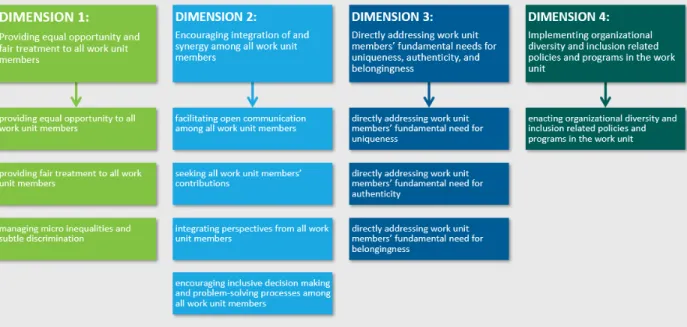
leadership within organiza�ons. The instrument was developed to address the lack of consensus and limited measures available for understanding and measuring inclusive leadership. The ILQ developed by Li (2021) demonstrated "content, construct, convergent, discriminant, and criterion validity," establishing it as a reliable measure of inclusive leadership. Based on research, the 40-ques�on instrument measures inclusive leadership as a mul�-dimensional construct as shown in Figure 3.
The ques�onnaire aims to capture each of these dimensions and assess leaders' behaviors related to fairness, equality, respect, integra�on, synergy, and transla�ng diversity and inclusion policies within their work units. Li (2021) envisioned that organiza�ons would use the ILQ to assess leaders, pinpoint areas for improvement, cul�vate inclusive leadership skills, incorporate
Figure 3: AHSM nurse and nurse manager tenure and years of experience.
inclusive leadership criteria in human capital management, and promote the establishment of inclusive work environments, leading to sustained organiza�onal health and growth.
M EASURES
Percep�on of Inclusive Leadership
Nurses' percep�on of their manager’s inclusive leadership style was measured with the 40-item ILQ. Nurses were asked to rate the frequency their nurse manager engaged in inclusive
leadership behaviors. The first survey ques�on asked par�cipants to iden�fy their role to determine if they would receive the nurse or nurse manager survey ques�ons. Nurses
responded using a 5-point Likert scale (1 = Almost never, 2 = Seldom, 3 = Some�mes, 4 = O�en, 5= = Almost always). Sample items include: "…make resources equally accessible to all work unit members" and "…value the uniqueness of all work unit members." The reliability for this
construct measured by Cronbach's alpha was .97 (Li, 2021).
Organiza�onal Support to Develop Inclusive Leadership Behaviors
Nurse managers' percep�ons of organiza�onal support to develop inclusive leadership prac�ces were also measured using the same 40-item ILQ provided to nurses. However, nurse managers
Figure 4: Inclusive Leadership Questionnaire dimensions (Li, 2021).
were asked to rate the frequency with which their organiza�on provides them with the resources and/or support to develop inclusive leadership behaviors. The first survey ques�on asked par�cipants to iden�fy their role to determine if they would receive the nurse or nurse manager survey ques�ons. Nurse managers responded using a 5-point Likert scale (1 = Almost never, 2 = Seldom, 3 = Some�mes, 4 = O�en, 5= = Almost always). Sample items include:
"…make resources equally accessible to all work unit members" and "…value the uniqueness of all work unit members." The reliability for this construct measured by Cronbach's alpha was .97 (Li, 2021).
Intent to Stay
One item was incorporated for front-line nurses to measure their inten�on to remain at AHSM.
The ques�on read, "I intend to con�nue working for AdventHealth Shawnee Mission."
Par�cipants provided responses using a 5-item ra�ng scale (0-1 year, 2 years, 3 years, 4 years, 5+
years).
Demographic Variables
Par�cipants were asked about their gender and age. Age ranges were grouped into six answer choices: 18-20, 21-29, 30-39, 40-49, 50-59, and 60 or older. In addi�on, par�cipants were asked to indicate their years of nursing experience and the number of years they have been employed at AHSM. The answer choices for both ques�ons were: 0-1 year, 2 years, 3 years, 4 years, and 5+ years.
D ATA C OLLECTION AND A NALYSIS S EQUENCE
The AHSM nursing staff were invited to par�cipate in the project through a convenience sampling approach. We received a file from the AHSM HR department containing the contact informa�on for all nurses and nurse managers who met the par�cipa�on criteria. We used a mul�-step approach to recruit par�cipants, including nurse managers and front-line nurses, to collect data for this cross-sec�onal survey. The data collec�on process involved two main components: an overview email shared with the Chief Nursing Officer and Chief People Officer
VII .
for dissemina�on during department mee�ngs and direct email communica�on with all nurses and nurse managers. The overview email aimed to promote widespread awareness before the survey was released, while the individualized emails ensured that all eligible nurses and nurse managers were directly informed about the project and given the opportunity to par�cipate.
In this project, the Inclusive Leadership Ques�onnaire (ILQ) developed by Li (2021) was adapted to create two dis�nct survey instruments tailored for different groups of nurse staff. The front- line nurses were presented with ques�ons that sought their percep�ons of their nurse
managers' inclusive management styles. The ques�onnaire for nurse managers aimed to gain insights into the adequacy of organiza�onal support and opportuni�es provided to foster an inclusive working environment for front-line nurses under their charge. Both surveys also
included demographic inquiries to assist leaders in designing targeted professional development strategies for various demographic subgroups. This informa�on could, for example, help
determine if male front-line nurses felt less included compared to their colleagues.
Both surveys were disseminated using Qualtrics on an account linked to Vanderbilt University.
Upon the circula�on of the surveys, nurse managers and nurses were advised that par�cipa�on was voluntary and that their responses would remain anonymous. Once they completed the survey, par�cipants were directed to a separate online link to enter a drawing for a $50 gi�
cer�ficate.
C HANGES TO THE O RIGINAL D ATA C OLLECTION P LAN
Our capstone team an�cipated that data collec�on would have been completed before the end of the Capstone I Seminar in late April 2023. We planned to release the surveys in March to allow for a two-week data collec�on period. However, several factors delayed the dissemina�on of the surveys, extending our data collec�on �meline beyond the end of the spring 2023
semester. First, our partner organiza�on ini�ated a system-wide shi� to Epic, a health informa�on system, around the �me we received IRB approval for the project. Epic is an integra�ve so�ware that streamlines communica�on and improves efficiency throughout the en�re hospital system. The changeover required four to eight weeks of cross-tes�ng with the
legacy system before going live. AHSM representa�ves were of the view that asking staff to complete our survey shortly therea�er would have been burdensome to their nurses.
Second, to compound the �ming issue, nurses at AHSM recently completed an unrelated
evalua�on survey and the Chief Nursing Officer, concerned about survey fa�gued, requested we delay the release of our survey so that the nurses could have some cogni�ve recovery �me.
AHSM's leadership also felt that gap �me would decrease any confla�on with survey iden�ty or employment evalua�on implica�ons. AHSM approved the dissemina�on of the survey on April 7, 2023. Since it was the beginning of the Easter holiday weekend and two weeks before the end of the semester, our capstone team decided to leave the survey open un�l the start of the summer semester, which began in early May 2023. Following the launch of the surveys, our capstone team sent the nurses intermitent email reminders every two weeks. We concluded our data collec�on on May 14, 2023.
D ATA C LEANING AND P REPARATION
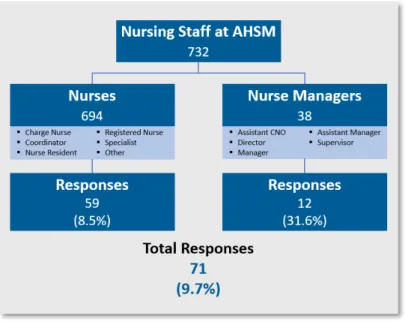
The data cleaning and prepara�on process involved several key ac�vi�es. First, only completed surveys could be submited, ensuring all par�cipants who submited responses were included in the dataset. Second, the dataset was split into two groups based on whether the par�cipant was directed to answer the nurse or nurse manager ques�ons, allowing for separate analysis of the two groups’ data (Figure 5). The survey included a branching logic for the first ques�on:
"Which of the following best describes your current role or job at AdventHealth Shawnee Mission?" Respondents who selected charge nurse, coordinator, nurse resident, registered nurse, specialist, or other were directed to answer the front-line nurse ques�ons. Respondents who selected Assistant CNO, director, manager, assistant manager, or supervisor were directed to answer the nurse manager ques�ons. Next, the Likert scale ques�ons in the Inclusive
Leadership Ques�onnaire were recoded to numeric values for consistency and ease of analysis.
For the Inclusive Leadership Ques�onnaire, the Likert scale values were recoded as follows: 1 = Almost never, 2 = Seldom, 3 = Some�mes, 4 = O�en, 5 = Almost always. This recoding step standardized the responses and facilitated quan�ta�ve analysis of the data.
D ATA A NALYSIS
S URVEY R ESPONSES
We received a total of 71 responses from the 732 AHSM nursing staff included in the survey distribu�on emails, resul�ng in an overall response rate of 9.7%. Of the 71 respondents, 59 were front-line nurses and 12 were nurse managers, culmina�ng in 8.5%
and 31.6% response rates, respec�vely.
D ESCRIPTIVE A NALYSIS
Nurse Survey Responses
We conducted a descrip�ve analysis to provide an overview of the par�cipant survey responses.
For the analysis, we calculated descrip�ve sta�s�cs for all ques�ons, including measures of central tendency (such as mean or median) and measures of dispersion (such as standard devia�on or range). The sta�s�cs below summarize the nurse par�cipants' percep�ons of their manager's inclusive leadership prac�ces (Table 1).
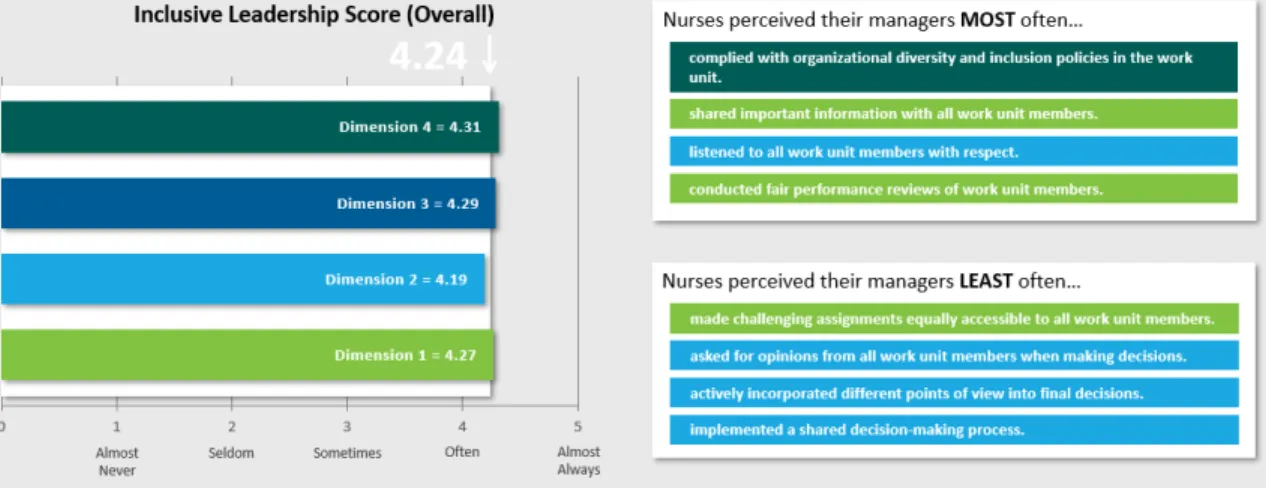
The overall mean score for nurses' ra�ngs of their manager's inclusive leadership prac�ces was 4.24, sugges�ng a generally posi�ve percep�on of inclusive leadership among the nurses, with the response "O�en" (4) being selected as the most frequent ra�ng. The standard devia�on of
VIII.
Figure 5: Survey groups and response rates.
Table 1: Descriptive statistics of nurse survey responses.
0.97 indicated moderate variability in responses, signifying some diversity in percep�ons. Examining each dimension individually, Dimension 1 (see Figure 6) had a mean score of 4.27, indica�ng a slightly higher percep�on ra�ng than the mean ra�ng for all dimensions. The standard devia�on of 0.83 suggested rela�vely less variability in
responses for Dimension 1 compared to the overall survey. In Dimension 2, the mean score was 4.19, which was slightly lower than the overall mean.
The standard devia�on of 0.98 indicated moderate variability in front-line nurses' percep�ons of their
manager's inclusive leadership prac�ces for this dimension. Dimension 3 and Dimension 4 had mean scores of 4.29 and 4.31, respec�vely. These scores suggested a similar percep�on of inclusive leadership behavior in both dimensions, which was slightly higher than the mean for all dimensions. The standard devia�ons for both dimensions were 0.98, indica�ng moderate variability in responses. Notably, the median values for all dimensions were consistently higher than the mean scores, in�ma�ng some degree of skewness towards higher ra�ngs. This
indicated that most nurses rated their manager's inclusive leadership prac�ces on the higher end of the Likert scale, with fewer respondents providing lower ra�ngs.
Figure 6: Inclusive Leadership Questionnaire dimensions (Li, 2021).
Nurse Manager Survey Responses
For nurse managers, the sta�s�cs below summarize their percep�on of the organiza�onal support to be inclusive leaders (Table 2).
The survey had a sample size of 12 nurse managers. Overall, the mean score for organiza�onal support towards inclusive leadership was 4.03 (SD = .69), indica�ng a rela�vely posi�ve
percep�on among the respondents as the value was above the midpoint of the Likert scale.
Analyzing the individual dimensions of the nurse managers’ data, Dimension 1 received a mean score of 3.84 (SD = .83), sugges�ng a slightly lower percep�on of organiza�onal support when compared to the mean for all the dimensions. Dimension 2 had a mean score of 3.99 (SD = .75), which was close to the overall mean. Dimension 3 received the highest mean score of 4.35 (SD = .63), which indicated a rela�vely stronger percep�on of organiza�onal support for inclusive leadership in this dimension. Dimension 4 had a mean score of 3.89, which was slightly below the overall mean, and had a higher standard devia�on of 0.87, in�ma�ng a wider range of responses within this dimension.
Table 2: Descriptive statistics for nurse manager survey responses.
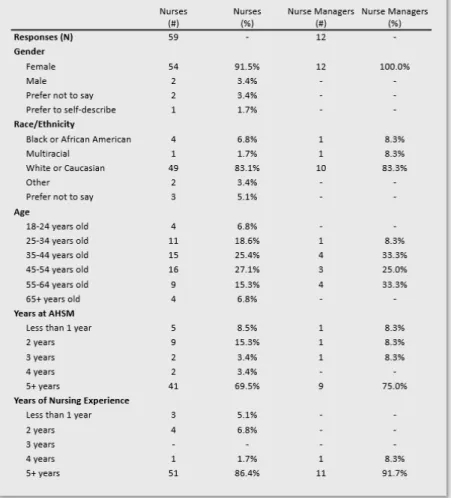
Par�cipant Demographics Addi�onally, frequencies were examined for categorical variables, including the nurse manager’s intent to stay and demographic informa�on such as gender, age, years of nursing experience, and years at AHSM (Table 3). Most of the nurse survey respondents had 5+ years of experience in nursing (86.4%), worked at AHSM for 5 years or more (69.5%), and intend to stay at AHSM for 3 years or more (59.3%). The high percentage of nurses with 5 or more years
of experience suggested that the survey responses were captured from a rela�vely experienced group of individuals at AHSM.
The descrip�ve analysis provides a basic understanding of the par�cipants' characteris�cs and their percep�ons, laying the founda�on for further analysis and interpreta�on of the data. The
Table 3: Frequencies for demographic variables.
Figure 7: Nurse intent to stay survey responses.
overall analysis suggested that respondents had a posi�ve percep�on of the ac�ons highlighted in the survey ques�on items and considered the behaviors iden�fied to occur frequently or consistently based on their experience. For nurse managers, there was a posi�ve percep�on of organiza�onal support for inclusive leadership, although there was a greater degree of
varia�ons across the surveyed dimensions.
I NCLUSIVE L EADERSHIP AND I NTENT TO S TAY
The analysis of nurses' percep�ons of their manager's inclusive leadership scores grouped by intent to stay revealed interes�ng findings.
Nurses who reported an intent to stay for less than 6 months had an average inclusive leadership ra�ng of 3.59. This suggested a rela�vely lower percep�on of inclusive leadership among this group, poten�ally indica�ng concerns or dissa�sfac�on that might contribute to their inten�on to leave. Nurses who expressed an intent to stay for over 6 months but less than a year had a higher average inclusive leadership ra�ng of 4.04. This indicated a more posi�ve percep�on of inclusive leadership among this group, sugges�ng they feel more supported and included in the workplace. Similarly, for nurses intending to stay for 1 to 3 years, the average
Figure 8: Nurse intent to stay and inclusive leadership rating.
inclusive leadership ra�ng was 4.03. This indicated a rela�vely consistent percep�on of inclusive leadership with the previous group, implying that nurses in this category felt their managers demonstrated a similar level of inclusive leadership prac�ces. However, nurses intending to stay for 3 to 5 years had a lower average inclusive leadership ra�ng of 3.71 for their managers. This suggested a minor decrease in percep�on compared to the previous groups, poten�ally
indica�ng a need for further inves�ga�on into factors that might specifically affect this group of nurses. In line with research, nurses who expressed an intent to stay for over 5 years had the highest average inclusive leadership ra�ng of 4.65. This pointed to a significantly posi�ve percep�on of inclusive leadership prac�ces among this group, reflec�ng a strong sense of support and inclusivity that might contribute to their long-term commitment to AHSM.
A one-way ANOVA was performed to compare the effect of nurses' percep�ons of their
manager's inclusive leadership on their intent to stay at AHSM. A one-way ANOVA revealed that there was a sta�s�cally significant difference in intent to stay between at least two groups (F(4, 54) = 3.51, p = .01). Post hoc pairwise comparisons, using the Tukey-Kramer test, revealed percep�on of the managers’ inclusive leadership prac�ces were significantly different between the nurses that intended to stay "over 3 years, up to 5 years" and those that intended to stay
"over 5 years" (t(54) = 4.05, p<0.05). There was no sta�s�cally significant difference between any other group pairs.
SUMMARY
Groups Count Average Variance
6 months or less 4 3.59 1.96
Over 6 months, up to 1 year 10 4.04 0.91
Over 1 year, up to 3 years 10 4.03 0.87
Over 3 years, up to 5 years 8 3.71 1.00
Over 5 years 27 4.65 0.28
ANOVA
Source of Variation SS df MS F P-value F crit
Between Groups 9.42 4 2.35 3.51 0.01 2.54
Within Groups 36.23 54 0.67
Total 45.65 58
Table 4: One-way ANOVA
Broadly speaking, the analysis highlighted the important rela�onship between nurses' percep�on of their manager's inclusive leadership prac�ces and their intent to stay. The data conveyed that nurses who perceived higher levels of their manager's inclusive leadership prac�ces were likelier to stay, while those with lower percep�ons may be more prone to consider other employment opportuni�es. These findings underscored the significance of promo�ng and enhancing inclusive leadership prac�ces as a means to increase nurse reten�on and foster a posi�ve work environment.
T ENURE AT AHSM AND I NTENT TO S TAY
The survey data revealed several notable points regarding the tenure of nurses at AHSM and their inten�ons to stay with the organiza�on. First, most front-line nurse respondents (41 out of 59) worked at the hospital for 5 or more years, demonstra�ng, as previously noted, that the data was skewed toward long-term employees. This group also had the highest percentage of responses indica�ng their intent to stay at the hospital for a substan�al period of �me (3 years or more). Second, the smallest number of nurses responding to the survey fell into the mid- term tenure category—2 to 4 years working at AHSM. However, it is noteworthy that all these nurses expressed an inten�on to remain at the hospital for at least a year or more, sugges�ng a commitment to their current posi�ons despite the rela�vely lower representa�on in the survey sample.
Finally, the nursing staff with the least tenure at AHSM, 2 years or less, also had low
par�cipa�on rates in the survey. These nurses, who historically experience higher turnover rates based on data shared by AHSM, could poten�ally provide valuable insights; however, their engagement with the survey was limited. Among those who did respond, their inten�ons to stay varied. Approximately 50% expressed an intent to remain at AHSM for the long term (3 years or more), while 14% intended to stay for the medium term (3 years), and 36% intended to stay only for the short term (less than 1 year).
This data highlighted the importance of considering the tenure of nursing staff when examining their inten�ons to stay at the hospital. While the majority of long-term employees expressed a desire to remain at AHSM, the mid-term group also demonstrated a consistent intent to remain.
However, further aten�on and targeted efforts to engage and understand the inten�ons of newer nursing staff are needed given their historically higher turnover rates at AHSM and limited survey par�cipa�on. It is also important to note that the dataset may not represent the en�re popula�on of 694 frontline nurses due to poten�al sampling bias. The responses
primarily reflected the opinions and inten�ons of the nurses who chose to par�cipate in the survey. Therefore, cau�on should be exercised when generalizing about the overall popula�on at AHSM based solely on these survey responses.
L IMITATIONS
Survey Response Rate
Determining a "good" survey response rate for research on working nurses can be challenging, as it depends on various factors such as the study objec�ves, target popula�on, survey method, and research context. Response rates to surveys and interviews in healthcare and nursing
Figure 9: Nurse intent to stay and tenure at AHSM.
research is a moving benchmark with complicated calcula�ons (American Associa�on for Public Opinion Research [AAPOR], 2023). In an atempt to focus our project, we accepted only fully completed surveys and our goal was to receive an overall response rate of 30%.
Response rate percentages are important indicators of the representa�veness and poten�al bias of the study sample. A higher response rate increases the likelihood that the sample accurately reflects the perspec�ves and experiences of the nursing popula�on at AHSM and enhances the validity of the findings. Lower response rates raise concerns about non-response bias and the generalizability of the results. For our research, we employed several literature-supported strategies to maximize response rates to the survey. These included using personalized invita�ons, providing clear instruc�ons, offering incen�ves, u�lizing mul�ple reminders, and ensuring the confiden�ality of responses (O'Connor, 2022).
Nurses may have chosen not to respond to surveys regarding their intent to stay in their current posi�ons for several reasons. One significant factor is survey fa�gue, where nurses may feel overwhelmed by the number of surveys they receive and opt not to par�cipate in addi�onal ones (Polit & Beck, 2021). The AHSM nurses recently completed an in-house survey, so we delayed the release of our survey by an addi�onal week to mi�gate fa�gue. Addi�onally, workload and �me constraints can influence an individual’s willingness to engage in surveys, especially when they perceive the surveys as �me-consuming or burdensome (Keusch et al., 2019). Moreover, concerns related to confiden�ality and anonymity may discourage nurses from par�cipa�ng, par�cularly if they fear that their responses may not be anonymous (Polit &
Beck, 2021).
The final reason our response rate from the front-line nurses may have been lower than desired was the unfortunate �ming of our survey that coincided with a hospital-wide transi�on to Epic, their new electronic health record (EHR) system. Research has highlighted the stress
experienced by nurses during EHR implementa�on. For example, a study by Granja et al. (2018) explored the stressors associated with the introduc�on of an EHR system in a hospital se�ng.
The findings revealed that nurses experienced heightened stress due to factors such as increased workload, challenges in adap�ng to the new system, and concerns about pa�ent
safety. Another study by Babbot et al. (2014) inves�gated the impact of EHR implementa�on on nurses' professional quality of life. The results indicated that nurses reported higher levels of stress and burnout following the implementa�on, with a nega�ve effect on their well-being and job sa�sfac�on. This added stress may have resulted in a decreased response rate by the AHSM nursing staff.
Of note was the limited response from the front-line nurses with less than two years of work experience at AHSM. AHSM leadership was par�cularly interested in this group; however, insufficient data inhibited our ability to develop meaningful insights related to their percep�ons and behaviors. Furthermore, it is crucial to recognize that a considerable number of nurses who responded to the survey have been employed at AHSM for a substan�al period, averaging nearly 7 years. Nurses with more years of experience may beter understand their roles and organiza�onal dynamics, which could influence their percep�ons of inclusive leadership. Also, their extended tenure likely impacts their level of familiarity with the organiza�onal culture, policies, and leadership prac�ces. Similarly, managers had rela�vely long tenures at AHSM, which may have also posi�vely influenced their percep�ons of organiza�onal support.
However, the perspec�ves of the nurses and nurse managers with longer tenure at AHSM may not be representa�ve of the general sen�ment held by the broader cross-sec�on of nurses who did not respond to the survey.
Bias
Bias was an important considera�on in this project, and several poten�al sources of bias could have influenced the results and their interpreta�on. First, the overall response rate of 9.7%
raises concerns about selec�on bias. The nurses who chose to par�cipate differ from non- respondents in terms of their employment characteris�cs and may differ in their perspec�ves and experiences as well. As previously noted, this could limit the generalizability of the findings to the broader nursing popula�on at AHSM. Addi�onally, self-selec�on bias may be present due to the survey being conducted via email. Nurses with stronger opinions or experiences related to inclusive leadership and intent to stay may have been more likely to par�cipate, poten�ally skewing the results by overrepresen�ng extreme viewpoints. Similarly, nurses with no inten�on
of remaining at AHSM long term or have no interest in inclusive leadership may have lacked the mo�va�on to complete the survey. Social desirability bias is another poten�al concern, as par�cipants may have felt compelled to provide socially desirable responses or align their answers with organiza�onal expecta�ons at AHSM, leading to biased percep�on ra�ngs.
Furthermore, recall bias could have influenced par�cipants' ability to accurately recall the frequency of their manager's inclusive leadership behaviors. Addi�onally, confirma�on bias may have influenced responses, as nurses with preconceived no�ons or expecta�ons about inclusive leadership may have selec�vely sought out answer choices in the survey that confirmed their beliefs.
Survey Design and Administra�on
Two significant limita�ons of this project pertain to the survey administra�on and the u�liza�on of a single-�me, cross-sec�onal survey design. First, the study design adopted restricts the ability to establish causal rela�onships and examine changes in percep�ons of inclusive leadership and intent to stay over �me. Both these constructs are dynamic and subject to fluctua�ons. Without longitudinal data, it is challenging to capture the temporal nature of these rela�onships and account for poten�al changes in percep�ons or inten�ons that may occur in the future or due to interven�ons implemented by AHSM’s leadership. Consequently, the findings can only provide a snapshot of the rela�onship between nurses' percep�ons of their manager's inclusive leadership and their intent to stay at AHSM at a par�cular period in �me.
Second, the survey was administered via email by doctoral students who were not associated with AHSM. While efforts were made to ensure anonymity and minimize bias, the involvement of external par�es may have influenced the response rate and par�cipants' willingness to provide accurate and comprehensive responses. The limited direct involvement from AHSM staff and poten�al unfamiliarity between the survey par�cipants and the project team could have impacted the overall response rate and poten�ally introduced response biases.
F INDINGS
F INDING #1
When asked about their views of their nurse managers' inclusive leadership traits, the frontline nurses had rela�vely posi�ve feedback. However, while the survey findings showed comparable responses to the ques�ons categorized in Dimensions 1, 3, and 4, ranging from a
mean dimension score of 4.27 to 4.31, there was a slight decrease in the overall average for ques�ons captured in Dimension 2, which had a mean score of 4.19. Dimension 2 in the survey addresses workplace integra�on. We found that frontline nurses believed that their supervisors encouraged integra�on of and synergy among work units less than other dimensions of
inclusive leadership (see Table 1 above, which highlights the mean score responses among the four dimensions of inclusive leadership).
This finding is of par�cular interest to the project because the sub-dimensions and the related survey ques�ons are a more balanced mix of ques�ons related to the concepts of uniqueness and belongingness. This is unlike Dimension 1, which only captured the concept of uniqueness, or Dimension 3, which overwhelmingly focused on the concept of belongingness. The nurses' view that there may be a "synergy gap" among their teams aligns with Hofmeyer's (2013) no�on that nurses thrive beter within more inclusive work se�ngs. Importantly, nurses will be more inclined to remain in their posts if they perceive that their leaders authen�cally create such inclusive work environments (Nishii & Mayer, 2009). Dimension 2 tells us several factors that nurses consider when evalua�ng their manager's inclusive leadership prac�ces. In the area of uniqueness, nurses desire their supervisors to (i) seek out their ideas when se�ng goals for their work unit, (ii) be more open to various perspec�ves whenever the group is working on shared challenges, and (iii) push to integrate viewpoints from team members. With respect to belongingness, nurses are tasking their managers with (i) communica�ng openly with all nurses
IX.
P
ROJECTQ
UESTION#1:
What are the percep�ons of Advent Health Shawnee Mission nurses with respect to their manager's inclusive leadership?
within the working team, (ii) establishing an inclusive problem-solving mechanism, (iii) reinforcing work collabora�on efforts, and (iv) invi�ng construc�ve debates.
Our finding here suggests a percep�on that while nurse managers treat those under their charge fairly and they directly address frontline nurses' need for belongingness and uniqueness, there are opportuni�es for leaders to integrate the views of the nursing staff more affirma�vely in decision-making.
F INDING #2
Nurse managers gave the organiza�on considerably high ra�ngs (average 4.35) for Dimension 3: support in directly addressing work unit members' fundamental needs for uniqueness, authen�city, and belongingness (see Table 2). Responses for all nine ques�ons in Dimension 3 fell within the top 15 highest-rated responses in the ques�onnaire.
Dimension 1, the support for providing equal opportunity and fair treatment to all work unit members (average 3.84), had the lowest ra�ngs. The first ten ques�ons of the survey pointed to the first dimension, and interes�ngly, seven of those ten ques�ons were amongst the lowest 12 responses. Dimension 4, implemen�ng organiza�onal diversity and inclusion-related policies and programs in the work unit, also scored lower (3.89). The last three ques�ons of the survey supported Dimension 4, and two of those three ques�ons were among the ten lowest-scoring ques�ons. Support for implemen�ng diversity and inclusion programs and ini�a�ves in the work unit scored on the low end, but support for complying with diversity and inclusive policies scored fourth highest amongst all ques�ons. Dimension 2, support in encouraging integra�on of and synergy among all work unit members, came in right below the mean (3.99).
The results of the analysis suggested that nurse managers felt the greatest organiza�onal support for crea�ng inclusion for the front-line nurses individually. Organiza�onal support for belongingness and uniqueness towards individuals scored equally high amongst respondents.
P
ROJECTQ
UESTION#2:
What are the percep�ons of nurse managers with respect to how AdventHealth Shawnee Mission supports their efforts to become inclusive leaders?
Lower scores came in suppor�ng managers when implemen�ng inclusive behaviors and crea�ng equity across the en�re work unit. These findings could suggest that nurse managers perceived more support in crea�ng a sense of inclusivity for each floor nurse on the team and less support in crea�ng an inclusive environment among the members within the team. This leadership support is important to team cohesion.
This finding is of interest because, as previously stated, Tang and Hudson (2019) noted that nurse belongingness improved reten�on and Nishii & Mayer (2009) concluded that the development of nurse managers who effec�vely create inclusive work environments could directly affect the work-life sa�sfac�on of floor nurses.
F INDING #3
The results of the analysis aligned with previous research on the rela�onship between inclusive leadership and employee reten�on. Studies have consistently shown that inclusive leadership, characterized by suppor�ve and inclusive behaviors from managers, plays a crucial role in employee engagement and commitment to an
organiza�on (Chami-Maleb, 2022; Lee & Jang, 2020; Wang et al., 2019). The finding that nurses intending to stay for over 5 years had the highest average inclusive leadership ra�ng aligns with research sugges�ng that employees who perceive a higher level of inclusive leadership are more likely to exhibit a long-term commitment to their organiza�on (see Figure 9). This posi�ve percep�on indicated that these nurses felt valued, a sense of belonging, and included in
decision-making processes, thereby fostering a sense of loyalty and dedica�on (Tang & Hudson, 2019).
On the other hand, the lower average inclusive leadership ra�ng among nurses intending to stay for less than six months and 3-5 years highlighted a poten�al area of opportunity for
improvement by AHSM leadership. Research has demonstrated that the lack of inclusivity, among other factors, can nega�vely affect employee reten�on (Wang et al., 2019). These
P
ROJECTQ
UESTION#3:
Is there a rela�onship between the percep�ons of inclusive leadership and reten�on among nursing staff at AdventHealth Shawnee Mission?
findings emphasized the importance of addressing any gaps in inclusive leadership prac�ces, par�cularly for nurses with lower percep�ons of their manager's inclusive leadership, to enhance their job sa�sfac�on and inten�on to stay.
Overall, the alignment between the survey results and exis�ng research strengthened the validity and reliability of this finding, despite low survey response rates. It reinforced the understanding that inclusive leadership is a cri�cal factor in crea�ng a posi�ve work environment and retaining valuable nursing staff. AHSM can u�lize this finding to inform targeted interven�ons and ini�a�ves aimed at strengthening inclusive leadership behaviors, ul�mately improving nurse reten�on rates and maintaining a suppor�ve workplace culture.
R ECOMMENDATIONS R ECOMMENDATION #1
Provide more robust collabora�on opportuni�es within and across the work units.
Front-line nurse survey responses indicated there is an opportunity for greater integra�on of ideas, perspec�ves, and opinions in the decision-making proces