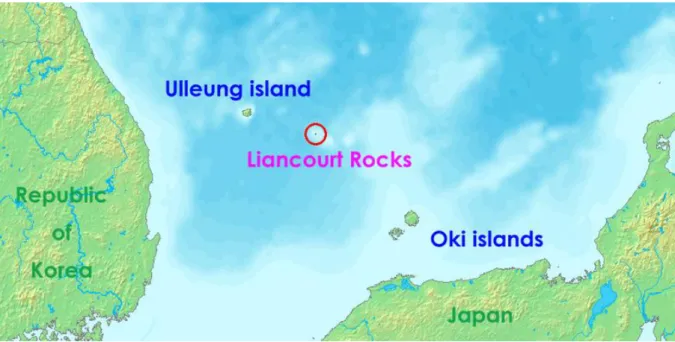
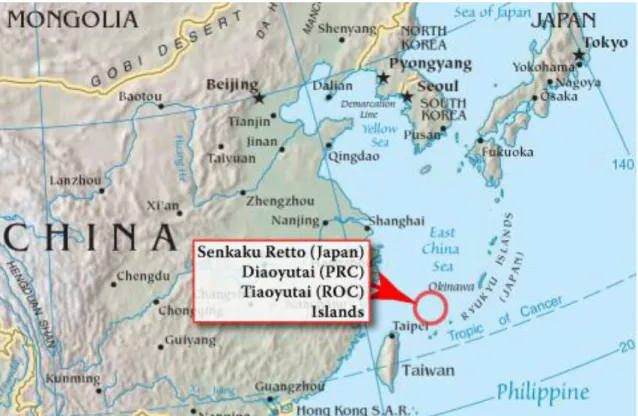
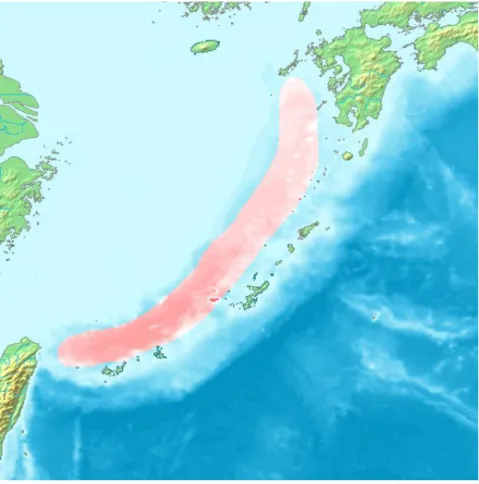
Finally, the chapters conclude with a brief summary of the sovereignty game in the post-Cold War period. This chapter provides an overview of the literature on territorial disputes in general and Japan's territorial disputes in particular.
Territorial Conflict Approach
- The Theory of Territorial Conflict
- Norms and International Law
- National Identity and Symbolic Value
- Methodological Focus on Conflict
- Challenger/Target Dichotomy
- The Insights of Territorial Conflict
- Summary
The last part of this section reviews some of the insights gained in the literature on territorial conflicts. A brief comparison of the two provides a useful introduction to the major theoretical problem facing the territorial conflict approach.
Fravel’s Theory of Territorial Disputes
Cooperation
The impact that such threats have on the behavior of states depends on the relationship between the opportunity costs of maintaining (and by extension) the territorial claim and the underlying value of the territory.32 That is, when the costs of claim exceeds the benefits of the territory, the state will cooperate. External threats arise from the anarchic nature of the international system, which ensures that states 'maximize the power and influence of their state.
Escalation
As mentioned, the theory assumes that changes in claim strength cause escalation. 34 The coup installed a president who favored unification with Greece, this level of political consolidation weakened Turkey's claim power enough to provoke military intervention.
Summary
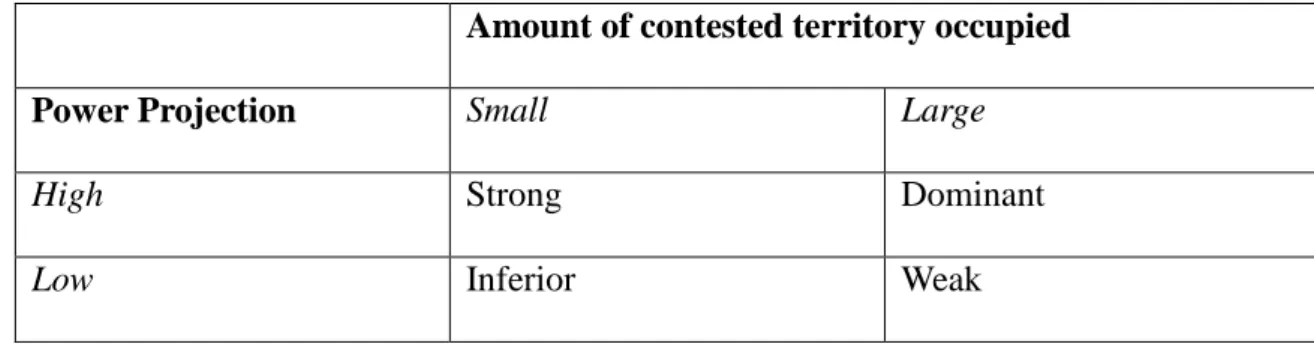
The final point to be made here combines elements of the previous two points: Japan is not China, and its claim power is more complicated than Fravel allows. The position taken in this thesis is that it is not the occupation of territory, but rather the ability to exercise sovereignty, that is the crucial factor.
Literature on Japan’s Territorial Disputes
- Pluralist Approaches
- Economic Interdependence
- Constructivism and Identity
- Relational Power
- Issue Linkage and Coercive Diplomacy
- Geopolitics
- Chaos Theory?
Both the analysis and some empirical data from Downs and Saunders' article are used in the Pinnacle Islands Dispute case study. Despite the enormous economic incentives that an agreement provided in the early 1990s, Russia did not accept Japan's demands for a return of the four islands (described in detail in Chapter Four).
Summary
This dissertation uses the possibilities offered by constructivism to build a tentative theoretical approach to the relationship between international law and state behavior in territorial disputes. Having provided an explanation of sovereignty, the chapter then turns to international law in relation to territorial disputes themselves – particularly contested island territories – so that the elaboration of the game of sovereignty can be based on the law governing such disputes and evaluate how it affects the behavior of the state.
International Politics and International Law
Realism
This is most evident in the past, when international law allowed the annexation of territories after wars, the colonization of land as terra nullius, etc. Despite realistic disdain for international law and even numerous cases of non-observance of it by states when expedient, the reality of contemporary international relations is such that the behavior of states most of the time mitigates international law.
Neoliberalism
Constructivism
In terms of how constructivism can be used to understand the relationship between politics and law, it is instructive to return to Wendt's analysis of the social construction of anarchy. It is clear that constructivism offers great promise in the study of the relationship between international relations and international law, especially with regard to the way in which the sovereignty game works in territorial disputes.
A Constructivist Theory of International Law
As Watts eloquently states, “if politics is the art of the possible, then international law is simply the art of the plausible” (2008: 8). Thus, the state practice that gave rise to customary international law was not "liberal" in the sense that Reus-Smit uses the term—indeed, "liberalism" in the history of international law is for many a deeply tainted term, used as a justification for war and oppression, especially of the weak.
What is Sovereignty?
Wendt and the Social Construction of Sovereignty
However, before elaborating on the dynamics of the sovereignty game—the rules of the game, the techniques and resources that states use, and the motives for doing so—we must first understand the nature of sovereignty itself, as the taking of sovereignty itself. the basis of the game of sovereignty. Indeed, the institution of sovereignty is self-perpetuating, since the interest of every state is in its preservation; when one state violates the sovereignty of another state, this is also perceived as a violation of the very concept of sovereignty, and thus is seen as a threat to all states.
Understanding Sovereignty
Most definitions and descriptions of sovereignty emphasize the role of recognition – as Thomson says, "sovereignty is not a property of a state, but is attributed to a state by other states." The concept of sovereignty is inextricably linked with the "rediscovery of the Roman law of private property in the sixteenth century" (Holland.
Summary
The International Law of Territorial Disputes
The Acquisition of Territory under International Law
Accretion – the acquisition of territory newly formed by geographical processes – is not relevant to this thesis. Obsolescence takes place when a state occupies a territory which was already under the sovereignty of another state; Shaw describes it as “the legitimization of a dubious title through the passage of time and the supposed consent of the former sovereign.
The Jurisprudence of Territorial Dispute Resolution
Disputed between Honduras, Nicaragua, and El Salvador, the judge at the ICJ awarded each island based on the parties' conduct since gaining independence and effective control of each island and acquiescence in that effective control.64 Without timely and meaningful protest, a state loses its claim to a dispute. Anthony Aust describes the critical date as "the date at which the rights of the parties to a territorial dispute are so crystallized that what they do afterwards does not affect the legal position" (Aust, 2005: 35).
The United Nations Convention on the Law of the Sea
What this means is that, from a legal perspective, exercise of sovereignty post-dispute emergence is not legally relevant.69 There is one more aspect of law related to time: the intertemporal rule, which requires that the law of the time in which the acts took place must be applied, rather than applying current international law retrospectively (2005: 35). Beyond even the EEZ again, states can claim a continental shelf - where it exists - which can extend up to 350NM from the coastal baseline or until the natural extension of the shelf ends, whichever is shorter.
The Sovereignty Game
The Acquisition of Territory by Force
Thuycdides' aforementioned Melian Dialogue tells the story of the interaction between two ancient Greek states, Melos and Athens; the fate of Melos reinforces the importance of the modern concept of sovereignty in preventing the acquisition of territory by force. The reason for this is that the international community, even if skeptical of British motives for the war,.
International Recognition
To begin with, it is clear that recognition is important: without international recognition of sovereignty over a given territory, sovereignty remains incomplete. Thus, obtaining international recognition of the claim to sovereignty over the territory is an important part of the game of sovereignty.
Authority: The Effective Exercise of Sovereignty
When a state seeks to exercise sovereignty over a territory, the first question to be answered is: is this exercise of sovereignty a break in precedent or is it in keeping with the status quo of the sovereignty in dispute. It is these two final aspects of the sovereignty game that this chapter now turns to.
Resources: Capital
These two illustrative examples show how states seek to improve their position in the sovereignty game by attempting to exercise sovereignty or prevent such exercises. A state can use broader bilateral economic relations in the sovereignty game: for example, it can refuse to trade with the other state.
Value of the Disputed Territory
- Economic Value
- Symbolic Value
- Precedential Value
- Strategic Value
The value of the island is negligible; it has no bearing on the demarcation of maritime areas and no history of human habitation. The other aspect of the precedential value of a dispute is entirely political in nature and comes down to a state's reputation.
Summary
This is followed by an assessment of the value of the disputed territory, which enables us to provide an understanding of the motivations of both states in the dispute following its re-emergence in 1996. The next section then looks at the details of the dispute. resumption of the dispute in 1996.
History
- Pre-1905 History
- The Russo-Japanese War
- The San Francisco Peace Treaty
- The Rhee Line
- The Secret Pact
There can be no doubt that the rocks have created a lot of friction, albeit ultimately between two US allies. The US had intended to break this line with the implementation of the San Francisco Peace Treaty.
The Value of the Liancourt Rocks
- Economic Value
- Symbolic Value
- Precedential Value
- Strategic Value
- The Wharf
- The 1996 LDP Manifesto
The value of maritime territory that the rocks could generate is difficult to quantify. It is difficult to underestimate the symbolic value of the Liancourt Rocks conflict for South Korea.
The 1998 Fisheries Agreement
The Korean argument was unacceptable to the Japanese, as a baseline drawn from Ulleungdo would place the rocks on the Korean side of the median line and thus in Korea's EEZ. In fact, Article 15 of the agreement itself carefully clarifies that although the islands are located in the so-called 'intermediate zone', this fact has no bearing on the dispute.
Japan’s Restraint: Stamps and Attempted Landings
Nihon Shidokai Attempted Landing
The Nihon Shidokai landing attempt in May of the same year (2004) is consistent with this reading of the Japanese government's attitude toward the rocks. The reason for the low-profile nature of the incident in Japan was once again Japan's position in the sovereignty game: the issues were off the table, the government focused on the maritime territory and the potential precedential aspects of the dispute.
Takeshima Day
The violent response to the enactment of the legislation in 2005 surprised those responsible (Interview with Fukuhara Yūji. The legislation creating Takeshima Day, as well as the actual inaugural celebration of the day in 2006, because it was organized by a sub-national government and not Tokyo, had less impact on the issue of sovereignty.
Hydrographic Research
So it would be more accurate to say that while the hydrographic research incident does match the pattern of the government driving the maritime issue rather than the rocks. The combination of the UNCLOS exemption and the stricter stance served to increase the importance of the sovereignty game as a determinant in the maritime dispute.
Recent Developments
In contrast, 2005 was, as it was, a terrible year for Japan-South Korea relations, with Seoul protesting and calling for the textbook to be changed, while a Foreign Ministry spokesperson added. The naming issue reflects the enormous weight South Korea places on international recognition of its sovereignty over the Liancourt Rocks.
Summary
The chapter shows how, following the ratification of UNCLOS in 1996 and the associated flare-up in the summer of that year, domestic opposition to the Japanese government's perceived weak stance on the dispute grew. Both incidents show the importance of the demonstration of jurisdiction and political sovereignty over the islands, although the two incidents had dramatically different implications for Japan's position in the dispute.
History
- The Incorporation
- The San Francisco Peace Treaty
- The Emergence of the Dispute
- The 1978 Peace and Friendship Treaty
The precise details of the years prior to the final incorporation of the islands under the principle of terra nullius are unclear. This clear military superiority could explain the change of heart regarding the incorporation of the islands (Su, 2005: 54).
The Value of the Pinnacle Islands
Economic Value
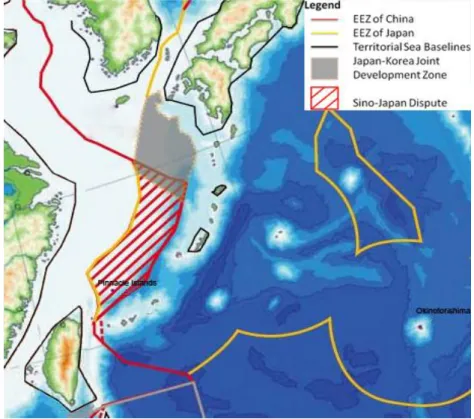
The Pinnacle Islands lie on the Chinese side of the Okinawa Trough, and thus on China's claimed continental shelf. In 2009, China made preliminary submissions to the UN Commission on the Limits of the Continental Shelf (CLCS), claiming its continental shelf up to the Okinawa Trough (Schofield and Gault, 2011: 30).
Symbolic Value
It is clear that the symbolic value of the islands has changed dramatically over the past twenty years, but the question remains as to whether they are considered a "national homeland". In contrast, the Japanese claim is based on the inclusion of the islands as terra nullius; The "late addition" of the Pinnacle Islands is clearly reflected in the title of Ishigaki's celebratory day: "Senkaku Colonization Day".
Precedential Value
Strategic Value
This symbolic aspect of the dispute added to the severity of the reaction in Taiwan. The group also applied again for official recognition of the lighthouse, and the dispute flared up again.
Domestic Reaction and 1997 Landings
Instead, the main purpose of Beijing's (and Taipei's) protests was to prevent recognition of the lighthouse—otherwise, China would see diplomatically allow recognition of the lighthouse in exchange for other concessions, as Wiegand's theory suggests. The consequences of the direct exercise of state sovereignty over the islands themselves were greater than China (or Taiwan) would have accepted in 1996 – political consent would have affected China's position not only on the disputed islands, but also on the sovereignty status of the adjacent sea territory.
The Maritime Dispute I: Prior Notification
Koizumi, Lighthouses and Leasing
The Maritime Dispute II: Conflict and Cooperation
Sovereignty and Arrests
Summary
History
The Value of the Northern Territories
Economic Value
Symbolic Value
Precedential Value
Strategic Value
The End of the Cold War: Japan-Soviet Joint Communique
Visa Nashi
Establishing a Post-Cold War Sovereignty Status Quo
Economic Aid and the G7
Shikotan Lease
The 1993 Tokyo Declaration
Sovereignty Issues Post-Tokyo Declaration
The Krasnoyarsk Process
Hashimoto Administration
Obuchi and Mori Administrations
Koizumi Administration
Visa Nashi Expansion
Post-Krasnoyarsk Negotiations
The Democratic Party of Japan Takes Power
Russia Pushes Back
Fishing
International Recognition and International Trade and Investment 286
Infrastructure, Investment, and Military build-up
Visa Nashi
Summary
Reassessing the Literature
The Sovereignty Game: Theory and Findings
The Liancourt Rocks Dispute
The Pinnacle Islands Dispute
The Northern Territories Dispute
Japan’s Approach to its Territorial Disputes
The Sovereignty Game
Recognition
Authority: Exercises of Sovereignty
A Universal Theory?
Reflections: International Politics and International Law
Suggestions for Future Research