The next chapter provides an overview of the recent research conducted on university technology transfer. One of the questions was split into two questions (see Appendix C for a copy of the survey).

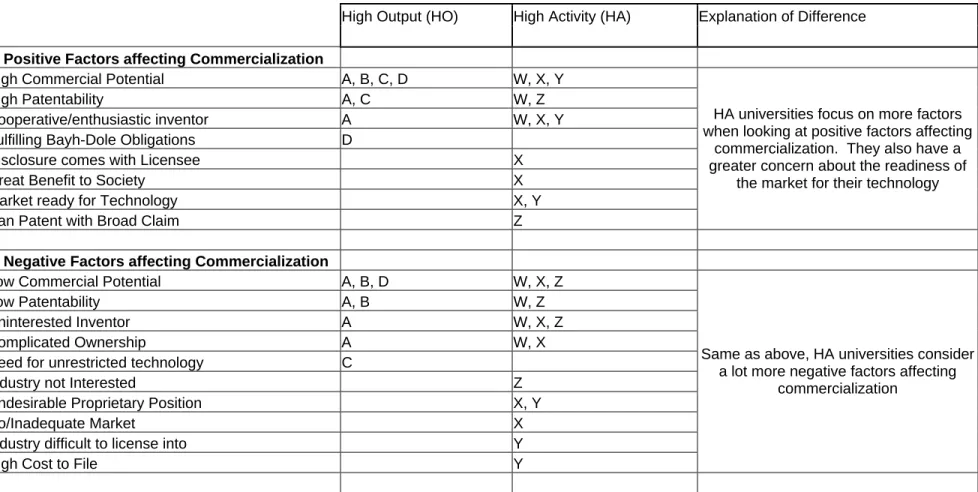
Positive Factors Affecting Commercialization
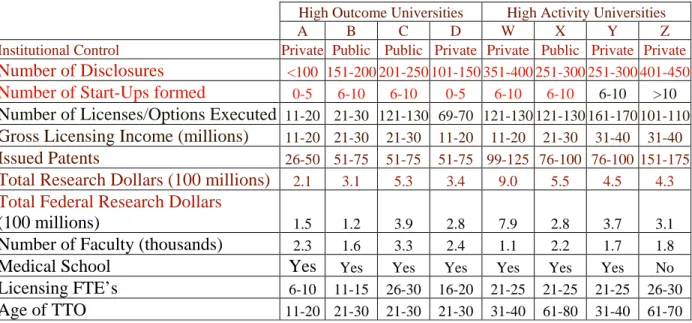
This section will demonstrate that the HO universities (see Table 5) have two important things in common in contrast to the HA universities – (1) they consider their faculty members to be an integral part of their technology commercialization process, and they have serious reservations about taking on any project where the faculty member is not fully committed, and (2) when making the decision whether or not to form a start-up, the high-output universities seem to be much more concerned about the start-up's ability to to attract funding and the technology's ability to generate revenue. This section will look at all three areas that were examined in the study and discuss the findings accordingly. The following is a look at the results obtained by examining the technology selection processes at both HA and HO universities.
This section looks at the responses to each of the factors that were measured, followed by a discussion of some of the unique practices in technology selection, as well as a summary of the section. In some cases, we have outside consultants do a commercial assessment for us and outside patent attorneys do patentability assessments for us.”
Negative Factors Affecting Commercialization
Necessity of Patent Protection
Before making this decision, TTOs must determine whether it would be cheaper for the customer to purchase the technology or make it. If it is cheaper for the customer to buy the technology, then there is really no need to seek patent protection. However, if it is cheaper for a company to produce the technology, then the TTO will have to seek patent protection in order to protect the suitability of the technology.
It is not necessary if the prospective licensee needs to receive anything physical from you, for example, genetically modified mice or other animals. It is often easier and cheaper for the client to license the materials from an institution under a delivery agreement, in essence, to buy them, than it would be to produce them themselves. If it ever turns out that making it is cheaper than buying it, then you should seek patent protection.”
Who Handles Patent Protection
For example, one director stated that his university licenses many biological materials and software without patenting. We file provisional patents in the office, but if there is actual prosecution regarding the patents being filed, we always ultimately seek outside counsel.
Is Most of Your Income from Patented Technologies?
TTOs’ Primary Customer
Half of the sample (2 HO and 2 HA) do not believe they have any unique technology licensing processes. However, the other four TTOs in the sample were willing to share their unique practices. They believe that by breaking up these functions, the TTO increases the efficiency of the process.
I believe the rate limiting step for most of the technologies we have is found in biomedical. In most cases, there appeared to be no significant differences between HO and HA universities in the factors that were considered as part of the university TTOs' technology selection processes. This section looks at the responses to each of the factors that were measured, followed by a discussion of some of the unique practices in technology marketing, as well as a summary of the section.
Methods of Marketing
HA universities are filing patents on a greater number of their invention disclosures, and this would confirm why these universities are so active in the first place. This is an interesting observation because it suggests that HA universities may spend too much time considering factors that do not necessarily influence their licensing revenues. We have a keyword searchable website and an email verification list on that site.
We work with the university's communications office to get stories out about the technologies we have available.” We list abstracts with TechEx—one of the Internet companies that accepts subscriptions from commercial entities and matches and pushes abstracts based on keywords. Last year, we also included an email notification service modeled after how NIH does theirs.”
Factor favoring Start-up Formation/Licensing
We consider every opportunity to create a startup company, whether it comes from a venture capital group we come into contact with. If they are interested in starting a business around a particular technology that we have in our portfolio, we are certainly willing to listen to them. HE universities pay extra attention to the start-up's management team, as well as its commercial utility and ability to attract funding before licensing to a start-up company.
We would probably always try to license an existing company first and if that doesn't work, we would create a start-up if necessary. In general, the inventor should be interested in participating in the creation of the start-up.”. The short summary is that we will pursue whatever route we need to to honor our loyalty to the technology and its commercialization.”
Importance of Industry Networks
Quite often different groups will want to come and find out what we are up to. If it sounds like they have a reasonable plan, we'll ask them to submit a business plan. A commitment by the faculty member to pursue product development despite the lack of industry interest, and a technology that lends itself well to an investment opportunity.
If there are already credible professional investors interested, or if there is a management team and an entrepreneur with a (good) track record. In this respect, there seems to be no significant difference between HO and HA universities. I still believe that there is an art to this business and that it is a people game or profession, and without those contacts or without developing those contacts and without having great personal interactions with those people, then you are not going to be successful in this business . ".
Methods of Cultivating Networks
Faculty Involvement in Marketing
The TTOs of HO and HA universities did not differ on most of the factors measured by the survey. Regarding the factors favoring the formation of a start-up company or the licensing of a start-up company, most TTOs agree that faculty buy-in is important (4 HO and 3 HA). However, the HO TTO university seems to pursue initial training only as a last resort, after a.
In this case, HO university TTOs place more emphasis on evaluating the technology's market potential and the startup's ability to attract funding (7 number of HO university TTOs versus 4 number of HA university TTOs). HO and HA university TTOs vary most in their ability to engage faculty inventors in the commercialization of new technologies. Although the majority of TTOs (3 HO and 3 HA) would admit that faculty inventors are essential to the technology commercialization process, only in the HO.
Qualifications for Licensing Officers
This section discusses the results obtained from research into management practices at both HA and HE universities. This observation may be due to the high level of patenting that takes place in HA universities, as mentioned in previous paragraphs.
Qualifications in Senior Staff
Incentive Compensation
Flexibility in Negotiating Licensing Agreements
Efforts to Educate Industry Contacts
Some of them [industry contacts] are quite knowledgeable about it and they've been through the process and they've done a lot of university licensing. And some of them [industry contacts] are new to the process and we need to do a lot more education on that. For those who are not so skilled, we give them a background of our operations; the policies and procedures we have in place for licensing.
Federal statutes we must comply with and any other policies we may encounter. So we spend basically 100% of our time trying to manage and evaluate and license invention reports.”
Efforts to Educated Faculty Inventors
These researchers found that the total number of licenses executed would have the greatest impact on the effectiveness of the technology transfer office. Based on the result of the qualitative study, HO and HA university TTOs appear to be similar in most respects. The tapes will be kept for 2 years after the end of the study, after which they will be destroyed.
The use or disclosure of PHI is requested solely for the purpose of developing this research protocol. Does this research involve procedures that pose minimal risk other than linking the consent document to private information? Are there any procedures involved in this research that require written consent outside the research context?
Note: Authorization only applies if protected health information (PHI) will be created, used, or disclosed during the research. A brief statement of the purpose of the disclosure that reasonably describes the basis for the disclosure.
Managerial Practices - this section will explore your management philosophy within your technology transfer office
Please participate in this study so that I can complete my M.S. Your university was chosen because you exhibited. outstanding performance in technology transfer between university and industry. Okay, so my first questions are about your technology selection processes - this section is designed to explore the processes that accompany a decision to commercialize one of the available technologies. What factors would contribute positively to your decision to commercialize one of the technologies developed at your university.
When your university seeks to patent a technology, do you handle it internally or do you seek external counsel. Next, I will ask questions about your technology marketing processes – this section aims to explore the process of creating awareness of the existence of your technology in the market. Thank you for taking the time to talk to me about your technology transfer processes.