
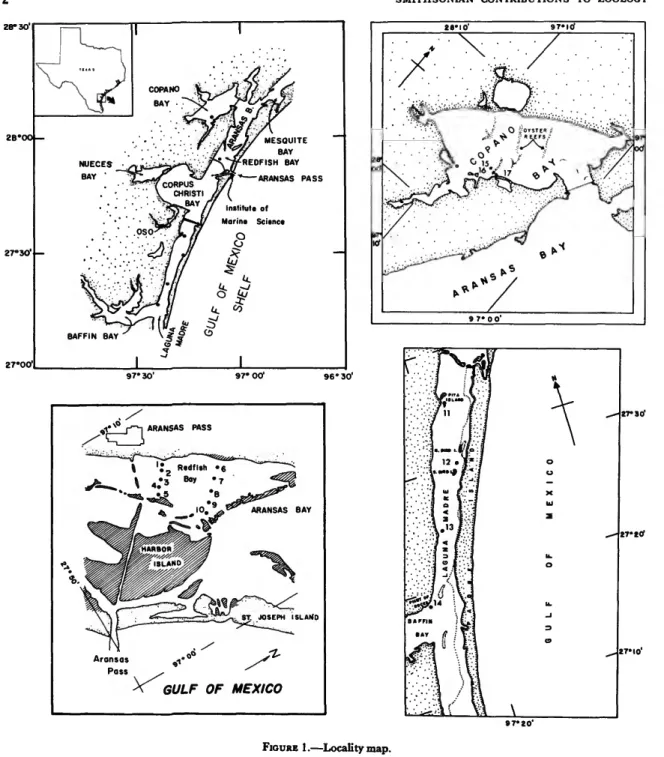
This report is based on collections of living benthic ostracods from Copano Bay, Redfish Bay, and Upper Laguna Madre on the central Texas coast (Figure 1). Water occasionally moves from Baffin Bay into the southern part of the Upper Laguna Madre. Odum and Hoskins (1958) reported that in Redfish Bay and the northern part of the Upper Laguna Madre,.
Samples were collected along a transect from the northern part of the Upper Laguna Madre to Port Isabel at the southern end of the Lower Laguna Madre. Indices suggest that faunal similarities are greatest between Copano and Redfish Bays and least between Redfish Bay and the southern part of the Upper Laguna Madre. Insufficient numbers of living ostracods were found in the southern part of Laguna Madre to follow seasonal variations in species proportions.
Graphs showing seasonal changes in ostracod abundance in Redfish Bay, Copano Bay, and the northern part of the Upper Laguna Madre are presented in Figure 10. In the northern part of the Upper Laguna Madre, ostracods were greater from August to September than in other months. Living ostracods were extremely rare in the southern Upper Laguna Madre and were more abundant in the northern Upper Laguna Madre and Redfish Bay than in Copano Bay.
Histograms showing the number of species in samples from Copano Bay, Redfish Bay, and the northern part of the Upper Laguna Madre are shown in Figure 12. In general, the data indicate that samples from Copano Bay are more diverse than samples from Redfish Bay, which are more diverse than samples from the northern part of the Upper Laguna Madre. This assumption is supported by the visibly greater abundance of vegetation in the northern part of the Upper Laguna Madre.
Faecal pellets were also abundant at all stations in Rooivis Bay and in the northern part of the Upper Laguna Madre as well as at Station 14 in the southern part. The one between the northern and southern parts of the Upper Laguna Madre has already been discussed. This article describes a study of the seasonal distribution of living ostracods in Copano Bay, Redfish Bay, and the Upper Laguna Madre of Texas.
In general, assemblages from Copano Bay were more diverse than those from Rooivis Bay, which were more diverse than those from the northern part of the Upper Laguna Madre. Ostracoids were more abundant in Rooivis Bay and in the northern part of the Upper Laguna Madre than in Copano Bay, and were extremely rare in the southern part of the Upper Laguna Madre. Good agreement was observed between ostracod abundance, shrimp abundance, and gross photosynthesis in the northern part of the Upper Laguna Madre.
Loxoconcha, 11 (fig.), 19, 24, 43
Manuscripts for serial publications are accepted by the Smithsonian Institution Press, subject to substantive review, only through departments of the various Smithsonian museums. If submissions are invited, the following press format requirements will apply to copy preparation. An instruction sheet for creating illustrations is available from the press upon request.).
The copy must be typed, double spaced, on one side of standard white bond paper, with V/i" top and left margins, submitted in ribbon copy with a carbon copy or duplicate, and accompanied by the original artwork. There may be multiple paragraphs. to a page, but each page must begin with a new paragraph. Identify the author on the first page with an unnumbered footnote containing his professional mailing address.
An index, if necessary, can be provided by the author when he returns page proof. Also number the taxa and their corresponding headings throughout the text for easy reference; do not include page references in the key. In synonymy, use the short form (taxon, author, date, page) with a full reference at the end of the paper under "Literature Cited." Begin each taxon at the left margin with subsequent lines indented approximately three spaces.
Simple tabulations in the text (eg columns of data) may or may not have headings, but they should not contain rules. Formal tables should be submitted as pages separate from the text, and each table, no matter how large, should be inserted as a single sheet of copy. For measures and weights, use the metric system instead of (or in addition to) the English system.
Submit all explanations on pages separate from the text and not attached to the illustration. In the bibliography (usually called "Literature Cited"), spell book, journal, and article titles using initial caps with all words except minor expressions such as "and, of, the." (For capitalization of foreign language titles, follow the national practice of each language.) Underline (for italics) book and periodical titles. A non-Smithsonian author will receive 50 free copies; order slips for quantities above this amount with payment instructions will be provided when page proof is forwarded.


