Oxygen Isotope Studies of the Petrogenesis of Hawaiian Lavas
and
a Theoretical Study on Equilibrium Thermodynamics of Multiply-substituted
Isotopologues
Zhengrong Wang
Thesis Advisor: John Eiler
Division of Geological and Planetary Sciences California Institute of Technology
Pasadena
2005
OXYGEN ISOTOPE STUDIES OF THE PETROGENESIS OF HAWAIIAN LAVAS
AND
A THEORETICAL STUDY ON EQUILIBRIUM THERMODYNAMICS OF MULTIPLY-SUBSTITUTED
ISOTOPOLOGUES
Thesis by Zhengrong Wang
In Partial Fulfillment of the Requirements for the Degree of
Doctor of Philosophy
California Institute of Technology Pasadena, California
2005
(Defended April 5, 2005)
© 2005 Zhengrong Wang All Rights Reserved
To My wife, Xiaolan Wu,
and my parents, Shusong & Faxiang Wang
ACKNOWLEDGEMENTS
Here, I want to bow my thanks to many people who have made a strong impact on my studies and six years of life at Caltech. First of all, I am grateful to my thesis advisor, Prof. John Eiler, whose encouragement, patience, mentoring and confidence in me have made a big difference during this biggest transition of my life from a student to a scientist.
I want to thank Prof. Paul Asimow, whose talent and enthusiasm greatly inspired me throughout my graduate studies at Caltech. I also want to thank Prof. Hugh Taylor, who has made a bridge between now and the “old days”, and enlightened me on the theoretical basics and fundamentals of stable isotope geochemistry.
I also want to thank the following Professors for facilitating my studies at Caltech and illuminating for me the mystery world of science: Professors. Jess Adkins, Michael Brown, Donald Burnett, Kenneth Farley, George Rossman, Edward Stolper, Jason Saleeby, Alex Sessions, Joann Stock, Paul Wennberg, Brian Wernicke, Yuk Yung, Peter Goldreich, Leon Silver, Peter Wyllie, Yuk Yung, Gerald Wasserburg, Rudy Marcus, and Mitchio Okumura. A lot of learning also took place in the Petrology Reading Group and the Stable Isotope Reading Group and I am indebted to them.
I sincerely appreciate the help and friendship of Mike Baker, Chi Ma, Chris Baumgartner, Jed Mosenfelder, Sally Newmann, Greg Holk, Mike Spicuzza, Edwin Schauble, Elisabeth Johnson, Paula Smith, Ronit Kessel, Sujoy & Sarah Mukhopadhyay, Ilya Bindeman, Hagit Afek, Lingsen Zeng, Jing Liu, Julie O’Leary, Prosenjit Ghosh, Laura Robinson, David Shuster, Paula Smith, Arnold Gail, Kanani Lee, Xianglei Huang, Chao Li, Weifu Guo, Sidao Ni, Desheng Wang, Wei-Chen Chen, Yi-Qin Gao, Qiang
Miller, Elisabeth Nadin, Chen ji, Cheng Jin, Liang Zhao, Lisa Welp, Kaiwen Xia, Huiyu Li, Zhonghua Yang, Huirong Ai, Eh Tan, Zhimei Yan, Ying Tan, The-Ru Song, Qinya Liu, Hao-Te Hsu, Xinling Wang, Xin Liu, Hualin Ye and Yindi Jing. They have made my life at Caltech more colorful and wonderful.
This thesis greatly benefited from my collaboration with Amy J. Jurewicz, Mike Fitzsimmons, Zhongyuan Ren, Prof. Mike Garcia, Eiichi Takahashi, and comments from Alexander Sobolev, Fred Frey, Shichun Huang and K. Muehlenbachs.
I would like to thank Wafa Abouchami, Albrecht W. Hofmann, Z. Fekiacova, Vincent Salters, and Mark Kurz for sharing with us unpublished data. This thesis is part of a group effort to study Hawaiian lavas. I appreciate all participants in HSDP-II and KSDP for their great work, and the database team of GEOROC website for making my work easier.
Finally, I would like to express my sincere thanks to my wife, Xiaolan Wu, and my parents, Shusong & Faxiang Wang, who constantly supported me emotionally and spiritually, and kept me in a good mood even when the filament of the Mass- Spectrometer burned out; when some mystery leak was hidden in the vacuum line; when capillaries or glass tubes were broken for no good reason; and when frustrations were about to take over. They are my pleasure and happiness incarnate.
Temporal oxygen isotope variations have been discovered in both Mauna Kea and Koolau volcanoes after detailed studies of the Hawaiian Scientific Drilling Project (HSDP-phase II) and Koolau Scientific Drilling Project (KSDP). In both volcanoes, oxygen isotope compositions of olivine phenocrysts all converge to ‘Mauna Loa-like’
values from depleted or enriched composition, respectively and yet, the interpretations are totally different. In the studies of HSDP core, many lines of geochemical evidences strongly indicate that low-δ18O values characteristic of Kea trend Hawaiian lavas are the product of contamination by hydrothermally altered rocks in the volcanic edifice. In the studies of KSDP core and submarine Koolau landslides, a full diversity of δ18O values correlate with trace element and radiogenic isotope compositions of host lavas. These correlations are interpreted as reflecting mixing between partial melts of high-δ18O and normal-δ18O components. A magma mixing model has been constructed to simultaneous- ly explain the oxygen isotope, major element, trace element and radiogenic isotope variations defined by these correlations. This model indicates that the Koolau shield- building lavas are mixtures of 75~100% melt of mantle peridotite with 0~25% eclogite melt, the protolith of which is Mid-Ocean Ridge Basalt (MORB) with Depleted Mantle Model (DMM) age of at least 1.8±0.3 billions years. δ18O value of this eclogite component is predicted to be 11.3±1.5‰, implying it is an upper crustal (layer 1 or 2) basalt or gabbro with a low-temperature alteration history; contains a small amount of sediment; and has experienced partial melting before forming eclogite.
abundances of all isotopologues in thermodynamically equilibrated populations of O2, CO, N2, NO, CO2 and N2O between 1000 and 193 to 77 K. This method uses Urey-type algorithms to evaluate partition functions and equilibrium constants of isotope exchange reactions, and simultaneously solves for abundance of each isotopologue of a given molecule constrained by all independent equilibria. Calculation results show that, in most cases, multiply-substituted isotopologues of these mono-molecular gases are predicted to be enriched relative to stochastic (random) distributions by ca. 1 to 2 per mil at earth- surface temperatures.
Table of Contents
Acknowledgements….…..……….. iv
Abstract………... vi
List of illustrations………. xii
Introduction….………... 1
Part 1. Oxygen isotope studies of the petrogenesis of Hawaii lavas..……… 10
Chapter 1. Oxygen isotope geochemistry of the second HSDP core... 11
Abstract………. 12
1.1 Introduction……....……….….. 13
1.2 Sampling and analytical techniques……..………...………. 15
1.3 Results……...……… 24
1.3.1 Oxygen isotope stratigraphy of the HSDP-2 core………... 24
1.3.2 Comparison of oxygen isotope compositions with other geochemical variables……….. 30
1.4 Discussion……….. 42
1.4.1 Evaluation of the effects of aqueous alteration……… 42
1.4.2 Relationships between phenocrysts and host lavas………. 43
1.4.3 Oxygen isotope fractionation during crystallization and partial melting 44 1.4.4 Possible sources of low-δ18O components……….. 45
1.4.5 Link between crystallization and the abundance of low-δ18O component(s)………... 48
1.5 Summary and conclusions regarding the petrogenesis of low-δ18O HSDP-II lavas……….. 56
1.5.1 Coupled evolution of mantle sources and shallow volcanic plumbing... 58
1.5.2 A “mash” zone beneath Hawaii……….……….. 63
References..……….. 67
Chapter 2. In situ oxygen isotope analysis by excimer laser (157nm) fluorination technique and its application to geological problems……… 77
Abstract………. 78
2.1 Introduction………... 78
2.2 Instrumentation and calibration…...……….. 80
2.2.1 Standard gas calibration………... 83
2.2.2 Modified dual-inlet system……….. 85
2.2.3 Continuous-flow-Irm-Ms system………...……….……… 86
2.3 Analytical results and discussion……….. 89
2.3.1 Oxygen yields……….. 90
2.3.2 Ablation mechanism……… 95
2.3.3 Coating experiment………. 96
2.3.4 Analyzing chromite………. 99
2.4 Application….………... 102
2.4.1 In situ oxygen isotope studies of minerals from Iceland………. 102
2.4.2 Oxygen isotope studies of olivines from subaerial Mauna Kea lavas…. 107 2.5 Conclusion..………... 108
Acknowledgements……...………... 108
References..……….. 109
Chapter 3. Insights into the origin of low-δ18O basaltic magmas in Hawaii revealed from in situ measurements of oxygen isotope composition of single- grain olivines………... 115
Abstract……… 116
3.1 Introduction………... 116
3.2 Sampling and analysis………... 119
3.3 Results………... 120
3.4.1 A model for the combined crystallization and crustal contamination of
Hawaiian lavas………. 128
3.4.2 Sources of contaminants……….. 131
3.4.3 A diversity of hydrothermal systems in the Hawaiian volcanic edifice.. 135
Acknowledgements..……… 136
References..……….. 136
Chapter 4. Oxygen isotope geochemistry of shield building lavas from Koolau volcano, Hawaii………... 140
Abstract………. 141
4.1 Introduction………... 142
4.2 Sampling and Analytical Techniques……… 144
4.3 Results and discussion………... 147
4.4 A quantitative geochemical model……… 151
4.4.1 Defining mixing end-members……… 153
4.4.2 Implementation of the model……….. 156
4.4.3 Modeling results……….. 158
4.4.3.1 Optimization calculation……… 158
4.4.3.2 Inferring properties of the enriched component.……… 161
4.4.3.3 Sensitivity test and some limitation of the model……….. 170
4.5 Discussion……….. 172
4.5.1 The systematics of mixing between depleted and enriched melts in N- dimensional composition space………... 172
4.5.2 Other possible mixing scenarios……….. 174
4.5.2.1 Mixing of peridotite melt with olivine-buffered hybrid melt…. 174 4.5.2.2 Mixing of peridotite melt with pyroxenite melt………. 177
4.5.2.3 Source-mixing, melting of an inhomogeneous source………... 181
4.6 Conclusion..………... 182
Acknowledgements…..………..……….. 183
Appendix……….. 191
Part 2. Theoretical study on equilibrium thermodynamics of multiply- substituted isotopologues………... 194
Chapter 5. Equilibrium thermodynamics of multiply-substituted isotopologues of molecular gases………... 195
Abstract……… 196
5.1 Introduction………... 197
5.2 Methodology………. 199
5.2.1 Algorithm……… 199
5.2.2 Evaluation of equilibrium constants……… 208
5.3 Application to common molecular gases……….. 213
5.3.1 Definition and properties of ∆……… 214
5.3.2 Relationship between ∆ and K values………. 215
5.3.3 ∆ values for isotopic masses……… 217
5.3.4 Diatomic molecules………. 217
5.3.5 Tri-atomic molecules………... 229
5.4 Discussion and conclusions………... 240
Acknowledgements..……… 243
References…..………. 243
Appendix……….. 249
List of illustrations
1.1 Stratigraphic profiles of the oxygen isotope compositions of olivines from the HSDP-2 core………... 25 1.2 Histograms illustrating the distribution of δ18O values for coarse olivine
phenocrysts and olivine microphenocrysts in submarine Mauna Kea lavas…... 26 1.3 Comparison of δ18O values measured for olivine phenocrysts or micropheno-
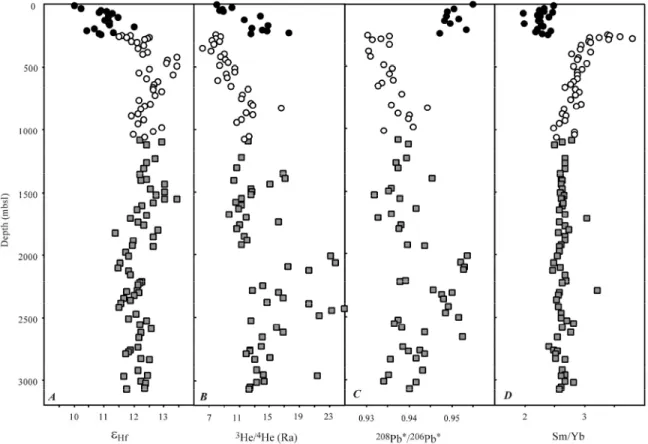
crysts to those measured for host glass or groundmass………... 29 1.4 Stratigraphic variations in εHf, 3He/4He, 208Pb*/206Pb*, and Sm/Yb in the
HSDP-2 core……… 31 1.5 Histograms illustrating the distribution in fractionation-normalized SiO2
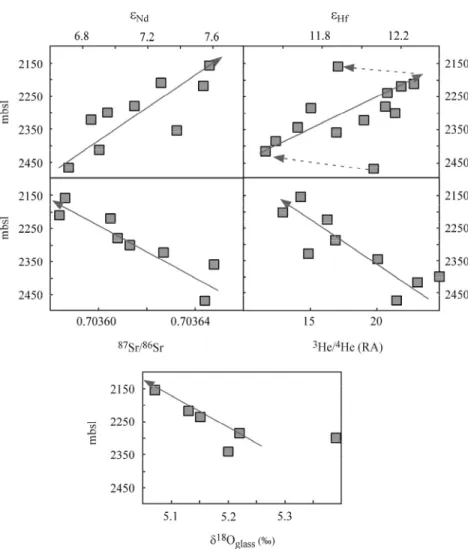
contents of submarine Mauna Kea glasses and subaerial basalts……… 33 1.6 Stratigraphic variations in εNd , εHf, 87Sr/86Sr, 3He/4He and δ18O glass over an
interval in the submarine Mauna Kea section………. 35 1.7 Comparison of δ18O values between phenocrysts and microphenocrysts from
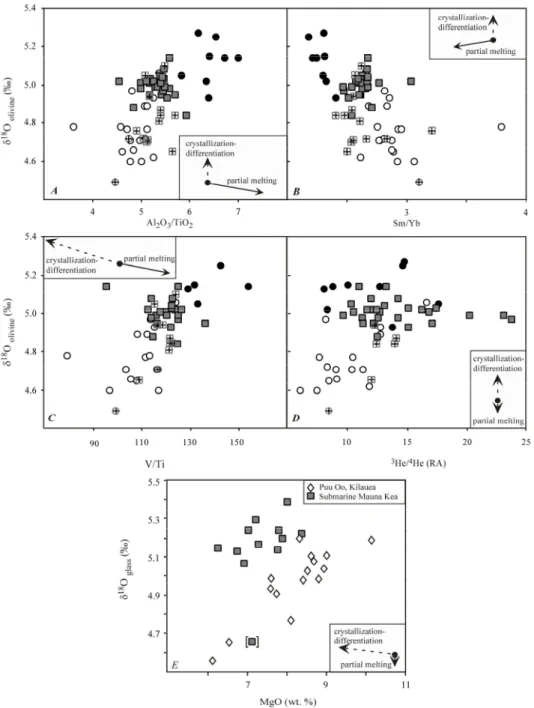
the HSDP-2 core with elemental abundances and radiogenic isotope composi- tions of host lavas……….………..…………. 38 1.8 Comparison of oxygen isotope composition of olivines with Sm/Yb ratios,
Al2O3/TiO2 and 208Pb/204Pb in HSDP-2 lavas………. 40 1.9 Outline of the essential features of proposed model for simultaneous crystal-
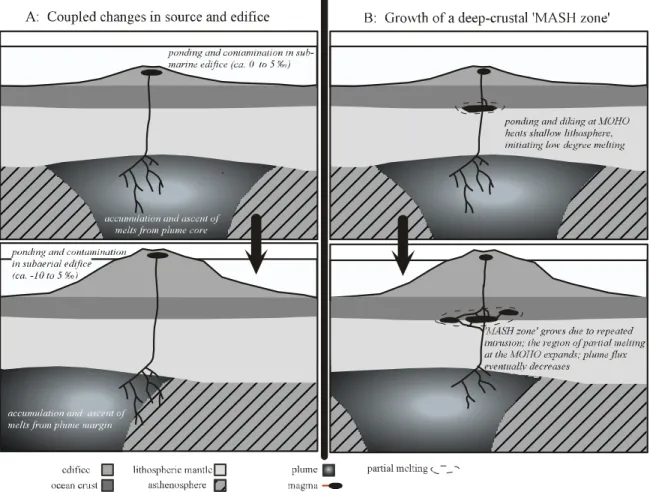
lization-differentiation and mixing with a low-δ18O component……….... 49 1.10 Comparison of observations with the predictions of the model outlined in 1.9.. 53 1.11 Cartoons illustrating two proposed models for the temporal evolution of
Mauna Kea that are consistent with the oxygen isotope geochemistry and
other geochemical properties of its lavas……… 60 2.1 Schematics of the excimer laser (157 nm) fluorination system……….. 81 2.2 Calibration of standard O2 gas………. 84 2.3 The relationship between ∆17O and A: the temperature of the molecular sieve;
B: the amount of gas measured………... 86
loss inferred from the geometry of the laser pits assuming a plate shape……... 93 2.5 Variation of excimer laser ablation rate of quartz with laser and sample
chamber conditions……….. 94 2.6 Effect of Cr on δ18O values of Cr and magnetite mixtures measured using
infrared laser fluorination techniques……….. 100 2.7 Compilation of δ18O studies on minerals from Iceland………….………..…… 103 2.8 Histogram of δ18O values of olivines from lavas (A) and from wehrlitic
nodules in Borgarhraun volcano, Iceland………..……….. 104 2.9 Examples of in situ oxygen isotope study on a rock section (CPX-rich) from
Borgarhraun, Iceland……...……… 105 2.10 Examples of in situ oxygen isotope study on a rock section (An-rich) from
Borgarhraun, Iceland…...……… 106 3.1 Variation of CaO concentrations with Fo contents of single-grain olivines
from Mauna Kea and Mauna Loa lavas……….. 123 3.2 Comparison of δ18O values with Fo contents of single-grain olivines from
Mauna Kea and Mauna Loa lavas………... 125 3.3 Relationship between MgO contents and δ18O values in the inferred melt…… 129 4.1 Stratigraphic profile of geochemical indices from Makapu’u head, H3 tunnel
and KSDP drill core……… 148 4.2 Summary of the oxygen isotope compositions of olivines, CaO/Al2O3, Sr/Nd
and 206Pb/204Pb ratios and εNd values for lavas from submarine landslides……. 149 4.3 Correlation between δ18O values of olivines and geochemical indices of their
host lavas from Koolau and Molokai volcano………. 150 4.4 Major element variation of Hawaiian lavas as a function of MgO………. 154 4.5 Schematic description of model implementation procedures in FeO-MgO
space……… 157 4.6 Geochemical indices varied with calculated proportion of eclogite melt for
Koolau samples……….. 160
of eclogite melt……… 161 4.8 Correlation between δ18O values of olivines and geochemical indices of their
host rock……….. 165 4.9 Correlation between δ18O values of olivines and radiogenic isotope ratios…… 167 4.10 Correlation between radiogenic isotope ratios to test binary mixing models…. 168 4.11 Normalized trace element concentration for the calculated eclogite source
rock……….. 169 4.12 Schematic description of the mixing relationship in SiO2-MgO-FeO-other
space……….... 172 4.13 Comparison between Hawaiian lavas and melts from melting experiments
after projection to Mg# = 0.76 plane………...………. 175 4.14 Variation of NiO wt% in olivines from Hawaii as a function of Fo content….. 178 4.15 Variation of NiO wt% in olivines from Hawaii as a function of Fo content….. 180 4.A1 Schematic relationship of projection of a line (AB) from a point (C) to a plane
(constant Fe/Mg) in SiO2-FeO-MgO-other space………... 191 5.1 A: Projection of the compositions of isotopologues of N2into the composition
space 14N-15N; B: Projection of compositions of isotopologues of O2 into the composition space 16O-17O-18O……….. 200 5.2 A: Variation of ∆ values of all isotopologues of N2 with 1/T; B: Variation of
-1000•ln(Ki /Ki-random) (i = 1) with 1000/T for the isotope exchange reaction in equation 30………..……….... 219 5.3 A: Variation of ∆ values of all isotopologues of NO with 1/T; B: Variation of
-1000•ln(Ki /Ki-random) (i = 1 or 2) with 1000/T for the isotope exchange
reactions in equations 31i and 31ii……….. 221 5.4 A: Variation of ∆ values of all isotopologues of CO with 1/T; B: Variation of
-1000•ln(Ki /Ki-random ) (i = 1 or 2) with respect to 1000/T for the isotope
exchange reactions in equations 32i and 32ii……….. 223
-1000•ln(Ki /Ki-random) (i = 1 to 3) with 1000/T for the isotope exchange
reactions in equation 33i through 33iii……… 225 5.6 A: Variation of ∆ values of all isotopologues of CO2 with 1/T; B: Variation of
-1000•ln(Ki /Ki-random ) (i = 1 to 8) with 1000/T for the isotope exchange
reactions in equations 8i through 8viii……… 233 5.7 A: Variation of ∆ values of isotopologues 14N15NxO, where x = 16, 17, or 18,
with 1/T; B: Variation of ∆ values of isotopologues 14N14NxO, where x = 17 or 18, and 15N15NxO, where x = 16,17, or 18, with 1/T; C: Variation of ∆
values of isotopologues, 15N14NxO, where x =16,17, or 18, with 1/T……….… 235 5.8 A: Variation of -1000·ln(Ki /Ki-random) (i = 8) with 1000/T for the isotope
exchange reaction in equation 34viii; B: Variation of -1000· ln(Ki /Ki-random) (i = 1 to 7) with 1000/T for the isotope exchange reactions in equations 34i
through 34vii………... 237 5.A1 Sensitivity test for the value of A: -1000·lnK1 and B: -1000·lnK2 in eqn 32i
and 32ii as a function of maximum vibrational and rotational quanta
calculated………. 250 5.A2 A: Comparison of -1000·ln(K3/K3-r) in eqn 8iii calculated using Urey method
with using direct summation method as a function of 1000/T; B: Relative difference Mi between partition function ratios calculated using Urey method and using direct summation method as a function of 1000/T………. 253
INTRODUCTION
studies of the petrogenesis of Hawaiian lavas; and 2) a theoretical study on equilibrium thermodynamics of multiply-substituted isotopologues.
PART 1.OXYGEN ISOTOPE STUDIES OF THE PETROGENESIS OF HAWAIIAN LAVAS
Oxygen isotope compositions of many crustal rocks differ significantly from mantle peridotites due to water-rock interaction and weathering (dissolution-precipitation) at near-earth surface temperatures. Therefore, oxygen isotopes can be used to identify crustal components that contribute to the petrogenesis of mantle-derived magmas, either as ancient subducted source components or as contaminants added during passage through crustal magma conduits (TAYLOR and SHEPPARD, 1986; EILER, 2001).
It has long been recognized that Hawaii lavas are characterized by δ18O values significantly lower than Mid-Ocean-Ridge-Basalts (e.g., KYSER, 1986; MUEHLENBACHS, 1986; TAYLOR, 1986; TAYLOR and SHEPPARD, 1986; EILER, 2001). This property was attributed to a variety of possible causes, including 18O-depletion of the lower mantle presumed to feed the Hawaiian plume (HARMON and HOEFS, 1995) or a source component of 18O-depleted recycled lower oceanic crust (HAURI, 1996; LASSITER and HAURI, 1998), although the scattered nature of observed oxygen isotope variations precluded a detailed formulation or tests of these ideas. Prior to the start of my thesis research, EILER et al., (1996a, 1996b) showed that δ18O values of olivines in Hawaiian subaerial shield building tholeiites vary systematically among the various volcanoes and correlate with trace element and radiogenic isotope compositions. In particular, olivines in lavas from most Loa trend volcanoes (Loihi, Mauna Loa, Hualalai, W. Molokai, and
5.1±0.1‰), or in the case of Koolau and Lanai (home to the most ‘enriched’ radiogenic isotope signatures in Hawaiian lavas), are higher in δ18O values than MORBs. In contrast, olivines in most lavas from Kea trend volcanoes (Kilauea, Mauna Kea, Kohala, and Haleakala) are 18O-depleted compared to MORBs. EILER et al. (1996b) suggested that
18O-enriched lavas from Koolau and Lanai sampled a recycled upper crustal source component, and this interpretation was adopted in more or less modified form by subsequent studies (e.g., DUCEA et al., 2002). In contrast, the cause of 18O-depleted compositions was debated. EILER et al., 1996b) suggested they reflected contamination by the Pacific plate; LASSITER and HAURI (1998) suggested they reflected the presence of an 18O-depleted source component in the Hawaiian plume (e.g., recycled lower section of oceanic crust), and GARCIA et al. (1998) suggested that at least a sub-set of them (recent lavas from Pu`u O`o) sampled an 18O-depleted component from the volcanic edifice.
The major portion of my thesis research focused on testing alternative hypotheses for the origin of oxygen isotope variations in Hawaiian lavas by conducting detailed studies of the temporal evolution of oxygen isotope compositions of Mauna Kea and Koolau volcanoes -- the low-δ18O and high-δ18O extremes -- and by developing and applying a laser-based micro-analytical tool for measuring intra-crystalline oxygen isotope variations in individual phenocrysts.
My first important finding was that olivine phenocrysts from the submarine section of Mauna Kea volcano have δ18O values similar to those in common mantle peridotites and in equilibrium with MORBs (5.01 ± 0.07‰, in Chapter 1); i.e., Mauna Kea lavas from below the submarine/subaerial transition lack the 18O-depletion thought to be
no similar break in radiogenic isotope composition is observed, suggesting the variation in oxygen isotope composition is not related to a secular change in the plume source.
Second, I found that microphenocrysts of olivines from both subaerial and submarine volcanoes are systematically lower in δ18O values than macrophenocryst olivines in the same and related lavas, and that microphenocrysts are in oxygen isotope exchange equilibrium with co-existing glass, whereas macrophenocrysts are not. Together, this suggests time-evolution of the δ18O values of Mauna Kea lavas between early precipitation of coarse, magnesian phenocrysts and late precipitation of fine, Fe-rich microphenocrysts. Finally, in situ measurements of δ18O studies on individual olivine phenocrysts from subaerial Mauna Loa lavas reveal that the δ18O values of their parental melts decreased monotonically over the course of their crystallization differentiation, from initial values that were indistinguishable from normal MORBs (in Chapter 3).
Taken together, these findings strongly indicate that low-δ18O values characteristic of Kea trend Hawaiian lavas are the product of contamination by hydrothermally altered rocks in the volcanic edifice. This result effectively disproves the previous hypothesis that the Hawaiian plume contains a recycled low-δ18O component, and makes it highly unlikely that subaerial Hawaiian lavas sample large proportions of deep Pacific lithosphere. Moreover, it provides a detailed view of the past volcanological processes in the Hawaiian volcanic edifice.
Detailed studies of lavas with high δ18O values at Koolau volcano yielded a very different result (in Chapter 4). Basaltic lavas from the KSDP core (collected 381-511 mbsl) contain olivines with δ18O values (5.39±0.1‰) higher than typical upper mantle
mbsl) have olivines with even higher δ18O values (5.56±0.05‰), similar to olivines from plagioclase-spinel peridotite xenoliths collected on Oahu (5.51±0.05) and approaching exceptionally high values previously reported for subaerial (Makapu`u) Koolau lavas (5.89±0.12). Olivines from dredged samples (including subaerial landslides and submarine Koolau volcano) show a wide range of δ18O values (5.2~6.0‰). Unlike the Mauna Kea series, this full diversity of δ18O values, across all three sample suites (drill core; subaerial lavas; submarine land slides) correlate with trace element and radiogenic isotope compositions of host lavas, defining a compositional continuum from a high-δ18O, extremely enriched end member toward a more normal δ18O, ‘Mauna Loa-like’
composition. I interpret this trend as reflecting mixing between partial melts of high-δ18O components and normal-δ18O components of the Hawaiian plume, and have constructed a model to simultaneously explain the oxygen isotope, major element, trace element and radiogenic isotope variations defined by this trend. This model indicates that the Koolau shield building lavas are mixtures of 75-100% melt of mantle peridotite with 0-25%
eclogite melt, the protolith of which is Mid-Ocean Ridge Basalt (MORB) with Depleted Mantle Model (DMM) age of at least 1.8 ± 0.3 billion years. δ18O values of this eclogite component can be predicted to be 11.3 ± 1.5‰, implying it is an upper crustal (layer 1 or 2) basalt or gabbro with a low-temperature alteration history; contains a small amount of sediment; and has experienced partial melting before forming eclogite.
Finally, much of my work on the petrogenesis of Hawaiian lavas made use of a 157 nm UV laser fluorination system that I developed over the course of my thesis research (in Chapter 2). This system is capable of in situ oxygen isotope analyses of minerals and
±0.1 to 0.2 ‰ (1σ).
PART 2. THEORETICAL STUDY ON EQUILIBRIUM THERMODYNAMICS AND KINETICS OF MULTIPLY-SUBSTITUTED ISOTOPOLOGUES
In the last chapter, I studied the theory of clumped isotope effects on the abundances of multiply-substituted isotopologues. Heavy stable isotopes are not randomly distributed among molecules in thermodynamically equilibrated mono-molecular gases (e.g., O2, N2, or CO2), but instead, preferentially concentrate into bonds with each other (e.g., 18O-18O,
15N-15N, etc.). This occurs because such bonds have exceptionally low zero-point energies and thus are comparatively more stable. This zero point energy effect is subtle (typically at per-mil level), but has recently been shown to be measurable (EILER and SCHAUBLE, 2004). The abundances of isotopologues of molecular gases containing more than one rare isotope (“multiply-substituted isotopologues”) could be used for a variety of geochemical applications including geothermometry, and such applications will require a sound understanding of these zero-point energy effects. I derived a method for systematically evaluating their influence in the abundances of all isotopologues in thermodynamically equilibrated populations of O2, CO, N2, NO, CO2 and N2O between 1000 and 193 to 77 K. This method uses Urey-type algorithms (based on simple harmonic oscillator and rigid rotor model, UREY, 1947) to evaluate partition functions and equilibrium constants of isotope exchange reactions, and simultaneously solves for abundance of each isotopologue of a given molecule constrained by all independent equilibria. I also examined the accuracy of the Urey-type models by comparison with
calculate partition functions. This comparison is only made for CO and CO2 due to limitations in spectroscopic data, but in these cases, there are no significant differences among methods. Calculation results also show that, in most cases, multiply-substituted isotopologues are predicted to be enriched relative to stochastic (random) distributions by ca. 1 to 2 per mil at earth-surface temperatures. This deviation, defined as ∆i for isotopologue i, generally increases linearly with 1/T at temperatures < 500 K, and with 1/T2 at temperatures > 500 K. An exception is N2O, which shows complex temperature dependences and 10's of per-mil enrichments or depletions of abundances for some isotopologues. These theoretical calculations provide a basis for discriminating between fractionations controlled by equilibrium thermodynamics and other sorts of isotopic fractionations in the budgets of atmospheric gases. Moreover, because abundances of multiply-substituted isotopologues in thermodynamically equilibrated populations of molecules vary systematically with temperature, they can be used as geothermometers.
Such thermometers are unusual in that they involve homogeneous rather than heterogeneous equilibria (e.g., isotopic distribution in gaseous CO2 alone, rather than differences in isotopic composition between CO2 and coexisting water). Also, multiple, independent thermometers exist for all molecules having more than one multiply- substituted isotopologue (e.g., thermometers based on abundances of 18O13C16O and
18O12C18O are independent); thus, temperatures estimated by this method can be tested for internal consistency.
Ducea M., Sen G., Eiler J., and Fimbres J. (2002) Melt depletion and subsequent metasomatism in the shallow mantle beneath Koolau volcano, Oahu (Hawaii).
Geochemistry Geophysics Geosystems 3.
Eiler J. M. (2001) Oxygen isotope variations of basaltic lavas and upper mantle rocks. In Stable Isotope Geochemistry, Vol. 43, pp. 319-364. Mineralogical Society of America.
Eiler J. M., Farley K. A., Valley J. W., Hofmann A. W., and Stolper E. M. (1996b) Oxygen isotope constraints on the sources of Hawaiian volcanism. Earth and Planetary Science Letters 144(3-4), 453-467.
Eiler J. M. and Schauble E. (2004) 18O13C16O in Earth's atmosphere. Geochimica et Cosmochimica Acta 68(23), 4767-4777.
Eiler J. M., Valley J. W., and Stolper E. M. (1996a) Oxygen isotope ratios in olivine from the Hawaii Scientific Drilling Project. Journal of Geophysical Research-Solid Earth 101(B5), 11807-11813.
Garcia M. O., Ito E., Eiler J. M., and Pietruszka A. J. (1998) Crustal contamination of Kilauea Volcano magmas revealed by oxygen isotope analyses of glass and olivine from Pu'u O'o eruption lavas. Journal of Petrology 39(5), 803-817.
Harmon R. S. and Hoefs J. (1995) Oxygen-isotope heterogeneity of the mantle deduced from global 18O systematics of basalts from different geotectonic settings.
Contributions to Mineralogy and Petrology 120(1), 95-114.
Hauri E. H. (1996) Major-element variability in the Hawaiian mantle plume. Nature 382(6590), 415-419.
141-164.
Lassiter J. C. and Hauri E. H. (1998) Osmium-isotope variations in Hawaiian lavas:
evidence for recycled oceanic lithosphere in the Hawaiian plume. Earth and Planetary Science Letters 164(3-4), 483-496.
Muehlenbachs K. (1986) Alteration of the oceanic-crust and the 18O History of Seawater.
Reviews in Mineralogy 16, 425-444.
Taylor H. P. (1986) Igneous rocks 2: isotopic case-studies of circum-pacific magmatism.
Reviews in Mineralogy 16, 273-317.
Taylor H. P. and Sheppard S. M. F. (1986) Igneous rocks 1: processes of isotopic fractionation and isotope systematics. Reviews in Mineralogy 16, 227-271.
Urey H. C. (1947) The thermodynamic properties of isotopic substances. J. Chem. Soc.
(London), 561-581.
PART 1. OXYGEN ISOTOPE STUDIES OF THE PETROGENESIS OF HAWAIIN LAVAS
CHAPTER 1
OXYGEN ISOTOPE GEOCHEMISTRY OF THE SECOND HSDP CORE
Zhengrong Wang, Nami E. Kitchen, and John M. Eiler
Division of Geological and Planetary Sciences, California Institute of Technology, Pasadena, California, USA
(Published in Geochemistry Geophysics Geosystems 4, art. no.-8712., 2003)
ABSTRACT
Oxygen isotope ratios were measured in olivine phenocrysts (~ 1 mm diameter), olivine microphenocrysts (generally ~ 100 to 200 µm diameter), glass, and/or matrix from 89 samples collected from depths down to 3079.7 m in the second, and main, HSDP core (HSDP-2). Olivine phenocrysts of 11 samples from Mauna Loa and 34 samples from the submarine section of Mauna Kea volcano have δ18O values that are similar to one another (5.11 ± 0.10‰, 1σ, for Mauna Loa; 5.01 ± 0.07‰, for submarine Mauna Kea) and within the range of values typical of olivines from oceanic basalts (δ18O of ~ 5.0 to 5.2‰). In contrast, δ18O values of olivine phenocrysts from 20 samples taken from the subaerial section of Mauna Kea volcano (278 to 1037 mbsl) average 4.79
± 0.13‰. Microphenocrysts in both the subaerial (n = 2) and submarine (n = 24) sections of Mauna Kea are on average ~ 0.2‰ lower in δ18O than phenocrysts within the same stratigraphic interval; those in submarine Mauna Kea lavas have an average δ18O value of 4.83 ± 0.11‰. Microphenocrysts in submarine Mauna Kea lavas and phenocrysts in Mauna Loa lavas are the only population of olivines considered in this study that are typically in oxygen isotope exchange equilibrium with coexisting glass or groundmass. These data confirm the previous observation that the stratigraphic boundary between Mauna Loa and Mauna Kea lavas defines a shift from “normal” to unusually low δ18O values. Significantly, they also document that the distinctive 18O- depleted character of subaerial Mauna Kea lavas is absent in phenocrysts of submarine Mauna Kea lavas. Several lines of evidence suggest that little if any of the observed variations in δ18O can be attributed to subsolidus alteration or equilibrium fractionations accompanying partial melting or crystallization. Instead, they reflect variable
proportions of an 18O-depleted source component or contaminant from the lithosphere and/or volcanic edifice that is absent in or only a trace constituent of subaerial Mauna Loa lavas, a minor component of submarine Mauna Kea lavas, and a major component of subaerial Mauna Kea lavas. Relationships between the δ18O of phenocrysts, microphenocrysts, and glass or groundmass indicate that this component (when present) was added over the course of crystallization-differentiation. This process must have taken place in the lithosphere and most likely at depths of between ~ 5 and 15 km. We conclude that the low-δ18O component is either a contaminant from the volcanic edifice that was sampled in increasingly greater proportions as the volcano drifted off the center of the Hawaiian plume or a partial melt of low-δ18O, hydrothermally altered peridotites in the shallow Pacific lithosphere that increasingly contributed to Mauna Kea lavas near end of the volcano's shield building stage. The first of these alternatives is favored by the difference in δ18O between subaerial and submarine Mauna Kea lavas, whereas the second is favored by systematic differences in radiogenic and trace element composition between higher and lower δ18O lavas.
1. INTRODUCTION
Rocks recovered by the second HSDP core (“HSDP-2”) provide the first opportunity to examine a large fraction of the temporal evolution of a single oceanic intraplate volcano. In this paper, we document and discuss the significance of oxygen isotope variations of olivines and coexisting phases in rocks recovered by this core.
At the outset of this study, more was known about the oxygen isotope geochemistry of Hawaiian lavas than of any other basaltic volcanic center, with the possible exception
of Iceland (KYSER et al., 1981; KYSER et al., 1982; GARCIA et al., 1989; GARCIA et al., 1993; HARMON and HOEFS, 1995; EILER et al., 1996a; EILER et al., 1996b; GARCIA et al., 1998). These previous studies showed that many Hawaiian lavas have low δ18O values (≡
[18O/16O/0.0020052 – 1]·1000) compared to most terrestrial basalts, and that this characteristic is most strongly expressed in shield-building lavas of the “Kea trend”
volcanoes (i.e., Kilauea, Mauna Kea, Kohala and Haleakala). Several hypotheses have been put forward to explain this phenomenon, including (1) 18O depletion of primitive lower-mantle that is presumed to core the Hawaiian plume (HARMON and HOEFS, 1995), (2) entrainment of 18O-depleted, recycled oceanic lithosphere within the Hawaiian plume (LASSITER and HAURI, 1998), (3) contamination of Hawaiian magmas by 18O-depleted rocks in the current Pacific lithosphere (EILER et al., 1996b), and (4) contamination of Hawaiian magmas by hydrothermally altered, low-δ18O rocks in the volcanic edifice (suggested by GARCIA et al., 1998 for recent Pu’u O’o lavas; the significance of this process for other Hawaiian lavas has not been explored).
In this study, we analyzed oxygen isotope compositions of olivines and coexisting phases from subaerial Mauna Loa lavas, both subaerial and submarine Mauna Kea lavas, and hyaloclastites and intrusives in the submarine Mauna Kea section. These data confirm the previous observation (EILER et al., 1996a) that the stratigraphic boundary between Mauna Loa and Mauna Kea marks a shift from “normal” to unusually low δ 18O values, respectively. Additionally, we find that coarse olivine phenocrysts in submarine Mauna Kea lavas and hyaloclastites are “normal” in δ18O rather than 18O-depleted like subaerial Mauna Kea lavas. Finally, we find there is a systematic difference in δ18O between coarse phenocrysts and microphenocrysts in the submarine Mauna Kea lavas --
the former are similar in δ18O to other oceanic basalts, whereas the latter are distinctly lower in δ18O. We discuss several models for these stratigraphic trends and examine them in light of geochemical and petrologic data presented in other articles in this theme (BLICHERT-TOFT et al., 2003; BRYCE and DEPAOLO, 2003; EISELE et al., 2003;
FEIGENSON et al., 2003; GARCIA et al., 2003; HUANG and FREY, 2003).
2. SAMPLING AND ANALYTICAL TECHNIQUES
Oxygen isotope ratios were analyzed in olivines, glass and/or groundmass from 89 samples of 88 tholeiites and one alkalic basalt in the HSDP-2 core from depths down to 3079.7 m below sea level (mbsl); these data are presented in Table 1. Our sampling of the submarine Mauna Kea section includes 27 pillow lavas, 21 hyaloclastites, 7 massive and 3 intrusive rocks. We refer to pillow basalts, massive lava flows and hyaloclastites as
“lavas” in the remainder of this paper unless we wish to make a particular distinction among these subtypes of basalts. Most samples below 560 mbsl are from splits of the geochemical reference suite also analyzed in the accompanying articles in this theme.
Samples from above 560 mbsl were collected by the authors from the portion of the HSDP-2 core stored at Caltech, and were generally taken from within 1.5 m of a reference suite sample; the exception is sample SR0133-0.04, which is 4.4 m below the sample SR0131-6.92 from the geochemical reference suite. All of our samples were taken from within a stratigraphic unit sampled by the geochemical reference suite. Further details for correlating our samples with those in other papers are given in Table 1.
All mineral, glass and groundmass separates were prepared by crushing, sieving, ultrasonicating in distilled water or 1N HCl, ultrasonicating in ethanol, drying, and
handpicking under a binocular microscope. Mineral, glass and groundmass fragments containing visible inclusions and alteration products were discarded during handpicking.
Most data are for large (≥ 1 mm) phenocrysts of olivine. However, we also recovered and analyzed fine-grained (usually ~ 100 to 200 µm diameter) separates of olivine microphenocrysts from 26 samples. We only separated microphenocrysts from lavas that are poor in coarser phenocrysts in order to avoid the possibility of mistaking small fragments of phenocrysts for microphenocrysts. The separated microphenocrysts are more susceptible to subsolidus alteration and might have formed by a different generation of olivine crystallization from that which formed coarse phenocrysts. Therefore, we distinguish between these two groups of olivine analyses in Table 1, all figures and throughout our discussion. Previous studies of the petrography and mineral chemistry of Hawaiian lavas have shown that coarse olivine phenocrysts and/or xenocrysts are relatively magnesian (forsterite contents between ~ 88 and 86%) and many are strained -- suggesting that they formed relatively early in the differentiation history of their host lavas or other magmas in the Hawaiian edifice and spent some time as components of cumulate piles before being brought to the surface (CLAGUE et al., 1995; BAKER et al., 1996). In contrast, microphenocrysts are less magnesian (typical forsterite contents of ~ 82 to 80%, extending down to ~ 50% on grain rims) and are inferred to be relatively late- stage precipitates from their host lavas. We checked that differences between these two populations previously identified in thin sections correspond to differences between our
“phenocryst” versus “microphenocryst” mineral separates by making electron microprobe measurements of splits from two of our samples (Table 2). Our separated phenocrysts from sample SR0762-4.60 have forsterite contents of ~ 87.3 ± 0.8 mole%, whereas our
separated microphenocrysts from sample SR0907-1.65 have cores with ~ 81.6 ± 0.5 mole% forsterite.
Glass separates were recovered from thin rims surrounding olivine phenocrysts in hyaloclastites or from thick glassy rinds of pillow basalts. Analyzed glass fragments were dark brown and semitransparent; fragments that appeared altered (e.g., opaque and lacking glassy luster) were not analyzed. “Matrix” separates consisted of fine-grained aggregates of glass and minerals. Two separates of matrix from sample SR0157-7.17 were analyzed: one having a particle size of 200 to 300 µm (“matrix-a”; consisting of dark gray aggregates of glass and mafic minerals) and one having a size <150 µm (“matrix-b”; consisting of light gray aggregates dominated by plagioclase). The first of these is most like matrix and glass recovered from other samples and is the measurement from this sample plotted and discussed in the following sections.
All mineral, glass and matrix separates were analyzed by laser fluorination at the California Institute of Technology using methods previously described by EILER et al.
(2000a, 2000b) and based on methods described by SHARP (1990) and VALLEY et al.
(1995). A total of 67 UWG-2 (garnet), 33 SCO2 (olivine), 15 SCO3 (olivine) and 26 ALV526 (glass) standards were analyzed interspersed with analyses of samples. Results for these standards are as follows: UWG-2 = 5.77 ± 0.10‰, SCO2 = 5.25 ± 0.09‰, SCO3 = 5.31 ± 0.08‰ and ALV526 = 5.36 ± 0.09‰ (all standard deviations refer to long-term reproducibility of raw measurements and are 1 ); these values compare with accepted values of: UWG-2 = 5.80‰, SCO2 = 5.25‰, SCO3 = 5.35‰ and ALV526 = 5.40‰ (Valley et al., 1995; Eiler et al., 2000a; 2000b). All δ18O values for unknowns measured on a given day were corrected by the difference between measured
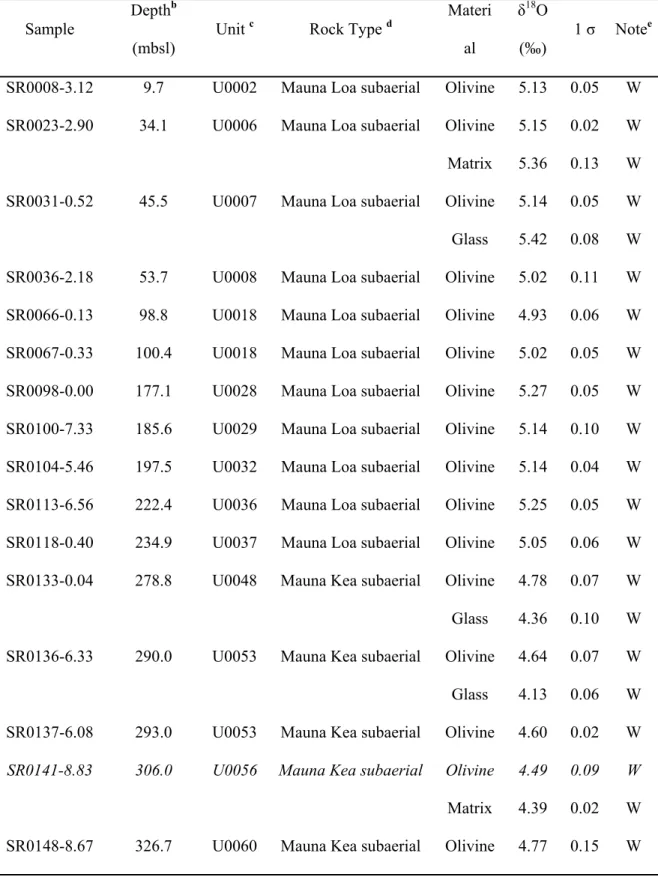
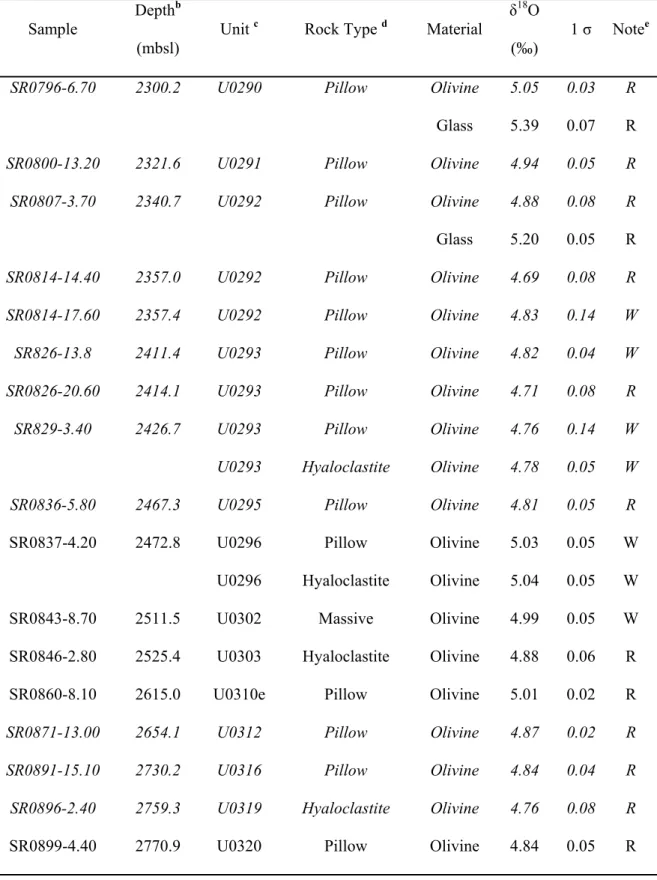
Table 1. Oxygen Isotope Compositions of Materials From the HSDP-2 Core a
Sample
Depthb (mbsl)
Unit c Rock Type d
Materi al
δ18O (‰)
1 σ Notee
SR0008-3.12 9.7 U0002 Mauna Loa subaerial Olivine 5.13 0.05 W SR0023-2.90 34.1 U0006 Mauna Loa subaerial Olivine 5.15 0.02 W
Matrix 5.36 0.13 W
SR0031-0.52 45.5 U0007 Mauna Loa subaerial Olivine 5.14 0.05 W
Glass 5.42 0.08 W
SR0036-2.18 53.7 U0008 Mauna Loa subaerial Olivine 5.02 0.11 W SR0066-0.13 98.8 U0018 Mauna Loa subaerial Olivine 4.93 0.06 W SR0067-0.33 100.4 U0018 Mauna Loa subaerial Olivine 5.02 0.05 W SR0098-0.00 177.1 U0028 Mauna Loa subaerial Olivine 5.27 0.05 W SR0100-7.33 185.6 U0029 Mauna Loa subaerial Olivine 5.14 0.10 W SR0104-5.46 197.5 U0032 Mauna Loa subaerial Olivine 5.14 0.04 W SR0113-6.56 222.4 U0036 Mauna Loa subaerial Olivine 5.25 0.05 W SR0118-0.40 234.9 U0037 Mauna Loa subaerial Olivine 5.05 0.06 W SR0133-0.04 278.8 U0048 Mauna Kea subaerial Olivine 4.78 0.07 W
Glass 4.36 0.10 W
SR0136-6.33 290.0 U0053 Mauna Kea subaerial Olivine 4.64 0.07 W
Glass 4.13 0.06 W
SR0137-6.08 293.0 U0053 Mauna Kea subaerial Olivine 4.60 0.02 W SR0141-8.83 306.0 U0056 Mauna Kea subaerial Olivine 4.49 0.09 W
Matrix 4.39 0.02 W
SR0148-8.67 326.7 U0060 Mauna Kea subaerial Olivine 4.77 0.15 W
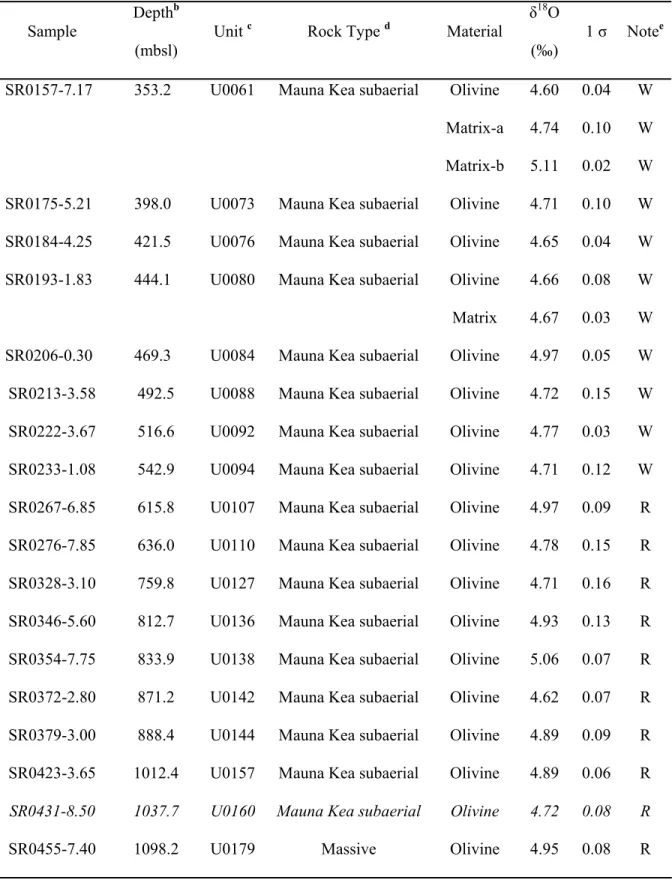
Table 1. (Continued)
Sample
Depthb (mbsl)
Unit c Rock Type d Material δ18O
(‰)
1 σ Notee
SR0157-7.17 353.2 U0061 Mauna Kea subaerial Olivine 4.60 0.04 W
Matrix-a 4.74 0.10 W
Matrix-b 5.11 0.02 W
SR0175-5.21 398.0 U0073 Mauna Kea subaerial Olivine 4.71 0.10 W SR0184-4.25 421.5 U0076 Mauna Kea subaerial Olivine 4.65 0.04 W SR0193-1.83 444.1 U0080 Mauna Kea subaerial Olivine 4.66 0.08 W
Matrix 4.67 0.03 W
SR0206-0.30 469.3 U0084 Mauna Kea subaerial Olivine 4.97 0.05 W SR0213-3.58 492.5 U0088 Mauna Kea subaerial Olivine 4.72 0.15 W SR0222-3.67 516.6 U0092 Mauna Kea subaerial Olivine 4.77 0.03 W SR0233-1.08 542.9 U0094 Mauna Kea subaerial Olivine 4.71 0.12 W SR0267-6.85 615.8 U0107 Mauna Kea subaerial Olivine 4.97 0.09 R SR0276-7.85 636.0 U0110 Mauna Kea subaerial Olivine 4.78 0.15 R SR0328-3.10 759.8 U0127 Mauna Kea subaerial Olivine 4.71 0.16 R SR0346-5.60 812.7 U0136 Mauna Kea subaerial Olivine 4.93 0.13 R SR0354-7.75 833.9 U0138 Mauna Kea subaerial Olivine 5.06 0.07 R SR0372-2.80 871.2 U0142 Mauna Kea subaerial Olivine 4.62 0.07 R SR0379-3.00 888.4 U0144 Mauna Kea subaerial Olivine 4.89 0.09 R SR0423-3.65 1012.4 U0157 Mauna Kea subaerial Olivine 4.89 0.06 R SR0431-8.50 1037.7 U0160 Mauna Kea subaerial Olivine 4.72 0.08 R SR0455-7.40 1098.2 U0179 Massive Olivine 4.95 0.08 R
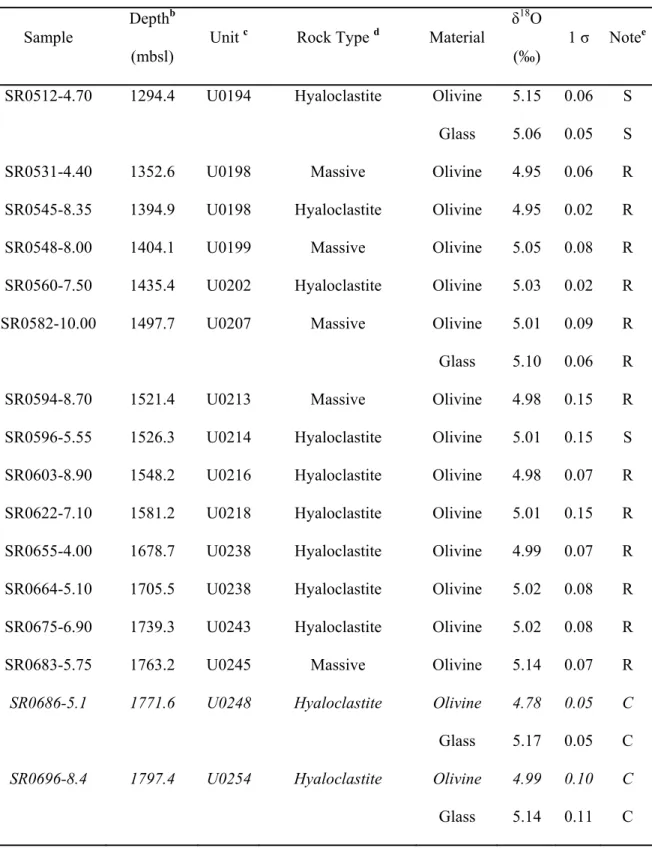
Table 1. (Continued)
Sample
Depthb (mbsl)
Unit c Rock Type d Material δ18O (‰)
1 σ Notee
SR0512-4.70 1294.4 U0194 Hyaloclastite Olivine 5.15 0.06 S
Glass 5.06 0.05 S
SR0531-4.40 1352.6 U0198 Massive Olivine 4.95 0.06 R SR0545-8.35 1394.9 U0198 Hyaloclastite Olivine 4.95 0.02 R SR0548-8.00 1404.1 U0199 Massive Olivine 5.05 0.08 R SR0560-7.50 1435.4 U0202 Hyaloclastite Olivine 5.03 0.02 R SR0582-10.00 1497.7 U0207 Massive Olivine 5.01 0.09 R
Glass 5.10 0.06 R
SR0594-8.70 1521.4 U0213 Massive Olivine 4.98 0.15 R SR0596-5.55 1526.3 U0214 Hyaloclastite Olivine 5.01 0.15 S SR0603-8.90 1548.2 U0216 Hyaloclastite Olivine 4.98 0.07 R SR0622-7.10 1581.2 U0218 Hyaloclastite Olivine 5.01 0.15 R SR0655-4.00 1678.7 U0238 Hyaloclastite Olivine 4.99 0.07 R SR0664-5.10 1705.5 U0238 Hyaloclastite Olivine 5.02 0.08 R SR0675-6.90 1739.3 U0243 Hyaloclastite Olivine 5.02 0.08 R SR0683-5.75 1763.2 U0245 Massive Olivine 5.14 0.07 R
SR0686-5.1 1771.6 U0248 Hyaloclastite Olivine 4.78 0.05 C Glass 5.17 0.05 C SR0696-8.4 1797.4 U0254 Hyaloclastite Olivine 4.99 0.10 C
Glass 5.14 0.11 C
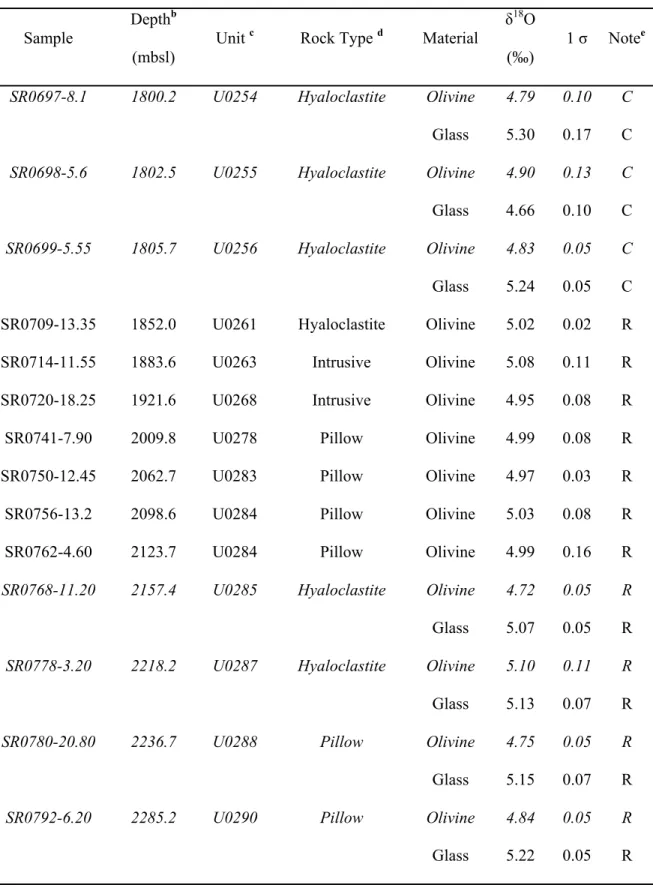
Table 1. (Continued)
Sample
Depthb (mbsl)
Unit c Rock Type d Material
δ18O (‰)
1 σ Notee
SR0697-8.1 1800.2 U0254 Hyaloclastite Olivine 4.79 0.10 C
Glass 5.30 0.17 C
SR0698-5.6 1802.5 U0255 Hyaloclastite Olivine 4.90 0.13 C
Glass 4.66 0.10 C
SR0699-5.55 1805.7 U0256 Hyaloclastite Olivine 4.83 0.05 C
Glass 5.24 0.05 C
SR0709-13.35 1852.0 U0261 Hyaloclastite Olivine 5.02 0.02 R SR0714-11.55 1883.6 U0263 Intrusive Olivine 5.08 0.11 R SR0720-18.25 1921.6 U0268 Intrusive Olivine 4.95 0.08 R SR0741-7.90 2009.8 U0278 Pillow Olivine 4.99 0.08 R SR0750-12.45 2062.7 U0283 Pillow Olivine 4.97 0.03 R
SR0756-13.2 2098.6 U0284 Pillow Olivine 5.03 0.08 R SR0762-4.60 2123.7 U0284 Pillow Olivine 4.99 0.16 R SR0768-11.20 2157.4 U0285 Hyaloclastite Olivine 4.72 0.05 R
Glass 5.07 0.05 R
SR0778-3.20 2218.2 U0287 Hyaloclastite Olivine 5.10 0.11 R
Glass 5.13 0.07 R
SR0780-20.80 2236.7 U0288 Pillow Olivine 4.75 0.05 R
Glass 5.15 0.07 R
SR0792-6.20 2285.2 U0290 Pillow Olivine 4.84 0.05 R
Glass 5.22 0.05 R
Table 1. (continued)
Sample
Depthb (mbsl)
Unit c Rock Type d Material
δ18O (‰)
1 σ Notee
SR0796-6.70 2300.2 U0290 Pillow Olivine 5.05 0.03 R
Glass 5.39 0.07 R
SR0800-13.20 2321.6 U0291 Pillow Olivine 4.94 0.05 R SR0807-3.70 2340.7 U0292 Pillow Olivine 4.88 0.08 R
Glass 5.20 0.05 R
SR0814-14.40 2357.0 U0292 Pillow Olivine 4.69 0.08 R SR0814-17.60 2357.4 U0292 Pillow Olivine 4.83 0.14 W SR826-13.8 2411.4 U0293 Pillow Olivine 4.82 0.04 W SR0826-20.60 2414.1 U0293 Pillow Olivine 4.71 0.08 R
SR829-3.40 2426.7 U0293 Pillow Olivine 4.76 0.14 W
U0293 Hyaloclastite Olivine 4.78 0.05 W SR0836-5.80 2467.3 U0295 Pillow Olivine 4.81 0.05 R
SR0837-4.20 2472.8 U0296 Pillow Olivine 5.03 0.05 W
U0296 Hyaloclastite Olivine 5.04 0.05 W SR0843-8.70 2511.5 U0302 Massive Olivine 4.99 0.05 W
SR0846-2.80 2525.4 U0303 Hyaloclastite Olivine 4.88 0.06 R SR0860-8.10 2615.0 U0310e Pillow Olivine 5.01 0.02 R SR0871-13.00 2654.1 U0312 Pillow Olivine 4.87 0.02 R SR0891-15.10 2730.2 U0316 Pillow Olivine 4.84 0.04 R SR0896-2.40 2759.3 U0319 Hyaloclastite Olivine 4.76 0.08 R SR0899-4.40 2770.9 U0320 Pillow Olivine 4.84 0.05 R
Table 1. (continued)
Sample
Depthb (mbsl)
Unit c Rock Type d Material δ18O (‰)
1 σ Notee
SR0907-1.65 2789.9 U0321 Pillow Olivine 4.65 0.07 R SR0913-2.4 2825.8 U0327 Intrusive Olivine 4.93 0.15 R SR0916-1.15 2837.6 U0330 Pillow Olivine 5.04 0.05 R
Matrix 5.06 0.09 R
SR0930- 15.85
2919.5 U0333 Pillow Olivine 5.14 0.02 R
SR0939- 18.10
2961.0 U0335a Pillow Olivine 5.08 0.02 R
SR0954-8.00 3009.2 U0339 Pillow Olivine 4.98 0.04 R SR0964-4.30 3058.0 U0340e Pillow Olivine 5.02 0.13 R SR0967-2.75 3068.9 U0343a Pillow Olivine 4.94 0.08 R a: Italicized entries are data for olivine microphenocrysts, all other olivine analyses are for coarse (1 mm and larger) olivine phenocrysts; b: Depth is in meters below sea level (mbsl); c: Units defined by the HSDP-2 stratigraphic column; d: Petrological description from the HSDP-2 core log; e: W, sampled by authors; R, from the HSDP-2 reference suite; C, sampled by Caroline Seaman; S, sampled by Sujoy Mukhopadhyay.
Table 2. Magnesium numbers of representative grains from olivine separates
Average
Coarse Phenocrysts; Sample SR0762-4.60
88.6; 86.6; 87.6; 87.6; 87.9; 88.4; 88.6; 87.9; 87.1; 87.5; 86.9; 87.0; 86.0 87.3 ± 0.8 Microphenocrysts; Sample SR0907-1.65
82.0; 81.3; 81.1; 82.2; 80.8; 81.9; 82.0 81.6 ± 0.5
and accepted values for standards on that day. All measurements of unknown samples were replicated, generally in duplicate but some between three and seven times; standard deviations for each sample are reported in the Table 1. Olivines from a few samples were not replicated to within our nominal analytical precision, suggesting that they are isotopically heterogeneous. These samples do not appear to be outliers to any of the stratigraphic or geochemical trends discussed below. We analyzed olivines from two to four different samples in each of nine stratigraphic units (units U0018, U0053, U0238, U0254, U0284, U0290, U0292, U0293, and U0296); average values for of δ18O olivine for the related samples are usually within analytical uncertainty of one another, suggesting at least these individual units are isotopically homogeneous. The δ18O values of olivine from pillow basalt are indistinguishable from those of immediately adjacent hyaloclastites in units U0293 and U0296.
3. RESULTS
3.1. OXYGEN ISOTOPE STRATIGRAPHY OF THE HSDP-2CORE
Olivines from the HSDP-2 core have δ18O values of between 4.49 and 5.27‰
(averaged for each sample; Table 1 and Figure 1a; minima and maxima for individual measurements, before averaging by hand sample, are 4.36 and 5.43‰). These ranges are similar to those observed in the ~ 1 km HSDP pilot core (e.g., 4.64 to 5.39‰ when averaged for each sample; EILER et al., 1996a) and are within the range of values typical of all Hawaiian lavas other than shield-building Koolau and Lanai tholeiites (which are higher in δ18O, Eiler et al., 1996b).